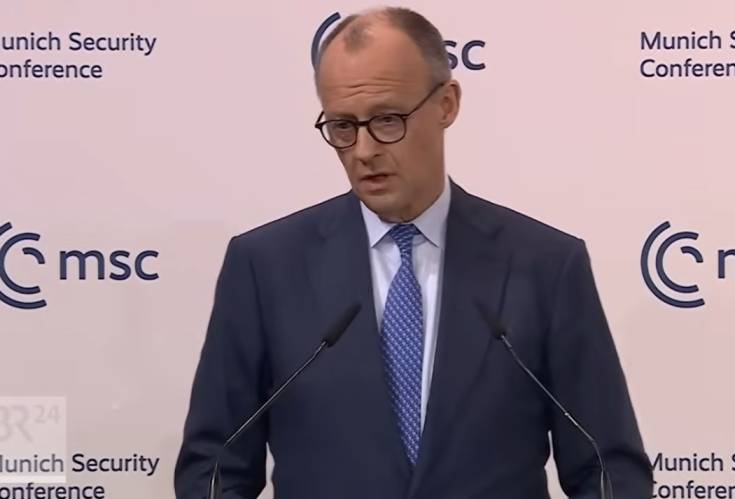
Editor’s Notes: In this powerful speech at the 2026 Munich Security Conference, German Chancellor Friedrich Merz outlines a strategic shift for Germany and Europe in an era of renewed great power competition. Merz explicitly rejects the “America First” isolationist trend, calling instead for a revived and more balanced transatlantic partnership where Europe takes greater responsibility for its own security. He proposes a four-point program for “European Self-Assertion,” which includes significant increases in defense spending, the strengthening of a sovereign European defense industry, and deeper integration with NATO allies. This address serves as a clarion call for democratic nations to stand united against revisionist threats and to defend the international rules-based order. (Feb 13, 2026
TRANSCRIPT:
Opening Remarks and Historical Context
FRIEDRICH MERZ: Dear Wolfgang Ischinger, dear Markus Söder, colleagues from different governments, parliaments, excellencies, guests, ladies and gentlemen, with only a few interruptions I’ve attended the Munich Security Conference for more than 30 years. The Munich Security Conference has always been a seismograph for the political situation. In the early years a seismograph for the relations between the United States and Europe. For many years it’s been a seismograph for the political state of the entire world.
In the early years I came here mainly to foster the relations with our American friends but also to meet new actors in foreign and security policy from many parts of the world. For several years also here in this room we’ve had an atmosphere marked by increasing tensions and conflicts in the world. And at the latest with the beginning of the Russian war of aggression against Ukraine four years ago we have entered a new phase of open conflicts and wars that make us hold our breath and that change our world more comprehensively than we also we in this room would have thought possible for many years before.
Against this backdrop, Wolfgang Ischinger, it was important to me to open this conference today because we need to talk. This is more urgent than ever. Before we do that, allow me to thank Wolfgang Ischinger on behalf of the federal government for heading this conference once again this year. I may say this, Wolfgang, thank you very much for your great work, especially in this year.
The Collapse of International Order
You’ve chosen a grim motto for this conference, “under destruction.” And it probably means that the international order based on rights and rules is currently being destroyed. But I’m afraid we have to put it in even harsher terms. This order, as flawed as it has been even in its heyday, no longer exists. And we, Europe, well, Peter Sloterdijk wrote a few weeks ago that Europe had just returned from a vacation from world history.
Together, we’ve entered an era that, once again, is marked by power and big power politics very openly. First of all, we see Russia’s violent revisionism, its brutal war against Ukraine, against our political order, with daily cruel war crimes. But this is only the shrillest expression we see on a daily basis. We see other developments in the world as well that are different to what we in this room would have expected or discussed in the years before.
The Rise of China and Shifting Global Power
China wants to be a leader in shaping the world, and it has paved the ground for that over many years with strategic patience. In the foreseeable future, Beijing could be on an equal footing with the United States in military terms. China systematically uses dependencies of others, and it redefines the international order in its own favour. If there had been a unipolar moment after the fall of the Berlin Wall, a unipolar moment in history, it has long passed.
The United States’ claim to leadership has been challenged and possibly lost. The return to power politics, however, is not only rooted in the rivalry between great powers. Ladies and gentlemen, it is also a reflection of restless, agitated societies in times of revolutionary changes. It is an expression of a wish, also in many democratic states, a wish for strong leadership in a globalised world, in which especially democratic states are coming very close to the limits of their ability to act.
The New Rules of Big Power Politics
Big power politics, it seems, gives strong and easy answers, at least to the big players, and at least at a first glance. With disillusion, big power politics turns away from a world in which increasing connectivity translates into the rule of law and peaceful relations between states. Big power politics has its own rules. It is fast, harsh, and often unpredictable.
It fears own dependencies, but uses dependencies of others, and, if necessary, even exploits them. At the heart of this stands a battle for spheres of influence, dependencies, and deference. Natural resources, technologies, and supply chains are becoming bargaining tools in the zero-sum game of the major powers. This is a dangerous game, at first for the small players, but later on probably also for the big players.
And our friends in the United States are adapting to this at a fast pace. They have realised their own need to catch up in some areas with China, and they are drawing radical consequences in their national security strategy. They do that in their own way that does not slow down this trend, but rather accelerates it.
Europe’s Response and Germany’s Role
And we, the Europeans, too, are preparing for this new era. And we reach different conclusions than, for example, the administration in Washington. Our prime task as Europeans, and, of course, as Germans, too, is to accept this new reality today. It does not mean that we accept it as an inevitable fate. We are not at the mercy of this world.
We can shape it. And I have no doubt that we will preserve our interests and our values in this world if we step up together with determination, with confidence in our own strengths.
This way, we will weather the storm and preserve our freedom. We will push open new doors. We will seize new opportunities. And if we get it right, we will emerge even stronger from this testing time.
German Foreign Policy Objectives
Ladies and gentlemen, in a very sober manner, we should firstly focus on our objectives and our possibilities. The major objectives of German foreign and security policy derive from our basic law, our history, and our geography. Above everything stands our freedom. Our security makes this freedom possible. Our economic power serves this freedom.
Our basic law, our history, and our geography mandate us to always think our goals in a European dimension. This focus is in our own vested interest. Only this way, it opens up the best opportunities for our country. Especially, particularly German foreign and security policy is anchored in a European perspective. And this Europe is more precious than ever.
Closing the Gap Between Ambition and Capability
The way we approach our goals is something that we adjust today to the possibilities that we have. Let me be very frank here. Compared to its power instruments, German foreign policy of the last decades had, if I may put it that way, a normative surplus. With the best intentions, it criticized violations of the international order all over the world.
It has often admonished, demanded, and scolded. But it was not worried enough about the fact that it often lacked the means to solve the problem. This gap between ambition and possibility had grown too wide. We are closing it now. And this way, we will be in a better position to face reality.
So let’s be honest about our own possibilities. And one striking example is Russia’s GDP is currently about 2 trillion euros. That of the European Union is almost 10 times as high. But still, Europe is not 10 times as strong as Russia today. Our military, political, and technological potential is huge. But we haven’t tapped it to the necessary extent for a very long time.
The Need for Mental Transformation
So the most important thing is to turn the switch in our minds now. We have understood that in the era of big powers, our freedom is no longer a given. It is at stake. We will need to show firmness and determination to assert this freedom. This will require our willingness to engage in new beginnings, in change, and yes, also make sacrifices. Not just some day, but right now.
And it is for very good reasons that we have our difficulties in Germany with state power. Since 1945, it has been deeply enshrined in our thinking that we need to rein in this power. And let me add, it is not just too much state power that destroys the foundation of our freedom. Too little state power will lead you to a different path, but to the same result.
Germany’s European Responsibility
And this question has a very much European dimension. Already 15 years ago, Radek Sikorski told us Germans, “I fear German power less than German inactivity.” This too is part of our responsibility, a responsibility that arises from our basic law, our history, and our geography. We assume this responsibility.
And we need a strategy for that to solve an obvious dilemma. The restructuring of the world by the big powers is happening faster and more comprehensively than we can strengthen ourselves. So I’m not convinced, because sometimes people automatically demand Europe to just write off the US as a partner.
Ladies and gentlemen, I understand the uneasiness and the doubts that lead to such claims. And I share some of them. But still, these claims have not been fully thought through. They ignore hard geopolitical realities in Europe. And they underestimate the potential that our partnership with the US continues to have, despite all the difficulties that exist.
Creating Our Own Agenda
It will not suffice to simply give smart reactions to the manoeuvres and moods of the great powers rhetorically. So in these challenging times, we are creating our own agenda. We are focusing on ourselves. This agenda is gradually being developed. And how could it be otherwise? But still, we’re implementing it at full speed. We use the pressure under which we’ve come to create something new, something hopefully good.
Big power politics in Europe, however, is not an option for Germany. Leadership and partnership, yes. Hegemonial fantasies, no. Never again will we Germans go it alone. This is the enduring lesson we’ve learned from our history. We assert our freedom with our neighbours, only with our neighbours and our allies and our partners.
We build on our strengths, our sovereignty, and our ability to show mutual solidarity in Europe. We do this with realism based on our principles.
First Pillar: Military and Economic Strengthening
Friends, if I may say so, ladies and gentlemen, this programme of freedom consists of four points. Firstly, we are strengthening ourselves in military terms, political terms, economical terms, and with technologies. We are reducing our dependencies and vulnerabilities. Our highest priority for us is to strengthen Europe within NATO.
We are making massive investments in credible deterrence. And just a reminder, Germany changed its constitution. At the NATO summit in the Hague last June, all allies, almost all allies, committed themselves to spend 5% of their GDP on security. Germany alone will invest hundreds of billions of euros over the coming years.
We support Ukraine in its brave resistance against the Russian imperialism in military, in diplomatic, political, economic terms, and also in military terms. And by the way, for a year, Germany and Europe have assumed the most important leading role. We have imposed unheard of losses and costs on Moscow. And if Moscow finally agrees to make peace, it will also be for that reason, because this is an expression of European self-assertion.
Defence Industry and Military Reforms
We have launched big conventional procurement projects in the field of air defence, deep precision strikes, and satellite technology. We are reviving our defence industry. New factories are opening. New jobs are being created. New technologies are emerging. The Bavarian state premier said it. Here in Munich, a cluster of highly innovative defence tech companies is booming, developing disruptive technologies, partly in close cooperation with Ukraine.
The Minister of Defence started the reform of our military service. And if necessary, we will adjust it further. We are strengthening NATO’s eastern flank. This is symbolised by our brigade in Lithuania, the first time in the history of the Bundeswehr that a brigade is deployed outside our own territory. We will do more for securing the high north. The first German Eurofighters have been earmarked, and more is to follow.
I often said that, and I will repeat it today. We will make the Bundeswehr the strongest conventional army in Europe as soon as we can, an army that stands firm when it has to.
Building Resilience
At the same time, we are making our society and our economy more resilient. We have initiated new legislation to make our grids and critical infrastructure resilient to hybrid attacks. We are forging resilient supply chains and reducing unilateral dependencies on raw materials, key technologies and key products. We protect our free democratic order against internal and external enemies. And among other things, we will also strengthen our intelligence services.
In this new world, competitiveness policy is security policy, and security policy is competitiveness policy. Both serve our freedom. This is why we want to be drivers of progress in the technologies of the future. AI will play a key role in this.
Second Pillar: Strengthening Europe
Secondly, we are strengthening Europe. A sovereign Europe is our best answer to this new era. Uniting Europe and strengthening Europe is our prime task today. Our Europe needs to focus on what’s essential, that is preserving and enhancing our freedom, our security and our competitiveness.
We need to cap the explosion of European bureaucracy and regulation. European standards must not put us in chains that rob us of our competitiveness. They need to highlight our strengths. They need to fuel innovation and entrepreneurship, encourage investment and reward creativity. Europe must not just withdraw to avoiding risks. It needs to open up new opportunities and unleash a new sense of agency.
A Roadmap for Sovereign Europe
Ursula von der Leyen, we discussed these questions today with the European heads of state and government, and we are developing a new road map for a strong sovereign Europe. Europe needs to become a real player in global politics with its own security policy strategy.
And by the way, just to remind you, maybe some people don’t know it, Article 42 of the Treaty on European Union, we commit ourselves to provide mutual assistance in case of an armed attack in Europe. So we need to spell out now how we want to organise this at the European level, not to replace NATO, but as a self-sustained strong pillar within the alliance.
Nuclear Deterrence and Defence Industry
I have started first talks with the French President Emmanuel Macron about European nuclear deterrence. And ladies and gentlemen, to be clear, we absolutely stick to our legal obligations. This will be fully embedded in our nuclear sharing within NATO, and we will not have zones of different security levels in Europe and the European defence industry. It finally needs to show its mettle.
Three big S’s, standardisation, scaling, and simplification of weapon systems will have to be organised in a European framework. We are tapping a huge potential by doing so. And we are translating this power into a joint external positioning that gains us new partners. Part of this is a strong trade policy. The EU Mercosur agreement will be provisionally applied. Yes, this is the right decision taken by the EU Commission.
A New Era of European Partnerships
The free trade agreement with India has been fully negotiated, and we will and have to have additional agreements. Diplomatically, we in Europe are truly squaring the circle these days. It is reflected also in our work for peace in Ukraine. When we need to be agile, we make progress in small groups with the E3, that is Germany, France, and the UK, but also with Italy and Poland as big European players.
We know in the long run we will only be successful if we take the other Europeans on board, and we’re doing that. For us Germans, there’s no way around it. We are at the heart of Europe. If Europe is torn apart, we are torn apart.
Germany is torn apart. But I would also like to appeal to our partners. Please realise the impact of the moment, and please also engage in a path towards a strong, sovereign Europe.
Forging a New Transatlantic Partnership
And thirdly, we want to forge a new transatlantic partnership. And let me start with the inconvenient truth right from the start. A divide has opened up between Europe and the United States, and Vice President JD Vance said this very openly here at the Munich Security Conference a year ago, and he was right. The battle of cultures of MAGA in the US is not ours.
Freedom of speech here ends where the words spoken are directed against human dignity and our basic law. We do not believe in tariffs and protectionism, but in free trade. We stick to climate agreements and the World Health Organization because we are convinced that global challenges can only be solved together.
Now, the transatlantic partnership is no longer something we can just take for granted. First, it started in the United States, then here in Europe, but probably also here in this room. Ladies and gentlemen, if our partner is to have a future, we need to forge it and reason it in a new way. This reasoning must be hands-on and not esoteric. We need to realise on both sides of the Atlantic that we are stronger together.
NATO: A Shared Competitive Advantage
We Europeans know how precious the trust is on which NATO was founded in an age of superpowers. Also, the US will rely on this trust. Even the US is reaching the limits of its own power if it goes it alone. The strategists at the Pentagon are very aware of this. NATO is not just our, but also, dear American friends, your competitive advantage.
Let me paraphrase this for our American friends in English. For three generations, trust amongst allies, partners and friends has made NATO the strongest alliance of all times. Europe knows deeply how precious this is. In the era of great power rivalry, even the United States will not be powerful enough to go it alone.
Dear friends, being a part of NATO is not only Europe’s competitive advantage. It’s also the United States’ competitive advantage. So let’s repair and revive transatlantic trust together.
Europe’s Self-Sustained Pillar
We, the Europeans, we are doing our part. I will say a few words about what Wolfgang Ischinger said before. Autocracies may have loyal followers, but democracies have partners and allies. And this sentence is also relevant for us Europeans.
A true ally takes his obligations seriously. No one forced us into this excessive dependency on the United States in which we have found ourselves recently. This dependence was self-inflicted, but we now cast off this state as soon as we can. And we are doing this not by writing off NATO.
We are doing it by establishing a strong, self-sustained European pillar within the alliance. It’s in our own interest. And, ladies and gentlemen, this approach is absolutely right. It is right if the United States further alienates itself. It is right as long as we cannot guarantee our security by ourselves. And it is also right in order to forge a healthier transatlantic partnership.
I suppose that we may have differing opinions more often than in the past. We will negotiate about the right way forward, and maybe have to argue about it. But if we do this with new strength, new respect, and self-respect, it will be to the benefit of both sides.
And, by the way, I could feel something of this spirit in the talks we had about Greenland over the recent weeks. And Mette Frederiksen, the Danish Prime Minister, can confirm this. She knows that she can rely on European solidarity. There is no limitation to that.
Building Global Partnerships
Lastly, and last but not least, we are forging a strong network of global partnerships. As important as European integration and the transatlantic partnership remain for us, they will no longer be sufficient to preserve our freedom. Partnership is not an absolute term here. It doesn’t require full convergence of all values and interests. This is one of the lessons we’ve learned these days, by the way, these days and weeks and months.
So we reach out to new partners with whom we share not all but many objectives. This avoids dependencies and risks, and at the same time, it opens up new opportunities for both sides. It protects our freedom. Canada and Japan, Turkey, India, or Brazil will play a key role in this, as do South Africa, the Gulf states, and others.
We want to work more closely together with these states on the basis of mutual respect and with stamina and determination. We share the fundamental interests in a political order in which we can rely on agreements made, in which we are able to solve global problems together, and in which we, first and foremost, resolve conflicts peacefully together.
We share the experience that the international law and international organizations serve our sovereignty, our independence, and particularly our freedom. We Germans know a world in which might makes right would be a dark place. Our country has gone down this path in the 20th century until the bitter and dreadful end. Today, we embark on a different, a better path.
The Power of Freedom and Partnership
Our biggest strength remains the ability to forge partnerships, alliances, and organizations based on the law and on rules anchored in respect and trust and that believe in the power of freedom. After 1945, it was mostly the United States, our friends in the United States, that sparked our enthusiasm for this bright idea here in Germany. We will never forget that. On this foundation, NATO became the strongest political alliance in history.
We remain faithful to this idea. With all our power and passion, with decency and solidarity, with creativity and courage, we carry this idea into this new age for a future that is not dark, ladies and gentlemen, but bright, a great time for us, but especially for the generations of our children and grandchildren who rely on us in these weeks and months to do the right thing. And we are determined to do that.
Related Posts