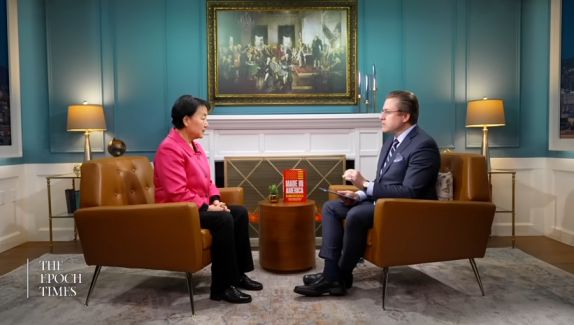
Editor’s Notes: In this episode of American Thought Leaders, Xi Van Fleet, a survivor of Mao’s Cultural Revolution, explores the “hidden history” of how American diplomatic and economic choices helped the Chinese Communist Party rise from the brink of collapse to global dominance. Van Fleet discusses her book, Made in America, highlighting critical historical turning points and the persistent Western failure to grasp the true, totalitarian nature of communism. She draws chilling parallels between the indoctrination tactics of the Red Guards and modern social movements in the West, warning that the nature of totalitarianism remains a persistent threat. This conversation provides a unique perspective on the ideological roots of current cultural shifts and the urgent need to understand the CCP’s global ambitions. (Feb 22, 2026)
TRANSCRIPT:
Introduction
JAN JEKIELEK: This is American Thought Leaders and I’m Jan Jekielek. Xi Van Fleet, such a pleasure to have you back on American Thought Leaders.
XI VAN FLEET: Thank you so much for having me back for the third time.
Totalitarianism vs. Authoritarianism
JAN JEKIELEK: Well, and you always have incredibly important things to say. And congratulations on your new book, which I will also say is very important and kind of dovetails with the book that I have coming out as well. So I find it particularly poignant. You mentioned something in there that a lot of people don’t understand. But I also covered totalitarianism is distinct from just your run of the mill authoritarian dictatorship. How is it different?
XI VAN FLEET: Yeah, I think this is important because a lot of people use it interchangeably, and a lot of people use “authoritarianism” to describe the CCP. There is a big difference, and I covered that in my book. The difference is that authoritarianism is, of course, dictatorship. They demand you do certain things, they demand that you obey, and mostly leave you alone. Not totalitarianism. Totalitarianism demands not only that you obey, but that you have to believe in them. That means they have to control your mind, and it’s like a religion.
So I think that totalitarianism is more like theocracy — like in Iran, like in China. They absolutely demand that you change your mind. That’s called thought reform. And you have to believe their lies. You can’t even pretend you believe — they demand that. And that’s my experience, my first 26 years in China. I think that’s important to understand. The CCP and the people running Iran — they are totalitarian.
JAN JEKIELEK: This is super interesting because I think that through pushing this mass propaganda into the system — this is something that was a huge lesson to me over the last 10 years — how powerful propaganda can be, that it will actually change the minds of people. I always thought that people never really accepted propaganda. I thought people knew it probably wasn’t true, but just kind of went along with it because they have all the guns. But no, it actually changes people, right? When it’s pushed in so hard through the system. So in the Cultural Revolution, which you lived through, you saw that in real time.
XI VAN FLEET: Yeah. And here too — I want people to realize that wokeism is also totalitarian in nature, because it demands that you believe. You can’t just say, “Okay, women can be men,” but you have to believe it. And they have been very successful in changing people’s minds. So it is totalitarian in nature. That’s why the underlying link is communism, Marxism.
The Red Guards and the Cultural Revolution
JAN JEKIELEK: Just very briefly, before we talk about the details of the book — how did the Cultural Revolution affect you personally?
XI VAN FLEET: I really start to think more and more that I understand — I really do — I understand people going on the street today in Minneapolis, fighting ICE, believing they’re doing something noble. And that’s exactly what happened to the Red Guards. You can’t say they just had no idea what they were doing. They believed in it. And same thing here — those on the radical left, they believe, they thought it was something noble. And that’s the power of indoctrination.
I’ve seen that. I was one of them. Even though I was not really a Red Guard — I was too young — I believed in the lies that I was told. I absolutely never doubted. I always believed that the Party is always right. The Party cannot be wrong. So I believed in the Party.
JAN JEKIELEK: And just very briefly, for those that might be uninitiated — the Red Guard. Tell me about who they were.
XI VAN FLEET: The Red Guards were kids. During the Cultural Revolution, Mao needed an army to carry out his revolution. And he couldn’t use the army — that would have looked like a coup — because his goal was to take down the CCP.
JAN JEKIELEK: Wait — Mao’s goal was to take down the CCP? I hadn’t heard that before. Tell me more.
XI VAN FLEET: Yeah, because he believed that he was no longer in control. He believed that his party was somehow not listening to him. So what to do? Get rid of them — all of them, from the central government down to the village level. And so he needed people to do it. He needed an army, and he had an army. That was tens of millions of Red Guards — young people who knew nothing and couldn’t think critically. And they did one thing really well: follow orders. So they did what Mao wanted them to do — to take down the CCP. And they did.
JAN JEKIELEK: So how did that look in real life? What did these Red Guards actually do?
XI VAN FLEET: 2020 — that’s what they did in the Cultural Revolution, like what they did here in America.
JAN JEKIELEK: Well, except that the Red Guard took it to a whole different level. I remember there was “The Three-Body Problem” — that series that came out not too long ago — where they really showed what these Red Guards were doing. And I was amazed that this landed on Netflix.
XI VAN FLEET: I was, too.
JAN JEKIELEK: Yeah.
XI VAN FLEET: And I tweeted about it because it’s very true to life. That’s very close to what happened.
JAN JEKIELEK: My point is — they were killing people. Literally. Right?
XI VAN FLEET: They were killing people. And the killing started with the professors, started with their teachers and principals. So I would say we’re not there yet. Very close. Very close. If we don’t stop it, it won’t take long for us to get there.
JAN JEKIELEK: And so what you’re saying is this is a combination of indoctrination and the understanding that there’s institutional power behind you — the combination of those two things.
XI VAN FLEET: Absolutely. I think most people would probably agree that Renee Goode did not prepare to die. He probably believed, like many others, that there would be no consequences. And they absolutely felt that they were empowered by the Democratic Party, by the people who urged them to go on the street, by the lieutenant governor who urged them to “put your body on the line.” Many of them probably did not think there would be any consequences — because there were no consequences in 2020. After all those riots, what happened to those people? Nothing.
How Woodrow Wilson Paved the Way for Chinese Communism
JAN JEKIELEK: So let’s go back now. You did some really interesting research in your book. You’re looking way back to even before the time when the Chinese Communist Party took power in 1949 in China — that already there were American interests that were basically supporting it. I did not know about this. Tell me more.
XI VAN FLEET: This is what I tried to do in my book — to trace all the way back to the beginning. And it really started in the 1800s, in the middle of the 1800s, when a lot of American missionaries and Western missionaries went to China to spread the gospel. At the same time, they also brought with them the idea of democracy and the idea of constitutional government. And it’s their work that actually fueled the Revolution of 1911, which overthrew the Qing Dynasty in 1912, created the Republic — it’s called the Republic of China, 1912.
They tried their best. It’s imperfect, far from being perfect, but it tried to follow the model of American-style government. And it failed — but it survived, and it’s still here today. People don’t think about it, but it’s still here today. The Republic of China is now in Taiwan, transitioned to a full democracy. So that was the beginning.
But what happened? China was on the way to potentially becoming a real republic — the first in Asia. But it was derailed. And that part of the history is just astonishing. Who played that role to derail the whole potential? Woodrow Wilson.
JAN JEKIELEK: Well, but we know — let’s go before Woodrow Wilson got involved. I mean, the Soviet Comintern was a little bit involved here. I say that glibly, but this was a project of the Soviet Union, right?
XI VAN FLEET: No, actually it’s the other way around. The Western ideas came to China around the same time — in the early 1900s, late 1800s and early 1900s. The Enlightenment ideas, ideas of democracy, ideas of freedom — and among them was also Marxism. But Marxism did not gain any traction. People were more drawn to Western ideas, and they called it “Mr. De and Mr. Sai,” meaning science and democracy. They believed that’s what China needed — that’s what would save China and help China modernize and become independent from foreign influence.
And then something happened after World War I. The foreign powers got together in Versailles — that was the Paris Peace talks. China was very hopeful, thinking that they would get their land — called Shandong Province — back from the Germans. Instead, it went to Japan. People had been so hopeful that Woodrow Wilson would help them with their rightful claim of getting their land back from Germany. It did not happen.
And that turned everything upside down overnight. Overnight, the sentiment shifted from pro-America to anti-America. That paved the way for the red tide to sweep through China. That gave the opening to the Russians to come to China, and eventually helped the radicals to form communist groups, and in 1921 officially founded the Communist Party. So Russia came second.
JAN JEKIELEK: But — just a fine point — they took advantage of an opening.
XI VAN FLEET: Exactly. The opening was created because the Chinese became disillusioned about Western-style democracy. That is really the key point. And so it basically set the stage for the Russians to come to China and eventually take over.
The Rise of the Chinese Communist Party
JAN JEKIELEK: Well, trace that for me. So now, of course, the Soviets came and were doing their thing — but it didn’t last that long in itself, right? Basically, Mao and the Chinese took control of the Communist Party at some point pretty quickly. Right?
The United Front: How the Soviets Infiltrated Both Chinese Factions
XI VAN FLEET: That is a long history. Actually, I think probably it’s better to read the book because there’s a lot of history. The Russians not only took over the Communists because they helped to fund the communists, they also took control of the Nationalists. The leader of the Nationalist party, Sun Yat-sen, who was considered the founder of the Chinese Republic, was looking for help from the west and everyone turned their back to him. So eventually he said, “I have to go to Russia because no one was willing to help us.”
At that time, actually, the dominant thought in America was isolationism — that China, such a vast and poor continent over there, doesn’t really matter to our national interests. It might have been right. But they overlooked a very important factor. The Russians were ready to move in, and they did.
JAN JEKIELEK: Absolutely. So we have two ways now that you’ve explained that America played a role in bringing us to today, the way the Communist Party rules. There was very early on in America, and frankly in the west writ large, a kind of love affair with communism. Something that I’ve been increasingly learning more and more about — I guess you could call it Lenin’s evil genius and ability to push very attractive narratives out into the world. Very warm and pleasant-sounding propaganda, which was very acceptable to all sorts of people who were disillusioned with their countries, disillusioned with their governments. And so it created this whole group of people that were just very sympathetic, even when atrocities started happening. So just tell me about this whole picture.
XI VAN FLEET: Yes, of course they are very good at finding out what is appealing at any given time. What was appealing to the Chinese was nationalism, because they felt humiliated by the west — by Woodrow Wilson particularly — because they put so much faith in him, believing that he would help China in the name of self-determination. So what the Communists said was, “Look, the Western imperialists cannot be trusted, but we will help you, we will help you with your struggle against them.” And it just sounded like music to the intellectuals’ ears of that time. And so they absolutely said, “This is our way out.” They believed that the Russian Revolution gave them the hope for China’s future.
JAN JEKIELEK: Explain to me how the Nationalists were also somehow co-opted by the Soviets alongside the Communist Party itself, which was —
XI VAN FLEET: — fighting them, because Sun Yat-sen could not get any help and he wanted to.
JAN JEKIELEK: But how did that manifest? It makes it sound like the Soviets were fighting the Soviets or something.
The First United Front: Infiltration from Within
XI VAN FLEET: This is very difficult to explain. My book covers a whole chapter on the United Front, which is something that every American should know — a term that every American should be familiar with. But let’s go to the beginning. It did not start now; it started way back.
When the Soviet Union helped to fund the Chinese Communist Party, it was very small — only 50 members. Guess who those members were? Do you think they were poor peasants or poor workers, the proletariat? No, they were intellectuals — some professors of Beijing University and their students. They were very small, while the Nationalists were a mature party because they had carried out the 1911 revolution that overthrew the Qing Dynasty.
So what the Soviets did was help the Nationalist Party, but with a condition: you have to incorporate the Communists. Their plan was to let the Communists be part of the Nationalists and eventually take over from within. And they were almost successful, until the new leader of the Nationalists, Chiang Kai-shek, realized the plan. He realized that the Communists had been infiltrating the party from within and had converted so many Nationalists into Communists.
So in 1927, he made the decision to purge them, and he killed some 4,000 suspects because they did not know who was who. It was a very, very messy situation. They killed 4,000, including Communists and also some leftist Nationalists, and that marked the split of these two. But what we need to understand is that that’s what Chinese Communists do — or Communists in general. They are parasites. They attach themselves to a bigger, more organized political force or party, grow from within, and they were almost successful.
JAN JEKIELEK: So how does the United Front fit in? Maybe explain what it is.
XI VAN FLEET: You can see from the first attempt that what they implemented was working from within — undercover, mostly. So it’s an infiltration and influence operation. A lot of the Communists joined the Nationalists, but only a few at the top were known to the Nationalists. Mao was one of them. So they knew that the top leaders were Communists, but the others they didn’t know. It’s really a work-from-within strategy.
And that’s what is going on in America — the work from within. You don’t know who they are, and it’s about influence. They leave no trace. A lot of people who are played have no idea that this happened to them.
JAN JEKIELEK: So what happened to them?
XI VAN FLEET: They absolutely took this stand and became the spokesperson for the CCP. And a lot of them were giving away trade secrets. And look at the Confucius Institutes — what they did is —
JAN JEKIELEK: So now we’re going back to the present.
XI VAN FLEET: Yeah, okay. Right. I have been talking about the present.
JAN JEKIELEK: Okay.
Confucius Institutes and the Modern United Front
XI VAN FLEET: So what they do is work from within. For the Confucius Institutes, money was such an attractive offer that a lot of universities let them in.
JAN JEKIELEK: Let me just qualify a little bit. Confucius Institutes, for those that may not be familiar, were basically institutions from China that connected themselves with universities and other educational institutions in America, coming with generous money and educational materials, and creating a partnership — ostensibly with no political orientation, but the reality was quite different.
XI VAN FLEET: Yes. One of the conditions was that you cannot talk about Tibet, you cannot talk about Uyghurs, and you cannot criticize the CCP. So there goes free speech. But they embedded themselves in almost all universities and high schools, and eventually it was everywhere. That’s how they come in from within. Because you want the money, you want the donation, you say, “Okay, we won’t talk about Hong Kong, we won’t talk about Taiwan.” But eventually you can’t talk about a lot of things. And that’s how they kill free speech. That’s how they influence people’s minds into thinking that the CCP is just another country, another party.
JAN JEKIELEK: And it’s very interesting, because when there’s a financial relationship, you’re also motivated to cover for it because you’re getting this benefit. Even if you’re a little suspicious, if there wasn’t the financial relationship, you might be more cautious. You wouldn’t have so much invested, of course.
XI VAN FLEET: Greed and money will blur people’s view of what they’re dealing with.
JAN JEKIELEK: And when the United Front was started, it absolutely had the goal of creating a pro-communist united front among all sorts of people who were not officially Communist. That’s where the name or the idea came from, right?
XI VAN FLEET: Talking about where the idea came from — it came from Lenin. The United Front, this idea and this tactic, was created by Lenin. And of course the Soviets taught their students well in China.
JAN JEKIELEK: So the Nationalists purge the Communists, but we still end up with the CCP taking over in 1949.
The Long March and the Road to Communist Victory
XI VAN FLEET: This story is absolutely fascinating. After the purge, the CCP had to withdraw and went to the mountains to become what were really called “Red Bandits.” But they were not going to give up. And that’s something we have to learn — Communists do not give up. Mao famously said, “A little spark will start a prairie fire.”
So they had their little so-called Soviet Republic in the mountains in southern China and started to expand, calling themselves basically an opposition government. Chiang Kai-shek was determined to get rid of them. He tried five encirclement campaigns to wipe them out, and the fifth time he was successful, driving the Communists out of that area and starting what many people now know as the Long March — their escape westward, eventually landing in northern China, in a place called Yan’an.
From there, the fight continued, because by then the Japanese had started their aggression against China. And totally by accident — also by national demand — they had to start another United Front, supposedly working together to fight the Japanese. That turned out to be another disaster. That cooperation ultimately ended the Nationalists and, after the civil war, drove them out of China to Taiwan. So twice they collaborated, and twice the Nationalists were deceived and eventually defeated.
JAN JEKIELEK: They had to escape to Taiwan, which is how the Republic of China ended up in Taiwan.
XI VAN FLEET: Correct. Yes.
JAN JEKIELEK: So this “enemy of my enemy is my friend” approach — it doesn’t work with Communists. That’s the message I’m getting here.
XI VAN FLEET: Yes. But that was later — that was Nixon. We still have a little important history to cover, and that was during World War II.
JAN JEKIELEK: Just to qualify what I mean — in this situation, obviously the Nationalists and the Communists were not friends, but they got together to fight the Japanese as the common enemy. And I wonder, after what had already happened, shouldn’t that already have been the lesson — that the enemy of my enemy is my friend doesn’t work with Communists?
America’s Failure to Understand Communism
XI VAN FLEET: Absolutely. But the history is very complicated. It is not that simple. My book explains why the Nationalists were forced to collaborate with the CCP again, and the same thing happened — they were deceived and defeated.
But this brings us forward to the 1930s and early 1940s, when the Americans came on the scene. Why? Because of the common enemy — the Japanese. Now they were forced to engage with China. They had a shared enemy in Imperial Japan. And this period was actually a period in which the Americans had a firsthand experience with the CCP. And the CCP managed to deceive the Americans and managed to utilize the Americans to defeat their enemy, the Nationalists.
So the lesson was never learned. Because after this, the same thing happened over and over and over, until even today. This is why the book is so important — to help people understand. America was there. And they did not understand Communism. And because they never understood Communism, they made all the possible mistakes and helped the CCP to take over China.
JAN JEKIELEK: So you’re saying that even during this time period, when the Nationalists and the Communists were working together, the Americans were also kind of on the side of the CCP?
XI VAN FLEET: Yes. And here is another important thing that the Americans never understood — the difference between totalitarianism and authoritarianism.
JAN JEKIELEK: Right. As we talked about.
XI VAN FLEET: Exactly. They never understood that the Chiang Kai-shek government — the Nationalist government — was indeed corrupt, was indeed ineffective, but it was an authoritarian regime. They thought, “This government is so corrupt. But look on the other side — look at Communism. They seem to be really organized, devoted. They seem to be the ones we should collaborate with.” They had no understanding. Actually, they should have known by then, because there was the example of what went on in the Soviet Union — but they refused to really learn from it.
And they bet on Communism, on the Communists, to help achieve the goal of defeating the Japanese. So they did, just as I said — they made all the possible mistakes and eventually helped the CCP to take over China.
JAN JEKIELEK: It seems like these mistakes basically continued for a very long time afterwards. It’s hard to imagine how that would be possible. I mean, this is the turn of the century — not too long after. And by the way, it’s not just the U.S. It’s the west at large that we’re really talking about here, but with the U.S. being the most influential, that is the key —
XI VAN FLEET: The lesson was never learned. That’s why the Communist tactic of the United Front keeps working.
JAN JEKIELEK: What is the tactic?
The Deception of American Presidents and the CCP’s Survival
XI VAN FLEET: Their tactic is deception and influence and infiltration. Because of their tactic, the Americans — and the Americans I’m talking about are journalists, diplomats, American generals, American presidents — all bought into the lie that the Communist Party were really the one that is going to help to defeat the Japanese. They believed all the lies, even though the lies were just so blatant.
JAN JEKIELEK: But the Japanese first and then later the Soviets. Right?
XI VAN FLEET: Yeah.
JAN JEKIELEK: Over many presidencies. Right. There was this whole hedge to try to stop the Soviet Union with the help of the Chinese, which at this point that relationship had soured.
Edgar Snow and the Propaganda That Shaped the West
XI VAN FLEET: Yeah. I can give you some examples of this. It started with the journalists. So they went to China before the Americans started to make alliances with the Nationalist government against Japan. One of them is called Edgar Snow. He is so well known because he wrote a book called Red Star Over China, and it’s still in print today. He went to Yan’an, the base of the Chinese Communist Party, and he did a glowing report of the Communists, comparing them basically to the early Christians. They are organized, they’re devoted, they are patriots, and they are the future.
And of course he had influence — direct influence on presidents like FDR and later Nixon. So his book absolutely changed the perception of the Chinese Communist Party in the West. He called them reformers. He called them “agrarian reformers.” “They are not really communist.” That perception lingered until today.
And it’s not only influential internationally because it’s in English. Later it was translated into Chinese and published under a different title, because that title sounds a little bit like communist propaganda. So they changed it to another title using a classic Chinese novel’s name — Journey to the West. That was absolutely the most influential book to get so many young people to Yan’an to join the revolution. Among them were two of my uncles. They read the book. They believed it. They believed that to defeat the Japanese, they had to join the Communists. That is how powerful the propaganda is.
Of course, Edgar Snow probably did not know that his book was actually propaganda, because all the information put in his book was offered to him by the CCP. In many ways, that is the first United Front tactic that they implemented on the Americans. He was the first, and then followed by so many other journalists — I mention many of them in the book.
But later the State Department, the diplomats, Christian educators, missionaries — people who, knowingly or unknowingly, mostly unknowingly, helped to spread the propaganda. A lot of them just helped so many young people, just like here in America today, to believe in communism and to abandon their families. A lot of them were well-educated, from well-to-do families, and they abandoned everything, went to Yan’an, and joined the revolution.
JAN JEKIELEK: Wow, that’s amazing. So these became the “old friends of the Chinese people,” as you call them.
“Old Friends of the Chinese People” — Useful Idiots of the CCP
XI VAN FLEET: That is the title the CCP gave to those foreigners who helped them with their cause — “the old friend of the Chinese people.” The first one to receive this title was Edgar Snow. And then you will see, along the line, many, many people — including our presidents — got that title. “Good friend, old friend of the Chinese people.” It has nothing to do with the Chinese people. It should be called “old friend of the CCP,” or useful idiots.
JAN JEKIELEK: And this also reminds me of one of the biggest pieces of successful propaganda that the Chinese Communist Party has pulled off — just this idea that the Communists actually represent the Chinese people, that the party is the people.
XI VAN FLEET: Yeah.
JAN JEKIELEK: In fact, I would argue nothing could be further from the truth.
XI VAN FLEET: That lie is still being believed by so many Americans and people around the world.
JAN JEKIELEK: Even Chinese. Many. Yes, right. That’s the craziest part.
The CCP Is Not China — It Is a Foreign Implant
XI VAN FLEET: Not too long ago, there was a guy called Victor Gao. He worked for some kind of think tank in Beijing. He had a video that went viral. He said, “China has 5,000 years of history, most of which there’s no United States, and we expect to survive another 5,000 years.”
This is a lie. Chinese civilization has lasted for thousands of years. But the CCP is not part of Chinese civilization. It’s an imported Western ideology. It had a beginning — that was 1921. That is the CCP. And they hijacked China. Now they call themselves China. It cannot be further from the truth.
This is very important for Americans to understand. The CCP is absolutely a foreign implant in China. I would say they were the colonizers of an ideology from Western Europe, from Germany, if we trace back to the beginning. It has nothing to do with Chinese civilization.
And during the Cultural Revolution, we saw that Mao wanted to destroy everything that’s Chinese through the so-called “Four Olds” — destroy the old ideas, old traditions, old customs, and old habits. Anything Chinese, they wanted to destroy. The CCP is not Chinese. I think it’s so important for people to understand this.
JAN JEKIELEK: Why are communists always so interested in destroying what Mao called the “Four Olds” — all of this tradition?
XI VAN FLEET: I really consider communism a theocracy. It’s a religion. And it’s absolutely a religion because it seeks to control not just a system, not just property or economy — it really wants to control people’s minds. So in many ways it is a religion. And because it is a religion, it cannot put up with any other tradition, civilization, ideology, and of course, religion.
Nixon Opens the Door — and Saves the CCP
JAN JEKIELEK: But with the coming of Deng Xiaoping, as the story goes, suddenly “to be rich is to be glorious.” So obviously China abandoned communism. Right?
XI VAN FLEET: Well, then we have to go back a little bit to Nixon, don’t you think? It was 1972, and I was in high school when we learned Nixon was coming to China. We just could not believe it. If Americans were shocked, just imagine how shocked we were — because since childhood we were taught that America is our deadly enemy, that America wants to destroy us, and that we must do everything to defend China against our enemy. And then you tell me President Nixon was going to visit us? We just could not get our minds around it.
And that was the height of the Cultural Revolution, when everything was in ruins — absolutely in ruins — and there was no economy. A few years after that, I was sent to the countryside after I graduated from high school. Why? There was no economy, no jobs, nothing. We lived in extreme poverty.
But the CCP was saved. Saved by no other than the President of the United States, Richard Nixon. And Trump rightly called that the biggest mistake Nixon made. Yes, that is true. He saved the CCP. He saved the CCP from the ruins.
JAN JEKIELEK: How?
XI VAN FLEET: He opened China up. And at that time, it was even worse than just economic ruins. In the late 1950s, the time was just so crucial because China was facing absolute total collapse. Internally, there was no economy, and everyone was living in extreme poverty.
But more than that, in the late 1950s, there was a big split between China and the Soviet Union. And it got worse. By the time of 1972, before Nixon visited China, the two powers were almost at the brink of nuclear war. Can you imagine? Mao was threatened both internally and externally — only this time it was by his former ally, the Soviet Union. He needed help. He absolutely needed help.
Sure enough, the help was on the way. And that was no other than the President of the United States, Richard Nixon.
JAN JEKIELEK: So he opened it up.
XI VAN FLEET: And all the crises eased. Soon after that, China got into the Security Council of the United Nations because the Americans did not do anything about it. So the CCP turned around, was absolutely saved, and escaped the immediate threat of being bombed by a nuclear weapon. And now safely on the side of the world’s superpower — the United States of America.
From Nixon’s Opening to Today’s Deep Infiltration
JAN JEKIELEK: You know, this is a really important story, and I want to encourage people to read your book because you flesh out so many of these details and nuances of how this all happened. But we go from this opening up — where the Nixon administration in effect saves the CCP as opposed to having it collapse and something else forming there — to a line that goes all the way to today, where the CCP has these deep, deep inroads into America itself.
We’re seeing another bio lab that’s been discovered. We have these “police stations,” as we say in quotes. We have all of this IP theft and cyber theft, and United Front-compromised individuals across the whole country. It’s not just America, but of course the focus has always been America. I would love to talk through all the nuance — and that’s something I think people should read your book for. But just give me a picture of how we went from Nixon’s opening up to today.
XI VAN FLEET: Yeah, there’s so much to cover and it’s almost impossible, but I’ll try my best.
So after Nixon opened the door to China, a lot of people had trouble understanding it — just like me. I was like, “What?” But of course I could not think critically. The party must be right. But a lot of Americans had trouble understanding it too. We were still in the midst of the Cold War. If we ally with China, which was a communist country, and the Cold War is about communism — it just makes no sense.
So what the Nixon administration did was come up with a way that somehow worked. They said, “Yes, the enemy is still communism, but the Chinese Communists — they’re not really communists. They are so-called communists.” And that has actually been the way they deceived Americans, and it still works today. Still today, people think, “Oh, Chinese communism — it’s kind of like Confucian communism. It’s not like Soviet communism.” And still today it’s “Russia, Russia, Russia,” and not many people say “China, China, China.”
So the CCP was allowed to go unquestioned. All the atrocities that happened behind the so-called Bamboo Curtain were not taught. Over 80 million Chinese died under the Chinese regime. Later, more than 300 million babies were forcibly aborted — not told. So the American people just thought, “Okay, Chinese Communists — they’re not really a threat, they’re okay.”
Deng Xiaoping’s Economic Reform — A Survival Strategy, Not a Path to Democracy
And so later on, they called it reform. Remember Deng Xiaoping, “the reformer”? Deng Xiaoping never planned to have political reform. All he wanted was economic reform. Why? Because China was absolutely on the brink of total collapse at that time. Nobody believed in the CCP, so he had to do something.
That’s why he got his now-famous doctrine — “black cat, white cat, as long as the cat catches the mouse, it’s a good cat.” Temporarily, we have to save this country. What do we do? Get foreign investment, get their technology. And that’s how it started.
And Americans were told, “You know, if we help China — first of all, it’s not a real communist country, it’s a so-called communist country — if we help them to develop their economy, democracy will just naturally follow.” Do we remember that? And I have to say, I even kind of believed it. Maybe. Maybe if we help them to have a strong economy, people will naturally demand more freedom of speech, and then we’ll have democracy in China.
Wrong. Because again, we’re dealing with communists. And after all these decades of opening and reform, what happened when Xi Jinping took over in 2012? Reverse. Now going back to the Mao era. Because to them, wealth is important. But nothing is more important than the —
JAN JEKIELEK: Control of power. Keeping the party.
XI VAN FLEET: Absolutely.
The CCP’s True Beneficiaries: Elite Enrichment Over People’s Welfare
XI VAN FLEET: Because yeah, power and party is the same thing. To save the party is more important than anything else. And this is something else I think it’s important that I want to bring up — the rise of China. Now it has become the second largest economy. Who benefits?
We’ll say, okay, Americans sacrificed, we lost millions of jobs. Maybe by doing so we helped the Chinese people to have a better future. No, that is not the case. We helped the CCP elite to become rich. Even today, I think 600 million Chinese only make $5 a day. Why? Because that’s not what the CCP is doing all this for. It’s for their power. So the CCP elites become billionaires, some even trillionaires.
So the rise of China is bad for America, bad for the world, because they have become a real threat — a regional threat, now a world threat. We can see their hands behind almost all the terrorist organizations. And also in America, we can almost see their hands behind all the radical organizations, behind BLM and behind the protests for Hamas and today’s anti-ICE protests. There are people reporting the connection of their money coming to fund those radical organizations.
But most of all, I think it is the Chinese people who are the victims of this powerful, powerful party. After the Chinese Cultural Revolution, the CCP really lost all their legitimacy. People did not believe in the CCP. Not only was the whole country in economic ruins, but people just lost faith in the Communist Party. But today they absolutely have more power than ever. And so democracy in China is further away from the horizon than ever. So the victims absolutely are the Chinese people.
Religious Freedom as the Litmus Test
JAN JEKIELEK: I just came back from the International Religious Freedom Summit, which was here in D.C. as we’re filming, over the last couple of days. And I keep thinking about this — that religious freedom really is the litmus test. Because as you said, in these communist societies, it is this kind of quasi-false religion character that communism takes on. And so of course, they have to suppress any other form of anything that would compete with that, because people naturally want to seek that connection — an actual connection to God, not with the Communist Party ideology as an intermediary. So it can never tolerate religious freedom. And I think if we understood this and saw that as the red flag —
XI VAN FLEET: Absolutely.
JAN JEKIELEK: — we would be in a very different situation. Right?
XI VAN FLEET: Yeah. And the other thing I can say is that during the Cultural Revolution, they depended on people reporting each other. I absolutely remember that we were encouraged to report even our parents if we heard them say something that was not politically correct or somehow against the party line.
They don’t have to do that today. With surveillance technology, they can absolutely control you before you even utter a word. And with the social credit system, they absolutely enslave every Chinese. If they suspect you — and it’s not even that you want to do something against the government — if they merely suspect that you might have something against the government, they can absolutely end your life. They can use an app. They can cut off your access to your bank account. You can’t even take a train or a plane. You are basically just disabled.
So that is not like the Cultural Revolution anymore, because now they have the technology, they have the money — thanks to the West and thanks specifically to the United States — and now they have become more powerful than ever and more dangerous than ever.
Powerful Yet Fragile: The Paradox of the CCP
JAN JEKIELEK: It’s interesting because they’re more powerful, they have a lot of power, and they are dangerous. I agree with that. At the same time, in some ways they’re very fragile.
XI VAN FLEET: Yeah. And you can see that just in the past two weeks — the news came out of China that Xi Jinping purged the number one in the military and a bunch of high-level military leaders. And this is not his first purge, but this is his biggest. And this guy was his childhood friend, but it doesn’t matter. Why? Because he feels insecure. Because of that, he has to purge everyone that he feels suspicious of. But eventually he won’t trust anyone. There’s no one left to trust. And how fragile is that kind of regime? Yes, from the outside it looks very powerful, but inside it’s very fragile. You’re absolutely right.
JAN JEKIELEK: So it’s kind of a mixed message, right? On the one hand, yes, there’s a lot of power — they have nuclear weapons, they had TikTok, they have the biggest and fastest militarization in the history of the world, arguably, and a massive state security apparatus to repress the people of the country. At the same time, some people would argue — and I think I would be one of them — that it’s unusually fragile.
I had one of our key analysts explaining how, in order to achieve what Xi achieved through these purges of the top military leaders, in a way he’s sort of reduced the overall power of the system, because he started breaking all of the unwritten rules of how that system worked.
XI VAN FLEET: Yeah. The other thing I think a lot of Americans don’t understand — who do you think is the number one threat to the CCP? Most people would probably say the United States, because it is the superpower that the CCP wants to replace. Of course it considers the United States as its number one enemy. That’s kind of true. But there is another enemy it fears the most — and that is the Chinese people.
The CCP spends more money on what they call “security” or “public safety” than on the military. It’s really all these surveillance systems and police. And to do what? To control the population. Because they are scared of the very people they rule over.
The Path Forward: Learning Hidden History
JAN JEKIELEK: Xi, I’m really enjoying this conversation. I would love to continue it for hours, but I think we’ll let people read your book and figure out a lot of these details. We’ve looked at a situation where on the one hand the CCP has an unusual level of power and military influence in the West — in America, we can see variations of it all the time. They’ve really taken advantage of the openness of our system. At the same time, there’s this fragility inherent because there isn’t that legitimacy, and there’s this paranoia to keep power at any cost. What do you see as the right approach going forward — good for America, good for the Chinese people?
XI VAN FLEET: Yeah, it’s a big question. But one thing I would say is that the theme and goal of my book is to really tell the American people: we have a threat. Absolutely. Over there, that’s the CCP. And in my first book, I addressed the threat from within — that is the American Cultural Revolution, the Woke ideology. But where is the real source of all these problems? Are they even connected, and how do we address it?
I would say that in my first book, Mao’s America, I tried to answer the question of the threat from within. That is the Woke ideology. And that is not coming from somewhere else — it’s homegrown. Woke ideology was born here and made specifically for a country like America.
But after that, I still felt like there were a lot of questions unanswered. And I want to make this very clear in my second book, Made in America — as the title says, I believe that the reason the CCP was first successful in taking over China and later in directly challenging America is because we, as Americans — especially our leaders — failed to understand the true nature of communism, and we failed to understand the threat it poses to us and to our way of life. Because of that, we made one mistake after another, and history was never learned.
The problem is here. We have to look inside rather than outside for solutions. And this is a huge problem. But I say: start with learning history. Start to learn how we got here to begin with. I think this book will help you understand a lot of things, because I call it hidden history — it’s not taught in schools and it’s not discussed in public discourse because a lot of people want to hide it. But in order for us to understand, we have to learn this very, very important piece of history. And that is what my book is all about.
The True Nature of Communism
JAN JEKIELEK: You mentioned that we really failed to understand the true nature of the Chinese Communist Party, of Chinese communism. I think this is of critical importance. I actually make the same argument. In a nutshell — how would you explain that nature in the shortest possible way? What is it that we don’t understand?
XI VAN FLEET: Okay. One way is to understand that communism — as we talked about a little — is a religion. It really wants to remake the world in its own image. And not only that, it wants to remake human nature. So it cannot be peaceful, because in order to do that, they have to use power and they have to use violence. This is not just what I’m saying — I lived through it. And history is there for us to learn. It happened in the Soviet Union, it happened in Poland — where your family is from — it happened in China, it happened in Cuba.
What do we do? We have to learn history.
The other thing I have to say is that nowadays a lot of people talk about globalism. And I have to say: communism is globalism. In its DNA, it wants not just to change human nature — it wants to take over the world. When I was growing up, we were always told, “Our goal is to liberate humanity.” So its goal is not just China, and then maybe some other country. No — the entire world. That is the threat.
You can treat it as a friend, but it always treats you as its mortal enemy. I use the story of the farmer and the snake in the book — a lot of people probably know that story. The CCP, or communism, is a snake. You can save it, you can help it, but it will bite you, because that is its nature. Its nature is that it is going to destroy you.
JAN JEKIELEK: Well, Xi Van Fleet, it’s such a pleasure to have had you on.
XI VAN FLEET: Thank you so much.
JAN JEKIELEK: As usual, thank you all for joining Xi Van Fleet and me on this episode of American Thought Leaders. I’m your host, Jan Jekielek.
Related Posts
- Tucker Carlson Show: w/ Ken Silva – Attempts on Trump’s Life (Transcript)
- Pod Force One Interview: w/ Donald Trump – June 2, 2026 (Transcript)
- Jimmy Dore’s Interview on Tucker Carlson Show, June 5, 2026 (Transcript)
- Transcript: Trump Remarks on American Agriculture at Wisconsin Roundtable
- President Trump Remarks on Beautiful, Clean Coal – June 4, 2026 (Transcript)