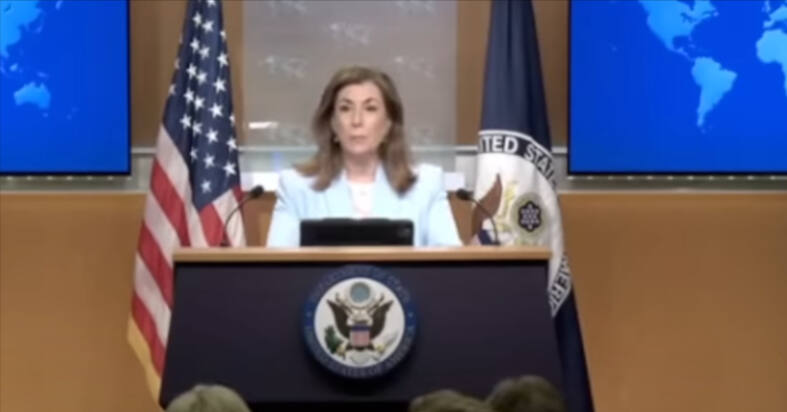
Read the full transcript of State Department Spokesperson Tammy Bruce holding press briefing after Trump issues new threat against Iran, June 17, 2025.
Listen to the audio version here:
Opening Remarks
TAMMY BRUCE: Thank you. Hi, everyone. Welcome back. Appreciate you being here. Thank you. Everyone’s set? We’re good? Great. Welcome aboard, everyone. Thank you again for being here.
For generations, the Middle East has been dealing with the world’s largest state sponsor of terrorism, with the attack on Israel on October 7th by Hamas reminding us of what’s at stake. Due to the wisdom of the American people, President Trump’s election to a second term has offered the world a chance to see an American leader committed to solving many of the world’s existential threats with determination.
Now, as the conflict between Israel and Iran continues, President Trump has also been clear that Iran cannot have a nuclear weapon. Secretary of State Marco Rubio has also stated that fact, as he has traveled the world working to implement President Trump’s vision of peace and security. That statement has also been uttered from this podium many times. The fact that Iran cannot have a nuclear weapon is clear.
As the White House reminds us, since taking office, President Trump has clearly stated no fewer than a dozen times that Iran cannot be allowed to have a nuclear weapon, for anyone who’s unclear on that fact. President Trump has made the same pledge no fewer than 40 times before taking office, even as far back as 2011.
Middle East Task Force Establishment
One of the highest priorities of the Trump administration is the safety and security of the American people. To that end, the Department of State has established the Middle East Task Force to help coordinate support for U.S. citizens, our U.S. diplomatic missions, and personnel and diplomatic engagement. The task force is operating 24 hours a day.
Over the past week, to help keep U.S. citizens informed, we have issued more than 30 security alerts to countries in the region and updated the travel advisories for Iraq and Israel. We remind U.S. citizens not to travel to Israel or Iraq, and not to travel to Iran under any circumstances.
We continue to monitor the complex and rapidly evolving situation on the ground as we continue to assess and address the needs of U.S. citizens. We urge all U.S. citizens to regularly visit travel.state.gov for the latest travel advisories and security updates, and to enroll in the Smart Traveler Enrollment Program, also known as STEP, to receive timely alerts and guidance from the State Department.
For Americans needing assistance, call plus 1-202-501-4444. That number again is plus 1-202-501-4444. If you’re on that website, you can also click on that red box. It will take you to a page where you can search for the embassy of your interest, where you are, where you would like to connect to be able to get help from the embassy in the country where you are. And, of course, the number’s there as well for your closest U.S. embassy.
I also want to add a couple other things here as we’re dealing with this. It is certainly a rapidly evolving dynamic, but to conclude the topper here today, I want to recognize the State Department and other U.S. government teams around the world working under threat on behalf of the American people, particularly those in Israel and Ukraine, who spent another night sheltering in bunkers as they came under attack.
Our priority is the safety of Americans overseas and here at home. It is the priority of Secretary Marco Rubio. It is the priority of everyone who works in this building and the thousands of American citizens who work anonymously and whom you will never see, who are working in embassies and consulates around the world and working with those local nations to be there for American citizens and to help facilitate American diplomacy.
Our priority is the safety of Americans, yes, here at home, but also overseas. We thank all of those working on behalf of the American people, all of you watching from home and from around the world. We thank you. And for everyone around the nation, we know and honor your work as we begin another briefing here ready to take your questions. All right.
Questions and Answers
REPORTER: Thanks for that. Could you give us some more details on this task force, how it’s going to work, and specifically if it’s going to help Americans potentially leave the region, be repatriated, depending on the countries that they’re in, and any more details you can give on that.
TAMMY BRUCE: Right. Well, I won’t be giving you just as a reminder of how today is a little bit of a different day for the briefing. There is always things that I can’t say to you, and yet we have a long back and forth. Sometimes we have a little bit of debate. I won’t engage in that today. My responses will be perhaps a bit quicker than usual, and I’ll be moving around more quickly to reach as many of you as I can. And there will be less that I can answer for you because of the circumstances that we’re dealing with around the world. So I just want you to know it’s not personal, but we’re working on certain things like the task force, as an example.
The task force is a group of people who are working, taking the calls of people, of American citizens around the world, making sure that they get connected with what they may need in that region. I won’t go into the details of all that the task forces do, of course, but it’s about information, making sure people here at the State Department and people that we get the information we need, but also people around the world, American citizens, get directed to the information that they may need as well.
So I’ll leave it at that, but this is something that the State Department does when there’s a situation that requires it, and this is one of those times.
REPORTER: Tammy, I’m sorry. Could I just ask about the phone number?
TAMMY BRUCE: Sure, Matt. Sure. Of course.
REPORTER: The phone number that you get, if you call that number, which I can do right now, who do you get? You get an individual who is—
TAMMY BRUCE: The task force?
REPORTER: No, you don’t get the task force. That phone number is a general phone number. The task force is busy. But it is a separate unit that is established to take the calls, to assist American citizens who call to the embassies. Particularly, you’re going to be referred to embassies who can help you get what it is you need.
TAMMY BRUCE: So good question. Thank you, sir. All right.
REPORTER: Andrea. Just a quick question. There’s some specific consular needs, one in particular that I’m aware of, and there may be more than one, is an American citizen in Iran, where there is no embassy, no consulate. Would that be the Swiss protectorate? Would there be other options? Can consular affairs give any advice as to what to do about Americans right now stuck in—
TAMMY BRUCE: I can’t speak to any advice or information regarding individuals in Iran at this point.
REPORTER: And what about American Israelis or Israeli Americans either wanting to come out or wanting to get back home? El Al, I believe, has resumed flights in some small measure for people. Some people have kids in Israel, and they were visiting the States, and they’re American citizens. Is there anything that they can do? Should they call this number?
TAMMY BRUCE: Well, obviously, if you know—and we encourage every American when you travel is to contact your local embassy or consulate. Let them know you’re there. Make sure you know where they are. Have those numbers. And that’s what I would recommend no matter where you’re traveling, but certainly in the Middle East, is know where those entities are. Know where the embassy is. So if you’re in Israel, obviously it’s Tel Aviv or it’s Jerusalem.
REPORTER: Are they open?
TAMMY BRUCE: Well, they will answer their phone. So there’s contacts that can happen in the midst of all of this. And, of course, I think that that’s the advice for wherever you are. But clearly, if you’re in a certain area, it’s obvious in this case that there are certain limitations in that region and that contact the embassy, the one that is nearest to you, and you will at the very least make sure they know where you are, but also they will give you some options for the plans that you would like to make.
REPORTER: Tamara. Tammy, I understand your limitations, but I have to ask this.
TAMMY BRUCE: I know you do.
REPORTER: It’s your job, and I appreciate that.
TAMMY BRUCE: I’m here to take questions, not necessarily always answer them.
REPORTER: Last night President Trump said he wants a real end, not a ceasefire. So does the United States support or pursue regime change in Iran, or are we just talking about dismantling Iran’s—nuclear enrichment, and would that include the United States helping Israel strike forward?
TAMMY BRUCE: Well, I’m certainly not going to characterize what President Trump says or tweets for that matter. He doesn’t need characterizing. He’s one of the most transparent, one of the most clear individuals that we’ve known. I think that we can take his word for his word, but I’m not going to speculate in a larger sense what that would mean. That is up to the president. He is the singular guiding hand about what will be occurring from this point forward, as he has been, and I think that that dynamic is pretty clear.
He says he wants an end. As he has said about every conflict that he has, as a peacemaker, worked to stop peacefully through diplomacy, that has been his commitment, and he wants these things, as he said, about a number of situations, not for a month or six months, but durable ends to this nature of forever wars, and that has been his posture, and that’s his posture now.
REPORTER: Okay. I have an easier follow-up.
TAMMY BRUCE: Yes, ma’am. I’ll take a hard one, too.
American Citizens Seeking Evacuation
REPORTER: How many people so far have contacted U.S. missions in Israel or elsewhere, American citizens seeking help to depart the country that they’re in in the Middle East?
TAMMY BRUCE: Yes, I won’t discuss those details or the numbers involved with the embassies.
REPORTER: Are you guys planning to facilitate charter planes to get people out or military evacuations?
TAMMY BRUCE: I will not discuss what our plans are in that regard.
REPORTER: Yes, ma’am. Just to follow up on that really quickly.
TAMMY BRUCE: Sure.
REPORTER: Are you guys considering at all operations that would help Americans who want to leave the region from evacuating?
TAMMY BRUCE: I know that our commitment is to the safety and security of Americans around the world. All right? Yes, sir. Yes, sir. Go ahead.
Iran Regime Change and Nuclear Intelligence
REPORTER: Tammy, would the U.S. government like to see regime change in Iran?
TAMMY BRUCE: First of all, I’m certainly not going to remotely address that. It would require me to speculate or speak on behalf of the president, which I will not do. What we’ve seen, though, is clear, is months and repeated statements that all he wants is a peaceful world, his activity and the activity and the nature of the actions that the United States has taken, and his special envoys have been rooted in one thing, which is negotiations looking for diplomatic solutions to generational problems that he wants solved diplomatically. That has been his constant posture, and there has been nothing that has changed in what he wishes for, what he would hope to accomplish, and so, of course, that’s not something I’m going to address.
REPORTER: Is the U.S. government and the Israeli government on the same page when it comes to the intelligence about Iran’s nuclear weapons program?
TAMMY BRUCE: That is a question for the White House and perhaps the NSC. That’s not something I can answer here.
Diplomatic Engagement and Unconditional Surrender
REPORTER: Nadia. Thank you, Tammy. The president said he wants to see Iran offer unconditional surrender. I’m not going to ask you to comment on the president’s statement, but I’m going to ask you if the secretary is involved in any kind of diplomatic emissions with his allies, with the Germans, with the French, trying to offer something to the Iranians as a way out.
TAMMY BRUCE: Well, I, again, would not speak on the details of any diplomatic conversations, if they occurred, between whom, what those details would be. We know, of course, the secretary and the president were at the G7. Their constant work from the moment they came to office has been to, certainly Secretary Rubio, was to open up conversations and to lead the world through diplomacy to make a difference. But that’s the only thing that would guide me when it comes to the nature of the decisions they’re making at this point.
REPORTER: Yes, ma’am. Without getting into the details of the conversations, is the door to diplomacy with Iran on its nuclear program still open from the U.S. perspective?
TAMMY BRUCE: That would be a decision made by President Trump.
REPORTER: Have you heard from the Iranians signaling interest in continuing discussion?
TAMMY BRUCE: That is not something that I can speak to.
Embassy Assistance and Travel Alerts
REPORTER: Yes, ma’am. Thank you. So I’m going to ask the consular a piece of this. In Israel, the latest security alert from the embassy there still says that the embassy is not in a place to evacuate or directly assist Americans. Do you have any timeline on when that might change for the Americans who are stranded in that country? And just looking at how quickly the security situation has changed there, the travel alert was raised to a level four from a level three for the entirety of the country. Is that a sign that the State Department was caught on its back foot a little bit by this change because Americans still can’t get help?
TAMMY BRUCE: I can say the answer to that last question is no. We are working 24-7 to ensure the safety and the security of Americans around the world. I can say that the Department of State is always planning for contingencies to assist private U.S. citizens’ departure from crisis areas. And we will alert the U.S. citizenry community if there is and when there is additional information to share regarding their options during any crisis, but certainly this one as well.
When it comes to how quickly people can expect a dynamic, the American government, the state government, Department. Our militaries, you’ve seen all of these assets, all of these departments involved in this dynamic in one fashion or another, are working exclusively for the safety of this nation and the safety of the American people wherever they may be.
REPORTER: Yes, sir. Thank you, Tammy. At the top, you said that you’re advising U.S. citizens not to travel to Israel or Iraq or Iran under any circumstances. Do you have any more general guidance for Americans in the Middle East more broadly as a region? Are there other countries that you’re advocating people depart from?
TAMMY BRUCE: Well, at our website, we have our travel alerts. We also have moved them on our State Department Twitter, our social media accounts. Those are for the public to see.
REPORTER: Would there be – what is the specific one for people to look to if they want to look for specific country travel alerts? Is it travel.state.gov?
TAMMY BRUCE: So, travel.state.gov, and you will see every travel alert there for you depending on if you’re going to be traveling. It’s not just for the Middle East or if you’re in a country right now. You can get your information there.
American Citizen Killed in Ukraine
REPORTER: Yes, sir. Two questions. At your top, you also recognize American diplomats serving in Ukraine and Israel who spent another night in a bunker. A bomb of American citizens happened to be killed by the Russians last night in Ukraine. Do you have any comment on the U.S. government act to protect American citizens in Ukraine?
TAMMY BRUCE: Yes, we are aware of last night’s attack on Kyiv, which resulted in numerous casualties including the tragic death of a U.S. citizen. We condemn those strikes and extend our deepest condolences to the victims and to the families of all those affected. The President, in the recent past, has made his thoughts clear about striking the civilian areas in that regard.
And just to reiterate again, which is at the thread throughout all of the work that we do, is the department has no higher priority than the safety and security of U.S. citizens abroad, and we can confirm the death of a U.S. citizen in Ukraine, and we stand ready to provide all possible consular assistance. And out of respect to the family, during this obviously horrible time, we have no further details to offer in that regard.
REPORTER: Second topic, in light of Iran’s tension, some of our colleagues from VOA, Persian Services, were called back reportedly. How much do the events of the past few days signify the role of VOA and other outlets to counter these narratives from U.S. enemies?
TAMMY BRUCE: Yes, I’m not going to go into the details of what we’re doing when it comes to communications into that region or into specific countries.
Presidential Ownership of the Situation
REPORTER: Yes, sir. Thank you, Tammy. Two Iran-related topics. Number one, the administration kind of kept this conflict between Israel and Iran at arm’s length over the first few days, and now since last night and especially into today, we’re hearing the President say, we, we, we more. “We have control over the skies. We know where the Supreme Leader is.” He’s kind of taking more ownership of the situation directly. Is that feeling trickling down to this building as well? Is, is, is there more of a ownership of the situation in, in the State Department as well?
TAMMY BRUCE: Well, I, I again can’t characterize the feelings of the President of the United States. We know that he is our lead. We know that he is the guiding hand. We know that he is one of a few who know all the details and he clearly has a mission and an agenda that is involved diplomacy and changing the world for the better for people. In the meantime, of course, things change. Our experiences change. He’s making comments that are a reflection of what matters to him. And of course, what matters to the President, matters to the State Department and every other department. I think that it is fair to say that his leadership and his reelection to the second term was because people here in the United States were tired of the status quo and what the world has seen is a peacemaker and someone who can make a difference. And that’s what they’re looking forward to. Final question.
REPORTER: Can I get in one more? There’s no special envoy for Iran. Several key locations in the Middle East don’t have a confirmed ambassador. We speak often about the day after situation in Gaza. What about the day after situation in Iran? Is the State Department ready for it?
State Department’s Continuous Global Operations
TAMMY BRUCE: Well, the State Department and the Trump administration, while you may not see things immediately just because it’s not maybe in the news or you’re not present for things that occur, doesn’t mean they’re not occurring. I would remind everyone that the State Department, as I found out, is sort of like the military. It’s 24-7. It is not something that is a basic eight to five dynamic. And it’s because people are working around the world constantly. It is literally their mission. Personally, their work is what they do and are committed to.
So while you may see a certain thing in a static framework, it doesn’t mean that we have not worked on that or are not working on that or that things will begin to happen. So it’s just a reminder that it’s not about the day after. We are working before, during, and after. It is the anticipation of people with history and an experience when it comes to the history, not just of a building and of a department of the United States, but the history of people working on diplomatic issues throughout the world. And they work for this department. They are committed to those issues. And that is what makes the State Department so effective, in addition to the leadership that is afforded by Marco Rubio as guided by Donald Trump.
NATO Summit and Middle East Crisis Impact
REPORTER: Yes, sir. You’ve been waiting. The NATO summit is in The Hague next week. President Trump and Secretary Rubio came back early from the G7 summit because of the nature of what’s going on in the Middle East. If this situation is still unfolding next week, should we expect some kind of changes to the delegation, changes to travel? Should we be anticipating that if the situation is still ongoing?
TAMMY BRUCE: You know, I can’t tell you if anything will change. I know it has not so far. But as we have experienced from day to day or even sometimes hour to hour, things do change. This is a very dynamic event. We’ve all had our special situations that we’re interested in, and we all want diplomacy to work, and we’ve been cheering on summits and ceasefire discussions. But this is something that is moving, as things tend to, very rapidly. So I would say that anything is possible. But at this point in time, that is still certainly on the books. But that’s going to be obviously to the… That’s a presidential trip. That’s going to be up to the White House. And I’m sure we’ll be affected by their decision making based on what they see. Yes, sir.
Intelligence Assessment and Iran’s Nuclear Program
REPORTER: Thanks, Tammy. Two questions, please. First of all… Can you tell me, sir… Alan Fisher from Al Jazeera English.
TAMMY BRUCE: Very good. How do you do?
ALAN FISHER: Fine, thank you. The U.S. intelligence assessment on March 26th was that Iran was not working towards a nuclear bomb. What’s changed that the U.S. position seems to be that it was very close?
TAMMY BRUCE: Well, again, I can’t speak to intelligence assessments, what may or may not have changed, or to the fact that it is President Trump and his team who are seeing things that matter when it comes to the decision making. And I think that that’s what’s happened here.
ALAN FISHER: Second question is, if the President in his first term was willing to give the Taliban 18 months to come up with a deal, why was there only 60 days given to the Iranians to discuss something which is much more complicated?
TAMMY BRUCE: Again, I’m not going to discuss the details of the decisions made by the President. Andrea?
REPORTER: I’m just saying that was Tulsi Gabbard’s testimony in open session to the committees.
TAMMY BRUCE: Well, yes, and as I’ve noted, today is not that day. Next, yes?
REPORTER: Yes, sir. Ty, in the white shirt. Is that you just suggesting that…
TAMMY BRUCE: Andrea, we’re moving on, please. Let’s please be able to manage this. Sir, in the back there.
Failed Negotiations and Current Crisis Characterization
REPORTER: Thanks, Jen. My question is, the other week we were talking about the negotiations between Iran and the U.S. and the President was very optimistic about it. And now drastically everything has changed. And we are talking almost about a full scale war between Israel and Iran. How do you name the procedure right now? Has the negotiations failed? Or how can we name it? My second question will be, the Iranian state TV has been targeted by the Israeli Air Force. How do you see that? Do you see a state TV channel as a legitimate target?
TAMMY BRUCE: Well, you’d have to ask Israel about their decisions when it comes to the choices with what they strive for and what they don’t. And on your first question, which now is already… What was your first question?
REPORTER: My first question after all this, after these escalations, how do you name…
TAMMY BRUCE: I would say that you would look to the President of the United States for how he is characterizing what has occurred. And he is very open and transparent with that and does it with his many conversations with the media and also on Truth Social. He is clearly accessible, certainly with his remarks. And he has said a number of things on social media that I think might answer your question. Yes, Saeed.
SAEED: Thank you. Very good question. On Gaza, can I do that?
TAMMY BRUCE: Of course. Are we continuing still with… I will come to you on Gaza, Saeed, I promise. But let’s continue with the topic at hand.
Iranian-Backed Groups and U.S. Response to Threats
REPORTER: So, yes, sir, in the back. Thank you so much, Tanya, for your questions. One question on Iraq, related to Iran. Iranian-backed groups, the time of Hezbollah, threatens the U.S. against interfering in the Israel-Iran conflict, which they said, any American intervention in the conflict would prompt the group to target the U.S. interests across the region. Have you reached to the Iraqi government and what’s your message to these groups? And the second question, what’s the State Department’s assessment of diplomacy? Have you put diplomacy on the side or you still believe that diplomacy can work with Iran?
TAMMY BRUCE: Well, again, I’m not going to comment on the nature of how the White House or the President or the DOD will respond to certain remarks or demands made by someone. So you’ll have to ask the DOD regarding their reaction in that regard. I would also, though, I know that the President’s Truth Social, he’s made it very clear, even I think today. And I think I’ve got that right here. This is, again, one of the things we’ve learned about President Trump is that when he tweets, when he speaks, the world watches and it’s the most clear framework that we can learn of his approach.
He has, I don’t know if I can get to the exact one, but he has made it very clear that, yes, here we go. He has noted that “we don’t want missiles shot at civilians or American soldiers or our patience is wearing thin. Thank you for your attention to this matter.” He is making it clear, I think, here regarding certain choices on the ground that are being made and that what we’ve asked for regularly is – and what he has made clear is that we were not a part of the initiation of this, certainly. We’re not a part of Israel’s attacks on Iran that I think was made – stated very clearly by both Secretary Rubio and the President. And that’s important for them, for people to know. And in this case, of course, the President has made it clear that if Americans are hurt or, in this case, a missile shot at civilians or American soldiers, that there would be a repercussion. I think that that would not be surprising. All right, we’ll go back –
REPORTER: Well, more on Iran. We’ll close with you, sir. Thank you so much, sir. Can you tell us about the role of partner countries in mediation efforts with Iran, like Mohammed bin Salman of Saudi Arabia, Qatar, and UAE? President Trump recently concluded successful trip to the Middle East. What can you tell us about the role of these partner countries?
TAMMY BRUCE: Well, it’s clearly, he went with a goal in mind. He makes deals. He’s the best dealmaker in the world. These partners in the Middle East that we have, they understand clearly our intentions and what our goals are, thankfully, again, to the approach and the style of President Trump. So I think that when it comes to, again, the best person who could explain his feelings and thoughts about what’s accomplished on any issue is the President himself. So I’d refer you back to what he writes and what he is posting on, I think, a very regular basis, which is helpful to people like me and, I think, to the world at large as well.
Trump’s Mediation Offers and Kashmir Issue
REPORTER: Despite Israel’s concerns can I have one more? Despite Israel’s concerns, President Trump is still trying to negotiate with Iran for a nuclear deal, showing that his priority is peace in the region. President Trump has once again recently offered to mediate on Kashmir, but the Modi government says that they don’t need Trump’s help. Does President Trump need Modi permission to bring peace in South Asia by resolving the Kashmir issue?
TAMMY BRUCE: Yes. This is every country, as President Trump has stated, is right to define its own future. He offers his help, and it’s up to whoever he’s offering it to whether or not they’ll accept it. We live in a fascinating, exciting time where we’ve got a man who can make the difference, and he’s generous about making that difference. He could have chosen to have this term be about anything other than peace and making America great again, but he’s stuck with that. He’s committed to that. It is part of his overall commitment to the country. So I would not speak to the nature of another country’s decision-making. That’s up to them. But I think all of us are grateful that we have a president who’s willing to help and wants to help.
Now, you have one more on Iran, and then we’ll go to Saeed.
REPORTER: Can you confirm or report that the former Iranian President Mahmoud Ahmadinejad has been killed in Tehran?
TAMMY BRUCE: I can’t confirm that or report on that or discuss it. All right. Thank you. Saeed.
Gaza Situation and Humanitarian Aid
REPORTER: Thank you. A very quick question on Gaza. In the last 48 hours, over the last three days, dozens of Palestinians have been killed at the aid centers and so on. With everybody focused on Iran, does this situation still garner some interest or attention from this building or from the United States of America? And are you urging the Israelis to hold off whatever, you know, the amount of firepower they’re firing at these aid secrets?
TAMMY BRUCE: Well, we, of course, are always saddened to hear reports about any mass casualty situation or shootings. I don’t know who isn’t, no matter what the dynamic. The IDF has said a particular incident is under review, and that is helpful, and we’ll see what their review comes up with. And in the meantime, I think it is important also, when it comes to the nature of the efforts to get aid and food to the Gazans, we now know, can report, that the Gaza Humanitarian Foundation now is working at four distribution sites and has distributed nearly 26 million meals to date.
So it is, again, a conversation about whether or not the State Department cares. Every day there’s a demonstration, and when we think about the State Department, it’s people. It’s people who’ve committed their lives to a diplomatic life, to a life of foreign service, to a political life, to try to make the difference for the world. So we see that manifesting here. And as we also know with today’s events and today’s conversations, there’s a reason why we need people like President Trump and the American commitment to peace abroad. All right?
Travel Ban Expansion
REPORTER: Yes? Go ahead. Yeah. It’s been reported over the weekend, actually, that there was a terrorist attack. Actually, the President would expand the travel ban to 36 other countries. A lot of them, from what I understand, are in Africa. There’s already 19 countries that are affected by the travel ban, to a different extent. Can you share any information about that? And is there any details, elements you have on this plan?
TAMMY BRUCE: I can speak a little bit about it, not into the detail of what about the decision making or the process in that regard. But we are, of course, committed to protecting our nation’s citizens by upholding the highest standards of national security and public safety through our visa process. In particular, as laid out in President Trump’s Executive Order 14161, “Protecting the United States from Foreign Terrorists and Other National Security and Public Safety Threats,” the visa adjudication process has got to ensure that U.S.-bound foreign travelers do not pose a threat to the national security and public safety of the United States. That is, I think, a very low bar and is a bar that every nation should be able to adopt.
To protect the national security and national interests of the United States and its people, the Department of State and other U.S. government agencies assess other countries’ security capabilities, information sharing, and identity management practices, exploitation of the U.S. visa system, such as overstay rates, and failure to facilitate the repatriation of their removable nationals. So noting where a country, perhaps as you did, is located, the geoposition, the actual location of a country, is not a factor, or what continent that country is on. These are about very specific aspects about whether or not the United States feels it can trust the information we rely on those countries for to determine whether or not they’ll get a visa.
We rely on the vetting and the presentation of information from other nations in order to say, yes, you can, or you can’t come. In this particular instance, I think that it’s clear, as we’re looking at providing a period of time, countries being told, if they don’t get to that point where we can trust them and they’ve got to change the system, update it, do whatever they need to do, to convince us that we can trust the process and the information they have. So that is the goal of this. The Secretary will have the discretion to determine whether or not someone is on that list, as we then also continuously vet the nature of what’s happening within these conversations. The goal is so that we can all move forward, so that people can come to the country. That’s our goal.
All right. Yes, sir.
REPORTER: Yeah. I don’t know why you’re so far in the back, Michele, but-
I’m back. I’m sorry. I was NPR. Yes. Just following up on that, there was a deadline given for these 36 countries tomorrow to come up with their action plan. I wonder if you’ve heard back from any of them yet.
TAMMY BRUCE: That’s incorrect. I can just tell you that that’s not correct. The fact is, is that they will have a considerable amount of time to rectify whatever the situation is that the State Department has determined is affecting the nature of our trust and how we issue a visa.
Iraqi Airspace Question
All right. Yes. And we’ll take Please. Yes, sir. With the beard there. Yes.
REPORTER: Thank you. The United States Can you tell me your name, sir, and your outlet?
Mustafa Abdo, Shafak News.
TAMMY BRUCE: Okay. Welcome aboard.
REPORTER: Thank you. Has the United States received any official request from Baghdad to help prevent Israeli overflights in Iraqi airspace? And what is Washington’s response to such a request?
TAMMY BRUCE: Again, you would need to speak to the Department of Defense and the White House regarding that. I won’t speak to the details of conversations, certainly, about anything of that matter involving any country.
Briefing Conclusion
And I think that will be it for today. As we return, thank you all for your patience, and I expect to see you again later in the week. Thank you very much, everyone.