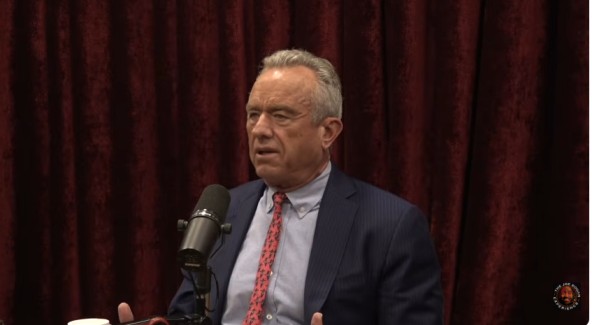
Editor’s Notes: In this episode of the Joe Rogan Experience #2461, Joe Rogan sits down with Robert F. Kennedy Jr. to discuss his recent government appointment and his ambitious mission to reform the American healthcare system. RFK Jr. provides a candid look at what he describes as a “sick care” industry, detailing massive fraud within Medicaid and Medicare while highlighting the country’s rising chronic disease burden. The conversation also explores the complexities of modern political partisanship and the dramatic shifts in party ideologies regarding trade and immigration. This deep-dive interview offers a unique perspective on the challenges facing government agencies and the ongoing efforts to prioritize public health over corporate interests. (Feb 27, 2026)
TRANSCRIPT:
Introduction: Headphones and Focus
JOE ROGAN: I like them, but if it’s just me wearing them, I feel stupid.
ROBERT F. KENNEDY JR.: Why do you wear them?
JOE ROGAN: I like it because it locks me in. Just locks me in. The only thing I hear is that person’s voice. And I can’t hear Jamie’s chair moving. I can’t hear anything else. And it just makes me really focused on the conversation only.
ROBERT F. KENNEDY JR.: I have ADHD, I had 11 siblings and I have seven kids. So I can work, I can focus.
JOE ROGAN: No matter what.
ROBERT F. KENNEDY JR.: No matter what.
JOE ROGAN: It’s a skill, it’s a thing to learn. If you’re the person that can focus without distraction, you’re a good person to be in the job you’re at. Yeah. What is it like? So since you’ve been appointed, I haven’t talked to you on a podcast.
RFK Jr. on His Role at HHS
ROBERT F. KENNEDY JR.: I know. Yeah, it’s the best job I could ever have. I feel like I was designed for the job and I just have so much fun. I mean, it’s a target rich environment. So there are so many ways that you can be effective, improve people’s lives every single day.
Part of that is because the agency was just such a mess. It wasn’t doing health care, it was doing sick care and just managing all of these perverse incentives and having us spending $5 trillion a year, two to three times per capita what any other nation spends, and we have the sickest population in the world, we have the highest chronic disease burden in the world.
You are the best at medicine in this country, but that’s when people get sick. You’d rather get sick here than any place in the world, but you’re more likely to be sick here than any place in the world.
And then it was just a big political patronage operation. And it still is. We’re putting an end to that now. I mean, the amount of fraud that goes through that place — we lose just on Medicaid and Medicare, $100 billion a year. And it’s all just this really shocking, blatant fraud that has become industrialized.
I mean, there are foreign nations like Russia — everybody’s heard of Somalia — but also Cuba has this operation in Florida where they open up these little PO Boxes for durable medical equipment, like knee braces and wheelchairs. And then they don’t have any knee braces or wheelchairs, but they have patient identification numbers. So they just claim to be shipping them to people.
And we found one hotel that had like 129 rooms and every one was a different company that was selling durable medical equipment. And we go in and shut them down and they immediately go back to Cuba. The whole thing is apparently run by the Cuban government. But Russia’s doing the same thing. Where do they get the patient ID numbers? They can buy those numbers on the black market.
Medicare and Medicaid Fraud
JOE ROGAN: Really?
ROBERT F. KENNEDY JR.: Yeah. And Russia does the same thing in Los Angeles with hospice care. So there’s more hospice care in Los Angeles than the entire rest of the country combined. It’s all fraudulent. And we’re just pumping hundreds of millions of dollars into these fraudulent operations.
The same thing that the Somalis did in Ethiopia — a lot of that money was going back to Boko Haram and terror groups over there. But the Medicare stuff is different. And we’re going to be able to catch almost all of that now because we’re using AI to do it. It was never used before. There was no effort at program integrity.
In fact, the Biden administration deliberately, purposely ordered them — they ended the program integrity office. So they went from hundreds of people to six people and they said, “We don’t want you doing program integrity, we just want you doing enrollments.” And so we got all this fraud.
Most of it came from these waivers that the states got. All the states got them for home care and community care. So, 30 years ago, Medicaid and Medicare — if you got a hernia operation, we paid for that. And you could tell somebody got the hernia operation because they had the scar. They used a licensed nurse, they used a licensed doctor. It was all documented.
Then some of the states said, “We’re sending a whole lot of people to the hospital and we don’t have home care providers.”
JOE ROGAN: So —
ROBERT F. KENNEDY JR.: “If you let us pay family members to do home care, the patient won’t have to go to the hospital, they won’t have to go to the emergency room, and we’ll save a lot of money.” So it was well intentioned. But then what happened is people immediately started abusing it.
So today, these are services that are normally performed by family members — buying groceries for your grandmother and bringing them home, you now get paid for that; balancing your grandmother’s checkbook; driving her to a medical visit. So then you had this organized fraud, and this is what happened in Minnesota. These organized crime companies would come in and say, “You designate all your children as having autism now, even if they didn’t, and we’re going to pay providers for each of them and we’ll give you a few thousand dollars to do it.” But then they would collect all the money.
And that’s what was happening.
When Did the Fraud Begin?
JOE ROGAN: How long was this going on for? Like, when did this fraud begin?
ROBERT F. KENNEDY JR.: It really accelerated during the Biden administration. We expected to pay for the Minnesota program just for autism care for kids with autism. The kids need the care because they go to maybe a special school, but then they come home from school and parents aren’t there because they’re working. Who’s going to take care of them? So in legitimate circumstances, you would want to pay for that.
But what happened is they just started this wholesale fraud. We expected the cost of that program to be about $3 million a year. In Minnesota, in Minneapolis, over a three year period, it got up to $400 million a year. So it was almost all fraudulent.
JOE ROGAN: I just don’t understand. So this accelerated during the Biden administration, but when did it begin?
ROBERT F. KENNEDY JR.: They specifically told people in my agency — and I’ve talked to them — “We don’t want to do program integrity anymore. We now just want to focus everything on enrollments.” In other words, enrolling more people in Obamacare and the programs.
And you could say there were bad motives there because the states don’t pay — the states pay a tiny fraction of it — but it all goes to the federal government. The states don’t really want to do fraud detection because all that money is coming into their state. And then every time you enroll somebody, you’re registering them to vote. So they may have had ulterior motives, let me put it that way.
But right now what we’re doing is we’re saying to the states, “We have audited you, and we believe that 50% of the program dollars you’re spending were fraudulent or possibly fraudulent. You show us a corrective action that you’re going to take, or we’re going to withdraw that money.” The next time the money’s not being withdrawn from individuals — we’re not reimbursing the state for it until they tell us.
Now, the red states have all said, “Yeah, we’ll do it.” But Maine, Minnesota, California, and New York have said no. Basically, they sent us a corrective action that was just ridiculous.
Political Motivations Behind the Fraud
JOE ROGAN: So is there a financial incentive? Are these people that are making all this money from fraud donating to any specific groups? Like, is there a direct turnaround?
ROBERT F. KENNEDY JR.: The Cubans in Florida — Florida, you know, they get mad at Trump because they say all the states you’re designating are blue states. That’s just because the blue states refuse to cooperate. But Florida’s a red state and we’re really going after them. We’re shutting down all durable medical equipment reimbursements for the whole state because it was probably being run by the Cuban government.
JOE ROGAN: But I don’t understand how no one saw it. No one from the government saw it. And would there be a reason why they weren’t looking for it other than they just wanted enrollments? Were they also — was anybody making money outside of these crime organizations?
ROBERT F. KENNEDY JR.: I would say no, the money was not — the states were making money.
JOE ROGAN: Right. But there was a lot of talk online about donations to parties and donations to NGOs.
ROBERT F. KENNEDY JR.: That is probably true too, although I don’t have any evidence of that.
JOE ROGAN: No evidence. Okay. So it really just ramped —
ROBERT F. KENNEDY JR.: Even if you get those kind of donations, it’s not the kind of proof that I would talk about. Because you cannot prove that —
JOE ROGAN: Right.
ROBERT F. KENNEDY JR.: — that donation motivated the bad behavior.
JOE ROGAN: But it just really highlights how ideologically captured some people are, that because it’s the right wing going after this Medicaid fraud, that somehow or another that fraud is okay, and that fraud’s not that big a deal. What’s the all told number that’s been stolen from this stuff? If you had to take a wild —
ROBERT F. KENNEDY JR.: It’s at least $100 billion a year. $100 billion a year just from Medicaid and Medicare.
JOE ROGAN: That anybody would not want to stop that kind of crime because it’s attached to the wrong party — it just shows you how weird this country is right now.
RFK Jr. on Party Affiliation and Political Identity
ROBERT F. KENNEDY JR.: Yeah, I mean, listen, I was a Democrat my whole life and —
JOE ROGAN: What are you now?
ROBERT F. KENNEDY JR.: Now I’m kind of — first of all, it’s illegal for me now to vote in any state. So I don’t really have a party affiliation because they challenged — I was a New York state resident when I was running. They sued me and they said, “Oh, you don’t really live in New York. You live in California.”
I said, “Yeah, but my driver’s license is from New York, my law license is from New York. I have an address in New York. My car is registered in New York. My falconry license is in New York. My hunting license is in New York. My fishing license is in New York. And I intend to return to New York.”
And there were hundreds of cases, just black letter law, saying the only measure is if you intend to return there at some point. We got crooked judges. And they said, “No, you’re not a New York resident.” I’d already said, “I’m not a California resident. I don’t intend to stay there.” So now I’m not legally allowed to vote in any state.
But you know, I saw this with party. My father hated partisanship because he thought it was dishonest. And he always told us, “You should vote for the man, not the party.” He said “the man” because at that time, it was predominantly men.
But I saw this when Trump — I grew up in a Democratic Party that was very anti-NAFTA, so it was for working people and labor unions. Then Trump said that he was anti-NAFTA. All of a sudden, the Democratic Party was pro-NAFTA, and that’s what turned my head the first time.
And then when Trump questioned vaccines during the 2016 election, the Democratic Party — that skepticism and those concerns were spread evenly across the party. My uncle Ted Kennedy was very much on the side of medical freedom, and it was evenly spread. But as soon as Trump said that, it became part of the dogma of that party.
And then when I ran, one of the things I ran against was the Ukraine war. And the Democrats were always the anti-war party. As soon as Trump questioned that war, they became the pro-war party and they invited the CIA director to speak at the Democratic Convention.
It just is — the party’s only agenda is “we hate Trump,” and anything he says, we’re going to do the opposite of it. And it makes me very sad for the party. And I don’t think it’s a sustainable way to operate.
The Tylenol Warning and Political Polarization
JOE ROGAN: No, there has to be some sort of an appeal to people in the middle that left when things went crazy. Just let us know you’re not crazy anymore. Let us know you’ve abandoned a lot of this crazy stuff and also, like, recognize what’s good for everybody. Right. Hundreds of billions of dollars of fraud is not good for any of us, the whole country. So we should all be together on this one thing. Like, this is terrible. This is stealing from your tax money. All of our tax money. Us American citizens, we should all be united on stopping any kind of fraud. Forget about who’s the f*ing president and who’s going to get responsibility for it? Who’s going to take responsibility? Who’s going to get the accolades? Like, who cares? Stop fraud.
ROBERT F. KENNEDY JR.: Stop.
JOE ROGAN: We’re all together. You shouldn’t have criminals from other countries living here, just stealing money from Medicaid. That seems like that should be a bipartisan issue in a rational society.
ROBERT F. KENNEDY JR.: Yeah. And on the — I saw this craziness when we did the Tylenol findings because the science is really clear. There are dozens — I read 76 studies over a week when we were looking at this. And the studies that support Tylenol safety are very weak, and they have huge holes in them. There’s overwhelming science that says you shouldn’t take it, particularly during pregnancy, and particularly the last days of pregnancy or in the perinatal period — the prenatal perinatal period, which is immediately after pregnancy. You don’t want to take it because the association with Tylenol usage at that point and neurodevelopmental disease is very, very high and pretty clear.
And so we issued a warning. We didn’t ban Tylenol. We just sent a letter out to all doctors saying, be careful. We didn’t want to ban it during pregnancy because as bad as it is, it’s the best thing. It’s better than taking ibuprofen or aspirin.
JOE ROGAN: Why is aspirin bad there?
ROBERT F. KENNEDY JR.: Because of Reye’s syndrome. It has a clear association with Reye’s syndrome, and they all have problems.
JOE ROGAN: What is that? Reye’s syndrome.
ROBERT F. KENNEDY JR.: R, E, Y, E. Yes.
JOE ROGAN: What is that?
ROBERT F. KENNEDY JR.: I’m not sure exactly what it does.
JOE ROGAN: Put that into our wonderful sponsor, Perplexity.
ROBERT F. KENNEDY JR.: And if you put aspirin use and Reye’s syndrome, you’ll see that.
JOE ROGAN: So is this just with pregnant women?
ROBERT F. KENNEDY JR.: Or with people in general or young children?
JOE ROGAN: Oh, well. So baby aspirin — didn’t they always used to have children’s aspirin?
ROBERT F. KENNEDY JR.: Yeah, I don’t know if they do it anymore.
JOE ROGAN: Reye’s syndrome is a rare but serious condition causing sudden brain swelling and liver damage, primarily in children and teens recovering from viral infections like flu or chickenpox. It has become very rare due to reduced aspirin use in kids. Wow, aspirin.
ROBERT F. KENNEDY JR.: Yes.
JOE ROGAN: I always thought of aspirin as, like, the most natural and healthy out of all those things that you take for pain.
ROBERT F. KENNEDY JR.: I think it is pretty safe.
JOE ROGAN: But it says avoid aspirin and — what’s that word?
ROBERT F. KENNEDY JR.: You say it, but is it salicylate?
JOE ROGAN: Salicylate-containing meds in children and teens with flu, chickenpox, or cold. Use acetaminophen or ibuprofen instead. Vaccinate against flu and chickenpox, and screen newborns for metabolic risks. So it’s acetaminophen that’s the issue in Tylenol, right? Yeah, because I read this terrible story about a lady who died during COVID — not from COVID, but from Tylenol. She just kept taking Tylenol.
ROBERT F. KENNEDY JR.: Well, Tylenol shuts down your liver if you take enough of it.
JOE ROGAN: That’s what happened to her.
ROBERT F. KENNEDY JR.: What I was saying is, when we issued this warning, it was immediately condemned by the Democrats. “Oh, here’s Trump and Kennedy doing weird science again.” And then you had all of these viral videos on TikTok of pregnant women eating Tylenol.
JOE ROGAN: Yeah. To say f* Trump. It’s crazy. I hope they didn’t really do it. I hope they were pretending, because that’s so dumb. It’s just so stupid. Why would you even want to risk that? How is that not a thing — that you just abandoned all party affiliation and go, “The health of my child. This is science.” They’re not saying don’t take Tylenol. You could still buy Tylenol. It’s a good thing to know that if you take too much of something, it’s bad.
There’s a lot of things that are fine if you take one or two pills, but if you’re that poor lady with COVID and you just keep taking it over and over and over again, you’ll die. We should know that. It doesn’t mean you shouldn’t take aspirin or you shouldn’t take Tylenol, but it just means know when to take it and when not to take it, and know how much to take. That’s all information that everybody should want to be out there.
The fact that people want to connect that to Trump, and “I’m going to take Tylenol while I’m pregnant” — like, what? Imagine the aliens watching us and going, “They’re not ready. They’re not ready for sophisticated time traveling technology. These f*ing dopes. What are they doing? They’re fighting over nonsense.” And it’s all heavily accelerated by social media.
Social Media, Tribalism, and Polarization
ROBERT F. KENNEDY JR.: Yeah. The algorithms just amplify that polarization.
JOE ROGAN: Yes.
ROBERT F. KENNEDY JR.: They’re just telling you what you want to hear and validating your worldview all the time.
JOE ROGAN: And also just outraging you. Just outraging you all the time. I’ve been off it for a while now. It’s like it frees your brain. All the weirdness of thinking about nonsense in the world — you’re aware of it peripherally, but it’s not in your face all day, which I think most people are dealing with a lot more even than I was. And they’re just bombarded by sensation, bombarded by anger and frustration and angst.
ROBERT F. KENNEDY JR.: It kind of liberates the darkest impulses of the human spirit. I don’t use it either, but I post stuff. But if I start reading my comments and take them seriously —
JOE ROGAN: No, it’s terrible. I genuinely thought when you joined forces with Trump, and then Tulsi did as well, I was like, “Okay, maybe this will unite us more and make more people realize that there’s a lot of people that are being left out that are in the center of all this, and we can all come together and work together.” That’s what I thought, naively.
Obviously, once you guys got in there, you guys were MAGA, and like, “Health is bad” and “Don’t stop the dyes.” No matter what it was, people were ideologically opposed to you being correct about anything, because now you’re connected with Trump. So it’s like I was watching liberals — the people that are always worried about food ingredients — just dismissing all of this talk about preservatives and glyphosate and red dye and all these different things. And it is just an ideological thing.
ROBERT F. KENNEDY JR.: Yeah. It’s dogma, and it’s part of tribalism. These connectors in our brain evolved over millions of years of living in these little tribal communities. And now you’ve got machines that can activate those parts of the brain, and they’re being manipulated all the time.
JOE ROGAN: Yeah. And then there’s a bunch of people that are commenting that aren’t even real people. There’s a lot of manipulation going on on social media, where who knows who’s doing it. There’s a bunch of different groups doing it, but they’re not real people that are outraged. They’re not real human beings that are saying these things. And they can kind of shift a narrative into a certain direction sometimes.
Joining the Administration: Expectations vs. Reality
It’s a fascinating time to be alive. As far as what you thought this job was going to be before you got in — what were your expectations? Did anything really surprise you?
ROBERT F. KENNEDY JR.: I try to go into every part of my life without expectations and just focus really narrowly on what I’m doing day by day. And that actually makes me a lot more resilient, because if you don’t have expectations, you never get disappointments, and so you can never get crushed.
But I would say that I had not spent a lot of my life hanging out with Republicans, and what I imagined they were talking about is exactly the opposite of what I found. Now I’m in an administration surrounded by immensely talented people, and they’re immensely idealistic. I always imagined the Republicans would get together and they’d be thinking about how do we screw the poor, and how do we reduce taxes on the rich? But they’re just narrowly focused on how do we solve these big problems and how do we make our country work. The level of idealism that I see at every level in the White House and in my agency is inspiring. And the level of capabilities — just the competence of the people I’m surrounded with — is remarkable.
I think the thing that shocked me most was how bad the agency was — just how inefficient. Nobody seemed to care that people were getting sicker and sicker. Nobody was taking accountability for the fact that we’re the health agency, and yet we have the worst health outcomes. We’re the richest health agency in the world. I think HHS is the equivalent of the sixth biggest country in the world if you look at its budget. It’s got the biggest budget in the federal government, bigger than the defense budget, and yet we are absolutely miserable at what we do.
America’s Chronic Disease Crisis
We’re literally presiding over this cliff where every American is getting — where 77% of American kids can’t qualify for military service. And nobody’s asking why that is happening. When I was a kid, the typical pediatrician would see one case of juvenile diabetes over a 40 or 50 year career. Today, 38% of teens are diabetic or pre-diabetic. So one out of every three kids who walks through his office door — why isn’t anybody noticing?
The autism rates have gone from 1 in 10,000 in 1970 — and people knew what autism was, they knew what it looked like. In 1970, they did the biggest epidemiological study in history to answer the question of what the percentage was, and they came up with 0.8 per 10,000 — less than 1 in 10,000. And today it’s 1 in 31. In California, it’s 1 in 19, and 1 in 12.5 boys.
JOE ROGAN: That’s crazy.
ROBERT F. KENNEDY JR.: That’s so crazy.
JOE ROGAN: 1 in 12.5 boys is crazy.
ROBERT F. KENNEDY JR.: And when my uncle was president — I was a 10 year old boy — we spent zero on chronic disease. Zero. And today we spend $4.3 trillion a year. And it’s the fastest growing item in the federal budget. And it’s existential. We can’t sustain it. And the Republicans and Democrats have been arguing for years about whether we do single payer or Obamacare this or that. It’s all about throwing money — who gets to keep the money. And we’re throwing it into a system that’s completely broken. It’s not health care.
JOE ROGAN: We just keep getting sicker and sicker.
ROBERT F. KENNEDY JR.: It’s like rearranging deck chairs on the Titanic. Why is nobody focusing on how do we get people healthy? Because that’s how you solve the health care problem. Right now, 40 cents out of every dollar that you spend in federal taxes is going to health care. And about 90% of that is chronic disease.
Americans don’t want to be sick. They’re being made sick. The obesity rates have gone from 5% in kids when I was a kid to now close to 20%. And in adults, 70% of adults are obese or overweight. That was not true when we were kids. It’s not because Americans got indolent or lazy or hungry. It’s because they were being mass poisoned. And the vested interests that are making money — everybody makes money on keeping us sick. The food companies make money on getting us sick, but pharma makes money on keeping us sick. The insurance — you would think insurance would want to keep you well, but it doesn’t. It actually makes more money if more people are sick.
JOE ROGAN: Hospitals too. How does the insurance company make more money if people are sick?
Fixing the Healthcare System
ROBERT F. KENNEDY JR.: Well, I mean, think of it this way. If you’re Lloyd’s of London, and you’re insuring all the ships in the ocean, do you want one ship to sink a year or do you want 1,000 to sink? If 1,000 sink, everybody’s going to be paying you premiums to ensure themselves against that eventuality. And you’re making money on the friction. So you’re making the money that comes into this. You’re making your money on the money that comes to the system. The more that you pump up that volume of money, the more you make.
So nobody is interested, nobody is economically incentivized to make people well. And we are not going to get well until we align those economic incentives with the health outcomes that we want, which is nobody gets sick. We end the chronic disease epidemic. And that’s what we’re doing now, trying to realign all those perverse incentives that reward you.
For example, the medical system pays out on fee based service. That means the more tests the doctor orders for you, the more drugs he prescribes you, the more contact he has with you, the richer he gets. He is not incentivized to get you well. We ought to be paying them a flat fee at the beginning of the year and saying anything, any cause from this patient the rest of the year come out of your pocket. And then he’s like, “Okay, how do I get this guy from getting sick?” And he starts studying nutrition books. And you know, that’s actually an interesting idea.
JOE ROGAN: It seems so captured at this point. It’s going to be difficult to unravel all that.
ROBERT F. KENNEDY JR.: It’s difficult, but it’s not impossible. And we’re doing it. You know, three years from now you’re going to see a different health care model in our country.
The Lack of Public Awareness
JOE ROGAN: I think talking about it has a big impact because most people are just not aware of how the whole system works and what is actually wrong with it. You know, most people just hear about it. “Health care, people are sick, they need health care. Why would they cut health care? Cutting health care is bad.” That’s what they would just immediately think.
And I think most people, they think of the fraud stuff and they want to dismiss it. I’ve heard all these people dismiss this Nick Shirley kid and what he exposed in Minneapolis. But the reason why is because it’s the wrong party. If this was a Democrat that was exposing Republican fraud, then they would be all into it, it would be on every newspaper. But instead, they’re trying to dismiss it as not relevant.
Aligning Economic Incentives with Health Outcomes
ROBERT F. KENNEDY JR.: Yeah. And to me, it’s weird because I know Democrats are human beings and they care about the same things that I do. I’ve known almost all of them, many of them for 40 years. Bernie Sanders I’ve known for 40 years. Their only solution is more money to the system, a system that is broken, that is making us sicker and sicker.
And what President Trump wants to do is he wants to fix the system. Most of that money is not going to the patients, it’s going to the insurance companies and the PBMs and all of these middlemen that are milking the system. And that’s why President Trump says the answer is to not pay the insurance company. It’s to pay the consumer directly and put him, make him the CEO of his own healthcare so that he can spend money. He’s now incentivized to do prevention and to maybe do holistic medicine or take vitamins or take vitamin D, which is, as you know, kind of miraculous. Or to do alternatives, to do preventative care.
And he wants to save money. Right now, nobody is in that position of accountability. We need to make them the CEO of their own health so that they have responsibility and they’re going to pay the cost if they get sick. Government pays, but they then decide how to allocate that money.
Price Transparency in Healthcare
And then we need to make the system transparent. And that’s one of the things that we’re doing. During his first term, Trump passed a transparency bill. But because Trump had passed it, everybody wanted to oppose transparency. If you’re a woman, you’re pregnant, you want to know how much it’s going to cost you to have that baby. There’s no way you can find that out for most of them. You can go nine months on a phone every day asking, “How much is it going to cost?” And you’ll never get a straight answer.
So, in New York, for example, what we’re doing now is we’re going to make all of the hospitals and all the providers post a menu of their prices that are available to everybody and that are available on a website that works. So if you want an MRI, and there are 40 places around your home that offer MRIs, you can’t right now figure out what they cost. Now you’re going to be able to go and look at them all on a single page and figure out what the cheapest one is.
If you go to a restaurant, the prices are on the menu. If you go to buy a car and the guy says to you, “You can buy the car, but I’m not going to tell you how much it costs until after you buy it,” nobody would operate that way. But that’s how our medical system operates.
So we have a mock up of this website. During the Biden administration, because Trump had passed that law, the Biden administration just refused to enforce it. So we’re in the same position now where there’s no transparency. We’re changing that now. We’ve sent out over a thousand letters to hospitals, warning letters that say, “You’ve got to post them right now.” And we just finalized new regulations. If they don’t do that, they’re going to pay a huge fine.
So I saw the mock up of the website and I asked the question, “How much does it cost in the hospitals within a mile of Manhattan to have a baby?” There were about 30 hospitals. I could visualize them on one page. One of them was $1,300, that was the lowest. The highest was $22,000. In Detroit, the cheapest place to have a baby is about $5,000 and the most expensive is $60,000. And it’s the same service, the same quality care. Nothing changes except the price. Why do we have that chaos? We have it because the industry wants to hide what it’s doing. And so there’s no market, there’s no ability for people to make good choices.
When I was staying with Dr. Oz during the transition at his house in Florida, one day Prime Minister Rudd, who was the former prime minister of Australia, came by. After he was prime minister, he had been appointed to run a commission to reduce health care costs and improve quality. And they were very successful. But he said the number one thing that they did that changed everything was price transparency, was showing people the price of what they’re going to pay.
So we’re now going to do that and people will be able to shop. Now we also have to shift all of that money away from the insurance companies and put it in the hands of the public so that they are maximally incentivized to make good choices.
Reforming the Food Pyramid
JOE ROGAN: So as far as making good choices with food, I love what you guys did with the food pyramid. Essentially flipped it on its head. Which is kind of crazy that for the longest time we were being told that the most important things, the primary diet should be grains and rice and wheat. And now it’s things that we’ve known for a long time. It’s whole food, actual real food. That’s what you’re supposed to be eating. The problem is getting people to change their habits and change their ways. And if people don’t start eating good food and if people don’t start taking care of their body, what other things can you even imagine would shift this trend?
ROBERT F. KENNEDY JR.: Well, here’s what’s going to happen. First of all, the food pyramid. I inherited a food pyramid from the first way I came into office, one year and two weeks ago. A week after I got in, I was handed the food pyramid that the Biden administration had. It wasn’t even the food pyramid. They got rid of that. They were just doing the dietary guidelines. So it was the recommendations that would be reflected in the food pyramid. It was hundreds of pages long and it was incomprehensible. And it was driven by all the mercantile impulses that had corrupted the food pyramid for 50 years. And it was written by lobbyists, it was written by the food industry lobbyists.
And the same impulse that put Froot Loops at the top of the food pyramid — which isn’t even a food, Froot Loops — were at the top of the top recommendation of the food pyramid. You can ask them to look up the old food pyramid.
JOE ROGAN: I need to see where Froot Loops stand. Don’t they throw some vitamins on Froot Loops? Is it like Vitamin E?
ROBERT F. KENNEDY JR.: Oh, yeah. As if that’s good for you. It’s good for you, right?
JOE ROGAN: They add vitamins. Do they even have vitamins?
ROBERT F. KENNEDY JR.: And you know, it’s not going to make it any better for you.
JOE ROGAN: No, no, I’m joking.
ROBERT F. KENNEDY JR.: But—
JOE ROGAN: But it was ridiculous. So how did—
Fixing the Food System: MAHA’s Approach to Nutrition and Health
ROBERT F. KENNEDY JR.: What we did is we got the best nutritionists in the country. We got Mark Hyman and we got the nutritionists from the best universities in the country. And we put them all in a room. And I thought it was going to take a month, it took 11 months because they fought over every recommendation and everything is cited in source so that we know we have good science.
But some of the stuff, because of regulatory malpractice all these years, some of the studies simply haven’t been done. So there are knowledge gaps which we should not have. So now we have a food pyramid. And because of the old food pyramid, people didn’t like the food on it and they were going to ultra processed food, which was okay on the food pyramid. So now 70% of the food that our kids eat is ultra processed food. 70% of the calories they get, and it’s just poisoning them.
And they took off the good stuff like whole milk, which is nutrient dense, which is feeding their brain. We have two generations of kids that grew up without milk, without the proper nutrients for their brain. We have the first country in the face of the earth that has chronic obesity and in the same people, malnutrition. So you have immensely obese people. And they’re malnourished. They’re medically malnourished. That’s because the food pyramid was so messed up.
So what’s going to happen now, Joe, is that we are going to be able to drive that. We’re going to be able to change dietary culture. Just the food pyramid is going to change dietary culture. And here’s how. Brooke Rollins, who’s an incredible USDA secretary, she administers $405 million a day that she gives out to food subsidies or school lunches, the WICS program, the SNAP program, Indian Health Services and all of these other programs. And so those programs now are going to get good food because the dietary guidelines dictate what they can and cannot feed kids.
Military and the VA also are changing. Now, this week I met with a guy, Chef Robert Irvine, who is a television chef. He’s been hired by Pete Hegseth to come in and change all the military meals. He’s already on five bases. By the end of this month, he’ll be on 20.
What he’s done is the food that we give our military is so bad they won’t eat it. So they’re going out and they’re spending their money on fast food. And fast food is not cheap. A Big Mac meal costs $12 to $14. It’s not a cheap meal. You can get really good food for that price. You could feed yourself the whole day for that price with good food. Mark Hyman’s new book has a diet — a $10 a day diet, three meals, great food.
Anyway, Robert Irvine has gone into these places and he gives them all fresh food, almost all of it locally sourced. As it turns out, it’s cheaper. The military is spending $18 a day for three meals for each soldier. He’s spending $10 a day and giving them real food. Good food. And the lines now are around the block and nobody’s going to fast food. Everybody’s fighting to get in. And what he says is it doesn’t cost more. We don’t need any more money. We just need to buy smarter and to be smarter about how we do it.
One of the things that we’re doing with the Dietary Guidelines is the SNAP program. We have 20 states now that have applied for SNAP waivers and have been granted so that you can no longer get candy on SNAP, you can no longer get soda. That was 18% of SNAP purchases. So we are taking the 63 million poorest kids in our country, giving them taxpayer funded diabetes. And 78% of them end up on Medicaid. Many of them have been treated for diabetes. So we’re paying to give them the disease and then we’re paying to treat it for the rest of their lives. And we’re changing that.
And one of the things that Brooke is doing is she’s going to require that any retailer that accepts food stamps has to double the amount of real food in their establishment. We’re working with farmers, we’re working with entrepreneurs to make sure every American can get high quality food that is affordable.
JOE ROGAN: I don’t know how anybody would be opposed to that. That all sounds fantastic.
ROBERT F. KENNEDY JR.: It’s weird that they are.
JOE ROGAN: How could you — the way you just laid it out, how could anybody be opposed to that? That all sounds great, especially for the soldiers. The fact that they were getting terrible food that they didn’t want to eat is just — that’s really offensive. You know, you think about what you’re asking of them and then you’re giving them garbage that they don’t even want to eat. Like, how do they feel that you care about them?
The Lost Art of Cooking and the Gut-Brain Connection
ROBERT F. KENNEDY JR.: Well, and one of the things Robert Irvine, the chef, told me — he said it costs $9 to get a frozen salmon, it costs $6 to get a fresh salmon. So good food is actually, if you cook yourself at home, much, much less expensive. The problem is Americans have forgotten how to cook.
And cooking is really important because it’s important for family cohesion, for a sense of community. It’s a daily, almost sacred ritual. And taking that away from our lives has amplified the spiritual malaise that we’re in. And one of the things we’re going to do is to start sending federal workers out to teach people how to cook. They don’t have the implements, they don’t have the cutting boards. They don’t know how to buy groceries.
And you can go into any big grocery store in this country. If you go and buy a steak, it’s still pretty expensive, but if you buy the cheaper cuts, it’s great meat and it is very, very affordable. Or liver, or all these alternatives. Chuck roast, you know, how can you be against that?
I told you — 20 states have applied for this SNAP program and we’ve granted them SNAP waivers. Why would you want taxpayer — if you want to drink a Coke, you ought to be able to. We live in the United States. We’re not going to take anything away from anybody. But the taxpayer shouldn’t be paying for it, particularly when we’re paying for it on the other end in diabetes. So this just makes sense to anybody.
20 states have applied. Only two of them are blue states. Bernie Sanders has been fighting for this for years, but Vermont won’t apply for one. And it’s all partisanship. And they’re putting their hatred of Donald Trump ahead of their love for their own children. And until we learn to stop doing that, healthcare in this country is not going to improve, at least in those states.
JOE ROGAN: So what strategies, if any, could you ever imagine that could be implemented that would kind of unite people on these things and get them to stop being so partisan about one of the most important aspects of being a human being — staying healthy. It’s like love and health. Those are the top ones that we all want. It just seems insane that we would choose this as a battleground. And it seems insane that it’s connected to one party or another. It shouldn’t be. We should all be united on at least this.
And I think if people were a little healthier and they were a little more fit, they’d probably have a lot less anxiety, probably a lot less conflict when it comes to political disagreements. Things could probably be worked out more amicably, especially among friends. Having good health improves virtually every aspect of your life.
ROBERT F. KENNEDY JR.: Yeah. I mean, for everybody, I’d say two things. The food ties directly into your mental health.
JOE ROGAN: Yes.
ROBERT F. KENNEDY JR.: And we now know this is so well documented — there’s a gut-brain connection, and that depression, ADHD — Chris Palmer up at Harvard is dramatically reducing the symptoms of schizophrenia simply by changing people’s diets, using a keto diet.
JOE ROGAN: Dramatically — like, what kind of percentage?
ROBERT F. KENNEDY JR.: They’re losing 30% of their symptoms.
JOE ROGAN: Really? Just from ketones, from keto. What about — have they done anything with like, the —
ROBERT F. KENNEDY JR.: The same thing is true. There’s a big paper about to come out on losing a bipolar diagnosis. Kids who lose a bipolar diagnosis simply by changing their diet. We know that ADHD is driven by all these food dyes and stuff, and that’s very well documented.
There are all of these — you go on the Internet and you look for studies that show what happens when you change the food in prisons and juvenile detention facilities. And they’ll put it in one wing of the prison — they’ll put good food — and then they’ll put the standard food in the other. And the level of violence goes down by 40, 45, 50%. The use of restraints in juvenile detention facilities goes down 75%. The number of incidents dramatically drops. And so it’s a public safety issue in the prisons.
I’ve been meeting now with all the prisons. Prisons have a real problem because they’re allocated — the state prisons are allocated 60 cents a day to feed the prisoners. And it’s all about shelf life. So they’re just feeding them the worst kind of poison that you could possibly — it’s all just chemicals.
JOE ROGAN: We’ve kind of given up on the idea of rehabilitation. It’s just all about punishment. And then —
ROBERT F. KENNEDY JR.: But this is also public safety. It’s guard safety. And the other thing, in the answer to your first question about how do you mitigate the polarization — I would say the only way that you do that is by getting people to start talking to each other. Because you’ve got to be able to find common ground with other people. And if you don’t talk to them, you don’t see their humanity.
JOE ROGAN: Right.
The Importance of Human Connection in a Polarized World
ROBERT F. KENNEDY JR.: And that’s one of the things that you do that is so great, which is you bring a lot of people on here who you disagree with and you have a civil conversation about them, and you show your curiosity about them, and you get to hear their rationale. And a lot of times I’ll listen to somebody on this show, I’ll say, “I don’t like this guy,” and then I’ll listen to his rationale and I’ll think, “Oh, actually, he’s making a lot of sense.” And we have to stop hating people because of the label on them and start listening.
And it’s really important we do that now because these algorithms are designed to drive us all apart. And we’ve always had political polarization in this country. I mean, I grew up during the 60s, and there were bombs going off and people being shot — it was very, very violent and vitriolic when my dad was running. And the polarization probably was the worst since the American Civil War. But today, when it is amplified by the algorithms, it’s hard to see where it’s going to end up in a good place unless we start learning to talk to each other.
JOE ROGAN: It’s not just the algorithm, it’s also the method of communication. When you’re only talking to people through angry tweets back and forth with each other — you were saying, sit down and talk to people. No one’s doing that anymore. Very few people. There’s a few FaceTime conversations going on. You see your friends if you go out with them. People are not talking that much anymore, and they’re not sitting down and talking. And when you do, everyone’s distracted. Everyone has their phones out, everyone’s checking text messages.
Cell Phones in Schools: A MAHA Legislative Push
ROBERT F. KENNEDY JR.: One of the most important things that we’re doing right now as part of the MAHA legislation from my agency — we’re going state by state and we’re asking them to do bell-to-bell legislation. And 26 states have now already done it, so more than half the states, so that kids can’t use cell phones in schools.
I went to a school in Loudoun County the other day, and the states love them. The students had fought and fought against this, against giving up their cell phones. The way they do it — all of the school districts and states do it differently — but in that state, they can bring their cell phones to school, but they have to leave it in their backpack. And if the parent calls and needs to talk to them, they can do it.
But I walked into the cafeteria — 600 kids in that cafeteria — and they’re all talking to each other. They’re sitting across the table. Nobody’s looking at their laps. The parents came that day. I polled the students and I said, “How many of you think this is a good idea?” And they all put their hands up and they said, “We all hated it for the first two weeks and now we love it.”
The parents said, “It’s the best thing that ever happened. My kid is not driving with their cell phone in the car anymore because they know they can live without it.” Or eating dinner with the family and we’re actually having conversations. And then the teachers in the schools love it because the disciplinary problems go down and the test scores go through the roof, because they’re focusing.
JOE ROGAN: Right, of course.
The Importance of Civil Discourse
ROBERT F. KENNEDY JR.: So it’s just like a no brainer. But again, it’s the blue states that are the hardest to convince to do it because they see it as a Trump part of the demonization of Trump being the tyrant or whatever.
JOE ROGAN: It’s just so stupid to not recognize the kids are distracted. Why does that have to be a right or a left issue? It’s stupid. This is a United States issue. The best way to have a group of people that succeed in this world is make it as clear a path for them as possible. And as soon as you allow them to use their phone all day, it’s too addictive. No one can put them down now. You’re going to lose 30% of your concentration or more easily, I would imagine. The fact that that would be a partisan thing is just nuts. It just shows how goofy we are.
ROBERT F. KENNEDY JR.: What you’re doing is so important. And now there’s a thousand people imitating you. Many really good podcasts, but it’s teaching people to have conversations. I mean, you are the best teacher, mentor on that and people admire you.
My kids — I have seven kids and they grew up with devices and stuff. I would slap them out of their hand. And also they couldn’t concentrate on long conversations. They’re like, “Get to the point. I only got five seconds. You got to make your point.” And then I see them sitting for three and a half hours and listening to a Rogan podcast. That was a cultural phenomenon. That was a cultural change.
This generation of kids, I have so much hope for because they grew up with that and they want it. So I do have a lot of hope that we’re going to be able to do this.
And then I think Charlie Kirk did that too, as an example to a lot of those kids, because whether you agree with him or not — and he had very strong opinions that people considered terrible — the one thing that he really did is he talked to people he didn’t agree with, and he always gave them the microphone and allowed them to amplify their voice. He had civility and he talked to them. He used logic a lot of times, not in an angry way. So I think he was teaching people how to have conversations again. You were teaching people how to have conversations again. And I think that’s one of the big hopes that I have for the future, that people learn to talk to each other with people with whom they disagree.
JOE ROGAN: It would be nice. But there’s also a real, genuine problem today in the marketplace of outrage. A lot of people’s podcasts are focused almost entirely on outrage — having arguments and screaming matches with people, putting people down, not having civil discourse, but trying to win, trying to dominate someone in an argument, trying to squash people.
And I guess in a sense, some of that is really good because it exposes bad ideas, but it just encourages that kind of discourse where if someone’s ideologically opposed to you, they are the enemy and you want to destroy them. And I’m like, okay, they’re just a human being. Find out why they got to where they are. That is a different perspective than you have, and why you got to where you are, and try to figure out if there’s a middle ground in there.
What do you believe? Why do you believe that? Ask them and don’t cut them off. Let them talk. Let them express themselves. Try to figure out what makes someone actually think, instead of just thinking that your ideas are a part of you. They’re just ideas. They’re not you. Some ideas you can hold in your mind and they’re bad for you. You haven’t examined them. You’re acting on them like they’re doctrine. And then you’re stuck with that idea because you’ve already espoused it so many times. You don’t want to be a flip flopper.
And so people get mad and you get this weird cycle of sh*y communication, and nobody ever breaks out of it and nothing ever gets done and no common ground is ever achieved. And the only way you’re going to ever break that is to stop talking to people like that. You got to just talk to them. Instead of talking to them like they’re the enemy, just talk to them like they’re a fellow human being about some ideas and treat them with respect. Talk to them like a person that you know, in any other circumstance, maybe even could be your friend. Just talk to them.
People can do that. It’s possible. It just takes discipline. You have to learn how to do it. It took me a long time to learn how to talk to people better. But it can be done and it’s technique.
ROBERT F. KENNEDY JR.: But as prevalent as that kind of vitriol is in the podcast world —
JOE ROGAN: Right.
ROBERT F. KENNEDY JR.: — it is incomparable to what’s happening on television because there are no conversations on television.
JOE ROGAN: Right. That’s more of what I was getting at, honestly. There are some shows that do that, but like some of these CNN shows, it’s just these crazy ideological battles. And guys, pro tip — you can’t have six people at a table all yelling for seven minutes. You don’t have enough time to get a real point across and it becomes a battle of who’s got the best prepared sound bites or who’s got the best snarky quip. It’s stupid. It’s a stupid way to talk about things.
ROBERT F. KENNEDY JR.: Cheryl went on The View. And it wasn’t like, you know, let’s have a congenial conversation with people and allow them to express themselves and to be fun and funny.
JOE ROGAN: Yeah, well, just have a conversation with someone if you disagree with them about certain things. It would have been far more productive to have a one on one conversation instead of this gaggle of hens squawking all at her. You see it over and over again when they oppose somebody — they’re all chiming in and it’s just not the way you could ever thoroughly cover a subject.
And they’re limited by their format. That format is very limiting. It’s a sh*y format where you go to a commercial at predetermined times, period, no matter what. And that’s crazy because if you’re in the middle of talking, a lot of points take a long time to flesh out. Just think about all the stuff you just explained about Medicaid. Imagine if you tried to do that — you can’t. And they would try to stop you. “You’re too in the weeds. No one’s going to pay attention to this.”
It’s like, I don’t think that’s true. And I think we’ve learned that because of podcasts, because there was no production, there were no executives, there was no one there. People were just putting on a webcam and talking. And so we realized people actually do like conversations still. They just don’t get a lot of them — not real ones.
You get interviews where someone has a sheet of questions. You get where someone is playing a role — you’re playing a role of a person who interviews people. You don’t really give a sh about what this person has to say. But people do want connection. They still do. And the fact that we don’t get it from social media, but most of our time is in social media, is just accelerating this detachment we have from each other. And that’s what people have to get past. I don’t know how to do it. Tell everybody — start your own podcast.
Lessons from Larry King and the Art of Conversation
ROBERT F. KENNEDY JR.: You and I were talking before we came in here about Larry King. He did that. A lot of people in the 70s and 80s — David Susskind and all of these other people — were actually having conversations.
JOE ROGAN: Yeah, Larry King was great.
ROBERT F. KENNEDY JR.: Absolutely.
JOE ROGAN: I love when he asked DJ Khaled, “How’d you gain all the weight?”
ROBERT F. KENNEDY JR.: What did he say?
JOE ROGAN: He said, “I ate too much. What do you want me to say?” Such a crazy question — “How did you gain all the weight?” Like, what? Larry, what are you talking about? That’s a wild question to ask someone.
But he would just have a conversation with you, and I think people have a hunger for that. And a lot of this infighting comes from no face to face communication. I think when people get a chance, especially if it’s not performative — that’s part of the problem. Like the Charlie Kirk stuff or some of the other things that people do in front of a crowd. Things become very performative when there’s a bunch of people watching and cheering and you know how the audience feels and you play to them a little bit. That’s probably not the best way to talk about stuff.
I think human beings naturally understand one on one conversations. We’ve had them for all of human history. So when you get a chance to hear people talk one on one for hours at a time, it expands your understanding of the world. Now I know how you feel about things. At least for this brief three hour conversation, I get more of a sense of how you approach things. And then people put that into their own mind and go, “Maybe I should approach things a little bit differently. Maybe I should think about things a little bit differently.” And we miss that. Social media robs you of that. It gives you the exact opposite of that.
ROBERT F. KENNEDY JR.: Yeah. What Charlie Kirk was doing — you’re right. It was less of a conversation and more of, sometimes, like being in the ring. But it’s a lot better than what’s happening elsewhere, which is just blanket censorship of people and not any willingness — just shutting people down and canceling them.
JOE ROGAN: Yeah, 100%.
ROBERT F. KENNEDY JR.: Well, that’s another weird thing. That’s a Democratic Party impulse, because it was the opposite of the Democratic Party I grew up with, which was unafraid of any debate. My uncle, my father said, “We should be able to debate. We should be able to win these debates in the marketplace with ideas. If we can’t, then we need to examine ourselves.”
JOE ROGAN: It was a core tenet of the Democratic Party.
ROBERT F. KENNEDY JR.: Yeah.
Free Speech, Censorship, and the Twitter Files
JOE ROGAN: And the unfortunate shift in that — I remember during the Bush administration when the FCC was going after Howard Stern. It was this huge thing. They were trying to close down Howard Stern because he was very critical of Bush. He was the guy out there fighting for free speech. They were getting fined enormous fines for things he had said that they deemed to be obscene. And that was a right wing thing. We always thought of it as a right wing thing.
And when you see what’s happening today — the wanting silence of your political opponents is the dumbest way to cut off your own hand. It’s so dumb. Because if you can’t see that this could be used against you if someone else gets into a position of power — if all of a sudden some enormous right wing corporation buys these media platforms and only pushes right wing agendas and silences all left wing agendas — do you know how f*ing crazy that is to just give that kind of power willingly to an anonymous group of people that you supposedly align with because you’re in the same tribe? It’s the dumbest thing ever.
And the fact that people on the left weren’t outraged when they read the Twitter files and found out how much involvement there was in silencing real information and removing people —
ROBERT F. KENNEDY JR.: They removed me from Instagram. I lost a million followers. 37 hours after he got — after he took the oath of office, swearing to uphold the Constitution, they were ordering Mark Zuckerberg to take me down. And then you look at what’s happening in England now — people going to jail for Twitter posts.
JOE ROGAN: 12,000 people in the last year.
Free Speech, Social Media Arrests, and the UK Pub Law
ROBERT F. KENNEDY JR.: And this was the Magna Carta was written. And now it’s just a dictatorship.
JOE ROGAN: Well, they got rid of trial by jury, except for murder and rape and a couple other things. Now it’s just a judge. So whatever it is, if it’s a social media infraction, there’s no reasonable judge by a jury of your peers. No, you’re getting judged by a judge.
ROBERT F. KENNEDY JR.: That’s the Soviet system. It’s like Kafka.
JOE ROGAN: I just can’t believe how quick it happened. When you look at the social media arrests, they were always disturbing. Like if you go back even four or five years, they had quite a few of them a year. But it really ramped up over the last year or so and it’s just insane to watch.
And a lot of it is criticism of immigration, like legitimate criticism of immigration and legitimate criticism of crimes that have been committed and people outraged, which is completely normal. But instead of doing anything about that, they want to arrest people from complaining. And it’s just really weird to watch.
ROBERT F. KENNEDY JR.: It’s going to get worse with the AI. It’s scary.
JOE ROGAN: Well, it’s just strange that they couldn’t do anything to stop that from happening. And that anybody, anybody that’s reasonable would be willing to let that happen because their side is imposing it. That seems like an existential threat to all critical thinking, all communication and debate. As soon as you start arresting people for opinions, that’s crazy, you’re getting nuts. Like anything that you deem might incite violence or outrage. People are outraged. They have a right to be outraged. If you can put them in a cage because they’re outraged, that’s nuts. That’s really nuts.
Now they have a pub law. Do you know this one? Oh, find that, Jamie. They’re trying to pass this thing. I don’t want to speak out of turn. I don’t want to f* this up because it was disturbing enough without me misinterpreting it. But the idea was to stop people from saying things on social media that you get arrest for. Stop them from saying those kind of things in pubs.
ROBERT F. KENNEDY JR.: And where is this? In England?
JOE ROGAN: Yes. See if you can find it. I know I saved it, but it’ll take me too long to pull it up. You find anything like that legit? Yeah, I mean, I wouldn’t imagine.
ROBERT F. KENNEDY JR.: It’s not.
JOE ROGAN: I mean, it’s not outside the realm of what they’re possibly capable of doing if they’re arresting 12,000 people a year for social media posts.
If that was happening in America and they were only arresting Republicans, I don’t think you’d hear a peep out of the Democrats. I think they think it’s important. We have to stop misinformation. Yeah, it passed.
ROBERT F. KENNEDY JR.: No, I don’t think it passed.
JOE ROGAN: You don’t think it passed? Okay, so what were they trying to? Okay. “Legislation aimed, blah, blah, blah. But it says you’re still free to converse.” The law now places this. “Free speech in UK pubs. Employer responsibilities requires employers to take reasonable steps to prevent staff from experiencing harassment by third parties, such as customers.” That’s normal, right? You don’t want to be harassed.
“Concerns have been raised that debates on, for instance, gender identity or political matters could lead to staff complaints resulting in patrons being asked to leave. If the behavior is deemed aggressive or harassing, it should not be misinterpreted as a ban on lawful, polite or controversial speech.”
Who’s to decide what’s controversial, though? “Third party harassment legislation focuses on addressing harassment rather than banning specific topics of conversation entirely.” Just any regulation of conversation is nuts. If it’s one thing, you’re harassing the staff owner.
ROBERT F. KENNEDY JR.: I’ve never known a pub owner who would allow people to come in and harass his staff. He already has economic and management incentive to not allow that. It’s not the kind of thing you need to legislate.
JOE ROGAN: But to say that someone doesn’t feel safe if people are having a civil conversation about gender identity. You don’t feel safe if you work there and that you’re getting harassed by people’s opinions that you don’t agree with. Well, that’s where things get weird because then, as we’ve seen, there’s a lot of people that get really triggered about a lot of things that are pretty normal for most folks. Microaggressions, dumb shit. There’s a lot of people that just want to be offended.
And if this is a law, that could lead to a lot more problems. It’s just a slippery slope and they’re not going in the right direction. And I don’t know how they course correct if they’ve fallen this far, that quickly. 12,000 arrests is crazy. That’s a crazy amount of people going to jail for social media posts. And it encourages self-censorship. So you don’t get a real sense of what people want or don’t want because people don’t want to be involved, they don’t want to go to jail, they don’t want to take a chance.
Free Speech and the First Amendment
ROBERT F. KENNEDY JR.: The framers of the Constitution, free speech was everything to them and they put it in the First Amendment because they knew all their other rights and guarantees were dependent on it. If you have a government that can silence its opponents, it has a license for any kind of atrocity.
JOE ROGAN: It’s just shocking that all other Western nations haven’t adopted that.
ROBERT F. KENNEDY JR.: Well, most of them don’t have constitutions.
JOE ROGAN: So crazy. It’s just so ridiculous. Free speech, which is like, we all agree, especially in America, it’s one of the most important things, the only way to find out what’s real and what’s not. You gotta let people talk it out. When you’re living in a world where the government has the power to dictate what’s real and what’s not real, and they don’t have an obligation to be correct, you got a real problem. And if there’s no consequences for them being incorrect and they’ve silenced correct speech, they’ve gotten away with something that’s real slippery and real dangerous. And when there’s a lot of money involved and a lot of businesses involved.
I typed it into Perplexity and it just gives a little context on it because the pubs were the same. “The pub thing reverses a 2013 removal of third party harassment liability, making pubs liable if staff overhear comments deemed harassing based on protected characteristics like sex or race. Critics call it a banter ban, fearing landlords will police conversations to avoid lawsuits, chilling speech in social venues.”
That makes it sound like if someone was doing that, the business was getting in trouble versus the person who was saying it. So they removed a third party harassment liability. So they removed the pub owner being in trouble. They removed that. It says it passed when I was looking it up, said it passed a couple months ago. So that makes pub owners liable again.
So it reverses the removal of the third party harassment liability. So they removed the liability. Now it makes them liable. So it now makes them liable if they overhear comments. So what this does is it encourages the pub itself to censor people, which makes sense. I mean, if you all of a sudden can now sue a pub that you went into and you didn’t like this conversation about gender identity that was taking place next to you, you have the basis of a lawsuit now.
ROBERT F. KENNEDY JR.: Yeah. So now the incentive is the pub owner to go out and police all the conversations so that if anybody crosses a guardrail, the pub owner now has to go in and interrupt them, which is not a good thing.
JOE ROGAN: If you weren’t a charitable person, you could imagine that there are certain groups that would have people go to places, have conversations and set up a lawsuit. You could commit fraud. If the pub is liable, you pay some kook to go in there and start yelling about transsexuals, and then next thing you know, you collect a lawsuit. That’s not outside of what I think a shady person would do.
If you think about what you’ve just talked about, with all the Medicare fraud and all the other fraud that we know has happened in the world, this is a giant loophole. This is a giant loophole for people to come in and sue people and silence everybody’s speech. And the fact that this is not being recognized is very disturbing. People don’t understand human behavior. Very weird. They’re willing to accept this kind of stuff.
Challenges and Frustrations in Getting Things Done
JOE ROGAN: When you look at the challenges of getting things done, what has been the most frustrating in terms of what you wanted to get done and what you were actually able to get done, or in the process of getting done?
Drug Pricing, Food Policy, and Healthcare Reform
ROBERT F. KENNEDY JR.: I mean, I’ve been surprised by how much President Trump has supported me on this stuff, because I’m going after the biggest big pharma, big insurance, big food. And these have all been taboos for every administration — Democratic, Republican. There were little incremental things that you could do under Democratic administrations, but nothing like this ever happened.
I mean, the agreement we made with the pharmaceutical industry could not have happened under any other president. The MFN agreement, the Most Favored Nation. And the way that worked is, we’ve been paying for the last 40 years the highest price in the world for medicine. We have 4.2% of the world’s population here, and over 70% of pharmaceutical profits and revenues come from the United States. Why is that? We do buy more drugs than anybody, but it’s because we pay a higher price. We pay two to three to five times what they’re paying in Europe, for example.
And President Trump likes to talk about this — Ozempic. The list price was $1,350. In America, you could buy the same drug in any pharmacy in London for $88, and it’s made in the same factory in New Jersey. And the reason that was allowed to happen is the Europeans just said, “We’re not going to pay any more for it.” They would set the price, and that was the maximum. There’s a lot of drugs they don’t have. There’s a lot of cancer drugs they don’t have in Europe because they just wouldn’t pay the price.
And so President Trump — every president has vowed to stop this. Clinton tried to stop it. Obama, Bush, all of them tried, and Biden all said, “We’re going to get rid of the MFN price.” And none of them did anything on it. And President Trump literally called me sometimes once a day, called late at night, 11:30 at night, and said, “Where are you on MFN?”
And we ended up getting it — it seemed insurmountable. But he said, “I’m going to use tariffs. I’m going to force the Europeans to raise their drug prices.” Because he didn’t want to — we had enough leverage on the pharmaceutical companies because of our Medicaid and Medicare programs. We could pretty much force them to lower their prices, but it would put them out of business. And he didn’t want that. He wants us to continue to be the center for innovation in this country. And he also wanted the companies to move all their production here, so that we’re making all the drugs here and not making them elsewhere in the world.
And so we sat down with them for months and we came to agreements with 16 of the 17 pharmaceutical companies. Now Americans are getting the lowest prices in the world. If somebody lowers a price in Europe, we get that price or lower. And people can get that today on TrumpRx. They can go for the most popular medications and get the cheapest price in the world.
And not only that, but the pharmaceutical industry — because we gave them certainty and because President Trump forced the European countries to raise the price that their citizens pay for drugs — the companies actually did well. They increased stock values by $1.3 trillion among them. And they’ve all agreed to onshore their production. So Lilly is building six plants here, new plants, including one of the biggest API facilities in the world. The API are the pharmaceutical ingredients that we ran out of during COVID. We need to be making them here because otherwise other countries can blackmail us. Pfizer, Merck — they’re all building big facilities here. And drug production is now going to come to the United States. We are going to be the center of the world in terms of drug production.
And those negotiations were very, very tough and they were extraordinarily complex. We have a really good suite of talented individuals, high caliber individuals who’ve left billion-dollar businesses. One of them is a guy called Chris Clump, who’s immensely talented. He walked away from a company that does data management for 85% of the hospitals in this country. He walked away from a billion-dollar company, divested, lost a lot of money, just because he wants to improve things. He ran the negotiations and the pharmaceutical companies fell in love with him because they realized they could trust him.
And we worked out this extraordinary agreement where now Americans have gone from paying the most in the world for drugs to the least in the developed world for drugs. And that’s going to change everybody’s experience.
TrumpRx, Insurance, and IVF
JOE ROGAN: Can I ask you how that applies? If someone — is it the same if someone has insurance or if they don’t have insurance? Like, how does insurance bill it versus how does someone buy it on their own?
ROBERT F. KENNEDY JR.: It’s going to lower the price for everybody. Anybody can go on TrumpRx whether they have insurance or not.
JOE ROGAN: And they would buy it themselves?
ROBERT F. KENNEDY JR.: Yeah.
JOE ROGAN: And so it’d be at a substantially lower price than they would have had in the past, if they buy it themselves. What if people are just getting it through insurance? Do they get — does insurance lower it as well?
ROBERT F. KENNEDY JR.: Yeah, the copay is lowered.
JOE ROGAN: Okay.
ROBERT F. KENNEDY JR.: And the first woman to buy a drug on it — the first customer was a woman who has been trying for years to do IVF. The drug cost $4,000. Now I think it costs something like $600. So it’s going to allow — one out of every three women in this country does not have as many children as she wants and she can’t have more. And IVF is going to be really important because our birth rate just dropped dramatically this year. It dropped to 1.75.
JOE ROGAN: Yeah, people don’t understand that. We’ve had a few conversations on this podcast about population decline, and most people are not aware of it. They just see how many people are on the highway. They think we’re overcrowded. They don’t understand this replacement number that we’re going to need unless we want our population to decline.
ROBERT F. KENNEDY JR.: The US is in a different situation than other countries. Japan is in total crisis. China is in an existential crisis because its population is going to drop dramatically. South Korea too. But people want to immigrate here, so we can make up the deficit through immigration. We have that advantage. But it’s still — the birth rate has dropped. It dropped from 1.9 this year to 1.75. And that affects Social Security. It makes the cliff for Social Security push ahead by another year because of that drop in birth rate. So it’s not a good thing. And American women want to have babies, and a third of them cannot have as many children as they want.
Removing Artificial Dyes from Food
JOE ROGAN: What was the pushback when it came to things like removal of dyes?
ROBERT F. KENNEDY JR.: The removal of dyes — again, I think because of President Trump’s leadership, we were able to convene the industry and talk to them about it. And a lot of them came in and said, “Yeah, we know we’ve got to change.”
JOE ROGAN: Really? The only thing I ever want to ask them is, why did you do it in the first place? A long time ago.
ROBERT F. KENNEDY JR.: Well, they didn’t have options. And what we did —
JOE ROGAN: But didn’t most of them — like for cereal, for example — didn’t they have to have no unnatural dyes when they sent it to Canada?
ROBERT F. KENNEDY JR.: Yeah, the ones in Canada. But in our country, we hadn’t approved a bunch of the alternatives. We only had one or two vegetable-based dyes. Marty McCary, who’s done a fantastic job at the FDA, has now fast-tracked five new, seven new ones this year. So we’re working with the industry to make sure they have the dyes. And they’re supposed to get rid of all the artificial dyes by the end of this year.
JOE ROGAN: And instead they’ll use just food-based dyes?
ROBERT F. KENNEDY JR.: Yeah, just vegetable and mineral-based dyes.
Prior Authorization and Medical Records Reform
ROBERT F. KENNEDY JR.: And that’s another thing that we did — again through convening industry because of President Trump’s convening power. We fixed prior authorization. So one of the most frustrating things that people go through when they encounter the healthcare system is that they have to wait for prior authorization from their insurance company. You go in, your doctor tells you you need a knee replacement, and then it takes six months for the insurance company to approve the surgery. And it was infuriating for people and really devastating and heartbreaking for a lot of them.
We got the biggest insurance companies, representing 80% of the American public, to all voluntarily agree to eliminate prior authorization for almost all their procedures. It’s a very small number now — I think 15% of the procedures still have it. And those are procedures where we want prior authorization because there’s a potential for abuse. For example, with spinal surgeries, a lot of people don’t need the surgery, and Medicaid and Medicare want to make sure that they actually need that surgery and that it’s beneficial to them. But for all the other ones, you will now know at point of care whether or not you’re insured. So you go to your doctor, he says you need a knee surgery — before you leave his office, he’ll know whether the insurance company approves it or not. And that’s going to dramatically change the medical experience.
Another thing that we did — again through convening industry — is we originally got 63 of the top tech companies together, and we ended up with a final agreement with 405 of them to agree to stop information blocking. So your medical records are owned by you, but you can’t get access to them. A lot of times, most of the time, the data company won’t give them to you. And so we’ve got them all to agree to stop doing that. So by the end of this year, every American will be able to get their medical records on their cell phone.
And that’s going to dramatically change the medical experience. It’s going to save lives. Because if you live in New Jersey, you get hit by a car in Portland, Oregon, you go to the hospital, and you spend the first two hours while you’re bleeding out filling out clipboards — or you come in unconscious and they don’t know what to do with you. They don’t know anything about you. Now your medical records are on your cell phone. They can see if you have allergies, they can see what your blood type is, they can look at all of your previous medical records and make good decisions about how to treat you.
And also, you’re going to be able to sync that with food purchase apps, so that you’ll be able to go into a grocery store and the app will tell you, “This choice is bad for you,” and offer you a better choice. There’s an app like that — Yuca — now, but there are a lot of them coming online.
JOE ROGAN: Spell it.
ROBERT F. KENNEDY JR.: I think it’s Y, U, C, C, A. Or Y, U, K, A. I don’t know, you can look it up. We use it. My wife uses it. You go into the grocery store, you put it on the barcode, and it rates each of the products about whether or not they’re healthy. It makes you a recommendation for a healthier one if it’s bad for you. And that is going to change the food culture in our country because companies are already changing their ingredients so that they can get better scores from the Yuca app and from other apps like it. It’s not the only one out there.
Ultra-Processed Foods and Front-of-Package Labeling
JOE ROGAN: But what about preservatives in processed foods? They’re always going to exist, right? You’re always going to have a certain amount of preservatives in processed foods.
ROBERT F. KENNEDY JR.: Well, first of all, we’re not going to take processed foods away from people. I think we’re going to change the amount of processed foods. For one, by April, we will have a federal definition of ultra-processed foods for the first time in history. And as soon as we do that, we’re going to do front-of-package food labeling. So every food in your grocery store will have a label on it — maybe a green, red, or yellow light telling you whether or not it’s going to be good for you.
JOE ROGAN: Oh, wow.
Peptides, Psychedelics, and Alternative Treatments
ROBERT F. KENNEDY JR.: And it’s going to evaluate all of the ingredients, et cetera. I think we’re not going to change this overnight, but we’re going to change it pretty quickly. And if you want to be healthy, we’re going to give you the information to take control of your own health. People just don’t want to be healthy and don’t care, there’s not much you can do about it. And most Americans want to be healthy. And they’re, we’ve seen that when they’re allowed to make healthy choices, they do not want to be eating this poison.
JOE ROGAN: Yeah. And ironically, the people that don’t want to be healthy, they feel that way because they’re not healthy. If they were healthy, they would want to stay healthy. They’re just part of the reason why they’re feeling this way is because they’re unhealthy. That’s why they don’t care.
Well, it’s also like the mountain is so big. If you’re 300 pounds, like, oh, my God, it’s so much work to do something about this and not fall back on the old behaviors. And I don’t know, other than by example, how you can get a large group of people to go along with that. When someone like Jelly Roll loses, I think it’s close to 300 pounds, when someone like that does that, that’s going to help a lot of people. So there’s some kind of an example of a guy who just completely changed his lifestyle around, changed what he eats.
ROBERT F. KENNEDY JR.: And he did it without GLPs.
JOE ROGAN: Yes, he did.
ROBERT F. KENNEDY JR.: Pretty amazing.
The Peptide Regulation Problem
JOE ROGAN: Which brings me to peptides. Where are we at right now on peptides and getting them regulated and making sure it’s not this weird gray area? Because we know they’re effective, but we also know that there’s a lot of pushback on peptides.
ROBERT F. KENNEDY JR.: Yeah, I mean, I’m a big fan of peptides. I’ve used them myself and use them with really good effect with a couple of injuries.
What happened was there were 19 peptides that — just so people understand, there was a law written to allow compounding pharmacies to make compounds that were part of approved drugs. Part of approved ingredients of approved drugs, make them individually for patients who did not have access to the particular formulation that they needed to fit them. Maybe if they had an allergy to the commercial brand or whatever. And the compounding pharmacies and peptides was part of that group.
There were 19 peptides that were widely formulated by compounding pharmacies. During the Biden administration, they illegally moved those to category two, which says do not formulate. It was illegal because they’re not supposed to do that unless there’s a safety signal. And they didn’t have a safety signal. They’re not allowed to look at efficacy. They’re not allowed to say, “We don’t believe these are efficacious,” or whatever. They can only look at safety. They moved those to category two, which means do not formulate.
What happened was there was huge demand for peptides. And so a black market came out. And the black market is run by companies that say that they’re making the peptides for animal use or for research purposes. And that peptide now basically completely replaced the legal market for peptides.
The compounding pharmacies are getting those peptides from FDA inspected facilities, some of them in India and China. But they were the same ones that the pharmaceutical industries are buying, and we inspect those. You know you’re getting a good product. You know you’re getting what you bought, what was advertised. With the gray market, you have no idea. And a lot of this stuff that we’ve looked at is very, very substandard.
I’m very anxious to move — probably not all of those peptides, some of them are in litigation — but about 14 of them back to making them more accessible. And FDA is in the middle of — I think within a couple of weeks we will have announced some kind of new action. And my hope is that they’re still looking at the science, and my hope is that they’re going to get moved to a place where people have access from ethical suppliers.
JOE ROGAN: That’s ultimately the problem with all this black market stuff. A lot of people are getting bogus peptides and they don’t have any idea how they work, whether to test them. They just take a chance. They take a risk. They get a little flyer in their email or something and they hear from somebody else, “I got it from this place.” They don’t even know. And they try, and you’re getting nonsense, bogus peptides.
ROBERT F. KENNEDY JR.: I mean, we created the black market.
JOE ROGAN: Yeah. Which we do with everything.
ROBERT F. KENNEDY JR.: That’s a very dangerous black market, which —
JOE ROGAN: — they’ve done during prohibition. They’re doing it right now with everything else. It’s unfortunate.
Ibogaine, Psychedelics, and Addiction Treatment
JOE ROGAN: I know there’s been some talk about psychedelics and I know that in particular ibogaine — what’s going on in Texas with the ibogaine initiative, where former governor Rick Perry and Brian Hubbard have been helping a lot of veterans, a lot of people with serious opioid addictions. And this is the plan to have some programs where you have this very effective way of getting people off addictions that we have for some reason banned in America up until these initiatives. I think there’s some stuff that can help a lot of people. I mean, how many people are addicted to opioids in this country? It’s pretty high. How many people are addicted to alcohol?
ROBERT F. KENNEDY JR.: 48 million.
JOE ROGAN: Have you looked into the ibogaine stuff?
ROBERT F. KENNEDY JR.: Yeah.
JOE ROGAN: What’s your thoughts on it?
ROBERT F. KENNEDY JR.: I don’t know enough, and I don’t think it’s well documented enough about whether its long term impact on addiction. But in terms of just the field of psilocybin and MDMA, there are lots and lots of good studies now that clearly demonstrate, or strongly suggest, that it is effective against —
JOE ROGAN: PTSD.
ROBERT F. KENNEDY JR.: Yeah, PTSD, sorry. And also some forms of depression, et cetera. And so I would say everybody in my agency and over at the VA, at Doug Collins’ agency, is very anxious to get a rule out there that will allow these kinds of studies, will allow access under therapeutic settings, and particularly to the military soldiers who have suffered these injuries, to get access to these products. We’re working through that process now, and you have Marty Makary — I mean, we’re all working on it and trying to make it happen.
JOE ROGAN: It would be great to extend that to police officers too, probably.
ROBERT F. KENNEDY JR.: Yeah.
JOE ROGAN: A lot of the same type of PTSD they experience, it just doesn’t get brought up as much.
ROBERT F. KENNEDY JR.: And if you can treat depression without using SSRIs, putting somebody on a lifetime sentence to SSRIs, you can treat them. There’s a number of things, not just psychedelics, but a number of interventions that we’re looking at that are rapid interventions, interventions that are more transformative in the way that psychedelics seem to rewire your brain. And so we’re looking at that as an entire category of interventions that people ought to be able to study, ought to have good access to, and we should get it out to the public as quickly as possible.
JOE ROGAN: What would be the hurdles to something like that?
ROBERT F. KENNEDY JR.: I think that we’re going to get it done.
JOE ROGAN: So how would that be implemented? Would it be implemented in a clinical setting? Would it be somewhere that —
ROBERT F. KENNEDY JR.: For some of them, you know, to encourage more clinical trials. Now, there would be very strong guidelines — I mean, this is what we’re envisioning, so I can’t tell you exactly what we’re going to do — but very, very strong therapeutic guidelines. How they’re applied, what kind of follow up. Because a lot of these things rewire your brain. If you don’t do follow up, it doesn’t work or you have a failure rate. So those kinds of protocols are all stuff that we’ve been developing and studying. And I think most of the people in the administration are anxious to make this happen as quickly as possible. I know Doug Collins over at the VA already has, I think, 21 studies going over there, and they’re very, very promising.
JOE ROGAN: And what are they using at the VA?
ROBERT F. KENNEDY JR.: I think they’re using combinations of MDMA and psilocybin, maybe using ibogaine. And I think they’re looking at a number of things, including ayahuasca and ibogaine.
JOE ROGAN: They shot down something fairly recently in California where they were going to decriminalize psilocybin, or they were going to allow it for clinical use. But I think the problem that they had was they didn’t say they were completely opposed to it. They said there’s no guidelines in terms of how it’s going to be clinically applied, who are going to be the people, what’s the dosage?
ROBERT F. KENNEDY JR.: Yeah, you need those guidelines because you don’t want to make it the Wild West.
JOE ROGAN: Exactly.
ROBERT F. KENNEDY JR.: You can have the horror stories overnight because some people can have very, very bad experiences on that.
JOE ROGAN: Also, some people are on medications and they should be very aware that this medication would go really badly with whatever the substance is.
ROBERT F. KENNEDY JR.: I mean, we’re looking at ways to get it done so that it’s in a very controlled setting.
JOE ROGAN: And so would you envision a place like that, once it’s implemented, where someone who’s suffering from depression or PTSD, regardless of whether they’re a soldier or cop or just a regular person, could be able to go to a place like that and get treatment?
ROBERT F. KENNEDY JR.: For me, personally, I would like to see that, but we need to move in baby steps with this because you don’t want to create a situation where people are getting hurt.
JOE ROGAN: And you don’t want to create a situation where mentally unstable people snap. Which can happen.
ROBERT F. KENNEDY JR.: Which can happen.
JOE ROGAN: Yeah. These are very powerful tools you’re working with. It’s like everything else, you can do it wrong. But it just makes sense that if you had less depressed people, more happy people, more people connected, more people that can kind of let go of whatever traumatic experience they went through and just live a more joyful, productive life — which many people that have taken these substances have experienced — it’s not a cure all for everything. It’s not going to fix everybody. It’s not even for everybody. But you shouldn’t deny people access.
ROBERT F. KENNEDY JR.: You shouldn’t have a soldier who has given everything for the country, who has suffered terribly, who has to go to Tijuana to get these treatments, who has to leave our country in order to get the treatments. It doesn’t make any sense.
JOE ROGAN: No, it doesn’t. Especially when so many of them come back with these stories. Guys, Sean Ryan, a bunch of my friends have done it. And I had a good friend, my friend Ed Clay, who runs the CPI down in Tijuana, the Cellular Performance Institute, which is an amazing stem cell clinic down there. He went down there because he hurt his back and he got on pills and he couldn’t get off them. Did ibogaine, got off them. He’s like, “Oh, my God. More people have to be aware of this. This really works.”
This is a thing that has been shown — I think it’s in the 80% range when you do one treatment where people don’t relapse, and it’s in the 90% range with two treatments. I mean, it’s incredibly effective. There’s nothing like it. And yet we’ve been denied access to it.
It also has, like, no chance of you being addicted to it. It’s a terrifying experience, apparently, or at least very uncomfortable. It takes 24 hours. Nobody wants to hop in and do it again. It’s not like, “Hey, let’s party and take ibogaine.” It’s an ordeal.
ROBERT F. KENNEDY JR.: Exactly.
JOE ROGAN: And that ordeal is extremely beneficial to people, but also severs the impulse of addiction in a lot of people. It’s very successful at it.
ROBERT F. KENNEDY JR.: I mean, I had a family member whose life was transformed by it. And I’ve been in recovery for 43 years, so I go to a meeting every day. It’s pretty hard to convince me that you can fix what’s wrong with you by taking something outside of you. But I have seen so much overwhelming anecdotal evidence, but also clinical studies, that attest to the effect under some circumstances with some people of these medicines. And I think you’ve got Jay Bhattacharya at NIH and Marty Makary at FDA, who are all doing whatever they can to make this happen.
Psychedelic Therapy, HHS Progress, and Agricultural Reform
JOE ROGAN: Yeah. Well, I sincerely hope that more people consider it. And I think one of the big hopes that we have is when you have someone like former Texas Governor Rick Perry, who’s a Republican, looking at this instead of from like, for the longest time, that was a left wing perspective. Right. Legalized marijuana, legalized psychedelics. You didn’t hear about it from former Republican governors like Rick Perry, but when he sees the benefit that it has with veterans, which he cares very deeply about, the veteran community, he’s like, no, this is not something to ignore just because it’s connected to hippies.
You know, I don’t know if you remember this, but Hunter Thompson, during whatever election he covered in Fear and Loathing on the Campaign Trail, when he put out that rumor that Ed Muskie — Brazilian witch doctors were coming in and giving him ibogaine. Ruined that guy’s career. But it’s so funny that he chose that drug because it’s like, no one’s addicted to that. That’s not the risk. The risk is heart attacks. The risk is you have to have your heart monitored while you’re doing it. It’s very stressful for a lot of people, but in a clinical setting, it’s shown to be incredibly effective.
And I don’t think we should ignore these things. I think it’s foolish. And I think that is one that seems to have a bipartisan agreement on, because a lot of people on the left have always been in favor of some kind of psychedelic therapy just based on experiences they’ve had that were positive. But seeing it from the right is very, very encouraging because I think it’s something for human beings. It’s not for everybody, but it’s a tool that I have seen benefit many, many people. And we should use every tool that could help us be healthier and happier, period. That shouldn’t be a right or a left issue. That’s just silly. It’s just dumb.
ROBERT F. KENNEDY JR.: Agreed.
JOE ROGAN: Yeah. I mean, it’s shocking that that is an unusual perspective, but I think we’ve been propagandized for so long, particularly on certain things, like the blanket term of drugs. All of them fall into this category of you trying to escape reality, and this one is literally the opposite. It’s like you confronting reality and finding out why the pathways to certain destructive behaviors were set in your life and how to correct it. I think that’d be great for everybody.
ROBERT F. KENNEDY JR.: I agree.
Progress at HHS
JOE ROGAN: Yeah. You’ve got, you’re already a year in here plus. And is it going as fast as you’d hoped? Like some of these reforms? What are the main frustrations that you have to deal with?
ROBERT F. KENNEDY JR.: Well, I mean, I didn’t know what to expect. I didn’t know when I came in, I didn’t know the president that well. But from the beginning, he was empowering me. And I never made an agreement with him about anything. But the first time he asked me whether I wanted to be HHS secretary, I said, I don’t think so. I wanted to do something. I wanted to be maybe a health czar in the White House. And then I thought about it for a while and thought, no, I really won’t be effective unless I’m in this agency and can actually get into the weeds. It has 82,000 employees and the biggest budget in government, and that would actually give me the power to change the system.
And so then I went back to him and I said, I want HHS. And he said, fine. And then he allowed me to appoint all of my sub-agency heads, which no president has ever done with an HHS secretary in history. He allowed me to appoint Marty Makary, choose Marty Makary at FDA, Jay Bhattacharya, Dr. Oz at CMS, and everybody else below them. So nobody’s ever been able to do that.
And then he gave me a very prominent job on the transition committee to set this all in motion. And then once I got in, he supported me on everything. And I think that is what allowed me to do things — I don’t want to sound vain or something — but because of the great team that we have and because of the support of the president, we’ve been able to accomplish more in one year than I think any other HHS secretary has done in history in four years. I’m pleased with what we’ve done, but it’s 20% of our economy. And so it’s a huge agency, and it’s in everything, and there’s a lot to do, but I think we’re moving really fast.
JOE ROGAN: So better than you’d hoped?
ROBERT F. KENNEDY JR.: I would say, yeah. If you put this on the table and said you could have this, the first day I got into office, I would snatch it off and say, I’ll take it.
JOE ROGAN: But I mean, I could only imagine staring at that mountain when you’re at the foot of it and realizing what a climb this is going to be.
ROBERT F. KENNEDY JR.: That’s not how I approach it. I just did it one thing at a time, and there’s something to fix every single day. And I have the smartest people in the country working with me. We meet every day — me and Oz and Jay and now Chris Klom and Marty. We have a meeting every morning, and we talk about what we’re doing and about where we need to help each other. It’s a very, very congenial team. We all feel like family with each other, and we’ve experienced things together.
Because of that, in former times, the HHS secretary has always been at odds with his departments — under Biden and even under the previous Trump administration.
JOE ROGAN: Why do you think that was?
ROBERT F. KENNEDY JR.: I think part of it is personalities. They’re all kind of alpha people. They have different ideas. I don’t know. I think a lot of that is just personality and struggling for power and influence and all of that kind of stuff. You want to run your own agency and you don’t want interference. And we’ve been able to do it in ways that are very, very collegial.
The Glyphosate Problem
JOE ROGAN: I wanted to ask you about pesticides. So what was the recent ruling on glyphosate?
ROBERT F. KENNEDY JR.: I was on an EO, which is an executive order from the president, saying that we’re going to make the ingredients for glyphosate in this country and for elemental phosphorus. And I’ve spent 40 years fighting pesticides. I was part of the trial team on the Monsanto case — the team that won three cases in a row and then got an $11 billion settlement with Monsanto, which is now Bayer. By the end of our trial, Bayer owned Monsanto.
But pesticides are poison. They’re designed to kill all life. It’s not a good thing to have in your food. So it’s not something that I was particularly happy with — let me put it that way, mildly. But I also understand the president’s point of view. The president didn’t create this system. He’s dealing with a problem that was created long before, over the past 60 years, when through federal policies and subsidies and the management of farming in this country, the agricultural management, we have addicted our farmers to these pesticides, and particularly glyphosate.
Glyphosate is the foundational pesticide of our food production system. 97% of corn in this country is produced with glyphosate and can’t be produced without it. 98% of soy is produced with glyphosate. If you banned glyphosate overnight, or if you got rid of it, or if somebody else cut off our supply, it would destroy the American food system.
JOE ROGAN: And how crazy is that statement? The entire American food system is based on using the poison.
ROBERT F. KENNEDY JR.: Right. Farmers don’t like it. Let me just explain what the EO did. Right now, according to the industry reports, 99% of our glyphosate comes from China. The Pentagon and others have identified this as an extreme national security vulnerability — that China controls the US food system. We can’t afford to let that happen. If we got into some kind of tangle with them, it could literally cut off our food supply overnight and cripple the country. And so that’s what the president was responding to.
But we all know we’ve got to transition off of glyphosate. We all know that. And the farmers hate it. They’re now starting to see these chemical-resistant weeds that can’t be treated with glyphosate. That’s predictable. Two, they hate the inputs — it costs them a lot of money. Three, foreign countries won’t allow them to export. Like Europe — most European countries don’t allow the import of our crops.
JOE ROGAN: Well, how are they doing it?
ROBERT F. KENNEDY JR.: They use less glyphosate than we do. But our system is all Roundup Ready corn and Roundup Ready soy. And so they don’t use it like we do over here.
JOE ROGAN: Ideally, we would transition away from that. Right?
ROBERT F. KENNEDY JR.: Yeah. And they know it’s destroying their soil and they’re all suffering from runoff. It destroys the microbiome in the soil. And because of that, you don’t get water infiltration in the soil. And so the soil then runs off, and it’s destroying their farms. It’s not sustainable. Everybody knows that.
JOE ROGAN: We had Will Harris from White Oak Pastures on here, and he showed us the literal line in the river between his organic farm and the next door neighbor’s farm. We could see this clear line where all the runoff is going into the river.
ROBERT F. KENNEDY JR.: Yeah. But Will Harris will also tell you the same thing that I said, is that what he did is very hard. And it took 20 years.
JOE ROGAN: What took him 20 years?
ROBERT F. KENNEDY JR.: It took him 20 years. And it’s not applicable to every farmer.
JOE ROGAN: Right.
ROBERT F. KENNEDY JR.: He understands the problem too. We all understand that this is a huge problem. So the president was dealing with national security, and they did something that I really don’t like, which is to support — there’s a lawsuit that’s now before the Supreme Court, but in the lower court they supported, they asked for federal preemption. So that would mean that if the federal label says that this is safe, these state lawsuits now cannot be brought. So it would throw out a lot of the state lawsuits and effectively gives them immunity from liability, which to me is not good. It takes away all incentive for them to make the product safer.
Again, the president is dealing with bigger issues. The company that’s making this has paid $11 billion in my lawsuit. They just signed another $7.6 billion settlement. There are 65,000 cases out there, and they’ve said, “We’re getting out of this business if we don’t get relief.” So the president is hearing that, the farmers are hearing that.
And they’re saying this is a temporary fix. We’re putting huge amounts of money into studying the impacts of glyphosate right now in my agency. And the president has made a big commitment — a billion dollar commitment — not only to regenerate farming, but also to developing new ways of dramatically reducing the amount of chemicals in our agriculture.
Laser Technology: A New Path Forward
I met this week with three farmers who are using this new system of lasers, which is now the cheapest way to control weeds in the vegetable fields. So vegetables — lettuce, celery, all of these vegetables — a lot of them are now using this. You’re going to see a very quick transition. It’s an attachment that is dragged by a tractor. It kills the weeds at every stage of their life. It identifies their species and kills them instantly all the way down through their root system by exploding them with this laser. And yeah, here’s one.
JOE ROGAN: This is what it looks like.
ROBERT F. KENNEDY JR.: Yeah, that’s what it looks like. Whoa. And this guy. So I —
JOE ROGAN: Can I ask you this?
ROBERT F. KENNEDY JR.: Yeah.
JOE ROGAN: Does this have any negative effect whatsoever on the food?
ROBERT F. KENNEDY JR.: No. In fact, you get a 30% increase in productivity of the farm, and the growing season shortens by three weeks for onions. And that is a huge economic boom. You zap the weeds, it pays itself back. For some of these farmers, it pays itself back in nine months. It’s a million dollar machine. But it pays back.
There’s a vegetable field — an onion producer in South Texas, the biggest onion producer in Texas. She has 8,000 acres. She was paying $1,500 per acre for pesticides, mainly glyphosate, and for manual labor. And now with this machine, it’s $300. She’s saving over $1,000 an acre.
JOE ROGAN: Is this showing how it does?
The Path to Regenerative Agriculture
ROBERT F. KENNEDY JR.: She’s got 8,000 acres. So it’s a million dollar machine, which sounds like a lot, but you got 8,000 acres and you’re paying 1,500 bucks an acre per season.
JOE ROGAN: I missed one.
ROBERT F. KENNEDY JR.: And now they’re making them on drones crop.
JOE ROGAN: Yeah. Yeah. Interesting.
ROBERT F. KENNEDY JR.: There’s all these kind of new, exciting technologies that give us a light at the end of the tunnel to transition, and it could be very, very fast. What the president wants to do is accelerate that. He says, yeah, we got. We can’t allow the company to go bankrupt. We can’t allow foreign interference, but we got to get off of this stuff. We got to give these farmers an off ramp so that they can get off it, because they don’t want to be on it. Nobody wants.
JOE ROGAN: Without crashing the food system. So this is a bridge. This is a bridge to health. The exact path you think would be technologies like this for weeds. What about for bugs?
ROBERT F. KENNEDY JR.: It’s harder. These systems are more difficult, are not yet economic. In the cornfield, the row crops, they’re economic for organic corn. And I talked to an organic corn farmer who’s in love with his mission. But, yeah, they can do it for bugs, too.
JOE ROGAN: So just zap the bugs.
ROBERT F. KENNEDY JR.: They zap the bug. They identify them and zap them. But in the row crops, these guys, the vegetable crops are paying 1,500 bucks an acre. Row crops are 50 bucks an acre. And so to get economically to their level, they have to scale enormously. So that is, how do we help them do that? How do we bring Silicon Valley entrepreneurs and billionaires in to start investing really heavily in these kind of technologies and let’s get off of this stuff.
Glyphosate: Health Concerns and the Gut Microbiome
JOE ROGAN: What are the primary health concerns about people that consume too much glyphosate? Or is there a threshold? I know there’s like a safe level that’s supposed to be detectable in your blood. Like, what does that mean in terms of.
ROBERT F. KENNEDY JR.: I don’t know if there’s any safe level. I don’t know.
JOE ROGAN: I shouldn’t even say there is a.
ROBERT F. KENNEDY JR.: That is what we are trying to figure out right now. And it’s associated with non-alcoholic fatty liver disease. There’s a scientific association, but it’s not strong enough for people to litigate on these. The litigation was all about non-Hodgkin’s lymphoma.
JOE ROGAN: Only that.
ROBERT F. KENNEDY JR.: Yeah, because that’s the one thing that they had a critical mass of scientific study support.
JOE ROGAN: Now, what about when they use it at the end of production?
ROBERT F. KENNEDY JR.: It definitely disrupts it. Sorry, your gut biome.
JOE ROGAN: Yes.
ROBERT F. KENNEDY JR.: The advantage of glyphosate is, unlike the other poisons, it doesn’t harm organic tissue, but it goes after plants, not animal tissue. Your stomach microbiome is plants. And so there’s, you know, it may contribute to this celiac disease and all these gluten allergies. It was coterminous with that, the introduction of glyphosate of Roundup Ready corn.
You know what Roundup Ready corn is, right? It means that you can spray the field and everything green dies, except for the corn, which is immune to glyphosate. That’s why it’s so advantageous to them. It saves huge labor costs and it allows them to sell the corn at a price that people can afford.
One of the most controversial uses is as a desiccant. And that means that there is no Roundup Ready wheat. So normally they weren’t using this in the wheat field. Around 2003, they started using it to dry out the wheat just before harvest. And that way they can harvest it without getting fungus on it and without getting mold on it. And for the first time, they were spraying it right on food. And so that is the major vector for getting into human beings.
Around 2003 is when you started seeing these explosions in celiac disease and gluten allergies. There’s no clear scientific evidence that it’s related. But there are some signals out there that now we’re looking at. HHS for the first time — they should have been looking at this 30 years ago. But they’re not. But we’re doing it now.
The European Bread Phenomenon
JOE ROGAN: Well, there’s a lot of anecdotal stories about people going to Italy or Spain and France, eating bread over there, not having any problem with it at all and being so confused. And then also people coming from Europe and eating in America and getting sick.
ROBERT F. KENNEDY JR.: And I don’t know whether that. There’s no telling whether that’s glyphosate or other pesticides or whatever. But.
JOE ROGAN: But it’s something.
ROBERT F. KENNEDY JR.: I have a son who had chronic eczema from when he was a kid, a disease I never heard of as a kid. And everybody’s got it now. And he would get it anytime that he ate spaghetti or bread. And he went to Brown, and then he took a year at the University of Bologna, and he ate spaghetti three meals a day and had no problem. And you hear there’s hundreds of stories like that that we’ve all heard.
JOE ROGAN: I feel different when I go to Italy. When I go to Italy and I eat over there, I feel different. There’s a restaurant called Gaetano’s in Las Vegas, in Henderson, and they use all Italian flour. They import it all from Italy. It tastes different, it feels different. You don’t feel terrible after you eat it. Something’s wrong with our food and everybody knows it.
And the fact that it’s become a left wing or a right wing issue is one of the dumbest decisions we’ve ever made as a country. And I know that a lot of it is, again, a lot of propaganda, a lot of these narratives trying to push people into thinking that things aren’t dangerous because right wing people believe in them. And then it’s nonsense.
I don’t know what that pathway is. When you’re dealing with monocrop agriculture and you have these enormous farms and you say 98% is based on glyphosate use or whatever it is, like, how do we get those people to ultimately transition? And if they do, could they even produce enough of their product to stay viable?
Supporting Farmers Through the Transition
ROBERT F. KENNEDY JR.: I mean, I’ve met with over 100 farmers in developing the food guidelines, our team. And I’ve been doing agricultural issues for 30 years. I can tell you farmers are the most hardworking people that I’ve ever met. They are good people. They want to produce the healthiest foods, and the inputs are killing them. Seven out of 10 years, farmers lose money and there’s no young people moving to the farm country anymore.
So we really need to do what we can to make sure we don’t lose any more farms in this country. And that’s what the president’s worried about. That has to be his priority. But he also wants to make sure we accelerate the development of off ramps, that they can transition off of this. And we’re putting huge amounts of money into regenerative agriculture. People like Mr. Harris — meeting with him, Brooke Rollins, meeting with these guys all the time trying to figure out how do we help you, how do we help other farmers to do what you’re doing? And that is a priority for the administration.
JOE ROGAN: Do you envision a real possibility of a country that is all regenerative agriculture with no pesticides? Is that even possible? That we could get to a point, whether it’s a decade from now or two decades from now, where we’ve completely eradicated the uses of these harmful chemicals?
ROBERT F. KENNEDY JR.: I mean, I think that’s going to happen. I think technology is going to allow that to happen. But you’re going to have a lot of robotic farming happening. And that’s another question. But yeah.
JOE ROGAN: Well, that’s robotic with these lasers. That’s what you’re doing.
ROBERT F. KENNEDY JR.: Yeah, yeah.
JOE ROGAN: So that would be.
ROBERT F. KENNEDY JR.: You’re going to have drones doing this. You’ll have drone swarms over farms killing insects.
JOE ROGAN: What about industrial fertilizer? What would be the solution to that?
ROBERT F. KENNEDY JR.: That’s a little more difficult, particularly in some parts of the country. You need nutrients in the soil, but there’s ways of growing. And Harris has shown this where you can dramatically reduce the amount of petroleum-based fertilizers that you’re using. Dramatically. Almost eliminate.
JOE ROGAN: Sure. But the scale of his farm and the scale of production in comparison to these monocrop agriculture places that produce corn — I mean, these people are dealing with enormous amounts of crops. The question is, could that be scaled regeneratively? Could you get it to a point where you have organic farms only?
ROBERT F. KENNEDY JR.: I think technology is going to eliminate a lot of the pesticides and the herbicides. I think it’s going to be much slower when you talk about fertilizers.
JOE ROGAN: But is there a pathway for that?
ROBERT F. KENNEDY JR.: I hope so.
JOE ROGAN: But you haven’t. No, no. Because it’s so far off.
ROBERT F. KENNEDY JR.: Yeah. I mean, that’s going to be after my three years before that happens.
Working for Trump: Life Inside the Administration
JOE ROGAN: Do you — I mean, if someone else wins and they want you to stay, are you going to stay? Do you have a thought of that or do you want to do as much as you can in four years?
ROBERT F. KENNEDY JR.: Well, whatever happens, because you can’t tell what’s going to happen in the election, I’m going to act as if I got three years to do everything and if I get more time, then I would probably take it.
JOE ROGAN: How many days a week are you working?
ROBERT F. KENNEDY JR.: I mean, I’m working. When I’m home, I’m working. It doesn’t stop.
JOE ROGAN: It’s just your life.
ROBERT F. KENNEDY JR.: And then we have a president who never stops working. And he’s up till 11, 12 at night. You can get a call at that point.
JOE ROGAN: Yeah.
ROBERT F. KENNEDY JR.: He says, “Were you sleeping?” Two o’clock in the morning. “No, no, of course not. I was working.” He’s an interesting guy to work for.
JOE ROGAN: Yeah, he’s got a lot of energy for.
ROBERT F. KENNEDY JR.: He’s got an incredible amount of it. I’ve never seen anything like it. And particularly with the food he eats. I don’t know how he’s still.
JOE ROGAN: He’s still eating mostly. I mean, he.
ROBERT F. KENNEDY JR.: Well, let me put it this way. When he’s on the road, he eats fast food because he trusts it. He doesn’t want to eat in some local place where he gets food poisoning or something. But when he’s at home at the White House or Mar-a-Lago, it’s all locally sourced, incredible food.
JOE ROGAN: Oh, that’s good.
ROBERT F. KENNEDY JR.: So he eats well. I mean, but he still — Dana White told me that he’s known him for 20 years and he’s never seen him drink water, just drinks Coca-Cola.
JOE ROGAN: What does he drink? Diet Cokes. Right. That doesn’t — he — I just had Michael Mallison here. He was talking about how he got off aspartame and how his brain fog just completely cleared up. He’s drinking Diet Coke every day.
The Aspartame Scandal and Donald Rumsfeld
ROBERT F. KENNEDY JR.: That is a really sleazy saga about how that got approved.
JOE ROGAN: We talked about it the other day. Yeah, we brought it up. Donald Rumsfeld.
ROBERT F. KENNEDY JR.: Donald Rumsfeld, yeah. And there was a really good FDA commissioner back then named David Kennedy. No relation, but he was a guy from Stanford. I think he was the president of Stanford for a while. And he was really good. Had total integrity. He was like David Kessler and other really great FDA heads. And he banned aspartame. And Rumsfeld came in there and just overruled him. Rumsfeld owned Searle, which was making — I can’t. That’s how it worked.
Immigration, Border Policy, and the Path Forward
JOE ROGAN: Well, that’s why this time with you in office has been encouraging. I mean, you doing the things that you wanted to do was, to me, the most interesting thing about this administration going in. Because I knew your conviction. I had read your Fauci book, and I’m like, if anybody could do something about this, it’s, you know.
And I’m kind of amazed at how much you have been able to do. And also watching the struggle, the difficulties of getting things pushed through that should have been pushed through easily with rational thinking. It’s a fascinating time because we are in a time of change. Some of it’s good, some of it’s bad, but we’re definitely in a time of change. And that’s not something you could say about every administration. It’s definitely not something you could say about everybody that’s been the head of the HHS. You’re the first guy that gave me hope when you got in there. I’m like, okay, maybe we’ll see some meaningful change for some things that are really important for people’s health.
ROBERT F. KENNEDY JR.: Oh, we’re doing it.
JOE ROGAN: I think you are. I think you’re doing that. Is there anything else you want to talk about? Any other subjects you want to cover?
ROBERT F. KENNEDY JR.: Why don’t you ask me about immigration? Because I know that that’s something that’s disturbed you.
JOE ROGAN: Well, so what are your thoughts on immigration, on what’s going on?
Immigration: History, Politics, and the Border Crisis
ROBERT F. KENNEDY JR.: Here’s the background, my kind of assumptions. During the last 10 years of his life, I worked very closely with Cesar Chavez. He had two issues. He had pesticides, which were a huge issue with him. And that’s what I worked with him on, on the dangers that his workers were experiencing from pesticides. And the other issue he had was immigration. He wanted to shut down the border because he saw the way that this huge influx of illegal migration across the border was impairing his ability to bargain, to leverage good wages and conditions for his workers.
When I grew up, the Democratic Party was against immigration, and it was the Republican Party who wanted it because the big corporations wanted cheap labor. The Chamber of Commerce was firmly embedded in the Republican Party, and they were all about open borders. Today, the Chamber of Commerce is with the Democratic Party. And so it’s one of these switches that is kind of inexplicable to me. But I think, again, it happened because President Trump said, “I’m going to fix it with a wall.” And that became, suddenly, open border, suddenly became a calling card for the Democratic Party.
But there’s a reason, and I see it in my agency, the cost that it’s imposing on our country — on healthcare, diminishing healthcare for Americans, and housing and jobs and all of these places where it hurts. We need workers in here and we need immigrants in here, but they should come in legally, and every country has to do that.
President Trump ran on this issue. He ran on enforcing and deporting, particularly the bad people. This is what you don’t hear. 70% of the people that they’ve arrested have criminal records. What the Democrats are always saying is only 14% of them have been convicted of a violent crime. Well, a lot of them have been convicted. The other ones have been arrested, and they just haven’t been convicted yet because they jumped bail or they jumped their warrants. The other 30%, a lot of them are gang members.
When they go looking for an immigrant, they’re not just randomly searching restaurants. They’re going after particular people whose names they’ve gotten from local law enforcement and from others.
During the Obama administration, President Obama deported more people than President Trump did — most in history. Nobody cared. And there were 76 people shot during that process. During the Biden administration, about half of those people were killed. None of it made the news. Now, because it’s Trump doing it, you have the entire Democratic Party and the media establishment saying, “Oh, look at the horrible things. He’s a dictator.” But he’s doing what he promised to do to the American people.
It’s very disturbing watching what you see on TV. The thing that makes it most disturbing is because there’s so much interaction with protesters, which is weird. The Democrats are telling protesters to go out there and stop law enforcement from doing its job. That’s not how protests usually work. If you don’t like US drug policy, and a lot of people don’t — a lot of people don’t like the war on drugs at all, they think it’s counterproductive — you wouldn’t send people to try and interfere with people who are arresting a drug dealer.
And when you have thousands and thousands of people doing that, there’s going to be thousands of interactions, and some of those are going to end badly because you have armed people doing dangerous things, and when you have crowds doing that, it’s going to blow up.
Nobody is happy with the way that things have looked, particularly in Minnesota. But a lot of it is because of this capacity of the press to take Trump derangement syndrome and amplify it into public outrage and set up a situation. I mean, I wouldn’t send my kids out to interfere with a law enforcement operation. There’s other ways to protest.
I think now they’re pulling out of Minnesota and they’re going to do this in other states where they’re not going to get that kind of crowd interaction. But a lot of the people that they’re arresting are people who actually, like I said, 70% have had criminal records.
Organized Protests and the Scale of the Border Crisis
JOE ROGAN: Yeah, we’ve actually covered that here. And then there’s also the issue that this is the first time in history that the border has been wide open for four years. It’s a different thing. It’s a different thing when you have at least 10 million people. They don’t even know how many for real.
ROBERT F. KENNEDY JR.: Yeah, it could be 20 million.
JOE ROGAN: They don’t know. And that’s a lot. And to have that happen all at once is pretty crazy. I think what disturbs people is, again, obviously, these violent interactions. What should disturb them is that these are not organic protests, that these protests are organized and paid for. And that’s crazy when you find that out — that people can actually be paid to protest, that they provide them with signs, they tell them what to do. It’s organized. They have Signal chats. There’s been a lot of people online talking about being paid to protest in certain places. And that’s kind of insane that that’s even legal, that you can organize a mob and pay them to go and make a bunch of noise.
ROBERT F. KENNEDY JR.: It’s like the color revolution, right?
JOE ROGAN: Exactly.
ROBERT F. KENNEDY JR.: And it happened here, just happened
JOE ROGAN: to take place in the place where hundreds of millions of dollars of fraud was being exposed. So then the narrative completely shifts away from the fraud and onto this unnecessary violence with ICE.
And then there’s the natural thing that people have — this distrust of people wearing masks. They don’t like officers wearing masks. But on the other side, they have to wear masks because they’re being doxxed and their families are being threatened, and you’re filming everything they do, and there are these organized instigators. So if it wasn’t for organized protest, I wonder if those particular interactions would have even happened, would have even taken place.
And I know you’re saying that they’re targeting specific people, they’re going after bad people, but also they’re showing up at Home Depot and just grabbing people too, and trying to find out if someone is a bad guy or a good guy. So there’s probably a lot of people that are just people that got duped into coming to this country thinking they’re going to be welcomed. And now they come over here and they’re trying to get jobs and now they’re getting arrested and deported.
It wasn’t their fault that they were encouraged and brought into this country, but they did break the law. And I understand that perspective. But it’s kind of insane that no one is pointing the blame at the fact that they let at least 10 million people — excuse me — into this country over the last four years, at least, being charitable. It’s kind of nuts.
Conditions at the Border and Sanctuary Cities
ROBERT F. KENNEDY JR.: I was down at the border during my presidential campaign. I went down there a bunch of times. The first night I went down there to Tucson, I couldn’t believe what I was seeing. It was like the Boston Marathon, the beginning of it — just the sheer number. And they all had it planned. The cartels were running the whole thing. They were advertising all over the world and bringing people in.
Border Patrol was completely demoralized. They were told, “Don’t arrest anybody, just fingerprint them. If they’re a criminal, turn them back.” But most of these people, they couldn’t figure that out, and otherwise put them on a bus or a plane to anywhere they wanted to go in the country. So it was just —
JOE ROGAN: And at the same time, you have legitimate people that are doing it the right way, that have to go through a long and difficult lengthy process to attain citizenship and to come here, get a green card and come here.
ROBERT F. KENNEDY JR.: The whole thing was crazy. And one of the complicated issues that you have now is a bunch of sanctuary cities and sanctuary states. It used to be that if somebody who was an illegal immigrant was arrested for a crime and put in the local jail, ICE was notified. So ICE would then come and the local law enforcement would transfer to ICE. In the sanctuary cities, they don’t do that. They just let them go.
JOE ROGAN: How is that legal? That seems insane. That seems like it’s a violation.
ROBERT F. KENNEDY JR.: It was just a policy. Law enforcement always cooperated with each other. Now, because Trump’s in there, they’re saying, “Okay, we would rather take the side of a criminal than take the side of the president.” So they’re choosing sides.
And as part of it — it’s like the other day during the State of the Union speech, when President Trump said, talking about immigration, “Please stand up if you think that law enforcement should protect the American people over illegal immigrants.” And not a single Democrat stood.
JOE ROGAN: Yeah.
ROBERT F. KENNEDY JR.: How can you do that?
JOE ROGAN: Well, that’s what we were talking about earlier, what you were saying. They’re ideologically captured. I mean, that should be something — if you want to be taken seriously, if you’re a reasonable person, you would stand up for that. It just really disturbs people when you see masked people grabbing people.
ROBERT F. KENNEDY JR.: Oh, yeah.
JOE ROGAN: Arresting people. And a lot of them turn out to be American citizens. That’s part of the problem too. But I did look at a chart recently because I thought it was fascinating — the number of American citizens that were arrested, what percentage during what Obama did versus during Trump. It’s actually, I think, higher. More American citizens were arrested during the Obama thing. You just never heard about it.
Also, if you hear Obama talk about immigration, if you hear Hillary talk about immigration, or if you hear Bill talk about immigration, you would swear they were running for president as a Republican. If you listen to the things they were saying back then, it was very much the Republican perspective.
ROBERT F. KENNEDY JR.: That was the Democratic Party — it always was against an open border.
JOE ROGAN: Yeah. Bernie even said it’s like, “Open borders? That’s a Republican idea. They want cheap labor.”
Closing Remarks
So, all right, anything else before we wrap this up? Listen, thank you very much for all your hard work. And it’s really exciting for me to have someone like you doing what you’re doing, because I do know that you really want to push for meaningful change. It’s genuinely going to help. And I think, so far, you’re on a good path. So I hope we can get all the other stuff done, too.
ROBERT F. KENNEDY JR.: Well, thank you, Joe. And thanks for the conversation. Thanks for all of your conversations. Patience.
JOE ROGAN: My pleasure. Thanks for being here.
Related Posts
- Seyed M. Marandi: Israel & U.S. Launch Surprise Attack on Iran (Transcript)
- Tucker Carlson Show: w/ Catherine Fitts on Control Grid, Banks’ Role in War (Transcript)
- Megyn Kelly Show: w/ Tucker Carlson on Epstein, Iran, America’s Gender Divide (Transcript)
- This Past Weekend: #642 with James Li (Transcript)
- Joe Rogan Podcast: #2460 w/ Rachel Wilson (Transcript)