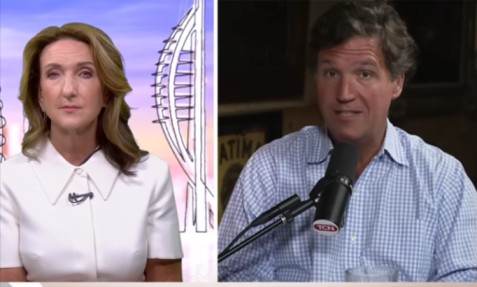
Editor’s Notes: In this high-stakes interview, Tucker Carlson breaks with Donald Trump over the U.S. military action against Iran, calling the president’s claim that the nation is safer an “absurd statement”. Carlson alleges that the U.S. was pressured into the conflict by Israel and describes Trump as “not free” to do what is best for the country. The conversation also delves into the fractured state of the MAGA movement, the morality of declaring war on a civilization, and Carlson’s strong rebuttal to accusations of anti-Semitism. He also touches on the mysterious press conference held by Melania Trump regarding Jeffrey Epstein, suggesting potential foreign interference. (April 12, 2026)
TRANSCRIPT:
Tucker Carlson on Trump’s Claims About Iran
LAURA KUENSSBERG: You tried to persuade Donald Trump not to go to war with Iran. You met him 3 times in the run-up to February 28th, and you spoke to him on the phone multiple times. Donald Trump now says because of this action that he has taken, the US and the American people are safer. Is he wrong?
TUCKER CARLSON: Well, of course, that’s an absurd statement. He doesn’t believe it, I don’t think. No, of course not.
I mean, we were told after the 12-day war in June that the United States had eliminated Iran’s nuclear program, and then we were told in February that somehow that nuclear program had not only been resurrected, but it had been paired with ICBMs that could threaten continental United States. I mean, the whole thing is a fantasy.
The United States went to war in Iran in order to effect regime change, to throw out the people who ran the country and collapse it at the behest and then the demand of Israel. And that’s a demand the Israelis have made of the US government for decades. And President Trump fell for it, did it.
And I think he recognized immediately that it was a mistake and that it’s very hard to extricate yourself from a war like this once it has begun. And I think the net effect, and the president himself has said this, is at best to leave the regime in place, give that regime control over commodities that flow through the straits at the eastern end of the Persian Gulf, in effect to make Iran much more powerful than it was on February 27th.
On Iran’s True Power and the Strait of Hormuz
LAURA KUENSSBERG: On that subject of being more powerful, I mean, you will know that the president has said, “Because of me, Iran will now never have a nuclear weapon. There will be no enrichment of uranium, and we will dig up and remove all the deeply buried nuclear dust.” Pete Hegseth said “epic fury has decimated Iran’s military and rendered it combat ineffective for years to come.” You don’t believe that? They’re lying?
TUCKER CARLSON: Well, of course, it’s not true. And it also reflects a fundamental misunderstanding of Iran’s power. Iran is not primarily a military power, though it’s turned out to be much more effective than anyone thought. Iran is an economic power. Iran has the power to halt a critical supply chain, maybe the single most critical supply chain in the global economy, which is shipping out of the Persian Gulf. And it retains that power because of its geography. And it’s always had that power, just hasn’t exercised it until now.
And so not understanding that allows you to enter into an engagement like this with the belief that you can beat them, sink their navy, destroy their air force, degrade their missile capacity, and you will somehow have won. But of course, the opposite is true. There is no way out at this point from that fundamental reality.
If the United States were to eliminate the central government in Tehran, it wouldn’t open the strait. The strait could be closed by piracy. In fact, you need a central government in Tehran to keep the strait open. We know that from the Houthis, who were able to close the Red Sea. And years, many years of war with the Gulf states, briefly with the United States, have not ended the Houthis’ ability to close access to the Red Sea. They have it as of right now.
So this is an asymmetrical problem. It doesn’t matter how many aircraft carriers you have, you still can’t prevent other people, your enemies in this case, from closing shipping lanes. It can be done with mines. This whole thing, this whole problem is very easy to understand, and you would have to be either not very bright or under immense pressure from another country in order to start a war like this. And the latter is true.
We did this because of pressure from Israel. Now, how exactly did they exert that pressure? That’s not entirely clear, but we’re going to have to find out. I think we have an obligation to find out. And of course, we can’t be a sovereign country under these circumstances. And we’re not a sovereign country at this point.
Has Carlson Fallen Out With Trump?
LAURA KUENSSBERG: And obviously Donald Trump would push right back on that. And you have been, until now, really a huge supporter of his. You wanted him elected, obviously, for a second term. Have you completely fallen out with him over this war then?
TUCKER CARLSON: I haven’t fallen out with him. I mean, I’ve known him for decades. I’ve always liked him. And I think anyone who spent time with him likes him. I feel sorry for him, as I do for all slaves. He is not free in this moment at all to do what he thinks is best for himself or his country.
LAURA KUENSSBERG: What do you mean?
TUCKER CARLSON: Well, he’s not free. And we learned that yesterday when Donald Trump announced a ceasefire, clearly with relief, and made its terms, or most of its terms, public.
And then that ceasefire ended within 2 hours because Israel intentionally violated the terms by attacking not just southern Lebanon, but the city of Beirut.
LAURA KUENSSBERG: So are you saying he’s a slave to Benjamin Netanyahu?
TUCKER CARLSON: I don’t think it’s as simple as he’s under the control of Netanyahu. But you could summarize it that way and you wouldn’t be totally inaccurate. And again, we know this because the single biggest mistake Trump, or any American president in my lifetime, has made was going to war with Iran in an effort to change its regime. It didn’t work. It was obviously a mistake immediately. Trump understood it was a mistake immediately, and he tried to get out of it this week and announced we were getting out of it. And the Israelis prevented us from getting out of it. So that’s the clearest possible example.
LAURA KUENSSBERG: Right.
TUCKER CARLSON: I mean, they didn’t allow it, therefore they’re in charge.
On Keir Starmer and British Sovereignty
LAURA KUENSSBERG: You will know that people, including the Vice President JD Vance, say things like, “Look, ceasefires are always messy to start with, give it a few days, it’ll settle down.” Let me move on because I want to ask you about the British Prime Minister. Keir Starmer was criticized by the US President. He said, “This is not Winston Churchill we’re dealing with.” Do you think Keir Starmer has made the right calls in this war?
TUCKER CARLSON: I don’t think Keir Starmer makes any calls about anything. I mean, Keir Starmer’s done—
LAURA KUENSSBERG: Well, he did make a call about this, obviously.
TUCKER CARLSON: Right. Okay. No, Keir Starmer is every bit as enslaved as Donald Trump is. It is illegal. It is a crime for which you can be arrested in Britain right now, criticizing Israel. If you say you’re for Palestine Action, you can be arrested. A lot of people have been arrested. So in other words, it is not legal in Britain to criticize another country. And that tells you about Britain’s sovereignty. It doesn’t have any. Its prime minister has no sovereignty.
LAURA KUENSSBERG: Those are facts.
TUCKER CARLSON: I have family there.
LAURA KUENSSBERG: That’s not true. And in terms of this war, I’m specifically asking—
TUCKER CARLSON: I’m sorry, what is not true about that? Have people not been arrested in Britain for criticizing Israel? They certainly have been. There’s videotape of it.
LAURA KUENSSBERG: If I may, Palestine Action is a proscribed group. It is banned. Therefore, people have been arrested.
TUCKER CARLSON: Why is it banned?
LAURA KUENSSBERG: That is correct.
TUCKER CARLSON: Why is it banned?
LAURA KUENSSBERG: I’m asking you a question specifically about Keir Starmer’s decisions.
TUCKER CARLSON: It’s banned because the Israeli government wanted it banned.
LAURA KUENSSBERG: And you will know that on February 28th, if I may, on February 28th, which was the day the US launched its action, the British Prime Minister told the country that he was not joining with the US because he thought it was illegal and that there was no viable plan. So clearly he made a sovereign decision, which he said was in the interests of the country. And I’m asking you, do you think he made the right call there?
TUCKER CARLSON: Any government that bans criticism of a foreign government is not sovereign. The British government has banned criticism of Israel. Therefore, it’s not sovereign. It’s acting on behalf of another country to the detriment of its own citizens. So let’s just be really clear about that.
LAURA KUENSSBERG: The British government has not banned criticism of the Israeli government.
TUCKER CARLSON: It certainly has by banning Palestine Action, which has nothing to do with Britain at all or its critical interests at all.
I often criticize Britain, but I love Britain. As I said, I have family there. And I don’t think that Britons understand just how badly they’ve been shafted by the United States. And I am ashamed of that, and I hope that we will do everything we can to rectify it.
I know that Keir Starmer understands that. He doesn’t seem to care. He doesn’t have, again, the control to do anything about it, which is sad to see. The debasement of the country is sad for me to see. But I think, I hope that our next president strikes a far more conciliatory and cooperative tone with Britain and tries to help Britain, because it has a lot of problems that will be very obvious by the next time there’s a presidential election in my country.
On Being Called Antisemitic
LAURA KUENSSBERG: You have said that you have been called antisemitic because of your opposition to the US joining Israel in fighting this war.
TUCKER CARLSON: Yes.
LAURA KUENSSBERG: In March, senior Republican Senator Ted Cruz said, “Antisemitism is being spread by loud voices, the most consequential of whom is Tucker Carlson.” Republican Congressman Randy Fein called you “the most dangerous antisemite in America.” What do you say to that?
TUCKER CARLSON: Of course, I’m not an antisemite, and that’s why they’re calling me one, because my position on Israel has nothing to do with the religion or ethnicity of Israelis. It has everything to do with decisions made by its government that hurt my country. And so in order to avoid having that debate, the fastest and most expedient way to end it is by calling the person trying to raise it a bigot. And I just don’t think that works anymore.
I would say that what matters in politics and in life is what you do. I think antisemitism and racism of all kinds, including anti-white racism, are all immoral and anti-Christian, and I oppose them. You shouldn’t judge people on the basis of how they were born, period.
On Nick Fuentes and Holocaust Denial
LAURA KUENSSBERG: Sure. And you said a moment ago what matters in politics is what you do. You had far-right commentator Nick Fuentes on your show who, as you know, said “Hitler was really f*ing cool,” “Hitler was awesome,” “Hitler was right,” “the Holocaust didn’t happen,” and said on his podcast, in his view, Jewish people are the problem rather than Israel. I know you’ve said you’ve had him on because you disagree with that, right? Do you have concerns that broadcasting Nazi-loving, Holocaust-denying guests to your audience and potentially mainstreaming and normalizing those views is an issue?
TUCKER CARLSON: Look, I’ve said that I disagreed with Fuentes on those questions. I don’t think that you should ever judge or attack people on the basis of their bloodline. I also interviewed Ted Cruz. I tried to interview Randy Fein. Both of them have—
LAURA KUENSSBERG: But let me go back to the 20 seconds.
TUCKER CARLSON: If I may finish my answer. I’ve interviewed both of them, or tried to interview Fein. He wouldn’t. But I’ve interviewed Ted Cruz, as you noted, and both of them have defended the genocide in Gaza, the murder of children. And I would say that sending money to a military that murders children is a little bit more significant a moral crime than saying ugly things.
LAURA KUENSSBERG: Do you think Fuentes is antisemitic? Do you think he is?
TUCKER CARLSON: It sounded like it to me. I said that to him and I said I oppose antisemitism, which I sincerely do. And by the way, unlike the UK, we have a First Amendment. So if I was an antisemite, I guess I would just say so at this point. I don’t know why I would lie about it, but I oppose it and I’ve opposed it in public consistently for my entire public life.
On Trump’s “A Whole Civilization Will Die Tonight” Post
LAURA KUENSSBERG: Can I ask you what you thought when you read Donald Trump’s post on Tuesday in which he said “a whole civilization will die tonight”?
TUCKER CARLSON: I was horrified by it. Look, as I’ve said, I don’t think that Trump, who I continue to like, I don’t think that Trump is in control. I don’t think Trump is making these decisions. I know he’s not because I was present in the run-up to this. He’s not making these decisions, and I feel sorry for him, as I’ve said.
But more than Trump, anything to do with him or his future, is the effect on my country. Our leaders should not talk like that. They shouldn’t. Our conflict is not with another civilization or another religion. It’s with governments, at least conceptually, that do things that we don’t like, that are bad for us. And we have conflict over that. We can never declare war on a civilization. We shouldn’t. That’s immoral. What does that even mean? Does that include the children in that civilization? Of course it does.
Trump, MAGA, and the Question of Control
LAURA KUENSSBERG: You don’t buy the argument. Look, this is what Donald Trump does. I mean, you’ve known him for years. This is what Donald Trump does. He uses extreme language to put pressure on to get some sort of concession.
TUCKER CARLSON: I mean, there are two levels in which to assess this. One, the practical. Second, the moral. As a practical matter, did it work? Is the strait open this morning? No, it’s not. So it didn’t work.
Its only effect likely is to engender a generational conflict with another civilization, another religion, another part of the world. How is that good for my grandchildren? Probably not. So practically, it doesn’t work.
And morally, the words you use matter, and the more power you have, the more they matter. And so to declare war on a civilization in my name, it’s just not acceptable. Doesn’t mean I hate Trump. It means that’s disgusting and wrong and hurts my country, and my obligation is to stand up and say so.
Calls for Trump’s Removal and the Question of Foreign Influence
LAURA KUENSSBERG: You’ve claimed a couple of times in our conversation that Donald Trump is not in control. Many Democrats and also some on the right, former Trump allies like Marjorie Taylor Greene, are now calling for the president’s removal, with some citing the 25th Amendment, which allows the vice president and the cabinet to declare that a president is no longer able to do the job. Do you want to see him removed?
TUCKER CARLSON: I want to see the system reformed. Once again, two days ago, the president— I mean, him. Him, the president before him, the president before him, the president before him. All American presidents since 1963 have done substantially what Israel wanted us to do. And now it’s really hurting us.
And I’ve been aware of this for decades, and I haven’t said one word about it because it’s not worth the fight. But now I see our country, its economy, its understanding of itself in the process of being destroyed because our leaders, and not just our president, our entire Congress, many of our governors, did the bidding of a foreign power.
And so the problem is not simply Trump. The problem is the mechanism of control that allows a country of 9 million to control a country of 350 million. What is that mechanism? I’m not sure I know the answer. We need to find out what that is.
LAURA KUENSSBERG: Well, as you know, as commander-in-chief, he could have said no to Benjamin Netanyahu. Other presidents have — Joe Biden, Barack Obama.
TUCKER CARLSON: You’re absolutely right. And I made that point. And you’re absolutely right, they did. And I wish our president had, but he didn’t.
LAURA KUENSSBERG: So it’s not the system.
TUCKER CARLSON: And he went into a war. Well, it is the system because the last president financed the Gaza genocide. The president before him, same thing.
Tucker on Trump’s Personal Attacks and Their Relationship
LAURA KUENSSBERG: You’ve said a couple of times in this interview that you really like Donald Trump. In March, you said you’ll always love President Trump, no matter what he says about you. On Thursday, he called you low IQ, a nut job, a fool. Also, he suggested you should see a good psychiatrist. Are you going to continue to love him?
TUCKER CARLSON: As I’ve said, I feel sorry for him, as I do for all slaves, but I will always like him. I will say Trump is one of the funniest people I’ve ever met. I feel sorry for him. I think he has some great qualities. I’ve certainly spent a lot of time with him, and I will always like him. If he called me now, I’d take the call. I don’t want anything from him.
LAURA KUENSSBERG: Well, he says he— He says you’re always calling him and he doesn’t pick up anymore.
TUCKER CARLSON: Yeah, no, that— I think that’s not true. You can check my phone records, but I’m sure NSA already is. I’m not defensive about it.
The Future of the MAGA Movement
LAURA KUENSSBERG: What do the splits in the MAGA movement that we see now, former Trump allies like yourself on the front foot criticizing the president and the action he’s taken, what do they mean for the future of MAGA?
TUCKER CARLSON: I think MAGA as a movement was never clearly defined, probably for a reason. There was no real platform in the Republican convention in 2024. That was, of course, by design. And so I think the movement is whatever Donald Trump says it is. I think that’s the definition. I don’t know another.
He turns 80 in June. So this is not a movement that’s going to, you know, persist through the generations, I wouldn’t think, since it’s based on one man. But the idea that the US government should act in the interest of its own population, or that any government should act in the interest of its own population, is a kind of core tenet of democracy. In fact, that’s the definition of democracy. The people rule. And I think that will long outlive all of us, I hope, because it’s the only form of government that makes inherent sense.
Melania Trump, Epstein, and Foreign Influence
LAURA KUENSSBERG: I wanted to ask you about the Melania Trump press conference — very unusual — where she denied connections to Jeffrey Epstein and said that any claims linking her and him need to end today. What do you think’s going on there?
TUCKER CARLSON: Strictly speaking, I don’t know what’s going on there. I know the White House communications staff had no idea she was going to say that. So it’s one of two possibilities. Either she was reading speculation about her relationship with Epstein on the internet and she was upset and wanted to clear her name, which is totally possible. Or there was something else going on.
The Israeli government has a long and well-documented track record of using sex scandal or the appearance of scandal to force American political leaders into doing its bidding. You hope it wasn’t that. But I did notice that within an hour or two after that press conference, a piece came out, I think in The Daily Beast, alleging some connection between Melania Trump and Epstein, which was obviously hurtful to her and embarrassing to the first family.
So I don’t know if there’s any kind of connection. But I do know, once again, this is a fact, that sex scandals are used, probably not just by the Israeli government, probably lots of foreign governments. It’s not just the Israelis. I just want to be clear.
Accusations of Antisemitism
LAURA KUENSSBERG: I am going to point out — I probably don’t need to because our audience can see and hear for themselves — pretty much everything that you’ve said in our conversation, Tucker Carlson, you have put at the door of the Israeli government. Now, to some people, that will be evidence that you are antisemitic. You are anti-Jewish.
TUCKER CARLSON: Oh, I know. I’m very anti-Semitic and anti-Jewish. Well, first of all, the state of Israel does not speak for all Jews at all, despite its claims. It does not. There are many, many Jews, many of whom I know, who don’t think the Israeli government of Benjamin Netanyahu speaks for them. I’m speaking of the government, not religiously. No, no, no, hold on, hold on.
LAURA KUENSSBERG: Of course you were suggesting that. What I was suggesting was that a lot of the things you’ve discussed today—
TUCKER CARLSON: I’ve been in this business longer than you, and I understand what a slur looks like. And you’re attempting to call me an anti-Semite in a passive-aggressive way. “Some people would say that.” Well, I’m responding to your slur and saying that it’s untrue. It does not apply to me.
Doubtless there are anti-Semites who don’t like Israel. I’m not an anti-Semite. I don’t hate Israel. The Israeli government — this is documented and I saw it personally — steered the United States into a war that hurts the United States and the world. I’m offended by that. I didn’t want it, and I’m mad about it now. I have every right to feel that way.
That does not make me an anti-Semite, despite your insinuation. And I think it’s important that I say that. And by the way, I hope that you run this. I can’t control whether or not you air this exchange. I hope that you will, because I think it’s important to push back against slurs like that because they limit our ability to understand what’s actually happening.
This is not an attack by Jews on the United States. This is Benjamin Netanyahu moving the United States to do something he thinks will benefit him but that does not benefit us. It’s that simple.
LAURA KUENSSBERG: Tucker Carlson, thank you very much for talking to us.
TUCKER CARLSON: Thank you. I appreciate it.
Related Posts