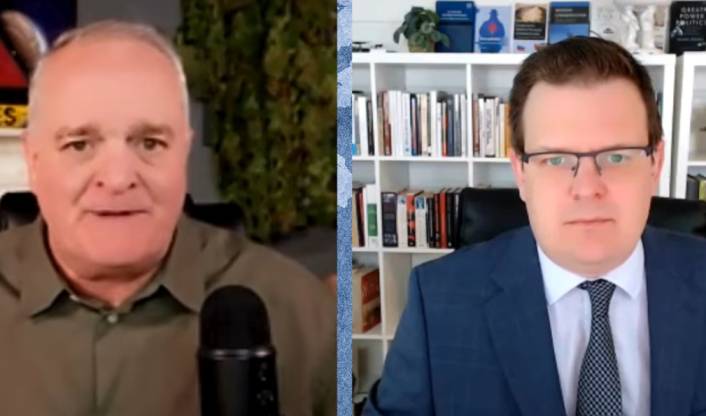
Editor’s Notes: In this episode, Glenn Diesen is joined by Lieutenant Colonel Daniel Davis to dissect the breaking news regarding Iran’s announcement to reopen the Strait of Hormuz amidst a ceasefire in Lebanon. They explore the conflicting narratives between the Trump administration and Iranian officials, debating whether this moment signals a genuine path toward peace or a premature optimistic outlook. The conversation further delves into the high-stakes military preparations continuing behind the scenes and the severe long-term economic consequences, such as global recessions and food security risks, that are already “baked in” regardless of the diplomatic outcome. (April 17, 2026)
TRANSCRIPT:
Introduction
GLENN DIESEN: Welcome back. We are joined again by Lieutenant Colonel Daniel Davis, a 4 times combat veteran and host of the Daniel Davis Deep Dive YouTube show, which I will leave a link to in the description. So thank you for coming back on.
We see a lot of developments. Iran declared that the Strait of Hormuz is open. Trump has apparently tweeted that it’s open, it will never be closed again, although Trump will keep the blockade on Iran. So what exactly is happening? Is this peace, or may that be a bit premature?
The Strait of Hormuz Reopens — But With Conditions
DANIEL DAVIS: Oh, it’s way premature. There’s a ton of things that have to happen right now.
Number one, Foreign Minister Abbas Araghchi this morning, when he announced that the Strait of Hormuz was back open again in conformity to the conditions that were set when they did the original ceasefire, was contingent upon the fact that there was now a ceasefire in Lebanon. So they said, “Okay, now that you did that, we’re going to do this.” And then he specified for the period of the ceasefire, which expires, I think, in the US time, midnight on Tuesday, Wednesday morning, I think, local time. So that only gives us a few days, number one, for it to be open.
So nobody, none of these tankers, none of these companies, none of these countries are going to just start flying tankers through the Gulf right now, I think. Now, there could be some that are probably already full that have been just floating around there that probably would love to get out. And so you may get some, but there’s not exactly going to be a flood of people coming out because none of the conditions have been met.
And then you had immediately President Trump in response to an Axios report that came out and said that there’s a deal on the table where the US would pay $20 billion for the reprocessed material. It wouldn’t be characterized like that. It would be a refreezing of Iranian assets in exchange for them to deliver all of the 400-something kilograms of reprocessed 60% material, etc. Trump immediately put out another Truth Social and said, “Nope, no truth to that whatsoever. I’m going to get all of that reprocess stuff. I will not give $1 for it. We will not release any of the funds, etc.,” which seems to just take the oxygen right out of what should have been an opportunity.
Because the fact that the president had put a lot of pressure, and he specifically pointed out that he put pressure on Israel to tell them to have this ceasefire. And he said something like, “I told them to do it,” in all caps or something, “and they’re just going to have to be quiet.” I can’t remember the phrase he used right off the hand, but he was definitely emphatic that he told Israel to have this, but then went to lengths to say that that’s not connected with the opening of the Strait of Hormuz. I don’t know if he just wants to have credit for it, like, “No, no, I did this on my own. It wasn’t because of that.” I don’t know.
Araghchi said it was definitely because of that. And in fact, the foreign ministry spokesman Ibrahim al-Faqar for Iran says, “This is contingent upon the implementation of certain terms and conditions at the ceasefire in Lebanon, and if the naval blockade continues, it will be considered a violation of the ceasefire.” So he’s saying that the US can’t keep its blockade open or it’s going to be a violation, but President Trump said it would continue. So he’s saying the Strait of Hormuz is open for all the traffic we want out, but it’s going to continue to be closed for the Iranian traffic. So we’ll wait and see how that’s going to work out.
But the Iranian side said, even this is contingent upon 3 things. He said, one, that the ships be commercial and that passage of a military ship is prohibited, and that the ships and their cargo not be linked to any belligerent state. So that’s a pretty big limitation. The ships pass through the route designated by Iran because apparently there are some mines in there, so they want to make sure it doesn’t get hit by a mine. And then it said the ships must be coordinated with the Iranian forces responsible for this passage, as the US Central Command confirmed before the war, the control of the Iranian Revolutionary Guard Corps over the Strait of Hormuz.
So we’ll see how this actually transmits because you have both sides saying very different things. Now, the oil market is thrilled. I mean, it dropped 12% almost immediately upon these two announcements. But the devil’s in the details, as they say, and these are pretty big devils.
Military Preparations Continue on All Sides
GLENN DIESEN: I agree. It’s like always, it’s sold as great optimism. And I think Trump is also good at talking down the oil prices. But as I said, it might be a bit premature. At the same time, though, we see that the Lebanon ceasefire, well, it’s unlikely to hold. And there’s also indication that the US might be preparing for renewed hostilities.
There’s also now talk of a possible ground invasion. Do you think this is put on hold now that, well, this seemingly the negotiations are moving forward, or do you think this is, you know, not just a little pause before we move on?
DANIEL DAVIS: Yeah, everything is moving concurrently. There’s movement in the diplomatic realm, there’s movement in the political realm, and there’s movement in the military realm. Everything is going forward as though none of the other things are going to succeed. And they’ll execute whichever one seems to — and this is all parties — whichever one seems to give their side the best chance.
So there is no question, we’ve seen open source reporting that the Iranian side has been doing all kinds of excavation. A lot of the tunnel systems we’ve hit, a lot of these mountainsides, a lot of these underground missile cities, they’re doing reprocessing work. They’re also moving assets around and probably in from one tunnel to another or something like that to cross level. They’re getting ready for more. They’re as fast as they can, probably manufacturing more drones and more missiles, to the extent that they’re able to do that.
And the US side is definitely doing the same thing. We’ve seen lots of air traffic, additional forces have been sent to the region, additional ships. So we’re definitely continuing to build up, and every indication is to include Secretary of War yesterday saying, “We are locked and loaded and ready to go when this ceasefire comes to an end.” President Trump yesterday in front of the White House was specifically asked, “When the ceasefire period comes to an end, are you going to resume hostilities?” And without hesitation, he said, “Yes, definitely.”
Now, he’s probably saying that to add negotiations pressure or whatever, but that’s what he said. That’s what the Secretary of War said. And this is what the US military is doing. So they have been radically and dramatically sending additional interceptor missiles, offensive missiles, whether that’s the JASMs, the Tomahawks, the SM-2s, SM-3s. All kinds of ranges of weapon systems have been restocked so that in the event that the order is given, then they will re-engage again and continue on the war with where it was.
So everything is happening concurrently. And then of course, the diplomats are hard at work. And so obviously lots of things behind the scenes have been going on. President Trump mentioned a number of Middle Eastern powers, thanking them this morning on Truth Social after he made that, indicating that there is multilateral diplomacy going on where everybody’s trying to find a way out of this.
So the question is, which is going to succeed? And we’ve got such a narrow window. We’re talking 4 days before this comes to an end here, unless the sides agree to extend it, which I think is probably 75% probability because both sides had some advantage in doing that, both in more military preparation as well as more oxygen and more space for negotiations.
But again, when you see that the conditions being set by Trump and by the Iranian side on what it means that the strait is open are incompatible, so is one side going to give or the other? Because otherwise the strait isn’t really open if the two sides don’t agree. And then the proof’s in the pudding. Then we’ll see on these trackers how many ships actually go out and is there a flood of ships going out or not? I mean, so far nothing is, but we’ve had a bunch of dueling social media posts. So we’ll see what actually happens on the ground.
Trump’s Narrative vs. Iranian Demands
GLENN DIESEN: But still, this contrast, and also this Truth Social post by Trump, maybe explicit, the Iranians have opened up, we will not end our blockade. You know, again, it could just be a show of strength or, you know, appealing to his own audience because he really has to sell more or less a victory that the US is in the driver’s seat. But in Iran though, if they see this as a complete breach and that doesn’t fit within the wider agreement, how do you expect, or do you expect them to follow through with this? Or why suddenly did the Iranians become so lenient in terms of being prepared to meet these demands?
DANIEL DAVIS: Well, I mean, we’ll see how lenient they are. I mean, that statement by their foreign ministry spokesman didn’t sound very lenient, sounded very, very limiting and very exacting and said, “Hey, either it’s a two-way street or it’s a no-way street.” So that’s why I say it’s incompatible with what Trump said because he said it’s a one-way street, my way, and you’re going to open up everything and I’m going to keep everything closed. But that’s the opposite of what the Iranians are saying.
So we’ll see what actually transpires. Maybe it’s not even open at all. Maybe this is just, like I said, dueling social media posts that don’t translate to anything happening on the ground. That’s a big problem here because Trump has all but declared an end. Trump also said Iran promised they would never close the Strait of Hormuz again. He promised they are definitely going to give us all of their nuclear dust, as he calls it. No word on any of that from the Iranian side.
So one has to wonder, what is all President Trump’s confidence based on? Is he letting the cat out of the bag? Is he letting people know what’s actually secretly going on behind the scenes and later on we’ll find out that’s true? Or is this just stuff that he hopes is true and he’s trying to say it by, “If I say it enough, it’ll become true?” Unfortunately, we’ve got experience in both of those kinds of things happening. So we don’t know what that’s going to mean either.
Bottom line is that there’s a lot of verbal action, a lot of written words, but so far no physical action. And in fact, speaking of the US blockade, I was looking this morning at one of those ship trackers that tracks all the traffic coming in and out of the Gulf. And they did like a super fast motion that looked at all of the traffic in the last 3 days of the US blockade. And they said that there are still a number of ships that are US-sanctioned ships that have gone out of the Gulf. We claimed that 13 ships or 14 had been turned back, but the graphic on the ground shows that actually quite a number — and I don’t remember the exact number, but it showed them physically moving through the Gulf and out, passed the blockade line. So I mean, you tell me, has it been blockaded or not? I don’t know.
Iran’s Nuclear Material — A Red Line?
GLENN DIESEN: It’s hard to tell. It’s such a war of narratives that reality becomes difficult to see. But it does seem very unlikely though that Iranians would give up their nuclear material for nothing in return, because then they would only leave themselves weaker and with a worse hand to play later on.
The Impossibility of a Ground Invasion
DANIEL DAVIS: And I mean, I’ll go so far as to say there’s zero chance of that, that they’re just going to hand that unless— and if they turn that over, there’s going to be something substantial in return. I think the days are over when Iran is just saying, all right, we’ll do what we’re told, we’ll capitulate and we’ll submit in order to end the fighting here.
I think that what happened with Operation Midnight Hammer, the Israeli attack in 2025, and then now this one has led them to conclude that it’s pointless to ever trust the US is going to do something willingly, or that by them being self-restrained, that that’s going to restrain us. I think they now see that it will only encourage us to do more later on after we get more ammunition restocked or whatever. So I don’t think they’re going to let that go.
And it is a major point unless they get something pretty significant in return, something that has even a version of a security guarantee and some kind of reparation. So even when they’re talking about opening up the strait here, apparently that does not mean that they’re not going to be charging a toll even for stuff that they allow out. They still have to have that going on because they’re going to try to make some revenue as well.
But there are these signs and billboards all over buildings in Tehran, billboards where there’s this hand holding hold of the Strait of Hormuz. And I think that’s emerging as a symbol of their resistance and defiance. It’s saying we have the leverage here. And so the idea that they’re just going to let that hand open and then just stand back and let it go back to any version of what it was before is inconceivable to me.
I just can’t think there’s any chance that they’re going to do that because that, along with their missile force, has been the real demonstration that they have some real leverage here and that they can’t just be coerced anymore because they played that hand. I just don’t think there’s any chance that they withdraw, though they would be foolish to do so. They have not shown themselves to be foolish so far. We’ll see what they extract for any concept of giving away that reprocessed material.
GLENN DIESEN: Well, it appears that then the possibility of ceasefire here or prolonging it or ending up with a permanent peace agreement seem, well, somewhat unlikely. I hope I’m wrong on this. I could be wrong, but if I’m not wrong, we end up in a return to these hostilities. What do you think it’s going to look like? Because for a while, many people have made the comment that a ground invasion of Iran seems like a, well, a foolish idea given the, well, the geography, the size of the territory, and, well, many other variables. But do you think a ground invasion could happen now?
DANIEL DAVIS: No, there’s no chance of that because just the physical— we don’t have the capacity to do so. I mean, physically, we would need 400,000 or 500,000 total troops to be able to even mount a credible possibility to actually have a ground invasion with the potential of taking these sites, taking the capital city, et cetera. And the massive mountain ranges on the entire western part of the country make it as close to a physical impossibility as you can get to have an army try to invade and to go through. There were just no routes that you can come in there.
And even if you still had— some have said, oh, see, this is why we shouldn’t have given up Afghanistan, because there are some planes and stuff you could come in on the eastern side of the country, and you could roll toward the west. But even if you look at that, it’s very constricted there, and it would be like going through a gauntlet. It would be almost death to go through there because you’d be a shooting gallery, because they could hold the high ground on either side. So even that doesn’t really hold it.
Therefore, the only thing that we have troops on the ground to do now is to have some kind of a raid, or maybe you could take Kharg Island. That would come at extremely high cost and be tenuous at best. And I argue that there would be no chance to hold it long-term. It would be like when the Ukrainian side had that incursion into Kursk Oblast in Russia. They were able to do it for a period of time, and for I think 7 months they held some territory there, but they were a dead man walking from the beginning because Russia, the whole country there, all they had to do is just slowly squeeze the thing down. And that’s exactly what they did.
And it would be the same thing here. If we took, even if we succeeded at the moment to take Kharg Island or Bandar Abbas, for example, or any other point target anywhere on the coast, what have you gained from that? Just like what did the Ukrainian side gain from having that piece of territory? It gained them nothing and it cost them profound amounts. It would be the same for us here. So we have the capacity and the numbers of troops that we could conceivably try to take some territory, but it would be an ephemeral victory. I mean, not even a Pyrrhic victory. It would be a temporary tactical success that would breed a strategic failure. So there’s no rational ground option at all for the United States here.
The Three Options — All Bad
GLENN DIESEN: So yeah, given that this is the situation we’re in, how do you see the possibility of actually ending this war then?
DANIEL DAVIS: Well, that is the problem because as I see it, there’s a few options that President Trump has and all of them are bad. Because once we embarked on this war, any kind of sane analysis would have shown, in the concept phase, that there’s no military solution here. There’s no path that you can compel compliance to get what you want, whether it’s assassination of the leader, a big shock and awe bombing campaign. The country’s simply too big. As you’ve said numerous times, even on my show, it’s like part as big as a good portion of Western Europe, and the terrain is just terrible for an offensive side there. So it was foolish from the beginning to think that you could, but we did anyway.
So we went through it. So now we are where we are. Whether we should or shouldn’t have been is no longer a question. But now then, the absolute question is, what now? Because since you’re already engaged and you’ve already committed to a course of action and you don’t have a ground component to even threaten anything on the ground, the question is going to be, what can we do now?
And as I see it, there are 3 main possibilities here.
One is that Trump has a negotiated settlement on terms that are minimally acceptable to the Iranian side. And their 10-point plan is the basis that they’re willing to talk. They’re not going to get all 10 of those. They don’t have any, I think, dreams about getting them. That’s their biggest wishlist. But there are a few things on there that I think are probably non-negotiable. Control of the strait, or at least a toll booth kind of situation is probably on the list. Some kind of security guarantees and reparations of some sort, whether that’s freezing, unfreezing of their assets, or something else like, again, charging that toll, maybe some of those kind of things, and keeping their missiles and keeping their proxies. That’s, I think, going to be their non-negotiables that they’re going to have to get. And Trump’s going to have to agree to some version of that. He could doctor it up any way he wants to at home, but there’s not many people in his camp or in Israel that would probably be quiet on that. I can imagine Israel doing whatever it took to sabotage any, if he was moving down that path.
The other one is that he can say, all right, you know what, I’m going to double down. So when this period comes to an end, whether it’s next Wednesday or if they have an extension, whatever, at some point it’s going to come to an end. And then he says, “I’m going to double down and I’m going to give you a firestorm like you have never seen before, and I’m going to blow up everything, all these targets, energy systems, infrastructure. We’re going to rain down holy hell on you unless you comply to some version of our 15-point plan.” And then he may say, I’m going to try that just to see if it works.
Iran has been unequivocal about what they would do if that’s the case. And so far, every time they have said something since before this war started, that if you attack, we’re going to do this— so far, they’ve done everything they have claimed. So there’s no reason to think that this wouldn’t be the next one, that they would respond in kind to the GCC countries, Israel, our assets in the region, etc., and it would be just lights out for the oil industry for an extended period of time, regardless of the Strait of Hormuz open or closed. That’s number 2.
And then I think maybe number 3 is he could say, let’s just play for the long game. I’m going to keep this blockade and we’re going to see who can suffer the longest. Can you suffer because we’re shutting down everything? We’ll bring in new sanctions. We’re going to have, as he called it, Operation Economic Fury. And then who can suffer the longest? And he may calculate that I think we can suffer longer than they can. That’s a bad play.
But as I see it, those are the three broad outlines. I don’t see another viable alternative. And those are all bad for the United States. And we could go into each one of them, but there’s no good one. That’s what we need to understand. There is no good victory narrative that can come out no matter what words come out of President Trump’s mouth. And they will, no matter what he does.
But if he chooses, I think, B or C, we’re going to be in a world of hurt. And so is the world economically. Option A is the best of the ugly options that gets things off the table and allows him to just turn and focus back to the midterms. Like everything else, he’ll eat a lot of crow here and he’ll take a lot of domestic heat, but there are so many other issues here in the US, then they’ll turn to something else and he’s good at changing the narrative anyway. That’s what he should do. We’ll see what he does do.
The Damage Already Done
GLENN DIESEN: It does seem a bit strange. Well, given that you have a ceasefire in Lebanon as part of these negotiations, it essentially gives the veto right to the Israelis, though, because they can anytime break this one and then negotiations fall apart. But let’s stay optimistic for a second, hope that Trump picks a wise path, will put an end to this war. How much damage has already been done? Because the global energy situation is quite poor, and we see now this having massive impacts around the world, and also the fertilizers. This is also something that’s beginning to really worry me. I mean, how big of a— how deep are we into these troubles?
Economic Consequences and the Road Ahead
DANIEL DAVIS: Yeah, I had a former British Commodore who’s now an expert in the energy field, since his retirement in the UK. And he argued, and there’s a number of economists that have been arguing this too, and we showed some of them on our show recently. But Commodore Steve Jermy has said, listen, I think that we already have baked in already, if this ends on next Wednesday and we have a miracle, a diplomatic miracle, we’ve already baked in, in his view, a recession because of the way the economic and the energy and the fertilizer situation you mentioned how all these things have compounding effects and how it’s going to even, even if it does end next week and even if this strait did completely open up today, it’s going to take months, a couple of months at minimum to get all of these tankers restarted again and coming back.
5 of the 6 GCC countries had already suspended or greatly suspended their production of the oil, physically pulling it out of the ground because they ran out of storage space for it. So that’s got to be undone. And that’s, that’s a lot harder of a problem than it may appear to be. So it’s going to take some time for even the flow to start once all the insurance companies are saying, all right, we’re willing to take the risk again and the carriers themselves are willing to take the financial risk.
So there’s a lot of things it’s going to take even once it’s open to finally get the flow back anywhere close to what it was on the 27th of February. I mean, many, many months into the future. So that means all the problems that are already there are going to compound. And I’m agreeing with you that the fertilizer one may be one of the biggest ones along with helium, because that has economic impacts and food security impacts.
Because now then people are planting right now to include the United States, in Asia, in the Philippines, and also Australia that I’ve seen so far. They’re planting now, but they’re doing it with less fertilizers than they need and at a higher cost. And of course, diesel also. All that’s raising the cost to produce the food. But then that means when it comes time for harvesting in the fall, you’re not going to get as much. So that’s going to be a scarcity coming in and that’s going to then last until the next planting season.
So these are problems that are going to have manifestations many, many months from now into next year, probably at the minimum. And that could— that whole thing together is going to cause a potential for an economic recession, a global recession. And if this doesn’t get solved here, then we could be facing the possibility of a depression.
GLENN DIESEN: Yeah, no, it’s— well, in retrospect, there will be— after this war is over, there will be no way looking back at this, I think, and considering any of this to have been a success. But it’s nonetheless worth being slightly optimistic about the efforts, at least by the US.
DANIEL DAVIS: Believe me, I want to be optimistic as well, because anything that— any, any diplomatic space— and this is what has been created here— that gives us a chance to get this over so that we don’t have the worst of those consequences later on, is to be enthusiastically supported, and I definitely do. But being realistic, we’re still going to be in trouble. There’s, there’s no good way out of this, and there’s no way to escape it without some problems. The question is, how big will those problems be?
GLENN DIESEN: Well put. That’s what I was trying to say. Thank you so much for taking the time. I know you have to run, so thanks again.
DANIEL DAVIS: I do. Yeah, thanks so much. I always appreciate you, Glenn. Thank you.
Related Posts