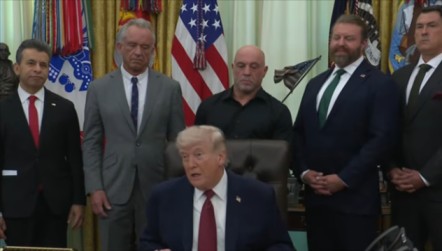
Editor’s Notes: On April 18, 2026, President Trump signed a historic executive order aimed at accelerating access to breakthrough medical research and treatments involving psychedelic drugs, such as ibogaine. The briefing highlighted a collaborative effort involving HHS Secretary Robert F. Kennedy Jr., FDA Commissioner Marty Makary, and public figures like Joe Rogan to address the national mental health crisis and the high suicide rate among veterans. This new directive mandates the FDA to expedite reviews and clears bureaucratic hurdles to facilitate the fast rescheduling of approved therapies. The event featured powerful testimonies from retired Navy SEALs Marcus Luttrell and Rob O’Neal, who shared how these once-taboo treatments personally saved their lives and helped them overcome severe PTSD and addiction. (April 18, 2026)
TRANSCRIPT:
President Trump Announces Historic Reforms on Psychedelic Drug Treatments
TRUMP: Hello, everybody. It’s a little bit unusual, right? Bobby’s a very unusual person. I said, when is the news conference? He said, Saturday morning. I said, I know. Has that ever happened before? Well, it’s an honor, and it’s very important what we’re doing. So, as you see and you know a lot of the people behind me, they’re tremendous professionals, medical professionals most, and some military professionals.
Accelerating Access to Psychedelic-Based Medical Research and Treatments
Today, I’m pleased to announce historic reforms to dramatically accelerate access to new medical research and treatments based on psychedelic drugs. In many cases, these experimental treatments have shown life-changing potential for those suffering from severe mental illness and depression, including our cherished veterans.
Our veterans are having a tremendously hard time. You know, the suicide rate — we have it down a little bit, but they are having a hard time. And I got a call from a number of people, including the great Joe Rogan, and he said, “We have to do something about this.” And I looked into it. I called Bobby. I called Oz. I called Marty and Jay. And it was really uniform support. And I said, “So why would we wait three or four years to get it done? Or 10 years, frankly. Let’s get it done immediately.” And that’s what happened.
This has probably never been anything that happened so quickly. Everybody is so strongly in favor of this. It’s for a lot of people, but it’s for our military in particular.
The Veteran Suicide Epidemic: A National Tragedy
The suicide epidemic among veterans is a national tragedy. Since 9/11, we’ve lost over 21 times more veteran lives to suicide than on the battlefield. So we lose — think of that — 21 times more. And today, we’re bringing them new hope. I think you’re going to see a big difference and a big reduction in that number.
Acknowledging the Key Figures at the Event
I want to thank Secretary of Health and Human Services, Robert F. Kennedy, Jr., who’s fantastic — where are you, Bob? Over here. He always makes it difficult. He’s done a great job, too. And people love him. And more importantly, your wife is here someplace, Bobby. She’s out there. Where are you? Where are you? The real boss in the family. It’s fantastic. Thank you very much for being here.
As well as FDA Commissioner Marty Makary, CMS Administrator Dr. Mehmet Oz, NIH Director Dr. Jay Bhattacharya. See how easy that name is now? You know, it used to give me a little trouble. That was a tough name.
Congressman Morgan Luttrell, who’s a friend of mine and a real war hero. You know, it’s something that a lot of us will never find out about. Retired U.S. Navy SEAL Marcus Luttrell — the two of them — I don’t know, what’s in your blood, fellas?
MARCUS LUTTRELL: Your boss.
MORGAN LUTTRELL: My mom and dad.
TRUMP: Good mom and dad. Good to have you.
Joe Rogan, who’s a fantastic person. We did a little interview before the election. We had over 300 million people. And I said, “Oh man, I hope Kamala doesn’t do it.” And she didn’t. He wanted her to do it, but she didn’t. Someday Joe’s going to explain why. I could tell you why.
JOE ROGAN: Because she didn’t want to.
TRUMP: Because she didn’t want to. Along with many other veterans, and I just want to thank — the people behind me are outstanding. It’s an amazing group.
Signing the Executive Order: Expediting FDA Review of Psychedelic Therapies
The executive order I’m signing today is really a moment. It directs the FDA to expedite their review of certain psychedelics already designated as breakthrough therapy drugs. They’re very much being discussed. It’s one of the hottest things — I think you’re talking about that, Oz, right? If these turn out to be as good as people are saying, it’s going to have a tremendous impact on this country and other countries, too. These treatments are currently in the advanced stages of clinical trials to ensure that they’re both safe and effective for the American patients.
Clearing Bureaucratic Hurdles and Fast-Tracking Psychedelic Drug Approvals
PRESIDENT TRUMP: And the nice part is we’re actually doing this early, but it has been going on — research has been going on for quite some time. But, you know, usually with things like this, nothing ever happens, no matter how the research ends up. But we’re changing that. This order will clear away unnecessary bureaucratic hurdles, improve data sharing among the FDA and the Department of Veterans Affairs, and facilitate fast rescheduling of any psychedelic drugs that become FDA-approved. And we think many of them will go very quickly.
Most Favored Nations Pricing: Slashing Drug Costs by Up to 80 Percent
And I have to say, the Most Favored Nations pricing that we established, that I established, has been knocking the cost of drugs down by 50, 60, 70, 80 percent. And Oz, I want to thank you and Bobby for the great job you’ve done. It’s incredible. And the press refuses to write about it.
The drug costs are going down — and by the way, Trump Rx, which is the way you go to get your very low-cost drugs. But when you think, in my first term, for 28 years, drug prices went up, and I got it down one quarter or one-eighth of a percent. I was so proud of myself. It’s the only one that, in 28 years, got them down. And I had a news conference to explain how great I was. I said, “I’m the greatest there ever was. I got it down one-eighth of a percent.” I was very proud, because it only went up — for 28 years, it went up. And now I got it down a little bit. And now I got it down 50 percent, 60 percent, 70 percent, with these guys. But nobody wants to write about it, but it doesn’t matter because the people have found out.
The Staggering Gap Between U.S. and Global Drug Prices
You know, we were the highest in the world, by far. Sometimes it would be 10 times higher than other countries. You’d buy a drug — I call it the fat pill or the fat drug — you’d buy it in London for $10 for a pill, let’s say. But actually, to be specific, London, $87. New York, $1,300. I said, “How can that be possible? How can it be possible? Eighty-seven dollars.”
And actually, a friend of mine called me up — he’s a very rich guy — and he happens to be on this Zepic, I guess, at the time. And it had — it was not working, by the way. The guy was extremely successful, but highly neurotic. He had a lot of problems. I will not mention his name. He’s begging me not to mention his, because he’s become quite famous. He’s a big factor here. But he’s very smart, very rich guy, very, very successful guy.
And he said, “Hey, President” — he used to call me Donnie, you know, he calls me President, out of respect — he said, “I’m in London. I bought this stuff for 87 bucks. And in New York, I pay $1,300. What’s going on?” I said, “Well, that’s the way it is. We pay the highest prices in the world.” And it sort of hit me how ridiculous it is.
Made, by the way — he checked it. He had a whole big research done on it because he couldn’t believe it. Made in the same factory, same plant, same — everything was the same except the price.
America Now Tied for the Lowest Drug Prices in the World
And now we are the lowest price. We are tied. In other words, whatever the lowest price in the world is, that’s the price we pay. That’s a tremendous difference. So we’ll be paying — they’ll go up a little bit. So the 87 will go, like, to 120, and we’ll go down from $1,300 to 120. So we’ll have these massive price cuts. And they’ve already started. And I think it’s one of the biggest things.
On Media Coverage and Rescheduling
PRESIDENT TRUMP: But unfortunately, the press doesn’t like to talk about it. But because it’s a — if I were a Democrat, it would be headlines all over the place. But — so I do that. That’s why I like live television, actually. It’s great because you can’t do any cutting. But we’re so honored by that. And that’s going to have a huge impact on this also, because the pricing — not only is it important, but the pricing is going good. And you’re going to get the rescheduling done, right? Please? Will you get the rescheduling done, please? You know, they’re — do you know they’re slow-walking man’s rescheduling? Okay. You’re going to get it done, right?
The Ibogaine Study and Federal Investment
In a 2024 study from Stanford University, 30 special operation veterans with traumatic brain injuries underwent — it’s called ibogaine treatment — ibogaine. Remember the name. Is that pronounced relatively properly, what you said? Yes. I don’t want to get it wrong. Ibogaine, because it’s so important. And experienced an 80 to 90 percent reduction in symptoms of depression and anxiety within one month. Can I have some, please? I’ll take it. I’ll take whatever it takes. I don’t have time to be depressed. You know, if you stay busy enough, maybe that works, too. That’s what I do.
In Texas, Republican leaders have already committed $50 million to the ibogaine research. And today, the federal government is making a $50 million research investment in its own. And so that was just approved just last night. We’re also opening a pathway for ibogaine to be administered to desperately ill patients under the right-to-try law.
The Right to Try Law
That’s a law that I started, and I got right-to-try. I’m very proud of it. That was done in my first term. And I used to marvel at the fact that people that were terminally ill could not get a drug. They’re terminally ill. They’re going to die. And the FDA — right, Marty? That’s right. Jay? The FDA was protecting them from dying, but they’re going to die. And so we have these incredible drugs, and they may work and they may not work, but we wouldn’t let anybody get them because they were bad for your health. But these are people that were going to die. And it never made sense to me.
So one of the first things I did early in my term — and it was very tough to get, actually. Hard to believe. It was very tough with Congress, but they came through. The Republicans came through. And we have something called Right to Try. And we’ve saved thousands and thousands of lives. If you’re terminally ill or very ill, and there is a new drug that is not available because it’s going through the process of the FDA — and Marty’s cut that process down by 50 percent. We’re down — it used to take 12 years, and now we have it down to five or six years. And it’s one of the most important things that you can do.
But if you’re terminally ill and there’s a new drug that may work or may not work, but it hasn’t been approved yet, you sign a document and you’re not going to hold the country liable. You’re not going to hold the drug companies or the insurance companies or anybody liable. And you have the Right to Try.
And what it’s done — and nobody wanted it. The insurance companies hated it. Even the doctors, they were all afraid of it because they didn’t want to be sued. But I took all of the liability out of it. You sign a document, you’re not going to sue the doctor. You’re not going to sue the hospital. You’re not going to sue anybody, including the country. And everybody signs it, like, immediately. And we have tens of thousands of people on this, and we’ve saved thousands and thousands of lives.
And what it has done — we never thought of it so much as. But what it has done is, in some cases, these drugs are working so good, it literally cures people that were terminally ill.
Right to Try and the Fight for Veteran Mental Health
PRESIDENT TRUMP: But it’s one of the things I’m most proud — I’m proud of a lot of things we’ve done. But that’s one of the things we’re most proud of — Right to Try. But I’ve always believed in ensuring that the American patients have access to breakthrough treatments and therapies with love for our veterans. And I have real love for our veterans. I was with a group yesterday. It’s incredible what they’ve gone through. And care for American patients. Today’s order will ensure that people suffering from debilitating symptoms might finally have a chance to reclaim their lives and lead a happier life. Just lead a happier life. They’ve been through so much.
So I’d like to ask Secretary Kennedy to say a few words, followed by Commissioner Makary, Marcus Luttrell, Joe Rogan, and anybody in the group that would like to speak. You’re tremendous people. I know many of you. And you’re really highly respected people. And the Luttrell family is well represented. But I don’t mind having both Luttrells. Both Luttrells can say a few words, okay? Great people. And so, Bobby, do you want to start it off, please?
Secretary Kennedy Addresses the Mental Health Crisis
ROBERT F. KENNEDY JR.: Thank you very much. Good morning, and thanks to the leadership of President Trump for making this historic day possible. Under the executive order, HHS will accelerate research, approval, and access to new mental health treatments, including psychedelic therapies, such as Ibogaine. We’re taking this decision, this decisive step, to confront one of the most urgent public health challenges facing our nation, the mental health crisis.
More than 14 million Americans live with serious mental illness, and one in four adults experiences a diagnosable disorder each year. Suicide has risen by more than 30 percent over the past two decades, with another peak in recent years. Among veterans, more than 6,000 die by suicide each year since 2001. We have lost far more veterans to suicide than to combat.
At the same time, millions of Americans living with depression, PTSD, addiction, and other conditions do not respond to existing treatments. We owe it to our war fighters and veterans to turn over every stone to alleviate the emotional and mental health blowback from their deployments. It’s disturbing to me and to the President that hundreds, in fact, thousands of veterans are having to travel to Mexico or other countries to experiment with interventions that hold great promise, but for which our knowledge is still insufficient.
Removing Legal Barriers and Expanding Access
This executive order will remove the legal impediments that block American researchers, scientists, physicians, and clinicians from properly studying these medicines, and where appropriate, establishing protocols for their safe therapeutic use. We’re directing the FDA to prioritize therapies that have received breakthrough therapy designation — treatments that early evidence suggests may improve what we have today. We’re expanding the use of Right to Try so that eligible patients with treatment-resistant conditions can access these therapies under medical supervision.
We’re also coordinating with the DEA and the Department of Justice to begin rescheduling reviews after successful phase three trials. When the FDA determines a therapy is safe and effective, patients should not face avoidable delays in access. At the same time, HHS will work with states, the Department of Veterans Affairs, and other federal partners to strengthen research and share clinical data. We will use that data to support faster evidence-based decisions.
Through ARPA-H, HHS will allocate, as the President says, at least $50 million from existing funds to partner with states that are advancing these therapies. We will support those efforts with funding, with technical assistance, and data sharing consistent with applicable law.
A Science-Based Pathway Forward
Researchers at Johns Hopkins, Stanford, and Harvard, and other leading institutions have reported meaningful and, in some cases, extraordinary clinical improvements. If these results continue, these therapies could offer longer-lasting relief, not just symptom management, and reduce the economic burden of mental illness, which costs this country hundreds of billions of dollars every year. This policy creates a strict, science-based pathway for FDA approval and controlled medical use. The bottom line is progress in mental health treatment has not matched the scale of the problem.
RFK Jr. Acknowledges Key Figures Behind the Push for Psychedelic Treatments
RFK JR.: I want to thank Joe Rogan for helping bring national attention to innovative, potentially life-saving treatments for veterans and others living with mental illness, and for pushing this conversation into the mainstream. I also want to thank Representative Morgan Luttrell from Texas, and former Navy SEAL Marcus Luttrell for their leadership on this issue. I also want to thank the CEO of American Thrive again, Brian Hubbard, and the organization’s ambassador, the former Navy SEAL Henry Berkowitz, and former SEAL Team 6, Rob O’Neill.
I want to thank a couple of people for getting this record done across the finish line, Kelly Means and Dr. Heidi Overton. Thank you, Heidi, for your leadership and for your attention to the detail, which is often frustrating. I’m always right, so thank you. And I want to thank you.
President Trump Praises the Team’s Hard Work
PRESIDENT TRUMP: Thank you very much, Bobby. You’re fantastic. Bobby’s really done an amazing job. You know, MAHA, it’s a big deal. And I want to thank you. You’ve really — you work so hard, Oz, and everybody up here. And I just want to thank you. Great job. And he’s somewhat outside of the box, would you say? And we need outside of the box a little bit, right? Would you say, Oz? Marty, please.
FDA Commissioner Marty McCary Announces Priority Vouchers for Psychedelic Treatments
MARTY MAKARY: Great, thank you, Mr. President. Next week, the FDA will issue three national priority vouchers for serotonin 2A agonists, also known as psychedelics. Under this new program, in this administration, drugs can get approved in weeks, not a year or a year plus, but in weeks, if they are in line with our national priorities. We have 18 vouchers in the program. We’ll be adding three more next week. This is an unmet public health need, and there are potentially promising treatments. That’s why there’s a sense of urgency around this. That’s why we’re doing it now. The applications are about to come in. So this is the natural, perfect timing for this announcement.
For many men and women, they have been fighting battles on the ground. But even after the wars are over, those battles continue in their mind. Now, there are a lot of medications in medicine where we don’t know exactly how it works, but we see profound results. If we actually listen to those who experience the therapeutic value, we can learn as a medical field. We just have to listen.
The stories of those individuals with dramatic results, that is data. That is scientific data, even from a single individual. We also have randomized control trials, and we have to do that because we need to be able to say there’s good support when we recommend these therapeutics. If you look at those trials, there’s a 30 to 40% remission rate for conditions like PTSD. Otherwise, we get nothing. We have almost nothing for these conditions.
And today, the FDA is also announcing the first Ibogaine investigational new drug clearance. This will pave the way for the first ever human trials in the United States. To be clear, the FDA will also have criteria and circumstances that have to be used to administer these drugs. These drugs can have side effects, and so it’s not like you go to the pharmacy and pick it up. It’s like medications that are administered in an ICU or an operating room. There are criteria for doing it in a controlled setting.
Finally, given the urgency of today’s mental health crisis, I just want to thank you, Mr. President, and say the FDA is proud to support this broader effort to evaluate new therapeutics for some of the greatest Americans we have in this country. Thank you very much.
Marcus Luttrell Shares His Personal Experience With Ibogaine
PRESIDENT TRUMP: Great job, too. Appreciate it. Marcus?
MARCUS LUTTRELL: Yes, sir. To start off, Mr. President, thank you so much for having us in here and doing this. You’re going to save a lot of lives with it. I’d like to say how grateful I am to have had the opportunity to go through the program and receive the Ibogaine. It absolutely changed my life for the better.
A Veteran’s Testimony
MARCUS LUTTRELL: I went through a lot of the programs that the veterans are going through, and I always kind of felt like I was a victim coming out of the program. When I came out of this, I felt like I had gotten my life back. That was five years ago. I literally lived the best days of my life every single day. I’m so thankful for everybody who’s in this room to help out with this. I know this is kind of a new frontier for us, and just the fact that we’re taking this kind of slow, smooth, smooth, as fast, and we’re getting it in there so we can test this out so we don’t get ahead of ourselves, I think that’s very impactful. I think there’s a lot of people out there that need help, not only our veterans, but our civilian population that can benefit from this, and it’s going to do great things for our country to get it back on track and open up a lot of doorways and pathways for us to be successful in the future. Thank you for your time.
DONALD TRUMP: That’s fantastic. So you’ve done this five years?
MARCUS LUTTRELL: Yes, sir. And it’s just been a whole different thing. Every single day is a better day for me.
DONALD TRUMP: Wow. That’s amazing, really. I can vouch for that. This guy’s got guts. Come here. Come on, guys. I didn’t realize you were involved in it already. It’s the best test you can have. There’s nothing better than that.
Joe Rogan Speaks
DONALD TRUMP: A man who’s really respected by everybody and he’s a fantastic person, Joe Rogan, to say a few words for you, sir.
JOE ROGAN: I want to say that I’m here because of the man to my left. Bryan Hubbard and former Texas Governor Rick Perry came on my podcast. They told me how impactful this medicine is. And having that conversation with them, millions of people got a chance to hear their story, hear the stories of all the different people that have had life-changing experiences from it. And I want Brian to be able to speak about this.
DONALD TRUMP: Good. Bryan, please.
BRYAN HUBBARD: Thank you, sir. I heard that, Joe. You have no trouble speaking.
DONALD TRUMP: He’s had no trouble speaking.
Bryan Hubbard’s Declaration
BRYAN HUBBARD: I want to assure you that my presence here is the most concrete affirmation that God has a wonderful sense of humor.
Federal prohibition of psychedelic medicine in America is over. On the 250th year of our nation’s founding, everyone who has fought for this day through decades of monumental struggle, sacrifice, and suffering can now declare a seminal victory for life, liberty, and the pursuit of happiness, rights we bear as images of our eternal creator whose essence is almighty, eternal, unconditional love for each and every one of us.
This is the end of the beginning. We have moved mountains, yet there are mountains to move. Psychedelic systems which have relentlessly suppressed psychedelics are the same systems which will now manage their emergence. We dare not let our guard down for one second and be hard-trigger ready to impose accountability for incompetence, obstruction, or failure.
Credit belongs, for credit is due. With this executive order, President Trump has delivered an epic victory for all humanity. I thank him for having the courage to make this happen and my mission brother, Joe Rogan, for having the spine to make the ask. To our brothers and sisters in Gabon, you have our deepest gratitude for your stewardship of the sacred tree grown for the healing of nations. I will do my best to deliver the respect and honor you deserve for helping heal this nation.
It is my joy to deliver these good titans unto the meat which will hopefully bind up the broken hearted, proclaim liberty to the captives, and the opening of the prison to all who are bound. God bless you and God bless America.
The Opioid Crisis and How This Happened
JOE ROGAN: I want to tell everybody how this happened. I sent President Trump some information. We have a gigantic opiate problem in this country, obviously. In 2024, more than 80,000 people died of overdoses. It’s a horrible number.
Ibogaine and the Fight Against Opioid Addiction
There’s more than 5 million people that are addicted to opiates right now in this country. With one dose of Ibogaine, more than 80% of people are free of that addiction. With two doses, it’s more than 90%. I sent him that information. The text message came back, “Sounds great, do you want FDA approval? Let’s do it.” It was literally that quick.
These drugs are illegal not because they’re harmful. They’re illegal because of the 1970 Controlled Substances Act that was passed by the Richard Nixon administration. They did it to target the civil rights movement and the anti-war movement. It’s not because these drugs harm people. For 56 years, we’ve lived under those terrible conditions. We’re free of that now. We’re free of that now. Thanks to all these people that you see next to me, and thanks to President Trump.
President Trump’s Remarks on the Executive Order
DONALD TRUMP: We all respect Joe, and he’s a little bit more liberal, but that’s okay. I have a lot of friends that are liberal, but Joe is an amazing guy. He wrote me a little note about this, and I had it checked out. I didn’t just do it. I had it checked out. I went to Bobby and Oz, I went to some of the people that work for you, little pros, and everybody came back with the same answer.
Normally, they’ll come back — because this happens a lot — I have a couple of them like that, where they’re not sure, it’s like it goes two ways. Everybody thought it was incredible, and I told Bobby, I said, “Bobby, let’s just do it and get Oz involved, and it’s going to get done so quickly,” and you guys did a great job. Would you like to say something, Oz?
Dr. Oz on the Team Effort Behind the Executive Order
DR. OZ: Mr. President, I want to thank Matt Zorn, who’s hiding in the back there, who actually, on Sunday, wrote the draft for this. You already thanked Heidi and Kelly, but Susie Wiles makes everything run here. This was an unimaginable task in one week to be able to go from a series of connections and communications with Joe Rogan through the honey badger of them all, Bobby Kennedy, who said, “We’re not going to stop.” We didn’t start calling everyone down, but Steph Spears has been involved, and Chris Klomp, who has been doing a fantastic job helping run everything in great efficiency, made something.
I just want to emphasize this. This is an entire paradigm shift away from a one-pill-a-day model, which has failed so many, and the many who are drug-resistant that Joe just spoke to — this offers them a way of getting out of that rut. The question now is, can we study why it works to understand it better, to use it better? That’s what Jay Bhattacharya is going to do, NIH, with major funding support, perhaps ARPA as well. Marty spoke eloquently about the FDA’s accelerated pathway for this, and then when we learn more, we’ll figure out better ways of getting access to these products through our healthcare system.
This is an extraordinarily exciting day, and it would never have happened if the President just would not take no for an answer. He called on the way, Joe, to the flight on Saturday, and I think he was as determined to get this done as the men in those rings, and women in those rings, that night. Thank you, sir.
NIH Director Jay Bhattacharya on the Importance of Continued Research
JAY BHATTACHARYA: I want to thank Professor Nolan Williams. When I was a professor at Stanford, I got to know him, and he taught me about Ibogaine and all the promise that it has for treatment-resistant depression and so many other conditions, and frankly, for me, I learned a lot. Unfortunately, he passed away last year. I want to thank this amazing team that just moved heaven and earth to get things done.
I do want to emphasize, this is something that we’re still studying, and we have to keep studying. We have to figure out the right way to make sure we administer it, that it’s safe, that we don’t just take it for granted that we already know everything, because we don’t.
Commitment to Science and Fast-Tracking Approvals
And for the NIH and for ARPA-H, we are absolutely committed to making sure that we keep studying it, keep getting the best gold standard science on it. You see here, Nora Volkow, who’s my National Institute of Drug Abuse director, she’s been an absolute hero in just developing, helping scientific, so the commitment for American science to focus on this, and in many ways that scientific advance has brought us to this moment. So thank you, President Trump.
DONALD TRUMP: But if it’s good, we want to get it fully approved fast, right? I mean, President Nixon has great evidence, and that’s what we want. Because, you know, these studies, they go on for a long time, and if it’s good. I mean, I have a witness right here, these two incredible brothers, that to me is a study, right? As Commissioner Makary said, there’s stuff that we know, and we can tell it works. We still have to figure out sometimes how it works or why it works. That we’ve got to keep doing, even as we move forward fast. But it does work. Some of those, I mean, absolutely, some of those treatments absolutely work. Yes, it works. It works. It works.
I’m trying to answer it, because it either works or it doesn’t. I would think that there’s been a lot of research already, indirect research, maybe the ultimate research, people that have taken it, because I’ve spoken to people that have taken it. Aside from the trail, both of them, I’ve spoken to five people that had big problems.
Veterans Share Personal Testimonies
ROB O’NEILL: I’ve done it three times. Yeah, please. It fixed my demonic relationship.
DONALD TRUMP: This is Rob O’Neill, he’s a friend of mine and a great guy. Go ahead.
ROB O’NEILL: It fixed my demonic relationship with alcohol. It saved my life, and then it saved my wife. So, every day is a blessing. It took about three years of, I did it three times. It’s a different adventure every time. It’s not fun.
DONALD TRUMP: So, without it, you would have had problems.
ROB O’NEILL: I did it with, there was a Green Beret 28-year sergeant major that told me when we finished, make sure you tell Amber Capone, the CEO of Veterans Exploring Treatment Solutions, that she saved my life, because I was going to kill myself next week. This was my last chance. I had a 28-year veteran tell me that. This works.
DONALD TRUMP: Okay, good.
MARCUS CAPONE: Yeah, Mr. President, with what Rob O’Neill is talking about, my wife Amber Capone is the CEO of our charity Vets, Veterans Exploring Treatment Solutions. We had prayed for this day to come 10 years ago when we started the charity. We’ve been sending veterans outside the country, Joe, that you’ve been talking about for years, several thousand now, and we said the mission will end once this day happens, so we believe this is a huge step in maybe that the mission goes away. Now we have affordable access right here in the U.S.
DONALD TRUMP: Why didn’t they get it done? We’re getting it done, right? You’re getting it done. Why are the presidents looking at it? Why didn’t they get it done? I think we needed you.
Congressional Efforts and the Path Forward
MARCUS CAPONE: I can answer that question. That’s my job. I can answer that question, sir. There’s a small group of us in the House that have been trying to move legislation since I showed up. Mr. Correa, Mr. Bergman, Mr. McCall, Mr. Crenshaw, every year have tried to move legislation. That side of the room is not going to like what I have to say about this. And every year it has all fallen short. Every year it has all fallen short. And it’s because of the proverbial roadblocks that are always in the way.
DONALD TRUMP: Fair assessment.
MARCUS CAPONE: But those members and myself were convicted never to give up, ever. And with this executive order, I’m going to maintain the podium, Mr. President. With this executive order, you have broken down those barriers and allowed us. I have all the faith in the world that this will codify and remain forever.
TRUMP: So thank you very much for taking care of your service members and your veterans and giving the members that have been working on this for so long a chance.
Well, this, when I sign this, this does solve it for the three-year, but we’ll get that codified very soon. Absolutely. Once I sign it, we get them codified, so we’ll make it permanent. I have no doubt it’s going to be working. Would anybody else like to say something? These two women are so talented.
Research as the Foundation for Change
UNIDENTIFIED SPEAKER: Well, I love an executive order that says research, research, research, because it’s ultimately what guides us on how to ultimately do things. And I think that this is what hopefully will start to happen. And bringing up change in a system that has been very difficult to modify because of prior experiences. These drugs have unique characteristics that could actually, if we don’t investigate them, can bring us into potential applications that currently we’re not thinking about. But if we close the door to science, if we close the door to data, we’ll just keep on doing the same thing again.
TRUMP: Was that door closed? Do you think the door was closed?
UNIDENTIFIED SPEAKER: It was hard to do research. It’s very, very hard. I mean, it’s actually just by scheduling as I want, it makes it very difficult.
TRUMP: So this is a big move, then.
UNIDENTIFIED SPEAKER: It will facilitate research. Bigger than just this one thing that we’re talking about.
TRUMP: Yes. That’s good. That’s good. I’m glad we didn’t waste a Saturday morning. Please.
Precision Mental Health and Brain-Based Treatment
UNIDENTIFIED SPEAKER: Yes. Mr. President, this is a much-needed bold move for precision mental health for our veterans and others and accelerates access to personalized, targeted treatment. As you have heard, many, many veterans and others experiencing mental health disorders, they go through up to years of trial and error, trying one treatment that doesn’t work, trying another and not knowing why.
My work at Stanford and with my colleagues is to develop brain-based tests that can be measured right now in our VA and other locations that help us understand why these new treatments work and who they’ll be most effective for. So with your mandate, we are in a position to really accelerate saving lives of many more people and getting them well sooner.
And I believe that with this, the United States will be the first country in the world to treat mental health like we do cancer and like we do many other chronic mental illness groups. Thank you.
TRUMP: The world is actually watching this because there are a lot of countries that want to do this and they haven’t been able to. They’re going to be following soon. Very, very strongly. Thank you very much, both. Anybody else? You guys okay? Everybody’s excited, right? You want to say something?
A Veteran’s Personal Testimony
UNIDENTIFIED SPEAKER: Mr. President, thank you. This treatment saved my life as well and so many fellow veterans. It helped me get off opiates, stop using a nerve stimulator I hadn’t planted, sleep for the first time in over 10 years. So thank you.
TRUMP: And you have no death, right? Zero. Wow. To me, that’s the best research of all, frankly. Absolutely. Okay. It’s my honor. That’s a good one. I wanted that one. Do you think Biden can do that?
Questions From Reporters — Iran and Ongoing Talks
We have some questions of the folks, and I think we’ll keep it on this subject pretty much. We’ll have some questions on Iran. I know that. But this is such an important subject that I’d rather let this just speak for itself. And we’ll be talking about Iran later. We have very good conversations going on. It’s working out very well.
They got a little cute, as they have been doing for 47 years. Nobody ever took them on. We took them on. They have no Navy. They have no Air Force. They have no leaders. They have no nothing. Actually, their leaders are — it is regime change. You call that enforced regime change. But we’re talking to them. They wanted to close up the Strait again, as they’ve been doing for years. They can’t blackmail us.
Iran, Soleimani, and a Tougher Stance
TRUMP: In fact, a lot of the ships are coming up to Texas. I don’t know if you know. In Louisiana, the ships are coming up. They got used to it. Maybe they’ll keep doing it. It’s worked out pretty good. But it’s going, actually, along very well. And we’ll see. But we’ll have some information by the end of the day. We’re talking to them. And, you know, we’re taking a tough stand. They’ve killed a lot of people. A lot of our people have been killed. A lot of your fellow soldiers have been killed over the years by Iran. The roadside bomb. Soleimani. I killed Soleimani. He was making the explosive form penetrators. We’re making them in Iran, bringing them to Iraq and blasting through the vehicles. Well, he was the father of the roadside bomb, essentially. And he killed a lot of people.
And when you see soldiers or others, but soldiers generally walking around with no legs, with no arms, a face that’s been smashed — that was Soleimani. That was Iran that did that. So we have a much different view on it than other presidents. They’ve gotten away with murder for 47 years. They’re not getting away with it anymore.
Will Psychedelic Treatments Be Available Through the VA?
Does anybody have any questions with the great professionals? Please. So I wanted to know, could this potentially ever be available through the VA? You know, because I was talking to Liz over here. You guys went down to Mexico together. But it’s really expensive. And this is another job that’s expensive.
We have the right guy. Oz, let’s go. A lot of veterans need this. Why are you good to this question? We’re talking about expense and availability.
DR. OZ: So I spoke to Doug Collins. Obviously, both he pays for the VA and we pay for Medicare, Medicaid, children’s health insurance — are very focused on the results that the NIH and FDA are going to offer us. We have a mechanism of creating models, CMMI. That might be the wise way to go because we can continue to study the impact. This is such a massive shift in how you deliver care. Imagine instead of taking a pill a day for your depression, you go through one treatment, but you have to have people watching. It’s a very different world. So we’re working that through. That’s why the president — I think this is the perfect step to get everything rolling, to deliver on the promise.
REPORTER: How much time would you say on that before you know?
DR. OZ: We could have a CMMI model that we would announce by the end of this year, but the reason I’m not committing to that now is I want to make sure that the FDA and NIH have time, along with the great scientists, to give us a bit more information about how to deliver care. I’ll give you one concrete example. For things like — well, Ibogaine is a little different story — but you would want two people in the room during the treatment. That’s true for many of these approaches. That’s a very different way of delivering medicine. And so the models that Abe Sutton runs — that group for us, and said great job for the president — that will be probably the fastest way of moving forward and give the VA data so they can make wiser decisions, because Doug Collins is very focused on this.
The Mental Health Crisis and Antidepressants
DR. MAKARY: There’s one thing I’d add. There’s nothing more expensive right now than the mental health crisis in America. 21% of Americans have a diagnosable mental health condition. The leading cause — excuse me, the second leading cause of death for young adults today is suicide.
TRUMP: Wow.
DR. MAKARY: Mr. President, antidepressants right now are the most prescribed class of medications in the country. Over 20% of women are on an antidepressant. And is that good in terms of — do they work? There’s highly problematic research on the fact that over 20% of U.S. women are on these drugs that are prescribed for life. We have a mental health crisis.
TRUMP: And they work?
UNIDENTIFIED SPEAKER: No. You know, maybe — I’m on a couple of them, and they don’t.
TRUMP: Well, we’ll get you down next. We’ll get you down next.
America’s Broken Healthcare System
MARTY MAKARY: I’m not going to stand there and say, “OK, could I be next?” But no, it is definitely an issue. But, Mr. President, what you and Secretary Kennedy unlocked is, for the first time, questioning this system, where we spend three times more per capita than any other country in the world, and we are living six, seven years less. We have the highest rates of suicide and depression in the developed world. The incentives of our system are not aligned.
And by the way, autism, which we’re really working hard on, right, Bob? We have the highest rates of pediatric cancer — it’s the highest rates in the world. We are struggling, and we’re paying more than any other country.
The Power of the Executive Order
And the power of this executive order is really representative and gives validation to the cries of MAHA Moms and the votes of MAHA Moms. Because for the first time, it’s taking a therapy that’s one time — this is a one time, not a lifetime drug — that can change someone’s life. And that’s the power. And I think that’s why the system is unlocked.
So the antidepressants, although we read about it and we prescribe to our military, they’re not very effective? I mean, it’s a lifetime drug, and I don’t know how many… Well, even if it’s lifetime, but do they… Look at what’s happened, as we’ve prescribed and we made one of the most prescribable… The numbers are not great.
MAKARY: Perhaps I could jump in from the scientific side.
TRUMP: What’s the timeline for this? Oh, look, she just wanted to say something. Oh, I’m sorry.
Understanding Why Rapid-Acting Treatments Work
UNIDENTIFIED SPEAKER: I think what’s really important about your order is you include — we really want to understand why these rapid-acting treatments work. We need that for every treatment in mental health illnesses. Standard antidepressants in research, they do work for some people, but certainly not everyone. And if we think of cancer and all other conditions, we have a test to know which treatment is needed, and we don’t have that for mental illness. It’s guesswork. This is trouble.
With that, it either works or it doesn’t work, and you have the result for this or you don’t. Part of this order — I think it’s really important that we’re able to have the investment to understand who does this work for, and the test to accompany that. So thank you for making that one.
TRUMP: Do you think this could be a big step above antidepressants, what we’re doing?
UNIDENTIFIED SPEAKER: I think it can be identifying who doesn’t respond to an antidepressant straight away rather than waiting for years.
TRUMP: What percentage of people respond positively to antidepressants?
UNIDENTIFIED SPEAKER: 20 to 30%.
TRUMP: That’s not great.
UNIDENTIFIED SPEAKER: No.
TRUMP: That’s not great. Well, thank you very much. Good question.
Timeline for Patients to Access Treatment
REPORTER: Mr. President, what’s the timeline for those with mental health disorders, substance abuse disorders, to readily take advantage of this treatment based upon the executive order that you’re signing today?
TRUMP: So I’d like to ask maybe Marty that question.
MARTY MAKARY: Sure. So first of all, right now it’s available on clinical trials. We have not had applications in-house at the FDA. There was one that came in under the Biden administration. It was kicked out and not accepted. We now have three applications that are imminent and we’ll be issuing vouchers next week.
The fastest FDA approval was 42 days during the HIV epidemic. On our national priority voucher program under President Trump, we are now down to that time frame on a routine basis instead of a year. In my opinion, we need the same level of urgency we had with HIV for PTSD and depression and anxiety and our mental health disorders and cancer and heart disease and so many other conditions. So you’re going to see decisions out from the FDA later this summer as soon as we get the applications.
TRUMP: Thank you. That’s great. Thank you. I really like that answer.
REPORTER: Thank you, Mr. President. And then in regards to the timing of the executive order, was there not enough known about this treatment a year ago or five years ago or eight years ago to sign the executive order that you signed?
The Science Behind Psychedelic Therapy
TRUMP: So you want to answer that question? Go ahead.
RFK JR.: I’ll just add in 2016, the lead professor at Johns Hopkins said this was the most promising therapy that he’s seen in his career and many doctors from leading institutions said that. There’s been a hold. There’s been incentives against this and the bravery and leadership of President Trump.
REPORTER: So you had an artificial barrier?
RFK JR.: Yes. And this, to be clear, is starting a fast track scientific process that’s subject to FDA approval. But this has been known among leading institutions many times as a very promising therapy.
REPORTER: So could it not have been signed in your first term or there just wasn’t enough information known about it?
PRESIDENT TRUMP: Nobody told me about it, frankly. All of a sudden, I’ve been getting a lot of calls. In all fairness, I think a lot’s been learned over the last few years.
Research Progress in Recent Years
JOE ROGAN: Yeah, can I just say that? I mean, a lot has been learned over the past few years. I think in the first term, if I was standing behind President, I would have been much more comfortable than I am now, thanks to the research that’s been done. I mean, there’s still a lot more to do. It’s worked for so many people. It’s really a great move to do this. But the research is really important because we’re going to keep improving, keep learning and make sure that the people get the treatment they need when they are depressed, when they are addicted, when they have PTSD. We keep doing the research and also acknowledge the research that’s been done. That’s when you get good health policy.
And Secretary Kennedy’s role, he just doesn’t stop. Every day, all day long until he gets these things done. This is not an easy boulder to push up the hill. And Secretary Kennedy was undaunted. And he’d been talking about it for a while, so he had a passion anyway. But his mentoring has allowed a lot of folks to move this quickly.
A Doctor’s Change of Perspective
DR. MARTY MAKARY: If I can jump in rapidly, because I was one of those doctors that was not supportive of psychedelic therapy because I thought it was magical thinking. But over the past 6 to 10 years, we have seen an emergence of data that we cannot ignore. These drugs have the capacity, as was mentioned before, with one single administration to change the behavior of someone towards a therapeutic effect. In animal models, one single administration recreates pathways that have been eroded because of pathology. So we have a tool that potentially could allow us to basically manipulate the ability of our own bodies to heal itself if we know how to properly use it. And that’s why research, as I mentioned before, is opening up doors to explore what else can we do, how to optimally use it.
PRESIDENT TRUMP: You’re just hearing and seeing automatic research. You’re hearing and seeing things now that you wouldn’t have really… you wouldn’t be able to have done a couple of years ago. I mean, it just seems to me, I’ve been hearing about it a little bit over the last year. Over the last year. I never heard anything about it in the past. It was almost like taboo. It’s not taboo anymore.
DR. MARTY MAKARY: And there was nothing of science neither. And I think that’s where the evidence speaks for itself. And ultimately, that’s what I say, I was one of those doctors that didn’t believe in it. So we do data in order to change our perspective and to do things better.
Closing Remarks
PRESIDENT TRUMP: I was surprised to hear about the antidepressants. I presumed they’d be better. That’s not very good. So Bobby, you’re going to push it very hard?
RFK JR.: Yes.
PRESIDENT TRUMP: You’re going to do it? These two guys and this third with Rob too and with you. I mean, that to me is research, right? Maybe the ultimate research, right? Big fans. Well, I want to thank everybody. And it’s going to be… Thank you very much. Thank you very much, everybody. Thank you, guys. Would you have a slide?
Related Posts
- Maggie Haberman: Trump’s ‘Unreality Bubble’ Meets the Midterms (Transcript)
- Transcript: President Trump Remarks on Healthcare, Sep. 18, 2026
- Transcript: Jonathan Swan’s Dive into Trump’s Reality: The Weekly Show
- Transcript: President Trump Remarks in Dublin, Ireland – Sep 12, 2026
- Transcript: President Trump Remarks at the Republican Midterm Convention – Sept 9, 2026