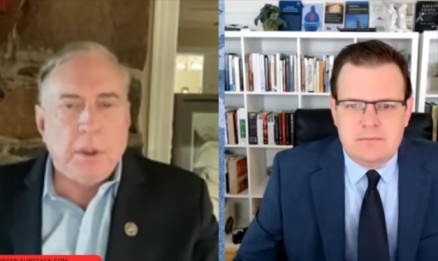
Editor’s Notes: In this episode, Glenn Diesen is joined by Colonel Douglas Macgregor to discuss the looming expiration of the ceasefire and the potential for “total war” against Iran. Macgregor provides a strategic overview of the conflict, contrasting the U.S.’s offensive power projection with Iran’s sophisticated home-court defensive capabilities. They explore the dire global economic consequences of continued hostilities, including the threat of famine and the collapse of the petrodollar. Finally, the conversation shifts to the shifting world order, criticizing the current U.S. administration’s refusal to adapt to a multipolar reality. (April 22, 2026)
TRANSCRIPT:
Welcome and Introduction
GLENN DIESEN: Welcome back. Today is April 21st, 2026, and we are joined by none other than Colonel Douglas MacGregor, a decorated combat veteran, author, and former advisor to the US Secretary of Defense. So thank you very much for coming back on.
DOUGLAS MACGREGOR: Sure.
The Ceasefire and Prospects for Peace
GLENN DIESEN: So we seem to be in the final hours before the ceasefire expires. We’re told there were going to be a meeting in Islamabad. Then there’s been uncertainty whether or not this is actually the case. It’s difficult to see where we’re going here because on one hand we hear the stories that the US has depleted a lot of its missiles and intercepted missiles. On the other hand, so they would want to get out of this. On the other hand, this appears that they’re too far away for an actual peace deal. So it’s the best thing we can hope for, an extension of the ceasefire, or will these negotiations take place, or are we going back to full-scale war?
DOUGLAS MACGREGOR: Well, I think the notion that we were going to hold talks again in Islamabad was always fiction. There was no evidence for any Iranian interest in doing so. The last talks were disappointing. The Iranians showed up with 70 people, large quantities of data, information, maps, and so forth, in the expectation that there was an intention to negotiate and come up with some sort of mutually agreeable solution. There wasn’t.
And, you know, when you have someone like Vice President Pence getting up during the meeting to go outside and take a call from Mr. Netanyahu, it suggests that these are not really negotiations. It also suggests that Mr. Netanyahu, not Mr. Trump, is in charge. And I think effectively, for the purposes of deciding whether we will or will not fight, that’s probably accurate.
So I think President Trump was trying to calm the markets again. He’s done this several times, said things that were patently false about the likelihood of the war ending sooner rather than later, and that the Iranians were desperate for talks when they weren’t, conveying the illusion, I suppose, that we were somehow or another winning this conflict in the Persian Gulf. We aren’t.
And as a result, I think there will be no talks. The ceasefire expires at 3 AM tomorrow in Iran. That’s Iranian time. And I think the Iranians are preparing to be attacked again. And they’re also preparing for the possibility that we will attack even sooner. So at this point, I think we should just dismiss whatever comes out of the White House as effectively nonsense, largely designed to calm the public and manipulate the markets. But I think that’s over now.
Sustaining the War Effort
GLENN DIESEN: Yeah, this appears to be a common theme with Trump, that is to always declare victory no matter what happens. We saw this with Yemen and, well, almost all instances. There’s always a victory somehow, no matter what happens on the ground. But how do you expect this war to be fought though? If the news stories we read are correct, the amount of missiles which have been used, I mean, it seems to be a very significant part of America’s stockpile. To what extent is it reasonable to continue a war to this regard, or at this high intensity? I mean, will the US try to do a low-intensity war? Will they focus on ground invasion, or it doesn’t seem like it’s possible to sustain, do another 40 days of this kind of warfare.
Strategic Overview: The Balance of Power
DOUGLAS MACGREGOR: Well, let me answer that question, but before doing so, let me sort of provide you with a strategic overview from the vantage point of people on the outside looking in. And I’m talking about people, I’m talking about the rest of the world that is watching what we are doing and what Iran is doing. Increasingly, we’re seen as this aspiring supranational authority that wants to impose its will on everyone everywhere. Iran has opted to stand up against this, and the world is very anxious to see what the outcome will be.
We have always had the ability, certainly since, I would argue, 1899, to project power. In fact, that was the whole purpose of President Teddy Roosevelt’s Great White Fleet. And he was the Assistant Secretary of the Navy when the Spanish-American War began, and that was the first time that we attempted to fight beyond the Western Hemisphere. We sent a fleet to Manila Bay in the Philippines, and we managed to defeat the Spanish fleet, which was rather antiquated, and we discovered we had no ground force that we could put ashore to claim victory, and so then we sat in the bay and waited for some period of time until some troops arrived and the rest is history.
But since then, we have been able to do that. We are not inherently defensive. We are a power that banks on the offense, the ability to attack beyond its normal limits in order to impose our power.
Iran’s Defensive Posture
Now, the Iranians aren’t inherently a defensive power. They spend perhaps 1, maybe 2% of what we do on defense. And their investment has been in fundamentally defensive weapons.
Contrary to the sort of unending Israeli propaganda and the propaganda by their agents that control our mainstream media, the Iranians can’t really reach very far beyond their own borders. So they are in a strategic defense posture.
And if you look at the two, one is operating 6,000, 7,000 miles away from its logistical support base, its manufacturing support, and the other is operating essentially from within the boundaries of its own country. And as a result, there is a home court advantage, as we say in basketball. And the Iranians have invested very heavily in a new form of warfare that has reduced us to a position very similar to what was happening on the Western Front in 1914 and 1915.
That if you try to move against Iran, you are identified, you are targeted. You are attacked from anywhere from 500 to 1,000 miles beyond Iran’s borders. That makes it very difficult when you’re dependent upon air and naval power to attack your opponent. That means you have to move your support and sustainment thousands of miles. You have to periodically refuel, reload from a great distance. The Iranians don’t have to deal with that. And most of their critical facilities and stores are underground.
What to Expect: The Coming Air and Missile Campaign
Now that’s the picture. So what can we expect to happen now? I think that we have replenished our stocks in the theater. We have sort of resupplied all of our platforms, naval and air, with required munitions. Now, how long will they last? I would say you would see something again similar to what we did the last time. I think there will be greater emphasis on an initial period of intensity. In other words, the first 48 to 96 hours will be more intense than what we saw previously. In other words, more sorties, more missiles, more bombings, and these will be concentrated on what are allegedly critical targets that if sufficiently damaged could influence the outcome of the operation.
Remember, this is an air and missile operation. That means that everything depends upon the targets you select. You’re looking for targets and portions of a targeting system that will give you a strategic advantage over your enemy, that will convince your enemy to give up, to say, “Enough’s enough, I can’t go any further.”
And we’ve been trying this really since the end of the First World War. There were massive bombing attacks, long-distance strikes, interdiction, as well as close air support in the last 6 months of the war. We tried many of these things, and then when World War II came, we doubled down on all of this. We saw a lot of people experiment with different ways to approach this during the Spanish Civil War.
But my point is that certainly since 1945, the air power community in the United States has been trying to prove that the air power community could do everything. So it was always foolish to expect that anyone who is a member of that committee, like General Cain, the Air Force four-star, would step forward and say, “You know, I don’t think you should do this, Mr. President. If you try to do it, it probably won’t work. It would be a strategic disaster.”
No, I think what he probably said is there are pros and cons. There are things we can do and maybe things we can’t, but we can certainly do the following, laid out what was essentially a plan for an air and missile campaign.
Destroying the Iranian State
So now what I think you’re going to see is a far more intense opening salvo. That salvo will be designed to be, in President Trump’s words, a war-winning operation. It’s going to be so furious and so devastating that the Iranian forces and their citizenry won’t recover. That means the objective now is to destroy the Iranian state. That needs to be understood.
When you begin attacking bridges and road networks and railways, power plants, desalination plants, oil infrastructure, that’s about destruction of the state. You have moved beyond what you consider to be critical military targets and are focused largely on critical infrastructure. I think that’s what you’re going to see now.
And we did that during the second war. Its effects were mixed. The most important thing we did during World War II, in retrospect, were two things. Number one, we destroyed the fuel distribution and manufacturing system. So you couldn’t produce fuel, you couldn’t redistribute it. That opened the path for the Soviet armies in the east. And then the second part was that you couldn’t refuel your air force. And that also meant that all of your air forces were concentrated on the protection of your cities.
Now, the Iranians don’t have an air force. The president talks about destroying the air force. They really haven’t had an air force of significance since the Shah left. So they have very few aircraft. That was never a major player, just like the Navy was never a major player. The Navy consists largely of fast speedboats, unmanned submersibles, unmanned service craft designed to operate in the Persian Gulf, not much further.
Assessing Military Stockpiles
So everything relies on missiles, target acquisition, match the missiles, match the unmanned systems to the various missiles or various targets. We think the Iranians have perhaps 45,000 to 50,000 unmanned systems remaining, maybe more. They certainly have somewhere between 15,000 to 20,000, maybe some more, missiles. I would say that that is more than an adequate supply to sustain Iran through several weeks. And they still have the ability beneath ground, out of reach, to manufacture missiles and manufacture drones. How many, how rapidly, I don’t know. But we also know that the Chinese resupplied them, the Russians resupplied them.
When you turn to our side, do we have another 1,000 joint air surface-to-surface missiles? We expended 1,000 of those in the first 3 weeks, most of those frankly in the space of a week. I don’t know, I suspect we’ve probably replenished those stocks. There are others where we’ve replenished with as much as we can provide, particularly your anti-missile missiles, your PAC-3, your THAAD missiles.
What have we got in terms of radars? Well, that’s a grim picture. The radars that have been destroyed have not been replaced. They cost hundreds of millions of dollars, take years to manufacture. Whether or not we have anything left to put on the ground, I don’t know. It could be that we would bring in whatever is left around the world. But my point is, I think the Iranians are in a better position than we are. That doesn’t mean that they’ll win and we’ll lose. It’s too soon to say that.
Then the other point is, how many precision-guided bombs do we have? And do we have unguided bombs? I suppose we probably do. And if you’re trying to demoralize your enemy, we still periodically rely on the provision of, say, B-52s, each of which carries 90 500-pound bombs. You do the math. How many B-52s can you fly over an area? That’s called carpet bombing. That clearly can be done.
Then the Israelis have been reprovisioned as much as we could afford, but I don’t think their air and missile defense is likely to be infinitely more capable than it was. I think they’re in a tougher position. We still have a lot of missile defense in the fleet. So that’s the picture. We have a lot more ships now at sea. We have more carriers out there, more pilots, more planes. I think we have replaced the losses of the KC-135s, the fuel tankers. So I think we’re gearing up for something similar to what you saw before, only far more intense up front.
Ground Troops and Trump’s Reservations
Now you asked about ground troops. What I find interesting based on the reports that you read, and I’m not on the inside, I’m not attending any of these meetings, so what I’m dealing with is hearsay, Glenn. That means I’m reading what the New York Times, the Washington Post, and others who are fed things by the Central Intelligence Agency and the National Security Agency and so forth, and from the Pentagon.
And what they’re suggesting is that President Trump has been unenthusiastic about the use of ground forces. He has said, “I don’t really want to do that.” That’s a very good thing because I can’t imagine any operation involving the use of ground forces in the Persian Gulf to seize islands that would make any difference to the outcome in the Gulf. I just can’t imagine it. I don’t know what they would be used for because it’s not going to give them control of the Gulf just because they’re sitting on an island. And I always worry about how do you resupply them? How do you evacuate people that are wounded? All this sort of business.
Now we’ll see whether or not they try to do something. I’m sure Special Operations Command wants to do things. I’d be very surprised if people in the Army and the Marines don’t want to do something. But I’m encouraged that President Trump at least has expressed reservations about it.
Iran’s Threat to the Persian Gulf and Global Consequences
So what will the Iranians do? And I think this is very important. We talked about the enormous damage we’re prepared to do. They made it very clear that they will destroy most of what’s on the west coast of the Persian Gulf. And that is of great concern to the entire world.
If you stop and consider that the ingredients for your fertilizer, about 50% of it — these things, urea, nitrogen, phosphate, and so forth — 50% of it comes out of the Persian Gulf. And you’re going to destroy this infrastructure? I think we’re looking down the line at famine across the global south. It’s unavoidable.
We talk in terms of liquid natural gas and petroleum. Those are already problems. There are people rationing things already in India, in Indonesia and Thailand and Vietnam. The cost of a barrel of jet fuel, I’m told, is now over $240 a barrel and rising. It’s not even on hand. Apparently Britain is going to run out of anything in about 2 weeks in terms of both jet fuel and heating fuel. And of course, all these countries in Western Europe that have gone crazy on the green energy business are in terrible positions. And they’ve also shut down many of their nuclear reactors. Now the French haven’t, but the Germans have.
And I’m sure this is an emergency status. I think what you’re going to see happen in Europe now, governments are going to be overthrown. You’re going to see new governments come to power. What can they do? Well, we’ll see. I don’t think they’re going to be able to correct the problems very quickly because most analysts that have looked at the magnitude of destruction from the first round have said it’ll take a year, maybe two years, if we were to stop now, to recover in the Persian Gulf.
And most people understanding what I’ve just outlined to you are concluding accurately, I think, that it will take 5 to 10 years to recover. And we’re not sure what recover means because a lot of this infrastructure in the Gulf may never be rebuilt. I mean, the decision may simply be made not to go back in there. And if anybody does go in there, I would say it would probably be China. Because right now, the sort of global safe area for cash and money is increasingly going to be China, not the United States. And I think that’s where things are headed.
If you look at just the credit markets, people are going to go to China to borrow, not come to the United States. And I think the petrodollar is already dead. Whether or not the yuan replaces it is anybody’s guess. Probably could, but it may be a basket of currencies.
And I think the Emirates and the Saudi House of Saud, all of these people are really in danger of losing their countries. In the sense that others will take over in their absence, because we know that large numbers of the Gulf elites have already fled to Egypt and Europe and other places. And again, we don’t know what will happen in the region this time around.
Regional Players: Turkey, Egypt, and Israel
You have the Turks that have geared up, in my estimation, to be far more involved this time around than they were previously. So are the Egyptians. I don’t see how Israel fares very well through all of this because whatever incentive may have existed in the past for the Iranians to exercise restraint no longer exists. And I think they’ve made that very clear. They’re ready to go to a total war footing. We’ve never done that. And the lesson of history is he who goes to total war footing, certainly in the 20th century, has a better shot of winning if he does it immediately than the person who doesn’t.
Remember, we forget that Hitler did not totally mobilize the German state and nation and people for war until mid-1943. How could you possibly wage war on multiple fronts the way they did and expect to win? On the other hand, the Soviets lived in a state of war mobilization and went to total mobilization very quickly. We did too, and so did Great Britain. We are not going to do that to defeat Iran. That’s an impossibility.
Expanding the War: The Strait of Malacca Proposal
Now, I should be careful because I’m sure you’ve seen the report that apparently General Cain, in his infinite wisdom, suggested to President Trump that it might be useful to consider conducting operations in the Strait of Malacca against Iranian vessels. I think that’s a catastrophe, but it’s not unusual for someone who’s already losing a war to think that they could expand the war to other areas and conceal the loss in one place and ultimately bring it to a successful close elsewhere.
I’m not sure that’s a good idea, but I know that there are people who probably think that way. And there are foolish people out there who say, “Well, fine, then we’ll also stop Chinese ships because after all, the Chinese are supporting the Iranians.” That’s your opportunity to spread and widen the war even further. And one of the reasons the Chinese have been so sensitive to the South China Sea is they know from their history that whoever controls the South China Sea ultimately controls the flow of resources into and out of China. The Royal Navy did that, the French did it before the Royal Navy, and ultimately the Imperial Japanese Navy did it.
The Path Forward: Ending Hostilities
So the bottom line is I see no good news here, no good new direction. The ideal outcome, frankly, at this stage would be to simply end this series of hostilities and put a stop to the whole thing and admit that we cannot, employing our military power, gain control of the Strait of Hormuz. What the Iranians have got, they’re going to keep.
And it’s up to the rest of the world, once this war ends, to sit down with Iran and work out something similar to the Montreux Convention, which was created in 1926 and put the Turks in charge of the Dardanelles. By the way, the Turks have handled that very well. There haven’t been any problems there. A similar convention can be set up, and I think the Iranians are the logical choice, given their strategic position, to run it.
We don’t like that. We’re opposed to that, but we keep forgetting we don’t live there, Glenn. We don’t live in Asia, we don’t live in Europe, we don’t live in Africa. We live in the Western Hemisphere. It’s a huge problem. It’s a strategic reality that we really don’t want to accept. And we don’t want to accept the fact that warfare has now changed dramatically. And with the right mix of missiles and unmanned systems and space-based surveillance and good communications, command and control, a much lesser power with fewer resources can be much more effective against a maritime aerospace power that doesn’t have those advantages.
India’s Economic Stake and the Gulf Crisis
GLENN DIESEN: Seems that bringing the fight to the Strait of Malacca would be a good way of pulling China closer into this war. That’s a disaster on its own. But you get the impression that there’s growing concerns around the world. They’re especially vocal, I think, in Asia now that, well, entire world is being— or sorry, the entire world order is being dismantled. That is, international law itself is rejected.
I mean, there’s always been violation of international law, but at least people were making excuses for breaching it or pretending as if it wasn’t being breached, thus upholding the legitimacy of international law by even breaking it. But this time around, this seems to be just refuting it to some extent.
I was wondering, what is the wider picture that you see from around the world? Is this a deliberate dismantling of the world order? It seems to be getting some strong reactions around the world, and not just on the economic sphere. There’s some massive pushback, and especially in regards to Iran, it’s quite a remarkable achievement that there’s now so much empathy for Iran around the world. I haven’t seen this before in my lifetime. So what do you make of this?
The Iran Question and Israel’s Agenda
DOUGLAS MACGREGOR: Well, if you look at India, India sees itself as dependent upon an extension cord that plugs at one end into India. Let’s say for simplicity purposes, the socket for the plug-in is in Mumbai. And then the rest of the extension cord goes through into the Persian Gulf and plugs into the various oil states, Emirates, and Iran and so forth. That extension cord was suddenly pulled out of the wall, and it’s something that the Indians never really anticipated. No one seemed to think that there was any reason why anyone would disrupt the flow of resources out of the Gulf to India.
But India also does roughly $180 billion a year of business in the Persian Gulf, so a great deal of commerce and money and resources are flowing into and out of the Persian Gulf as far as India is concerned. India is sensitive to international laws and norms. India is opposed to the use of force to solve anything if it can avoid it. And they’re shocked now that the United States has opted for the use of force to solve Israel’s problem. Let’s put it that way with Iran, because if it were not for Israel, we would not be at war with Iran. Let’s be frank.
There’s no real reason for us to do so. We have this wealth of propaganda out there that’s been created over the last 3 decades to try and demonize Iran and turn it into public enemy number 1 for the United States, but that’s a lot of nonsense. When 9/11 occurred and we suffered the losses from the 2 towers that were destroyed in New York City, 1 million Iranians poured into the streets in places like Tehran and elsewhere at night and held candlelight vigils to mourn the loss of life in the United States. There was real hope at that point that some sort of improved relationship could be fashioned as a result of this tragedy. They tried very hard and we essentially spit in their faces.
It’s unfortunate. They were very supportive of us in ways that most people don’t know. Once we were in Afghanistan and then subsequently, if it hadn’t been for General Soleimani that we were so anxious to murder, we couldn’t have stopped the war against us in Iraq. He was instrumental in going in, persuading the Shiite militias to stop fighting, picked up the imam that was responsible for leading the Shiites, brought him back to Isfahan, put him in a corner and told him to study theology until further notice.
Subsequently, when we fought ISIS, those Shiite militias liberated Christians, liberated Sunnis, liberated Yazidis, liberated Druze, anybody that was oppressed by ISIS. And they fought very hard with us, not against us. All of these things were swept away in favor of Israel’s agenda. And Israel’s greater Israel project agenda is the problem. The destruction of life in Gaza, the destruction of life in so-called West Bank in Palestine, now the destruction of life in Lebanon. All of these things are inextricably intertwined with the desire now in Israel for us to destroy Iran. It’s what it’s all about.
The Petrodollar and America’s Strategic Decline
There is no particular reason why we should be involved in— how many times have you heard Americans stand up and say, “We’re not really dependent upon the resources in the Gulf. Why are we there?” It happens all the time. But we’ve had this long-term agreement that enshrined the petrodollar as the currency for the purchase and bartering sale of oil. Now that’s being destroyed. I don’t think we’re going to ever see that come back again.
That’s been a cornerstone in the edifice of our prosperity because we came out of the Vietnam War completely broken financially. We could not cope. That’s one of the chief reasons we came off the gold standard. And that also then made the petrodollar preeminent. This was Nixon’s way of extricating ourselves from this terrible economic disaster that LBJ, President Johnson and his friends had created in Vietnam.
Well, all of that’s water under the bridge now. I think we’re out of the Gulf. And I don’t think we’re coming back. And that’s why I said I don’t think we can afford to go back because we can’t finance what’s required there. Only China can do that. So this whole war has been nothing short of a disaster strategically for us.
The intelligent thing to do now is end it, to step forward and say, “This is the wrong instrument. We were wrong. We shouldn’t have done this. We’re going to try and find a different way. We are looking for help from others to help mediate this.” But that means that we behave like a normal power within this multipolar system. And you know, Glenn, there’s no appetite for that in Washington. We want to be the supranational authority. We want to establish the rules of the game, and then we want to dominate the game, and we want to win the game. That’s over. Those days are past.
Europe’s Strategic Delusion and the Ukraine Crisis
GLENN DIESEN: Well, I think this adjustment from the global primacy to multipolarity is going to probably bring us to more wars. But in this war, it seems to have consequences. Of course, Asia is being impacted in a great way, especially economically. But in Europe as well, we see Zelensky is making the point that the lack of air defences now is as bad as it could possibly be. At the same time as the weapons are drawing up, he’s complaining that the US has been disrespectful to his country because Witkoff visited Moscow but not Kyiv.
We see the EU complaining that the US weapons which are supposed to be sent to Ukraine are being delayed or diverted. The Europeans are talking about establishing a NATO without the US, a different NATO that is, and at the same time as you’re seeing the situation going worse, the Europeans still appear to be escalating. There are these massive drone programs they’re sending to Ukraine, seemingly allowing their territory to be used to strike Russia’s Baltic coast. And we now see that Russia is essentially warning that all of these factories producing all these drones are considered now legitimate targets.
So where do you see all of this going? I don’t want to say— I’m wondering how to describe this best. There seems to be some massive, not panic, but delusion. I’m not sure what is a good word to describe what is happening in Europe now, but there’s not much strategic thinking. It’s just this obsession with defeating Russia. Yet the weapons are drying up, lack of capability seems to be compensated with more belligerent language and dismissing of all the red lines. So where do you think this will take us?
Europe’s Energy Crisis and the End of NATO
DOUGLAS MACGREGOR: Well, my perception is that the misrepresentation of Russia’s true intentions, which never had anything to do with conquering anybody anywhere, is going to vanish in an energy crisis that the current governments in Western Europe in particular can’t master. I think that’s the final straw. So the globalist leaders who want to maintain this war against Russia will be unable to do so because they’ll be thrown out of office.
I’m still surprised that we have not seen open revolution in places like Germany and Great Britain. I think we will in the future. The situation in England, Scotland, and Wales is really bad. We’ve already seen the Irish come out into the streets. I think we’re going to see more of that. They may be the canary in the coal mine for the British Isles. I hope so. But the people that are running the show in Parliament are simply out of touch with reality. They recently refused licensing for more drilling in the North Sea, even though they know that the oil deposits there are enormous and the need for the energy is overwhelming. But we’re still dealing with these people that live in this illusory world where wind and solar power are going to replace carbon-based energy. It’s not going to happen, not this way. I mean, perhaps at some point Tesla’s dream of harvesting energy from the atmosphere will work, but in the meantime, we have to use what we’ve got. We’ve got to survive on that.
I think Europeans are concluding that. And I think in Germany, you eventually, you’re going to see a return to the status quo, which is these people that are running things are going to be gone and they’re going to have to restart nuclear power plants. And they’re going to have to, once they’ve thrown these people out, they’re going to have to come to terms with Moscow. And they should. Again, everything, all the abuse, the insults, and the lies hurled at Moscow have to be fundamentally dismantled. That’s very hard to do when the media is controlled by these globalist governments. The media has not told the truth. They portrayed Ukraine as a sort of luminous group of patriots fighting desperately for their freedom. It’s a lot of nonsense. The Ukrainians were built up for the purpose of attacking Russia by us. We encourage this. We cultivate it. When I say us, I’m talking about we and the Europeans.
NATO is finished. Exactly what I thought would happen at the beginning of this crisis in January of 2022. And I said so. NATO is done. The Europeans must find a way forward for themselves that makes sense. And I think eventually this will happen. I hope sooner rather than later because President Putin has restrained the use of Russian military power. He’s held it back. He has everything he needs to finish this war decisively this year. There’s no question about that. He also has the means to flatten substantial areas in the Baltic States, in Germany, Poland, elsewhere, anywhere in Great Britain for that matter, where they’re manufacturing these drones to be hurled against Russian infrastructure and against Russian citizens. He has sat on all of this. He has declined to do those things. He’s held the force back. The Russians want to do it. He doesn’t.
I hope that European governments will outpace the Russian desire for action. I really do, because it would be disastrous for that war to unfold in Europe. And the Europeans today, they’ve lost their fear of war. They don’t understand just how bad it can be. And I think these governments, once they’re replaced, new people will come in and they’ll behave differently. And this man Zelensky and the corruption in that regime, its underpinnings, which are the worst imaginable criminality, they have to be revealed. The truth has to come out. How many times have we heard about these supposed atrocities committed by Russians only to discover that they were committed by Ukrainians? And that’s not to suggest that in wars all sides make mistakes. We all know that. We committed terrible atrocities on more than one occasion. Most of the time they were accidental. Some of the time they weren’t. But what the Ukrainians have done is unforgivable. And this has got to stop. We have to stop them. I wish we would stop immediately.
Trump, Iran, and the Washington Status Quo
DOUGLAS MACGREGOR: I had hoped that Donald Trump would pull the rug on that one. It turns out he’s been unable to do anything. He is truly the prisoner of the Washington status quo. And I think that extends to what’s happened in the Persian Gulf with Iran. The Congress has done nothing. Nothing to really restrain him. And that’s because they’re all on the payroll. You have a few voices here or there, but the Israel lobby and its agents in the United States have ensured that the money flows to those that support Israel. Hopefully that will change. There is a vote this week on the War Powers Resolution. I hope that that produces something, but I’m not optimistic. There’s just too much inertia in the system.
And Donald Trump, he cannot get past his three rules that he learned from Roy Cohn. I’m glad that other people have picked up on that. I waited a long time to talk about it because I’d hoped that that would not be the case, but I think we have to be honest. It is his three rules of deny, deny, attack, attack, and twist everything into a victory. That seems to be the case. When I listened to the president, who was confronted with a question by a journalist, “Mr. President, why did you put your face on the figure of Jesus Christ and then send this out?” And he said, “Well, I thought of myself as a physician who was healing people.” Well, that’s absurd. He had an opportunity to be truthful. And what should he have said? “I made a terrible mistake. I apologize for offending people. It was in bad taste and I shouldn’t have done it. I regret it. And I hope people will help me get beyond that.” That’s what should have happened. But he can’t tell the truth.
And just as we were talking before the show, I said the Iranians are not going to talk to us. Everybody knows that, that’s paid any attention to them. There’s no point in talking to us. Remember, they too watched our little soirée with Mr. Putin in Anchorage, and what did we do? We showed up with nothing. And President Trump seemed to think he was going to charm the Russians into doing whatever he wanted so that he could walk out and pretend that he was this heroic figure that won the war. The Russians came with proposals, substantive material. The Iranians came to Islamabad with a group of 70 people with substantive materials. They thought they were there to actually negotiate a solution. They discovered that’s not what it’s all about. All of it has been about the same thing. “You must submit to Israel. You submit to Israel’s demands, the war stops.” Well, here’s a newsflash. That’s not going to happen.
The Cost of Deny, Deny, Attack, Attack
GLENN DIESEN: Yeah, this deny, deny, attack, attack, and claim victory, it has, it comes with a great cost though. I can see why it’s assumed it will have some benefits, but such as with this, the picture of Trump as Jesus, it comes off just so much worse. But you can say the same in Iran when the US killed all those little girls. If he would’ve come out and just said, because I assume this was accidental, I think that’s reasonable to assume, just said “this was an accident, it’s a horrible thing, these things happen in war, it should never have happened,” you know, this week. And then you could put the whole matter to rest. Instead, this whole idea that Iran is launching Tomahawks at its own schools, I mean, it just makes the matter so much worse and keeps the whole wound open. I think this strategy of his, the deny, deny, deny, attack, attack, and spin everything as a victory, it has to have some exceptions, otherwise it’s very self-destructive.
DOUGLAS MACGREGOR: Well, there’s a portion of the base that supports him that believes in something that was widespread in the United States, certainly at the end of the 19th and the beginning of the 20th century, and there’s this statement, “my country, right or wrong, but always my country.” In other words, whatever your country does, you defend it to the bitter end. But one would think at this point in time that we, like every other power, at some point have made mistakes, and identifying those is the only way to move beyond them.
America’s Military Illusion and the Need for Change
DOUGLAS MACGREGOR: But he’s not the man to do it. And he keeps telling everyone, “We have the greatest military in the world.” Well, we have the greatest military in the world designed to refight World War II. It’s not the one we need. It hasn’t been what we needed since 1991. But instead of recognizing that, he keeps telling everybody, “Oh, I rebuilt the military during my first term.” Well, he put money into the old structure. Didn’t build anything new. And this is our problem. It’s sort of like the army of Frederick the Great that marched out to meet Napoleon in 1806. It didn’t work and they were destroyed.
We’ve got to get out of this mess that we’re in. If there’s anything good that comes out of this, it’s that we will see a turnover in Washington. Because Americans are not stupid. They see what’s happening. And I think this assumption that everyone is going to rush into the arms of the left is wrong. I think Americans are saying, “Wait a minute, everyone has betrayed us. Elections don’t matter. We go to the election booth, we vote, and we get the same damn stupid outcome.” So I think if nothing else, that realization is beginning to set in in the United States. That’s a good thing.
GLENN DIESEN: Well, Colonel, thank you for taking the time and sharing your insights. As always, it’s been very interesting.
DOUGLAS MACGREGOR: Okay, thank you, Glenn.
Related Posts