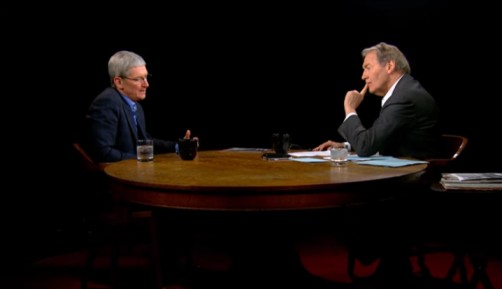
Editor’s Notes: In this special episode, Charlie Rose examines the monumental legacy of Tim Cook as he prepares to step down after a historic 15-year tenure as Apple’s CEO. The program traces Cook’s journey from succeeding the legendary Steve Jobs in 2011 to transforming Apple into a $4 trillion global powerhouse and the world’s most valuable public company. With Cook transitioning to Executive Chairman on September 1, 2026, the discussion highlights his operational mastery and the introduction of defining products like the Apple Watch, AirPods, and Apple Silicon. Finally, the episode looks toward the future under incoming CEO John Ternus as Apple navigates a new era of hardware innovation and artificial intelligence. (September 12, 2014)
TRANSCRIPT:
Introduction
CHARLIE ROSE: Tim Cook is stepping down after 11 consequential years as CEO of Apple, one of the great innovative companies in the world. Following founder and visionary creator Steve Jobs, Cook was the right person at the right job as Apple organized and consolidated the brilliant insights of Jobs in product development and then spread them and the company around the world.
Born in Alabama, Cook went to Auburn and Duke and worked at IBM before being recruited by Jobs to come to Apple and Silicon Valley, where he put his operational talents to work. As CEO, under Cook’s leadership, Apple became the most valuable publicly traded company in the world as a multi-trillion-dollar enterprise. The company added services to its revenue base, functionality was added to Apple products, secrecy of the ecosystem was continued, and multiple manufacturing bases were added to the supply lines. Along the way, Apple became an economic powerhouse.
Tim Cook will continue to impact the company as executive chairman. John Ternus becomes the new CEO. Tim Cook did a number of conversations with me while he was building Apple, and here is a composite of them.
Is the philosophy of Apple, we don’t have to be first, we want to be prepared to be the best?
Apple’s Philosophy: Best, Not First
TIM COOK: The philosophy has always been to be the best, not the first. If you look back in time at Apple, the iPod. The iPod was not the first MP3 player. It was arguably the best, and arguably it was the first modern one, but not the first. The iPhone was not the first smartphone. BlackBerry was shipping phones, Palm was shipping phones. iPhone was the first modern smartphone. And then if you look at iPad, tablets were shipping a decade before. And yet iPad arguably was the first modern tablet and the first one that met commercial— any level of commercial success.
Steve Jobs’ Legacy
CHARLIE ROSE: When you introduced the Watch, you famously said, “One more thing,” words that Steve had used. Where is Steve in all this?
TIM COOK: Well, he’s in my heart and he is deep in Apple’s DNA. Spirit will always be the foundation of the company. I literally think about him every day. His office is still left as it was.
CHARLIE ROSE: On the 4th floor?
TIM COOK: On the 4th floor. His name is still on the door. And we still— if you think about the things that Steve stood for at a macro level, he stood for innovation. He stood for the simple, not the complex. He knew that Apple should only enter areas where we can control the primary technology. All of these things are still deep in our company. There’s still things that we very much believe.
The strive for perfection, for being the best, for only doing the best products. For staying focused. The fact that despite this table being so small that you and I are sitting at, you could put every Apple product on it, every single one that we ship today. And yet this year our revenues will be approximately $180 billion. There’s probably no other company on the face of the earth that could say that.
Most companies begin to do larger and larger and larger portfolios because it’s so easy to add, it’s hard to edit. It’s hard to stay focused. And yet we know we’ll only do our best work if we stay focused. And so the hardest decisions we make are all the things not to work on, frankly, because there’s lots of things we’d like to work on that we have interest in, but we know that we can’t do everything great.
Apple and the Future of TV
CHARLIE ROSE: Is TV one of those?
TIM COOK: Well, TV is one that we continue to have great interest in. So I choose my words carefully there, but TV is one of those things that if we’re really honest, it’s stuck back in the ’70s. Think about how much your life has changed and all the things around you that has changed. And yet TV, when you go in your living room to watch the TV or wherever it might be, it almost feels like you’re rewinding the clock and you’ve entered a time capsule and you’re going backwards. The interface is terrible. I mean, it’s awful. And you watch things when they come on unless you remember to record them.
CHARLIE ROSE: So why don’t you fix that?
TIM COOK: Well, we’ve taken stabs with Apple TV, and Apple TV now has over 20 million users. And so it has far exceeded the hobby label that we placed on it. And we’ve added more and more content to it this year. And so there’s increasingly more things that you can do on there. But this is an area that we continue to look at.
Succeeding Steve Jobs: The Question of Vision
CHARLIE ROSE: And was this a question for you? Among some investors, among some consumers, among some people who write about technology, there was the question — Steve was a visionary. Can Tim continue the Apple tradition of creating new products every 4 years or less?
TIM COOK: When he called me one weekend in August of ’11, and he said, “I’d like to talk,” and I said, “Oh, okay. When?” And he said, “Now.” So I said, “I’ll be right over.” And he told me, he said, “I’ve been thinking a lot. Apple’s never had a professional transition at CEO. I’m determined that we will have one now. I want you to be the CEO.” And honestly, I didn’t see it coming.
CHARLIE ROSE: You did not see it coming.
TIM COOK: I know you look at me in disbelief, but you can say I was in denial or whatever, but I thought— I felt Steve was getting better. He was still at home, but I felt he was getting better. I was seeing him regularly, and I guess at the end of the day, I always thought he would bounce. He always had. He had had some incredible lows in his health, and it had always bounced. And I always believed he would. And so it took me a little by surprise. I mean, he had talked to me about being CEO before. And so I always knew it was his long-term thinking—
CHARLIE ROSE: That you would become the CEO.
TIM COOK: That I’d become the CEO.
CHARLIE ROSE: But not then.
TIM COOK: Not that specific moment. And so he and I had a discussion back and forth because I was testing him on this. I said, “What kind of things do you want to do as chairman versus me do?” And it was just sort of having a good banter with him. And I said, “For example, ads — do you want me to just do the ones that I think are right, or do you want to be involved in it?” And he said, “Well, I hope you’ll ask my opinion on some things.”
I thought, Charlie, on that day that he would be chairman for a long time, that I’d be CEO for a long time, and that we would continue to work together. And he knew when he chose me that I wasn’t like him, that I’m not a carbon copy of him. And so he obviously thought through that deeply — about who he wanted to lead Apple. And so that I have always felt the responsibility of. And I’ve wanted desperately to continue his legacy and the Apple I deeply love. And so from the onset, I wanted to pour every ounce that I had in myself into the company.
But in terms of being everything he was, I’ve never had that objective. I’ve never had the objective of being like him because I knew the only person I can be is the person I am, right? And I’m not an actor. I’d be terrible in Hollywood. And so that’s what I’ve done. I’ve tried to be the best Tim Cook I can be.
And I think the reality is that Apple has always had incredible contributors at very high levels. Jony’s been there forever and contributing at an incredible level, as has Craig and Jeff and Dan. And you just go around the table. We have a new CFO now. There’s this group of people, and we’ve recruited Angela. Angela now runs retail, Angela Ahrendts. She is fantastic. This level of people are capable of doing incredible things. And it’s a privilege of a lifetime to work with them.
Building the Right Team
CHARLIE ROSE: And you have a picture in your office of Martin Luther King and a picture of Robert F. Kennedy. Robert F. Kennedy, after his brother’s assassination, someone said the difficulty for him — well, he’ll have no RFK as he was to his brother, Jack. So I might ask the question, do you have a Tim as you were Tim to Steve?
TIM COOK: I think each person, if you’re a CEO, the most important thing — to me — is to pick people around you that aren’t like you. That complement you, because you want to build a puzzle. You don’t want to stack Chiclets up and have everyone be the same. And so I believe in diversity with a capital D, and that’s diversity in thought and diversity in any way that you want to measure it.
And so the people that surrounded me are not like me. They have skills that I don’t have. I may have some that they don’t have. What we do as a team collectively, we are able to do some incredible things. And it’s because we collaborate. And I see one of my key things in life is to make sure that we collaborate at an incredible level because we run the company functionally. We’re not like the typical big company that has n number of divisions and n number of P&Ls. Everybody is a functional expert. And then we collectively, to get things done, we work together as a team because the work really happens horizontally in our company, not vertically. Products are horizontal. It takes hardware plus software plus services to make a killer product.
And so all of these people, if you were to line us up and talk to everyone — you know several of them — we’re all different. And that’s the power of it, is that we’re not trying to put everyone through a car wash so they look alike, talk alike, think alike at the end of the day. We argue and debate. If you were to come in our executive team meetings on Mondays, you’d hear a lot of discussion and debate about something. We don’t always agree on everything, but we have great respect for one another and we trust one another. And we complement one another, and that makes it all work.
Blocking the Noise
CHARLIE ROSE: Did the team, you leading the team, have any question that you could accomplish what you did knowing those questions were out there about the future of Apple?
TIM COOK: I think for me, I can’t talk about what everybody else thinks, but for me, one great skill I have is blocking noise. And so I typically read and listen to things that are deep and challenging and intellectual in nature, not just the noise. I think if you get caught up in the noise as a CEO, you’re going to be a terrible CEO because there’s so much noise out there in the world — everybody’s on the sidelines saying what you should do, shouldn’t do, et cetera. It’s sort of like the old Roosevelt quote, “In the arena.”
CHARLIE ROSE: Teddy Roosevelt.
TIM COOK: Yes.
CHARLIE ROSE: “Credit belongs to the man in the arena who gets dirty and all of those things.”
TIM COOK: Well, I’m the dirty one.
CHARLIE ROSE: Yeah.
TIM COOK: And you have to block the noise. And so the question I think is, did I have doubts? The answer is no. And did the executive team have doubts? I think you can see in our products that we were all betting on each other in a big way.
Apple’s Evolution: Openness and Partnerships
CHARLIE ROSE: But that goes back to my original question. Apple is becoming— it’s building on its tradition, but it’s doing things different. Steve said to you, don’t ever ask yourself, “What would Steve do?” Correct?
TIM COOK: He did.
CHARLIE ROSE: Don’t ask that. Do what you think you need to do based on the circumstances that you face. So is Apple becoming more open? I’ve mentioned the fact that people who have apps, create apps, can do it for the Watch. You are now engaged in partnerships with people like IBM. You’ve made an acquisition. Tell me, where is Apple going?
TIM COOK: Are we more open? Yes.
CHARLIE ROSE: More engaged by partnerships?
TIM COOK: Well—
CHARLIE ROSE: Are we interested in enterprise because we can partner with IBM?
The IBM Partnership
TIM COOK: I think IBM is— that’s a great one to talk about for a moment because I think it’ll give you an insight into how we look at things. And this is probably different than the past is we look at these products and the iPads that aren’t here. And we think we can change the way people work. We’ve changed the consumer’s life. We’ve changed the way students learn and teachers teach. But when you get to the working environment, the change that we’ve made to us isn’t significant enough.
And so we begin to ask ourselves, why? Why haven’t we done more? The real answer is in the applications. There’s not enough apps that have been written for verticals, for very deep verticals, like what the airline pilot does, what the bank teller does, down at the level of the job. And so we began to ask ourselves, should we do this? Or should we partner? Or should we just forget it?
And I didn’t want to forget it because this is a way to enrich people’s lives in a big way to change the way people work. I mean, most of our life is spent working. And certainly our apps are changing the way I work, but I’m not seeing as much in other places. And so we began looking out and thinking about, well, who could we partner with? And Ginni and I had been talking about some other things for a while. I have great respect for her, great trust in her. I think she’s—
CHARLIE ROSE: She’s the CEO of IBM.
TIM COOK: Is the CEO of IBM. She’s fantastic. And we began to talk about this area. This is an area where they’ve got things that we don’t have. They have deep vertical knowledge of many different verticals. They have a huge sales force. And so IBM brings significant enterprise knowledge to the table. We bring the products that enterprise want. And so we have something they don’t have.
Well, we also don’t compete on anything. To me, this is the perfect marriage. There’s no friction. There’s just we have what they need, they have what we need. Together, we can provide something to customers that is blow away. And so IBM is in the process with our help of designing many different apps for many different verticals from banking to all the different financial services to pharmaceutical to aerospace and manufacturing and so on and so forth. And they have the go-to-market that we don’t have.
And so this is an area where I think that everybody’s going to win. We’re going to win. IBM’s going to win. And more importantly than both of us, the customer is going to win.
The Beats Acquisition
CHARLIE ROSE: Why did you think you had to buy a headphone manufacturer?
TIM COOK: In Beats, what we saw is several things. We saw— Talent. —talent that I’m super impressed with. Jimmy and Dre, off the charts creative geniuses. They also had teams underneath them that I really liked. Jimmy has a deep knowledge of the musical industry. Dre knows artists. Dre is an artist.
And they had started a subscription service. And this subscription service, some people think they’re all alike. Well, let me tell you, I went into the thing skeptically. Not to the acquisition, into their service, because Jimmy had told me how great it was. And so one night I’m sitting playing with theirs versus some others. And all of a sudden, it dawns on me that when I listen to theirs for a while, I feel completely different. And the reason is that they recognized that human curation was important in the subscription service, that the sequencing of songs that you listen to affect how you feel. It’s hard to describe. But you know it when you feel it. And so that night, I couldn’t sleep. And so I was thinking, we need to do this.
They also have— I think they’ve done a fabulous job with their brand and in the headphone business. It’s a fast-growing business. They went into it not too long ago and have done really well. However, they needed a global footprint. We have a global footprint. They have been primarily US, not solely US, but primarily US.
And so I felt we could get a subscription service, we could get incredible talent, and that I think we can all put our heads together and do some things that are beyond what either of us are currently doing. And we could get a fast-growing business. And the financial is not the only element of looking at it. At all, but next year, or in our fiscal year, which is about to start, it’s accretive. When’s the last time you heard of a technology CEO saying that they were doing an acquisition that was accretive? I mean, it just doesn’t happen.
And so I think it’s wonderful to get the influx of talent, the different perspectives. It’s this idea of diversity that I use in a big way. I think it’s really going to help us. And I am 100% sold on the subscription, music subscription service. And of course, we can scale it where Beats would have had a more difficult time because they’re a small company.
Hardware, Software, and the Apple Ecosystem
CHARLIE ROSE: Is the new chapter in Apple also defined by the fact that you’re moving away from just being essentially a hardware company?
TIM COOK: You know, I wouldn’t say that we were never just a hardware company, so I would define that a little different.
CHARLIE ROSE: Part of your revenue comes from the iPhone, for example.
TIM COOK: But a significant part of the iPhone is the software and the services, right? It’s just that we don’t split out the price between the hardware and the software and the services. It’s all part of our own ecosystem, and we do that because it all works together. It just works when you do it that way.
When you split the two, you wind up with— I mean, think about what happened in the PC area when you had Windows and a separate OEM that was doing hardware and then somebody else that was doing apps. And you have a problem, you’re pulling your hair out, you call the help desk, and the help desk tells you to call another help desk, and that help desk tells you to call somebody else, and the other guy doesn’t even have a help desk. So we recognized early on that these kind of devices, you really need to have a womb-to-tomb view of them for the customer’s sake. And so if somebody calls us, it’s our problem. We’re not passing the buck. And so I think you get a much better customer experience.
CHARLIE ROSE: But do you miss opportunity to take advantage of a whole group of people because—
TIM COOK: Well, look at our ecosystem, Charlie. I mean, we’ve got 9 million registered developers. And so we’re not having a problem getting people to develop for a platform. If you were at our conference in June in San Francisco, there’s developers there from almost every country in the world and they’re writing—
CHARLIE ROSE: So you have all the innovation, access to all the innovation.
TIM COOK: We have incredible access to innovation and we also view it and treat it as a privilege to work with the developers we do. And so we treat them like it’s a privilege. And from their point of view, they get to design something from a company that has over 90% of their customers on one version of the operating system. So we’re not fragmented like Android is.
We’ve got— we’ll release iOS 8 next week. And right now, iOS 7, the one that we just released a year ago, 92% of our customers are running iOS 7. If you looked at a comparable number for Android, it’s very low. It’s extremely low. If you looked at a comparable number for Windows on the PC side, very low. And so you can really write software to the latest, or write your app to the latest software versus spending your time on all of these versions and iterations and so forth.
So it’s great from their point of view, and they get to sell their product worldwide. Think about how it used to be if you were a developer. You had to go negotiate with every retailer, and there’s no global retailers. And so you were negotiating in every country in the world trying to get your product on the shelf. Here, you can push a button, we review it, and it quickly gets in the App Store. And it’s in an app store in 155 countries.
I mean, it’s really shocking. The jobs that this thing has created is unbelievable. We’re now, between the people that we employ directly and the developers— the developers are a big piece of this— we’re responsible for 1 million jobs in the United States. And a lot of that are people that have concluded to write apps.
Apple’s Competition
CHARLIE ROSE: Who is your competition? Well, Google, people would say Samsung instantly because of the products they make. Smartphones like this, not like this, but they make smartphones. They have the Android operating system, which is the largest operating system in the world.
TIM COOK: Well, Google supplies that to them. And so I think I would say Google is your company. Google is the— it would be the top, and then they enable many people in the hardware business like Samsung. And Samsung is the best of the hardware companies in the Android sphere.
CHARLIE ROSE: Google is competition. Who else?
TIM COOK: Who else?
CHARLIE ROSE: The big four are Amazon, in terms of most people’s consideration, Amazon, Apple, Facebook.
TIM COOK: I don’t consider Facebook a competitor. I consider Facebook a partner. We’re not in the social networking business. And will not be. We have no plans to be in the social networking area. We partner with both Facebook and Twitter, and we have integrated both of them into the operating system. And so we’ve worked closely with both of them so that our customers can get access in a different and unique way to their services. And we like both companies.
Amazon? We don’t work with that much. We have little relationship there. They sell, as you know, they come out with a phone. You don’t see it in a lot of places. They have some tablets, but they’re not a product company. Apple’s a product company. And so in the long term, will they become a bigger product company? I don’t know. You’d have to ask Jeff what his plans are. But when I think of competitor, I would think of Google as the—
Learning from Mistakes: Apple Maps
CHARLIE ROSE: So all the successes you have pointed to, when you do something that’s not as much of a success, and I’m obviously thinking of Maps, and you look at it, what did you do wrong?
TIM COOK: Oh, we screwed up, to put it bluntly. There are many screw-ups in that one. There’s just not one, there’s many. And we’ve learned and corrected and are continuing to invest in Maps because our fundamental premise that Maps were really key to Apple is the same as when we made that call many years ago. But we did screw up on the release. It should not have happened like it did. It shouldn’t have come out.
And sometimes when you’re running fast, you slip and you fall. And I think the best thing you can do is get back up and say, “I’m sorry,” and you try to remedy the situation and you work like hell to make the product right. If you’re probably never making a mistake, you’re probably not doing enough.
Tim Cook’s First Meeting with Steve Jobs
CHARLIE ROSE: I mentioned at the beginning of the interview the fact of when you made a decision in 1998 about Apple and you had some reservations. But at the same time, during your interview with Steve, you said something like this. I was prepared within 5 minutes to throw caution to the wind. What did he say that made you believe this company is the place for Tim Cook?
TIM COOK: It was an interesting meeting. I had gotten a call several times from the search people that he had employed. And I kept saying, “No, I was at Compaq, I was happy,” or thought I was, and they were persistent. And so I finally thought, “I’m going to go out and take the meeting. Steve created the whole industry that I’m in. I’d love to meet him.” And so I’m honestly going into the meeting—
CHARLIE ROSE: There’s no downside to this.
Joining Apple and Working with Steve Jobs
TIM COOK: Well, I’m just thinking I’m going to meet him. And all of a sudden, he’s talking about his strategy and his vision. And what he was doing was going 100% into consumer when everybody else in the industry had decided you couldn’t make any money in consumer. So they were headed to servers and storage in the enterprise.
And I thought— I’d always thought that following the herd was not a good thing. It was a terrible thing to do, right? It was— you’re either going to lose big or lose, but those are the two options. He was doing something totally different. And he told me a little about the design, enough to get me really interested. And he was describing what later would be called the iMac.
And the way that he talked and the way the chemistry was in the room, it was just he and I, and I could tell I can work with him. And I looked at the problems Apple had and I thought, you know, I can make a contribution here. And working with him, and this is a privilege of a lifetime. And so all of a sudden I thought, I’m doing it. I’m going for it.
And you sort of have this voice in your ear that says, “Go west, young man, go west.” I was young at the time. But you know, you come back and you try to do the things that people do with spreadsheets and stuff, and none of it makes sense. It didn’t make sense. And yet my gut said, “Go for it.” And I listened to my gut. There was literally no one around me that was advising me to do it.
CHARLIE ROSE: But in your speech at Auburn, your commencement speech, you spoke to intuition. Yes, and it’s—
Intuition Over Analysis
TIM COOK: That’s what I mean by gut. Your intuition was telling me loudly to go, and it wasn’t based on, you know, as an engineer, you want to write down pros and cons and the financial part you want to look at, and you want it to say go. You want it to sort of validate the decision that your gut has come to, and it never did.
Because, you know, Michael Dell had made a comment weeks earlier that if he were the CEO— and he was a very, is and was a very respected CEO— that if he were the CEO of Apple, he would close it down and give the money back to the shareholders. That it had no future. I remember he said that. You know, and he was just saying what everybody thought.
CHARLIE ROSE: They didn’t know Steve Jobs. They didn’t know Steve.
TIM COOK: And so in that meeting, I concluded all of those guys are wrong. They don’t know him and they don’t know his vision and they don’t— they see things in the traditional way, which Steve never did. You know, he was always looking well beyond the— and looking at things with beginner’s eyes. He had a gift for that. He clearly had a gift for that.
And he took that gift and embedded it in the company. It wasn’t a gift that he kept to himself. And so one of the— I loved many things about him, he’s a dear friend, but he was also a great mentor. He was a great teacher. This is something that’s never written about him. But what he left in not just me, but many of us, is what he taught us. He was one of the best mentors in the world.
CHARLIE ROSE: This is more than perfectionism.
TIM COOK: Oh, it’s much more than that. No, it’s much more than that because that’s just— that’s holding the bar so high that it’s very hard to hit. But no, it’s teaching and making sure people are learning and him taking such an interest. He’s going out of his way to do this. And I saw him do that over many years with not just me, but many people. And I think it’s missed. It’s a huge, huge part of what he did that’s missed in most of the things that I’ve read.
CHARLIE ROSE: The misconception misses that, the teaching aspect of it.
TIM COOK: It does. That and the human aspect of him. He was an incredible human being. And I think, you know, I’ve never read anything that really captured him or captured the Steve I knew.
What Comes After the Internet
CHARLIE ROSE: You once said to me at a conference, and I was about ready to go in and interview someone in a big public conference. I said, “What do you think I should ask?” And you said, either facetiously or not, “Ask him what comes after the internet.”
TIM COOK: I remember telling you that. And I remember your reaction. I wanted you to ask them because I wanted to hear what they were going to say. I think you have to think about things like that. And sometimes in the Valley, everybody can get so fixated on one thing. And lots of companies pop up and do those things. And you’re not thinking enough about the next, next, next thing. And so it’s something that we think about.
And I don’t know what the answer is. We always have some ideas here and there.
CHARLIE ROSE: Well, give me one.
TIM COOK: Well, I don’t want to give you one. I don’t want anybody else to copy it. We have people out there that copy us, and so I don’t want to help them do that.
Privacy, National Security, and the Snowden Debate
CHARLIE ROSE: In this country, we’ve had to— because of Edward Snowden and other incidents— try to come to grips with the idea of freedom, privacy, and national security. Where is that debate?
TIM COOK: I think it’s a tough balance. And I don’t think that the country or the government found the right balance. I think they erred too much on the collect everything side. And I think that the president and the administration is committed to kind of moving that pendulum back. However, you don’t want— it’s probably not right to not do anything. And so I think it’s a careful line to walk. You want to make sure you’re protecting the American people, but you don’t want to— there’s no reason to collect information on you or 99.99% of other people.
CHARLIE ROSE: A lot of people say, and have said to me, there’s a whole ton of information already out there that are in the possession of companies like Google, like so many other companies, that that information is there and they worry about that. Too much personal information is out there and who has access to it, that kind of thing, which is different than the national security implications of what you do to listen in on people’s phone conversations or what technology companies do to provide lists of whatever might happen.
TIM COOK: We’ve taken a very different view of this than a lot of other companies have. Our view is, when we design a new service, we try not to collect data. So we’re not reading your email, we’re not reading your iMessage. If the government laid a subpoena on us to get your iMessages, we can’t provide it. It’s encrypted and we don’t have the key. So the door is closed.
But our business, Charlie, is based on selling these. Our business is not based on having information about you. You’re not our product. Our product are these and this watch and Macs and so forth. And so we run a very different company.
I think everyone has to ask, how do companies make their money? Follow the money. And if they’re making money mainly by collecting gobs of personal data, I think you have a right to be worried, and you should really understand what’s happening to that data. And the companies, I think, should be very transparent about it.
From our point of view, you can see what we’re doing on the credit card thing. We don’t want it. We’re not in that business. I’m offended by lots of it. And so I think people have a right to privacy. I think that’s going to be a very key topic over the next year or so, and will reach higher and higher levels of urgency as more and more incidents happen.
For us, in the Snowden thing, just to go long on that for just a moment— what we wanted was to be totally transparent because there were rumors and things being written in the press that people had backdoors to our servers and all this kind of stuff. None of that is true. Zero. We would never allow that to happen. They would have to cart us out in a box before we would do that.
If we ever give information— and we finally got agreement from the administration to release how many times we had national security orders on Apple— in the 6-month period, and we had to release a range because they won’t let us say the exact number, it’s between 0 and 250. That’s the lowest number you can quote. Zero to 250.
CHARLIE ROSE: Could have been 1 or it could have been 249. Correct. But you—
TIM COOK: So you can tell we have hundreds of millions of customers. So it’s a very, very rare instance that there’s been any data asked. And one of the reasons is we don’t keep a lot, you know. So we’re not the treasure trove of places to come to.
Values: Human Dignity and Equal Rights
CHARLIE ROSE: I mentioned Robert Kennedy and Martin Luther King in your office. Tell me the values that you consider most important beyond the culture and the values of Apple. Tim Cook, the man.
TIM COOK: Treating people with dignity, treating people the same, that everyone deserves a basic level of human rights. Regardless of their color, regardless of their religion, regardless of their sexual orientation, regardless of their gender, that everyone deserves respect. And I’ll fight for it until my toes point up.
And I think those two guys, if you look back in history, I think they’re not the only two. There were many that really— but they laid their lives on the line and they knew they were doing it. And I have tremendous respect for both of them. And so I do, I look at them every day because I think for people, there’s still too many cases in the world and in the United States where there’s a class kind of structure, or people are trying to convince each other that this other group of people don’t deserve the same rights. And I think it’s crazy. I think it’s un-American. I think it doesn’t belong.
And I also see, as a businessman at Apple, I can see the value in diversity. I see a tremendous company that, because we don’t judge each other, because we don’t have different rights and so forth, because we allow anyone in the front door— I see a company where this inclusion really inspires innovation. And so I see the value of it from that point of view as well.
But from a more human point of view, I feel it’s just and right. And I’ve seen it not occur, and I’ve seen the devastation of it not occurring. And so I want to do everything I can do to not only not propagate it—
CHARLIE ROSE: What offends me most about discrimination is that you’re not being able to access the full range of not only of humanity, but also you’re doing a huge disservice to yourself because of the human potential. I agree. Anything that restricts the human potential is doing a disservice to you and to everybody around you.
TIM COOK: I agree. And it’s not what the country was based on. You know, I get back to that. There’s some basic level of rights that our forefathers had the insight to think about. And we’re still fighting, 250 years— a little less than that, I guess— afterwards to see that vision, but it’s worth the fight. And we’ve certainly come a long way since Dr. King’s speech on the Mall. But we have a lot further to go.
CHARLIE ROSE: We have a lot further to go. And finally, there’s the threat to the planet.
TIM COOK: There is.
Apple’s Values: Environment, Human Rights, and Legacy
TIM COOK: And this is one that we’re putting a lot of energy in. We at Apple. We at Apple. We want to leave the world better than we found it. And what does that mean for us? It means that we take toxins out of all of our products. We’ve done that. I think we’re still the only consumer electronics company that’s done that. It means that we focus on renewable energy. And so we have a data center that people told us we could never get to 100% renewable energy. There was just too much of— it was too much. We’d never get there. We’re there. We have it in Maiden, North Carolina. You should go see it. They’re working with both the state and working with the talent within Apple, we were able to pull that off. We’ve got other data centers, 100% renewable. We’re building the headquarters, our new headquarters. It’ll be 100% renewable. And we’re working on our supply chain. And we’re digging deep within the supply chain. And we’ve got initiatives going on there as well.
To me, I know some people have issues with this, but to me, it’s all about leaving the world better than you found it. And I don’t know about you, but when I spend my spare time, when I have any, I like to be out in the national parks. And reminding myself of the land and the beauty of it. And you can go to different places and see that slipping away. And it’s not right, and we owe it to the generation, to the younger generation, to solve this and not to keep turning and looking the other way.
CHARLIE ROSE: Those same values also ought to be applied to the people who make Apple products, wherever they live and wherever they work.
TIM COOK: Absolutely. And you can see what we’ve done there. We have trained now well over a million, probably 2 million people on their rights and where you and I have a good view of what our rights are, that’s not the same in every country in the world. And so one of the best ways you can make sure that things are happening well is if people stand up and say, “Something’s happening that’s not right here.”
We also, we’ve audited so deep in our supply chain and we do it constantly, looking for anything that’s wrong, whether it’s, down to the— there’s a safety exit blocked. We have gone beyond the auditing and are now essentially holding university-style classes on the manufacturing campuses of our partners because people see, just like you and I probably, you don’t start in life at a— here, you start in life at the bottom and you crawl up. And so we’re trying to provide education, which to me is the great equalizer among people, to people on the factory floor who want and aspire to do more. And so we’ve worked with local Chinese universities to employ classes right on campus to make it super convenient for people.
I really feel that we’ve done a tremendous amount in this area. And plus we’ve been incredibly transparent because this is an area unlike me being secretive about the future. I want everybody to copy. And I’d love that everybody takes exactly what we’re doing and do it. And if they’ve got any better ideas, I want them. Because I think we all ought to be, just like with the environment and human rights, this is an area we ought to all share. We can all improve the world on. It’s not building a new product where we want to keep it secretive.
The Junction of Technology and Humanities
CHARLIE ROSE: And the Apple of your future stands, as Steve once said, at the junction of tech and humanities.
TIM COOK: Yes, it does. And you can see it in these products, in this incredible watch. You can feel it. You can see that in everything that we do, we have this focus on — How am I changing the world? How am I enriching somebody’s life? How am I making things easier for people? And we’re just not making products to sell. That doesn’t get me up in the morning. I get up in the morning and many other people get up in the morning to change things. I mean, that’s who we are as a company. That hasn’t changed. We may change other things. We may become more open. We may participate in these things that we haven’t done before, but what drives us are making great products that enrich people’s lives. It’s the same thing that’s driven Apple forever.
CHARLIE ROSE: But it’s been a good business. Are you now not the largest company in the world in terms of market cap?
TIM COOK: We are. But we don’t fixate on it, Charlie. We don’t— I don’t get up in the morning thinking, wow, we’re the largest. Let me act arrogant.
CHARLIE ROSE: Well, no, you don’t think of it that way. You think of it in a— you also have over $100 billion in the bank. Based on whatever the stock buyback has done, which I don’t know the numbers. You do think of that in terms of the opportunities it provides you to do all the things that we’ve been talking about. Whether it’s technology, whether it’s humanities, whether it is being a good citizen.
TIM COOK: I do. And I see it as a responsibility. I don’t see it as a burden. I see it as a responsibility and I feel that this gives us even a greater ability to contribute more. Not just in the monetary sense. We’ll always contribute the most to humanity through our products because these products will change people’s lives and enable them to do things they couldn’t do before. We can reach more people doing that.
But I’m proud to be working on Product Red with Bono in eliminating AIDS in Africa. I’m proud that we’re out in front on environment. I’m proud that we’re pushing like crazy in human rights. I’m proud that we’re working on education and trying to change the way teachers teach and students learn. These things excite me. These things move the dial in the world. And I’m not just talking about the US, I’m talking about worldwide. And I think these are the things that make our hearts sing. These are the things that get us up in the morning and it drives us to do unbelievable things and work unbelievably hard. It’s not the largest market cap in the world. This is not an objective where people will work the extra hour, will go the extra mile. Those things aren’t things that push people. I mean, I don’t know. They don’t push me anyway.
And I’m not saying— to all the shareholders out there, I’m not saying I’m not focusing on you. I am very focused on them. But I’m talking about what drives people. And what we’ve learned is something simple. It’s very simple in a way. If we focus on great products that enrich people’s lives, and we do that well, really well, the financial returns will follow and our shareholders will be happy. And it’s a continuous circle. And so I like that because it’s simple.
Too many companies focus on, let’s try to get the largest market cap. And that doesn’t drive people. I was at Compaq at a time where the objective was to become a $40 billion company. Well, employees don’t get excited about that. This isn’t something you wake up and you go, I’m going to take the hill today to do $40 billion. It’s just not that. But changing the world — these are the things that people work for and this pushes people.
And so this is who we are as people. And it’s the values of our company. It’s been the values of our company forever. Steve, and it’s Steve’s credit, he put these values in the company. And not only so, it wasn’t just his values, it was his mentoring and teaching that instilled these deep in the company. And so if I step off the curb this afternoon, I hope I don’t, but if I do, those will be the values of the company tomorrow and the next day and the next day. It’s that deep. And it is. I know I probably said it too many times, but it’s a privilege of a lifetime to be there because I think there’s no place like it on earth.
Bono, U2, and the Free Album
CHARLIE ROSE: What was it that Bono said to you? That got me to buy his free album?
TIM COOK: Yes.
CHARLIE ROSE: What did Bono say to get you to buy his free album? And what did he say to you when he walked over to you at the presentation? It was something akin to Zenmeister. I’m not sure what it was.
TIM COOK: He called me the Zenmeister or something because he can’t shake me. He can’t shake me up. You know, from our point of view, it’s kind of simple — we love music. We were thrilled with the album. We think the album is killer. I don’t know if you’ve listened to it yet. I’d really encourage you to do it. And so what we wanted to do was we wanted to give something to our customers, and I think the vast majority of them are going to love the music and love the gift. Some may not love it. I hope they all do. But it was more about our customers. And so it felt great to participate in something that’s music history with the largest album release ever. But the real thing was giving something to our users.
CHARLIE ROSE: And you can get the album. Free.
TIM COOK: Yeah, and it was— I hope you listen to it. They have done a killer job. They’ve worked on it for 5 years. The band has done incredible work here, and I think you’re really going to like it. They performed one song at our event, and I think the crowd really, really liked it.
What Makes Apple, Apple
CHARLIE ROSE: Everybody wants to know the answer to this question. What is it about Apple? Why Apple?
TIM COOK: It’s the people, Charlie. We do have a little bit of money and we’ve got some IP and so forth, and all this stuff is great, but it’s the people that make Apple. It’s the people and the culture. And the culture here is this very unique blend of idealism that anything is possible, that we can be bold, and a deep humanity. And everybody here wants to change the world, and we do that through our products, through creating the greatest products in the world. And we try to give people tools that make them do things or allow them to do things that they couldn’t otherwise do. So that’s sort of the thread that ties us all together. And it’s the best place in the world to work.
CHARLIE ROSE: Why?
TIM COOK: Because of the feeling, the feeling that you get when you’re making a difference. It’s better than any paycheck. It’s better than anything you could ever get out of a job. This feeling that you’re truly making a difference in the world. And I’d never felt it before entering the Apple door. And after you get that feeling, you become incredibly selfish. You never want to give it up because you know how special it is. And I’ve never really encountered it in other places. And so I hold it dearly.
CHARLIE ROSE: A different mindset, a different attitude about products, a different ethos about perfection.
TIM COOK: It’s a bar of excellence that merely good isn’t good enough, it has to be great. As Steve used to say, insanely great. It’s that it not only has to be great, but it has to make a difference with people. It has to enrich somebody’s life. And so you get the combination of these feelings coming together, and I don’t know, it’s just you feel like a kid again. And there feels like there is nothing impossible. That you can do anything.
CHARLIE ROSE: You believe you can do things other companies can’t do.
TIM COOK: You do. We all do. And we have, fortunately. And you do it to benefit other people. And so it’s not a thing about revenues and profits. Those are outcomes or results of doing things great. They’re not the purpose. They’re not the North Star. And so I don’t think this thing is replicatable. And so we hold it very dear.
Steve Jobs’ DNA and Apple’s Unique Advantage
CHARLIE ROSE: Is the DNA of Steve Jobs baked deeply into everything you just said?
TIM COOK: It is. It is. This is Steve’s company. This is still Steve’s company. It was born that way. It’s still that way. And so his spirit, I think, will always be the DNA of this company. That doesn’t mean that it doesn’t change and morph with the times and so forth, but the underpinnings of excellence, of creating great products, this will always be the foundation of this company.
CHARLIE ROSE: Is it because you have control over hardware and software?
TIM COOK: That’s a key element. That’s why we can innovate like no one else is because we have control over hardware, software, and services. And we found that the real magic happens when these things come together. And very few, really, I’m not sure any other company has that. Most people subscribe to really specializing in one of those. We found that to produce a great customer experience, you have to do all three. You have to do all three to make them seamless. And that’s what we do.
CHARLIE ROSE: Someone said Samsung has the hardware, not the software. Google has the software and not the hardware.
Apple’s Culture, Focus, and the Legacy of Steve Jobs
TIM COOK: Yeah, I think that’s a fair assessment. I think both companies have tried to do the other and found it’s not so easy. And fortunately, we have decades of doing both. And really get deeply the power of both. Now, but we also know that you can only do it really great on a few things. And so the other part of our model is to focus. And you could put every product we’ve got here around us right now. And despite our revenues being over $200 billion, we would not be able to be really great if we had to do many, many different products. We couldn’t do that, and we know we couldn’t do it, and so we don’t even try.
CHARLIE ROSE: If you’re so good and there’s so much money in the world, why can’t people come here and steal your best?
TIM COOK: You know, because you can’t steal culture. You can’t steal that, just like you can’t replicate it. If it were replicatable, there’s so much money in the world in different parts, people that have tried to copy our products, they would first try to copy the culture that produces the products. But it’s not so simple. You can’t tell people to all of a sudden magically want to change the world. You can’t tell people how to feel. You can’t instill passion. These things develop out of a culture that’s sort of self-sustaining in some ways, and we’re very fortunate to have that.
CHARLIE ROSE: But you’re making products, how is that changing the world? Because you’re giving— making phones and iPads. But look, look what this phone did.
TIM COOK: This phone created an app ecosystem that now has 1.5 million apps in it, and you can do literally everything with these apps. They can improve your health, they can improve others’ health, they can improve your learning, they can help a kid learn who has autism. They can help you write music. They can help you create art. They do things that give you the tool to do things that you would not otherwise be able to do. Just think about your day and what you’ve been able to do because that ecosystem exists and because that product exists. I don’t know about you, but I look at my life and I can’t imagine it without these things.
CHARLIE ROSE: But see, I don’t understand why somebody can’t duplicate this. Yes, you have good people. Yes, you have great people. Great people. And yes, you have a passion for perfection. But all the people who believe in that are not here in Cupertino. They’ve got to be. I mean, it astounds me that there’s— Apple is unchallenged.
TIM COOK: Businesses get in the way of themselves. And so they begin to create organizations that have their own objectives, and then they begin to create conflict between these organizations, and they fight each other. They begin to become focused on each other instead of on customers and competition. We don’t really do that. We have very few objectives for the company. We have very few products. We all oar in the same direction. We all oar in the direction of great products. This is what we rotate the company around. And so it becomes— we do complex things, but we have a very short list and it makes it work with us.
CHARLIE ROSE: So you see ideas that maybe you could turn into good products, but you say no.
TIM COOK: Yeah, and saying no is always the hardest thing. Because you go through your life and every day, all day long, all of us can say, “Oh, this is so crazy. We’d like to do work on this. We’d like to work on that.” We could come up with an infinite list, literally, of things to work on, but we know we can’t do them all great. And so we shorten the list a lot.
CHARLIE ROSE: How do you decide which ones you do?
TIM COOK: There’s no formula. There’s no formula. It’s arguing, it’s debating, it’s figuring out what things that we can do better than other people. If there are other people that can do them as good, we’re not interested in going into that. We want to be somewhere where we can do something that’s truly great and truly different.
CHARLIE ROSE: So nobody in the world can make an Apple Watch the way Apple can make an Apple Watch.
TIM COOK: I think you can look at the market and see that that’s true. I mean, take a look at—
CHARLIE ROSE: They would have stepped forward.
TIM COOK: Of course, of course, they would have already been on the market, but it wasn’t. There were smartwatches on the market, just like there were smartphones on the market before iPhone and tablets on the market before iPad. But arguably, we had the first modern one of each of those.
The Legacy of Steve Jobs
CHARLIE ROSE: Let me go back to Steve for a second. What does he contribute today? What does the legacy of Steve Jobs mean in the day-to-day activities of Apple?
TIM COOK: Most of the things I just talked about originated from Steve. The idea of focusing on few things, the idea that excellence is an incredibly high bar, the focus on building great products, insanely great products, the idea that we should have a functional-based organization and not a division like most corporations do. All of these things were things that link back to Steve.
CHARLIE ROSE: Okay, but he’s not the only perfectionist in the world. No. He never was. No, that’s true. I know a lot of people who are insane about perfection. Are you saying he’s the only one who was insane about perfection and products?
TIM COOK: I think he was— I don’t know if I would say only, but there are characteristics of Steve. I think of people as packages, packages of all kinds of characteristics. I think Steve had such a unique set of characteristics rolled into one person. I’ve never met anyone on the face of the earth like him before. It was a privilege of a lifetime.
CHARLIE ROSE: I don’t think there’s anyone on the face of the earth like him. No one. Not one person.
TIM COOK: Not one. Who had this incredible and canny ability to see around the corner, who had this relentless driving force for perfection, who had this ability to focus things to their simplest. If I’ve learned anything from my tenure at Apple, it’s that simple is the hardest. It’s so easy to come up with a complex solution to something. It’s so easy to design a complex product, but it’s so hard to get it really simple, to peel things back to their core.
He had a way of doing that that infused in all of us how to do it. It wasn’t always a teacher-student kind of thing, although maybe I look back on it and I would describe it like that. But it was just how he conducted himself every day. I mean, from the clothes he wore— he didn’t want to make a decision about what to wear, so he wore the same thing. That’s about focus. It’s about deciding what things you’re going to focus on. And he knew that that was one item that he could peel away from himself to take away the clutter. Well, that same thing, I saw him do all day, every day. He went to very few conferences.
CHARLIE ROSE: How do you explain a Steve Jobs?
TIM COOK: I don’t know that you can explain it. It’s sort of like a thousand-year flood or something. You know that he’s the original of a species, and sui generis — it’s sort of one of a kind. He’s sort of like Halley’s Comet, except that came along a lot more often than Steve Jobs do.
Steve Jobs on Living and Dying
CHARLIE ROSE: He taught you about living. He did. He did. Did he teach you about dying?
TIM COOK: He did. Yeah, he did. That was a very difficult period for him and for everybody around him, but there were many, many things he taught me and how he did that. I mean, from a point where— I think I’ve said this once or twice before — but I went over to his house sometimes after work. And one day in particular, he was in such bad shape, and he was waiting to move up the waiting list for a liver, for a cadaver liver. And it didn’t seem to me that he was going to live long enough to get to the top of the list.
And so I went out and had mine checked, and he had told me that he had a rare blood type. I found out that I had one as well, and I assumed that they matched, and I offered him mine. And he was like, no — there was just no way that he was going to accept it. He wouldn’t even discuss it. And I think this says a lot about him, and it really makes me wonder. I hope that if I’m in a similar situation, I can make the same choice. But I think there’s a great lesson there.
CHARLIE ROSE: But he knew he was done. He did. He knew—
TIM COOK: That’s a hard question to answer honestly. I mean, he and I in some ways were polar opposites, but we shared a lot as well. We shared a really deep focus on excellence. We both shared a deep love for Apple. And so there were lots of things, and we worked together very closely. And I clearly had great respect for him, and I think he felt the same way about me.
CHARLIE ROSE: Clearly, the most important thing he had other than family was the well-being of this thing he built his life.
TIM COOK: When he told me, I felt like— almost an indescribable feeling — it’s like somebody’s entrusted in you a huge part of themselves. And that’s the way I felt that day. And I remember asking him, “Are you sure you want to do this?”
This was 6 weeks or so before he passed away. And at that point in time, I didn’t see that occurring, and I don’t think he did either at that point in time. He had decided that he would not be CEO any longer and that he was going to be chairman. And he called me and said, “Come over, I want to talk to you about something.” It was like on the weekend or something. I said, “So when do you want me?” And he said, “Now.”
And so I drove over to his home and he said, “Timmy, Apple has never had an orderly transition at CEO, never in the company. And I want that to occur and I want you to be the CEO.” He and I had talked about this very generally several times before that, obviously. But not like, “I’m ready to give you the torch,” so to speak. And so it was a bit of a shock for me, because I had seen him getting better and better.
CHARLIE ROSE: And he also told you not to think about what he would do.
TIM COOK: He did. He mentioned that he had watched what happened at Disney when Walt passed away, and he described the company as being paralyzed — sitting in meetings and trying to guess at what Walt would do in whatever situation it was. And he did not want that to happen with Apple. And so he actually covered this twice then and once subsequently — that he did not want this to occur with Apple, to never think about it, to just do what was right.
CHARLIE ROSE: And I’ve always tried to do that. What was it that you two did together? What was the relationship, the business relationship?
TIM COOK: With Steve, I wouldn’t call it a business relationship. It was a friendship. A friendship. And at Apple — and I think this is true more broadly about the company — business and personal blend together. And so there was a very close bond there. Can I describe it? I’m not sure I can describe it, Charlie. It’s sort of like, think about somebody you see every day and you do for multiple years and you sort of feed off each other a bit. That’s the way I felt about Steve. And over time he entrusted me in doing more things, and I always appreciated that. And I always learned from him. Every day I learned something. And it was a privilege of a lifetime.
CHARLIE ROSE: You can’t be more different. You come — you come.
TIM COOK: One of the beauties in Steve is he didn’t want everybody to be alike. He didn’t see a need for everyone to look alike, talk alike, speak alike. Whatever. He didn’t put everybody through a car wash and get a Chiclet out the other side. And so I think you can tell in his selection that that’s not how he thought.
CHARLIE ROSE: He wanted diversity.
Growing Up in the Segregationist South
TIM COOK: He did experience diversity of experience, diversity of life experience, diversity, people seeing things through a different lens. And I think he knew, I know he knew that the most important thing about Apple is getting everyone to work together well, getting the collaboration at a high level. Because we’re fortunate to have such fantastic people. If you can get the collaboration, you can get some incredible products out.
CHARLIE ROSE: Let me ask about you though. I mean, tell me how growing up in segregationist South shaped you. Because you tell the story of seeing a cross burning and a hood comes off and you, you saw as you’re on your bicycle someone you knew and you said it’s seared on your brain and it changed your life forever.
TIM COOK: There were so many things, Charlie, with growing up where— and this was a period of time, keep in mind, I grew up in the ’60s and the ’70s. And through this period of time, the US in general was struggling with segregation, desegregation, was struggling with racial tension. And we’re actually, the country’s still struggling with that today. Although in a different manner than back in the ’60s and ’70s.
But the high order bit for me was what I saw was that people weren’t able to do their best, that there was some sort of built-in headwind for certain people. Maybe it was because they were African American. Maybe it was because they were gay. Maybe it was because they believed in a religion that was different than the majority religion. Whatever it was. Maybe it was because they were female, maybe whatever the situation was. But I saw so many people that had this headwind.
My own community was a very great community. But looking at the broader community, you saw this and you saw it, it would sort of hit you in the face as you traveled about. George Wallace was the governor of Alabama during part of this, and you know the history there. And so you get reminded about how much better life could be for everyone if there was no discrimination.
Wouldn’t it be incredible if there was none? And it’s free. This isn’t something where you have to sit, oh my God, we’ve got a trillion dollars deficit or whatever the situation is. You know, let’s decide about entitlements. It’s nothing to do with all of this. It’s just treating people with basic respect and human dignity.
And from an early age, my heroes in life were Dr. King and Robert Kennedy. And they still are. Because you look at these guys and you focus on what they stood for. And their vision of the world, and not if we could achieve it, but when we achieve it, you think about how great it will truly be. I mean, even if you think about it in a cold way of economics, it will be so great. But that’s not the reason to do it, in my view. The reason to do it is because it’s just and right.
CHARLIE ROSE: And that’s the reason their pictures are in your office. That’s the reason they’re in the office.
TIM COOK: They remind me of that. They remind me of what is most important. And I showed you the photo of Jackie Robinson as well in there. And you think about what he went through in life and how great he was, and how he was sort of a pioneer, and how he knew he had to hold his own two bird. In order for the greater good, to win the game.
CHARLIE ROSE: Exactly.
TIM COOK: A larger game. Exactly, exactly. And so these folks really inspire me.
Human Rights and Personal Identity
CHARLIE ROSE: You also say human rights is a big issue for you.
TIM COOK: Yes.
CHARLIE ROSE: You also say that coming out, announcing, even though your friends knew that you were gay. No other CEO of a Fortune 500 company that might be gay has come out. You said it was God’s greatest gift to you.
TIM COOK: Yeah, I— for me, when I look back and I think, why did I have the insight that discrimination was such a massive issue and what would happen in the absence of it, about how great things would be. It’s fundamentally because of this. It’s not because— I’m not saying that I know what it’s like to be African American. I can’t say that. But when you’re in a minority group, it gives you a sense of empathy of what it’s like to be in the minority. And you begin to look at things from different point of views. I’m not saying no one can do that without being in a minority. There are some people that are incredibly good at looking at it. But for me, I think it was a gift for me.
Apple’s Leadership and Culture
CHARLIE ROSE: Explain this to me too. So the founder suffers, leaves a proud legacy of a great company, and great people. I met a number of them, who were there. They’re an incredibly incredible group of people who come to this extraordinary meeting on a Monday morning, every Monday morning. They all show up. They all want to be there, and they’re required to be there to a degree if they want to be part of management. If you didn’t show up for a couple of meetings, people begin to wonder. Wouldn’t you?
TIM COOK: Yeah, they want to show up. Yeah, they really want to because they want to participate.
CHARLIE ROSE: They want to participate because they may miss something.
TIM COOK: Exactly. Things move fast, so you don’t want to be absent.
CHARLIE ROSE: Johnny Ive, Eddie Cue, Craig Federighi, Jeff Williams, Alan Duff, Phil Schiller. These were people who made Apple great. These were people who made Steve Jobs great. Not one has left.
TIM COOK: People love Apple deeply, the people.
CHARLIE ROSE: But they got plenty of money.
TIM COOK: Yeah, but people aren’t in it for money. Yes, they get paid and people need to get paid. They got a beautiful resume. But they know that there’s a difference between really loving the work and doing your best work. And they feel like they can do that here and change the world. And you look at these other things, yeah, you can make more money somewhere else maybe and all this kind of stuff, but life’s more than that. Life’s so much more than that. And I think they all know that.
CHARLIE ROSE: And do you worry though at some point that may change, not because they’re tired of Apple or anything else, but they may say, people will retire over a while.
TIM COOK: We’re not immune from retirement. But fortunately, if you look at their organizations, there are unbelievable people that will be the next generation of leadership at this company.
CHARLIE ROSE: You didn’t have to do anything to win them over because you were already part of who they were?
TIM COOK: I was a known. I was a known. And they knew my strengths. They knew my weaknesses. They knew I loved Apple deeply. I think Apple is a company that you want someone sitting in the CEO chair that understands deeply the company and loves it. The requirement to do what we do is to love this company. People would not do well here if they don’t love the company. I know that sounds really soft and all that, and some people hear that and think, ah, who cares about that?
But you care about it. I care about it deeply. And to have the level of care that we want in our products, it takes that feeling. If you view this as a job or you’re working for a paycheck, if that’s your purpose, Apple is not the company to be at because it requires a higher level of energy and passion than you get out of working for a paycheck.
CHARLIE ROSE: You don’t think I’d find people who feel the same thing at Google or Amazon or Facebook? I suspect that some of those companies you might, I don’t know.
TIM COOK: I don’t think you would find people that have done it for as long and as consistently as Apple.
Following a Legend
CHARLIE ROSE: Did you feel like you had anything to prove? Because as you know, people said that it’s very hard to follow a legend. It’s very hard to follow essentially a founder.
TIM COOK: Yeah, I never viewed I was competing with Steve. I love Steve. Steve is not my competition. My competition are working out in companies that are competing against Apple. And so I never viewed that it was like that. I know that it was a common media view of you can’t follow somebody that’s successful and do well.
But from my point of view, I looked at this and said, he selected me. I want to do every single thing I can do and use every ounce of energy I’ve got to do as well as I can. Because I want to do it because he selected me to do it. And I deeply love this company. I mean, and I’ve never felt that way before entering those doors.
Apple’s Recipe for Innovation
CHARLIE ROSE: Let me talk about what’s here. I mean, there’s this recipe for innovation. It is the notion that you’re creating products. You don’t focus group these products. You’re creating products people don’t know they need until they need them. Because they love them.
TIM COOK: Yeah, if you go out for a focus group, focus groups generally will find evolutionary kind of things. They’ll say, you know, I want something to be a bit faster or whatever. You’re not going to find things that are around the corner from a focus group. And so what we do is we make things that we want. And we think we’re reasonable proxies for a greater number of people. So if we can design something that passes our tests and our expectations, then we feel like it can be pretty successful in the market.
CHARLIE ROSE: And you measure that because somewhere at some point one of you had thought, wouldn’t it be nice to— and because you were here, you know it has to meet certain standards. It has to not only perform well, has to look well and feel well and be unique and somehow be of a quality that people feel like they have to have it. And what’s in it is them.
TIM COOK: It has to be better, not just different, but better. And so if it doesn’t pass that test, we don’t do it.
CHARLIE ROSE: Eddie Cue has said Apple improves on products created by other companies, for example, the Miles Digital Music smartphone, rather than coming up with some brand new idea. It takes something that somebody’s tried and makes it as close to perfection as you can.
TIM COOK: Sometimes people have tried it, absolutely. And I think you would find that in the phone case. There were smartphones in the market. You find it with MP3s, right?
CHARLIE ROSE: Right.
TIM COOK: There were MP3s before iPod. There were tablets in the market well before iPad. But also, I would point out that the first modern one were those items— was the iPad for tablets and iPhone for smartphones and iPod. And once that benchmark was set, the industry began to run toward that new objective.
CHARLIE ROSE: So you set a new paradigm for it.
TIM COOK: You do. And it takes, as it turns out, it takes longer to do that than it does to be first. We don’t have an objective of being first. If we are, it’s great. But if we’re not, we’re not losing sleep over that, because we want to be the best, not the first, and not produce the most. Our overriding objective is to be the best.
CHARLIE ROSE: And you are prepared to wait until you feel like you’re there. You’re not going to put a timeline.
TIM COOK: We’re not going to put a timeline on it.
CHARLIE ROSE: We have to have this by—
TIM COOK: No, no, we’re opposed to doing that because that you begin to drive decisions that are not great for great products.
CHARLIE ROSE: Then who decides when to pull the trigger?
TIM COOK: At the end of the day, it’s my responsibility. Now, do I depend on some great people? Of course I do.
CHARLIE ROSE: But at the end of the day, the definition of the CEO’s role is you decide when we make a major move.
TIM COOK: Although the most important thing I do is decide people. That’s the most important. Because they’re making the 1,000 things, the 1,000 decisions that don’t necessarily come to the top of the company.
CHARLIE ROSE: How do you know those people?
Hiring Philosophy and Finding the Best Talent
TIM COOK: First of all, you don’t bat a thousand, and you’ve got to admit to yourself you’re not going to bat a thousand because when you do make a bad selection, you want to change it in a hurry. But fortunately, after you’ve been doing it for a while, you develop a feel for what kind of person does their best work here.
And for Apple, that means a high level of curiosity. The best people here are intellectually very curious. They’re always asking why. They’re wicked smart. They’re collaborators. They’re willing to sort of be in the background. They don’t really care about their own brand, so to speak. They care much more about Apple.
CHARLIE ROSE: And you’re prepared to go outside to find the best.
TIM COOK: We are, sure. Burberry, to find Angela, it’s a great example.
CHARLIE ROSE: You were going to get Dr. Dre and Jimmy. Absolutely. Don’t say that you weren’t that interested in the headphones, but you were more interested in the talent, which proves your point. Absolutely.
TIM COOK: It’s the people that’ll make a difference. It’s people, absolutely. Apple is about people.
CHARLIE ROSE: And to get the people, you will steal them?
TIM COOK: Well, I don’t think of it as stealing.
CHARLIE ROSE: Why, did Steve steal you from Compaq? He wanted you—
TIM COOK: Well, Compaq had known me. He convinced me to join.
Apple’s Interest in Cars and New Technologies
CHARLIE ROSE: And it is said that you’re hiring some of the smartest people who understand cars now. I’ve read that. Yeah, but that would be if you are doing that and there’s every reason to believe you are, it would fit the pattern at Apple. If you’re planning to go there, get the best people to take you there. And so if we read that you are hiring these people, we have to believe you want to go there.
TIM COOK: What we do, Charlie, is we will look and explore a number of things, and then a very small fraction of those we advance. And so I’m not going to comment about cars and our interest there. But I would just say that if you just monitor where we hire, what skills we hire, you’ll not necessarily connect the dots. Because there’s such a great— there’s curiosity. Creates an exploration here that— and we have to go far enough to get down the road to see what the end looks like. And sometimes that takes a while.
I can see you’re not buying it.
CHARLIE ROSE: Not buying that at all. No, but it is true.
The iPhone: Origins and Innovation
CHARLIE ROSE: It’s true. Let me talk about products now. Yeah, and we’ll get to cars in a moment. Smartphone, iPhone. I watched recently a video of Steve at that famous presentation. It was like he had discovered the secret to life. He loved technology. He loved design. He loved performance. He loved whatever it was that made him love Dylan and Japan’s mystique. Yeah. All the values, all of the things that had galvanized his life, he felt he was holding in his hand, right?
TIM COOK: Yeah, we were all incredibly excited. You know, this was years in the making.
CHARLIE ROSE: Like how many?
TIM COOK: Well, the underlying technology is double-digit years, but sort of the phone project itself, 3 to 4 years by the time it came to market.
CHARLIE ROSE: It’s interesting you say that because I want to nail this down. Yeah, at Apple. Yeah, the underlying technology took years. Yes, because you can’t— that doesn’t come overnight. No. And until— I mean, you couldn’t do the iPod until we found an operating system that was tiny enough.
TIM COOK: Yeah, yeah, yeah.
CHARLIE ROSE: And you found it at Toshiba, as I remember.
TIM COOK: Well, now you’re thinking about the hard drive.
CHARLIE ROSE: No, the hard drive, the hard drive.
TIM COOK: Absolutely. I mean, I just said the 1.8-inch drive, right? Right.
CHARLIE ROSE: But that was the hard drive. Yeah, but it is the notion of waiting for somebody to have a technology that you can use that will deliver on what’s in your brain about what might be possible.
TIM COOK: Yes, you have to have the enablers. And when you have the idea, the enablers may not be there yet. You may be able to create them. Other people may be working on them. And it’s not until all of those things line up that you can formulate the really greatest products.
CHARLIE ROSE: What has to line up?
TIM COOK: The underlying technologies and your vision of what the product can do. And usually for us, the ecosystem is also important because you have to recognize that something like an iPhone or an iPad, the ecosystem there is incredibly important for the customer experience. The platform is very important because you want developers, you want to unleash millions of people developing for the platform. And so if you think about the iPhone, it wasn’t the first iPhone that did that, it was the second iPhone.
Timing the Market: When to Ship a Product
CHARLIE ROSE: Meaning, but then means you went to market and then you made it better later? Correct, correct. So why didn’t you wait for it to be better before you went to market?
TIM COOK: There’s always the decision of do you wait until everything you can think of is there, or do you go out with a really great product? There will always be something better if you wait, and it’s always a difficult decision to decide when you let the train leave the station. But if you always wait until you have everything, you will never ship anything. Perfect is the enemy of good.
CHARLIE ROSE: Absolutely, absolutely. And that’s called judgment.
TIM COOK: That’s called judgment. And it is gut and it’s intuition and there’s no formula for it.
iPhone’s Market Share and Profitability
CHARLIE ROSE: It is said that the iPhone 6 Plus and the iPhone controls only 20% of the market, it is said, but brings in 90% of the profits. I would say that’s a very good return. Return?
TIM COOK: I think it’s the return on innovation.
CHARLIE ROSE: You’re agreeing with the numbers, or you’re—
TIM COOK: I don’t know if those numbers are exactly right or not, but clearly we have a higher percentage of profits than we do of units. But our focus is always on making the best, and if you make the best, you will generally have a higher percentage of profits than you do of units. That’s true in the Macintosh, it’s true in the smartphone.
CHARLIE ROSE: How important is the iPhone to Apple?
TIM COOK: It’s very important.
CHARLIE ROSE: Well, it’s more than that. It’s very important. Come on, it’s more than that. It’s more than 60% of your revenue. Yes, yes, that’s more than very important. It’s incredibly important. Exactly. More. I mean, it is the engine driving the company.
TIM COOK: It is the engine driving the company. Well, those other engines are pretty good too.
CHARLIE ROSE: Yeah, but 60% of your revenue.
TIM COOK: Yes, it’s hugely important.
CHARLIE ROSE: You know what they say, watch out for saturation. What do you say?
TIM COOK: As I look at it, there’s over a billion smartphones sold a year. There’s about 2 billion mobile phones sold a year. And so there’s still a lot more between the billion and the 2 billion. Also, the underlying technologies that are possible in smartphones, things will get better and better. And so I don’t think the smartphone is near the end of its lifecycle. I think it’s closer to the beginning than I think it is the end. I do.
Encryption, Privacy, and National Security
CHARLIE ROSE: You’ve been the great exponent of encryption. You’ve been the great exponent also of the idea that these other guys are selling information, personal information. We’re simply selling products. And we’re not interested in releasing your personal information. And we’re not interested in anybody having access to it, including the government. So we encrypt. Others say, in the government, you know what they say? They say it’s like saying, you know, you have a search warrant, but you can’t unlock the trunk.
TIM COOK: Yeah, let’s talk about what it’s really like. Here’s the situation: on your smartphone today, on your iPhone, there’s likely health information, there’s financial information, there are intimate conversations with your family or your coworkers. There’s probably business secrets from the work that you’re doing. And there’s also tracks of what you’ve searched on, lots of information about what you’re looking at and writing and so forth. And maybe you’re a journalist, so maybe even your sources, right?
And all of this stuff is incredibly personal. And we believe incredibly private, and you should have the ability to protect it. And the only way we know how to do that is to encrypt it. Why is that? It’s because if there’s a way to get in, then somebody will find a way in. There have been people that suggest that we should have a back door, but the reality is if you put a back door in, that backdoor’s for everybody, for good guys and bad guys. And so we don’t know of a way, nor have I heard of anybody else that came up with a way to safeguard your information unless we encrypt it.
Okay, but does the government have a point in which they say, if we have good reason to believe that information is evidence of criminal conduct or national security behavior? Well, if the government lays a proper warrant on us today, and it’s been through the courts and so forth, a judge has ruled, then we will give the specific information that is requested because we have to by law. In the case of encrypted communication, we don’t have it to give. And so if your iMessages are encrypted, we don’t have access to those. Your FaceTime is encrypted.
CHARLIE ROSE: Okay, but help me understand how you get to the government’s dilemma.
TIM COOK: Well, the problem with that is saying, I don’t believe that the trade-off here is privacy versus national security. I think that’s an overly simplistic view. We’re America. We should have both. We shouldn’t give up national security for privacy, and we shouldn’t give up our privacy for national security. And I believe strongly we can have both.
CHARLIE ROSE: But I don’t know how that is.
TIM COOK: But think about that. The guys on the other side are very smart. The guys in the NSA, et cetera, are very smart. These guys are really top-notch. And I can’t talk in detail, and I’m sure they won’t talk in detail, but I think they have lots of ways to gather intelligence information. And this is one way. And the reality is, if we give that one way, we’re not giving it to just them, because we just opened it up for the world to have, for anybody, for every hacker, for everybody out there that might want information. And so we must encrypt is the answer.
And you find, Charlie, it’s not just about Apple encrypting, everybody will need to encrypt. Many companies are already encrypting because it’s the only reasonable way to protect information. Do you think you have the eyes coming around your point of view? I think that most people have come to agree with sort of the high-level tenets of that encryption is a must and that any backdoor, that it’s not possible to have a backdoor without it being for everybody. And so I think most people are there on those.
I think the FBI would like help in some of their cases. And I think they’re probably off, I’m sure, working on alternate forms of intelligence gathering, et cetera. These are very smart people. And so, but I do believe that everybody is moving toward realizing encryption is not bad, that in fact encryption is good because it shields you from many crimes that would occur if the information weren’t encrypted.
Related Posts
- SparX Interview: w/ Paras Chopra – Can Indian IT Services Survive AI? (Transcript)
- Transcript: Marc Benioff Interviews Sam Altman at Dreamforce 2026
- Transcript: Salesforce CEO Marc Benioff Keynote at Dreamforce 2026
- Transcript: Mark Zuckerberg Interview on Meta’s Muse AI Agent – Sources Podcast
- Breaking Points Interview: w/ AI Researcher Nate Soares on Slowing AI Development (Transcript)