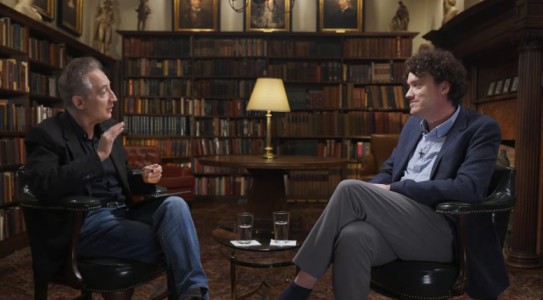
Can artificial intelligence be truly creative? In this conversation, Brian Greene talks with NYU Courant Institute mathematician Tristan Buckmaster about how AI agents helped prove singularity formation for the Euler equations and pushed toward solving the Navier-Stokes Clay Millennium Prize Problem. They explore computer-assisted proofs, Lean verification, the Anthropic–OpenAI race, and what this “Deep Blue–Kasparov moment” means for the future of mathematics, science, and society. Read the full transcript of this conversation below:
Can Artificial Intelligence Be Creative?
BRIAN GREENE: (00:00:48 – 00:06:21): Today’s conversation will take up a pivotal question: Can artificial intelligence be creative? Can it do what the best human minds can do? Or is it at rock bottom, relegated to always being derivative, a very fast and efficient tool for recombination, a regurgitation machine that can only provide a mishmash of things humans have already come up with?
Now, look, many would be happy if AI can’t be truly creative, and that’s understandable. Right? We humans, we have a fondness for our place in the scheme of things. We like to think we’re endowed with a particular sort of exceptionalism that originates in the depth of our own minds. So we come up with tests and benchmarks, the kind of things an AI might do which would result in us declaring, “Hey, that’s one of us, a creative intelligence.”
Now, the thing is, the target keeps moving, right? I mean, for the pioneering computer scientist Alan Turing, the benchmark was the ability to hold a real-time conversation good enough to pass for being human. And AI surpassed that benchmark years ago. How about writing essays and scoring high on standardized tests? That’s all in the rearview mirror too. Solve problems from the International Math Olympiad. That’s done as well. That was back in the summer of 2025.
Yet each time AI clears such a hurdle, we tend to look at the result and say, “Well, yes, that’s impressive, but it isn’t quite enough.” We say in retrospect, the task we set just wasn’t hard enough. But over the horizon, there has been one more target different in scale and scope. Solve one of the Clay Millennium Math Problems. These are 7 problems that mathematicians have been struggling with for decades, if not more, that were viewed as the pinnacle challenge for mathematicians to solve. And the Clay Institute, well, it put its money where its mouth was, offering a million-dollar prize for a solution to each problem. A quarter of a century later, one such problem had finally fallen while 6 others remained.
One of these problems concerns what’s called the Navier-Stokes equations, which describe how fluids flow from water in a pipe to the atmosphere swirling above the Earth to ocean currents flowing around the globe. And in practice, the Navier-Stokes equations work, making wonderfully accurate predictions. The Millennium Prize question asks whether the equations can ever break down, whether a flow that starts out smooth and calm can in a finite amount of time blow up, kind of tearing itself into what we call a singularity where the flow becomes nonsensical. For example, becoming infinitely fast so the math just stops working.
This past August, a solution was announced and AI was a primary author. Humans were essential, and you’ll hear today from one such essential human, Tristan Buckmaster. But by his own account, there were steps in the argument that the machine took which he did not, nor did any other human. So if the result holds up, AI can demonstrably solve abstract mathematics problems that are at or beyond the reach of human brains working on their own.
So what does this all mean? Have we reached something like superintelligence, or perhaps have we been overestimating the specialness of our own creativity? We will spend some time exploring these lofty questions, but this story also comes crashing down to earth because there were 2 teams pursuing this problem. One, a collaboration between my guest and a researcher at Anthropic. The other, a team at OpenAI, raising thorny questions of who did what when.
Now, we’ll touch on that controversy, but the core of our conversation will focus on the ideas, the mathematics itself, and what this moment means, right? I mean, if AI can now do original work at the far edge of abstract thought. It is hard to name a domain of human creativity that stands beyond its reach.
My guest, Tristan Buckmaster, is a professor of mathematics at NYU’s Courant Institute and has been a leading figure in the study of fluid equations for over a decade. He is one of the people who, in partnership with a large language model, helped achieve what no human had done before. So my conversation with Tristan Buckmaster.
Tristan, thanks so much. Thank you for joining us. So we’re going to get into the details of Navier-Stokes and fluid flow and all that good stuff. But just to sort of set the scene first, as briefly as you can, how has AI changed the way you go about doing your mathematics and the way others do as well?
AI’s Deep Blue–Kasparov Moment
TRISTAN BUCKMASTER: (00:06:25 – 00:07:39): You could think of it as an extension of what we’re able to do. We’re able to go beyond what a typical mathematician can do. We can reach levels of mathematical, physical intellect that is beyond what the top mathematician or the top physicist is out there.
So, I talk about this as being a sort of “Deep Blue Kasparov moment,” where it was finally the case where the sort of machine beat the greatest chess player at the time. And this had huge ramifications for chess. And now it will have huge ramifications for science.
Now, I made that analogy for a number of reasons. It wasn’t just— I’m not talking about your phone beating you in chess. I’m talking about a supercomputer which had tons of— had a huge development involved in beating the greatest chess player.
BRIAN GREENE: (00:07:39 – 00:08:03): Right. But I guess the one question I’ll ask now, and we’ll probably come back to it, in more specific contexts in just a little while. But would you say that the AI is just advancing the computational capacity, or would you say that the AI has brought in unexpected ideas? Would you dare say creative ideas?
TRISTAN BUCKMASTER: (00:08:04 – 00:08:53): Yes, absolutely. So the AI has— everything has its origins, and so that’s something that’s missed. So in, us mathematicians like to think of us as creative and we come up with these brilliant ideas and then we solve new problems. But these brilliant new ideas are built off other people’s ideas. So we in ourselves are taking ideas from completely other areas of mathematics and sort of absorbing them and creating new ideas from that.
That is essentially what AI is doing itself. So it’s not so dissimilar to how we think ourselves, how we are creative ourselves. We take ideas from broad areas and we sort of absorb them in our own way and then produce a new idea.
BRIAN GREENE: (00:08:53 – 00:09:21): Yeah, no, I’m fond of recollecting that Einstein took ideas of Lobachevsky and Riemann and Gauss and applied them in a brilliant new way to get the general theory of relativity, but it’s not like it came out of thin air. Exactly right. So far then, you’ve not seen AI act in a way that you would call alien to the way we think?
TRISTAN BUCKMASTER: (00:09:22 – 00:09:42): No, I would actually say that it acts in a way that’s quite similar to the way we think, except it doesn’t need to sleep. And it doesn’t need to feed, and you can have 10,000 of them out there working 24 hours, 24/7 on your problem.
BRIAN GREENE: (00:09:42 – 00:09:42): Right.
TRISTAN BUCKMASTER: (00:09:43 – 00:09:54): So, but otherwise, the actual sort of ideas that it comes up with aren’t all that alien from what we mathematicians have seen.
Understanding the Euler and Navier-Stokes Equations
BRIAN GREENE: (00:09:55 – 00:11:06): So let’s get into some of the details of this work. And I should say at the outset, people no doubt have read about this in the news. There’s some controversy about issues of this team versus that team and credit. Look, we can’t ignore that. We’ll get to it in due course, but I’d rather us focus on the ideas first because they’re wonderful and rich, and that’s ultimately what this is all about.
So one of the Millennium Math problems from the Clay Institute, has to do with the flow of fluids and involves equations that I encountered a little bit in my training, not that much since I’m in a slightly different area, but Euler equations, Navier-Stokes equations.
Roughly speaking, would you say that it’s reasonable to think about those equations as Newton’s equations, like F = ma, that high school kids learn, but not applied to rocks or baseballs, but applied to all the little fluid packets that are streaming down a pipe or whatever other conduit they might be. Is that a reasonable way of thinking about it?
TRISTAN BUCKMASTER: (00:11:06 – 00:12:01): Yeah, I mean, the essence is that it’s a continuum. So a fluid or a gas is a continuum, and it’s sort of Newton’s second law applied to a continuum of particles. These are the 2 most fundamental equations in existence to describe fluids. And fluids can also include air.
So I mean, normally we wouldn’t associate those 2 particular equations, which are called incompressible fluid equations, to air. However, in certain circumstances, actually they do model air quite well. So the one thing to take on is that they are basically the fundamental equations that describe fluids which we see everywhere in the world.
BRIAN GREENE: (00:12:01 – 00:12:15): And how did the equations of Euler, I guess written down, what, in the mid-1700s or something, then about roughly 100 years later I guess you had Stokes and Navier giving other equations. How do those 2 equations differ from each other?
TRISTAN BUCKMASTER: (00:12:16 – 00:12:31): I mean, first of all, it’s remarkable. The Euler equation itself, I think, is the second most prom— I mean, the second sort of PDE, significant PDE discovered of all time.
BRIAN GREENE: (00:12:32 – 00:12:34): So just PDE, partial differential equation?
TRISTAN BUCKMASTER: (00:12:34 – 00:13:05): Partial differential equations, which we use for describing all sorts of physical phenomena, which is remarkable in itself. It’s the first nonlinear partial differential equation, which I won’t get into that, but it is one of the foundations of my entire field, so in terms of mathematics and physics.
Now the main difference between— I mean, the difference between the Euler equations and the Navier-Stokes equations is the Navier-Stokes equations have viscosity, so internal friction.
BRIAN GREENE: (00:13:06 – 00:14:04): And I guess when thinking about real fluids, air is an example, water going down a tube, blood going down your arteries or veins, whatever the right word would be. Those are examples in which you have the fluid kind of rubs against itself, creating a kind of internal friction. And if you leave that out, you’re not modeling the fluid as accurately as you would if you include that term. And I guess that’s what Navier-Stokes were able to modify Euler’s version, which didn’t have that kind of viscosity, that frictional force at work.
These are difficult equations to solve. You mentioned the word nonlinear. Of course, we don’t want to get all technical here, but would you say maybe you can just give a rough sense of nonlinearity, what that means and why it makes it difficult to solve these equations.
TRISTAN BUCKMASTER: (00:14:05 – 00:14:41): Nonlinear behavior causes all sorts of phenomena like chaotic phenomena, turbulence. It’s what creates the richness in the solutions to the PDE. So linear PDE tend to have sort of less rich behavior.
So all the things that you see, these beautiful structures that you see when you look at air flowing past a wing, or you look at water in the ocean, these beautiful structures, this all comes from the nonlinear behavior of the equation.
BRIAN GREENE: (00:14:42 – 00:14:50): And nonlinear, can we think about that basically as the flow of the fluid affecting the flow of the fluid?
TRISTAN BUCKMASTER: (00:14:50 – 00:14:52): Exactly, self-interaction.
BRIAN GREENE: (00:14:52 – 00:15:57): Yeah, and that’s what makes it hard, whereas if it’s linear you kind of solve one solution, take another, you can add them together, there’ll be a solution. All those wonderful properties that make things like the Schrödinger equations much easier to analyze, you lose all of that in these real-world situations with fluids.
So we use these equations, you mentioned they’re the vital equations of your field, they’re the vital equations for people who are doing real-world stuff, engineers that are actually building the wing of the airplane and the heart surgeon trying to build a new heart, presumably they’ve got to understand the fluid flow of blood and so forth. They work.
And yet, from a mathematical point of view, mathematicians have raised questions about these equations that I guess the engineer and maybe the applied physicist don’t worry about as much. But what are the issues that these equations sort of bring to mind?
When Fluid Equations Break Down
TRISTAN BUCKMASTER: (00:15:58 – 00:16:47): Well, in this case, what we show is the velocity becomes infinite. So this is obviously not something that’s physical. So it’s important to say that these equations are models themselves. They’re incredibly useful models. They’re used all the time. But models don’t always work. They break down. And understanding when they break down gives us a much deeper understanding of these— of physical phenomena itself.
Because even though this— you will not see a fluid go at infinite velocity, you will actually see the behavior of these solutions up to some limit. So up to some approximation, they will behave like these crazy solutions that we’re describing.
BRIAN GREENE: (00:16:48 – 00:18:26): And so that’s the issue then. You’re saying you have this equation, you apply it in ordinary circumstances, does a good job. That’s why it’s hung around for what, 250, 300 years, whatever. And the worry is that there can be situations in principle which is what the Clay question asks, and we’ll come to that in a moment, where the equations would predict something that seems nonsensical, like the fluid’s going infinitely fast, or maybe that it’s swirling around in a vortex that’s going infinitely quickly. And the worry is maybe that suggests these equations are not as pristine and universally applicable as you would have thought.
And so this was articulated, I guess. I mean, these Clay problems, these Millennium problems, I’m not really familiar with the history. I guess they were inspired maybe— Hilbert, David Hilbert, in the turn of the 20th century came up with these 23 problems, famous problems that he thought would help guide mathematical thinking into the next century as to what problems you should focus upon.
I guess in 1999, a group of folks came together and came up with a new set of problems to guide thinking. There were 7 of them, is that correct? And one of them was this problem to do with fluid flow, the Navier-Stokes. Can you give us a rough statement of what the problem that the Clay Institute put forth, and maybe even tell us why do you think they chose that one?
The Clay Millennium Prize Problem
TRISTAN BUCKMASTER: (00:18:27 – 00:19:42): Yeah, so I mean, the problem is that you know what the fluid looks like at an initial state. So you have a perfect snapshot of what the fluid is, and then you evolve this fluid according to the equation. And then the question is, does the fluid do something unphysical? Does the velocity of the fluid become infinite in time?
And this is a key question of whether the equation itself is predictive. If it’s going to do something unphysical, then obviously it’s not predictive. So it’s sort of the— it’s the first question you ask about these equations. Given that you know the state of a system, or a fluid in this case, at a given point in time, does it accurately give a sensible answer of what it will behave like at a later time?
So it’s the most fundamental questions about this, about a PDE, and it’s also— this is, if you like, the most famous— these 2 equations are the most famous PDEs. I mean, it’s sort of almost— it helped birth our entire field.
BRIAN GREENE: (00:19:43 – 00:19:58): And so when did you learn that this was a Millennium problem? Were you aware of it the moment it was announced? Were you working on this beforehand? Were you thinking about this at all, or this is— you were too young at the time for it to register?
TRISTAN BUCKMASTER: (00:19:59 – 00:20:23): I mean, yeah, I know. I mean, I knew about it before I knew what it meant. I certainly— I always loved fluids. I loved the image of chaos. I love the ocean. I just always loved fluids. And so I was naturally drawn to this problem, even though I didn’t understand it. As—
BRIAN GREENE: (00:20:24 – 00:21:09): No, that’s interesting. I love that because I have to tell you, when I was an undergraduate, I probably wasn’t as advanced as you. I think the next generation is always so much more advanced than we were. But I was in college and I knew I wanted to work on general relativity, even though I had no idea what it really was about. I went to the bookstore; I carried around Weinberg’s textbook with— that was the thing. So I understand that being drawn to something, even if you don’t fully follow it.
The fact that there’s a million-dollar prize associated with this, how do you feel about that? Is that a good thing to do? Is it just give it more press and a little bit more interest?
TRISTAN BUCKMASTER: (00:21:09 – 00:21:33): I don’t know. I don’t like to think about the Millennium Prize itself. I’ve said this many times, I was never someone that— it was never my goal to solve it. My goal was to be part of the history, to be part of the story in solving it. Yeah, that was always my goal, and is, and I hope I’ve achieved that.
From Leray to “Nightmare Solutions”
BRIAN GREENE: (00:21:33 – 00:22:01): Yeah, as we’ll get to it in just a little while. So let’s maybe jump into some of the high points en route to where we are today. We can pick it up at many points. There was work by Leray— I guess that’s even way back in the 1930s— that was pretty pivotal in shaping how people thought about the problem for a while. Can you just give a feel for the direction that he was suggesting and where that’s gone?
TRISTAN BUCKMASTER: (00:22:01 – 00:22:45): Sure. So what he showed was that for given— for any given state, there exists a solution for all time. So it sort of answers the question somewhat. But it doesn’t answer the question of whether that solution is meaningful physically. So these solutions could have infinite velocity.
So it said that there exists a solution in sort of a more generic class of solutions, but it didn’t say that this solution had to be unique. It didn’t say that this solution had to abide by reasonable physical properties such as the velocity is finite.
BRIAN GREENE: (00:22:45 – 00:22:50): But that did influence how people progressed from that point.
TRISTAN BUCKMASTER: (00:22:50 – 00:23:20): Absolutely. So we knew that there exists a solution, and so for a long time it was saying— it was just to show that this solution that Leray constructed, this Leray-Hopf solution, was in fact regular, was in fact smooth. It didn’t have any of these infinite velocity characteristics. So it was long thought that all we had to do is show that this solution that was constructed in the ’30s was actually the one we wanted.
BRIAN GREENE: (00:23:21 – 00:23:37): And you began to work in this direction. I guess some important work, was it around 2017? Or so, you worked in a way that spoke to the characteristic you described a moment ago, whether or not the solutions are unique.
TRISTAN BUCKMASTER: (00:23:37 – 00:24:59): That’s right. So there was a lot of important work prior to that. There was work of Scheffer and Caffarelli-Kohn-Nirenberg where they showed that these solutions that Leray had constructed, they can have non-physical behavior like infinite velocity, but they would only be at a point in time or a point in space. They’ll be very rare.
And so what we showed, and this was work with Vlad Vicol, was it wasn’t quite the solutions of Leray, it was something very similar, a slightly more general class. We showed that in this slightly more general class, what is known as weak solutions, that actually the craziest things could happen.
So, I mean, you could have— I mean, one of the analogies that is often told is that, say you have this glass of water and it’s perfectly still, and then you fall asleep, and then suddenly that water just out of nowhere just starts moving violently. And then you wake up, and then you fall asleep again, and then it’s back to being still.
And we call this a “nightmare solution” because you have this nightmare of the— and we showed that within this class of weak solutions, these nightmare solutions existed.
BRIAN GREENE: (00:24:59 – 00:25:11): And I mean, just to give us a feel for what that would be, is the energy in the fluid somehow concentrating itself, doing something momentarily crazy, and then dissipating? Is that how to think about it?
TRISTAN BUCKMASTER: (00:25:12 – 00:25:37): No, I mean, this is not— I mean, the energy is coming out from nowhere, from infinity. If this was a real physical phenomenon, we would have no— the energy crisis would be solved because we could create energy from nothing. This is not— it’s not physical whatsoever. But we show within this class of solutions, which we call weak solutions, this kind of crazy behavior could happen.
BRIAN GREENE: (00:25:38 – 00:25:45): So does that simply tell you that this class of weak solutions, just not the ones that are going to give you the insight into the real problem?
TRISTAN BUCKMASTER: (00:25:45 – 00:25:45): Yes.
The Hou-Luo Scenario and Computer-Assisted Proofs
BRIAN GREENE: (00:25:45 – 00:26:31): Right. And so that then inspires other directions to perhaps start with a more physical scenario that you can say, “Yeah, that’s real, I could actually build this thing,” and determine whether singularities form in that situation.
I guess there was work around 2013 or so, where some researchers imagined a sort of a tin can with fluid, where sort of the upper part of the fluid might be spinning one direction, the lower part spinning another direction. In principle, you could set it up that way. And they, from that I gather, showed that singularities could form right around the boundary of the tin can itself. I mean, tell me about that.
TRISTAN BUCKMASTER: (00:26:31 – 00:26:53): So that was a numerical experiment. Experiment by Hou-Luo, and that was later proven by Hou and Chen— I’m not sure the exact time— 10 years or so later, that it actually happens, and it forms a singularity at the boundary of the can, if you like.
BRIAN GREENE: (00:26:54 – 00:26:57): And so that’s numerics, you said, and numerics are famous—
TRISTAN BUCKMASTER: (00:26:58 – 00:27:03): Initially it was numerics, and then later it took a long time to show that—
BRIAN GREENE: (00:27:03 – 00:27:46): To get to the proof of it. But it’s good to even go back to that journey because I think that journey, in at least poetically, is something that resonates throughout the subject. So you might say, “Look, let’s just put these Navier-Stokes equations or Euler equations on a really powerful computer, just let it simulate. And if we start with well-defined and sensible initial conditions and the solution just starts going crazy, we’re kind of done, maybe we have it.”
But of course that reasoning is highly, highly suspect because of the nature of simulation numerics. So where could that thinking just lead you completely awry?
TRISTAN BUCKMASTER: (00:27:46 – 00:28:09): That’s right, and there was so many people that tried this strategy. They did these very clever numerics and they would point towards a singularity, but they— things are going to infinity. Nothing can be perfectly resolved. And so people would do some numerics and they would see sort of a singularity forming, and then—
BRIAN GREENE: (00:28:09 – 00:28:11): Like the velocity is getting really high or something?
TRISTAN BUCKMASTER: (00:28:11 – 00:28:19): Really large, yeah. And then someone else will run it for a little bit longer, the computers get a little bit powerful, and then suddenly it goes away.
BRIAN GREENE: (00:28:19 – 00:28:32): So it grew large and then it turned over and it came back. Exactly. In fact, I’ve heard a phrase someone said that there’s a “graveyard full of simulations” in which it appeared that things were going infinite, but in fact they weren’t.
TRISTAN BUCKMASTER: (00:28:33 – 00:29:11): That’s right. And so what was different about this Hou-Luo scenario is that the core structure of the singularity could be extracted. So while things were going— becoming infinite, if you zoomed in on it at just the right rate, it would look stationary and nothing would become infinite.
And so, I mean, the singularity is hidden in this zooming out effect. And that’s why it was— they were able to turn these numerics into actual proof.
BRIAN GREENE: (00:29:11 – 00:29:17): And did they themselves turn the numerics into proof, or was it a wider collaboration.
TRISTAN BUCKMASTER: (00:29:17 – 00:29:29): It was Hou and Chen. So Hou was in— and Luo were the ones that came up with the numerics. And so one of the— Hou created with his later PhD student Chen.
BRIAN GREENE: (00:29:30 – 00:29:34): And you’re saying, but that was a decade later or something like— I mean, many years later.
TRISTAN BUCKMASTER: (00:29:35 – 00:29:35): It took a long time.
BRIAN GREENE: (00:29:36 – 00:29:51): So it’s a highly non-trivial step to go from a computer simulation that suggests that something’s going haywire, infinite velocity or spin or something like that, to an actual mathematical proof of that being the case.
TRISTAN BUCKMASTER: (00:29:51 – 00:29:52): That’s right.
BRIAN GREENE: (00:29:52 – 00:30:09): And so what is that journey like? I mean, do you have to— I presume you just completely change gears. You take inspiration, I gather, from the numerics, but you’ve gotta somehow make it an analytic statement that you can treat exactly.
TRISTAN BUCKMASTER: (00:30:10 – 00:30:52): That’s right. So in that case, this was sort of the ideas of a computer-assisted proof where you had a basic— the proof is basically pen and paper, but then there’s an element which is numerics, and those numerics need an absolute bound.
You have to show that the errors are less than 10 to the minus 13, and you can’t just use regular floating point, regular computations of a computer, you have to have actual error bounds like that, rigorous error bounds. And you don’t do that yourself, you let the computer do that.
BRIAN GREENE: (00:30:53 – 00:31:11): And how reliable are the computers at getting those kinds of bounds? Is there a similar kind of worry that a better computer with more compute power at some point will say, “Well, you thought that was the bound, but actually—” No, in this case, the enclosures of the bounds, all the calculations, are like—
TRISTAN BUCKMASTER: (00:31:11 – 00:31:28): They always leave extra room, and it’s rigorous. You could in theory take all the computations and put them down on pen and paper. Of course, it would be thousands of, thousands, millions of pages of computations, but in theory you could do that.
BRIAN GREENE: (00:31:28 – 00:31:52): And so does any— I mean, do humans look in the innards of these computer-assisted proofs at this level? We’ll go to others in a moment to check. I mean, are we sufficiently happy to trust what is emerging, or do you ultimately need a human brain to be part of the process, even for what the computer’s meant to be doing?
TRISTAN BUCKMASTER: (00:31:52 – 00:32:19): It is very difficult. I mean, it’s a combination of the proof and also a computer program, and the computer program is code, and you have to check that the ideas of the— of this sort of rigorous numerical check are correctly implemented in the code. And so it’s— you could imagine the momentous task it is actually to check this. Yeah, it is very difficult.
BRIAN GREENE: (00:32:20 – 00:32:33): And but people have become comfortable, I gather, with this collaborative approach between numerics in this very specific guise and the pen and paper that is the traditional approach?
TRISTAN BUCKMASTER: (00:32:34 – 00:32:39): I would say even that is new, and so some people are comfortable with that and some people are not.
BRIAN GREENE: (00:32:39 – 00:32:58): Really? And so how does the field deal with that? Is it just, I mean, at a conference, are there naysayers in the audience who are like, “Ugh, this is one of those computer things, I’m going to leave for that talk and only going to come back for the ones that are traditional approach”?
TRISTAN BUCKMASTER: (00:32:59 – 00:33:17): Absolutely. I mean, I think certainly in the early days of computer-assisted proof, that was the case, is that a lot of people just dislike them. I mean, computer-assisted proof existed far before work in fluids. They existed for the 4-color problem.
BRIAN GREENE: (00:33:17 – 00:33:18): 4-color, yeah.
TRISTAN BUCKMASTER: (00:33:18 – 00:33:22): So, I mean, when that came out, that was also highly controversial.
BRIAN GREENE: (00:33:23 – 00:34:32): But in that case— and again, I don’t want to go on a huge diversion, but that is an interesting point of comparison. This famous problem about how many distinct colors do you need to color regions on a map so that no 2 colors are ever contiguous with each other? And I gather— I don’t know the history well enough to go through it, but I gather the mathematicians proved it subject to a discrete number of cases that one by one by one you could check by hand, but that’s where a computer can do it better and more quickly.
Now in that particular example, because it was a discrete number of cases, it feels to me that people were willing to say, “Okay, we could go through it ourselves one by one. But sure, the computer’s just going to go case by case by case.” That one feels pretty convincing even to a Luddite. It’s like, “Okay, I’ll grant you that one.” Is there a similar set of words that can get the Luddite to a place of accepting the computer’s role in these problems?
TRISTAN BUCKMASTER: (00:34:32 – 00:34:46): Well, it’s the same thing. So you have to reduce to finite number of dimensions. So that is done with pen and paper. So by pen and paper, you reduce to a finite number of computations, and then those finite number of computations are done by the computer.
BRIAN GREENE: (00:34:47 – 00:35:12): And still though, there are folks who are like— yes, yeah, we gotta love mathematicians, you guys, the purest of the pure. Us physicists, yeah, well, we’ll crack a problem any way that we can. So that was an important moment. With that proof. But that proof didn’t answer the Millennium Problem, right? And for, I guess, for a number of reasons. Maybe you can just—
TRISTAN BUCKMASTER: (00:35:12 – 00:36:05): And there was also, I should say that there was an incredibly important result prior to that where Tarek Elgindi proved a singularity for the Euler equations, but the flow wasn’t exactly smooth. For all purposes, looking at it, it was pretty smooth.
And people often have a selective memory because I think had prior to that result of Tarek Elgindi, people would have thought that that was almost equivalent to proving smooth blowup for the Euler equations. But he showed there’s actually a difference. So it’s another one of these cases where, and people, once you know that there’s a difference, you forget that that was the case.
BRIAN GREENE: (00:36:06 – 00:36:08): Now that was Euler, and I guess it just—
TRISTAN BUCKMASTER: (00:36:08 – 00:36:09): And that was pen and paper.
Viscosity, Boundaries, and the Real Challenge
BRIAN GREENE: (00:36:09 – 00:36:44): Pen and paper. Now it is very hard to keep the distinct problems straight in your brain, so bear with me. So the Euler problem, if you have a fluid blowing up there, one could say, “Hey, but you left out the friction, right?” Maybe the viscosity or the friction would have slowed down the particles or redirected the fluid in such a way that you wouldn’t have the blowup.
So the Clay problem is really focused— and correct me if I’m wrong— on the more realistic situation of Navier-Stokes where you do have viscosity.
TRISTAN BUCKMASTER: (00:36:44 – 00:37:11): That’s right, but you should treat viscosity as an annoyance. I mean, that is how Vlad and I proved this non-uniqueness of the Navier-Stokes equation. We treated the viscosity as it was just some annoyance that we just dealt with and threw it away. It didn’t play a big role. So—
BRIAN GREENE: (00:37:11 – 00:37:33): Because my intuition is that it would play a big role. Where am I thinking about this wrong? Because again, as a physicist, I’m like, “Yeah, sure, frictionless fluid, it’ll go faster and feed on itself and go faster. Okay, I can imagine it blowing up.” But you put some friction in there, and the friction could be proportional to the speed maybe and slow it down, and that would seem pretty vital.
TRISTAN BUCKMASTER: (00:37:33 – 00:37:37): Yeah, so it— what it does is it makes it harder to blow up.
BRIAN GREENE: (00:37:37 – 00:37:37): Yeah.
TRISTAN BUCKMASTER: (00:37:37 – 00:38:01): So you need a mechanism within the nonlinear dynamics, and the nonlinear dynamics is Euler. That’s fundamentally Euler. You need a mechanism within the nonlinear dynamics which is stronger than viscosity. So you should think of viscosity as making the problem harder. It doesn’t make the problem essentially different, it just makes it harder.
BRIAN GREENE: (00:38:01 – 00:38:21): So by harder, and again I don’t want to belabor the point, but the challenge is to show that the nonlinear dynamics of Euler is stronger in some sense than the resistive force coming from the viscosity and friction. Once you do that, it’s just sort of a detail annoyance kind of thing.
TRISTAN BUCKMASTER: (00:38:21 – 00:38:22): That’s right.
BRIAN GREENE: (00:38:22 – 00:38:41): Got it. Now the other thing about the example of the 2 fluids spinning in opposite directions and the proof showing that there’s a singularity— there’s a tin can. I mean, there’s a boundary there, right? And I gather that the Clay problem says, “No boundary. I just want you to do this without that being part.”
TRISTAN BUCKMASTER: (00:38:42 – 00:39:12): That’s right. And one, mathematically you could treat the boundary as a singularity itself. You can mathematically sort of imagine a fluid where you take, you reflect the fluid across the boundary, and this would create non-smoothness. So it’s like having— so in terms of without the boundary, it’s a more— it’s a different problem. And it’s very important the singularity occurs at the boundary.
BRIAN GREENE: (00:39:12 – 00:39:16): Right. So that is a question, big question mark at that point.
TRISTAN BUCKMASTER: (00:39:16 – 00:39:23): That’s right. And then that became the big thing, is how do you prove singularities without the help of this boundary?
Neural Networks and the Search for Blowup
BRIAN GREENE: (00:39:24 – 00:40:00): Right. So the field continues. I mean, it’s progress, but there’s still the open question. Computers was, as we’ve discussed, playing a pretty vital role. Deep learning also has played a vital role, and that’s something that you made use of.
And I read somewhere that the way you got into thinking about deep learning as associated to this problem is a bit of happenstance with an undergraduate student that was thinking about the motion of ice floes in the Antarctic or something like that. I mean, how does that story go?
TRISTAN BUCKMASTER: (00:40:00 – 00:40:19): Yeah, that’s right. So I was supervising an undergraduate program with Charlie Cowen-Breen, who was a Princeton undergraduate who was looking at how ice sheets move. So you could think of this as a fluid problem, but really slow.
BRIAN GREENE: (00:40:19 – 00:40:21): Slow fluid, right.
TRISTAN BUCKMASTER: (00:40:21 – 00:41:15): How ice sheets flow in Antarctica, and you were actually trying to work out what the viscosity years at different areas of the ice sheets. And in that case, they were using neural networks. And this is not the kind of AI we consider today. It’s just sort of— they used neural networks to try to figure out the properties of these ice sheets, in this case, the viscosity of the ice sheets on Antarctica.
And when I was supervising this project, I thought, to do all these simulations is really tedious. To do these simulations, you just run a fluid and you hope it works. And then you— it doesn’t work and you have something, and then you run another thing. And then I wanted to turn the problem into a search problem where I would search for the— what the core dynamics of the singularity is.
BRIAN GREENE: (00:41:16 – 00:41:25): And by works, you mean the simulation wouldn’t work. It would yield an infinite flow for something to crack the problem.
TRISTAN BUCKMASTER: (00:41:25 – 00:42:02): Exactly, yes. So I’m looking for— exactly. So I’m looking to blow things up. Right. And so I would look, but I would try to find the core structure that forms that blowup.
And I found that neural networks were a great way in order to describe the whole zoo of possible solutions that you could have, and in order to sort of to look to narrow this search problem for this mechanism of blowup.
BRIAN GREENE: (00:42:02 – 00:42:15): And what sort of— as you said, these aren’t the neural networks that we’re going to get to in just a little while, the ones that people are more familiar with. These were highly physics-trained neural networks. Is that right?
TRISTAN BUCKMASTER: (00:42:16 – 00:42:45): That’s the terminology. Physics— by physics, it’s just— by physics, they just mean the equation. Yeah, sure. So I think there’s some misunderstanding that physics means that we’re sort of really using physical properties or something like that.
We’re just using that they— we take a sort of approximate solution and then we throw it into the equation, and then we look at what the error is, and we use that to train and find a better solution.
BRIAN GREENE: (00:42:45 – 00:43:02): And so the neural network basically is almost like a powerful searchlight in the space of possible solutions, and it gets better and better at finding configurations that might yield an infinite velocity, a blowup, something of that sort.
TRISTAN BUCKMASTER: (00:43:02 – 00:43:22): Yeah, so the neural network represents the solution. And it represents in a complicated way, and if you— that you can adjust the parameters slightly and have large changes. And it just represents in a very efficient way the solution and makes the search easier.
Collaborating with Google DeepMind
BRIAN GREENE: (00:43:22 – 00:43:27): Now, is that the approach that you wound up collaborating with Google DeepMind?
TRISTAN BUCKMASTER: (00:43:27 – 00:43:28): That’s right.
BRIAN GREENE: (00:43:28 – 00:43:31): So what was that collaboration like and how did that go?
TRISTAN BUCKMASTER: (00:43:31 – 00:44:07): So yeah, so in that we sort of pushed that further and we found a whole zoo of solutions to similar solutions to what Hou-Luo found. But all those solutions had boundary. So there was these numerical solutions of blowup that had boundary and we did not find any solutions without boundary. And to be clear, I know that DeepMind’s great interest was to solve the Navier-Stokes problem.
BRIAN GREENE: (00:44:07 – 00:44:07): Yep.
TRISTAN BUCKMASTER: (00:44:07 – 00:44:27): But the actual way we were structuring it, it couldn’t possibly solve the Navier-Stokes problem. There’s a fundamental obstruction there. I was interested in just the simple problem of finding a singularity without this boundary. That was my interest.
BRIAN GREENE: (00:44:28 – 00:44:36): And so did you take time off to go to DeepMind headquarters, or was this just a cross-country collaboration?
TRISTAN BUCKMASTER: (00:44:36 – 00:44:47): How did that— mostly I didn’t travel with a young child, but I did go a couple of times, 2 or 3 times to London.
BRIAN GREENE: (00:44:47 – 00:45:02): Yeah. And this resulted in a 20-odd person paper or something, right? So what was the— what would you say is the final result of that collaboration? And then where does it leave us in the quest for gold?
TRISTAN BUCKMASTER: (00:45:03 – 00:45:30): So we got really good at what I was doing before, what sparked from this problem of this undergrad— of this undergraduate student. We got really good at finding numerical solutions and we got really good at navigating this solution space, but we didn’t solve— we didn’t solve the fundamental problem, which is to remove the boundary.
BRIAN GREENE: (00:45:30 – 00:45:40): Right. And so did you feel that that was the approach that ultimately would work, or were you inspired by that to go a different direction?
TRISTAN BUCKMASTER: (00:45:40 – 00:46:35): No, I thought it was an interesting approach, and I think it will lead to other things. So it leads to other problems where we’re interested in— we can do some numerical experiments and turn that into a proof. So I think that’s very interesting itself, but it’s certainly not related. It would— that strategy would never lead to the Millennium Prize problem, right?
I think there was some mis— that was somewhat misreported in the fact that there was some news back then. I mean, this is only a year ago that— Right. Everything has changed in such a period of time.
But I remember there was a lot of news on the internet that we was— we were so close to solving the Millennium Prize. I would go to a conference and people would say, “Where’s the solution to the Millennium Prize?” They assumed that we’d solved it and had not released it yet. And that just wasn’t true.
From Neural Networks to Large Language Models
BRIAN GREENE: (00:46:35 – 00:47:25): Right. And so that I think is a good jumping-off point for talking about the different ways that computers have impacted this problem. So we’ve discussed simulations as one approach. We discussed the deep learning, the neural networks, the physics-inspired neural networks, understanding the solutions in that way.
Most people are now, of course, quite familiar with AI in the large language model guise, which also, as we’re about to discuss, has played a role. Can you just sort of just give us a quick primer on the differences between these kinds of computer-assisted intelligence or artificial— whatever the language you want to use to compare them?
TRISTAN BUCKMASTER: (00:47:25 – 00:48:05): So now we’re going back to pen and paper, but without the pen and paper. So we’re going back to actually just proving things with pen and paper, but I’m not the one writing it. So the one writing the proof is the LLMs. So there’s no numerics involved.
There’s— it’s much like— it’s much more similar to even the work I was doing back with Vlad Vicol, where I was designing this fluid which would create this non-uniqueness. We are designing a counterexample, designing a fluid which will cause a singularity.
BRIAN GREENE: (00:48:06 – 00:48:13): And you design that presumably through a very carefully worded prompt?
TRISTAN BUCKMASTER: (00:48:15 – 00:48:27): Well, no, I mean, so, well, these— we should say that the first idea in this direction was by humans. Yes. Diego Córdoba and Luis Martínez-Zoroa.
BRIAN GREENE: (00:48:27 – 00:48:30): Yeah, tell us a bit about— yeah, please give their names again and tell us.
TRISTAN BUCKMASTER: (00:48:30 – 00:49:04): So the first sort of ideas in this direction was by Diego Córdoba and Luis Martínez-Zoroa, who with pen and paper were pre-AI, AI was not useful back then, were able to show a singularity formation for what’s called the incompressible— It’s another one of these family of fluid equations, and perhaps the simplest one. It just sort of describes fluid through a porous media such as sand or rock.
BRIAN GREENE: (00:49:05 – 00:49:08): Like sand and then hitting a boundary or hitting a surface?
TRISTAN BUCKMASTER: (00:49:08 – 00:49:09): Well, there’s no boundary in this case.
BRIAN GREENE: (00:49:09 – 00:49:10): I see.
TRISTAN BUCKMASTER: (00:49:10 – 00:49:58): But the density varies, so that’s the key thing. It’s just a simple— it’s a model equation. It’s another fluid equation out there. It’s probably the simplest one. But no one had proven singularities for any of these equations.
And they basically proved that if you have a small sort of force— and you could think of the force— I mean, the force comes from nowhere. But you could think of it as the wind or anything like that. If you have a force which is incredibly smooth, then you could have a singularity that could form.
That it did— if you were to translate the result to the Navier-Stokes problem, technically it didn’t— it wasn’t smooth. It wasn’t smooth in time, but it was pretty close.
Smooth Forces and the Clay Problem
BRIAN GREENE: (00:50:00 – 00:50:51): And so you mentioned forces, and again, I don’t want to get too deeply in the weeds, but I think it is interesting just to pull that out, that there are versions of the Euler equation and the Navier-Stokes equation where you imagine the fluid’s just doing its own thing and you just let it go and you see what happens.
But as you mentioned, you could also imagine exerting a force on the fluid, perhaps as you say, from the wind or some barriers pushing, whatever. And how do those versions of the equations compare to the force-free ones? And the Clay problem, did it allow one to have forces that might themselves contribute to this infinite motion of the fluid in the future?
TRISTAN BUCKMASTER: (00:50:52 – 00:51:10): That’s right. So the Clay problem allowed forces, but the forces had to be very nice. And so this is what we call smooth forces. And so it wasn’t thought that having a very nice force was a big difference from not having the force at all. And I wouldn’t—
BRIAN GREENE: (00:51:10 – 00:51:17): And by nice, you mean you can’t just hit it with an infinite sledgehammer or something and then it goes infinitely fast?
TRISTAN BUCKMASTER: (00:51:17 – 00:51:24): Of course. If you just have a force that pushes things infinitely, then of course it’s an easy problem.
BRIAN GREENE: (00:51:24 – 00:51:36): And so why think about force? I mean, physically, obviously it makes a lot of sense, but from a mathematical standpoint, what’s the motivation for allowing latitude in that direction?
TRISTAN BUCKMASTER: (00:51:36 – 00:51:41): It makes it a little bit easier. It doesn’t fundamentally change the blowup, but it makes it a little bit easier.
BRIAN GREENE: (00:51:41 – 00:51:46): So Clay was trying to make it easier for folks to actually come to an answer to this, or?
TRISTAN BUCKMASTER: (00:51:47 – 00:52:18): Well, if we go back in history when Charlie Fefferman sort of posed the problem, it was thought the other way. So everyone thought that Navier-Stokes was well-posed, that it was that the solutions would behave.
So they wanted to make it— so actually, I mean, I don’t know the— I can’t speak for Charlie, but I believe— I mean, back then everyone thought that the Navier-Stokes equations was well posed. So setting it as the Navier-Stokes as opposed to Euler was actually meant to make it easier.
BRIAN GREENE: (00:52:19 – 00:52:19): Right.
TRISTAN BUCKMASTER: (00:52:19 – 00:52:21): When actually it did the reverse, it made it harder.
Planting Seeds: A Cascade Toward Singularity
BRIAN GREENE: (00:52:22 – 00:52:34): Got it. Okay, good. So, insight now came from the work that you just described. How did that inspire you and your work from there?
TRISTAN BUCKMASTER: (00:52:34 – 00:53:39): So I had this really nice idea. So you’d create these fluid packets where you’d essentially have one packet which would grow, and then just as it gets really— so it has sort of large gradients, changes in its velocity. Exactly. Then you would insert a little seed, and that’s where the force comes in. So you insert this tiny little seed, and that would suddenly grow.
And then once that gets large enough, you insert another little seed and so forth. And this is how sort of a cascade of little pushes until the singularity occurs, right?
Now you don’t have to do this way, and so there’s an overemphasis of the difference between forced and unforced. You can put those seeds to begin with. You could plant them at the beginning of the time. It just makes the problem harder. So by being able to put them at just— to put that little kindling in the fire at the right points of time, it makes it a little bit easier.
BRIAN GREENE: (00:53:39 – 00:53:55): So in principle you could, I would imagine, rerun the equations backwards from the impact of the seeds to have very special initial conditions that themselves would play the same role?
TRISTAN BUCKMASTER: (00:53:57 – 00:54:07): You could, you sort of, yeah, almost like that. You have to take the seeds backwards. Basically, right?
BRIAN GREENE: (00:54:07 – 00:54:38): Exactly. Yeah. But in principle, then you could encode it in sort of a force-free version. So it’s a very special initial conditions. And so this was a human idea, right? This is an idea that you can model on paper analytically.
But as you began to push this idea forward, you were using AI as a tool to make progress. Which AI were you— I mean, a conventional one that we know of, or—
The Breakthrough with Anthropic’s Internal Models
TRISTAN BUCKMASTER: (00:54:39 – 00:55:10): Well, I mean, so I was working on this for, say, a year, and we were using conventional AI. I love this idea of Luis and Diego, and I was sort of investigating how to further this idea. But the big breakthrough, I mean, that happened when was using internal models of Anthropic through Levent Alpöge. And that is what—
BRIAN GREENE: (00:55:10 – 00:55:14): And what’s an internal? That’s a model that’s not released yet to the public kind of thing?
TRISTAN BUCKMASTER: (00:55:15 – 00:56:30): That’s right. And one thing that I think is— I mean, I don’t have any NDAs, and this is not a formal collaboration with DeepMind, so I actually have no visibility on that side in terms of what’s happening on the AI side.
I have— I use my own AI in order to— I use Claude and I use ChatGPT to process and to create, to produce new ideas and to focus the search. But I don’t have access to any internal models.
And I think one part of the story I think that’s missing from all this is not the models themselves, but, I mean, when I began working with Levent about a year ago, the first thing that we started working on was agents. So it’s so surprising that everything comes so quickly.
I mean, I think the idea of agents maybe was, I don’t know, 2023, 2024. But in terms of when it was popularized, when it was really used, was sort of Claude Code, I think, which is just a year ago.
BRIAN GREENE: (00:56:30 – 00:56:30): Yeah.
TRISTAN BUCKMASTER: (00:56:31 – 00:56:32): And we were—
BRIAN GREENE: (00:56:33 – 00:56:36): I mean, can you explain agents? I mean, not everyone may not be familiar with—
How AI Agents Work Together on Math
TRISTAN BUCKMASTER: (00:56:36 – 00:57:37): Yeah, so agents is what— instead of having you ask one question to your AI, as we do, you could ask the same question to 100 agents, or you could ask different questions and they could coordinate with each other. And what was discovered was that even if you have a worse model, you could outperform the better models by having lots of agents.
And this is— and so when we started, we were experimenting with how we could use agents with math. And that’s kind of— and that’s one part of the story that’s not maybe told, is that it’s not only that the internal models have got so good, it’s that these companies have huge computational power to run thousands of agents that us mere mortals can’t. Right.
BRIAN GREENE: (00:57:38 – 00:57:55): And to what extent do you steer those agents? I mean, do you say, “Hey, you group of 10 work on this and you 20 work on that, and when you get to here, I want you to then compare your notes”? Is it like in a classroom where you’re directing the students?
TRISTAN BUCKMASTER: (00:57:55 – 00:59:10): Exactly. You have a harness. So you actually— yes, absolutely. You have to direct the agents. You have to tell them how to work together. And in many cases you just ask them the same question, but you ask it to a lot of them. There’s so many different techniques that you can have.
Another thing you can do with a lot of computational power is that in— so typically how a mathematician writes mathematics is we write it in quite a terse manner because we have fundamental understanding that we know how to go from step A to step B. Now, typical LLMs have somewhat problems with that. They skip— they try to do that where they skip a step, but they make mistakes.
But when you have a lot of agents, you can actually expand everything out. So if you imagine a university exam is the analogy I like to say. So in a university exam, you have to say all the steps. And so you— if you have enough computational power, you can have the agents say every single individual step.
BRIAN GREENE: (00:59:10 – 00:59:10): Yeah.
TRISTAN BUCKMASTER: (00:59:10 – 00:59:13): And in that way, you can make it much more reliable.
“The Worst Mathematics I’ve Ever Seen”—But Correct
BRIAN GREENE: (00:59:13 – 00:59:37): Now, I’ve also, I think, heard you say that the proofs that have emerged are some of the ugliest, worst-written proofs that you’ve ever seen because of this quality, presumably, or this lack of familiarity, I guess, or capacity to do it the way a high-end mathematician would.
TRISTAN BUCKMASTER: (00:59:37 – 01:00:22): Well, yeah, they’re set on their goal to prove this problem, and they’ll get there no matter what. And if that means creating a whole lot of nonsense, then they’ll create a whole lot of nonsense.
And I think so what happened in the first proof of our Euler result that came out of this sort of AI slop is that some ideas from my previous ideas of say the computer-assisted proof, which is a separate program, sort of entered in the ideas of the LLM and they started using this and they started using these computer-assisted ideas and they had all these numbers throughout the entire paper, which were completely irrelevant. And it had all this code that was checking things.
BRIAN GREENE: (01:00:23 – 01:00:34): And why was it going so— I mean, so it sounds like it’s just this chaotic, expansive thinking with a core that progresses in the right direction, but all this stuff swirling around it.
TRISTAN BUCKMASTER: (01:00:35 – 01:00:38): That’s right. And it doesn’t get rid of that stuff. And then—
BRIAN GREENE: (01:00:39 – 01:00:40): And is there a reason? I mean, could you—
TRISTAN BUCKMASTER: (01:00:40 – 01:00:47): But it was correct. It was the worst mathematics I’ve ever seen in my life, but it was actually correct.
BRIAN GREENE: (01:00:47 – 01:00:49): And you mean correct because you went through it?
TRISTAN BUCKMASTER: (01:00:50 – 01:00:51): No.
BRIAN GREENE: (01:00:52 – 01:00:53): So how do you know?
Verifying Proofs with Lean
TRISTAN BUCKMASTER: (01:00:53 – 01:01:13): Oh, we— I mean, there’s 2 ways that we knew. One was that we had lots of— the first way we could determine that it seemed correct was that we had a whole lot of agents check every single step. But then how we actually really verified it was that we converted it to what’s known as Lean. Yeah, which is—
BRIAN GREENE: (01:01:13 – 01:01:14): Maybe you could say a few words about Lean.
TRISTAN BUCKMASTER: (01:01:15 – 01:01:45): Lean is a programming language where you can formalize a proof, and it’s basically you have to be incredibly pedantic where you say every single case, you have to deal with every single case that could possibly arise, and you have to use formal logic in order to show that a proof is correct.
And so you take a 3-page proof and it ends up being 10,000 lines of code. Yeah, but you can be absolutely certain that the proof is correct if it has a certificate.
BRIAN GREENE: (01:01:46 – 01:02:02): And so you’ve done that with this nonsense. And can you tell the AI at that point, “Hey, congratulations, now can you kind of carve out the things that matter from the things that don’t?” Or is it— Absolutely.
TRISTAN BUCKMASTER: (01:02:02 – 01:02:07): I mean, so that was the process. We had this complete nonsense, and then you—
BRIAN GREENE: (01:02:07 – 01:02:10): By nonsense you mean good stuff surrounded by nonsense? Presumably.
TRISTAN BUCKMASTER: (01:02:11 – 01:02:32): I would say it’s not even the English language. They had English words in this slop, but it wasn’t even English. It wasn’t— you can’t imagine how horrendous it was. And what was kind of amazing was that if I use Gemini or ChatGPT or Claude, they could all understand this complete nonsense.
BRIAN GREENE: (01:02:32 – 01:02:32): Wow.
TRISTAN BUCKMASTER: (01:02:33 – 01:02:37): Yet a human wouldn’t view it as actual English.
Are AIs Creating Their Own Language?
BRIAN GREENE: (01:02:37 – 01:02:46): Is this in some sense the beginning of a new language that the AIs themselves are using to make progress and understand?
TRISTAN BUCKMASTER: (01:02:47 – 01:03:24): I think the AIs naturally almost create their own language, and, but I think the— we do try— I mean, I don’t work for one of these AI labs, but I think we all try to get them to speak in a language that we can understand so that we can understand their thought process. And also that in order for alignment and all that stuff, we would like to know what they’re thinking.
So I think— so yes, we could just let them go off in their entire own language. But I think there’s also some value in not letting them do that.
BRIAN GREENE: (01:03:24 – 01:04:05): No, it’s huge. And I think it’s sort of one of these dystopian kind of scenarios where ultimately they invent their own way of discussing things, their own discourse. We have no idea what’s going on. They won’t tell us. Or when we ask them, “What are you guys talking about?” They tell us what we want to hear.
So would this AI slop add to the fear and worry and anxiety about how quickly these systems can do things that are beyond not only our understanding the endpoint, but even understanding the trajectory that they’re following.
TRISTAN BUCKMASTER: (01:04:05 – 01:04:42): Absolutely. And there’s been some cases, I think in the case where this Hugging Face incident, I think there was a case where the AI agents were purposely trying to change their logs so the humans couldn’t actually read them.
So the fact that they can have their own language, absolutely, I think we should worry about that. I mean, we need some way to make sure that they’re aligned in some sense. And so we need better ways that to make sure we understand what they’re doing and why.
BRIAN GREENE: (01:04:42 – 01:04:59): And so the only way that we really understand the AI output of a proof of any of the fluid flow equations that you’re working on is to have the AI itself be the intermediary and pull it out in a way that is more intelligible to us?
TRISTAN BUCKMASTER: (01:04:59 – 01:05:12): Correct. You have to have the AI— it’s— you have to query the AI what it actually meant. And it can then do an extra conversion from that slop to human language.
Proving Singularities for the Euler Equations
BRIAN GREENE: (01:05:12 – 01:05:24): And so where then does that leave you and your work? So this is mostly focused on the Euler problem, so without the viscosity. And where would you say this got you?
TRISTAN BUCKMASTER: (01:05:25 – 01:06:15): So we first started with closing the gap for the incompressible porous media equation, which is those are small— in order to make it smooth in time. And then we moved on to what’s known as the Boussinesq equation, which is basically the Euler equation on a ring. And essentially, if you can prove a singularity for the Boussinesq equation, then you can prove singularity for Euler equation on a ring.
And then we had our initial proof for that, and then we had several proofs later. Yeah, and so, and then, yeah, the big result was that we could prove singularity forming for the Euler equation with smooth forcing.
BRIAN GREENE: (01:06:15 – 01:06:36): And this is in how many dimensions? This is in 3 dimensions. And the Clay allows for Navier-Stokes to be on a 3-dimensional rings, so to speak, a torus, so to speak. So it’s not far from that, but you’re not quite there yet, I guess, in terms of claiming that you’ve reached the Clay problem.
TRISTAN BUCKMASTER: (01:06:36 – 01:07:10): Well, then the difficulty is handling viscosity, right? So we got— we actually have several proofs, and we have in fact one proof that we haven’t released, which is another proof of the Euler equation, which has one of the mechanisms that you need to get to— basically, you can almost get rid of the forcing. So this was— yeah, so I think you’ll probably get into the other stuff later.
BRIAN GREENE: (01:07:10 – 01:07:13): Yeah, but essentially— actually, pretty soon.
TRISTAN BUCKMASTER: (01:07:14 – 01:08:08): Essentially, so the— well, I mean, so essentially, the starting point of what OpenAI did was to remove the forcing for Euler, and that result they have, the underlying structures is almost identical to the one, this other result which we haven’t released, right?
Building on, there’s a clear family of ideas. There’s the work of Luis and Diego, and then there’s additional ideas that led to Boussinesq and then Euler, and then there’s additional ideas that led from that to this other version of Euler which leads to Euler with— Euler without a force, and then there’s additional ideas from that. And this is somewhat lost in this whole—
The Race Between Anthropic and OpenAI
BRIAN GREENE: (01:08:08 – 01:08:48): Yes. Well, look, obviously it’s a complex chain of ideas. So it’s understandable that The New York Times isn’t going to parse out every detail of the nuance there. But I think we’re sort of getting a feel for the distinct versions of the problem and the progress that’s been made.
Now, of course, at some point in this process, you learn of the work that you just mentioned happening at OpenAI. And it’s been widely reported. Maybe just give us a summary of how you learned and what you learned and what was going on with all that.
TRISTAN BUCKMASTER: (01:08:49 – 01:09:58): Sure. So, I mean, the first event was there was a leak from Anthropic to OpenAI, and suddenly there was a rumor that had going around that Anthropic had solved a Millennium Prize. And I think the rumor was actually that they had solved 2 Millennium Prizes. And this spread, I think it went from, I don’t know the exact history, but I think it went from Anthropic to OpenAI, and then it went then to the other, maybe to DeepMind and so forth. But then it went to the world.
And there was, at the time on Twitter and everything like that, there was all these— so there was people making bets on whether Anthropic had solved a Millennium Prize or not. And at that time, it wasn’t linked specifically to me. I think it was more linked to Anthropic, the company.
And we had heard that sort of “red alert” had occurred. And I will say it wasn’t just at OpenAI. Red alert had occurred at the other companies as well.
BRIAN GREENE: (01:09:58 – 01:09:59): Sure.
TRISTAN BUCKMASTER: (01:10:00 – 01:11:32): And they were throwing millions and millions of dollars in order to— so for them, it’s sort of a— for the AI companies, it’s sort of a crisis because they want to show that their model is better than the other model, yeah, in order to do that.
And one thing, this is why I also wanted to emphasize the properties of agents is it’s not actually just the model. It’s the amount of compute you had. I don’t think— I don’t have access to the internal model at OpenAI. I don’t have access to the internal model at Anthropic, but I don’t imagine they’re all that different. What is different is how much agents you spawn.
So yeah, so then there was this leak and we tried to— we didn’t want it to become Anthropic versus OpenAI. We saw this important thing that we had gone beyond human intellect. We’d solved a Millennium Prize using AI.
And I think that was my original— what I wanted to say is I wanted to have a statement when we released this result, and this was for Euler. I wanted to have this statement is that we’d gone beyond human intellect and we’d reached this Deep Blue Kasparov moment. And it was time as a community to think of what that means and the implications of that. I mean, and I think the implications go well beyond mathematics.
BRIAN GREENE: (01:11:32 – 01:11:53): Yeah. So that’s a deep and laudable way of looking at what’s going on, but of course you got caught in the middle of corporate America’s battle between the leading tech companies. So I gather that OpenAI got in touch with you.
TRISTAN BUCKMASTER: (01:11:53 – 01:12:07): Yeah. So we tried to calm it down. So we had heard that it had gone sort of kind of crazy in OpenAI. Leadership had— I mean, it’s just math, but for them it’s like an existential crisis. Between the companies.
BRIAN GREENE: (01:12:07 – 01:12:08): Yeah.
TRISTAN BUCKMASTER: (01:12:08 – 01:12:43): And so we heard they’d gone kind of crazy, and so we reached out to a mathematician at OpenAI to just sort of calm it down. We told them that we were using their product. This was not going to be exclusive Anthropic. This was not like what the thing I was doing previously with DeepMind, which was an official collaboration, right?
This was something unofficial, and we were happy to share this idea. And the story was that AI had overtaken human design, not Anthropic, right? That AI had over—
BRIAN GREENE: (01:12:43 – 01:12:43): Yeah.
TRISTAN BUCKMASTER: (01:12:43 – 01:13:38): And that’s the story we wanted to tell. And so we reached out just to sort of calm them down and let them know that we’re using and that we would credit their products.
And then they told us, “Great, we’re going to— let’s not compete, and you can use as much resources from us as you want.” And I said, “Great, let’s talk sometime, whatever.” That was it. And then immediately they started competing.
So, yeah, and then it came to this call on Saturday and that was the when, so they— we heard that they were about to do something stupid, in that— in the words that we heard from our contact, that OpenAI was about to do something stupid and we had to speak to them so that they wouldn’t do something stupid.
BRIAN GREENE: (01:13:38 – 01:13:39): And the stupid thing would be—
TRISTAN BUCKMASTER: (01:13:39 – 01:14:44): We don’t know. We just heard that they were about to do something stupid. Yep. And so that’s when— and so we said— that’s when we agreed to call, and that this was this call that’s been in the news. And so it included Sébastien Bubeck, who’s been in World Science Festival, just— oh yes. And so that was the— and that started the call.
And then so the first question I had was, which of the problems had they solved? And it just turned out they had solved the force one. And I was like, “Okay,” and then I asked, and then they wanted— they came prepared. They said, “We have this amazing model, and we can solve all these sort of problems and things like that.” And they said, “Let me show you the prompt.”
And I, at this point, I wasn’t particularly interested in seeing the prompt because I knew they’re not going to show me the actual prompt. And what they showed me was the—
BRIAN GREENE: (01:14:44 – 01:14:45): What do you mean by that though?
TRISTAN BUCKMASTER: (01:14:45 – 01:14:45): The prompt?
BRIAN GREENE: (01:14:45 – 01:14:48): No, when you said that they wouldn’t show you the actual prompt.
TRISTAN BUCKMASTER: (01:14:48 – 01:15:20): Oh, because they haven’t been particularly honest in the past. They want us to believe you can sort of one-shot these problems, that you just put it into the prompt and you press enter and then it solves it. That’s sort of the marketing that they would like to have.
And that’s exactly what they claimed to me, is that they copy-pasted the exact description of the Millennium Prize and pressed enter, and poof, out came the solution.
BRIAN GREENE: (01:15:21 – 01:15:22): Really? That’s what they were saying?
TRISTAN BUCKMASTER: (01:15:22 – 01:15:24): That’s what they said at the beginning of the call.
BRIAN GREENE: (01:15:24 – 01:15:25): I see.
TRISTAN BUCKMASTER: (01:15:25 – 01:15:57): And then quickly it turned out that wasn’t true, so that they had worked on— they’d worked on easier problems like Euler equations and they had other prompts and it was— yeah, so there was obviously something fishy going on.
And they wanted— they didn’t want to tell me when they started working on the problem and then eventually they admitted to the fact that they only started working on it once they heard the rumor of our work.
BRIAN GREENE: (01:15:58 – 01:16:00): Matter of days.
TRISTAN BUCKMASTER: (01:16:00 – 01:16:10): It was maybe a week or so before the— a week, a little over a week, I believe, from the announcement.
Is the Navier-Stokes Millennium Problem Solved?
BRIAN GREENE: (01:16:10 – 01:16:32): Yeah. And so what are we to make of where things stand? So first of all, let’s just talk about the mathematical physics. The work that you guys have done— excuse me— the work that they’ve done, let’s not at the moment talk about credit competition, whatever, where does it leave us on the fundamental math problem?
TRISTAN BUCKMASTER: (01:16:34 – 01:17:00): So in terms of where it leaves us, I mean, I think we have to— so going back to my original statement is that we have to think of what is— what do we do as mathematicians now that we have this incredibly powerful tool that can go well beyond what we could do before? So I think the math of today is not the same as the math as tomorrow. And one thing I think is a positive—
BRIAN GREENE: (01:17:00 – 01:17:07): But wait, before we get to the big question, which I think is a vital one, I’m actually talking much more specifically. When we talk about the Clay Problem.
TRISTAN BUCKMASTER: (01:17:08 – 01:17:08): Yes.
BRIAN GREENE: (01:17:09 – 01:17:09): Is it done?
TRISTAN BUCKMASTER: (01:17:10 – 01:17:27): I believe so. I mean, it’s not in a readable form, but I believe so. So there’s an additional idea that they added on where they have this sort of collapsing vortex. And so they used—
BRIAN GREENE: (01:17:27 – 01:17:33): They means their swarm. But you’re talking about OpenAI?
TRISTAN BUCKMASTER: (01:17:33 – 01:18:42): OpenAI, yes. Okay. Yes. So the— there’s the— you have this incompressible Euler equations result. And that gave this key mechanism. And then what they did is that they added a separate idea where they had this vortex, this vortex which came in and collapsing vortex. And then they took the ideas from Euler and they repurposed it for another task.
It’s the same mechanism, but what it does is that it sort of fixes the vortex. The vortex isn’t a solution to the Navier-Stokes equation. And so these, what they call “pulses,” they have the same structure as the sort of building blocks for the Euler problem, but they’re used for a different task. They’re used to fix the vortex and to ensure that it collapses and causes singularity.
BRIAN GREENE: (01:18:42 – 01:19:01): And so if that approach and proof were to be verified, I know that Clay likes to have 2 years between, which is good so things aren’t rushed to judgment and so forth. That conceivably, in your opinion, might solve the Clay problem. That might be it.
TRISTAN BUCKMASTER: (01:19:01 – 01:19:19): No, I think it’s a solution. I think they have a Lean proof. I mean, they do have a Lean proof. So I think it is the PDF, the document that they produce, is not readable to mathematicians, but you can figure out the key ideas and turn it into something readable.
BRIAN GREENE: (01:19:19 – 01:19:26): And where would you say that your side of the work sits relative to that proof?
TRISTAN BUCKMASTER: (01:19:27 – 01:19:41): So that— we were that step before. So essentially, their starting— what they call their starting point, which was the unforced Euler equations, was almost identical to where we stopped.
BRIAN GREENE: (01:19:43 – 01:19:51): Is there a connection between those two, the fact that you stopped there and they began there? Is that just how it played out?
TRISTAN BUCKMASTER: (01:19:52 – 01:20:53): Well, they happened to discover it maybe one day or two days after I said my name to them. So I mean, I can’t say how things occurred, but they magically started from where we stopped a day or two after I had revealed my name and then continued it.
Now, there is key new ideas to get to Navier-Stokes. I’m not downplaying that. And in those key ideas is they actually take that mechanism that we use and use it in a different way. In our way, we use that mechanism to cause the singularity. In their way, they use that mechanism— it will grow, and it will grow sufficiently big in order to fix their singularity.
But it’s how mathematical ideas and how science work. It builds off each other.
Years of Progress in a Little Over a Month
BRIAN GREENE: (01:20:53 – 01:21:20): Now the crazy thing is, right, these equations were written down, whatever, 1757 or something, and now we’re talking about a matter of days vital to the progress. Now one quick question. It clearly— when you talk about the new ideas in the OpenAI approaching, and I don’t know anything about the details of what’s happening inside or and so forth. Presumably that’s an AI idea.
TRISTAN BUCKMASTER: (01:21:20 – 01:21:21): Yes.
BRIAN GREENE: (01:21:22 – 01:21:39): And so what we’re seeing really is the vision that was painted, I don’t know, a couple years ago, that in a matter of days, AI is doing what would take mathematicians months, years, longer.
TRISTAN BUCKMASTER: (01:21:39 – 01:22:45): Yes. And so if you look at the different— I’ve sketched how different ideas led to the Millennium Prize. But if we put this in human years, maybe that was 10 years. Different steps would have occurred in a different number of things, and it would have involved a lot of different people. I mean, Luis and Diego would have played a major part, but others would have came in and came up with new ideas, and then that would have been built on each other.
And there was— I think there was a lot of— there’s somewhat some misunderstanding within the community that they thought that Navier-Stokes was so close. Yeah, it was not. When people were saying that Navier-Stokes was so close to solve, it was— there was general ideas, and— but there was a thought that maybe within the actual experts of the field, maybe 5 to 10 years. Right, to solve it. Not a weekend.
I mean, this massive progress occurred in the time of a little over a month.
What This Means for the Future of Mathematics
BRIAN GREENE: (01:22:46 – 01:23:22): Right. And so where does that— taking the larger view now that you began to describe before— how does this leave you thinking about mathematics? I guess the specific question might be, there must be joy in that now there’s a non-human but verifiable proof of something that you’ve been thinking about for a long time. But do you feel bereft of a certain kind of deep understanding that you might have acquired had this been a purely human endeavor?
TRISTAN BUCKMASTER: (01:23:22 – 01:24:42): I think at the moment I can still— it’s not beyond human understanding. So we, I mean, we can still understand the proof and we can still sort of gather. Whether that’s the case in the future, I don’t know. It is sort of disconcerting to have these AI models sort of surpass us. That I find disconcerting, and the fact that it really does change the field.
I mean, if you talk about exciting things, I mean, you’re a physicist, I’m a mathematician, our 2 fields diverged for so long, they could come back together. You could imagine amazing new development. I mean, we can suddenly do things which have physical relevance, and we can hopefully bring tools to physics that answer key problems in physics. So I think there’s super exciting future directions that we can pursue.
But there’s also all sorts of questions of where we go, what we do about journals, what we do about PhD students, what we do about— there’s a multitude of questions out there that I don’t have answers to, but we have to start posing now.
BRIAN GREENE: (01:24:42 – 01:25:20): I mean, talking about graduate students just for a moment as we sort of reach the end here. What do you say to a new graduate student today who has perhaps— perhaps they don’t have it any longer, but imagine they come to you with the traditional dream of being a mathematician who works on proofs on paper or the blackboard and works on a problem for 10 years because it really grabs them. Is that a wrong image now? Is that an image that’s just going to become less and less the working mode of mathematicians?
TRISTAN BUCKMASTER: (01:25:21 – 01:26:05): I don’t fully know what will happen. I think the focus will change, certainly maybe, I mean, I hope the sort of race dynamics in academia will change, the first one to publish this result. I mean, I don’t think that means so much anymore.
I hope there’s more focus on actually providing elegantly solutions. Like elegant— there’s a notion of elegance in math. I don’t want math to become slop, right? So look, I would tell a graduate student is that there is a path. We haven’t figured it out yet. Just hold on for a little bit and we’ll try to figure it out for you.
BRIAN GREENE: (01:26:06 – 01:26:39): I’ve mentioned a few times in some of these conversations but I’ll mention it again because it sort of struck me. A very good friend of mine who’s a physicist, a mathematician too— I believe it was Mike Douglas who said it to me, but I don’t know if you know him. But I think he said to me, “We physicists or mathematicians need to pick our final problems because 5 years from now there won’t be much room for us.” I think he said that to me. Someone did. What do you think about that notion?
TRISTAN BUCKMASTER: (01:26:41 – 01:26:51): I don’t know. Things move so quickly from— I mean, we used to say things move year to year. Things literally move month by month now.
BRIAN GREENE: (01:26:52 – 01:26:52): Yeah.
TRISTAN BUCKMASTER: (01:26:52 – 01:27:48): So I can’t predict. I mean, I can say that there’s exciting things in the near term and that near term may be very near. I mean, in fluids, the biggest question out there beyond what we do is to understand turbulence. Yeah, this is the mother of all questions in fluids.
You even have— you have simple questions is, how does lift work? How does a plane actually cause lift? We don’t actually know from first principle how lift works. We can watch a plane go up, we can come up with some sort of basic ideas, but they’re not— none of them are actually correct.
So we essentially just model the lift and that becomes a new equation, but we can’t use the fundamental equations to explain lift. So there’s a lot of exciting things to do and we can focus on that for now, but I can’t answer the question.
A Moment When the World Changed
BRIAN GREENE: (01:27:49 – 01:28:08): So when you— so imagine 20 years from now you’re looking back to August and September of 2026, do you think you’re going to remember the race, the phone calls, the flurry, the talks with The New York Times, or will you kind of look back and say that was a moment when it all changed, or all of that?
TRISTAN BUCKMASTER: (01:28:09 – 01:29:02): That’s what I will think. I think it’s the moment in which science has changed. But it’s not just science. I think the world has sort of changed. Because I’ve described how you can use agents to go beyond human intellect in math, you can use agents to go beyond human intellect in machine learning, in AI itself.
So if you talk about the improvements of the models, suddenly you have a mechanism to take some the best AI experts in the world and go beyond them with their help and improve the models further. So you can see where this sort of leads. So I mean, this has huge implications for all of society, not just mathematics.
BRIAN GREENE: (01:29:02 – 01:29:07): So it’s both exciting and terrifying, which is a great place to end the conversation. Thank you so much. Thank you.
Related Posts
- Transcript: Judge Andrew P. Napolitano’s Keynote at the 2026 Independent Journalism Awards
- Transcript: Why Adaptability Beats Planning in an Unpredictable World? – Mr. Sanjeev Sanyal
- Transcript of Dr. Prathosh AP Lecture: AI Is Making Intelligence Cheap
- Transcript: Stanford’s Chad Jones on The Future of Jobs in an AI World
- Jared Isaacman: A New Era for NASA and American Space Exploration (Transcript)