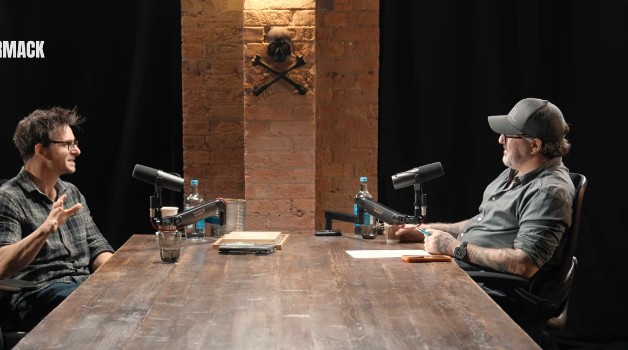
What would it take to rebuild civilization from scratch if society collapsed tomorrow? In this interview, Peter McCormack sits down with astrobiologist and author Prof Lewis Dartnell to explore the ideas behind his bestselling book The Knowledge: How to Rebuild Our World from Scratch, from why cities become unliveable, how long a supermarket could keep you alive, and the one item he would save to reboot technology, to making glass, soap, and photographs by hand. They also discuss money and the division of labor, wood-powered cars, building a self-sustaining settlement on Mars, and his upcoming book, Ingenious.
The Knowledge: A Thought Experiment for Rebuilding Civilization
PETER MCCORMACK: (00:01:12 – 00:01:13): Morning, Lewis. Hi.
PROF LEWIS DARTNELL: (00:01:13 – 00:01:14): Hello, Peter. How you doing?
PETER MCCORMACK: (00:01:14 – 00:01:46): Yes, very excited to talk to you. I am partway through The Knowledge, as I told you, and I think once I’m done that, I’ll be going through all of your books. But I’m really interested to talk to you because I think we’re at an interesting time for civilization.
We seem to be at the forefront of achieving everything that’s appeared in scientific science fiction films and also potentially destroying humanity and civilization. And so we should probably let people know why I’ve asked you to come here, the civilizational aspect, and then we’ll get into it.
PROF LEWIS DARTNELL: (00:01:47 – 00:03:03): Yes. So my third book that I wrote is called The Knowledge: How to Rebuild Our World from Scratch. And it uses a thought experiment, uses the conceit of the loss of everything we take for granted in our everyday lives as a starting point to looking behind the scenes of our modern world and how everything works.
So page 1, chapter 1, there has been an apocalypse. It doesn’t matter if it was a global pandemic or nuclear war or an asteroid strike or whatever. The big red reset button has just been pushed. And you are in a group of survivors that have survived the apocalypse. You’re living in this devastated wasteland afterwards, and the question that’s going to be on all of your lips is, “What now? What would I most need to know? What would I most want written down in a DIY guide?”
Not just to survive— I’m not really talking about Bear Grylls, how do you skin a beaver with your bare teeth sort of thing— but how would you go about rebuilding civilization from scratch? Could you reboot civilization in the way you might reboot a computer after it’s crashed? Could you leapfrog to the most useful technologies and accelerate the rerunning of history to redevelop a technological civilization as quickly as possible? That’s the idea I was playing around with.
PETER MCCORMACK: (00:03:03 – 00:03:32): And I think that’s what hit me with the start of the book, was what we have taken for granted— this kind of accumulated knowledge, experience, set of skills, technologies that we’ve built that all just kind of work together to give us this life.
And if there was an apocalypse and maybe you, me, and Connor are left wandering the streets, there is that survival component, but then there’s also the rebuilding of civilization. And is that rebuilding of civilization really— is that biological? Is that just within us? Is that what humans are like?
PROF LEWIS DARTNELL: (00:03:33 – 00:04:25): Well, I mean, I think so. I think we’re obviously an innately curious, explorative species. Otherwise we wouldn’t have got where we are today. And that will continue. If we ever do have to reset. But I think fundamentally, people are lazy and they like to be comfortable.
And almost all of the inventions and tools and technology we invent, we do it because it makes something easier that we want to be able to do. It makes us able to create more food more easily or to be warmer or have to labor less to do the things and provide the basic sustenance that we need.
So you might argue that after an apocalypse, people might want to learn the lessons from history and not mess about with cities and civilization again. I suspect that wouldn’t happen. I think there’s a very good reason why these things arose in the first place, and that reason will remain true even after some great big global catastrophe.
Why You Should Get Out of the Cities
PETER MCCORMACK: (00:04:26 – 00:04:43): Okay, so say there is. We wake up tomorrow, there’s been some kind of apocalypse. But we’ll avoid the kind of nuclear fallout version of that event. Connor’s gone to Porsche and got himself a car, and then afterwards we sit down, we’ve got to survive. What would kill us?
PROF LEWIS DARTNELL: (00:04:45 – 00:06:02): So I argue in the book, in The Knowledge, that you want to get out of the cities as quickly as possible because modern cities we all live in today are just bubbles of artificiality. You turn on the tap and water comes out of it, you might live in a high-rise apartment block. There’s a lot of car parks and tarmac and pavements all over the place.
So if you are having to go back to basics and provide and support yourself again, you need a source of natural water because the taps don’t work anymore. You don’t want to be yomping up the stairs the whole time. Cities don’t really work without gas and water and electricity providing for them.
So go somewhere nice and rural, somewhere where you’ve got dirt, you’ve got soil you can put seeds into and start growing your own food, you’ve got a source of fresh water nearby. Probably want to be near a forest or a wood so you’ve got a source of fuel and all the other useful things that timber and wood can give you. You can do some really interesting chemistry with timber as well.
So you want to get out of the cities.
PETER MCCORMACK: (00:06:02 – 00:06:11): Probably what happened with the first communities that were built around rivers and water and forests anyway. So we would rebuild new cities.
PROF LEWIS DARTNELL: (00:06:12 – 00:06:31): You’d be doing a speedrun through history basically. So going back to ancient Sumer, ancient Mesopotamia, with some of the first cities and first civilizations on Earth were built by rivers because rivers are a reliable source of water. The soil in places like this is very fertile. Find yourself somewhere a bit like that and use that as your start point.
How Long Could a Supermarket Keep You Alive?
PETER MCCORMACK: (00:06:31 – 00:06:36): And we have no access to technology, we can’t access Wikipedia, we are—
PROF LEWIS DARTNELL: (00:06:37 – 00:07:36): Well, we can come back to that. That’s an interesting question. But in chapter 1 of the book, I play around with this sort of apocalyptic wasteland idea that a lot of the people might have been killed off. Let’s say there’s been a pandemic which has wiped out most of the people, collapsed civilization, society has disintegrated and fallen apart, but the stuff is still here, the cities are still there, there’s all that resources just left lying around.
So chapter 1 is effectively how can you do scrap heap challenge for real? What would you want to scavenge and forage for from basically the leftovers of the civilization that came before, what would be most useful?
And there’s an interesting thought experiment in that. And I’ll ask you, Peter, if you were trying to scavenge for food in an average supermarket, how long do you think one supermarket could keep one person alive for before it rotted or degraded or gone off, or you’d eaten everything that was in there?
PETER MCCORMACK: (00:07:36 – 00:08:01): Okay, so if I’m being sensible, I would start with the fresh produce before it goes off. Yeah, before it goes off. That probably gives me a week to 2 weeks of some of that, maybe some of the meats and the fish. And then you would have the kind of packed steaks and things. That’s maybe the next couple of weeks. And then you work your way through the packages and the tins. And I mean, I found things in my cupboards that have been 2 years old and smells fine.
PROF LEWIS DARTNELL: (00:08:01 – 00:08:01): It’s good.
PETER MCCORMACK: (00:08:01 – 00:08:13): Smells fine. You see, you can probably have it. I think a supermarket might last me a— I don’t know. I mean, this is pure guesswork. It should last me a couple of years, I would have thought.
PROF LEWIS DARTNELL: (00:08:13 – 00:09:16): So I think probably even a couple of decades. So I worked this out, went into an average supermarket. Yeah, it just happened to be the Sainsbury’s near where I was living in North London, in Stoke Newington at the time, and went up and down every aisle with clipboard, pen and paper counting everything in there that could be eaten and getting some really odd looks from people who popped in to get bread and milk for the day.
Multiply that all up, divided by the amount you need to eat per day to survive. And the answer I came up with was an average supermarket could keep one person alive for 55 years or 63 years if you’re happy to eat all the canned dog food and cat food as well. I think by that point I would just end things. I would find a way of getting out of this hypothetical supermarket.
But the point here is there’s so much preserved sustenance that you wouldn’t have to go right back to agriculture and literally farming, growing your own food. You get this grace period where you can scavenge what you need to keep yourself going while you’re working it out how to do it yourself, how to go right back.
PETER MCCORMACK: (00:09:16 – 00:09:17): What lasts 55 years?
PROF LEWIS DARTNELL: (00:09:17 – 00:09:22): So the cans, the tinned food can have an enormous longevity.
PETER MCCORMACK: (00:09:22 – 00:09:22): Okay.
PROF LEWIS DARTNELL: (00:09:23 – 00:09:38): And there’s been cases where Arctic explorers have left caches of food that they ended up not going back to or not eating all of, people recovered subsequently. And it’s perhaps not the tastiest, but it’s still not going to kill you. It’s still not poisonous. It still can provide sustenance.
Why 10,000 Survivors Is the Starting Point
PETER MCCORMACK: (00:09:38 – 00:09:48): So just a few people on their own, that works. But maybe there’s 10,000 people, 15,000, 20,000 people, that becomes territorial.
PROF LEWIS DARTNELL: (00:09:48 – 00:11:28): Yeah. So in fact, the thought experiment I play around with is of the order of 10,000 people in roughly the right place. Because if you have too few people, you don’t have people with enough diversity of skills and knowledge base, and it’s likely that you would then just immediately slide all the way back to basically hunting and gathering. That you might go all the way back to the very beginning of human existence and not have this chance of quick rebooting a civilization. You need enough people to provide the roles for a society to recover. So let’s pick 10,000 as a relatively arbitrary starting point.
And yeah, obviously, once the social fabric has frayed and ripped apart, there’s no police, there’s no courts, there’s no top-down control to force people to behave, you’re going to have a Mad Max situation, right? We’ve all seen this film. I’m not pretending that people can’t be very unpleasant to each other, that you wouldn’t have a period of a dog-eat-dog world where the strong and the powerful take what they need.
But that has also happened time and time again in history. There have been civil wars, there’s been local breakdowns in the social fabric, and there is violence, there is an unsettled period. But on the whole, people are peaceful. We cooperate, we work together. That is how we built cities and civilization in the first place.
And sooner or later, you’ll get some basically dominance of violence. There’ll be a king or a queen, or someone will establish themselves in a powerful position. Law and order, to a large extent, will reestablish itself. And now what? How do you accelerate yourself back through history to give yourself as comfortable a life as you can?
The Skills That Would Matter Most
PETER MCCORMACK: (00:11:28 – 00:11:31): See, I wouldn’t fancy my chances on my own.
PROF LEWIS DARTNELL: (00:11:32 – 00:11:35): I really wouldn’t. What survival skills have you got? I don’t really—
PETER MCCORMACK: (00:11:35 – 00:11:41): I don’t really have any. I haven’t really grown any food. I think I could have a go.
PROF LEWIS DARTNELL: (00:11:41 – 00:11:42): Yeah. How hard can it be, right?
PETER MCCORMACK: (00:11:43 – 00:11:56): I mean, once we finished at Sainsbury’s, I’d pop down to the garden center and get some seeds and get some soil. I think I could figure out planting some things and trial and error. I could do that, some of that hunting. I wouldn’t know where to start, but I think I could fish.
PROF LEWIS DARTNELL: (00:11:57 – 00:12:03): I think I could fish or make some traps, right? Yeah, you could do sort of SAS survival, make a rabbit snare sort of thing.
PETER MCCORMACK: (00:12:03 – 00:12:27): I think in time, give me a few months, I will start to learn and I would be able to, but I’d probably lose some weight along the way. But I think there’s other skills that I think are going to be important. There’s engineering knowledge.
I mean, I’m no use in the city when the electricity breaks down, but there will be people who understand a generator, what generator we need, what fuel do we need, diesel, how we store it. Does an engineer become super important?
PROF LEWIS DARTNELL: (00:12:27 – 00:12:50): Engineers would be super important. People with medical knowledge, nurses, doctors, carpenters, metal workers, people who are good with their hands. To make and repair. And in that immediate aftermath, in that grace period, trying to keep stuff going as long as possible before you can no longer make the spare parts and you’re right back to smelting metal for yourself. You want to prolong that grace period as long as you can.
PETER MCCORMACK: (00:12:50 – 00:12:55): It’s kind of funny because I remember as growing up, my dad was very handy. I mean, he’s an aircraft engineer. There’s a problem.
PROF LEWIS DARTNELL: (00:12:55 – 00:12:57): That was my father, in fact. He was a flight engineer for British Airways.
PETER MCCORMACK: (00:12:57 – 00:13:16): Oh, my dad was aircraft engineer for Monarch. I don’t know if you remember Monarch. But he was very handy. He had a problem with his car, he had the Haynes manual out and he would fix the car. Problem in the house, he would generally fix things and fix anything. You get somebody in for everything now. There’s always somebody who can—
PROF LEWIS DARTNELL: (00:13:17 – 00:13:20): who’s more specialist and more able to do something new learning.
PETER MCCORMACK: (00:13:20 – 00:13:34): Yeah, we’ve kind of outsourced all that kind of handiwork that traditionally predominantly men would do around the house because we’ve had that specialization. But we’ve also done that with knowledge now. We’re in a period where we’re outsourcing knowledge.
PROF LEWIS DARTNELL: (00:13:34 – 00:13:34): Yeah.
Building a Total Library of Human Knowledge
PETER MCCORMACK: (00:13:35 – 00:13:38): So what knowledge would be important?
PROF LEWIS DARTNELL: (00:13:39 – 00:17:09): So the book The Knowledge has got a sort of base level of these are things you would hope would never be lost again to history. Imagine if the fall of the Western Roman Empire, they had built some kind of total library of all of the engineering knowledge, all of the metallurgy, all the things that largely became lost in that region of the world until it started being rediscovered and civilization sort of picked itself back up and then started doing big monuments and very populous cities again. That’s the book I tried to write.
But if you did take this seriously, and I stress again, I have no reason to believe the world is about to end. We are facing very uncertain times. There are huge hazards and existential risks out there. But I’m not a prepper, I’m not a survivalist, I don’t think the world actually is about to end.
But let’s say we spot a comet streaking towards the Earth, we’ve got 6 months to prepare before it slams into the planet, wipes out most of humanity, collapses civilization around the world, and we want to build some kind of bunker to preserve a population of humans that could then repopulate the world afterwards. And give them the materials and the knowledge they need to do that as quickly as possible.
You might try to put together some kind of total library, a library of not just one book, not just my paperback of The Knowledge, but books on medicine and metalworking and carpentry and agriculture and farming and gardening, all these things. But you’d also want to give them a set of tools, and there’s a really interesting project called the Global Village Construction Set.
And it was playing around with this same sort of post-apocalyptic thought that I was playing around with in the book, but also with very practical applications of a lot of people in the developing world could do with a bit of a leg up and be given a set of tools that could help them develop.
And the idea behind this Global Village Construction Set is it’s a set of, I think, 50 tools that are all linked to each other. You use that set of tools to make every item within it. And that might be something simple like a lathe up to the internal combustion engine for a car or for a tractor or for a combine harvester or whatever. So you might pack that physical kit along with the basic knowledge you would need to use it and repair it and sort of flourish from there.
But I think what’s sort of changing now, which is really interesting, is that knowledge doesn’t just have to be passive. You could interact with that knowledge. You could have some big digital database of everything that we know, and including practical, pragmatic knowledge with an AI that’s been trained on it. And you can ask questions of that AI and help problem solve with it.
Or— and this is quite a fun thought experiment as well— have the AI tell you exactly what you need to know at the right moment over the years and decades and then generations of recovery. So you’re not trying to get ahead of yourself, you’re developing at a sustainable rate.
And we’re now basically talking about the sort of Foundation, Isaac Asimov’s story of trying to preserve the knowledge that the civilization empire needed, because he predicted this collapse was coming. That basically is possible now. We could do that in some mountainside bunker, and just have it as a save file, a backup file, for all that we’ve built, all that we’ve learned, if ever anything catastrophic were to go wrong, you want that as a stop to fall back to.
Should Some Knowledge Be Left Out?
PETER MCCORMACK: (00:17:10 – 00:17:38): I wonder if we would want to approach things differently.
PROF LEWIS DARTNELL: (00:17:38 – 00:17:39): How would you go about it?
PETER MCCORMACK: (00:17:41 – 00:17:45): What, rebuilding civilization? I mean, I’m—
PROF LEWIS DARTNELL: (00:17:45 – 00:17:48): or preserving what you would want to not have lost?
PETER MCCORMACK: (00:17:48 – 00:18:27): I think you have to preserve everything, and you have to make that fountain of knowledge available to those left to rebuild civilization how they want. But I wonder if there would be important lessons from history that we would say that we would want to bypass that. Would we want to bypass nuclear weapons or certain weaponry, or is that just a natural part of our evolution in that we are tribal?
There will be divisions, there will be borders established, there will be conflict, and you can’t avoid that. But I do wonder if we would want to do things differently. Yeah, I find it actually quite exciting in some ways. I kind of want an apocalypse and just have a go.
PROF LEWIS DARTNELL: (00:18:27 – 00:19:17): Just feels like do Minecraft for real and see if you can start from nothing. So I did play around with this idea that you could have almost sort of 10 Commandments in a book like this and say, “Do this, don’t do that.” I think the problem is people will do what they feel like doing anyway, even if there’s some book from the time before that told them not to do it. That might just make them more likely to want to try it.
Like the sort of wet paint sign. Well, I have this irresistible urge to touch it to check whether it is wet or not. And I struggle with this idea of technologies can be put to bad purposes, they can be dangerous. So something like explosives, for example, that give you firearms and muskets and cannon and bombs. Should I just not put how to make explosives in the book? Maybe that would help protect a peaceful society for longer.
PETER MCCORMACK: (00:19:18 – 00:19:18): But mining?
PROF LEWIS DARTNELL: (00:19:19 – 00:19:43): But you need explosives for good uses as well, for mining, for quarrying, for digging tunnels, for leveling the land and reforming the landscape around you. And that is in fact true of any technology. It gives you capability, allows you to do something which is useful, and you could apply that to nefarious purposes or to wholesome, beneficial purposes. And the knowledge itself is neutral. That’s just blank, right?
PETER MCCORMACK: (00:19:43 – 00:20:07): There’s that famous quote, “Every technology is a weapon depending on how you point it,” something along those lines. So you probably still have every technology. Yeah, I do wonder. So education would be hugely important then, how we rebuild an education system, and so we have the right numbers of people pursuing all different interests to help us rebuild civilization.
PROF LEWIS DARTNELL: (00:20:08 – 00:21:15): Yeah, absolutely. There is more to making a well-developed, healthy society than just what you know and what you can make. There’s ethical and moral norms. There’s education. We’ve mentioned things like police force or people to keep society in line and protect the weak from the strong. All of that is, of course, important. The problem is it’s hard to condense that down to its very essence.
With knowledge and technology, to a certain extent, you can whisper something in someone’s idea. It took people hundreds of years to stumble across this idea. Try this experiment, see what happens, and then see what you can build from it. You can do a huge amount of leapfrogging in terms of knowledge and technology that would be harder to do with political systems or social systems.
There’s a reason it takes democracy a long time to develop on a natural course in society, away from autocracies and monarchies. And I’m not sure how much that could be accelerated, but the technology and the knowledge could.
How Long Would It Take to Rebuild?
PETER MCCORMACK: (00:21:15 – 00:21:50): Well, interestingly, we did another interview today, and the guy we interviewed, Roko, he had an interesting thought experiment about how AI is now accelerating us beyond what the democracy can keep up with. The speed of change, the speed of economic change, the speed of technological change, and a chance to actually reset back before this time feels kind of exciting. How long would it take us to have civilization back where we’d go, “We’re back, we’re back”?
PROF LEWIS DARTNELL: (00:21:50 – 00:22:38): Great question. I don’t have the answer. I’m not sure there is one answer because it depends entirely on the circumstance, right? What was the nature of the catastrophe? Was it a pandemic that killed the people but left the stuff untouched? So you have this grace period and it’s a rapid reboot.
Was it a global all-out nuclear war and it’s just radioactive slag left across all the cities and you’ve triggered a nuclear winter, so even farming and agriculture becomes hard? How many people have survived? How are they distributed?
But I think I convinced myself rationally when I was writing this book that around 10,000 people living largely peacefully in roughly the same area would give you a good start to generally accelerate that speedrun back through history.
The One Item to Save: A Screw Thread
PETER MCCORMACK: (00:22:39 – 00:22:52): So if you were a prepper, we have a potential apocalypse coming. I mean, I’ve read nuclear war scenario, and that’s not an apocalypse I’m interested in trying to survive.
PROF LEWIS DARTNELL: (00:22:53 – 00:22:54): You wouldn’t choose that if you had the menu beforehand, right?
PETER MCCORMACK: (00:22:55 – 00:23:13): Seems pretty bad. Yeah, it seems pretty bad. But other scenarios, meteor hits, something else where you wake up the next day, the sun’s still shining, and if you were prepping for that, you had your bunker, based on what you’ve learned, what are the essential things you would take down beyond food into the bunker with you?
PROF LEWIS DARTNELL: (00:23:14 – 00:23:30): So if I was restricted to take one single item, okay, that I think would be most useful to reboot civilization, that isn’t something you could make yourself if you just know how to do it, I would take a screw thread. And I will tell you for why.
PETER MCCORMACK: (00:23:31 – 00:23:31): Okay.
PROF LEWIS DARTNELL: (00:23:32 – 00:24:33): Let me back up a bit. There’s a cracking example of basically doing Minecraft for real. And he was a machinist, a metal workshop guy called Dave Gingery. And back in the 1980s, he wrote a series of books about how you can start from literally nothing and build every piece of modern machine tool that you’d have in a workshop, from a lathe to a milling machine, to all the kit you need to make the stuff that we all live with in the modern world.
And he started with nothing more than a bucket of sand, bucket of clay, bucket of charcoal, and some scrap aluminium. So this is literally Minecraft for real. He just had the raw materials. And knowing how to do it, he used the charcoal to start melting the aluminium. He used the clay to form, with the sand, some casts, and he poured the molten aluminium into these casts to make different pieces. And he built bit by bit, component by component, the beginnings of a lathe. And do you know what a lathe is?
PETER MCCORMACK: (00:24:33 – 00:24:37): No, I’ve heard you say it 3 times now. I don’t. It went too far for me to ask.
PROF LEWIS DARTNELL: (00:24:37 – 00:25:03): “I still don’t know what that means, but by now I’m too embarrassed to ask.” In simple terms, a lathe is a sort of longish machine tool, and you hold the thing you’re working on at one end, and then you spin it, and then you can run a tool along its length. So if you are carving something like a candlestick or a chair leg or something, you run a chisel along the length and you can go in and out and it—
PETER MCCORMACK: (00:25:05 – 00:25:05): Oh, here we go.
PROF LEWIS DARTNELL: (00:25:05 – 00:25:40): There we go. This is a lathe. Yeah. And you can use the lathe in another way to sort of drill out, bore out a hole through the middle of something. So if you’re working in metal, we’re now talking about how you make a cylinder and a piston and the beginnings of a steam engine and stuff like that.
But what’s incredible is that what Dave Gingery was doing with his lathe is you need nothing more than a half-completed lathe to finish itself. You need a lathe to make another lathe. It’s like a machine that can reproduce, it can replicate like life. The only thing you need to make other lathes is just one lathe.
PETER MCCORMACK: (00:25:40 – 00:25:41): Mechanical AI.
PROF LEWIS DARTNELL: (00:25:41 – 00:26:52): It’s sort of mechanical AI, mechanical life. The problem with that, though, is that there’s a critical piece in the middle of a lathe, and basically therefore any other machine tool, where you need to precisely control how much something moves by maybe turning a little handle. And that’s effectively the screw thread.
It’s like a screw that you would screw into wood. There’s a spiral going around it, but the pitch of that spiral, how much it turns, is very, very uniform and very, very precise. So if you turn your handle one revolution, it will move it exactly 1 centimeter, 1 inch, or whatever.
But historically, making that first screw thread was very, very difficult because you need a screw thread to make another screw thread. And it was just this very long, drawn-out, arduous process of improving ever so slightly and ever so much more, refining it little bit by little bit.
But if you had just one perfect example of a screw thread, you could build your lathe and then make all the screws, all the lathes, all the milling machines, everything you would need with this sort of Minecraft from scratch approach that Dave Gingery showed you how to do. So I’d want his— I think it was a series of 8, maybe 10 books in the end. I’d want his books in my apocalypse-proof bunker, in my library of all knowledge as well.
Have We Made Life Too Easy?
PETER MCCORMACK: (00:26:53 – 00:27:08): Well, so it’s a wild thing to go through to figure this stuff out, and it makes me wonder, are we losing something now in life? But have we made life too easy? Are we losing something by not teaching people these basic skills or this understanding? I mean, you’re teaching me things I’ve never even been taught myself.
PROF LEWIS DARTNELL: (00:27:09 – 00:28:33): And I mean, these are things I didn’t know anything about until I had that itch in the back of my head of what would you need to reboot from scratch? I’ve just set myself the research project and I’ll sit down and research and read and write for 3 years to produce this book.
But in a sense, in the modern world, modern civilization, particularly in the Western world of all living cities, you don’t need everyone to know how to do all the stuff. That’s grossly inefficient. And the way that civilizations become more capable and more efficient is by having role specialization.
I might be very good as a scientist and discovering new things. Someone else can stop me dying if I get sick and they work as a doctor or nurse. Someone else can make the food that I eat and the doctor’s, the nurse and the carpenter as well. So it’s this society where everyone contributes to the whole, but no one person knows more than their specialty. And over history, we’ve become more and more specialized as technology has got more and more developed.
You go back to the Black Death in the 1340s, that basically was an apocalypse across Europe, and the civilization collapsed, it crashed. But society basically just bounced back because everyone did have a rough idea of how to grow their own food, how to make things, how to make leather, how to make the tools and the materials they need. We don’t have that anymore. We’re much more brittle as a society. That perhaps a smaller shock could just fracture the entire thing.
PETER MCCORMACK: (00:28:33 – 00:28:35): So we’re both resilient and fragile.
PROF LEWIS DARTNELL: (00:28:36 – 00:29:41): It’s a weird concept, right? We are very, very capable. We’re incredibly efficient with how we make and do things. But the very fact that we’ve become so specialised and that the way we make things is so interlinked on a global scale, and we saw this with the coronavirus, that even— I mean, I’m not going to downplay how serious an event it was, but it wasn’t close to an apocalyptic event.
But even so, that shutting down of productivity, that restriction of trade and moving things around, just lots of stuff started running out in the supermarkets. And I think the coronavirus opened up a lot of people’s eyes of maybe I have been taking a lot of stuff for granted, that this life that is incredibly comfortable and good for me, maybe it won’t be here. It probably will. But maybe it won’t.
It’s like watching a disaster movie and it’s scary and it’s thrilling, but when it’s over, you can breathe a sigh of relief and think, “Oh, thank God for that. The world hasn’t ended.” I pop down to the supermarket, get myself an oven pizza sort of thing now.
PETER MCCORMACK: (00:29:42 – 00:29:43): It’s just one big giant machine.
PROF LEWIS DARTNELL: (00:29:44 – 00:29:44): It is.
PETER MCCORMACK: (00:29:44 – 00:29:49): We’ve constructed. It’s I, Pencil, the macro version.
PROF LEWIS DARTNELL: (00:29:49 – 00:29:50): Yeah.
PETER MCCORMACK: (00:29:51 – 00:29:56): It’s wild. How did you end up in this rabbit hole of curiosity?
PROF LEWIS DARTNELL: (00:29:57 – 00:30:28): I don’t know. I don’t know where it all started from, to be honest. So as I mentioned, my dad is really good with his hands. He’s very good at repairing stuff. He was an aeronautical aviation engineer. I am not like that. I can just about fix my bike if something— my bicycle— if something goes wrong. I’m not particularly handsy.
And it just started off as just a point of curiosity. And in fact, for all of my books— I’m just about to publish my 6th book now. I’ve written the book that I would have given my left arm to read. I was really interested in the subject but realized it didn’t exist yet.
PETER MCCORMACK: (00:30:29 – 00:30:29): Are you allowed to talk about it?
PROF LEWIS DARTNELL: (00:30:30 – 00:30:41): Let’s talk about that at the end, maybe. We can sort of— coming soon on, we can discuss the next book. But I’ve also, Peter, brought some show and tell with me, so we could look at some of these things if you wanted.
Money and the Division of Labor
PETER MCCORMACK: (00:30:41 – 00:31:06): Yes, I have one question before that. So you talked about the division of labor, which is important, and I mentioned to you this show previously was a show about basically money and economics. And a number of the economists I’ve interviewed over time have talked about how money became a thing, with shells and pearls, and then it had to be scarce and became gold. With that division of labor, how important will money be in rebuilding civilization?
PROF LEWIS DARTNELL: (00:31:07 – 00:32:22): I’d say very important, because in a small society where everyone roughly knows each other and can therefore trust each other, or at least know who not to trust, who’s got a bad reputation. You can largely do quid pro quo. “Yeah, sure, I’ll come and help harvest your crops this week if you help me with mine next week,” or I’ll get some marrows from the farmer and swap them for some nails that I forged.
But to progress much beyond that, money is just an incredibly useful app, basically a technology for putting a value on different people’s labor or produce. So you don’t have to haggle each time. You reach some sort of conversion rate, exchange rate, basically, not between dollars and sterling, but between one of the things that I can make and one of the things that you can make. It takes me 2 days to make this, but you only a couple of hours. So mine is therefore more valuable.
And you get that numerical value put on unit of my time or a unit of the thing that I’ve made, and then you can exchange it and trade it much, much more readily. And I think it would be hard to imagine a society developing any real degree of sophistication without that efficiency that money gives you.
PETER MCCORMACK: (00:32:22 – 00:32:38): And how intrinsic money is to civilization advancing in that there’s this kind of— not everybody has it, but a lot of people have this desire to earn and earn more. Be wealthy, be successful. And with that, that is a driving force behind civilization. We invent stuff because we want money.
PROF LEWIS DARTNELL: (00:32:38 – 00:32:43): But also, I think it really is true, we invent stuff because we’re damn lazy.
PETER MCCORMACK: (00:32:43 – 00:32:43): Yeah.
PROF LEWIS DARTNELL: (00:32:43 – 00:32:57): We invent the steam— and I’m simplifying a bit, of course— but we invent the steam engine because I’m sick and tired of having to wield a pickaxe to mine for stuff, to mine for coal or mine for the iron or whatever. Why don’t I get a machine to do it instead?
PETER MCCORMACK: (00:32:57 – 00:33:12): But if you look across history, the societies that have tried to eradicate the competitive side of things, they have slowed their own civilizational progress. So money does become intrinsic because it has to be the way human nature is.
PROF LEWIS DARTNELL: (00:33:12 – 00:33:56): Or communism, perhaps in its purest form, where society as a whole gives to the needy what they need and takes from you what you can produce. I am no political theorist. I don’t know much about it. I haven’t thought particularly deeply about this at all, but I’m not sure if communism has ever really been given a fair chance of trying without it basically descending back into autocracy.
And you do have a huge stratification across your society, and the people in power keep it that way because it serves their own best interests. I wonder if that sort of system perhaps is inherently unstable to being overtaken by powerful people in the way that democracies can also be taken over, as we are seeing at the moment around the world.
Running a Car on Wood
PETER MCCORMACK: (00:33:57 – 00:34:05): Yes, we are seeing right now. Okay, before we get into a big political debate, let’s shift and let’s see what you’ve brought. This is— I’m really excited by this. So this is stuff you’ve built.
PROF LEWIS DARTNELL: (00:34:05 – 00:37:42): So when I was researching and writing The Knowledge, I spoke to huge numbers of people, I read huge amounts of stuff, but I also tried to put my money where my mouth was and did maker projects, did Minecraft projects from scratch of, if I was doing this for real, how would I go about it?
And we mentioned earlier about wanting to keep vehicles running. And it’s not just about driving over to the next village, but machinery, as we just mentioned, removes the labor from our own muscles and our own sweat and toil. Vehicles are very good for pulling a plough across a field, so it’s much easier than having an animal or a person pulling a plough. So you want to keep machinery and transport working.
But in this post-apocalyptic world, you’re not going to have access to petrol, diesel, or indeed the crude oil they’re refined from for very long. The stuff we’ve already refined will start going off, and the crude oil that’s left around the world is now very, very hard to access. You have to dig very deep with very high technology to get it.
So the question becomes, how do you keep your machinery and your vehicles and transportation running without having access to crude oil-based fuels? And it turns out that you can run a car using nothing more than wood as fuel. You can have a wood-powered car.
And the first thing I brought along to show you here, Peter, is a simple demonstration of this. This is a gasification stove, and I made it myself in a couple of hours on a weekend. And there’s a big outer tin can with a smaller tin can in the middle, and I’ve drilled a bunch of holes around the bottom of both of them. And you would put in your kindling and a handful of twigs of fuel, you light it, and because you’ve got those air holes in the bottom, this thing burns very efficiently, just like a barbecue. There’s nothing special about that, right?
But what is special about this gasifier stove is you can see there’s another row of air holes right at the top of that inner combustion chamber. And as the wood starts breaking down under the heat of its own combustion, as it’s turning into charcoal, it gives off lots of gases and vapours, and the smoke is itself combustible. You’ve got this very flammable mixture of gases, into which you then reintroduce oxygen through that upper row of air holes, and all of that burns as well.
So it’s incredibly efficient of the fuel you put in it because it burns everything completely. You don’t lose the gases, you don’t lose the smoke, it recombusts them. And so this is the kind of appropriate technology or intermediate technology which is being taught around the developing world, for example, to help people living in a shantytown in sub-Saharan Africa, for example, so they can make most use of the firewood they’ve got and not be breathing in the smoke when they’re cooking the meal because it burns the smoke.
But what we can also do is scale up this gasifier stove from something the size of a baked bean can, scale up to something the size of a dustbin basically, strap it to the back of a car, and you can run a car onward. Use that same pyrolysis or gasification process to break down wood as it turns into charcoal, take off those gases and vapours, feed them into the engine cylinders at the front of the car, and only then allow them to mix with oxygen and explode usefully to drive your car forward. You can drive a car by burning wood rather than diesel or petrol.
PETER MCCORMACK: (00:37:42 – 00:37:47): It’s kind of like a cross between Ghostbusters and Back to the Future.
PROF LEWIS DARTNELL: (00:37:47 – 00:37:50): It is wonderfully steampunky Mad Max-y, isn’t it?
PETER MCCORMACK: (00:37:50 – 00:37:50): Right.
PROF LEWIS DARTNELL: (00:37:50 – 00:37:57): With this dustbin-sized gasifier unit on the front, and you can see the pipes taking those vapors and gases over the top.
PETER MCCORMACK: (00:37:58 – 00:37:58): Where is this car?
PROF LEWIS DARTNELL: (00:37:59 – 00:38:46): So there’s a huge community in Scandinavia where they have a lot of trees, and there’s sort of this— clubs have been built up where they will build and then drive these gasifier-powered cars. And you don’t get miles per gallon, you get miles per kilogram of wood. And it’s this wonderful idea. You could be in a post-apocalyptic Mad Max world, you would drive, and as soon as you start running out, pull over, chop down a tree, chuck it into your gasifier unit, and keep going again.
But there’s a historical precedent for this as well. And during the Second World War, where both sides got very good at blowing up each other’s oil refineries in Europe, in this sort of localized apocalypse of the Second World War, there were over 1 million gasifier-powered vehicles across Europe.
PETER MCCORMACK: (00:38:46 – 00:38:47): I’ve never even heard of this.
PROF LEWIS DARTNELL: (00:38:47 – 00:39:09): It’s a phenomenal bit of history. There’s a photo in the book as well with London buses that were being driven with a huge gas bag on their top deck. Double-decker buses, but the top deck was taken up with this huge gas bag. And you could use biogas, you can use methane, you just feed a flammable gas into the cylinders and you can run your vehicles and transportation, your combine harvesters and your tractors based on that.
PETER MCCORMACK: (00:39:09 – 00:39:11): And this isn’t too complicated to build?
PROF LEWIS DARTNELL: (00:39:12 – 00:39:42): Well, if you’ve got a car that is running, you can modify it to run off the gasifier stove rather than the petrol. You probably want an older-style car. As soon as they get all these computer-controlled fuel injections, it gets harder. But the point I’m making here is you can use that as a sort of backstop. You can slide back so far, catch your regression to a state like this, keep transportation machinery running while you’re then recovering capability to build internal combustion engine from scratch yourself.
PETER MCCORMACK: (00:39:43 – 00:39:46): That is amazing. And so you built this?
PROF LEWIS DARTNELL: (00:39:46 – 00:40:24): So I made this with just simple tools in the course of a weekend. It’s called a rocket stove as well, and you get a proper 3-4 jet of flame coming out the top. I demonstrated this for my TED Talk a couple years ago and came that close to setting fire to my own face.
I’d forgotten how much hairspray they’d put on, which is very, very flammable. And I’ve been sat in the makeup chair next to Monica Lewinsky, feeling really nervous about to go onto this big red spot of doom. Didn’t pay attention to the amount of hairspray they put in, because I knew only one thing about Monica Lewinsky, and it was not the sort of thing you bring up in a polite conversation.
PETER MCCORMACK: (00:40:24 – 00:40:26): We all know one thing about Monica Lewinsky.
PROF LEWIS DARTNELL: (00:40:26 – 00:40:50): So yeah, so it’s called a rocket stove. It’s very primitive technology, but it demonstrates pyrolysis and that breaking down of wood create the vapours you can run a car off. But you can also run some very, very interesting chemistry and get things like turpentine, creosote out of the wood by doing this pyrolysis process. And then also in Scandinavia, they have entire power plants running on that pyrolysis process of breaking down wood.
Making Glass From Scratch
PETER MCCORMACK: (00:40:51 – 00:42:03): Amazing. That’s incredible. Okay, so what else have you built?
PROF LEWIS DARTNELL: (00:42:03 – 00:43:15): So the other sort of making things from scratch, other Minecraft from scratch project I did is, as your society is recovering, the grace period is going to run to an end. You’re going to have to start building things yourself, learning about the world around you, and basically reinventing science.
And science isn’t just about textbooks, it’s about how you explore the world around you, spot patterns, understand how things work, and then exploit that knowledge to make your life easier, basically. But for the Scientific Revolution in our own history, we had to first have a way to observe the world around us and to measure it. You need telescopes and microscopes and thermometers and barometers and test tubes.
And for all of these scientific instruments, you need one particular material. You need something which is relatively strong, you can build something out of it, it needs to be chemically unreactive so it doesn’t change what you put inside, and it needs to be perfectly transparent. And the only material that you can make easily that does all those things for you is glass. Without glass, you can’t build the basic tools for science to observe and measure the world around you. And then progressed to a technologically advanced society.
PETER MCCORMACK: (00:43:15 – 00:43:17): And so you started with a bag of sand?
PROF LEWIS DARTNELL: (00:43:17 – 00:43:25): So I, well, I did sort of a Robinson Crusoe experiment. I went to a beach, and we’ve got a picture if you wanted, we could go to that.
PETER MCCORMACK: (00:43:25 – 00:43:25): Yeah, please.
PROF LEWIS DARTNELL: (00:43:25 – 00:44:36): Yeah, so if you go to that picture of the beach. So I went to a beach. I didn’t go to this one. This is one I found on Google Images. This is a lovely beach. I went to a beach in Norfolk, where it p***ed with rain the entire time. But I could do this Robinson Crusoe experiment and find the basic raw materials for making your own glass from scratch.
You need silica, or silicon dioxide, which you can get from the sand. You need something called a flux, which helps you melt the sand at the sort of temperatures you can reach in a kiln or a furnace. And for that, you can use soda ash, which is literally burning seaweed and then trickling water through the ashes to extract sodium carbonate, or soda ash as it was called historically. And then you need lime as a third ingredient, which you can get as calcium carbonate from coral, seashells, chalk.
So I went to this beach in Norfolk, I collected the raw materials, refined them, processed them a little bit, mixed them together in the right recipe, put them in a hot place, and made my own glass from scratch. This is my Robinson Crusoe glass you can see there.
PETER MCCORMACK: (00:44:36 – 00:44:38): Wow. I’m going to be very careful with this.
PROF LEWIS DARTNELL: (00:44:39 – 00:44:49): So you notice there’s quite a lot of seeding in there. There’s lots of little bubbles. So for this glass, when I tried it the first time, I didn’t leave it in the kiln for long enough for those bubbles to escape.
PETER MCCORMACK: (00:44:49 – 00:44:50): But it’s only bubbles?
PROF LEWIS DARTNELL: (00:44:51 – 00:44:52): It’s just bubbles. It’s otherwise pure.
PETER MCCORMACK: (00:44:53 – 00:44:53): Wow.
PROF LEWIS DARTNELL: (00:44:53 – 00:45:06): You need to use very pure white sand, which is why I went to this particular place in Norfolk, because the yellower brownie sand has got iron in it, which turns your glass green, which is fine for a wine bottle, crap for a telescope.
PETER MCCORMACK: (00:45:06 – 00:45:12): Can I ask you a really dumb question? What is the makeup of sand? I mean, I know what sand is, I’ve been to— but what is the makeup of it?
PROF LEWIS DARTNELL: (00:45:12 – 00:45:43): I mean, there’s another slide we could go to which shows the chemical structure of sand. So soda-lime glass, you can see in the bottom right there, is this sort of non-crystalline structure, mostly from that silicon, from the silica, from the sand. But you’ve used the flux to help melt it, and you stabilise that mixture using the lime. And it just so happens to be transparent to light.
PETER MCCORMACK: (00:45:43 – 00:45:48): Where does it all come from? Is this just luck? Is this just something we’ve been lucky to get?
PROF LEWIS DARTNELL: (00:45:48 – 00:46:32): I know, so we’ve been making sand for centuries and millennia. The Romans were master glassmakers. And the point I make in The Knowledge is the Romans made exquisitely pure, transparent glass. They also happened to notice that if you have a glass vase that’s sort of curved and bulgy with water in it, it seems to make things you look through behind it bigger.
So they noticed this magnification effect, the lens effect, but they never made that conceptual leap of, well, if we take a piece of our purely transparent glass, mold it into a particular shape, this sort of curvy shape, and invent the lens, you could have had a Roman telescope or Roman microscope hundreds and hundreds and hundreds of years before history stumbled across it.
PETER MCCORMACK: (00:46:32 – 00:46:33): So there is some lensing in this.
PROF LEWIS DARTNELL: (00:46:34 – 00:46:36): So I mean, there might be a tiny bit. I haven’t tried to make that into a lens.
PETER MCCORMACK: (00:46:36 – 00:46:37): On the curve, yeah.
Germs, Soap, and the Most Useful Knowledge
PROF LEWIS DARTNELL: (00:46:37 – 00:48:55): The next step for this Robinson Crusoe experiment would have been to take some of the glass I’d made from scratch, grind it into that lens shape, and then build a telescope. Or perhaps more usefully, a microscope, because then you can demonstrate for your post-apocalyptic society, or if you’re playing with this time traveler equivalent, showing ancient Romans how to see that germs exist.
The reason people get sick isn’t because the gods are fractious and they’ve thrown a plague at you, it’s not because you’re a bad person, it’s because there are living things which are so small the eye just can’t see it, but they get inside your body and they make you ill. So you can demonstrate the existence of germs and therefore the importance of washing your hands, for example.
So if I were to preserve a single piece of information that I think would have the most impact on accelerating that recovery, or equivalently, if you were to travel back in time and you’ve got 10 seconds to quickly tell something, before you jump back to your own time, what would be the most useful thing you could tell someone to have an impact on history? I would argue it’s how to make a microscope to demonstrate germs, or soap, which is a very easy way of beating germs.
And soap is nothing more than getting some hot fat— so you’ve hunted an animal, you’ve eaten the meat, you render down the fat, you mix it with soda ash again, which you can make from the beach like I showed, and it’s also the key ingredient for glass. And that soda ash is very alkaline. It reacts with the fat and saponifies it. It turns it into soap.
And genuinely, something as simple as washing your hands regularly, particularly after you’ve had a s***, or particularly after you’re about to prepare or eat food, cuts down an enormous amount of disease transfer. Today, it saves millions of lives around the world from something as simple as preventing diarrhea and then dehydration. In the developing world.
It’s an incredibly simple piece of knowledge which in our lives we’ve kind of internalized. If someone comes into the public toilets next to you, comes out of a cubicle, and runs straight out in the restaurant without washing your hands, you look at them odd. They’ve just done something disgusting because our society is ingrained in us so deeply. You’ve got to wash your hands, otherwise we all get sick.
Lost Knowledge and a Selfie From Scratch
PETER MCCORMACK: (00:48:55 – 00:49:26): Well, I’ve just got a bit of a tangent. So looking and considering what the Egyptians managed to achieve with building the pyramids, I’ve done a small amount of looking into this, that the size of the blocks and the way they fit together, the mathematics they must have had and understood to build that, it’s pretty incredible.
Yeah, here we are as a developed civilization, we’ve made some advancements they haven’t. Have you at all looked at the gaps, the things that they have missed, that stopped them advancing and industrializing?
PROF LEWIS DARTNELL: (00:49:27 – 00:51:37): Not specifically, but related to that, there are interesting examples of knowledge that has been lost from history, and then it took us hundreds of years to stumble across it again. For example, the Romans were exquisite at making concrete, making cement and concrete. You could argue that the concrete that the ancient Romans were making for things like their huge domes, is superior to the concrete we make industrially today because it is sort of harder wearing, it lasts longer.
And that knowledge on how to make concrete was lost from Europe after the fall of the Western Roman Empire. It’s this sort of small-scale example of the idea we’re playing with, that after the collapse of civilization, what would you most want to preserve to help people that survive it to rebuild afterwards?
So we’ve looked at glass and how that’s the basis of effectively all scientific research and the Scientific Revolution, but how you can make it so easily yourself and tell someone what to do with it to invent the microscope, for example. There’s some other slightly more advanced chemistry which is incredibly clever, incredibly satisfying, which is the chemistry of silver, and certain silver compounds are reactive to light, and this is the basis of photography.
And on the back of every book, there’s always the author portrait, the author photograph, and they’re often looking quite smug. It’s kind of, “Yeah, look at me, I did a whole book all by myself.” I wanted even the author photograph on the back of The Knowledge to remain true to the conceit of the book. I wanted to make a photograph from scratch myself.
I wanted to create a selfie in the most fundamental sense you could create a selfie by mixing together this very simple silver-containing chemistry, smearing it onto a glass plate, photographic emulsion, loading into primitive single-lens camera, the kind of thing I could have built on my Robinson Crusoe beach, and taking my own selfie. And I’ve got, Peter, my selfie with me here.
PETER MCCORMACK: (00:51:37 – 00:51:38): Oh my God, this is amazing.
PROF LEWIS DARTNELL: (00:51:39 – 00:51:43): This is it here. Now you’ll notice something in myself here.
PETER MCCORMACK: (00:51:43 – 00:51:44): That doesn’t look like you.
PROF LEWIS DARTNELL: (00:51:45 – 00:52:10): Well, it was a couple of years ago. The Knowledge came out about 10, 11 years ago, but also I’m looking quite stern, quite unhappy, and the reason for that is this isn’t like having your mobile phone, reaching up and going click and having an instant photograph you can load up to Instagram or whatever. That primitive silver chemistry is quite slow to respond to light. So that is something like a 15-second exposure.
PETER MCCORMACK: (00:52:11 – 00:52:12): So you have to stay very still.
PROF LEWIS DARTNELL: (00:52:12 – 00:52:21): Perfectly still. You cannot hold a natural smile for 15 seconds without you relaxing your facial muscles slightly, and therefore blurring your whole face.
PETER MCCORMACK: (00:52:21 – 00:52:25): So this is why everybody from— I mean, what period would this have been?
PROF LEWIS DARTNELL: (00:52:26 – 00:52:26): Victorians.
PETER MCCORMACK: (00:52:26 – 00:52:28): Victorians, the way they all look p***ed off.
PROF LEWIS DARTNELL: (00:52:28 – 00:53:08): They all look so very sort of like they’ve got sort of a rod up their a***. It’s a really, really sort of stern and unjoyful. It’s simply that we’re looking at our own ancestors through a distorted lens, or at least through distorting chemistry that enabled us to capture people’s likenesses with photography. It forced them, through that slow-reacting silver, to hold a very passive, very static pose.
And what you can’t see in this picture, there is a wrought iron stand behind me with a skull clamp locked into the base of my head to hold my head completely and perfectly still for 15 seconds. So that is why I’m looking so stern. And the author photograph on the back of The Knowledge.
PETER MCCORMACK: (00:53:08 – 00:53:13): That’s incredible. It doesn’t look like you though. You’ve changed a lot. Oh, thank you.
PROF LEWIS DARTNELL: (00:53:13 – 00:53:15): I’ve developed into my looks, I hope.
PETER MCCORMACK: (00:53:15 – 00:53:18): No, just, you look very different, but it’s amazing that you’ve done this.
PROF LEWIS DARTNELL: (00:53:19 – 00:53:32): What’s really nice with that is what’s actually making up the picture are tiny little grains of pure, shiny silver metal. So if you tilt it with the lights behind you, you get the right angle and it’ll catch, and the whole thing will kind of pop.
PETER MCCORMACK: (00:53:32 – 00:53:33): Oh, you get a negative?
A Book That Can Print Itself
PROF LEWIS DARTNELL: (00:53:34 – 00:54:20): Exactly. As it’s reflecting the light differently off those crystals of silver. And so the technology of photography has been very useful, partly for scientific research, but also for just recording ourselves and telling stories and having a picture of our loved one if we’re traveling far away or whatever.
So clearly, that’s slightly later in this rebooting process. The other bit of show and tell I’ve brought along with me is in the pages of this book about how to make and do everything from scratch for yourself. I explain how to make your own paper. I explain how to make your own simple ink, and I explain how to construct a primitive printing press.
PETER MCCORMACK: (00:54:21 – 00:54:21): So everything—
PROF LEWIS DARTNELL: (00:54:21 – 00:54:23): Hugely important part in our own history.
PETER MCCORMACK: (00:54:24 – 00:54:24): Yeah.
PROF LEWIS DARTNELL: (00:54:24 – 00:55:03): In terms of storing and accumulating and disseminating information. But within the pages of this book, it contains the instructions on how to make a book. So like the lathe, this book, The Knowledge, has got its own capability for reproduction. It can reproduce and replicate itself.
And so what I’ve got here is the page from the book on how to build a printing press printed on homemade paper with simple ink using a primitive printing press. So that’s a sort of instance, if you like, of this book reproducing itself as another sort of fun maker project that I went through when I was researching.
PETER MCCORMACK: (00:55:03 – 00:55:04): How many of these did you make?
PROF LEWIS DARTNELL: (00:55:04 – 00:55:12): That’s just a once-off, and I’ve got a couple of my selfies, and I keep them very, very carefully at home. They’re incredibly valuable to me.
PETER MCCORMACK: (00:55:12 – 00:55:15): You could have made a few of these and auctioned these off. Incredible.
PROF LEWIS DARTNELL: (00:55:15 – 00:55:17): Well, if anyone else wanted to buy one.
PETER MCCORMACK: (00:55:17 – 00:55:42): I would buy one of these. I think your book’s brilliant. I’ve rattled through it in a couple of days, but I think it’s absolutely brilliant. It’s one of those real kind of awakening moments that you’re like, “I’ve just taken everything for granted.”
I feel like the— you know the film WALL-E where they’re sat in the pod? I feel like I’m the fat guy drinking the milkshake in the pod. I don’t have any skills. It’s incredible. You didn’t make the whole book though.
PROF LEWIS DARTNELL: (00:55:43 – 00:56:10): I did. I didn’t bother printing the whole book. So printing is a way of mass-producing information, right? But it’s quite slow to typeset. To get the little bits of metal which you’ve cast in the process we sort of briefly explained already, with the imprint of a letter on, and then you arrange them onto the page, and then you press a piece of paper down onto it. So setting up each page is quite time-consuming, but you can print 1,000 pages very quickly.
PETER MCCORMACK: (00:56:10 – 00:56:11): How long for one page?
PROF LEWIS DARTNELL: (00:56:12 – 00:56:21): So I worked with a guy to lay out the typesets, and he was very good, and he sort of showed me what to do, and then I was like, “Oh, you’re too slow,” and did it himself. But I don’t know, maybe 5, 10 minutes to set up.
PETER MCCORMACK: (00:56:21 – 00:56:26): It’s not too bad for a page. It’s incredible. I’m absolutely blown away.
PROF LEWIS DARTNELL: (00:56:26 – 00:57:04): But I mean, there’s lots of words that we use in everyday language that come from typesetting, from printing. To call something a cliché is if you don’t want to have to keep laying out all the letters for a page you might want to come back and print again later, you basically make a cast of that, and that is called a cliché. So a cliché is something you print a lot, so it becomes sort of standard or sort of overused.
Uppercase, in terms of uppercase letters, is literally the capital letters were put on the top of the case when you’d open it up and you were printing them from. So that is seeped into our everyday lives with the language that we use.
The Role of Luck and the Apocalypse-Proof Kindle
PETER MCCORMACK: (00:57:05 – 00:57:14): How much of our civilization or evolution— I don’t know if I even said that correctly— but the evolution of a civilization, how much luck has been involved in it?
PROF LEWIS DARTNELL: (00:57:14 – 00:59:46): Huge amounts in the first running of history, if you like. There’s this idea of serendipity, and a common story told is with Fleming and the discovery of antibiotics, where he basically was a bit lazy, didn’t clean up his agar plates with bacteria growing on them. Some spores of mold have fallen onto it. He went away for the weekend, came back to the sink, and saw that on some of the dirty plates he’d not bothered washing up yet, those spores had grown and killed bacteria in a ring around them.
And he reasoned rightly that those mould, that fungus was releasing something which was killing the bacteria. And then we just discovered penicillin from the Penicillium mould that was growing there.
So that’s one of the things I talk about in the book, that just knowing the existence that antibiotics exist, this is how you go looking for them, you could jump centuries into the future, as it were, of just telling someone how to discover, how to look at something the right way to discover something that’s useful, and then how to exploit that to help people. So there’s all this sort of counterfactual history you can play around with as well as a fun way.
Should I show you my last thing? So we mentioned already that if we were to see an apocalypse coming, an asteroid screaming towards the Earth, you might want to preserve an entire library of books. And ideally, you wouldn’t have them in just one location, but they’d be dotted around so that groups of survivors would be near to their nearest save file, their reboot disk, and they could go and get access to the knowledge they need.
Problem with that, though, is that storing human knowledge on paper books, so stuff like this, isn’t a great way of preserving human knowledge because paper moulders, it rots, it burns if fires start raging through the abandoned cities.
But what you can do with modern technology is have an entire library of human understanding, human knowledge, load 10,000 books into the memory of something like a Kindle or other e-reading device and have the sum total of human knowledge in the palm of your hand.
Now the problem becomes, though, is that when the apocalypse does come and the grid goes down, you’ve got everything you need to know in the palm of your hand, but you can’t charge your Kindle because you can’t just plug it into the wall because the power’s gone down. So to solve this problem, and sort of slightly tongue-in-cheek again, I built myself an apocalypse-proof Kindle, which is here.
PETER MCCORMACK: (00:59:46 – 00:59:46): What?
PROF LEWIS DARTNELL: (00:59:47 – 01:00:55): So I’ve loaded onto this Generation 1 Kindle, which I loved because it’s got the genuine keyboard at the bottom, and you can get it to read a book to you in this very sort of Hitchhiker’s Guide to the Galaxy electronic voice. And I’ve loaded onto that a copy of my book, The Knowledge, and 9,999 other books which you might find useful.
And if the battery ever gets flat, you’ll notice on the outside of this cover, I’ve used some scavenged solar panels, which I’ve wired together into the USB jack at the bottom of the Kindle, and you can recharge that effectively indefinitely. You can keep that human knowledge alive and readable as long as the electronics survive before degrading.
But I’ve also said that in this book, it tells you how to print books. So as soon as that starts deteriorating, decades in the future after the apocalypse, or you want to photocopy that knowledge for other people to use, turn to the section that tells you how to make a printing press, make the printing press, and then effectively download the information back off that Kindle and start printing physical libraries of real books again.
Post-Apocalyptic Stories About Rebuilding
PETER MCCORMACK: (01:00:55 – 01:01:04): It’s amazing because I think most people when they think of an apocalypse, think of survival. But you are firmly in the camp thinking about civilization.
PROF LEWIS DARTNELL: (01:01:04 – 01:01:22): What comes next? I mean, I love playing games like The Last of Us. I enjoy watching TV series like The Walking Dead. Yeah, but for me, that is the less of the two things which are interesting. It’s not just the survival in this sort of chaotic, violent aftermath, it’s what comes next.
PETER MCCORMACK: (01:01:22 – 01:01:22): Has anyone—
PROF LEWIS DARTNELL: (01:01:22 – 01:01:23): How could you rebuild?
PETER MCCORMACK: (01:01:23 – 01:01:26): Has anyone covered that in science fiction? Because we’ve—
PROF LEWIS DARTNELL: (01:01:26 – 01:01:31): I mean, I always think of Cormac McCarthy’s The Road, which is unrelentingly, brutally depressing.
PETER MCCORMACK: (01:01:31 – 01:01:32): I read that in a day once.
PROF LEWIS DARTNELL: (01:01:32 – 01:01:34): Did you sleep that night?
PETER MCCORMACK: (01:01:34 – 01:01:48): I don’t think well, because yeah, there’s only one real moment of joy in that book where they discover the bunker with the tin pineapple, whatever they discover. And the rest of the time is— well, I don’t want to ruin it for people.
PROF LEWIS DARTNELL: (01:01:48 – 01:01:50): Spoilers. But it is not a good read, not a happy read.
PETER MCCORMACK: (01:01:50 – 01:02:06): And the film is hard going. And there are so many films that cover this, A Quiet Place I find fascinating. But so many of them— but does anyone actually cover the rebuilding of civilization? Silo, yeah. Silo‘s interesting.
PROF LEWIS DARTNELL: (01:02:06 – 01:03:47): There was another— what was the— there was a TV series called Blackout or something like that, which picks up 10 years after the event when, for whatever reason, electricity stops working, civilisation collapses, and then it is the story of recovery.
Books tend to focus— sorry, films tend to focus on the more visually appealing things like the apocalypse or the catastrophe itself. Disaster films is a huge genre. But I think you’re right, less so it’s about the recovery afterwards, because you get some great human interest stories there about people pulling together in communities, sort of collaborating and working together.
But it is explored really well in literature. There’s Canticle for Leibowitz, which is where there’s a monastery of scribes who are trying to keep alive and preserve the knowledge from the civilization that came before. But it’s this real sort of pathos moment where they might find a blueprint for something which they’re copying very diligently, but they just have no idea what it does or what it would actually build. Or they’ve got one set of blueprints but not the other 9 they need to actually make that thing.
And the book has got a very long timescale, and civilization progresses and recovers, and they reinvent nuclear weapons and then wipe themselves out again. So it’s this sort of cyclical nature of history.
But if you go to the book’s website, the-knowledge.org, I’ve got a huge long list of 20 books which I recommend as the best post-apocalyptic rebuilding. And then there’s similar stories like Swiss Family Robinson or Robinson Crusoe, or books like The Martian, which is basically Swiss Family Robinson, basically what we’re talking about, but doing everything for yourself on Mars, not on a post-disaster Earth.
PETER MCCORMACK: (01:03:49 – 01:05:20): There’s the Harrison Ford film where he goes out to Africa with his family and they build a village and— oh, what is it called? Mosquito—
PROF LEWIS DARTNELL: (01:05:20 – 01:05:21): Mosquito Coast.
PETER MCCORMACK: (01:05:21 – 01:05:37): Yes, Mosquito Coast, which they tried to make into a recent TV series. Wasn’t very good, but they create ice in the village and then there’s a collapse and everything burns down and then they try and establish again. And I’ve always felt that was a good one. Have you seen that? Yeah, I should get you to watch that.
PROF LEWIS DARTNELL: (01:05:37 – 01:05:39): That’s some homework for you there, Connor.
Building a Self-Sustaining Civilization on Mars
PETER MCCORMACK: (01:05:39 – 01:05:47): There you go, Connor. Well, look, if we do manage to survive and not kill off the majority of the world, how do we look forward? Where do we go next?
PROF LEWIS DARTNELL: (01:05:49 – 01:05:50): In what sense? How do you mean?
PETER MCCORMACK: (01:05:50 – 01:06:12): So, I mean, what is the future for us? Is it this interplanetary travel? How would we establish civilizations on other planets? You mentioned The Martian, which I think a lot of us all love that. I’ll say film. A lot of people love it as a book as well. But how do we establish civilizations elsewhere? If we landed on Mars, what would we have to do?
PROF LEWIS DARTNELL: (01:06:13 – 01:07:07): So The Knowledge takes us up to electronics, of how to build a simple radio, how to invent vacuum tubes, which are the beginnings of making computers. So it gets us up to roughly 1940s technology in some aspects. But my actual research, what I do at the University of Westminster and what I’m publishing on, I’ve got PhD students I work with, is in astrobiology. Which is looking at the possibility of life beyond the Earth.
So I spend most of my time thinking about our next-door neighbor planet, Mars, and whether it ever had the right conditions on its surface for simple life, so bacterial-like life, to get started. And if there are Martian bugs, Martian bacteria, what’s the best way of finding them? What signs of life, what biosignatures would we look for? What kind of instruments and experiments should we give our Mars rovers to search for, to look for them?
PETER MCCORMACK: (01:07:08 – 01:07:08): Have we found anything?
PROF LEWIS DARTNELL: (01:07:09 – 01:09:29): We’ve not found anything yet. We’ve only really started looking in a concerted way in recent decades. Sending probes to Mars and looking for life which might have been extinct for billions of years is a hard thing to do. So we’re kind of just starting out, and our telescopes are finding more and more Earth-like planets through the galaxy. And so we might find signs of life on an Earth-like planet orbiting another star. So astrobiology is looking in lots of different places, in different ways, for the first examples of life, of biology beyond the Earth.
But I spend a lot of my time also thinking about when humans are first sent to Mars. So we visited the Moon with Apollo. The next step would be to send a human crew to Mars and ultimately start building up some kind of settlement, some Mars base, a self-sustaining society on Mars, which is now starting to edge back into the sort of things I’ve been talking about with The Knowledge. How do you encapsulate into something you can launch on a rocket that when you unpack it, when you arrive on Mars, will provide for everything that you need to self-sustain?
So there’s links and synergies between The Knowledge, the book that I wrote, and my research in astrobiology, and what NASA and ESA and Japanese and Chinese space agencies are doing as well, of playing with this idea that Andy Weir explored in The Martian, of making something self-sustaining on another world where you can’t even take for granted air to breathe or water that you can drink.
And as Mark Watney found in The Martian, it’s actually quite hard to grow food in Martian regolith, in the soil on Mars, because it’s very dry. It’s just ground-up volcanic dust, effectively. There’s no organic matter in it. And Mark Watney in the film, you might remember, solves that by mixing his own poo into the soil.
A research project I’m running with my students at the moment is how to not use poo, but how you can biofertilize the Martian regolith by mixing things like cyanobacteria. So simple, single-celled green life that you can grow very easily, mix into the soil, and then grow crops you can eat, or crops that can be genetically engineered to create pharmaceuticals or drugs that the people living on Mars would need. So it’s that sort of capability and interlinking of capability that I’m looking at in that context.
PETER MCCORMACK: (01:09:29 – 01:09:31): But it’s doable on Mars? Achievable?
PROF LEWIS DARTNELL: (01:09:31 – 01:10:26): I mean, yes. And there’s a lot of technological challenges still to be solved. And a lot of people around the world are walking, pushing towards that. But there’s also psychological challenges and unknowns. What is the composition of a crew that would work together as a team that we could send to Mars and they’re not going to start trying to tear each other’s throats out after 8 months spent in something the size of a caravan as they’re travelling over there?
Because it’s not like you can just open the door and pop out for a walk to get a breath of fresh air when you’re in a spaceship or when you’re on a pressurised habitat on Mars. So it’s a particular kind of person that just gets on very well with other people and is very cooperative and works very well in a team.
So there’s psychological research going into what’s the best composition of the crew, as well as how do we build the life support system that is nigh on 100% reliable, because you can’t send out spare parts if something were to break.
PETER MCCORMACK: (01:10:26 – 01:10:30): Are the resources required there? Can we produce enough water there?
PROF LEWIS DARTNELL: (01:10:31 – 01:11:41): Yes, there’s a lot of what’s called in situ resource utilization, or ISRU. So you can’t possibly launch everything you’d need from Earth in a massive rocket or series of rockets. So we’d want to live off the land as much as we can, to use what we find there.
And we know that there’s deposits of ice underground in certain regions of Mars, so we could dig that up, melt it down, purify it for the astronauts to drink. You can do electrolysis, which is passing electricity through water, and it splits H2O into hydrogen and oxygen, which they can now breathe. You can use the Martian regolith there to try to grow crops. People are looking at whether you can start using the Martian regolith to make sort of Martian concrete and building materials, how you might start smelting metals out of it.
So there’s a lot of work going into this. But Mars is alien enough. It’s another world. It’s like Earth, but also very different, that things we take for granted on Earth just wouldn’t work on Mars for various reasons. So it’s trying that translation process and working out how you can effectively pull yourself up by your own bootstraps on another world, on another planet.
Cosmic Radiation, Hobbit Holes, and Terraforming
PETER MCCORMACK: (01:11:41 – 01:11:48): So when I’ve looked at this before, one of the big issues is the radiation. How do we overcome that?
PROF LEWIS DARTNELL: (01:11:49 – 01:13:10): So that actually is the focus of my research, is on cosmic rays. And I’ve run great big computer programs, computer simulations I’ve built of how quickly does this very, very nasty, very high-energy radiation from outer space— that sat right here, just off Piccadilly in central London, we’re protected by a lovely thick atmosphere above our heads, by the magnetic field of the Earth, which is a bit like a deflector shield around the planet. On Mars, you don’t get those, right? If you’re an astronaut or indeed a Martian bacterium, you’re basically naked. It’s very, very hazardous cosmic radiation.
So one of the ideas for protecting humans in a habitat on Mars is to effectively build a hobbit hole. In The Lord of the Rings, J.R.R. Tolkien’s story, the hobbits lived inside hills, and it was all very twee and pastoral. But that actually would work very well for humans in the future living on Mars, where you have your habitat, and you basically just bury it with some kind of space JCB.
You just pick up the regolith from over here, pile on top of your habitat, so you’ve got a meter ideally near, or 2 meters of stuff between you and the radiation, and that will shield and absorb the radiation as it comes down. So space people, people living on Mars, might be living in a hobbit hole in the future.
PETER MCCORMACK: (01:13:11 – 01:13:13): So it kind of is Silo, isn’t it?
PROF LEWIS DARTNELL: (01:13:13 – 01:13:14): Living underground.
PETER MCCORMACK: (01:13:14 – 01:13:21): Yeah, living underground. And the idea of terraforming it that Elon Musk talks about, blowing up nukes and terraforming, is that—
PROF LEWIS DARTNELL: (01:13:21 – 01:14:49): No. Looking further into the future, people are very reasonably and rationally discussing terraforming, so making Mars to be more like Earth. And actually what we’re talking about there is turning back the hands on the clock of Martian history.
Mars was once much more Earth-like. It used to have a much thicker atmosphere, used to have water gushing across its face. We see lots of evidence for ancient Martian rivers and lakes and seas and possibly an entire ocean in the northern hemisphere. But Mars today has undergone a catastrophic environmental collapse. It’s incredibly cold, incredibly dry, its atmosphere has been blown away into space. So when we’re talking about terraforming, we’re effectively saying, could we return Mars to how it once was?
And one of the ideas is to effectively nuke the South Pole on Mars, where there’s lots of ice, and in particular lots of carbon dioxide ice. It’s frozen gas. So you blast that back up into the atmosphere, pump up the atmosphere so it’s thicker, you get a stronger greenhouse effect, which starts warming things up.
And then further down the line, you might start getting ultra-hardy cyanobacteria or lichen, which you can grow on the ground, and they’ll start producing oxygen very, very slowly. It builds up over time that humans can go outside, not have to wear a spacesuit, and then ultimately be able to take off their breathing mask so you can breathe Martian air and start living on Mars as if it was another version of the Earth. But we’re talking centuries, right?
How Earth Got Its Oxygen and the Search for Life Beyond Earth
PETER MCCORMACK: (01:14:49 – 01:15:02): Yeah. So I have another stupid question. So with Earth, was it the evolution of plant material on the surface that created the atmosphere that we have now then?
PROF LEWIS DARTNELL: (01:15:02 – 01:16:32): It was. So photosynthesis, which is where life worked out, it developed the biological technology of absorbing sunlight, splitting open water to derive energy for itself. And oxygen is basically the pollution given off by photosynthesis. Oxygen is the waste gas, the exhaust gases from that process.
And long before plants and trees evolved, there were single-celled organisms called cyanobacteria, which are green with chlorophyll. They can do photosynthesis. So there was this fundamental transformation in the deep time history of Earth, where oxygen first started building up in the atmosphere.
There was lots of iron dissolved in the oceans, which then rusted, was no longer soluble, and just dropped onto the bottom of the ocean and built up these thick formations of iron deposits called banded iron formations or BIFs. And basically all the iron ore we mine today are from those BIFs from that particular period in Earth’s history.
And that’s a story I tell in another book of mine called Origins, how the Earth and Earth’s history has grossly influenced, directed human history. So this great oxidation event created the iron ore that we mine for all of technology today, but set the stage for the evolution of more complex life, multicellular life, animal-like life, life like humans with our big brains and intelligence that could then evolve later on.
PETER MCCORMACK: (01:16:33 – 01:16:37): So if Mars had water and had oceans— did it have oceans?
PROF LEWIS DARTNELL: (01:16:37 – 01:16:46): There’s tons of evidence. It’s quite controversial whether it had an ocean in the northern hemisphere, but it definitely had flowing water, definitely had lakes, it definitely had seas.
PETER MCCORMACK: (01:16:46 – 01:16:48): So it could have had the conditions to create life.
PROF LEWIS DARTNELL: (01:16:49 – 01:16:50): That’s the hope.
PETER MCCORMACK: (01:16:50 – 01:16:55): And so then when you look out wider and you’re looking— are you involved with SETI?
PROF LEWIS DARTNELL: (01:16:56 – 01:16:59): It’s an interest of mine, but it’s not something I’m directly involved in.
PETER MCCORMACK: (01:16:59 – 01:17:04): But when we’re looking out for other planets, we’re essentially looking for planets that are showing the same or similar conditions.
PROF LEWIS DARTNELL: (01:17:05 – 01:18:15): For Earth-like planets, yeah. So something like Mars, or maybe Europa, which is an icy moon orbiting Jupiter. These are places which we think have habitable environments, the sort of environments where life could get started and survive under.
If we’re talking about intelligent life, civilization-building life, technological life, the life that if it were to arise on another planet, we could visit or have a conversation with. So this is the idea of SETI, or the search for extraterrestrial intelligence. We think it probably needs to be a pretty Earth-like planet, a planet with an oxygen-rich atmosphere that enables more complex life forms to develop on it.
So for complex life, we’d be focusing on more Earth-like planets. For pond scum, basically, for simple bacterial-like life, we think the conditions are broader that would allow for that. And a lot of my research is into extremophiles, so some of the hardiest forms of life on Earth that teach us what is a habitable environment, what is the extreme range of conditions that life on Earth can survive under. And therefore, where might we find it elsewhere?
PETER MCCORMACK: (01:18:15 – 01:18:21): But in other environments and other planets, life might have evolved to survive in other more extreme— we don’t know.
PROF LEWIS DARTNELL: (01:18:21 – 01:18:26): Absolutely, it could have done. But what we do know is that life definitely can develop under these conditions.
PETER MCCORMACK: (01:18:26 – 01:18:26): Yeah.
PROF LEWIS DARTNELL: (01:18:26 – 01:18:31): So that’s your sort of your datum, that’s your set point, and then you see if that exists elsewhere.
PETER MCCORMACK: (01:18:31 – 01:18:34): Is a digital-only civilization still a civilization?
PROF LEWIS DARTNELL: (01:18:35 – 01:18:40): Well, I mean, that’s a great question. It’s a sort of philosophical discussion.
PETER MCCORMACK: (01:18:40 – 01:18:40): Yeah.
PROF LEWIS DARTNELL: (01:18:40 – 01:19:00): But to have digital life, you have to have biological life first, and then maybe it progresses into sort of sci-fi concepts like uploading its consciousness into huge supercomputers and living a virtual life, which you can then— you can accelerate time and you can experience life much more quickly than in the real world.
Lewis Dartnell’s Next Book: Ingenious
PETER MCCORMACK: (01:19:00 – 01:19:02): Are you going to tell us about this next book that’s coming out?
PROF LEWIS DARTNELL: (01:19:02 – 01:19:28): Yes, the book that is coming out in May of next year, May 2027, is called Ingenious, and it is all about the most satisfyingly clever solutions to problems or innovation. So when you hear about the answer, you just sit back with a smile on your face and go, “Oh, that’s clever,” chef’s kiss. That was the perfect response to that particular problem.
PETER MCCORMACK: (01:19:28 – 01:19:29): Can you give us an example?
PROF LEWIS DARTNELL: (01:19:30 – 01:20:24): So there’s aspects of technology and inventions, there’s tactics in sport, there’s survival situations where someone did something really clever to save their life. The example I often give, just because it’s quite quick to explain, is in the early 1930s, ’40s, around that sort of time, mail-order catalogs were really taking off in the States. And there was the Sears catalog and some other competitors.
And Sears wanted to make sure that its catalogue would be the one that people would reach for to choose what they wanted, pick up the phone, and then order it. And they made their catalogue ever so slightly narrower, and ever so slightly shorter than their competitors.
So naturally, without thinking about it, when you’re piling them up next to your telephone, you put the Sears one on top. Otherwise, the pile will be unstable. And so when you sit down to order something, it’s the first one you pick for. And you’re right, it didn’t change the world.
PETER MCCORMACK: (01:20:24 – 01:20:25): He’s incredible though.
PROF LEWIS DARTNELL: (01:20:26 – 01:20:30): But “Oh, that’s clever,” right? That is gratifyingly, satisfyingly clever.
PETER MCCORMACK: (01:20:30 – 01:20:52): This is incredible. Look, I’m going to read the book. I hope you’ll come back and talk to me about the new book when it comes out. I’m very excited to complete The Knowledge and work my way through your books. I think you’re brilliant. I love everything you’ve done. Yes, this is brilliant.
And if anyone’s listening, please do go and check out Lewis’s books. And if you’re listening, go and check out the YouTube because you need to see some of this stuff. Amazing. Thank you. I really appreciate it.
PROF LEWIS DARTNELL: (01:20:52 – 01:20:53): It’s been a lot of fun.
PETER MCCORMACK: (01:20:53 – 01:20:55): Thank you. We will see you all soon. Love ya. Bye.
Related Posts
- Forget UBI. You’ll Get Paid Just for Being Human: Emad Mostaque on Impact Theory (Transcript)
- Full Transcript: Mark Cuban Interview on Diary Of A CEO – Oct 26, 2026
- Stephen Semler Interview: Poverty and Inflation Crush Americans – Tucker Carlson Show
- Transcript of President Zelenskyy Interview: Diary Of A CEO Podcast
- Transcript of Megyn Kelly Interview: Cornell 7 Case on Tucker Carlson Show