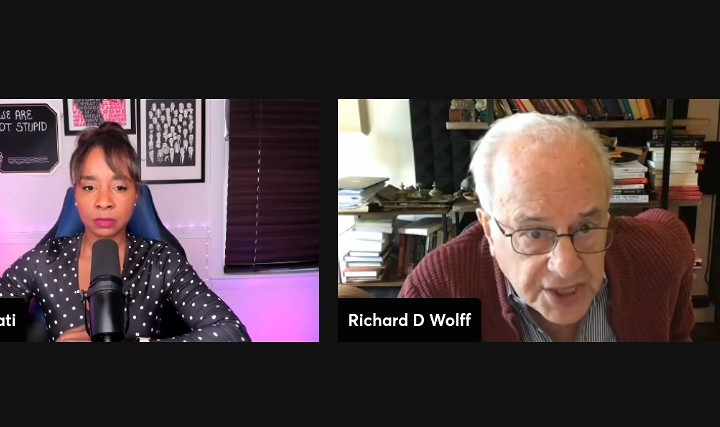
In this episode of the Sabby Sabs Podcast, host Sabrina Salvati talks with economist Richard Wolff, host of Democracy at Work, about the truth behind the France protests, from the teachers’ strike over underfunded schools to the general strike called by all five French union federations. Wolff explains Emmanuel Macron’s unpopularity, the spread of protests across Europe, the scapegoating of immigrants, and the role of police provocateurs in turning public opinion against protesters. Read the full transcript of this interview below:
Welcome and the Today Show Report
SABRINA SALVATI: (00:00:06 – 00:00:18): Welcome to Sabby Sabs Podcast. I’m your host, Sabrina Salvati. My special guest today is Professor Richard Wolff. He is the host of Democracy at Work, and he is an economist. Professor Wolff, welcome back.
RICHARD WOLFF: (00:00:19 – 00:00:22): Thanks, Sabrina. I’m very glad to be here.
SABRINA SALVATI: (00:00:23 – 00:00:45): So there’s a lot going on in Europe. Many of us have been talking about the protests that it appears they started in France but have now made their way to other countries in Europe as well. I want to go ahead and bring this clip in here. They’re talking about this also earlier on the Today show. So let me go ahead and start with this, and that’ll bring us up to where we are currently.
VIDEO CLIP BEGINS:
UNIDENTIFIED SPEAKER: (00:00:45 – 00:02:01): This is some of the worst rioting France has seen in years. What started as peaceful protests over the rising cost of living, poor conditions in schools, descending into widespread violence across the country. Authorities say they made around 2,500 arrests while more than 1,000 police and firefighters were injured in confrontations with mobs in Paris, Marseille, Calais, other major cities. In central Paris, you saw groups of masked people attacking and then looting stores. That includes major luxury brands like Lacoste and Louis Vuitton.
But probably the most painful image is the one on your screen right now. This is the 19th century town hall in the city of Limoges. You see it going up in flames. This building survived 2 world wars only to be burned down by rioters.
Now, much of this public anger is aimed at President Emmanuel Macron. He’s in his final year in office and is seen by many French people as out of touch. He’s been criticized for attending a Céline Dion concert on Friday, the day before the rioting exploded. Macron did address the nation last night. He acknowledged higher prices and he blamed that partly on the Iran war. But he said nothing could justify the violence we saw all across France.
VIDEO CLIP ENDS:
How the French Protests Began
SABRINA SALVATI: (00:02:03 – 00:02:59): Okay, Professor Wolff, you get a gist on what’s happening here, and I know you know a lot about France. Let’s start from the beginning. These protests originally, if I remember correctly, they started with the students. The students were protesting the conditions at the schools, that the schools were under-resourced, underfunded, and they were taking their demands to the street.
At that point in time, we weren’t seeing what we are now, right? That building on fire, all these people just all out in the streets everywhere. And people are starting to wonder if these protests may have been infiltrated, right? How many of the people who are out in the street were the original protesters and how many of them are people who may have shown up and took this as an opportunity to start burning things down. So I want to get your perspective on this, why they were out there in the first place. And if you could tell everybody a little bit about the history of protests in France.
RICHARD WOLFF: (00:03:01 – 00:14:10): OK. Let me begin by forewarning everyone, I’m going to give you a different interpretation from what you got on that clip from that— I don’t know which news service you were using that from, but what that man is doing is playing the role which a media person should not play. Of mouthpiece for the government over there. He shouldn’t do that, but that’s what he chose to do. That’s where his bread is buttered, so that’s what you get.
And now to answer your question. France is a country with a deep, long history of believing in real popular democracy. They think that— the French people— if you feel strongly about an issue and there are other people who agree with you, let the rest of us know. We want to know that you feel that way and that you feel strongly that way. Nobody makes you go on a demonstration. You are handed a flyer or a leaflet. You’re told, “we’re here, we’re going to be demonstrating about this issue or whatever that one is.” And the French people come out.
How do I know it? My family is French. My father was born in France. I’ve spoken French since I’ve been a baby. I grew up with it. I grew up here in the United States. I was born in the United States. But if your father is French, well, you learn the French language, you learn to enjoy French food, things like that.
Okay. How did this particular strike event occur? It started with a union strike, not well reported here. It started by a strike of a teachers union. The teachers union went out on strike because they said the government was underfunding education. They pointed to a plague of rats in large numbers of school buildings because the money to hire the people to take care of the rats wasn’t forthcoming.
They cited the fact that if a teacher quit or went and took another job or retired, they weren’t being replaced, forcing more and more kids to have one teacher because they were economizing on not hiring and therefore paying an adequate number of teachers, and that all kinds of teaching resources were being shortchanged.
It was worse in the neighborhoods that were poor compared to those that were wealthy, and it was worst of all in the immigrant communities.
France is a country that has had major waves of immigrants from both North Africa places like Morocco, Algeria, Tunisia, and so forth, and from sub-Saharan Africa, Black people from below the Sahara Desert. So there’s an anti-immigrant component to what’s going on, and the people who are living in the immigrant communities, which are often quite segregated, for example, in a ring around the city of Paris.
In our country, people who have more money go to the suburbs. In France, it’s a little bit the other way around. If you have more money, you stay in the city. Paris is a playground for rich people. Poor people go to the suburbs.
Okay. Step 2: high school students, not universities, high school students went out to support their teachers. That’s when the movement went from a union labor strike into a national movement of high school students. Those students learned about the French tradition of popular democracy, how the French go into the streets, how the French express themselves. So these students wanted to expressed the fact that they agreed with their teachers. Of course, they’re in the same classroom, they suffer the same conditions.
And then the students, because they’re well-educated— students are political in many European countries the way they are not here in the United States. If you travel abroad, it’s one of the first things you’re going to notice if you move among people and get to know them in their daily life. So pretty soon other social forces began to join. That’s where the reporting of this fellow you had on is really poor.
French Unions Call a General Strike
Let me give you an example. 3 days ago, the 5 different federations of labor unions— we have one, the AFL-CIO, they have 5. Those are different federations of different unions. They are often in disagreement with one another, but all 5 of them unanimously came out 3 days ago and announced their support of the teachers on strike, their support of the teenagers, high school kids that went out to support them, their criticism of the police for wildly overreacting with violence and brutality.
French television, unlike America, had lots of pictures of teenagers that the cops had beaten and hurt badly. They were right up there so you could see, and they asked the young man or the young woman, “who hurt you like this?” And they all said the same thing: “the police.”
Last thing: the 5 trade unions announced that in support of what the teachers went on strike for and in support for what the high school students joined them for, the unions were calling— get ready now— for all working people in France to go out into the streets on the 5th of November. That’s in 3 weeks, not even 3 weeks from now. They’re organizing a general strike. Railroads, airplanes, subways, restaurants closed.
Now, that’s what should have been reported, that you’re having now a nationwide strike demanding that the president of the country go out. They blame him and he’s the guy. I mean, if that’s where the buck stops, then that’s where the blame goes. And that’s what they did. They demanded that he go. He’s up for reelection next year anyway. Don’t wait.
By the way, just a footnote, Mr. Macron who is the president of France, has worse polling numbers than Mr. Trump. He makes Mr. Trump look good. That’s right. He makes Mr. Trump look good. So he’s an unpopular president. And what has he done? He’s taken money away from healthcare, education, transportation to give to what? He’s a big supporter for the Ukraine war. Lots of French money not going to take care of French people, going to fight the Russians in Ukraine. He has also helped the Israelis in a variety of ways in the fighting with Iran.
So the French people are saying, “What are you doing using our tax money, cutting back the services for us, and spending wild amounts of money on foreign events and the military support, which goes to big industrial corporations, for those foreign adventures? That’s not what we want. That’s not what we vote for. Go, go, go.”
So the French government is in the crisis of this decade. They may not survive.
Protests in Spain, Belgium, and Italy
Meanwhile, another thing your commentator didn’t mention. Last Saturday— that’s not that many days ago— there was a call for people to come out to a demonstration in the capital of Spain, a city by the name of Madrid. 500,000 people came out. Spain is not a very big country. That is an enormous achievement of the mass movement in Spain.
And here’s what they’re demanding, which Americans might think about. They were demanding housing. The big issue in Spain— rents are too high, nobody can afford the rents. Nobody can afford to even think about buying your own home. And their fury is much worse than it used to be, and they’re angry, and they want action.
I could go on. There were student uprisings in Belgium and likewise in Italy. So the great fear among the leaders of Europe is that this large social movement, not at all limited to high school students. I mean, they had the courage to be the first ones to go into the streets in large numbers, but now the union movement is 100% behind them and it’s spreading to other countries.
Everywhere it’s the same. “You are spending our money, the taxes we pay, on things that are good for rich people, good for businesses, and good for the foreign adventures you want to fund. And you’re taking the money away from the things we need— healthcare, education, transportation— and we won’t stand for it anymore.”
It’s a waving of the finger at the government saying, “the elections are coming and we are going to bounce you out of there. Because you haven’t done your job.” And that’s been true for a while, but now it’s not just true, it’s right out in the open.
A Message to American Students
SABRINA SALVATI: (00:14:11 – 00:14:21): So they’re basically having a class war protest, which is what we should have had here in the United States a long time ago.
RICHARD WOLFF: (00:14:21 – 00:15:37): By the way, I mean, Americans are not shown this, but on French TV some of the high school students said— one young woman with real passion in her voice, she said, “come on, you Americans, join us. You know you have these same problems in your schools.” Lord knows I do. My sister is a schoolteacher in public school. She knows very well what’s going on.
So they’re aware they want us. But American students won’t hear her because instead of listening to her and giving her 30 seconds in front of a camera, they have jokers like the guy you clipped here, who gives us the party line from the government without any of the rich flavor of what this is about.
All French unions haven’t agreed on hardly anything. And they all came out in record time. This trouble started at the beginning of last week. By the end of last week, all the unions were on board for a general strike. That is speedy politics.
Protests Spread Across Europe
SABRINA SALVATI: (00:15:39 – 00:16:53): Well, I want to show people some of those other countries as well because yes, this definitely has spread like wildfire. Albania is a big one that I can show you guys here. And Albania again, of course, back in the news. But we originally on this show started talking about Albania because Jared Kushner wanted to take property, take land from them. So you see how people in Albania have also risen up as well.
We also have another one here This is from Portugal. They said that Portugal’s on the brink of a revolution. They are saying— I want to show people just the video images here. You can see the tanks coming out, or the— at least maybe those are Hummers. I think Hummers coming out in the streets with the brigade there. So that’s Portugal.
And another one that I have here as well I go to the other one. I forgot where the other one was, but you guys get the point that this is happening all across the country. Now Macron said it was because of the war. I just want you to hear what he said here.
VIDEO CLIP BEGINS:
EMMANUEL MACRON: (00:16:54 – 00:17:22): Thousands of men and women, of fellow citizens, protested with legitimate claims, and we should never mix up those people, those men and women who protested peacefully with looters and rioters, because there are people out there who rightfully feel that the price of fuel is going to higher price, which has increased because of what has happened in the Persian Gulf—a war that France was not part of.
VIDEO CLIP ENDS:
Blaming Immigrants: The Politics of Scapegoating
SABRINA SALVATI: (00:17:23 – 00:18:33): So the war with Iran, Donald Trump did respond to this, and Donald Trump said that this was “fake news,” even though obviously we can see this for ourselves. But that brings me back to the part that you mentioned about the immigration in France. Donald Trump and Benjamin Netanyahu are blaming all of this on the migrants. They said, “it’s the Muslims, they have taken over France, they’re out in the streets and they’re destroying the city.”
And to me, some people here in the U.S. really believe that. They’re saying, “yeah, he’s right,” and they’re trying to send this message that this is what’s going to happen to the US if you elect these, they call them pro-Hamas, but obviously pro-Palestine candidates. They said the same thing is going to happen here.
And it almost seems as though Donald Trump and Benjamin Netanyahu are finding a way to try to benefit from this. And so I wonder how much of this is the actual protesters and then the people, it seems like there may have been some infiltration, which I have a video to show of that as well. I wanted to get your take on that.
RICHARD WOLFF: (00:18:34 – 00:24:35): Well, in my judgment, one of the oldest tragic tendencies been around for centuries is when political leaders get themselves into trouble, they don’t admit it. That’s considered to be poor politics. And they think that the name of the game is to find someone to blame. And we call the people they focus on scapegoats.
I don’t have to tell you and your audience, but I will mention it. Very popular in the United States is to blame Black people. In parts of the country, it’s to blame Indigenous people, the native people that were here for— kind of hard to call them immigrants, because they were here before we European types were here, but they’ll try it. Black and brown people, you know the pitch. That’s what we’re doing now, blaming the immigrant.
I’m a professional economist. I try to explain to people the United States is an economy of 330 million people. The total number of undocumented immigrants— no U.S. government has said it’s more than this. 10 to 12 million people. All right, before you do anything else, let me explain. There is no way on God’s green earth that a population of 10 to 12 million people is the reason why you have economic difficulties in a population of 330 million people. That’s ridiculous.
When you add that the 10 to 12 million people, the undocumented immigrants, are among the poorest people on the planet, then the idea that the reason there’s joblessness in Oklahoma or there’s terrible rentals in Chicago has to do with immigrants is simply looking for a scapegoat.
Now let’s turn to Israel because it’s the same story. You’ve got to be really courageous to talk in Israel about the problem of immigrants. You’re the immigrants. How do you think the Israelis got there? They left other parts of the world to go to Israel. They said so. I’m not making this up. Israel was to be the home country for the Jewish people. So Jewish people who either were expelled from other parts of the world or left on their own, many of them went to Israel.
By the way, many of them went to Europe, many of them went to the United States where they were all— ready? Immigrants. So denouncing immigrants, if you’re an Israeli, an amazing move, you are either stupid on a level that’s embarrassing or you’re just falling into that trap.
Sadly, tragically, disgustingly, this Mr. Macron very carefully mentioned the immigrant over and over again, trying very hard to get the white French people to think that these protests are particularly something to do with immigrants. The only part of that that’s true is that the immigrant young people are stuck in schools even worse funded than the regular white schools, just like in the United States.
And of course, therefore, if you’re going to have an upheaval, it’s going to focus where the people are clearly suffering the most. That’s true in Italy where you have immigrants from the Middle East and places like that, Africa, Germany where you have them from Turkey, and so forth. Immigration is a problem there like it is here, but it’s a problem mostly because you have made them scapegoats.
Why Immigrants Are a Net Benefit to the Economy
I just want to point out that immigrants, economically speaking, are mostly a benefit to a country. They’re not a cost. That is a Republican right-wing idea that should be understood to be as false as so many other things Mr. Trump has said. If you hire an immigrant— again, I gave an example— suppose the immigrant comes here. Most immigrants come here with nothing. They have to immediately go out and get a job. Usually multiple members of their family have to get a job because they can’t survive otherwise.
All right, so let’s suppose they find an employer who pays them $20 an hour for anything. No employer does that unless the employer gains more than $20 by hiring that person. So they’ll hire you because you allow them to sell more output, or you allow them to sell a better quality of output. You work. That’s why they pay you $20, because you do work that they tell you to do. They make money off that. They got to make more than $20 by hiring you.
Why? Because if they didn’t, if all they earned was an extra $20 and they have to pay it to you, what’s in it for the employer? Nada. Nothing. And they’re not going to do that. So once you understand that, you’ll understand that when the immigrant goes to work, that immigrant produces more than they themselves get. They are a net positive for the economy as a whole.
Netanyahu and the Fear of a Right-Wing Backlash
SABRINA SALVATI: (00:24:35 – 00:24:52): I do want to bring up a point here. That this video clip here from— I just want you to hear what Benjamin Netanyahu said, right? And this is my fear, this talking point that he has here.
VIDEO CLIP BEGINS:
UNIDENTIFIED SPEAKER: Do you think Emmanuel Macron has learned his lesson today seeing what’s happening in France?
BENJAMIN NETANYAHU: (00:24:53 – 00:25:02): Well, I think the French people see what’s happening in the streets of France and probably will, as it looks like it could foster a change in the political makeup of France.
UNIDENTIFIED SPEAKER: (00:25:02 – 00:25:05): If a right-wing government comes to power in France, do you see relations with Israel improving?
BENJAMIN NETANYAHU: (00:25:06 – 00:25:15): I certainly do, because they understand that they’re under threat. Again, it’s the common enemy that creates common interest.
UNIDENTIFIED SPEAKER: Do you think Emmanuel Macron has learned his lesson today, seeing what’s happened?
VIDEO CLIP ENDS:
SABRINA SALVATI: (00:25:15 – 00:27:29): So here’s my fear, Professor Wolff, right? When I see some of the things that are taking place in the streets, right, when some people in the U.S., people say “we need a revolution, we need to take to the streets” and stuff like that. My big concern that I have is that the fires, the buildings that are burning and all that kind of stuff, and the way it’s being reported— what if the answer to that they’re going to say is to bring in a right-wing government, right?
My concern is that the response to this, to remove Macron, who’s— he’s terrible, I get it— to remove him But my response is, because of the way that some of this stuff is happening out in the streets, that the response to that will be to bring in someone from the far right. And that’s the fear that I want— that I’m worried about, that they’ll bring in someone who’s going to implement even more crackdowns and harsher restrictions on those people, kind of similar to what happened here in 2024, right?
We had the protest, the pro-Palestinian protests. And granted, it wasn’t to that level like what we see in France and stuff like that, but we had hundreds of thousands of people out in the street. And it seemed like the response to that was, “well, we’ll fix it by putting in someone to the right.” And so then Trump ends up getting back in, and then things are still crazy, and the Palestinian people are still obviously no better off.
I just worry that when I worry that the response to this, if you don’t have a dual power system set up, right, the mutual aid, the worker co-ops that you talk about, something else, an alternative system for people to venture to, I worry that the response to it is going to be an even more extreme right-wing response, and they’re going to crack down on people in France. So I guess the question is, how did the Yellow Vests, how did they deal with that? Because they went out in the streets and they were able to get wins.
RICHARD WOLFF: (00:27:30 – 00:37:24): Lots of wins they got, lots and lots. They defeated Mr. Macron over and over. Let me comment, however, first on Mr. Netanyahu. Mr. Netanyahu said 2 things are the same that they aren’t, and he knows enough, so he’s just lying. In France, the right wing is hostile against immigrants that come from the Arab parts of the world and Africa. They’re angry at those people who are immigrants. Who is Mr. Netanyahu angry at? Arabs? Arabs were there before the Jews were. Who’s the immigrant? This is crazy what he’s doing. This is just cuckoo stuff. He’s counting on people not understanding.
What he means and dares not say what he means is that the right wing in France has anti-Muslim tendencies. There’s some truth to that, and that’s what’s similar to the Netanyahus of this world. They are very anti-Muslim. It’s got nothing to do with immigration. It has to do He wants the Europeans who are anti-immigrant to line up behind Israel, which France, by the way, has mostly done.
The countries in Europe that took a courageous stand against Israel and for the Palestinians were not France. Ireland did that. Spain and Portugal did that. Even Italy did it. France waited. That’s not to the credit of France.
The Shift in American Opinion on Israel
Now, next item that’s really important: there’s been a momentous change in the United States. Up until 2 or 3 years ago, public opinion in the United States saw Israel as a heroic country trying to give a home to the Jews who had suffered the Holocaust and all of that. And so they got the sympathy. Not anymore. Today, the bulk opinion in the United States is that what the Israelis have done in Gaza is a genocide. That word is used to describe it.
So what made that happen? I’ll tell you what made that happen. It was the young people, Black and white, Jewish and Christian, who went out on demonstrations, mostly at American colleges and universities, asking for sympathy with the Palestinians and an end to the United States providing the money and the weapons that enable Israel.
Let me remind you, Israel is a country of about 14 million people. Roughly half, 7 million, are Jewish. The other half are Muslim, Arabic. They’re surrounded by 20 countries, all of which are Muslim. Hundreds of millions of Muslims, 7 million Jews in Israel. You know how that’s going to end up? Israel is going to be the loser. And they would have been already long ago if it weren’t for the United States.
So the young people went out. One of the colleges where they went out is Cornell University, and Cornell, like many other universities, expelled some of them, suspended some of them, cut off the education of some of them. Meanwhile, now when they have a clear case of a rape by half a dozen white students of a young woman, well, they don’t know how fast they should act.
What? You were fast last time for people demonstrating peacefully about a genocide far away, and you took rapid action, which you were proud of. But here you got a real crisis. You’re slowing— another woman came forward today in the New York Times, today, from Cornell.
Oh yeah, you think we’re exploding in Europe? We’re going to be exploding here. And by the way, Sabrina, for the same reasons: education, healthcare, it’s all being cut back. I want to remind you, last year for months we were shown pictures— you saw them— of Elon Musk holding a chainsaw as he cut out inefficient government. Sure, every time you cut out something serving the people, you say you’re just doing it to make things efficient. Sure you are. People aren’t that stupid. Just like you have written in your room there, “we are not that stupid.”
And I think what you’re seeing is a revolt that is going to spread and that Mr. Macron, he’s just— that’s the way they act. They see nothing. They understood. He knows the condition of the schools. He has an army of people working in the Education Department of France. They know the conditions of the schools. Did they fix it? No. They waited for the teachers to go out on strike. Did they fix it then? No. So the high school kids went out to make it clear the teachers are right. Did they fix it? No. Now they’re busy calling in the cops.
Provocateurs and Police Violence
Let me remind everyone of something. The French learned this long ago and Americans should learn it too. One of the ways you turn the people against protesters white or Black, it’s all the same, is to have some violence. It’s always good to have some violence and blame it on the protester. That gets other people to say, “oh, I agree with what they’re saying, the protest, but I’m against violence.” We’re all against violence.
You know who those people are called in French? Here’s the French word: Provocateur. That’s how you say it in French, and you can guess what the English meaning is. A provocateur, somebody who’s in there. And if you think that the police of the United States or the police of France don’t understand the usefulness of having a provocateur, then you are naive and need help that I am not professionally equipped to give you.
One of the first things that happened to Mr. Macron when he won the election to be the president of France is the newspapers in France caught his number one personal bodyguard actively beating young women and children in a demonstration. He got caught and he was fired. It embarrassed Mr. Macron to have such a person.
Well, believe me, if he had it back then when there weren’t protests, knowing nothing at all, I am guaranteeing you provocateurs are part of the story. They know that one of the first things you want to do in every protest is to have some violence, to make sure the violence occurs where a camera person is nearby who can get a good picture of it. Otherwise, if you believe it, you’re being taken in.
By the way, in the French press, because I watch it, in the French press over the last 2 or 3 days in the morning, there are clips, and you know what they are? They’re high school students with brooms and dustpans sweeping up the streets. And the reporters go to these kids, say, “what are you doing?” And they answered, “we are protesters. We don’t want the reputation of burning things, so we’re here to clean up.”
They know what they’re up against. So in France, unlike the United States, some of the television coverage will show you and the French people go, “oh, oh.”
Could France Turn to the Far Right?
Now, a last thing. You’re worried about it going to the right. You’re correct. It could. It could go that way there. It could go that way here. But let me tell you something which again most Americans don’t know. Because of the way our media echoes the government. The largest single block of seats in the Assembly, the National Assembly, which is their parliament, their Congress, is the left. It’s run by Jean-Luc Mélenchon, is his name. He is one of the leaders of this movement. He is the head of the left block in the country.
If the right wing ever took over, they would have an opposition from the French people that would make them very careful about anything they do. Those Yellow Vests will be out there on them in a heartbeat. It’s different from the United States.
SABRINA SALVATI: (00:37:26 – 00:37:47): That is interesting. I want to show people one of those provocateurs just so that people understand this. They were caught.
VIDEO CLIP BEGINS:
UNIDENTIFIED SPEAKER: Here’s who the hooded ones are. Here’s why they cover their faces and they’re never stopped, unlike the students whose faces are clearly visible. Here we are in France and these are French police officers. But do you really think it’s any different in Italy?
VIDEO CLIP ENDS:
RICHARD WOLFF: (00:37:48 – 00:38:10): So this is them. Yeah, right, it’s the police officers who are often, you’ll never know they’re doing it in disguise. They don’t wear police— they don’t show ID, they don’t have uniform. They’re just there and they shout the same slogans everybody else does. It is—
SABRINA SALVATI: (00:38:10 – 00:38:10): there you go—
RICHARD WOLFF: (00:38:11 – 00:39:49): it is disgusting. And let me tell you something, nothing stimulates more protests than these images of policemen beating up on high school kids. This is not— and I think Mr. Mélenchon, who’s a very smart man, is going to be leading these things. His is the largest of the left-wing parties that came together to make that bloc.
Nazis took over France in World War II. And they had a resistance that fought them every step of the way. So it’s going to be a while.
The shame— when you had that clip of Netanyahu and he had that grin, the people of France, they already know who their enemy are. You know what he’s doing? Those people in France, they’re called the National Rally. They’re followers of a woman named Marine Le Pen. They include Nazis from Second World War.
So Mr. Netanyahu, a Jew, the victim of the Holocaust, is saying that he’s with the right wing, the closest thing to a Nazi you got in France. That’s the party they go to, the National Rally. That’s why they’ve never been able to get power in France. Because they got that Nazi reputation, that Mr. Netanyahu would say, “I’m with them.” That tells you what he has become.
Closing Thoughts
SABRINA SALVATI: (00:39:52 – 00:40:11): Well said. Well, hopefully people in the U.S. can look to what is happening in Europe and realize that it’s the same issue. We need to be protesting over these same things. I hope people understand that. Well, Professor Wolff, thank you so much for your time. Really do appreciate it.
RICHARD WOLFF: (00:40:12 – 00:40:29): My pleasure, Sabrina. And look, I want you to know that people like me appreciate enormously the work that you do, the conversations you have, the information you bring out. This is an enormously important service, and more so now than ever before.
SABRINA SALVATI: (00:40:31 – 00:40:32): Thank you so much.
RICHARD WOLFF: (00:40:32 – 00:40:33): All right.
SABRINA SALVATI: (00:40:33 – 00:40:38): Hey guys, this was a Sabby Sabs video. If you like what you saw, hit that like button and subscribe.
Related Posts