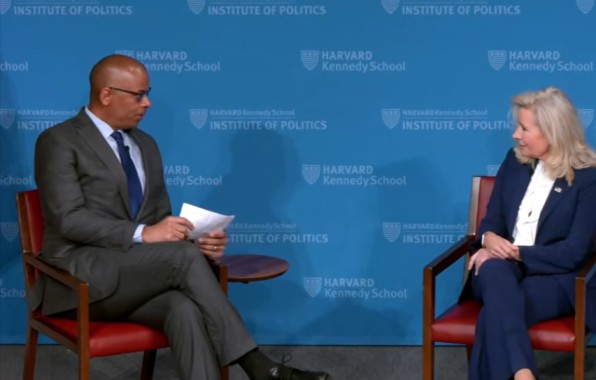
In this candid conversation with former Transportation Secretary Anthony Foxx, former Congresswoman Liz Cheney looks ahead to the high-stakes 2026 midterm elections and warns that the results must be respected. She recalls what it was like inside the Capitol on January 6th, why she voted to impeach Donald Trump, her work as vice chair of the January 6th committee, and the advice of her late father, Dick Cheney, to “defend the republic.” Cheney also takes audience questions on Trumpism, campaign finance, the Iran war, American exceptionalism and bipartisanship. Read the full transcript of this conversation below:
LIZ CHENEY: (00:00:00 – 00:00:04) Thank you.
ANTHONY FOXX: (00:00:04 – 00:00:11) Okay, good evening everyone. I’m looking forward to this wonderful conversation. Congresswoman Cheney, thank you for joining us.
LIZ CHENEY: (00:00:11 – 00:00:14) Well, it’s my pleasure, really an honor to be here. Thank you.
Lessons in Patriotism From a Political Family
ANTHONY FOXX: (00:00:15 – 00:00:45) Well, you’re very welcome. I wanted to start just with a values conversation and about the fact that you were raised in a political family. And absorbed the life of politics as a child all the way up. I wonder whether you— what you learned about patriotism as a child and maybe what you later learned about it that may be different in your career path later on.
LIZ CHENEY: (00:00:46 – 00:03:47) Well, thank you very much for the question. And thank you again for having me and particularly having me here as part of the Center for Public Leadership. It’s hard to imagine a time more important than the one we’re in for the work of the center and what the Kennedy School is doing as a whole. So it’s an honor to be here.
When I think back in terms of lessons of patriotism as I was growing up, both my parents really made an effort to make sure that my sister and I were exposed to and understood and spent time learning about American history. And I think that’s the best way for patriotism, the best foundation for patriotism. I can’t say that at the time that it was going on that I really appreciated it. My dad would take us to Civil War battlefields pretty frequently. Oh, there’s my dad. That’s actually the night that I was elected, my primary election in Wyoming.
But I think that they both, my father had, my mother has a tremendous love of history and a dedication to it. And I think that when you understand what sacrifices people have made throughout the course of our nation’s history, and when you understand the challenges that they faced, the threats that they faced, I think it makes it much, much more likely that individuals, that you will in fact appreciate that and understand the importance of service.
The other sort of really formative period for me in terms of my patriotism, I would say, is when I was working overseas. And I was working at USAID and then at the State Department. I began in 1989 working at AID before I went to law school. I was working in countries starting in the Middle East and Asia, but then the wall came down. And having the opportunity to spend time working in Poland and Hungary and Ukraine and Moscow, it really gave me a sense of an exposure to people who were willing to do so much to try to secure their own freedom.
And I think that it’s so important. I always encourage young people especially to make sure that if you have the opportunity to spend time studying overseas, do it. It’s such a formative experience and I think really helps you understand and appreciate just this treasure that we have as Americans.
Explaining the Donald Trump Phenomenon
ANTHONY FOXX: (00:03:49 – 00:03:56) So I’m going to ask you how you can explain the Donald Trump phenomenon.
LIZ CHENEY: (00:03:58 – 00:04:00) How much time do you have, Secretary Foxx?
ANTHONY FOXX: (00:04:01 – 00:04:17) And with this context. Many times when people ask a question like this, they’re asking about the president and the current administration. David Brooks wrote a column several months ago in which he said, the question we should be asking is, “What does it say about us?”
LIZ CHENEY: (00:04:17 – 00:04:18) Yeah.
ANTHONY FOXX: (00:04:18 – 00:04:20) Can you maybe provide your answer?
LIZ CHENEY: (00:04:20 – 00:07:19) Yeah, it’s interesting. I think about it, that phrasing, I think about it actually in terms of this upcoming election next week. In terms of the 2028 election. For a period of time during the Biden administration, those of us in the Republican Party who were warning about the potential danger of reelecting President Trump, you face a challenge if you’re saying to people, “Well, you have to take my word for this.” After January 6th, you didn’t have to take anybody’s word for it. We saw what he was capable of. But now, unfortunately, we have seen almost 2 years now of what he is capable of and of what damage is done by people who are enabling him.
And so this question of, we know who he is. There’s not a single person in elected office today maybe with very few exceptions, who doesn’t know who Donald Trump is, who doesn’t know the kind of person he is. But the question is, what kind of people are we as Americans? And are we going to be a society that stands for the truth? Are we going to hold accountable at the ballot box the men and women in elective office who have enabled what he’s doing.
I mean, I think that’s one of the biggest challenges, and I think one of the saddest things, frankly, about the period that we’ve lived through is the extent to which men and women who know better have been willing to rationalize and accept and really enable things that are indefensible.
And so I think on the positive side, there’s a real sense around the country that I get.
And so I think that’s the choice for us really coming up is how do we make sure that we are electing people to office and that we are holding accountable people who are in office for their conduct in a way that really reflects the seriousness of the issues that they have to handle and grapple with for all of us.
Predictions for the 2026 Midterm Elections
ANTHONY FOXX: (00:07:20 – 00:07:46) So since you brought up the midterms, I was going to ask this later, but I’ll ask it now. Some prognosticators believe the House will flip from Republican control to Democratic control. There are also those who believe that the Senate is possibly also going to flip. What’s your prognostication and what do you think Republicans should do post-midterms and what do you think Democrats should do post-midterms?
LIZ CHENEY: (00:07:48 – 00:10:00) I think Republicans should come back into the light. I think that, look, it certainly seems to be a situation where when you combine the fact that the party that is in power in the presidency tends not to do well in midterms with the reality of what we’re seeing in terms of the economy, in terms of the policy decisions that have been made, in terms of corruption.
I think one of the most interesting things in some of the polling I’ve seen recently is the extent to which people are concerned about corruption in our leaders at levels they haven’t been before, that they haven’t been concerned about it as an issue. And I think that if the election— if we could count on the fact that the election results were going to be respected, then I think it’s clear the House will flip. And I think the Senate is too close to call.
I think that you’re beginning to see now a real effort on the part of the administration to sow chaos. And doubt and confusion, whether they’re doing this through some of the litigation that they’ve filed, whether they’re doing it through the ongoing claims about rigged elections that we know are false. And so I think it is going to be incumbent upon all of us to be very careful about making sure we’re standing for the truth, that we’re not pushing stories that are fabricated, that are untrue, that people have confidence in the election process.
I think it’s also very important that the message is sent to the members of the House, in particular the House Republican leadership right now, that the voters of this country expect that they will do their duty, they will obey their oath to the Constitution, that they will seat people who are elected regardless of whether those individuals are members of the Republican Party or not, but that they will honor the will of the people.
ANTHONY FOXX: (00:10:02 – 00:10:03) Do you think that’s at risk?
LIZ CHENEY: (00:10:04 – 00:11:16) I do. I think you have to be concerned about it because of the track record, in particular what we saw happen in 2020. One of the real instigators of the effort in 2020 to reject electoral votes was Mike Johnson. He was taking the position in 2020, he didn’t provide any evidence. What he would do is say that he thought that we shouldn’t count the votes of certain states like Arizona, for example. The phrasing he used was, “because we are convinced.” Because we’re convinced.
Now, that’s not the role of the Congress to act on some manufactured instinct and use that as an excuse to throw out the votes of our fellow citizens. But I think you have to be concerned that just based on precedent, it doesn’t leave you with a lot of confidence. But I think making sure that they are on notice, that we are paying attention, and that the American people expect them to do their duty is very important.
Voting With Trump in His First Term
ANTHONY FOXX: (00:11:17 – 00:11:39) I want to take you back before January 6th into the first Trump term. And according to at least FiveThirtyEight, you voted with President Trump 93% of the time. Did that reflect philosophical agreement with President Trump or party loyalty?
LIZ CHENEY: (00:11:40 – 00:14:11) Yeah, look, I had joined the Republican Party because of substance and policy, because of the things that I believe about a strong national defense and limited government, low taxes. So there’s a substantive reason why I and millions of people are members of each party. And I think if you go back to the first term, you see that the president was actually governing in a way that was much more consistent with traditional conservative Republican policies.
When he took steps that I disagreed with, I said so. One of the very first disagreements that we had publicly, for example, I think it was in January of 2017, right after we had both been sworn in, he began to say, “NATO is obsolete.” And began to question the usefulness of U.S. participation in NATO, and I spoke out against that. So I spoke out when I disagreed with him, but I think at that time, the other thing to remember is that Paul Ryan was Speaker of the House for the first 2 years of the administration, and so the Republicans, we really were putting forth legislation that reflected conservative principles and values.
And I think it’s really important that we differentiate between policy perspectives and policy views and constitutional challenges and issues. And one of the things that I was asked after I voted to impeach when I would go home to Wyoming, a number of times I was asked by my constituents, people would say some version of, “Well, how could you vote to impeach a member of your own party?” And Wyoming had given President Trump his largest margin of victory of any state in the country.
And so I was surprised at the extent to which there wasn’t a recognition, certainly among my elected colleagues that your party affiliation should have nothing to do with questions of impeachment, and your duty about has the president committed impeachable offenses, has got to be separate and apart from party affiliation.
ANTHONY FOXX: (00:14:11 – 00:14:29) It’s really interesting because in some ways you could imagine why an elected official might rationalize their position, but for the public, to also have the same rationalization? Do you attribute a cause to that? Is that something people are taught, or what are we—
LIZ CHENEY: (00:14:31 – 00:15:39) Well, I think you have to really distinguish between the behavior of elected Republicans in Congress and voters. And I think that partly what’s happened among voters is that President Trump betrayed a lot of very, very good and honorable and patriotic individuals. And there are people around the country who felt like, who feel like their voices weren’t heard. And President Trump managed to convince them that he was listening to them. And so I think that betrayal is a very different thing than the conduct of elected Republicans.
And look, I think rationalization is sort of like a— it’s a fundamental human behavior. The scale at which we’ve seen it used to defend things that shouldn’t be defended is unusual historically for us in this country, I’d say.
Why Republicans Objected to Certifying the 2020 Election
ANTHONY FOXX: (00:15:40 – 00:16:25) So I’m going to take you up to the 2020 elections, the Congress has a constitutional responsibility to certify the elections. And President Trump claimed that he, not President Biden— President-elect Biden at that point, had won the election. So roughly 140 of the House Republicans objected to certifying the election results. You were not among them, and some privately agreed with your position. Can you help us understand why members of Congress would take a public position and have a privately disclosed position?
LIZ CHENEY: (00:16:26 – 00:19:37) Yeah, that happens sometimes. I think that there, in this set of circumstances, the members told themselves, Republican members told themselves, and some of them said this publicly, “It doesn’t really matter. We’re just saying we’re going to throw out some electoral votes. Let’s just do this one last thing, and then we’ll be done with it.” And that view was made very clear in terms of people like Mike Johnson filing the brief in the Supreme Court that essentially, he convinced members to sign on to this brief that was without legal basis. And part of the excuse was, just do this one last thing.
There was a moment on January 6th before the session convened when I was in the Republican cloakroom and there were sheets that were laid out on tables for members to sign. And I didn’t— I kind of walked in and I said, “Hey, what’s going on?” And one of the staff members said, “Well, those are the objections.” So it would say Arizona, Michigan, and members could sign on to show their support for objecting.
And one Republican member, as he worked his way down the line, and he signed every single piece of paper, he said— I don’t know if he knew he said this out loud, but he said, “The things we do for the orange Jesus.” And it was just such a moment of convincing themselves they could do this.
And the final point that’s important to remember is, not only did they object, but many of them told their constituents, if you come to Washington on January 6th, you can overturn these results. And we had another moment when the House Republicans were all meeting a day or so before, I think it was the day before, when one of our members who had been very vocal about telling her constituents, come to Washington and you can change the results. She stood up in this meeting of all of the Republicans and she said, “Look, I’m really worried. I’m worried about my security because we’ve all told people they can come here to overturn the results and that isn’t true. And when they find out it’s not true, they’re going to be really angry at us.”
So it was just this moment of saying something out loud that made clear people thought that they could conduct themselves this way. And it was a lack of seriousness about our constitutional responsibilities.
Inside the Capitol on January 6th
ANTHONY FOXX: (00:19:38 – 00:19:51) So take us inside the Capitol on January 6th. You were in the chambers. As the riot, or whatever people call it, occurred, what was it like on the inside?
LIZ CHENEY: (00:19:52 – 00:22:19) Yeah, the first thing that happened was, before the session was called to order, I was in the cloakroom and I was working on my remarks. I was going to speak that day to explain why we didn’t have constitutional authority to object. And my dad called me, and he asked me if I was watching President Trump’s speech on the Mall. And I said I hadn’t been because I was working on my remarks. And he said, “The president just said we have to get rid of the Liz Cheneys of the world.” And we had a discussion about what did that mean. He said, “The president has put a target on you. And you need to think carefully about that.”
But through the course of our— it was a few-minute discussion, I said to him, “I can’t let the fact that the president has done that stop me from speaking.” That seemed like a very fundamental moment in a democratic system. You cannot have legislators fearful because the President of the United States has threatened them.
And I knew— I think about that call and my dad, and obviously he was worried as a father. But I also know that the heartbreak in his voice was also about our country, and that we’d come to that. And at the end of the call, it was clear I was going to speak and he said to me, “All right, call me when you’re done, and I love you.” And the next time I spoke to him was when we were being evacuated from the House floor.
And then the real feeling from that day, of being there in the chamber, being instructed that the seats were bulletproof, and as the mob was banging on the doors, the Capitol Police were telling us to take cover behind the seats. I mean, it was surreal. But the emotion that I remember is just deep anger that this was happening and that elected officials in this country had contributed to this happening. And it wasn’t something that ever should happen, certainly in the United States.
The Impeachment Vote and Mitch McConnell’s Decision
ANTHONY FOXX: (00:22:21 – 00:22:47) So a week after January 6th, you voted to impeach President Trump. You were the 3rd-ranking Republican in the House, the chair of the House Republican Conference, and you knew the vote might end your career. Walk us through the night before, and was there any part of you that was second-guessing your position?
LIZ CHENEY: (00:22:48 – 00:24:55) No, I never second-guessed that vote, and I honestly didn’t think about it in the context of, what’s it going to mean for my future political career? Because that seems like an inappropriate way to think. It just didn’t occur to me.
And what was happening in the days leading up to the vote was there were a number of Republicans— and don’t forget, we had started in the day after the attack, with a really unified party. And there were very few people on the Republican side in the House who were defending the president. Maybe one or two, but it was— you had Kevin McCarthy actually saying on our leadership call that he was going to tell the president he should resign. I mean, there was absolute understanding of what had happened.
I think that what changed was a sense that people got that we don’t have to stick our necks out here because Trump’s done anyway. And that was certainly ultimately Senator McConnell’s position. And if I have to sort of look back and see, there were many moments, but one really crucial moment that led us to where we are today was Mitch McConnell not voting to convict. And I think if he had voted to convict, you would have had enough Republicans who would have followed him that he would have been convicted.
And I think that that’s a real tragedy. And I think that was a political calculation. The same notion of people believed that Trump was finished and that anybody who had done what he did was simply not going to be accepted back onto the national stage. And so therefore, they sort of thought, well, we can get by this without having to take the tough vote.
Serving as Vice Chair of the January 6th Committee
ANTHONY FOXX: (00:24:57 – 00:25:14) So in the wake of all of this, you become the vice chair of the January 6th committee, serving with the chair, Bennie Thompson. You kind of become the Democrats’ favorite Republican at this point.
LIZ CHENEY: (00:25:14 – 00:25:17) It’s really a title I aspired to my whole life.
ANTHONY FOXX: (00:25:21 – 00:25:28) Were you ever worried that progressives would use you to hurt the Republican Party, leaving aside the president?
LIZ CHENEY: (00:25:29 – 00:28:47) No. I mean, first of all, I think progressives were so confused by me that it was— No, I wasn’t worried about that. I was— it was unfortunate, again, that we didn’t have a bipartisan commission. That process had basically been voted down, so that wasn’t going to happen. And I thought about how could you possibly have gone through what we did and not investigate. After every major crisis, certainly in recent memory, whether it was Pearl Harbor or the attacks of 9/11, we as a country had a bipartisan commission.
And I thought actually it would have been preferable to have a bipartisan commission made up of people who weren’t currently serving, outside leaders and experts who really could take an in-depth look at this without the pressure of being in office. But when that was voted down, the select committee became the option. And to be in a position where, as somebody who had been very Republican and partisan, not in a negative sense, but probably sometimes too partisan. To be in a position where I found myself serving on a committee that Speaker Pelosi was asking me to join, I couldn’t have imagined that. I’m sure she couldn’t have imagined it either, actually.
But it was really important. And I think the work we did was so important, partly because there’s a historic record now. And the testimony of the men and women who were those closest to President Trump is there in the historic record. And so when people say it was a hoax or it was made up by the Democrats, that’s simply not true.
And I think that it was so important— and this is relevant for this election— so important that there were Republicans, elected Republicans, at a state level who stood up to tremendous pressure from President Trump. I see one of them actually in the audience today, Stephen Richer, who did tremendous work in Arizona to ensure that people’s votes were counted, that the certification meant something, that— and also Stephen has to this day— and I’m sorry to mention you, Stephen, I hope that’s okay— but continued to this day to stand up against the charges that— the false charges that are being made about how the elections were run. But if it hadn’t been for those elected Republican officials being willing to go against the tremendous pressure they were feeling, I think the outcome could have been far worse.
A Low Point and the Peaceful Transfer of Power
ANTHONY FOXX: (00:28:48 – 00:29:04) So I often tell our students that leadership can sometimes be lonely. And I wonder whether you’ve already described it, whether there was another low point for you in the course of all of this and how you dealt with it.
LIZ CHENEY: (00:29:06 – 00:30:47) I was talking earlier today. I don’t know if I would describe this as a low point, but it was an emotional moment, and it was a moment of realizing what’s at stake. And it has to do with my kids. And it was a few days after the attack, and my husband and I were having dinner with our 2 youngest with our 2 sons. And I looked across the table at my sons, and I had this sort of sudden realization that we have lived in a country where we took for granted— we had the luxury to take for granted— that we would always know a peaceful transfer of power, that we would have these intense important debates and discussions, but that you could count on. You didn’t have to worry that power was going to transfer by violence.
And when I looked at my sons, I had this thought of, are they going to know that? Are they going to grow up in a country that’s characterized by a peaceful transfer of power? And being able to take that for granted is a blessing. And so that was a very emotional moment for me, but it was also a moment of, this is a fight we have to win. And we can’t be frivolous about this tremendous jewel, as Abraham Lincoln called it, an “inestimable jewel” of our freedom.
“Defend the Republic, Daughter”: Remembering Dick Cheney
ANTHONY FOXX: (00:30:49 – 00:30:52) Your father passed away almost a year ago.
LIZ CHENEY: (00:30:52 – 00:30:52) Yeah.
ANTHONY FOXX: (00:30:53 – 00:31:02) And he stood with you publicly through this whole ordeal. Would you share what your conversations with him were like?
LIZ CHENEY: (00:31:04 – 00:33:59) Yeah, I actually— Election Day will be the one-year anniversary of my dad’s passing. And throughout my whole life, he was my most trusted and important advisor. I talked to him every day. Usually multiple times a day. And what a blessing it was to grow up watching his career in public service, learning from him, and also being able then to get advice and guidance from him.
And his advice would range from sort of in-depth policy analysis about our nuclear forces and our nuclear triad to— one time I called him before I was about to go speak to a group in Wyoming, and I said, “Dad, I’m going to go speak to this group. Do you have any advice for me?” And he said, “Liz, that is a really important group, so don’t screw it up.” And I was like, “That’s really helpful.”
I think sometimes people ask, they seem surprised that he stood the way that he did, because he was a lifelong Republican. But he never wavered. And throughout this whole period, he was somebody who was very clear about what was at stake.
New Year’s Day in 2021. So 5 days before January 6th, we were having lunch at my parents’ house. And we had been going through watching sort of this constant build and the lies and the attacks and the concern that the Defense Department, for example— we’d had Chairman of the Joint Chiefs Mark Milley had put out a statement at one point in December saying, “The US military has no role in our elections.” And that caused huge blowback from the president, which— and that should be an unobjectionable position. But so it was clear that this was a very difficult moment.
And as my dad walked me to the car, came around and he gave me a hug and he said to me, “Defend the republic, daughter.” And it’s, first of all, it’s very moving to talk about. I try to live up to that. But also when I say it, I think like, really, who talks like that? “Defend the republic, daughter.” But he did and it was very, very sincere.
When It’s Right to Change Your Mind
ANTHONY FOXX: (00:34:01 – 00:34:26) We’ve to this point talked about your rock-solid principles around constitutionality and so forth, but there are times when people of principle change their minds on things. And I know, for example, in 2013 you opposed same-sex marriage and then later changed your position. When is it okay for one to change their minds?
LIZ CHENEY: (00:34:27 – 00:35:36) When you get something wrong. And I think that every individual knows there’s a fundamental difference between sort of flip-flopping on issues because you’re trying to sort of see which way the wind blows, or you look at the people around the president today who used to speak very publicly about the danger that he poses and who now have embraced him. So there’s a difference between that sort of change in position and a change that comes from saying, “Look, I have thought about this and I understand it and I have a lived experience that’s caused me to know that I got that wrong.”
And we all get things wrong. And I think it’s really important that we have elected officials who will say, “I got it wrong.” And so I think, as important as that is, and sort of how we deal with individuals as humans in the nonpolitical realm, it’s important in politics too.
The Courts and the Rule of Law
ANTHONY FOXX: (00:35:37 – 00:35:48) So you and I are both lawyers. And we follow the courts and various things. I wonder how you think the courts are holding up amid all of the various challenges. Yeah, including the Supreme Court.
LIZ CHENEY: (00:35:48 – 00:36:48) Yeah. I mean, look, I think that if you look at the 3 branches of our government, the courts today are just doing hugely important work and sometimes standing alone against this onslaught. And they don’t always get everything right. I think the Supreme Court’s decision on the immunity case was not right. And I think whatever they were intending to say, what Trump took from it is that he’s completely immune and he can do anything that he wants when he’s in office.
But I think for the most part, we have seen on a bipartisan basis— and that’s probably the wrong word— we’ve seen judges appointed by both Democrats and Republicans who have stood for the rule of law. And that gives me hope.
Would Liz Cheney Serve Again?
ANTHONY FOXX: (00:36:49 – 00:37:08) And I’m going to ask my last question before we go turn it over to the audience. And by the way, we have microphones here, here, here, and here. When you ask a question, just let us know what your name is and what school you’re a part of. Would you serve again? And under what circumstances?
LIZ CHENEY: (00:37:10 – 00:38:46) I wouldn’t— I’m certainly not going to say I would never serve again. I have a real sense, though, that right now, sort of the challenges that we face really require that we kind of step back from the way we’ve been doing our politics. And I spend a lot of time on campuses around the country and thinking and writing about sort of how do we get back to first principles and how do we get back to a politics that serves us and that will maintain our constitutional republic. And I think that that’s an issue that requires a lot of good people being willing to serve.
And look, I think this also is an issue that people need to be thinking about as the midterms come up. Because of the role the Senate has played and the role that individual senators have played in confirming some of the most inept, incompetent individuals to some of the most critically important cabinet positions. And that power of confirmation is very significant. And I think that when senators vote to confirm people like Pete Hegseth, RFK Jr., and a range of others, I think that really calls into question— it would for me— calls into question their credibility about their independence and their willingness to do what’s right.
Audience Q&A: Has Trumpism Changed the Republican Party?
ANTHONY FOXX: (00:38:47 – 00:39:02) Thank you. We’ll start with questions, and we’ll start over here.
NATASHA: Hi. Thank you so much for joining us here tonight. My name’s Natasha. I’m a college student studying econ and history, and it’s been an absolute pleasure to hear from you tonight.
NATASHA: (00:39:03 – 00:41:02) My question is, do you think Trumpism, or whatever you want to call it, has fundamentally changed the Republican Party?
LIZ CHENEY: Yeah, definitely. And I— but I also think it’s an interesting phenomenon for a number of reasons, including because it’s not conservative. I’m constantly sort of surprised, for example, by the extent to which the president, people around him speak about how opposed they are to socialism, which, I agree we should be opposed to socialism. But this president has used taxpayer dollars to take stakes in private companies, to have the US government take stakes in private companies on a level that we haven’t seen before. And it’s just sort of one example of this fundamental move away from what the party used to stand for.
The other place I think this is very evident is what’s happening in Russia and Ukraine, and the extent to which this administration has not just made a decision that America won’t be involved. President Trump has put us firmly on the side— he’s attempting to put us firmly on the side of Vladimir Putin. And to be in a situation where we are essentially rewarding the Russians, providing financial incentives to the Russians, while we know they have provided and may still be providing intelligence that allows Iranians to target Americans, to target our men and women in uniform, and to be looking the other way and aligning us with Putin and against the forces of freedom is a fundamental departure from where the Republican Party has been in the past. Thank you.
Reelection Fears and Putting Country Over Party
ANTHONY FOXX: (00:41:04 – 00:41:05) Hi. Oh, sorry. Yes.
SOPHIE: (00:41:06 – 00:44:32) Thank you so much for being with us today. My name is Sophie. I’m a sophomore at the college, also studying history. You said today that concerns about reelection didn’t factor into your decision about whether or not to vote for impeachment. But for most of your colleagues, your Republican colleagues who were facing that decision, it clearly did. I was wondering if you think fear of losing reelection or being challenged in primaries had always shaped the decisions of congresspeople this much, or if there was something unique about the Trump era that’s made it harder for Republicans to make choices that put the country over their party.
LIZ CHENEY: It’s an interesting question. Look, I think that if you’re in elected office, election matters. And so I think it has— it’s always informed people’s behavior. I think that though you can look back and find moments, for example, in the aftermath of Watergate, when you had a group of Republican senators who went to the White House to see President Nixon and tell him he needed to resign. You could point back to moments where people were willing to put service to the country ahead of thinking about reelection.
I also think, though, it gets back to leadership, because the role of an elected official should be both to represent the people who have sent you to Washington, and also obviously, your duty to the Constitution is above everything, but to represent your constituents. But there are times when on policy matters you may make a vote or take a position and then you go home and explain it. And I think thinking about elected officials as leaders, as you are helping to explain and educate and talk to your constituents as you’re learning from them, our elected officials also shape public opinion. I think that there’s not as much of that in the mix as we should have.
But I think what we have seen happen should make us think more seriously about term limits, which is something that is a much longer discussion. I’ve not always been a supporter of term limits, but I do think we need to find ways to encourage and reinforce elected officials taking positions that aren’t just focused on how am I going to survive the next election. Thank you.
A Thank-You and a Signed Copy of Oath and Honor
UNIDENTIFIED SPEAKER: Hi, I promised myself some years ago that if I ever had the opportunity, I would say thank you for all the work that you did on that committee. But thank you in general for everything you’ve done to defend the Republic, then up until now. I tried to get Oath and Honor from 4 different area bookstores.
LIZ CHENEY: Oh my gosh.
UNIDENTIFIED SPEAKER: None of them had it.
LIZ CHENEY: You’re breaking my heart.
UNIDENTIFIED SPEAKER: I know people— If I can get a copy and send it to you either through the Institute of Politics or through your—
ANTHONY FOXX: (00:44:33 – 00:44:33) Is there a question?
UNIDENTIFIED SPEAKER: (00:44:34 – 00:44:54) Yes, there is. The question is, if I can send that copy to you, would you autograph it for me?
LIZ CHENEY: Yes, I’d be honored to. And if you talk to the folks here at the IOP and at the Center for Public Leadership, they know how to find me.
UNIDENTIFIED SPEAKER: I will do that. Thank you very much.
LIZ CHENEY: Thank you.
Money in Politics, Campaign Finance and Term Limits
ANTHONY FOXX: (00:44:57 – 00:45:22) Asked and answered. Fantastic. Okay.
TENIO OLAT SULEIMAN: Good evening. I’ve got a certain— certainly a little different type of question. My name is Tenio Olat Suleiman. I’m a student here at the Kennedy School, also at the Tuck School of Business at Dartmouth College. Thank you for being here, Representative Cheney. My question comes from a concern in the behaviors of politicians and the mechanisms that may incite, let’s say, less than sincere behaviors.
TENIO OLAT SULEIMAN: (00:45:22 – 00:45:23) You just mentioned term limits.
TENIO OLAT SULEIMAN: (00:45:24 – 00:45:34) But love— would love to give your thoughts on what changes should be made regarding money in politics, campaign contributions, that kind of thing, and as well as term limits.
LIZ CHENEY: (00:45:35 – 00:48:00) Yeah, I think with respect to campaign finance, I think we’re in a mess right now. And I believe strongly that campaign contributions are political speech. I think that people ought to have the right, it should be protected, to dedicate their resources towards causes they believe in. But I think we need more transparency. I would like to see candidates have to immediately disclose where the resources are coming from. And I also think that the Citizens United decision had consequences that perhaps had not been anticipated.
I mean, when you have the growth of super PACs— and this was certainly the circumstance when I was running in Wyoming— as a candidate to be carrying out sort of your campaign strategy, and then you have these groups, these super PAC groups that come in to spend money, and you can’t talk to them, and they are spending money in your race that may be focused on issues that aren’t helpful or that aren’t in any way representative of what you stand for. That situation was not a good one. The situation we’re in today, where now candidates can coordinate, some of those obstacles have been lifted, is also troubling when you have somebody like Elon Musk, who’s putting hundreds of millions of dollars into these races.
Look, I think ultimately we’re going to find that there’s a saturation level and people can’t be bought for the most part. I think political spending isn’t the ultimate determinant in who wins races. But I think we have to find a better balance that protects people’s constitutional rights, I don’t like the idea of government financing for campaigns. I think that I always think of that as a taxpayer. Why should my taxpayer dollars be used to support candidates I don’t agree with? But I think that moves we can make towards much greater transparency are certainly a step in the right direction.
The Iran Nuclear Deal and the War With Iran
ANTHONY FOXX: (00:48:01 – 00:48:03) Thank you. Back over here. Thank you.
UNIDENTIFIED SPEAKER: (00:48:06 – 00:52:51) Good evening, Congresswoman. Thanks very much for being here.
LIZ CHENEY: Thank you.
UNIDENTIFIED SPEAKER: For years, you argued that the Obama nuclear deal with Iran was a failure, and you pushed to dismantle it and cancel negotiations. You spoke about your many disagreements with the administration tonight, but on Iran, they seem to have ultimately steered towards your position on confronting Iran when they started the war. However, now 8 months into this war, thousands of Iranian civilians and hundreds of US service members have been killed or injured. The Strait of Hormuz is being used as leverage in a way that it never was before, and we’re no closer to a definitive settlement. Most Americans say that the war was a mistake and that the country would be lucky to go back to the JCPOA. So looking back, would you now also acknowledge that it was a mistake to withdraw from the deal?
LIZ CHENEY: I think you have to separate those two things. Those are both huge issues. With respect to the JCPOA, my concerns about it remain, and one of those was that the verification structure and framework that was put in place wasn’t a real one. And you had Secretary Kerry at the time, for example, saying, “Oh, the deal is going to guarantee anywhere, anyplace, anytime inspections.” That didn’t happen.
There is often a tendency inside the State Department, and this happens in both Republican and Democratic administrations, for people to sort of say, “Oh, any deal is better than no deal.” And it’s rationalization in a different way of, well, it’s better to have this deal than not. But I think what happened was a couple of things. One, Iran gained benefits, which ultimately it was able to use in ways to continue to support terrorism around the world.
The second real problem with the deal was when the United States said we will allow, we’ll agree that Iran can enrich uranium, that essentially began the dismantlement of the Nuclear Non-Proliferation Treaty. And whereas before that, we had a structure, imperfect, but it was a structure where we could say to countries around the world, you don’t need your own nuclear weapons program, you can count on our nuclear umbrella. And that depended in part upon the structure about who can enrich and who can’t. And when the Obama administration agreed that Iran could enrich, it began to dismantle that structure.
So I think that there were a lot of problems with the JCPOA. I don’t think that it was effective in stopping Iran’s march toward a nuclear weapon. But saying that does not mean that you look at the current situation and say that the current situation is one that is not exceedingly dangerous. And I think one of the real challenges we face is you can’t separate out an analysis of what’s happening in Iran, the decisions that our commander-in-chief is making, from the fact that our commander-in-chief is depraved.
And so the lack of a serious process and serious policymaking. And I mentioned earlier the fact that we know the Russians and the Chinese have been helping the Iranians. And we also know that they’re watching. And we are today facing a situation that I think has not been fully disclosed to the American people about the situation with our stockpiles, with our munitions. I think the amount that’s been expended is much, much higher than the administration’s telling us. I think that the damage that’s been done to American facilities in the Middle East is very significant.
And so I think that a reasonable and a rational response and approach to Iran that had involved maximum pressure, that involved the use of military force where necessary, if necessary. There’s a reasonable and responsible approach we could have taken that doesn’t mean embracing the JCPOA, but also doesn’t mean embracing the dangerous moment that we’re in now, because what you’ve said about Iran is right.
Congress and the Non-Delegation Doctrine
LIZ CHENEY: (00:52:51 – 00:52:58) It’s true.
ANTHONY FOXX: Okay, we have a hard stop at 7, so I’m trying to get as many in as we can. Let’s go up here. Sure.
UNIDENTIFIED SPEAKER: Hi.
UNIDENTIFIED SPEAKER: (00:52:59 – 00:53:14) Thank you for your time tonight. This will be a very quick one, more in the legal direction. Do either of you feel that perhaps Congress could have breached the non-delegation doctrine, specifically on declarations of war, taxation, and assignment of funds?
LIZ CHENEY: You want to answer that first?
ANTHONY FOXX: (00:53:16 – 00:53:18) You’re our guest. I want to make sure you get a chance.
LIZ CHENEY: (00:53:21 – 00:54:48) I think it’s— it’s very clear that Congress is not playing the role that it was intended to play. If you go back and you read the Federalists, for example, it’s very clear. I mean, it’s an incredible and a miraculous structure that our framers put in place, but it is one that depends upon, fundamentally depends upon the character of the people in office and depends upon their notion that they could count on, in a separated government, they could count on individuals who were in the legislature to protect and guard their authority. And that’s certainly not happening today in a whole range of issues that you’ve mentioned, as well as the appropriation of funds. I mean, it’s hard to know exactly where to stop because the list is so long.
And I think that when we think about what the solutions are, the solutions fundamentally and ultimately the single most important one is to elect better people. Because we can put guardrails in place, we certainly need to learn from what’s happened in this moment, but if the president is going to blow through the guardrails, then they don’t provide much protection to us. But people can do that.
American Exceptionalism and Building Bipartisan Solutions
ANTHONY FOXX: (00:54:50 – 00:54:59) And I’ll be happy to answer after, but want to save time. Here and here, real quick, and we’ll try to take these both and then ask our guest to answer.
SURAJ: (00:54:59 – 00:55:20) Good evening, Congresswoman Cheney. My name is Suraj. I’m a first year at the college. My question is about American exceptionalism, which I think has long rested on the belief that the US has a uniquely special role in the world in defending democratic values. Given the democratic challenges that we’ve witnessed at home, do you believe that American exceptionalism remains a credible ideal, or has it made us complacent?
ANTHONY FOXX: (00:55:20 – 00:55:24) Okay. And here.
AARON SANCHEZ: Hi, Congressman. My name is Aaron Sanchez.
AARON SANCHEZ: (00:55:24 – 00:55:35) I’m an MPP1 here. I’ve spent most of my career in Democratic politics in the California delegation, but the health policy wins I care about, like student mental health legislation, have often needed Republican votes.
AARON SANCHEZ: (00:55:36 – 00:55:49) From your time in leadership and on the January 6th committee, what actually earns Republican support for Democrat-led legislation? And who in the 120th Congress on your side of the aisle are worth investing with to build bipartisan solutions?
LIZ CHENEY: Okay.
LIZ CHENEY: (00:55:50 – 00:55:52) I’m going to answer yours first because I already forgot yours.
SURAJ: (00:55:53 – 00:55:54) Sorry. No. Exceptionalism.
LIZ CHENEY: (00:55:54 – 00:59:31) Yeah. But I’ll— so we have to have bipartisanship to get to solutions. There’s no question. And I think that there are serious members on both sides of the aisle. Unfortunately, you have some members, some of the most serious and responsible ones leave, which is challenging. And I’m sitting here like I’m hesitating to name Republicans. I don’t know that that’ll help them.
But I think that elected officials who— I often use the examples of people on the Democratic side like Elissa Slotkin and Abigail Spanberger and Mikie Sherrill, who all were in the House when I was. And we served on the House Armed Services Committee together. And what I found was 2 things. One is I knew I could always go to them and say, “Explain to me why you believe X, Y, or Z.” If it was an issue that we disagreed on, for example. And we could sit and have substantive policy discussions, and it didn’t mean we were going to end up in the same place, but I did understand their views, and I hope that they learned from me as well.
And the other thing about the 3 of them, and there are others too, but they were always prepared. Always. And so if we were going to have a committee hearing or if they’d proposed an amendment that I was going to speak against, for example, I knew I had to come ready because they were. And that makes all of us better.
And so I think that while I wish there were more, frankly, on both sides, I think that as voters, helping to reinforce the people that are engaged in substantive discussion helps. And look, I think at this state level, it’s really important too, not just at the federal level. And sometimes it’s easier at a state level to get bipartisan solutions done. Thank you.
And then with respect to American exceptionalism, I don’t think that you can ever count America out. And we were founded on the values that have been values that people around the world and throughout history have wanted to be part of, have wanted to live under, have— I think they’re inalienable. And so I think that I wouldn’t say that we have lost that.
But I would say that we’re at a moment where it really matters what we do next, and it really matters how we engage with the world after the Trump administration, because there’s so much work that has to be done to rebuild alliances and to convince people they can count on us again. But understanding the importance of those alliances and how much they multiply our own power and our own ability to advocate for what matters, I think has to be a fundamental part of our next campaigns.
ANTHONY FOXX: (00:59:32 – 00:59:41) We’re going to have to leave it there. I apologize. I wish we could have gotten to more questions. But let’s give a round of applause for Liz Cheney. She’s a wonderful guest.
LIZ CHENEY: (00:59:41 – 00:59:42) Thank you.
Related Posts
- Transcript: The Truth About France Protests w/Richard Wolff
- Tucker Carlson Interviews Jeffrey Sachs on Israeli Election (Transcript)
- Transcript: President Trump Speaks at Corpus Christi Rally, One Week Before Election Day
- Rebecca Bextel Interview: Tucker Carlson Show (Transcript)
- Full Transcript of Barack Obama’s Ohio Rally Speech – Oct 24, 2026