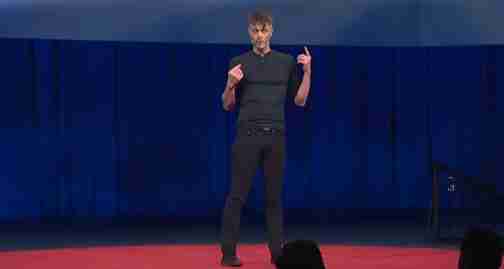
Read here the full transcript of playwright David Finnigan’s talk titled “A Controversial Play — and What It Taught Me About the Psychology of Climate” at TED Talks 2024 conference.
Listen to the audio version here:
TRANSCRIPT:
Introduction
Hi, I’m David. I’m a playwright from Ngunnawal country, the unceded lands of the Ngunnawal people in southeast Australia. I come from a family of climate scientists, and in 2014 I wrote a play entitled “Kill Climate Deniers.”
The play follows the story of a group of eco-terrorists who take over Australia’s Parliament House during a Fleetwood Mac concert and hold the entire government hostage, demanding an instant end to climate change. So the story is ridiculous, but I wanted the play to start a conversation about what happens when the unstoppable force of climate change meets the immovable object of politics.
The Provocative Title
OK, so obviously the title “Kill Climate Deniers” is provocative. But just to be clear, when I wrote it, I wasn’t targeting anyone real. Now thanks to the work of journalists and scientists like Naomi Oreskes, we know how climate denial began. Oil and gas companies recognized the issue of greenhouse gas emissions back in the 1950s and ’60s. They set out to cast doubt on the science. They funded lobby groups, marketing firms, politicians. They astroturfed an entire climate denial movement into being.
So now there’s this industry of pundits and journalists who make a living denying the reality of climate change. When I made the statement “Kill Climate Deniers,” I expected outrage from these people. But I did not expect pushback from the general public. I figured there are no real climate deniers. If there are regular, normal people who don’t believe in climate science, they can’t be that passionate. So I was very wrong.
Initial Reactions and Challenges
Now to begin with, the play received exactly the attention I expected from exactly the people I expected. When the first production was announced in 2014, a conservative politician in my hometown of Canberra called for the play to be shut down. There were angry articles in the Murdoch press, Breitbart, Infowars, all the usual suspects in the right-wing media machine. Some of these pundits accused the play of being an “incitement to terrorism,” and they referred me to the police. Their argument was that people would see the show and be inspired to take an entire government hostage to end climate change.
Now the theater company didn’t have money for lawyers or a crisis communications team, so out of concern for the actors’ safety, the production was cancelled. But I didn’t like backing down. It didn’t feel good. I felt as if giving up on the project was like agreeing with the people attacking it. And I did not agree with them. The play was not an incitement to terrorism. But no theater company was willing to take the risk of being referred to the police. I couldn’t get it up as a show.
Alternative Approaches
So instead, my musician friend Reuben Engel turned it into an album. Reuben sampled dialogue from the play and wove it into a series of original electronic tracks. We toured that record around Australia. We couldn’t get into theaters, so we went to nightclubs, we held dance parties. Then we launched an unauthorized covert walking tour of Parliament House. People downloaded a special version of the album on headphones and listened to the music and the story while walking around the real-life setting of Australia’s halls of power.
Success and Wider Reception
Now all of this helped to build up an audience for the project. But even more importantly, there were no real-life copycats. Not one government building was taken hostage by eco-terrorists during a Fleetwood Mac concert. So four years after the original production was canceled, the play finally made it to the stage in 2018 at the Griffin Theatre in Sydney, followed by productions in Prague, London, Los Angeles and so on. Obviously I was very happy.
And in one version of the story, that’s where it ends. This project just joins a long list of things right-wing commentators have found to be outraged about, alongside Elvis, smartphones, twerking, Miley Cyrus, Fortnite, the Beat Generation, skateboarding, Woodstock, Woodstock ’99, sugary cereal, TikTok, gay marriage, NWA, feminism, the Twist, Dungeons and Dragons, LiveJournal, shopping malls and women reading novels.
Unexpected Engagement with Climate Deniers
But as the play made its way into the world, something else started happening. I started hearing from climate deniers. And not fossil-fuel pundits or right-wing journalists, real climate deniers. Regular, normal people. And I couldn’t get my head around it. Like, why did they care so much? Like, if you’re an ExxonMobil executive, then you have a financial incentive to downplay climate science. But if you’re a high school teacher in Queensland or a massage therapist in Massachusetts, why would you spend your nights and weekends desperately trying to debunk Earth science research?
Now it turns out that although climate denial began as an astroturfed movement created by fossil fuel companies, it caught on because it connects with a certain group of people in a very real way. I got emails, I got physical letters, I got phone calls. They started showing up to performances of the play. And as the show got bigger and bigger, there were more and more of them, and they were passionate.
The Unexpected Conversation
I wanted this play to start a conversation, and it did. It just was not the conversation I thought I was starting. I ended up speaking with hundreds of climate deniers over the course of this project. Now some of them wanted to insult me and threaten me. Some of them wanted to tell me variations on the same gag, like, “What if I wrote a play called ‘Kill Climate Scientists?'” But some of them were interesting.
These deniers wanted to explain to me why climate science was wrong.