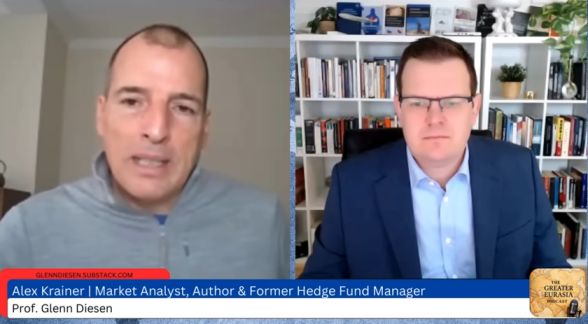
Editor’s Notes: In this insightful discussion, market analyst Alex Krainer joins Glenn Diesen to explore the growing influence of unaccountable oligarchies on Western democracies and the resulting social decay. The conversation draws striking parallels between modern political systems and the fall of ancient Rome, highlighting how “shallow democracies” often prioritize elite interests over the public’s desire for peace and prosperity. Krainer also examines the role of the “expert class” in manufacturing consent for controversial policies, ranging from economic management to perpetual foreign wars. Ultimately, they warn that if the current system remains unreformed and detached from the will of the people, Western nations may face a heightened risk of civil unrest or systemic collapse. (Jan 28, 2026)
TRANSCRIPT:
GLENN DIESEN: Welcome back. We are joined again by Alex Krainer, market analyst, author and a former hedge fund manager. You can follow him on his podcast, that is the Alex Krainer Podcast, as well as his Substack and I will leave a link in the description. So thank you for coming back on.
ALEX KRAINER: Always a pleasure, Glenn. Thank you for the invite.
GLENN DIESEN: So I like your combination of your market expertise as well as your political analysis, which is why I thought you had some very interesting takes on the threat of the rising oligarchy. We have, well, you can say in the United States, but I would also say this applies to Europe, how they are essentially hijacking democracy. And you even, you know, in your podcast, you draw links to the ruin of Rome. I was wondering, to what extent do you see an oligarchy and why is it undermining democracy?
The Facade of Western Democracy
ALEX KRAINER: Well, we have to be clear about it. It’s a little bit complicated because I think that the way we’ve been culturally conditioned to regard democracy, we think that it’s ruled by the people and of the people and for the people, and that’s how ideally it should be. But I find that in reality most Western nations, and we have very good empirical evidence of that for Great Britain and United States, what you get in actuality is a shallow type of democracy that is a democracy only on the facade, while the system, the government, the economic system is actually being ruled by an oligarchy.
And so this is clear from empirical evidence that I cited in the video that you were mentioning. And this is why I think our societies are, that is, our democracies are not delivering at all what people want. Because if you, you know, we’ve been living under democracies for the last three generations, at least in the West. And you know, people, when they go to vote, what they want is prosperity. They want high standards of living, they want peace, they want security.
But somehow they always get rolling economic and financial crisis, repression, censorship, insecurity, deteriorating standards of living, disintegrating infrastructure, and forever wars abroad. So something’s obviously not working correctly. But nevertheless, the media continue with the promotion of democracy as one of the highest values and ideals that we should pursue and never question and so forth.
But if you analyze what the system actually delivers as opposed to what we are told that it should deliver, we realize that the symptoms of social decay of these economic crisis, of wars, because we have to face it. Most wars in the world are instigated by democratic governments around the world, primarily Britain and the United States.
Historical Parallels: Rome and the Lombard Banking Period
And then when we see the syndrome, we see that it’s the same or very similar to what we saw in Rome, in ancient Rome and in Greek antiquity, and also during the Lombard banking period in Italy in the 12th and 13th centuries. It’s always the same, and it continues to propagate itself. And I think that by today in the Western world, it’s become undeniable that our democracies are dysfunctional.
So, obviously, we have to reform them somehow. And I think that in order to reform them, we have to start from the clearest possible understanding of what the problem is. And to my mind, the problem is that we are, in fact, being ruled by an oligarchy that is completely unaccountable.
The Russian Model: Putin’s Confrontation with Oligarchs
And then we also, by today, have a very handy model about how to deal with oligarchies from Russia, because Russia was one of the best examples of what happens to a society when it has an unrestrained oligarchy in power. So that was Russia in the 1990s. And then in 2000, Vladimir Putin came to power. And we had a spectacular turnaround in Russia in every respect.
And what Vladimir Putin did is he didn’t round up all the oligarchs and kill them or put them in prison. He basically rounded them up and laid down the rules. And he said, you stole what you stole. It’s yours. Continue to run your businesses, continue to enjoy your profits, but you have to pay your taxes correctly, you have to treat your employees correctly, and most importantly, you have to stay out of politics.
And so, you know, at that time, this was in, I think in March 2000 or 2001, that may have seemed like a very reasonable thing to propose. So, you know, I remain super wealthy, I remain a billionaire, and I don’t have to deal with politics, fine. You know, everybody should have been able to make peace with that.
But the problem is that the oligarchs became used to the idea that Russia was their private fiefdom, that they could do as they pleased, that they could nominate ministers and take them out at their discretion whenever they chose. And so this was practically a declaration of war. And a number of oligarchs tried to oppose Vladimir Putin, and it went badly for them, mostly.
This was not, you know, these were not shootouts. I mean, none of them were shootouts. They were legal battles.
So the oligarchs took the government to court. The government defended itself, and they prevailed. And then the only oligarch of the seven bankers that ended up in prison was Mikhail Khodorkovsky, who was a bit brazen because he was representing Jacob Rothschild’s interests in Russia. This is not a conspiracy theory. This is now a well understood fact. It’s on record.
So he challenged Vladimir Putin politically and then he ended up in prison over tax evasion, kind of like Al Capone, you know, and he spent nine years in prison. But basically, Vladimir Putin put the oligarchs into their sandbox and said, you may play here, but that’s it. I run the country. The country has a government, it has a parliament. You don’t dictate politics.
Russia’s Economic Revival
And so we saw a spectacular economic revival of Russia. It has become, if not a superpower, then definitely a global power to be reckoned with. The standards of living increased spectacularly for the Russian people. During Vladimir Putin’s reign, Russia’s economic development was, I looked at these numbers a few years ago, so I don’t want to say that they’re still true. But Russia even outpaced, I think, up until 2017, for sure, Russian economic growth even outpaced the Chinese economic growth.
And now with this war in Ukraine, we see that Russia is not only an advanced economy, it’s a very robust system that even though Russia was hit with the biggest sanctions package ever imposed on any country in the world in history, it didn’t unbalance Russia, it didn’t destabilize her. And so this is the effect of checking the power of the oligarchy, something that is unthinkable in the West.
The Western Oligarchy: Unaccountable and Invisible
Because, you know, while Vladimir Putin could summon all these oligarchs to the Kremlin and lay down the rules for them, it is unthinkable that an American president or a British prime minister or a French president can line up the oligarchs and say, well, from today on, it’s going to be like this. In fact, the prime ministers and presidents in the West are subordinate to the oligarchs.
So we don’t know for sure who the oligarchs are. It’s all in the conspiracy theory domain. We don’t know what their agendas are. But we do see that very strange things are happening. You know, we have the sudden offensive of the LGBT agenda that nobody voted for. We have forever wars that nobody voted for. We have these financial crises that are unexplained and resolved in ways that nobody supports.
We have this irrational, insane hostility towards Russia that is causing our leaders to implement completely insane policies like destroying our energy infrastructure and energy security, just because they think this is a way to hurt Russia. We have insane policies like net zero that nobody voted for. An investment of tens of billions of pounds into something called carbon capture.
So they’re building these immense industrial facilities to extract carbon from the atmosphere and store it underground, which is completely insane. It doesn’t serve any purpose. It doesn’t make anybody else better off. They’re saying, oh, we’re saving a planet. But nobody voted for this. This is not the democratic will of the people.
And then, you know, you go beyond. You go into these even sinister ideas of covering the prime agricultural land with solar panels and at the same time investing tens or hundreds of millions of dollars into technologies to dim the sun. You know, ordinary people wouldn’t vote for this. They wouldn’t support it. They would oppose it.
So obviously, the West has gone pathogenic and dysfunctional, and we’re going to have to reform the system. But to reform the system, we have to understand where the problems are coming from. And, you know, basically, this is the motivation behind the video you referenced.
The Rise of the Expert Class
GLENN DIESEN: Well, I’ve a colleague of mine in Australia, an American, Salvatore Babones, he wrote a similar, well, a book about, well, essentially the rise of the expert class, how that would undermine democracy. And it kind of fits a little bit within the category of oligarchy as well.
And the main premise is that some aspects of governance should be outside democratic controls. For example, military, people don’t know how to be ruled, what the military requires. So this is something we do on the side, which shouldn’t be under direct democratic control. But then they say, but also technologies are quite important, these aspects, or central banks, normal people don’t understand this.
And one after another, each one and one aspect of governance is begun to be centralized and kind of falls outside democratic control. And at the end of it, democratic control more becomes, you know, can vote on the minor things, but the major pulses, they’re written in stone and cemented into a kind of permanent bureaucracy which the Americans often refer to, you know, as the blob or the deep state.
Tocqueville’s Warning: Democratic Despotism
But I want a lot of what you’re talking about, though, is I really like Alexis de Tocqueville. You know, he wrote these books when he visited the United States in the 19th century to inspect how democracy worked there. And he has this chapter in the second volume on democratic despotism. And contrary to what I guess the common assumption now is, he writes that democracies are uniquely vulnerable to oligarchy.
Because, you know, there’s very little pushback due to the belief that their representatives are actually represent the people and they use more soft ways of regulating more and more of the aspects of life. And because of this trust in government and the preference of material security and social peace, there’s a willingness to essentially hand over a lot of the autonomy of people’s lives.
And people, he has a fascinating paragraph who writes that people become more and more infants in the democracies because if everything should be equal and essentially this requires a very big government and it creates this soft tyranny. And the government becomes paternalistic, guides citizens like children. And eventually the citizens enjoy this. They like, you know, not to do, make all the hard decisions.
And while this is happening, you would have wealthy interests growing and growing and increasingly dominate all the democratic institutions, where after a while the consensus is just manufactured by the elite. So democracy is just a bunch of rituals. And even as oligarchy asserts itself, the democracies, he argued, would still maintain the democratic language, the institutions, all these rituals of voting, even though it didn’t really matter because power was centralized, the civic responsibilities were in decline. There was a massive pressure for conformity.
And again, very little oppression is needed because people simply fall in line. It’s a fascinating chapter to read. It’s a bit, well, if you would have read it 30 years ago at the end of the Cold War, when liberalism was the silver bullet to fix everything and democracy would just thrive and change the world for the better, some kind of utopia this would have been. You know, I guess Alexis de Tocqueville would have gathered a lot of dust on the bookshelf.
But these days, when you see how governments begin to behave, I think it’s time perhaps to dust off these books and have a look at some of the early assessments of the challenges of democratic despotism. But do you see it the same way, this population being, well, I guess, treated like infants and just accepting the comfort that this is why we hand over more and more uncritical power?
The Oligarchy’s Control Through Expert Class Manipulation
ALEX KRAINER: Yeah, I think this is definitely the case, and I think it’s by design. Because, you know, the problem when you have what the Greeks called tyrants, what the Romans called kings, and what we today call autocrats or whatever, there’s an obsession in our society against tyrants, kings, autocrats and so forth. And we see that in the United States of all people, of all places, they have these organized protests called “no kings” protests. Of course, that doesn’t happen in Britain or in Canada, where the Prime Minister swears his oath to the king. It doesn’t happen in Denmark, Holland, Spain—in the United States. Why?
Because I think when you have a true sovereign at the top of the governance structure, then they can hold the oligarchy in check. So if the oligarchy becomes abusive, a true sovereign can curb their power. And this is the transition that happened in Rome in 509 BC when the last Roman king was deposed. And from that point on, Rome was basically ruled by an oligarchy in completely unrestrained ways.
And then obviously they have to give the people some semblance of democracy, of influence, ability to change the system through its institutions. But you’re always forced into this maze of rules and regulations and structures and institutions that are almost impossible to navigate for any ordinary person. And at the same time, the oligarchy can implement changes top down very easily because they control the economic power. So they can buy all the congressmen and senators and they can pay all the lobbies that they want and they have an absolutely massive return on investment into politics.
So this is what we have in the West. But obviously they’re not going to be telling us about it. They try to conceal this. And then, you know, when it happens here and there that democratic will of the people manages to actually affect some change, then they’re going to promote this story as like, “You see? You see, this is a true democracy and the people hold all the power.”
Manufacturing Consent Through Controlled Expertise
At the same time, they use their control of the media to convince us basically to go against our own interests. And very often that does involve what you call the rule of the expert class, because they always bring the experts that tell us, “Oh, you know, to save the planet we have to go to net zero. Because climate change and, you know, it’s very complicated. So the ordinary person cannot understand it. So you go and you listen to experts.”
And the only experts that come in the media, you know, the 97% that agree on all this, is that human activity is causing climate change. So guess what? We have to stop driving fossil fuel powered cars and we have to dismantle all the nuclear power plants and we have to basically commit an economic suicide and you have to have no job and you have to freeze in your apartment. Why? Because if we don’t do all this, we can’t save the planet. We’re going to, you know, the whole planet is going to burn up.
And then the same thing with the water shortages, which are also an invention, you know, the pandemics, the very, very terrible, dangerous, deadly viruses that are going to kill us unless we have vaccines and passes and boosters and eventually chips under their skin. It’s all means to control the population. And the expert class plays an extremely important role in this. And then the ruling oligarchy has very effective ways to choose which experts we will get to hear and which experts they will silence.
The Pandemic as a Watershed Moment
However, I think that this deception can only go so far and then not farther. And I think that in our experience, in our lifetimes, the pandemic of 2020 was the watershed moment where I think maybe very few people or very small percentage of people would read Alexis de Tocqueville and say, like, “Hey, you know, he was right. This is really what we’re experiencing.” I think by today, that segment is much, much more significant. I don’t know what it is, but I think it’s, you know, maybe before the pandemic, it was 1%, and maybe today it’s 20 or 30 or 50%.
The problem is that people are still made to feel that if they question the system, that they are in a minority, that they’re like a loony fringe. And so what I often find is that if I speak to somebody, they will be maybe shy to really say what they think. But when I tell them what I think openly, then suddenly they go like, “Oh, yes, I completely agree.”
You know, somehow media projects this idea that there’s these loony conspiracy theorists out there who are completely wrong about everything. And if you agree with them, then you’re one of the loonies. So people kind of feel isolated. So they don’t like to say what they really think about this and that. But when they realize that you agree with them, they feel relieved, and then they’re ready to talk, and then they tell you everything.
Reaching the Inflection Point
And so I think at some point, you hit an inflection point where many people realize that they’re not loony fringe, that they’re not crazy conspiracy theorists, that their views are actually based on reality, and that we are facing an actual enemy in our societies, and that these experts that they bring in front of us are actually deceiving us, that they’re not telling us the truth.
And so I think at this point, things start changing, and you get Trump—you get Donald Trump in the White House because he was the only alternative. You know, you could have the fourth Barack Obama administration through Kamala Harris, or you had to go a different direction. And so clearly, the American people chose the alternative.
And we see that even in Europe they have to increasingly intervene in our democracies to proscribe candidates because people would vote for Călin Georgescu and for AfD in Germany and for Rassemblement Nationale in France and so forth, but they won’t let them. So they use courts, as they did in Rome, you know, the lawfare. They use courts to simply disqualify certain candidates and say like, “Yeah, yeah, you can have a democracy, but you can only choose among these candidates and not those other ones that you really want to vote for.”
Well, you know, as John F. Kennedy said, if a peaceful revolution is made impossible, then you end up getting a violent revolution. And I’m afraid that this is the direction in which the Western world is going.
Liberal Ideology as Identity and the Oligarchic Reality
GLENN DIESEN: Well, this idea that you can’t question the system, I think the problem is that they made these liberal ideals into an identity and ideology. That is how they identify. They are a democracy, essentially. They represent democracy. So it’s very difficult to challenge the democratic authority they have because then that’s essentially what they built the whole legitimacy upon.
But there was also this appeal, I guess, of ideological rule because in human nature, as we organize in groups, we tend to identify us as in-group versus out-group, who is the other, and always frame it in the language of good versus bad. So, you know, splitting up the world as democracy versus authoritarian, this becomes our entire worldview.
So once you begin to disagree with, I guess, the democratic credentials of the political leadership and whether or not they become oligarchs, it’s seen as an attack essentially on the political legitimacy itself because, well, to some extent it is. But often the people screaming the loudest about our democratic values—you know, there’s people like von der Leyen and Kaja Kallas who nobody voted for them. Even Kaja Kallas recently referred to von der Leyen as a dictator. So they don’t even shy away from having this infighting.
But even the actual elected people, who people had a chance to vote for—the Starmers, the Merz, Macron. I mean, we have Blackrock Merz obviously heavily influenced from his background in finance. You had the same with Macron when he was, if you remember, back when he was sold into politics as the leader to take over. He used to be an investment banker with Rothschild and the way the media sold him in as, “Oh, this was the new open liberal guy who would be able to transform France.” I mean, it’s very much managed elections.
Academic Evidence of Oligarchic Control
And I also don’t like how referencing the rise of an oligarchy somehow is treated as some kind of a conspiracy theory, because you actually had academic work on this. There’s a paper by Yale who looks at all the policies in the United States and compares it to how people vote. And since the 1980s, they more or less confirmed that voting has little to any impact on policies at all. And so, yeah, you can choose who sits at the throne, but the policies won’t change.
You even have former US President Jimmy Carter who passed away now, who said that, well, the United States isn’t really a democracy anymore. It’s an oligarchy. You have to see where the power rests. But still it’s treated as something on the dark corners of the Internet, something you would—even if you can see it. You can’t deny the distribution of power in terms of economic, how much has concentrated. You can watch the inauguration of Trump. You can see the whole front line just being lined up by tech billionaires. And still, no, no, it’s not an oligarchy, it’s still a democracy.
Toward a Pre-Revolutionary Era?
But as you suggested, you can only do this for so long before the game is up. People begin to realize that they do want different policies as well. They begin to throw a wrench into the political system. They look for alternatives which are very different—populists, as they refer to. And there’s very little that can be done now except for the political elites to become more and more coercive. As you said, ban elections, overturn elections, arrest political opponents, like in France.
But how far can this go? Because you can feel that the trust in the politicians, trust in the media, it’s all declining. And the great irony, of course, is liberal democracy has a lot of great ideas there. But if you’re not able to criticize a system that is, for example, the concentration of wealth, democratic despotism, you can’t manage the weaknesses and you end up killing it.
So it’s quite ironic that we almost banned criticism of the system. But where do you see this going? Are we heading—are we entering a pre-revolutionary era?
The Oligarchy’s Historical Playbook: War as Social Control
ALEX KRAINER: It does appear that way, Glenn. What the oligarchies did traditionally through history is when the social pressures became unbearable, meaning when the oligarchy completely lost credibility and people wanted to overturn them, then they would cry “barbarians at the gate,” and so they would project all the problems onto an external enemy, and then they would provide all kinds of incentives or coerce the men of the population, the fighting age males, to go and fight the external enemies. And if they didn’t have a war, they would invent one. They would simply contrive one.
Because what happened is they would deflect the grievances onto some external enemy, and then they would send men to war, and then these men would be sacrificed in very large numbers. And it’s controversial to say that that’s a deliberate policy, but that’s very apparently a deliberate policy that you send men to war and then you don’t just try to win the war and bring the men home. And now these men are heroes, and they’re still maybe your potential enemies. You try to get rid of as many as you can.
And then you also use the fighting to recruit those who might be your praetorian guard, the most compliant, the most ambitious ones who want to serve the power. The problem today is that it doesn’t seem that the old playbook is working anymore because they are losing the control of the narrative.
In the past, they could cry “enemies, barbarians at the gates” because they controlled the means of communications, because we all relied on newspapers, magazines, radio and television. So it was very easy for them to control the narrative. And we didn’t have really alternatives.
The Internet Changes Everything
But today we have the Internet and the social media. So when they cry “barbarians at the gate,” that is, “the Russians are coming, the Russians are coming,” people do not believe them because people have a more discerned understanding of what is happening. And the old tropes that the Russians, when they’re done with Ukraine, that they’re going to start invading the rest of Europe, most people don’t feel that way. They don’t fear Russia as much as they should.
And so when the leading politicians and military leaders tell them, “Well, guess what, you’re going to have to sacrifice your children,” people say, “No, we don’t want to sacrifice our children. We will not. We don’t think Russia is our enemy. We should bridge all our differences at a table.”
And so the social tensions have become very acute. Our leaders have lost all credibility. The expert class has lost credibility. Standards of living are deteriorating radically. The external enemy, the red cloth of external enemy is not having an effect. So now what happens now?
I think either you get a social uprising or a revolution or a civil war. So I think that this is direction in which we’re headed, and hopefully it can be averted. But these people are not just going to go silently into the night.
I think that it would be extremely important for us all to try to get as many members of their Praetorian Guards on our side, meaning to try to communicate with people in the military, with the police forces, firefighters, territorial defense units, whatever you have, and to tell them that the enemy is at home and we need to reform our societies. So let’s not go to war one against the other, but see how we can best reform our systems. And then the oligarchies will have no choice. They cannot go against the people.
Plato’s Warning About Oligarchy and War
GLENN DIESEN: Well, if you read Plato’s Republic, he to some extent writes what you say. Now though, he makes a point that these oligarchy governments, they tend to have a bias towards instability and war. Interestingly, Obama said that when he entered the White House. I talked to Colonel Lawrence Wilkerson, who was there in the White House. He was making the point. Obama told him that in this town, no matter what you try to do, there’s always this bias for war.
And if you look towards Plato’s Republic, this was essentially his argument that the rich elite will begin to accumulate wealth. You would have growing inequality, resentment will begin to spread. And then of course, the oligarchy would lean towards war for two reasons.
One, as you said, also to accrue more wealth, given that they wouldn’t carry the cost of these conflicts. It’s essentially the peasants will have to die. But also starting wars abroad is a good way of uniting the population. It distracts from internal conflicts. It reinforces the power of the elites.
Again, it goes back to human nature. We are a group animal. The more the external threat, stronger external threat you have, the more it’s in human nature to seek internal cohesion and solidarity. And we will essentially punish each other for failing to toe the line.
But is this how, just as the last question, is this how you see many of our current wars? Because we have a lot of problems with the oligarchy. First of all on the international arena, their powers in decline due to power rise of countries like China, but also the decoupling of energy centers and also great power like Russia. But energy centers like Venezuela, Iran falling out of control. And you see the hegemon declining.
It has external element of new centers of power, but also domestically you have more growing resentment from a population. Is this how you see the war against Russia? Potentially China, Venezuela, likely in the near future, Iran and I guess the troubles of our time. Do you see it’s linked to the oligarchies?
Resource Control and the Banking Class
ALEX KRAINER: Yeah, it is linked to the oligarchies. But I think it’s not in all cases to deflect from domestic problems. Sometimes they just genuinely want to conquer other nations, the resources, that is, they want to gain political control over resource rich nations. Why? Because in that way, they turn that nation’s labor and resources into their own collateral, which is an amazing way to create. It’s an amazing way to credit to yourself someone else’s wealth.
Because the moment you’ve issued loans to your clients like KBR, Exxon Mobil, Shell, whoever, to go and develop an oil resource in Iraq or Iran or wherever, Venezuela, that nation’s resource wealth becomes your wealth the moment you issued that loan to your client. And throughout history, these ruling oligarchies were always the money lending class, including in Rome.
The Real Story of Julius Caesar and Brutus
So just as an example, Julius Caesar, who to this day is being demonized in our historical curriculum as the man who almost destroyed Rome’s democracy, he actually wanted to reform Rome and curb the power of the oligarchy. Brutus, who was one of the people who assassinated him, was one of those oligarchs. And Brutus wasn’t this republican defender of democracy. He was a rapacious money lender and a usurer.
And there’s a story about him extending a loan to the officials of the Cypriot town of Salamis, and charging them 50% or 48% interest. And then when they disagreed, when they said this is excessive, “We owe you this much and not that much,” he sent cavalry to lay siege to the town. And at least five city officials died of starvation. But Brutus insisted on payment in full, even though he was charging 48% interest.
And this was basically the modus operandi of the Roman Empire because it was run by the money lending oligarchies, by the bankers. And so this should be a warning to us because Rome, when Rome fell and it deteriorated in a very ugly way, it was constantly torn apart by civil wars. Roman generals spent more time fighting other Roman generals than barbarians or other invaders.
Hidden Lessons of History
But the way history presents us the Roman Empire and how it all went, they always concealed the most important lessons. They always concealed that it was about debt and banking and oligarchy and colonizations and imperialism and so forth. And so we have to uncover all these lessons now because we can, because we have the Internet, because a lot of resources are coming out and many clever historians endowed with imagination and willingness to dig through the old documents are now publishing extremely interesting books and new interpretations of things that they tried to conceal from us.
And so I think in this sense, I feel very optimistic about the future. But it’s not, again, they’re not just going to be going silently into the night. They will put up a fight. They will resist. So we have to stand firm and we have to demand real changes, not just, “Let’s go to war again.” And then we’re going to start from a blank slate, and then for a generation or two, we’re going to think that everything is wonderful until the debts become unpayable again, and then we’re going to do the whole thing again in cycle after cycle and sequence more world wars because we had to. Why not have the third one and then maybe the fourth one and so forth?
So I think we have to break this cycle of history, but the only way we’re going to break is by really understanding where the problems are coming from with as much clarity as is possible. And I think that today this is possible. So it’s going to take some effort. It’s going to take many podcasts like this one, but I think that we have to do it because that’s the future we’re going to leave behind to our children and their children.
Grounds for Optimism
GLENN DIESEN: Well, I like it when you finish on an optimistic note. So, well, there are changes coming, you do feel, not from the newspaper headlines, but obviously you see the shift in sentiment that there are some who actually want to restore some of the values and virtues which political leaders claim to represent, although clearly abandoned a long time ago. So, thank you very much for taking time.
ALEX KRAINER: Thank you for the invite, Glenn. Always a pleasure. And until the next time.
Related Posts