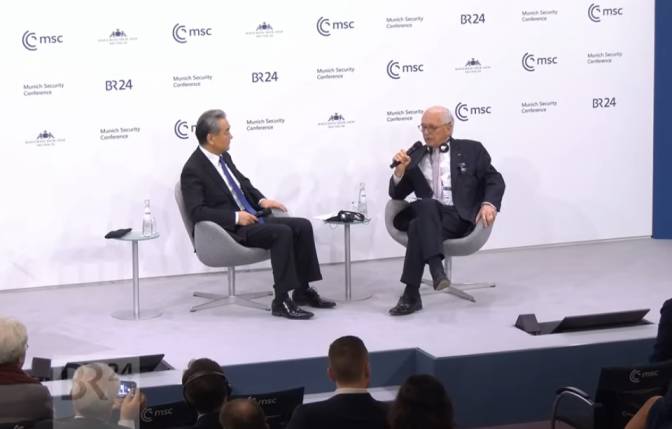
Editor’s Notes: At the 2026 Munich Security Conference, Chinese Foreign Minister Wang Yi outlines China’s diplomatic stance on the war in Ukraine, emphasizing the need for a political settlement and European involvement in peace talks. He also addresses China’s complex relationships with the United States and the European Union, while issuing a sharp warning regarding regional tensions in the Asia-Pacific and Japanese policy toward Taiwan. (Feb 14, 2026)
TRANSCRIPT:
Questions on Ukraine: China’s Role in Peace Negotiations
WOLFGANG ISCHINGER: Thank you very much for your speech. We have time for a few questions which people from the audience have sent over to me. Let me start by the one question that’s on everybody’s mind here, a question related to the war in Ukraine. I hope this is going to be the last time that we need to discuss this question about how to end this war. Many of us hope that this will be the year when this war will actually be ended. The United States, Marco Rubio just spoke before you, the United States is actively engaged with Russian negotiators and Ukrainian negotiators to try to end this war. My question is a very simple one. What can China do? What can China contribute to convince Russia to finally end this war and to withdraw from Ukraine? Please.
WANG YI: China’s position and stance is clear that all regional hospital issues should be resolved through dialogue and consultation, and we need to find a political settlement. So this holds true for the Ukraine crisis, but China is not a party directly involved. We don’t have the final say. What we are doing is to promote talks for peace. So that’s why we sent our special representative on shuttle diplomacy, and through all possible channels we have been sending our message that we want to see a cessation of hostilities at an early date and the resumption of dialogue.
But finally, now we are seeing that the peace talks have begun, and I think now what are being discussed are the real issues. We welcome this, because without dialogue, how can peace ever arrive? If we don’t keep dialogue going, a peace deal, a treaty, will not fall from the sky. So we hope that through our consistent efforts we can reach a comprehensive, durable, and long-lasting and binding peace deal acceptable to all parties. So I think this is the common goal of the international community, including China.
Europe’s Role in Peace Negotiations
Europe should not watch this from the sidelines. Right here in Munich last year, at that time the United States had started engagement with Russia, and Europe seemed to be left watching from the sidelines. And I said then that since the conflict broke out right here in Europe, Europe has every right to participate in the negotiation in due course. So I said that “Europe should not be on the menu, but should be at the table.”
And now we are seeing that Europe has come up with the courage to talk with Russia. This is good, and we support this, but we think that we should not have dialogue for dialogue’s sake. I think Europe should come up with new ideas and new plans on how to resolve this issue. And in this process, we need to foster a more balanced, effective, and sustainable security architecture for Europe. So by doing this, we are addressing the root causes of the crisis, and we can prevent it from reoccurring. And to achieve sustainable and lasting peace, China will, in our own way, give our full support for the peace process. I thank you.
Commitment to Territorial Integrity and Sovereignty
WOLFGANG ISCHINGER: Thank you. Please allow me to push you just a little bit more on this question. I remember that when this war broke out, now four years ago, on this stage here, we were discussing the issue then, and you made a very important statement then, namely that China remained committed to the fundamental principles of the United Nations, including territorial integrity and sovereignty. Can you repeat, would you say again today, that China remains committed to the idea of sovereignty and territorial integrity of Ukraine?
WANG YI: China is a major country, so I think it is incumbent on us to keep our policy stable and consistent. We should not have all the policy flip-flops. So China is such a major country. We mean what we say, and we do what we say in implementing our policies. And after it is implemented, we will see it through to the end. So the four things must be done, proposed by President Xi Jinping, is just this.
First, the sovereignty and territorial integrity should be observed, and all the legitimate security concerns of all parties needs to be observed. This is what we say, and we will continue to mean what we say and do what we say. We will continue to be a force for peace in the world.
WOLFGANG ISCHINGER: Thank you very much, sir. Let’s turn to US-China relations. The previous speaker was Marco Rubio, who talked a little bit about the same question also. There are obviously continuing contentious issues between the United States and China. Taiwan appears to be one of them, but not the only one. So my very simple question to you this morning is, since we know that there will be a summit between President Xi Jinping and President Trump in like two months, in April, could you describe a little bit your expectations regarding that summit? Does China expect, as President Trump would probably call it, “a deal” with the United States? Or what would you see as a positive outcome from a Chinese perspective?
China’s Expectations for the Xi-Trump Summit
WANG YI: How China and the United States get along bears on the fundamental trajectory of the international situation. So China, with a sense of responsibility to the world, to history, and to the people, we approach and handle our relations with the US.
President Xi Jinping has summed up the lessons of China-US relations over the past decades and proposed the three principles: mutual respect, peaceful coexistence, and moving cooperation. And through dialogue and consultation, we seek to find the right way for the two major countries to get along well with each other on this planet. And we will continue on this path so that in the interest of our two peoples and in line with the expectation of the international community.
But whether we can achieve that goal ultimately depends on the United States. And we are encouraged that President Xi has shown respect for President Xi Jinping and for the Chinese people. He has stressed that the US and China working together can get a lot of great things done. And the two presidents can make the fantastic relationship between the United States and China even better.
Two Possible Paths for US-China Relations
But I’m not sure whether all people in the United States share this view. To some people, they are still trying everything possible to suppress and contain China. They are doing everything to attack and smear China. So I think there are two different prospects lying ahead for our bilateral relations.
One is to the United States can understand China reasonably and objectively and have a positive and pragmatic policy toward China and our two sides work together in the same direction to expand our interests that will lead us to cooperation. So that would really be the best outcome for both countries and the world.
And the other prospect is seeking decoupling from China and severing supply chains and oppose China on everything in a purely emotional knee-jerk way. So they are cobbling together all these small exclusive circles and they are trying to split Taiwan from China and stepping on China’s red lines which would very much likely push China and the United States toward conflict.
But China on our part wants to see the first prospect and I believe you share the same way. But China is well prepared to address all kinds of risks. China believes that history always moves forward despite twists and turns. China is confident about the prospects of the China-U.S. relations and we believe that the vision and objectives put forward by President Xi Jinping will be realized because this is the only right choice. Thank you.
China-Europe Relations and Economic Dependencies
WOLFGANG ISCHINGER: Thank you very much. We have just a couple of minutes left. Let’s turn to China and the European Union, if I may. We Europeans have learned the hard way that strong dependencies are not a good idea. We were dependent to a very large degree on energy supplies from Russia. Today some people are warning that Europe might get too dependent on China.
So could you talk a little bit about China’s strategy to convince Europeans that it’s a good idea and not a bad idea to engage more strongly with China and that China is going to be, from a European point of view, a credible long-term partner and not, as our papers have said in the past, in the recent past, a systemic rival and maybe even a strategic adversary?
China-EU Relations: Partners, Not Rivals
WANG YI: I think this is a simple answer and I think that China and the EU are partners, we are not systemic rivals or strategic competitors. We have been engaged with each other for half a century and we have accumulated all these outcomes and deliverables, aren’t they enough to tell the true nature of China-EU relations? So now I think every year the trade volume for one day exceeds the trade volume for the first year after we establish diplomatic relations. So why someday China suddenly became a rival of the EU? I think this is a very negative thinking and this will do no good.
We don’t want to see the amplification of the so-called narrative of systemic rival because this will be toxic for the future development of China-EU relations. But there are differences and divergences between our two sides, for example our social systems, our values and our development model, but that’s because we have different history and culture and based on this our peoples have different choices about the way we develop but that doesn’t mean that we should become rivals or competitors.
What’s important is that we should respect each other, admire each other and learn from each other and grow together and light up the world. This is the right choice. Chinese ancient philosophers said that all things can coexist on earth without harming each other and always can go parallel with each other. So I think this was proposed over 2,000 years ago in China. At that time we had those wisdom and I think now we can do better.
Confucius once said that for gentlemen we can achieve harmony without uniformity. So we acknowledge that there are differences and divergences between us but that doesn’t mean that we couldn’t reach better harmony. So this is what we should seek and this is how gentlemen should get along with each other. So I think both sides can follow this way and can do like a gentleman does, especially in this current tumultuous international landscape.
It is more important for China and the EU to practice multilateralism, to safeguard the authority of the United Nations, to say no to unilateral practices and to safeguard free trade and oppose bloc confrontation. I sincerely invite all our European friends to join us in the implementation of the Global Governance Initiative proposed by President Xi Jinping and build a more just and equitable global order. This is what we should do together. Thank you.
Asia Pacific Peace and Stability
WOLFGANG ISCHINGER: Very last question. We’ve already run out of time actually. Asia Pacific. When we look at reports about possible or actual renewed tensions in the Asia Pacific region, can you present a message of reassurance about what China is prepared to do to avoid, to prevent renewed escalation, renewed concerns about tensions, possible military confrontations in your part of the world?
WANG YI: First, I don’t think that the situation in Asia Pacific is getting increasingly tense. In today’s world, Asia is probably the only region that maintains overall peace. Not long ago, border clashes broke out between Thailand and Cambodia, but that was brought to a halt with China playing our mediating role. China has become an important pillar for peace in Asia, and as one of the world’s most important forces for peace today, we will continue to play a constructive role in safeguarding regional peace and stability.
Of course, Asia is not without challenges. Here I wish to say one thing, that is we should be alert to a very dangerous development in Asia. Not long ago this evening, Japanese Prime Minister said publicly that a Taiwan contingency amounts to a survival-threatening situation that could trigger the use of collective self-defense.
So this is the first time in 80 years that a Japanese Prime Minister has uttered such words. It directly violates China’s territorial sovereignty, and it directly challenges the fact that Taiwan has been returned to China. It completely violates Japan’s commitment to China. Could China possibly accept this provocation? No way. No Chinese can accept it.
Here we are in Europe, in Germany, and I’d like to make a comparison. After the Second World War, Germany conducted a thorough reckoning with Nazi crimes and passing laws to ban all the speech and actions promoting Nazi ideology. But Japan still pays homage to the Class A war criminals, and they are enshrined as so-called heroic spirits. So this means that Japan has lingering ambitions for invasion and colonialism of Taiwan, and the ghosts of militarism are still haunting the country.
Historical Lessons and Warning to Japan
The lessons are not far behind us. Back then, Japan also cited the so-called survival-threatening situation to launch its war of aggression against China, and also the Pearl Harbor. If Japan doesn’t truly repent on its wrongdoing, history will only repeat itself. This is the lesson we should learn.
So I think all the conscious people should be alert and stay sharp. The Japanese people should not let the far-right extremists fool and track them alone. And every country that values peace should shout this loud and clear at Japan right now. If you go back down that old road, it will be a dead end. If you try gambling again, the loss will be faster and more devastating.
WOLFGANG ISCHINGER: Thank you. Thank you very much, Mr. Foreign Minister. Thank you very much. We have run out of time. Let’s offer a round of applause. And please come again next year. That will be the ninth time of your appearance.
Related Posts