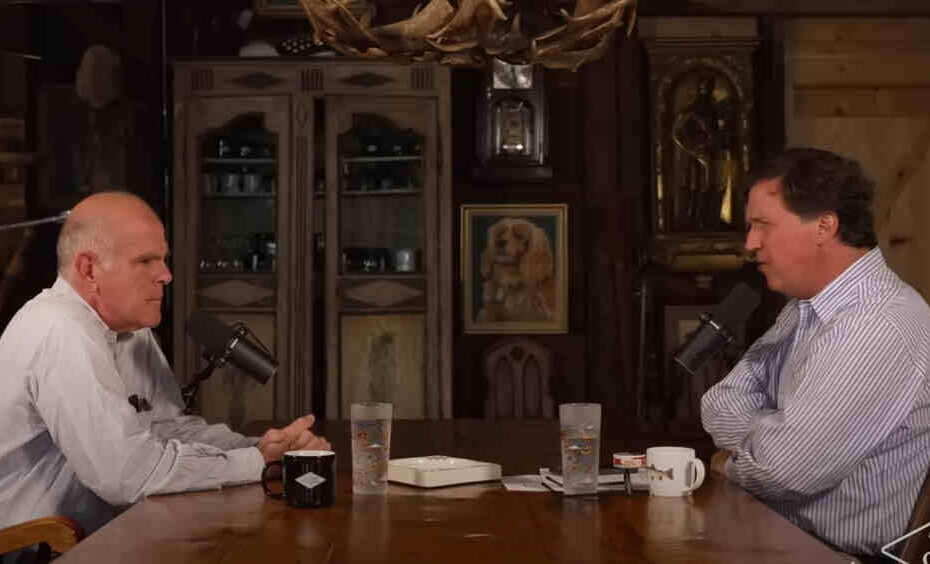
Read the full transcript of journalist Christopher Caldwell’s interview on The Tucker Carlson Show titled “How Immigration Is Erasing Whites, Christians, and the Middle Class”, premiered on August 27, 2025.
The Decline of English-Speaking Nations
TUCKER CARLSON: So you travel more than anybody I know, you spend more days out of the country and have for more years than literally anyone I know. So answer this question. The countries that seem to be moving backward the most quickly, this is my perception, are the white, Christian, English speaking countries. New Zealand, Australia, Canada, UK, United States. Am I matching that? What is that?
CHRISTOPHER CALDWELL: Well, no, I can’t really speak about the countries of what they used to call the old Commonwealth, Australia, New Zealand, I’ve never been to those places. But I certainly think that England, the UK more generally, but England in particular is really in a difficult position now. And I think that the diagnosis that English people generally are coming to is that they’ve had too much immigration.
TUCKER CARLSON: It seems like they’ve been overwhelmed by immigration. But you may have a better handle on the numbers. How much immigration has the UK had?
Britain’s Immigration Crisis: The Numbers
CHRISTOPHER CALDWELL: Well, I think that they’re up around, you know, the country had a lot of immigration since the Second World War. It had some moments of acceleration. They had a huge wave of migrants from both the Caribbean and the Indian subcontinent in the years right after the war. And by a huge wave, you know, it’s a couple hundred thousand.
But more recently we’ve had even larger numbers. And in fact, one of the things that has made Brexit so contentious in England is that the big promise of Brexit, the primary promise of Brexit was to limit immigration. That’s what most English people thought it was for.
Now, Brexit was delayed between the referendum and 2020. And when Britain finally got Brexit, it had Covid. And so it had a period of zero immigration for a while. But then something really interesting happened, which is the people who had managed to get Brexit, that is the government of Boris Johnson sort of looked at the numbers and they were very frightened that the economy was going to continue slow after Covid.
And due to the way the British government scores economic predictions, immigration comes out as, by definition, a benefit to the economy. So they decided to just loosen immigration for a little bit. And the result was really extraordinary. They got, I think, 4.5 million immigrants between 2021 and 2024. 4.5 million, yes.
And so we’re talking about, in three years, we’re talking about an immigration that is 7% of the country’s population. And that immigration because Britain had left the European Union, was not European immigration. It was 80% of it came from outside of Europe. So it was a profoundly foreign immigration and the largest Britain had ever had. And it was brought about by the very people whose entire reason for being in government was to stop immigration. And it’s had an extremely destabilizing effect on the politics of the country.
The Economic Fallacy of Mass Immigration
TUCKER CARLSON: So they, according to the way British economists score the economy, more people, almost always from poor countries make you richer or something?
CHRISTOPHER CALDWELL: Yes. I mean, it’s sort of like it adds a certain amount of units of labor and the country is that many units of labor richer. And there’s not really a sufficient, without going into the economic details, there’s not sufficient reckoning done of the fact that these people will age, they’ll form families and they will collect the generous and perhaps overly generous state benefits that they’ve been brought in to help defray.
TUCKER CARLSON: Yeah, I mean, is there in the history of the world a country that’s had like that level of immigration from poor countries that got richer because of it?
CHRISTOPHER CALDWELL: The United States? But it’s a very special case because we were, you know, we had laid claim to a continent wide land mass, although we didn’t always do that explicitly and we had only a very few millions of people with which to claim it. And so we really needed people and they generally came from societies that were, or let’s say they came from, they might have come from societies that were richer than ours, but they came from the less fortunate parts of those societies.
So I think it did enhance the United States. While we had, you know, a more or less virgin territory. I understand that the Indians were there, but a lot of the territory was virgin and ripe for development. As long as we were in that position, it was a benefit to us.
The mistake that other countries in the world have made and Europe more than anyone has been to assume that if they get mass immigration, it’s going to work the way it did under the very special circumstances of 19th century North America. But instead what’s happening is it’s working more like the circumstances of 17th century North America. That is the people who are arriving from abroad are becoming the core group.
The Great Replacement in London
TUCKER CARLSON: They’re replacing the indigenous population.
CHRISTOPHER CALDWELL: That seems to be what’s happening not everywhere, but in a lot of places. If you go to London, it’s incontestable.
TUCKER CARLSON: Well, it’s overwhelmingly, it’s like 70% non British. Right?
CHRISTOPHER CALDWELL: That’s right. That’s right.
TUCKER CARLSON: So what, I mean, can that be changed, fixed, reversed?
Political Solutions: Deportation and Legal Reform
CHRISTOPHER CALDWELL: That’s what the discussion in England is about now. And that’s why the politics on the English right is so fractured. It’s fractured, but it’s actually very interesting. A lot of new ideas sort of popping up out of desperation. You know, they’re mostly ones that you would recognize from the Trump campaign. They have, a lot of them have to do with deportation.
There’s a lot of discussion of withdrawing from the European Convention on Human Rights and from the U.N.
So there is talk about exiting those agreements and to not just talk. I mean, this is the sort of thing that whenever it’s brought up in a Western country, it’s described as extreme right wing and fascist and that kind of thing. It’s not just being talked about in England. It’s being talked about by, I would say, the three main forces on the English right, which are Nigel Farage, who’s in the Reform Party, Kemi Badenoch, who is the leader of the Conservative Party, and Robert Jenrick, who’s the main sort of radical Conservative alternative within the Conservative Party.
All of them are talking about getting Britain out of the European Convention of Human Rights to the extent where you think if there is ever a Conservative government again, it will happen. I mean, it’s no less believable than Brexit was before Brexit happened.
An Unprecedented Historical Moment
TUCKER CARLSON: But that’s still, I mean, that’s pretty tepid really, like pulling. I mean, the country’s been pretty much the same for a thousand years. I mean, you can go to Stonehenge, pull up bone fragments and trace the DNA to people living in Britain. So I mean, for all history that we know of, it’s been pretty much the same people with something. The French came a thousand years ago or whatever, but there have been some changes. But in general they’re the indigenous population and now in 80 years they’ve been overthrown, replaced.
CHRISTOPHER CALDWELL: It’s extraordinary. This is an extraordinary anthropological moment.
TUCKER CARLSON: It’s like I’ve never heard of anything like that happening.
CHRISTOPHER CALDWELL: Well, there were these, there have been a couple of examples of what the German Paleo historians call Folkewanderung, movements of peoples, where people move off the steps in Asia and into Western Europe and then they, you know, that’s how we got our Indo European languages.
TUCKER CARLSON: Yes.
CHRISTOPHER CALDWELL: And you know, there’s movements down through Greece and onto the Minoan area, I don’t know exactly when it was about a thousand or two thousand years ago.
TUCKER CARLSON: And the Finns have kind of Asiatic eyes.
CHRISTOPHER CALDWELL: You know, I don’t know what happened when. But occasionally there are these huge movements of population. This one’s a little bit different because it’s enabled by technology. So it’s not contiguous peoples sort of pushing against one another. I mean, it’s sort of people who are brought by boat and by airplane. But in terms of its importance. Yeah, it’s a major event.
The Invited Invasion
TUCKER CARLSON: I guess what I’m saying is the reason it’s unprecedented I mean, Genghis Khan, you know, rolled over and impregnated thousands of people, but I don’t think those people’s leaders asked him to come and impregnate their wives. This is like the only invasion I’ve ever seen that was been bidden by the leaders of the countries that have been invaded, like, “come and invade us.”
CHRISTOPHER CALDWELL: It’s not like they were begging for it, but they sort of created a climate of permissiveness that which people took advantage of. And it’s the. I think what you’re getting at is what was the psychological state of Europeans between 1945 when they started doing this?
TUCKER CARLSON: Yes.
CHRISTOPHER CALDWELL: And today that made this possible?
TUCKER CARLSON: That’s exactly the question. And I don’t understand it.
The Post-War Psychological Transformation
CHRISTOPHER CALDWELL: And it’s a funny thing, because you and I have lived through the deepest part of that transformation, and it’s still kind of a mystery to us. So if anyone’s watching this a hundred years from now, I hope they can see how confused we, in fact, were.
But, I mean, I think that in the wake of World War II, something happened in the middle of the 20th century, and it’s really tough to say what it was. It might be a coming to consciousness after the horrors of the two world wars. It’s like you don’t want to. You know, this is maybe too moralistic an explanation, but people began to understand that there were bad things could happen if you were too judgmental about other people’s or inimical.
But there are other factors, such as just the technological factors, the sort of the visibility of alternative places to live through television. And that, I think, is. I think the technological factors. Oh, and the fact of easy travel through airplanes and the fact that the telephone, the television and finally the Internet enable you to go someplace without being cut off from your ancestral homeland. So it makes the decision to travel abroad much lower stakes.
You know, I mean, the people who came to the United States in the 19th century from Sicily, they were gone. They got, you know, for the most part.
TUCKER CARLSON: They never saw their people again.
CHRISTOPHER CALDWELL: Yeah, well, you know, in fact, in the Italian migration, a lot of them did go back, but it was a. In general, it was a big decision. In the case of the Irish, I think they were usually here for good anyhow.
I think it’s a combination of. At the level of statesman, I think it’s a discomfort with any kind of expression of hostility or lack of hospitality towards other peoples, but at just the operational level of the individual migrants, I think technology had a lot to do with it.
The Collapse of Western Self-Confidence After Victory
TUCKER CARLSON: It’s impossible but I mean, yeah, technology for sure. But you know, I don’t know, Victorian England had, you know, the ability to move people around the world to control, you know, the world’s biggest navy and all that and it would have been unimaginable. They didn’t want millions of non English living in England because they were proud of England and they thought it was distinctly English and they thought.
I guess what I’m getting at is it’s so strange to me that the self confidence of Western Europe collapsed after winning the war. I think that’s so Germany’s a different case but I mean Britain, France, Spain, Portugal, I mean these are all countries that Blake had nothing to be ashamed of. From my perspective, certainly England and France. Why did they lose confidence in themselves after winning?
CHRISTOPHER CALDWELL: That’s a sort of complex question. I’m not sure I agree that these countries had, I mean they were all in very different positions. I mean Germany, Austria and Italy were the defeated powers and the malefactors in the war.
TUCKER CARLSON: Right.
CHRISTOPHER CALDWELL: France had collaborated, part of France had collaborated and there was a tremendous amount of soul searching and there was a tremendous amount of guilt. Spain and Portugal had kind of resolved their own civil war in the 1930s and they were kind of out of the picture. It would seem that Britain had a record that it could really be proud of, but it was dismantling an empire.
And so the two main victorious, non, you know, the Victoria, the main victorious powers were the United States, Britain and Russia. Russia was communist and had its own project to propagandize. But the United States and Britain, they also had reasons for self examination.
There was, you know, I think there was plenty of triumphalism after the Second World War. It’s a very tough thing to read. I think that the America I grew up in was really quite proud of its, its role in the Second World War even as it was reexamining its own history, you know, of racism, slavery and, and, and, and, and even the, you know, the settlement and the, and the wipeout of, of the Indians, you know, so it was a mix of, it was a mix of impulses. So I’m not sure that they were, I’m not sure these countries were, were as self doubting as we as we think.
Britain’s Demographic Transformation
TUCKER CARLSON: Well, the effect was to just collapse. I mean especially in the case of the UK. So is there any getting back to what it was even 35, 40 years ago?
CHRISTOPHER CALDWELL: You know it’s funny, I heard a member of The Reform Party saying that what people really long for in England is a return to the status quo. Anti Tony Blair. That is, you know, Britain had a lot of, of migration. There was one wave in the 40s and 50s, there was another one that kind of coincided with our, the beginnings of our latest wave which has never. Which has gone on unabated.
But they had a wave in the 70s and 80s, the British did. But the, but the, the biggest one was just. Was intentionally started by Tony Blair and the. So the Reform. This one member of the Reform Party says if we could just go back to the status quo, Auntie Blair, that would be fine. That was only 30 years ago.
But in fact, the amount of change has been so tremendous. And it’s not just that the numerator of migration is changed. It’s also that the denominator of the total population of Britain has changed. That is Britain is a very, very slow grow, growing demographic. So they’re not really producing a lot of new children. And so a disproportionately large amount of the British people in years to come are going to be the product of immigration. So no, I don’t see any in general. There’s no way short of like cataclysmic developments to reverse any of that.
Cultural Dominance and Historical Precedents
TUCKER CARLSON: So it just kind of goes extinct. I mean, because there’s no way that those two cultures can live and share power. I mean, one that doesn’t, that’s never happened in history. One culture dominates. In the end you have a culture.
CHRISTOPHER CALDWELL: It depends on how separate they remain. I mean, let’s look at the, at the, at the history of the settlement of North America. I mean, the British, particularly, if you talk to Spanish historians and Spanish observers of this, were notoriously insistent on remaining separate in the, in the lands they, they conquered. And they did, and they did dominate. And some, in some places they were able to settle these, these areas. In other places like India, they were sent home, you know, after a long period of exploiting the place.
But there were other, there were other nationalities that tended to colonize by, by mixing more. And so there is a, there is a sort of a, a mix of cultures becomes possible. The cultures that mixed into what we now think of as different Latin American cultures were earlier on quite separate. There still is a degree of separation in South America between these different strains like the European culture and the native culture.
But I mean, in most of Latin America you can say that there’s such a thing as Brazilian culture, there’s such a thing as Mexican culture, and there will be, I trust, such a thing as English culture in 50 or 100 years, but it will be a very different thing than the English culture that we recognized over the last 500 years. So it is a rupture, you’re right.
Rising Political Radicalization
TUCKER CARLSON: What happens to the, I mean, at some point do the politics get radical?
CHRISTOPHER CALDWELL: Well, that I think is the, Makes.
TUCKER CARLSON: Me feel radical hearing about this.
CHRISTOPHER CALDWELL: Well, that I think is what’s happening in England now. And it’s one of the reasons I went to England and it’s why I, I think it’s really, it bears watching in, in the next few years. They had a, they had a huge, they had a lot of riots last summer. I mean, there was an episode in which, you know, the British born child of Rwandan immigrants, who sounds like he was kind of a crazy man, went to a Taylor Swift dance party that was being held for a bunch of little girls and he stabbed a dozen of them and killed three of them.
And the town in which he did it just blew up and the, and the protests spread across the country and you had like a wave of really quite spontaneous public uprising. And that was last, that was just about a year ago in August. The government which had just entered office, the Starmer, the government of Keir Starmer, the Labor government chose not to view it as a spontaneous uprising. They described it as the, you know, a reaction to misinformation and that sort of thing.
That did not convince the public very much, though, and I think it contributed to the, in general, low popularity the government has enjoyed since then. It’s a strange, just as an aside, it’s a very strange situation in Britain where they have a land, this labor government has a landslide majority, although they’ve won only a third of the votes. So that in itself is very stabilizing. But I think the events that we’ve just been. Let’s see, the developments we’ve just been discussing have contributed to make Britain susceptible to radicalization.
Germany’s Constrained National Identity
TUCKER CARLSON: What about Germany? I mean, Germany’s also been completely transformed by immigration, but that’s a society with less free even than Britain. And people can’t even say it out loud. They’ve been taught to hate themselves and to keep that stuff inside. But you wonder, at some point did Germans say, you know, just had enough and.
CHRISTOPHER CALDWELL: Well, you know, I think it’s. It’s worth. It’s worth remembering that, you know, that we had a lot to do with that, you know, German culture of denazification and sort of, let’s say, German, the critical German approach that they take to their past. And so Germany was not. Germany has never been a real free speech society. It’s not a value that is held to quite the high degree that we hold it in our First Amendment. In fact, no other culture on earth really has that absolutist idea of free speech that we treasure, I think rightly.
But so working with that German culture, which is not a pure free speech culture, I think that we reasoned, you know, the United States, partly because of the circumstances of the Cold War, wanted to reintroduce Germany into the family of civilized nations very fast. I mean, we were talking about rearming them in the 1950s. You know, we were talking about creating, building a European army around Germany in, in like 1955. It was as an alternative to that that the European Union was created, because that prospect really freaked the French out, okay?
But at any rate, the United States really wanted Germany to be introduced to the West. And to do that, a certain number of ground rules had to be laid down. You know what I mean? Like, you couldn’t buy a copy of Mein Kampf. You couldn’t. Eventually, you couldn’t join a Communist party. You know what I mean? So, yeah, Germany had. Germany’s. Germany’s free speech was, was a little constrained. You know, it might have been constrained anyway, but it also had this highly critical idea of, of of, of German history.
And again, it’s understandable, but there’s a lot of great stuff in German history too. I mean, the Reformation comes out of Germany. Germany was the most cultured country in the world, with the arguable exception of Britain at the end of the 19th and the beginning of the 20th century. And I don’t have to go through the list, it was only a matter of time before Germans said, well, can’t we talk about the good things in our culture too?
I thought that that moment actually was coming around the time of the Iraq war. And I think that that was a, to a, to a, you know, Gerhard Schroeder. I mean, at the time it was fashionable to blame France for the European opposition of, to the American adventure in Iraq, in which, in which, you know, Europe has been spectacularly vindicated, I think. Yes, but in fact, I think it was Germany as much as France that was driving that rebellion. And it was Gerhard Schroeder who said, who is then the chancellor of Germany. He said, “The foreign policy of Germany is going to be made in Berlin and only in Berlin.” I thought that that was happening then.
At any rate, for a long time, people really lacked the institutions through which to express that German. You know, I wouldn’t even call it pride. It’s just, it’s the desire that, it’s partly pride, but it’s just the desire that German Germany be treated like a normal country again. You know, and I think now, 80 years after the war, that 80 years after the war and confronted by certain problems that actually require a certain amount of national pride to address, I mean, Germans are beginning to talk that way again. They’re beginning to say, you know, we need to be Germans again.
The Alternative for Germany’s Growing Influence
TUCKER CARLSON: It’s interesting that AFD, the alternative for Germany, is treated like an outlaw party by the courts in Germany and yet it’s growing in popularity. I was just reading, in the largest German state, members of the party were.
CHRISTOPHER CALDWELL: Banned from owning guns because North Rhine Westphalia. Yeah.
TUCKER CARLSON: Can that continue?
The German Constitutional Crisis and Party Banning
CHRISTOPHER CALDWELL: Well, this is a big drama. Yes, it can continue. It’s an interesting situation. I mean the German constitution permits something called the Office for the Protection of the Constitution to monitor parties to make sure that they’re not dangerous right wing extremist parties. And the goal of having that in the constitution was to prevent any recrudescence of Nazism.
Now there are parties all across Europe that had certain antecedents, whether in the institution itself or in certain personnel. You know, the way, for example, Mussolini’s fascist party was ended at the end of World War II. But a lot of its members went and they joined the MSI, the Italian Social movement. And that sort of continued after the Second World War. And then there were offshoots of it. Many of the people in it became left wing. Giorgia Meloni started a new party, but it had some people who are in the MSI.
So if you want to trace a genealogy from mid 20th century fascism to certain European leaders, you can. And people do that as a way of sort of gaining talking points against Meloni. However, the interesting thing about the AfD though is that the AfD is not one of those parties.
The AfD’s Origins and Evolution
The AfD was founded in 2013 by a bunch of academic macroeconomists who were worried that the European Union, by guaranteeing the debts of Greece and other failing countries, was in an invisible way taxing Germany. So it was built around a very recondite complaint, and not a hate filled complaint. And I remember interviewing the head of the party at the time who was an economist named Bernd Lucke and he was just a very nerdy guy. He’s left the party since.
But the party underwent two transformations. The first came in 2015 when Angela Merkel invited immigrants from fleeing the Syrian civil war to come to Germany. And they began streaming over land into Europe and were then joined opportunistically, as you may remember, by a lot of Pakistanis and Iraqis and Iranians and Afghans and just a whole huge human wave.
And a woman in the party, a very charismatic sort of mother of many children named Frauke Petry, said, “You know what? We are the alternative for Germany. No party is arguing for an alternative immigration policy, and that has to be us.” And so it became the anti immigration party.
But at the same time it had attracted people who wanted a change in Germany for all sorts of things, including what we would call culture warriors, people who wanted to change the school curriculum so that it denigrated Germany less. And then it became a whole big grab bag of parties of tendencies, which it is today, although they are a much more united party than I think a lot of people think.
And they’re now getting 20% in the last election and between elections they tend to poll much higher. So they’re a serious party. They have at times in the last few months, since the elections in January, been the largest party in Germany in terms of opinion polling.
The Democratic Paradox
TUCKER CARLSON: So if you have a country that calls itself, advertises itself a democracy, a country run by the people who live there, and over time the establishment excludes parties that represent the majority of the people, then don’t you get a revolution at a certain point?
CHRISTOPHER CALDWELL: Maybe. I think I got a little off track. There’s one piece I forgot to explain. So there exists in the German constitution this idea of banning parties.
TUCKER CARLSON: Yes.
CHRISTOPHER CALDWELL: And when people understood it, it was something that was supposed to be done in like 1948, whenever a gang of people got together in one city. And that’s why there have been parties banned since the Second World War, not in a very long time. And they tended to be tiny little groups of what we would call jack booted thugs.
The idea that this mechanism could be used to ban the largest party in the country and furthermore, one that was founded two generations after the Second World War in 2013, is not what the constitution envisioned. Nonetheless, you can see the appeal of it for two formerly big national parties that are now shriveling up and want to get those votes back or want to keep from being swept away.
TUCKER CARLSON: Well, of course I can. It’s just such a violation of the core principle of a democracy that I just don’t think you can either have to change the name of the system. It’s just an autocracy run by people with power and everyone else shuts up, or you have to stop doing that.
State of Emergency Liberalism
CHRISTOPHER CALDWELL: Yeah, that’s right. You have interviewed Calin Georgescu on this show. If you look at what happened in Romania and the elections last November, where he was simply disqualified because someone in the government asserted, without presenting proof, that there had been a Russian campaign to elect him, and managed to head off his replacement in the second round of that election, which was delayed for many months and got a member of the establishment into the Romanian government. It didn’t really work like a democracy.
And yet when it happened, people said, “Well, we’ve defended democracy, we’ve defended democracy against the voters.” So it’s the kind of thing that Bertolt Brecht would make a joke about.
TUCKER CARLSON: Right.
CHRISTOPHER CALDWELL: And yes, it’s not small d democratic, but people have chosen to call this form of government, which you might call state of emergency liberalism, which is basically the most accurate description of what it is.
TUCKER CARLSON: It’s a great description.
CHRISTOPHER CALDWELL: They claim the term democracy, but I don’t think they’re doing so very successfully. And the parties that represent this state of emergency liberalism do not do terribly well.
The Growing Frustration Gap
TUCKER CARLSON: It just seems like the spread between what people want and what they’re getting grows wider every year. People seem to hate mass migration everywhere in the world. I don’t think there’s a single person who likes mass migration, really. And you can tell by their behavior.
In this country, I think people have an expectation of sovereignty which almost no country has. Like a country gets to make its own decisions, but that’s not, in practice, happening anywhere with only a few exceptions. And so there’s so much frustration about that that I’m wondering what’s the point where it bubbles up into something unmanageable?
CHRISTOPHER CALDWELL: Well, a couple of things. I’m not sure that the gap between what people want and what they’re getting is wide, but I’m not sure that it’s widening. I mean, the election of Trump was certainly a call for more action against mass migration.
TUCKER CARLSON: Yes.
CHRISTOPHER CALDWELL: And since he’s been elected, the border has been pretty much closed. There have been deportations, there have been certainly the rhetorical stance of the administration is against migration. I mean, Trump may disappoint his voters on other things, but on that one thing which I think we agree is a really central issue, actually the will of the people and the actions of the government have kind of converged.
If there were to be a Conservative government in England, and it abolished the Human Rights act, which would allow Britain to act in a fully sovereign way, then the way would be wide open to deporting people who did not have the right to be there and certainly to stopping the ongoing traffic of small boat migration in England. So I think it’s possible things are getting better from a democratic point of view.
Why Revolution May Not Come
You also said, at what point does this explode? I’m not sure it does because one of the things that makes things explode is discontent in numerous and dynamic classes. And that’s why the Arab world was so unruly throughout the 1980s and the 1990s, because you had this part of the world in which people were having like six or eight or 10 kids and there was no place to put these young men. And there was a lot of martial dynamism in these societies.
And in fact, wherever you have a lot of young people, if you look at the United States in the 60s and 70s, you have a lot of disorder and rebellion. But we’re not societies like that anymore. We are top heavy societies full of old, wobbly people. And these are not the kind of societies that say, “Darn it, I’ve had enough.” These are people who need care, not where they’re going to run out into the street shaking their fists.
TUCKER CARLSON: When the children of the latest wave of migrants to the United States are 18, so that’ll be in 15 years, then you’re going to have a really dynamic society. You’re going to have a lot of people born in this country to immigrant parents who feel like they want a piece of it. And you’re going to have massive change, wouldn’t you think?
Historical Parallels to the New Deal Era
CHRISTOPHER CALDWELL: Absolutely. And I think that’s why I’ve tended to look at what’s happening now with arguments over the border and with Trump as part of a process that will come to resemble about a century later, the process that led to the New Deal. Because I think the New Deal was the consolidation of a new governing system in a way that took account of the waves of migration that had changed the country between 1880 and 1920.
We look at our present demographic change and we say, “Oh, my goodness, what country has ever faced anything like this?” And there really are a lot of points of contact between what has happened with us and what happened to the country between 1880 and 1920.
You have people from the initial argument saying, “Look, it’s all well and good to receive people, but this country is about a certain set of values. It’s historically determined. These people who are coming know nothing of our country. How are they going to ever assimilate into it?” It’s exactly the same arguments that you got in the 1880s, 1890s.
Then you get demands for closing the border. And it just doesn’t happen and doesn’t happen and doesn’t happen until 1924 when it suddenly happens. And then suddenly the only people who can come here are the people who are already here. The only Americans are the ones who’ve already arrived. Those are the only foreigners.
And that’s why there are so many Italians in Argentina. They came after 1924, when the Italians could no longer go to New York. And so from there, these people had no choice but to mix together into a new kind of American.
The New Deal Model of Integration
And the people who said these people will never be able to adapt to the old American ways, they were wrong. But they weren’t totally wrong. The country did change to reflect the identity of the new immigrants.
And then in 1932, when Roosevelt came to power on the heels of an event that discredited the old elites, which is the crash, then he claimed the authority to basically reorganize the country in the name of this new mix of the settled Americans, the new immigrant Americans. And it knit the country into one people so effectively that by the 1950s and 60s, young Americans were complaining about how boring and homogenized the United States was.
TUCKER CARLSON: Yes.
CHRISTOPHER CALDWELL: So it can be done.
TUCKER CARLSON: Will there, after Trump leaves in three years, will there be a series of Trumps, or will the party revert to what it was?
The Future of the Republican Party and Trump’s Legacy
CHRISTOPHER CALDWELL: Oh, will the Republican Party revert to what it was before Trump? First of all, I think Trump is such an unusual person that I don’t think he can really be replicated, no matter how hard anyone tries. He came to prominence because he had an incredible amount of what used to be called brass at a time when brass was what was required.
There are other people who seem to have more of the qualifications that a politician would require – patience and an understanding of policy and things like that. You had people like Ron DeSantis seem to be offering that to the Republican Party for a while, but it’s not what the country felt it needed. The country felt it needed brass. The country felt it needed someone to come in and insult, topple, and break the old establishment.
TUCKER CARLSON: Was that establishment broken after Trump?
CHRISTOPHER CALDWELL: Well, it’s still in progress. This is something you know a lot more about than I do. But if I look at Trump’s first term, I would say that it was an almost utter failure on Trump’s own terms. He used that list that Leonard Leo and others had given him to fortify the Supreme Court as a more or less conservative force, and he nominated a lot of judges. But I don’t think that he ever understood where the actual levers of power in the government were.
So the same deep state that he had complained about went on, was as strong on the day he left office as it was on the day that he arrived. And so one had the impression that he’d learned absolutely nothing.
Trump’s Second Term: A Constitutional Revolution
And so what has happened under Trump’s second term is one of the most astonishing surprises in the history of American politics. Now, in Brexit, you had a guy who was kind of a genius in the workings of British government, named Dominic Cummings, who was able to say, “Well, no, you don’t need to win a majority in Parliament on this one. You just need to control the Cabinet Office.”
Trump never had such a person, but apparently – and the details are still not clear – he acquired one or several in the course of his four years out of power. I think Steve Bannon is correct to say that the four years out of power, in Trumpian terms, were a great blessing for him.
So there’s someone – maybe Steve Miller is a candidate for this – who has the most tremendous Machiavellian understanding of what can be done inside government. The speed with which USAID was dismantled, which seems to me was not really a cost saving operation, it was like a purge of a certain tendency in government, was really, whatever you think of it as an ideological operation, it was a tremendously expert operation in terms of government.
The rejiggering of the executive orders that he has canceled and the new ones that he has passed in order to give a new reading to affirmative action – and I would say that affirmative action was in many ways the key institution of American government of the last half century. To render it inoperative, even if he hasn’t fully killed it, is a constitutional revolution.
So yeah, things are still in progress. It’s very difficult to see whether an operation like deportations is going to accelerate or whether Trump is really running out of gas. But it’s hard to see how it will proceed from here. But it’s been a huge change. He’s turned out to be a very significant president.
Affirmative Action as the Key Institution
TUCKER CARLSON: Can you go back a second? How was affirmative action the key institution in American government?
CHRISTOPHER CALDWELL: Well, I’ve always thought, and we’ve talked about this, that the passage of the Civil Rights Act of 1964 created a new constitution that was really at odds – a de facto new constitution that was at odds with what we thought of as our real constitution.
What it basically tried to do was create a society in the South where blacks could live as equal citizens to whites in public and in large companies and that sort of thing. But it wound up being an incredibly versatile tool. You could use it for anything once you had declared a sort of national emergency.
So getting women onto corporate boards or getting bilingual education into schools, getting protection for transgender story hour – it just ramified into every corner of American life, and anybody could be made suspect. Anyone who ran a company that was larger than a few dozen people was understood to be under the government’s watchful eye.
You could avoid being sued, really, only by establishing an affirmative action program. And so it became the means through which the government could approach any institution, public or private, and say, “We’d like to have a look at your hiring practices. We’d like to have a look at how you’ve been behaving for the last year in your board meetings. We’d like to know if there’s anyone you’re hiring who has kind of an animus against black people or women or gays or immigrants.”
And so it had a very chilling effect at every level of government and at every level of society.
TUCKER CARLSON: Is that over?
CHRISTOPHER CALDWELL: It is for now, except we now have a culture in which, for 50 years, people, even in the most private conversations, have been trained to ask themselves, “Can I say this? Or is this okay? Or, I’m not homophobic, but…”
And so you have a society that has really been trained to be scared. So a lot of this – yes, I think institutionally it’s over, but culturally, we are really not a people that has learned to use freedom. And that will take a long time. It’ll take a long time to get an easy freedom of conversation back.
TUCKER CARLSON: About obvious things that you notice – differences between people and differences between groups.
CHRISTOPHER CALDWELL: About anything.
TUCKER CARLSON: About anything.
CHRISTOPHER CALDWELL: Almost anything. Yeah.
The Changing Power of the Word “Racist”
TUCKER CARLSON: Do you see that changing? I see it changing.
CHRISTOPHER CALDWELL: Do you see it?
TUCKER CARLSON: Yes, I do.
CHRISTOPHER CALDWELL: That’s interesting.
TUCKER CARLSON: Yeah, it feels like the term “racist” has lost its sting, almost completely.
CHRISTOPHER CALDWELL: Yeah, well, I would expect that to happen. I haven’t really gathered any evidence about it. For one thing, it’s harder to sue a person when the government has announced that it’s not enforcing affirmative action, that kind of thing.
It used to be that if someone could just successfully attach the word “racist” to a person, whether through a lawsuit or a public relations campaign, no one could hire him. Do you know what I mean? It was a real…
TUCKER CARLSON: Oh, I do know what you mean.
CHRISTOPHER CALDWELL: And it was not as different from the Chinese social credit system, which we liked to deplore, as we like to think.
TUCKER CARLSON: And that is no longer true.
CHRISTOPHER CALDWELL: Yes, I think that is no longer true. I think it’s no longer true that institutionally you can destroy a person with that kind of imputation. However, it may become true again depending on what happens in the next election. So people are wary.
And I also think that we’re not the sort of people that is comfortable going out on a limb anymore. We’ve become a very conversationally cautious people, or at least anyone who’s lived the last several decades in this country. You acquire habits. I think that you can’t expect a person who’s had these very self-protective habits beaten into him over decades to give them up in the same way that people who lived through the Depression maintained their habits of frugality for 60 years after that.
TUCKER CARLSON: Yeah, I remember when banks introduced ATM cards, they couldn’t get people who grew up during the Depression to use them.
CHRISTOPHER CALDWELL: Well, that’s a very good analogy.
Memories of Free Speech
TUCKER CARLSON: It was just too spooky. Do you remember a country where people spoke freely in conversation? Do you have memories of that?
CHRISTOPHER CALDWELL: I remember one where people spoke more freely. And in fact, I went to college in the 1980s. I think it was pretty free. And actually when people describe – the first really mention in the wider public of so-called political correctness was I think in the winter of 1990 to 1991.
TUCKER CARLSON: Yes.
CHRISTOPHER CALDWELL: And shortly thereafter you had the Clarence Thomas hearings for the Supreme Court which introduced the idea of sexual harassment. And I got the feeling that things were changing very quickly right then.
There are a couple of incidents then, and one that I remember very clearly was there was an executive for the Los Angeles Dodgers named Al Campanis who got invited on Ted Koppel’s show “Nightline” to talk about Jackie Robinson, 40 years after he’d entered the big leagues. Al Campanis had been – he was not only not a racist, he had been Jackie Robinson’s roommate and he was one of his defenders.
But he said a few things kind of the wrong way. He gave a wrong answer to the question of why aren’t more blacks managers? And he was ruined. This is a guy who had fought to bring Jackie Robinson into the major leagues, but he lost his job.
And I remember Maxine Waters, who was already very active in California politics, said she wanted to be sure that he wasn’t secretly being given any benefits by the Dodgers of any kind. And he was just destroyed, this kindly old man who had been a friend of Jackie Robinson’s.
And it was clear something was happening there. And I think that what was happening is that these enforcement possibilities, which are in the Civil Rights Act, lawyers were getting more adept at using them for a growing number of things. Like saying, “Well, of course you have freedom of speech, but if you say that in the company you own, you will create a hostile environment for your employees and therefore they’ll be able to sue you for this much money.”
So basically without banning speech, you were able to make speech very uncomfortable for people.
The Rebellion Against Political Correctness
TUCKER CARLSON: Did that just play out? I mean, is it just impossible for people to live this way forever?
CHRISTOPHER CALDWELL: No, it didn’t play out, it had to be rebelled against. And the removal, the lifting of the executive orders that order affirmative action by Trump was an absolutely necessary step. The decision not to enforce affirmative action was a necessary step.
By the way, it was preceded by a Supreme Court case that appeared in its mealy-mouthed way to say negative things about affirmative action programs in universities. But it’s clear that universities were proceeding as best they could to maintain it.
So no, it does not play out. This affirmative action political correctness woke – this whole constellation of authoritarian and even totalitarian seeming rules. They are rules. They are not part of the culture. They are not the result of a lot of people deciding we really ought to be nicer to trans people. They are enforced by the fact that if you fall afoul of civil rights laws, it can cost you your business and your reputation and everything else.
TUCKER CARLSON: What’s the real purpose of them? I sense that social justice is not actually the goal.
CHRISTOPHER CALDWELL: Well, no, and I should add that this is just a – well, let’s deal with this. I think that solving the age-old race problem in the United States was the original goal of civil rights.
TUCKER CARLSON: Yes.
The Tools of Social Control
CHRISTOPHER CALDWELL: But the tools that were given to solve that problem included ways to overturn democratic, democratically made decisions in the South. That tool, that ability to circumvent a democratic mandate from the American people, from any people, is such a valuable thing for politicians to have.
And so they started using it for everything. As I say, underrepresentation of women, underrepresentation of immigrants, underrepresentation of Hispanics. All these things become crises. And social justice actually was the name that was given to this. But it was always, and you can call it anything you want, but it always was a way of using the government to sort of order society.
And the danger of it was that you could do that at a really, really micro level. I mean, you can do it at the level of like what signs people hang in the doors of their shops. And so it became kind of like the world that Vaclav Havel describes in his. And that’s why everyone started reading Vaclav Havel and Alexander Solzhenitsyn again. Because our society felt like those Eastern European societies at the time of.
TUCKER CARLSON: No, it was Soviet, it was totalitarian. I mean, in the strict sense it was total control over people’s lives.
CHRISTOPHER CALDWELL: Yeah, I like that. To draw the distinction that Hannah Arendt does at one point. A lot of people use totalitarianism to mean like a really bad dictatorship. But the way Hannah Arendt uses it means like the state gets into the totalitary, the totality of your—
TUCKER CARLSON: Exactly.
CHRISTOPHER CALDWELL: Of your life. Right. There’s no nook of your life that the state, where the state does not belong. The state wants to be at your dinner table, and listening in on you. The state wants to be on your route to work and make sure, the state wants to be everywhere with you in everything you do.
The Possibility of Reimposition
TUCKER CARLSON: Can we go back to that? So you said that this was not organic. The population never cried out for total control of its personal conversations or anything else. It was imposed on the population by the state. Now it’s been rolled back by the state run by Donald Trump. But can it be reimposed? Would people put like, could President Alexandria Ocasio Cortez be like, “my goal as president is going to be to eliminate racism.” Wouldn’t people just laugh at her?
CHRISTOPHER CALDWELL: Yes, but there might be a confrontation. I mean, as long as Trump hasn’t removed these laws from the books, which he hasn’t, he’s merely sort of suspended the enforcement of them. And he’s unwritten some executive orders which can be reissued. I mean, it’s a reprieve.
So the interesting thing would be what would happen if, how would the public respond with four years of living more freely if those freedoms were suddenly withdrawn? And this includes, you mentioned young people. This includes people who’ve never had any experience of having politically correct censorship at work or that sort of thing. And I don’t know, you were saying—
TUCKER CARLSON: Last night at dinner that people often say the Democratic Party, when it takes power again, as it will at some point, will be a lot more radical. But you were saying, maybe that’s not correct.
CHRISTOPHER CALDWELL: I don’t know what they will have the capacity to do. You say, well, how will people respond if President Ocasio Cortez says, “we’re going to have affirmative action and drag queen story hour again?” I just don’t know. But I do. Yes, I do think the Democratic Party is probably going to find something to, some way to radicalize.
The Return of Economic Debates
TUCKER CARLSON: At what point do economic debates, like, reemerge? I notice as we’ve been talking about drag queen story hour and race and sexuality and all this stuff, there’s been, in a way that would have been weird 40 years ago, but almost no conversation of macroeconomics in public. All the oxygen’s taken up by the political corrective stuff.
CHRISTOPHER CALDWELL: Yeah. And I think it’s a very welcome thing that economics is coming back. You hear a bit of it when we talk about the tariffs. I mean, but Trump has really confounded a lot of the categories. I think that everyone has the habit of saying, talking about tax cuts for the rich and all that kind of thing to tie this to what we’ve been saying with immigration.
Immigration is a very important part of this economic question. Trump. An interesting thing about Trump’s first term is that as best we can measure, was a highly egalitarian period. And we really only have accurate, undistorted numbers for the first three years of it, because the final year of it was Covid, but it really appeared that the bottom quintile of earners advanced against other quintiles for the first time since the 20th century.
TUCKER CARLSON: Really?
CHRISTOPHER CALDWELL: Yes, yes. And this is in the Fed’s numbers that came out towards the end of Trump administration. If you look at total economic performance, like the way we tend to measure it. We tend to measure it by the mean, that is the GDP per capita economic performance was much better. It was better under the Obama administration than it was under Trump. The economy grew more.
However, if you look at the distribution of was there were far lower gains for the very rich under Trump, but there were relative gains for the, there were absolute gains, let us say, for the people in the lower quintiles. I think the four bottom quintiles did quite well under Trump. And that.
TUCKER CARLSON: So his voters benefited is what you’re saying.
CHRISTOPHER CALDWELL: Exactly. So there’s, I mean, and it’s hard to say why that happened. I think immigration did go down, but mostly immigration was talked down. When you have high immigration, high immigration is like a direct transfer payment from those who compete with immigrants to those who use immigrants, but that’s interesting.
Immigration as Wealth Transfer
TUCKER CARLSON: Immigration really is a transformation of wealth to the rich.
CHRISTOPHER CALDWELL: Yeah. So when we talk about Trump and immigration, that’s I think an important thing to keep in mind. And that is why a lot of people were really surprised by the shift in votes among, particularly among black and Hispanic males to Trump in 2024.
And people have sought to explain it through these cultural factors that we’ve been discussing earlier today. Oh, it was a Trump’s endorsement by this rap hip hop star or whatever. But I think it might just be that people at that part of the economy who tend to be that benefited from Trump. One tend to be disproportionately black and Hispanic. And it might just be a direct case of people just devoting their direct economic interests.
TUCKER CARLSON: It’s a little weird. If you go through the Congressional Black Caucus, certainly among the people whose names you’ve heard, like the famous black political leaders in this country, they’re all for open borders, huh?
Intersectionality as Coalition Building
CHRISTOPHER CALDWELL: Well, I think that that is largely intersectionality. And people talk about, people in universities talk about intersectionality like it’s a theory about how different types of lack of privilege intersect. Like, am I more discriminated against because I’m a black woman or because I’m a lesbian and that kind of thing, or because I’m foreign or whatever.
But actually what intersectionality is, you’ve used the term on your show, but what I think it really is is just coalition building. The civil rights regime created a system in which you could do almost anything you wanted. A minority could do almost anything that he wanted with government. You could do almost anything you wanted with government in the name of minorities. But minorities remained minorities. You couldn’t get the majority to do that.
So what happens is minorities wind up make the beneficiaries of minority government wind up making an alliance. You can’t vote against immigration because you’re a woman. And women’s rights are immigrant rights and immigrant rights are human rights and human rights are gay rights and they’re all wrapped up together. So. And that’s where the much mocked non sequiturs of intersectionality come from. Like, like Gays for Gaza and that kind of thing. My favorite. Yeah, so, but really you’re just describing—
TUCKER CARLSON: The Democratic Party, that, that this is just like theoretical overlay to justify retroactively a coalition.
CHRISTOPHER CALDWELL: The Democratic Party is the party of the beneficiaries of the Civil Rights Act of 1964.
TUCKER CARLSON: Democratic Party is the party of beneficiaries of the Civil Rights Act of 1964. And the Republican Party is the party of the victims of the Civil Rights Act of 1964.
CHRISTOPHER CALDWELL: Or those who have objections to it. On, I mean, if you count among the victims those who feel they’re liberty’s constrained by it. Yeah.
TUCKER CARLSON: I would say curtailing someone’s liberty is to hurt somebody.
CHRISTOPHER CALDWELL: Yeah.
TUCKER CARLSON: Interesting. Does that change?
The Economic Impact of Immigration Control
CHRISTOPHER CALDWELL: Well, as I say, I think it’s in abeyance now. But if I could say another thing about immigration and the economy, there is a kind of a longer term process sort of working itself out. As we create this, as we create through border enforcement, a tightening of the labor market on the bottom of the income distribution. It should do some very good things for the country. If you believe, as I think you probably should believe that inequality is one of the biggest problems confronting the country.
It’s going to alleviate that somewhat, but it’s going to do it in a kind of a, it’s going to do it in a way that is going to hurt in places. I think people are right. I mean, I think those economists who say that immigration, that curtailing immigration is inflationary are right and it’s inflationary in a lot of ways that affect not just the upper middle class, but also the middle class lifestyle.
Like the great proliferation of really nice restaurants. The idea that when this experiment in mass immigration in a nearly open border with Mexico began in the 1970s, there weren’t a dozen sushi restaurants in Pittsburgh. I mean, people didn’t—
TUCKER CARLSON: There were no sushi restaurants in Pittsburgh.
CHRISTOPHER CALDWELL: This stuff, we tend to think that these amenities have developed because of our improving taste, that we’re just so much more discerning than our parents were. But the difference I think is this source of just plentiful, bountiful, really cheap labor for people who can work in back kitchens and things like that.
TUCKER CARLSON: When I worked in a restaurant as a dishwasher 40 years ago this summer, it was a diner in New England. Everyone was white in the kitchen. Everybody. Everyone had a criminal record. Everyone was white.
The Middle Class Transformation
CHRISTOPHER CALDWELL: That’s interesting. But so when you tighten up that labor market and suddenly you have to pay your dishwasher a dollar more, $2 more, $3 more, the meals in your restaurant are going to get more expensive. So there aren’t going to be gourmet sandwiches for $11.99 anymore. They’re going to be like $28.99, and people are going to say, “I’m going to bring my sandwich to work.”
And then the restaurant is going to close and the country is going to become much more like it was like what you saw the tail end of in your diner in New England. It’s going to have crummier food. It’s going to have things are going to, there’s going to be a lot more sameness. That’s what the world of a low immigration, less free market, where there’s less of a free market in labor. That’s what a society like that looks like.
The working class gets richer, they move towards the middle. Everyone gravitates towards the middle class, right? And institutions, economic institutions, begin to serve the middle class. That is, you have a shrinking of gourmet restaurants and a concentration of restaurants in the middle of the middle of the road category.
TUCKER CARLSON: So the middle class was the dominant portion of the country, majority middle class country up until I think 2015. And did that change and then the middle class was no longer the majority. Is that because of immigration?
CHRISTOPHER CALDWELL: Has a lot to do with immigration? Yes, globalization and immigration. And I mean, I think people tend not to mention immigration. I mean, people tend to say it’s a mix of globalization, that is free trade and technology. But I think that the most important part of globalization is immigration.
TUCKER CARLSON: Why is it the most important? You mean it has affected the most changes?
Economic Impact of Immigration
CHRISTOPHER CALDWELL: George Borjas, the Harvard economist, has said that immigration people always talk about, is immigration good for the economy or bad for the economy? And basically, whenever you measure it, it’s tough to get an effect on the economy that’s more than like 1%. It’s so trivial.
But what the huge effect is, which is like dozens of times larger than the effect on the economy as a whole, is the transfer effect, the sort of loss of jobs by people who need $15 an hour to wash dishes to those who will do it for $8 an hour. And the benefit to people who used to be paying their gardener $30 an hour, but now find it can be done for $6 an hour or more likely, they pay a guy who’s got a team on his truck and they pay him $30 an hour and let him sort out how this is done, and he does it much quicker, and they save money. You see what I mean?
TUCKER CARLSON: I do.
CHRISTOPHER CALDWELL: So it becomes a transfer from the working class.
TUCKER CARLSON: So it doesn’t necessarily—I think what you’re saying is it doesn’t necessarily expand your economy, but it just makes the rich richer?
CHRISTOPHER CALDWELL: I think so.
TUCKER CARLSON: So that would explain why rich people, and these are broad strokes, but in general, hate any conversation about immigration immediately go to motive, “you’re a racist,” and just aren’t at all interested in talking about it at all. And why working class people really resent it. There may be other reasons too, but that seems like a big reason.
The Global Economy Divide
CHRISTOPHER CALDWELL: Yes, those are broad strokes, but I think they’re roughly accurate. There’s a French sociologist named Christophe Guilluy who’s written books about how this has worked in France, and his thinking has really clarified mine on this.
You basically, in France, you have 20 cities that are like nodes of the global economy. And they like, in Toulouse, you have Airbus, and where there are engineers and executives at Airbus, they have African gardeners and there are nannies, and there are all sorts of people there. It’s a global economy niche.
When you get out into the countryside, none of that stuff touches anything. It’s basically people—the economy consists of like returning cans to the grocery store.
This explains why if you live in a place like Washington D.C. or Berkeley, California or Boston, people are sincerely puzzled. They say, “How did Trump win? I don’t know anyone who voted for him,” and they’ll say something like, “No, really, I’ve talked to people of all classes. I didn’t vote for him. My mother didn’t vote for him. My nanny from Jamaica didn’t—not naturalized and vote. She didn’t vote for him.”
And the answer is the dividing line is not between rich and poor. It’s between the beneficiaries of and the excluded from the global economy. That’s the dividing line into politics.
The Cost of Open Borders
TUCKER CARLSON: So when you give up open borders, you’re really giving up like a whole way of life.
CHRISTOPHER CALDWELL: You give up the solidarity between classes in your country.
TUCKER CARLSON: Oh, what does that mean?
CHRISTOPHER CALDWELL: I don’t know. As soon as I said it, I realized that you could look at it in a different way. I mean, you give up a dynamic that brings the classes close together, which is that the ability of working class people to withhold their labor for more money. You undercut that.
They become—it’s why trade unions, when they were actual industrial unions and not arms of the Democratic Party, they equated immigrant labor with scab labor.
TUCKER CARLSON: They were behind the immigration restrictions.
CHRISTOPHER CALDWELL: Yes. Of the 1920s. So you give up that dynamic. It’s very tempting. There are other ways to look at it. But yeah, I think that’s basically the best way to look at it.
The Japan Model
TUCKER CARLSON: Will China ever decide as its economy matures and it cools inevitably that it needs mass immigration to China?
CHRISTOPHER CALDWELL: I don’t know much about China. I know a little more about Japanese. China has had a tremendous amount of internal labor migration which is just about to come to the end of. And so its labor costs are going to rise. I don’t know how it’s going to react.
It’s very interesting that Japan has chosen a tightening economy over a diversifying society. That is, they’ve kept out immigrant labor for the most part. And where they’ve admitted it, they’ve tended to do it on a temporary basis. You get a few Filipino nannies and they send them home at the end of their term.
TUCKER CARLSON: The only mass migration they’ve had in the last hundred years has been from Korea, which they controlled until 1945. And then the Koreans who stayed kind of pretend they’re Japanese.
CHRISTOPHER CALDWELL: Yes. So I think that, and how’s that trade worked for them? I think it’s worked well for them. I mean, the United States is constantly—the United States has brought tremendous pressure on Japan to admit immigrants. And this is one of the things that I find quite mysterious.
But if you look at the pressure that the United States—this is one of the things that I think that USAID did. It’s sort of an ideological arm of the country. But if you look at not just programs, but people in the United States diplomatic or in the State Department were always sort of browbeating Viktor Orban in Europe, for instance, for not being more welcoming of immigrants.
So I think we’re at the point now where we’re in a moment of transition. But Japan is deeply in debt. I believe they have the largest per capita debt in the world, although it is all to themselves. So it’s debt to the—so it should be workable.
But there’s still a Japan. And as we’ve discussed, Japan decided that it valued its cultural continuity more than European countries did. And so Japan, if you go there, you’ll discover it’s still, I think, the Japan that people who went there 20 or 30 years ago remember it as.
TUCKER CARLSON: So that, I mean, they seem like the only smart country in the world because that does seem—no one’s starving in Japan. Actually, Japan is infinitely nicer than New York, for example. And Tokyo is. And even though it’s bigger and more crowded.
CHRISTOPHER CALDWELL: Yeah.
TUCKER CARLSON: And I just wonder, like, is that—that just seems like the greatest win to me.
CHRISTOPHER CALDWELL: Well, they think so because they continue to keep this policy. And there’s not a lot of agitation for changing it, but I don’t know. It’s been a few years since I’ve been there.
Hope for America
TUCKER CARLSON: Last question. Are you hopeful about the United States?
CHRISTOPHER CALDWELL: Yeah, but I’m not sure that’s saying much. I tend to want to be hopeful and the United States has some tremendous strengths.
The United States—something has happened since the—I’m using Europe, which I think is the best frame of comparison here. The United States has got a lot richer than Europe in the last 15 years. I don’t know why that’s happened. The two societies seem to be converging up until roughly the time of the financial crisis of 2008 and then the euro crisis that followed it.
And since then, the United States has peeled away by like, I don’t know, 20 or 25% from European standards of living. So it’s richer. It seems to be in a period of democratic abolition. I mean, that is, the populace is engaged.
This doesn’t mean that they’ve made a right choice with Donald Trump or that he’s always going to do the right thing, but the public is kind of vigilant and it is reforming the country. And we’ve reformed before. So I’m relatively optimistic.
TUCKER CARLSON: I am, too, and you make me feel optimistic. Christopher Caldwell, thank you very much.
CHRISTOPHER CALDWELL: Thank you, Tucker.
Related Posts
- The Attack on Iran — Why Now? w/ Ian Bremmer (Transcript)
- Gordon Chang: Why Trump’s Iran Strategy Is All About China (Transcript)
- Steven Jermy: Iran War Endgame & the Global Fallout (Transcript)
- Daniel Davis: U.S. Miscalculation – War Not Going as Planned (Transcript)
- Scott Ritter: Full-Scale War as Iran Attacks All U.S. Targets (Transcript)