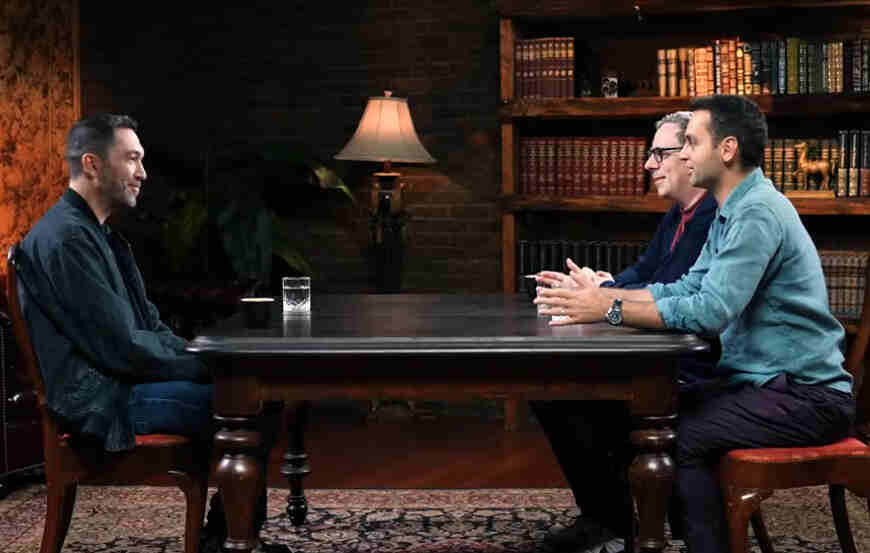
Here is the full transcript of Comedian Dave Smith’s interview on TRIGGERnometry Podcast with hosts Konstantin Kisin and Francis Foster, on “War, Nick Fuentes, Tucker Carlson and the American Empire”, November 12, 2025.
Meeting Dave Smith
KONSTANTIN KISIN: Dave Smith. This has been waiting to happen for a long time. The Internet wanted it to happen. You’re here. Nice to meet you. Thanks for coming on.
DAVE SMITH: Oh, thank you guys both for having me. I agree it’s been long anticipated. I’m glad we were able to make it happen.
KONSTANTIN KISIN: Yeah. And you and I individually, we’ve debated stuff before, and one of the things I’ve always really genuinely enjoyed about it is I think we come at the world from very different directions, but it’s always a discussion of the issues.
DAVE SMITH: Yeah.
KONSTANTIN KISIN: And there’s not enough of that. A lot of the conversations in our space have become very ad hominem. That’s not why you’re here. And that’s how we’re going to approach it, I think from that angle.
FRANCIS FOSTER: So speak for yourself.
KONSTANTIN KISIN: Yeah. Francis has a list of quotes from 2012.
DAVE SMITH: What would be great if me and you did a good faith debate. Me and you? Like a vicious.
FRANCIS FOSTER: Yeah.
DAVE SMITH: And we could just go back and forth. I like that.
FRANCIS FOSTER: Yeah.
Dave Smith’s Background
KONSTANTIN KISIN: We can try it out. Try both ways. But anyway, it’s nice to have you on. Before we get into it, a lot of our audience actually won’t know your background or your story, who you are. They’ll just know that they see you talking about certain things and whatever. So tell us a little bit about you, first of all.
DAVE SMITH: Well, I’m from here, from New York City, where we’re recording this interview, and born and raised in Brooklyn, New York. I started stand up comedy in 2006, I think. Then I became very interested in the Ron Paul presidential campaigns. And I got sucked down the black hole of being obsessed with all of these issues that we all talk about all the time.
And then I just been podcasting for the last 15 years or so, and it’s for a long time to basically no audience, and then over the last few years to somewhat of an audience, which is better.
KONSTANTIN KISIN: And the Ron Paul thing that attracted you was his position on foreign policy and non-interventionism?
The Ron Paul Awakening
DAVE SMITH: Yeah, at first that was the thing that really drew me. So I was, you know, I think much similar to you. We’re around the same age. And I think our kind of coming of age was 9/11 and the war on terrorism and the Iraq War specifically.
And so at that point, you know, this is 2007 when I first found Ron Paul. So at that point, the wars have been going and going really badly for several years. And also all of the pretenses for the war have kind of been exposed at this point, you know, down to not just the weapons of mass destruction, but every detail of it just wrong.
And so I was essentially, you know, I’m a Jewish kid who was raised by a single mom in Brooklyn. So I was a liberal, but without really thinking much about it. That was just the correct thing to be. So I liked, I had probably kind of a standard liberal critique of George W. Bush, you know, and I liked the movie Fahrenheit 9/11 or whatever, even though, yeah, it turns out I was all wrong. But I was with the spirit of, yeah, we’re against George W. Bush.
And I remember in 2006 being happy that the Democrats won the Congress back. And I actually, you know, I was really dumb enough to believe them at the time. I was like, well, that’s the end of that. You know, they’re not going to fund the war anymore.
And so that was kind of a moment of disillusion where I was like, oh, for all the stuff that Nancy Pelosi talks, she’s going to keep funding George W. Bush’s war even though she has the purse strings now. So I was kind of a little bit like I’d woken up to that.
And then when I saw Ron Paul in the famous Ron Paul-Giuliani moment, I was like, this guy is actually radically more anti-war than any of these Democrats who are kind of squishy on the issue. And I just thought his perspective blew my mind on it. And it was something like when he really explained blowback and how these wars got started, I was like, wow, this really makes a lot of sense.
So I was very interested in that. And then just because I liked him and I was interested, I read his book and I just wanted to learn more about him. And then he kept making the case for free market economics and really free market economics, like substantially more free market than the typical free market advocates.
And I thought to myself, that’s got to be wrong. There’s got to be something that he’s missing. So I almost wanted to read about it to find the flaw in it. And along the way I ended up getting converted and became the libertarian day-walking autist that you see in front of you.
The Impact of 9/11
FRANCIS FOSTER: So that was kind of your journey, which was looking at 9/11 and everything that happened. And I don’t think people understand. For our generation, that had a profound effect. It had such a profound effect because you know, the crew that we’ve got, you know, they’re younger lads and we talk to them and it doesn’t resonate.
But for us who grew up, because I’m pretty much the same age, there was before 9/11. There was after 9/11. It literally felt like there was day, then there was night.
DAVE SMITH: I mean it’s like, and even now looking back at it all these years later, it almost feels like the moment, you know, like in a time traveling movie, that’s the moment that we got to go back and change.
KONSTANTIN KISIN: We did live in a different world.
DAVE SMITH: Yeah, yeah, no, that’s right. And I mean there’s like, there wasn’t a Department of Homeland Security, there wasn’t a TSA, there wasn’t a war on terrorism. There wasn’t this constant emergency state that we’ve been living in since 9/11.
You know, even in the immediate aftermath of 9/11 when they passed the Patriot Act, even in the immediate aftermath of 9/11, it was controversial. There were people who were like, whoa, this is really un-American to start saying we don’t need a judge to sign off on a warrant before we start surveilling people and all this stuff.
And what they put into the Patriot Act, right, was a sunset provision that, well, this will have to be approved every six years or whatever it is, and we’ll have to come back and justify that the emergency is still here. But that’s just, it just gets approved. I mean, I think they changed the name of it one year or whatever, but it just keeps getting approved.
Essentially, my point is we’ve just accepted that we’re in a permanent state of emergency since 9/11 and we govern that way. And I think it was, you know, we probably were ignoring a lot of problems in the 90s, but you kind of can’t overstate to young people like you were talking about today how different the world was back then. It was so much better in so many ways.
But look, you know, there were racial issues obviously in America, but the obsession with racialism was just nothing like it is today. Pre-9/11, the country was a much freer country. The government was a much smaller government. And there just was a feeling of security, perhaps an illusion of security that was really ripped away from a lot of people.
Iraq: Our Generation’s Vietnam
FRANCIS FOSTER: And what happened is that there was obviously 9/11, there was Afghanistan, which you can debate. Should we have got involved? Should we not have? Should we have stayed for so long? All of those questions perfectly valid, but I think where most sane people say we made a colossal error was Iraq.
And Iraq, in many ways, I was thinking about this the other day when I was going for a walk, and people might get a little bit triggered by this, but it was kind of our generation’s Vietnam, where we went, oh, what you said and what the truth is, those are two separate things.
KONSTANTIN KISIN: I would go even beyond that, which is, it’s not just what you said. It’s like there were millions of people on the streets of Britain when we were, we would have been, I don’t remember how old we would have been. We would have been…
FRANCIS FOSTER: We were in 2021.
KONSTANTIN KISIN: So, yeah, so we’d be 20, 21. Millions of us protesting against this, saying the thing that then turned out to have been exactly true. And yet our governments went and did it, and also made the world less safe and more unstable as a result.
Afghanistan and Iraq: The Catastrophe
DAVE SMITH: No, that’s right. I mean look, with Afghanistan, right, the real catastrophe in Afghanistan was that because the choice was made to not… I mean immediately after 9/11, well before the army invaded, the CIA and Special Forces were taken out Al Qaeda cells in Afghanistan. I don’t think anybody was arguing against that or if there is someone arguing against that, that’s a very fringe argument.
But the decision was made that no, we’re not just going to take out the Al Qaeda cells, but we’re going to fight a regime change war against the Taliban, which is a totally separate thing. Like it’s a much different thing to say they’re guilty of the crime of housing somebody who planned to attack us. Because no one was really alleging that the Taliban was in on the plans for 9/11. It was just that they essentially rented a room to Osama bin Laden and his guys.
That’s a, you know, that’s like going to war with the landlord because a murderer lives… Look, maybe it’s a little bit different than that. It’s a little different but it’s certainly not a given that we should have…
KONSTANTIN KISIN: They rented a room because they really like this guy Osama.
DAVE SMITH: Sure, sure. And I’m not, look, and we had, our government had a long history with the Taliban, both positive and negative. But yeah, I mean look, the Iraq war and then also just the fact that they put this “axis of evil” together of Iraq, Iran and North Korea, three countries that the only thing they have in common is that none of them had anything to do with 9/11.
Like it just clearly was not about that and it was very transparent. I mean I guess to this day, and maybe we’ll debate, people still debate what exactly the motivation to go into Iraq or what exactly led to all of these wars or what the components were.
But the thing that everybody kind of just knows is that the Bush administration had a bunch of war hungry people in their ranks and that they used 9/11 essentially as an opportunity to cash this blank check for war.
And I do think, and I’ve tried to express this many times because I do think it’s fair to be as charitable as possible, I think they believed in the hype. Like I think that they believed, these were, when they said it’ll be a cakewalk, I think that’s what they envisioned.
I don’t know, they still had 90s mentality. They were looking at the war in Serbia or the interventions in the Balkans or they were, you know, and going, this will be easy. Look at the 91 war in Iraq. We could just go overthrow Saddam, we can, the Soviet Union’s gone, we could topple all these countries.
But what it ended up being, I mean, is just the greatest catastrophe of the 21st century. I mean just millions of people slaughtered, tens of millions of people displaced or injured and you know, and every last one of the countries, every theater worse off than it was before.
The Lasting Impact on America
FRANCIS FOSTER: And it’s really interesting to see the impact that has had on America. Because it’s had an impact in the UK, but it hasn’t had as visceral an impact as has in the US amongst our generation and to Tucker’s generation as well.
Like I look at Tucker and his anti-interventionist stance and I think a lot of it, and we’ve constantly, I talk about this all the time, we think that a lot of it comes from the fact that, you know, if you are pro-war and pro-intervention and you see something go so horrifically wrong, so terribly wrong.
And it’s not just the millions of people that die. It’s also the servicemen that come back who believed in an idea, had their, let’s be fair, they had their lives completely ruined. And the number of them that then went on to commit suicide or develop drug problems, alcohol problems, that would, if I was gung-ho, which I wasn’t, but if I was, that would really make me look at myself in a very deep and profound way.
The Iraq War’s Lasting Impact
DAVE SMITH: Well, I think, yeah, I think that’s completely true. And I think Tucker would say that and has said that himself. But I think like one more layer to it is then also seeing that so many of the people who advocated for this war with certainty that they were right, talk down to all the rest of us like we were a bunch of idiots for having these concerns.
With certainty said, you know, we will be greeted as liberators and democracy will sweep the region and the war will be paid for in oil and it’ll be a cakewalk and all of this stuff. And they have weapons of mass destruction, obviously the big one.
And then were completely unaffected by that and then just started advocating for the next war and the next war and the next war with the exact same condescension toward people saying like, hey, what if this turns out to be a catastrophe? What if you’re not right about all of this?
And so I think there was what happened with a lot of people like Tucker Carlson and there’s a lot of people in that camp. I mean I think like Ann Coulter, I think Laura Ingraham to some degree, kind of like the more paleo-ish wing of the, essentially a bunch of them were following the neocons lead when they were in power.
And then I think it was that. I think it was not just that the Iraq war was a disaster, but that they kept advocating for more of it afterward. And then they’d be like, whoa, these people really do just want to fight wars endlessly.
Like it was almost, I mean I think I saw Ann Coulter once even say she thought like the left wing caricature of neocons, that they just always want to fight wars. She thought was the dumbest thing ever when George W. Bush was in and then in the subsequent years she was like, I really got no response to them anymore.
I mean that does seem to be at every take like there’s not. It’s very strange to me. And look, I guess people could accuse me of the equal opposite. Like I’m almost always opposed to the war.
Britain’s Role in Iraq
KONSTANTIN KISIN: Well, I was about to do that. Maybe I can because we’re coming to an era where I think there is a profound disagreement, which is Francis and I both viewed the, see in Britain the war in Iraq was even worse because the only reason we went to war in Iraq is we didn’t want to ruin our relationship with Big Brother.
DAVE SMITH: Right, right, right.
KONSTANTIN KISIN: The wee little brother, you know, big brother wants to get in the fight. What are you going to do? That’s basically what happened.
DAVE SMITH: Right, but wasn’t it unpopular in like I don’t think it ever had majority support.
KONSTANTIN KISIN: That’s what I’m saying.
DAVE SMITH: So just, so Tony Blair making the decision to go.
KONSTANTIN KISIN: If you read between the lines of what he said at the time, it was basically like, well if we don’t do this, America won’t be our friend anymore.
DAVE SMITH: Yeah.
KONSTANTIN KISIN: And by the way, if you’re Britain, that’s kind of a big deal.
DAVE SMITH: Sure.
KONSTANTIN KISIN: So, you know, I don’t necessarily think that that truth was a fake truth that was real. Like that’s a real concern if you’re the British Prime Minister, you have to think about what happens if you’re no longer America’s friend. That doesn’t mean killing.
DAVE SMITH: Sure, sorry.
America as Global Empire
KONSTANTIN KISIN: Right. But here’s what I was going to ask you because we had that same reaction to Iraq in particular. But I also think the going to the other extreme and saying there is no situation when we have to go out and particularly if you are America.
And look, I know this is maybe an era, we might disagree as well. You like it or not, America is a global empire. America’s 5% of the world’s population consumes 25% of the world’s resources. That’s why you guys are so prosperous. That’s why you’re doing as well as you are. It’s why you get to have your way in all sorts of international debates and discussions and whatever.
But that empire is maintained by sometimes getting the club out and going, you guys need to fall in line here. Is that a fair assessment?
DAVE SMITH: I mean, I think it’s to some degree a factual assessment. I mean, yes, America is an empire. And in order to be an empire, yeah, there has to be like a threat of violence that you’re going to have to use at times. So I don’t disagree with that.
But I guess I would just say that like, you know, if we’re accepting that as the premise that like, look, America is this empire, well then it’s like I do think at a certain point, because I see so many conversations about democracy and the rule of law and all of this. Well, I’m just saying. But that’s my point.
KONSTANTIN KISIN: I’m Russian, it’s my real politician.
DAVE SMITH: Well, that’s the thing which I think it almost leads you to accept. Look, the people of the United States of America never had a referendum on empire. We never decided that we wanted to be an empire.
And in fact, I could argue that the peace candidate running for president almost always wins. I mean, like, it’s almost always a huge advantage. You can go all the way back the last hundred years.
And the Constitution, the law of the land, does not say that we’re an empire. We’re supposed to be a limited constitutional republic. And you can’t be both. You can’t be a limited constitutional republic domestically and a global empire abroad.
KONSTANTIN KISIN: Why is that?
Republic vs. Empire
DAVE SMITH: Because a government that is big enough to rule the whole world is also too big to be a limited government. It’s too big to be a limited constitutional government. And in fact, it can’t be limited. It needs to have emergency powers. It needs to be able to, as you just said, exert force anywhere around the world if someone’s not acting the way you want to act.
And so to me, that’s the whole essence of the game, is that it’s like if we’re going to be an empire, we can’t be a republic.
KONSTANTIN KISIN: I see.
DAVE SMITH: And so if you want to save the republic, we have to abandon empire.
KONSTANTIN KISIN: I see that. It’s an interesting perspective. I mean, I’m not sure that’s necessarily true in terms of the size of government, because you could have a very significant military and foreign service and the apparatus of government for dealing with foreign conflict while leaving your citizens mostly alone. I think that’s possible.
DAVE SMITH: We’ve got to tax them to pay for it at the very least.
The Cost of Empire
KONSTANTIN KISIN: Well, well, the thing is this is what I was going to say is you might need to tax them to pay for it. But think about what you lose when you cease being an empire. This is my point. About 5%, 25% of the resources consumed, right. Like, are the American people really prepared for the consequences of not being an empire that dominates the world?
Because you got to think, and this is kind of how the world works. And we do know this, America pulls back. That vacuum isn’t going to stay there. We’d agree on that, right? Like Russia and China. Whoever else can would fill that void. We see this in Africa, right. America pulled out of Africa. The Chinese, to a lesser extent, the Russians, but the Chinese especially are basically coming in and taking over. Nature abhors a vacuum.
So that’s always been my argument and I’m keen to genuinely hear your perspective on this is like America. You can, you know, you can. You had Yanis Varoufakis on the show who called it like, called it the Death Star. The Death Star.
FRANCIS FOSTER: And that was quite funny. There was so many people who were livid in the comments.
DAVE SMITH: The American Empire, yes.
KONSTANTIN KISIN: You know, it’s called trigonometry for a reason. But my point, my point being, right, is what the choice you have actually in the real world is between an American led world or a Chinese led world or a Russian led world. And then I go, which of those would I rather live in?
Filling the Vacuum
DAVE SMITH: Well, so I think, okay, so I do agree, like, generally speaking, right, that like something will fill a vacuum. But I don’t think the choices between an America led world or a China led world or a Russia led world.
I think what ends up filling those vacuums, like it’s not inevitable that it’s going to be a hegemon, that it’s going to be one. In fact, the unipolar moment, which I think is kind of over at this point. But the unipolar moment is the aberration that that’s like usually not the way the world has worked historically.
Usually there are different competing powers and they have their spheres of influence. And then so in other words, yes, it might be true that there are areas where China fills the vacuum.
But look, even, which was kind of interesting I think to see over when Donald Trump first came in, right, when he was going, we’re not going to fund the war in Ukraine anymore. Then you had European countries going like, okay, well we’re going to step.
KONSTANTIN KISIN: I totally agree with.
DAVE SMITH: Great. So, but I’m just saying, so in a sense the fact that America say it didn’t end up happening, but like, let’s just say America withdrew in that instance. Well, there might be several other people who end up filling that vacuum. And you might, so like decentralization can also happen. It’s not that a vacuum doesn’t get filled, but it might get filled by multiple parties rather than one.
KONSTANTIN KISIN: America is still involved in the war though, right?
DAVE SMITH: Right. No, I’m saying that didn’t actually end up happening.
KONSTANTIN KISIN: I’m just saying that you didn’t pull out.
DAVE SMITH: Right. That’s my.
KONSTANTIN KISIN: That you didn’t pull out though. If you had pulled out, Ukraine would get overrun and then you’ve got a whole new problem. And this is kind of, I think, where there’s a genuine disagreement about the ideas of this because I just, I come from a place where we don’t have political correctness in Russia. So people don’t pretend that all of this isn’t true.
DAVE SMITH: Right.
The Reality of Power Politics
KONSTANTIN KISIN: You know, all of this stuff American people are told about, you know, we’re going out there to spread democracy or they hate us because of our freedom. I mean, with Islamists and we’ll get onto that. That is partly true, but generally speaking it’s about we want to control the land, we want to control the money, we want to control the oil, we want to control the rare earth minerals.
Now if we accept that, which I think we both agree on, then you go, well, do I want Americans being in charge of that or do I want the Chinese being in charge of that?
DAVE SMITH: Again though, I mean, I think it’s like, it’s not strictly like, I don’t think, look, we are, even though, I mean China’s a big economy and has a lot of people, but we are substantially richer than China is, you know, and we’re going broke being the world empire.
I don’t think China is looking at what we’re doing and saying, you know what we should do? We should get in on these 20 year catastrophe forever wars and really have our society crumble while we waste all these resources.
And so like, I don’t, again, I don’t think it’s going to be a global like hegemon unless it’s the US right now. But that being said, I mean, I think empire is always a losing game. I mean it’s, I think it’s good for the ruling elite, but I think it always like kind of ends up costing more to the nation than it ends up producing.
KONSTANTIN KISIN: Always.
FRANCIS FOSTER: Really?
The Cost of Empire and Government Spending
DAVE SMITH: Well, okay, I shouldn’t, maybe that’s an overstatement. Maybe not in every single, I mean, you know, in general, broadly speaking, I think that’s the case. And I think Americans would be far better off if you say whatever resources we get from fighting forever wars. I think we’d be far better off to not need to have an inflationary monetary policy, an income tax, a giant, you know, like this giant burden.
I think like, if there is one lesson of America, it’s that actually free markets and true capitalism is what’s going to produce the most wealth in the most sustainable and ethical way.
KONSTANTIN KISIN: No, that I totally agree with. I’m not sure what you said about empire. I mean, we had one of the greatest historians. I’m not resorting to arguments from authority.
DAVE SMITH: I’m just saying you guys had Darrell Cooper.
KONSTANTIN KISIN: Dominic Sambrook, part of the rest of history that I think they’ve got the biggest history podcast in the world. And we talked about, he talked about the fact that empires are the natural unit of history. Like if you look throughout history, that tends to be the way that the great powers of the world operate their empires. Right.
So I don’t know that it’s fair to say that America’s problems or any country’s problems in them are about forever wars, because I don’t. The entire Western world, including countries that weren’t involved in the foreign wars, are all making the same mistake. And I think that mistake is not foreign policy. Although, as we discussed, there’s been some pretty f*ing big mistakes. It’s about entitlements and benefits.
DAVE SMITH: Well, that’s true, too.
KONSTANTIN KISIN: I mean, sure, that’s where I think actually we’ve basically got to a situation, and I can’t remember whose quarter it is, but we talked about this with one of our guests, where the public have worked out that they can vote to get more from the government and punish anyone electorally who says, we can’t give you more free shit.
And so in the UK, more people take more out of the tax the benefits system than they put in, 51% of the public. Right. And I think that’s really the death spiral that we’re in. We can’t reduce our spending and we can’t reduce our debt and we can’t reduce our deficit because we don’t want to forego the free shit.
The Entitlement Trap and Generational Wealth Transfer
DAVE SMITH: Well, I think that’s right, and I think this is true on a lot of different levels. Right? And certainly I know a bit more about America than Europe. But look, I mean, the bottom line for all this is we have, we have a government that’s way bigger than what we can afford, which is much, much bigger than what we can afford.
And so you can’t tax enough to get there, so you have to tax your population, then you have to borrow a whole bunch of money, but even that’s not enough. So then you got to print the money, right? And these are essentially the three ways government can raise money or can money.
And so what you have now is that, right, there are these giant entitlement programs that, yeah, it’s much more, it’s much more politically advantageous for Donald Trump to say, I’ll never cut Social Security or Medicare because he’s got to lock up that base of seniors who are Republicans. And also just the monetary system just keeps the prices of everything going up and up and up.
And what it ends up creating, in a weird way is the justification for socialism. I mean, you know, like when these kids say, they’ll say things like, “profit is theft.” And I think it’s very easy for, like, guys like us to look at it and go, hey, that’s the dumbest thing I’ve ever heard in my life. Because the idea that. What type of fixed pie fallacy is that? That if I go out there and I’m successful, that doesn’t mean I’m taking it from you. That means I’m creating more wealth. I’m creating a bigger pie with more slices.
But the thing is that under this current paradigm, they do kind of have a point. Like, I bought a house three years ago, just about exactly three years ago. And I just got this is an official appraisal or anything like that. But I got a letter from my real estate agent that said the house is up 200 grand in the last three years. And that does seem, based on the listings I’ve seen the houses selling for. That seems about right.
And you think about that, in a way, you’re like, wait, so what is that other than like essentially welfare from the system? That because I’m in the owner class, because I got into the owner class three years ago, I now get an extra 200 grand of my net worth. And the bar for young people to go buy a house is now that much higher. It’s like, I kind of did take that from them in a sense.
But then like, as we’re starting to hit this point where the young generation is getting so left behind, you still have these entitlement programs that are transfers of wealth from the young people to the wealthier older people. Think about how crazy that is.
KONSTANTIN KISIN: And it’s crazy, especially because there are fewer and fewer young people relative to the number of older people. But are you kind of. I think you’re agreeing with me, which I appreciate. But isn’t that kind of the point that while the foreign wars are bad and wrong and immoral, in some cases it’s not really them that’s causing all this problem, all these problems?
DAVE SMITH: Oh, I mean, it’s a huge driver of it, too. I mean, they’re all, look, if you look at the American government, it’s the, at this point, it’s the entitlements, the defense budget, and the interest on the debt.
The Defense Budget and American Empire
KONSTANTIN KISIN: But the defense. But the defense budget isn’t about fighting all these foreign wars. The defense budget is about protecting your empire, which gives you access to. You basically control all of Europe. America dominates Europe. You basically decide what happens in Western Europe. You dominate parts of Asia.
You get the resources that come with that. You get whatever oil you want from wherever you need it. You get to control the world. You get. You have a defense budget not because you want to invade Iraq, you have a defense budget because you’re the biggest country. I know you don’t like hearing this, but in the absence of a neutral world policeman, America, someone’s going to be the world. Someone’s going to be going around kicking ass. Right. And if you want to. And if you want to have the 25% of the world’s resources, that’s you.
DAVE SMITH: Yeah, I mean, I just. I guess I don’t mind hearing it. I think that is the way things are. But it’s illegal under our Constitution. The American people never decided that they want this. And in fact, the American people are saying pretty loudly, we don’t want this anymore. We don’t want to pour money into all these different parts of the world.
And I don’t agree with you that we get more bang for our buck than we otherwise would. And look, it’s very easy even going into, like, these abstract conversations about, like, empire or who controls the shipping lanes or what would fill the vacuum if we didn’t do that. Okay, but we still blew trillions of dollars on these. I mean, it’s like $8 trillion for the war on terror. We agree.
KONSTANTIN KISIN: We agree it was a mistake.
DAVE SMITH: Fine, fine.
KONSTANTIN KISIN: But.
DAVE SMITH: Right, and we also agree not just a mistake, but like a horrifically catastrophic moral mistake.
KONSTANTIN KISIN: Immoral.
DAVE SMITH: Yeah, but also it’s $8 trillion. I mean, that’s a huge, huge chunk of this. So listen, if you’re arguing that entitlement programs, yes, they account for even more of the budget, and yes, they’re a huge part of this whole, you know, monstrosity of big government. So I agree with you on that. But no, I think, look, at the very least, we’d be way better off had we not just fought all these.
KONSTANTIN KISIN: Stupid wars that I agree with. I was making the point about the defense budget. The defense budget isn’t for invading Iraq. The defense budget is for dominating the world.
DAVE SMITH: Sure. But again, I think this is more to the benefit of the elite than it is to the American people. I mean, yeah, it’s like the defense budget is also why that all those richest counties in America are the suburbs of Washington, D.C. is the reason why we’re making millionaires. If you’re connected to the weapons companies.
And it’s, you know, I mean, like, this is, yeah, it’s again, a huge transfer of wealth program, essentially transferring from the working and middle class to the ultra politically connected. And so I think essentially that. And this is true for all government spending. That’s the swamp. That’s the essence of what the swamp is is that you extract money from the real economy, from people who are working, and you hand it out to the politically connected. I think it’s like criminal.
The Middle East and Israel-Palestine
FRANCIS FOSTER: So that being the case, moving on, let’s talk about something that nobody’s going to get offended by, which is the Middle East. So because your position has been very interesting on the Middle east, it’s mainly been that you’ve been, how could I characterize it as being kind of pro Palestinian in your outlook, in the way that you see, or would you put it another way now?
DAVE SMITH: I wouldn’t say pro Palestinian. I mean, I’m not like, I don’t even know exactly what that means. Like, I’m not saying, like, I’m against what’s been done to them. I would, you know, I would be against that being done to, I think, just about any group of people. So, no, I don’t think I’m pro Palestinian. I think I’m pro American. But I’m certainly a critic of Israel’s destruction of Gaza.
FRANCIS FOSTER: So what is it in particular? Did you feel that it was disproportionate, the violence or the, I should put it another way, the Israeli response to October 7th, did you feel that was disproportionate? Was there another way that it should have been done?
DAVE SMITH: Yeah, I mean, I think there’s lots of other ways that it could have been done and certainly it was disproportionate. But I think that, I mean, I think it’s horrible and I think that it’s, that America shouldn’t be involved in it. I think it does nothing but cause a headache for our country.
And you can see that all over the place. Like, even if you’re for the war, you kind of can’t deny that, like, this has caused major turmoil here. It was a major problem for the Democrats politically. It’s a major problem for Donald Trump politically right now. It is not good for, as it says in the preamble to the Constitution, it is not good for domestic tranquility at the very least.
But also, yeah, I just don’t think, I don’t believe that we should be involved in like this horrific, I don’t even think you can call it a war, the destruction of a captive people.
Iran and Regional Stability
FRANCIS FOSTER: Because there’s a lot of people would say, and I’m sympathetic to this, which is you have Iran, which are essentially funding terror cells right the way through the Middle East, Hezbollah, Hamas, amongst others, which are effectively destabilizing the region.
And there’s a lot of Muslim Arabic countries who despise Iran because they see them as an existential threat to their existence, which they are. They are, they’re Islamist in nature. So by that you would argue that unless you deal with the threat of Hamas, unless you deal with the threat of Hezbollah, you are essentially going to have a Middle east which is more unstable, which is going to become a hotbed of terrorism, which eventually is going to impact the safety of nations around the Middle east, but also in the west and in the United States.
DAVE SMITH: Yeah, I think there’s been a lot of people who are arguing if we don’t take this group out or that group out, it’s going to lead to instability in the Middle East. And every single time we go to make that move, it leads to more instability in the Middle East.
And I just firm, I flat out reject the idea that Iran is an existential threat to any of those Sunni states in the region. But Saudi Arabia, who are we talking about? Jordan, Egypt, UAE?
KONSTANTIN KISIN: I mean, if you speak to people in those countries.
DAVE SMITH: Yeah, I’m sure they’re concerned about that.
KONSTANTIN KISIN: They’re very concerned about it.
DAVE SMITH: Yes, of course. And there’s a Sunni, Shiite beef that’s been going on for many, many years and there’s a lot. But the idea that like the US Sock puppet states over there are really threatened by Iran, I just don’t think is right.
FRANCIS FOSTER: They don’t.
DAVE SMITH: They do feel that, yeah, okay, fine. But like, I don’t think they’re right about that. I don’t think Iran is taking over Saudi Arabia. Like, what do you mean existential threat here? They’re going to take out one of these countries. Look unlikely.
KONSTANTIN KISIN: Take out is, you know, take out is. Countries don’t tend to take each other out. But go to war, you know, they’re fighting over interest, like they are.
The Shifting Alliances in the Middle East
DAVE SMITH: Yeah, they’re fighting over interest. I think that’s more correct. But I also think that there’s an interesting thing where when you go like all these Shiite terrorist groups, or I guess Hamas is whatever, but if you’re talking about Hezbollah, Hamas, the Houthis, like the people who Iran have been in business with, and I think of those groups, Hezbollah the most, you know what I mean? Like there’s real direct connections and training and stuff there. It’s a little bit different with the Houthis and with Hamas.
But again, those weren’t the enemies of the American people. You know, when we go back to 9/11, and it’s been really fascinating how like the war on terror just like totally shifted over to being this whole other group that has nothing to do with knocking our towers down or attacking the Pentagon or any of that. Our beef was always with the Sunni radicals. And the Sunni radicals are actually at war with a lot of those groups that you’re talking about.
So we’ve weirdly also done this thing now where we’ve picked sides, which I would say I think has a lot more to do with security concerns for Israel than it does for the United States of America. But now we’re on the side of Al Qaeda in Syria, we’re on the side of Al Qaeda, we were in Libya, we’re on the side of Al Qaeda in Yemen. And so like no, I actually don’t think that’s good for, you know, if you look over the last 15 years, the people who are destabilizing the regions the most were the Bin Ladenite head choppers. And that was really the major problem that we had there. And so fighting on those guys’ side in all of these conflicts I don’t think has done anything.
KONSTANTIN KISIN: Well, the Sunnis have changed, right? The Saudi regime, the UAE regime, they are very not extremists. The Saudis used to spread extremism throughout Europe. They’re not doing it now. The people in charge. Right, so the extremists and the terrorists are mostly now being funded and spread by Iran, I think is Francis’s point.
The Iraq War and Iran’s Regional Influence
DAVE SMITH: Yeah, okay, but even that, I mean, I don’t know that that’s exactly right. I mean I think you’re probably right in your characterization of Saudi Arabia’s revolution and the UAE. But at the same time, I mean, look, again, again we all agree on this. But to go, what was the huge mistake here that Iran has all this influence in the region? It was the Iraq war is the dumbest thing they ever did is that these neocons were convinced.
You know, it’s really, I was watching the other day because David Worms did this interview that was kind of like responding to me, which is just weird and surreal feeling because it’s the weird world that we’re all in now. But he’s like talking about, he’s still arguing that like no, if the Hashemites had taken over in Iraq, then the Shiites would have had to listen to them and then Iran would have had to be nice or Hezbollah would have had to be nice to Israel.
But the obvious truth which was predicted by many people in real time was that obviously we had a dual containment strategy in the 90s, right. Obviously if you took out Saddam Hussein, it was going to hand the region to the Shiites who were much closer allied with Iran and that was going to increase their influence in the region. So again, this is all George W. Bush and Barack Obama’s fault. And yeah, now that being said, I don’t think that means that we should go into the next war to try to push the balance back in the other direction.
FRANCIS FOSTER: I think the danger was, Dave, is that with Iran, when they use rhetoric like “we want to wipe Israel off the face of the earth,” you know that they are funding terror cells. There is the suspicion that they’ve got nuclear weapons. If you say those types of words and you let’s say you don’t get involved and something awful happens that’s going to destabilize the world. Whatever happens that’s going to start a war.
DAVE SMITH: Well no one, I don’t think anyone’s speculating that Iran has nuclear weapons. I don’t think there’s any…
FRANCIS FOSTER: Well, they’re on the point of maybe getting nuclear weapons which is why the strike happened.
Rhetoric and Justifications for War
DAVE SMITH: I guess I think that, I think that look, they chant mean things is not good, but that’s also not a justification for a war. And, or it’s nowhere even approaching a justification for a war. And I do think…
FRANCIS FOSTER: But it goes beyond chanting, Dave.
DAVE SMITH: Okay, but that is what you brought up. So I’m saying like there’s look, I think when people look at these things, like in the same way that if you were looking at a trial, you don’t just look at what the prosecution says, you look at what the defense says. Also, even if it’s a really, really bad person, you still look at what the defense says as well.
If you talk to people, I’ve talked to several Iranians about this, but if you ask Iran why do they hate America, why do they hate America, what do you think the most common answers are? Like what? Because it’s very clear there’s two that are really big that come up all the time and it’s not, and it’s not the same reasons why the Bin Ladenites hated us. It’s kind of different things.
But the two big beef they have is that we overthrew their government in 1953 and imposed the Shah on them. And the other one is that we backed Saddam Hussein when he did the worst thing he’s ever done, which was launch the war, the Iraq-Iran war. He killed 500,000 Iranians and used chemical weapons and all types of horrible things.
Yes, they chant mean things about us. We could also look at the rhetoric out of D.C. and out of Tel Aviv. Not too friendly toward Iran either. You know, we put them on the axis of evil after 9/11, invaded and destroyed the two countries that touched them, right? Iraq and Afghanistan. And they were on the axis now.
So it’s just kind of weird to hear Americans or Brits talk about their rhetoric and what a threat they are to the Western world. It’s like, hey, let’s like there’s been a lot. John McCain was singing “Bomb, bomb, bomb Iran” when he was running for president. Hillary Clinton, you know, you talk about threatening to wipe them off the map. What were her exact words, if you remember? It was something, you know, when she had to like overcompensate being like a woman running for president. And she, I forget her exact words, but it was something “we will totally eradicate, totally decimate Iran” or all of these things.
KONSTANTIN KISIN: Well, the question was if Iran were to launch a nuclear attack on Israel, what would our response be? And “I want the Iranians to know that if I’m the President, we will attack Iran whatever stage of development they might be in their nuclear weapons program in the next 10 years, during which they might foolishly consider launching an attack on Israel. We would be able to totally obliterate them. That’s a terrible thing to say. But those people who run Iran need to understand that because that perhaps will deter them from doing something that would be reckless, foolish, and tragic,” and we actually have the might to do it.
DAVE SMITH: And we’ve attacked them. They haven’t attacked us. So, again, I would just say that zooming out to the bigger picture, yes, Iran funds groups that are a pain in the a to Israel. That is certainly true. And there’s a big…
FRANCIS FOSTER: It’s more than a pain in the a, Dave. Let’s be fair.
DAVE SMITH: Yeah, yeah. You know, that was a euphemism, obviously. Yeah, yeah.
FRANCIS FOSTER: But October 7th is more than a pain in the head.
DAVE SMITH: Okay, but, okay, fine. But I’m saying Iran has historically funded Hamas, Hezbollah, the Houthis, they’ve sold arms. And it’s like, okay, but like, actually, Iran is zero threat to the United States of America. They do not have nuclear weapons. They do not have the capability to hit America if they did have those nuclear weapons. And the idea of launching a war of choice, a war of aggression, because you say they chant mean things, and what if we didn’t do anything and then something bad happens? I just think you’re nowhere near the realm of, like, a just war.
Israel’s Recent Actions and Iran’s Nuclear Program
KONSTANTIN KISIN: No, no, I, that I totally agree with, but that isn’t remotely what’s happened here. No one has launched a war on Iran, a preemptive war on Iran.
DAVE SMITH: What Israel and the US just did, they call it the 12 day war.
KONSTANTIN KISIN: So what happened is, and this is, I think it’s useful to come back to October 7th. October 7th happened, and then it became very clear that Iran has been funding the organizations that have been attacking Israel this entire time. Now, you may agree or disagree about Israel being an ally, should be an ally or not of the United States, but Israel is an ally of the United States.
So to the extent that, and you know, we had Yossi Cohen, the former director of Mossad, on the show to talk about the nuclear secrets they stole from Iran, which then they gave to the United Nations and everybody else to see for themselves. I mean, it’s very clear Iran would like to have a nuclear weapon. And by the way, when we asked Yossi, why do they want one, he said, because it allows them to project power in the region, which is why anyone wants a nuclear weapon, right.
DAVE SMITH: Well, I think also the deterrent, you know, I mean, and it’s not even clear to me that they wanted a nuclear weapon. And forgive me, I’m not taking Mossad’s word for it that they do.
KONSTANTIN KISIN: It seems like what, it’s the documents they stole.
The Nuclear Deterrent Strategy
DAVE SMITH: Well, sure, but they were, look, they were very clearly do. I mean, so after 9/11, right? Bush puts the axis of evil of Iraq, Iran and North Korea, okay, so North Korea races to get a nuke. They get nuclear weapons. We’ve left them alone ever since.
Saddam Hussein in 2002 tells the UN “I’ll allow inspections regimes to come in,” kind of waving the white flag, rather. Gaddafi later does the same thing. “We’ll get rid of our chemical weapons program, we’ll get rid of our nuclear program.” All of this, we go in and topple both of those guys and they get killed publicly.
Iran goes the middle, you know, so, like North Korea developed nuclear weapons. Those other countries got rid of all their weapons. Iran went, “Hey, we’re going to hang out here. We’re going to let the world know that we’ve mastered the fuel cycle. We can break out and get a weapon if we want to, but we’re not doing that yet.” A kind of standoff of like, “don’t attack us because we could make a nuke, but, you know, we don’t want to make it.” But, you know, this kind of this vague game.
But it’s a latent deterrent. That’s the idea here. And then they can negotiate from there. And that’s where they were sitting down to negotiate, like what level of enriched uranium they would be at. So it essentially, I guess the point is that it’s hard to then look at them and go, “this is very suspicious that you haven’t gotten rid of your entire nuclear program.” It’s like, well, the last guys who got rid of their nuclear program ended up sodomized to death in front of an angry crowd of people. And the country that got nukes gets left alone.
KONSTANTIN KISIN: I totally agree with that, which is one of the reasons I actually believe that if the US and Europe doesn’t help Ukraine have a peaceful solution that works, you’re going to have loads of other countries pursuing nuclear weapons, because if no one else is going to protect you, you might as well get a nuke. Like, if Ukraine had nukes, it wouldn’t have been invaded, right?
DAVE SMITH: Yeah.
The October 7th Question
KONSTANTIN KISIN: So this is why one of my concerns about allowing these things to get out of hand is actually it helps nuclear proliferation. But the point about October 7th, which is why this is important, is ultimately you and I can agree, and Francis, I’m sure does too. The war in Iraq was a mistake. A lot of mistakes have been made on foreign policy.
The question is, what do you do when you are in the situation when October 7th has happened? Right. And this is, you know, we’ve had people who have different perspectives on this conflict. As you know, Bassem Youssef was one of them. And I asked him what I think is a very legitimate question is like, what should Israel have done? Forget about the occupation, forget…
DAVE SMITH: Let’s accept all of that has happened.
KONSTANTIN KISIN: All of that has already happened. Let’s accept it. And I don’t want to argue about it. I don’t want to go into history because everyone’s got their own arguments and blah, blah, blah, blah, blah. But it’s happened. What should Israel have done?
And what, I mean, we were just on Rogan’s show, and I think Rogan agrees way more with you than he does with us about this. But he was like, yeah, if this happened to America, we’d be as bad, if not worse.
Dave Smith’s Response
DAVE SMITH: I don’t know. I mean, I don’t know. You know, it’s, we could get into that. But let me just say, I’ll say this first and then I will very directly answer your question. But first I will say, I don’t think it’s like, I get what Bassem was saying to you about that too. Like, I understand the argument of being like, I could say the example I made at that Charlie Kirk event with the now infamous Charlie Kirk event, but the comments that I made was like, hey, look, if you’re pro-life, it’s not incumbent on you to have a plan for the baby’s education or daycare or something like that.
Like, you could just say, I’m against this option because I find this morally unacceptable. And then you figure it out for the… So, like, my point is, like, you can just oppose what Israel did to Gaza and not have to come up with a solution. But I think it’s also a fair question to ask. Well, I think it’s fine to say this is morally…
KONSTANTIN KISIN: Not really, because ultimately they have to do something.
DAVE SMITH: Okay, well, fine. But no, I mean, I also say, I also think it’s an interesting question.
KONSTANTIN KISIN: Okay.
DAVE SMITH: And kind of a thought experiment. So I can go to October 8th, I can’t change anything that’s happened before that. I have to inherit that world. And then what would we do after October 8th?
Well, look, I mean, I do think, first and foremost, I think Netanyahu should have resigned in disgrace. I mean, Netanyahu’s entire political career has been very openly built around thwarting the establishment of a Palestinian state.
KONSTANTIN KISIN: Let’s forget about Netanyahu.
DAVE SMITH: But this isn’t… You’re asking me the question.
KONSTANTIN KISIN: I’m asking what? No, I’m asking. I’m not asking what Netanyahu. I’m saying what should Israel have done?
DAVE SMITH: Right. Well, he’s the Prime Minister of Israel.
KONSTANTIN KISIN: So this is part of Netanyahu resigned.
DAVE SMITH: Look, also, just the fact that…
KONSTANTIN KISIN: Dave Smith is now appointed Prime Minister of Israel following Netanyahu’s resignation. What does Dave Smith mean?
The Intelligence Failure Question
DAVE SMITH: Well, sure, sure. But I’m just saying, I mean, also the fact that it was his whole plan to prop up Hamas and keep them in power, that should be enough that you get out of the way now. Fine. First off, there should be a real investigation, man. And this is, I mean, this is something that still to this day, I know, of course, look, obviously there’s a million clips of Charlie Kirk saying how much he loves Israel, and then there’s other clips that they’re all circulating.
But his first reaction on the Patrick Bet-David podcast, which he did, you know, he said that again later at speeches and stuff, was like this. It is kind of bizarre that… And I’ve talked to military experts who have said the exact same thing, and they’ve been like, look, there is something. And I’m not alleging anything. I don’t know. You know, I’m not saying it was a false flag or something like that. I don’t think that’s the case.
KONSTANTIN KISIN: So what do you think it is? What is it that you think an investigation will unfold?
DAVE SMITH: Well, I mean, the massive intelligence failure, how the most surveilled area of the world got into the biggest fortress in the world. And there was such a long delay in areas of a response. I mean, that really should…
KONSTANTIN KISIN: But what do you think that likely points to?
DAVE SMITH: I really don’t know because everyone we’ve…
KONSTANTIN KISIN: We’ve spoken to former soldiers, people who’ve served in the IDF, all kinds of people like that. And they basically say, look, we messed up on a whole set of levels. The intelligence people blame the IDF, the IDF blamed someone else. And that tends to be how these things go down, really.
But I also, with all respect, do get the sense that quite a lot of people that talk about, well, why did it take them six hours to do this? And that, I mean, we’ve had former British paratrooper on the show goes, well, look, in the UK we’ve got, I don’t remember the exact stats, but we’ve got like X thousand soldiers who are on prime active duty. But that’s a 24-hour call-up situation, right? We don’t have, you know, thousands of people on a one-hour response time when they’re in the barracks, they just pick up a rifle and head to the front line. So I think there’s some pretty reasonable explanations for how that could have happened.
DAVE SMITH: No, no, quite possibly, yeah.
KONSTANTIN KISIN: But what I get, with all respect, is that quite a lot of people who ask the question seem to be implying something, but they never say what it is that they’re implying.
DAVE SMITH: No, I mean, well, Charlie asked the question. Was there a stand-down order? I don’t know. I mean, you know, I don’t know. But it does seem, it does seem to me something really worthy of investigation and really getting to the bottom.
KONSTANTIN KISIN: Netanyahu did say this when we interviewed him, right?
DAVE SMITH: What?
KONSTANTIN KISIN: They said the investigation is super necessary.
DAVE SMITH: Yeah, right. Once the war is… Okay, fine, but you can’t have an…
KONSTANTIN KISIN: Investigation in the middle of a war. Especially to your point, with the person who oversaw the…
DAVE SMITH: I’m not sure exactly. Why can’t you have an investigation while they’re bombing Gaza? Because the bombs have to stop dropping before we can look into that.
KONSTANTIN KISIN: Because they’re running a war effort. Imagine being investigated while you’re trying to manage a war. That doesn’t work.
DAVE SMITH: Right. I guess, but I don’t exactly understand it. But maybe…
KONSTANTIN KISIN: Do you know?
DAVE SMITH: Well, I don’t know. No, I mean, I think, imagine…
KONSTANTIN KISIN: Okay, well, imagine you run a podcast, which is a lot easier than running a war, right?
DAVE SMITH: Well, sometimes it feels…
KONSTANTIN KISIN: But imagine you were under the greatest scrutiny in America, being investigated by every department.
DAVE SMITH: This is actually how I feel when…
KONSTANTIN KISIN: I’m running my podcast.
DAVE SMITH: You’re not far off.
KONSTANTIN KISIN: Well, you got to stop smoking weed then, because it’s not that bad. Right, fair enough. But imagine you are being investigated by every department. And if you are found to have been responsible for a mistake that you made on your podcast, or someone that works for you made a mistake that then you have to cop the blame for, you get the electric chair. Would that affect your ability to run a podcast? I would say yes.
DAVE SMITH: Yeah, I guess so. But at the same time, it’s like, it’s also an awfully convenient thing to be able to say, I’ll prosecute this war. And as soon as I’m done prosecuting the war, then you can start investigating. I don’t think… And there’s an incentive there to keep the thing going.
KONSTANTIN KISIN: I don’t think anyone who is in any way blameable for October 7th is desperate for that investigation to come as quickly as possible. I totally agree, of course. But let’s come back to the… Netanyahu’s resigned and disgraced this whole investigation. Smith is Prime Minister of Israel.
A Different Approach to the Response
DAVE SMITH: Well, look, I would say that I think there are, again, like, you know, even with what you’re talking about with Rogan and where I think people go like, well, imagine Mexico attacked America in this way. Like, what would we do to Mexico? But I also do think that there is a really fundamental difference between Gazans attacking Israel and Mexico attacking America.
Because Mexico, although obviously there’s a huge power discrepancy between our two governments, they are a government with a military and some degree of sovereignty. And it’s much more like a Native American reservation, but a Native American reservation where we never gave the Native American citizenship. And it’s not a Native American reservation the way American Native American reservations are where they can come and go as freely as they please.
And it’s just not, you know, we never gave the Native American citizenship. We still hold them on these reservations. We’ve had a blockade around this reservation and an occupation going back 60 years. No, in that scenario, I would not find it justified for the American military to start carpet bombing the reservation. No. In fact, I think you would have a responsibility to make this a police action. Like you have to arrest these people.
And before Netanyahu, I mean, there was a terrorism problem since the creation of the State of Israel, partially the Zionists and partially the Arabs, but there was, but throughout the entire history of Israel, it was only Netanyahu who ever treated the terrorism problem as a problem for the regular old military. It was always targeted assassinations, special operations.
Again, Gaza is the most surveilled area in the world. They can wait these guys out. They can touch them, they can target them. Now, again, it might put IDF soldiers at more risk than sometimes. That’s a thing that all modern armies accept that we will increase the risk to our own guys to fight wars in more moral ways than we have in the past.
But I think that it should have been there was just a way to do it that would have, I mean, short of right on October 8th, right away, where they cut the electricity, cut the water, cut all that, just essentially announcing that we’re at war with the civilian population.
I mean, look, dude, I know, listen, I know me and you, like, see, like we don’t see eye to eye on this. I know we’re on different sides of this, but just even saying like, did you say like a few weeks ago when the ceasefire deal first starts? Right? I’m going to ask you guys genuinely.
So Hamas at one point, or Israel accuses Hamas. Let’s just say they’re right. Hamas is slow-rolling, returning the dead remains of some of the hostages. All the living hostages have been returned, but there are remains of dead hostages. And Israel accuses them of slow-rolling. Let’s even say they were.
And so as a response to that, they go, we’re having the aid, halving, cutting in half the aid that’s getting into Gaza as a response to Hamas slow-rolling dead remains. Not saying that doesn’t mean anything, but dead people are a little bit different than alive people that you’re going to cut off the aid to women and children because of… That’s it’s war.
Doesn’t that on some human level, don’t you guys go, yeah, that’s wrong. Like you shouldn’t… It depends on the civilian population like that.
The Police Action Debate
KONSTANTIN KISIN: The issue is that the police action thing is really what this is all about, right? Because if you see this as a war, I mean historically speaking, no country at war is required to provide aid to enemy civilians. This never happened.
DAVE SMITH: Well, it’s not a matter of being required to provide it. It’s a matter of blocking the aid that international organizations are trying.
KONSTANTIN KISIN: But whenever any country has been at war, this really hasn’t been a concern of theirs ever. And Israel is doing way more than any country at war has done on this front. But it doesn’t matter. I don’t defend Israel. I don’t say that everything they’ve done is right. I don’t think they’ve done it the way that I would have done it. You are really not going to like the way I would have done it.
But what I’m trying to find out from you is you say police action and that’s—we had this debate, but not face to face, where we exchanged videos on this. Right. And we talked about Native American reservation and you say police action. You’ve got 50,000 jihadi terrorists. Jihadi as in willing to die for the cause. Is that fair? You shake your head.
DAVE SMITH: Maybe. I mean, I don’t know. I think that, I don’t think any of us really know for sure, but yeah, I think the Israeli government was claiming something like that.
KONSTANTIN KISIN: Are you disputing the numbers or the jihadism?
DAVE SMITH: I just don’t know. I don’t know what the number of jihadists. I just don’t know.
KONSTANTIN KISIN: It’s the number you’re unsure about.
DAVE SMITH: Yeah.
KONSTANTIN KISIN: Okay, so it’s not the jihadi part.
DAVE SMITH: There are jihadists, obviously they are prepared to die. Yes, there are.
KONSTANTIN KISIN: So you’ve got—can we say, just so that we do agree, like 40 to 50 or 30 maybe?
DAVE SMITH: Maybe.
KONSTANTIN KISIN: So for sake of argument, 40 to 50,000 people in a highly geographically concentrated area. Tiny area. Right. Tiny, tiny area. 50,000 people with pretty sophisticated weaponry, actually. IEDs everywhere, booby traps everywhere, anti-tank missiles, sniper rifles. This is a militarized terrorist organization. Can you really, do you really think you can deal with that in a police action?
Occupation and Sovereignty
DAVE SMITH: Well, I think you can certainly deal with it with targeted assassination, special operations, the way Israel’s dealt with their terrorism problem for their entire existence. But the point again about this is that I think that when you’ve—look, if you occupy, occupying a country, let’s say after a war, you occupy a country for six months or for a couple years or something like that.
Israel has been occupying the West Bank and Gaza for longer than the Soviet Union occupied Eastern Europe. It’s a 60 year—and at a certain point you’re saying, there was this big thing where they just voted to annex the West Bank when JD Vance was there just to be disrespectful to America, even though they are our welfare country. They can still disrespect our most—think about the most basic of asks from America. Could you just not occupy? Could you just not annex?
But look, the truth is it’s already been annexed. All of this is Israel. Israel’s had—
KONSTANTIN KISIN: And let’s come back to the police action.
DAVE SMITH: There’s an obligation at that point that these people are your people. Whether you acknowledge that or not. When you’ve had control of them for 60 years, you’re the sovereign in these areas. Then yeah, I think—
KONSTANTIN KISIN: But how do you police 50,000 armed jihadis? How do you deal with that as a police action? Imagine you had the Native Americans. They were pretty badass boys when you guys first came here. Imagine you had 50,000 of them in Manhattan, right? And they just went on a slaughtering and raping rampage, right? And then you’re going, let’s send in the cops. I don’t know that there’s anyone who thinks that’s realistic.
DAVE SMITH: All right, well, I mean, but tell—
KONSTANTIN KISIN: Tell me how that’s realistic. I’m open to it.
DAVE SMITH: Well, I’m just saying that—well, look, as I just said, Israel has a long history of targeted assassinations and—
KONSTANTIN KISIN: But it’s different. October 7th is a different level of threat to anything that’s ever happened before.
DAVE SMITH: You kept these people occupied for over 60 years. You never gave them—
KONSTANTIN KISIN: But we already baked all of that in.
DAVE SMITH: Yeah, I know, but I’m just making the point that whether you think it’s logistically difficult to do or not, the truth is that they just destroyed the entire strip. I don’t think—and Hamas hasn’t been eradicated anyway.
The Israeli Response
KONSTANTIN KISIN: But that’s—I agree with that. But what I’m saying is it’s not logistically difficult. I just think it’s wishful thinking to imagine that a threat—so here’s how I see it, and you tell me where you think I’m wrong.
Sure, October 7th happens. If you’re the Prime Minister of Israel, you should yourself. You go, we’re being invaded. Our people are being slaughtered. You might also be worried about the blowback on you. You were in charge. I hear all the things that you, I think you might say, and then you go, we can’t live with this. That’s what any, that’s what any president or prime minister of a country that had been invaded in that way would say, we cannot have this on our doorstep.
I don’t care about history. I don’t care who’s right, who’s wrong. We can’t have this. Right. The people who did this, the people who funded this, the people who orchestrated this, the people who participated in this, they need to hand themselves in for justice or we’re going to kill them all. That’s what America would do, right? I think that’s a fair claim.
DAVE SMITH: I don’t know. I don’t know about that. But I mean, look, I mean, so—
KONSTANTIN KISIN: Then they go in and they are trying to eliminate Hamas. They’re not trying to go in with special forces and take out Sinwar. They’re not trying to take out this guy or the commander of this. They’re trying to destroy Hamas. That’s what they’re trying to do.
Now, if you think that’s not the right reaction, I understand. I think most people would say, if this has happened to your country, America, Britain, that’s what the overwhelming majority of people would demand of their government. If the Native Americans had done this, that would be the nature of the response. I don’t believe it’s credible to say that can be addressed on a policing basis. That’s a large scale military operation and there’s no other way to do it. Accomplished destroying Hamas, degrading Hamas to the point where it just can’t come back.
DAVE SMITH: Yeah. Now I don’t think that’s been done, but okay. I mean, so look, I mean, I guess in your view it wouldn’t be—I wouldn’t be able to degrade Hamas through police action or special ops or something like that. And in my view it’s like you’re also not able to degrade Hamas. But my view comes with the bonus added of not slaughtering 100,000 people. So that’s kind of the difference. But let me just say—can I just to your point, because I get what you’re saying and I—
KONSTANTIN KISIN: Do think there is something—they have degraded Hamas. So, Dave, it’s like they’ve killed a—
DAVE SMITH: Whole lot of them and probably created another generation of Hamas that will, that they will be fighting for years to come and we’ll see how this—
KONSTANTIN KISIN: I’m getting very interrupted. I get excited.
Justification and Perspective
DAVE SMITH: No, it’s fine. I’m guilty of the same thing. But I will say that I do think there’s this tendency for people to say, well, look, if you want to put yourself in the—and me and Coleman talked about this a bit. But if you want to put yourself in the Israeli shoes, I’m fine with that. I think then we should also put ourselves in the Palestinian shoes and then we should put ourselves in the American shoes. Well, that’s—or the British shoes for that matter. Because that’s what I really am concerned with.
So I would say, first of all, I think it was Aaron Maté actually, who had the line, which I really liked a lot, where he said, in order to buy Israel’s justification, the justification for this, you have to accept the premise that nothing can justify October 7th, but that October 7th can justify anything.
And there is something where you go, look, okay, I’m sure Israel could look at October 7th and say, we find this to be intolerable and we are entitled to a violent response. And if some innocent people get killed in that violent response, well, I’m sorry, but this just happened to us and we have a right to do that. You could get there from the Palestinian perspective too. It’s different. There are differences, but—
KONSTANTIN KISIN: Although the differences are what matters here.
DAVE SMITH: Okay, well, I don’t know. I’m not sure they are, but go ahead.
The Difference in Conduct
KONSTANTIN KISIN: Here’s the difference. The difference with, say you mentioned, for example, the Soviet Union occupying Eastern Europe. When Eastern Europe wanted to break away from the Soviet Union, they didn’t invade Moscow and rape women, they didn’t take hostages.
The difference is that armed resistance, look, man, we’re men. If people came to our place and started putting us in chains, we’d rise up, we’d pick up a rifle, we’d engage in armed resistance. But when you deliberately target civilians, it’s not the same. It’s not the same as dropping bombs on terrorist houses who deliberately put their families in those houses. It’s not the same. And that’s the difference.
DAVE SMITH: Yeah, see, I just—I guess if it wasn’t for all of the reports over the last two years, then maybe I would. Is it that different than IDF soldiers taking target practice at kids, as multiple doctors in Gaza have reported? Is it that much different than the—what was it called, the “Where’s Daddy” AI scheme, where they were following the terrorists back to their homes to take out their families too? I mean, no, I don’t—
KONSTANTIN KISIN: Do you think Israel is deliberately killing civilians?
DAVE SMITH: By definition, yes.
KONSTANTIN KISIN: By what definition?
DAVE SMITH: Well, in the sense that if you take an action that you know is going to result in civilians being killed, then it’s deliberate, but—
KONSTANTIN KISIN: The rules of war say that.
DAVE SMITH: That is what—rules of war are a construct. I mean, listen, sure, we’re talking about morality or logic here, but it’s—
KONSTANTIN KISIN: Look, let’s talk about logic.
DAVE SMITH: You’re taking—look, you’re—again, all the reports, I mean, which you could go through. You go read Dave DeCamp’s reporting for the last two years, and every single day there’s been an article about another atrocity that was being committed against them.
Now, there certainly is a difference between the primitive nature of Hamas’s attack and the barbaric nature of Hamas’s attack. But at the same time, the end result of it is innocent people being slaughtered.
KONSTANTIN KISIN: I know it is.
DAVE SMITH: So, and if you—
KONSTANTIN KISIN: But there is a difference between Nazi Germany attacking Poland and the Western allies responding, would you agree? There is a difference. They both result in people being killed, but there is a difference because it’s about the conduct and who initiates that particular phase of it. Right. Is that fair?
DAVE SMITH: Yeah, but I think that—
KONSTANTIN KISIN: So this is the difference with October 7th. This is why it’s a different category of violence, in my opinion, because you’ve got a situation where a band of terrorists deliberately invade another place and they don’t attack—I mean, sure, they attack some IDF—
DAVE SMITH: They kill a bunch of IDF there.
KONSTANTIN KISIN: They attack some IDF facilities, but really it’s about taking Israelis hostage, raping them, killing women, killing children, dragging them off to the dungeons and holding them there for power. That’s not the same as what the IDF is doing. Would you accept that?
The Nature of Corruption and Conflict
DAVE SMITH: No, I don’t really think that’s right. I mean, again, I think there’s, if it makes sense, I just like to use an example. It’s almost like, you know, you could say like Eastern European countries where there’s a lot of corruption and there’ll be like low level, primitive corruption type stuff.
Like if you’re in, I don’t know, there’s countries in Europe, if you’re in Romania, it’s kind of like a known thing, which is true, I think in Mexico too. If you get pulled over by the cops, you could slip them some money and get out of it. And that’s very low level corruption.
In the United States of America, good luck doing that. You know, if you get pulled over for a DUI and you try to slip a cop a couple hundred bucks, I mean, maybe one time it’ll work, but I can assure you that is not a good idea and you’re just going to get another charge. We don’t have low level primitive corruption like that.
What we have is the prison guards union lobbies for mandatory minimums for marijuana. We have corruption on a much more sophisticated high. But in a sense it is still corruption.
So in the sense that, yes, Israel, when you’re having a fighter pilot bomb a building and you say it’s collateral damage, I understand where that is not, it doesn’t get as visceral reaction. It’s not as barbaric and primitive as Hamas breaking into Israel and just killing everything that moves and then dragging as many people back to holding captivity.
But again, Israel just in this, when they did the swap just a couple weeks ago after the ceasefire, Israel released 1,700 Gazans that they’ve been holding without charges of anything. They’ve been doing this, by the way, since well before this latest update in Gaza.
KONSTANTIN KISIN: But you can’t compare those two things either.
DAVE SMITH: Well, I can’t.
KONSTANTIN KISIN: Hold on, hold on. You can’t compare them.
DAVE SMITH: You can compare them. Well, you can’t equate them. You certainly can compare.
KONSTANTIN KISIN: Okay, fine. You can’t equate them, which is what I’m really saying. You can’t compare people, many of whom are violent terrorists and many maybe aren’t and many aren’t. And people who’ve been taking hostage by a war, a war party of Hamas crossing into Israel while they butcher and rape. Well, it’s not the same thing.
DAVE SMITH: Again, I’m not saying it’s the same thing.
KONSTANTIN KISIN: Well, you kind of are.
Comparing Human Suffering
DAVE SMITH: No, I’m not. I’m saying that they are awfully similar. If I don’t think, as you said, we’re men and we’re men with families and stuff like that. I think that, yes, if Hamas militant broke into your house and grabbed your kid and brought him back over there, I don’t know that that actually is that much different than someone in an IDF uniform breaking into your house, grabbing your kid and going to hold them.
By the way, there’s been reports going back decades and decades of torture in these Israeli detentions. They hold Palestinians from the West Bank and Gaza. In fact, I think it was 1999 when they outlawed finally what they called “moderate interrogation practices.” Moderate interrogation, including tying them up and binding them and blasting loud things that we would consider torture.
So yes, it’s much more systematized, it’s much more sophisticated, it’s not as primitive. But in the same way that I went like the prison guard union lobbying for mandatory minimums really is, it is as much corruption as just paying off a cop when you’re drunk behind the wheel. It’s just at a much larger scale.
And the point is that those, the people, the woman who you hear wailing as she hears her one year old screaming for her from underneath a building of rubble, who’s literally being tortured to death, you know, just his bones crushing and screaming for his mother, she’s feeling the same thing that those Israeli parents felt when their kids got slaughtered at that festival.
The same thing me and you would be feeling if it was our kids in that situation. And so the point is that, look, obviously I’m not equating it, I’m not saying they’re the same things because I’d be much more comfortable being next door neighbors with a drone operator who is drone bombing weddings in Yemen or something like that than I would being next door neighbors with a Hamas terrorist.
Because there is a difference in the way more sophisticated civilized men can compartmentalize things like that in their life. But I do think that if you’re talking about this conflict and you’re going to put yourself in their perspective, put yourself in their perspective, the end result is that they’re going through that at a much larger scale than the Israelis, of course.
KONSTANTIN KISIN: But that’s what happens when you start a war with a much bigger force, right?
DAVE SMITH: It’s very debatable who started what year. Well, everyone claims they’re reacting to the other one.
KONSTANTIN KISIN: I know, but October 7th is a sui generis thing. It’s a one of a kind thing, right?
The Question of Responsibility
KONSTANTIN KISIN: But October 7th is a sui generis thing. It’s a one of a kind thing. And the reason this really matters is, I think you paint a very important picture. I don’t think enough people, particularly on the pro Israel side, get the scale of the suffering in Gaza.
But if I were that father, I would be going, why are we here? How has this happened? And what I’d be saying is, why did you have to go and do October 7th? Why did you make me put a weapon cache in my house? Why is Hamas doing this to me?
We were living in relative peace. The Israelis had left. I’m not saying it was great. I’m not saying it was the greatest place to live in the world. But we were living in relative peace. The Israelis had left. I could go and work across the border, blah, blah, blah, blah, blah. And now I’ve got IDF bombs on my head because you went and raped people.
DAVE SMITH: Oh, well, I mean, look, I don’t disagree with that.
FRANCIS FOSTER: Right.
DAVE SMITH: You’re saying the people of Gaza should be upset with Hamas for October 7th. Absolutely. And in fact, there were actually protests against Hamas now, which also is a very different thing than protesting in Israel.
KONSTANTIN KISIN: You know what I mean?
DAVE SMITH: That takes real courage.
KONSTANTIN KISIN: Absolutely.
DAVE SMITH: And so, yeah, absolutely. But I also would probably think the same thing on the Israeli side that you, after October 7th, how would you not sit there and go, Benjamin Netanyahu, the longest serving prime minister in Israeli history. His whole thing was to deny the Palestinians a state by propping up Hamas so that we would never have to. How would you not have that same reaction if you’re an Israeli? Well, you did this to us, Bibi.
KONSTANTIN KISIN: I think a lot of Israelis do feel that way and yeah, and they should.
DAVE SMITH: They both should listen. Everyone should hate the government they live under. That is my central point.
KONSTANTIN KISIN: Well, we could probably agree on that. And I think a lot of Israelis do feel that way. And I said, I’m pretty certain that when the war is over, I don’t think Benjamin Netanyahu is likely to be reelected. But the reason I bring this up.
DAVE SMITH: We can agree on that. Yeah.
Scale of Suffering vs. Ultimate Responsibility
KONSTANTIN KISIN: The reason I bring this up though, Dave, is, and I think this is really important to, for us to clarify, is the scale of the suffering is something not enough people, as I say on the pro Israel side, give due credence to.
But I also think that a lot of people who are anti Israel, they use the scale of the suffering to confuse the issue of who bears ultimate responsibility for that suffering. And that is really the area of disagreement.
Because we can all agree that what’s happened, look, man, I’m a father. When I see what’s happening in Gaza, it makes me sick.
DAVE SMITH: Yeah.
KONSTANTIN KISIN: And it should. And it should make everyone sick. But the reason we disagree is that I believe the people who are responsible for that are the people who did October 7th.
And I’m on the record of saying this, if Hamas had attacked IDF installations, I was totally undecided about Israel and Gaza until this war broke out. You know, we had Melanie Phillips on the show in 2019, and I was undecided. When October 7th happened, I was like, the people who are responsible for what comes after this is the people who did this. Because any leader of any country would react in something like this way or probably worse.
DAVE SMITH: Yeah, I mean, I guess I just think that the same exact logic could be applied in the reverse. And to say, listen, 60 years of brutal occupation, man, whatever comes after this, you’re responsible for that. Now, I don’t agree with that. I don’t agree with that.
KONSTANTIN KISIN: But that isn’t true, though.
DAVE SMITH: Well, I mean, it’s as true as what you said.
The Russia-Ukraine Comparison
KONSTANTIN KISIN: No, it’s not. Because I’m not saying, see, take another example. Russia, Ukraine. I have Ukrainian family. I have Russian family too. And it’s a tragic conflict. They’re engaged in a brutal war and it’s a much more parity war, therefore it’s much more brutal, actually. There’s way more people, men on both sides being killed.
If Ukrainians who I support went on a rampage in western parts of Russia and started raping women and taking children hostage, I would be like, there is no way this is justified. There is no oppression, killing, butcher, murdering in Ukraine that Russian soldiers have done that justifies this. This is an outrage. It’s just completely unacceptable.
It’s a different type of thing to the conflict you’ve been engaging in. And if you do this and the Russians then go ham on you, you caused this. This is how I’d feel about it. And that’s the difference.
DAVE SMITH: Yeah.
KONSTANTIN KISIN: And that’s the difference.
Individualism vs. Collectivism
DAVE SMITH: Yeah, I guess I just don’t, so certainly what I would agree with is that, and I think this almost just comes down to individualism versus collectivism. You don’t have a right to just kill innocent people no matter how much you’ve been suffering. It doesn’t matter even if the Israeli government.
KONSTANTIN KISIN: What happens?
DAVE SMITH: Well, I’m saying that, say in the example of Hamas or in the example you just used with Ukraine, it doesn’t matter. It doesn’t matter how brutal the Israeli government’s been to you. You still can’t just go kill teenagers at a festival. That’s not a justified response. So I completely agree with you on that.
But then also, as I said before, cutting off aid to the civilian population who’s war torn after two years, how is that justified?
KONSTANTIN KISIN: How much aid is Russia providing to Ukraine right now?
DAVE SMITH: Hold on, let me just finish my point here. Cutting off that aid is also not a legitimate response to Hamas slow rolling the dead remains of civilians.
KONSTANTIN KISIN: Okay, so, but it’s like this is what I’m saying to you. Russia’s not providing any aid to Ukraine.
DAVE SMITH: Yeah. But also doesn’t have a blockade around Ukraine.
KONSTANTIN KISIN: As much as it can. It does. They deliberately.
DAVE SMITH: Ukraine has been getting, there’s been no shortage of aid that’s coming in.
KONSTANTIN KISIN: Been getting because we are trying to help. But the Russians have done everything possible to cut off rail tracks and the supplies and everything. They’re bombing logistical infrastructure in rural areas.
DAVE SMITH: Think that if Russia, Russia is not providing any aid.
KONSTANTIN KISIN: And no one’s saying, oh, why aren’t they providing aid?
DAVE SMITH: Yeah, nobody’s defending what Russia is doing. Nobody here is saying like, well, okay, maybe, I know, but Washington D.C. okay, well look, even that Washington D.C. has been funding Ukraine to the tune of hundreds of billions of dollars over the last few years.
KONSTANTIN KISIN: But that’s not my point. My point is no one is criticizing Russia for not providing aid to Ukraine. I think no one is criticizing Russia.
DAVE SMITH: I think people have.
KONSTANTIN KISIN: They’re criticizing Russia for invading. Yes, but they’re not criticizing them not providing. No one says they have a duty to feed Ukrainian civilians.
DAVE SMITH: Well, it’s also because the Ukrainian civilians aren’t food insecure. They don’t need. I mean, it’s like, look, like you said there’s more parity in that conflict. It’s been much more military deaths on military deaths. And so it’s just not the same dynamic.
But, yes, look, if Russia had Ukraine under a full blockade and then they invaded Ukraine and they weren’t letting food in from the international community, absolutely. You would say you have an obligation to allow this aid.
KONSTANTIN KISIN: Aid.
DAVE SMITH: Sure, sure.
KONSTANTIN KISIN: And no other country would either.
DAVE SMITH: Well, I don’t know about that.
KONSTANTIN KISIN: When the U.S. was fighting in Iraq, that cut off electricity and water to the cities that they were sieging. It’s what everyone does.
DAVE SMITH: Yes, to a certain state it is. Okay, but.
KONSTANTIN KISIN: Yeah, but also, it’s how you fight a war.
DAVE SMITH: Yeah, but also. Okay, you wouldn’t.
KONSTANTIN KISIN: That’s why war is terrible.
DAVE SMITH: Okay. By the way, also. Yeah, I agree with that. But so also, you didn’t have George W. Bush going to the army and calling them Amalek. You also didn’t have people in the highest levels of the US Government floating out plans of ethnically cleansing all of Iraq and then taking it over for ourselves.
And there’s just many different things in this conflict. But, yes, we’re all in agreement that the war in Iraq was terrible. That’s not really the moral standard.
KONSTANTIN KISIN: I’ve been hogging the mic for an hour. Sorry, Francis.
New Media and Dangerous Ideas
FRANCIS FOSTER: No, it’s all good. So, you know, the great thing about our conversation is I think it shows new media at its very best in that we’re having a conversation, it’s respectful, no one’s trying to misrepresent. You know, things get a little bit passionate at times. Yeah, as they would just like sex. Yeah, exactly. Not the way I do it.
But all in all, I think this displays the very best in new media. People on different sides, good faith, having a disagreement, finding common ground in certain instances, disagreeing on others. But ultimately, with the moment we walk away, we’re going to be like, actually, you know what? That was brilliant. We enjoyed it. I think everybody watches or listening to it is going to have a blast.
The issue comes with new media is that there is real issues. Well, I have real issues. And let’s explore what you think in particular about this kind of this new medium where you have people interviewing certain people who have ideas that I personally think are dangerous, you know, Holocaust denial and whatever else.
And look, you can bring whoever you want on your show. For instance, we’ve invited Nick Fuentes on the show. He hasn’t responded. We’d love to have Nick on to have a full, robust conversation. And actually challenge some of his views and some of the things he says, which I personally find despicable and highly dangerous. Where do you sit on that whole conversation and that whole debate?
DAVE SMITH: Well, I certainly agree with what the first part of that, you know, and that I think there’s also something where I just think with the three of us, I think that’s kind of just our personality anyway. We’re interested in these ideas. We want to talk about them, we want to debate them at some point. But I am just like, yeah, we go grab a beer after this.
And part of that is just, well, it’s just kind of, what else are we going to do? I mean, what’s the alternative to that? You know what I mean? And anytime you’re talking about a political issue, almost anytime when you’re talking about an important one, it is a matter of life and death or close to that.
I mean, if you’re having a conversation with Bernie Sanders about healthcare, you know, from my perspective, Bernie Sanders health care proposals is going to lead to serious suffering and deaths and all, but, man, I mean, what are we going to do? Just all go to war with each other always and all hate anyone particularly.
Also, I’m a Jewish guy who’s very critical of Israel. So I got tons of family who have the exact opposite. What am I going to hate my family now? I gotta hate my Democratic cousin or something like that? It just seems crazy. And so I think the only path forward is for us to have these conversations and, you know, like, so to your point of are there dangerous ideas?
I mean, I think there’s dangerous ideas all around us. And I think socialism is a dangerous idea. I think fascism’s a dangerous idea. I think wars of choice are dangerous ideas. But we just gotta be able to talk about these things. And I think that that’s one of the best things about the new media.
Then with Fuentes specifically, in this case, and I’ve always been against all types of cancel culture, even when it’s just, you know, even if the government wasn’t involved the way they were with the big tech companies, I’d still be against big tech companies kicking people off. Cause that just isn’t good. It’s not the right path.
But with Fuentes specifically in this case, I think, as you guys know, part of the reason why you’re saying you wanted him to come on the show, he’s just gotten so huge that it’s almost we’re at a point where we need to have this conversation.
It makes absolutely no sense anymore for hearing Mark Levin call to cancel Tucker Carlson and Candace Owens and Nick Fuentes and kick him off social media, kick him out of these things. Deep platform. It just kind of reminds me of a couple years ago when Brian Stelter was calling to cancel Joe Rogan. And you’re just like, who are you? Who do you think you are in the rankings of this thing?
And I just, I’m not saying popularity makes you right, but popularity does make you relevant. It does make you a relevant part of the discussion. And I think that the best thing that could happen with Fuentes, the rise of Nick Fuentes, is that he does a bunch more of these shows. And I think there should be more debates, more conversations.
But I would also say, I think with the same attitude that we have right now, we’re just like, hey, let’s talk about what we disagree with, but do it in a respect of, like, let’s talk about this like civilized men.
The Importance of Pushback
FRANCIS FOSTER: Look, I’m fully in agreement with you, Dave, where canceling people, kicking people off platforms, it doesn’t work. It drives ideas underground. It’s only going to go to a platform where these ideas aren’t going to be challenged. It’s going to give them a certain amount of dangerousness, sexiness that they simply don’t deserve.
My issue comes with people when they interview the Nick Fuentes of the world and they do not give an appropriate pushback on ideas. That’s where I think it gets dangerous. Because then you just have people saying their horrific ideas and you go, where’s the pushback? Where’s the challenge? Because if you don’t push back on people’s ideas, in my opinion, you’re effectively endorsing them.
DAVE SMITH: I don’t agree with that. I just don’t agree. I don’t agree that if you don’t push back on someone’s ideas, you’re endorsing it. I mean, I was talking about this the other day on some show, but the example that just came to my mind was this guy, Ben Burgess, who I like, is a nice guy, he’s a democratic socialist, and he wrote this book, and I believe the title of the book was, it was called “Canceling Comedians While the World Burns.”
And this was back a few years ago. And it was 2018, 2019, or maybe it was around that time. But he was talking about how you got all these left wing activists and they’re canceling Louis CK or they’re going after this guy. Meanwhile, we still don’t have universal health care, universal housing or universal childcare.
I just thought that was a really interesting book and an interesting take that I kind of agreed with. And so I interviewed him. We just talked about the book and kind of talked about that. Now I didn’t, I never pushed back or argued with him, but I don’t think you can deduce from that that therefore I’m endorsing democratic socialism.
KONSTANTIN KISIN: His ideas are not that extreme, Dave. Yeah, but if you have a Holocaust denier who says Hitler was very cool on your show and you don’t push back, that’s a different.
DAVE SMITH: Well, so I guess. But I guess my point would be that I’m not so sure I agree with the idea that being pro socialist should be viewed as that far different from being pro Nazi or something like that.
These are the great evil ideologies of the 20th century and they’re both responsible for a lot of horror and deaths and all of that. It’s been very conventional thinking for a long time that communism is kind of misguided, but fascism is kind of evil. And I don’t think any of us actually agree with anything about.
KONSTANTIN KISIN: You don’t need to persuade me that. But your example isn’t quite fair. For example, we had this will go out before the episode I’m about to mention, but we interviewed Hassan Piker, right? He basically says in the episode, he doesn’t say it in terms, but he’s like, I sort of say, well, people call you a communist. Isn’t that. And he’s like, yeah, I’ve got no problem.
When we interviewed him, we pushed back on stuff he said because communism is a horrific ideology and we talked about our family’s experiences and whatever. So my point is comparing him to a kind of soft socialist who says, you know, we shouldn’t cancel comedians, we should focus on health care.
DAVE SMITH: No, but he’s not a soft socialist. I mean, he’s a hardcore. He’s, I mean, I would consider him a communist. He literally argues that private businesses should be abolished and that it should all be, you know, every business should be run democratic.
KONSTANTIN KISIN: But does he admire Stalin? Does he said, what we need is Stalin policies in America. So that’s the difference. Okay, fair enough.
DAVE SMITH: But okay, so again, I’m not equating the things I’m saying. The logic of saying that when you don’t push back, you are therefore endorsing, I think is faulty logic. So that’s.
KONSTANTIN KISIN: But it depends on the extreme is my point.
DAVE SMITH: No, but I’m saying that logic still remains no matter how extreme the person is. If you have a conversation with somebody who has the worst views in the world and you just talked about cars and you agreed on that, it doesn’t therefore logically follow that you agree with the other stuff.
KONSTANTIN KISIN: But what if you had someone on your show who says we should kill black people or, you know, black people are genetically inferior and therefore we should structure society in such a way that they get mistreated or whatever, or someone who says, you know, who encourages his followers to say I will kill, rape and die in my name, as Nick does.
DAVE SMITH: Are we talking points? I missed that one.
KONSTANTIN KISIN: You didn’t see that one. And then you have that person on and you don’t talk about any of this, right?
DAVE SMITH: Well, I don’t.
KONSTANTIN KISIN: That’s kind of a problem, isn’t it?
DAVE SMITH: Well, I mean, the thing about it. Okay, there’s a couple things here. First of all, it’s a unique situation, like Tucker having Nick Fuentes on. And I also had Nick on a couple weeks before. That’s why I was talking to him. It was a big deal until Tucker had him on and now no one cares about that anymore. Tucker eclipsed me again.
But look, there’s this weird disconnect to me between what that interview actually was and the way that a lot of people are perceiving it. They’re saying that Tucker, or myself for that matter, didn’t go, “Hey, we’ve got you here. I think you’re a terrible person and here are all the awful things that you’ve said and I want to fight with you for three hours about all these awful things you’ve said.”
But I also think that Nick Fuentes is a unique thing. He came up in the dark. His whole brand is that he’s saying the most toxic things and he’s intentionally, obviously, if you ever watch the kid, he’s doing a right wing shock jock thing. There’s a lot of humor involved in it, there’s a lot of trolling involved in it and there’s a lot of kind of getting off on, “I’m saying the wildest edgiest thing.”
And in that environment, no, I actually don’t think it’s good. Well, let me just finish this, okay?
The Interview Approach
In that environment, I don’t think the right move is to go, “I’m appalled by what you said.” To me, at least it seemed more like the right move was to go, “All right, hey, let’s talk about this. Do we actually believe this?”
And what was interesting to me is when he talked to me, at least I know he did condemn racial hatred. He was like, “Yes, we shouldn’t hate people just because of the race that they are.” I brought up the Holocaust. And I was like, “You seem to be implying pretty heavily here that you don’t think this happened. So let’s argue about this, because I’m pretty darn sure it happened.”
And he really just kind of conceded. He was like, “Yeah, I think it might be exaggerated.” I was like, “I don’t really think it is. Because look at these numbers and look at this.” And he kind of conceded that.
On Tucker’s show, Tucker literally said to him, “Listen, we are Christians and it is against my religion to hate a group of people based on being in that group.” And again, he did kind of seem to concede that.
Now, I don’t know. Does this mean that Nick is moderating his views? Does it mean that he’s trying to pull the wool over everybody’s eyes and he still believes all of that stuff? Is he maybe a 26-year-old kid who kind of doesn’t himself know whether he made a name for himself as being the edgiest, most shocking guy? Now he’s become ultra huge. Now Charlie Kirk gets murdered in front of all of us.
And I don’t think it would be the worst thing in the world if he was moderating his views and wanted to get a little bit better. And so while I agree with you on this, I think there should be more debates. I think Ben Shapiro should debate Nick Fuentes. Honestly, I think there should be big debates that happen.
But I didn’t think also in the Tucker thing and with me too, in the context of it, they had been feuding. I mean, Nick had been attacking me a little while ago. And then with Tucker and him, I mean, they were in a white hot feud where Tucker also took a swipe at him and kind of took a swing and missed by calling him a fed without really being able to back that up or whatever, which is in this business almost the worst thing you could call someone.
And so I don’t know, it was like a standoff in a weird way. And I don’t know, I don’t think that’s bad. I’m still, I still err on this.
KONSTANTIN KISIN: We’re not saying it’s bad.
FRANCIS FOSTER: We’re not saying it’s bad to come back. So I guess when you were saying attacking someone and going, “I’m outraged, I’m disgusted,” I agree. I think that’s all performative nonsense.
KONSTANTIN KISIN: Yeah.
The Interviewer’s Responsibility
FRANCIS FOSTER: And we’ve had it. We’ve been accused of going soft on people and not showing appropriate levels of outrage. When we interview a mainstream politician like Nigel Farage, I find it childish, I’m going to be honest with you, and performative.
But what I do think it’s a responsibility of anyone sitting in the chair is if this person is saying outrageous things is for you to get to the bottom of it. Does he genuinely believe it? Is he being a kind of comedic edgelord? Is he saying it purely in a cynical way just to get money clicks and attention? Is it a combination of all three? Or is he just a kid who’s just somehow found himself after starting off in his mum’s basement to use a hack concept of the Internet, and all of a sudden, he’s got this kind of huge global audience? What is it?
That is the responsibility of the interviewer. And also, as well, when Nick says the words, “Jews are not assimilable in society,” and Tucker just lets that go. We’ve got to be honest, Dave, we really.
KONSTANTIN KISIN: “I love Stalin” and lets that go.
DAVE SMITH: He said, “We’ll come back to that.” But okay, but also, that happens sometimes, as you guys know, in interviews. You don’t.
KONSTANTIN KISIN: That would never happen with us.
DAVE SMITH: Okay, fine. But things happen where you’re like, “Oh, I wanted to get to this point. I wanted to debate this, too.” I guarantee in this interview right now, there’s views I have that you guys both think are wrong, that we don’t get to on this show.
KONSTANTIN KISIN: Yeah. Look, I don’t agree with you that broccoli is brilliant, if that’s what you believe. But if you said, “I love Stalin,” we might come back to it.
DAVE SMITH: Fair enough.
KONSTANTIN KISIN: Especially if you are the voice of conservative America and someone comes on your show and says they love the greatest mass murderer in the ideology of your opposition, communism, in history. Yeah, true.
DAVE SMITH: People are always leaving the goat out of their conversation.
KONSTANTIN KISIN: Yeah.
DAVE SMITH: It’s not fair.
KONSTANTIN KISIN: I have some dispute about how much of that was intentional and how much of that was not.
DAVE SMITH: There’s a whole other argument of, does that even really matter at a certain point?
KONSTANTIN KISIN: I think your correction is true. The second greatest. I’m Russian, so I’m a bit biased, trying to build up the numbers, right. Those jokes could go out of context. That’s a different category. And if someone, if I was the voice of conservative America and someone praised Hitler and then came on my show and also praised Stalin, I think I might sort of, I might be like, “What?”
DAVE SMITH: Sure. And isn’t it reasonable to say that, okay, I understand there’s going to be people who praise Hitler and people who praise Stalin, but you can’t praise both, man. You’ve got to be good. You’ve got to be good on the other one. I’m just saying if someone loves Adolf Hitler, the one thing I can count on is that they’re good on hating Joseph Stalin and vice versa.
The Broader Context
So anyway, so that gets into the question, but I think this is how I feel kind of more broadly about the thing with Nick Fuentes himself, right. And I don’t know him super well, but we hung out a little bit after we did the show, and I don’t look, I feel like, and I think, actually, I think I’ve seen you yourself talk about this, and maybe even I can’t remember the exact thing you said, but you might have even said that it was the most dangerous part of wokeism on the left.
And I certainly know I’ve been on record predicting this. Jordan Peterson and all these people have said for so many years, our whole thing to the woke left was, now, I don’t know if I would quite put it as the worst part of it, but you’d be like, “You be careful. You have no idea what you’re stirring up here.” 100%. And essentially, now there’s many things going on. That’s one of the dynamics, but that’s a big part of it.
KONSTANTIN KISIN: Right?
DAVE SMITH: So now we see that emerging. We see that reaction emerging, I think.
KONSTANTIN KISIN: But you on white men long enough, they’re going to go, “Well, okay, we’re white, and we’re men, and you.”
DAVE SMITH: Yeah, that’s right. And it’s a natural response that I think people in general would have. So my thing is that there’s a whole young audience of people who listen to this guy, and I don’t wish to berate them with, I want to open up the conversation and allow them to see that there is legitimacy to their grievances, but there is also a very dark path that they can go down with those grievances, right. So that’s a big part of it.
And then the other thing is, I do think we kind of, I said this when I was interviewing Nick, guys our age, we’ve all had this thought before where we’re like, “Thank God there wasn’t all this stuff around when I was a kid, because, my God.”
And I remember one of the examples that I really thought, and I’m not, I wasn’t the toughest kid, but we were a little group of hooligans. We probably thought we were tougher than we actually were. But I remember when the, you remember when Nicholas Sandmann, I believe was his name, the Catholic Covington, the Catholic Sandmann, who was just smiling at the Native American. And then when the full video came out, you were like, I mean, he actually could not have handled it better.
KONSTANTIN KISIN: Right.
DAVE SMITH: You would be so proud of your kid if your kid was in that situation and handled that way. But I remember thinking, what would me and my group of friends have said when the Black Israelites came over and they started going to these kids and they go, “You’re a bunch of rapists and colonizers, and you ruined this.”
I mean, me and my friends, dude, when I was 19 or whatever, we would have been like, “That’s right, b. That’s why you got raped.” I mean, we would have said the most hard just because that’s how we were as little kids.
And so, anyway, I guess my point is just now we have young people who have essentially grown up online. And I don’t, it’s like, I would like there to be room for someone even who has had the worst takes ever to not be buried by what they said at 22.
The Double Standard
And then one quick point, and I’ll make this real quick. I also think that as I watched this, this whatever the event that all the Mark Levin and Lindsey Graham and all these guys, it was the Jewish Republican thing through an event. But I listen to Mark Levin, and it seems to me like he’s doing Nick Fuentes, too. It’s almost the same thing.
KONSTANTIN KISIN: Something.
DAVE SMITH: Mark Levin is discussing ideas. He’s going, “Listen, you little cockroach. You think you’re going to come through me? I’ll squash you like a bug, you Nazi scum.” And you’re like, you’re basically doing the same thing, dude. You’re just doing it from a different angle. All types of calls for flattening Gaza. It’s like, I don’t know, man. I don’t like that stuff on any side, but it does seem to be that.
The Comparison Between Different Interview Styles
KONSTANTIN KISIN: But I think this is the point, though, Dave. I think if you had Mark Levin on your show, you’d have a very different style of conversation with him as you did with Nick. And agreed, right? And this is the same thing.
And by the way, I think it’s very important to say we are not saying that if you have someone on your show, you’ve got to berate them. We haven’t berated you. We haven’t berated Bassem Youssef. We haven’t berated Norman Finkelstein. We didn’t berate Hassan Piker. We don’t berate people with whom we disagree.
But what’s interesting about this, and I’m not calling for anyone to do that, and Tucker and you and anyone else can have anyone they want on their show and should, right, if they choose to. But the difference is when Tucker has Ted Cruz on, he goes hard in the paint. Ted Cruz is a state senator in this country, which is one of the reasons that you go hard at him, right?
But on the other hand, this is a guy who’s a serious guy. On the other hand, he has Nick Fuentes on who says “I love Stalin,” and he doesn’t push back on him at all. And this is where people see the discrepancy.
DAVE SMITH: I just think this is a very weak comparison. I mean, really, to have a sitting US Senator on your show who’s calling for regime change war in Iran, which is what the whole fight was over, that is just a very different thing than talking to a 26-year-old streamer.
KONSTANTIN KISIN: You can’t have both, Dave. You can’t say he’s just a 26-year-old streamer while saying he’s got a massive audience.
DAVE SMITH: Because he is. He’s both of those things. He’s a 26-year-old.
KONSTANTIN KISIN: But you’re saying it to diminish his stature in the comparison.
DAVE SMITH: No, I’m just describing what he is that is different than a sitting US Senator calling for a regime change war.
KONSTANTIN KISIN: He, like us, is someone who influences a lot of people.
DAVE SMITH: Sure.
KONSTANTIN KISIN: With that influence comes a level of scrutiny that’s appropriate, right? He’s not someone who’s inconsequential and he’s someone who’s saying things like “I love Hitler, I love Stalin.”
The Nature of Interview Dynamics
DAVE SMITH: Okay, but that is different than a sitting senator who’s advocating for a war. It’s just different. Also, I will say, as you know, with these things, right, and Tucker kind of said this when he was on my show recently, but with all of these, like this conversation right now, where we’re disagreeing about stuff, but we’re doing it in a civil tone, but all of us have the option to shift that gear.
KONSTANTIN KISIN: Yeah.
DAVE SMITH: I could make this a confrontational interview, or you could make this. There’s a dance to that. And if you actually go watch the Ted Cruz thing, it kind of starts pretty civil. And I think Cruz was the one who kind of escalated it to being more confrontational.
But Fuentes could have done that, but he didn’t. Or Tucker could have done that with Nick, and he didn’t. But again, I just think that all these things are situational. It’s different.
And obviously there is, I guess, and maybe this is part of my own bias. But yes, if you were somebody, say, like Mark Levin, who has been one of the biggest right-wing talk show hosts for my entire life, probably less relevant now than then, but there was a time when he was in the big three. It was probably Limbaugh, Hannity, and I think he was pretty close to them.
Who’s been advocating for several wars that have been absolutely catastrophic, who’s now advocating for more. Yeah, I have a different tone with that than I do with something that I perceive to be more edgelord streaming. So I just…
KONSTANTIN KISIN: You don’t think Nick likes Hitler or you don’t think he likes…
DAVE SMITH: You know, honestly, I don’t know. I just don’t know.
KONSTANTIN KISIN: Did you ask him?
Understanding Nick Fuentes’s Motivations
DAVE SMITH: I mean, I won’t publicly say what we said privately, but like I said, I’m actually not sure he likes me too much, to be honest.
KONSTANTIN KISIN: You are Jewish.
DAVE SMITH: Yeah, I don’t think that’s his issue. I got the impression that he was feeling the weight of the moment, that feeling the weight of the moment of Charlie Kirk getting killed. And I thought, I actually thought his stream after that, which I publicly gave him credit for, the initial one after that, I was like, I did just appreciate anyone who had that tone.
And particularly this guy as the biggest leader of the biggest, farthest to the right. That’s good to be calling for de-escalation and Christianity. I thought that was really good.
I got the impression that, and I don’t want to say what he views, but I got the impression that he was a person who was thinking about the weight of the moment that he was in, thinking about all of that and also having been kind of having painted himself and been painted by others into this corner.
And I kind of felt like, let’s leave a door open and maybe he’ll move a little bit to being not as bad. That being said, I don’t know that that’s going to happen. I think it’s quite possible that that won’t be the case.
KONSTANTIN KISIN: But do you think he’s a Nazi?
DAVE SMITH: I don’t know. You know, I don’t know what that means exactly. Is he a Nazi? He’s said favorable things about the Nazis. He seems to believe in some type of Catholic theocracy or something like that. I don’t know.
I think that to me it’s like the Nazi thing is devil worshiping of today. You know what I mean? It’s the most outrageous thing that you can say. It’s the biggest taboo. And so I think there’s something about, I don’t know, in the same way that when you’d see almost a goth kid who’s like dad isn’t around and who hates. Is he really a goth or it’s like, I don’t know.
KONSTANTIN KISIN: He’s rebelling that moment.
DAVE SMITH: Sure. Well, he’s rebelling and I think Nick has been on record. I think there’s a clear decision to go, if this is the thing that’s off limits, if this is the button I’m not allowed to push, I will be pushing that as hard as I possibly can.
The Importance of Redemption and Accountability
FRANCIS FOSTER: You know, but also as well, look, I think you made a very good point about the whole redemption aspect. The fact that if you remove redemption from people, it doesn’t matter who they are, they will think to themselves either consciously or subconsciously, you know what, there’s no room but route back for me so I might as well double down. What else is there open to me?
But I think there comes two strategies that you have to implement for these people. Number one, you have to put in a golden bridge where if you roll this back, there is going to be hope for you on the other side. Because if you remove that hope, then effectively what else is left for them but doubling down and becoming even more radical?
But also as well, and particularly with young men and somebody who’s worked however long with young people when I was teaching, it’s like you need to hold them accountable. If people are not held accountable for their actions or their points of view, then they’re going to think this is fine or acceptable to say.
Particularly if the clicks are notoriety and the money’s coming through because you can say to yourself, “Hey, it’s just banter. Hey, this doesn’t matter. Hey, this is cool.” But there are going to be people watching it who are like, “Oh, maybe the Holocaust didn’t happen. Maybe Jews aren’t assimilable. Maybe Jews X, maybe Jews Y.”
And then before you know it, you see all of these people propagating on the Internet and look, you’ve got Jewish family, I’ve got Jewish family, Constantine’s got Jewish family, we’ve got Jewish friends. I’m not Jewish, I was raised Catholic, but I have Jewish people and friends coming to me going, “Francis, we’re really worried.”
Yeah, we were with somebody last night and we were having dinner and he got quite emotional and I thought, what’s going on here? I looked in his eyes, Dave. There was genuine fear. And he said to me, “This is the most worried I’ve ever been.” And this is a guy who is not a young guy.
And that really strikes. It worries me because people shouldn’t have to live like that. And I don’t think it’s an exaggeration. You know, when people go, “Racism’s everywhere,” I go, “Yeah, come on, let’s all calm down.” But you look at this stuff and you go, this is the most vile, toxic stuff. And that must worry you, I think.
Assessing Real Threats Versus Perceived Fear
DAVE SMITH: Yeah, I don’t. Certainly, there’s definitely been, look, there’s been a huge, enormous rise in anti-Israel views. And with that there has come a big rise in just anti-Jewish views in general. And sure, I mean, there’s, I know that there’s a lot of fear, particularly in this city right now. There’s a lot of fear amongst Jewish people.
There’s armed security around all types of Jewish schools and synagogues and stuff like that. And sure, I think that’s terrible. You don’t want anybody to be in fear of their safety.
And that being said, it’s not exactly clear to me. I mean, I don’t know, it’s not exactly clear to me how real that threat is. If there wasn’t armed security there, would people be bursting into… It’s kind of hard, it’s hard to decipher what the Twitter comments actually mean in real life. I don’t know.
FRANCIS FOSTER: Look what happened in Washington.
DAVE SMITH: Well, sure, sure. But at the same time, this is again, for people who have been using the term “woke” a lot. I’m just saying you can’t borrow the methodology of the woke left here and say that if people feel scared or if you can point to one example in a country of 350 million people that therefore you can deduce from that that this is what they used to do with hate crimes and stuff like that.
If there was one example that would prove that everybody’s right, and then they would also use fear in this kind of…
FRANCIS FOSTER: That’s a fair point. But let’s come back to what we were talking about. The rhetoric, the things being used online. I don’t think it’s unreasonable for a Jewish person to see clips of Nick Fuentes where he goes, “Sit down, Jew boy,” and go, “Holy f*, that’s like something out of Mississippi Burning. What the hell is this?”
DAVE SMITH: I’m not saying that a Jewish person shouldn’t be offended by stuff that Nick said.
FRANCIS FOSTER: I’m not saying it’s offended. I don’t really care about offense, Dave. Offense, offense. I’m talking about that would really worry you if I was Jewish and I had kids. And what I’d be like, what is this the start of something? Because it sometimes feels like it. I’m going to be honest with you.
The Difference in Contemporary Rhetoric
KONSTANTIN KISIN: Because the difference is, you know, your point actually, I think is totally valid, which is people exaggerate threats and then they go, “Well, because of this, now this.” But I don’t think during the summer of 2020, when BLM went nuts, there were people streaming on platforms saying the type of things that they’re saying about…
By the way, he’s also saying about black people right around. “Blacks never relax” is a favorite catchphrase of Nick’s, as far as I can tell, right? That wasn’t happening. People were not talking about, you know, like Nick, about the black power in society. And we’ve got to, when we come to power, we’re going to execute the perfidious Jews.
DAVE SMITH: Where is that? That wasn’t happening during the Black Lives Matter. Yeah, I’m sorry, I’m just not following.
KONSTANTIN KISIN: The people who want anti-BLM.
DAVE SMITH: Okay, okay.
The Threat to Jewish Communities
KONSTANTIN KISIN: We’re not saying the type of things that Nick is saying. So it’s not quite the case that, you know, work left, work right. We can argue about the terminology. I don’t actually give a f* about the term work right. I care about the phenomenon, which I think is real, which is what we’re actually talking about.
But so that’s kind of the point, right? We’re not saying, oh, look, a Jewish person got offended by a tweet and now we have to restructure society to make. It’s just like, I think what Francis is saying is there’s a real threat. And you’ve got to remember as well, we come from the UK where attacks against Jews are happening on a daily basis now.
DAVE SMITH: Are they? Yeah, I just don’t know enough about the…
KONSTANTIN KISIN: I mean there was just an attack outside a synagogue in which a number of people were killed and it’s a regular thing now.
DAVE SMITH: Yeah, I mean look, that stuff is sure, it’s definitely not good. And I think that there’s, you know, there’s a feedback loop or a weird symbiotic relationship between kind of like there’s a well-deserved paranoia that Jews have about society turning on them, right?
And this is something like as a Jewish person, I mean you really cannot overstate this. There’s a major cultural thing amongst Jews, particularly my parents’ generation. It’s not quite at the same with my generation and younger people, but where they really were raised on, in many cases more than the religion itself. The religion that they were raised on was that Europeans tried to exterminate you and they will do it again.
This could happen at any moment and that you have to, you know, and that not for the state of Israel existing, that you know, that probably would happen or something. And so yes, when they see things like that then it’s just complete confirmation to them that of course this is all real. That’s part of the reason why I think it’s very unhelpful for Nick to say those things, you know.
But I also do think that, and I guess I agree with your point. No, it’s not exactly the same as some of these other phenomenons. I guess I would just make the point that it’s almost you want to calm all of that down and rationally assess what really is the threat level to Jews, you know, in this country. Because broadly speaking, Jews are 2% of the population in America. They are wildly successful. They’re not exactly a victim group, although historically, well, you can be both.
KONSTANTIN KISIN: You can be economically successful and have influence perhaps disproportionately so as many successful minorities do. It’s not right. You can also be at the same time the target of violence. And actually often those two things go hand in hand.
DAVE SMITH: That’s a fair point.
KONSTANTIN KISIN: They go hand in hand together.
DAVE SMITH: Amy Chua’s book on that was actually really great. Where it’s like the market dominant minorities end up…
KONSTANTIN KISIN: Thomas Sowell has some really interesting writing about middlemen minorities.
DAVE SMITH: Yeah, that’s a fair point.
Platform Responsibility and Extreme Views
KONSTANTIN KISIN: Yeah. You know, I think this one thing I would like people to take away from this conversation, which is what we are talking about, is not who should be platformed or not platformed or any of this bulls*, but rather about if you’re going to have people with extreme views, we feel you have a responsibility that comes with the audience that you have.
I have, Francis has, Tucker has it in a much bigger way, all of us, to make sure that if there are people who are coming with really abhorrent views, you could definitely and maybe should have a conversation with them in the way you said. And I don’t think berating them is necessarily the answer, but you got to, you can’t.
People say this stuff like, you know, Kevin Roberts tried to pull this off, and he’s a very slick political operator. Does that Heritage guy, he was like, look, the answer to terrible ideas is to engage with the terrible ideas. And Dana Loesch goes, so would you have him on Heritage? No, right? So you can’t have those both things.
DAVE SMITH: He handled that in the worst possible way at every inch of it. Because first he came out with a real bold statement like, I got Tucker’s back, and screw all you guys who are trying to smear him. And then it’s like, hey, once you say that, dude, then you have to lay the gauntlet down and defend that. That just to make that statement. And then just totally back. It was just, he’s a politician. The thing that got leaked where they’re all the struggle session about all of it. Oh, my God.
KONSTANTIN KISIN: Heritage is a big organization, and clearly a lot of people that feel differently about it within the business, within the nonprofit, whatever it is. I don’t know. I mean, in a large organization, particularly a nonprofit one, where it’s like, look, I’ll be honest with you. If trigonometry staff came to me and to me and Francis and were like, we don’t like the direction of the show, I’d be like, you find a new job.
DAVE SMITH: You hear that, fellow?
FRANCIS FOSTER: I mean, they’re also younger and stronger than us.
KONSTANTIN KISIN: That’s true.
DAVE SMITH: They probably overpower the story. Just your team beats the crap out of you, and you’re like, oh, my God, these kids can run for days.
KONSTANTIN KISIN: And also, they’re a lot better looking. So the quality of the show, at least on the visual front, would improve.
FRANCIS FOSTER: Yeah, but…
KONSTANTIN KISIN: But in a large organization that’s a nonprofit with appointees, you know, if half your organization thinks you made a terrible mistake and they’re going to say it at all staff meeting, that’s perfectly legitimate. They’re entitled to express. It’s not a struggle session. It’s people saying you took our thing that we’re all part of. Some of us have worked here ten times as long as you in a direction that we hate.
Yeah, to me. But anyway, I don’t want to sh*t on Kevin or, you know, whatever. My point is something else. Let’s just say one thing that’s important to say, which is we’re not calling for anyone to be no-platformed or censored or whatever, or canceled, by the way, right? I haven’t, I don’t follow Mark Levin’s comments very closely. If he’s calling for people to be banned off social media, I don’t agree with it.
DAVE SMITH: Oh yeah, he explicitly said cancel them.
KONSTANTIN KISIN: I am deplatform. By no means. No one here is calling for that. I think we, even if you believe that instinctively, I think we tried that and we see that it doesn’t work well also.
The Overton Window and Iraq War Hypocrisy
DAVE SMITH: And I would also say that, and I think this is one of the things that’s interesting to me about the Nick Fuentes phenomenon, but all of this stuff, because I’ve really never, I’ve been around some pretty influential people. I have never seen anybody stretch the Overton window the way this guy has and rise to the level of prominence with views that all of us would have assumed would be, oh, that’s a non-starter. You’ll never get popular taking that opinion or whatever.
But one of the things that’s kind of interesting is from my perspective also, for Mark Levin to be calling for deplatforming of anyone, it’s like as we started with, dude, you cheerlead the Iraq war. I just don’t understand. And this was a thing that’s very interesting to me too. And it was kind of a dynamic when I debated Douglas Murray on Joe Rogan’s show.
And with Mark Levin and all these guys, it’s just the nerve of somebody to have cheerlead the war in Iraq and then turn around and say, now I’m going to dictate who should be allowed to be in this conversation or who should be marginalized or who should be… I don’t know. And maybe this is because I am a radical libertarian. And so fundamentally, even as we were talking about in Gaza, I believe that state action is every bit as evil as private action if it’s the same action.
But you cheerlead a war that got a million people killed and you were wrong about everything. Now, if you’re going to argue that you still get to be a commentator, you don’t have to go away forever. Fine. But I really don’t think you should be lecturing anyone on who else ought to be deplatformed. And then in addition to just agreeing with what you said that it’s also just not productive.
Defining Movement Boundaries
KONSTANTIN KISIN: Yeah, I don’t think it worked. But I was going to go to something else, which is I do think there’s been also a kind of weird and I don’t think accurate defense of Tucker and what he did and the broader conversation, which is, stop trying to cancel Tucker. And mainly it’s directed at people who are just saying, I don’t like the way he conducted our interview, right?
So, and then it comes to this thing about, oh, you know, these people are trying to split the right or whatever, and what we need to do is just let everybody, you know, come together and hold hands and sing Kumbaya. But you are libertarian. I imagine that if someone came to the Libertarian Party or the libertarian movement and was like, hey, guys, I think the best libertarianism is big government, you’d be like, well, you’re entitled to that opinion, but you’re not in this movement here, right?
DAVE SMITH: Yeah. If you love socialism and gun control, you probably can’t be in the libertarian movement.
KONSTANTIN KISIN: Just like if you love Stalin and Hitler, maybe you are not part of the right wing conservative movement. Is that so?
DAVE SMITH: When people say, I mean, that’s what the… We don’t really get to decide.
KONSTANTIN KISIN: That’s what the debate is about right now. There are some people who say, well, if you try to have that debate, you are trying to cancel people and you’re trying to split the movement. I’m not on the right, nor am I in any of these conversations, but I look at it from an outside perspective and I go, isn’t that a movement trying to work out whether it believes as a libertarian movement in big government?
Are these ideas that Nick is talking about, do they belong in this family of views or do they stay outside of it because they don’t belong in the same way that I don’t think Tucker Carlson would have Dylan Mulvaney on, the trans influencer, and be like, tell me your views about how to chop your d* off. And then every conservative would be like, yeah, Tucker’s entitled to have… Well, he is entitled to have whatever he wants, but that doesn’t fit within the conversation of the broader political wing of America. Is that a fair assessment?
DAVE SMITH: Well, look, I mean, as I said before, I think there should be more debates and more conversations and all of this stuff. So I agree with you. And I also think the whole argument which has been made on both sides of you’re splitting the MAGA coalition, it’s always, it’s like, yeah, but so are you. I mean we’re all split. That’s the whole problem with you on that. We’re figuring out what we…
KONSTANTIN KISIN: Which ideas belong and which don’t.
DAVE SMITH: Right, but what’s kind of interesting, right, about just again, not so hard. And I think you’re also right that there certainly have been people, probably yourself included, who have been like, hey, I want to debate Nick Fuentes, or I think Tucker should have been, you know, more aggressive in debating him. And then they go, you’re engaging in cancel culture. And that’s silly.
But also at the same time, Mark Levin is up there. But the thing that was interesting about Mark Levin’s call for cancel culture, as I was saying before, is that he’s calling for Tucker, Candace and Nick Fuentes to be canceled, which at this point are probably the three biggest right wing political commentators in the country.
And so yes, it is certainly true that this MAGA coalition is going to have to figure out what their identity is going to be going forward after Donald Trump. And I think that’s what a lot of this fight is over right now. But I think what’s, there’s again, as I said before, there’s, because there’s so many different aspects to this, but there’s the stuff we said before about how the left wing racialism was always destined to trigger a reactionary racialism on the right wing. Then there is the fact that so many of these young people grew up without fathers and on drugs.
KONSTANTIN KISIN: I did a whole video about it.
The War on Terrorism and the Shift in Conservative Politics
DAVE SMITH: I mean, there’s a lot of these factors. And then of course there’s the factors that we all know, which is like the war on terrorism and what a disaster this has been for the entire country. And of course, Donald Trump, even in 2016, was really a rejection of the Bush neoconservatism. He said it right to his brother’s face that “your brother lied us into a war,” about the most aggressive thing you could say to somebody else.
And I think what’s happening right now is that there’s been like the non-interventionist, the anti-war right wing. And that ranges from non-interventionists like myself who believe in liberty and are not identitarian, all the way over to very identitarian non-interventionists are getting a bigger and bigger portion of the right wing in this country.
And there’s a new power imbalance here where a lot of the old guard neocon types, interestingly, who were the Never Trumpers themselves. I think it was Dinesh, when he was on your show, was bringing that up, I believe. Was it?
KONSTANTIN KISIN: It might have been. Which point specifically?
DAVE SMITH: Well, I think what he said, I watched the interview with Dinesh on this show and then I watched the interview with him on like it was like the Jewish network channel. And I might be mixing up which happened in yours and which happened in that one, but at one point—
FRANCIS FOSTER: That’s quite anti-Semitic, man.
DAVE SMITH: Well, there you go.
KONSTANTIN KISIN: There you go. I can tell you this is not the Jewish channel.
DAVE SMITH: It was all a bunch of Indians talking to Jews.
KONSTANTIN KISIN: Same thing, right?
DAVE SMITH: But he was saying at one point that he was mentioning, he was like, “This is where the neoconservatives lost all their influence is because they jumped on the Never Trump.”
The Loss of Conservative Intellectual Guardians
KONSTANTIN KISIN: In the Reagan era in conservatism, there was a certain, I would call it the intellectual guardians of the tribe. People like William F. Buckley, Reagan to a certain degree. But there were others, Irving Crystal. And the idea here was that if you came in with like the poison of anti-Semitism, blatant racism, you know, criticism of affirmative action, yes. Calling blacks monkeys, no.
So if you did that, you were basically asked to leave the room and you were abolished from the—you wouldn’t be invited to conservative conferences. You certainly wouldn’t be a speaker. It would basically be the end of you as a public figure.
So that’s gone and it’s gone. Why? Partly because we don’t have a conservative intellectual class that performs that task. And why don’t we have that? Well, partly because the mainstream of that class went Never Trump.
And so when I look around for, if I were to make a list of let’s say 30 of my colleagues from the Reagan days, I would say that probably about 25 of them went anti-Trump and they went to anti-Trump in different places. John Bolton is a little different place—
DAVE SMITH: Than say Bill Kristol.
KONSTANTIN KISIN: But nevertheless, they’re by and large excluded from MAGA. And what happened is partly as a result of a cultural shift. MAGA produces a new type of pundit.
The Hypocrisy of Never Trumpers
DAVE SMITH: He did kind of yada, yada, yada over the war on terrorism. That didn’t also have a huge thing to do with how they lost their influence. Like, it was also the swimming pool of blood of innocent babies that you’re standing in.
But it is actually—but there’s something very interesting to me where, and I’ve noticed this dynamic a lot, right? So this was Ben Shapiro, did several segments on me over the years, but he never said my name. It became kind of a running joke amongst my audience that he would break, but it wasn’t even—he’d play clips of when I was on Rogan. He’d play a clip on my podcast and still go, “Some comedian who blah, blah, blah.” And you’re like, you clearly saw it and it’s the easiest name to remember.
But so the first time he ever said my name was when I came out against Donald Trump over the 12-day war and I called for him to be impeached over it and all this stuff. I was pretty dramatic about it. But so then he called me out by name and then, I’ve had Josh Hammer. This is what he tried to debate me on at that event with Charlie, where it was like, “Look what this guy’s saying about Donald Trump.” And then Steven Crowder just recently, it was like, “Look what you said about Donald Trump.”
But it’s like, guys, we all remember that you were the Never Trumpers. We all remember the National—
KONSTANTIN KISIN: Review piece was Bannon Never Trumper.
DAVE SMITH: Never Trumper said under no circumstances—
KONSTANTIN KISIN: He didn’t ever vote for Donald Trump.
DAVE SMITH: Same with Steven Crowder. Same with Mark Levin. Mark Levin urged his whole audience, “Know that you will never get me to support Donald Trump.”
KONSTANTIN KISIN: I mean, J.D. Vance was a Never Trumper.
DAVE SMITH: Yeah, yeah. No, but I’m just saying, but for anyone who was a Never Trumper to start using that against you just seems like a very weird thing. But so there were the—obviously there’s the war hawks who were totally against Donald Trump. They then all became Trumpers or became Democrats. Some of them just went and built Kristol and them. But, and now there is just this big fight about what’s next?
KONSTANTIN KISIN: I think the fight is good.
DAVE SMITH: I agree. I think we’ve got to. I think it’s necessary.
KONSTANTIN KISIN: I just don’t like this idea that if you say, “I think these ideas,” like the example I gave you of big government and the libertarian movement. “These ideas should be outside of the tent.” A lot of people go, “That’s engaging.” That’s not cancel culture. That’s people arguing about what it means to be a conservative or right winger.
The Problem with Racialism
DAVE SMITH: Sure, sure, 100%. And I’ll say this, as I’ve been saying pretty consistently, is that I’m like, I just oppose all of this racialism. I mean on all sides. I mean it’s just like, it’s again, I’m not saying identity doesn’t matter or there aren’t any differences between groups. I’m not an egalitarian. I thought Charles Murray’s book was totally reasonable.
I’m not like you can’t mention that there are differences between media and IQs or something like that. There’s obviously differences between racial groups and cultures and all of these things. But the only way, just like we were saying before about the only way to go forward is for us to have a conversation and be reasonable. Because otherwise we just have to always fight.
The only way to go forward in a multiracial multicultural society is to have a strong level of individualism. And I will say that I think, Josh Hammer had multiple tweets, he didn’t say it once, multiple posts where he said that Jew hatred is in the DNA of Europeans. And I think that’s also like all the anti-white racism. Yes, all the anti-white racism of the woke.
KONSTANTIN KISIN: But this is something my grand—I’m, I’m a sort of slowly becoming Christian I think, and I was raised as a Christian but I have one of my grandparents, my grandfather was an atheist Jewish. So I maybe, maybe I’m allowed to say this. Progressive Jews are the worst people in the f*ing world.
FRANCIS FOSTER: I mean I’d go for Peter Foes.
KONSTANTIN KISIN: But in the political realm, well there’s some overlap. Right, but and this is kind of the problem I think for Jews in general is because Jews are disproportionately successful. We can get into reasons for why that is and I don’t think—anyway, let’s not get into that longer conversation.
They are over-represented in everything. And so if you are on the far right and you want to prove that Jews are responsible for all the left wing craziness, there they are. There’s a bunch of progressive Jews who did all retarded—that got us to where we are now, right, with the woke left stuff.
If you want to, if you’re on the left and you’re a left wing anti-Semite and you want to prove that Jews are the reason for ICE rage, there’s Stephen Miller right there in the White House doing all this.
DAVE SMITH: And so no, the war on terrorism, communism, I mean, yeah, there’s a whole—
KONSTANTIN KISIN: Bunch of things you could look at because Jews are over-represented and particularly in intellectual endeavors.
DAVE SMITH: Well, in my field of media libertarianism, I mean it’s totally like Murray Rothbard and Ludwig von Mises and just Jews all around, so.
KONSTANTIN KISIN: And the same with other groups. If you really racialize a nation and you get everyone to think about their identity, I just don’t think that ends well for anybody.
The Corrosive Nature of Collectivism
DAVE SMITH: Well, it also—no, I agree with you. It doesn’t end well for anybody. It’s also, it’s corrosive to your own soul and your own mind. I’ve just seen it in people. I’ve seen people who get—and both on all different types of racialism. I’ve seen it during woke leftists where they just got—and somehow racialism, it’s like catnip for the plebs. People love it.
They get—so yeah, it really does play on that tribal thing and it leads to sloppy thinking. I’ve just seen this all over the place where you’re like, no, dude, you’re starting with your conclusion here and not thinking clearly. And this is one of the problems of collectivism in general is that it’s not actually accurate.
KONSTANTIN KISIN: Did you have this—
DAVE SMITH: We’re individual.
KONSTANTIN KISIN: This is not a gotcha in any way. I’m just curious because I didn’t watch all your interview with Nick. Did you have this debate with him about identitarianism?
The Nick Fuentes Conversation
DAVE SMITH: Yeah, we got into, yeah, I mean we got into just the idea of collectivism versus individualism and the idea of harboring resentment toward anybody because of their race. And then I mean, we kind of had the argument of, is your beef with the Israel lobby and the government of Israel or is your beef with the Jews?
And I made the point to him, which I think is a really sound point, is that there’s really no question that the Israel lobby was pushing for the war in Iraq. Whether it’s the neoconservatives, AIPAC, the UAE, the Washington Institute for Near East Policy, all these groups were openly for the war in Iraq. But American Jews were the strongest in opposition to the war in Iraq. Now part of that is because they’re liberal, but whatever. Still on that issue, they were good on that issue.
And so I was just making the argument that, well, no, actually I’m much more accurate when I’m saying the Israel lobby rather than saying the Jews. And then I think at one point I was like, Barry the dentist down the street has nothing to do with what’s happening in Gaza. And he seemed to kind of agree with that.
But the thing is, I thought we might argue a little bit more on the show, but every time I kind of brought up a topic that was the thing I thought we were going to argue about, he didn’t really disagree with what I was saying. And maybe I should have done—maybe I should have been tougher. But again, also, it’s like, none of these things are ever a perfect interview.
And I wouldn’t, I wouldn’t be opposed. I said this on a show the other day, but I wouldn’t be opposed to doing a more structured debate with Nick Fuentes about these issues. I did a debate with them once a few years ago.
Moving Forward After the Civil Rights Era
But look, I mean, I just think that there’s going to have to be a thing. I also think part of this, which is a kind of a broader question, is like, so I was born in 1983, right? The Civil Rights Act in the United States was in 1964. Now, as a kid, you feel like that’s ancient history. But as you get older, you’re like, oh, I was born 19 years after the Civil Rights Act, and now we are 60 plus years after the Civil Rights Act.
And I think perhaps that it’s kind of appropriate. And I’m not even talking about law, I’m just talking about culture. But I think it’s kind of appropriate to have a different dynamic 60 years after something versus 19 years after something.
And I think that the fact that essentially the rules of polite society have been for quite a while that everyone’s allowed to be collectivist, everyone’s allowed to have their own racial identity, except for straight white men. And that is just—we’ve got to find a way to go, no, it just, it can’t be that. It’s not going to work. Going well.
KONSTANTIN KISIN: That’s why we’ve been against.
DAVE SMITH: No, I know.
KONSTANTIN KISIN: Last time.
DAVE SMITH: Well, look, the first thing I ever saw you on, as I’m sure most people, or not most people, but a lot of people found you on that Oxford speech that went super viral. And I thought that was brilliant, man. Like, you were totally breaking it down. This is not this.
First of all, we’re so many years removed from this that it’s just unreasonable to say that these people are the victimized class also with a mass immigration. Like, half the people who are on the lower rungs of society weren’t here to be oppressed by any of this stuff. They just got welcomed into a very nice society that’s been built. So they really don’t have a grievance with the. They might think they do, but they don’t.
And so I do just think there’s something. There’s a signal of Nick Fuentes being so big that all of us should really think about, you know, really grapple with this. It’s like there are young, straight white men, and that’s not exclusively his audience, but I think it is majority who are not playing this game anymore. And I understand it.
I saw one clip again the other day. It was someone. I think it was someone at the Momdani victory party. I don’t know if you saw this, but at his victory where they were like, “white people don’t have culture.” You know, that whole woke thing that they go off on. Everybody needs to decide to tell her in their lives, life’s a lot better. And that’s the coolest thing about America. It is the coolest thing about America, except we’re multicultural.
FRANCIS FOSTER: Well said.
DAVE SMITH: And we need to teach people how to embrace that. I think white people need to learn to have a race because they do what they think they’re entertaining and they.
KONSTANTIN KISIN: Need to what they like.
DAVE SMITH: It’s funny, you said there’s a certain point where you just hear that and you’re like, we don’t. Like, white people don’t have culture. Are you out of your mind? Like, what are. And we’ve just got to find a way to move forward where it’s like, we’re not doing that anymore on all sides, right?
The Value of Good Faith Debate
FRANCIS FOSTER: Yeah. And that is a perfect place to end the interview. Dave, look, one of the things I love about America is that people are so much more willing to come on this show, to come on shows where people disagree and have good faith discussions, disagreements, debate. So really, thank you so much for coming on. It’s been a pleasure. The final question is always the same. What’s the one thing we’re not talking about as a society that we really should be?
DAVE SMITH: Well, oh man, there’s a few.
KONSTANTIN KISIN: God, there’s. Wait, do you mind if we don’t wrap up just yet? Because we got a bit of time, and there’s one or two other things I want to talk about.
FRANCIS FOSTER: Okay, cool, cool, cool, cool.
KONSTANTIN KISIN: But I have forgotten what I wanted to ask.
DAVE SMITH: That’s unfortunate. Before you leave.
KONSTANTIN KISIN: Before you leave, I’ve got all these questions that I forgot.
DAVE SMITH: You guys are too young, but you haven’t.
KONSTANTIN KISIN: Can we get some more water? And I’ll remember it.
DAVE SMITH: When we were kids, there used to be cop shows that were real big. There was a big one in America called Colombo. And it would always go. It would always be the same thing. Like, it would be like he’s asking the guy things. And then the guy’s like, “no, I was here. I was here at this time.” And then you go, “okay, we have no further questions.”
And then he’d walk and he’d go, “there is just.” And that would always be the moment where they’re like, they got. He’d be like, “I wasn’t there on Tuesday.” And no one said Tuesday. So I thought Constantine was the best.
KONSTANTIN KISIN: That’s what’s going to happen.
DAVE SMITH: I was like, all right, I survived this. We got through it. And then Constantine went, “there is just one more thing.” There is a screenshot here.
The 2025 Elections and Israel
KONSTANTIN KISIN: There is just one more thing, and it’s not a screenshot, but it is actually a question. And I don’t mean this in a dispensary way, but here’s something I think about a lot, right? We’re all creatures of the Internet. You are. We are. Everybody in our game is on the Internet, and there’s a hell of a lot of the country that’s not on the Internet.
We on the mainstream media, with very good justification. But if you look at the numbers, TV in aggregate, is way bigger than us, right? They might be going this way and we’re going that way, but there are way, way, way more people in this country who are not engaging in debates about Israel on Twitter than there are who are. Right?
And so I thought that obviously you just had the midterm. Not the midterms, but you had the elections here in the U.S. The Democrats crushed.
DAVE SMITH: Very good night for the Democrats.
KONSTANTIN KISIN: Very good night for the Democrats. And, you know, there’s some reasons for that which we can get into. But I did see a tweet from you that made me kind of go, is Dave a little bit too online here? Because you said, you know, this is all about Israel is sort of how I read. It may be unfair.
DAVE SMITH: No, no, no. That probably, you know, I did a whole podcast on that and that was the tweet I put out that day. But I probably could have worded that better or at least been a little clearer on what I was saying, which I think I was clear on the podcast. But I did say at one point in the tweet, “it’s all about Israel.” And I didn’t. My point is not exactly that. And in fact, I don’t think that’s even what.
KONSTANTIN KISIN: Because it’s about economics shut down.
DAVE SMITH: Yeah, right. But the thing is this, right? It’s like. So first of all, let me just say it first. It really. Because I’ve seen some Republicans here trying to downplay it. Like, whatever these were, these were Democrat strongholds anyway. But that is just not right. And this should be a huge wake up call for the Republican Party because you.
After the absolute destruction of the party, the collapse of Biden and Kamala Harris, and this party being, and I mean, in my lifetime, there’s never been a party that was more damaged than where the Democrats were coming in with a 24% approval rating that even when Trump’s approval rating dipped, didn’t bump up at all. Like, they just, they were. And the fact that, okay, in.
KONSTANTIN KISIN: Take.
DAVE SMITH: New York City out of it, because Trump endorsed Cuomo. So the Republican getting 7%, even though that’s pretty pathetic, is a little bit of an asterisk. But in Jersey, it was a much closer race for the governor, the gubernatorial race, last time, than this time. And Virginia should be competitive after 2024.
So the fact that they got blown out by 20 points and then blown out in New Jersey worse than they did two years ago, that’s a really bad sign. And when I say that it’s all, I mean, look, Kamala Harris didn’t lose solely because of Israel, but it definitely totally divided her base.
And they, you know, the left wing activists were calling the president “Genocide Joe” for a full year leading up to the election. And those left wing activists were the people they needed to be out there as their attack dogs against Donald Trump. And they weren’t doing it. They were protesting him. They were protesting the genocide. As they see it, that was the current administration was conducting.
And now likewise with Donald Trump, you know, you have this dynamic where he can say, “I gave Israel every weapon they needed so that they could destroy all of Gaza and then we’re going to spend money to rebuild it and do all this. And I bombed the Houthis and I bombed the nuclear sites in Iran and all this.” But that’s actually not what’s winning any of the votes.
What people care about and what all three of these Democrats ran on is the unaffordability crisis, right? In other words, inflation. In other words, the debasement of the currency. And so my broader point is, what we started with to begin with, that it’s like if you want to do what Donald Trump’s doing, which is essentially saying, “I want an even bigger defense budget, I want to have the first trillion dollar defense budget, and I won’t touch entitlement programs and all of this,” well, then the only way to maintain that is to continue debasing the currency.
But the problem here is that what they go, “look, inflation’s not as bad as under Joe Biden. It was only three and a half percent year to date.” But that just means for everybody else, it’s worse than it was under Joe Biden.
Over-Indexing on Issues
KONSTANTIN KISIN: Well, but this is why I’m asking you, because with all respect, we disagree about Israel. But that’s not why I’m saying it. I just think, for example, when Wokeness was at its peak, I would say that was my lens to see pretty much everything. And so I would probably over index the impact of social things. It just, when I saw that tweet from you, I just thought, you’ve massively over indexed this one issue.
DAVE SMITH: Yeah, yeah, no, I might have been a little bit guilty of that. And I probably could have worded that tweet better. But I do also think that we shouldn’t understate. I mean, look, this huge divide on the right wing right now is all about this. I mean, it’s all about foreign policy in Israel at least.
But note to your point, that’s in the commentator class. Whereas I do agree with you that for, broadly speaking, for the rest of the country, things like, look, I mean, through all of 2024, every single poll that was, I mean, maybe there’s one I missed, but every single poll that was done on it, it’s like the two issues were the economy and immigration. That’s what people care about. Right, but of course, of course that makes sense.
KONSTANTIN KISIN: Right.
DAVE SMITH: But I also think that the economy and immigration are also, you know, they’re related to all of these policies. I mean, immigration not as much for us, I think much more so in Europe, that immigration is not unrelated to the fact that we fought wars in Iraq, Afghanistan, Syria, Libya, Somalia, Yemen. Is that a big factor? No. You don’t think toppling of Gaddafi was a big factor in the migrant crisis?
KONSTANTIN KISIN: I think the fact that people wanted to leave was partly caused by the conflicts, of course, whether we had to let them in.
DAVE SMITH: No, I agree with, I certainly agree with that. You still don’t have to let them in. Right. So if you’re going to have a lax. Yes, it is the worst of both worlds to have a lax immigration policy and then start funding civil wars in all of the southern.
KONSTANTIN KISIN: What I’m getting at, though, and forgive me for honing in on this, and you’ve already said, you know, I should have been. I just wonder whether there is. When you stare into the abyss, the abyss stares back into you. And I just wonder because your focus has been on the things that you believe Israel has done wrong, whether that’s kind of so over indexed now that you just, when something happens, you just go, “well, this is about Israel.”
And by the way, you challenge people as well on this, to be fair to you. Right. Like when someone said Israel killed Charlie Kirk, you were like, “what’s the evidence for this?” Yeah, right. But I also just wonder whether, you know, you’re over indexing it.
DAVE SMITH: Yeah, look, I mean, I’m sure we’re all guilty of that at times and perhaps, although I don’t, I do think that. No, there’s a major, I mean, this is a big thing that’s happening in the country and the relationship between the U.S. and Israel is, I think, viewed in a drastically different way. That would have been unthinkable a generation ago.
And I think that particularly with young people and that’s going to be, you know, that’s going to have a big impact going forward. No, I mean, I think that there’s, you know, it’s like, people can say “Twitter’s not real life.” And it’s like it is.
KONSTANTIN KISIN: It comes eventually.
DAVE SMITH: It is and it is. You know what I mean? Like, it kind of is and it kind of isn’t.
KONSTANTIN KISIN: But you can’t blame the election results on it, is what I’m saying.
The Debt Crisis and Economic Reality
DAVE SMITH: I think that the fact that Donald Trump is pursuing the foreign policy that he’s pursued, I think is also related to why he buried the Epstein thing, which really got a lot of his base, got a lot of the enthusiasm, like, calm down. I think it really damaged him and I think we’ll see that in the future, like looking back at it, that that really did damage him.
But I do agree with you that I think Covid and immigration and the money, the inflation is the thing that most people are really feeling. I mean, and that just most people, what they really care about is like the kind of basic things that people care about. It’s like being able to afford a decent home, being able to send their kids to a decent school, having decent health coverage. You know, things like that.
So I do agree with you. But I also think that, like, essentially, like the foreign policy and the entitlement programs are very related to those phenomenons.
FRANCIS FOSTER: Dave, what a pleasure. Final question is always the same. What’s the one thing we’re not talking about that we really should be?
KONSTANTIN KISIN: Before Dave answers the final question at the end of the interview, go to triggerpod.co.uk, where we ask him your questions. What would you say are the key differences between the IDF and Hamas?
DAVE SMITH: So do I think that Hamas will relinquish power? Yes.
FRANCIS FOSTER: I mean, and if they don’t, what would be the appropriate response from Israel?
DAVE SMITH: Oh, man, you guys are making me steal, man. Douglas Murray, this isn’t fair. Well, I mean, you know, at the risk of sounding boring, it really is the debt. I mean, like, there’s just so many conversations in politics and you know, you have these moments like we had the Tea Party here in America where, hey, we were really talking about the debt and deficit. And that’s what all the Republicans are going to run on is we’re going to be deficit hawks.
None of that materialized into anything. It materialized into Donald Trump. Well, I mean, I guess this is before Donald Trump was president, but Barack Obama just kept raising spending every year. Trump came in, raised the spending from the levels that Obama had in then. You know, during 2020, his last year breaks all the records with the highest spending year ever.
Joe Biden comes in and increases the spending from Donald Trump. Donald Trump comes in again, increases the spend. We can’t even go back to pre-Covid levels. And then, of course, there was this big thing about Doge was going to find $2 trillion in the budget and cut that. And we had these super tech geniuses who were going to do it and they were going to figure it all out. Complete failure led to no cuts whatsoever.
And we’re at a point now where the interest on the debt is over a trillion dollars a year. I think it’s going to be $1.3 or $1.4 trillion this year. And going up, it’s now becoming the number. Let’s just think about this. If we were to balance the budget, which is impossible to even imagine under current situations. We still run trillion dollar deficits every single year. This is like a cataclysmic shift that is coming and it threatens the dollar as the world reserve currency. It threatens the whole standing of America in the global order. And yet there’s just no political will, as we were talking about before, to deal with any of the things that we can afford.
The Growth Solution and Economic Systems
KONSTANTIN KISIN: This is why people don’t talk about it, man. Because in the paradigm that we exist in, there’s nothing you can do. And that’s why I think what Trump is trying to do is trying to grow fast enough that you outrun that problem. And maybe if AI doesn’t kill us all, that’s the way that robotics and AI maybe creates enough wealth creation over a rapid period of time that we can sort that.
DAVE SMITH: Even with drastic spending cuts though you would need rapid growth just to overcome.
KONSTANTIN KISIN: Right.
DAVE SMITH: So the idea that you can do it without drastic spending cuts is really a problem. But then I would also point out that then this is the thing, I guess that’s frustrating and I, so I agree with you. But then I think the whole role is to break that paradigm. Just like, you know, how do you do it? We’ll just intellectually like talking about these things.
But the point is that, look, the whole lesson of the 20th century about economic systems is so obvious. Like central planning fails and laissez faire free markets produces prosperity. Like the unbelievable. I mean, and look, think about the experiments run in North and South Korea or East and West Germany where you have the same race, the same culture, the same like everything. Just one is an economic socialist and one is reasonably free market.
And so you’re like, oh, what’s the problem? That we have to shrink the size of government and make that much smaller. It’s like, yeah, that’s what leads to prosperity. We could have a ton of it, but we would have to really get serious about it.
The Democratic Dilemma
KONSTANTIN KISIN: But think about this though, man. We just talked about the election results, which are all about affordability. To cut entitlements and spending, you’re going to have to hurt a lot of people.
DAVE SMITH: Yeah, no, there’s…
KONSTANTIN KISIN: I know everything is trade-offs and those people don’t…
DAVE SMITH: That’s right.
KONSTANTIN KISIN: They are not going to vote for somebody who does that.
DAVE SMITH: Look, this is the truth. It’s a flaw in democracy. Right. And I’m not saying that that’s an argument for anything other than democracy, but it certainly is a flaw in democracy. And there’s those flaws in monarchy, there’s flaws and you know, all types of different systems.
But one of the major flaws in democracy is just like anything else, if we’re in the car and the car breaks down and there happens to be a mechanic who’s in the car with us, we don’t vote over what we think the solution should be. We go, well, you know this, so you tell us what it should be. And now I’m not saying you want a dictator or something like that, but when you have democracy, when everyone gets an equal vote, whether they’re a net taxpayer or a net tax recipient, whether they’re 18, whether they’re 60, whether they any of these things, it just always makes sense to number one, play to the low information voters. There’s always a lot more of them than there are high information voters.
And then number two, to promise free stuff to people. It’s always more, listen, I’m going to cut your taxes and give you free stuff is always a better sell than we’re going to cut your program or we’re going to, you know, and. But the short term pain that would be felt by cutting a lot of these programs is far preferable to the long term pain of a real debt crisis which we’re facing and the possibility of like real hyperinflation which seems to be long term.
The most reasonable answer to all of this is that eventually you just, what do they call it? Monetize the debt, right? You just eventually you got to say, okay, well the only way we can actually pay this money back is if we pay it in dollars that really aren’t worth that much.
FRANCIS FOSTER: Thank you so much for coming on the show. Follow us over on Substack where we continue the conversation.
KONSTANTIN KISIN: There’s a genocide happening in Sudan right now. Under your non-interventionist foreign policy, we do nothing and let it happen. How many people would have to die before non-interventionism becomes immoral and complicity?
Related Posts
- Scott Ritter: Full-Scale War as Iran Attacks All U.S. Targets (Transcript)
- Seyed M. Marandi: Israel & U.S. Launch Surprise Attack on Iran (Transcript)
- Joe Rogan Podcast: #2461 w/ Robert F. Kennedy, Jr. (Transcript)
- Tucker Carlson Show: w/ Catherine Fitts on Control Grid, Banks’ Role in War (Transcript)
- Megyn Kelly Show: w/ Tucker Carlson on Epstein, Iran, America’s Gender Divide (Transcript)