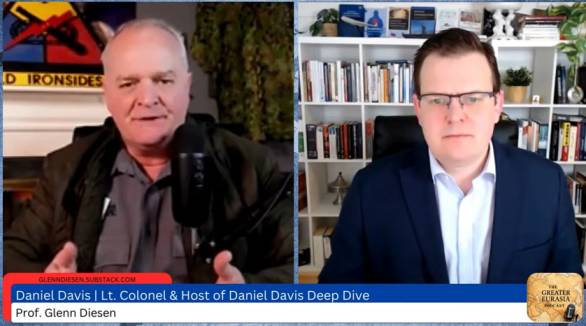
And they already understood ahead of time that this was going to be very costly for them.
But they had calculated — this was in the New York Times just days before — that fighting a war with the U.S. was less risky than submitting to the U.S. That, again, was another signal that they had made this decision to go.
And now, so far, that’s exactly what they had done and they are paying a price. And there’s no doubt that there’s been profound destruction of their armed forces, of their senior leaders, of course their political and military, and definitely their military infrastructure’s taken a beating. But I’m pretty sure you and I did talk about this. They have these underground facilities throughout the country, and they have the ability to withstand a lot of this for an extended period of time. But we don’t. That’s the key issue here.
I said that we had to — we had maybe four or five days of high intensity flight. Maybe we could stretch that out to a couple of weeks if you’re judicious in the use. But then what if the other side doesn’t capitulate? You’re in real trouble. And now then that’s where it looks like we are.
The Ayatollah’s Assassination and Its Consequences
There’s reports out just in the last few hours that President Trump is saying, “Hey, maybe we can have a ceasefire. They’re asking me for it,” which has got to be complete BS. There’s no way they would ask for it, not now, not after their Ayatollah has been assassinated. That’s the last thing they’re going to do, is cease fire under those conditions.
Otherwise he would have been taken to a secure location. Evidence suggests that he knew he was going to be assassinated. And he willingly sacrificed his life to be used as a martyr. Because he didn’t go to a protected place, he stayed where everyone knew where his compound was, so that when the strike came in, he was killed. That’s what it looks like happened intentionally.
And now that result looks like it’s having a situation to where it’s not causing the backbone to quiver, but it’s actually consolidating support behind the regime and throughout the Shia world. There’s lots of protests going on around the world in support of the Iranian side because of the sacrifice of the Ayatollah.
So I think it has been a profound — and I mean to say a miscalculation is bad because that almost implies that you thought maybe it was going to be good, but what you base it off of, you thought it was going to work, but it didn’t. This was well known ahead of time that unless the other side just quit, and everything in the world said they wouldn’t, and you went ahead anyway. That was a profound error. So yeah, I think it’s a major miscalculation.
Iran’s Strikes Across the Region
GLENN DIESEN: Well, they didn’t seem to predict that Iran would attack bases across the region. So Qatar, United Arab Emirates, Bahrain, Oman, Kuwait, Iraq, Jordan, Saudi Arabia, obviously Israel, but also, as you said, killing Khamenei. This is a very strange thing that they thought the government would collapse then.
In the Shia culture, the martyrdom is so deep. This is something that would, as you said, get them riled up or consolidate. But also in the Shia region, Shia communities across the region, you see from Iraq, Pakistan, Bahrain, they’re all taking to the streets in support of Iran, given this attack and killing of their religious leader.
And I saw Trump giving a speech now in which he argued that all the Iranian army should put their weapons down and their civilians should take to the streets. Does he really think this is what’s going to happen now?
Trump’s Miscalculation: Projecting His Own Values
DANIEL DAVIS: It’s just, I really do. I think that he does think that. I think that in his mind, you know how a lot of people often do projecting — whatever your values are and whatever you would do in a circumstance, you just project onto another actor. And I think that’s what he did, because he’s thinking, “Yeah, if I came in and somebody from the stronger position came in and just started bombing the crap out of me and killing some people, I’d give up. I’d just say, yeah, let’s roll in.”
So that’s what’s going to happen. And then he’s like, “That’s kind of what happened with all those speedboats. I killed all these people and blew it up. Nobody did anything. I stole the leader from another country in Venezuela. Nothing happened. And they just rolled over the whole leadership in Venezuela. All you got to do is just show how tough you are, and then they’ll just roll over.”
And I think that’s what he thought was going to happen here, not recognizing the radical and profound differences between Venezuela and the Shia country of Iran, as you pointed out. So I think it was a big miscalculation.
Iran Strikes Civilian Sectors — A Message to the Region
I will say the one area where I wasn’t — I did not foresee properly. Iran had said that they would attack the bases of everywhere America was in the region. We took that seriously and bolstered up a lot of the air defenses. But I did not think that they would, from the beginning, also attack the civilian sectors of those countries.
It appears to me that their message was, “Hey, you guys, we’re suffering from the U.S. We have since 2010, from Israel and then starting with the assassination of Soleimani by the U.S. in 2019, we’ve just been hit mercilessly and you guys are protecting them. You guys are putting these bases in there and they’re using that against us. So it’s time for you to feel some pain too.”
It looks like that’s kind of what they said, kind of like a big F* in a big way. And there’s been some really big strikes. I thought that they would not do that in an effort to say, “Hey, don’t take action against us. This is just against the U.S.” But it looks like they’re saying, “I’m just tired of getting pushed around.”
Which is another indication — the reason I bring that up is because that shows that they’re all in on this and they’re going to say, “Listen, we’re even going to hit other regimes in the area to see if we can put pain on the United States, on Israel and on their backers in the region. And they’re going to start suffering until everybody backs off and then maybe we will too.” Maybe they’ll do some negotiation later. I don’t think they’re going to do it right now though.
Iran’s Wider War Strategy
GLENN DIESEN: No, that’s what I’m thinking as well. I think probably, yeah, they would want an end to this, but I think they want to inflict some more pain. Otherwise, you know, you will going to have a similar war again in six months as well during negotiations.
DANIEL DAVIS: Probably.
GLENN DIESEN: But what do you see though, the wider war strategy of Iran here? Because I was also a bit surprised by the civilian targets, that is airports, hotels. The foreign minister said, “We attacked hotels because they housed American troops.” But still I’ve seen a lot of other civilian targets which didn’t — yeah, it fits more within your analysis here that is more about causing pain.
But they jumped straight into the closing off the Strait of Hormuz. They attack ships, I think four oil tankers so far, if I’m counting correctly. So what is the strategy now of Iran? I mean if, yeah, if you would sit down with the war planners, what do you think they would say?
Iran’s Strategy: Going All In
DANIEL DAVIS: I think that they have calculated we’re going to run this out for a number of months. That’s my guess based on what they’re doing. These things aren’t short lived. These things aren’t like, well, we’re trying to do this and we’ll ratchet up bit by bit to increase the pain. But if you back off at any time, so can we.
This sounds like they have said, no, we’re all in. And so we’re going to shut down. All the stuff we’ve been signaling we were going to do, the stuff you didn’t believe us. And I’m sick of it. After 47 years of taking this kind of punishment, from their perspective, I’m done. And so now then, new rules are in effect and you’re going to go by what we say. You’re going to finally taste some of the pain that we’ve been taking.
Because I think that they view this as a genuine existential crisis. And I think that they said we’re going to have to. It looks to me like in their councils, they must have calculated that we’re going to suffer real bad for this, there’s no doubt about it. But we are going to have a shot at having a positive outcome at the end, which is to drain the United States dry.
The War of Attrition Problem
The whole issue with the Russia Ukraine war is that it’s a war of attrition and both sides have a lot of inputs. And so it’s taken years and they’re still not there. As bad as Ukraine’s been hit, they can still keep going. The United States, on the other hand, is not analogous to the Russian side in that one. We don’t have that much capacity to just go for years like this.
As a matter of fact, you heard General Jack Keane on the morning of the attack say, boasting that we could do this for two or three weeks, and he said, “But maybe it’ll be done faster because they assassinated the Ayatollah.” And they said, “Well, now then, maybe it won’t even take that long.”
Well, if that’s your planning range, that was to me another major blunder of the United States to admit that we have a narrow window here. So what you’re telling Iran is, make sure you spread this out further than three weeks, because we’re going to have a really hard time maintaining enough gasoline for our jets, bullets and bombs for our jets. The missiles, the air defense missiles, the air offense missiles, the attack missiles, all of those kinds of things. We don’t have that many to just get into an indefinite expenditure here. We just don’t have it.
And however many Iran has, they also have limited. So it’s not like they can go on also for years, but they can go for more than three weeks.
Mounting Casualties and Political Pressure
I think they have calculated. And when you see these now increasing videos from Israel, and now then you see what I had feared about and was angry, and I’m angry about now, about the casualties, the United States, when those start to pile up, and believe me, they’re going to do everything they can to accelerate those number of casualties in both places. People at home are going to start saying, “Wait a minute, why did you do this? Where’s this quick victory?”
And especially if it drains out past three weeks, they’re going to say, “Hang on, you guys said this would be an easy win, or that it would be something that we could get done.” Now then we have it because Trump is now saying, “Hey, maybe within three days we can have a ceasefire in negotiation.” But what if now it’s the fourth day and the fifth day and there’s still no sign, the bombs and missiles keep falling from Iran’s side.
Now they start getting into more stuff when we start running low on air defense missiles as well. Now if they start pulling out wave upon wave of 300 to 400 at a wave of these Shahid drones, reportedly they have like tens of thousands of them and they could do that for a long time. We haven’t even seen any of those yet, not at scale. And we have seen some of the smaller number of drones get through American defenses as it is, at Bahrain in particular. There’s one famous video that’s out there.
If you keep going down that path and now all of a sudden we can’t even stop drones because we’re running low on air defense capabilities and we start suffering even more casualties as the time goes on, then there’s going to be incredible political pressure on both Jerusalem and Washington to start looking to something.
Iran’s Endgame: Negotiating from Strength
And now then, I think if you asked me what their objective was overall, I think from the Iranian side, it is to cause so much pain that now then we come back with hat in hand and looking for a negotiated settlement that is much worse for us than the one that was on the table the night before. All this from the Oman foreign minister. Now then those deals are gone. They’re never going to come back with those kind of generous terms again. Now then they’re going to be demanding a lot in return. They’re going to be demanding a drop in sanctions, change of designation, get rid of this terrorist designation, et cetera.
I don’t know that they’ll trust us on anything, but if they get something like that, at least a change of the negotiations and the sanctions, that could be a win for them, something they might consider. But it’s going to take a lot of pain on our side to get to that point because the anger and the hatred is so high for them.
And now then our arrogance has been challenged here, because for us to admit that we’re not strong enough to compel compliance from little Iran, that’s going to be a major, major problem for our side. It’s something that they won’t do easily and will be fought fiercely. Among all these war lusters and these warmongers who loved all this and have been pleading with Trump to do it, and he finally gave in, you could imagine they’ll continue on. And of course then they’ll blame Trump if he agrees to anything like this and say, “Oh, he just didn’t have the stamina, he didn’t have the stomach and the courage to keep going. We should have stayed.” They’ll blame everybody in the world except for themselves and see the disaster that what they got, what they wanted, how much it cost us.
But that’s a lot of stuff on the table here. That’s kind of where I see this going, which means a lot more people are going to die and a lot more things are going to get blown up.
GLENN DIESEN: Were you surprised though, that there was no gradual escalation ladder here, that they went all out so quickly? Again, this has been the end of day two and you know, all these countries hit, the Strait of Hormuz, the civilian targets. Like you said, they’re going all out. Did this take you by surprise?
Iran Goes All In: No Gradual Escalation
DANIEL DAVIS: It was 50-50. I wasn’t shocked. I wasn’t fully on board. I didn’t think they would, like I said, they did go a little bit further than I thought, but it’s logical, it’s what I would have done. But based on their 47 year history, I didn’t think they would. I thought that they would go bigger than they did in the 12 day war. I thought they would attack the US bases and I thought it was a coin flip on the Strait of Hormuz. I thought that might be a negotiating tactic, that, all right, we’ll ramp this up.
But it looks like, based on evidence, that in their councils of discussion before this started, they said, “No, we’re all in. If the United States and Israel start this war, we’re just all in.” And so now then I think that their calculation is just, yeah, there’s no more ramping up anything now that you’ve assassinated our Ayatollah.
And in that same council meeting, it’s now my assessment, based on evidence, that they said, “Hey, 86 year old, he didn’t have that much longer to live anyway.” And I think he said, “I’m not going into the tunnels, I’m not going to hide. I’m going to put myself right there where I’m always at every day. And when the bombs come, they’re going to take me out at that time, use me as a martyr, and then use that to rally people in our country and around the other parts of Shia Islam.” And it looks like that’s succeeding, at least so far.
Iranian Opposition Rallies Behind the Country
And I’ve talked to one and I’ve read that a friend of mine interviewed another Iranian who were just passionately against the Ayatollah and have protested against him in the past. And they said, “Listen, y’all are putting us in a terrible situation because we hated the Ayatollah and wanted to get rid of that regime. We’ve been protesting for years in this case.” And I’ve known this guy for well over a decade in my case.
And then others have said the same thing, that, “Look, while we don’t like him, do you think that we’re going to embrace Israel, our biggest enemy in the region, who’s been doing all this stuff to us since like the 2010 Stuxnet and on forward, assassinated our people in Tehran, blown up our embassies and stuff, and now attacked us twice? You think that we’re going to embrace what they’re doing and we’re going to succeed? No.”
And they’re not going to come tell us that Reza Pahlavi is going to become the new leader of Iran. Are you serious? That’s who we rose up against in 1979. That family, there’s no way they’re going to take him back, that he’s going to be able to govern any kind of coalition in Iran. At least that’s my opinion.
So they are angry at Israel, so they’re not going to embrace that. So if our thought was that we’ll cause enough mayhem and wound the leadership of Iran, then they’ll rise up because we’ve killed a bunch of their people and done stuff, and that’s going to be great for us, like Lindsey Graham, he’s the biggest proponent of that. I think that they’re angry at him too, because your assumptions were badly flawed, because now they’re in a bad position. They’re not going to turn against their own country and embrace what they’ve been calling the Little Satan for 47 years, or the Great Satan in our case.
The Failure of Regime Change Logic
So I think that no matter what weird words come out of Trump’s mouth, like, “Oh, these great and wonderful people of Iran, we look forward to having them,” they said, “Listen, we know it’s the same kind of language you guys have been using to everybody. You said that about the people in Libya, you said it about the people in Somalia, you said it about the people in Afghanistan, in Iraq, et cetera. You always say that kind of stuff, and then you walk away the minute it’s unhappy.” This is what they’re saying. “And so we know how that works out. We’ve seen this play before, so we know this is not about us. And you’re going to not do anything for us once you get what you want, which is the loss of that regime.”
So that’s another reason why they’re not exactly falling all over themselves to do what we’re asking them to do and to basically become our boots on the ground so that we don’t have to send in an army. I think that they’re saying, “Yeah, you want an army, bring an army. If you want to roll in and do this stuff, do it. Don’t ask us to die in large numbers on the ground because you don’t want to send in an army. And by the way, we don’t even like you.” So that’s complicating our strategy, too.
GLENN DIESEN: Yeah, it’s so, in the United States, there are many people who really hate Trump. Some even moved away from the country because they don’t like him. But even those people would not back Chinese forces bombing Washington or New York. I mean, it is quite crazy that this assumption that you can just sell this idea that, “Yeah, well, we’re fighting with you guys, the people.” This is a good way of weakening the opposition, if anything.
I did want to ask you, though, about the vulnerability of the aircraft carriers and overall the US Navy, because the Iranians seem to have their missiles going through everywhere, hitting these bases almost in all the countries of the region. However, the US Navy, though, it seems to be — well, I’m not sure if it’s been untouched. I haven’t seen anything. Have the Iranians attempted, or is it simply beyond their reach?
The Battle of Wills: Assessing the Conflict’s Trajectory
DANIEL DAVIS: Yeah, I don’t know. I’ve seen one video that claims to be from some Chinese tourists or something like that, and I don’t remember if it was Haifa or Tel Aviv somewhere where they claim to show this grainy video of a US ship getting hit. I don’t know. There are so many deep fakes out there, you can’t take anything at face value anymore, even really good looking videos. So I don’t know. Certainly haven’t heard any reports on that.
I had heard that there were some reports of US casualties killed in action earlier on in the process, like in the early hours. And the Pentagon, I’m sorry, the Central Command, CENTCOM, said no, there hasn’t been any. Well, from some direct sources that some of my friends know, they knew there were, but that’s what they were saying. And then of course, today they have confirmed that there were three killed, five seriously wounded and a number of others less wounded. And my sources are saying even that number is not true. It’s low, it’s higher than that. So we can expect to see that coming out.
So it’s possible that there have been some, but then we haven’t been reporting it so far. We’re afraid of the news because unlike all these situations where there are 10,000 cell phone cameras every time there’s anything happening in the city, that’s not the case out at sea. No one would know unless it’s reported. So maybe there has, maybe there hasn’t. I don’t know. That has been one thing that surprised me. I expected it to, but whether it hasn’t happened or whether we just don’t know about it yet, I can’t really say at this point.
GLENN DIESEN: Well, how would you assess the developments going forward in the next days and weeks? Again, this is a war of attrition, then. Should it be assessed by the ability of each side to cause pain to the other and also the ability to absorb the pain? Or is this how you should understand actions on both sides? Or is the United States more just looking for some…
No Boots on the Ground: A War Fought on the Cheap
DANIEL DAVIS: Ultimately, it’s a battle of wills. I mean, you can generally say that about every war, but this one even more so because we chose to try this on the cheap. We said, let’s bring all this naval and air power in, but no boots on the ground, because it’s like a bugaboo in the United States. And many people, to include Senator Cotton, Senator Cruz, and Senator Lindsey Graham, they all repeatedly bragged about how there were no boots on the ground. Nobody was talking about that. President Trump said that because they know that that’s something that American voters hate. So they thought, well, maybe we can win this on the cheap.
Instead of like in 2003 when we had a lot of air and naval power and a credible ground force of hundreds of thousands of troops that, when it was necessary, rolled in on the ground. So if you’re talking about President Trump telling the IRGC, the police forces, and the Basij and everybody else to put down your arms, well, that doesn’t carry any weight if there’s nobody there to make you do it. Just bombs fall unless you have an army that can come and compel it, like the Iraqis did when we said the same thing to them. And then here comes the First Armored Division rolling up the street. That’s going to have some teeth. But this one here, there is no armored division. There’s nobody on the ground whatsoever. So there’s no reason for them to capitulate. They just think, all we have to do is survive the onslaught.
And they know how many weapons we have, or they have a pretty good idea. They know that we have been bled deeply, maybe not dry, but we’ve been bled deeply by all the support we’ve given to Israel since October 2023. They know that we’ve been bled because of the four years of nonstop sending stuff to Ukraine. And it doesn’t matter that Trump hasn’t given it away. He sold it. And we’ve still given. Our inventory has gone down and our production has gone out there. So nothing was replaced that was lost during the Biden administration. It’s continued to dwindle. And now all of a sudden you need it. And they know that.
Iran’s Missile Stockpile: An Unknown Quantity
Look, they piled up all this stuff for years, for decades, because they’ve always foreseen this being a possibility. We have no idea how many missiles they actually have, how many drones they actually have, because they’re underground. And we can’t count those. We can’t go in with satellites, but we can imagine that they have a lot. Senator Ted Cruz today said that his understanding is that Iran can produce, right now, with all of these sanctions and everything else and all these fires and all these attacks, still 100 missiles per month. So whatever was lost in the 12-day war has been replaced. And we don’t even know how many they had before. I’ve heard wildly different assessments, but whatever it is, it’s a decent amount, and that’s on top of the tens of thousands of drones that they have.
So I think that they have just said it’s going to be a test of political will. Their will is going to say, “We’re going to keep this going beyond your two-week window, and we’re going to start spreading it out for like two or three months after that, when you’re going to be hurting.” Because if we now don’t have very many air defense missiles and we start getting into a situation like the Ukraine side, where they have an inadequate number of Patriots and IRIS-T and all the other kinds of air defense they have, and all of a sudden Russia can come and flood the zone with more missiles than they have interceptors, the stuff is going to get through.
Iran could be in that same, weirdly enough, position as Russia, where we use the bulk of our interceptors right now, and all of a sudden we can’t knock that many down. And by the way, there was some pretty dramatic footage — I think we’re going to show one of the scenes on our show this afternoon — of an American, reportedly an American videographer, I think it was in Bahrain, where they had the camera up there and they could see an incoming missile. And then you saw a Patriot interceptor fire up to intercept it. And you can see, because the angles were just flawless, it missed. The Patriot missed and the other missile came in and just hit very close to where the guy was on the ground. I mean, that’s day one. That was the first day that you’re seeing we’re already missing.
Now imagine if you don’t even have enough of those, and now the missile comes in and there is no defender, there’s not even one missile going up. And then you can start putting more and more of these lower cost drones in the air because you can’t knock those down in quantity either.
Running Out of Missiles: The Critical Inventory Problem
So I think that the Iranian side is calculating, “We’re just going to increase the pain on you until you can’t survive anymore.” Our strategy, on the other hand, is like, “Oh snap, I thought this was going to be done in a few days, in a week, maybe two weeks, and then they would capitulate.” So that’s still the hope. They’re still saying we still have a couple of weeks of really high intensity strikes that we can have, and there’s a lot of pain that we can bring on the Iranian side. So I’m sure that we’re going to continue on along with Israel to try and bring as much pain as possible, hoping that we can get them to that point.
But if we get beyond that and the Iranian side is still viable, and our side is now down in its inventories of missiles — offensive and defensive — it doesn’t matter how powerful our navy is, how many fighter jets we have, how many Patriot missile batteries we have. None of that matters if you don’t have the missiles. That’s the key issue that too few people recognize. It’s about the inventory of your offensive and defensive missiles. And it could be that Iran has more of them and certainly more to use here.
Unless we strip everything out of Indo-PACOM or everywhere else in the world and bring them in here, and now we’re literally empty-handed everywhere else, that could be a real problem. But there’ll be a temptation to do that. This could be a major, major problem for our side if it doesn’t end within a couple of weeks.
GLENN DIESEN: So much for the pivot to Asia. This is the opposite of what Trump was going to do.
DANIEL DAVIS: That’s going to be stripping Asia to get what we need to fight here.
Iran’s Pressure Points: Where Will the Pain Be Felt Most?
GLENN DIESEN: Yeah, sorry, just a last, very quick question. You mentioned that the US can well exhaust itself, that the Iranians can put a lot of pain on the United States. But what do you think is the most vulnerable area? Because if I was advising the Iranians, I would point out that you have many pressure points you can push against the United States. You can hit the American assets in the region, that is all the military bases. You can hit the Gulf states, even the civilian targets, to make sure that these countries go through a lot of pain — even oil refineries, whatever you want to go for. You can also go after the global economy, for example, shutting down the Strait of Hormuz or shutting down some of the air traffic. You can also focus a lot on Israel, and as we speak you have all these missiles raining over Jerusalem. Which area do you think is most likely to break first?
DANIEL DAVIS: Yeah, this will tell us really where the Iranian mindset is right now. My guess, based on what we’ve seen so far, is that they made a statement by firing in Dubai and Bahrain and some of these other cities. I think they’re saying, “Okay, message sent and received. We told you that.” But now I think, because quantity is an important thing, they’ll turn to the more higher value targets that they have.
And I think that for the United States, the pressure point is casualties. I think they’ll prioritize anything that’s going to be high casualty-producing on the United States throughout the region, at all of our bases. And maybe they’ll start going after the ships, I don’t know. And then the same thing in Israel. I think that they’ll go after casualty-producing capabilities. I think they’re going after the military first, especially anything with the intelligence. They’d love to go after those. And I had seen some reports that they did go after some intel facilities inside of Jerusalem to try and cause some degradation of their ability to track anything that’s going on inside of there.
And of course, if they can go after missile launchers on the Israeli side or their aircraft, that would be a high value target. Same with the United States Air Force — if they could knock those out, if they could knock out the tankers, that’s a big thing too, because that will limit our ability to even use the fighter jets that we have.
The Escalation Ladder: How High Can It Go?
But I think that what they do next depends on what we do. If we don’t go after the Iranian oil infrastructure and their energy supplies and their refineries, et cetera — and I haven’t seen any reports that we’ve done that yet, maybe we have and I just didn’t see it — but if we start going after that, especially at scale, and we can, it’s a fixed target, it wouldn’t be that hard, then I think you’re going to see Iran also start to pivot.
Because I think part of the signal, when I see them hit all of these civilian targets, is that they’re saying, “That’s bad for you. And I think it was Qatar, or maybe Dubai, where they hit a high-profile hotel in the middle of the city, for which tourists and other things, they hit an airport.” But they’re like, “You know, we could also hit something else that’s important to you, and that is your oil infrastructure. We can hit your refineries, we can hit your transfer stations at the ports, et cetera. We could cause profound damage that would take a long time to fix and come at much, much higher cost for the Kingdoms themselves.”
But I don’t think they’ll do that unless we go after theirs. And so if we try to ramp this up to bring more pain on the Iranian side, then I think you can see an expansion. So talking about the escalation ladder — I think the escalation ladder started on rung four or five, but there are still rungs above it that it can go to. And so there is some room left to escalate, and I hope we don’t get there, but those are the things I’m worrying about.
Related Posts