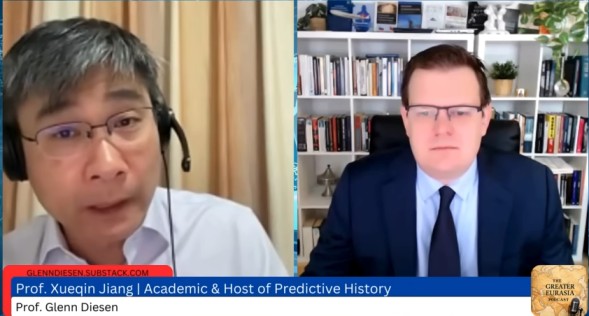
Here is the full transcript of Canadian-Chinese educator Professor Jiang Xueqin’s interview on Greater Eurasia Podcast with host Glenn Diesen, January 5, 2026.
Brief Notes: In this deep-dive geopolitical forecast for 2026, Professor Glenn Diesen and Jiang Xueqin analyze Donald Trump’s upcoming “grand bargain” visit to China and its implications for the global financial order. They deconstruct the strategic logic behind the recent U.S. intervention in Venezuela, arguing the move was designed to strangle China’s resource access and enforce a renewed global reliance on the U.S. dollar.
From the “irrational” remilitarization of Europe to the bursting of the AI investment bubble, the duo explores the systemic weaknesses threatening to push the American empire into a state of “micro-militarism” and domestic instability. Ultimately, Xueqin warns that these global maneuvers are merely the setup for Trump’s ultimate goal: a high-stakes confrontation with Iran to cement American hegemony for the coming decades.
Introduction
GLENN DIESEN: Welcome back. We are joined today by Professor Jiang to discuss 2026, what to expect. So thank you very much for coming back on.
JIANG XUEQIN: Thanks Glenn.
Trump’s State Visit and the US-China Grand Bargain
GLENN DIESEN: So you’re renowned for using historical patterns and game theory to predict the direction of geopolitics, and from the election of Trump to the invasion of Iran, you’ve been pretty much spot on. So I thought who better to ask about what to prepare for this year, 2026. And yeah, we’ve certainly gone off to a very rough start.
But before we look into 2026, can I ask you, what is it that makes your geopolitical predictions more accurate? Is it to rely on the economic structure, then the elite politics, ideology, or military balance? If you would assess 2026.
JIANG XUEQIN: Yeah, so I use game theory and I basically see geopolitics as a game played by different players who are trying to maximize their own self-interest. So I don’t really look at ideology. I basically focus on self-interest.
GLENN DIESEN: So for 2026 then, what are the main things you are looking at?
JIANG XUEQIN: Right. So for me, I think the big event of 2026 will be this April when Trump visits China on a state visit, his first in his second term. And the US-China relationship will be the big question for 2026. Russia, the war in Ukraine, it’s basically pretty settled, it’s stabilized. What will happen between Europe, NATO, Russia, we can basically forecast easily. But what’s really up in the air is the US-China relationship.
So what Trump wants to do is go to China and negotiate a grand bargain between China and United States. Remember that in 1971, Nixon removed the US dollar from the gold standard and so the US dollar was now free floating. So to stabilize the US dollar, to give it value, he did two things.
The first is he established the petrodollar, meaning that Saudi Arabia would only allow for its oil to be purchased by US dollars. And the second thing that he did was he visited China to open up China. And so what America did in the 1980s was transfer technology and expertise to China, open its market so that China would become addicted to the US dollar. And for a few decades this relationship worked really well.
But then the United States started to abuse its exorbitant privilege. It started to print too much US dollars. It started to engage in these wars in the Middle East that were causing the debt to balloon. Then you had the 2008, 2009 great financial crisis. So China became much more worried about the value, the stability of the US dollar.
So then it began to try to internationalize the yuan. It created something called the Gold Corridor, the Shanghai Gold Exchange. So it’s trying to recalibrate the financial market so it becomes much more stable, and China would have much more sovereignty in the global trade system. And this is now destabilizing the US dollar.
The Strategic Logic Behind Venezuela
So what Trump wants to do is to force China to continue to buy US dollars, because remember, if China were to dump all of its US Treasuries, then there will be a sovereign debt crisis in the United States. So Trump needs to figure out how to liberalize the Chinese financial markets and get Chinese to continue to buy more US dollars. And that’s why we’re seeing what we’re seeing right now.
By invading Venezuela, what Trump hopes to do is force China to buy oil using US dollars. So where does China get most of its oil? It gets most of its oil from the Middle East. So if Trump were to attack Iran and destabilize the Middle East, then China will be forced to rely more on the Western Hemisphere for its oil supply.
But not just the oil supply, but also for silver, for gold, for lithium, for copper, basically all the minerals that China needs to power its EV industry, its AI industry. So this is the grand strategy that’s being played out where Trump is conducting all these wars around the world in order to strangle the Chinese economy so that China becomes reliant on the Western Hemisphere for supply. And then China will be forced to buy more US dollars. And that’s the great game that we’re being played, that we are witnessing right now in 2026.
The Paradox of Force and Trust
GLENN DIESEN: But it looks like this can go both ways, because if the United States really wanted for China to use the US dollar, and again, there’s a lot of benefits for China to use the US dollar, then they would want to do, I guess, to some extent, the exact opposite. That is to create trust and an open, predictable international economic system in which the rule of law would come first.
The problem of forcing will suggest that all rules were cast aside.
And I guess, if you took the Venezuelan case, instead of being forced to buy oil in US dollars, they could go the other way. They can make themselves more dependent on Russian energy given that they have a common border and put these two great powers even closer. So how do you assess what direction the US goes? Because at the moment there seems to be a bit of a strategic vacuum. They want to build trust, but at the same time they want to force China and coerce it to do exactly what it wants. You can’t have it both ways. You have to pick one path and stick with it. Otherwise everything falls apart.
JIANG XUEQIN: You’re absolutely right. I completely agree. The United States, if it were to perceive China as a peer and were to treat China with respect, to see China as a sovereign nation that is worthy of respect, we would have no issues. China would be perfectly happy to trade as equals with the United States.
The problem is that the United States is the global hegemon and insists on maintaining its global hegemony. So China must be a subordinate to the American empire and China refuses to do that. China is a sovereign nation and it wants to be respected on the world stage.
But as you point out, these two nations are co-dependent on each other. If China were to lose access to oil in the Middle East and in the Western Hemisphere, it could depend on Russian oil. But Russia could not meet China’s energy needs. China imports three quarters of all its oil from overseas. Half of those come from the Middle East, 20% come from Russia.
If China tomorrow could import all its oil from Russia, it would do so. But Russia does not have the capacity to do that. You still have to build those pipelines which will take years and years and cost tens of billions of dollars. And so China is sort of stuck right now.
Mutually Assured Economic Destruction
But as you point out, China does have a lot of tools. It does have a lot of weapons. For example, it can continue to destabilize the US dollar. And we saw that with the silver markets, right? So what China did at the start of this year was announced that it would restrict exports of its silver. And China dominates the silver market. And this caused the price of silver to skyrocket in COMEX, the commodities exchange in the United States. And this destabilized the US financial markets.
So what we’re seeing is almost mutually assured destruction, right? So if the United States were to cut off China’s oil, if the United States were to embargo China, China could just dump all its US Treasuries, could just cause financial havoc and both nations would be destroyed.
So what we’re seeing, and here’s a metaphor, okay. Imagine a ladder over an abyss. And both China and the United States are trying to climb this ladder and it would be in their best interest to climb it together. At the same time, the United States for whatever reason insists on being higher than China.
Now if the United States goes too far and leaves China far behind, the ladder destabilizes and they both fall into the abyss. If China overtakes United States and climbs too far, they also both fall into the abyss. So this is a really dangerous and really stupid game they’re both playing. And again, we would not be in this situation if the United States showed some humility and started to treat China as an equal. But unfortunately we are in this situation.
Ideology, Hubris, and Racism
GLENN DIESEN: Yeah, that’s why I initially asked about ideology. Because often, at least for political realists, the assumption is the states are rational. But we see with ideology over the past 30 years a whole political class being raised on the notion that peace in the world requires the hegemony of the West because then will elevate this liberal democratic value. So it’s the idea that they can’t imagine a world in which it’s not based on dominance. And I think this is fueling a lot of irrational behavior. I mean, if it’s a problem in the US, it’s definitely a problem in Europe.
I like that you pulled China into the Venezuelan issue because many people miss that. Venezuela did offer to accommodate all these American energy companies though. But it’s not about only the US getting access. It’s also denying or conditioning the access of rival great powers. So I think, yeah, that’s an important aspect.
But also in terms of accommodating China though, Kissinger made a similar comment back in 2014 in regard to Russia. He said if they are a great power then we should treat it as such, accommodate their interest so they can be accommodated into the US-led order. If not, we’re going to end up with stupid policies such as trying to defeat or destroy them. And that’s what he warned against. And I fear that’s the direction they’re going with China as well.
JIANG XUEQIN: Sorry, sorry, sorry. You know, I love what you said. So let me make two points to reinforce what you said.
First of all, I don’t think it’s ideology. I think it’s this hubris and racism, okay. I think that Americans think that they are the best and they hate the fact that China is catching up to America. Okay? So it’s hubris. And you can also say it’s racism right now. What’s happening in this geopolitical order. That’s number one.
Number two is that, you know, we saw what happened in Venezuela, you know, Maduro being kidnapped. A lot of people are saying that America did this to capture Venezuela oil resources. That’s not true. What America did was to spite China because America’s not going to go in and build up Venezuela’s oil infrastructure. That costs tens of billions of dollars. It’ll take many, many years before America can really bring the Venezuela oil industry up to modern standards.
What it’s doing is cutting off access to China. That’s the entire goal. Right. So it’s not to claim the oil and it’s not to benefit US oil companies. It’s just to spite China. That’s all it is.
Economic Crisis as the Wild Card
GLENN DIESEN: Well, no, I agree. I think this is the main issue. This is why they keep referring to the Monroe Doctrine and obviously China is the main concern there. Because if you want to control your own hemisphere, seeing China as being the main trade partner to all of Latin America is something that has to be reversed.
But how do you factor in though the unknown variables? For example, if I would predict one thing for 2026, it will be an economic crisis, that is for the United States. And again, once economic crisis kicks in, it manifests itself in political social instability. The rationality of states tend to wither away when things at home go poorly and they will seek quick fixes and easy solutions and yeah, like these tariff policies or allow economic conflicts to elevate into war.
So how do you see economic crisis playing into 2026, especially the US-China rivalry?
# The Fragility of the American Financial System
JIANG XUEQIN: Right. So America, the American economy has some major weaknesses and you’re right that it’s possible that America faces a great financial crisis this year. So let’s go over some of the major problem areas.
The first is artificial intelligence where right now most American GDP is driven by investment in AI. So just building data centers which consume a lot of water, electricity in local communities. And what’s a problem is that these data centers cost tens of billions of dollars. And it’s really unclear how these data centers will make money because right now how most people use AI is to generate videos and to cheat in school. Right. To get ChatGPT to write their essays.
It’s unclear how this will be beneficial to the economy and if it’s possible for AI to be profitable, this will cause millions of jobs to be lost. So it seems as though the AI bubble is about to burst. The problem though is that right now the U.S. economy doesn’t make any sense. Right?
So there’s Michael Burry, who is very famous for predicting that in 2008 the subprime market, the CDO market, would collapse. And he took out billions of dollars in bets against this market. He made a lot of money. And then he made a bet against AI because he was certain that none of the fundamentals made any sense in the industry. And then he suddenly announced that he was actually leaving the industry.
And the reason why is, okay, the AI industry doesn’t make any sense. But guess what? The entire American financial industry doesn’t make any more sense anymore. Meaning that right now the American financial industry, it’s controlled by a few oligarchs, it’s controlled by a minority of people who can dictate the market to their will. And so the average consumer, the average investor, market fundamentals no longer apply to what’s happening.
So yes, in theory, the AI market should, could collapse. But because there’s so few players within the market, it’s controlled by, you know, seven companies, they can do whatever they want. And the American government has something called Operation Stargate, Project Stargate. And so Trump has promised hundreds of billions of dollars to invest in the AI infrastructure. So it’s possible that this bubble keeps on going on and on.
Okay, so this means that right now the American financial industry lacks the capacity to self-correct. And so if the market collapses, it’s probably going to take the entire economy with it. And so that’s a great problem facing the U.S. financial industry. That’s problem number one.
Over-Financialization and the Silver Market
Problem number two is over-financialization. And this goes back to the silver example where when China announced that it was going to limit its exports of silver and China controls about 60% of the silver market in the world, the price of silver went crazy. The reason why is that in China, silver is used for manufacturing needs. So silver goes into AI, EV batteries, all that. So China really needs silver.
But in the United States, silver is used for speculation. So silver is really, it’s owning paper silver. And a lot of these companies like JP Morgan, they’re over-leveraged 300 to 1. So every 1 ounce of silver that they have, they promised 300 on paper. And so it’s a great bubble that’s going to burst. What we saw in silver was almost like a small bank run.
But it’s not just silver. It’s almost all these commodities where these commodities aren’t used for manufacturing needs, they’re used for speculation. And so the American financial industry is one great Ponzi scheme that’s about to explode at any point.
And the third great weakness of the U.S. economy, of course, is cryptocurrency, where Bitcoin, it’s all just speculation. It brings actually no benefit to society. So you have all these major weaknesses in the American economy, but because first of all, you have a few oligarchs who control all the resources. Second of all, the American government can print as much money as it wants. There’s something called quantitative easing. And third of all, there’s really no challenger to the U.S. dollar.
This bubble can sustain itself past 2026, but when it collapses, the entire society collapses. So you’re basically looking at civil war.
GLENN DIESEN: So civil war in America.
JIANG XUEQIN: Yes.
GLENN DIESEN: So in terms of gold and silver, you would assume that this rally will continue then, given that it’s the paper gold and paper silver has been inflated so far beyond what actually exists in terms of the hard assets.
JIANG XUEQIN: Look, the reality is that demand exceeds supply, right? So silver goes into AI, it goes into EVs, batteries. Because silver is the best metal conductor in the world. And there’s no second. Copper is second, but it’s far behind silver. So you need silver and the world cannot produce enough silver. And this has been true for the past five years.
And China and the United States are investing heavily into AI. So right now there’s a major fight for access to silver. And this goes back again to Venezuela, where Latin America and South America actually are the world’s greatest producers of silver. So whoever controls Latin America and South America basically has control over the AI future.
China’s Strategic Vulnerabilities and Strengths
GLENN DIESEN: Well, so things look a bit grim for the United States and you have all these bubbles you refer to. Once this begins to fall apart, civil war becomes a real possibility. But how do you see this obviously affects the rivalry they have now with China, but what do you see on the Chinese side? Because what are the strategic priorities and how do you see them pursuing them? Because one would assume that China would also become a bit more assertive as it becomes more confident, but also as the pressure is building on the United States to essentially break China and restore the ’90s, if you will.
JIANG XUEQIN: Yeah. So, you know, the greatest strength and the greatest vulnerability of the United States is the U.S. dollar. Right. But the greatest strength and the greatest weakness of China is its reliance on exports. China is an export-oriented economy. And in order to feed its economy, it focuses on exports. And sometimes its export strategies are kind of counterproductive and self-defeating. So for example, it dumps commodities onto the world market, which hurts the trade system.
Okay, so China also has a lot of fundamental issues. Right now. The problem is that the United States is threatening to strangle, embargo, blockade China. Right. So one thing that will flare up in 2026, it’s already flaring up right now, is a rivalry between China and Japan.
So Prime Minister Takaichi has said that she believes that Taiwan is part of Japan’s strategic interests. And what does she mean by that? What she means by that is that if China were to get hold of Taiwan, Taiwan could blockade Japan from access to the Strait of Malacca and therefore oil from the Middle East, which Japan is dependent on. And so Japan believes that if China were to invade Taiwan, then Japan would have to step in.
Okay, so Taiwan is key, but you know, the opposite is true where if Taiwan were to, Japan, the first island chain could embargo China, can block China from trade. So I think in 2026, you’ll see a lot more heated rhetoric between China and Japan. The reason why is both economies are dependent on Middle East oil and whoever can control the Strait of Malacca can basically strangle each other’s economy.
Europe’s Irrational Path to Militarization
GLENN DIESEN: Yeah, well, this is the classical problem. I mean, again, I think we talked before about how it looks a bit like pre-World War I, that is that China has kind of outgrown this security architecture or economic architecture as well, which is, well, more or less designed to contain China. So if there’s not a diplomatic path to this, it does look like conflict becomes unavoidable.
But if we shift a bit towards Europe and well, which includes then Russia. You said that the Ukraine war has been more or less settled, stabilized. I assume you’re not referring to stable front lines. I’m assuming that the future of the conflict has been determined now, which seems correct. But on the other side, the reason I focus on the rationality of states is because you see from the Europeans now increasing rhetoric that, well, we can’t afford a peace.
If the war ends, then Russia would focus its resources on us. And so one after another, you see different European leaders and media outlets saying, well, war may be better than peace now. So are we prepared to end this war or how do you see this playing out now?
JIANG XUEQIN: Yeah, so I think the future is obvious. Europe is going to militarize against Russia, even though it is against the best interests of its people. Its people will be very upset with remilitarization. You’re already seeing massive protests in Germany. A lot of this will be irrational.
Meaning, Europe has absolutely no path to victory in Ukraine, but Europe’s going to send men to their deaths in Ukraine anyway because Europe doesn’t know what else to do. Right. So what Europe is really saying is that we banked on Russia losing this war and then we could impose an indemnity on Russia and that would solve all our fiscal problems.
Now that Russia is winning the war, we are facing economic collapse at home and we don’t really want to face that. So we’re going to continue the war and hope for the best. So there’s no strategy here. It’s suicidal, it’s irrational, but Europe is stuck where it is.
GLENN DIESEN: Well, whenever I ask different experts what they see the likelihood of a direct war between Russia and the Europeans, they usually say, ah, very little because the Europeans don’t have the troops. It would be suicidal. But this assumes that all wars are calculated and deliberate.
Because if I think war, an accidental war, war by miscalculation will be rooted in this assumption of escalation control, that is, you know, the Europeans can’t afford to see Russia win. So we’ll send a little bit more long-range missiles, we’ll try to target the political leadership. Let’s blow up some Russian tankers so we escalate at the same time as pressure is mounting on Moscow to stop allowing the Europeans to step over all red lines.
So why should the Russians accept Europeans engaging in direct attacks, killing Russians? So they will then retaliate. And I don’t think the Europeans want a direct war. They would just like to kill Russians through Ukraine and then, you know, claim that their hands are clean. But I don’t think this is coming to an end.
I think from what I hear coming out of Moscow, we’re reaching the end of the line. Especially the Germans should be hit hard if they continue along this path. But if you open any, sorry, European or German newspaper, they don’t seem to realize this at all. If they recognize possibility of war, it’s because Russia will want to restore the Soviet Union or, you know, march on Paris, something along those lines. Do you think though that this is a real prospect?
The European Elite’s Self-Reinforcing Bubble
JIANG XUEQIN: Look, I think that the leadership of Europe, the European elite, they live in their own reality. So you know, like YouTube and social media, there are different bubbles. And I think the European elite, they literally believe that Russia will collapse tomorrow and we just wait another day, then the Russian economy will collapse, the people of Russia will revolt and Putin will be overthrown, and then Russia will sue for peace.
If you just watch their media, they repeat this over and over and it becomes a self-reinforcing bubble. The EU, it is this sprawling, self-reinforcing bureaucracy and they’re not capable of imagining defeat, they’re not capable of imagining different possibilities. They’re certain, they’re absolutely certain that if they just wait out one more day, then the war will be over and they would have won.
And you know, if you talk about irrationality, go to World War I and for those four or five years where millions of people were dying for no reason and the reason why was these leaders just could not accept the possibility that they had made a mistake. Okay. I mean it’s, I understand this is all silly. Why would you sacrifice men? Because you can’t afford to make a mistake.
They can’t afford to admit that, hey, maybe sending Boris Johnson to sabotage peace talks between Kiev and Moscow was wrong. Maybe blowing up that Nord Stream pipeline was wrong. Maybe antagonizing Russia these 20 years by expanding NATO to its borders was wrong. These people absolutely refuse to admit they’re wrong and they’re willing to sacrifice their own nations to avoid admitting, you know, being wrong.
The Future of European Security Architecture
GLENN DIESEN: Yeah. Even now that the loss, NATO losing Ukraine is starting to become obvious, the new goal appears to be, well, let’s lose slower. Let’s keep the Ukrainians a little bit longer in the fight, even though it will be a humanitarian disaster for Ukraine and also strategic disaster for Europe, because this is not good for them.
But how do you see this playing out in the European security architecture? Because again, the EU and NATO are the two main pillars of how Europe has been structured in the post-Cold War era. They’re supposed to be the hegemonic order of Europe. Also what U.S. unipolarity was supposed to rest on, especially NATO.
Do you see them being able to survive? Well, 2026 might hold on, but how do you see this? Well, what would you expect from 2026? Complete collapse isn’t necessarily in the cards, but it seems to be deteriorating fast. I mean, as we speak, Trump is laying claim to Greenland and the Danish Prime Minister trying to refer to Article 5, but I’m not sure if America would come to the defense of Greenland if America goes after Greenland. I mean, this is kind of absurd stuff.
The Collapse of NATO and the Battle for Odessa
JIANG XUEQIN: Look, the reality is that Trump hates Europe. He hated Europe ever since 2016, when Europe basically insulted him during his first presidency. Europe thought he was a joke, he was a charlatan. And Europe inspired Obama to overthrow him in 2020. So Trump hates Europe.
And you can tell because, you know, what was the first thing that happened after Trump won election? He sent J.D. Vance to Europe to scold Europe for failing Russian civilization, for letting in too many immigrants, for embracing woke ideology, for betraying Christian values.
And so Trump would be more than happy to see the entire NATO system collapse. And you can argue that Trump is forcing NATO to collapse because Trump is forcing NATO to fight a war it could possibly not win against Russia.
So I think what’s going to happen is that NATO will sleepwalk into disaster, into Ukraine. And the reason why is that it’s just this lumbering bureaucracy that cannot possibly imagine its own demise. And these are just bureaucrats who just want to collect their own paycheck and who are looking for their own pension. So they don’t really care what happens. They’ll just do what they’re told.
And this war will be settled in Odessa. I think that NATO will collapse in Odessa because NATO will commit to defending Odessa. Russia will encircle it, blockade it, and NATO will not be able to hold on. NATO will force Europeans to be conscripted into the army to die in Odessa. They will refuse, and you will have civil war throughout Europe.
But this is a five to ten year time frame. It’s not going to happen this year. It’s going to be another five to ten years, but it’s a slow death for Europe.
GLENN DIESEN: So Odessa would be the end of the Ukraine war then?
JIANG XUEQIN: Yes.
GLENN DIESEN: Well, that makes sense. The Russians have set their eyes on Odessa as the—this is to a large extent about the Black Sea. And of course, this is where NATO attacks Russia from, primarily from Odessa. And I think the British and French would never accept giving up Odessa. This is, I think, the key prize in this war. So you’re probably spot on there.
How about Europe’s goal of strategic autonomy? This was—we heard for many years, strategic autonomy, European sovereignty. These were the slogans of the EU. It’s very stark contrast to the subservience to a U.S. which hates Europe. But how do you see the internal cohesion holding in place? Because I think Europe succeeded when it was able to deliver economic benefits to its member states as a collective bargaining power. I don’t see that anymore.
The Death of European Identity
JIANG XUEQIN: Yeah. So after 1945, Europe was forced to adopt the ideas of the open society. This is Karl Popper who argued that World War II was caused by fascism, by this excessive embrace of nationalism. So to prevent another great war, societies have to become much more open, multicultural, tolerant.
And that was a strategy for the EU bureaucracy for the past few decades. That’s why they’ve let in so many immigrants. That’s why they’ve embraced woke ideology. And it’s basically made societies much more polarized.
So you have the real possible civil war in Britain, in France, because they let in all these immigrants. And the natives see these immigrants as a threat to their cultural identity. And so, you know, wars are fought because people want to fight them to protect the ones they love, and they fight them for their homeland.
But right now, if you go to Britain and you ask them, “What does Britain mean to you?” I think British people would be hard pressed to answer you. If you interview these immigrants in Britain and say, “Hey, are you willing to go fight a war in Ukraine to defend Britain?” they’ll say, “Hell no.”
And natives are like, “Why would I leave this land to go die in Ukraine so that these immigrants can take it over after I’m dead?” So the idea of getting these Europeans to go fight anywhere is just ridiculous now.
And yeah, I mean, you will conscript quite a few because these European nations have become authoritarian, but it’s going to destroy their societies. So Europe is no longer capable of fighting a full scale conflict with Russia.
GLENN DIESEN: Sometimes I get a feeling of some similarities with the Soviets after the Bolshevik Revolution when they were fighting because the Russians were deeply religious. So when they were essentially going to fight under a Bolshevik or a Soviet flag, the problem then was what exactly are they fighting for? So they kind of had to allow the church to come back in because this is what people fought for.
And I get the same impression now that the Europeans are being told that we have to go and die for them to fight Russia. And if you ask why, they will refer to, you know, the nation and the typical things people would die for. But they spent the past years, not decades, to express their contempt for our faith, our traditions, our culture. And now we’re supposed to die for it.
I mean, what are we dying for? It doesn’t really make any sense. I mean, this is what nationalism is. People kill for it, but they’re also willing to die for it. I think the smearing of nationalism, even though it was introduced in the French Revolution with democratization, I think it’s been another flaw.
But yeah, so how does this play into the United States? Because the Europeans were a key partner of the U.S. in the past during the Cold War and the hegemonic era. But what do you see the Americans doing now? Are they drifting further away from the Europeans? Will they abandon bloc politics or will they simply demand subservience?
How will the U.S. build its power moving forward? Because this is what perplexes many European politicians. Every time America slams them or threatens Greenland, they all go on Twitter going, “Well, we’re good allies, you need us to be great.” But it doesn’t appear that this sentiment is shared by Washington. So what will the U.S. build its power on?
America’s Transactional Empire: Exploit or Abandon
JIANG XUEQIN: Look, the United States is now transactional. It’s an empire and it’s going to exploit its vassals. And if it cannot exploit its vassals, it’ll just abandon them.
So the United States right now, it’s uncertain what it can derive from Europe. Europe has an aging population, it is not willing to fight wars. It does not have that many able-bodied men, it has very few resources. So the United States doesn’t really know what it can do with Europe.
And in fact, the United States believes that Europe has been stealing and exploiting the United States for the past few decades. It’s the American security infrastructure that has protected Europe, that has allowed Europe to create its welfare state. The Americans think that the Europeans are just lazy and decadent and corrupt.
And so the United States is going to throw Europe overboard, just abandon Europe to Russia and forget about it.
And so the United States national security strategy is very clear. It’s going to use the Western hemisphere to project its power overseas. The example goes after China, where, listen, in the future, China, if you want resources, don’t think about the Middle East because it’s on fire. The entire place is at war. Don’t think about Europe because Europe is dead. Don’t think about Africa, because we’re going to challenge you there as well.
You’re going to have to come and buy resources from the Western hemisphere and therefore you’re going to have to buy from us. So I think that’s the national security strategy going forward. The United States is intent on maintaining its hegemony for the U.S. Dollar. And so it needs to make China subordinate to the U.S. Dollar, dependent on the U.S. Dollar.
GLENN DIESEN: Yeah. This idea that they will in this new imperial phase of the United States, that they will either exploit or abandon. I don’t think the Europeans appreciate this because I heard the same from Americans as well. We were trying to decide whether or not we should make it an exclusive sphere of influence for the United States or just extract the wealth.
But if it’s the option between exploiting or abandoning, the Europeans can’t envision a future without the leadership of the U.S. So they’re allowing, I think, the U.S. to extract wealth at the moment through all this, putting companies across the Atlantic or these trade deals which are so horrible, but they still sign them on Trump’s golf course.
But of course this is a temporary fix. Once America has extracted everything it needs, Europe is even weaker, more irrelevant, and it will be abandoned anyways. But, well, again, there’s no discussion in the political class what to do. It’s just the assumption that Trump is the bad man and if we just wait him out, things will go back to normal.
JIANG XUEQIN: That’s literally what they’re doing. They believe that in 2028 the Democrats will come in and reverse Trump’s policies, as Biden did in 2020. And what the Europeans don’t realize is that this is a new reality. We’re not going back to 2020.
Even if the Democrats were to come in in 2028, they’re going to maintain Trump’s imperial policies because this is in the best interest of America. America derives no benefit from helping Europe in any way.
GLENN DIESEN: Especially if it grows even more irrelevant. I mean, but they don’t see it in terms of national interest and the value of an alliance. They talk about friendship and values, which is kind of—yeah, but I saw again where the ideology comes in. I mean, they convince themselves that this is what glues us together as opposed to having common strategic interests.
But for the United States though, do you see overall its power retrenching? Will they overextend or will there just be a complete absence of a coherent strategy?
Venezuela and the Seeds of Imperial Decline
JIANG XUEQIN: So what we’re seeing is acceleration of the demise of the American empire. So let’s go back to Venezuela and I’m sure everyone saw what happened where, you know, these Chinook helicopters carrying Delta Force special operators flew into Caracas and killed basically Maduro’s security team, his Cuban security team, and then escorted him to New York where he was perp-walked and it seemed as though, you know, a triumph of the Romans, where they brought in these kings who they captured and they paraded him through the streets of Rome.
And so in America, everyone’s ecstatic about this. Everyone thinks this is tremendous. But what people don’t recognize is that the reason why Americans didn’t do this in the past is because it’s stupid to do this sort of stuff. Because why would you insult a nation like this?
So not only did Americans go kidnap a head of state, a sovereign head of state who represented the state itself, but they also destroyed the mausoleum of Hugo Chávez, who is the spiritual heir of the Chavismo movement in Venezuela, who is the current regime in Venezuela.
So Trump has made it impossible now for the United States to seek an arrangement with Venezuela. Even if there’s some negotiation that takes place, it’s going to end up in bad faith because Venezuelans have lost trust in the United States.
But not only that, South America right now will rally against the United States. Trump has threatened both Mexico and Colombia. He has his eyes set on Cuba, on Nicaragua. So now the South Americans are like, “We can’t trust Americans. We need to stick together.” And they’re going to resist American power.
And then Africa, Europe, the entire world is going to see America for the bully that it is. So listen, America has had the greatest military for the past 50, 60 years. It didn’t really want to use its military because once you start using your military, you’re stuck using the military forever. You’re better off using soft power, you’re better off using covert ops, propaganda, infiltration. And that’s what America did really well for these 50, 60 years.
And it could have done the same thing in Venezuela, where they could have basically bribed Maduro, bribed the elite to seek an economic treaty with the United States where all oil belonged to the United States. And Venezuela would have agreed to this and all of South America would have been happy with this deal.
But instead it chose to do what it did because it wanted to project strength and power. And so it sacrificed strategy for optics. And this is a sign of an empire in decline, where it’s no longer capable of grand strategy, where it’s no longer capable of foresight, it’s not capable of restraint and humility. It’s complete hubris.
We see this all the time when empires are in decline, where not only does it antagonize its enemies, but it also antagonizes its own allies and exploits its vassals. So what the United States is doing is suicidal. It’s short term, it’s stupid.
And look, in the short term, I’d say for the next two to three years, it will look great in that America is able to control the entire Western hemisphere. All the world bows to America. In the long term, you have sown the seeds for global discontent, for a global revolution against American power. And basically, I think that the American empire is done.
The Micro-Militarism of a Declining Empire
GLENN DIESEN: Yeah. The French philosopher Emmanuel Todd, he calls this “micro-militarism.” And he sees it as a common trait, as you suggest, of a declining empire. That is, you seek the military solutions against minor states, easy targets to project strength and cover up declining status in the world.
But no, I think you’re right. Of course, this is the extraordinary thing. Maduro was resented many places in Latin America, even, especially by the Brazilians. But none of the Latin Americans want to see this kind of thing. The U.S. restoring its empire and hegemony across America through military force. It’s so counterproductive.
JIANG XUEQIN: Look, Maduro, regardless of his faults, and he has lots of faults, he was the head of state of Venezuela. He represents a nation state. So when you kidnap Maduro in this manner and you humiliate him in such a manner in New York City, you are humiliating the entirety of the Venezuelan people and also by proxy, the South American people as well. So this can only end in a disaster for America.
GLENN DIESEN: Yeah, well, in the U.S. a lot of people fiercely hate Donald Trump, especially the Democrats. But if you would have China, Russia kidnapping Donald Trump, parading him down the streets, you know, this will be a national humiliation. Even the biggest haters of Trump would see this attack on America.
But again, this is the problem when you only focus on leaders. That supposition, you take this guy out, put in someone else, and then everything will be fine. Even this time didn’t even put in someone new, just took the leader and then hoped that everything would fall apart. I think this dictator, this is the… Whenever we call our adversaries dictators, this is the assumption. You just remove the head of state and then everything will fall apart, which is so…
Trump’s Reality TV Approach to Geopolitics
JIANG XUEQIN: Look, that’s how Donald Trump thinks. He thinks that, oh, I’ve captured Maduro. Therefore, now Venezuela belongs to me, and Venezuela now must obey what I tell them, because I’ve captured their head of state. He lives in his own reality.
You know, he spent too much time doing reality TV, the Apprentice. And so he thinks that if I can just make people believe this, it will become reality. And he doesn’t recognize that there are these fundamental laws to geopolitics.
So an example is, you know, Trump, when he was with the Apprentice, it had the best ratings on TV. But whenever Trump ran a business, he ran it into the ground. He destroyed every single business that he touched. So that’s the man. He is like, he’s going to get great TV ratings, but he should destroy America in the process.
GLENN DIESEN: I often refer to this scene in the meeting with Zelensky in the Oval Office, when after scolding Zelensky and he just looked towards the camera, “Well, this is great TV.” I think he forgets the actual role he’s in. President.
JIANG XUEQIN: He does not live in our world. He lives in his own world, Trump world, and it’s all make believe. And in his world, he thinks that, hey, if I can manifest this idea, if I can make enough people believe this idea, it will become reality, okay?
In his world, he thinks that he is making America great again by resurrecting the American empire. He believes that by, you know, capturing Maduro, by bombing Iran, he is projecting force. And if people understand how powerful America is, everyone will bow to America and just obey America and all the problems will just vanish, the debt will vanish, the polarization will vanish, all this discontent will vanish.
GLENN DIESEN: Well, it’s possible he’s able to topple the government there. But I did think it was a bit premature when he, when he, you know, he kidnaps Maduro and then he says, “Well, we’re going to run Venezuela now like a colony until we find someone to take over,” like a puppet regime.
But I thought, well, you know, don’t sell the fur until our skin before you kill the bear. It’s why the government is still in place. I thought it was a bit premature, but again, maybe they have a plan or maybe it’s just complete delusion. Who knows?
JIANG XUEQIN: In Trump world, because he was able to kidnap Maduro, which was a feat of spectacular television, okay, looked great on TV. He thought he had won the war, and now the people of Venezuela must obey him because he’s proven himself to be the God emperor Trump. Okay?
In his world, in his mind, he literally believes that he now controls Venezuela because he now has Maduro in his hands. That’s what he literally believes.
The April Grand Bargain with China
GLENN DIESEN: Well, on the Global South though, do you see any other developments, predictions for 2026? Given that you predicted the attack on Iran, do you see another attack in 2026? Because it appears that the Israelis are selling this very hard to Trump, though.
JIANG XUEQIN: Look, Trump is going to continue his attacks everywhere, okay? So expect land strikes against cartels in Mexico. Expect land strikes in Colombia. That’s a massive American Navy assembled in Caribbean. It’s not going away. It’s still going to, you know, attack fishing boats. It’s still going to do what it’s going to do.
So the American military presence in the Caribbean is only going to increase because what Trump wants to do is bring the entire Global South under its control. And then in April, when he goes to China, he now has leverage over China. Okay, everything is leading to April, where Trump wants to sit down with China and negotiate a grand bargain in which, and an example is where, okay, you know what, you’re the subordinate to the empire, China.
So what’s going to happen is this. We control Venezuela, but we will allow you to go into Venezuela and build the oil infrastructure so you can extract it and buy from us with U.S. dollars. Okay, that’s literally what Trump has planned in April.
GLENN DIESEN: And how will the Chinese respond to this, though?
JIANG XUEQIN: That’s a great question. And how China responds will determine next five years. So I’m based in China. I know China very well. And I will tell you, right now, there’s a lot of debate within China. There’s a lot of different factions who have, who proposed different strategies.
Some are very pro-Russian and say, listen, in the long term, we’re better off with Russia. But there are also some more factions who are like, you know what? We don’t become too reliant on Russia. If we get 100% of oil supply from Russia, that’s going to be a problem. So maybe it’s better to get, you know, 50% from America, 50% from Russia.
So you have a whole spectrum of views. And what China will decide in April will depend on how these different factions coalesce together. And they will also have to look at the geopolitical environment. And then there are these domestic concerns as well.
So I couldn’t tell you right now what will happen in April, but my thinking is, if I were a betting man, I would think that China and the United States will come to a grand bargain. But this grand bargain will not actually alter the geopolitical landscape, meaning that the empire will still collapse and you’ll still have wars raging around the world.
The Iran Question
GLENN DIESEN: Yeah, well, I think that, yeah, the three main rules of energy security is diversify, diversify, diversify. So it’s probably a good move for China not to become excessively dependent on Russia. So, yeah, main partner, good. But, yeah, any country wouldn’t want to put themselves in that position where all eggs are in one basket.
But again, back to Iran though, because again, I think you’re right. There’s many countries who could be next. Colombia, Cuba, Mexico, Panama. Well, de facto Denmark taking Greenland. Could we go back to Gaza? Lebanon, they could lose Syria, go back in there. Russia intensify China, of course, Nigeria, maybe not bombing there.
So there seems to be a lot of countries on Trump’s war list. But in terms of Iran, how likely do you think this is that there will be a do-over? Because they didn’t go as well as they hoped last time, obviously.
JIANG XUEQIN: So I think that Trump was elected. The Israelis helped to elect Trump because, remember, Miriam Adelson gave $100 million to Trump. Right. So, and a lot of it was that Trump agreed that he would resolve the Iran issue. And we saw that in June in Operation Might of Hammer.
But you know, Trump is transactional. So he is going to invade Iran at some point, but he wants to maximize his own personal benefit. Okay. So what this means is that he’s looking for as much as possible from the Israelis.
So what’s happened is that Elon Musk has promised Trump $200 million for the midterms in November. Miriam Adelson has promised Trump $250 million if he were to run for a third term. Okay? So Trump is just trying to maximize as many benefits as possible before he pulls the trigger and orders an American attack on Iran.
But all the pieces are in place, right? Because we’re seeing all these protests in Iran. We can never know for sure the extent of these protests, but we can know that, listen, you have these Mossad agents in there, you’ve got all these American special forces in there. A lot of money is being spent on bribing these criminal networks, minorities, dissidents, to cause as much havoc as possible in Iran.
And quite honestly, Iran itself is facing a lot of economic issues because of the American embargo. So Iran is in a lot of trouble in 2026. But whether or not Trump pulls the trigger in 2026 is I can’t tell you. It’s possible he launches more strikes, but the real issue is will Trump launch a ground invasion of Iran?
Because Israel wants regime change in Iran, and the only way we can do that is with ground troops. Airstrikes won’t do it, and Israel itself cannot do it by itself. So it needs the United States to send in ground troops. So 2026, I think we will see an acceleration of events, but maybe 2027 is when we’ll have the full climax.
GLENN DIESEN: Yeah, but with this great power rivalry with the Chinese, the Russians reasserting dominance over the Western hemisphere during an economic crisis, it just seems going after ground invasion of Iran would really be overextending. This is not going to be Iraq. This is a very different animal.
I mean, Iran is huge territory. It’s a much larger population, it’s much more powerful militarily. This could be a… This would be a disaster.
JIANG XUEQIN: You know, sorry, facts don’t matter to Trump, okay? They’ve never mattered. Trump, you know, they tried for the longest time to give Trump press briefings, right? Daily briefings where he was updated on geopolitics. And at first there’s a page, and they recognized he doesn’t even have the attention span for a page.
So they made it a paragraph, and they recognized, oh, my God, he can’t even read a paragraph. So what they figured out was that this guy watches TV all the time. So if you want Trump’s attention, if you want him to recognize certain aspects of foreign policy, you need to go on Fox News and tell it to him there, okay?
So this guy’s brain is a TV set, and so he doesn’t recognize the fundamental rules of geopolitics. He doesn’t understand what it means to be overextended, what it means to have enough resources to fight wars. All he sees is optics, right?
So he thinks that this thing in Venezuela was a huge success. Why can’t we do the same thing in Mexico? Why can’t we do the same thing in Cuba? And why can’t we do the same thing in Iran? So for Trump, it’s all about optics, about visuals. He sees these Delta Force operators flying into Tehran and blowing things up, and that’s how his mind works.
Overextending Diplomatic Capital
GLENN DIESEN: There’s a lot of focus on the United States overextending its hard power, but I think it’s also overextending its diplomatic capital. Because Trump only speaks in this language of, “This is my dear friend, we’re best friends,” in order to, you know, be as his good cop, or he’s going to destroy you, which is his bad cop.
But it was either or. And he tends to switch back and forth to the point, at least what I hear from the Russians, that they don’t take him that seriously anymore because nothing he says will last for more than a week because he will switch again.
I mean, now he says, “Vladimir, my good friend,” and now “I will destroy their economy.” And, you know, “We’ll kill some more Russians.” I mean, there’s no consistency. It’s either… Yeah, but that was my point with Chinese as well. Either you build trust in America’s economic infrastructure, or you try to coerce something, but you can’t do both.
JIANG XUEQIN: Well, I think he is consistent. He’s a Mafia boss. And that’s what people don’t really understand about him. You know, he’s not the President of the United States, he’s the Mafia boss. And once you appreciate that, then he’s easy to deal with.
Just don’t trust him. Just don’t take what he says seriously. Just don’t believe anything he says. You know, he’s going to do what is in his own personal best interest, not necessarily the best interest of the United States, but his own best interest. He’s going to do what makes him look good.
This Maduro raid was counterproductive for the United States. It really hurt the American standing around the world. It made America look like a criminal enterprise. But he doesn’t care because it made him look good on TV.
GLENN DIESEN: Do you have any final thoughts on 2026 before we wrap up?
Trump’s Grand Bargain: The Road to April 2026
JIANG XUEQIN: Yeah. So I would say that this event in April, when Trump visits China, Trump needs to figure out a lot of things before April. Okay.
So what we’re seeing in South America is the United States establishing hegemony, military hegemony throughout South America. And we can see, we will see an escalation of that over the next few months, especially with regards to Colombia and Mexico, possibly Brazil as well, where Trump gets into an argument with Lula for whatever reason. Trump likes that to show that he’s the boss.
We can also expect to see more conflict in Africa as well, because Africa is where in national security strategy, Trump said very vocally that he will not cede Africa to China, that America and its allies will challenge, America will challenge China wherever he can.
And the last area would be China, Japan. So I would say that as time goes by, the conflict between Japan and China will just increase because Trump needs to exert as much leverage over China as much as possible.
And then you’ll have this meeting in April. And I think there are four meetings actually scheduled for 2026. So Trump needs to resolve the China issue. And the reason why is the end game is Iran.
He needs to resolve the China issue before he launches a full scale invasion of Iran. Russia will come to Iran’s defense. There’s nothing that Trump can do about it. The wildcard right now is China, what China will do in response to an Iran invasion.
And so the end game is Iran. China is maybe the penultimate boss before Iran. But I think if I were betting man, and I think people will be surprised by this, China, United States will come to an arrangement.
When Elephants Fight—and When They Make Love
GLENN DIESEN: Well, I think everyone should keep an eye on April, then. And I like the idea that if these two major powers, the U.S. and China, can work out a deal, then other pieces can fall in place.
On the other hand, if they work at a deal, it could also be something about the U.S. asserting its dominance in its near abroad. The Arabs have a nice expression. I think it’s along the line that “when the elephants fight, the grass get trampled, but when the elephants make love, it also gets flattened.” So they’re screwed anyways, that’s my point.
Anyways, thank you so much for taking the time.
JIANG XUEQIN: Thank you.
Related Posts
- Transcript of This Past Weekend #688: w/ Candace Owens
- Transcript: Dana White Interview on Diary Of A CEO Podcast
- Transcript: Scott Galloway Interview: Middle Class Is A Lie – FO570 Raj Shamani
- Transcript of Rupert Spira Interview: Mayim Bialik’s Breakdown
- Transcript of Shawn Ryan Interview on Diary Of A CEO Podcast