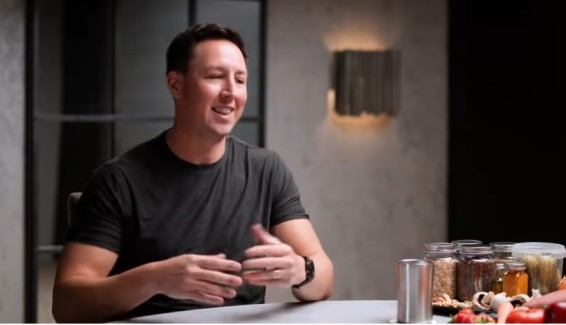
This is a transcript of gut microbiome expert Dr. Will Bulsiewicz’s interview on The Diary Of A CEO Podcast with host Steven Bartlett, January 1, 2026.
Brief Notes: Top gastroenterologist and gut microbiome expert Dr. Will Bulsiewicz returns to The Diary Of A CEO to explain why chronic inflammation and “leaky gut” sit at the root of everything from bloating and brain fog to cancer and autoimmune disease. He breaks down, in simple language, how a damaged gut barrier keeps your immune system stuck in a 24/7 “war mode,” silently driving fatigue, skin problems, low mood, and long-term illness even in people who look fit on the outside.
Drawing on cutting-edge research and dramatic cases from his own clinic, Dr. Will shows how fecal transplants, fiber-rich plant foods, fermented foods, and even a cheap spice like turmeric can rapidly reshape the microbiome, cool inflammation, and improve responses to treatments such as cancer immunotherapy. He then lays out a practical daily routine and four missing elements in most modern diets that, if fixed, can rebuild the gut every 3–5 days and give you more energy, sharper thinking, and a longer, healthier life.
—
Why This Book Matters
STEVEN BARTLETT: Dr. Will, before we started recording, I asked you about this new book that you’ve written and the way that you spoke about it was incredibly passionate. Why?
DR WILL BULSIEWICZ: I sincerely believe that if people take the advice that’s in this book and they actually follow it, which is the hardest part, I’m completely convinced it will transform your life. And that’s because we all are struggling with the same problem. We manifest it in different ways. But there’s this common issue which is inflammation.
And it’s the health story of our time. It’s not getting enough attention. And this book is not only about shining the light on that. It’s about providing people with the evidence-based tools that they need in order to be successful and to live an anti-inflammatory life. And when you do that, you will thrive and you will live longer and you will have less disease.
Understanding Inflammation
STEVEN BARTLETT: Can you explain inflammation to me like I’m a 10-year-old?
DR WILL BULSIEWICZ: Steve, you have an immune system that protects your body. And inflammation is when we turn that immune system on, we make it active. And sometimes that’s a good thing, right? If you had a tummy bug, you want to clear that infection, right? If you hurt yourself, you want to heal that wound. That’s when your immune system is really good, it’s working for you.
But the problem that we have these days is that we’re turning on the immune system when we don’t need to. And it’s staying on 24 hours a day, seven days a week. And that ultimately creates problems because it leads to new issues, new health conditions.
STEVEN BARTLETT: The word inflammation sounds like something has inflated or become swollen.
DR WILL BULSIEWICZ: Yeah, well, that is a part of the process. For example, if you hurt your knee, right? There will be inflammation in your knee and it will get red, it will get swollen, it will become tender. And those are the typical characteristics of inflammation when it arrives.
But what we’re talking about is chronic low-grade inflammation. And this is a tricky thing because it can fly below the radar. It can fly below the radar where you don’t realize that it’s there. Your doctor may not realize that it’s there. And it manifests in these subtle ways where it’s like you have increased fatigue, you have difficulty concentrating, you don’t sleep well at night, you wake up with aches and pains, or you have joints that hurt a little bit, or you’ve had skin issues. Right?
And it’s like, well, we all have those problems, but that’s inflammation. Inflammation is driving many of those issues. And so it’s important for people to be aware that there’s so many patients that go to their doctor complaining of these symptoms and the doctor is kind of not really sure what to do about that. And I think it’s time for us to open our mind and bring awareness to the possibility that there is this issue, inflammation, that’s driving that problem, the symptoms, the health conditions of which there are many. And ultimately we need a plan to address that.
Inflammation Beyond Weight
STEVEN BARTLETT: And can you be skinny and in shape and still have inflammation? So it’s not just a weight thing?
DR WILL BULSIEWICZ: 100%. No, it’s not just a weight thing. Because if you think about people who are competitive bodybuilders, they look amazing on the outside and they’re falling apart on the inside. And these people often suffer with digestive health problems. I know because they reach out to me, including many people that are well known who look incredible and they’re suffering with gut issues and then ultimately they’re at risk for other health-related problems afterwards.
The Gut-Immune System Connection
STEVEN BARTLETT: So on this point of inflammation is when your immune system kind of stays on. Why does it stay on? And I mean, how do I turn it off?
DR WILL BULSIEWICZ: Well, we have to start with acknowledging that the reason why this causes problems is that it… Let’s sort of use an analogy of the immune system is your small army and they’re there to defend you. And when we activate the army and they’re actually going to war, you have to expect that there’s going to be damage to the surrounding areas, right?
Like if there’s a war occurring, of course there’s decimation and damage that occurs, and it’s brutal. And the problem is that if we’re activating the immune system, the areas that are surrounding it, that’s your body, right? And the decimation and destruction that’s occurring is within your own tissues, within your organs.
As I was researching this book, I actually took three years to understand this topic.
We have our gut microbiome and there are 38 trillion microbes that live inside of our large intestine. And they include bacteria and yeasts and archaea, which are these things that have been on the planet for 4 billion years, and possibly parasites. And so in this entire community of microorganisms, they’re there with a purpose, and that is to support you and your physiology. One of their key jobs is actually to basically feed the gut barrier that lines your entire intestines.
STEVEN BARTLETT: Do you want to show me using this?
DR WILL BULSIEWICZ: Sure.
STEVEN BARTLETT: Is this the right part of the body?
The Gut Barrier Explained
DR WILL BULSIEWICZ: So now the large intestine is the home to your microbiome. So these 38 trillion microbes, this is their residence, this is their domain, where they live. Now, this entire system, which is on the order of 20 or 25 feet, so something on the range of 6 to 8 meters, it’s coated with a single layer of cells which we call the epithelial layer, and that is your gut barrier.
And it’s a quite fascinating part of your body because this is like the castle wall and keeps the bad stuff out, but simultaneously needs to allow the good stuff in. And these cells, they turn over every three to five days. So it’s a beautiful thing, actually, because every three to five days, you have an opportunity to create a brand new gut barrier.
So within the system, the microbes that live inside your colon, their job is to basically repair and restore the gut barrier. And when the gut barrier is intact, it’s going to do its job of protecting the immune system. And when the gut barrier starts to break down, then things can sneak across, which we would refer to as increased intestinal permeability. But the common language is leaky gut.
The immune system will see and recognize things that aren’t supposed to be there. And so the immune system then steps up and wants to take it out. And that basically means it needs to get activated and attack, and that is inflammation. So the breakdown of these three systems that start with the microbes—microbes are actually your first layer of defense—and then leading to the breakdown of the gut barrier, is what ultimately activates the immune system.
When we have things that are sneaking across that are not supposed to be there, the reverse can also be true. And that, to me, is where the exciting opportunity exists, is that if you can heal the gut microbes, then the gut microbes can get back to work and do their job of repairing and restoring the gut barrier. And when you create a strong gut barrier, then basically you’re protecting the immune system. And then what you see actually is the immune system cools off and it becomes more tactical and capable of doing its job.
How Inflammation Damages the Body
STEVEN BARTLETT: Okay. And when we’re eating lots of bad stuff and many of the things we’re going to talk about today are causing a breakdown in those microbes, which is causing the gut barrier to worsen, which is causing the immune system to kick in, which is causing the inflammation. And the inflammation is therefore causing our cells to be damaged. What’s the immune system over-functioning causing? You’re talking about the army analogy, where there’s an army and they’re at war and some of them are damaging the surroundings. How is it damaging my surroundings, my immune system being on all the time?
DR WILL BULSIEWICZ: Well, so what ends up happening is it sets off this sort of chain reaction which can have an effect throughout your entire body, where the immune cells—it’s not just a couple of immune cells—they start to basically send out signals. And these signals, we call them cytokines. So you can measure those cytokines, and those are basically communication tools that the immune cells are using with each other to basically call for help.
As they get revved up, these cytokines start to go out. And then this leads to a cascade of even more immune cells releasing even more cytokines and then kick off this wave. And this is what ultimately you can feel throughout your entire body. And it has these consequences of basically causing damage to these individual tissues.
So it depends on which tissue we’re referring to. Inflammation in the liver, we would call hepatitis. But at the same time, we have overwhelming evidence at this point that inflammation in the brain, which we call neuroinflammation, has been associated with mood disorders. So like major depression, inflammation in the brain has been associated with cognitive disorders like Alzheimer’s disease, Parkinson’s disease.
It’s not to claim that all disease literally is related or caused by the gut microbiome. That’s not the call. It’s more so to say that we need to understand that our immune system is so powerfully connected to our microbiome that you cannot separate the two. And there’s evidence to suggest that we can manipulate. So whether it be antibiotics which decimate the gut, or the alternative, the opposite would be a fecal transplant which rapidly reinvigorates the gut and restores that gut architecture and ecosystem.
Fecal Transplants: A Powerful Tool
STEVEN BARTLETT: What’s a fecal transplant?
DR WILL BULSIEWICZ: So fecal transplant is where you take a healthy person’s poop and you transfer it into the person who’s sick.
STEVEN BARTLETT: Where are they administering it?
DR WILL BULSIEWICZ: The way that I’ve always done the fecal transplant, because I’ve done many throughout my career, is during a colonoscopy. So if in theory… What’s a colonoscopy? Yeah, so a colonoscopy is a medical procedure where typically you would be asleep. And while you’re asleep, I take a long flexible tube that is about the size of my index finger. And I can pass that with control all the way through the entirety of your large intestine, which is about five or six feet long.
And I can actually dip into the last part of the small intestine, which we call the terminal ileum, which is down here in the right lower part of the abdomen. You’re administering the fecal transplant because they have this vicious infection called C. Diff. And those infections, this infection can be life-threatening. And you’re administering the fecal transplant because the antibiotics are not working. So you need an alternative where the idea and goal is to restore balance within the gut ecosystem.
STEVEN BARTLETT: Yeah, you’re putting good bacteria in, not taking bad bacteria. Yeah, not taking all bacteria out, I guess.
DR WILL BULSIEWICZ: So you put, and you put the good bacteria in and when this happens, you’re actually all at once reinstalling potentially hundreds of species in balance in the right amounts. So it’s like an entire ecosystem transplant. It would be like us being like, okay, here’s this forest that’s not doing well. We’re going to take the Amazon and we’re going to transplant it into the space. And now that we have all these animals that do well in this space, the forest is vibrant again.
The Modern Lifestyle and Gut Damage
STEVEN BARTLETT: So going back to our point about the immune system, the reason why the immune system is staying on is because I have damaged my gut and it’s essentially trying to repair my gut. And so if I live in a permanent state of a damaged gut because of what I’m consuming, then I’m going to live in a permanent state theoretically of inflammation.
DR WILL BULSIEWICZ: The thesis from my perspective is that the modern world and the way in which we live is damaging our gut, damaging our microbiome. And then we’re suffering the consequence of that, which is disruption of our gut barrier and ultimately the activation of our immune system in this forever war, which is chronic low-grade inflammation.
The Cancer Connection
STEVEN BARTLETT: How is cancer associated with this? You talked about 130 different diseases and in your book, I think it’s around page 22, you mentioned, I think it’s chemotherapy where you’re making an analogy between how chemotherapy kind of wipes everything out and how a poorly kept gut is associated with an increase in cancer likelihoods.
The Immune System’s Impossible Task
DR WILL BULSIEWICZ: Let’s start with this. Your body produces 3.8 million cells every second. Your immune system has the responsibility of identifying where there’s a problem and taking it out. You can’t possibly create 3.8 million new cells and not have some genetic abnormality that could turn into cancer. Right?
So the responsibility of the immune system is to basically be perfect every day of your life and remove those problematic cells before they turn into something bigger and better. It’s an impossible task.
There’s an entire story that’s unfolding now in this conversation about how the gut microbiome is connected to our immune system and the way in which we treat cancer. And it started really in melanoma. We have been using sort of immune manipulations for a very long time to treat melanoma.
But what changed is they were using these things called immunotherapy, to be more specific, immune checkpoint inhibitors. So it turns out that your immune cells have, like, basically a kill switch. If there was a problem, you could flip it off immediately. And that specific receptor is called PD1.
And the tumors, they’re so nasty because they produce this protein that basically activates the kill switch, turns off your immune system. So the immune checkpoint inhibitor, the idea is to basically flip that switch back on, and by flipping it on, activate your immune system, which will then wake up, see this cancer, be like, “Okay, that needs to be taken out,” and go after it.
If someone received antibiotics before the immune checkpoint inhibitor, they didn’t do well. So then it raised the question, maybe this is a microbiome thing. So they said, “Okay, well, if antibiotics do this, what happens if we move in the opposite direction and basically restore the microbiome with a fecal transplant?”
And what they discovered was incredible results. There’s now multiple studies in melanoma where they take people and they give them a fecal transplant from someone who was a responder and give it to the person who’s about to go get treated. And that’s what they did, and with incredible results. Like, literally twice as many people were beating cancer relative to the expectation.
Parkinson’s Disease: A Gut Problem First
The fascinating thing about that is that it’s not just a cancer story. There’s research now in Parkinson’s disease. So Parkinson’s disease is a neurocognitive disorder. So that means basically, it’s a brain condition.
Well, it turns out that Parkinson’s probably starts in the gut, and this is actually a disorder of the gut-brain connection, because both parts are involved. It’s not just the brain condition. The brain condition is actually the more severe part.
So for the people who are listening at home, we have a model out, and I have just lifted their skull like Hannibal Lecter and exposed their brain tissue. And what we want to talk about is the brain-gut connection, the connections between the brain and their intestines.
And so we have classically thought of Parkinson’s disease as being a brain health problem. But I’m here to tell you that this problem begins down here in the gut and involves the connections between the two. Because every single person that I’ve ever seen with Parkinson’s disease, they’re constipated. All of them.
And what’s interesting is that they’ve now shown that the constipation comes before the Parkinson’s disease. So now, this doesn’t mean for people who are constipated, there’s a lot of you out there, this doesn’t mean that if you’re constipated, you’re going to develop Parkinson’s disease. There’s a very small percentage of people.
But it’s important to understand that the manifestations of this health condition actually start in the digestive system before they actually transfer up to the brain. And so now in this study, Steve, what they did is they took these people who have Parkinson’s disease, they gave…
STEVEN BARTLETT: Them a fecal transplant. They gave them a poo transplant.
DR WILL BULSIEWICZ: They gave them a poo transplant. And what they found was a year later, they had a durable continued benefit in terms of their movement issues. There are now other studies with Parkinson’s disease that are showing benefit both for the brain and the symptoms of Parkinson’s disease, but also for the gut in terms of that constipation that I was talking about.
The Truth About Fecal Transplants
STEVEN BARTLETT: I mean, it begs the question, these poo transplants sound great. Can the average person go and get one?
DR WILL BULSIEWICZ: I think we need to talk about that. Yeah, we need to talk about that, because there was a Netflix special where they made it sound like you should just do it at home. Do not do that. Please do not do that.
So, number one, we need to study and adequately understand what the risks are. The fecal transplant makes it sound like this is like the quick, easy thing that you do and you fix your entire life. But that’s not the same as rebuilding your microbiome using the lifestyle and diet tools that actually are going to give you the meaningful health impact that you’re…
STEVEN BARTLETT: Searching for over the long term.
DR WILL BULSIEWICZ: Over the long term, a huge percentage…
STEVEN BARTLETT: Of the population struggle with gut problems. We asked the Diary of a CEO audience and roughly it was over 60% of people that listened said that they’re currently struggling with some kind of gut problem, whether it’s bloating or some kind of discomfort or just digestion issues generally.
Now that’s 61% of people responding to those three words: bloating, discomfort, irregular digestion. Then about 15% of people, 14, 15 of people said self-diagnosed that they think they have irritable bowel syndrome.
Am I right in thinking the causes of what they’re saying they have are wildly different potentially? Or is it like one or two things? Because I’m trying to figure out how I help those 61% of people that, like me, have eat something sometimes and then feel shit and then not really sure what it is, feel a little bit bloated, might feel a bit gassy, might have strange digestion, but not necessarily sure what’s causing it and when.
Personalized Gut Health Solutions
DR WILL BULSIEWICZ: Yeah, I mean, this is the same issue that I struggle with, right. So I write a book with the goal of trying to help as many people as possible, knowing that you can’t. There’s no one size fits all, right?
So ultimately it’s about empowering people with the right information and helping them to identify. I literally wrote about this in my author’s note right in the front of the book, which is basically to say, you’re all going to read the same book, but the way in which this book touches you is going to be unique to you.
There’s going to be something in there that you’re going to find that you’re like, “That’s my moment. That’s my aha moment.” Right? And for many people, like just looking, statistically looking at the average American diet, there’s a huge opportunity when it comes to diet. And that is where I put a lot of energy and attention because I know what the stats say. So I know America needs this.
But at the same time, there’s a conversation that gets into other topics that, look, the way that we live is different than the way that our grandparents grew up when they were kids. To me, it’s more about like helping people to see, like, what is that one thing for them.
There’s some people who are going to be listening to this that it’s not their diet, it’s not sleep, it’s not circadian rhythm, it’s trauma. And I think that these are things that need to, like, we need to shine a light on that.
STEVEN BARTLETT: We’ll do all of that on this point about bloating, discomfort, irregular digestion. If I have one of those things, does that theoretically mean that something is not right?
DR WILL BULSIEWICZ: Everyone gets bloated once in a while. So I think it would be unfair to make it sound like you should never have any adverse symptoms at all.
STEVEN BARTLETT: But if it’s prolonged.
DR WILL BULSIEWICZ: But if it’s prolonged, if it’s a chronic health issue, if you’re the type of person who you wake up in the morning and you say, “I hope today is going to be a good day, I hope I don’t have to deal with that specific issue,” you have a problem. Like, we already know.
And then we have to work on that to address that issue. And how we go about that, I think needs to be, on some level, personalized. But the tools that are at our disposal remain the same. So it’s just a matter of, like, let’s put it on the table. Here are your choices. You pick which ones are most applicable to you. Where are the opportunities for you? And I can’t tell you that without knowing more about you.
Understanding Gas and Constipation
STEVEN BARTLETT: What about this issue of people getting gassy? Like, farting a lot? Is that typically associated with one particular gut issue? Or is that, again, could that be…
DR WILL BULSIEWICZ: A plethora of issues? So it could be. It could be a plethora of issues. This is a common problem. If I have to, like, start with what is my number one thing? It’s constipation, for sure. 100%.
There are so many people who are listening right now that are constipated and they don’t even know it because they poop every day. And they think that how often they poop is the definition, and that’s not true. So constipation is what happens when you’re not adequately emptying your bowels. And that could be a frequency problem, but it could also be that it’s a partial poop.
STEVEN BARTLETT: Oh, okay. Because I thought constipation was if you just haven’t been, you can’t go. You go to the toilet, nothing comes out.
DR WILL BULSIEWICZ: Look, don’t get me wrong. If you don’t poop for a week, I know you’re constipated. I don’t need to ask any more questions. If you go a week. But if it’s, there are people who they poop every other day, that’s their normal. They feel fine. They don’t have any gut symptoms, they don’t have a constipation problem. We’re okay. Right.
STEVEN BARTLETT: So frequency is not the be all and end all.
DR WILL BULSIEWICZ: It’s part of the, it’s part of the equation. Right? But there’s also people who they poop. And I want to sort of paint the picture and forgive me, like, I feel very comfortable talking about poop. This is what I’ve done for a living.
But they go to the bathroom in the morning, they struggle. It’s not satisfying. They had to work really hard to get a little nugget to come out. And then they feel like they still have to go, and maybe 45 minutes later, they poop again. Okay, that’s not a new poop. You’re doing partial poops. You’re probably doing a 20 or 25% poop.
So you could poop three, four times during the day. You might not still be fully emptying your bowels. Right? And so that, so that’s an example of a person who can actually be struggling with bloating and constipation and not think because they’re like, “Doc, I’m pooping three times a day.”
STEVEN BARTLETT: Where is the gas coming from in that? Why do people, you eat something and then you fart a lot. What’s going on?
The Science of Gas and Your Microbiome
DR WILL BULSIEWICZ: So gas travels with poop. You may, I don’t mean you specifically, Steve. People listening may notice this, that you wake up in the morning and you’re farting like crazy. And that farting continues until you actually have your morning bowel movement. And then once you have your good, healthy morning bowel movement, you feel solid and you’re not farting anymore. Right.
The gas travels with the poop. So, and the reason why this happens is because, first of all, your poop is not just the leftover remains of your food. Actually, your poop is predominantly your microbiome. 60% of the weight of your stool is microbial.
STEVEN BARTLETT: Really? Yes. When you say microbial, you mean like the bacteria?
DR WILL BULSIEWICZ: The bacteria.
STEVEN BARTLETT: 60% of it’s…
DR WILL BULSIEWICZ: Let me give you an example. If I took your drink and I added some soluble fiber, which is prebiotic, into your drink, there’s no grit, there’s no roughage. You don’t even know it’s there. And you’re going to have a bigger, healthier bowel movement tomorrow as a result of what I just did.
Why? Because I fed your microbe, and they grow stronger, and then they multiply. And because they multiplied, you have a bigger bowel movement. Right? That’s the way that that works.
Now, don’t get me wrong. You eat a salad, you’re going to end up with a bigger bowel movement as well. But a big part of that is the fiber within that salad that’s feeding these microbes. They multiply, they grow, and you have a big bowel movement.
STEVEN BARTLETT: So if that was my stool, my poop, I’m holding a chocolate bar here, 60% of that would be the microbes.
DR WILL BULSIEWICZ: 60% of that would be the microbes, yes. So for that person, when the poop is in gridlock and it’s not moving through, then those microbes are basically sitting there with unlimited time to ferment and produce gas.
STEVEN BARTLETT: Okay.
DR WILL BULSIEWICZ: So anything they come into contact with, they’re just going to start working on it. So it’s not just like a fiber thing. Anything they come into contact with, it could be protein. They will ferment it, they will produce gas. So this is a big part of the reason why constipation is so strongly associated with gas and bloating.
STEVEN BARTLETT: When people eat dairy and things like that, I think some people that have gluten, they often tend to get a little bit gassy.
DR WILL BULSIEWICZ: Yeah.
Gas, Bloating, and Gut Motility
STEVEN BARTLETT: Is that constipation?
DR WILL BULSIEWICZ: Gas and bloating is not just a constipation issue. I would argue that constipation is the number one cause of that particular issue. But there’s many potential causes. Number one could be motility. That’s constipation.
STEVEN BARTLETT: What’s motility?
DR WILL BULSIEWICZ: Motility is the way in which your intestines move. So if the intestines move too fast and out of rhythm, you get diarrhea. If the intestines slow down too much, sluggish, you get constipation. We want the intestines in a rhythm, because when they’re in a rhythm, just like your heart, that’s when they perform their best.
So in a rhythm basically means predictable, consistent, daily bowel movements. That’s ultimately where we would love to be. And that, in a way, taps into an entire circadian conversation that we can have later. This is a part of your circadian rhythm, a fantastic morning bowel movement.
Motility is just one of the causes of gas and bloating. The second is the microbiome. If you have a microbiome that’s damaged and struggling, it’s not going to be able to do its job the way it’s supposed to. And part of its job is processing and breaking down fiber, because the fiber in our diet, we don’t have the enzymes to digest it.
So it works its way through the intestines, comes into contact with the microbes. And the microbes, they have literally 60,000 enzymes that we don’t have as humans. They go to work as teams. Fiber stops being fiber, produces short chain fatty acids. This is the way that it’s supposed to work.
When your gut is not happy, they’re weak, the microbes are weak, and you’re asking them to do work, and they can’t handle that, and you end up with sloppy digestion, and that’s gas and bloating.
The third thing can be your diet. So you just mentioned dairy, which contains lactose. Lactose can be easily fermented to produce gas. You mentioned gluten. Gluten itself is a protein. So can gluten technically be fermented? Yes, it could be technically fermented, but that’s not really what’s going on.
What’s happening is that gluten containing foods, which are wheat, barley, and rye, also contain these carbohydrates called fructans. And fructans are actually really good for our microbes. They’re prebiotic. But if you consume a very large amount of them and you’re not used to eating these foods, it can cause—
STEVEN BARTLETT: Gas and bloating. These days, when I was younger, if I had pasta, I was fine. If I have pasta these days, I’m going to feel it for the next two days.
DR WILL BULSIEWICZ: Really?
STEVEN BARTLETT: I don’t know. And I didn’t even know what’s going on. But then other people can eat pasta as much as they want.
DR WILL BULSIEWICZ: Out of curiosity, can you go to Italy and eat pasta and be okay, or no, same thing?
STEVEN BARTLETT: I have not really tried. Anecdotally, I think when I remove, when I have non-gluten bread or non-gluten pasta, I think I feel much better. But I’m well aware, from speaking to people like yourself, that such a small percentage of the population is actually gluten intolerant. But we all kind of think we are to some degree, I think. What’s the numbers? Is it 20% of people think they are or something?
The Glyphosate Problem in American Wheat
DR WILL BULSIEWICZ: So here in Los Angeles, it’s probably 80% of people think that. Almost everyone’s gluten free, which they don’t need to be. And actually, it can cause problems. It can cause problems to be gluten free, unless you know what adaptations to make.
STEVEN BARTLETT: So when you ask that question about Italy, what are you getting at?
DR WILL BULSIEWICZ: There’s a processing issue in the United States involving wheat, which is that they allow the wheat to be sprayed with glyphosate, which is Roundup. It’s a weed killer. And they do that to basically dry it out as quickly as possible.
So imagine for a moment that you’re a farmer and you have this field of wheat. You harvest it. Okay, here are your choices, Steve. You can wait a couple weeks and let it dry out naturally in the air and store it somewhere, or you can spray it with this chemical and it will be dry by tomorrow, and then you can ship it out.
And the problem is that glyphosate is not on the label. You would never know whether it’s sprayed or not sprayed, unless you’re buying organic. If you buy organic, then by definition, they’re not allowed to spray it. You would never know if it’s there.
The thing about glyphosate is that it’s been approved to exist in our food system under the assumption of safety, because what it does is it shuts down this thing called the Shikimate pathway, and that kills weeds or it kills plants. And we have a workaround, and it has to do with basically amino acids. We have a workaround where we can basically create those amino acids as humans, but the plants can’t. So the plants die. We live.
But there’s a problem, which is that the microbes that live inside of our large intestine, they don’t have the workarounds. So that microscopic amount of glyphosate, you would say, well, us big humans, that’s so small. What do you think happens when it comes into contact with them?
We know that glyphosate disrupts the microbiome, that it depletes the beneficial bacteria. And the ones that tolerate it the best are the inflammatory ones, the bad bacteria. So you’re shifting the balance. And this is a small thing, but I hear from people, Steve, that go to Italy. They say, “I can’t eat wheat in the United States.” And then they go to Italy and they’re fine.
STEVEN BARTLETT: And you think it’s that glyphosate?
DR WILL BULSIEWICZ: Yeah, they don’t do that there.
STEVEN BARTLETT: So if I tried, I’ll try organic pasta tonight, and maybe that will be better.
DR WILL BULSIEWICZ: Yes. And then the alternative choice is, how do you do with bread? Are you okay?
STEVEN BARTLETT: Not all bread. Generally, I stay away from bread.
Fructans and Fermented Foods
DR WILL BULSIEWICZ: Okay. Do you do sourdough? Do you do okay with sourdough?
STEVEN BARTLETT: Yeah.
DR WILL BULSIEWICZ: There we go. So here’s the second part of this equation. Put the glyphosate, put that to the side for a moment. Let’s talk about the fructans that we were talking about a moment ago. When you ferment your wheat, when you ferment your dough, you actually reduce the fructan content.
STEVEN BARTLETT: What’s fructan?
DR WILL BULSIEWICZ: So these are the long chain carbohydrates that exist in wheat, barley and rye. So if it contains gluten, it also contains these fructans. Gluten is not the only thing in wheat. And these fructans, again, they’re good for you, they’re good for your microbiome. But people who have a slightly damaged gut, they struggle to process and digest them.
So this would explain why some people, they eat wheat containing, gluten containing foods and they struggle, but they do okay with sourdough. Because if you ferment the bread, it reduces the fructan content and actually then you can tolerate it.
STEVEN BARTLETT: Oh, okay. So you think it might be the fructan in the bread that I have an issue with and sourdough doesn’t have fructan in it?
DR WILL BULSIEWICZ: Yeah. There was a study that was in Gastroenterology a few years ago. Gastroenterology is the top journal in my field where basically they send people home with a bunch of breakfast bars. Not chocolate, but nonetheless they send people home with a bunch of breakfast bars. Three of them.
One of them was a placebo bar, so they didn’t add anything special. One of them contains a very large concentration of gluten, and then the third one contained the fructans. And the placebo is our standard. We’re going to compare to that.
When people ate the gluten containing bar, and these were, by the way, people that they did not have celiac disease, they did have gluten problems, according to them. So this is the 20% of people that you mentioned a moment ago who think they might have a gluten problem.
When they ate the gluten containing bar, they actually had less symptoms than the placebo. So in other words, the gluten is not the problem. But when they ate the fructan containing bar, they were triggered.
So basically what this said is that we have been taking this concept of gluten intolerance and we’ve misnamed it. It’s not a gluten intolerance, it’s a fructan intolerance. These are people who are tending to struggle with these particular parts of that food.
STEVEN BARTLETT: What foods contain fructan?
DR WILL BULSIEWICZ: So wheat, barley and rye.
STEVEN BARTLETT: Okay.
DR WILL BULSIEWICZ: And there’s many different types of fructans, by the way. So you may not react to all of them. You may react to just some of them. But garlic and onions are also classic. So you hear people who are like, “I can’t eat garlic. I feel horrible.” That can be a fructan issue.
Teff, amaranth, sorghum, quinoa. These are whole grains that don’t contain gluten, and they also don’t contain fructans.
How Long Does Gut Repair Take?
STEVEN BARTLETT: How long does it take to repair the gut when you have done damage to it? That’s a very broad question, intentionally. But generally, for the average person who’s sort of irritated their gut, how long does it take to restore and for those microbes to go back?
DR WILL BULSIEWICZ: It really depends. You have to start with, okay, what’s your starting point? How deep is the damage? How bad is it? Because for the people who have ulcerative colitis or Crohn’s disease, those are forms of inflammatory bowel disease. Those people have the deepest dysbiosis. Dysbiosis is the word that we use for a damaged gut.
STEVEN BARTLETT: Is it possible to reverse that?
DR WILL BULSIEWICZ: It’s possible to put them into remission so deeply that they don’t have a flare.
STEVEN BARTLETT: Is that what the flare looks like on this little model that I have in front of me?
DR WILL BULSIEWICZ: Yes. So going back for the people who are listening and not on YouTube, you can flip over to YouTube if you’re interested. But what I’m showing here is the model of the large intestine. And the model includes a little area that looks raw, ulcerated, it’s bleeding. If you were to bump up against it, it’s going to start to, you’ll start to see blood coming out. So it’s a very vulnerable, sensitive area.
Now, these inflammatory bowel diseases, Steve, I have an interesting study on this topic. They are, to me, the classic gut inflammatory health condition. And what’s happening is the immune system is attacking the microbiome.
So technically, it’s not actually autoimmune, because autoimmune would be you’re attacking your own body. The immune system’s not attacking your intestines. The immune system is attacking your microbiome and rejecting it. And because that’s happening, your intestines are stuck in the middle.
STEVEN BARTLETT: So this here is the immune system attacking the microbiome.
When the Immune System Attacks the Microbiome
DR WILL BULSIEWICZ: It’s attacking the microbiome, which is in the tube of the large intestine, and the immune system is trying to get at it and kill it. Why? Because it’s decided that it’s the enemy.
So the immune system is confused because when we’re born, we don’t have much of a microbiome. At birth, it’s the closest that we will get to not really having anything. And then during the first three years of life, you build your microbiome through your life experience, and by three years of age, you are basically fully adult sized in terms of your microbiome.
During this time, your immune system is learning from and with those microbes. So there’s this interplay between the two that is undeniable where when the microbiome is healthy during childhood, during those first three years, it results in a healthier immune system.
STEVEN BARTLETT: So what’s going on here?
DR WILL BULSIEWICZ: The immune system is supposed to acknowledge your microbiome as being friendly, and it does not. It decides that your microbiome is the enemy, and so it’s taking it out.
STEVEN BARTLETT: So what do you think is for someone that has irritable bowel syndrome or Crohn’s disease, and they have one of these big sort of ulcers in their small or large intestine, is it because of their lifestyle, typically? So lifestyle change, or is it lots of things? What’s the number one perpetrator?
DR WILL BULSIEWICZ: Okay. There’s clearly a genetic component. So we have to be upfront about that. These are things that are not necessarily within a person’s control entirely.
STEVEN BARTLETT: I mean, there’s no evolutionary reason why this would happen. There’s no evolutionary reason why you’d have severe gut digestion problems.
DR WILL BULSIEWICZ: No, there’s no advantage to it at all. And these things that occur, they were quite rare years ago. In fact, in third world countries today, there’s not much inflammatory bowel disease. There’s not a lot of Crohn’s disease and ulcerative colitis in third world countries. If you go to Africa, there’s very little.
And then what you see, though, is as countries industrialize, there’s a takeoff and they start ramping up. So within the United States, over the course of 40 years, from 1970 to 2010, ulcerative colitis and Crohn’s disease cases were increasing by up to 55%.
STEVEN BARTLETT: And you can get that at any age.
DR WILL BULSIEWICZ: You get that at any age. Yeah.
STEVEN BARTLETT: Even if I’m healthy right now, I could do a set of things that would give me this.
The Impact of Antibiotics on Gut Health
DR WILL BULSIEWICZ: Yes. In fact, if you take antibiotics, your risk of developing an inflammatory bowel disease in the next year just doubled.
STEVEN BARTLETT: Oh, gosh.
DR WILL BULSIEWICZ: If you disrupt the gut with antibiotics, which the antibiotics do, there’s nothing that will basically decimate the gut faster, reducing gut diversity, disrupting the gut barrier by 50% during a course of antibiotics and activating the immune system.
It really speaks to that. If you take antibiotics, these risks of inflammatory health conditions really start to go up. We see this in both adults and kids.
STEVEN BARTLETT: You had a patient of yours called Michelle who took antibiotics and had a life threatening swelling of her colon. This is the colon, right?
DR WILL BULSIEWICZ: Show me where the colon is. So the colon is the large intestine.
STEVEN BARTLETT: Okay, fine, yeah. And so she took an antibiotic and had a life threatening swelling of her large intestine.
Michelle’s Case: A Life-Threatening C. Diff Infection
DR WILL BULSIEWICZ: So she took an antibiotic. She took clindamycin, which is a classic skin antibiotic. And the problem is that clindamycin wipes out your gut hard.
And when that happens, there’s a risk that this pathogenic bad bacteria called C. Diff, if it’s in there, it can multiply and then you get this infection, the C. Diff infection, that causes inflammation of the entire colon.
So this patient, Michelle, what happened? I was on call and I get this text and they say, “You got to come to this room right now, this patient is sick” and she had just been transferred in from an outside hospital.
So I was in the middle of typing up a consultation, drop that, run through the hospital, walk into the room. She’s clutching her belly and she’s moaning and groaning and she has no clue where she is. She’s sweaty, she’s pale, her vital signs are completely out of whack, her heart is racing, she’s breathing really fast.
And I did a little test, which is that I gently bumped her bed, just like that. And if a person has severe inflammation of their intestines, they will jump if you do that because they have peritonitis, or you could call it an acute abdomen.
So just by bumping the bed like that was enough for her to, and she’s screaming, right, and clutching her belly, and she has no clue where she is or what is going on. She’s completely delirious.
She was maxed out on antibiotics. Our choices were to rush her to surgery, remove the colon, or alternatively, to give her a fecal transplant and give her a shot at keeping her colon.
So I take her down to the operating room and I actually used a, I mean, I won’t bore you with the details, but I used a special technique that’s atypical for what I would normally do because the inflammation was so severe to pass a scope. So this scope that I used was a smaller scope to be more gentle.
STEVEN BARTLETT: A scope being a tube.
DR WILL BULSIEWICZ: A scope is a tube. And I mentioned that if you get a colonoscopy, it’s the size of my index finger, so that’s probably about a centimeter across. But I instead went with a smaller scope that’s more like 5 millimeters, 6 millimeters across.
It’s more gentle, and it just makes it harder to do. But I basically passed the scope through her rectum and all the way through her intestines to get it over here on the right side. So it’s basically like I have now passed all the way through her large intestine.
And in that location, I delivered the fecal transplant to her. And so the amazing thing is that, number one, that procedure went really well. By the next day, she was a normal human being. She was laying in bed, she was able to have a conversation.
And after two days, she was so normal that we were able to send her home. So the entire severe infectious issue that she was facing got shut down and corrected by restoring her microbiome.
And then when you restore the microbiome, the C. Diff basically gets suppressed and the immune system falls back into balance. The inflammation washed away.
STEVEN BARTLETT: So do you have a fridge full of these fecal matters that you can just tap into when you need it?
DR WILL BULSIEWICZ: No, but there is a company in Massachusetts that does. And that’s what most hospitals use, is they’ll basically have this sent in.
But it’s actually kind of interesting because there’s new development in this space where, for the first time, drug companies are actually identifying how to manipulate the microbiome using things that are not actually a fecal transplant, but sort of derived from the idea.
Now what they’re developing is a way to rebuild the gut and protect it during this period of vulnerability. So that’s the new thing that’s coming.
Diet Trends and Misinformation
STEVEN BARTLETT: You must hear about so many different types of diets and juice cleanses and whatever else that influences and podcasters promote that you absolutely hate because you have a deeper understanding of the consequences on the gut.
What are some of the biggest diets or, I don’t know, these sort of trends that you absolutely despise because they are misinforming people about how to create a healthy gut?
DR WILL BULSIEWICZ: Well, I think the thing from my perspective is that trends fluctuate hard. In 2020, it was like the vegan diet was in. In 2023 it was the carnivore diet. You couldn’t have more diametrically opposed diets.
And so the problem is that to the person who’s at home and they’re trying to get this figured out, it’s very easy to get sucked into whatever the trend is, because that’s what you’re hearing about when you open up your social media.
Whereas as I sit here, the science has not changed that dramatically in the last five years. We are working on this, but these are small fluctuations in terms of our understanding of things. It’s not a radical, we don’t whiplash like that.
Nor has your biology. You have the same biology five years ago. So this entire concept of whipping people all over the place is total bullshit from my perspective.
I want to start by saying that any person who has the audacity to change their diet in the interest of their health, I actually think that’s incredible. And it doesn’t matter what your choice is because you’re just trying to figure it out. And ultimately I just want people to be better.
But the problem is that there’s a lot of dietary advice that’s insane. And it comes on both sides, Steve. So absolutely, I don’t believe that a 100% meat or organ only diet is in balance or the optimal solution for longevity.
But on the flip side, like a fruit only diet, I would never support or recommend either. That’s completely insane. What are we doing? So I think that these highly, the more restrictive that you get, the more that I think you’re drifting away from what is quite simple, which is whole food in balance.
STEVEN BARTLETT: What about these juice diets and stuff like that? People do. People do like a seven day juice diet or water diet or whatever.
DR WILL BULSIEWICZ: So you will often feel better if you have gut issues and you take away the stuff that’s irritating your gut. And so simplifying your diet and doing something like that, you can make yourself feel better on a temporary basis and think that you did something.
Generally speaking, that’s not really doing much of anything at all.
How Quickly Can the Gut Microbiome Change?
STEVEN BARTLETT: How long does it take to both kill and then create new gut microbes?
DR WILL BULSIEWICZ: Well, so the beauty of it is that your gut is very forgiving. So the choices that you make today will be reflected in your microbiome by tomorrow.
The beauty of it is that these microbes, their superpower is that they are able to procreate so fast. Procreate meaning making babies, so they can create new generations. Estimates are potentially as quick as 20 minutes.
And so we can use that to our advantage. Because if we actually support them with what they need, change can come real quick. And I get back to every three to five days you build a new gut barrier. So there’s an amazing opportunity that we have to actually see some quick health effects.
STEVEN BARTLETT: Are there any big sort of health myths or diet myths that you’re concerned about that people are currently following or believe in particular? Is there anything you look out into the world and think, “Oh, God, that’s going to be awful for the gut”?
DR WILL BULSIEWICZ: Oh, gosh, it’s not something that I pay a ton of attention to because I’m not on TikTok, to be honest with you. So I find it interesting that actually TikTok, some of the trends that have come more recently are actually on point.
So which feels great because I love it when people are getting excited about stuff that’s good, like the fiber maxing trend.
STEVEN BARTLETT: I’m not hired about them.
The Fiber Maxing Trend
DR WILL BULSIEWICZ: So fiber maxing, it feels like after not really talking about fiber for a really long time, people are starting to come around to the benefits that come from fiber.
And this was really exemplified on TikTok with this fiber maxing trend where people are basically trying to increase their fiber profoundly.
So the issue though is that you have to ease your body into it. So I think the idea is the right idea of where people are trying to go, but the execution, I just want people to do it in a way where they feel okay, because if they don’t feel well, they’re going to bail and then they’re going to think, “Well, fiber’s not for me.”
STEVEN BARTLETT: And what was this trend? It was people trying to just get up and above their daily recommended dose of fiber by eating high fiber foods.
DR WILL BULSIEWICZ: Yes. And acknowledging that 95% of people in the United States and 90% of people in the UK are deficient in fiber as we sit here right now.
STEVEN BARTLETT: And what complications or implications does that have for one’s gut microbiome?
DR WILL BULSIEWICZ: Massive.
STEVEN BARTLETT: Because fiber’s feeding the good bacteria.
Short Chain Fatty Acids: The Anti-Inflammatory Powerhouse
DR WILL BULSIEWICZ: Fiber is the principal food for the good bacteria and it is the precursor to short chain fatty acids. So the short chain fatty acids are what we create when fiber comes into contact with microbes.
STEVEN BARTLETT: Short chain fatty acids are the thing we create when fiber comes in contact with the gut microbiome.
DR WILL BULSIEWICZ: Yes.
STEVEN BARTLETT: Bacteria.
DR WILL BULSIEWICZ: Okay.
STEVEN BARTLETT: And the short chain fatty acids are really good.
DR WILL BULSIEWICZ: They’re so good. In fact, of all the things that I’ve studied and learned about, these are the most anti-inflammatory thing that I’ve ever come across.
So there’s three of them, three main ones: acetate, propionate and butyrate. They all have their own distinct effects within the body. They have effects right there in the gut on the microbes, on the gut barrier, on the immune system.
STEVEN BARTLETT: And these are produced. These three things you just named are produced when fiber comes in contact with the gut microbiome.
DR WILL BULSIEWICZ: Yeah. So if you were sterile, if you didn’t have, if you were born without a microbiome. You ever hear about bubble boy?
STEVEN BARTLETT: Oh, yeah, it was a film or TV show, wasn’t it?
DR WILL BULSIEWICZ: Yeah, it was like a documentary in the 70s of this kid who was, he was born with this rare genetic immune disorder. And so his family, in order to try to protect him, they isolated him, thinking if no bad stuff can get in, then he would be fine.
So he lived in a sterile bubble. So in theory, if you were sterile, you would never get the benefits of these short chain fatty acids because you’d never have bacteria, because you don’t have bacteria.
But we have the opposite of that problem, which is that we have bacteria, but we don’t feed them, we don’t give them fiber. You can’t create something from nothing, so you have to give them the fiber in order to allow them to create the short chain fatty acids from it.
Best Sources of Fiber
STEVEN BARTLETT: And these short chain fatty acids. So I’ve got my gut microbiome in my gut here. I put fiber in there in the form of what foods are the best foods for fiber?
DR WILL BULSIEWICZ: Okay, so what we have here is an entire array of choices. And the beauty of it is that there’s only one thing that I can spot on these two plates that does not contain fiber. Do you want to guess?
STEVEN BARTLETT: I guess that it is.
DR WILL BULSIEWICZ: Okay. You want to give it to you.
STEVEN BARTLETT: It’s not the turmeric, is it?
DR WILL BULSIEWICZ: No, but the turmeric probably doesn’t have very much. Okay. No, it’s the oil. Because the issue is that this is 100% fat. So you by definition cannot have any fiber inside of an oil.
STEVEN BARTLETT: Okay.
DR WILL BULSIEWICZ: All right.
STEVEN BARTLETT: It’s like sunflower oil.
The Power of Plant-Based Foods and Fiber
DR WILL BULSIEWICZ: So, yeah, whatever type. Now you could have polyphenols. Like extra virgin olive oil has polyphenols that are really good for the microbiome. Extra virgin olive oil is actually incredibly good for the microbiome, but it doesn’t have fiber. Everything else has fiber.
So we have all these different plant-based foods. And the beauty of it is that it doesn’t have to be complicated. Fruits, vegetables, whole grains, seeds, nuts and legumes. They all have fiber.
STEVEN BARTLETT: Meat.
DR WILL BULSIEWICZ: Anything that’s not a plant does not have fiber.
STEVEN BARTLETT: Oh, okay. So if it grows in the ground, it has fiber.
DR WILL BULSIEWICZ: So if it comes from a plant, it has fiber. And that includes, by the way, the mushrooms. So the mushrooms are technically fungi, but they share a lot of the same characteristics that the plant-based foods do. So there’s fiber, there’s polyphenols, all of these things we want to include in a healthful diet.
How Short Chain Fatty Acids Support Your Immune System
STEVEN BARTLETT: So if I eat these high fiber foods, they go into my gut, the microbiomes produce this thing called short chain fatty acids. And the short chain fatty acids, they produce more good bacteria, but also they help my immune system calm down.
DR WILL BULSIEWICZ: Yes. So if you think about, let’s go back to the model that we led off with, which is that there’s these three parts to your immune system, or actually your, I should call it your defense system, because your gut microbes are the first layer of defense. Right. That was what was broken down by the antibiotics in Michelle.
The second layer of defense is your gut barrier, which is the lining of your gut that protects the immune system. And then the third part is the actual immune system itself. We don’t even want to have to activate that. We’d rather the first two parts take care of it for us. Right.
So the beauty of this is that you eat, you consume these high fiber foods, they come into contact with your microbes. Right here in the large intestine, specifically the right colon is the classic spot. And they unpack them and they release the acetate, propionate, and butyrate.
And those three things impact your microbes, impact your gut barrier, impact your immune system. Now, of the three, my favorite is butyrate, because it’s the butyrate that has the biggest effect on the microbes, on the gut barrier. Like you literally need butyrate in order to produce the proteins that hold your gut lining together. And the butyrate has a direct effect on our immune cells.
So these are again, the most anti-inflammatory thing that I’ve come across. And part of why we’re suffering with these, going back to the original conversation about these chronic inflammatory health conditions, and you asked me, where do they come from? We live in an industrial world where 95% of us, at a minimum, 90% of us, are not getting even close to the amount of fiber that we need.
Indigenous Tribes vs. Industrial Populations
And when we compare this to other places, so there was an interesting study that came out recently where they looked at the microbiome of people in Italy, Singapore, and then they had native tribal people in the Bolivian Amazon and native tribal people in Malaysia. So two indigenous tribes living a hunter-gatherer lifestyle against Italy and Singapore.
What they discovered is that there is this radical difference in terms of the diversity of the microbiome. There’s a difference in terms of their ability to produce short chain fatty acids. And there’s this question that comes up about aging because as we age, inflammation increases. Is that inevitable? Are we stuck in a position where, like, based upon our age, we should just expect that we’re going to have more inflammatory issues?
What they found in the tribal populations is that actually that’s not true at all. So they were protected against inflammation regardless of their age, because of their lifestyle. But they were living, and it’s not just what they eat. They wake up when the sun comes up, they sleep when the sun goes down. They’re connected to their tribe. They’re not looking at Instagram.
There’s so much to that story. The point being though, that in the industrial world, we’re not consuming a sufficient amount of these types of foods.
The Impact of Alcohol on Gut Health
STEVEN BARTLETT: I guess they’re not also drinking alcohol and vaping.
DR WILL BULSIEWICZ: No.
STEVEN BARTLETT: Which we do a lot more in the Western world.
DR WILL BULSIEWICZ: Yeah, we do.
STEVEN BARTLETT: What impact does that have on the gut microbiome? Because I don’t typically hear people talking about alcohol in the gut microbiome.
DR WILL BULSIEWICZ: What we know is that it definitely affects the gut barrier with total clarity.
STEVEN BARTLETT: I guess it’s wiping up my oral microbiome as well to some degree if I’m pouring vodka.
DR WILL BULSIEWICZ: And it would be the same as using an alcohol-based mouthwash. Right. Which now we don’t recommend anymore. And so, yeah, so alcohol. There was a study actually that changed my mind when it comes to alcohol. So I actually don’t drink hardly at all anymore. Like very rarely. I’ll have a glass or two with my wife if we’re on a special dinner.
And in this study, they basically gave people a significant amount of alcohol and then they tracked every 30 minutes the measure of their blood alcohol level and simultaneously the measure of what’s called lipopolysaccharide. So it comes from the inflammatory bacteria that live inside of our microbiome. It’s not supposed to be in your bloodstream.
If it’s in your bloodstream, that generally indicates that your gut barrier is insufficient and weak because it’s able to get across. And the problem is that the immune system has been trained to identify that lipopolysaccharide as the enemy. And so it gets activated. So, and this is where inflammation comes from.
So in this study, they had people have a number of drinks and they start tracking every 30 minutes. And what you saw was that as the blood alcohol level goes up in parallel, the lipopolysaccharide goes up when the alcohol peaks. So did the lipopolysaccharide.
There was this weird thing that happened. I can’t explain why, but the alcohol level peaked. It started to come down, and then actually it bumped back up. And when that happened, the lipopolysaccharide followed the exact same pattern, and the lipopolysaccharide did not return to normal until the alcohol level was zero.
So when I saw this from my perspective, to be clear, it wasn’t a study of one drink, although we do know that one drink is sufficient to disrupt your sleep and cause other health issues. But when I saw this, I saw enough to say, I don’t think there’s any amount of alcohol that’s safe.
STEVEN BARTLETT: To summarize what’s going on there. The alcohol is coming into the body. It is impacting the gut in some way, which is making the gut go into dysfunction. And that dysfunction lasts for a little while because I’m trying to understand why you looked at that and thought, you know what? Absolutely not. I’m not going to drink as much as I was.
DR WILL BULSIEWICZ: Yeah. So basically, alcohol was causing leaky gut.
STEVEN BARTLETT: Oh, leaky gut.
DR WILL BULSIEWICZ: Okay. Yeah. So alcohol was causing leaky gut. That’s what we saw in that study. And the fact that the amount of leaky gut was proportional to the amount of alcohol in the blood and that the leaky gut did not return to normal until the alcohol level was zero says to me that any amount of alcohol that’s detectable in the bloodstream can create this problem, which is going to cause inflammation.
Which is going to cause inflammation. We know with total clarity that people who are heavy drinkers, their gut is totally destroyed, and that that’s actually a requisite step on the pathway towards developing cirrhosis and alcoholic liver disease. So there are some people who seem to get away with it where they can be a heavy drinker, and they never actually get cirrhosis.
STEVEN BARTLETT: Cirrhosis is.
Understanding Cirrhosis and Liver Health
DR WILL BULSIEWICZ: Cirrhosis is the, so the liver sits in your right upper abdomen, and its job is to detoxify your bloodstream. And all of the blood that goes to your gut, the first place that it goes after your gut as it returns to the heart is your liver.
And it’s actually a smart setup anatomically because we don’t want toxic blood to get access to the heart and then circulate and ultimately get back to the brain. So we allow the liver to protect and defend it. But the cirrhosis, what’s happening is that basically the liver, which is soft and spongy, like imagine a sponge that you can put it under a faucet. The water goes in one end, wiggles its way through, comes out the other end.
Okay, instead of that, it’s just a piece of plastic, right? It’s hard. It’s not letting anything through. That’s what happens when a person develops cirrhosis. And there’s many causes of cirrhosis. Cirrhosis comes from inflammation. So all cirrhosis health conditions ultimately are inflammatory health conditions. They’re all part of the 130 health conditions associated with inflammation.
But in this particular setting, what we’re talking about is alcohol. And what I’m saying is that to create that inflammation in the liver, based upon the available data, it seems that you have to disrupt the gut microbiome in order to get there.
STEVEN BARTLETT: So many of us are pursuing passive forms of income and to build side businesses in order to help us cover our bills. And that opportunity is here with our sponsor, Stan, a business that I co-own. It is the platform that can help you take full advantage of your own financial situation.
Stan enables you to work for yourself. It makes selling digital products, courses, memberships, and more simple products more scalable and easier to do. You can turn your ideas into income and get the support to grow whatever you’re building. And we’re about to launch Dare to Dream. It’s for those who are ready to make the shift from thinking to building, from planning to actually doing the thing.
It’s about seeing that dream in your head and knowing exactly what it takes to bring it to life. Join the challenge, post a video sharing your dream and enter to win $100,000.
I’ve just finished writing my third book. I haven’t firmed up the title yet, but I have started mocking up some different designs. And I’ve been doing this with Adobe Express, which is one of our sponsors. What I love about Adobe Express is that it makes it so easy for me to obsess over the tiniest details. The typography, the font, the color, the text placement, the stuff that might sound petty to most people, but actually compounds to create something that stands out, something that’s one better than the rest.
And designing my cover art has reminded me of how many creative things I’ve learned over the years. But it’s also reminded me that there are so many creative minds around me that are also sitting on their own secrets. So I’ve created the one better guide in Adobe Express to bring those tips to you.
And in it, you’ll find principles from the very, very best in their industry turned into quick and easy practices for you to apply so you can train yourself to create exactly like the best performing teams in the world do. Just head over to Adobe LY1 better to download Adobe Express now and make sure you visit the Learn tab to discover how you can become one better than the rest.
Turmeric and Its Anti-Inflammatory Properties
There’s an orangey looking chemical on the plate over there. Turmeric. People talk about turmeric a lot when they’re speaking about inflammation. Yeah, I’m not really sure what the truth is on turmeric and inflammation.
DR WILL BULSIEWICZ: Yeah, you have to be a little bit careful because you could easily overdo it.
STEVEN BARTLETT: Oh, really?
DR WILL BULSIEWICZ: So well. So we just have to be smart with the way that we approach, because the turmeric that we’re really talking about is if you were to take it on a consistent daily basis, which actually from my perspective, makes a ton of sense for people that have chronic inflammatory health issues.
STEVEN BARTLETT: So turmeric is helping inflammation go down somehow.
DR WILL BULSIEWICZ: Turmeric is helping inflammation to go down because it blocks another one of the cytokines. So in the same way we’re talking about those walkie-talkies and basically pulling the batteries out, turmeric helps to accomplish that. So there’s a specific cytokine that turmeric has that effect.
And so you mentioned curcumin. So curcumin is the phytochemical found in turmeric. Turmeric is the root. Curcumin is the chemical that actually does the thing. And it turns out that curcumin is what we call a polyphenol.
So polyphenols, as we sit here and we look at this beautiful array of all these colors, every single one of these foods contains polyphenols that define the color and that impact the gut. Like the onion here would have quercetin, and many people have heard of quercetin as being beneficial for longevity. Same would be true for the garlic.
So there’s different polyphenols for different colored foods, and 95% of them require our gut microbes in order to be activated. So with turmeric, you just need to be careful with supplements because if you overdo it, if you take too much, that could create an issue.
A Perfect Gut Day
STEVEN BARTLETT: Though here in front of me, I have a, I guess this is a perfect gut day. Have you seen this?
DR WILL BULSIEWICZ: Yeah.
STEVEN BARTLETT: I wanted you to explain to me, step by step, how to have a perfect gut day.
The Perfect 24-Hour Rhythm for Optimal Gut Health
DR WILL BULSIEWICZ: All right, so I’m going to define for people the way that I would approach the perfect 24-hour rhythm. We have an innate circadian rhythm. Circadian rhythm basically means that our body functions on a 24-hour clock. Why? Because we evolved with the sun.
The sun goes up and it comes down, and that is one of the most powerful things that defines everything that exists both for us as humans and in our entire environment. So everything around us also evolved with the sun and is connected to it.
Around 50% of our genes are turned off or on at specific times of day based upon our circadian rhythm. More than 50% of our microbes rise and fall during the course of our day to meet the moment. Our body thrives on consistency.
So what I want to talk about is how do we create a consistent daily routine that can optimize our microbiome? And I’m going to take you through all the different steps.
Let’s imagine that the sun comes up and it’s seven in the morning and you naturally wake up and you are consistent about it. You’re off to a great start. Consistency with the time that you wake up is a fantastic way to start your day.
And what I want you to do in the first five minutes of your day is I want you to initially just focus on waking up and thinking about your day and how you’re going to approach it. Because starting at 7:05, you’re going to wake up your microbes, you’re going to wake up your body with hydration.
So we’re going to opt for water. And in a perfect world, I would love to add a prebiotic fiber supplement to that water. So, like, our company is called 38terra. You could add that there, or you can add an alternative. This is the hydration. The water turns on your gut, turns on your brain, turns on your kidneys.
STEVEN BARTLETT: So not coffee straight away?
DR WILL BULSIEWICZ: No. So pause the coffee, start with hydration. And we’re waking up your gut with the water and also with the prebiotic fiber that’s going to feed those microbes in your gut.
Okay, so that’s at 7:05. And let’s pretend that takes you 10 minutes. And so now it’s 7:15. And we’re going to basically flip the switch to tell your body it’s time to go, that we’re starting a new day.
And this is actually the most powerful moment. So if there’s only one thing that everyone takes away, I want it to be this, because I’m giving you the two most powerful levers in terms of activating your circadian rhythm.
The Power of Morning Light and Exercise
Number one, sunlight. Or at a minimum, bright light exposure. So what happens is that light passes through our eye and hits the retina in the back of the eye, enters into the body, detects this, and it enters into the optic nerve.
And right at the very first spot where you could collect information from both your left eye and your right eye sits this part of your brain called the suprachiasmatic nucleus, the SCN. And the SCN is the orchestrator. That is the master clock of your circadian rhythm.
So I would think about it like school. So when we were kids and we went to school, we might have all been wearing a watch. And that watch gives us a general idea of where we are in our day. All your organs, all your tissues, more than half your microbes, they have their watch. They have a feel for where they are in the day.
But it’s the alarm that goes off between classes that ultimately is what matters the most. That’s the central clock. That’s your SCN. Your SCN is basically managing all of that.
And there’s an entire cascade of things that follows from when you tell the SCN today started. So that light exposure is what basically activates the SCN to release cortisol through a series of events. It releases cortisol. Cortisol is the morning hormone. It allows us to get activated. It makes protein and energy available to our cells. It makes us focused. It actually suppresses our immune system.
In that moment, you want more cortisol. And by getting morning light exposure, you can bump it by 50%. So we’re off to a good start.
The second lever that we can pull with our outdoor time is exercise. You don’t need to do a full scale workout. I’m not talking about the most vigorous exercise of your day. I’m talking about light exercise. But if you just move your body, which during the summertime, what you would do is you might go outside and you might have a rucksack and you take a walk.
When the weather is good and when it’s January and the weather isn’t so hot, you might actually have a light box. The light box allows you to stay inside. You just got to make sure it’s 10,000 lux is what you’re looking for. So the light box is the substitute for the sun.
And then you could do any form of exercise. You could do squats, you could do lunges, push-ups, whatever it may be. You could do jumping jacks, do yoga.
So during this period of time, if you get light exposure and you exercise, the exercise can add another 25 to 50%. This is a compounding effect that’s going to give you the ultimate morning cortisol peak.
And this is essential to propel your day because by getting this, you will be more focused, you will be able to do more from a cognitive perspective. Your endurance will be enhanced. You also will sleep better tonight and you will notice this on day one, I promise you.
All right? And you’re going to do that for about 20 minutes. So from 7:15 until 7:35, you’re going to be doing your light and exercise. Ideally outdoor light whenever possible. If you wear glasses, by the way, take off your glasses. You don’t have to look directly at the sun.
At 7:35, we’re going to basically come back in and this is a time for us to now have our coffee and also quiet time. So to me, we don’t have enough time in our day. The day is so fast-paced. We need to be intentional about creating opportunities to activate our parasympathetic nervous system.
Activating the Parasympathetic Nervous System
So there’s two sides to our autonomic nervous system. Autonomic is just, you can’t totally control it. It’s just going. One side is sympathetic. Sympathetic is the part that gets you going fast. This is your accelerator. And the other side is your parasympathetic, which is your break. It’s your rest and recovery.
So now that you’ve done your outdoor time and your exercise, you come in and we want to give you 10 minutes of just quiet, low-key sympathetic time. So that could be meditation, breath work, could be reading your Bible, could be journaling. Whatever it is that works for you.
So you do that with your coffee for 10 minutes, and that brings us to 7:45. And now you have breakfast. So breakfast is the perfect opportunity to take your supplements.
STEVEN BARTLETT: Okay, so what breakfast? What supplements?
DR WILL BULSIEWICZ: Okay, so your breakfast.
STEVEN BARTLETT: And what is my breakfast strategy? Am I going for a lot of food? Do I need to have breakfast? Why do I need to have breakfast?
DR WILL BULSIEWICZ: You should have breakfast. You should definitely have breakfast. Yeah. So your metabolism changes during the course of the day. Your strongest metabolism is first thing in the morning.
And so what that means is that you could literally eat the exact same food at 7:45 or at 3 in the afternoon. And when you eat it at 7:45, you will get better blood sugar control. You will get better blood fat control. So those are manifestations of our metabolism. And when they’re under control, that’s actually really good for our body.
So whenever possible, we want to shift our food towards earlier in the day.
STEVEN BARTLETT: And what kind of foods?
DR WILL BULSIEWICZ: I would argue that we go high fiber and moderate protein.
STEVEN BARTLETT: No sugar?
DR WILL BULSIEWICZ: Yeah, low sugar.
STEVEN BARTLETT: Low sugar.
DR WILL BULSIEWICZ: Refined carbohydrates should get left out as much as possible.
STEVEN BARTLETT: What’s a refined carbohydrate?
DR WILL BULSIEWICZ: Flour or sugar.
STEVEN BARTLETT: Okay, so no baked goods, no eggs Benedict.
DR WILL BULSIEWICZ: So the exception, from my perspective would be if you want to have avocado toast, then a sourdough.
STEVEN BARTLETT: Awesome.
DR WILL BULSIEWICZ: Prefer not. They’re delicious. But no, I prefer not. Because ultimately what we want is we want high fiber and moderate protein. And by doing that combination, it’s maximum satiation. So you’re going to feel full. You’re giving your body what it needs from a protein perspective, and you’re simultaneously giving your gut what it needs from a fiber perspective.
STEVEN BARTLETT: Oats.
DR WILL BULSIEWICZ: So, I mean, you could do oats for the reasons that we were discussing glyphosate earlier. The oats should be organic, and if you were to do them, do them as minimally processed. So I don’t really love instant oats.
Breakfast Strategies for Children
STEVEN BARTLETT: What about for kids? If I’m giving my kids breakfast, should I be thinking about anything in particular? Because a lot of parents, I’ve talked about this quite a few times before, but when I was younger, I’d get a lot of orange juice, and I didn’t realize that orange juice was just like sugar water.
DR WILL BULSIEWICZ: Yeah.
STEVEN BARTLETT: Is there anything that parents should be thinking about when they’re giving kids their breakfasts?
DR WILL BULSIEWICZ: Of course. And I think that the most important thing is that you need to model for your kids what a healthy breakfast looks like by having it yourself, by eating yourself. Because if you don’t do that, then you can’t expect them to.
So healthy breakfasts. My kids, I have four kids, so my kids love avocado toast. They love avocado toast. You could absolutely do yogurt with berries. You could do berries and nuts. There’s a lot of different choices in that regard. So overnight oats, chia pudding, these are different choices that you could do for sure.
STEVEN BARTLETT: On this point of kids, before we carry on with our perfect morning and day routine, are there decisions that you make as a parent to give your kids certain things that will have a lasting impact on their immune and gut function?
DR WILL BULSIEWICZ: 100%. Yes. And I think it opens up a discussion about where the connection between our gut and immune system starts. It starts before birth. The first three years are critical.
So let me unpack that just a little bit, Steve. They have studies where they look at mom’s microbiome during pregnancy. So mom poops, they analyze her poop, and they’re able to basically identify patterns that are associated with the kid developing allergic diseases later on.
They also have studies where moms who increase their fiber intake during pregnancy reduce the likelihood of their kids developing allergic diseases later on as well.
Early Life Factors That Impact the Microbiome
STEVEN BARTLETT: What about kids taking antibiotics? Does that have a, when you’re forming your gut microbiomes at a young age, does that have a consequential impact?
DR WILL BULSIEWICZ: 100%. Antibiotics, bottle feeding, and birth by cesarean section. And by the way, all of my kids were born by C-section. It’s not what we wanted, but it’s what happened.
But those three things are associated with an impact on the microbiome and the immune system. And if you look downstream over the course of the first five years, increased risk of allergic diseases, increased risk of autoimmune diseases, increased risk of metabolic diseases.
STEVEN BARTLETT: Because in a C-section, the baby didn’t pass through the birth canal. The birth canal would have given the baby some of the mother’s microbiome.
DR WILL BULSIEWICZ: Yes.
STEVEN BARTLETT: And then breastfeeding does the same. It gives the baby microbiome.
The Critical Role of Breastfeeding in Microbiome Development
DR WILL BULSIEWICZ: Breastfeeding gives them access to mom’s skin microbiome. But also breast milk contains these things called HMOs, human milk oligosaccharides. It’s quite fascinating to consider this. We evolved where mom’s breast milk contains these things. Human milk oligosaccharides, there’s over 200 varieties. They have no nutritional value to the child directly. So why do we have them? Because they’re prebiotic.
So these human milk oligosaccharides in breast milk were basically designed to feed the developing baby microbiome. And this is part of why we get into some challenges where when you replace it with the bottle, the formula, you might put fiber in there, but it’s like a monofiber. It’s not the same as the 200 plus varieties of human milk oligosaccharides.
So there was a study that was done out of Finland where they looked at roughly 1,100 kids, and they tracked them for five years. During this time, five years, they got a microbiome specimen, poop specimen from the kid at 3 months and 12 months of age. And they looked at, okay, so some of these kids develop allergic diseases. So eczema, food allergies, asthma, rhinitis, allergic rhinitis, those are the classic allergic diseases.
And what they found is, okay, there were certain factors that predicted who was going to develop allergic diseases by the age of five. Number one, exposure to antibiotics in the first year of life. Number two, being bottle fed.
All right. Then they looked at the microbiome at 12 months. And just to be clear, these kids, they had not developed the allergic disease yet. That comes later. But they looked at the microbiome at 12 months and they could tell who was going to develop the allergic diseases later on because there was a specific pattern. What was missing were the bacteria that produce short chain fatty acids.
STEVEN BARTLETT: Short chain fatty acids of that chemical we talked about earlier on that you…
DR WILL BULSIEWICZ: Get from fiber, which produces those three things. Yes. Butyrate, acetate and propionate. And in fact, when they checked the poop for butyrate levels, the butyrate levels were low. So in essence, what they discovered in this study that was quite fascinating is that you can look at the microbiome and predict who will later on go on to develop the confused immune system with these allergic diseases.
The Optimal Daily Routine: Breakfast and Morning Supplements
STEVEN BARTLETT: So going back to our daily routine.
DR WILL BULSIEWICZ: Yep. Where are we? Yes, we’re at 7:45. So you want your high fiber, moderate protein, as little sugar as possible, breakfast. And this is the perfect time to take your morning supplements because the morning supplements, the ones that I recommend that are evidence based are vitamin D, omega 3s and turmeric.
STEVEN BARTLETT: That’s for inflammation.
DR WILL BULSIEWICZ: So these are for inflammation.
STEVEN BARTLETT: Okay.
DR WILL BULSIEWICZ: Yeah. So now I also believe that we should test whenever possible. There’s a test for vitamin D, there’s a test for omega 3s. If you have enough, you don’t need to take the supplement. But if you’re deficient, that’s where supplements play an important role. So I believe that supplements should be taken consistently in a circadian fashion. So that means that we take our morning supplements at the same time every day.
STEVEN BARTLETT: Why?
DR WILL BULSIEWICZ: Because basically everything about our microbes and our body and the way that it works thrives on consistency. So supplements would be the same. And when we do this, so it’s been 7:45, we’ve had our breakfast, we’ve taken our morning supplement stack, and now it’s been an hour since we woke up, and it’s time for a fantastic bowel movement.
And that is the manifestation of all the work that you’ve done. Because when you get your morning light exposure, that helps to contribute to that bowel movement. When you exercise, that contributes to that bowel movement. When you drink your coffee, that contributes to that bowel movement. All these different things ultimately lead to this place where you’re having that good, healthy bowel movement. And that’s indicative of a gut that’s in rhythm and doing well.
So that’s your morning. Now you’re going to go to work, and I want to circle back to roughly the lunchtime hour.
The Importance of Social Connection at Lunch
So it gets to be lunchtime and it’s 12 noon. And basically, I would advocate for people to have lunch with another person. Like the way that you and I are sitting here at this table right now. So because we don’t do that enough, like, way too much, we’re on our phone like this and eating at the same time that we’re flipping and scrolling.
STEVEN BARTLETT: How’s that good for my gut and inflammation, though?
DR WILL BULSIEWICZ: So feeling socially bonded to another person. 50%. This is, by the way, statistics that come from before the pandemic. Right. So the pandemic made this worse. 50% of people in America were lonely before the pandemic even started. Loneliness is the equivalent. Loneliness will destroy your longevity faster than just about anything. Loneliness has been shown to be on par with smoking cigarettes on a routine basis in terms of the impact that it has on your health and your longevity.
STEVEN BARTLETT: And you’re quite clear there that you define loneliness as the feeling of disconnection versus being alone, right?
DR WILL BULSIEWICZ: Yes. So, but being alone, you have to think about where we came from. So we are tribal by our nature. Like, you have to understand that for millions of years, humans lived the specific lifestyle of being hunters, gatherers. In our tribe, there was no money. The currency of wealth was your bonds to other people. That’s what allowed you to survive and thrive.
Your family was like, basically the measure of wealth. The bigger the family, the more wealthy you were, because you would work together to support one another and take care of each other. But then the broader tribe, which is not 300 people, let alone hundreds of thousands on social media, the broader tribe, which was this, like, family of families, we were in it together. If you and I were in the same tribe, if someone attacked us, I know that you would step up to defend me and I would do the same for you.
STEVEN BARTLETT: So this is causing some kind of cortisol issue, stress issue that’s then impacting the gut microbiome and causing inflammation.
DR WILL BULSIEWICZ: If we want to torture a person, like literally the easiest way to do it is to put them in solitary isolation. That’s literally torture. We’re so social that we need that.
STEVEN BARTLETT: And it’s the cortisol response that that’s going to cause that that then causes inflammation.
DR WILL BULSIEWICZ: That is correct. So ultimately that is a manifestation of the brain gut connection. We have an innate need of human bonding. And when that innate need is not met, then it’s actually quite stressful for us because we feel vulnerable and unsafe.
STEVEN BARTLETT: We sleep worse as well. I was reading about some stuff around when people feel lonely, they go into self preservation, which is kind of like, I guess the analogy would be if you drifted off from your tribe, you would have to be a bit more alert. You’d have to be on edge, you’d have to be waiting. You couldn’t sleep for eight hours in peace because you’re in danger now. You don’t have that sort of insulating factor of a group of people.
DR WILL BULSIEWICZ: It’s so interesting to think about. There’s a condition called Stockholm syndrome. And Stockholm syndrome is what happens if you take a person hostage. And in that scenario, you’re the person who’s taken hostage. You have a choice. You can reject the person who’s taken you or you can actually find the good in them and bond with them.
And it’s actually a survival mechanism that within that context of being taken hostage, people have a tendency to bond with their captor and have sympathy for them. And that’s, and we think that’s a defense mechanism because we’re so social, we need that as opposed to like being alone and being held captive.
Post-Lunch Walking and Afternoon Routine
STEVEN BARTLETT: Okay, so we socialize at lunch. We have dinner with other people.
DR WILL BULSIEWICZ: Yes. So I want people to socialize at lunch to address this epidemic of loneliness that I think is highly problematic and not to be underrated because again, that’s like smoking a pack of cigarettes. So let’s imagine that we have a nice lunchtime. We’re not talking about 10 minutes, we’re talking about 45 minutes. That includes conversation. Right.
And we get to the end. And now what I would encourage people to do before you go back to work is to get outside and take a walk. So there’s two advantages to this. We talked earlier about the benefits of sunlight in the morning and also the benefits of exercise in the morning. We’re circling back to that. But things are a little bit different this time.
By getting outside, you’re getting different rays of sun. So the, actually the types of rays that we get from the sun are slightly different and they’re more likely to boost our serotonin later in the day. And that serotonin is what lifts our mood, gives us focus, helps us to get things done. So this reinforces our circadian rhythm when we take a walk and we get outside a second time.
Also the exercise, a 10 minute walk, just 10 minutes of simple walking is enough to get 30 to 40% improvement in your blood sugar control. Because when you activate the big muscles in your leg, it helps to draw the blood sugar out of your bloodstream. So like it’s the messaging there is, if you just ate too much and you don’t feel well, force yourself to take a walk as opposed to laying on the couch.
All right, so and the outdoor walk also activates our gut and helps our gut to get into rhythm and that reduces bloating after a meal. Okay, so and then you do that for 15 minutes. It’s 1 o’clock, you’re back to work. I encourage people to have a matcha green tea. I’m a big matcha believer. This is of all the teas that exist, that has the highest polyphenol content and it’s phenomenal for the microbiome. So, and it gives you a nice boost to your afternoon. Okay, let’s accelerate to 4 o’clock.
The Optimal Time to Exercise
STEVEN BARTLETT: I saw you. I think it was in your book that I read this.
DR WILL BULSIEWICZ: Yeah.
STEVEN BARTLETT: In your book it talks about how the gap between sort of 3 and 6 is the optimal time to exercise.
DR WILL BULSIEWICZ: That’s right, yeah. So 3 and 6 p.m., the reason for that has to do with our core body temperature. So our temperature cools off at night, our body temperature lowers at night, and then during the day it starts to rise in the morning. Exercise, by the way, in the morning helps to accelerate that. But our peak is 3 to 6 p.m.
STEVEN BARTLETT: I felt attacked on page 159 of your book where you said, “My one request is that you do not have a heavy exercise late in the evening as this activates the sympathetic nervous system and can negatively affect your ability to quickly fall asleep.”
DR WILL BULSIEWICZ: Yeah. What time are you working out?
STEVEN BARTLETT: I mean, last night it was like bloody God, 11 till midnight. Oh, no, that’s like quite typical though, because I don’t know, I just, it’s when I get my time.
DR WILL BULSIEWICZ: How’s your sleep last night?
STEVEN BARTLETT: Not great. But I mean, like a series of…
DR WILL BULSIEWICZ: Issues took place two hours, so, okay, fair enough.
STEVEN BARTLETT: Yeah, like a series of like my other issues. The time I ate was bad and the time I went to the gym was bad and so was a mess.
DR WILL BULSIEWICZ: Yeah, well, ideally two hours before bedtime. Okay. At least two hours before bedtime. So, and like, especially when it’s vigorous exercise, if it’s light exercise, it’s not a big deal. But vigorous exercise is a different story. Okay? So, yeah, so 3 to 6. This is more from like an exercise performance perspective. Like that’s the best time if you want to lift heavy weight.
STEVEN BARTLETT: Okay.
The Perfect Daily Schedule for Gut Health
DR WILL BULSIEWICZ: 3 to 6pm, so let’s imagine that we go and we get, we smash a workout at 4 o’clock, right? And so I’m going to give us an hour to smash that wonderful workout. And then now it’s five and it’s the perfect time for dinner.
I want to point something out real quick. We had breakfast around 8 and we had lunch around noon and we had dinner around five. We’ve spaced things out by about four hours. And that’s actually the perfect time from the perspective of your digestive rhythm.
So there’s this thing, this concept within the gut that many people haven’t heard of called the migrating motor complex, where between meals your gut has this entire thing that it does. And it basically is like sweeping through and reorganizing itself, but it gets disrupted if you eat. So it’s ideal to give a four hour space between these meals. And if you do that, you will actually notice a difference in terms of how you feel with your digestion. Because you’ve allowed your gut to fall into a rhythm.
All right, so we have our dinner, it’s five o’clock, we’re moving into the evening. And now it’s going to be 7 o’clock at night. And let’s imagine, I know this time of year, the sun is going down much earlier than this in most places. But imagine that it’s seven o’clock. Look, when the sun goes down, you want to start to dim the lights in your house. You want to start to reduce your personal light exposure. Because light exposure, just casual lights within your home can cut your melatonin down by 30%.
Melatonin is the sleepy time hormone. So in the morning it’s cortisol and in the evening it’s melatonin. And it’s interesting because what we did in the morning with both exercise and with light exposure, it was designed not only to enhance that cortisol peak, but it also increases our serotonin. Serotonin, the happy hormone that keeps us focused. Well, serotonin is actually the precursor to melatonin.
So when you make the investment of morning light, morning exercise, you’re setting yourself up for excellent sleep in 14 hours. And we want to protect that. Melatonin is going to start to rise when it gets dark outside. And so we want to dim the lights within our home. And we want to really be cautious as we move towards 8 o’clock.
If our bedtime’s going to be 10, forgive me if that’s too early for some people, but I think it’s nice to have a consistent bedtime. If our bedtime is 10, then by 8 o’clock we want to be sort of dialing back on our devices or wearing blue light blocking glasses. The blue light blocking glasses can help to protect us.
And then roughly 8:30, take your evening supplements. So we had our morning supplements which were vitamin D, omega 3s and turmeric. Now we want to take our evening supplements which are zinc and magnesium. And if you take melatonin that would be the time to do it. Or if you take a different sleepy time supplement, that would be the time to do it. Roughly 8:30 to 9, somewhere in that range, because it’s going to take about 60 to 90 minutes to really kick in.
Around 9 o’clock we want to activate our evening ritual. And so in the morning we had our quiet time. We should have a quiet time in the evening too, to intentionally activate our parasympathetic nervous system and get relaxed before bedtime. So that at 9:30 we basically are preparing for bedtime. And that might mean a hot shower, actually heat at night, hot shower, sauna is perfect because actually it cools off your inner core temperature, believe it or not.
And that’s exactly what we want. We want a cool room, we want a dark room and that will help us to sleep better because then at 10 o’clock we want to go to bed. And 10 o’clock, it could be whatever time, but I would argue that we should be consistent. It could be 10:30, it could be 11. Whatever time you choose, adapt to it.
But the point from my perspective is it’s not so much 10 is the magic number, it’s more so that 10 is the magic number if you always do 10. 10:30 is the magic number if you always do 10:30. Consistency is key.
Time-Restricted Eating and Meal Timing
STEVEN BARTLETT: And you would recommend three meals a day?
DR WILL BULSIEWICZ: I think that you could do three meals. I think that the way that we structured this is that if you were done eating at 6 o’clock at night and then you’re having breakfast around 8, you have a 14 hour fast.
STEVEN BARTLETT: Do you think that fasting window matters?
DR WILL BULSIEWICZ: That specific number?
STEVEN BARTLETT: 14 or no, just generally, generally having sort of a big intermittent fasting window where you haven’t eaten for 16 hours, whatever it might be.
DR WILL BULSIEWICZ: I think that there’s two parts to the value that we get from time restricted eating. So the first is we give our gut a time to rest. So when you, particularly eating late at night, the timing of it all could be debated. The one spot where it’s a total non negotiable from my perspective, is late night eating. So I mean no offense, sometimes we’re busy, right. But when you eat late at night, it hits you different metabolically and then it carries and it lingers into the next day and it will affect your sleep.
STEVEN BARTLETT: Yeah.
DR WILL BULSIEWICZ: So we really, as much as possible want to opt for early dinner time and then shut it down for the evening as much as possible.
STEVEN BARTLETT: People will be saying, yes, but I’m hungry. And I think part of the reason that they’re hungry from what you’ve explained, is probably because they didn’t have breakfast. They started eating later. That’s typically what I find is if I have breakfast, I’m typically not hungry late at night.
DR WILL BULSIEWICZ: Yeah, yeah. I think the breakfast helps to sort of set the tone for the rest of the day in a specific way. So the two advantages of time restricted eating are that you get that gut rest, which anything over 12 hours is good for the gut. And then the second part is, I think it just, the underrated thing that no one talks about is it helps us to get more consistent with our meal times.
So this entire conversation about circadian rhythm can be summarized in one word: consistency. If you ate at the same time every single day, you would feel the difference in terms of your digestion, I promise you. And so the advantage of time restricted eating is it brings attention to what time am I eating dinner, what time am I eating breakfast? And then you end up being a lot more consistent about it as opposed to just flying by the seat of your pants.
STEVEN BARTLETT: Do you fast ever?
DR WILL BULSIEWICZ: Do you try and long fast?
STEVEN BARTLETT: Long fast or just sort of more time restricted eating stuff?
DR WILL BULSIEWICZ: I do time restricted eating all the time. In fact, I most days, look, I’m imperfect and so what that means is I don’t personally follow all the advice I give. So I don’t eat breakfast most days. Because I’m going hard. So I wake up, I do my morning routine, I get to the coffee stage and I jump into work.
STEVEN BARTLETT: Same.
DR WILL BULSIEWICZ: So.
STEVEN BARTLETT: But were you eaten today?
DR WILL BULSIEWICZ: Today I did, yeah. Yeah, today I had my breakfast because I wanted to be on my game, but on the weekend I have my breakfast. I notice the difference actually. I’m less hungry during the day when I have that breakfast. That sort of just keeps it balanced. So, yeah, sometimes I do one meal a day.
The Trauma-Gut Connection
STEVEN BARTLETT: One of the things we touched on briefly at the beginning was this concept that trauma is linked to gut function powerfully. In what way?
DR WILL BULSIEWICZ: We were talking a moment ago about the autonomic nervous system, which is sympathetic versus parasympathetic. We live our lives on sympathetic overdrive, which basically is the equivalent of constantly feeling threatened. Right? Heart rate pumping, blood pressure up, more focused, but then you suffer the consequences within your gut. The gut gets sacrificed.
When we are activating our sympathetic nervous system, we don’t do enough to do the opposite, which is the parasympathetic nervous system, which is what happens when we slow down. Conversations, holding hands, hugs, prayer, journaling, meditation, sauna, that’s parasympathetic.
Okay, so to the trauma question. It’s been shown that, and this is something that I had to learn, not only myself, but I had to see that. I always thought that kids, if they were young enough, they wouldn’t remember. And what I’ve realized is actually this idea of “the body keeps the score” is so well said. It’s so true. The body does keep the score.
You can have trauma that occurs before the age of two. There’s no way you remember that, and yet it will manifest later on in adults. And this has been shown actually in kids that are adopted and have an unstable first two years of life. They are more likely to suffer with health related issues later on.
This issue of trauma, what happens is that it restructures the brain and how your brain functions and it keeps you…
STEVEN BARTLETT: Sort of trapped in that fight or flight state.
DR WILL BULSIEWICZ: Keeps you trapped, yeah. So there’s a part of our brain called the amygdala and the amygdala is what gets activated if you go to a haunted house, if you get scared of something or it’s the middle of the night and you hear something creepy in the bushes and you’re not sure what’s going on. Okay, so that’s the activation of your amygdala. Well, the issue for people that suffer from trauma is that they live with the amygdala perpetually turned on.
STEVEN BARTLETT: So if something’s happened to me in my life that’s caused some form of trauma, there’s an increased probability that I’m going to be in a more sympathetic state in terms of my nervous system, which is going to activate a hormone which is then going to disrupt my gut motility and all the other things we talked about, like the gut barrier and other dysfunction across the gut. What is the link there? Is it the hormone that’s produced when I’m in that stress state that is impacting my immune system, which is then having the impact on my gut?
DR WILL BULSIEWICZ: Yes. This is all a manifestation of the brain, of the brain gut connection. So what’s happening is that your brain has the ability to release a hormone, corticotropin releasing hormone, CRH. And CRH is effectively your sympathetic nervous system getting activated, turned on in a person who’s had trauma.
And to be clear, not everything that’s bad is trauma. Right. It’s possible to have things that are bad that are not actual trauma. Trauma is the thing that sticks with you. It’s when you have something occur that overwhelms your ability to cope with it. And so, and then it has this lasting effect.
The Brain-Gut Connection and Trauma
STEVEN BARTLETT: I was thinking, as you’re speaking, about some of my friends that have had some bad diagnoses recently. Got a friend that got diagnosed with something very, very serious. And what I then noticed is after that diagnosis they had lots of other health-related issues that seemed to be unconnected. But the doctors associated with stress.
DR WILL BULSIEWICZ: Yeah.
STEVEN BARTLETT: And maybe the traumatic news of that one thing has caused this cascade of other issues downstream.
DR WILL BULSIEWICZ: Yeah, 100%. And that’s all a manifestation of the brain-gut axis. So the brain-gut axis is how we think about the brain being connected to our gut and how they’re in communication with one another.
And within that context, the brain releases this hormone, the CRH, corticotropin releasing hormone that has an effect throughout the entire body. It puts them on edge. And the consequence is that that CRH, that’s like… So this is a bit nuanced, but let me clarify something about cortisol.
Cortisol is the morning hormone. When you get that spike in the morning, it’s perfect. It’s exactly what your body needs. What you don’t need is you don’t need cortisol to still be elevated at 10 o’clock, 11 o’clock, midnight, one in the morning. Cortisol is the get up and go hormone. Right now it’s disrupting your sleep. Now it’s actually the adversary of your circadian rhythm.
And that’s what’s happening in these people, is that through the brain-gut axis, they’re activating the cortisol and the cortisol then disrupts their gut barrier and leads to inflammation.
STEVEN BARTLETT: Where does healing from that trauma start in your view? If a patient were to come to you and they had loads of complications with their gut, but you were able to identify that trauma was playing a role, where would you start with that healing journey?
DR WILL BULSIEWICZ: The most important thing is to… And I think this is the moment that will be most impactful for some of the listeners. Not all, but some. The most important thing is to understand that the trauma is the root of the issue.
Because most people, the way that we react to trauma is the part that we don’t want to talk about. Right. So we push it into the corner and we pretend that it’s not there. We’re not… Like, we know it’s there, but we’re not going to even look at it.
And so the solution is to accept and acknowledge that the trauma is the root of the problem, because then you need to actually turn towards it. And that’s with professional help. So there’s different things that you can do, different approaches, including cognitive behavioral therapy. They’re all administered by trained health professionals. That’s not what I do. But step one is the acknowledgement and understanding. That’s the problem.
Understanding the Bristol Stool Chart
STEVEN BARTLETT: You remember last time we made lots of different shapes of poop. I think we were using… What’s the Bristol stool? There we go.
DR WILL BULSIEWICZ: Yeah.
STEVEN BARTLETT: We have this Bristol stool thing here, which is the different types of poop that people produce. And on this table, I think we have a variety of different styles. Just to remind me once again, if I was guessing, I would assume that maybe this one is healthy or this one.
DR WILL BULSIEWICZ: Yeah.
STEVEN BARTLETT: Which one is healthy?
DR WILL BULSIEWICZ: The chocolate bar is your glorious Bristol four. What’s a Bristol? Right, a Bristol four. So the Bristol stool scale is seven unique types of poop. And you can tell by looking in the toilet bowl.
We have been told, “Don’t look, there’s nothing to see there.” But what I’m saying is, and we discussed this, that 60% of the weight of your stool is your microbiome. That’s the microbiome story right there in the toilet bowl.
And so the Bristol 4 is the normal bowel movement. And it shouldn’t be a rectangle, but it’s soft, but formed like a sausage.
STEVEN BARTLETT: And the word Bristol is coming from this thing called the Bristol stool chart.
DR WILL BULSIEWICZ: Yeah. So the Bristol stool chart actually comes from Bristol in the UK, right, the city of Bristol, where they did a study in the early 90s. And what came of that study was the discovery of these seven unique stool types.
And four is normal and three, many people would consider normal. Three is just sort of lumpy, bumpy, like the… And many people would consider that to be normal. But type one and two are constipation. And types six and seven are diarrhea.
Now, what’s interesting is that the Bristol study was one location in the UK, 2,000 people. Actually at Zoe, we did a nationwide survey in the UK and we had 140,000 people tell us about their poop. So we actually have, we’re working on publishing the papers that came from this, but we have the largest survey on bowel habits that’s ever been done in the world.
STEVEN BARTLETT: And how many people’s poop was healthy?
DR WILL BULSIEWICZ: Well, based upon the… Actually it was interesting because the results were about what you expect. There’s a disproportionate number of people that are struggling with bowel-related issues. So it’s probably about 40% of people that are struggling with bowel-related issues.
STEVEN BARTLETT: Of all the different types of poop one could have, is there any that I should be most concerned about?
DR WILL BULSIEWICZ: If you have these like little pellets, rabbit pellets, that’s severe constipation.
STEVEN BARTLETT: And is that a lack of something? A lack of fiber?
DR WILL BULSIEWICZ: Well, it can be a lack of fiber for sure, but sometimes it’s a stool softening issue too. So, like, for people that have severe constipation, fiber is more nuanced than people are willing to discuss on social media. Everyone makes it sound like the simple solution is just increase your fiber. It’s not necessarily that simple.
So sometimes you have to add magnesium. Magnesium supplements are great with fiber.
STEVEN BARTLETT: What do they do?
DR WILL BULSIEWICZ: So they help to draw water into the intestine and that water softens up the stool. So if you have the fiber for the form and you have the magnesium to make it soft, this is how you get a soft formed bowel movement.
We talked a moment ago about taking a nighttime magnesium supplement. Okay. If your goal is to sleep or to relax, magnesium glycinate is a phenomenal choice. But if you’re constipated, that’s not going to do anything. So don’t do that.
For constipation, magnesium oxide is the one that I would typically go with, but there’s also magnesium sulfate and magnesium citrate. Those are the choices.
And if you get to a Bristol 7, which is just like diarrhea, that’s just… Yeah, it’s just liquid. You’re not in a good place. And so obviously that needs to be addressed as well.
And be aware of what we talked about earlier, which is that there are some people who suffer from chronic constipation and then they start having diarrhea and actually that’s overflow.
The Four Missing Elements in Modern Diets
STEVEN BARTLETT: Dr. Will, what’s the most important thing we haven’t talked about as it relates to all that is in your new book that you think we should have talked about? I mean, we’ve probably covered a tiny, tiny, tiny fraction of all the things in there, but it gives people a flavor. Is there one other thing that you think is the most important thing that we haven’t talked about?
DR WILL BULSIEWICZ: Here’s what I really feel compelled to say, to be totally honest with you. You’re holding the book. The book is called Plant Powered Plus. I don’t want people to be intimidated by the title of my book. Let me explain this.
I believe that there are many paths to healing. There are many different dietary patterns. The one that’s going to work the best for you is the one that you’re actually willing to do. Right. So this book is not about a one-size-fits-all approach, nor is it 100% plant. That’s not what the book is about.
So instead the conversation and what we haven’t discussed is what’s missing in our diet that we really need. And we’ve kind of started to touch on this. I’ve identified four things, and these four things you find in all of the healthy dietary patterns. So whether it’s Mediterranean, pescatarian, flexitarian, if you do it right, you’re going to have these four things.
Number one, fiber.
Number two, polyphenols.
Number three, healthy fat. So healthy fat is the extra virgin olive oil. Healthy fat is this avocado right here. Healthy fat are these seeds and nuts right here. Okay, they all have healthy fat. And in whole form, you should consume these whole form foods without restriction.
If you are obese and you’re trying to lose weight, the problem with any oil, not just seed oils, also including extra virgin olive oil, is that this is the highest calorie thing that exists on the entire planet. You cannot create something with a higher calorie content than oil. So it’s not to your advantage to really focus on oil. If anything, you should be limiting your oil intake.
But these healthy fats, the monounsaturated fats that you get from nuts, from avocado, if we had fish, like a salmon or shellfish, the omega-3s that you get from those things, there’s tremendous benefit to those healthy fats.
STEVEN BARTLETT: That was the third one.
DR WILL BULSIEWICZ: And then the fourth is fermented food. Okay, so which we don’t actually see, we kind of see here. We got the pickles. All right, we got some pickles here. But the thing about fermented food is most of us are not eating fermented food.
So the average intake of fermented food in the United States is zero. And if any, maybe once in a while, yogurt. That’s it. We have tons of choices that are available to us.
And the key that people need to know is a Stanford study done by some of my friends, Christopher Gardner and Justin and Erica Sonnenberg. And what they showed is that in just eight weeks, by adding fermented food to their diet, people could increase the diversity of their gut microbiome. That means a healthier gut, and they lowered inflammation.
So as the gut gets healthier, inflammation goes down. And they did that just by adding fermented food.
So, Steve, these four things: Fiber, 95% of Americans are deficient. Polyphenols, almost no one is getting the recommended amount of fruits and vegetables. Healthy fats, we’re not opting for the types of fats that we’re talking about right now. I want people to get more omega-3s and more monounsaturated fat. And finally, fermented food, no one’s really consuming.
If you think about your diet, this shouldn’t be an exercise in more of the thing that you already have. This should be an exercise of what is the thing that’s missing that we could add, that could transform our health, because that’s the real opportunity. So that’s what the nutrition program is about.
Dr. Will’s Personal Transformation
STEVEN BARTLETT: When I look at this photo of you before and after, I think this one’s probably sort of during medical school, was it, or just after medical school?
DR WILL BULSIEWICZ: No. So I was actually… That’s in my early 30s on the left. Yeah.
STEVEN BARTLETT: And then this photo here, which I’ll put up on the screen, is you at what age?
DR WILL BULSIEWICZ: Yeah, about 40.
STEVEN BARTLETT: Okay. Well, 10 years has passed, and you look 10 years younger.
DR WILL BULSIEWICZ: Yeah.
STEVEN BARTLETT: And you look pretty ripped.
DR WILL BULSIEWICZ: Yeah.
STEVEN BARTLETT: What changed in your life between these two photos? What was different in one’s mind? Knowledge, mentality, psychology? What was different?
DR WILL BULSIEWICZ: So the easy answer is I changed my diet. I changed my lifestyle. I grew up eating junk food. I grew up eating fast food. We celebrated that sort of diet. And I shifted towards eating the way that I’m describing to you today.
I obviously started going to the gym and working out. I think everyone should be going to the gym and working out. I don’t think that’s to be underestimated. That’s an important part of the program that I’m proposing for people.
So there’s those things, but the part that you don’t get on the surface, that I don’t really talk about that much, is I also need to heal on the inside. So I was in a dark place, and I wasn’t in a dark place just because of my diet. There were issues that existed within our family. I had issues with my dad, and I needed to resolve those.
And what happened? A few things. One, literally, an angel came into my life. That’s my wife, right? She came into my life in 2012, and she never pushed anything on me. But just seeing her and having her as a presence in my life was what I really needed to change myself in terms of my diet, in terms of my lifestyle, but also to pick up the phone and call my dad, who I hadn’t talked to in 10 years.
STEVEN BARTLETT: You’d fallen out, totally fallen out.
Healing Through Forgiveness
DR WILL BULSIEWICZ: And there’s an entire story that goes into that. And I have to own my own mistakes because I’m as guilty as anyone for the issues that existed between us. But I picked up the phone and I called him.
And the other thing that happened in my life that really changed everything was the birth of my daughter. So my oldest, I have four kids. My oldest is now 11. And when you hold that child in your hands, you’re a different person instantly.
And I can’t describe this to a person, to someone who’s never experienced this, but you have a purpose that you didn’t have prior to that day. You’ve experienced love that you never understood. And the love that I had for my daughter helped me to understand the love that my own dad had for me. But I could never accept that.
And so the complexity of it all is, yes, I changed my diet, my lifestyle, yes, I started working out, but I also needed to forgive my dad for the things that happened when I was a kid. And reconnecting with my dad was actually one of the most important and powerful things that happened for me.
STEVEN BARTLETT: He was vacant. He was absent. Or was it something…
DR WILL BULSIEWICZ: No, my… When I… So this is something that, chapter eight of my new book, to me, it’s my masterpiece of all the chapters. This is my third book of all the chapters I’ve written. It’s the one that I’m most proud of by far. And if people get the audiobook, they’re going to hear it in my voice.
So there were some things that I needed to talk about, and you’ll find them in that chapter. And basically this story is that our family, we went through a really hard time. And my parents got divorced, and I was 7, and I was the oldest of three boys. It was not a nice divorce.
And when that happens, you feel like you have to choose a side. And from my perspective, again, like, you know, I was a kid, but there was a part of me that said, “Dad, you’re a man. Why did you allow this to happen? Why did you allow this to happen to our family? Why didn’t you fix this?”
And eventually, I stopped talking to him. And that was around the time that I graduated from college. And so for 10 years, I was like… I went to medical school at Georgetown. I went to Northwestern. I was the chief medical resident there. I won the highest award in my residency class. I was fully accomplished. I was, like, accomplishing everything. I was very, very sad inside.
And what was missing was my dad, and I needed him there. And so having my daughter and feeling the love that I felt instantly for my daughter helped me to understand the love that my dad had for me.
And ultimately, what I realized, Steve, is that… because the thing you have to know that’s hard to explain in short order is that we had two brothers. My dad used to take us camping. Three boys. No one else, just himself. He’d take us camping all the time. He took us on vacation all the time. If there was a sporting event, he was always there, right?
But I wasn’t able to see that all of that was really an act of love. And now having kids, myself, and understanding how hard it is to be a parent and raise these kids, the idea of taking three boys camping by yourself is insane to me. I now understand how hard my dad was trying.
A Dedication to His Father
STEVEN BARTLETT: And in your book published in 2020, I believe, 2020, you wrote this for him. Could you read that in your own voice? Because I was going to read it, but it’s very personal. You wrote this in the front of the book?
DR WILL BULSIEWICZ: Yeah. “I lost my dad during the preparation of this book. It was sudden and completely unexpected. I couldn’t wait to share this book with him. It would have been easy to just send an electronic copy, but I really wanted his first read to be a physical book with the hardcover, all the pages, and his son’s name on the front.
Over the past few months, my dad repeatedly told me how proud he was of me. He told me that my grandparents, John and Helen Bulsiewicz, would have been so proud of the work I was doing in the name of our family. I can’t tell you how much it means to me that he said all that.
It breaks my heart that he’s not here anymore. I am who I am because of him. But I will forever be grateful for the special times that we shared. Love you, dad. We’ll always be thinking of you. This book is for you.”
STEVEN BARTLETT: You know, we’re all susceptible for letting a relationship sour and then losing a lot of time. And I think that’s why your story is so inspiring, because it reminds us that I guess what matters most in the end.
And sometimes we can lose, I don’t know, decades, years because of grudges or because of misunderstandings that have never been addressed. So I mean, it’s a huge compliment to your wife that she had the wherewithal to try and get you guys to reconnect so that you could reform that relationship before he did pass away.
And no doubt that he would be incredibly proud if he was watching over us now and had seen what’s happened in the last five years in your life. Because it’s been incredible. Absolutely incredible.
DR WILL BULSIEWICZ: Healing comes in many forms and sometimes it’s the changes that we make to our diet and sometimes it’s the changes we make in our relationships with other people. There’s different opportunities. You and I talked about, like what is the thing for every person is something different.
STEVEN BARTLETT: And it’s funny how they’re both extricably linked because when one gets right with themselves and others, they often find it much easier to get control of their diet and their lifestyle and then it all clicks.
I highly recommend everybody goes and gets this book. It’s going to be published in the US here on the 13th of January and in the UK on the 15th.
DR WILL BULSIEWICZ: That’s right, yeah. Tuesday in the US, Thursday in the UK.
The Impact of Knowledge
STEVEN BARTLETT: So I’m going to link it below. We just touched on a fraction of it and we haven’t gone into much of the details, but if you are someone that is struggling with your gut, you know, one of the 61% or 70% of people that told me ahead of this conversation that you were, I highly recommend this book because it’s incredibly accessible in the way that it’s written, but also it’s incredibly comprehensive and up to date.
And as you said, the science on the gut and all of the related gut-related sort of issues and symptoms that we have is always evolving. So I love having these conversations. It’s almost refreshers and updates to me because every single time I learn something new and I get more of the sort of jigsaw puzzle of my gut health and as it relates to like my brain and my immune system filled in and it’s having…
It’s really remarkable how much of a real world impact these conversations have had on me. I don’t think people know this enough, but they often ask me, “Which conversations had an impact on you?” The way that I view it is, it’s almost… it is like a jigsaw puzzle and each conversation is adding a piece.
And I can see since we had that last conversation about poop and the gut and the microbiome and all those things, there’s been radical changes I’ve made to my life that have had a radical impact. It’s like the lights have been turned on. And that’s a really good example of what this book does. When you read it, it turns on the lights.
So highly recommend people go check it out. You are launching a YouTube channel, you said?
DR WILL BULSIEWICZ: Yeah, I’m launching a YouTube channel. It’s the gut health MD. And that’s also my social hashtag on my social handle. So you can find me on those locations. But my home base is my website, theguthealthmd.com and if you come there, I highly encourage people to register for my email newsletter because it’s a completely free resource, basically a substack for free, that’s designed…
This is where I love to really have these conversations with people about, “Hey, there’s this new study. Let’s talk about it. Hey, there’s this thing that I’m seeing. Let’s talk about it.” Right? “Hey, this is what I’m doing right now,” right? So it’s an opportunity for sharing that goes beyond, like, the limitations of social.
STEVEN BARTLETT: I’ll link all of that below, everything we’ve mentioned in the last 30 seconds so everyone can check you out.
We do have a closing tradition where the last guest leaves a question for the next. And the question that has been left for you is, “What is one thing you could do today to help rectify your life’s biggest regret?”
A Message of Hope
DR WILL BULSIEWICZ: Isn’t that funny? Well, I think that the good news, this is to me, if anything, a story of hope and optimism, because on many levels, I did. So reconnecting with my dad was key.
But I think that the other piece is when you… when you lose a person the way that we lost my dad, he’s gone, right? And it happened real fast and I didn’t get to say goodbye. I will say it’s my faith that allows me to know, like, not to pretend to know, to actually know that these things that I need to say to him, that I never actually got a chance to say that I wish I did, I’ll have a chance to do that. And I look forward to the day when I see him again.
STEVEN BARTLETT: What would you say?
DR WILL BULSIEWICZ: I would tell him that I hate the fact that it took me so long to figure out that he was a great dad. And, you know, adults may have conflict. That’s what the divorce was. But he was a phenomenal dad. And I didn’t see that or get that until I had my own kids.
STEVEN BARTLETT: Dr. Will. Thank you.
Related Posts
- How to Identify the Root Cause of Hair Fall Before Starting Treatment
- Transcript: Activate Your Ultimate Inner Doctor – Dr. B M Hegde
- Thomas Seyfried Interview on Cancer Origins: Diary Of A CEO (Transcript)
- Making Sense #485: w/ Siddhartha Mukherjee – The New Science of Cancer (Transcript)
- Tucker Carlson Show: w/ Michael Nehls on Alzheimer’s, Depression, Anxiety (Transcript)