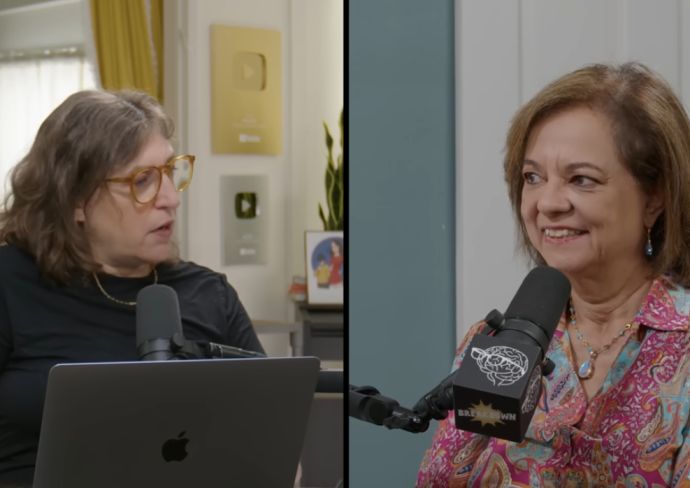
Editor’s Notes: In this compelling episode of Bialik Breakdown, Dr. Mayim Bialik and Jonathan Cohen sit down with Anita Moorjani, a renowned author and speaker who experienced a medically inexplicable recovery from terminal stage 4B cancer. After falling into a coma due to complete organ failure, Moorjani underwent a profound near-death experience that transformed her understanding of illness, healing, and the power of unconditional self-love. The conversation explores her remarkable journey from being given only hours to live to becoming cancer-free within a month, offering a unique perspective on the connection between our emotional well-being and physical health. (August 26, 2025)
TRANSCRIPT:
MAYIM BIALIK: Hi, I’m Mayim Bialik.
JONATHAN COHEN: And I’m Jonathan Cohen.
MAYIM BIALIK: And welcome to the last episode we ever will release of The Breakdown, because this one broke the mold. We don’t need to do any other episodes ever again.
JONATHAN COHEN: News to me. I was ready to keep going.
MAYIM BIALIK: If you’re not going to believe something, it would be this episode.
JONATHAN COHEN: And yet there’s more proof for this episode than any other.
MAYIM BIALIK: There is literally more scientific proof for an inexplicable, non-physical healing than we’ve ever heard of before. And what’s amazing is the person we’re going to speak to has never heard of anyone with her story.
JONATHAN COHEN: Our guest today went from a stage 4B cancer diagnosis.
MAYIM BIALIK: Her family was told she had hours to live. She ended up falling into a coma as a result of complete organ failure. And she had an experience that led to a month later being discharged from the hospital with no evidence of cancer in her body. How do you get from a terminal stage diagnosis of cancer to having an undetectable level of cancer a month later? An encounter that is out of this world. And indeed, her consciousness left her body. And for almost 2 days, she was floating in another realm where it was not only communicated to her how she got cancer, but how she would be able to heal from cancer. And that happened within a month of her opening her eyes and saying, “I’m back.”
Introducing Today’s Guest
MAYIM BIALIK: We’re going to be speaking today to Anita Moorjani. She is a renowned author and spiritual speaker. Her New York Times bestseller, Dying to Be Me: My Journey from Cancer to Near Death to True Healing. She was living in Hong Kong. She was raised in Hong Kong. She was battling end-stage cancer, and she experienced a remarkable and I would say extremely, extremely unique near-death experience.
She ended up writing about it for Dr. Jeffrey Long’s website, NDERF, the Near-Death Experience Research Foundation, and was essentially discovered. Not only was she told in her near-death experience why she got cancer and how to heal. She was also shown a life that had nothing to do with the life that she was living. She had no idea how any of what she was shown would possibly come true. And it has.
Anita Moorjani is an inspirational speaker and by her own admission, has had an experience that no one seems to be able to clinically explain. It can only have happened from a non-physical physical transformation. We’re going to hear all about what her life was like, what the things were that led up to her getting cancer, what it was like to treat her cancer, what it was like to be told she would die, what it was like to come back from death and heal and spend her life sharing her story.
Anita Moorjani, such a pleasure to have you in person at The Breakdown. Break it down. You have one of the most incredible transformational stories. Tell us what your body was experiencing at the point that you had stage 4B cancer.
The Physical Reality of Stage 4B Cancer
ANITA MOORJANI: So at that point, the doctors told my family that it was terminal and my body was— my muscles were atrophying because my body was no longer absorbing nutrition. So I weighed about 85 pounds. My muscles were completely atrophied, so I could no longer walk. I looked like a skeleton, but I did not have the strength to stand on my own legs. And even when I was sitting, like I would be on a wheelchair, even when I was sitting, I didn’t even have the strength in my neck to hold my head up. My head would be hanging down and my lungs were filled with fluid. I had open skin lesions that were weeping toxins.
But the cancer, because it was lymphoma, it was lymphatic cancer. It caused tumors throughout my lymphatic system at all the lymph node points. And these tumors, many of them were the size of golf balls. So you could see them, these golf ball-sized tumors from the base of my skull around my neck, under my arms, in my chest, all the way down to my abdomen. And because my lungs were filled with fluid, when I would lay flat, I would choke on my own fluid. I was going to the clinic every 2 or 3 weeks to have the fluid drained. I was also connected to an oxygen tank with the tube going in my nose, and I had a portable tank. So basically I was in a wheelchair with an oxygen tank or lying in bed but propped up, otherwise I would choke. But then on February 2nd, 2006, I didn’t wake up. I basically went into a coma.
JONATHAN COHEN: How many tumors are we talking about? Like when people think about the lymphatic system, they don’t really know all the places that— I don’t know how many lymphatic parts are there.
ANITA MOORJANI: Yes. So there’s a— I mean, there’s a lot of points, but I had at least 6 tumors the size of golf balls, which is a significant size.
JONATHAN COHEN: You’re pointing to by your neck.
ANITA MOORJANI: Yes.
JONATHAN COHEN: Here.
ANITA MOORJANI: Here, one under each arm, a bigger one under this arm, actually. And then in the chest and one lodged like somewhere close to my lungs. So at least 6 that were significant.
JONATHAN COHEN: And the doctors are telling you and your family, this is the end. Say goodbye. There’s no medical intervention that’s going to help you.
ANITA MOORJANI: Not at this point. Not at this point. Absolutely not.
Organ Failure and the Road to Coma
MAYIM BIALIK: And what happens in the body at this point that leads you to go into a coma is that basically your organs are not getting enough fluid, blood flow, nutrients to sustain life.
ANITA MOORJANI: Exactly. And now the organs are shutting down. So it started with my kidneys. The doctors told my parents, my mom and my husband and my brother, that now my kidneys have shut down already and the other organs are starting to follow suit and that there is just no nutrition in my body to heal it. There’s not even enough nutrition to handle any kind of treatment. It’s so far gone.
JONATHAN COHEN: And what was the journey up until that point? How many years had or months had you been in this increasingly debilitated state going through? I would imagine all kinds of medical interventions and attempts to get you well and heal the cancer.
ANITA MOORJANI: Yes. So the journey was just under 4 years, about 3 years, 10 months.
JONATHAN COHEN: Wow.
ANITA MOORJANI: For the whole journey. And in the beginning, it wasn’t so bad, but it was one of those situations that I would get better and then it would come back and then I would try different treatments, including complementary. But then it reached this point where I started to nosedive dramatically towards the end of 2005. That’s when it started to nosedive dramatically. And that’s when, because the doctors were starting to tell me, “You probably only have 3 months to live.” And I remember even hearing that impacted me greatly. And I started to feel there’s no point fighting, there’s no point living.
And so on February the 1st, the evening of February the 1st, I was so tired. I had been in so much pain and so much discomfort fighting just to stay alive, fighting just to breathe because every breath was laborious. And every time if the oxygen tank was taken away or if I was getting up and trying to exert myself and just attempting to walk, I would be huffing and panting. Life was just, just living was laborious and I was so tired. I didn’t think it was worth fighting for anymore.
No Clinical Explanation
MAYIM BIALIK: Based on this description that you’ve just given us, there is absolutely no clinical, medical, or physiological explanation for why you’re here.
ANITA MOORJANI: Yes.
MAYIM BIALIK: I mean, would you say that that’s accurate?
ANITA MOORJANI: I would. And several doctors have confirmed it after the fact. Yes.
MAYIM BIALIK: One doctor has even described you being here as there has to be a non-physical explanation for why you’re here.
ANITA MOORJANI: Yes. Yes, he did say that. He actually even said that I would put it down. He said, “I’m not religious, but I can only put it down to divine intervention.” That’s what he said.
Life Before Cancer: Background and Upbringing
JONATHAN COHEN: What I’m fascinated about is that we’re going to get into what happened in this radical transformation that you underwent when life was too laborious, where it became too hard and you stopped breathing. I’m curious, though, to still understand your mentality, because this is someone who, as you described, it’s 3 months, 3 years and 10 months of treatment, real like remission, it coming back. And so you’re on a roller coaster.
Before you had cancer the very first time, what was your life like? What was your mentality? What was your output? Were you a religious person? Who were you before this journey?
ANITA MOORJANI: So I grew up in Hong Kong and my parents are Indian, ethnically Indian. I met my husband Danny in Hong Kong, who also happens to be Indian. And we got married. My husband and I, we have a great relationship. However, before I met him, and I hadn’t been married very long before I got diagnosed, I would say my life was not that easy because my parents being Indian, my dad was really strict as I was growing up and I was being groomed for an arranged marriage.
But I went to a British school where all my classmates, all the other kids, the teachers, they were all British. So as I grew up as a teenager and into my late teens, all the other kids were thinking about which college they would go to or which university and their careers, while I was being groomed for an arranged marriage. And I was told, or I was discouraged from even thinking about a higher education because the smarter you are as a woman, the harder it is to get you married and to find you a suitable husband.
Whereas I was someone who wanted my independence. I wanted to work. I wanted to earn my own money because we are expected to live with our parents and have our dads take care of us and not move out until we get married, and then our husbands take care of us. So when I said, I want to work, I want to travel, I want to do these things, I was told, oh, that will depend on your husband after you get married.
So I basically grew up in a culture with a tremendous amount of gender disparity, and I wasn’t valued. And a woman’s worth is measured by how valuable she is to the men in her community. So we grow up actually learning for our own survival to be subservient to the men around us. That was my upbringing, with a very strict dad. So my entire life was spent trying to win his approval and trying to win the approval of the men in our community, and you get judged. And so I grew up being a people pleaser, and I would call myself a doormat.
And I wasn’t religious per se, but I would say that I was totally open to spirituality. The reason I wasn’t religious and yet completely open to all religions and spirituality is because growing up in Hong Kong, having Indian parents, British school, and Hong Kong being predominantly a Chinese city, I was exposed to Christianity, to Hinduism, to Taoism, to Buddhism. And so I was just exposed and immersed in all of it. So I never followed any one religion, but I did respect all of them. And I did feel there’s some truth in all of them.
On Culture, Gender Roles, and People-Pleasing
MAYIM BIALIK: I also want to just sort of offer you the opportunity to sort of clarify. The notion is not that all Indian families produce people pleaser daughters. As the grandchild of immigrants from Eastern Europe, it’s very familiar to me, this notion of sort of being groomed, as you said, to be obedient, to caretake, to be a caregiver. And historically, for all of human history, women have kind of borne the brunt of this kind of emotional labor and physical labor in the home.
I think it’s important not to say that we’re denigrating the Indian culture in particular, but in families that tend to be patriarchal, that tend to be kind of centered around these kind of traditional gender roles, you will often see this kind of challenge, especially for women who are intelligent and independent and want to sort of break out of that.
ANITA MOORJANI: Yeah. Thanks for actually giving me that opportunity to clarify that. You’re absolutely correct, because when I go to India, I see amazing strong women heading up companies and living independent lives. But it seems to be more true for immigrants, for the offspring of immigrants. Yes, you’re right about that.
Breaking Off the Engagement
MAYIM BIALIK: One of the interesting things about your life before you found the person who’s become your life partner and you describe as your soulmate, you broke off an engagement.
ANITA MOORJANI: Yes.
MAYIM BIALIK: Which in my community as well can be very, very scandalous. Once you are especially in the process of meeting with prospects, it’s seen as very untoward for a woman to decline an engagement, to make changes or alterations, or even to question the arrangement. So can you talk a little bit about what it was in you that was already sort of brewing in terms of you being able to assert yourself? Because I think it does connect to your later story.
ANITA MOORJANI: When I was in my early 20s, at first I was rebelling against the arranged marriage. I refused to have an arranged marriage. And just to put into context, I was so immersed in British culture because of the other kids at school. I was into British pop culture. I was into Cyndi Lauper. So I didn’t want an arranged marriage.
But then all my British friends went off to university and went to follow their careers. My Indian friends all had arranged marriages. Starting at age 17, I started losing all my Indian friends one by one. By the time I was 21, I was really lonely. And so I agreed to giving it a chance. And that’s when I started to get introduced to prospective grooms. And eventually I did agree and say yes to someone. And then we were engaged.
It was only after we were engaged did the reality of what the rest of my life would be like start to hit me. So over the months, I was literally being trained on how to cook certain foods, traditional foods, in the way they needed to be cooked, and to dress a certain way, and all the finer details. I was literally being groomed, and also how to follow our Hindu religion about going to the temple and how many times a week. I never really went to the temple even though I was Hindu in name, but now I was expected to go to the temple.
So I was literally being groomed for this life that lay ahead of me where I would be living with the groom and his parents, his family basically. And as we got closer to the wedding, I started to really get scared that this was it. And I started to talk to the family, my future husband’s family, to say I would like to go back to school because I didn’t finish school. It was an absolute no. I said I would like to work even if it’s part-time. It was an absolute no. So I started to get really afraid for my future, and I thought, this is it. I’m in my 20s and I have nothing to look forward to.
One day, 3 days before the wedding, and I don’t always share this part, but I went and cried on my mother’s shoulders and I told her that I’m so scared, I can’t go through with it. My mom said, “It’s okay, you don’t have to go through with it.” That was such a relief. So I actually ran away, but only my mom knew where I was. So I ran away 3 days before the wedding and it really upset everybody because if you know anything about Indian weddings, they’re huge affairs.
MAYIM BIALIK: It’s days and days and days.
ANITA MOORJANI: Yes. So everything was booked. All the venues were booked, the bands, the food, the videographers, the relatives had all flown in with the gifts. And it was—
JONATHAN COHEN: How many people are we talking about from all over the world that are coming?
ANITA MOORJANI: Hundreds. Hundreds. Hundreds of people.
JONATHAN COHEN: Wow.
MAYIM BIALIK: And there’s a different outfit that you wear sometimes, several different outfits a day. Like, it’s a very large—
ANITA MOORJANI: And all these other people have brought all their outfits, all their fancy—
MAYIM BIALIK: I don’t know why the first thing I think of is, you come to a wedding and it’s like, “I brought 17 outfits and she didn’t even show up.”
ANITA MOORJANI: I know. Exactly.
The Escape
JONATHAN COHEN: So 3 days before, everyone is there already, or they’re still in progress of—
ANITA MOORJANI: Most of the people are there. They’re already there. They’ve brought wedding gifts and everything is booked. The bands, the food, the hotel rooms, the venues, everything, the honeymoon, it’s all booked and done.
JONATHAN COHEN: I’m just fascinated about the moment you decide to run away. Is it at night? Are you evading people so that they can’t spot you walking out the door?
MAYIM BIALIK: It’s like Shakespearean.
JONATHAN COHEN: Yeah. How do you escape? Where are you when you decide to run away? And then, literally, the physical act of escaping. How does that work?
ANITA MOORJANI: So I phoned up a friend who is not a relative but a very close friend, because we knew that nobody would think of finding me there at her house. They would think I was at home or with a relative. And she came with her partner, her boyfriend, and they picked me up and they whisked me away to her home, which was a little further away, quite a few miles away from where all the activity was taking place, where all the families were.
JONATHAN COHEN: Did you have to go at night? Was it like a black car? Did you have to have like a robe over you? I’m imagining it like a prison break movie where you are like in the linen.
ANITA MOORJANI: No, fortunately it wasn’t that dramatic because at that time nobody suspected anything. So it just looked like maybe I was going out or something. But I wasn’t planning to come back.
JONATHAN COHEN: You didn’t have like a suitcase with you.
ANITA MOORJANI: We did put a bunch of things in the trunk of her car. Yes.
MAYIM BIALIK: Did you tell the fiancé?
ANITA MOORJANI: So prior to me even running away, I called him because I wanted to talk to him. And this is the part that I’ve never shared publicly, but I guess there’s a time when one has to do this. I called him because I felt we needed to talk. He had a temper and I was afraid of him and he was reminding me too much of my dad.
MAYIM BIALIK: Oh my.
ANITA MOORJANI: And I was scared to go through with this and I wanted to talk to him about it before actually turning up at the temple for the wedding. I was told I could not see him. I had to just show up at the temple.
MAYIM BIALIK: How many times had you met before you were even engaged?
ANITA MOORJANI: We had met very few times. Not that many. And we weren’t allowed to meet much. We kept being told—
MAYIM BIALIK: You were never alone with him, correct?
ANITA MOORJANI: Maybe hardly ever. Maybe once, twice at the most. But we were told, “Don’t worry, everything will sort itself out after you’re married.”
So when I said I need to talk to him, because when I talk to him on the phone, he seems irritable, bad-tempered, and I’m about to marry this man. I need to see him face to face. I want to look into his eyes and feel that he does care for me and that I’m going to be happy. And I was told that you can do all that after you’re married, just show up at the temple.
So I tried calling him. He wouldn’t talk to me on the phone. He was very abrupt. And then I said to my mom, when I cried and cried, “If I can’t see him, I’m not going to show up at the temple.” And that was 3 days away. And my mom said, “I’m with you, I agree with you.” She didn’t know half of what was happening in the conversations. Her reaction was, “Why didn’t you tell me earlier?” So she helped me get out and she said, “I will handle it. I will tell his family,” because he was not talking to me properly.
The Role of Anita’s Mother and the Path to Illness
MAYIM BIALIK: When I started reading your story, I realized your mom is in many ways kind of like a co-heroine of this story because I think about my own parents. My father tried to back out of the wedding days before, and his mother said to him, take a nap, you’ll feel better. And he took a nap and then he felt better. But apparently when he called my mother to say, “I don’t think I can go through with it,” she said, “Fine, f* you,” and hung up. Stunning. She was 18 at the time.
When I think about both of my grandmothers and the culture that I come from, it’s very rare to find a woman who will say to a daughter in that situation, “I’ve got you.” There’s not many options, even for women of your mother’s generation, to have the wherewithal to say, “You don’t have to go through with this arranged marriage, I’m going to protect you.” It’s enormous.
ANITA MOORJANI: It is enormous. I was so grateful for her and I wouldn’t have been able to do it. Had my mother not sided with me, I would have gone through with it.
MAYIM BIALIK: And also, all of this is sort of part of your journey, your path, which is revealed to you years later in a very specific way. Once you break that engagement, you ended up sort of rebuilding a life. You end up meeting this man who you fell in love with. It was a love match, as we call it, and you started building a life together. But there are a few people in your life who you experience some tragedy with that also is part of your story. Can you talk a little bit about what you encountered adjacent to a few specific health-related traumas?
ANITA MOORJANI: So my best friend who I grew up with, we were the same age. She was diagnosed with cancer, what seemed like out of the blue, and she had been healthy and vibrant. And then she just found herself huffing and puffing, going up and down stairs. So she went for a checkup and they found a tumor lodged between her lungs. And it turned out to be quite serious. It needed surgery immediately. And then it was actually diagnosed as an aggressive cancer.
That came as a shock to me, almost as big a shock as if I received the diagnosis, because we were so close and she was like a sister to me. And she had two small children. I didn’t have children. So she had little children, and I couldn’t believe that she was going through this.
What ended up happening is that, probably because of the way I was brought up, I ended up almost neglecting my life just to help her. I was doing things for her kids. I was basically feeling guilty if I went out and had fun while she was in the hospital getting her treatments. I could not go out with my friends. I couldn’t go shopping because going out with my friends made me feel like she was missing, because she was part of the group of friends and it just didn’t feel right to go without her. So I literally gave up my own life during that time that she was sick, and started to neglect my own home.
And then my husband’s brother-in-law, same age, also was diagnosed with an aggressive form of cancer. So I was watching this happen around me. And as I was watching, I became so fearful of cancer. I started researching cancer prevention. I became obsessed because these two people my age, healthy — I became obsessed with trying to avoid getting cancer.
I started to order everything I could online — antioxidants and supplements to prevent getting cancer. I started to follow an anti-cancer diet. And I’m someone who loves chocolate. I have a sweet tooth. I gave up eating sugar and I gave up eating a lot of my favorite foods just because I was on this anti-cancer diet. And my life just felt so small and limited and fearful, because here I was on an anti-cancer diet at the same time watching two people I love deteriorate.
The Connection Between Caregiving, Fear, and Cancer
MAYIM BIALIK: It’s impossible to not think of our conversation we had with Gabor Maté. In his book, The Myth of Normal, he talks about one of the hardest things for people to hear, which is that what physicians have noted for hundreds and hundreds of years is that by and large — meaning not in every case, but by and large — there are certain personality features that tend to group with certain diagnoses.
When we talked about this with Gabor Maté, I said to Jonathan, “I don’t even know if I want to talk about this because it’s so painful,” especially for any of us who have been ill, have lost someone to cancer in particular, for people listening who might be struggling with cancer themselves. But what Gabor Maté talked about is that people who tend to live for other people and be caregivers and suppress their needs in place of others’ needs, and people who tend to be on this kind of fearful and anxious spectrum, oftentimes you will see a cancer diagnosis. And it’s just so — I can’t even articulate it — because there are many people with those features who don’t get cancer. That’s absolutely true.
JONATHAN COHEN: And to caveat, there are a lot of environmental issues and toxins that people get exposed to that are outside of that realm. So if we’re isolating the variables and we’re just thinking about people who have no other reason or exposure or issue, then there’s this overwhelming similarity.
MAYIM BIALIK: But also, how do you frame that? Because no one wants to believe that they gave themselves cancer. No one wants to walk around saying, “I did this to myself.” What was your framework?
Anita’s Diagnosis and the Unexpected Relief
ANITA MOORJANI: So, of course, at the time, I never would have thought I gave this to myself. But let me tell you something that speaks volumes. While I was caregiving for my friend and I wasn’t even able to live my own life, one day I felt a lump here and I went to the doctor. And the first thing the doctor said was, “Oh, it’s your lymph glands. You must be fighting an infection. Let’s put you on antibiotics for a bit and see if it goes down.” It didn’t go down. And at that time it was very common to prescribe antibiotics for anything.
JONATHAN COHEN: Everything.
ANITA MOORJANI: So yeah, everything.
MAYIM BIALIK: Yes.
ANITA MOORJANI: Today I’m reluctant to do that, but it didn’t disappear. They said give it 3 weeks. It didn’t disappear. So that’s when they said, “Oh, we’ll have to do a biopsy. It looks like a cyst.” They did a biopsy and the biopsy came back, and then they did the scan and saw it had spread down to my upper left quadrant. The biopsy confirmed that it was lymphoma. The scan confirmed that it had spread to the upper left quadrant. So they said, “You have stage 2 Hodgkin’s lymphoma.”
It should have freaked me out because I was so scared of cancer. But here’s a secondary emotion that I actually noticed. I felt, “Oh, now I get to take care of my own life.” And I’m getting goosebumps even when I remember that moment. Now I was able to tell people, “Sorry, I can’t do this because I have to go for my treatment. I have to go do this for myself. I have to rest.”
MAYIM BIALIK: There’s an episode of Curb Your Enthusiasm where Larry David’s mother dies. And obviously this is a comedic turn, but he was so excited that he now had a reason to say no to people. Because this character on Curb Your Enthusiasm famously doesn’t like doing things, and he was like, “Oh, I can’t go to that benefit. My mom died.” And it’s funny because you’re laughing because it’s so absurd.
But you talk about this — that if there is any element of relief when you are diagnosed with something, that “I can finally take care of myself, I can finally say no, I can finally rest,” that’s an indication that you’re not essentially living the life that you’re supposed to be living.
ANITA MOORJANI: Yep. That is a huge indication. You don’t need an excuse to live the life that you were meant to live. Don’t wait for the excuse. That’s why I share my story.
MAYIM BIALIK: Oh yeah.
ANITA MOORJANI: And interestingly, you mentioned Gabor Maté, because when my book Dying to Be Me came out, eventually he actually heard of it and read it and reached out to me. And he said that he wrote a book called When the Body Says No, and he said, “You’re exactly the kind of person that I’m talking about.”
Living in Fear Through the Cancer Journey
JONATHAN COHEN: Well, I’m curious now. We started the cancer journey. Where do you get diagnosed and how does that go for you in terms of your emotional world, your psychological world? What changes during those initial phases of cancer, and what is the trajectory, obviously, to get you 3 years and 10 months later?
ANITA MOORJANI: In the beginning, I didn’t really look sick, so I was still able to continue with a lot of the activities. Later, when I went into the coma, I got a lot of clarity. Everything that I was doing, I was still doing from a place of fear of cancer. So even every treatment, every food I was eating, every supplement — I was on a boatload of supplements and I was on a very strict diet — I was still researching how to get rid of cancer. And I wasn’t doing things because “Oh, now I really do want to take care of myself. I do love myself.” I had a reason now to say no to people. But everything I was doing came from the fear of the cancer and the fear of death. Every activity, everything I ate, everything I put in my mouth.
MAYIM BIALIK: And obviously, when you’re fighting for your life, right?
ANITA MOORJANI: Yes.
MAYIM BIALIK: It’s hard to sort of step back and say, “I love myself. I’m nourishing my body.” It’s very hard to do that because the human experience is one of fear of suffering, fear of pain, fear of death. And especially at the time when you were dealing with this, cancer was still this kind of large, looming fear. There’s so much uncertainty about it.
The Fear of Being a Burden
ANITA MOORJANI: Yes, it is. And so I had this fear around me and what made it worse was that I was watching these two people, my best friend and my husband’s brother-in-law, getting— their health was deteriorating. So there I was determined not to let that happen to me. Neither of them were integrating complementary medicine, so I was the one that was throwing myself into that. I was doing Ayurveda, I was doing yoga, so they were deteriorating, and then when my best friend died, I was devastated.
Even then, even though I was taking care of myself, when people were offering to help me, when people were seeing that I was deteriorating, I would not let them help me. I would keep saying, “No, I’m fine. I’m okay.” People would offer to drive me or cook food for us because my husband, as I deteriorated and as I got worse and worse, my husband stopped going to work full-time and he was helping to care for me. Other people would step in and I was still always saying, no, I don’t want to trouble them, I don’t want to bother them. And so I was still pushing them away because I didn’t want to be a bother to anyone.
One of the things that I realized later in hindsight was that even having cancer didn’t heal me from being a people pleaser. It was death that healed me from that.
The Ayurvedic Journey
MAYIM BIALIK: You did embark on a journey. You went— I don’t want to call it home because your home was obviously Hong Kong, but you went to India and you, for a period of time, immersed yourself in Ayurvedic principles and diet and kind of the customs of that cultural healing modality, which is very, very powerful. Something interesting happened in that you started to feel better.
ANITA MOORJANI: Yes.
MAYIM BIALIK: And when you were immersed in that community and that culture of Ayurveda, you felt that something was resonating. And when you went back to Hong Kong, which is a much more diverse in terms of cultural beliefs, religious beliefs, spiritual practices, you felt that there was something that happened when you got back to Hong Kong that was not as supportive as what you were doing when you were in India. Can you describe a little bit about what you talk about in terms of the confusion that your body experienced?
ANITA MOORJANI: I did Ayurveda, Ayurvedic medicine, where I was following a complete Ayurvedic diet, and I was doing the yoga postures, and I was following a yoga master. And at that time, I was being told, “Don’t even think of the word cancer. It’s just a word. It doesn’t exist. Pretend it doesn’t exist,” because the yoga masters were saying, in actuality, it doesn’t exist. Every disease is just an imbalance in your body. So what we are going to do is we are going to fix the imbalance. And I loved that way of thinking. It really resonated with me.
So I immersed myself in that and I felt incredible. I did feel all the lymph nodes start to soften and go down, and I was feeling so much better. I was doing yoga, I was eating differently because they gave me— you see, when I was doing it myself in Hong Kong, I was so scared of everything I was eating. Here now, the fear was actually gone. Now I was really eating nutritious food where I could eat dairy. I had stopped eating dairy. I was able to eat sugar again because in Ayurvedic diet, you’re supposed to eat sweet, sour, salty. You’re supposed to have the full range of flavors.
So I was eating so much better. I was gaining some weight, and so I wasn’t as emaciated, and I was looking better, feeling better, and emotionally and mentally much better. And I was looking forward to a future, and it showed in my body, in my health, in my energy.
So then when I was in that space for about 6 months, I thought, okay, I’m good now. I’m going to take this what I’ve learned back with me to Hong Kong because I’m missing my home, I’m missing my dog. Danny had come out to see me twice while I was there. So I went back home and of course all my friends wanted to know how I was doing and I love my friends, but I was back in that community. My best friend hadn’t passed away yet, but she had missed me tremendously and my brother-in-law. And so I was back in that community of cancer and hospitals and watching two people die. And they started to ask me, “Where are you at with your treatment?”
Returning to Hong Kong — The Fear Returns
MAYIM BIALIK: They used the word cancer.
ANITA MOORJANI: They used the word cancer. It all came back. And, “Are you going for your checkups?” And I said, no, I’ve been going for this Ayurveda. I’m going to go back there for the follow-ups. And they said, “Oh gosh, that’s not— that’s pseudoscience. That’s woo-woo. You don’t want to do that. You need to go to a real doctor.” And here I am watching what’s happening around me. All the fear came back and I felt myself getting worse again, getting back into that. It’s almost like I felt like my environment was shaping me.
MAYIM BIALIK: You also talk about how there was something about the consistency that you found when you were in India that was not present when you got back to Hong Kong. And it’s something that I think a lot of our listeners can relate to, especially anyone who’s had an autoimmune diagnosis or a diagnosis that kind of jumps around where you keep trying to find the thing, you keep trying to find the treatment, the supplement, the guru, the medication, the meditation. And there’s something about the confusion that comes from jumping from place to place that when you removed yourself from that, you found some more clarity.
ANITA MOORJANI: Yes. So when I was in India, there was no conflict. I was immersed in Ayurveda. I was immersed in one culture, one way of eating that was helping me, that this culture knew was healing and nourishing. And my mind was satisfied, my soul, my spirit.
But when I was in Hong Kong, because I was exposed to Eastern and Western, Western naturopathic, Western medicine, Eastern naturopathic, where certain foods were considered healthy in one culture, were considered cancer-causing in another culture. So even during my time in Hong Kong, I had known about Ayurveda, but in Western naturopathy, I was told that sugar and dairy causes cancer. It messes with your hormones. So you’ve got to cut that out. But whereas in India it was fine to do that. But when I was in this melting pot of cultures, it was so confusing that no matter what I ate, somebody was telling me, “That’s bad for you.” So I felt I was doomed no matter what I did or what I ate.
The other thing that was happening is that when I was having Western treatment, the naturopaths were telling me, “Your body is already dealing with something toxic. It’s dealing with cancer. You don’t want to weaken it by putting more toxins. Do you know that chemotherapy kills all your white blood cells?” And I was getting an earful of that. When I was with the medical people, they were saying, “Oh, all that naturopathic stuff is pseudoscience. You can’t go in that direction.” So I just couldn’t win.
And I have learned so much from going through that and feeling that fear and feeling that no matter what I do, I’m going to be feeling fear. It was so hard to climb out of that fear.
JONATHAN COHEN: And we know from a medical perspective that the mindset of the person has a biological impact.
MAYIM BIALIK: We know that the mindset of the doctor administering treatments can also have an impact on the efficacy.
ANITA MOORJANI: Yes.
Arriving at a Terminal Diagnosis
MAYIM BIALIK: Thank you for taking us through these years of the journey because it’s one thing for us to kind of come in hot and be like, you had cancer and now you’re alive. That’s not the whole story. You’ve given us some of the introduction here into how you arrived at a cancer diagnosis that had progressed to stage 4B.
ANITA MOORJANI: Yeah.
MAYIM BIALIK: You are given essentially a terminal diagnosis.
ANITA MOORJANI: Yes.
MAYIM BIALIK: There are no more treatments or interventions that can be administered. Even if they could be, your body does not have the strength to sustain. Even finding a vein, being put through any of these treatments. You went into organ failure.
ANITA MOORJANI: Yes.
MAYIM BIALIK: Which is a progressive process. You went into organ failure and you fell into a coma.
ANITA MOORJANI: Yes.
MAYIM BIALIK: The unbelievable and miraculous part of your story is that your consciousness was sustained throughout your coma.
ANITA MOORJANI: Yes, it was.
MAYIM BIALIK: When was the first moment that you realized that you were present even though your body was not?
The Coma Experience — Consciousness Beyond the Body
ANITA MOORJANI: While I was lying on the hospital bed, my physical body was lying on the hospital bed, and I started to notice that I wasn’t feeling any more pain. And it felt as though my breathing wasn’t laborious anymore, but I didn’t notice that I probably didn’t even need to breathe because when you’re not your physical body, you don’t need to breathe. But I noticed that suddenly I was feeling light and the pain was just gone. The discomfort of not being able to breathe, it was just gone and the fear was gone.
But at the same time, I was aware that my family around me were distraught and I could hear what they were saying. And I didn’t know that I was in a coma. I thought I was awake and I was hearing all this. But I had no idea that my eyes were closed. I was in a coma and they were talking about me while I was in a coma. I didn’t realize at first. It took a little while for me to realize because I wanted to communicate with my family who were so distraught. I wanted to say, “Hey, wait, I’m actually feeling better. I’m feeling fine. I feel really good. What’s going on?” And that’s when I started to realize, oh, I’m not exactly in my body anymore. And that’s when I started to become aware something is happening.
MAYIM BIALIK: I want to give the PS before we go back and go into the experience that you had. The PS is what you’re about to describe that happened led to a transformation so significant and enormous that you eventually were discharged from the hospital with an essentially undetectable level of cancer.
ANITA MOORJANI: Yes.
MAYIM BIALIK: Within a matter of 5 weeks. 5 weeks.
ANITA MOORJANI: 3 to 5. Actually, it was 3 weeks that they could no longer find it, but they still kept me there. They said, “We’re going to keep looking because cancer doesn’t disappear like that.”
MAYIM BIALIK: You haven’t met Anita. So with that framework, there’s something that happened. How long were you in the coma?
ANITA MOORJANI: Just over 30 hours. So not even 2 days, a little over a day.
MAYIM BIALIK: And you had a cohesive experience of existing as your consciousness outside of your body.
ANITA MOORJANI: Yes.
Verifiable Accounts From the Coma
MAYIM BIALIK: Can you give us a few examples that would support the notion that consciousness does not reside in the body or in the mind?
ANITA MOORJANI: So one of the things is that I heard my husband talk to the doctor where the doctor was telling my husband, “These are her final hours. She won’t even make it through the night.” I actually saw him telling my husband that. I saw them face to face, but they were outside the room and they were down the hall at the nurse’s station, which was later verified.
I was aware of things like while I was in the coma, the doctors were taking fluid out of my lungs and the nurses were trying to find veins to put tubes into. So I was aware of all of this happening. I was even aware that my brother, who was in India at the time, was trying to get to the airport to get on a flight to get to me before I actually died. But nobody had told me that, but I was aware. It was like I could see him, but I use the word see loosely because we don’t have eyes. So it’s like a 360-degree peripheral vision awareness, but it’s beyond the hospital room that I was in.
MAYIM BIALIK: Now, some people might be thinking— I’m just going to say it— some people might be like, “Well, I don’t know what Hong Kong medicine was like when she was in the hospital because she must have not been in a coma, right?”
ANITA MOORJANI: Yeah.
MAYIM BIALIK: She must have not been in a coma. But this is a modern, progressive facility.
ANITA MOORJANI: Yes.
MAYIM BIALIK: And there are very specific markers that we use clinically.
ANITA MOORJANI: Yes.
The Near-Death Experience: Leaving the Body
MAYIM BIALIK: To say this person is in a coma. It’s usually a lifting of the eyelids. There’s pupil stuff they do, the light, just like if you’ve seen any TV show where they’re like, are they alive? This is not a new designation of physiological existence that we don’t know about. You were clinically in a coma. You should not have been hearing anything. You should not have been experiencing anything. Nor should you be able to recount the volumes of information that you came back with knowledge of.
ANITA MOORJANI: Yes. And the hospital I was at, it was one of the top cancer hospitals in Hong Kong. And one of the doctors who has actually come on to my YouTube channel to speak, Dr. Brian Walker, he’s British, he’s Scottish, and he was my doctor at the time. He just came on to give me credibility so that people could see that it really did happen. And he was there throughout the whole thing.
JONATHAN COHEN: So tell us about the moment you realize that you are not in your body.
ANITA MOORJANI: At that moment when I started to become aware that, hey, I’m feeling pretty good. That’s when I started to realize, I’m feeling pretty good.
MAYIM BIALIK: And it might be because you don’t have a body.
ANITA MOORJANI: Yes.
The Absence of Fear and the Clarity of the Experience
ANITA MOORJANI: Yeah, and I noticed that my breathing wasn’t labored, the pain was gone, and that’s when I realized that I was not in the body. But then it didn’t end there. The biggest thing I noticed was that the fear was gone. The fear of death, the fear of the cancer, the fear of the treatments, that fear was gone. It was just gone. That was huge for me because you don’t realize how big or how deep that fear is when you’re in it. But when it’s gone, you notice the void.
It’s kind of like when you’re in a room with an air conditioner and you don’t notice the sound of the air conditioner, but when it goes off, you’re like, oh wow, that was loud. In that state, I realized, wow, I had been living in so much fear. And not just from the cancer. Long before the cancer. That’s when that clarity hit me.
JONATHAN COHEN: But you do a metaphorical cartwheel once you realize, hey, I’m just hanging out here. Like, maybe it’s not linear time.
MAYIM BIALIK: It’s not. I mean, I think that’s sort of what I wanted to get to. Is that what ended up kind of evolving — and it kind of came in waves from the way you describe it.
ANITA MOORJANI: Yes.
MAYIM BIALIK: Is that you kept feeling kind of an emotional connection to things going on, and then you kept pulling away, is the way you described it. You kept kind of pulling away and getting farther.
ANITA MOORJANI: Yes.
MAYIM BIALIK: From anything concrete. So there’s something — and other near-death experiencers have described some of this, and certain psychedelic experiences also have mimicked certain aspects of the way you describe it. You were flooded with a sense of awareness and freedom and an astounding clarity. Can you talk about that before we get to love?
The Life Review: Understanding the Trajectory
ANITA MOORJANI: It was like I understood why I was there lying in that hospital bed. I understood why I had got cancer. I actually understood for the first time, as much as we hate saying we caused it, I understood how I had allowed my body to get cancer. It’s a hard one. I’m not blaming the victim here. It’s never anybody’s fault when they’re sick, but I could see the trajectory of my life and I could see all the points in my life, the thoughts, the decisions I’d made that led to this point of me lying there on that hospital bed.
JONATHAN COHEN: Was it like a life review, like snapshots? How did the information come to you?
ANITA MOORJANI: So it was like a life review, and here’s where mine is a little weird and different. Because when people talk about a life review, one thing is I could feel everything my family could feel, which I could. I was feeling everything.
MAYIM BIALIK: You felt like you became people.
ANITA MOORJANI: Yes, I became them. I could feel how distraught my family was. I could feel the hopelessness of the doctors. I could see my Dr. Walker, who is my family physician — he felt hopeless and I could feel it. And my mom was holding onto his arm saying, “Isn’t there anything else we can do?” And I could feel my mom was wishing that it was her instead of me. I could feel all of these things.
At the same time, I could see everything in my life that caused me to get to this point. Where other people often talk about all the places where they hurt other people and they could feel the hurt of the other person, what I was seeing was where I had been hurt my entire life, where other people had hurt me, or where I had allowed myself to be hurt because I didn’t accept help. I didn’t say no. I was always the people pleaser. I was always there for everybody. I let everybody cry on my shoulder, even when I didn’t have the bandwidth or the time. So I could see how I had downtrodden myself or allowed myself to be hurt. So it was my own pain that I was seeing an entire trajectory of. And so, wow, that’s what led me to this point. That’s how I squashed my little spirit and soul right down.
MAYIM BIALIK: You’re describing a version of what some people might describe as hell. But you weren’t experiencing it necessarily as reliving the pain. You were gaining a clarity of the trajectory of your life that led to subsequent hurts over and over, so that the feeling that you were left with was, “Now I understand.”
ANITA MOORJANI: Yes.
MAYIM BIALIK: Not, “Oh my God, my life was horrible.”
ANITA MOORJANI: No, it was a “Now I understand.” That was the big emotion — the clarity, the “Oh, I get it now.” Why didn’t I know this before? Why didn’t I know that it’s okay to stand up for myself? Why didn’t I know I’m not a bad person if I speak out? Why didn’t I know I’m not a bad person for having run away from that marriage? Because my family had been ostracized for that. I was told no one would marry me after what I’d done. So internally we’re beating ourselves up. I didn’t know that I’m not a bad person.
Realizing Our Magnificent Power
MAYIM BIALIK: You were able to get in touch with — or something touched you that communicated — basically what became your entire philosophy and life journey from the time that you had this experience until now. Can you describe what the next level of feeling was?
ANITA MOORJANI: The next level of feeling was that I actually, for the first time, realized that I am incredibly powerful. I mean, we all are, but I had never known this, and I didn’t know why this was hidden from me, from us, from everybody. I just realized, wow, we come in with this incredible power. We have all this energy. Energy’s the only word I can think of, or soul. We have this incredible powerful energy or soul at our disposal to express through this physical body, and we don’t know how powerful it is. So I use the term “magnificent.” I realized that I am an amazing, magnificent being. And we all have access to that, but people just don’t know it.
MAYIM BIALIK: Talk about what the source of that is for you.
ANITA MOORJANI: The source of it is what I call “the All That Is.” It is the collective of everything that has ever lived, everything that is yet to live, every life form. Recently, I’ve been using an analogy of a mirror ball. It’s like every single soul, not just on this planet, but even off planet, because I’m sure there are probably beings on other planets — who knows?
MAYIM BIALIK: Of course.
ANITA MOORJANI: Yes, there has to be. But every single life form is a life form and we’re all connected. And that’s what I realized — when we don’t have these physical bodies, there is no hard boundary to separate you from me. That’s why, when I’m not in my body, I feel what you’re feeling and you feel what I’m feeling if you’re not in your body. People who are empaths are less in their body. They feel what other people are feeling.
We don’t realize it because we believe we are just these physical bodies, but we are so much more. That part of us is actually bigger than the body, but we don’t see it. And that part of us is connected with everyone else. We could say it’s connected with strings or with waves, but we are all connected. And because we’re all connected together totally, we are the All That Is. We are one. And I felt so connected to that.
Unconditional Love: The Core of the Experience
MAYIM BIALIK: Talk about the experience you had of love. And I think the hardest thing is for you to describe something that is indescribable. But you talk about what your experience was of unconditional love. What was that like?
ANITA MOORJANI: For the first time, I felt like I was enveloped in this feeling of unconditional love. And it was a feeling of — I was loved just because I exist. For the first time that I can remember, I realized that I didn’t have to do anything to feel loved. I didn’t have to be anything. I didn’t have to try any harder. I didn’t have to please anyone. I didn’t have to win anyone over. I was loved just because I existed.
So it felt like for the first time I could actually relax. I wasn’t acting, performing, trying to win someone over. I’d spent a lifetime doing that. And that feeling was so beautiful and refreshing and yet alien. It felt so new to me. And so what I noticed was that with the absence of fear, that void was filled with this feeling of just love. In this feeling, you feel safety, you feel trust, you feel that you can just completely relax and be yourself and you’re not going to be judged. You’re not going to be shamed. For me, shame was a big one throughout my life.
Waking Up from the Dream
MAYIM BIALIK: One of the things that you described was that it didn’t feel like a dream. It felt like you had been dreaming your entire existence and you had finally woken up. Like movies like The Matrix, right? Talk about what it would be like to sort of pull the veil back and see the nature of our true existence. Can you describe what that felt like?
ANITA MOORJANI: It felt like I had woken up from the dream. You know how sometimes when you’re having a bad dream and you’re so relieved when you wake up that it was just a dream? That’s what it felt like. It felt like, “Oh wow, that was just a dream. Oh my God, I’m not in all that pain and all that fear.” It felt like such a relief and it felt so real. And the clarity, the understanding made it feel like this is reality. This is the truth, not that what I was living.
MAYIM BIALIK: Did you go to heaven?
ANITA MOORJANI: That’s a great question. And it depends on what one believes heaven is. My own interpretation of heaven is that I believe heaven is a state of being and not a place. And so I believe I was in that state where it was just incredible. And I don’t want to undermine anybody’s religious beliefs. I’m very respectful of everybody’s beliefs, but I always feel that I just need to qualify what I mean when I say things.
God, the Divine, and the Nature of Consciousness
JONATHAN COHEN: Do you believe in a divine intervention or just this collective love consciousness?
ANITA MOORJANI: I believe in a collective love consciousness, but that’s what I call the divine. In other words, I don’t see God as a being that is outside of us, but I see God as a source of divine energy that we can commune with, that we commune with and express through us as well.
MAYIM BIALIK: Right.
MAYIM BIALIK: My children call that cheating when I tell them that’s like my conception of God.
JONATHAN COHEN: Only because all religions have personified God in a way that is not —
MAYIM BIALIK: And even beyond personification, but that like, oh, there’s reward and there’s punishment. And it’s like, no, it’s like breath. Yeah, right.
ANITA MOORJANI: There’s no reward. All reward, punishment — all that’s a here thing. Not a there thing.
JONATHAN COHEN: Do you think that the Earth is an experiment for souls to come and learn lessons and that this is all sort of some simulation, as you talk about waking up?
ANITA MOORJANI: It could be. I think that we came here as part of our evolution, the soul’s evolution. But I know that from the perspective of being beyond the body, we do a lot of really stupid things here. I don’t know.
The Choice to Return
MAYIM BIALIK: We spend our time worrying about a lot of things that I think you’ve experienced are simply not as important as we think they are.
ANITA MOORJANI: And causes harm. For example, from that perspective, let’s say from the perspective of where we go to when we die and you look back, it seems crazy that we still have wars. It seems crazy that we still think we can kill people. Nobody has the right to kill other people. It’s crazy the amount of resources and money we use to kill people and how little we use to help and feed people.
All of this, when we look back on our lives, we will see, even the amount of time we just spend chasing after stuff just to compete for no other reason but just to feel like we’re ahead of everybody. All these things make no sense from the other realm.
JONATHAN COHEN: So is the other realm like, hey, how come they can’t get it? Or they’re patient and they’re like, well, they’re going to learn and evolve and they’re hopefully going to bring this consciousness to Earth.
ANITA MOORJANI: My sense is that from the other realm and what I sensed while I was there, it’s like, let’s see if we can help them get this sooner.
JONATHAN COHEN: Because that’s where I think it’s a little bit like a game designed or an experiment designed to see if these humans can absorb and integrate this consciousness from the other realm. If there are, for lack of a better word, puppet masters on the other side hoping that we will wake up.
ANITA MOORJANI: Yes, they’re hoping that we will wake up, that they’re trying to help us wake up. So we have free will. They’re not going to control us. They’re not going to make us do anything. They’re not going to annihilate us. We all have free will, but they are there hoping that we will wake up. They’re there to help us wake up. They’re not there to punish us, but they’re there to guide us and push us to wake up.
MAYIM BIALIK: Is there anything else you’d like to share with us about what you sort of encountered? And then I want to kind of get to what it was like to know that you were going to be returned to your body and what that choice was like?
Encountering Loved Ones on the Other Side
ANITA MOORJANI: I did encounter — my dad had passed away 10 years prior, my best friend who had passed away. I did sense them around me, their essences. They don’t have physical bodies, but I did feel their presence around me, guiding me through this process. And one thing that felt incredible to me, like a huge relief, was that I felt nothing but unconditional love from them. And particularly my dad, who I had always felt was disappointed in me. But now I felt this unconditional love from him and that felt really good.
JONATHAN COHEN: Was there a bit of a push and pull between being aware of your family members in the earth plane and the experience of being aware of people on the non-earth plane? Like, how did you sort of divide attention? Because you have a lot of very detailed understanding of what’s happening in the hospital as well. Like, how did that work?
ANITA MOORJANI: So in the beginning, as I was in the early stage of being in the coma, I was a little bit more here than there.
MAYIM BIALIK: In terms of awareness?
ANITA MOORJANI: In terms of awareness. And I was being drawn by what was happening here in the physical and feeling for them more. But then I started to get pulled away and I would get pulled away and then pulled back and then pulled away. But each time I was going further and further away from the physical.
So I started to become less and less aware of my family in the physical, and that’s when I started to become more aware of things that were happening in the non-physical. And there was also a feeling of, they’re going to be okay, they’re going to be okay. And whether that being okay meant that I was going to die and one day they will join me in the future, or whatever it meant I didn’t know, but it was just a feeling that it’s okay. You don’t have to worry about them.
JONATHAN COHEN: So if I understand it, it’s like I’m concerned because all of a sudden you’re having this huge empathic awareness of what they’re going through.
MAYIM BIALIK: But at a certain point she goes into a coma and not much is going on.
JONATHAN COHEN: Yes, but in that coma state, you’re like, oh, I’m really aware of everyone. I want to make sure they’re okay. You probably feel the intensity of their grief and despair a lot. But the more you move away from that, the more almost intergalactic or otherworldly your experience becomes. And also the more love you have for them, knowing that it’s like an interesting separation, right? It’s like you don’t have to take care of them. There’s nothing you can do, and they’re going to be okay.
So as you’re feeling more love, you’re actually giving them more love and separating from — not — I don’t want to pathologize it by saying codependent, but maybe a highly empathic response. Instead of feeling their pain, now you’re sending love to them, knowing that they’re going to be okay. Do you then have a moment of realization about, oh, if I go too far here, like, what about that? Am I leaving that behind? Is there a concern about your body and what’s happening? Or are you just immersed in the love and you’re like, I’m just going to stay here forever? Is there an understanding of time?
MAYIM BIALIK: She’s experiencing her consciousness outside of her body. It’s tripping balls to like the millionth level. She’s not — it’s not a cognitive thing. She’s like feeling the universe.
JONATHAN COHEN: Every now and again you’re feeling the universe, you’re like, wait a second, I used to like that body over there. Am I ever going to return to it?
The Promise of Healing
ANITA MOORJANI: So my body was so sick and my family had been suffering. No part of me wanted to go back into that body because even though I loved my family, I truly believed that leaving my body was the best thing for them as well. I did actually believe that.
MAYIM BIALIK: So what you’re describing is a place that I would never want to leave.
ANITA MOORJANI: Yes.
MAYIM BIALIK: But the reason that you eventually returned your consciousness to your body is because you were told something very specific by this power that you were experiencing about what was going to happen to you. This, to me, is like — it’s the most unreal part of this story. What were you told about what would happen if you went back?
ANITA MOORJANI: So I was told that my purpose hadn’t been completed yet and I still had some things to do. I had some things to experience. So at first, as I said, I really didn’t want to come back because I reached this point that was like — I was given the choice whether to come back or not, and no part of me wanted to come back, but it was like I was being coaxed to come back, not forced, but gently nudged. And that’s when I was told, “Now that you know the truth of who you really are, your body will heal very quickly.”
MAYIM BIALIK: Anita, this sounds crazy.
ANITA MOORJANI: I know.
MAYIM BIALIK: You had stage 4B terminal cancer.
ANITA MOORJANI: Yeah.
MAYIM BIALIK: I don’t care what you’re experiencing. How did you believe that you could heal from that after being able to see that you were in a coma and you had nothing else physiologically to support yourself with?
ANITA MOORJANI: It was, just being in that state, it was like a realization. It’s like waking up. It really was like waking up. It’s like, oh my gosh. And literally the message was, “Now that you know the truth of who you really are” — and every part of me, I wanted to know, do I have to do anything? “No, just live your life fearlessly. That’s it.”
MAYIM BIALIK: I mean, we have to take a pause here because I believe you. First of all, I believe you. I’m into it. But of all the NDEs that I’ve learned about, and we’ve had Jeffrey Long on, we’ve had a lot of the people that you have gotten to interact with, and we’ve spoken to so many people — I don’t know that I’ve heard such a dramatic promise coming from the awareness of consciousness that you experienced.
JONATHAN COHEN: Also, a lot of people get told it’s time to go back and then they fight it, right? They’re like, I really like it here. I don’t want to go back. Did you have a push and pull? It doesn’t sound like you needed a signing bonus to return.
ANITA MOORJANI: There was a little bit of a push and pull, but the next piece of the message was that my husband Danny — “It’s your husband Danny’s and your purpose is linked. If you don’t go back, he can’t complete his purpose either.”
MAYIM BIALIK: Oh, Danny.
ANITA MOORJANI: I know, right?
MAYIM BIALIK: Danny, gotta come back for Danny.
ANITA MOORJANI: So that’s when I decided to come back.
JONATHAN COHEN: It wasn’t like you’re going — because we’ve heard other people say, I want to stay here, and they’re like, nope, you’re going back. For you, you had a choice.
ANITA MOORJANI: I had a choice, but I was being encouraged to come back. Yeah, it was like I had suffered enough, and there was a lot I had learned from the suffering.
MAYIM BIALIK: Now is the time to put it into practice just by being your magnificent self. That’s right? I mean, that was the equation.
ANITA MOORJANI: That was the equation.
Visions of the Future
MAYIM BIALIK: What is the moment of choice and what does it practically look like when your soul is returned to your body?
ANITA MOORJANI: So even before I made the choice to come back, I was shown some scenes — it was like I was made aware of some scenes of my future, which seemed really unrealistic to me.
MAYIM BIALIK: Were you sitting here with us?
ANITA MOORJANI: I know, right? I saw you in my NDE.
MAYIM BIALIK: So if I had a nickel for every time I heard that, Anita.
ANITA MOORJANI: And I’m so glad I wrote about it back then in 2006. It’s on Jeffrey Long’s website that I wrote about it then because it really did pan out because the scenes were of me speaking to large audiences. Now, me at that time — I’ve never been a speaker, never been an author. I’ve always been someone who was quite shy, a people pleaser. I am the last person to be standing on stage speaking to hundreds, thousands of people.
MAYIM BIALIK: What else did you see?
ANITA MOORJANI: I saw I was going to be touching people, but I didn’t know how. I had no clue what I was going to be talking to people about. I saw myself fully healthy. I saw myself traveling the world, which had always been my dream, like having a lot of freedom and my husband Danny and I being together, doing a lot of things together.
But I still didn’t know what my purpose was. In other words, I didn’t know what am I talking about when I’m on stage? What am I traveling the world for? What am I doing? I did not know. And the message was, “It’ll unfold as long as you just be yourself fearlessly.” That’s it. That’s all I needed to know.
MAYIM BIALIK: Okay, so how did we get back into our body?
ANITA MOORJANI: So then when I made — I thought, okay, I’ll go back into my body.
JONATHAN COHEN: Was there a contract? When you say okay, does it just miraculously happen? You were like, okay, you have 5 more minutes, soak it up. Like, what’s the —
MAYIM BIALIK: What’s —
JONATHAN COHEN: I’m just interested in the technical aspect of what happens there.
Returning to the Body
ANITA MOORJANI: So time isn’t linear, which is— so when I share the story back, I mean, I always have to put it into a sequence, but it was like whatever I put my attention on, that’s what was going on. And so what it feels like looking at it now is that as soon as I decided, okay, I will go back because I have all this exciting stuff waiting for me. And it felt like the minute I made that decision, my physical eyes started to open on my body, but I wasn’t altogether in my body yet. My physical eyes were opening, but I was still groggy. I was partly there, I was partly here, and my family were around me and they were surprised. They said, oh wow, she’s opening her eyes. And I could see them, but I was really groggy. And my brother was there. He’d made it from India. And then I just started to say, Dad is here. I started to say things like that. And then I started to say, I’m going to be fine. It’s not my time. I’m not going to die. I’m going to be fine. So my family were wondering, what’s going on? What did she experience? They called the doctor. And this doctor had only come on duty that morning. I had never seen him.
MAYIM BIALIK: Good morning for that doctor.
ANITA MOORJANI: Yeah, I had never seen him before I went in the coma in my life. But he had come in and he had taken fluid out of my lungs that morning.
MAYIM BIALIK: So you had experienced him not before the coma.
ANITA MOORJANI: No.
MAYIM BIALIK: You experienced seeing him when you were in the coma. And then this is the dude that comes in.
ANITA MOORJANI: Yes, this is the dude, the same guy that was on, still on duty.
MAYIM BIALIK: And you said to him, I said, you’re the one.
ANITA MOORJANI: Yeah, I said, good afternoon, Dr. Chan. He goes, how do you know my name? And I said, aren’t you the one that took fluid out of my lungs this morning? And he said, you couldn’t possibly know that. You were in a coma.
MAYIM BIALIK: Well, Dr. Chan, the world’s not the way you think it is. They didn’t teach you this in med school.
ANITA MOORJANI: So he couldn’t— he didn’t know what to make of it. He tried to shake it off. And then he said to my family, she’s still critical. Don’t get your hopes up. Sometimes people go in and out of—
MAYIM BIALIK: You’re like, b*hes, I’m back. Love it. You are trilingual, correct?
ANITA MOORJANI: Yes.
MAYIM BIALIK: Because you spoke Cantonese. Because you were from Hong Kong.
ANITA MOORJANI: Yes.
MAYIM BIALIK: You spoke English because of your school.
ANITA MOORJANI: Yes.
MAYIM BIALIK: And what did you speak with your family?
ANITA MOORJANI: It’s Sindhi, which is a dialect, an Indian dialect.
MAYIM BIALIK: What language did all of this happen in?
ANITA MOORJANI: It actually happened in English because of my British education. I tend to read and write in English.
MAYIM BIALIK: So the cognitive aspects of the— obviously there was so much sensory experience that wasn’t, that didn’t have a language. Love does not have a language, but that’s fascinating. Okay, sorry, go back. We’re in our body, eyes are open. Dr. Chan is losing his mind.
ANITA MOORJANI: Yes, he was really losing his mind.
The Miraculous Recovery Begins
MAYIM BIALIK: So he said, don’t get your hopes up to your family because you’re still critical. You still have no muscles, right?
ANITA MOORJANI: Nothing.
MAYIM BIALIK: You’re still less than 90 pounds.
ANITA MOORJANI: Yes.
MAYIM BIALIK: You’re exactly the way that you were.
ANITA MOORJANI: Yes.
MAYIM BIALIK: Except now you’ve been in a coma. So physiologically, your body has shut down in a way that also has consequences. What happens next?
ANITA MOORJANI: Yeah. So after he tells my family, don’t get your hopes up, he actually says— because when I start saying these things— he said it must be the meds messing with her mind. So if I had a nickel for every time someone said that. So he leaves the room and I start saying to my family, I keep saying to them, I’m going to be fine. It’s not my time. They can actually take the tubes out. And my family are trying to calm me down. And then I said to Danny, isn’t it interesting that the doctor said to you that I’m not even going to make it through the night? And that’s when he said, how could you possibly have heard that? That was said outside the room, down the hallway at the nurse’s station. I said, I saw the doctor, and I described the doctor. I described everything to him. He couldn’t believe it. That’s when he realized something had happened.
And then I said to them, I actually said to my family, my organs are going to be functioning again. I said, I know they said my kidneys have stopped functioning, but my kidneys are going to be fine. And a few hours later— because the doctor, when he had come in, he took some tests— a few hours later—
MAYIM BIALIK: There’s not a test for what Anita went through.
ANITA MOORJANI: They came in. And so one of the first pieces of news they gave us was, your kidneys are functioning. We don’t know what to make of it. And I don’t know what got into me. And I said, oh, I already knew that. I was surprised that they were surprised. So then after about 3 or 4 days—
MAYIM BIALIK: You moved to the ICU, correct?
ANITA MOORJANI: Yes. I wanted to sit up and I wanted them to take the tubes out. I wanted to eat. I started asking for Belgian chocolate ice cream. And I hadn’t eaten chocolate or sugar.
MAYIM BIALIK: Dairy and chocolate and sugar.
ANITA MOORJANI: That was the first thing I wanted to eat. So my poor husband went out in search of ice cream.
JONATHAN COHEN: Are you in pain at this point? What’s the pain difference between when you went into the coma and returning?
ANITA MOORJANI: The pain was dramatically less, even though I had these open skin lesions. They were cleaning the wounds. The pain was dramatically less because mentally I was feeling euphoric. I wanted to listen to music. I wanted to sit up. I wanted to pull all the tubes out.
MAYIM BIALIK: Patients started complaining that Anita’s partying too loud. Can you please move her?
ANITA MOORJANI: Yes.
MAYIM BIALIK: She said she felt like a child. She was eating ice cream, listening to music, wanted to laugh.
ANITA MOORJANI: Yeah. And they had to move me because I was a disruption in the ICU.
MAYIM BIALIK: But you weren’t delirious.
ANITA MOORJANI: I wasn’t delirious. I was euphoric. I was euphoric that, oh wow. So in that time, life made sense to me all of a sudden. I understood why I was here, why I was back. It was light. Life wasn’t heavy the way it was before the near-death experience where I realized I don’t have to work so hard and please everybody. So I was euphoric. And then the tumors started shrinking before our eyes and the doctors didn’t even know what to make of it. Dr. Chan, the one who was freaking out, he actually made this gesture of wanting to throw my medical records into the trash. He said, I don’t even know what to write in here.
MAYIM BIALIK: He should throw his medical degree in the garbage. That’s what he should throw away. So they eventually do take out the feeding tube.
ANITA MOORJANI: Yes.
MAYIM BIALIK: And you are eating.
ANITA MOORJANI: Yes.
MAYIM BIALIK: This is something they didn’t expect.
ANITA MOORJANI: No.
MAYIM BIALIK: They eventually took out the oxygen.
ANITA MOORJANI: Yes.
MAYIM BIALIK: And now you’re breathing in lungs that were full of pleura, like they were full of fluid so much that you couldn’t even be laid down. So the body seems to be doing something.
ANITA MOORJANI: Yes.
The Tumors Disappear
MAYIM BIALIK: The biggest question is, what happened to the tumors?
ANITA MOORJANI: So they actually did start shrinking.
MAYIM BIALIK: What?
ANITA MOORJANI: And within 3 days they were able to notice it even just visually and to the touch. Within 4 or 5 days, they didn’t even need a scan. Just X-rays showed they had shrunk by about 60, 70%, and then they were waiting for me to get stronger. Now, they told me that the open skin lesions I had— I had two open skin lesions— they said these won’t heal on their own. They’ll need reconstructive surgery because your body doesn’t have the nutrition to heal them. They healed on their own.
MAYIM BIALIK: They healed on Belgian chocolate ice cream.
ANITA MOORJANI: They did.
MAYIM BIALIK: But they healed on—
JONATHAN COHEN: How long did that take to heal the areas that were open wounds?
ANITA MOORJANI: So they had to regularly disinfect and rebandage those areas. So it took a total of about 4 or 5 weeks for the wounds to completely close up and seal.
JONATHAN COHEN: I’m not a cancer doctor, but seeing the tumor shrink in 3 to 4 days at 60% is unheard of.
ANITA MOORJANI: No, I know. I know. And that’s why they could not explain it. They could not believe it. And they were waiting for me to get stronger to do the biopsies because the biopsies was what was going to tell them. So first they were waiting to do a bone marrow biopsy, which is very painful.
MAYIM BIALIK: And at stage 4B, you should be able to detect it in the bone marrow.
ANITA MOORJANI: Yes, absolutely. But there was no trace of cancer in the bone marrow. But even more so is that when the tumors disappeared, they said, we still want to do a lymph node biopsy just to make sure.
MAYIM BIALIK: God love Western medicine.
ANITA MOORJANI: Yes. So they sent me to the radiologist. The radiologist is supposed to mark up a lymph node, which then the surgeon biopsies, removes to have biopsied. So I go to the radiologist and he is looking at my scans from the day I went into the coma, and he’s looking at me and he’s looking at the scans, and I hear him. He doesn’t know I speak Cantonese. He’s speaking in Chinese. He’s calling the department that keeps the records and says, I think you sent me the wrong scans. This is not the patient I have here. She does not have all those tumors.
MAYIM BIALIK: I kind of want you to say it in Cantonese. I want to hear what you heard. Sorry. Okay, keep going.
ANITA MOORJANI: Then the department says, no, that’s the right patient. That’s her name. Check her tag. This is the one. So then he calls my oncologist and tells the oncologist this has just happened. And the oncologist tells him, I don’t care. Just find a lymph node to biopsy. And he says, I can’t even find a lymph node that suggests cancer. But still, he’s forced to biopsy a lymph node. So he still marks one, which then gets surgically removed and of course comes back with nothing.
MAYIM BIALIK: Of course.
ANITA MOORJANI: Yeah.
JONATHAN COHEN: I have some empathy for these doctors because this is going in the face of everything they understand to be the reasonable protocol. So they’re obviously totally confused. You’re on the other side being like, what’s wrong with you people? How come you didn’t get the download?
ANITA MOORJANI: Yes, that’s exactly what I’m saying.
JONATHAN COHEN: I should be out of here. So I assume you want to leave, right?
ANITA MOORJANI: Yes.
JONATHAN COHEN: And you want to be done with this and you’re like, I’m going to turn my back on the hospital and never go back.
MAYIM BIALIK: Yes.
JONATHAN COHEN: And they have to, of course, do some due diligence to avoid malpractice.
ANITA MOORJANI: Yes.
JONATHAN COHEN: And so you’re in this bind here where they don’t understand you, you don’t understand them. How do we get out? How do you get yourself discharged?
ANITA MOORJANI: So in the end, I just let them do what they have to do. I let them go through it because I knew they weren’t going to find anything. And during that time while I’m there, I’m trying to just build up my strength and eat more because the other thing they said is your body is so frail, we’re not letting you out until you hit 95 pounds, or they gave me a weight I had to hit. I mean, what a dream, trying to gain weight deliberately with ice cream. And yeah, being told by a doctor you need to gain weight.
Recovery and Reintegration
JONATHAN COHEN: Are you walking at the time? Are you starting to be able to move more? Like, what, how are you physically?
ANITA MOORJANI: So I was still weak, but I was starting to walk. I was still starting to move more, gain some energy on my legs. I was practicing on the stairs in the stairwell at the hospital. So I was using that time to just gain energy. And every day I was just getting stronger and stronger. And even the doctors, the nurses were amazing. They were cheering for me. They were crying for me. They were laughing for me. They were amazing. And they were just so happy that I was healing because everybody thought I was going to die.
MAYIM BIALIK: About a— I think it was a month and 6 days after you went into the coma, you were released from the hospital, and a week later you were dancing and drinking champagne on your birthday.
ANITA MOORJANI: Yes, I was. I was still super skinny, but— and frail, but I was.
MAYIM BIALIK: That’s when you should be dancing and drinking champagne. So a week after you were discharged from the hospital on your birthday.
ANITA MOORJANI: Yes, I was discharged on March 9th. It was my birthday on March 16th.
JONATHAN COHEN: You’re dancing. You’ve had this euphoric realization. You’ve basically broken the medical system. They don’t know what to do with you.
MAYIM BIALIK: Also, the euphoria has continued.
ANITA MOORJANI: It has. But I struggled integrating.
Integrating the Experience Back into Everyday Life
JONATHAN COHEN: You’ve beaten death. You’ve had this out-of-body experience. You’ve been sent back to Earth. You’ve been told you’re going to be traveling the world. You’ve been given the vision of what your life is going to look like. You’ve been told, and you’ve actually woken up and seen that you don’t have to live with fear. But now that you’re out of the hospital and you’re back in everyday life, how do you integrate it? How much of that experience stays with you, and how do you start to build the life that you have now?
ANITA MOORJANI: So that’s where it gets more challenging as we move forward. So when I come out of the hospital, I’m still euphoric, and I’m still feeling very connected. Everything looks really beautiful, even all the same old scenery, the same old places, my same old apartment. It just looks amazing and beautiful. Everything looks so fresh. It’s like I’m looking at everything through new eyes and I have this second lease on life.
And also what was amazing was seeing all my old friends and my community again. I remember some of my friends, they cried when they saw me because they said, “We never thought we’d see you again when you went into the hospital and we were talking to your husband.” And yeah, literally they were all waiting for me to die. So I remember walking into a room one day shortly after coming out of the hospital and walking to a venue into a room and a couple of people just cried, their jaw dropped and they just cried. And I was very touched by that because these were people who I’ve loved and lived in the— I’ve lived in this community for so long.
But as time went on, I started to notice that I’m not the same person I used to be. That’s when it became hard because everybody else still knew the person I was before, and that’s a challenge. And I realized, for example, I didn’t want to go and work at a regular job like I used to. It didn’t seem like something I wanted to do with my life. Things like sitting in traffic, what a waste of time. I’d rather be out looking at the sky or out in nature or sitting on a beach or eating ice cream. So every minute I just wanted to relish and cherish. But none of my friends were doing that. They were all in their jobs commuting. I never wanted to commute on the subway anymore because who wants to be packed like sardines every day just to go to a mundane job?
So I just couldn’t fit in anymore, and I started to actually feel lonely after a little while, and I didn’t know what to do with myself because I thought, I don’t want a job. It just feels so mundane. And then that’s when Danny encouraged me to just write, write for myself. And so I did. He said, “Write what happened to you, describe what you’re feeling. Don’t write it for a blog or a book, just write for yourself. Cathartic. Make it cathartic.” So I did. I just wrote and wrote and wrote. And it was long, and I didn’t even know that what I had was a near-death experience. I would not have given it a label or a name. I just wrote what happened, and then it felt good to write, and I kept adding to it.
Then one day my brother sent me a link to a website called NDERF.org.
MAYIM BIALIK: Yes, Jeffrey Long’s site.
Going Viral and the Path to Publishing
ANITA MOORJANI: Yes, and when he sent that to me, it blew my mind. I started to read some of the stories, and they were calling them near-death experiences. And I thought, “Oh my gosh, I relate to this. I relate to this.” So as I looked through the site and I read a couple of them, and then it said, “Have you had an experience yourself?” And it said, “Click here if you have to submit your story.” So I clicked there and it asked questions. I answered all the questions. Then it said, “If you have more, copy and paste it here.” Boy, did I have more. What I had typed up, if I’d printed it on paper, it would’ve been 20 pages, single line spacing. So I copied and pasted that whole thing in.
And then once I hit submit, the screen said, “Please allow 3 weeks for us to get back to you.” Within hours, Jeffrey Long reached out to me and he said, “Oh my gosh, that is such a remarkable experience.” So he asked me some questions about the illness. He asked me about my medical records. So I shared a lot of information with him and he also confirmed that I should not be alive. And then he asked my permission to share my story on the home page of his website, but he said he was not going to put my full name. I said, “Yes, please don’t use my full name, just Anita M’s NDE.”
So that was just a few months after this had happened and unbeknownst to me it started to go viral. And on that is where it actually says that I will be speaking. I see myself speaking to thousands before it happened. Like literally months after I had had this experience, it went viral. And then Wayne Dyer discovered it. Somebody brought it to his attention and Wayne Dyer took it to Hay House, his publishers, and said, “You have got to track this woman down. Get her to write a book and publish it, and I will write the foreword. I will promote her.”
And so Hay House tracked me down. They told me I was really difficult to track down because there was no email address, no last name, just said Anita M’s NDE. But with the clue that it was Hong Kong, they somehow found me. And I got an email from Hay House from the chief editor, and it was my birthday again. And the email said, “I’m the chief editor at Hay House, and Wayne Dyer has discovered your story and has brought it to our attention, and we would like to invite you to write a book which we will publish.”
I read that email and I started crying, and I thought, “Oh, this is the door starting to open. To what I saw.” And then after, so first I wrote back and I said, “Is this a scam?” And she wrote back right away and she said, “No, this is for real.” And anyway, they made the process really easy for me.
And then before my book was even published, Hay House invited me to come to Los Angeles, to Pasadena, to speak at an event, a Wayne Dyer event, where I stood on stage and there were 3,000 people in front of me. And I started to shake because that was the scene I saw. And I couldn’t believe it. And that’s when Wayne Dyer said to me, “Why are you shaking? Are you scared?” I said, “Yeah, I’ve never spoken in front of 3,000 people before.” He said, “But you’ve been dead and back. What have you got to be scared about?” And I said, “Actually, being dead is easier than public speaking.” But yes, and here I am.
Three Key Lessons: Undoing, Love, and Intuition
MAYIM BIALIK: There’s kind of 3 things that you talk about that I wonder if you could outline for us. We often ask people, what would you impart to people, based on your experience and this undue love and intuition?
ANITA MOORJANI: When anything goes wrong in our lives, when we get sick or if we failed at something or we have stuff going on in our lives that’s stressing us out, the first thing we do or the first thing we ask ourselves is, “What am I doing wrong? What can I do differently? What more can I do? What is it I’m missing? What can I learn? What can I read? What can I take for it?” What if the answer is not in doing more, but in actually doing less or undoing?
I usually use the analogy. I like analogies because they help me to explain things. I use the analogy of Michelangelo, and when Michelangelo was asked how he carves these beautiful statues of angels from these blocks of stone, he says, “The angel is already there. I just chip away until I set the angel free.” That’s really what we are being called to do most of the time. It’s about letting go of what is not you so that you can set yourself free. It’s not about doing more, adding more, being more, researching more. It’s about letting go of what is not you.
MAYIM BIALIK: So that’s the undoing. Talk about love.
ANITA MOORJANI: The way that we have come to understand it in the physical is actually conditional because people fall in and out of love, and that means it’s conditional. It means if you’re not fulfilling my needs, I eventually stop loving you. And so when I describe love in the other realm, I always say unconditional love, but technically, if it’s conditional, it’s not love. Love has to be unconditional.
And so when I experienced that realm, what I realized is that in our purest form, when I crossed over, I left behind not only my physical body, I left behind my gender, my culture, my beliefs. I left behind all the baggage I had accumulated over a lifetime. I’d left everything behind, and the only thing that crossed over was my pure essence or pure consciousness. To me, that is pure love. Pure consciousness, pure essence is the same as pure love. And that love is the unconditional love. And that’s who you are at your essence. That’s who you truly are.
And when you set that free, that is the you that navigates the world, this beautiful essence that is just unconditional love. So whether somebody’s being hateful or mean, it shouldn’t affect who you are. You’re still love at your core, at your essence. And that’s what unconditional love is.
MAYIM BIALIK: And can you talk about what it looks like to deepen your intuition? Because that’s something that you talk about you weren’t really aware of, and in many cases you pushed aside your intuitive abilities. You believe that we all have them.
ANITA MOORJANI: Yes, we do. We are all intuitive, but we have repressed it. I believe our intuition is as strong as our other five senses. We are actually multisensory beings, but we have repressed everything beyond the five senses. And I believe that babies are born intuitive. They know when their mother comes into the room. Look at our animals. Our animals know when we are nearing, when we’re nowhere in sight, but they know it’s their intuition. Animals know to get out of harm’s way. There’s no reason for us to not be without that. That’s actually our birthright, but we have actually repressed it since we were born.
One way to actually learn to become more intuitive is to hone that muscle because it’s like a muscle. If you haven’t used it your whole life, it starts to atrophy. To hone that muscle, you have to first be aware that you have it. You have to be aware without a doubt you have it. The only reason you’re not feeling it is because you haven’t used that muscle. Then you can start to practice things. There are many exercises and tests, but the more that you actually love yourself and have confidence in yourself, the higher your intuition, the better your intuition. The more that you loathe yourself and feel shame for yourself and are constantly judging yourself, the less you rely on your intuition. Therefore, the less you use that muscle. And therefore the less powerful it is.
Intuition as a Frequency
JONATHAN COHEN: Let’s describe a little bit the mechanism that’s happening, because what you’re saying has been repeated, and so many guests have agreed with you. And in our experience, we also agree with you. What’s important, I think, for people to understand is that the self-loathing, the doubt, the fear, it actually gets in the way of intuition, because intuition is a frequency that you have to have a level of calm, peace, understanding, and trust in the process of yourself and in life for you to hear.
ANITA MOORJANI: Yes, 100%.
The Mechanism Behind Frequency and Intuition
JONATHAN COHEN: And fear is a frequency that is like the air conditioner vibrating so loudly that it pulls your attention away and makes you unable to shift into the vibration of intuition. If intuition comes to us in either a felt sense or a heard sense or just a knowing, we can’t actually tap into that if I’m constantly in the, “I should have done this,” or, “I should have done that.”
Our rational mind is taking up so much space that we’re not able to follow what would be sometimes subtle, sometimes loud, but often subtle little knowing of, “Oh, I don’t want to go to this direction. I’m going to go to the other direction.” And then you bump into someone and a lot of synchronicity happens in that way when we’re not being pulled off track.
MAYIM BIALIK: Yes.
ANITA MOORJANI: So you’ve actually articulated that very, very well. So the more that you do trust yourself, the more that you start to actually be on the same frequency as your intuition. Because if you look at our pets, our dogs, they don’t second-guess themselves. They don’t doubt themselves. They don’t have questions about, they don’t feel shame. So yes, you’re absolutely correct in that.
JONATHAN COHEN: I think it’s important because a lot of people have heard shame, fear, they don’t help you access these. And they might be like, okay, I understand that. But why? Why can’t I? For me, I don’t really register anything until I understand the mechanism behind it. Because then I’m like, oh, my mind is racing, I’m beating myself up, and I’m actually blocking the thing that I want.
ANITA MOORJANI: Yes. And you’re right. I liked that you use frequency because, tell you the truth, I use frequency a lot, but I wasn’t using it so much today because I wasn’t sure.
MAYIM BIALIK: We love that word.
ANITA MOORJANI: Oh, good. Okay.
JONATHAN COHEN: When you describe your feeling of that overabundance of love in the other realm, I believe that people are capable of tapping into that like a radio signal. Yes, we can tune our consciousness towards that frequency and then feel it entirely in our body. It can take over our thinking. It can take over the space that we would otherwise be ruminating and fearful because we’ve filled it with this frequency of love and acceptance.
Creating Space for Intuition in Daily Life
ANITA MOORJANI: Yes, that’s exactly right. And what I usually tell people is that if you want to be more intuitive and you want to be filled more with the frequency of love and acceptance, just take a look at what you do on a day-to-day basis. Are you filling that time with stress, with watching the news all day long, which is the worst thing you can do, or you’re at a job you hate and you’re being bullied by your boss? Just look at how you spend your days.
There is no room in your day if that’s how you’re living to actually get the intuitive messages. Your frequency continues to go down as you spend your day doing things that are stressful. But when you can create gaps in your day where you can go sit on the beach, or you can head for the hills, or you can listen to music, or you can go have a nice meal with friends and laugh, you’re raising that frequency. And that makes you more intuitive.
JONATHAN COHEN: Most people are stuck in the state where they’re going to do basically the same thing and then add a 5-minute mindfulness meditation, or they’re going to do basically the same thing and then rush to yoga and they’re going to go through the yoga class and then they’re going to go back. And I don’t fault people for that because life is hard and we want to distract ourselves. And it’s very challenging to break out of the routines and habits that we have.
ANITA MOORJANI: Yes.
JONATHAN COHEN: But what you’re saying is that if we don’t make space to feel something else, we will only feel the thing that is causing us the pain and suffering that we’re currently experiencing.
ANITA MOORJANI: Yes, because the way the person is living is actually creating that stress, that which they are trying to run away from. And so as they’re trying to run away from something, they’re actually creating that which they’re running away from because they’re fitting in the yoga, they’re fitting in the meditation as part of a very tight schedule.
MAYIM BIALIK: It’s kind of like when you said when you were trying to treat your cancer out of fear.
ANITA MOORJANI: Yes.
MAYIM BIALIK: Instead of— I mean, I don’t know what the alternative looks like necessarily.
Shifting from a Fear Trajectory to a Wellness Trajectory
ANITA MOORJANI: When I speak to people in my events and people with cancer who do come to my events, I actually tell them that what I would like them to do is to not think of the illness trajectory, but to think of a wellness trajectory, because every single person can make changes in their health.
When you get a cancer diagnosis, the diagnosis that the doctor gives you is based on your cancer, on your cells and their movement and their progression, provided you don’t do anything at all. It’s based on the current trajectory of those cells based on where you are right now, provided you do nothing to change. But you can change a lot of your current circumstances. And so I have them go inward and check where they have stresses in their life. How much time are they spending doing things they love to do? I also have them imagine that if you have a clean bill of health, what do you want to do with the rest of your life?
MAYIM BIALIK: Do you—
ANITA MOORJANI: You don’t want to go back to the life you had before because that’s the life that gave you cancer in the first place. So start building that new life, start creating it as though that is going to be your outcome and start living towards that. So you’re shifting your focus instead of focusing on the fear of cancer, you’re focusing on the possibility of wellness and what that looks like.
MAYIM BIALIK: What that reminds me of is when people talk about manifesting and a lot of people roll their eyes at the notion of manifesting. A lot of critical people do, or skeptical people. But what you talk about is kind of like you have to live something as if you believe in it in order for it to work.
ANITA MOORJANI: Yes.
MAYIM BIALIK: Meaning you can’t just talk about wanting to be better. You have to also do the legwork. And this is where a lot of people, I think, get caught up in the notion of prayer. Like, why hasn’t God answered my prayers? Like, I’m praying for this. Why hasn’t it happened? And what we have to do is what’s called the legwork. Like, you have to do the legwork and let God be your partner. If you believe in God, let the universe be your partner. But it doesn’t mean that you just kind of wait.
What Manifesting Is Really About
ANITA MOORJANI: Oh, exactly. In fact, I want to do a Jonathan and put a little mechanism to this. So there are some things when people talk about manifesting, when they talk about the law of attraction, they talk about vision boards. There are some things they’re missing. And I know because I have lived through this. Sometimes when you create a vision board, like let’s say you’re sick and you put this vision board of all these people that are healthy, it actually makes you feel worse.
MAYIM BIALIK: This is what happens when I try and do a vision board. I just cry.
ANITA MOORJANI: Yeah, because it’s like, “Why am I not there? Why am I not there?”
MAYIM BIALIK: Right? Like, “Here’s a board of all the things I can’t do.” That’s what it can feel like.
ANITA MOORJANI: Exactly. It’s not about a vision board. The piece that’s missing is how does it make you feel? So if something is making you feel crappy, then that’s not for you. It’s lowering your vibe. It’s lowering your frequency. So here’s what you’re trying to do with manifesting, what is really missed out. People just talk about visualizing. It’s not the visualizing. It’s not the graphics. It’s how is it making you feel? Because how you feel is what’s changing the frequency. And it’s the frequency that is drawing on your intuition and it’s drawing from out there. It’s the frequency that’s changing your surroundings.
MAYIM BIALIK: Which is why when you do something like HeartMath, where they’re telling you to imagine positive scenarios and your heart starts to behave differently, it’s why Joe Dispenza and Tony Robbins do all these meditations. Think of the amazing thing, feel it in your body. You can’t just cognitively think about it. You have to feel it. You have to use both sides of your brain.
You don’t just conjure the thing and say, okay, I thought of the 10 things that I want to have happen. The idea is to start experiencing what it feels like to lean into goodness. Think of your puppy. Think of a baby. Think of the person that you always love to see. Anything that brings up complexity, pain, sadness, those are not things that are going to get you on that frequency of healing.
ANITA MOORJANI: Exactly. And you need to be on that frequency just to live life.
MAYIM BIALIK: Here’s my hot take. If you’ve ever had a friend who’s on ecstasy and you’re at a club, but you’re not on ecstasy and they’re like, “Oh my God, life’s amazing.” And then they come down off ecstasy and they’re still like, “That was amazing. It was such a fun night.” And you’re like, “I don’t get it.” You have been able to maintain that friend-on-ecstasy vibe as your new normal.
But you know what I mean? Like when people do drugs and you’re like, “Oh my God, just sober up. It’s too much.” But I’m not saying you’re annoying. I’m saying you’re able to maintain in an authentic way what it feels like to be in touch with that rush of chemicals, that experience, and that consciousness that many people don’t get to encounter unless they’re in an altered state.
The Drive to Live
JONATHAN COHEN: I also think the crucial piece here is that we need a drive to live.
ANITA MOORJANI: Yes.
JONATHAN COHEN: If we are just going through the motions, our bodies will break down and they will stop having the vitality required for us to thrive.
ANITA MOORJANI: Yes.
JONATHAN COHEN: And most people are in some version of that where they have not carved away the marble that is the angel.
ANITA MOORJANI: Yes.
JONATHAN COHEN: And so how do we empower ourselves, find those things that are going to give us that euphoric feeling so that our cells do the things we need them to do. It’s like, if we think about it from that standpoint, that I need to have euphoria and things that get me excited in order for my cells to optimally function, then it’s no longer wishy-washy manifesting, or I’m trying to get my million bucks and my yacht. It’s not about that.
ANITA MOORJANI: It’s not about that.
JONATHAN COHEN: I need to connect with the frequency that’s going to allow my physical body to do the basic processes to allow me to live.
Gifts Brought Back from the NDE
MAYIM BIALIK: Before we let you go, I know that you don’t have any specific kind of, “I have an extrasensory ability.” Some people come back from an NDE and they’re changed in kind of physiologically interesting ways, or they feel like they have a new sense that they didn’t have before. What do you feel is the special ability that you came back with?
ANITA MOORJANI: I realized after the NDE that I am an empath. I realized that I am highly intuitive. I realized I have an enormous capacity to love a lot of people. Since I came back, I have actually noticed that I do have the ability or the gift to bridge the two worlds. With my words, to articulate and to bring it to people who are grounded, even people who are grounded in science.
I have realized that I do have this, and I think maybe it’s the experience that’s brought it out in me, but I have the ability to actually articulate and express concepts that are beyond our five senses for a world that doesn’t understand it.
MAYIM BIALIK: How do you not get sort of a messiah complex? Meaning, how do you not feel like, “Oh my gosh, I’m this exceptional human being that literally should have died, kind of did die, came back, beat every odd that there was.” Do you ever feel like, “Wow, I have to keep this in check?” I mean, you came back with a message to deliver to the world, and you have.
Closing Reflections and Post-Interview Discussion
ANITA MOORJANI: I actually remind myself, because it’s so beautiful on the other side, that perhaps the people who got— who get to stay there are actually the lucky ones. And it is, despite the fact that I appear to be on ecstasy all the time. The other side is easier than here. It can still get pretty lonely here sometimes. And my husband, and if ever I do get a messiah complex, Danny is the first to remind me and say, “What if actually you flunked and that’s why they sent you back.”
JONATHAN COHEN: You’re not so great or you would have stayed there.
ANITA MOORJANI: Yeah, exactly.
MAYIM BIALIK: You still had more to learn.
ANITA MOORJANI: You still have more to learn. You’re not that great.
JONATHAN COHEN: I love that.
Where to Find Anita Moorjani
MAYIM BIALIK: Where can people find out more about the work that you do? Because we didn’t even get to get into it. You teach courses, you lecture, you have a sanctuary, as it were. Tell us where to find out more about you.
ANITA MOORJANI: So I have a website that’s anitamoorjani.com, and I have a few books out, 3 books and 2 children’s books. And I have a membership platform where people can sign up to access courses and journeys. I do a lot of guided journeys because a lot of people are not able to meditate without guidance, but if I guide them with my voice and take them on the journey, they can raise their frequency that way.
MAYIM BIALIK: Thank you so much for being here. We bring greetings from Lee Harris, who we had on, and he was so excited and said to us, “Have you spoken to Anita?” And we said, we’re literally having her next week.
JONATHAN COHEN: And so we recorded him. He was on the last podcast right before you, and your podcast is going to air right after.
MAYIM BIALIK: Oh, wow.
ANITA MOORJANI: I love him.
MAYIM BIALIK: The day that he was here, your books came in the mail. So literally, as we were saying goodbye to him, a package was delivered and it was literally your books. So anyway, we had such a lovely time with him and he sends regards. So we also wanted to pass that on.
ANITA MOORJANI: Oh, he’s so lovely. I just adore him.
The Story of Erica and the Synchronicity of This Meeting
ANITA MOORJANI: And I just wanted to share this quick story of my friend Erica.
MAYIM BIALIK: That’s right.
ANITA MOORJANI: So my friend Erica, who came here, she’s a big fan of yours. And what happened is that she’s the one who introduced me to your podcast. And she said to me, “Have you ever watched Mayim Bialik?” And I said, “No, I haven’t.” And she said, “You’ve got to watch her.” And she told me all about you. That you were Sheldon’s girlfriend on The Big Bang Theory. And so we watched the one where you talk about empathy and about empaths, and I watched it and I was hooked. I thought, wow, she’s a great interviewer. I loved it. And so Erica said to me at the end of it, Erica goes, “We’ve got to figure out how to get you on her podcast.” 2 days later, I got the email from you saying, from your people saying, “We’d like you to be on her podcast.”
JONATHAN COHEN: What do you think that is? Because my— the caveat is that I believe that when we are on our paths, we will have much more synchronicity without even trying. Things will just sort of appear. We don’t have to manifest and vision board and try so hard, like you said. So what do you attribute that level of synchronicity to?
ANITA MOORJANI: You said something I always say, you don’t even have to do the vision board when you are on that right path. So I attributed it to a raised frequency, that’s all. Because when you raise your frequency, the higher your frequency, the less you have to actually focus on specifics because what is actually yours will just come to you. What you need for this path will come to you. Sometimes if you just focus— I mean, sometimes when you think, “Oh, I need to visualize this,” you might actually be limiting what’s actually coming your way.
MAYIM BIALIK: Maybe there’s more possibilities than even what your puny mind can imagine.
ANITA MOORJANI: Exactly. Because if I had to figure out how to get from my deathbed to where I am today, I’m not smart enough to figure that out or to visualize it. But just by raising my frequency and allowing it to unfold, I just followed the breadcrumbs.
JONATHAN COHEN: I also think that people often have two parts of their lives. They often have a suffering and a beginning phase, and then they have the— once you get over a certain threshold, things sort of unfold in a different capacity. And I think it’s important to sort of figure out where are you in which phase of life you’re in.
ANITA MOORJANI: Yeah, I never thought of it that way, but yes, there is this. It’s like a pattern.
MAYIM BIALIK: Anita, thank you so much for being here. Really such an honor to meet you.
ANITA MOORJANI: Thank you for inviting me. I’m so thrilled to be here.
Breaking Down the Science of Frequency and Vibration
MAYIM BIALIK: That was unbelievable. It was a little bit life-changing. There’s so many things. But one of the things that I did want to talk about, and it’s interesting that I kind of like that we have a reputation that makes some people nervous. Like, should I talk about raising frequencies? I’m less into it in terms of understanding it than you are.
JONATHAN COHEN: Depends on who she’s talking to. If she’s talking to you versus me.
MAYIM BIALIK: Well, so I wanted to actually talk about this a little bit because I think it does hone in on some of what we try to do here, which is sort of like straddling this gap between what’s science, what’s not, what needs to be science and what doesn’t need to be science.
And this is one of those things where the people who use terms like raising frequency— this is co-opting a physics term that has nothing to do with what we’re talking about. So frequency, literally, frequency is how many times a wave cycle or an oscillation will pass a specific point. That’s what it is. So it’s like if you picture a wave, right? Like a wave function, like a sine function or a cosine function, depending on where it starts. If you picture that and you take an interval, there’s a certain amount of time that it takes for one wave. I’m just going to give an example to go through. And if 2 waves go through it in the same interval, that’s a higher frequency. It’s more frequent. And we measure this in hertz, right? How many times something happens per second or per designated time. That’s what we, you know, that’s how we measure frequencies. So the thing that this is something that kind of gets— it’s a different term. It’s a different term because it’s a different term. You don’t like—
JONATHAN COHEN: You don’t raise frequency. Well, what about vibration? So vibration can have— OK, be like humming at a lower decibel level and you want to raise the vibration. I feel like that’s maybe a more accurate term. When I say frequency, I mean more like a radio channel where you’re tuning yourself to a radio channel. You can sort of— if you’re thinking almost more AM than FM.
MAYIM BIALIK: Seriously?
JONATHAN COHEN: Yeah. Here’s why. Because it feels like there’s more gaps and you have to be a little bit more precise to log on to an AM channel. And there’s more digits in between the channels. So you can be slightly off channel and be getting the wrong signal. And what you want to do is find the right signal, which will then impact your vibration.
MAYIM BIALIK: So, yeah. When I like the technical concept— this feels closer. The technical concept of vibration is an oscillatory back and forth movement. If you’re thinking about a higher vibration, it just, to me, what I think of is like, oh, this is a vibration, but this is a higher vibration and this is a lower vibration.
JONATHAN COHEN: Well, too high is no good.
MAYIM BIALIK: Says you.
JONATHAN COHEN: Well, if you’re too high, then you have, I think, another problem where the cells could be mutating and moving too quickly.
MAYIM BIALIK: So we’re looking to raise the vibration. But there’s a ceiling effect.
JONATHAN COHEN: Well, you want to raise the vibration, assuming that most people are in a depressed state or semi-depressed state, disconnected from— elevate the vibration, elevate from this state where we’re not connected to our joy. We’re not connected to a love frequency. We’re cycling in the unknown. We’re caught in the news cycle where things are uncertain. We are indoctrinated with outrage, which captures our attention. And none of that gives us the time and the space to feel what is sometimes called higher vibrational frequencies like love, which is calming and peaceful and then gives us other opportunities.
Good Vibrations: Finding What Raises Your Frequency
MAYIM BIALIK: So, yeah, I was thinking of the Beach Boys song because it actually does capture what we’re talking about. So the Beach Boys song Good Vibrations, it’s, “I love the colorful clothes she wears and the way the sunlight plays upon her hair. I hear the sound of a gentle word on the wind that lifts her perfume through the air. I’m picking up good vibrations. She’s giving me excitations.” So these things make sense to me because when we’re thinking about it, I’m serious in terms of what Anita was talking about. These are the things that make them happy. The colorful clothes. It gives you that feeling of goodness, right? The way the sunlight’s playing, it gives him excitation. So for me, it’s pom-poms.
JONATHAN COHEN: Find the things that give you excitation or good vibrations.
MAYIM BIALIK: Yeah. The Marky Mark song is not— it’s like, “It’s such a good vibration. It’s such a sweet sensation.” Like, that’s it.
JONATHAN COHEN: The Beach Boys song is better.
MAYIM BIALIK: The Beach Boys. It’s more appropriate. Because otherwise it’s like strictly hip-hop. “Boy, I ain’t singing this, bringing this to the entire nation. Black, white, red, and brown, feel the vibration.” Doesn’t have the same.
JONATHAN COHEN: No, it’s not the same.
MAYIM BIALIK: It’s not the same. It’s not the same as “I’m picking up good vibrations.”
JONATHAN COHEN: So our job—
ANITA MOORJANI: Good, good, good.
JONATHAN COHEN: Sorry, you can’t end there.
MAYIM BIALIK: I think there was a Sunkist commercial when I was a kid and they were water skiing and I remember as a kid I was like, would I ever be the kind of gentile adult that could water ski? Because that’s what all the people in the commercial looked like. They didn’t look like anybody I grew up with. They were blondes and tan. They looked like they went to fancy school and they’re water skiing.
JONATHAN COHEN: On wood water skis back then.
MAYIM BIALIK: Yeah. I was like, someday could I be in a Sunkist commercial singing Good Vibrations?
JONATHAN COHEN: The answer was?
MAYIM BIALIK: No, I will have my own podcast about mental health and I will recite the lyrics looks like a nerd.
Final Takeaways: Joy, Wonder, and What Anita’s Work Offers
JONATHAN COHEN: Look, the most important thing is you find the things that give you a rush.
MAYIM BIALIK: Look, if we ever get to speak to Anita again, which I would love to—
JONATHAN COHEN: I’m sure we will.
MAYIM BIALIK: I mean, I think that’s probably the— and I don’t get anything from saying this. Like, yeah, I would take that course. Meaning if you’re unhappy in your life, if you’ve got something brewing and you’re like, I wish I didn’t have to— I think that Anita has something to offer for people to kind of blow your perspective out of the water because so many people feel, “I’m destined to this, I’m determined to do that, I have to do this. I don’t want to, but how am I going to pay the bills? How am I going to survive? How?”
And that’s the thing too. I want to make sure that people understand Anita is speaking to all sorts of people, not just people who are like, “I can afford to never work again and I’m just going to go to the beach all day.” That’s not what she’s talking about. She’s talking about what does your life look like. What makes you happy? What drives you? What is your cellular information communicating about the life you’re living? There’s more in your control than you realize.
JONATHAN COHEN: Really, really well said. The last thing I want to say here is that there seems to be a childlike wonder and enthusiasm. It reminded me of Jill Bolte Taylor that people reconnect with when they find their joy. Yes, there’s something about growing up that is stripping the joy out of our lives, and it doesn’t have to be like that.
MAYIM BIALIK: There’s something about being human that just sucks the joy out of our existence.
JONATHAN COHEN: Reinvigorate the joy and everything will be a little easier. You’ll be more connected with your intuition. Also, if you just love this conversation or you think, I wish there were more, guess what? There is more. We have a few pieces of this conversation that literally couldn’t fit in the episode because we spoke to Anita and got so many amazing topics covered. So check out the additional never-before-released exclusive content only on Substack.
MAYIM BIALIK: That’s bialikbreakdown.substack.com. And from our breakdown to the one we hope you never have, we’ll see you next time.
Related Posts
- Transcript: Harvard Scientist David Sinclair Interview: FO562 Raj Shamani
- Transcript: Diary Of A CEO Interview w/ Neuroscientist Andrew Huberman
- Mel Robbins Podcast: w/ Gut Specialist Dr. Rajsree Nambudripad (Transcript)
- Transcript of FO556 Raj Shamani Interview: w/ Andrew Huberman
- Transcript of Tukaram Mundhe Interview: Nation Wants To Know With Arnab Goswami