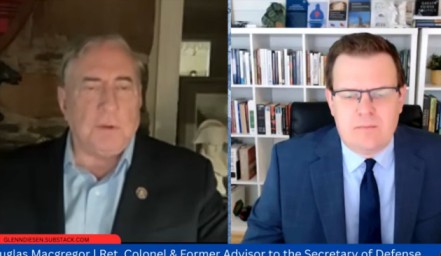
Read the full transcript of Colonel Douglas Macgregor’s interview on Greater Eurasia Podcast, May 21, 2026.
Editor’s Note: In this episode of Glenn Diesen’s program, Colonel Douglas Macgregor offers a candid assessment of the escalating tensions in the Persian Gulf, arguing that the U.S. is facing a critical turning point and may be effectively finished as a military presence in the region. Macgregor details the risks of a potential new round of conflict with Iran, noting that American forces are ill-prepared to achieve their strategic goals while facing severe economic and financial constraints. Additionally, the conversation touches on the ongoing Ukraine conflict, with Macgregor suggesting that Western globalist policies are fueling instability and that Germany is reaching a breaking point that could force a major shift in foreign policy.
INTRODUCTION
GLENN DIESEN: Welcome back. Today is May 21st, 2026, and we have the great privilege of being joined by Colonel Douglas MacGregor, the former advisor to the US Secretary of Defense, a decorated combat veteran and author. So, thank you very much for coming back on the program.
DOUGLAS MACGREGOR: Sure, happy to be here, Glenn.
The Iran Situation: Are We Heading Back to War?
GLENN DIESEN: I’ve been looking forward to getting your take on what’s happening now in Iran. It appears that both sides are rejecting each other’s proposals for peace, and it doesn’t seem to be a clear meeting point anywhere. Do you think it’s likely we’ll be going back to war?
DOUGLAS MACGREGOR: Well, I do. On the other hand, I have not been keeping up with the variety of responses that we are eliciting from Washington. President Trump said something about a negotiation. And there seemed to have been some willingness on the American side to be more flexible. The idea of “let’s set aside the nuclear issue and other things and sort things out for the strait.”
So if you’re telling me that everyone has now firmly rejected everyone else’s proposal, I believe it. But I haven’t seen anything final from Donald Trump. And of course, you never know what you’re going to get out of Donald Trump. He seems to negotiate against himself a lot. There’s not much evidence that he’s really talking to anybody else. So who knows what’s real and what isn’t.
But I think what’s most important right now is the idea that Mr. Netanyahu is coming to Washington. And that’s the latest rumor. I haven’t seen it officially announced yet anywhere, but I have it on fairly good authority that he’s flying to Washington. The last time he did that, of course, you had the war break out. He visited, he spoke, everyone was sort of in the kissy face, huggy bod mode. And then suddenly he flew back, the war began, and Trump said, “Oh gosh, we need to join the war.” And off we went.
So I don’t know what’s going to happen now, but the fact that he’s coming to visit tells me that he wants to make sure that Trump is not losing his grip, that Trump is not weakening, that Trump is not trying to cut a separate deal. All of those things may or may not be true. I have no idea.
So at this point, I would expect it to start up. I just don’t know when. The interesting thing is this overlaps, as you know, with the Hajj in Saudi Arabia that begins on the 24th, and that’s usually a 10 or 11-day event. So that would mean that we would be going to war in the middle of the so-called pilgrimage. Whether or not that’s significant, I have no idea.
The other thing is that I’m still unclear on whether or not the Saudis and the Qataris are going to authorize our use of their airspace or for that matter, any bases. I don’t know what the outcome there is. There’s so much — I don’t want to say disinformation, but contradictory information floating around inside the Beltway. It’s very hard to know what is real or isn’t. But to go back to your original question, do I think they’ll go back to fighting? Yes, I do.
What Has Changed During the Ceasefire?
GLENN DIESEN: Well, what has changed though during this ceasefire, the pause? To what extent has each side been able to replenish their arms, regroup, and prepare for war again? And also, what would you expect to see different this time around? Would the US go faster up the escalation ladder? I assume Iran would respond in kind. I mean, given that Trump wanted this ceasefire, what do you think is going to be done different this time around?
DOUGLAS MACGREGOR: I think that the opening will be a sledgehammer by the United States. Frankly, my impression is that we have brought — let’s back up a minute. We talk in military terms in the Army about basic loads of ammunition. Usually you think in terms of 3 basic loads. There’s the first one that is supposed to get you through the first week or so of combat. Then there’s the second that is supposed to come in and assure that you can stay there for another week or 2 weeks. Then there’s a third that keeps you in the fight for a month.
I think we have something like that happening right now with our air and naval forces. We are absolutely loaded to the gills with munitions and aircraft and missiles. No question about it. Everything is ready to go. But in addition to that, this time around, I think we have almost the same amount of ammunition in reserve. Which means that instead of getting a 3 or 4-day intensive bombardment, you could conceivably keep it going for 5 to 7 days. So I expect that this will be much more intense, much more severe, inflict much more damage.
Now the question is, what does that mean to targeting?
I don’t have access to the targeteer. But if you are limited to air and naval power and you don’t have any ground forces that you can use to exploit strikes, then it becomes an exercise in trying to determine which target set is going to be the most useful to you in terms of compelling the enemy to collapse or disintegrate or surrender.
I don’t know. I’m sure we’ll hit all of the targets we hit previously because we now know, thanks to the CIA leak to the New York Times, that the Iranians emerged from the last round with virtually 90% of everything intact. Well, if 90% was intact the last time around, that means we’re now facing with almost complete certainty 100% readiness, because I think that level of replenishment has occurred on the Iranian side.
In addition to that, there are several sources claiming that additional Russian radars for air and missile defense, and some for purely targeting at great distance, have been brought in. And the Chinese have brought in some additional missiles — some of the same ones that have been fired in the past, but a new class of missile, a very well-known but not used thus far cruise missile designed to sink ships at sea out to 300-kilometer ranges. So that means about 180 miles. That would probably hold everyone quite a distance from the opening to the Persian Gulf.
Now, the other thing is that there’s evidence that Russian and Chinese technicians are also on the ground helping to operate these systems. Now, none of that should surprise us because we’ve been doing that in Ukraine for the Ukrainians against the Russians now for years. But nevertheless, you have people in Washington who say, “Well, this is outrageous. What are these Russians and Chinese doing?” Well, what do you think they’re doing? They’re doing to us what we’ve been doing to them.
So I think this is a very serious moment. I think we’re going to see far more damage this time done by both sides to each other. And I think that we can bet with virtually 100% certainty that Iran will finish off the oil infrastructure on the west side of the Persian Gulf. And I imagine they may well go after the desalination plants that have an enormous impact on Saudi Arabia, not just the Emirates, to the point where if they destroy the one that’s in Al Jubail, then that means Riyadh runs out of drinking water almost instantly. In which case they have to evacuate the capital because they have no other way to provide drinking water.
So this is a very serious moment. And I think it reflects, particularly on Donald Trump’s side and with Mr. Netanyahu, a certain level of desperation. They’ve got to win this in their minds — do whatever it takes short of the use of a nuclear weapon. Now, some people think that the Israelis could actually break that taboo and use a nuclear weapon. I don’t know. I certainly hope not because that would open up Pandora’s box and then anything becomes possible.
But assuming that doesn’t happen, I think every conceivable form of attack is going to be employed this time around with far more intensity than we saw the first time.
The Reported Split Between Trump and Netanyahu
GLENN DIESEN: Well, about this reported split between Trump and Netanyahu. So allegedly Trump wants to make peace with the Iranians, or at least get a longer pause, and Netanyahu wants to continue to degrade the Iranian military, ideally knock out the government. Do you think there’s a lot of substance to this, or is it meant to make the Iranians lower their guard? How are you reading the situation?
The Hotel California: Trump’s Middle East Dilemma
DOUGLAS MACGREGOR: Well, I think the Persian Gulf has turned out to be, for Donald Trump, the Hotel California. You check in, but you can never check out. He’d like to check out. There’s no doubt in my mind that that’s the case. But he also has obligations to his Israeli lobby, not just Mr. Netanyahu personally and the Israeli state, but to his donors who funded his election. And I think they want the complete and utter annihilation of Iran.
And I think he’s probably saying, well, I understand that, but what if we can’t do that? Then their answer is go back and find another way to do it. In other words, there’s no easy exit for Mr. Trump from this mess. So I think the best that he could hope for is what you just described, some sort of pause. And whenever you get a pause, I think he spends a great deal of time trying to figure out, well, how do I exploit this pause to either win or escape? One of the two.
And I don’t think it’s working out very well for him because I don’t think there’s an easy answer. So I think, yes, there’s probably a split along those lines, but on the other hand, how much maneuver room has President Trump really left himself? Now we know from the past that he’s very much inclined to exaggerate, and he frequently lies about the level of discourse between Iran and the United States, between Iran and Pakistan, between Iran and the Emirates, or the Emirates and Pakistan. So it’s very hard to gauge what’s real and what isn’t.
So I’ve really gotten to the point now where I just don’t bother trying to figure out what’s real and what isn’t. It’s a waste of time. So I think he’s in the Hotel California. He wants to check out. He can’t. That means he’s got to restart the war. Now what happens if he restarts the war and after another 3 weeks we’re nowhere, we’re in the same position we were before? Well, then he’s humiliated. Then he has to make an ignominious withdrawal. He has to admit failure.
Will he do that? I don’t know. He may say, well, there’s nothing left now. It’ll be another midnight hammer exercise. We’ve destroyed everything. There’s no reason to keep this up. Iran no longer represents a threat to anybody. Iran is impotent. Its neighbors are no longer afraid. Of course, most of its neighbors no longer exist because they’ve been bombed out of existence in the Persian Gulf region. But he may say that and then say, I’m going home and I plan to attend the World Cup. Who knows? Anything is possible.
Financial Crisis and the Bond Market
But what will people at home feel? What will they think? And we can’t be certain of that right now because the real effects of the disaster in the Gulf haven’t been felt here yet. I think by the end of June, the beginning of July, our strategic petroleum reserve is going to be getting very low to the point where it’s in danger of going dry. That puts us in a difficult position. It’s already clear that we can’t afford to export all of the crude that people are asking us to export because we need that as the foundation for our refining industry. We also have a problem with the oil that we extract from shale that has to be exported because we don’t have the refineries to deal with it because of the difference between the shale oil and normal oil or normal crude.
So he’s got to deal with these things. Then in addition to that, we have the financial crisis. And I’ve been watching the bond market for years. And that’s simply because everyone I respect, whether it’s Alasdair MacLeod or Ray Dalio or Luke Gromen, any number, Gundlach, brilliant financial analysts. They’ve always said, look at the 10-year bond. Once the 10-year bond breaks the 5% ceiling in terms of its yield rising, we can’t service the debt. Everything begins to collapse. So we’re inching up toward the 5%. So what does that mean if that happens during this next round? I think it means that we pull out. Because we can’t afford to stay.
And we’re already watching as gold replaces the dollar as the world’s reserve currency. And that’s not something that was planned on last year or 6 months ago or 2 years ago, but it’s happening. It’s real. And the Chinese, we know, have accumulated enormous quantities of gold. Nobody knows how much they’ve got. Now, to create some liquidity with foreign reserves, the Russians have actually sold some gold. They’ve got plenty of gold. India has plenty of gold. All of this gold is going to end up backing BRICS. And this is a battle between BRICS and the US-dominated Western financial system.
So if the US Western-dominated financial system suddenly collapses in crisis because of what’s happening in the bond markets, not just in the United States, but around the world, we’re watching everyone who can offload our debt. How do you sustain the war? And I don’t think we can. Now, perhaps Mr. Bessant has some new magic up his sleeve. I have no idea.
So I think President Trump is really squeezed at this point. If he doesn’t go back in, it looks as though he’s been defeated and is giving up. In other words, regardless of how prudent it may be to do, he can’t just sail away, fly away and forget it. He refuses to say what I’ve been urging him to say, which is for humanitarian reasons, we’ve got to get out because this is no longer just about the United States and Iran or just a few other nations in the region or states in the region. This is about the world and the entire world is suffering. And if we don’t stop this, if we go through with this next round, it may be a decade before the global energy complex really recovers.
Reversing the Green Revolution
We’re going to have famine. He’s effectively reversing the Green Revolution, because the fertilizer doesn’t exist. People in the United States, they don’t even know what Green Revolution means, most of them. They don’t understand how that’s changed because in the ’60s, we had a little more than 4 billion people living on the planet. Today, we’ve got more than 8 billion. That’s not accidental. That’s because of the Green Revolution. We’ve been able to feed all of these people. What happens when we can’t?
Now, we’ll have problems inside the United States. Everybody knows that, but they’re not as severe as they are, say, in the Global South. And I don’t know what happens in Europe. Europe is going to be in very serious trouble when it comes to these things. And look what the Europeans have done to the Dutch. Look what the Dutch globalists have done to themselves. And the Dutch are the most productive agricultural state in the world. And because of the Ukraine war, we’ve lost access to vast tracts of farmland that used to produce enormous quantities of food.
The whole thing is a disaster, but politicians in the United States, in Washington, are not thinking in terms of the rest of the world. They’re thinking in terms of themselves. And there’s also remembering how much money they have been able to line their pockets with as a result of the Israel lobby and the Israel lobby supporters and all the other lobbyists that are out there that have no interest whatsoever in anything that happens anywhere but in the United States. So it’s a bad situation. There’s no easy solution.
Iran, the Strait of Hormuz, and U.S. Defeat
GLENN DIESEN: Well, my assumption though with Trump was, he thought probably the best scenario would be he’s able to regime change and, well, destroy Iran. Worst case, that he has to pull back. He can declare victory, point to how many people have been killed and the navy destroyed, all of this, a bit like Yemen, and just declare victory and go home.
But the problem, of course, is if the Iranians hold the Strait of Hormuz, then they can put a higher toll on countries that threaten Iran’s economy, with sanctions, threaten Iran by hosting U.S. bases. They can put extra toll on countries that trade in the US dollar. So that’s what I was wondering, how does the world look like if the US is effectively defeated in Iran, if defined as the US having to pull back with the Strait of Hormuz then solidly under Iranian control, and being able to essentially use the tolls to create this incentive system to have its own economic and military security, well, shored up.
America’s End in the Middle East
DOUGLAS MACGREGOR: Whatever happens next, whether we attack or we do not attack, whether we try to leave and say we were successful or not, I think we Americans are finished in the Middle East. And I think that’s the greatest concern that Mr. Netanyahu has right now. If we cannot break Iran’s grip on the Persian Gulf, if we cannot force our way back into the Persian Gulf, and I think it’s pretty clear that we cannot, that means that we are finished in the region. We will not come back into these bases. There will be nothing to rebuild. It will be a decade before the countries that existed there even recover, if some of them ever recover at all. Because frankly, in that part of the world, there just isn’t enough water to support much development.
So I think that’s the greatest single problem, not so much for us. And let’s be frank, I would argue that we should have withdrawn from most of the overseas bases a long time ago. And I’ve been giving briefings to War College classes, to Army audiences, to any audience that would listen for the last 15+ years, that the whole notion of forward military presence is finished. And everybody looks at me, well, you’re crazy. And I kept trying to tell everyone, we have new capabilities today. Whatever you put forward in a forward presence mode, that means in bases like the ones in the UAE, bases in Germany, bases in Korea, bases in Thailand, bases in the Philippines, it doesn’t matter where you go. You are now a target array waiting to be destroyed. You can be easily identified, easily targeted, and enough theater or tactical ballistic missiles or cruise missiles can be launched to wipe out your forward presence at the beginning of any conflict or crisis.
The Case Against Forward Military Presence
So I’ve urged that we abandon this forward presence nonsense. Remember that forward presence was justified in the aftermath of World War II, not just by the Cold War, but by the assumption that by being there, we were going to prevent other conflicts from breaking out. Well, that hasn’t worked, has it? It hasn’t worked largely because we’re the ones causing many of the conflicts. But the bottom line is those days are over.
So in one sense, this is a blessing insofar as it’s going to compel us to pull our forces back and come home. At least we can protect them inside the continental United States if defense becomes the primary focus, because our whole force posture, our military thinking since the end of the Second World War has been offensive. The best defense is the offense. That was always the argument. If we’re forward, we can attack quickly. We can nip this problem in the bud. In other words, we can solve this problem before it gets out of control. Those days are over. Technology has changed. You cannot do that anymore. And if you try, you’ll just lose your forces.
That means we’ve got to come back to the continental United States and figure out how are we going to defend ourselves? Because this strategic defense is now superior to any strategic offense. The only thing that is left that we cannot stop are hypersonic missiles in the form of intercontinental ballistic missiles, which means that we live permanently, and the Russians and the Chinese and others who have ICBMs, permanently under the threat of total destruction if any of those are used. So other than that, which is unchanging, the world is a very, very different place. We can’t operate in the world of the past. It’s gone. This is a new world.
So what are we going to do? I don’t think Americans have thought that through. I don’t think anyone in Washington has thought it through. And they’re all very reactionary. “Oh, we could never leave Korea. Oh, we could never leave Japan.” Well, wait a minute. We don’t live in Korea. We don’t live in Japan. They’re not part of the United States. What do you mean you say we can’t leave? And now we have governments like the one in South Korea that’s effectively telling us, “Listen, we really think you ought to get out.” Now they don’t say that publicly, but they do behind closed doors. And they’re very polite about it, but it’s getting to the point where at some point in time, there will be no more politeness and they will just say, “Come on, you got to go.”
Now, why would they want us to go? For the same reason that I don’t think anyone’s going to invite us back into the Gulf because we are seen as a catalyst for conflict. We are not indigenous to the region. We’re not organic to the international system in that area. Wherever we are a foreign entity, and we have the potential to drag countries with us into conflicts that they would otherwise never fight, we are unwanted. And we have now gone to war with Iran largely as a result of Israel’s interests, not our own. And that’s the problem. No one wants to be dragged into anything unless it involves them. And the one state among the Emirates that was most interested in the same thing Israel was, was the United Arab Emirates. They were effectively aligned with Israel. So they were interested in the destruction of Iran. That has not worked. That’s been a disaster for the UAE.
NATO’s Role in Ukrainian Drone Strikes
GLENN DIESEN: Well, to pivot to another horrific war where also there’s some allies who are reorienting themselves. It appears that as the US is pulling a bit away from the Ukraine war, or at least outsourcing it to the Europeans, the Europeans are seemingly escalating a bit. At least the Russians are now accusing the Baltic states of either facilitating or just tolerating Ukrainian drone strikes through their territory, if not even launched from their territory.
How are you seeing this situation? Because I’m getting messages from Moscow that this is it. Accepting this would be way too — it would be much more dangerous than responding in some way. How are you assessing this?
DOUGLAS MACGREGOR: Well, what I’m going to say is something that I’m sure the Russians already know, so I don’t think I’m giving anything away. But people need to understand that the flight paths and the targeting for these long-range drone strikes have all been provided by American military capability. You can’t fly from where they were launched in Ukraine across the Baltic States and then strike targets just outside of Saint Petersburg without U.S. help and assistance.
Our surveillance aircraft, our satellites have mapped every refinery, every oil derrick, every airfield, every installation of strategic or operational military importance inside Russia. That information has been gold to the Ukrainians who have no military capability today other than drones. That’s all they’ve got. They can’t launch an offensive on the ground. They’ll lose everyone that they have in the space of a few hours. They can’t move and conquer new territory for any length of time. There’s nothing they can do except launch these drones in a series of what I would call revenge strikes.
But these strikes have reached the point where the Russians have had it. Their patience is gone. They’re angry. And the Russian population, as much as it supports President Putin, is effectively saying, “This has got to stop. We all understand this is a special military operation, but either crush this or declare war or both. Get it done. End this.”
Germany’s Political Turning Point
I think we’re very close to that. However, something has always been working in Mr. Putin’s favor, and that has been the globalist regimes themselves in Western Europe and the policies that they’ve pursued. Their policies have been economically, socially, culturally destructive. We now have millions of people living inside Europe that would, under normal circumstances, never be there because globalist leaders, going back to Merkel, have opened the borders and allowed millions of people into those countries. Who are now living at great expense to the economies in those countries. People who are so fundamentally different that they can never be assimilated and don’t want to be assimilated. If anything, large numbers of them have decided that they’re going to turn Europe into what they want it to be, not what it is.
So things are finally beginning to change, and the place that’s of greatest importance because it’s the most powerful state in Europe is Germany. And Germany is on the edge of exploding like a volcano. They have an opportunity to break the stranglehold that the globalist leadership has had on that country for years. That may happen, and it’s probably going to happen. The question is when. Will it happen next week, next month, later in the year? I don’t know, but I think it’s coming because there is a growing readiness to admit that this has all gone too far.
Germany is being turned into what the famous Morgenthau Plan tried to do to it — deindustrialize it, destroy its scientific industrial might and power, undermine, erode its morale, destroy its sense of self, its national identity. All of this is ending because Alice Weidel has turned out to be a person of extraordinary ability. She is somebody that we refer to as a rocher du bronze, or Felsen der Brandung in German. In other words, she’s the granite in the fire. She has withstood everything that could be thrown at her, and she is telling the truth. And people, even in the Bundestag, even in the Bundestag, in the CDU, they’re beginning to say she is right.
Now, if she takes over, what do we expect to see? Well, the first thing that’s going to happen is that I imagine she or her new foreign minister will fly to Moscow and say, “Look, this is it. We want nothing to do with the policies of the past. We didn’t like it. We didn’t support it. We opposed it. We want to do business.” And what is President Putin going to do? Is he going to say, “Well, we don’t like you anymore”? Of course not. He’s going to do business. And the cheap energy will flow.
And for every civilization, cheap energy is vital. It used to be like cheap labor. Cheap labor is still good. Cheap energy, though, is a vital necessity. And without it, you don’t have cheap credit. If you don’t have cheap credit, which is what we’ve been operating on in this country for decades now, everything stops. Right now, these KKR, BlackRock, all these multi-billion-dollar private credit firms, they’re in trouble. They have no liquidity. They’re trying to borrow against the assets they have under management to survive. They’re going to go under.
So my point is that that’s where Alice Weidel will take Germany. And all this business about “we’re going to build the biggest army or the biggest air force or whatever” — that’s impractical. And more important, it’s not even necessary. And that’s what Weidel understands, and I think increasingly the German electorate understands it.
You know, we had this movie years ago. It was a comedy. It was a great film. And it was about a Russian submarine that has problems and runs aground off the coast of Maine. And so the Russian crew, the captain goes ashore looking for support, and eventually the local townspeople help the submarine and they get the submarine back out to sea before the Coast Guard and the Navy and everybody else has a heart attack. And it’s called The Russians Are Coming. And this has been the mantra for years in Western Europe. We used to joke during the Cold War in the 1970s, “Oh, the Russians are coming, the Russians — they’re on I-95, headed from New York to Philadelphia. News at 7.” It was ridiculous. They weren’t coming. They’re not coming now. No one in their right mind wants to do this.
The Risk of Russian Retaliation
So I think once Germany stands up and says “no more” and puts an end to this, it’s going to be very hard for everybody else. Now, the reason I brought up all of this mapping of installations and navigating courses for these drones is because it’s all being done through the Baltic states, or it’s been done down through Romania and out to the Black Sea where they’ve been striking targets all the way out to the Caucasus. This is very dangerous, and the Russians really are very frustrated and angry. And again, it’s unnecessary.
But you’ve got unbalanced, unreasonable, dangerous people like this Kallas, who is the EU foreign minister. Now, why in the name of God would you pick an Estonian politician to be the foreign minister for the European Union? It’s absurd. Makes no sense. We have more people in New York City, LA, the top 15 or 20 cities in the United States than exist in these little countries. Now, do these little countries have a right to exist? Absolutely. Are they in danger of being overwhelmed and destroyed by the Russians?
GLENN DIESEN: No.
DOUGLAS MACGREGOR: But if this nonsense doesn’t stop and they don’t get out of the business of aiding in the construction of these long-range drones, and the rest of the Europeans continue to ship these components where they can be assembled in Ukraine — because Ukrainians don’t need help with the FPV, the first-person drones. Those things they can build until the cows come home. But the long-range drones, no, that’s a different matter entirely.
And if this doesn’t stop, then at some point the Russians may lose patience. So I think it’s kind of a race. Does Germany offload this terrible government, which has done so much damage to the country? And Merz, who is going to get most of the credit for it, is not the first. You’ve got to go all the way back to Merkel’s arrival. And ever since she took over, Germany has been on the path to hell. That has to stop.
If that stops and Germany gets new leadership, then I think the Russians will pull back and wait for the visit from Berlin to Moscow. But if that doesn’t happen soon, then the possibility of strikes by the Russians on the manufacturing facilities or the military facilities in the West that are playing a role in this could very definitely happen. I think that would be unfortunate because I think Russia is on the verge of winning the peace.
GLENN DIESEN: So Germany — either do a regime change or we might go to war.
DOUGLAS MACGREGOR: What would you say? Go to war with who? If you’re a European, who are you kidding? You’re not going to get that. That’s nonsense. Sorry. That’s the issue. But go to war to do what? What have you got? There’s nothing there. Who are we kidding? I mean, this is the joke. “Oh, you’ve got to load up all your tanks and artillery pieces and troops on the trains and then run the trains all the way to Poland to the border and disembark and get ready for the big offensive?” No, they’ll all die on the trains. Everything will be destroyed. Precision-guided weapons will wipe it out before it ever gets there.
Europe’s Military Posturing and U.S. Commitment to NATO
GLENN DIESEN: So what are the Europeans doing? Because while they’re doing these things — that is striking through the Baltic states also with the US assistance, as you say — they’re also putting this new UK-led naval block being built against the Russians. I’m not sure if they are putting pressure on Russia or if they’re actually preparing for a war which they can’t fight. But if they do pick a direct fight, or the Russians now decide that they have to strike Latvia or Estonia, either giving them some plausible deniability by using Ukrainian drones which they have downed, or just doing direct missile strikes on Latvia — do you think the United States still would come to the rescue?
The Limits of U.S. Military Power
DOUGLAS MACGREGOR: Well, the United States is not going to use nuclear weapons. The notion that if this so-called Article 5 is invoked, let’s say by Lithuania, Latvia, Estonia, that the United States will launch nuclear weapons at Russia is absurd. That won’t happen.
So then the question is, if we’re not going to do that, what can we do? Well, right now we’ve gone through about two-thirds plus of our missile arsenal. I don’t know what the exact numbers are. If we launch very next, in the next few days, and we go into another phase, I think we’ll go from two-thirds having been expended down to perhaps less than a fifth on hand, at which point in time, what can we do? Very little. Because if we’re going to get into an attrition conflict involving missiles, we’re going to lose it because the Russians can produce more, the Chinese can produce more. And the Chinese are certainly not going to stand by and watch us brutalize or try to destroy Russia.
I guess the issue is this. Donald Trump was elected to do many things and people mistook him for being this strong, influential leader who would represent their interests. Well, first of all, he’s not representing anybody’s interests in the United States. Any more than Starmer is representing the interests of people in England, Scotland, Wales, or Northern Ireland. Forget it. He’s not. That’s increasingly obvious. Macron, I’ll let others debate that, but I think he’s on very fragile territory as well. Meloni has tried to back off, but she hasn’t taken decisive steps that she needs to take for Italy.
So what do we expect Donald Trump to do? I wouldn’t expect him to do much. Because we can’t fight two wars at once, not if the wars involve vast numbers of missile exchanges, because most of those are being expended down in CENTCOM, U.S. Central Command in the Middle East. We have limited, limited numbers.
Trump’s Retreat from Taiwan and the China Question
Now, one of the things that Donald Trump said when he returned from his trip to China, which I thought was very good, is that he essentially put an end to the nonsense about going to war to defend Taiwan. He said, “We can’t do it.” So effectively what he said, he’s right. He said, “Taiwan’s 100 miles from China, but we have to travel 6,000 to 7,000 miles to reach the place.” Somebody talked sense to him. I don’t know who it was. Whoever it was deserves the Nobel Peace Prize. Because the dumbest thing I could imagine is the United States trying to precipitate a war against China.
China is the largest fortress in the world. You know, there’s this old expression, “A ship’s a fool to fight a fort,” which means fleets don’t take fortifications ashore. They can’t stand up to the fortifications ashore. You can always fire more missiles from your magazine ashore than you can from your magazine aboard ship. So he said, “No, that’s not going to happen.” Thank you, President Trump. God bless you. That’s vital and essential. Let’s get rid of this stupid nonsense about China and going to war.
Now, other than that, he was embarrassed because President Xi simply said, “Well, I’m happy to welcome the leader of a declining power to my country. And as the leader of a rising power, it is a great pleasure to see you.” What a great statement. Is he wrong? Not entirely. Is he right? No, not entirely, but he’s not a fool. He was sending a message.
China is the largest manufacturing base in the world. For every one rocket engine or missile engine we turn out, they can probably turn out 500 to 1,000. It’s a simple fact. Go back to World War II, and when you ask the Germans how they lost the war, they’ll say Lend-Lease right away, because the Soviet Army wouldn’t have gotten 50 miles beyond Stalingrad without all the trucks and all the Jeeps and all the steel and all the trains and all the metal — I mean, just go down the list. Impossible. Well, that’s what we are facing today with China. China has replaced us as the leading manufacturing power in the world. So thank God for that.
Stuck in the Hotel California
Now, otherwise, everything that was reported after that trip was irrelevant nonsense. We didn’t close any big deals that are going to make us rich, and we didn’t take advantage of any Chinese weakness or anything else. That’s all nonsense. So he’s now back in Washington, and he’s still stuck in the Hotel California. And it’s obvious to him that it’s in China’s interest that we sit in the Hotel California called the Persian Gulf. The Chinese aren’t going to help us get out. The Russians have tried to help us get out, but we don’t listen to them. We’re not going to change our posture for the reasons we’ve already cited. But at least we have offloaded the stupid idea of war with China. That’s wonderful.
The question is, now what? And that brings us back to where we were before. I think you’ve got a collision coming. On the one hand, the reality in the Persian Gulf — we don’t have the capability or the right force mix to change that equation. They’ve got it. They’re holding it. It’s very tough to change that. Then on the other side, we have this thing called the American economy and financial system. Which one is going to break first? That’s the question. I don’t have the answer.
GLENN DIESEN: Yeah, if you can only pull the plug on the Iran war and the war in Ukraine as well, then perhaps, yeah, we could start the process of rebuilding and stabilizing instead. Anyway, sir, thank you very much for taking the time. It’s always very fascinating.
DOUGLAS MACGREGOR: Okay, thank you, Glenn.
Related Posts