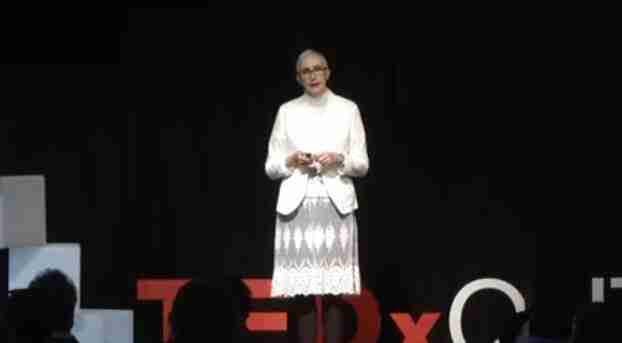
Read the full transcript of Professor Suzi Vaughan’s talk titled “Fashion Your Future: Think More Like A Fashion Designer” at TEDxQUT 2015 conference.
Listen to the audio version here:
TRANSCRIPT:
Early Aspirations and Fashion Career Decision
SUZI VAUGHAN: I don’t think it would be true to say that I always wanted to be a fashion designer. When I was little, and I was actually little once, I think I wanted to be a ballerina and I wanted to be a zoologist, all sorts of things. But by the time I was about sixteen or seventeen, I knew absolutely that what I wanted to do was to pursue a career in fashion.
And when I look back, I think probably the signs were there somewhat earlier than that. I obviously early on, had an attraction to natty dressing and was clearly willing to pose in fashion spread type settings as you can see from that early photograph.
Parental Reaction and Educational Choice
When I decided I wanted to leave school, it fell to my mother to tell my father the news and that was a difficult thing to do. I decided I wanted to do fashion so I didn’t want to stick around, I didn’t want to finish my A levels, I wanted to leave school a year old earlier and embark on that path to studying fashion. And when she told him, I think it would be true to say he went into a dark room and he would have probably stayed there for a while.
Because in fairness to him, neither he nor my mother had had parents who had encouraged them to stay on at school, certainly not to go on to university or to aspire to careers. And my father had worked really really hard to save the money to put my sister and I through a good school in his mind to set me up for a sensible path perhaps to become a lawyer or a doctor or an engineer.
Something that a smart girl might do with her life. So when I chose to leave school and go and study fashion, I truly think he was disappointed and frightened that I would never do any of the things he’d hoped for me in my life. Thankfully, that’s not the case. But but I found myself a year later. This was my Boy George phase.
Fashion Education and Career Journey
I got out of Wales into London and you can see what happened. Enrolled at Central Saint Martins, which was at the time and still is one of the hardest fashion colleges in the world to get into. And I can truly say I have not had one day of regret in my life for choosing that different path that I took. I loved fashion college. I went on to work and study and travel all over the world.
So my father’s fears that I would never get out of Wales, those little black spots are some of the places that I’ve traveled and lived and worked. And now, go figure, I’m a professor and a deputy vice chancellor. So maybe I got my sensible job in the end. But it’s actually only been in the last few years when I’ve been in this role rather than being a fashion designer or educating fashion designers that I’ve really begun to think about what thinking like a fashion designer means and how much it brings to other situations and other roles.
Times of Change and Fashion’s Role
And part of that is to do that we live in times of change. Now, perhaps people would always say we’ve lived in times of change. If you ask someone five years, fifty years, a hundred, maybe even five hundred years ago, they would say we are living through times of change. But I think the truth is, and we’ve heard much about that today, that the rate of change, the disruption of the change that we’re living through now is quite significantly different. And there is nothing on the horizon that suggests that that is going to be different anytime soon. And what it has occurred to me in the job that I do now is that, of course, fashion thrives on change.
I would suggest there is no other discipline or industry that thrives as much on change as fashion does. And in fact fashion doesn’t just thrive on change, fashion creates a desire for change. So any of you who’s sitting in the audience today feeling smugly that fashion does not touch you at all, I just ask you to think about the last piece of clothing you bought. And whether or not you bought that piece of clothing to replace another piece of clothing that had completely worn out. And I ask you to actually think about when you last threw a piece of clothing out because it had truly worn out.
Because that is the exception to the rule now. And fashion is very very clever at thriving and creating a desire for change. So what I want to talk to you about today is the idea that you can fashion your future by employing some of the ways of thinking more like a fashion designer. I’m going to share with you in the next few minutes nine ways to think like a fashion designer.
Nine Ways to Think Like a Fashion Designer
1. Use Your Imagination
And the first is about using your imagination. Because imagination is a fantastic thing. It’s completely free and it’s a limitless resource. Every one of us has limitless resources of it. But if you think about how frequently you are creative and I don’t mean creative just in the nature of drawing or painting or dancing or any of those things but literally every day. How often do you use your imagination?
Most of us take the same routes to work every day. We drink the same kind of coffee every day.
We eat similar things and we do similar things. And we also try to take very similar approaches to the problems that we encounter even though we know and again we’ve seen many times today that that is increasingly fruitless.
2. Be Curious
Be curious. The best fashion designers are insanely curious about everything and everybody. Whether it’s science or technology, history, culture, music, film, art, They want to know everything about everything. And that is because they are constantly seeking to be inspired and re-energized to come up with new ideas. So next time you go to the movies, why not go and see a film that you would never consider seeing? Next time you open a newspaper, open it on a different page and read that page.
Next time you go online, follow a different path. Because whilst it’s never been easier to access information and connect to people, what we often do with that possibility is to access information that we know we’re already interested in and connect to people who share similar passions and likes. So be more curious. Next time you’re in a social environment, speak to someone that you don’t think you would have something in common with. Maybe someone considerably older than you or someone considerably younger or any other way.
Be observant. Fashion designers have to look for emerging trends. It’s like antennae. They have antennae on their little heads because they are constantly striving to stay ahead of a curve, to think about things, to try and imagine what is going to appeal to you at a certain point into the future. So they are always watching for emerging trends.
They’re looking for a pattern. Suddenly everything’s about Japan. Exhibitions open. There’s movies, new restaurants. But think about it in your work life or in your community. See the patterns that start to emerge. Listen to the things that people start to talk about and think about how you can become more involved in those things.
4. Don’t Overlook Simple, Familiar Things
Don’t overlook simple, familiar things. You’ve sat here today and listened to all of these different speakers. They’ve been confronting, they’ve been inspiring, they’ve been evocative, they’ve been funny. They’ve used the same language of English which has twenty-six letters. Twenty-six letters. But if you use simple things and familiar things well, you can create endlessly. And fashion designers do that all the time. Think about the simplest thing like a white t-shirt.
It’s been around for absolutely decades: denim jeans. But by reimagining them, making them relevant to your lives, thinking about them in different ways all the time, they go back to the simplest things and use them again.
5. Have Lots of Ideas, But Don’t Fall in Love with Them All
Have lots of ideas but don’t fall in love with them all. It’s amazing how many times you hear people say, “I’ve had an idea.” Great! Fashion designers have to have thousands of ideas. And for every ten you might see come to fruition, most of them they let go. Have lots of ideas but learn to let the majority of them go. What each of us today have learned, again who’ve spoken here, is a number of weeks ago we had a little rough idea. But the energy, the effort, the expertise that has gone into honing, polishing these little ideas that we have shared with you today has taken an immense amount of effort.
Could you have done that with a hundred ideas? I would suggest you couldn’t.
6. Share Your Ideas
And share your ideas. Fashion designers, of course, share their ideas all the time. But they share them right from the beginning because they often get inspired by quite abstract things. So they find ways to share those ideas through sketches, through toils, that might just take moments to draw but allow someone else in to that idea. And I think each of us again, when I had a little bit of an idea about something about thinking like a fashion designer. But when I took the opportunity to do this and I accepted this offer about two months ago, I’ve taken every opportunity between then and now to test this idea with people, to watch their when I said I was going to talk about being a fashion designer to watch their faces, to share ideas along the way and what I share with you today is quite different as a result of that. So don’t be afraid to share your ideas.
Be an influencer. We talk a lot about social media. How many friends do you have? How many followers do you have? But what we’ve begun to realize is you might have lots of friends and many followers. It doesn’t mean that you have any influence. And by influence, I don’t mean power. I don’t mean the people that are your bosses or any of those things. What fashion has realized over the last fifty to sixty years is that designers have moved from a place of real influence. If you look at fashion magazines from the 1950s, they’re like instruction manuals. “Wear this dress with this hat, these gloves, these shoes, if you want to get it right.”
But of course, over that time, people don’t want to get it right. They want agency. They want to develop their own look. They want to bring things together in their own way. And that’s the same for fashion, as music, as all those different things they don’t want to be dictated to. And so fashion designers have made relationships and partnerships with people who they see as influencers. But they’ve also learnt from those people. So think about who the people are in your social groups. Who are the people who are often the outliers, a little bit more courageous, who influence people around you. And if you have ideas worth sharing, then share them with those people and your ideas will probably go further.
8. Don’t Be Afraid to Try New Things or Make Mistakes
Don’t be afraid to try new things or to make mistakes because most mistakes are really quite easy to remedy. And everything we’ve heard today, everything we know is that we cannot be secure in the ways that we do things. It’s so hard to be vulnerable. It’s so hard when you work in a university to unlearn things, to put yourself in a place where you may fail, to be humiliated. And believe me, when fashion designers make mistakes, they are very public and they can be very humiliating.
But they learn resilience, they get back up, they do it again and they move on. So don’t be afraid to try new things. No one knows what the future will bring. And that can be scary or exhilarating. We don’t know what will happen in five minutes, let alone a year from now, five years from now.
9. Be Optimistic
So my last way of thinking like a fashion designer is to be optimistic. Because fashion designers spend their whole time imagining futures that don’t exist. Imagining ways that we might be in the future. So be optimistic. Think like a fashion designer.
Fashion your future by thinking and using some of those ways. So thank you very much.