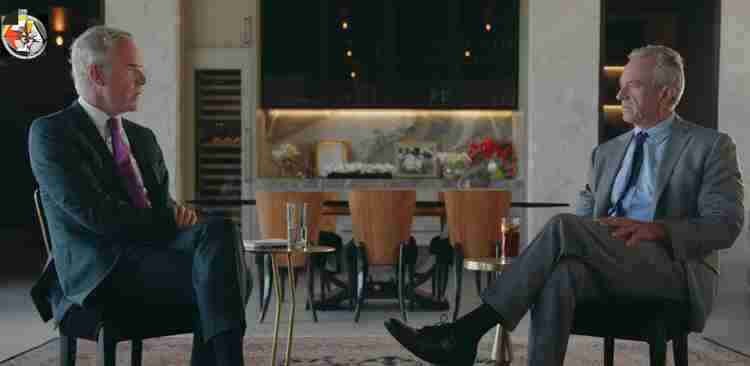
Read here the full transcript of The Dr. Jordan B. Peterson Podcast episode 484 titled “The Great Partisan Shift” with American politician Robert F. Kennedy Jr.. This episode was recorded on September 18th, 2024.
Listen to the audio version here:
TRANSCRIPT:
DR. JORDAN B. PETERSON: Hello, everybody. So today I had the privilege of round two with Robert F. Kennedy Jr. The first time we had a discussion, which I enjoyed a lot and thought was very worthwhile, the powers that be at YouTube decided that it was okay for them to eradicate it, which was not something that I was happy with and still remain unhappy about.
We’ll see if the same thing happens this time. So we covered — a lot has changed since that first interview, most markedly that RFK is now allied with Donald Trump. And that’s quite a strange turn of affairs. We have a coterie of disaffected Democrats running on the Republican side against Kamala Harris.
And what did we talk about? Well, we talked a lot about why RFK has become disenchanted with the Democrats. And I’d pushed him on that issue in our first discussion, asking him, for example, when the left goes too far, we finally have the answer to that question. That’s in this podcast, because RFK outlined five different ways the left has gone too far.
So highlighting, highlighting what? Highlighting their lack of care for free speech, highlighting the fact that they’re now the party of war, highlighting the fact that they’re no longer the party of the working class. Well, there’s three ways that the left has gone too far and not just what is that’s the tip of the iceberg. We talked a fair bit about, well, the policy issues that Kennedy has been discussing with Trump, concentrating particularly on the health crisis, on free speech and on international peace.
And those do strike me as three major issues that we need to contend with.
So join us for all of that. YouTube censors allowing.
The Alliance with Trump
DR. JORDAN B. PETERSON: So I’m very curious about the alliance that you formed with Trump. I’m curious about whether you ever imagined that such a thing was a likelihood. And then I’m curious about why you decided it was a good idea.
ROBERT F. KENNEDY JR.: Yeah, I never imagined such thing was a likelihood. In fact, I was reading a statement that I had forgotten I made, but I made it repeatedly in the 18 months, during the 18 months when I was run — after declaring that I was going to run. When people oftentimes ask me, why don’t you run with Trump?
And I would say, and then on several occasions, I was approached by the Trump campaign about running as his VP. And my answer to that was always that that would result in a divorce with my wife if I — even if I had the inclination to do that. Because it’s something that just constitutionally she at that point, could not have handled, and would have, I think, impacted her job and would have, and, and, her friendships, her relationships, her family, etc. But a lot, you know, we both learned a lot during the election, we saw, I saw this metamorphosis of the Democratic Party, the party that I was born and raised in my — my family’s been involved in the Democratic Party since my, all of my great grandparents came over on the, in 1848, during the potato famine, and landed in Boston.
And it was the Democratic Party that they came in, came over penniless, and friendless, and it was the Democratic Party that provided for them that made sure that they got food, that they got jobs, that protected them against the, the reigning hierarchy of power in Boston at that time, which was, you know, run by what they call the Brahmin class, which was very hostile to Irish Catholics in particular.
Kennedy Family’s Democratic Legacy
ROBERT F. KENNEDY JR.: And my great grandfather was the first Irish Catholic mayor of Boston, the first — let me put it this way, Irish Catholic ghetto mayor, there was one mayor before him that was Irish Catholic, but he was chosen by the Brahmins. And he was the first one who was, you know, part of the rebellion of the Irish. And the ultimate takeover of Boston and many of our other urban areas by Irish Catholic politicians. My grandfather, John Fitzgerald, was called Honey Fitz, because he had a beautiful, sane voice that sounded like honey.
And his contemporary, Patrick Joseph Kennedy, was a state legislator and a political boss in Boston, their children married by Rose Fitzgerald, married by my grandfather, Joseph Kennedy, he was the treasurer for Franklin Roosevelt’s campaign, he was the only Wall Street figure who supported Roosevelt. And then he became the first commissioner of the SEC, he had political ambitions of his own, but he ruined those ambitions by his anti-war position, both in World War One and then World War Two. He served as the US ambassador to the court of St. James under Roosevelt to Great Britain.
And then his children, his son, Joe, who was killed during the war, gave a speech, you know, would have run for, would have run and my grandfather had ambitions for him to be the first Irish Catholic president. He spoke, he gave a keynote address at the Democratic Convention in 1940. My uncle, John Kennedy, became the first Irish Catholic president of the United States. My father served as Attorney General in the United States Senate, and then died, was assassinated in his own run for president.
My uncle, Ted Kennedy, was the second longest serving member of the United States Senate. And so, you know, my family, the DNA of the Democratic Party was baked into my own character, my identity, I grew up in the party, I began campaigning when I was six years old, on my uncle’s campaign, I attended the convention in Los Angeles, I’ve attended almost every Democratic convention since then, worked in probably 100 campaigns. And, I was a stalwart in the Democratic Party, but the Democratic Party that I grew up with changed dramatically, has changed in the last year.
The Democratic Party’s Shift
ROBERT F. KENNEDY JR.: The Democratic Party I grew up in was the party of peace. My, my uncle, John Kennedy, he was asked by his best friend, one of his two best friends, Ben Bradley, who was then the editor of Washington Post, what do you want in your gravestone? And without skipping a beat, my uncle said he kept the peace. He said the primary job of a president of the United States was to keep the country out of war. He said he didn’t want children in Africa and Latin America when they — when they heard about the United States to think about a man in a military uniform with a gun, he wanted them to think of a Peace Corps volunteer, he wanted them to think of the Kennedy Milk Program, which provided nutrition to millions of malnourished kids around the world.
He wanted them to think of USA idea of Alliance for Progress and these other programs that my uncle created to protect economic power rather than military power abroad. My uncle was under tremendous pressure to go to war in Laos, which he resisted in 1961, to go to war in Germany during the Checkpoint Charlie crisis in 62 to go to war against Cuba in 61 during the Bay of Pigs. And then again in 63 during the Cuban Missile Crisis, and then to go to Vietnam. Virtually all of his advisors were telling him he had to send 250,000 troops to Vietnam or the government was collapsed.
And he said it’s their government, we cannot fight a war for them. He ultimately under great pressure sent 16,000 military advisors. And then who were not under his rules of engagement allowed to participate in combat. Some of them did. In October of 1963, he learned that Green Beret had been killed in Vietnam. And he turned to his aide Walt Rostow. And he said, I want the casualties, a list of complete list of casualties of US casualties. Rostow came back to him an hour later with and there was 75, 76 Americans that died at that point.
My uncle said it’s too many. And that afternoon, this October 22, 1963, he signed National Security Order 263, ordering all military personnel, US military personnel out of Vietnam by 1965, with the first 1000 coming home in by December. So that would have been six weeks later. And then he was killed 30 days to the date after he signed that order.
And a week after that, President Johnson, his successor, remanded National Security Order 263. Johnson then sent 265,000 Americans to Vietnam, it became our war. My father ran against that war in 1968. And he also was killed in that process.
And then Nixon took over and sent 560,000 Americans to Vietnam. We killed a million of them, maybe 2 million. They killed 56,000 of our, our children, including my cousin, George Skakel, who died in the Tet Offensive. And, and America then went down a different path or, you know, becoming a feature of the military industrial complex, which Eisenhower had warned against three days before my uncle on my birthday in 1961.
Three days before my uncle took me out of office, Eisenhower made that warning. And my uncle spent three years, 1000 days in his presidency, keeping us out of war and keeping the military industrial complex at bay. This was one of the defining features of the Democratic Party. We were the party that was against war.
Republicans were the pro war party, we were the party that was for civil rights, including constitutional rights, and particularly freedom of speech, which is the the backstop for all the other rights, the United States Constitution, a country that has the capacity to censor its critics has the license for every kind of atrocity. My father understood that my uncle understood that that was one of the that was a bedrock assumption, the Democratic Party that free speech was, if any, any constrictions, that free speech was the first step down the slippery slope of totalitarianism.
DR. JORDAN B. PETERSON: Is it fair to say then that you found the Democrats, and at the present time, you’ve alluded to peace and under Trump, now the party of war are now that you know, they’re, they’re about to get us into a war with Russia.
The Current State of the Democratic Party
ROBERT F. KENNEDY JR.: So we can start by talking about depression. Depressed people are sad and frustrated and disappointed. They tend to feel all negative emotions simultaneously in a manner that’s paralyzing. Depression is fundamentally a biochemical disorder. One of the things I tried to determine as a good behaviorist was whether the person who was suffering was suffering because they were ill in the strictly physiological sense, or whether they were suffering from the cumulative micro and macro catastrophes of life.
The probability that tossing an antidepressant into the mix is all of a sudden going to fix your life that are absolutely catastrophically out of order is zero, the more unstable your life is, the less serotonin your brain produces. And that makes you hypersensitive to negative emotion and suppresses positive emotion. You take the problem, I’m suffering. And then you think, well, why are you suffering?
It’s exposure therapy. And then you can practice encountering the obstacles that are stopping you and it’ll make you braver. And it’ll help you deal with your problems. Voluntary confrontation with the forces of darkness and chaos is the fundamental story of life.
Putin has said this week, yeah, that if we send missiles into into Russia, that he will consider himself to be a war with NATO and the United States of America. And you know, and he’s got more weapons than we do. And he’s got is the biggest nuclear power in the world is 1200 more nuclear warheads than we do. And they’re better than ours.
And his electronic warfare system is a generation ahead of ours, as they’ve shown in Ukraine, they can shoot down almost anything that we send against them. And I and Kamala Harris during the convention made this extraordinarily belligerent speech that appears to have been written by the neocons. And, and before she went on, a CIA director spoke immediately before. And they had military people speaking.
This was inconceivable, you know, when I was growing up. And Kamala Harris in recent days has touted her endorsement by Dick Cheney. Dick Cheney was like Darth Vader, if you were a Democrat in 2004, practically, the, the, the qualification for you being a Democrat is to consider Dick Cheney a war criminal. Dick Cheney and John Bolton, who she also touted her endorsement by, and 225 other neocons who came out and supported her that day.
But Dick Cheney and Dick and John Bolton were the people who gave us the Patriot Act. They’re the ones who launched the surveillance state, the censorship state. The legalized spying by the CIA and propaganda by the CIA against the American people never happened before. It’s in their charter.
They can’t do that. And Dick Cheney, and then they gave us the Iraq War, which is the greatest cataclysm, a foreign policy cataclysm in American history. We destroyed Iraq, which was our bulwark against Iranian expansion. The October 7th invasion were a direct result of our destruction of Saddam Hussein.
Iraq is now no longer a bulwark against Iran. It is now a proxy of Iran, thanks to our war, which is exactly the foreign policy outcome that we’ve been struggling to avoid for 30 years. We killed more Iraqis than Saddam Hussein by far. We turned Iraq into a warring cauldron of Sunni and Shia denizquas.
We created ISIS. We sent with that Iraq and the spillover war in Syria. We sent between two and 4 million immigrants into Europe and destabilized every nation in Europe for a generation. The emergence of totalitarianism in Europe right now, the abolition of free speech in Europe is a direct result of the Iraq War.
Brexit is a direct result of the Iraq War. It was a cataclysm. If you ask Dick Cheney, who gave us torture for the first time in American history, we have this tradition in this country against torture. George Washington, even when the British were torturing Americans and murdering them on prison ships in Manhattan, you know, off Manhattan Island.
Washington was asked about torturing a British prisoner who had critical information, military information. He said, I’d rather lose the war than do that. If we lower ourselves to that level, then what’s the point? Abraham Lincoln was presented with the same dilemma during the Civil War and said, no, we’re not going to do that.
And he wrote guidelines against torture for the U.S. military that later became the basis for the Geneva Convention. That is our legacy to the world, the Geneva Convention. You don’t torture people.
And Dick Cheney introduced that extraordinary renditions, openly torturing people, bragging about it. If you ask Dick Cheney today, do you disavow any of those policies? He would say, no, I embrace them. The war in Iraq was a great thing. We got rid of Saddam Hussein. It’s insanity. And he has not changed.
DR. JORDAN B. PETERSON: Why is he endorsing Kamala Harris?
ROBERT F. KENNEDY JR.: It’s not because the neocons have changed. It’s because the Democratic Party is now the party of the neocons.
DR. JORDAN B. PETERSON: When I interviewed you last time, I asked you a question that I’ve asked almost, I think, every Democrat that I’ve spoken to, or former Democrat, which was, when does the left go too far? And you answered that in that question, you said, when they align with Dick Cheney, they’ve gone too far.
ROBERT F. KENNEDY JR.: That’s where they are now.
DR. JORDAN B. PETERSON: Yeah, well, so this is, so how do you, how do you explain?
ROBERT F. KENNEDY JR.: By the way, I could go on with that list of departures from the Democrats.
The Political Realignment
DR. JORDAN B. PETERSON: Yeah, yeah, yeah. Well, I’m curious about the inversion. And, you know, I studied American history in college. And, you know, one of the ways that we study American history is, is according to these four big realignments that happen among the parties during different parts of our history. And we’re going through one of those realignments today with the Democratic, you know, the Democratic Party was the party of civil rights has now become the party of censorship, the party of surveillance.
ROBERT F. KENNEDY JR.: Yeah, it was the party of that, that was fighting against the subversion of American democracy by big corporations, by Wall Street and, and, and, you know, and corporate robber barons and titans. Today, the Democratic Party is the party of Wall Street is the party of big pharma, big tech, a big ag, a big food of the military industrial complex.
When I was a kid, the Democratic Party was the party of the poor. The Republican Party was the wealthy party. That’s where most of the wealth in this country, 70 or 80% was in the Republican Party. We were the party of firefighters, the cops, the union leaders, the, uh, and, and it was very interesting at the Republican convention. You went for the first time in history, Sean O’Brien, the president teamsters union speaking to great applause. I, this was unheard of. I was on tour recently with JD Vance and we spoke at the firefighters convention in Boston and he was, he was touting about the importance of today’s Republican party for collective bargaining, which was a criminal act in the past to the Republicans.
During the 2020 election, Jordan, roughly 50% of the people in this country voted for Trump and roughly 50% voted for Biden. The 50% who voted for Trump owned 30% of the wealth in this country. The 50% who voted for Biden owned 70%. So you, the, the Republican party, the poor, the party, the working class, the working poor of unions and, and, uh, and the democratic party has become the party of billionaires. Donald Trump chased the billionaires out of the Republican party and they’ve all gone off to chase the neocons at the Republican party.
Environmental Concerns
ROBERT F. KENNEDY JR.: And I would also argue Republican party is now the party of true environmentalists, the fixation that, you know, and this is the space that I came out of and I got into, you know, environmental work. I’m working for commercial fishermen on the Hudson river and then rivers all over the country, protecting habitat, protecting water, clean air, protecting our children against toxins. And it’s, and to try disruptors, there’s a chemical.
Now the second most used chemical in this country has this country is atrazine. It’s banned in Europe and all over the world, but we use it here. It’s in 63% of our drinking water. There’s a famous African American scientist named Tyler Hayes, who’s at the university of Berkeley. He, he did a famous experiment that anybody can look up on the internet and it, uh, he put 70 African water frogs in a, an aquarium. He put atrazine in the water of that aquarium that was less than EPA’s level. So it’s less than the levels we have in 63% of our water supply. 60 of those frogs became sterile. They’re all male frogs. 60 became sterile. 10% of those frogs turned female and they were able to produce fertile eggs. So it changed their sex.
And of course, normally, you know, when you see something like that in an animal model, the first thing you want to do is test it in a mammalian model and a human model. Those tests were never done. So we don’t know what impact it’s having on our children, if any, but I think those studies ought to be done.
I’ve been trying for 40 years to get Republicans in Fox News and elsewhere to pay attention to this threat of anti-crime disruptors. And they ridiculed me, derided me, you know, and just ignored me. Dr. Carlson did an extraordinary documentary a year and a half ago on anti-crime disruptors and basically said all the things I just said. And he was absolutely attacked by the left and by the mainstream environmental community. And then, you know, the other big issue with the mainstream environmental is this fixation on carbon alone and all the things that brought us into the environment.
People become environmentalists not because they’re scared of a line on a graph and, you know, you’re going to be dead after, you know, at this point in history if you don’t behave. We got involved because of love, because of love of the habitat, because of love of the environment, because of love of our purple mountains, majesties, our rivers, streams, understanding. We’re not protecting nature for the sake of the fishes and the birds. We’re protecting it our own sake because nature enriches us.
And this has been forgotten by the environmental movement. And they’ve simply become fixated on carbon alone. And that is the only issue. And, you know, I’m watching the outcome of that now on the coast of the Atlantic coast of North America. If 21 offshore wind farms being built, it’s privatized 5,000 square miles of land between the Gulf of Maine and North Carolina. And they’re pounding into the sediment. 2,200 turbines. Turbines are unspeakably large. Just the blades on those turbines are 1,000 feet long. They’re bigger than the Eiffel Tower. They’re all made in China.
And when they explode, which one did off in Nantucket a month ago, they put shards into the water so you can’t swim without getting cut. You can’t go to the beaches of Nantucket because of the shards. But they’re killing the whale. The national marine fisheries have warned that the turbines are going to cause the collapse of the cod fishery because they’re in the spawning grounds. No, the environmental movement doesn’t care.
They built these and they are destroying the whale populations. And everybody knows it. In two years, we’ve had, you know, on average, there was about four groundings a year. We’ve had 109 whale deaths, unexplained. Over the past two years alone, since 2016, we’ve been averaging 16 to 20 a year. And these are right whales. Right whales, there’s only 368 left in the world. Only 70 fertile females. Minky whales, humpback whales, and other large whale species. And they’re being exterminated. And everybody’s pretending it’s not the wind farms, but nobody’s.
There’s no other explanation. There’s been no other changes. And the federal environmental agencies that regulate this also regulate oil production in the Gulf of Mexico. The rule is that if there’s a single whale death within 50 miles of an operation, everything comes to a halt until it’s explained. They’ve waived that rule. And they refuse to investigate the deaths. They refuse to do proper necropsies of the dead whales to keep us in the dark about what’s actually causing this. But everybody knows what’s causing it.
And the big environmental groups, the inside the beltway groups, including my group that I love, which is NRDC, the Sierra Club, and Greenpeace. They’re all pretending it’s not happening. You have the small environmental groups on the coastline. The 17, you know, these little environmental groups that are going crazy protesting and demanding investigations. But they have been excluded now from the process.
Wind Energy and Subsidies
ROBERT F. KENNEDY JR.: And you’re seeing the same, you know, all of those. These wind farms are all being built by foreign companies, right? Nobody would build a wind farm, an offshore wind farm. I’m very much in favor of onshore wind. I’ve built onshore wind. My brother’s in that business. You know, onshore wind is very efficient and very, very effective. And we have the best onshore wind in the world here in the United States. Onshore wind can provide wind power at about 11 cents a kilowatt hour. Offshore wind, 33 cents a kilowatt hour. The average price of energy in this country is about 14 to 16 cents a kilowatt hour. Onshore wind is more than double that. I mean, offshore wind.
So no utility in the world would ever build one of these towers unless it was funded billions of dollars in federal subsidies and tax breaks. The foreign companies, because they’re foreign, they cannot take advantage of U.S. tax breaks. So they get the big financial houses from our country to finance them so they can take those tax breaks. So the big players are BlackRock, Goldman Sachs, Morgan, Citibank, Wells Fargo, all the big contributors to the Democratic Party. And they’ve gotten the tax breaks from the Inflation Reduction Act, which was Joe Biden’s signature environmental accomplishment. But it’s not actually protecting the environment. It’s all about subsidies, these giant boondoggles for huge players that are destroying the environment.
The other big $79 billion of subsidies are going to carbon capture, which is tearing up the Midwest farmland. This boondoggle to big oil companies, to big methane companies, to big ag to take the carbon from methane plants and then inject it into deep wells, oil wells in the Bakken Shale and in southern Illinois to bring out the last drops of oil. So instead of reducing carbon, they’re actually increasing carbon in the environment. It’s just this extraordinary $79 billion in subsidies to do something that is an absolute boondoggle. And there is no other way to describe it.
I’ll tell you one other thing. One of the byproducts of carbon capture is sulfuric acid, which the Woods Hole Marine Institute now has a contract to dump 2 million metric tons of this material. Which destroys any form of life. It actually destroys your genes and destroys the cellular level. They dump it into the ocean off and then dunk it. And, you know, it’s part of this process. And they’re all going along with it because they’ve all been paid off. And it really is kind of sickening. It’s criminal. And it’s, you know, and that is somehow, as I said, there’s been this huge inversion where the Republicans are opposing that. Republicans are focused on protecting the environment, protecting habitat, protecting our children from these toxic chemicals. And the Democratic Party and the associated environmental groups have forgotten about that mission.
DR. JORDAN B. PETERSON: So you pointed to this inversion. You described the failure on the Democrat side to continue standing for peace. You’re very skeptical about the environmental movement in relationship to Democrat policies. You talked about free speech. I’m curious how that inversion played out as well in your more personal experience while you were running for president. Because the last time we talked, you were more or less embarking on your campaign.
ROBERT F. KENNEDY JR.: Yes, as a Democrat.
DR. JORDAN B. PETERSON: And so I presume that and I know for a fact that you had all sorts of misadventures, let’s say, on the campaign route. So I’m curious what you encountered, practically speaking, in terms of impediments to your campaign. Because you were, as we all know, you were trying to rehabilitate the Democrats, to pull them to the center, to put yourself forward as a credible candidate. So I imagine, and maybe I’m wrong, that there were things that you experienced practically well. Because you’ve been in the realm of abstraction to some degree, that you experienced practically while you were on the campaign trail. That also, what would you say, made you much more cognizant of how the political process actually works, particularly on the Democrat side. So what was that like?
The Democratic Party and Democracy
ROBERT F. KENNEDY JR.: Well, yeah, and that is the ultimate irony, that the other part of the inversion is the Democratic Party has now come out essentially against democracy. And, you know, I saw that firsthand. Because I saw, you know, I was not normally, in order to choose the president, when my father wanted to run in 68, he challenged the president of his own party, just like I did. But there was primaries, and he was allowed to challenge him, and it forced Johnson to step down. I think if I’d been able to challenge the same situation, President Biden, that he would have been forced to step down much earlier, because he would have been forced to debate me. People would have seen his impediments much earlier. And we could have had real democracy. You could have had other people come into the race, not just me, but, you know, Gavin Newsom and Amy Klobuchar and Vice President Harrison. Other people would have run.
But instead, they just called off the primaries. They literally canceled the primaries, and they gave, you know, they gave the election to President Biden without ever coming out of the White House. They did not want him to debate, clearly, because they did not want to see some of the, you know, the public to see some of these deficiencies. So you had a kind of apparatus that was running a candidate who was unqualified for the job. And everybody now recognized that. But they wanted him in there anyway, because they needed a figurehead who could win the election.
DR. JORDAN B. PETERSON: And who’s they?
ROBERT F. KENNEDY JR.: Well, you talked about the military-industrial complex. Well, yeah, but I, you know, I’m not even going to go into, you know, the deep state analysis. But I would just say, I don’t know who made the decision. You know, clearly, there were people around him, you know, and it could be Anthony Blinken and, you know, Sullivan and even, you know, who knows who else. But whoever was calling the shots, and, you know, there was a really, really unbelievable moment or poignant moment during the Democratic National Convention, when Chris Cuomo points up into the bleachers of the arena, you know, where the convention was taking place. And there was these high seats, the box, the owner’s boxes up in the upper rim of it. And he said, those are the boxes that cost a million, a million and a half to be in that box right now.
Democratic Party’s Approach to Free Speech
ROBERT F. KENNEDY JR.: And those are the big donors, the Democratic Party, the corporate donors, the Black Rocks, these kind of groups that are up there, the military-industrial, the big pharma. He said, we don’t even know who they are, but they’re the ones that are making all the decisions here on the floor. And, you know, those are the people that ultimately anointed Kamala Harris, you know, who I don’t think is, I don’t want to be mean-spirited, and I’ve been very disciplined about not name-calling. To me, it’s a disqualifier to be President of the United States if you don’t believe in freedom of speech.
And Vice President Harris has repeatedly said that the First Amendment is a privilege, not a right, that the government has a duty to censor what she calls misinformation. That’s not protected by the First Amendment. That’s a very dangerous word, misinformation. The First Amendment protects all speech. It protects lies. It was passed not to protect convenient speech, but to protect the speech that nobody wants to hear. And when the government takes upon itself the right to decide what’s true and what’s not true, then you have a totalitarian system. Because, of course, it’s going to, you know, and we saw this during COVID, where the government was really the biggest propagator of misinformation, of factual, factually inaccurate information, that it then uses the control of information to manipulate the public.
And by the way, protecting lies is important because a lot of the assumptions that we have about life and policy and politics and war and peace and the economy started out that now we believe as consensual truth. Those started out as hypotheses or suppositions that people considered dishonest or lying or wrong or erroneous or misinformation back then. A whole process of democracy is a dialectic in which, you know, new ideas that are unpopular that appear manipulated and dishonest challenge existing realities. And in that dialectic, you know, in the furnace of debate and of dialogue, of conversation, these ideas are annealed.
And in a true democracy, functioning democracy, they rise in the marketplace of ideas and become policies if they survive that process. Nobody should be an arbiter at the beginning, at the outset. It’s what you can talk about and what you can’t. And the impulse of the Democratic Party to censor debate is part of a larger disease which has to do with centralized control rather than democracy and the mistrust of the people, the mistrust of the demos, which is the people, which is what democracy is named after. They believe that the government needs to control what people hear so that they don’t become infected with dangerous ideas.
And it was dangerous ideas that launched the American Revolution, an idea that people could actually govern themselves, which was considered a lie back then. And they won the revolution. And then our nation has been about trusting people and avoiding centralized mechanics of control. And now the Democratic Party is all about the centralization of control.
It’s about surveillance. It’s about controlling the flow of information. It’s about top-down policies that are dictated by an oligarchy. And it’s the opposite of democracy.
Kennedy’s Campaign Experience
ROBERT F. KENNEDY JR.: And so I saw that firsthand. And I saw it in the Democratic Party alone. This was irony. From the beginning, our polls were showing, and all the national polls were showing, or almost all of them. And I was voting President Trump. And about 57% to 60% of the people who said they were going to vote for me said that if I left the race, they would switch their votes to Trump. So me being in the race was actually helping the Democrats. It was the Democrats who were trying to destroy my campaign, who were trying to, you know, sue me.
They just spiked out. Yeah. And it’s very strange, right, because I was helping them. The Republican Party made no effort to keep me off a ballot. They didn’t make efforts to discredit me. I mean, President Trump said, you know, obligatory bad things about me, that I was a left-wing radical and all this stuff. But they weren’t mean-spirited things, and they weren’t, you know, there was no effort to keep me from speaking.
The Democrats kept me from speaking. And their allied media outlets. When Ross Miro ran in 1992, Jordan, he was 10 months in the race, and he had 34 interviews on the mainstream media, on ABC, NBC, CNN, et cetera. Right.
In the 18 months that I spent in the race, I had two live interviews.
DR. JORDAN B. PETERSON: And how long were they? How long were the interviews?
ROBERT F. KENNEDY JR.: Well, they weren’t long. I mean, the longest one was with Aaron Burnett, which was, I think, 22 minutes, maybe 27 minutes. So you got to go to live interviews. So they can’t, you know, they can’t censor it. If you do a taped interview, they cut out whatever they don’t want the public to hear.
Yeah. Oh, I had two live interviews during 18 months compared to 34 interviews in 10 months that he had. You know, I wasn’t allowed to write letters to the editor, to The Washington Post, The New York Times, any of the mainstream, you know, sort of Democratic periodicals or publish editorials. None of them.
I could not speak to that constituency. And, you know, that’s really why, you know, I had to withdraw. And then they wouldn’t let me on the debate stage. Yeah.
Right. And that was a collusion, too, because if you had the old debating commission that was run by, originally for the first 15 years, you know, my uncle had the first televised debate in 1960. And for 20 years after that, it was run by the League of Women Voters, which was independent, unbiased. And they had their own rules for letting people in.
They would have let me in under their rule. And for the next, you know, after 1980, it was run by the Commission on Presidential Debates, which was also unbiased. And but now President Biden and President Trump said, we’re not going to use the Commission on Debates. Now we’re going to make a separate deal with CNN.
And we now know what happened in that. The New York Times reported in their conversations where President Biden said, we are not going to be on the stage with Robert Kennedy. We want you to keep him off. And if he if you have rules that let him on, then we’re not coming.
And for CNN, you know, it’s it’s tens of millions of dollars for that debate. And then they’re going to get. Why didn’t Trump agree? Well, you know, he he got it. He went back and forth on it. So the Republicans were not entirely good on that. But he did say publicly, you know, I think he should be on. Yeah, I remember that.
And then then the same thing happened with ABC. And they adopted rules that that actually I was able to reach their metrics, their thresholds. But they still kept me off the stage. And that’s illegal.
Clearly, it’s illegal under FEC rules. You’re not allowed to deliberately exclude another candidate from the debate without neutral rules. And you’re not allowed to develop rules specifically to keep somebody off the debate. Otherwise, the debate itself becomes an illegal campaign contribution.
And that’s why, you know, Trump’s lawyer went to jail for that. So what they were doing was criminal. But the FEC is an anemic organization that is half the commissioners Republican, half are Democrats. So independent, none of them care about an independent.
And they, you know, so they just didn’t act on it. You know, about, I don’t know, three months ago. President Biden and Kamala Harris gave this statement about Vladimir Putin, where they said they were ridiculing him because he had won the Russian election with, I think he got 88 percent of the vote. And they said, well, you know, that’s because he didn’t let anybody else run against them.
And because he controlled the media. So, you know, that’s not really democracy. Well, that was the same system they put in place over here. This whole thing was an irony.
But, you know, that is also the fact that the Democratic Party abandoned democracy was another part of this inversion that that has taken place. And, you know, my wife saw that process firsthand. And I think, you know, it it changed some of her worldview and made her she wasn’t happy about me endorsing President Trump at all and did not want me to do it. But it became, I think, you know, tolerable for where she and that was important for me to have her on board.
Trump’s Team and Kennedy’s Interactions
DR. JORDAN B. PETERSON: Right. So can I ask you a little bit about what I’ve seen as a major transformation on the Trump side? And it’s allayed some of my concerns hypothetically about the manner in which he might conduct an administration. Like, I think he made a major error in the debate with Harris, not stressing continually the makeup of the team that he’s gathered around him.
At the moment, I was joking with some people earlier today about the fact that if I was an American, which I’m not, I would vote for Trump. Merely because Musk said he would head a commission on investigation into inefficiencies in government. And to me that like that’s a stunning opportunity because Musk has shown time and time again that he can do exactly that sort of thing. He has Musk.
He has you. He has Tulsi Gabbard. He has J.D. Vance. He has Vivek Ramaswamy. I mean, first of all, these are unlikely Republicans, to say the least. And they’re also remarkable people. And so it seems to me that along with the inversion of the Democrats that you described and laid out in multiple dimensions, there’s also been a transformation not only of the Republicans in the way you said, but also in the team that’s gathered around Trump himself.
And so while I’m curious what you think about Trump per se, you’ve met with him many times now, and you guys have obviously called together something approximating a functional agreement. He obviously listened to you on the health front, but then there’s these other people that are surrounding him at the moment, too, that seem to be, well, they remind me in some ways of you. They’re not the typical political players. They’re much more entrepreneurial.
They’re certainly not classic Republicans. And so how are things going with you and Trump? You said a bunch of things about the Democrats that were critical, but you haven’t yet elucidated your opinions with regards to Trump and the team that’s around him now. So I’m curious about your sentiments in that regard.
ROBERT F. KENNEDY JR.: I mean, I had multiple discussions. I got a call from about two hours after President Trump.
I got a call from a guy called Kelly Means, who is really a genius who’s been on the forefront of reforming our food system and dealing with the chronic disease epidemic. He and his sister, Casey Means, did this wonderful interview with Tucker that introduced a lot of people to them. He called me and he said to me, are you interested in talking to the Trump team about some kind of a partnership about perhaps unifying your parties? And I said, no, immediately.
And then I actually called my family members and talked to a number of my immediate family members and they said, you should talk to my wife said, you know, you should talk to him. But she was not thinking about unifying the party. She was just thinking that he had just been shot and that, you know, a lot because I came from a background where my you know, my uncle, my father was killed by assassins, that it would be a compassionate thing to talk to him. But my kids were, you know, you should talk to him about, you know, about hearing him out on what he has in mind.
And so I ended up, I then sent Kelly Means a text saying, you know, I’m interested. And then a few minutes later, I got a text from a three way text from Tucker Carlson with an unknown number that was President Trump’s cell phone. And he said, you know, will you guys talk? And then I said, yes.
And a few minutes later, I got a call from President Trump. And we talked probably for 30 or 35 minutes. And we talked about a lot of issues, different issues and, you know, about his shooting and about the issues that I was interested in. And he expressed a kind of a, at that point, which was a conformance with me on some of that alignment with me on some of those issues.
We agreed to meet the next day and we ended up meeting in Milwaukee and we had, I think, probably about two and a half hours together. And at that point, we talked about the food system. We talked about the chronic disease epidemic. We talked about the neocons and the addiction to war.
Trump’s Stance on Neocons and Censorship
ROBERT F. KENNEDY JR.: And I was impressed by his, I would say, visceral revulsion about the neocons and about their view of an imperium abroad and a national security state at home, which go hand in hand because imperialism abroad is inconsistent with democracy. And with also his abhorrence for censorship, which he was, again, it was visceral with him. And I think part of that is because he’s seen it in action. You know, he’s been the target of censorship the same as I have.
And so then we agreed that maybe there was grounds to meet on. They wanted me to do something at the convention, the Republican convention, and I was not ready to do anything. And then after that, I actually contacted the Harris campaign to see if she would have a conversation with me. And she just said, all right, no.
DR. JORDAN B. PETERSON: And then what why do you think that was? I mean, you’d think a conversation.
ROBERT F. KENNEDY JR.: I don’t know. I don’t. To me, it’s unimaginable that, you know, you wouldn’t have a conversation, that kind of conversation, particularly because, you know, my. Because the race could be so close, it’s going to be within two or three points. And I had a following enough that was large enough to swing it one way or the other. And at least theoretically.
So, you know, I wouldn’t guilt by association. Is it something like that? I mean, I’ve had a lot. I think Democrats who talk radioactively to the Democratic Party and also they, you know, they believe their own publicity, so they’re all reading The New York Times and watching CNN.
And if you’re living in that information ecosystem, first of all, you’ll never see me talk, explain my own issues. What you’ll hear is that, you know, I’m anti-vax and that I’m anti-science and that I’m a crazy person and that I’m a lunatic and, you know, all the other things that are just are kind of the standard defamations and perjuries about me on the Democratic-controlled media or aligned media. And they’re probably believing parts of that. And, you know, so that might also look into her mind and explain what what they did, you know, why they did.
I could speculate a lot, but, you know, what’s the point? And then I continue to having conversations with the Trump campaign and with President Trump himself, being a number of personal conversation.
Discussions with Trump and His Team
ROBERT F. KENNEDY JR.: And I ended up going to Mar-a-Lago with Amaryllis, my daughter-in-law, who runs my campaign. And we sat down with Don Jr. and with President Trump and Suzy Wiles, his campaign manager for several hours and talked through these issues. And we agreed to do a unity campaign where we would, like they have in Europe where there are, you know, there’s coalitions where you don’t give up your own independence or your capacity to criticize your allies on things with which you don’t agree with them.
And he was very agreeable to that and on the things that, on the issues that we don’t agree on that I would continue to criticize him and he could criticize me without penalty and to our alliance and that the issues that we did agree on, he agreed to make them priorities and to involve me in some way in helping to choose the new government and helping to give emphasis to the policies that I was concerned about and the three policies were children’s health and the chronic disease epidemic, which involves the food system and the, you know, and getting the corruption out of the public health agencies, out of USDA, second, ending the censorship and surveillance, and number three, ending the warfare of state, ending the Ukraine war immediately.
And all of those are issues that he, those are big issues, had come to on his own and that I think he appreciated my insights on some of those issues and my passion for some of those issues and my knowledge about some of those issues and expertise. And he welcomed me, you know, my involvement. I mean, one of the things you asked me about what I sort of had come to discover about president Trump and he had said to me a number of things that were very illuminating.
One is that he and Donald Jr. and JD Vance were absolutely, had the extraordinary antipathy toward what the neocons have done to our country. I was surprised about that, how knowledgeable they were and how passionate and JD Vance is a soldier and so his understanding of the neocons comes out of his own, you know, service abroad and his own military service. And then Donald Trump Jr., I don’t know exactly how he came to his antagonism toward them, but it is, it was, it’s very, very heartfelt. I gave me a lot of confidence as well that he’s surrounded by people who are close to him that are in his family and that, you know, are going to be involved in his administration who agreed with me.
We talked at that time about, in fact, it was an issue that I brought up about bringing Tulsi onto the team and, and they were very, very welcoming of that idea. And that, of course, another one who had tremendous trouble with the Democrats, not only, and she was the deputy director of the Democratic National Committee, you know, four years ago. She was a core, you know, Democrat and a Democrat presidential candidate, Democrat Congresswoman.
DR. JORDAN B. PETERSON: Yet a formidable figure.
ROBERT F. KENNEDY JR.: Yeah. And very, very formidable. And and somebody that I like personally a lot and I’ve had a long and very, very friendly relationship with. And then, um, but he also said something to me, he said, last time that I was in, you know, in 2016, he said, I, I was, uh, uh, we got elected and he, he said, we didn’t really expect that that was going to happen.
And, uh, right. I was not prepared for it. Yeah. And he said, you know, we launched the transition committee in January. And I was immediately surrounded by, you know, business people and lobbyists and saying, you pick this guy, pick that guy, pick that guy. And he said, and I did it. I did what they said. He said, I later came to regret it.
And a lot of those people were bad people. Like, you know, how he talks about, he said, they were bad people. Yeah. Yeah.
And, um, and he said, I don’t want to do that this time. I want to do something completely different. And he said, we’re going to launch a transition committee starting this week. So normally the transition committee is paid for by the GAO, by the general accounting office. And you don’t launch until after the election, but with him, he got private donors to, uh, to lot to pay for the transmit transition committee. And he’s starting it or five months early so that they can actually put a government in place.
And then another thing he said is, you know, one of the big complaints against president Trump has been that he’s sort of a captive of the heritage foundation and project 2025. And he said to me, uh, he said, you know, project 2025, they keep trying to stick that to me. And I’ve never read it. I never heard it. I heard of it until people started telling me that I was behind it. And he said, I was written by a right-wing asshole is what he said to me.
And he said, there are left-wing holes and are right-wing holes. And that was written by a right-wing asshole. And so in that way, you know, he, uh, he kind of, you know, disavowed this kind of ideological, um, pigeonhole that they’re trying to put him in. And I think it’s administration is going to be really interesting because, uh, like you said, he’s surrounded by people who are entrepreneurial really are common sense people who want to do the right thing for our country.
And you know, I also came to understand president Trump at a different light and it’s easy for me to understand because I’ve been vilified and demonized by the press and the, and the view of me, you know, across the liberal landscapes is that, you know, I’m this really insane, crazy person. And, um, and, you know, but a lot of people, I, I, you know, take that for as gospel as reality. And, uh, you know, I think a lot of the things that have been said about president Trump are the same thing. There are things that are, are propaganda tropes. There are very simplistic characterizations of them that miss some of the richness of his character and of his, uh, of his personality.
Potential Shift in Democratic Party
DR. JORDAN B. PETERSON: Yeah. Well, that seems to be especially the case now that he has this quite remarkable team around him. So let me steel man, the Democrats for a second and, and tell me what you think of this. I have a number of Democrat contacts and they’d be making a case to me that things have genuinely shifted, um, since Harris took the reins and they point to things, such things as relative, um, relatively less emphasis being placed, for example, at the DNC on the climate crisis and carbon dioxide, a relative, um, shelving or siloing of the more radical leftist movement within the Democrats, which in my experience, they’ve just, they’ve what, uh, declined to even admit that that exists, which has been a kind of blindness that to me is nothing short of miraculous.
It’s like, is it possible that there is a shift towards the center in the, in the Democrat party and have we seen that since Harris took the reins and do you have any hope in that regard? Or was your experience, your personal experience with their machinations and the problems that you detailed out, um, so comprehensive that, that you think that that, what was that is that is too little, too late or not real at all, I guess.
ROBERT F. KENNEDY JR.: Well, it’s hard to look into somebody else’s head. So, and so I make a practice of not doing it, but what I would say, um, is a couple of things. One is that both Jim Walsh and Kamala and I, I, I made this point before, and then Hillary yesterday, um, who’s kind of the bellwether for, you know, who was the Democratic party is all have been very, very vocal about, um, about censorship, about their enthusiasm for government censorship and about how they’re going to crack down on the social media.
And nobody has spoken out about the censorship now taking place in Europe or in Brazil where you think, see that as characteristic of Newsom’s new bill, for example, the bill that they have here in, uh, in California, but the, you know, the ban on Twitter in, in, uh, Brazil, the arrest of Pavel Durov in, um, in, uh, in France, which is, you know, an extraordinary event that the head of Telegram would be pulled off his plane when he stopped for refueling stop and put in jail. And there’s no reason to do that because Europe is openly censoring content already.
Um, and by the way, they do have, you know, Pavel Durov is a resident of Abu Dhabi and, and France has a exhibition treaty with, with Abu Dhabi. So they could arrest him anytime they wanted. And, uh, it was, it seemed to be like a, uh, a deliberate signal to the world about if you mess with the machine, you are going to be chewed up and spit out. And, uh, and also, you know, I think having to do with Ukraine war, because telegram is widely used in Ukraine and also Russia. And there are, you know, there are lists or groups in Ukraine that are pro-Ukrainian and in Russia that are any, uh, Ukraine war and, or, you know, or pro-Russian in that war. I think that it was probably a U.S. instigated.
France has this robust, a, an attachment to freedom of speech as we have in our country. They, in 1789, during the French revolution, they passed all of these bills that are still on the books that give a, that make freedom of speech sacred in, in, uh, France. And then in the 1880s, they passed another slew of bills that reinforced and fortified the tradition of freedom of speech. So it was, it was as robust, their attachment of freedom of expression as it is in this country. And yet they abandoned it, you know, overnight.
And if, if America really was the exemplary nation, if we were the promoter of democracy around the world, we would spend less time overthrowing democratically elected governments and more time defending freedom of speech as it, as the Western democracy is abandoned. We, we, we would be objecting and we would be saying, you know, this is bad for you, but it’s also bad for Americans. I mean, you add this, you know, somebody I would consider an insane person, Gary Breton, the commissioner of the European commission. He quit this weekend.
DR. JORDAN B. PETERSON: Oh, thank God.
ROBERT F. KENNEDY JR.: Yeah. Yeah. I mean, Gary Breton, Musk, you and my criminal and civil prosecution, if he allowed, I don’t get any permission from you apparently with the former president of the United States, who is the, you know, is the nominee of one of our two big political parties. You can’t listen to him, give a live interview that he has to protect the people of Europe against that threat. Oh, and we should be objecting to that.
Yeah. That’s for sure. You know, a real president, president Biden president or vice president Kamala Harris would be coming out waving flags saying, you don’t do that. You know where we’re no matter what, no matter what, no matter what, no matter what, it’s absolute. You do not do that. You’re not a democracy. If you do that and calling them out on it, there was none of that.
Well, I think that if you don’t understand that, um, that censorship is incompatible with democracy, that that is a disqualifier for being president of the United States. I worry that, you know, the, the, the things that, uh, the, the things that president that vice president Harris says she’s for seem to be politically driven and not heartfelt. For example, you know, her big promise, you know, her promise about the taxing tips. What she took from president Trump and it was, it was to seem like a last minute, you know, I’m going to do this because it’s politically savvy or change on the border, her failure to explain why she didn’t do that before. You know, all of the inconsistencies in that same, again, not heartfelt, but politically driven, the big signature, you know, for economic reform that she promised her in the convention to give every new business in this country, $50,000 gift. Okay. Well, you know, it’s actually just laughable, um, because in, in New York, there are a thousand new businesses starting a day.
Economic Impact of Harris’s Proposals
ROBERT F. KENNEDY JR.: I would be 50 million a day just for New York businesses. And if you gave that money, there’d be 2000, 3000. No kidding. Right. So fast. You can hardly imagine. And so, you know, she’s talking about hundreds of billions of dollars a year and where’s that money going to come from? And then, you know, her other idea, which is just that half baked discredited, terrible idea about price controls, you know, and wage controls. Every time that’s been tried, it’s been a catastrophe. There’s no place. There’s no one ever done it.
DR. JORDAN B. PETERSON: Right.
ROBERT F. KENNEDY JR.: No, it can’t be done. Right. Right. And so none of these seem to be well thought out. None of them seem to be part of a coherent and consistent ideology or thought process. None of them seem to be common sense. And I think, sir, I don’t, I think that, you know, she did very well on the debate, but anybody can do well on that debate. Who can, anybody who can pass the bar exam, but she did the, you know, doing that debate, the bar for her was low too, to be fair.
The bar was low, but, you know, anybody can do you. You can anticipate every question that you’re going to be asked or 95 percent of them. And if you’re surrounded by good people, they can write you up a good 90 second, you know, soundbite. So she had these 90 second soundbites and she delivered them well.
But I think her understanding of the issues seems to be an inch deep and a mile wide. And that, you know, what I would really like to see is her going on long form interviews.
DR. JORDAN B. PETERSON: I had, I’d like to see that too.
ROBERT F. KENNEDY JR.: And being asked a second question, a third question, why did you do this? Explain this. How is this consistent? What was your evolution? Just asking the kind of questions that any curious interview would ask and make her explain that and she can’t do it.
And this is somebody who’s supposed to be president of the United States. They’re supposed to be able to go toe to toe with our critics around the world to explain her vision, to explain her record, to explain her her aspirations for our country. It seems like she does not understand the use of power. And we’re seeing that, you know, her support of the Ukraine war and nuclear war, you know, the risk of nuclear war.
I don’t think she has any comprehension. I don’t think she has the ability to talk to foreign leaders. I haven’t seen any evidence of that. And I think that she is susceptible to manipulation because she doesn’t have firm ideas about her own, of her own.
I think she’s susceptible to manipulation by the deep state, by people who want the war, by the neocons that run the White House now and run the foreign policy apparatus of the State Department. And I think I fear that she’ll be manipulated by them and that those entities actually want a nuclear war. So like they did in my uncle’s time and like they’ve done for many, many years, they want a confrontation with Russia that will fragment Russia and give us access to its natural resources and eliminate our big competitor, you know, in the West. And all of their policies have been bad.
DR. JORDAN B. PETERSON: That’s a dire prognostication. That’s for sure.
ROBERT F. KENNEDY JR.: Yeah. So that’s why I’m worried about, you know, her. I’m worried she won’t protect our civil rights, our constitutional rights at home, and she will allow herself, America, to be dragged into really catastrophic wars abroad. At this point in history, I think that’s, you know, we’ve got the emergence of all these surveillance technologies, the AI. At this time in history, if we get a president like that, it will, for the next four years, it may be too late for our country to have recovered.
Focus on Public Health Crisis
DR. JORDAN B. PETERSON: So you you laid out three policy areas where you felt that you could work with with President Trump very effectively, health, speech and peace, and we spent a fair bit of time concentrating on free speech and on peace and war. And I think we’ll turn to that more the peace and war issue on The Daily Wire side in the conclusion of our interview. But maybe we can close up, if you don’t mind, with the with some more thoughts on the health crisis, because one of the things you’ve done that I think is unprecedented and that’s become perhaps more part of the public discussion since you’ve teamed up with Trump is to make public health a political issue. And so you talked about the public health crisis, and maybe you could lay out the dimensions of that crisis. I mean, I know there’s an obesity epidemic. There’s a diabetes epidemic. These are very, very serious problems. And so but you concentrated on that in a way that just isn’t characteristic of anybody on the political landscape at all. Now it’s become an issue that’s front and center.
And so I’d like to hear more about your thoughts. Why do you think that’s such a fundamental priority, you know, compared to, say, free speech and and war and peace? Why health and what you see lay out the landscape of the problem and also the landscape of potential solution?
ROBERT F. KENNEDY JR.: Yeah. So we are now the sickest country in the world. We have the highest chronic disease burden in the world. When my when my uncle was president, I was, you know, 10 year old boy. About six percent of Americans had chronic illness. And today, 60 percent. And my uncle was president. We spent zero in this country on chronic disease. Zero.
And today, and for many chronic diseases, first of all, there weren’t even diagnoses and there weren’t drugs available. Today we spend four point three trillion dollars of ninety five percent of our health budget. It’s the biggest and it’s five times our military costs. It’s the biggest item in our budget and it is the fastest growing.
And not only that, so it destroys, it’s destroying our country economically, absolutely debilitating and all of our other issues are small towards it. If you just measure its economic impact, it has other impacts. Seventy seven percent of American children are no longer eligible for the military because of chronic disease. And is that obesity related to what one of the obesity when my uncle was president was three point four percent. Today, it’s seventy four percent.
DR. JORDAN B. PETERSON: And what do you think is driving the obesity epidemic? It’s been such a transformation.
ROBERT F. KENNEDY JR.: Yeah, I mean, it’s being driven by poison food. I, you know, I process ultra processed wheat, sugar and flour. Seed oils, soy, canola, sunflower and then and then, you know, wheat and corn, which are, you know, are which are all all heavily subsidized. So those 90 percent of farm subsidies, the crop insurance, et cetera, go to those three categories of soy, corn and wheat. And and those are the feedstocks for all of our processed foods.
They turn into sugar. They’re they’re all nutrient barren. They, you know, the original crops were nutrient rich, but the GMO crops are nutrient barren and they’re heavily dependent on pesticides. The point of the way that the reason GMOs are so popular is because they’re resistant to pests. The reason they’re resistant to pests is because they are they are resistant to pesticides like glyphosate. So you can saturate the whole landscape with glyphosate from airplanes. And that’s the only thing that’s green is GMO corn, which is, you know, which is round up, round up ready. It’s called roundup resistance corn.
And because of that, it’s also very, very heavily laden with with pesticides, wheat. Glyphosate is also used as a desiccant, which means it dries out wheat. So it’s sprayed on the wheat right at harvest, which means it’s going right into the food. And when that began in 1993, that’s when you saw all the appearance of all these gluten allergies and celiac disease and wheat allergies that you don’t have in Europe.
You know, you can eat spaghetti here and you’re going to get eczema and all of these stomach complaints. Then you go to Italy and you eat it and you get thin. But here and then the corn has turned into high fructose corn syrup, which is just a formula for making you obese and diabetic. And Americans, you know, diabetes is one of the diseases.
When I was a kid, the average pediatrician saw one case of diabetes in his lifetime. So a 40 or 50 year career, he may see one case of diabetes today. One out of every three kids who walks through his office door is diabetic or pre-diabetic. And we spend more on diabetes than our military budget.
So that is, you know, and nobody’s talking about that. And all of these autoimmune disease, diabetes, autoimmune disease, Alzheimer’s is a form of diabetes. It’s like pre-diabetes. It comes from poison food.
DR. JORDAN B. PETERSON: So how much of it do you think is the toxin load per se? How much of it do you think is overhydrate? It’s the overload of sugars because all of those grains turn into sucrose and they’re very low in nutrients. So we’re malnourished.
ROBERT F. KENNEDY JR.: You know, you’re seeing high levels of obesity and in the same people, people who have high levels of obesity, there’s also high levels of malnutrition. The most malnourished people in this country are the most overweight because they’re eating food like substances. And then, that’s a good phrase, and then they’re covered with chemicals and pesticides. Some of those are part of the food processing, but some of them are pesticides, et cetera.
There’s a thousand ingredients in our food that are illegal in Europe and other countries. So we’re just mass poisoning us and nobody has chronic disease epidemic like we do in our country. That’s why one of the reasons we have the highest death rate from COVID. We had 16% of the COVID deaths in this country, we only have 4.2% of the world’s population.
So we did worse than any other country and the CDC explains that, says it’s not our fault. It’s because Americans are so sick. CDC said the average American who died from COVID had 3.8 chronic diseases. So it wasn’t COVID that was killing them, it was chronic disease, right?
And we have the sickest, we have the highest chronic disease burden, we have the highest COVID death rate. It’s not just, it’s an autoimmune disease, like rheumatoid arthritis, human auto-diabetes, lupus, Crohn’s disease, all this IBS. All of these things had suddenly appeared in the mid 80s. I never knew anybody with any of those diseases when I was a kid.
The neurological diseases, ADD, ADHD, speech-related language like tics, Tourette’s syndrome, narcolepsy, sleep disorders, Tourette’s syndrome, ASD, autism, autism race. In my generation, a 70-year-old man is about one in between one in 1,500 and one in 10,000. That’s what it is today. My children’s generation is one in every 34 kids, according to CDC, one in every 22 in California.
So, you know, and it is devastating. Our generation, our economy, it’s going to cause autism alone. So there’s a recent paper by Mark Blaxall that shows it’ll cost a trillion dollars a year by 2030. And then, so then the allergic disease, again, which I never saw as a kid, I had 11 siblings, 71st cousins. I never knew anybody with a peanut allergy. I have my seven kids with allergies. You know, it’s…
DR. JORDAN B. PETERSON: So you’re up against some big, some major forces in fighting that particular battle. I mean, first of all, you have to sway public opinion in that direction. And then there’s going to be a massive force arrayed against any possible interventions. That’s for sure. So what, tell me what you think you could do and also tell me why you don’t think you would be stopped.
ROBERT F. KENNEDY JR.: Well, I think they’re going to try to stop us, but I’ve been thinking about this for 40 years, so I know how to do it. And, you know, I’ve worked with Mark Hyman and Kelly Means and Casey Means and a lot of other people to figure out how to do it without having to go to Congress to do it all with executive orders and policy changes. And, you know, I’ll give you one example. I mean, you can get Florida out of the water by executive order, out of the water systems all over the country.
And that is, you know, that’s a big issue with public health and cancer, et cetera. But there are other things like, well, it would be very hard. You’d never get congressional approval to ban glyphosate, which is causing all kinds of health problems and cancers all over this country. And so but here’s what you can do.
You can NIH has a budget of $42 billion a year, and it distributes that money to 56,000 scientists who are at research centers, mainly universities in North America, Canada, the United States and some in Europe. And they’re supposed to be doing basic science, but what they really do nowaday is they do drug development for the pharmaceutical industry. So NIH is now the primary incubator for new pharmaceutical drugs. And it changed that that rule that that changed.
NIH used to be the primary scientific agency in the world. It changed that change in 1980 because we passed a bill called the Bayh-Dole Act. And allowed NIH itself and NIH scientists to collect royalties on any pharmaceutical product that they developed. So now that they followed the money and now what NIH does is they’re in a partnership with pharma, they develop new products to treat chronic disease.
And anybody who tries to study the etiology, the origins, the causes of chronic disease, that scientist will be blackballed forever. And so what I’m going to do, you know, is change NIH and say, we’re going to we’re going to make the primary purpose of this agency to develop science on what’s causing chronic disease. Oh, right now there’s very little science that says, if it causes diabetes, that’s delivered. We don’t have that science because the agency does not want to see that science.
Strategies for Addressing Public Health Issues
ROBERT F. KENNEDY JR.: I’m going to make sure that science happens. Not one study, but not just 20 studies, but 100 studies that show that. Now, what happens when you have 100 studies? There is a rule in the federal courts in this country called the Daubert rule. And that says that if you believe you’ve gotten sickened by a product, like say you think Coca-Cola made you obese, you can’t sue Coca-Cola unless there’s at least a critical mass of studies, maybe 20 or 30 that say that that’s what it’s a liability enhancer. Well, the judge has to make that decision about whether you’ve passed the Daubert threshold before he allows you to go to a jury. Oh, and a big case like when I was tried the Monsanto case, I was part of the trial team. The big threshold is, can you pass Daubert? Can you pass Daubert?
And we had about 20 studies that showed that Monsanto Roundup caused non-Hodgkin’s lymphoma. And we had mouse studies, we had brat studies, animal studies, bench studies, observational studies, epidemiological studies, so a good range of all different kinds of studies that show that once you get that critical mass and you can go to a jury and once that happens, the product is through. So when we sued Roundup, we had 40,000 home gardeners who had gotten non-Hodgkin’s lymphoma from using Roundup in their backyards.
And the way that you try multi-district litigation, you try one of those cases at a time, right, and one after the other, rapid fire, till somebody says, uncle, you either lose them all and then, you know, it’s so you run out of money because it costs a lot of money to try a case or you win them all. And the maker of that product then has to come to the negotiating table and settle it. We won $289 million in the first trial, we won $89 million in the second. The third trial, we asked for a billion dollars, we got $2.2 billion from the jury.
And then Monsanto came to the negotiating table and we settled the cases for $13 billion and they agreed to take Roundup, to take glyphosate out of home gardening products. That’s what you do. Got it. You know, once the nonscience is out there, you don’t have to legislate up against iFood, the lawyers are going to come out of the woodwork and they’re going to be representing a million kids with diabetes and the company is going to say, we’re not going to make this product anymore.
Concluding Remarks and Future Discussion
DR. JORDAN B. PETERSON: All right, well, we should, you’re on a tight timeline. I’m going to continue this discussion on the Daily Wire side. I think I’m going to drill down more into foreign policy and the state of the world with regards to the eternal state of warfare that we seem to have drifted into yet again. I’d like to talk about Israel and Gaza and about Ukraine and Russia. There’s other issues as well. So if you’re inclined to join us on the Daily Wire side, that’s what’s going to happen. And so I guess the other thing I’d just like to mention is we’re going to see each other again in about two weeks in D.C., I believe, at the Rescue the Republic.
ROBERT F. KENNEDY JR.: Rescue the Republic. Yeah, yeah. That’s been put together by Brett Weinstein. And everybody should come to that. That’s going to be one of the. If you care about this slide of America into censorship, surveillance and totalitarianism, you want to be at this event because this is going to be like the march on the Pentagon back in the 60s. It’s going to be the biggest march ever and the biggest event. Protesting the this this really ugly dissent apocalypse for democracy.
DR. JORDAN B. PETERSON: Right. Right. Well, all right, sir. Thank you very much. Hopefully the powers that be at YouTube will let this interview stand because they took the last one down, which I wasn’t very happy about. So I hope you didn’t trans. Oh, definitely. I hope we didn’t transgress against any of the invisible rules, but we tried to. So thank you very much for coming to see me. It’s much appreciated. And well, good luck with your continued negotiations with Trump. That’s quite the twisting turn of affairs. And it’s going to be quite something to see how this all plays out in the next 50 days. That’s for sure.
So everybody who’s watching and listening, thank you very much for your time and attention and give some consideration to coming to Washington, D.C. on September 29th for this Rescue the Republic event. It should be quite the thing, quite the celebration. That’s how Weinstein characterized it. There’s music there as well as speeches from people whose ideas you actually might want to hear. So that’s a once in a generation event. So, you know, make your way there. Thanks again, sir.
ROBERT F. KENNEDY JR.: Thank you, Jordan.
Related Posts
- Joe Rogan Experience: #2429 with Tom Segura (Transcript)
- This Past Weekend: #630 with Stephen Wilson Jr. (Transcript)
- Shawn Ryan Show: SRS #264 with Hunter Biden (Transcript)
- Tucker Carlson Show: Matt Gaetz on ADL, Israel Policy, and Identity Politics (Transcript)
- TRIGGERnometry: Christina P on Woke Culture, Feminism, and More (Transcript)