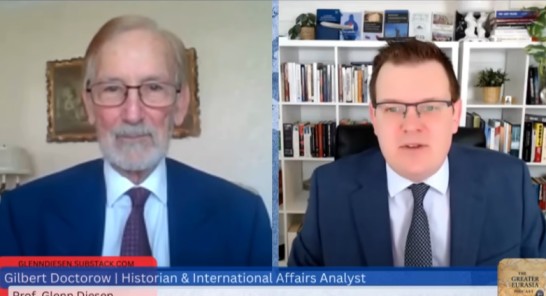
Editor’s Notes: In this episode, host Glenn Diesen is joined by historian and international affairs analyst Gilbert Doctorow to examine the profound global ramifications of the Iran war, particularly its impact on Russia and China. The discussion delves into the “lawlessness” of modern diplomacy and how the conflict is reshaping the strategies of major Eastern powers while highlighting the growing fissures within Western alliances like the EU. Doctorow provides a critical analysis of the Kremlin’s cautious response and the potential for a deeper military-strategic realignment in the East as the traditional world order continues to fracture. (March 24, 2026)
TRANSCRIPT:
Introduction
GLENN DIESEN: Welcome back. We are joined today by Gilbert Doctorow, a historian and international affairs analyst, to discuss how the Iran war is affecting the east and primarily Russia. So thank you for coming back on.
GILBERT DOCTOROW: Hi. Very good to be with you.
The Many Dimensions of the Iran War
GLENN DIESEN: So we see that this Iran war, it has many dimensions to it, which I assume would have to be interpreted by the Russians in different ways. So it’s everything from this deceptive diplomacy to the lawlessness of the thing, the brutality of the war in terms of the willingness to escalate, killing government leaders, attacks on critical infrastructure, nuclear power plants.
It could be the goal of weakening Russia and China. But we also see some US miscalculation, Iranian resilience likely, and the possible destruction of the Gulf states if their desalination plants go. And we see a split in the relationship between Americans and Europeans.
So, again, much of these are indications that the ramification of this war will not merely be regional, but indeed global. So how do you see this whole disaster unfolding in the Middle East impacting and being interpreted by the east and again, Russia and China, primarily?
Russia’s Muted Response and the Kremlin’s Silence
GILBERT DOCTOROW: Well, I think the first thing I’d like to do was delay a little bit here, because when we speak about Russia, we speak about President Putin and his administration, about his foreign minister, what they’re saying, and then what the chattering classes are saying. People — the Moscow establishment — are saying, as exhibited on the talk shows and not only in the talk shows, they are very, very different.
If you look strictly at President Putin and his immediate assistants or Foreign Minister Lavrov, you see very little reaction, astonishingly little reaction from the Kremlin to these dramatic, shocking developments which bear upon the whole of the possible relationship with Donald Trump and with the world order in general.
Trump’s behavior is obscene. It’s obnoxious. I don’t want to just search for other derogatory words. I think he’s reserved for himself a secure place in hell. But that’s my personal opinion. I’m not speaking as an analyst.
Speaking as an analyst, what he has done is utterly shocking, utterly disrupts anything resembling the world order. Respect for the UN Charter, respect for international law. He has spoken of his being held in check only by his own moral limits, his own take on morality, and not by international or other law. And he’s acting accordingly. The problem is that his morality is bestiality. His behavior, by ordinary human standards, is the most awful thing we’ve seen in a very, very long time.
Let me distinguish between what is said and what is done. American presidents and their assistants have done some horrible things going back to Nixon and to Kissinger, but they never spoke about it so openly, in your face. “We can do anything and you’ll have to settle with what we do.” This is utterly shocking. That distinction comes up, of course, in all the talk shows. They make a great deal about it that we’ve never witnessed this type of directness — transparency for America’s “might makes right.”
But at the level of the Kremlin, it’s almost total silence. Of course they don’t dare say anything about Mr. Trump’s showing his true nature. They don’t say they’re going to continue negotiations. They don’t say they’re going to take them off. They only note that they are in suspense and that the Americans have requests of that.
The Meaninglessness of Iran’s Alliances with Russia and China
As regards Iran, many of us in the alternative media had assumed that Iran was bracketed — both in the Shanghai Cooperation Organization and in BRICS — by these two major powers which provided it with stability, some sense of security, and with good reason to behave in an orderly way and not to be a sponsor of terrorism. Now we see that these two brackets are virtually meaningless.
Both Russia and China — and I’m very cautious about this because how much our knowledge is valid is difficult to say, since all of these things are kept in the dark — but considering the lack of accusations against Russia and China for giving meaningful support to Iran, we can assume that there is no meaningful support to Iran.
We heard that Washington was shocked that the Russians could possibly be supplying military intelligence to Iran. How horrible. That’s as much as we saw. The Israelis said that they blasted out of the water ships that were carrying Russian arms to Iran. Russia has denied that they were carrying any weapons or that these even were Russian ships. But aside from that, we don’t hear a word about Russian arms being supplied.
So what is the meaning of the alliance or the cooperation agreements? What is the meaning of Iran being in the Shanghai Cooperation Organization or BRICS? I would say at this point, zero.
Iran’s Surprising Resilience
Now, I don’t mean to be too harsh here, because what we all have learned — including the Russians and the Chinese, and of course Mr. Trump and his close associates — is that Iran is pretty capable of looking after its own interests more than anyone.
Without even taking into account the 4,000-kilometer two-stage missile that was fired, they have shown a capability of maintaining prioritization, firing timing, and all of the things that come from command and control, which supposedly was utterly destroyed by American and Israeli attacks.
So the Iranians have held on very, very well.
And of course their backup is the Straits of Hormuz and their ability to cause economic damage to the Middle East and to everyone who is supplied by the Middle East, meaning primarily the Far East and to a lesser extent Europe.
This was not to be anticipated — that Iran could survive such dramatic, horrific attacks as they had experienced, but they did. And therefore you have to go back and ask the first question. Maybe the Iranians were perfectly justified in not concluding military defense alliances with Russia or China and keeping their options open.
The power of Iran to survive all of this has been stunning. Their ability to maintain the pressure on the globe and to destroy at will almost all of the production of hydrocarbons in the Middle East makes almost irrelevant their power over the Straits of Hormuz. If there’s no production, then there’s nothing for tankers to take through the Straits of Hormuz. So either which way you look at it, they are in a commanding position.
That was not to be expected. Certainly the Russians, officially, never expected that Iran could be more powerful by its asymmetric defense against the United States with its direct, barbarous attacks on Iran.
Military Calculations and the Question of a Russia-China-North Korea Alliance
GLENN DIESEN: Given that we see that all the rules are essentially gone, thrown away, and the US is so blatant about it as well — that is especially Pete Hegseth — and now this whole rhetoric that following international law and the rules of engagement is political correctness, and “we will do whatever it takes,” essentially dismissing international law. How does this work on the military calculations of the Russians and the Chinese?
Because the US seems very determined to defeat its opponents. And again, any point to the idea that knocking out the Iranians would also have the purpose of weakening China. So how does this affect the military cooperation? What is the potential — is there any talk now of deepening military cooperation between Russia, China, North Korea, or others?
GILBERT DOCTOROW: All right. Go back to the very start of this. As I mentioned in recent interviews and in my writings, the American attack, the Israeli attack on Iran shocked the Russian foreign policy establishment to its skin. They were shocked to the point where they began to realize that the method that the Putin government has been using — the slow, slow war of attrition — is not appropriate to the present security environment. And they started speaking openly about it.
This was done on one program of Solovyov to a shocking degree. They all but denounced Putin in every way, except his name. The next day, Solovyov ate his words and was speaking about “our wonderful commander in chief who works tirelessly till three in the morning to look after our welfare.”
But then there are others who have kept up the pressure. Alexander Dugin, the court philosopher, as he was considered to be of Putin’s Kremlin, came out with at least as harsh a critique of the war management as that one show of Solovyov did. And of course Dugin is untouchable. After the brutal murder and assassination of his daughter, he was made a hero and you cannot say a word about him. And there he is, on open space, on his own website, denouncing the go-slow approach.
So there is a change in mentality. The question is where and when this pressure is applied to the President and with what effect.
The Duma Delegation to Beijing and the Push for a Defense Alliance
As to the question that you posed, this was directly discussed again on the same talk show — Solovyov. After the shocking attack and then recanting his words, he disappeared from television for a week. And I thought, my goodness, it looks like press freedom has just evaporated. No, I was quite mistaken. He disappeared from television because he joined a parliamentary delegation from the Duma to their counterparts in Beijing. This is periodical, and it was very timely.
One of the members of that delegation, one of the chairmen of the Duma Committee, who spoke again on the Solovyov program, explained that they were keen to engage the Chinese on this very question you’ve posed. Shouldn’t there now be forged a three-way defense alliance between Russia, China, and North Korea?
And of course the question arises, why North Korea? How can you equate North Korea’s power situation with these two superpowers of Russia and China? And of course the really interesting contribution of North Korea is the will and determination to act, as opposed to speak.
There is reason to believe that the North Koreans are supplying munitions to Iran — namely, underwater drones and missiles that can destroy aircraft carriers. This has been supplied by North Korea. If you look at it, we can ask the question: why aren’t they supplying them a nuclear bomb? Maybe they are. We just don’t know about it. But the point is the North Koreans are not talkers, they’re doers.
Russia and China as “Just Talkers”
The Chinese and the Russians are just talkers. And that comes out from Lavrov’s latest address commenting on the situation in the Middle East. It’s just whining — “oh, look what’s going on.” I’m sorry, this is the second most powerful, militarily powerful country in the world, and all they can say is, “my goodness, how sad this is.” This is a pitiful verbal response to the Americans running amok in the Middle East.
Not to mention, where is the physical response to America’s running amok in the Middle East? Just to say, as Dmitry has been saying to everyone who gives him the microphone, “boy, this is going to really upset the world economy.” A brilliant observation which none of us could have made on our own without his intervention.
Russia’s Strategic Paralysis and Putin’s Tilt Toward Israel
Russia has been holding back and saying nothing. And let me address why. Again, I don’t want to be critical. I want to just be analytical here. The reason, to my understanding, is very plain. Russia has made a strength out of being in talking relations with everybody.
When you have a situation as critical as the present one, which could easily advance to World War III and which could easily lead to a global depression, it is not a virtue to be talking to everybody, holding hands with everybody. You’ve got to do something and take some stand, and Russia’s not doing that.
On the contrary, what I’ve heard on the Solovyov program and on Kiselev on Sunday evening — he was reading from a teleprompter, lines which must have made him very embarrassed, but which were coming from the Kremlin — the lines were, “oh, how sad that the Gulf states are being harmed in this conflict.” Well, that is because Mr. Putin wants to hold everybody’s hand and advertise how Russia is a fair intermediary because it’s speaking to all sides.
I don’t believe that is the proper response to the present dire situation. The notion that Russia sheds tears — which I think are crocodile tears — over the harm done to its competitors. The Gulf states are, after all, its competitors in supplying hydrocarbons to the world. It’s shabby looking.
The fact emerges — many other observers have made this point, I didn’t weigh in on it, but now I had no choice but to weigh in on it — Putin leans towards Israel. There’s no question about it. And his justification for it does not stand up to reason. The justification was that 2 million Russian speakers, or passport holders, live in Israel and we can’t see harm done to them.
Well, friends, those are no friends. The Israeli residents, the Israeli passport holders who are dual nationals and have Russian passports also, are no friends of Moscow. And anybody who says otherwise is not being serious, including the President of Russia. They are enemies. And just as Mr. Chubais was an enemy, just as Nina Yeltsin is an enemy, and they all get coddled by the President of Russia.
I won’t say more. He has every possibility of changing direction and I hope he does. But as it is now, Russia’s great power status is utterly wasted on resolving the global crisis in the Middle East.
Russia, China, and the Fracturing of Global Alliances
GLENN DIESEN: I was thinking you mentioned that of course the Gulf states are competitors to Russia, especially in the energy markets. But how do you see the other — I guess what benefits could come to Russia? Because the media often points out that Russia is the big winner in this war. I guess it makes sense to some extent. That is, energy prices are going up, a lot of its energy competitors are going off the grid. The fact that the US had to drop some sanctions on Russia, once this solidarity around the sanctions falls apart, it might be difficult to build up. You have weapons being redirected which would otherwise been used to kill Russians.
But I thought the more specific thing which also affects the Chinese would be the faltering of the alliance systems. That is, in the Middle East we see some Gulf states rethinking how wise it is to host all these US bases. In East Asia, like in South Korea, some must be rethinking, well, how certain are the security guarantees as the US pulls out all these Thaad and Patriot missiles. And indeed also in Europe, you see a deepening split between the US and the EU.
So do you see this being — well, to what extent do you see this being benefits, or do you see it the same way, that these things are happening — that is, the weakening of the alliance systems? Because that seems to be a key component of the hegemonic position. That is, if you can divide all the regions of the world into obedient independent allies and weakened adversaries.
The Collapse of BRICS and Eastern Alliance Structures
GILBERT DOCTOROW: Well, I’ll address that question, which is very important. But first I want to turn it around on the alliances that we in the alternative media had deemed so important in ushering in a new global governance that would be polycentric, multipolar — that has been shot to hell.
Listening to Russian television, they were speaking now about BRICS in terms which none of us could have expected. Listening to their discussion following what’s happened in the last two weeks, they were more or less acknowledging that BRICS is worth zero. And I say that to all of our colleagues — if Russians are saying that, why are they saying so? Before that, they saw that the United States had upended BRICS by imposing these 50% sanctions on countries trading Russian oil. And it worked. India dropped all of its purchases of Russian oil. Well, that was the past.
Now they are saying simply, BRICS — you know, by the way, BRICS was never intended to be anti-American. This is what Russians are saying on state television. BRICS was supposed to build an alternative framework that would eventually succeed the faltering IMF and World Trade Organization, all these other structures dating from the post-World War II period, and would be a new order. Now the Russians are not saying that anymore.
That explains why — I think it was the last meeting of BRICS, maybe two years ago, when we all — when was the meeting in Kazan? This was October, was it? Yeah. When we discovered that there was going to be no alternative to the existing exchanges, currency exchanges, there’d be no BRICS currency. And this seemed peculiar, but nobody particularly highlighted it. And now it’s perfectly clear why. Because the Russians understood back then, but never said it aloud, that BRICS is virtually worthless. That has come out of this.
And I’d say that the Shanghai Cooperation Organization hasn’t come out much better, although in its last meeting it was clear that the Russians and the Chinese were looking to invest more in that as their main vector for moving forward new world governance, with BRICS falling away in importance.
So when we say that the Western organizations, whether it’s NATO, the EU, whatever, are being shattered, are opening up hidden fissures which have great importance for their future evolution — I say what we thought were the organizations uniting the East have turned out to be shattered also. So that creates a still more chaotic situation than any of us could have imagined.
Yes, of course, here in Europe, the shattering of the EU is only in the first stage. I cannot imagine how Ursula von der Leyen will survive her statements in the last week — that “we will not import one gram of Russian gas” — under the present situation of shortage and spiked prices and high inflation. How can she survive this? Much as they are not pragmatists, all of the leaders of Western Europe are faced with the politically hazardous inflation that is coming.
Europe’s Energy Dependency and the Von der Leyen Problem
GLENN DIESEN: How do you make sense of the Europeans here though? Because this is quite a shock to them. They just cut themselves off and celebrated having no more purchases of Russian oil or gas. And then now, of course, they’re being cut off from the Middle East as well. And we saw the United States — obviously seeing now that they are completely dependent on American LNG — which allows Trump to essentially say, telling the EU, “You will pass this trade deal, this horrible trade deal which nobody in the EU wanted, otherwise you will not anymore have favorable access to LNG.”
So who could have foreseen this? You cut yourself off from all other suppliers, and then the one supplier you now depend completely on has political leverage. I mean, it’s quite predictable, but still shocking in some way.
But what is happening within the EU — as you mentioned, these statements from von der Leyen go so far against the national interest of the member states. How do you see this playing out? There are exceptions. I would say the Belgian Prime Minister especially — I think it’s quite impressive in these days of unbearable conformity, where everyone falls in line. They always use this expression, “European solidarity,” which is just a poor excuse for rejecting common sense, because one is obviously going down the wrong path and one is using the slogans of European solidarity as a way of suggesting that all dissent is something negative.
But the Belgian Prime Minister suggested minor things like, after this war, we should normalize relations with Russia — which he was then criticized for. So how do you see Europe adjusting to this Iran war? Because that, of course, will also affect its position on the Ukraine war.
Bart De Wever’s Political Ambitions and Europe’s Direction
GILBERT DOCTOROW: Well, it hasn’t adjusted fully. It hasn’t even adjusted partially. When you look at the odious behavior and odious statements coming out of Trump, they’re in such violation of European values. But the question is, how much longer can this hypocrisy hold — that this man and this country are the closest allies of Europe? It’s in such violation of all their ideals that sooner or later this has to break. The question is when, and who will lead the way?
Now, coming back to Bart De Wever — I’m very glad that you mentioned him. I’ve got a personal take on this. I think he’s campaigning to become the president of the European Commission. He is in front of the microphone every day. His NVA is putting up on YouTube his speeches and his answers to questions. He comes to a meeting, as he did a week ago, of the European heads of government, and he passes like 200 journalists who are lined up with their microphones. And he stops here and he stops there, and he stops in the fourth place. He’s campaigning to take charge.
Now, I don’t take at face value any of his conformist statements. I think he is running the same race as Fico and Orbán, but in a very shrewd way — not to upset people, guarding his flanks and avoiding saying anything that will allow his enemies to stick in a dagger and remove him from where he wants to go.
Therefore, he says that he supports Ukraine 100%. Therefore, he tells you about his parents and how they took in Ukrainian refugees. Therefore, he says that yes, we will have normalization of relations with Russia only after a peace treaty is signed — and a peace treaty that is acceptable both to us in Europe and to Ukrainians. From my understanding, that’s all hot air. It is simply defensive, protective, while he’s going at the things that count.
He, after all, did say normalization of relations with Russia. And he, after all, did explain himself — that if you have a peace treaty, it is a peace treaty, not a scrap of paper. And the peace treaty means that you have resolved all outstanding issues. And after that, you normalize relations, as he said we did after World War II — we start trading normally and everything else.
That is in direct contradiction to what we’re hearing from all the Russia haters in the EU. They want a peace treaty that is only a truce and sets the stage for round two or three — when they will drive Russia out of Europe or ensure that it stays outside of Europe. So he is going in a very different direction, and I’m sure it is a campaign he’s waging to take over the direction.
The Missing Discourse on Lasting Peace in Europe
GLENN DIESEN: And again, this falls within the whole idea of the Europeans — they don’t even want an end to the war, it seems. They just want a ceasefire, and nobody really wants to try to find a way of restoring relations as they were. And as you correctly say, you hear this in the rhetoric over and over again — that once this is over, we can find some different avenue where we can compete with or fight the Russians on more favorable terms. Even the Ukraine war can’t really be put to an end. They even say quite openly they need a break to breathe, to regroup, to rebuild. But the fight isn’t over.
So I’m missing this from the discourse — this willingness to take a step back and discuss basic things like, what actually are the sources of peace? How do we envision a stable, prosperous Europe in the future? Is that one where the largest country in Europe by territory, population, military, and economy will be under constant containment and attempted to be severed from the rest of the continent? Is this a source of stability? Is it going to be the Western countries just dominating so much that Russia has to adjust, or will it be some way of everyone sitting around the same table? There is no discussion of this. I just hear politics being reduced to cheap slogans of “our values” and “Russian aggression.”
And at the end of the day, for all their crocodile tears over Ukraine — if they really wanted to save Ukraine, their first priority should be to remove it from the front lines of this new geopolitical game. You can’t seriously convince any person that this has benefited Ukraine in any way.
But in terms of putting an end to the war — how has the Iran war affected the possibility of diplomacy? I would think that the Russians are not very keen, after the deceptive diplomacy with Iran — that is, first the JCPOA, then these two surprise attacks when negotiations were going well. How does this affect — I mean, do they still talk about Alaska now in Moscow? And what are they talking about in China? Because Xi Jinping was going to meet Trump next month, but this meeting was postponed.
China’s Inaction on Iran and the Path Forward
GILBERT DOCTOROW: Well, I’ve criticized the way that Vladimir Putin has been managing the war, and I have to criticize still more sternly the position of the Chinese, who look like absolute wimps. Their stand on Iran is utterly incomprehensible, given — as I said — their sponsorship of Iran in these two key organizations where China and Russia are both leaders, I mean both BRICS and the Shanghai Cooperation Organization. It is incomprehensible that they have done nothing of substance to assist Iran, and the MFA has been so cautious in their words about Iran.
But that’s so much for the Chinese. I don’t know where this is headed, but it is clear that Europe is going to change. It is clear that the position of several people is unsustainable and it will take a lot of change in leadership across the continent. But a good start will be cleaning house in the European institutions. I do not see how, as I said, the lady can survive what she has done with her own two hands, and that will be a good start to cleaning house. But there’s a lot more that has to change.
We’ll see whether or not Mr. Orbán survives his vote coming up two or three weeks from now, since he has been so important in resisting the machine in Brussels. But I’m sorry, I think I’m straying from your question. Could you just rephrase it?
Diplomacy Pathways: Alaska and the China-US Meeting
GLENN DIESEN: The possible pathways now for diplomacy — because the Russians were looking towards Alaska as a way to go, and the Chinese I think were hoping that some relations could be improved with this meeting, which was supposed to take place next month. Because for them, of course, this could be an opportunity — if the US is now struggling, perhaps they would like to put a pause to this economic war against the Chinese.
Russia’s Internal Divisions and the Ukraine Battlefield
GILBERT DOCTOROW: Well, the present situation, of course, is very embarrassing for President Putin. Going back a little bit more than a month, there was an open public break between his position and the position of the Ministry of Foreign Affairs.
The opposition within the Ministry of Foreign Affairs started with Sergey Lepkov, who said famously that “the initiative, the impulse from Anchorage is gone. There is no further room for diplomacy. This will be resolved in the field of battle.” He was immediately reprimanded. But then within two, three weeks, we find that his boss, Sergei Lavrov, is saying the same thing. All this time, Pskov, speaking on behalf of Putin, is saying the opposite.
And they appointed Dmitriev, made him very important. And now, let me not mince words. Dmitriev, by my understanding, is an American plant. He is part of the liberals whom Putin has always coddled in a traditional power play of — you tilt to the right and then you tilt to the left, then tilt back to the right. That is how Gorbachev maintained his power until he fell. And I think that the present head of state is playing the same game, which could lead to the same result.
There’s a point where you have to stand on one side or the other and you can’t keep on shifting back and forth. And it is time, since President Putin invested so much of his political capital in these negotiations. And if you look at them, you have to be mad to believe that anything can be achieved with Donald Trump and negotiations, for all the reasons you just gave. Nobody is speaking about it so directly, but it’s pretty obvious that this war will end on the battlefield and that Mr. Trump’s role is less than nothing.
So there you have a big divide in Russia, and it remains to be seen when or whether the president will adjust to the new conditions. So far, he hasn’t. So far, they’re quite pleased that Trump has pulled back and is not pressing new talks with Witkov. But that day will come and Putin will have to decide whether or not he’s going to continue this farce or not.
The Ukrainian Front and Russian Offensive Preparations
At the same time, we are well aware what Mr. Zelensky said a day ago — that the Russians are preparing or starting a big summer offensive right now — is correct. They are. The only thing that was false in Mr. Zelensky’s statement was that it is very costly, that the Russians are losing a thousand men a day. As we know, as I’ve seen for the last four years, every time that Ukrainians open their mouths about Russian losses, they’re projecting onto the Russians their own losses. The Ukrainians are losing a thousand men a day is entirely believable. The Russians are — is not. Nonetheless, the Russians of course have losses.
But what was significant about Zelensky’s remarks, which otherwise are not reflected in what Russian state television is telling their audience, is that he was speaking about the use of tanks and of heavy equipment coming back into play. Now, partly this is seasonal because they have more cover now. The leaves of the trees are coming out, spring is underway. But I don’t think that explains the whole thing. I think the Russians are simply much more confident that they are able to keep the Ukrainian drones at bay or counter them one way or another. And they’re massing heavy equipment, which they haven’t done for close to a year.
So that is in preparation of a big drive on Kramatorsk and Sloviansk, which are now just 18 km — artillery range from the Russian standpoint — after which you’ve got a clean sweep. At the same time, looking at the map as you and I do, it is shocking that four years of war, in a fifth year of a war that’s going on almost as long as World War II, that Russia has only captured in the last few months an additional 5% of Donetsk province, or 8% — it’s gone from 25% that was held by Ukrainians down to 18%, other than Donetsk almost. Their moves, for understandable reasons, have been extremely modest. We will see very soon whether they can make the end run and reach the Dnieper in a matter of weeks and not years. So that is all in front of us.
Ukrainian Successes and the 1,200-Kilometer Front
GLENN DIESEN: Well, how about just the last question on the war developments. We’ve seen some successes of the Ukrainian offensive, especially down south in the Zaporizhzhia region. How do you make sense of this, given that they have lost a lot of access to money and weapons now over the past weeks?
GILBERT DOCTOROW: It’s a 1,200-kilometer-long front. And if they found a weak spot, whichever side did, then they’re exploiting it. But I wouldn’t say that any isolated successes they have and surprises that they make are going to overturn the big picture, which is the Russian advance, as I described, against the last two major medium-importance outposts — Sloviansk and Kramatorsk.
The Ukrainian success would be surprising only to those among us who have spoken day after day, week after week about the Russians having shattered the Ukrainian lines, that their excess efforts at recruitment have been utterly unsuccessful, and so forth. As you know, among our colleagues and among the platforms on YouTube, there are many that issue daily the most lurid, the most sensationalist accounts of the war coming to an end with Russian victory and Ukrainian capitulation, as if it’s a pushover. It has never been a pushover.
The Ukrainians, despite everything, have fought with great valor, which Russian state television speaks about, but almost none of my colleagues speak about. And I say shame on them, because the fact remains that there is fighting spirit in Ukraine. There is the problem that you’ve highlighted — they are very short on equipment and of course their numbers of soldiers have been significantly depleted. That is undeniable, and is why, as I say, they can concentrate force in one or two locations. But on the whole 1,200-kilometer line, the Russians have by far the strategic advantage.
Global Dimensions: From Ukraine to Iran
GLENN DIESEN: Well, thank you for taking the time to speak with us. I appreciate it. It seems like indications that this is taking the shape of a world war — when you see that one conflict is impacting another. I don’t think we’re quite there yet. But given how large the global ramifications are, and how these wars and conflicts — from the one in Ukraine to Iran — are also impacting the US-Chinese rivalry, it does appear to take on these global dimensions. Do you have any final thoughts before we wrap up?
GILBERT DOCTOROW: Well, I agree completely with your summing-up words. It has a global dimension. The two are intimately related. And of course, the depletion of American air defenses in the war of Israel against Iran is a major setback for Ukraine. So just in those very simple terms of equipment available, the two wars are directly interrelated — to the disadvantage of Ukraine.
Related Posts