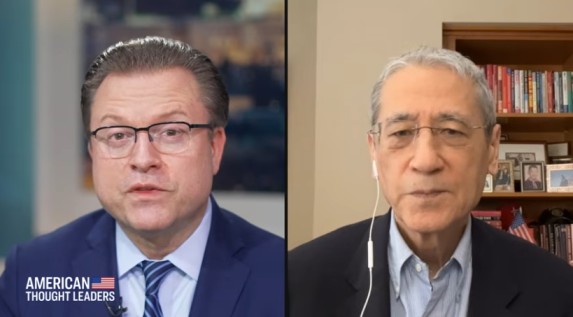
Editor’s Notes: In this episode of American Thought Leaders, host Jan Jekielek sits down with China analyst Gordon Chang to discuss how joint U.S.-Israel strikes on Iran are fundamentally reshaping the global balance of power. Chang argues that President Trump is indirectly targeting China by cutting off its critical sources of support, particularly Iranian oil, which previously accounted for a significant portion of China’s imports. The conversation explores the idea that “all roads lead to China,” examining how Beijing’s influence is being systematically reduced in key regions like the Middle East and South America. Ultimately, Chang frames this period as an existential struggle against the Chinese Communist Party, urging a return to a “peace through strength” strategy to defeat communism worldwide. (March 1, 2026)
TRANSCRIPT:
JAN JEKIELEK: This is American Thought Leaders, and I’m Jan Jekielek. Gordon Chang, such a pleasure to have you back on American Thought Leaders.
GORDON CHANG: Thank you so much, Jan.
China’s Response to U.S. and Israel Strikes on Iran
JAN JEKIELEK: So, Gordon, hot off the presses. China’s UN ambassador on this March 1 emergency session at the UN has basically said that the US and Israel strikes were brazen violations of sovereignty and demanded an immediate ceasefire to what’s happening in Iran. What’s your reaction?
GORDON CHANG: Well, that’s China’s reaction. It’s the same one they had in Venezuela. All they did was they took the same press release, they used the white out, they took out the word Venezuela, they put in Iran, they took out the word Venezuelan, and they put in Iranian. And there you have it. China is not a superpower, if it ever wants to be. It always criticizes the U.S., but when the U.S. is determined to do something, it cannot stop us. And that shows just the limits of Chinese power.
Xi Jinping’s Maoist Playbook — and Trump’s Counter-Strategy
JAN JEKIELEK: It’s a very interesting reality you’re contrasting here, or comparing with the Venezuelan reality. And I can’t help but notice that we have two, let’s call them totalitarian leaders that have been deposed in the last very, very short period of time. What is Xi Jinping thinking?
GORDON CHANG: I think that Xi Jinping believes that President Trump is a Maoist. Remember, Mao boasted that he won the Chinese civil war because he encircled the cities from the countryside. Xi Jinping, who reveres Mao, I think has taken that page out of Mao’s playbook and used it against the US, where he looks at Ukraine, North Africa, and Israel as countryside, and the United States as the city.
Well, Trump has just taken that same policy and applied it against China, because Venezuela and Iran are countryside and China is the city. And this is extraordinarily successful. And the thing about Xi Jinping is he knows what Trump is doing, but he can’t stop him.
JAN JEKIELEK: So tell me more about what he knows what Trump is doing, because I don’t think everybody knows what Trump is doing. I don’t think everybody’s clear on that.
GORDON CHANG: Well, the narrative is that Trump is sort of gone soft on China, and on certain things he has. But if you look, for instance, at the national security strategy, it’s very clear that China is a high priority. It may not be the number one priority, which is the Western Hemisphere, but if you look through that short document, it’s clear that China is foremost in President Trump’s mind.
For instance, towards the end of it, it talks about how the United States must not allow any hostile power — the phrase that it uses — to either close off the South China Sea or impose tolls on traffic over or on the South China Sea. Well, there’s only one country that fits that description, that has that ambition and has that power.
When you look through the entire document, I believe that President Trump is going after the Chinese, and he’s not doing it directly, but he is doing it indirectly, and he’s cutting off their sources of support. Oil, for instance. Venezuela supplies maybe 3 to 4% of China’s imported oil, but Iran was somewhere between 15 and 23%, depending on the year. And that’s important because when you put those two numbers together, you get a significant portion of China’s imported oil has now been taken off the board.
President Trump may allow the Venezuelans to sell oil to China, but not at the heavily discounted rates that China was benefiting from. And Chinese factories are now dependent on cheap oil. Well, they’re not getting it anymore. If they get their oil, they’re going to have to pay market prices.
China’s Oil Imports and the RMB Settlement Factor
JAN JEKIELEK: And also just to add to that, Venezuelan and Iranian imports for China were actually settled in RMB, which most people are not willing to do.
GORDON CHANG: Yes. I mean, who wants a currency that is not a hard one? When people have a choice, they want the stronger currency. Now, Venezuela and Iran might have been forced to take a cheap currency because they didn’t have very much choice, but now they’re going to get that choice, and that means that they’re going to have to start paying dollars again.
Chinese Military Equipment Failing Against U.S. Countermeasures
JAN JEKIELEK: So I don’t know how closely you’ve been following this. I’m getting reports from a few think tanks that basically there aren’t any new anti-ship missiles or drones being shipped, or there’s no kind of rush to support Iran — an increased rush of sales to Iran since this has happened. So I’m kind of wondering, what is China really saying? What are they actually going to do? You said that they can’t do anything, but there are some things they can do. For example, they could accelerate those deliveries.
GORDON CHANG: There are reports of something like 15 to 18 Chinese cargo planes that left China’s bases and flew into Iranian airspace. We don’t know what they brought over, except that there are confirmed reports that they did sell or transfer a particular type of Chinese radar.
Now, it didn’t do the Iranians very much good, because we knew where they were, and when the Iranians powered them up on the 28th, we just took them out, so we didn’t lose any aircraft.
And it shows once again that Chinese export equipment isn’t very good. It somehow did not see more than 150 American aircraft that were near or in Venezuelan airspace. And again, on the 28th of February, they just didn’t see our planes.
Now you can say, well, the Chinese radars that they sold the Iranians and the Venezuelans weren’t as good as the ones they have at home. And that’s probably true. But the point is that the stuff that the Chinese are selling to others just is not working against American countermeasures.
The Case for Regime Change in Iran
JAN JEKIELEK: How do you react to the sort of — well, I guess you could call them accusations or statements — that what the US is doing in Iran is regime change?
GORDON CHANG: Yeah, well, happy that we’re doing that, because there won’t be peace in the Middle East or even the wider world until we get rid of that regime. That regime has declared itself to be an enemy of the United States. Matter of fact, the Iranian president in December actually came out and said it. He said, “We’re in a state of war with the United States.”
But we have these Iranian death squads that are running around the United States. We know the Iranians turned off a water system in Aliquippa, Pennsylvania, not too long ago. Iran in the past has killed Americans. And you know what they did against Israel on October 7th.
So, yes, the Iranian regime has to go. It had a nuclear weapons program. It’s got ballistic missiles. It is a danger to the international community, and it has killed thousands and almost certainly tens of thousands of executed Iranian prisoners over the last five or so weeks.
So I believe that we have to get rid of the Iranian regime. We can’t keep on saying, “Oh, it’s unacceptable for Iran to have a nuclear weapon,” or “It’s unacceptable for the Iranian regime to execute tens of thousands of its own citizens,” and then not do anything. So bravo to President Trump for doing this.
Public Opinion, Democratic Hesitation, and the Lessons of History
JAN JEKIELEK: A couple of thoughts come to mind. One is that perhaps unusually, the like or dislike of the ayatollahs is kind of an 80-20 issue in Iran. From what I understand, 80% don’t like them very much at all, and 20% are pro. But the other fact that comes to my mind is that I don’t think there’s a lot of appetite in the US electorate for regime change. Unpack that for me.
GORDON CHANG: That’s, of course, true, and we know that. And it’s true not only among Democrats, but also among Republicans. President Trump ran on being the “no more foreign wars” president. But there are times when presidents have to do what is absolutely necessary to protect the American public.
You go back to Tocqueville, who talked about how democracies are very slow to recognize threats, very slow to go to war. And that’s true. We ignored Osama bin Laden. We ignored him after he killed six Americans by bombing the North Tower of the World Trade Center in February 1993. We ignored him until one day when he reached out and killed 2,977 Americans. And then we said, “Well, how did that happen?” Well, that’s the nature of our democracy.
And yes, I understand that it is unpopular, but that’s the way we end up in situations where many Americans get killed. World War II in Europe could have been avoided if Britain and France had exerted their power in 1936 and stopped the Third Reich from remilitarizing the Rhineland. So we know that tens of millions died because Britain and France could not rouse themselves to do what was absolutely necessary.
Well, we’re the Britain and France of this century — until, of course, President Trump decided no, we were not going to allow these threats to gather. And I think that this is a profiles in courage moment for the President.
Peace Through Strength and the Existential Struggle with the CCP
JAN JEKIELEK: Well, it’s interesting. “Peace through strength,” right? That has also been the president’s mantra throughout. And I think the president would probably argue that this is an exercise of that.
GORDON CHANG: Yes, and it certainly is. He’s ensuring peace in the long term, because among other things, he has started a chain of events that probably will lead to the end of the Iranian regime. And he’s again encircling the cities from the countryside, which is an important thing for us to do.
We Americans don’t understand that we are in an existential struggle with the Communist Party. We don’t want to think that. But remember, the party has declared a people’s war on us. That was a landmark editorial in People’s Daily, the most authoritative publication in China, in May 2019. And we Americans just look at that and say, “That’s propaganda. We can ignore it.” But that’s a mistake. It’s a mistake because with its strident anti-Americanism, the party is trying to create a justification to strike America.
And as a footnote, in March of 2023, PLA Daily, which is the main propaganda organ of the Chinese military, defined People’s War as “total war.” So we know China has a doctrine of unrestricted warfare. It has been killing Americans. And we have been doing our best to not know what’s going on.
Cleaning Up the Countryside: Venezuela, Iran, and Cuba
JAN JEKIELEK: Well, the thing about communism — and this is something I write about in my upcoming book, Kill to Order, as well, which, by the way, thank you for endorsing, very, very much appreciate that — but communism is international. And at the moment, there always is this sort of impetus to spread, for a whole suite of reasons which we don’t need to get into here necessarily.
But we have Venezuela, we have a Venezuelan leader being removed, we have the Ayatollah being removed, and we have the Cuban regime — Communist regime — on, I don’t know, maybe thin ice would be the phrase. I’m curious what you think about the pattern here, because to me, it almost seems like it goes in line with how you describe it — kind of cleaning up the countryside.
The Chinese Communist Party’s Threat to America
GORDON CHANG: Well, the Cuban regime is fragile. It’s, for instance, dependent on Venezuelan oil provided at concessionary prices. And now they’re running out of fuel in Cuba, and that means increasingly hard times on that island. And yes, it’s important for us to do that.
We’ve had a series of presidents who have endorsed this notion of managed decline. Carter did that, Nixon did that, and it took Ronald Reagan to say, “No, we win, they lose.” And then after that, we had a series of presidents, both Republicans and Democrats, who bought into this managed decline theme. And Trump is saying no.
Now, people can say they don’t like Trump’s tactics, they think they’re counterproductive, who knows? But the point is Trump is disrupting this managed decline theory. And he said, “I’m not accepting it.” And that’s really important because that gives us a chance to actually prevail and to have freedom prevail around the world.
So this is really important. And we should — all Americans, whether we’re Republicans, Democrats, Independents — we should all be cheering on the president because this is the struggle of our lifetimes. And we better recognize it, because if we don’t recognize it, Jan, although the United States is a far stronger society than China, we can lose our country. We can lose our country because we’re not defending it with the vigor and with the determination that’s necessary. And thank God we now have a president who started on the road to defending our country in the way that it must be in these perilous times.
JAN JEKIELEK: Well, just one thing I might add. People would point out that we have a lot of internal problems. And indeed, I see this pointed out a lot, and we should deal with those before we cast our gaze outside. But indeed, Communist China — I saw some really good reports from Asra Nomani recently, basically showing that these kind of China-funded protests — anti-Iran war protests — kind of sprouted up even before it was announced somehow. Kind of astroturf protests funded from outside, basically to fuel this sort of internal division that indeed we do have to actually deal with as a society.
GORDON CHANG: Yeah, the argument that we need to deal with problems at home has a superficial logic to it and certainly is politically popular. But when you start to look at it, it doesn’t hold water. And the reason is that China is purposefully creating and aggravating problems and is standing in the way of solutions in the United States.
So for instance, just take what happened on January 31st in Las Vegas. You had Las Vegas SWAT and federal agents descend upon a home that had more than a thousand vials of a red substance or substances that was clearly making people, quote unquote, “deathly ill.” According to the housekeeper who reported this, this looks like a Chinese biological weapons storehouse. It is connected because it was owned by somebody who was now going to be going to federal trial in April for running the lab in Reedley, California. In Reedley, California, they found a secret Chinese biological weapons lab which had at least 20 pathogens, many of them for deadly diseases. And almost 1,000 mice have been genetically engineered to spread disease.
So tell me, how do you solve your problems when you have millions or tens of millions of Americans dying from a biological weapons attack launched from American soil?
China’s Multiple Vectors of Subversion
JAN JEKIELEK: There are all these multiple vectors of subversion that the Chinese Communist Party has been waging on America. I just had Peter Schweitzer on the show. But no, you were going to say something. Jump in.
GORDON CHANG: I’m just saying fentanyl — when you were talking about this, there are so many others. And they’ve been fueling the protests in 2020 and all the rest of it. And sorry to jump in, but yes, they are there. And all the things that Peter Schweitzer has been talking about in his new book recently.
JAN JEKIELEK: No, absolutely. For example, just the different forms of weaponized migration. This sort of anchor babies. And to possibly having a million American citizens that are actually raised in China under the Chinese Communist Party. It’s kind of shocking how deeply they’ve been able to abuse our open system.
GORDON CHANG: I mean, we have the 14th Amendment to the Constitution. There are no easy solutions to that problem because you are dealing with US citizens who could very well come back and vote in a coordinated fashion as directed from Beijing. If a person’s not a US citizen, you can deport them, you can do all sorts of stuff, but if they’re a US citizen, they’re basically untouchable.
Communicating With the Chinese Communist Party
JAN JEKIELEK: Someone we both know, Christopher Balding, had a very interesting commentary recently, which I caught, and I think he’s very insightful often. His commentary was like, just think of them like the mob. If you’re thinking about the Chinese Communist Party, the way that you have to communicate with them is to, metaphorically, put a horse’s head in the bed. And that is an effective form of communication.
I think he’s arguing that seeing the Ayatollah gone, seeing Maduro gone — that’s a form of President Trump communicating, while saying on the one hand, “We’re great friends with President Xi,” and on the other hand, there’s this horse’s head in the bed happening. I’m curious what you think about that.
GORDON CHANG: Christopher Balding is perceptive. I wish the Communist Party were like the mob. Unfortunately, they’re worse than the mob because their goal is not to just make money. Their goal is the extermination of the American people and the extermination of the American form of governance. The analogy gets it across, but just —
JAN JEKIELEK: Extermination of the American people — the way of thinking, or physically? Just to be clear what you’re saying here.
GORDON CHANG: Well, your paper reported that in the first half decade of this century, General Chi Haotian, then Defense Minister of China, gave a secret speech that advocated the use of disease to, quote unquote, “exterminate the American people.” He said that yes, it is indeed brutal to kill 1 or 200 million Americans, which was about the population of the US then, but that’s the only way for the Communist Party to rule the world. That’s almost a direct quote.
So his idea was to clear out the hills, valleys, and plains of North America so that the Chinese could inhabit the United States. That’s extermination of the American people. Now, one could say that reported speech has never been confirmed. But we have seen acts of maliciousness, especially with regard to disease, that confirm that the Communist Party does have that ambition.
For instance, with COVID-19, once it got out into the Chinese public, Xi Jinping took decisions in December of 2019 and January 2020 to deliberately spread that disease beyond China’s borders. That was mass murder. That was evil. And that shows that China has that maliciousness that General Chi Haotian exhibited 20 years ago.
Organ Harvesting and the Ruthlessness of the CCP
JAN JEKIELEK: Well, as you know, in Kill to Order, this is one of my main theses — there’s this large-scale murder-for-organs industry which, it’s unclear how many hundreds of thousands of China’s own people it has killed in cold blood, for profit and elite longevity. I think the ruthlessness and the sort of utilitarianism — basically using people as fodder for power purposes, or profit, or whatever purpose — this is an important functioning element of how the Chinese Communist Party operates.
GORDON CHANG: It illustrates the maliciousness of the regime. I mean, this is beyond the comprehension of most people. And if you go back over the last 10, 15 years, a lot of people have shied away from the accusations of organ harvesting because they were just too grotesque — they were too far beyond the way that people in democratic societies think. It was just evil. And we Americans have been shying away from the notion that there is evil in the world.
Now, I’m a Christian. Evil is very much in the Bible — you’ve got the devil. But American society has, for a number of reasons, shied away from this notion that there is evil. But organ harvesting, which you document in your book, it is evil. And we have to start talking about it in those terms.
One of the reasons why Ronald Reagan prevailed was because he was willing to say in public that the Soviet Union was the “evil empire.” Now, that’s a long topic which I love to talk about, so I won’t do it. But the point is, we have to recognize the concept and we have to speak out in public about this.
JAN JEKIELEK: Well, Gordon, indeed, if we understood how this organ harvesting worked and just accepted it the way we would treat, for example, statements like a general wanting to exterminate some number of Americans, that becomes a lot more of a credible statement. I guess that’s what I’m thinking here. But we’ve kind of not allowed ourselves to understand the lengths to which the Chinese Communist Party will go to maintain and project power.
GORDON CHANG: Absolutely. It is a confirmation of the state of mind of the Communist Party. And it’s very difficult for us as Americans to understand it, which puts us at risk because, as I mentioned, we are not willing to confront it. We have not confronted a lot of things, and Americans have died as a result.
The Center to Defeat Communism
JAN JEKIELEK: Well, Gordon, you’re leading this new CPAC thing — the Center to Defeat Communism — which is a great development. In fact, I was commenting with someone who’s a part of it. I was saying, “Wow, you guys have a new center to combat communism.” And the person corrected me: “No, Jan. This is a center to defeat communism.” Okay, thank you for correcting me. Tell me a little bit about what that’s about, because it sounds like at least there are some people out there who are looking to face all of this right in the eye.
GORDON CHANG: I can’t say that I’m leading it. Spencer Hartman, who works at CPAC, is leading the effort and he’s fantastic. And he’s got a team with Ernesto Gonzalez, led by Matt Schlapp, the chairman of CPAC. And this is to defeat communism. This is going back to what Ronald Reagan taught us. And we have to understand that communism is evil and that we can’t coexist with it, as much as we’d like to, because Communists think that they cannot coexist with us. And so we have to defeat it.
When you think about what Martin Luther King Jr. said about justice — “Nobody has justice until everybody has justice” — it’s sort of the other side of that sentiment. This is worldwide, as you said, and it is an ideology that believes in the destruction of free societies. So free societies have to recognize that and have to act with the determination that is necessary in these circumstances.
It’s unfortunate. Like Rodney King said, “Why can’t we all just get along?” Well, yeah, we would like to do that, but that’s not the ideology of communism, and it’s certainly not the ideology of the Chinese Communists.
Iran and the Risk of a Power Vacuum
JAN JEKIELEK: Just jumping back to Iran for a moment — the concern, and I think this is a very legitimate concern, is that there’s a kind of a power vacuum that gets filled by something worse. We’ve looked at some of our regime change operations of the past, and quite a number of them didn’t go very well. The more recent ones especially didn’t go very well at all. So what makes Iran different?
GORDON CHANG: I don’t think we can get worse than what we’ve got right now. But we’ve had regime change operations like Germany and Japan, and that was because there was political will to make sure that those operations went well. And we had American business that was fully on board.
I think the reason why Afghanistan and Iraq didn’t go well is because you didn’t have the secure environment in which business could come in and transform society. And this is the issue right now in Syria. Syria’s leader, a former Al Qaeda operative, said — and he said this to the United States — “I want to be Japan and Germany. I don’t want to be Afghanistan or Iraq.” He said, “I don’t want US aid. I want US business.”
And so we have to go back and understand what made Japan and Germany successful. And we can do it again if we have the political will, if we can create the peace and stability. And I’m sure that we can, because Iran is very different than Afghanistan or Iraq.
Iran, China’s Retreat, and the Question of Trump’s Beijing Visit
JAN JEKIELEK: Well, one thing that Iran really does have going for it is that, again, I think, as I said earlier, it’s an 80-20 issue. 80% — I mean, this is, of course, a rough estimate gleaned through VPNs and so forth of sentiment — but really are against the regime and are looking to do something better. They feel something that was imposed on them. And, of course, it’s been an atrocious totalitarian system.
GORDON CHANG: Iran is not Iraq, although they border each other. Iran has a tradition. That tradition was interrupted for 47 years by the theocratic regime. But the Iranian people will get this right. And we saw how many people in Iran wanted to be free. So that is a real indication that Iran can work.
JAN JEKIELEK: And just again, sort of thinking more into this sort of neighborhood idea — through Belt and Road and through a whole bunch of other corruptive practices, China has basically set itself up all over the world. And part of the reason was for the oil, for example, with these two countries that we’ve been discussing.
But partially — and this is indeed something that was stated by, I remember, one of their top think tank people — it’s an attempt to distract the U.S., which the CCP, as you pointed out, views as its enemy, from looking at China. If you’re distracted by other wars, if you’re just looking at the Middle East, if you keep having that problem and having to focus there, it’s very hard to focus on what’s happening in the Pacific. And arguably that’s been a very successful strategy for a few decades.
GORDON CHANG: Yes. And you have a whole bunch of people, especially in the Pentagon, who say, well, we should not be involved in Ukraine, for instance, because that distracts us from East Asia. But I believe that that is misguided because the Chinese are looking at Ukraine really as the template and the future. And the people in Taiwan say this, that their future is being written on the battlefields of Ukraine.
Because if the United States allows Russia to keep territory through acts of aggression, then the Chinese will think that they too can do the same thing — that the United States will accede to a Chinese grab of Taiwan or parts of Japan or the Philippines, whatever. And so I think that you cannot allow Russia to succeed in Ukraine.
Wang Yi, the Chinese foreign minister, on July 2 was pretty clear about the relationship between Ukraine and Taiwan. And that means we have to understand that just because we do something in one part of the world, it affects other parts of the world. It’s not isolated. You can’t just do one thing here and then not expect that it won’t affect what goes on elsewhere.
And that’s why I think it’s very important to prevail and make sure that Iran becomes a free society. We do that, we certainly put China in a very difficult position. As Mao would say, that’s part of the countryside — a critical part of the countryside.
Reverse Kissinger: Dismantling China’s Global Alliances
JAN JEKIELEK: Well, and so this is interesting too, because how can the Chinese Communist Party continue to spread its power when it’s had its power reduced significantly? Is this something that you expect President Trump to continue — to kind of remove these allies or prevent them? Is something like a reverse Kissinger, as has been described some months ago, still a possibility?
GORDON CHANG: Yeah, I see Trump not letting up. We started — well, we started with Trump’s triumphal tour through the Middle East in May of last year. Those three Gulf states really sort of pushed China and Russia out of the region, or at least out of that part of the region. And what we have witnessed since then is the further reduction of Russian and Chinese influence there. And that’s culminated, of course, with the strike on Iran on February 28 and a continuing war.
So yes, this is something that’s important. And it’s not just the Middle East — it’s Venezuela. Cuba looks fragile. I don’t think the President is going to stop with where he is in Panama, with the taking away of the two ports from CK Hutchison. I don’t think we’re done there yet as well, because the Chinese have a fourth bridge over the canal that they’re building. They’ve got all of these listening stations throughout South America. The Chinese military is loaded up in Cuba. I don’t think Trump’s going to allow that to continue.
So yeah, this is freedom moving forward. Bravo, President Trump. And it’s the Chinese retreating. China is not a superpower. We are learning that this year, and we’re learning that because somebody with the name of Donald John Trump decided, “No, I’m not accepting this notion of managed decline. I don’t think the Chinese are going to own the 21st century — not on my watch.”
And this is what Americans need to hear, because we underestimate our own power. We have a lot of people in our country who say, “The Chinese are going to take over. We might as well live with it.” Thank you, Bill Clinton, but no — that’s not the way we are. That’s not in American DNA. And thank God, President Trump is saying we will prevail.
Can the U.S. Drive a Wedge Between China and Russia?
JAN JEKIELEK: Is it possible for the President, or the U.S., to put a wedge in the China-Russia — the so-called “no limits” partnership? Is that possible?
GORDON CHANG: Not likely. If Vladimir Putin goes, who knows what can happen? But while he’s still there, you have Putin and Xi Jinping seeing the world in the same terms. They identify their interests in the same way. They see the same enemy — that’s the United States. And they’re cooperating. They’ve been cooperating a lot.
And you hear a lot of supposedly smart people say, “China and Russia have been historical enemies. They’ll never form an enduring partnership.” All of that’s 100% right and 99% irrelevant, because we do not worry — or should not worry — about China and Russia in the 2000s. Yes, they very well may be separate and apart then, but we have to worry about what the Chinese and the Russians are doing now. And right now they are on the same page.
Yes, there are antagonisms. Yes, they sometimes squabble over oil and gas prices. But the point is, they are working together. Russia would not be fighting in Ukraine right now were it not for all-in Chinese support. So if you think Ukraine is important — and I do, for the reasons I mentioned — then yeah, we need to be concerned about that.
And we’re not going to woo Vladimir Putin away from Xi Jinping, or vice versa. That’s just not going to happen. It is much too difficult, and we’d have to make too many compromises, and we’d have to undermine our own ideals to do that. The way you separate Russia and China is you defeat them.
China’s Military Purges and the Taiwan Calculus
JAN JEKIELEK: So it’s pretty clear to me through the President’s actions that Taiwan is an important strategic asset for the U.S. — that’s somewhat laid out in the national security strategy as well. The question is China. Right now, Xi Jinping is in the midst of multiple military purges, some happening literally as we speak. What is the impact on those calculations? It’s very interesting that these things are happening at the same time.
GORDON CHANG: I believe that the Chinese military right now is not capable of starting hostilities with an invasion of the main island of Taiwan. The Central Military Commission of the Communist Party, which is the governing body of the military, now has only two of seven members. One of those members is Xi Jinping himself, and the other is a political commissar. There’s nobody there with war-fighting experience. There’s nobody there with any operational experience to speak of. And so the chain of command in the Chinese military has been severed for the first time in the history of the People’s Republic.
As you mentioned, there’s turmoil as we speak. Just two days ago, we learned that there were nine military deputies of the National People’s Congress who are not included on the list for the upcoming meeting of the Congress, which starts on the 5th of this month. And that’s after the shocking announcement of an investigation on January 24th of the two senior generals. One of them, Zhang Yao Xiao, was the number one uniformed officer — the first vice chairman of the Central Military Commission. He’s gone. He’s about the only guy there who had any wartime experience.
So yeah, I don’t think the Chinese military right now can — its pilots are as capable as they were at the beginning of the year, its ship drivers are just as good as they were two months ago. But the point is, the military doesn’t have leadership now. That’s only temporary, or might only be temporary, because Xi Jinping can now reach down and promote compliant flag officers who will do whatever he wants, which means China could speed up the timeline.
But at this moment, I don’t think we have to worry about the Chinese military starting hostilities with deliberate forethought. Now, they can back in and stumble into a war — and that can happen at any moment. But I don’t see Xi Jinping waking up some morning and saying, “We’re invading Taiwan,” and the military saying, “Yes,” because that’s just too difficult for the Chinese military right now — at least regarding the main island of Taiwan.
Should Trump Still Travel to Beijing?
JAN JEKIELEK: Just two days ago, the White House confirmed again that there will be a visit — that President Trump will be traveling to Beijing. How do all of these realities — the purges, the Iran war — impact that visit?
GORDON CHANG: Just a few hours ago, the death of three service members was announced. If they were killed by Chinese weapons — and Iran has a lot of them — then President Trump should not go to Beijing now. He shouldn’t go to Beijing for a lot of other reasons, like fentanyl, like COVID. But this is just one more reason why it is wrong for him to go. It is wrong strategically, and it is wrong morally.
JAN JEKIELEK: Why strategically wrong?
GORDON CHANG: Because what he is doing is legitimizing the Chinese regime at a time when it is weak. But more importantly, we see that he is going soft on China on things which he shouldn’t.
So, for instance, there’s reporting which I believe is accurate that his administration is not announcing Taiwan weapons packages because he doesn’t want to roil relations in the run-up to that March 31st meeting or summit. Also, the Trump Commerce Department is not putting in place important restrictions. For instance, Commerce is not banning the installation of Chinese-made equipment in U.S. data centers. Chinese-made equipment can allow the Chinese to steal data and also perhaps to control those centers — maybe shut them down remotely. He’s not prohibiting Chinese trucks and buses into the United States. The list goes on and on of things that he is not doing. And he’s not doing that, I think, because he doesn’t want to get Xi Jinping upset.
Two things will illustrate this. The Chinese forced Keir Starmer to greenlight the mega embassy as a condition for Starmer going to Beijing. Well, Starmer didn’t get very much in Beijing — if he got anything at all. He probably gave more than he got, and they just humiliated him with the way that they treated him. And you can see that from the images that Beijing released.
Contrast that with the Japanese prime minister, Sanae Takeichi. She stood up to the Chinese starting on November 7, and she took her party — which was certainly ailing — and she won a historic landslide victory on February 8. And that was in large part because she stood up to the Chinese.
President Trump went soft on China in the beginning of 2020. I guess he did that because he wanted to take China off the table — not have it be a factor in his reelection. And we know how that worked out. And now he’s doing the same thing. He’s going soft on China in the run-up to the midterms.
I don’t do domestic politics, but I think this is not going to be good for the president. Every time he says Xi Jinping is his friend, Republicans do not like it, and Americans don’t like it. So I think Trump has just misjudged the mood of the American people when it comes to China.
JAN JEKIELEK: Well, and when he says that as well, we have widespread reports that it is actually used against dissidents to kind of demoralize the various dissident groups that are in China. Stuff like that is actually broadcast into the prison, saying, “Look, the president’s on our side.”
But there’s another way to look at it too. Right now, the President has just kind of decapitated one of China’s key proxies and client states. And now it’s two. So maybe he doesn’t want to add insult to injury before he heads over there — with his Taiwan arms sales or something like that.
GORDON CHANG: Yeah, but that’s the notion that if you’re nice to the Chinese, they’ll be nice to you. And we know that that does not work. So we’ve been trying that for decades. I mean, if you try it for the first time, yeah, okay, and it worked, that’s understandable. But you keep on trying it for decades and decades, and the approach still doesn’t work. Well, you know, that’s on us now.
Ronald Reagan, he called the Soviet Union the “evil empire.” The dissidents inside the Soviet Union said, “Look, we all knew it was evil. That’s not any revelation.” But what was a revelation was you had a leader of a major Western country say that, and it electrified the dissident community in the Soviet Union. It gave them heart, it gave them enlightenment.
And this goes to the point you just made about how the regime is using this inside the Chinese prisons. This is just wrong. I love a lot of what Trump does, and I think that you’re right. There’s a lot of stuff that Trump does that really is hurting the Chinese, and that’s great. But on some of these optic things, this is not good at all. We need a little bit more of Ronald Reagan in the Oval Office.
Final Thoughts: A Consequential Moment
JAN JEKIELEK: Well, Gordon, this has been an absolutely fascinating discussion. A quick final thought as we finish.
GORDON CHANG: The critical moment. As Lenin said, “There are decades when nothing happens, and then there are weeks when decades happen.” Well, the weeks that we’re now in, decades are happening, and we have to be vigilant because you have a regime in China that could, very much for its own internal reasons — which we haven’t discussed — lash out. So this is a consequential moment, and we’ve got to be strong and we’ve got to support our president.
JAN JEKIELEK: Well, Gordon Chang, it’s such a pleasure to have had you on.
GORDON CHANG: Well, it was great to be here, and thank you so much, Jan. I really, really appreciate it.
JAN JEKIELEK: Thank you all for joining Gordon Chang and me on this episode of American Thought Leaders. I’m your host, Jan Jekielek.
Related Posts