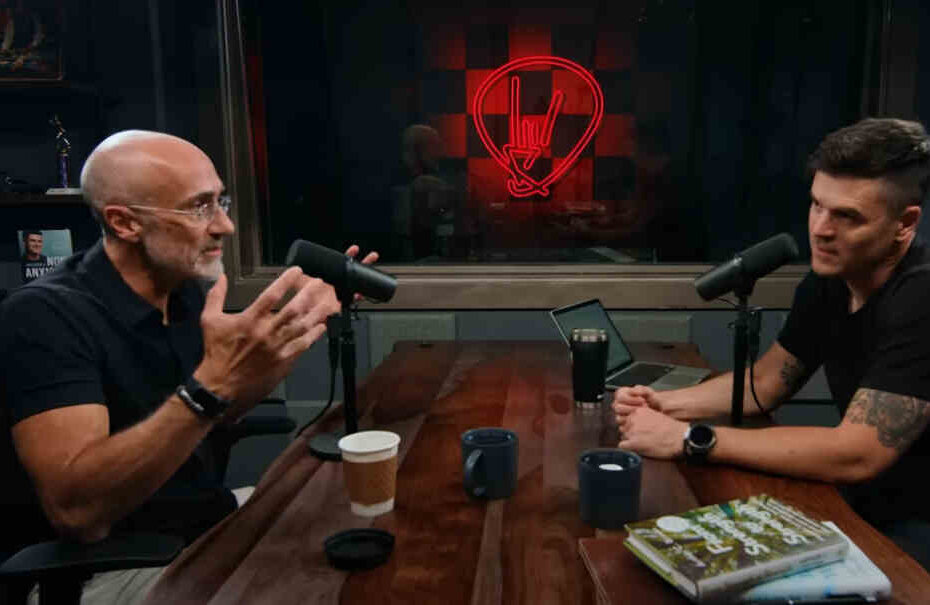
Read the full transcript of Harvard professor Arthur Brooks’ interview on The Dr. John Delony Show on “The Real Reason Marriages Fall Apart”, Premiered September 20, 2024.
Introduction
DR. JOHN DELONY: What’s going on? This is John with the Dr. John Delony Show. I’m so, so grateful that you are here. In my opinion, this is one of the most important episodes I’ve ever been a part of. This is one of those episodes that as soon as it was over, I made some changes in my life. And my life and my marriage and my relationship with my kids is different because of the experience I had recording this episode.
All the way from Boston, Massachusetts, the great Dr. Arthur Brooks joined me. And he is somebody who has long been a lighthouse for me, thinking about how to talk about happiness and love, faith and living and building better lives. And he is a professor in the Kennedy School of Business at Harvard University, where he teaches courses on happiness, the science of happiness, the science of love, and how this stuff all works in this madhouse world we’ve created for ourselves.
So here’s the deal. We cover love, the brain chemistry of love, faith and science, how to find love and how to reignite love, how to find and create happiness almost regardless of your situation. We talk about agency and choice. We talk about so, so much. And again, I left this conversation—and by the way, it’s a longer conversation. We just dug into it and kept going and going and going.
We’re going to link to all of his books in the show notes, link to a number of his articles, and he writes for the Atlantic every week. He’s just a brilliant, brilliant man. But more than that, he’s able to explain things in a way that a knucklehead like me can understand. And he gives me action items to go enact these things into my life.
And I’m telling you right now, I’ve already seen pretty radical transformations in my home, and they already thought I was optimized for love and happiness. I’m telling you, this episode can change your life. So buckle up, put on your headphones. And by the way, it’s safe for the whole family. I recommend everyone in your household listen to this episode. Check out my conversation with the great and wonderful Dr. Arthur Brooks.
Teaching Love at Harvard
DR. JOHN DELONY: You teach love to grad students at Harvard, and they love it.
ARTHUR BROOKS: Well, I teach happiness. I teach the science of happiness. And the most popular module in the class that I teach at the Harvard Business School, the MBA curriculum—the most popular module of that class, which is a very popular elective. I’ve got 180 in the seats and 400 on the waiting list.
DR. JOHN DELONY: Right.
ARTHUR BROOKS: Is how to fall in love and stay in love.
The Soulmate Myth
DR. JOHN DELONY: Here’s the path, and this is my unsophisticated take. And I want you to walk us through what’s actually happening here. My grandparents were married 73 years, and when my granddad died, my grandmother was so pissed that he couldn’t wait two more years because you get the 75 number, right?
They were hilarious and amazing. He’s a World War II vet. She raised four great, wonderful kids. But when he died, the decline was quick. And the way she would talk about him—I remember thinking or seeing in real time, “Oh, she lost like a leg and a lung when he left. She lost a couple of chambers of her heart when he left.” That’s a soulmate.
ARTHUR BROOKS: And a deeply biblical understanding of marriage, by the way. One flesh.
DR. JOHN DELONY: That’s it. It’s one. And I was in grad school at the time, and I remember thinking, “Oh, no, no, no, no, no, no, no. They did 72 years of loss, of going to war, of economic hard times, all this stuff.” We’re trying to reverse engineer that and say at 28 or 25, “Find your soulmate and then go that way.” And it hit me—oh, it doesn’t work like that.
ARTHUR BROOKS: All right.
DR. JOHN DELONY: Right. It doesn’t work like that. You have to go the other way. And our entire culture says that’s wrong. It doesn’t feel right. So walk us through—you meet somebody and you’re taken by them, and they’re clearly taken by you. Walk us through the brain chemistry from there to, “Oh, no.”
The Four Stages of Falling in Love
ARTHUR BROOKS: Yeah, yeah. So typically, know that 59% of these relationships are starting online now. 59%. It’s insane. So that’s how it’s happening. But still, between 15 and 20% of relationships that end in marriage start at work. So these are kind of in person. These are not mediated. You’re probably not falling in love with somebody on the Zoom screen. It’s still when you’re going to a place and you meet somebody and you’re both available—or ideally you’re both available, because most affairs actually start at work too. And we can actually talk about why that happens neurochemically.
So, okay, so the way that it starts—the ignition of relationships, of romantic relationships—has to do with hormones. It’s testosterone and estrogen. The sex hormones are the ignition of attraction, basic attraction. And so we’re uncomfortable with that because, you know, what does that mean?
DR. JOHN DELONY: That—
ARTHUR BROOKS: That seems sort of unseemly? No, that’s natural. That’s biology.
DR. JOHN DELONY: I see you and I’m attracted to you.
# Stage One: Attraction
ARTHUR BROOKS: Yeah, you’re attracted to another person. Right now, if that’s all it is, then you’re going to end up in relationships that people regret, that are not healthy, et cetera, et cetera.
# Stage Two: Euphoria and Anticipation
Generally speaking, when you’re attracted to each other and get to know each other a little bit, then the second stage happens really, really quickly—just within days, ordinarily. That involves two different neuromodulators, which are dopamine and norepinephrine.
Everybody who’s listening to us, watching us right now has fallen in love—almost everybody. And it’s like, “Can’t wait.”
DR. JOHN DELONY: Can’t wait, can’t wait.
ARTHUR BROOKS: It’s like, “I just—the text just came in. I think that’s that person.” You see the person from afar. You have that weird feeling of euphoria and anticipation.
DR. JOHN DELONY: But I didn’t know adrenaline is in on this.
ARTHUR BROOKS: Yeah, yeah. Norepinephrine. Not epinephrine. Norepinephrine, which is related, of course. It’s all from the adrenal glands. It’s highly related.
DR. JOHN DELONY: I didn’t know that was part of the game.
ARTHUR BROOKS: Yeah. Oh, yeah.
DR. JOHN DELONY: Oh, yeah. So that’s gas.
ARTHUR BROOKS: Yeah, that’s gas.
# Stage Three: Rumination and Bonding
And what that’s doing is it’s taking you then to step three, which ordinarily will start happening a couple of weeks in. Once you’re dating and know each other, then what happens is this crazy thing where there’s another neuromodulator implicated, but it doesn’t increase. It plummets.
DR. JOHN DELONY: It falls off a map.
ARTHUR BROOKS: That’s serotonin. So now everybody knows—at this point, they think they know—that clinical depression implicates serotonin. So serotonin levels are too low in the synapse of the brain. And for, you know, blah, blah, blah, gobbledygook.
What’s going on is when people take antidepressant drugs like Prozac, that’s supposed to increase the amount of serotonin in the bloodstream that’s in the synapse. And why? Because there’s all this evidence that when serotonin levels are low, you’re going to feel sadness, you’re going to feel rumination, ruminative sadness.
Now, the part of the brain that’s implicating is a thing called the ventrolateral prefrontal cortex. It’s literally a structure in your brain dedicated to rumination. “I’m so stupid. I can’t believe I did that. My life has been a mistake.”
DR. JOHN DELONY: What’s the—for lack of better terms—what’s evolutionarily that would preserve us, that would keep us in the tribe?
ARTHUR BROOKS: Yeah, well, what it will—not necessarily what it does—is it makes you learn from your mistakes. When you ruminate on something that happened in the past, you learn from something that didn’t go right so you don’t do it again in the future.
But it has other functions as well. That ventrolateral prefrontal cortex—it’s ignited when serotonin levels fall. Okay? Another thing that it does is it involves creativity. Creativity is rumination. So you’re thinking about a business plan, you’re thinking about writing a poem, a symphony, right? It’s the same structure in the brain. Rumination.
DR. JOHN DELONY: “She broke my heart.”
ARTHUR BROOKS: Or it’s just like, “I can’t stop thinking about it. I can’t stop thinking about it.” And when you’re falling in love, this is step three. So serotonin level falls. The ventrolateral prefrontal cortex lights up like a Christmas tree. And you ruminate on the other person because you’re bonding on the other person. You’re bonding to the other person.
Now, it makes you do the insane things like, “I just sent 100 text messages to that person. And I humiliated myself in the last hour because I was so freaked out about the fact that she didn’t answer me, that he didn’t say anything to me, or that he didn’t sound right in that last call. He didn’t sound right in that last call.”
DR. JOHN DELONY: So nowadays the text message didn’t look right.
ARTHUR BROOKS: It didn’t look right, whatever it is, because we have a million ways to ascertain what’s going on. And the reason that ordinarily you’d be like, “I don’t know, whatever, I’ll figure it out”—which you would in ordinary life—you can’t do that because you’re ruminating so much because your ventrolateral prefrontal cortex is turned on so high because your serotonin levels have fallen, because you’re bonding to the—you’re imprinting on the other person. That’s what’s going on. You’re writing a symphony in your brain about the other person. Right. And your brain looks like you’re clinically depressed in step three.
DR. JOHN DELONY: Right.
ARTHUR BROOKS: That’s the reason that people are like, “It’s so wonderful. It’s so terrible.” That’s why it hurts. It’s misery. And if you stayed there for the rest of your life, you’d want to die. You would literally want to die.
# Stage Four: True Bonding
What you’re trying to get to is the step four, where you have other hormones and neuropeptides. For example, oxytocin, which is a bonding hormone that says, “This is a member of my tribe. This is my kin.”
DR. JOHN DELONY: So that’s when you’re low, it’s met.
ARTHUR BROOKS: Yeah. Well, that’s when—what will happen is you start to recognize somebody as your partner. After a while, you have to go through these steps. But step four is the bonding that actually is involved in the production of oxytocin. So that’s what you’re trying to get to. That’s what you want to get to.
One, two, three, four. It’s wonderful. It’s terrible. It’s frightening. It’s exciting. That’s the whole thing. But again, remember, you and I know because this is our world—psychology is biology. It just is. And you’re doing all this stuff. You’re not an idiot. You know, you’re falling in love is the way that this works. If you understand this, you can manage it better.
The Danger of Over-Managing Love
DR. JOHN DELONY: Do you want to, though? Because I feel like that’s what eHarmony does.
ARTHUR BROOKS: Yeah, well, eHarmony doesn’t do this necessarily, because it doesn’t actually take us through the steps.
DR. JOHN DELONY: Right. It drops you off. But I remember I skipped a final to go get coffee with my wife. And I literally rationalized, like, “I’ll talk to the professor. We’ll figure this out.”
ARTHUR BROOKS: We’ll figure this out.
DR. JOHN DELONY: And that makes—if my son was like, “Dad, I met this girl. I’m going to go get coffee,” I would say, “Please, please go.”
ARTHUR BROOKS: Please go take your final. I know, but right.
DR. JOHN DELONY: But also, I threw away a full 100% track scholarship to university because I met a girl at a summer camp. Yeah. And you know what I mean?
ARTHUR BROOKS: You’re romantic.
DR. JOHN DELONY: I’m so bad. I’m so bad. I threw it all away.
ARTHUR BROOKS: Yeah. Yeah. And I quit a job and moved to Spain.
DR. JOHN DELONY: It made perfect sense. And I have my life because of it. And it’s completely irrational. It’s insanity.
ARTHUR BROOKS: I get it. No, no. And for sure, I mean, you can manage it to a certain extent. The real problem, by the way, is when two people are falling in love, but they’re at different speeds going through the neurochemical cascade.
DR. JOHN DELONY: That was my dean of students job. “Hey, this guy keeps texting me and I don’t want him to.”
When Love Becomes Obsession
ARTHUR BROOKS: What’s happening? There’s a whole—there’s a syndrome, actually, that’s identifiable in the literature called limerence. Not hemophilia. It’s not a blood disorder.
DR. JOHN DELONY: No, it’s much worse. Romancephilia. Yeah, limerence.
Understanding Emotional Patterns in Relationships
ARTHUR BROOKS: Yeah, exactly. And what it means is that you fall in love too quickly and there’s a non-trivial number of women who suffer from this and they just go, 1, 2, 3, 4. And the guy’s like, we just met.
And so the result is they get into relationships with what we call dark triad personalities. They’re men who have high levels of narcissism, Machiavellianism and psychopathy. The red pill boys, they have psychopathic traits and they feed on this for women who go right through the scale.
And so a lot of what I’m doing is I’m saying if you’ve got this thing, you need to manage yourself because you need to understand yourself and you need to understand the people who are going to prey on you because they will. You’ll be a magnet for dark triads and be like, “every boyfriend I have is a psychopath.” But it’s literally true. Not because you have bad luck, but because you’re a blinking light that says psychopaths welcome.
DR. JOHN DELONY: And here’s the, I feel like 95% of this show has become un-Hollywoodizing everything.
ARTHUR BROOKS: Yeah. Yeah.
DR. JOHN DELONY: It is not sexy every morning. Like I would eat my body weight in gummy candy every day. It’s a problem.
ARTHUR BROOKS: Love it. Me too.
DR. JOHN DELONY: And I have to decide, am I going to do that or not?
ARTHUR BROOKS: Right?
DR. JOHN DELONY: There is no Hollywood movie that I know of that’s worth watching that somebody says, “hey, I need to consciously and intentionally limit myself to three text messages a day to this person.” That just doesn’t exist.
The question is always, how do you feel? How do you feel? How do you feel? And I feel like in our culture we chase feeling off a cliff because that same feeling shows up this way. But that same feeling showed up for me 10 years in when I didn’t feel it anymore.
ARTHUR BROOKS: Right.
DR. JOHN DELONY: And then your colleagues are like, well, then I guess it’s not a soulmate.
ARTHUR BROOKS: Or they say the, what I think is the most insane statement these days is that “relationship just ran its course.” Like, they don’t just stop, people quit. Right. And that’s fine if you want to quit, but this idea that there’s just a natural lifespan to some of this circle, it circles back to, you have to know what you’re talking about to then say, “okay, oh, gosh, that’s me.”
DR. JOHN DELONY: Yeah.
ARTHUR BROOKS: And I’m not insane or broken or crazy, but I have to, I have to be intentional about it for sure.
DR. JOHN DELONY: I mean, that’s why emotional self-management is so critically important. That starts with knowledge. That’s why, you know, I do the science. I don’t do the science because it’s, you know, whiz bang, super cool. It is. Yeah. I do it because it’s in the public interest. And we get a better world when people fall in love, stay in love, that’s it.
Bodies Built for Scarcity
DR. JOHN DELONY: But we have to call it that. We have bodies built for scarcity when it comes to food.
ARTHUR BROOKS: Yeah.
DR. JOHN DELONY: That’s not our environment anymore. We have bodies designed for, there’s two suitable mates in this tribe, and dad and his dad’s going to pick them.
ARTHUR BROOKS: Right.
DR. JOHN DELONY: And that’s not our world anymore. So we have to build structures.
ARTHUR BROOKS: That’s right. The thing that you’re talking about that’s really important that I talk about with a lot of my students, a lot of people, because I’m on the road all the time talking about these things with young people and not so young people, because everybody wants love. You know, people my age can fall in love just like a kid, you know, because the brain is the brain.
So the thing that I talk about is what’s the realistic expectation as you’ve gone through this neurochemical cascade. And you want a relationship to endure as opposed to simply be established. You establish a relationship. What do you want it to be? What’s the goal?
And the answer is generally between two and five years after the initiation of the relationship, you don’t want passionate love. You want companionate love, which sounds, my kids have heard me say this. They’re like, “dad, that’s not hot.”
DR. JOHN DELONY: Exactly.
ARTHUR BROOKS: Right?
DR. JOHN DELONY: Yeah.
The Foundation of Enduring Love
ARTHUR BROOKS: Companionate love has tons of passion in it. But companionate love is based on best friendship. That’s what it’s based on. The foundation is friendship. The foundation of enduring love, enduring romantic love is friendship.
Here’s the reason that people will fall in love and then will break up and realize they hate each other. They don’t just like, whatever. They hate each other. The reason is because they’re disappointed about the fact that they actually were incompatible as friends. And they’ve slept together.
DR. JOHN DELONY: Right, right.
ARTHUR BROOKS: You know, they’ve traveled together, they’ve done all this stuff. They told each other their secrets and they’re not even friends. They don’t even like each other.
DR. JOHN DELONY: And the other side is, I talked to couples and like, y’all sleep together how many? Like three times a year. And they’re like, “dude, this is my best friend.”
ARTHUR BROOKS: This is my best friend.
DR. JOHN DELONY: Right. And like, we figured out what works for us.
ARTHUR BROOKS: Yeah, and that sounds awful. Yeah.
DR. JOHN DELONY: Yeah.
ARTHUR BROOKS: You know what’s more awful is not being able to stay in love, not being able to actually have a best friend, not having the person who truly understands you at a deep level. Now it’s better. I mean, marriages tend to be happier when they’re based on best friendship and where they’re still sleeping together. Of course, of course, of course. But the truth of the matter is that you can’t make the perfect the enemy of the good.
DR. JOHN DELONY: That’s right. Right.
ARTHUR BROOKS: When we’re talking about these things, there’s all sorts of ways to organize your life. But a marriage cannot be organized over the long term on something that’s not deep friendship. That’s a constant.
DR. JOHN DELONY: That is so countercultural.
ARTHUR BROOKS: Totally, totally. Totally. I mean, this guy came.
DR. JOHN DELONY: Madness.
ARTHUR BROOKS: That’s not Disney. That’s not Disney. “It’s my best friend.” I mean, that’s not the end of the film. “It’s my best friend.” It’s like, dude, I don’t know. That’s not happily ever after in the movies, but that is happily ever after in real life.
DR. JOHN DELONY: I’ve got a few best friends. We’ve been friends for 30 years. We still get together a couple times a year and we live all over the country. We’ve all done stupid stuff to each other, said stupid things. That’s not funny, man. But like, but we have a couple of non-negotiables that have emerged that, like, you can raise kids, you can bury parents, you can go through cancer together. But if this singular thing happens, I guess none of it. Right.
Everything feels so disposable. But I keep looping back to, as you’re talking, it just keeps looping back to, how does this feel? And where’s the passion? Where’s the passion instead of where’s the foundation? We’re going to figure this out.
ARTHUR BROOKS: Yeah. Right.
DR. JOHN DELONY: We’re going to work through it and maybe what we had is over. We’re going to build something else.
ARTHUR BROOKS: Of course.
DR. JOHN DELONY: Because we said we would. Right?
ARTHUR BROOKS: Yeah.
DR. JOHN DELONY: And that does not seem to be, having lived that, yeah, I get it. It’s one of the hardest things for me to try to distill down and explain in a simple way.
The Role of Emotions in Relationships
ARTHUR BROOKS: Yeah, it is. And this is one of the reasons that couples that are formed in religious communities, they tend to do quite well because they have this supernatural basis for the relationship as opposed to the feelings basis for the relationship. If your assumption is that my emotions are everything, woe be unto you, because that depends on what you’re digesting.
DR. JOHN DELONY: The life of hell.
ARTHUR BROOKS: It’s terrible. It’s terrible. By the way, this is not just about marriage. This is not just about relationships. Work. Everything. Everything. Everything.
Look, emotions are produced by the limbic system of the brain, a structure of tissue evolved between 2 and 40 million years, designed to take signals that come from the outside below your level of consciousness and translate them into a language that says either you should approach or avoid a thing.
DR. JOHN DELONY: Right. Don’t die.
ARTHUR BROOKS: That’s what emotions are for. Emotions are for two things: to keep you alive and get your calories and find mates so that you can survive and pass on your genes. That’s what emotions are for. Biologically, that’s what emotions are for. But we’ve built them up into this, like, cosmic thing. No, no, no, man.
DR. JOHN DELONY: Their job’s not to tell you the truth.
ARTHUR BROOKS: The job is all it is to keep you not dead. You know, and so the whole point is you have a prefrontal cortex in your brain with a tissue right behind the bumper of your brain, 30% of your brain by weight. That’s what makes you human, is the prefrontal cortex, as opposed to being a squirrel or something right behind your forehead.
You want the emotional information to get to your prefrontal cortex so you can decide, what do these emotions mean? Where do they come from? What am I going to do? And should I disregard them?
DR. JOHN DELONY: Right.
ARTHUR BROOKS: But if you’re living according to your emotions, you’re, man, you’re the squirrel, right? You know, it’s like, got to get enough. Sleep with them, sleep with them, sleep with them, sleep with them.
DR. JOHN DELONY: No. We just met, right?
ARTHUR BROOKS: Yeah, yeah. And it’s like, “I’m not feeling it today.” That’s okay.
DR. JOHN DELONY: That’s okay.
ARTHUR BROOKS: Go work it out. Go work it out. Or, you know, what do I want to be tomorrow?
DR. JOHN DELONY: I don’t feel like it today. Put your phone down and look at your kids.
Practicing Approach When Feeling Avoidance
ARTHUR BROOKS: Yeah, yeah. And one of the things that your prefrontal cortex can do that your limbic system can’t is when you have, and by the way, this is one of the great secrets of the marriages with the greatest longevity. Right. When you feel avoidance, you practice approach. That’s what great marriages have in common. And that’s pure prefrontal cortex.
Your limbic system says avoid. Avoid. You’re annoyed. She bums me out. She’s irritating me. She’s on my case.
DR. JOHN DELONY: Dishes in the sink.
ARTHUR BROOKS: It’s like, “I’m just going to go down to the man cave and watch a game.”
DR. JOHN DELONY: That’s it, right?
ARTHUR BROOKS: No, no, no. That’s when you say, “bring it in.”
DR. JOHN DELONY: I’m going to go hug.
ARTHUR BROOKS: I was like, I’m going to, I love you. That’s when you say, you say “I love you” most when you feel it the least. Like, there’s a, you can get one. I have a, I have one-touch flower ordering on my phone.
DR. JOHN DELONY: Right.
ARTHUR BROOKS: And I touch a button on my phone, and flowers go to my house. My house. Yeah, right. And I do it not when I’m feeling the greatest warmth for my wife, but when I’m feeling the iciest.
DR. JOHN DELONY: Yeah, right.
ARTHUR BROOKS: For Esther, like, I’ve been married almost 33 years at this point, so, you know, I got a lot of tricks under my belt. It’s like, click. It’s like I’m not feeling it. Click.
DR. JOHN DELONY: Right.
ARTHUR BROOKS: And because I want to practice approach when I’m feeling avoidance, unfortunately, Esther’s figured it out.
DR. JOHN DELONY: Well, but so I was like, what’s wrong?
ARTHUR BROOKS: I got flowers.
DR. JOHN DELONY: I was traveling, and I just flew in this morning. I was traveling, and you know those traveling phone calls you get a little short? And I was short, and I didn’t like it. I don’t have, I don’t know how these phones work. And so the guy who travels with me, I was like, “hey, do you have that thing where you can order food and send it? Will you send ice cream to my house?” And he’s like, “okay, whatever,” 21st century.
And so anyway, I got a message later that was just all hearts. And it was like, “hey, thanks is awesome.” But it was that I can stew. I’m on the road. I don’t have to see anybody. I can just be all dramatic. But that’s anxiety, right? That is every, I don’t want to work out. I don’t, if you head into it, it’s always on the other side of it. It’s never the other, it’s never avoidant. Right?
ARTHUR BROOKS: Yeah. And this is, this is how, you know, the master of your brain is governing the emissary, you know, when the prefrontal cortex is mastering the limbic system of the brain. Look, you need emotions. You’d be dead without them. Of course. Absolutely. You’d be dead every week without them.
DR. JOHN DELONY: Right.
ARTHUR BROOKS: I mean, and people who want to live without so-called bad feelings, they don’t understand emotions. But these are physiological responses to the outside world. You need to govern them using your full capabilities, your full capacities. That’s what it means to be fully alive. That’s what it means to be a human.
DR. JOHN DELONY: Right.
ARTHUR BROOKS: And when you’re watching the movies that say, “go with your feelings,” you’re going to screw this up and you’re going to be unhappy.
The Third Rail of Faith in Social Science
DR. JOHN DELONY: You and I both know this, and the average listener won’t know this, that the field of social sciences and especially the field of psychology is a largely atheistic field. It’s a largely, let’s see if we can use these tools of hard science and bring them over here to people. Right. And create these artificial environments where we can pull apart the human and see what it’s made of.
The studies that walk up to the line of, or as my friend says, walks up to the doorway of faith, they’re just incalculable that if you are a faith practitioner or you submit to something bigger than yourself, every part of your life is different. It’s elevated.
And the field as a whole, it seems to be, and maybe I’m biased, but they walk up to that line and they will walk through serotonin, dopamine, oxytocin, they will walk through these other parts and this one they will say “and faith.” And then they walk like they have to acknowledge it because they’re not going to be dishonest. But there’s no, what I would call an integrous look into, okay, what is this? Why can’t we talk about it? Right. It feels so third rail before third rails existed in 2016. Right.
ARTHUR BROOKS: Yeah.
DR. JOHN DELONY: And I can’t wrap my head around it.
ARTHUR BROOKS: Yeah.
DR. JOHN DELONY: Other than it. I don’t know. You live in it further than I am.
ARTHUR BROOKS: Yeah. So, you know, I’ve thought about that an awful lot because I’m a lifelong practicing Christian and I’m a social scientist. I’m a behavioral scientist now, which most…
DR. JOHN DELONY: People don’t know are opposing worlds.
ARTHUR BROOKS: Mostly opposing worlds. Not entirely. Something like 16 to 17% of social scientists, Ph.D. social scientists are religious or have a religious practice, I should say. Most of whom in the United States are Christians because it’s a predominant religion, but not all. I mean, some, I know many in my field who are serious about their Jewish faith.
DR. JOHN DELONY: Absolutely.
ARTHUR BROOKS: For example, and if you go to India, you know, a lot of social scientists are practicing Hindus, et cetera, et cetera, but 16, 17%, that’s way below the American average. Right?
DR. JOHN DELONY: Right.
ARTHUR BROOKS: So what’s the deal? Social science largely says that everything that happens that you experience is socially constructed.
DR. JOHN DELONY: Right.
ARTHUR BROOKS: Including your faith.
DR. JOHN DELONY: Okay.
ARTHUR BROOKS: Including God. And so therefore God is, the conclusion is often that God has been constructed socially to deal with problems that we don’t know how to deal with in any other way. Now, that makes a supposition that once we get to a certain level of knowledge as a society and as individuals, then God will be unnecessary. That’s scientism. That’s a religion. The whole idea is that science is going to overtake faith and religion being the opiate of the masses for now.
DR. JOHN DELONY: Correct.
ARTHUR BROOKS: And so a better future is one where we find the answers. And it turns out now, increasingly, we realize that’s wrong and we understand the science of why that’s wrong. So the new frontier is going to be way more accommodating to religious faith than it currently is or has been in the past.
DR. JOHN DELONY: And you don’t think there’s, it feels like there’s an end around coming with tech trying to answer that same question. Not with social science anymore.
ARTHUR BROOKS: Well, for sure, because Freud was going…
DR. JOHN DELONY: To solve it for us. He didn’t. And so now is the end around with, yeah, we’ll just…
The Left Brain Trap of Technology
ARTHUR BROOKS: And it’s going to be an exercise in futility in the same way. And we actually know why. We actually know why that is. And increasingly the case. So you know the work of Iain McGilchrist, the great psychiatrist and neuroscientist from Scotland, he wrote in 2004, a long time ago, “The Master and His Emissary.” And what he was talking about was the hemispherically lateralized, this is nerd speak for the brain has two sides to it. Right. Okay? The left hemisphere and the right hemisphere.
Now, back in the old days, there was this kind of pop idea that you, if you were artsy or if you’re an analytic, all that’s nonsense. None of that actually held up to the science. But we are hemispherically lateralized because the two sides of the brain, the human brain, communicate with each other but do different things.
What we find is the big questions of meaning are adjudicated on the right, and the analytical questions, the problems, the distractions and details of life are adjudicated on the left. So what does this mean? If you want to set an agenda for your life, you’re going to come up with the big questions and ideas on the right, and then you’re going to work out the little problems on the left.
Tech and science are on the left. So social media is on the left, screens are on the left.
DR. JOHN DELONY: Right.
ARTHUR BROOKS: All of the stuff that tech is bringing us is left side. One of the reasons that young people are finding it harder and harder and harder to find the meaning of their lives is because they’re being pushed by the entire culture, the technocratic culture, into the left side of the brains. The right side is becoming inaccessible to people, and that’s why they’re not, they don’t just feel a lack of meaning. They don’t even know where to look. They don’t even know where to look geographically in their own brains anymore. My whole world is about getting back to the right side of the brain.
DR. JOHN DELONY: But you can’t sell that because it’s, it’s, it’s relatively easy. Well, it’s simple. Not simple.
ARTHUR BROOKS: It’s a simple idea, but it’s really hard to do. You know what I mean?
DR. JOHN DELONY: But it’s hard.
ARTHUR BROOKS: Yeah, I mean, you got across the corpus callosum. I mean, man, you got to get from the wiring to the right side of the brain and people are saying, “I can see it over there, kind of. I can see it over there, kind of.” And so you have to talk about very practical protocols in your life, like how much screen time you should not get. You know, how long should you be looking at your phone now? How long should you be not looking at your phone continuously?
These are the questions that I’m trying to answer. How should you be adjudicating your relationships? You want to go out on a date? Find a matchmaker, not a dating app. Because the dating app is the complicated left brain solution to the right brain complex problem. That’s love, right? And so you need another human complex right side that’s going to help you with yours, AKA your parents, your friends, the people who are setting you up.
The Right Brain Question of Marriage
DR. JOHN DELONY: Okay, so we want to match. All right. The truth of, in my world, I was 18 years old, heading off to college and I went to this spiritual retreat and this well meaning but way overzealous guy was saying, “here’s what’s about to happen.” So I wrote down, it’s not good, it’s all bad, right?
So the encouragement was write down your list of 10 non-negotiables and my future mate and all of my 18 year old wisdom. And this time I was still hoping to become the blonde, the backup meeting singer Pantera. So I was right. I’ve been with the same woman 25 years. She had two of the 10, and one of them was to be a beautiful woman. That was one of them. Nice, right? So I was wrong on 80% of what would be classified as this left him.
ARTHUR BROOKS: What is it? That’s not…
DR. JOHN DELONY: But what didn’t occur to me at 18 was this purpose, this anchoring.
ARTHUR BROOKS: Right?
DR. JOHN DELONY: What do we want to build together?
ARTHUR BROOKS: Right?
DR. JOHN DELONY: And that’s a different, and it feels like the why of…
ARTHUR BROOKS: Marriage, by the way, the right brain question of marriage.
DR. JOHN DELONY: Yes, you get that one right. You can figure this out.
ARTHUR BROOKS: The non-negotiables were the details of what a marriage is. You’re trying to solve that problem in the left side of your brain. Whereas what you really should be thinking about and falling in love is saying in the love is the why of the relationship per se, which is a right brain question.
Teaching a Generation Without Models
DR. JOHN DELONY: How do you talk to a generation of young people whose parents, parents came home from the war, one person got behind a newspaper and the other person just worked. Then two parents bought this, “we have to, or we’re going to work 24/7, 365 together.” And we’ve created the loneliest generation in human history.
And then you and I are telling them, “hey, look, this sounds crazy. Find somebody that you think is handsome. Find somebody you think is beautiful. Find someone that you can laugh with and then go become great best friends.” And there’s no, there’s no model for that.
And so I’m asking someone, “hey, I want you to dribble this basketball and throw it in that hoop.” And they’ve never seen a basketball plate. How do you make that connection for folks? Because I feel like we’re asking people to head out into the jungle with a machete saying, “just trust us.” Because this isn’t working. Clearly this is not working. And another app isn’t going to help.
ARTHUR BROOKS: Well, there’s a theological response. We could leave that aside for a while. But there’s a philosophical response and there’s a technological response to that. Okay, so the technology. Let’s start. This should be very practical about this. You’re unlikely to do that with the apps.
DR. JOHN DELONY: You’re not.
ARTHUR BROOKS: It’s just, it’s hard. It’s harder than you think. Like, and I’ve got the data on this. This is not. And you’ve got the data on this too, that you’re more likely to get more dates and you’re less likely to be attracted to the people that you’re dating. That’s what the data show.
You’re going to have more dates and you’re going to like them less than you would otherwise, which sucks. I mean, that’s a bad deal. It’s like I’m going out with all these guys and I don’t like any of them. Why? I’ll tell you why. We actually know why.
We are built for attraction to people who are complimentary to us. When you’re curating your dating profile on almost any dating app, you’re writing a profile of yourself and looking for yourself, you know, and so I want somebody who, you know, lives in such and such and such a place. Okay, fine. Somebody who’s got such and such a religious faith. Okay, but who likes Sriracha and thinks that, you know, Austin, Texas is a personality and, you know, whatever your likes this kind of music and more than anything else, votes like this.
And you’ve just curated a portrait of you. You’re looking for you. That’s really not hot.
DR. JOHN DELONY: No.
The Science of Attraction and Compatibility
ARTHUR BROOKS: We are biologically unsuited to people who are too close to us. And there’s all this research, you know, the T-shirt sniffing test. Are you hip to this? Yeah. And so what this says the olfactory bulb. This is the major histocompatibility complex, which is to say your repertoire of immunological responses to pathogens.
You want people who are more biologically different than you so that your offspring are going to have a better repertoire of immunological repertoire. And that means you’re going to be more romantically attractive, more sexually attracted to people who are different than you, not the same.
And there’s a correlation between your immunological profile and your personality profile. That’s just the fact. And so when you curate your dating profile to be you, you’re going to get people who are too much like you and you’re not going to like them.
DR. JOHN DELONY: It’s like the two norths on a magnet, right?
ARTHUR BROOKS: Yeah, totally. And I get it. I mean, there’s got to be some level of compatibility. I mean, it’s like if you’re very, very serious about your faith and you don’t want to marry outside the faith, then look for somebody who’s got your faith, but don’t look for somebody who’s got your personality or necessarily your race. And you know, that kind of stuff, like complementarity. That’s what we want, is complementarity.
So that’s the first thing to really be thinking about when people are setting this up. And that’s the reason that matchmakers are better than apps, because your parents know that they know you, and your friends know that they want somebody who’s like you but not too much like you. They’ll be like, yeah, there’s something about it. It doesn’t seem like a good match because they’re using the right side of their brains when they’re setting you up. That’s the first thing to think about.
The Culture of Safetyism and Risk Avoidance
Okay, then the second thing to think about is that we’ve built a world without risk. The biggest problem is not that we’re sending people out unprepared with a machete. The problem is we’ve told them to go out with a machete where they don’t know where they’re going is a bad and dangerous thing to do. We have a culture of safetyism.
So it’s like, I’m going to adjudicate your conflicts in elementary school, and if there’s a problem in college, I’m going to call the dean. And so kids have learned that it’s a dangerous world out there.
DR. JOHN DELONY: My students walking out of an exam if they didn’t like it, texting their moms on the way out.
ARTHUR BROOKS: Yeah, exactly. But that’s because they’ve been acculturated to a world that doesn’t have risk and doesn’t have danger. Guess what’s dangerous? Dating. Guess what’s scary?
DR. JOHN DELONY: Do you love me? Falling in love?
ARTHUR BROOKS: And so what I try to inculcate is a mentality of entrepreneurship. And the thing that matters the most. Look, the enterprise that matters is your life. You’re the founder, you’re the CEO, the currency that you’re trying to make explosive in fortune is love and happiness. So go take a risk. If you’re not giving your heart away, you’re not an entrepreneur. That’s just a fact.
DR. JOHN DELONY: And that means you will get hurt, period.
Embracing Heartbreak as Part of the Journey
ARTHUR BROOKS: Oh, yeah. No. The average entrepreneur, startup entrepreneur, who’s successful has 3.9 failures. Okay? So let’s just, as a rule of thumb, if your heart has not been broken badly four times, you haven’t been in the game enough on average. I mean, your results may vary, right? Maybe you’re, some people marry their first girlfriend and it’s like 73 years of bliss.
But the truth of the matter is that you need to be really entrepreneurial and you need to wake up and say, bring it on, man. I’m an entrepreneur. And I’ve talked about this a lot. I gave a talk in D.C. about this to a bunch of young adults working on the Hill, which is the world’s most dysfunctional dating market, right?
And I said, if you’re an entrepreneur, you got to get your heart broken. Just fact. And a guy comes up to me, sees me a couple weeks later on a plane, of all places. He’s like, yeah, I couldn’t get that talk out of my head. And he said, I’m on my way to Philadelphia to declare my love to a woman I’ve been secretly in love with for two years. I’m like, it was just a speech.
And then he heard from him later that she didn’t love him. She introduced him to her boyfriend. It was horrible. I mean, he was just, like, repudiated. He was humiliated. And I said, I’m sorry. I didn’t, you know, I didn’t mean to ruin your life. And he says, no, no, no. I’ve been…
DR. JOHN DELONY: He’s free.
ARTHUR BROOKS: I’ve been meaning to thank you because the worst thing in my life happened and I didn’t die. And now I can. I’m not afraid anymore. In the same way, it wasn’t as bad as I thought. This is the thing in life, you know? This is the thing, you know, the first time you jump with a parachute out of the plane, you don’t die. You’re like, I can do that again.
Yep. It’s the first time. That’s the hardest. And that’s the world that we’ve created. That’s really, really difficult for young people with the machetes and the jungles and et cetera.
The Power and Danger of Contempt
DR. JOHN DELONY: You’ve written on this eloquently in one of your older books, and it’s something that I’ve wrestled with.
ARTHUR BROOKS: What’s that?
DR. JOHN DELONY: You wrote an excellent book on contempt in the culture. I’ve tried to unpack it in my mind. And here’s my challenge with asking people to walk away from contempt. I think it may be the most powerful drug we have now. Now, because it insulates us. This idea that I am a, it’s hierarchical. I am better than you for this reason.
And if I’m just an assistant manager at NAPA Auto Parts or I am a lowly assistant professor, I get pushed around all day. I get told I’m stupid all day. I get laughed at every day. I get the crappy jobs, all they get, the bad committee assignment. I get all the stuff.
And then I got some coach telling me that if my kid doesn’t play this travel sports league, that I’m going to ruin them. So I got to pony up this money. I’ve got a spouse who just spins, spinning us into the grave. All I have in our current culture, I got no friends that I hang out with regularly. Cheers doesn’t exist anymore.
All I have is contempt. I have a guy standing up saying, your life sucks because of them, right? And I don’t know, it feels harder to detox than fentanyl. I don’t know how to detox as a culture or forget the culture, the big picture. I don’t know how to look at somebody and say, I need you to lay down the only sword you have.
Understanding the Four Basic Negative Emotions
ARTHUR BROOKS: So contempt is a combination of two basic negative emotions. So there are only four negative emotions. We all feel like very special flowers emotionally. But we have, emotionally, we have the same kitchen with the same ingredients. We make different things in that kitchen.
But the four negative emotions that everybody has are anger, disgust, sadness, and fear. Those are the four basic negative emotions. That negative doesn’t mean bad. It just means that those are the things that signal threat to us from the outside world.
So fear and anger are from the amygdala, and they light up when there’s a threat. In either fight or flight. Disgust comes from the insula, and that says there’s a pathogen that can kill you. So you should find it disgusting. You should find it terrible, and you should avoid it. Yeah, you should avoid it.
And sadness, it stimulates the dorsal anterior cingulate cortex, and that’s a part of the brain dedicated to social pain or emotional pain. That’s from losing someone or something that you love. That’s what sadness comes from. Okay?
All of these things are evolved. All these things are adapted. They’re very important for us because before, for example, you had vaccines and antibiotics, all you had was disgust.
DR. JOHN DELONY: That was it.
ARTHUR BROOKS: That was like, that smells bad. That looks rotten. That smells like it might be dead. That looks like it’s something that might contain a lot of bacteria. And I have sensory organs from the olfactory bulb to this insula in my brain to say that seems like it has bacteria in it. And it might give me an infection. I’ll die. You need this stuff is what it comes down to.
But we use them socially, and people manipulate us socially to use these emotions. Now, anger is not bad in relationships, right? I mean, anger’s not bad. The Gottmans that you’ve talked about a lot on your program, John and Julie Gottman and the Gottman Marriage Lab in Washington State, they show that divorce and anger are uncorrelated. And that’s really important.
DR. JOHN DELONY: Anger means you care.
ARTHUR BROOKS: Yeah, anger’s a hot emotion that says, I care what you think and I want it to change. It can be uncontrolled. It can become destructive in all sorts of ways. But anger per se is not a problem, thank God, because, you know, the secret to my 33 years of happy marriage is the lack of correlation between anger and divorce.
Disgust is really bad in relationships, however, because disgust should be relegated to actual pathogens. A person shouldn’t be a pathogen. Now, demagogic leaders use disgust by relating people to actual pathogens in the environment. When somebody says those people are disgusting, they’re trying to stimulate the insula in your brain, and it will stimulate the disgust response, and you will go into panic mode.
DR. JOHN DELONY: Vermin. Cockroach.
How Disgust Is Weaponized in Politics and Culture
ARTHUR BROOKS: The Hutus called the Tutsis in the Rwandan genocide cockroaches, better word for it. Hitler referred to the Jews as rats. There’s a reason for that. They’re trying to stimulate, but we have an American political culture, culture in the United States, they say what that person says is disgusting.
When they use the word disgusting, they’re trying to stimulate your insula, the part of your brain that will hijack your emotional life. And so that you feel panic and rage toward another person. Out of my life. That person can really, really hurt me. So somebody who disagrees with you politically becomes a threat to your life at that moment. That’s what the internal chemistry. That’s just pure biology, man. That’s just straight up biology.
Now, mix disgust with anger together. That’s contempt. That’s a complex emotion that we get. When you see it in a human relationship, that relationship is not necessarily doomed, but it’s a big problem. That’s why the Gottmans find that the leading indicator of a couple on the rocks going toward permanent schism is eye rolling, derision, sarcasm. That’s contempt.
And that’s the disgust that’s coming through. And that’s that coldness, not the hot anger. It’s the coldness of disgust that comes through. That’s the problem. And we have it all over our culture.
DR. JOHN DELONY: That is our culture.
The Culture of Contempt in Marriage and Society
ARTHUR BROOKS: That is our culture. We have a culture of contempt. Absolutely. So that’s what I talk about in politics, because I’m trying to do something to help our country a little bit. That means don’t roll your eyes when somebody says something you disagree with politically. Never do it in your marriage, because that’s interpreted by the brain of your partner as you thinking that I’m a pathogen and I’m worthless and I need to be cast out.
Because your brain will interpret you don’t—you wouldn’t say, “I think you think that.” But my brain thinks you think that even if you didn’t intend that. That’s why it’s so unbelievably damaging. It’s like physical abuse with respect to what it does to relationships.
And when we do it to each other in our culture, to our colleagues, to people we don’t even know, we’re going to get permanent enemies. And that’s why Democrats and Republicans can’t talk to each other. That’s the reason. Because social media and traditional cable and politicians and people on the street are acting this way toward each other. And we’re seeing each other as vermin. We’re seeing each other as pathogens.
DR. JOHN DELONY: The only path out of that is when I feel cold towards my wife.
ARTHUR BROOKS: Like we talked about earlier.
DR. JOHN DELONY: I have to decide. I have to be intentional about being warm, and I got to head towards her.
ARTHUR BROOKS: Your marriage will not survive if it’s not primarily managed by your prefrontal cortex. That’s right.
DR. JOHN DELONY: That means I have to be intentional on a somewhat regular basis. And this is what I loved when I was at the law school. We sat around the table on Friday mornings and had donuts. And it was these incredible law professors who all disagreed with each other and they’re all friends. And I loved it. And it was remarkable. We’re sitting with theology professors just yelling. I mean, it gets so—it’s an orchestra. It’s so good.
ARTHUR BROOKS: And you can get a culture of that. I mean, the culture of that’s really beautiful.
DR. JOHN DELONY: That’s—
ARTHUR BROOKS: That’s what we’re trying to get in academia, but we don’t have—
DR. JOHN DELONY: We don’t have it right.
ARTHUR BROOKS: But in the day—
DR. JOHN DELONY: But I have to decide to do that in my day to day life.
Managing Culture and Cancel Culture
ARTHUR BROOKS: And you have to manage that if you’re leading a culture. The alumni—I do a lot of alumni events at the Harvard Business School because they want the happiness guy, right? The supply chain management guy is less popular with the alumni. So I mean, look, his work might make them more money. But anyway, my point being that I’m talking to the alumni, they’re like, “I love it here because we used to have these big disagreements here with our friends. What’s going on? What’s with cancel culture?”
It’s bad management is what’s up with cancel culture across academia. I mean, we’re better at HBS than a lot of places because we’ve got great management, but a lot of places don’t. And so they’re letting cancel culture run out of control. They’re letting the culture of contempt go out of control.
They’re saying that when somebody says something that you find obnoxious, that that’s a threat to you with trigger warnings and microaggressions and safe spaces and all this stuff. What it’s doing is this: it’s making it impossible for you to disagree with somebody without expressing contempt.
DR. JOHN DELONY: Which means you will never land—
ARTHUR BROOKS: No, no. You’ll never land. And furthermore, you won’t learn. It’s just mediocre. That’s what it comes down to. And that’s what you need in your marriage. You need a marriage that could sustain lots and lots of competition of ideas because that leads to excellence, but it must not be governed by contempt. Or the competition of ideas will lead to schism, will lead to separation, will lead to emotional separation, if not physical separation.
DR. JOHN DELONY: And then you go back to work and that one person laughs at your jokes.
ARTHUR BROOKS: Yeah, right. I mean, this is really—now you’re off to the races. Well then the person who laughs at your joke, you instigate the neurochemical cascade of falling in love. There we go. And then your boss, who’s a moron, says, “We’re going to do a team building effort,” which is two days on a lazy river in canoes and your spouses aren’t invited.
DR. JOHN DELONY: That’s right. Right.
ARTHUR BROOKS: And “I don’t know what happened exactly.” Famous last words. I’m like, I got brain scans. Let me show you what happened.
DR. JOHN DELONY: Yeah, I’m pretty sure I know what happened. Yeah, but contempt feels so powerful.
The Neurochemistry of Being Right
ARTHUR BROOKS: Yeah, I know it is. I mean, look, you get a neurochemical reward for it for sure.
DR. JOHN DELONY: Because it saved your life.
ARTHUR BROOKS: Yeah, for sure.
DR. JOHN DELONY: I mean, evolutionarily, it saved your life for sure.
ARTHUR BROOKS: And furthermore, it feels good to be right. I mean, we have an evolved tendency to get the reward of being—there’s a reason you have a “my side bias” on everything, which is kind of a catch-all term for all the things that we do. All these psychological biases that we have. There’s about 30 that make it hard for us to—
DR. JOHN DELONY: I feel like there’s a thousand of them.
ARTHUR BROOKS: Yeah, yeah, but there’s a catalog of about 30 biases that we have that make it hard for us to assess information fairly and to update our views and to be more correct as opposed to feeling more correct. “My side bias” just in general says that I’m going to defend my point of view as if this were the family fortune.
There’s a great Vietnamese Buddhist monk, Thich Nhat Hanh, and he used to say that the greatest form in modern life, the greatest form of attachment, is attachment to opinions. And we understand the neurobiology of why that’s true. You get a reward for being right. You get a reward for being—and we could go back to the evolution of why that would happen in tribal societies, et cetera, et cetera, but it makes perfect sense.
And so the result is you have to know that you’re scratching a little itch, you’re getting a little dopamine and the locus coeruleus in your brain is spraying a little dopamine in there. It feels good to be right. It feels good to go to somebody who says you’re right. And the people who disagree with us—they’re stupid and evil and they hate America. That feels good, right? And when your friend says, “Yeah, your wife, she is a harpy.”
DR. JOHN DELONY: That was an awesome filter. Just go to the Rolodex. But yeah, but again I go back to thank God I have a group of men in my life that I can call and say, “I said this and my wife said that.” And they go, “Yeah, you’re an idiot.”
The Importance of Truth-Telling Friends
ARTHUR BROOKS: Yeah, dude. Yeah, dude, don’t—yeah, you did wrong. Yeah, you got to curate your relationships such that you’ve got friends who are more likely to tell you you’re wrong.
DR. JOHN DELONY: When you’re wrong.
ARTHUR BROOKS: You have to have—where they’ll over-correct on you.
DR. JOHN DELONY: Yeah.
ARTHUR BROOKS: They’re more likely to criticize because they know that the best thing that can happen to you is that your marriage lasts.
DR. JOHN DELONY: That’s right.
ARTHUR BROOKS: And if they love you, they want you to have a successful marriage. I have a really super close friend in Atlanta and I talk to him all the time. His name is Frank. And I call up Frank, I said, “Frank, you got a problem? What’s your problem?” We’ve known each other for years and years and years and years and years. “This thing’s really bumming me out. This thing is really—I think this conflict is really bumming me out.”
He listens, he says, “Buddy, you might be thinking about this in the wrong way.” I know he’s going to take me to the woodshed. I called him because he’s going to take me to the woodshed.
DR. JOHN DELONY: Yeah. My buddy Todd says, and I quote, “That’s the stupidest thing I’ve ever heard.” That’s just—no matter what it is, that’s always a response. “That’s the stupidest thing I ever—” Right. And you got to have those people. But that means again, like weightlifting, like nutrition, like all these things, I have to choose to be uncomfortable in the moment for this long term benefit.
Embracing Discomfort for Growth
ARTHUR BROOKS: Yeah, yeah, yeah. Side note of a very, very profound point that you’re making right now, that a lot of young people, a lot of people listening to us are younger than you.
DR. JOHN DELONY: Correct.
ARTHUR BROOKS: Right. Your core demographic is people making their way. Right. They have heard that psychological discomfort, that pain and suffering are evidence of a problem. And that is wrong. That is a lie. If you’re doing something difficult, like falling in love or going to college or making your way through life and you’re not sad and anxious, then you need therapy. That’s the truth.
DR. JOHN DELONY: Right.
ARTHUR BROOKS: And you need to not eradicate it. You need to learn how to manage it, learn from it and grow from it.
DR. JOHN DELONY: What’s the balance between those who will call my show and say “I’ve been in an abusive relationship?” And they keep—there’s a line there for sure.
ARTHUR BROOKS: And this can be so exaggerated and so maladapted that you actually have a medical problem. Of course, I mean, clinical depression is no joke. Generalized anxiety is no joke. But that’s one of the ways that you don’t eradicate this. But you try to turn down the dial on this. You don’t want to turn to zero, you die.
DR. JOHN DELONY: Right, right, right.
ARTHUR BROOKS: You want to turn it down to manageable levels where you’re continuing to have a full human experience that will lead to a rich life and you continue to learn and grow. But the idea—you go to a campus counseling center and they say, “Oh, you’re feeling sad and anxious. That’s a pathology.” Yeah, that’s a huge problem.
DR. JOHN DELONY: Or “I’ll email your professor and say—”
ARTHUR BROOKS: That’s a huge problem.
DR. JOHN DELONY: “I can’t teach on this topic.”
ARTHUR BROOKS: Yeah, yeah, yeah, for sure. Yeah, yeah, that’s a big problem. That’s a very profound point that you’ve made a lot in your show. And I want to underscore that the science follows that very clearly that we need to take care of ourselves, et cetera, and we need to take care of our mental health, which is a big theme of what you talk about. But that doesn’t mean—that means go—
DR. JOHN DELONY: Do the hard—switches off.
ARTHUR BROOKS: That means dials may be down or at least understanding how to turn the dials. Yeah. And that’s emotional self-management.
DR. JOHN DELONY: But I found that you turn those dials down so you can do the next right hard thing.
ARTHUR BROOKS: Yep, that’s right.
DR. JOHN DELONY: The next easy—
ARTHUR BROOKS: That’s right. Look, I’m not going to get under a 600-pound bar to squat my first time in the gym. I’m going to get hurt. It’s going to be a big problem. I’m going to lower the weight if I’m going to get at the bar.
The Power of Choice in Marriage
DR. JOHN DELONY: An average person on an average day hears there’s a problem out there that either you caused or that somebody caused to you. And you can’t do anything about it. You’re not good enough, strong enough, smart enough. I’m going to pat you on the head and you go over in the corner and just tap me in and I’ll…
ARTHUR BROOKS: Go solve your problem for you. Whether that’s…
DR. JOHN DELONY: It’s across all fields. And the word that keeps… I feel like it’s being taken out of everything is the word “choose.” And I go back to this conversation. My wife and I, this is seven or eight years ago, we sat across the table and just said, we’re adults. Are we done? Is our marriage over? The way we’ve been married cannot continue.
ARTHUR BROOKS: That’s over.
DR. JOHN DELONY: Are we going to stay married? And both of us said, I choose in. And it was my wife that first put this on the table. We’ve chosen together a miserable marriage, which stinks, but that also means we can choose a pretty incredible one.
ARTHUR BROOKS: That’s a decision you probably oozed into a miserable marriage.
DR. JOHN DELONY: We did. We did.
ARTHUR BROOKS: Yeah.
DR. JOHN DELONY: But it was a million tiny little choices. But the oozing is made up of a whole bunch of little decisions that consciously or unconsciously, you just keep doing and you just do the next thing. And unintentionally, yeah, you land in this.
And so I keep going back to this idea of choice. And you write about this in “Strength to Strength.” And I think it’s phenomenal. But you make what I think is the ultimate countercultural argument right now, which is happy. This elusive drug that we’re all chasing. Culturally, there’s a series of choices.
And I go back to sitting with people who lost children, who’ve lost their… like, lost everything, who’ve been marginalized, whatever the marginalization, whatever it is. And we always land on the same question. What are you going to do now? What are we going to do now?
The Victim Industrial Complex
ARTHUR BROOKS: We have an enormous amount of power. It’s not unlimited, as you say.
DR. JOHN DELONY: It’s boundary.
ARTHUR BROOKS: And we have different circumstances. I mean, some people have much harder lives than I do. And one of the things that we use to shut each other down is “you’re talking from a position of privilege. You can’t understand what I’m going through because of whatever your characteristics are.” Fill in the blank for sure.
But that’s just a way to shut down the debate. That’s a way to make it impossible for people to be empowered. And the reason for that is because the victim industrial complex is being manipulated by people that want to conscript us into a culture war by enraging us by the fact that we have no power.
DR. JOHN DELONY: Is it that intentional?
ARTHUR BROOKS: Yeah. Well, I mean, that’s how all activism works. That’s how it works. And I’m not anti-activism per se, but I understand how it works as a social scientist, which is that you link people together in their shared sense of victimization.
DR. JOHN DELONY: But underneath that is a patting on the head. You’ll never be able to do this.
ARTHUR BROOKS: Yeah. Or you need me. Or we need some outside circumstance to change. And again, sometimes we should work for change. We should work for greater justice. No, don’t get me wrong.
But the truth of the matter is you have one life. And if you’re waiting for the outside world to change for you to get happier, you’re going to be in trouble. And I talk to people all day long, and so do you. I mean, you talk to them on the radio all day long. They’re like, “I don’t know, Dr. Delony, I don’t think I can be happy until my husband does X, Y, and Z. I don’t think I can be happy until I get a raise at work. I don’t think I can be happy until my health improves.”
Right. Okay. I understand those outside circumstances. Let’s work for those outside circumstances. But the majority of your time, a big bulk of your time should be dedicated to managing what you can manage, which is you.
And when people cross that Rubicon, when people realize that for the first time, their life changes, literally. And I opened this book that I wrote last year, Oprah Winfrey and I wrote a book called “Build the Life You Want,” which is about how to get happier, not get happy, because no negative emotions, you’re dead.
DR. JOHN DELONY: There’s no finish line.
Building the Life You Want
ARTHUR BROOKS: Yeah, yeah. And you… and I believe that you will be happy, just not here. But the point being, you can get happier. And the way that you do that is by no longer looking at your outside circumstances as the source of where you should be focusing your energy.
I start the book by talking about my mother-in-law. I loved my mother-in-law. I was very close to my mother-in-law. I was closer to my mother-in-law than I was to my mother for all sorts of reasons. I saw her more, I talked to her more. She loved me, too. Yeah, she liked me. I loved her anyway.
And she had a really tough life. She grew up in the Spanish Civil War. That wasn’t the hard part. On the contrary, she has happy memories of a family that was close, et cetera. The problem was, after the Spanish Civil War, she fell in love with a guy, married the guy, and he wasn’t a good husband. And he was… I mean, he was running around all the time. He was a Spanish husband in that period. And they cheated a lot, and it broke her heart.
And then he finally took off with a woman who was the same age as her oldest son and didn’t pay child support. So my wife grew up in poverty with a single mother, and sometimes the lights would go off and it was a bad situation.
And to top it all off, my mother-in-law was still in love with her ex-husband. And she would see him coming to work because the apartment they lived in in Barcelona was across the street from the factory that he managed. Yikes. And she would see him coming to work every day, coming to work, you know, from, you know, taking the subway into work from the place where he lived with the other woman and had had a son and the whole thing. And she would sit at the window and cry.
And one day she had this, like the scales fell from her eyes. She realized that she could rebuild her own life, notwithstanding the fact that that thing was breaking her heart. And she said, “Look, I have tons of control here.”
And so she went back to school, she got her teaching certificate, she started to support her family, she got her own friends, she rebuilt her own faith. She built her life on her own terms. And when I met her at 59, she was 59 years old. And she had been doing this for 10 years. She was just like, she’s a gangster. Yeah.
And she had let the guy come home by then, so he, you know, that, like, his much younger old lady had tossed him because, you know, like, live by the sword, die by the sword, and he wants to come home. And she’s like, “Yeah, but it’s not going to be the same anymore.”
DR. JOHN DELONY: It’s my house now.
ARTHUR BROOKS: It’s my house now. And they had… and so I used to say to her, or she used to say to me, “Yeah, I’ve been married. I’ve been married 60 years, 46 happy years. 14 of them, he was gone. It was no good. And when he came back, we did it the right way. We did it the right way.”
And they died happy. They died happy because she had rebuilt her life, not because she had gotten the marriage that she wanted. That outside circumstance was not perfect, and she couldn’t turn back the clock. And she could not erase the past.
DR. JOHN DELONY: She could choose what happened the next minute.
ARTHUR BROOKS: She rebuilt her life, and she made herself into a different person. That’s the reason Oprah and I call the book “Build the Life You Want,” build your life. That’s what it comes down to. Don’t build the outside world. That’s very inefficient.
It’s like saying, “Yeah, I don’t know. I got these tires on my car that keep popping on the road. So I need a big rubber road that doesn’t pop the tires on my car.” Yeah.
DR. JOHN DELONY: It’s not reality.
ARTHUR BROOKS: No, it’s not. It’s not.
The Missing Ingredient: Agency
DR. JOHN DELONY: That, to me, feels like the missing ingredient, which is agency, which is one of the core foundations of mental health.
ARTHUR BROOKS: They call it self-efficacy in our world. Right. But what it comes down to is understanding…
DR. JOHN DELONY: But it’s been robbed.
ARTHUR BROOKS: It’s been taken completely, and it’s been… look, sometimes it’s intentional. The activism complex in our country wants you not to feel agency. They don’t want that. They want to be your savior. They want to be your savior. And that’s a huge problem.
DR. JOHN DELONY: I guess I both have to grieve because I participated in that for so long. And also I realized I rob people. I think as a culture, we rob people.
ARTHUR BROOKS: We do. And there’s another thing. It’s a side note, however, there are some things that are out of your control. And the PhD in Delony Studies, if I may, is learning not just to take agency over the things over which you can have agency, which is more than you think. It’s also abandoning yourself to the holy will. That’s right. That’s really what it’s all about.
DR. JOHN DELONY: Right.
ARTHUR BROOKS: I mean, there’s a Saint, Alphonsus Liguori, wrote a book called “The Abandonment to the Will of God.” Right. And again, if you’re Christian, like you or me, it’s easier. But there is a supernatural, metaphysical will to which you can abandon yourself, which has this incredible level of comfort.
DR. JOHN DELONY: Yeah.
ARTHUR BROOKS: That’s for everybody.
DR. JOHN DELONY: Everybody.
Abandoning Control to a Higher Power
ARTHUR BROOKS: You know, it’s funny because, you know, my kids are older than yours, but… and my kids are all grown up and they have kids at this point. They’re in their 20s at this point, but, you know, they got married young, started having kids young, thank God, because, you know, I’m selfish and I like being a granddad.
But, you know, when one of my kids was in high school and was just a problem and we were worried. I mean, we were really worried, like, what? Where’s this going to go? What does this mean? What kind of crisis is this going to turn into?
DR. JOHN DELONY: Right?
ARTHUR BROOKS: And finally, my wife, she adopted a prayer. And people who are not religious can adapt this as they see fit. She used to say, “Lord, my son’s name is Carlos. Lord, you have a problem with Carlos? How can I help?”
DR. JOHN DELONY: Oh, man. Wow.
ARTHUR BROOKS: It was very reassuring because, you know, look, there’s some things that are steward, in control. Yeah, yeah. And some of this is out of my control.
Now, this is important for parents because religious or not, you can’t live their lives. You cannot. And to a certain extent, you got to let go, but not completely, because you’re going to help them whenever. And you are the safety net to the extent that you can be, but you can’t live their lives. You can’t feel their emotions.
And, you know, faith is really super helpful in this. But just the abandonment to the cosmic will in and of itself can give you this freedom that you couldn’t have otherwise.
DR. JOHN DELONY: I had a grad school professor, and she said, if you’re in this class, you can do gymnastics with words. All of you can. So you’re not going to write down your vision or your passion or what? She said, I just want you to draw a picture of why you’re here, here. That’s stupid. We’re all adults. I was wearing a suit. I just come from my day job and I’m here. This is dumb.
And I mulled it and mold it and mold it. And at the end, here was my picture, and it was a crudely drawn thing. I wish I’d saved it. But it was me sitting on a curb with a cigarette lighter and somebody else leaning over with their cigarette, and everything was on fire behind him. And I didn’t have words for, I’ll just sit with you.
And I remembered back to being 16, working my first job at Burger King. And I learned real quick, dude, you can just, like, make somebody’s day if you just, like, stop that fog. And you say, hey, how are you? And they click on, I’m good. How are you? You know what I mean? I’ll just sit with you. Or when you’re sitting with somebody who just lost everything and, like, I’ll sit here.
But it was that I’m going to surrender this to this job title or to this amount of money into the. And I got to tell you, man, everything has shifted since that.
ARTHUR BROOKS: Yeah, very helpful. And there’s one point to turn that around, to turn that matrix even one more notch. When you’re talking, when you have, when you’re in the process of grief, when you’re in the process of loss at the very beginning, you need somebody who will sit with you, who will simply love you, to be sure.
But the process of grief actually turns into the process of healing when you do one big thing, which is when you become the person who’s sitting with somebody else.
DR. JOHN DELONY: That’s it.
ARTHUR BROOKS: You want to heal? Go heal somebody.
DR. JOHN DELONY: That’s right.
The Path From Grief to Healing
ARTHUR BROOKS: Go love somebody. That’s the key thing. Yeah. Yes. This is a funny thing because, you know, thank God I’ve never lost a child.
DR. JOHN DELONY: Right.
ARTHUR BROOKS: Come close. But one of the things that you see, because I’ve worked with people who have lost children, and again, this is not, I mean, you lose a spouse, you lose a parent. That sad. But it feels natural.
DR. JOHN DELONY: You’re supposed to.
ARTHUR BROOKS: You lose a spouse, and it’s really real. Real grief. But you sign up for that.
DR. JOHN DELONY: Right.
ARTHUR BROOKS: I mean, it’s like when we’re men, we’re actually signing up for being the one who dies first. Everybody assumes that.
DR. JOHN DELONY: Right.
ARTHUR BROOKS: And that’s hard. But losing a child is a different kettle of fish. It’s out of order. It’s out of order, and you can’t justify it. And it’s not fair, and it doesn’t feel right.
But one of the ways that people actually instigate the process of healing who have lost children is they start to try to help people who have lost children more, and the experience is fresher than theirs. And to say, this is going to happen and this is going to happen, and this is going to hurt, and let me tell you what the pain turns into. Let me tell you, the pain gets better. I mean, it’s not perfect. It’s bad. I wake up and I cry a lot, et cetera, et cetera.
DR. JOHN DELONY: Then people say, but I’ll be here.
ARTHUR BROOKS: But it’s not the same. It’s not the same. It’s going to be better than it is right now. And that process of helping somebody else is really one of the most metaphysical truths that we can find.
See, Mother Nature wants you to only focus on yourself and your pain because Mother Nature doesn’t care if you’re happy. Mother Nature just wants you to live another day, to pass on your genes and pay attention to the psychodrama. And you’re the star in it, right? I mean, literally, your dreams at night, you’re the star of every single dream. It’s just terrible. It’s tedious and boring and terrifying.
You can turn the tables on that and get happier by zooming out on you, by becoming little and making the universe large. And the best way that you can go do that is to go love somebody, to go serve somebody, to go help somebody. And in your moments of greatest pain, when you do that, you get the weirdest, most immediate relief.
DR. JOHN DELONY: It’s like somebody takes the weight off the bar.
ARTHUR BROOKS: It’s incredible. Yeah, incredible.
DR. JOHN DELONY: Somebody asked me last night, doing a Q and A, and they had gone through a series of loss and pregnancy losses, and that was the question. And I actually think it’s a curse now, because we live, it won’t last forever because it can’t hold. The sinner can’t hold. But the question was, how do we move on? How do we heal?
But the question was more geared towards, like, how do we start a podcast about this or how do we turn it into a course? And my answer was, you don’t like, you can’t. I got struck by lightning. That’s not going to happen. Can you sit with somebody who also lost a kid? Because that’s when you’ll never, you’ll never make sense of it.
But there’s a strange redemption. A flower will grow from that soil, right? And it’s not sexy and it’s not on TV, but I’ll sit with you, right? And that becomes this weird, you leave and it’s a little lighter.
ARTHUR BROOKS: And this is why your anxiety work is so important, because you have learned that serving other people who are anxious has helped you to understand and be less anxious.
DR. JOHN DELONY: Just get your eyes out of your belly.
Becoming a Happiness Teacher
ARTHUR BROOKS: Yeah. Yeah. I mean, this is the secret to getting happier, is you should be a happiness teacher. That’s the reason I teach a class called Leadership and Happiness. On the first day of class, I said, I want all of you to join me as happiness teachers. And I got one semester to get that done. If you want to be happier, I don’t care how unhappy you are. I want you to be a happiness teacher.
DR. JOHN DELONY: So if I will close with this, I get my first job and I’m head of a college. I finally get hired as the boss or my small little division. Give me a couple of bullet points that I can walk in and say I can help start making changes in this culture.
ARTHUR BROOKS: Yeah. To begin with, you need to understand yourself. The number one management challenge that you have, the number one HR issue that you’ve got, is you. That’s what it comes down to. If you cannot lead yourself, you cannot lead others. You cannot be a happiness teacher unless you’re actually understanding yourself as much as you possibly can.
Put on your own oxygen mask first. There’s nobody in the history of employment who wants to work for a miserable sob. Nobody wants that. By the way, that’s the same thing if the firm is your family, your marriage. Yeah, yeah. I mean, because you know you’re only as happy as your unhappiest child. That’s idiocy. You should not be as unhappy as your unhappiest child. You should not be because you have a responsibility to not be as unhappy.
DR. JOHN DELONY: You can’t be tethered to your kids. Yeah, yeah, yeah.
ARTHUR BROOKS: You cannot do that because all you do is you drag everybody down. Under the circumstances, you have a responsibility to model the process of becoming a happier person, because that’s the gift you want to give your children. That’s narcissistic. For you to be as unhappy as your unhappiest child is the way that that actually works.
So that’s the first thing to keep in mind. If you’re not serious about your happiness, you’re not serious about leadership. That’s the first thing that comes into it. The second thing is the more that you’re actually thinking about the happiness of the people around you and thinking about lifting people up in bonds of happiness and love and using your job as a vehicle for that, then you will actually be on the path to getting that done. Those are the two things to remember.
DR. JOHN DELONY: Conversely, you will only be happy if they perform for you. And this is a place for you to exercise power.
ARTHUR BROOKS: Exactly.
DR. JOHN DELONY: And that’s the modern workplace.
ARTHUR BROOKS: That’s often the modern workplace. But that’s not the most successful people. There are some people who have that who are successful in spite of that, who are that good. And that’s sort of the tech bro entrepreneur who’s like a genius, has great ideas and is a jerk and who’s selfish and narcissistic and Machiavellian and.
DR. JOHN DELONY: But does that center ever hold?
ARTHUR BROOKS: It doesn’t. And ordinarily, those people are so miserable that they actually can’t sustain that for a very long time. But some are so brilliant that they can get away with it in spite of it. The mistake that we make is thinking that they’re successful because of it. And that’s not the case.
You will always be more successful over the long run, over the course of your life, which is how you should be thinking about the cadence of your success by actually thinking about these serious principles of love and happiness.
DR. JOHN DELONY: That’s so good, man. Thanks for your time.
ARTHUR BROOKS: Thank you, John. Thank you for your work.
DR. JOHN DELONY: Well, I mean, this is important for me because you’re one of the few people that I look to when I get stuck or when I need some sort of, how would Arthur phrase this? And so I appreciate your voice out in the world.
ARTHUR BROOKS: Thanks.
DR. JOHN DELONY: And it’s got a direct impact on.
ARTHUR BROOKS: You’re lifting people up and bringing them together. I just happened across you a long time ago, and I’m thinking, that guy’s making sense. That guy’s speaking my language.
DR. JOHN DELONY: The gift here has always been like, there’s the Atiyas and the Hubermans in the world. Yeah. Can you talk to the single mom of two kids right now?
Love Without Lies
ARTHUR BROOKS: And your superpower, if I may?
DR. JOHN DELONY: Yeah.
ARTHUR BROOKS: You never lie. Yeah.
DR. JOHN DELONY: Yeah.
ARTHUR BROOKS: And you speak from a position of love.
DR. JOHN DELONY: That’s it.
ARTHUR BROOKS: Love without lies.
DR. JOHN DELONY: Yeah. Yeah.
ARTHUR BROOKS: It’s kind of a good tagline, isn’t it?
DR. JOHN DELONY: I’ll take it.
ARTHUR BROOKS: I’ll take it.
DR. JOHN DELONY: I’ll take it. Yeah, man. It’s a blessing. Thank you for honoring us for your time.
ARTHUR BROOKS: Oh, it’s my pleasure. Thank you.
Closing Remarks
DR. JOHN DELONY: All right, thank you so much for hanging with us. That was the great, just amazing Dr. Arthur Brooks. As I said earlier, all of the information, all of his books, articles, everything is linked in the show notes if you want to learn more about how to get in touch with Dr. Brooks.
Now here’s the real challenge: take what you learned in this episode and create a plan for your life, for your home, and then go get after it. I believe in you. Dr. Brooks believes in you. And I want you to believe in you, too.
Thanks for joining us. We’ll be back soon right here on The Dr. John Delony Show.
Related Posts
- On Purpose Podcast: with Priyanka Chopra Jonas (Transcript)
- TRIGGERnometry: w/ Freya India – How the Internet Ruins Young People (Transcript)
- Diary Of A CEO: w/ Divorce Lawyer James Sexton (Transcript)
- On Purpose Podcast: w/ Relationship Coach Matthew Hussey (Transcript)
- On Purpose Podcast: w/ Sabrina Zohar on Modern Dating (Transcript)