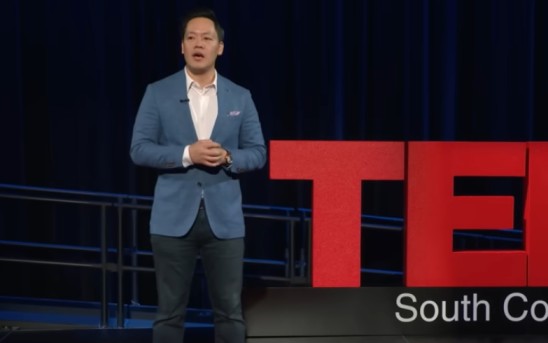
Editor’s Note: In this TEDx talk, senior living expert James Lee reflects on decades of experience working with thousands of people reaching the end of their lives. He shares profound, real-world lessons gathered from dementia patients and his own father on how to approach our final chapters with peace instead of remorse. Ultimately, Lee challenges the audience to reframe their choices, embrace authenticity, and consciously write a meaningful life story by focusing on what truly matters before the shot clock runs out.
Introduction
JAMES LEE: The one thing that the future hasn’t spared for all of us is the experience of getting older. And yet the subject of death is not usually something that people are comfortable with, much less thinking about our own mortality. But whether it’s a day more or a hundred more years, we are all moving toward our final sunset, our last chapter.
I want to invite you today to think about a life well lived and at the end of your life that you are on your deathbed. I want you to think about that moment and think about who are the people in the room with you. You know, the tougher question actually may be who’s not in the room with you.
Regret. It’s the one thing we could all probably agree that we’d like to have less of as we move through life. Am I right?
Two Universal Questions at the End of Life
There are two fundamental things that I’ve seen over the 20-year career that I’ve had in senior living so far. I’ve had a chance to work with thousands of people at the end of their life, their final chapter. I’ve been over a hundred funerals and counting. Suffice it to say, I have contemplated mortality a lot.
And look, there are two nearly universal questions that people express as an accounting of their lives. The first question is about our small part in something much bigger than ourselves. I think that has to do with legacy. And the question is, did my life have meaning, significance?
The second question is a little bit more intimate, and that’s, did I make a positive difference in the lives of the people that I care about the most?
And what I’ve gathered from these thousand deathbed lessons is that the same handful of themes will appear again and again and again. I wanted to share some of these stories with you. I thought what better way to talk to you about regret than to share with you some stories from these pretty unique perspectives that I’ve gained.
Three Lessons for a Life Without Regret
There are three lessons that I hope will help you to live a meaningful life and that in the end, on your actual deathbed, you’ll look back and answer those two questions a little bit more confidently.
- The first lesson is about how to make the right decisions.
- The second lesson is about how to keep the right perspectives.
- The third lesson is about how to create the right burdens.
Yes, the right burdens for your loved ones. And look, at first, these are going to sound a little bit aspirational or philosophical, but I promise you that they have many, many applications in life, in relationships, in friendships, in creating innovations, and so much more.
Lesson One: How to Make the Right Decisions
So let’s get started with lesson number one, how to make the right decisions. Every consequential decision that you make in your life, well, it is either a vote toward the things that you want, or it is a vote away from the things that you don’t.
Leaving a poor relationship is not the same thing as pursuing a future version of yourself that’s in a great relationship. Leaving a job that you hate is not the same thing as pursuing your dream job. They may feel like the same decision, but very different intentions. Intentions matter to outcomes.
So, as you listen to these stories, I want you to think about your own life and the story that you are writing and what you’re going to feel on that last day.
The Story of Pauline
Let’s begin with a story of a resident. Her name was Pauline, and I met her in one of the first years of my career in senior living. At this point, I was an activities director, still the hardest job I’ve had in senior living.
I met Pauline, and at this time, Pauline was already living with late stage Alzheimer’s disease. But that’s not the thing that I remember most about her. Pauline was from New York and she loved music theater. So when I heard that her favorite musical was coming through town, I was so excited to tell the family about it.
And you can imagine my surprise then when this very loving family said to me, “James, that’s such a sweet thought. But the truth is my mom is not going to remember that tomorrow. We just don’t think it’s worth putting her through the potential trouble for something she’s not even going to remember.”
And even then at the start of my career, before I learned much more about dementia, this logic just didn’t sit well with me. Maybe you’re having a similar feeling right now.
But thankfully we explored the conversation a little further. I convinced the family — I was a little more charming at that time of my life — and I reassured the family that I’ll be there personally and at the first sign of real trouble that we would turn back and we would go home. So they agreed and the outing was on.
So we went to the show, Pauline was dressed up in probably an outfit she hadn’t worn in a while. And you can imagine what happened from there. We went to the show, we sat down, and from the moment that the curtains opened and the orchestra blared, her face came alive.
I wish I could tell you what the show was about, but I was glued to the expressions of joy on Pauline’s face.
I went back to work the next day, and the thing that the family thought was going to happen — well, here’s the thing. Turned out they were right. She had no memory of what happened just 12 hours ago.
But two profound things changed after that. The first was that Pauline retained some positive emotion about me. And she was just kinder to me from that day forth. All of my team members were like, “What happened? Why is she so much nicer to you?”
Later, I would learn — here’s a little dementia tip — people in moderate to late stages of Alzheimer’s and dementia can actually form new relationships and they can maintain those relationships. It just requires that you, the care partner, take a little bit more initiative in creating those relationships.
The second and more profound thing that happened after that was that my perspective changed. In that moment, in that theater, I learned joy does not need to be remembered in order for it to have been meaningful.
Think about every decision that you’re making. If you want to make the right decisions more consistently, think about what am I moving toward, not just what am I moving away from.
Lesson Two: How to Keep the Right Perspectives
The second story today is about the right perspectives. I’ve learned that in order to keep the right perspectives, you have to have a north star in your life.
In life, I believe that we develop a lot of masks or personas to get through all the different parts of life. And initially, we may think of that as just being flexible or adaptable, kind of situational awareness about life. We have the work mask, we have the family mask, and on occasion, you have the public persona mask.
But what I’ve learned in senior living, specifically in dementia care, is that at the end of life, you get to keep one. And of course, that’s your true identity.
The Story of Alice
I remember this lesson vividly, and the experience of having that in real time, I won’t forget that anytime soon. A few years later, after this story with Pauline, I was an executive director of the first community that I got to lead on my own. I was at an assisted living and memory care community. And on this day, I was finishing my rounds, was about to head home, and I came upon a resident named Alice.
Now, Alice — it turned out that this was hours before she passed away, literally on her deathbed. And she taught me about the power of authenticity.
So at this point in her disease process, Alice could say two phrases. Not because of her, but because of her disease. So I was walking by her room and I heard her say the first phrase. And that first phrase was, “Help me.”
Now I want to reassure you, she wasn’t in pain, she wasn’t in discomfort. It was just one of the phrases that she had available to her to kind of beckon attention. So I heard the phrase, knocked on the door, walked into her room, and I knelt beside her bed and I offered her my hand. And she took it.
She breathed a sigh of relief and she moved her head in my direction with her eyes still closed and she said phrase number two, “I love you.”
I looked at Alice and I said the only reasonable thing you can say in that moment, and that’s “I love you too.”
What is remarkable about this moment with Alice, if you think about it, what she needed help with was to express her love to another human being. She did not know it was me in the room. She just seemed to want to share her love with somebody, anybody. Now, how lucky that I got to be that person.
Here’s the other remarkable thing about Alice. This is exactly who she was for the two years that I knew her prior to this moment. She just was that type of person who had a positive affect for life and she just shared her love with people freely.
Now the research is still ongoing about how identity changes for people as their dementia progresses, but the vast majority of research currently points to the fact that most people will retain some sense of identity throughout dementia, including moderate to late stages.
Now, one of the first things to go, though, are role identities. Role identities are things like CEO, author, inventor, innovator, TEDx speaker. These tend to be things that you don’t remember at the end of life. And whether you have dementia or not, people that I have served — older adults at the end of their life — they tend to not rely on those role identities that all of us worry about putting on our LinkedIn profiles.
The things that are a little bit more sticky are family roles, but even those are up for grabs. That’s why calling somebody “mom” in the late stages may not evoke the same sense of identity as calling her “Mary.” That’s another tip for you.
The things that are a little bit more salient, the things that tend to stick around, are personal attributes — what you value about yourself.
So here’s kind of the moral of that story. While you are thinking about your greatness and all of the things that you’re pursuing right now and the things that you’re innovating — and by all means, do those things. Pursue the things that are going to make you great. But keep this in mind: the things that make you great are probably not the things that you’re going to think about at the end of your life, and they most certainly will not be the things that your loved ones care about.
Here’s a really important point. Good just may be more significant than great. I want to say that one again. Good just may be more significant than great.
If you want to have the right perspectives throughout your life, take a page out of Alice’s story and be your authentic self as often as you can in every situation that you can.
Lesson Three: How to Create the Right Burdens
Think about at the end of your life and let’s also make this positive. You’ve checked off every bucket list item. You’ve accomplished everything that you want to. You’ve had a good life.
Now I want you to think about the moment when you are on your deathbed, the last page of your last chapter, and think about who’s in the room with you. I actually want you to think about this — whether in spirit or in person, fill that room. Put people in that room. Think of their names. Picture their faces.
Maybe they’re your family, your dear friends, coworkers. Some of us have close coworkers. And I want you to think about them right now.
Now I want you to ask yourself, what is the one thing that they all have in common? It’s you. Isn’t that remarkable? You are the only common denominator in the lives of the people that you care about.
So the most important thing that you can do for them — in fact, the most logical thing that you can do to improve their lives — is to continuously improve your own.
So there’s lesson number three: strive to be your best self.
A Personal Story: My Father’s Final Chapter
My dad was diagnosed with cancer at the age of 60, and it was stage four by the time we heard about it. And it was one of the things that he regretted at the end of life. He regretted not taking care of himself a little bit better. In fact, that’s one of the things he said to me that’s going to stick with me. That moment of a father apologizing to his son — I mean, that’s a real intimate moment.
And ultimately, we had 14 months together for his journey home. But fortunately, because of my ingrained life philosophy of move toward, not away, we pursued every conversation that we didn’t have earlier. When I was a kid, we didn’t have a lot of conversations of consequence. You always think you’re going to have time for that later.
But the silver lining of all of this was that we had a shot clock, and we knew we had to have these conversations. And to my dad’s credit, he took advantage of every single one of those. When I asked him questions that were challenging, he answered them, and we dug deep.
Now, at the moment when he was on his deathbed, I was racing down the highway from San Antonio to Corpus Christi and I missed his final breath by a mere five minutes. Regret. It’s the one thing that lingers with you.
But fortunately, my brother was in the room. So he was there, he was holding his hand, and he said, “Thank you,” offered him a prayer. And I know that my dad left with peace in his heart. I made sure of that in the 14 months prior.
And look, right now, my dad is nudging somebody next to him.
Creating the Right Burdens
He’s pointing on this stage right now, and he is taking full credit for the fact that I am here. That’s how my dad was. I’m okay with that.
See, in life, when you think about keeping the right perspectives and making the right decisions, and this last one is important, creating the right burdens. When seniors choose senior living for themselves, there’s really one consideration that they think of more than any other.
And you’ll probably be able to fill this sentence in two. They say, “When I get older, I do not want to be a burden on my family.”
Okay, I’ve seen thousands of stories. Let me give you a spoiler alert. You will be.
You will be a burden on your family, but there is a positive orientation to it, and there’s a more challenged one. The positive orientation to it means that the person that you’re caring for has probably taken care of the things that are consequential, taking care of their finances, taking care of their health as best as they could, had conversations of consequence, dug deep into the more uncomfortable parts and faced it. And because of that, the people who are closest to them now, they live a less complicated version of burden. It’s a positive thing. I think that burden is actually love, just being accountable to another person.
Also, there are people that we support now that are probably living a little bit more complicated version of their last chapter, and it isn’t because of dementia. If you take care of your conversations that you need to have, if you take care of your family, if you take care of yourself, you will create a situation where your burdens are positive ones. I took on the burdens of caregiving for my dad out of love. We moved toward reconciliation and love and conversations that he wanted to have.
And I’m grateful that he took the opportunity to do that.
A Love Letter for the People You Leave Behind
So this third lesson about how to create the right burdens. If you are the only common denominator in the lives of the people that you care about, then you taking care of yourself is not selfish. It’s actually a love letter for the people that you’re going to leave behind.
To live in a way where you have less regrets at the end of your life, these three lessons, I really hope that they help you.
In order to make the right decisions, move toward, not away. If you want to keep the right perspectives, be your authentic self. And the third and final lesson, in order to create the right burdens for your loved ones, strive to be your best self.
I have thousands more stories to be a part of. I have hundreds, maybe thousands more funerals to go to. And I’m sure that I will update these life lessons along the way. But for now, I get to honor their stories of Alice, Pauline, and my father, and the thousands of other people whose lessons have imprinted on my heart. And I hope that in some way they help you to live in a way that you’re going to have less regrets.
You Hold the Pen
Here’s the thing, you get to write that last chapter and whether it comes a little bit sooner than we’d like it or at the end of a long and happy life, that last chapter is coming.
But the good news is that you hold the pen to it. I hope that these stories help you to write not just a great one, but a good one. Good luck.
Related Posts