Share & Care!
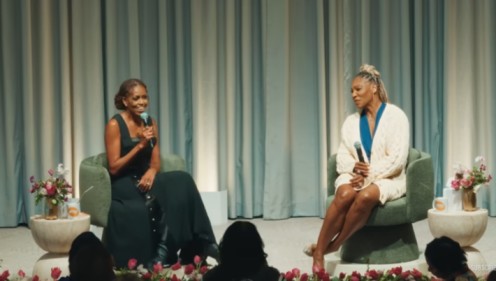
Read the full transcript of tennis star Serena Williams’ interview on IMO Podcast with Michelle Obama, May 13, 2026.
Editor’s Note: In this episode of IMO, host Michelle Obama sits down with tennis legend Serena Williams for an intimate and wide-ranging conversation centered around the powerful journey of motherhood. Serena opens up about her legendary career—including winning a Grand Slam while pregnant—her harrowing postpartum medical struggles, and the profound impact of her own mother’s guidance. Together, they share raw, open insights into the joys, vulnerabilities, and shared strengths that define what it means to be a mom.
Introduction and Welcome
MICHELLE OBAMA: Hey there. Hi there, moms. ¡Hola, Serena! Hey, Serena girl.
SERENA WILLIAMS: Hey.
MICHELLE OBAMA: What’s happening? First of all, let me start by thanking Steve and Connie Ballmer and the entire LA Clippers organization for hosting us today. They are wonderful. Let’s give them a round of applause. And you guys have been great partners to us personally, and we are incredibly grateful to be working with you, so thank you.
We’re here today to talk about my favorite subject, motherhood, with some of my favorite people, mothers, right? And what better guests to have, not just one of the greatest athletes in the world, but one of the greatest mothers in the world. ‘Cause we’re backstage and I’m like, “How are the girls?” And this one, you know, you couldn’t, you can’t even say their names without just feeling it, right?
SERENA WILLIAMS: Yeah, they’re pretty special. Pretty special.
Always Wanting to Be a Mother
MICHELLE OBAMA: So we’re going to talk about motherhood, our motherhood journeys, and so much more. But I want to begin with just a fundamental question. I don’t know about you. I’ve done a lot in life. I have accomplished things, degrees and all the things. And I always knew that I wanted to have a career. I wanted to have an impact. But the one thing I always, always knew I wanted to be was a mother. For sure. I mean, it is the most important thing. And I knew that from a long, long time.
And that’s not always true. I mean, we all come to motherhood in different ways for different reasons. And there’s no right way to be a mother, that’s for sure. That’s all I’ve learned. But I’m wondering, Serena, did you feel that way? Did you always want to be a mother?
SERENA WILLIAMS: Yeah, actually, I’ve always wanted to be a mom. I didn’t know, there’s a lot of things involved with becoming a mom, but I always knew that I wanted to be a mom, even when I was young, like playing with my dolls. And I was always the one that just wanted to have kids. So it’s always been something that I’ve always knew throughout my life. And I didn’t know when, I just didn’t know when it was going to happen. But I always knew that that was one goal that I just definitely wanted to reach, and that was becoming a mom.
Conception Journeys and Freezing Eggs
MICHELLE OBAMA: Yeah. And then you start trying to be a mom, which I did. And what they never, what I was never told was that the biological clock was real. And I try to tell a lot of young people that, a lot of young women, that that clock is real. And Barack and I, we married in our late 20s, and took our time, hanging tough, and then we started working on conceiving. I got pregnant once and miscarried, which was devastating. And then we tried and tried and tried, and we had to do IVF for both girls, which, you know, it becomes more of a thing than I knew then. I think more young women are talking about their conception journey, that it’s not always guaranteed. But Serena, tell us if you feel comfortable about your conception journey. I mean, you—
SERENA WILLIAMS: Well, one thing I— well, that is definitely— I’ve never had that subject.
MICHELLE OBAMA: Yeah.
SERENA WILLIAMS: That’s kind of intimate.
MICHELLE OBAMA: Well, you know, it’s true.
SERENA WILLIAMS: Well—
MICHELLE OBAMA: But we’re with moms. And this is only going to air to millions of people.
SERENA WILLIAMS: So it’s just— just between us girls, while we were in Rome, and one thing led to another, and then 9 months later.
MICHELLE OBAMA: So, but you were pregnant. While you were still— so were you trying?
SERENA WILLIAMS: No, I wasn’t trying to have a kid at the time, but—
MICHELLE OBAMA: But you were not not trying, clearly.
SERENA WILLIAMS: Apparently. But you know what’s so interesting about what you said about the biological clock? I tell all my friends of age, freeze your eggs.
MICHELLE OBAMA: Yeah.
SERENA WILLIAMS: ‘Cause I just feel like that is the best thing that you can do as a woman as you decide to go on this journey. I feel like I did that, and I—
MICHELLE OBAMA: You froze your eggs?
SERENA WILLIAMS: Yeah, yeah, yeah, I froze my eggs. And I felt like once I did it, because I was still playing professional tennis, and I felt like I wasn’t ready to stop, and I wanted to keep going, and it just wasn’t time. And then all of a sudden, all this pressure came off of my shoulders. It was just all this weight just fell off my shoulders once I did that. Then I told a lot— ever since then, I told everyone to do it. And someone—
MICHELLE OBAMA: How old were you when you decided to do it?
SERENA WILLIAMS: I was in my 20s. I was like 27, 28. So it was a really good time to do it. And also, someone told me to do it. So I always felt like it was really important for me to pay that forward.
Breaking Down the Walls: Open Conversations About Women’s Health
MICHELLE OBAMA: I mean, there’s so much pressure on women just to, you know, if you don’t get that part right, there’s still a feeling that something is missing. I don’t know about all of you, but I know that when I started struggled to conceive, I took that on like a personal failure.
SERENA WILLIAMS: I mean, I don’t think that we have that conversation enough about how many times that either you conceive and you have a miscarriage, or whether you conceive and it doesn’t work. So I feel like the only times it works is when you’re not trying to conceive. I think that’s just a really important part of just being a woman, and just all these things that I’m all about, just breaking down these walls and talking about the comfortable, and I’m comfortable in talking about things that more people don’t.
MICHELLE OBAMA: So you could tell us more about Rome, but it’s okay.
SERENA WILLIAMS: Not that. Now that’s a different type of conversation. I wasn’t sure we were here for that. So I don’t know, I just feel like a lot of people aren’t really, women aren’t really open. Like, it’s kind of like, you know, like menopause and perimenopause. Like, so many, like my mom’s generation, no one’s open about that conversation. My mother said she didn’t remember.
MICHELLE OBAMA: I was like, “You lying.” Exactly, or it didn’t bother you.
SERENA WILLIAMS: My mom said, “Oh, that was nothing.” Yeah, right.
MICHELLE OBAMA: It’s never nothing to them.
SERENA WILLIAMS: Yeah, and I’m just like, but now I think this generation is all about it. Like, the more you know about it and the more you can just tell people about it. Like, I try to tell everyone about it. I tell all my friends, “Listen, I started prednisone. Why not?” And it helped me sleep better and helped me do that. And they’re like, “Really? I hadn’t done that.” I’m like, “Girl, you better do it.” I hear you. So I’m all about just talking and having real raw, open conversations, because I think it’s so important not to hide what all of us go through.
MICHELLE OBAMA: That’s absolutely right.
SERENA WILLIAMS: It doesn’t matter what color you are, how tall you are, it doesn’t matter. We’re all going to go through it. So I think it’s so important to have those conversations. So back to the kids, I think that too is just like, it’s important to say, this didn’t work out for me, or this is how I had my kid, or this is what I did and this was my journey. And then it also helps you feel more like, “Oh, it’s okay.” Like, one thing when I was pregnant, I checked my underwear every single time I went to the bathroom. I mean, sure, we all did that at some point.
MICHELLE OBAMA: Is it still there?
SERENA WILLIAMS: Exactly. It’s like, no one talks about that, ’cause it’s just a natural, it’s almost like a natural reaction.
MICHELLE OBAMA: It’s so true, yeah.
SERENA WILLIAMS: Yeah, it’s like, ’cause you just have stress the entire time you’re pregnant until you actually give the baby, then you have a whole nother stress, but. It’s just like, just having those conversations.
MICHELLE OBAMA: Mm-hmm. I am so with you. One of the reasons why I like to be open and honest is because we didn’t have that necessarily. And the truth is, is that we don’t pay enough attention to women’s health. There’s so much we don’t know about our bodies, so much that doctors don’t share with us. Even the issue of conceiving and freezing eggs. If you don’t have the right doctor at the right time, you may not get that information. I still know young women who aren’t thinking about freezing their eggs because nobody mentioned that to them. So it becomes, do you have the right doctor? Are you in the right location?
SERENA WILLIAMS: Even if you get married later, you can still use those eggs with your husband. That’s right. It doesn’t, like, it’s just so, you just have so many more opportunities and options. And so I don’t know, for me, I was really happy that I did it.
Pregnant at the Australian Open
MICHELLE OBAMA: So then you got pregnant and you were in a Grand Slam tournament when you— when did you— what? I mean, okay, can you walk us back to when you found out? And because you were pregnant when you won the Australian Open in 2017.
SERENA WILLIAMS: I had no intention of winning.
MICHELLE OBAMA: Yeah. But just for the record. You were just, I’m just here.
SERENA WILLIAMS: Just for the record. Throwing it in there. This is one time I can lose and not be upset about it.
MICHELLE OBAMA: Really?
SERENA WILLIAMS: No, ’cause I remember thinking, so it all started in New Zealand. I was playing a tournament before the Australian Open in New Zealand, and I’m not the most positive person on the court. If anyone ever followed my career, everyone was making fun of Coco. Everyone see that? Making fun of Coco. I know, right? And Serena’s like, “Oh, you just hold on.” I had to say something, ’cause I was like, “Uh.” Really? Can you smash that in one go? Like, hello?
MICHELLE OBAMA: Coco, you can do better than that, girl.
SERENA WILLIAMS: You can do better than that. And then, of course, someone started pulling up all the pictures of the rackets I smashed. I was like, “Wait, what is this, a Serena roast?” I was just trying to support her.
MICHELLE OBAMA: Just trying to help the girl out. Just get off my back.
Winning While Pregnant: The Australian Open Secret
SERENA WILLIAMS: So, anyway. I was at this tournament with the famous attitude that I may have had sometimes. And I just had a bad— I just lost to this girl that I just, I shouldn’t have lost to. And I just remember I was just so mad. It was windy, and I was mad at the wind, and it was the ball kid, I was mad at the ball kid, and I was so angry with everything. I was so mad. And I’m sure I smashed a racket. I was miserable.
MICHELLE OBAMA: Yeah.
SERENA WILLIAMS: And even in the presser after, we all know about pressers after.
MICHELLE OBAMA: Oh my God.
SERENA WILLIAMS: I said, “I hate this place.” I never did this in my life. I said, “I hate this place. I’m never coming back. It sucks.” I was miserable.
So then next week I’m in Australia and I’m working out and I’m like, “Why am I breathing so hard? Why am I breathing hard?” Anyway, eventually, also my boobs were massive, massive, massive. And I was like, okay, I’m just going to take a test. And I took a test, ended up it was positive, but I was like, okay, this is crazy.
And so anyway, so I ended up going to the doctor and he’s like, oh, surprise, you’re like— I’m like, what am I, like 4 weeks pregnant? Like, no, you’re 7 weeks pregnant.
MICHELLE OBAMA: Wow.
SERENA WILLIAMS: And I was like, what? What?
MICHELLE OBAMA: What?
SERENA WILLIAMS: Excuse me? Crazy, but then it all made sense as to why. So bad. I mean, I was really— that was the worst of one of them, probably one of the worst of the worst.
MICHELLE OBAMA: And you weren’t pregnant those other times?
SERENA WILLIAMS: No, no, I was thinking about being a mom. I always wanted to be a mom. Yeah, that was probably in the back of my head. So yeah, so then I was like, oh my gosh. So then I thought to myself, I was like, “Wow, self, what we going to do?”
MICHELLE OBAMA: “Self? Self, there’s a baby in here.” And did you already commit to play at the Open?
SERENA WILLIAMS: Yeah, and I was supposed to play doubles. So I pulled out of doubles, and Venus didn’t tell me anything, but later on she said, “When you pulled out, I knew you were pregnant.” I’m like, “How?”
You didn’t tell her? No, because I also felt really bad, because I was just like, I didn’t want to pull out, and I didn’t want her to be stressed, and then it was crazy, I couldn’t, you know, just didn’t want to stress anybody out. So one of my sisters knew, and the baby daddy knew, my husband.
MICHELLE OBAMA: Yeah, that’s good, that’s good, that’s good.
SERENA WILLIAMS: And my agent knew, Jill.
MICHELLE OBAMA: Uh-huh.
SERENA WILLIAMS: So we just kept it, and then, but apparently Venus knew too. So she told me, like, early on, it was like on the third round in the locker room, she’s like, she told me, and I was like, “Oh, okay.” And then I felt bad in the final because I was like, I always felt bad because I was like, she probably wanted to take it easy on me, because she’s always protecting me.
So I was like, I wish she, I really wish she hadn’t have known. Because then maybe, I don’t know, maybe it would’ve been different, maybe it wouldn’t have, but still, I just like to be super fair with whoever I’m playing. So yeah, so that’s kind of how it happened. And then at the end, I was 9 weeks pregnant, and then it was nuts, so.
MICHELLE OBAMA: So how’d you feel through it? I mean—
SERENA WILLIAMS: I was exhausted. I remember playing points, and so—
MICHELLE OBAMA: Most of us are just in bed. You know, we in bed. We’re not like breaking rackets, we just in bed.
SERENA WILLIAMS: We’re asleep. I had a piece for that. But I remember thinking to myself, I can’t play long points. I need to finish, I have to, 3 shots and I have to be done. So I hit like, I was like, I have to hit lots of winners and lots of aces, which is an insane strategy.
MICHELLE OBAMA: You were on a mission.
SERENA WILLIAMS: But I hadn’t planned on winning, but every time I kept winning, I was like, oh, I can beat her. And then, you know, and I was like, oh, I can beat her. And then it was like, oh, I gotta beat her.
MICHELLE OBAMA: Her.
SERENA WILLIAMS: She pissed me off, so she got to go down. There was only one or two of those.
MICHELLE OBAMA: So you just revenged your way to the title.
SERENA WILLIAMS: Oh, girl. And then there was another one. I can’t lose to her. I mean, I have some sort of pride. So that’s how I would have it.
MICHELLE OBAMA: Yeah.
SERENA WILLIAMS: Wow. Wow.
MICHELLE OBAMA: —did it feel extra good that you were able to—? So, yeah, but—
SERENA WILLIAMS: OK, that’s what I was saying. So I couldn’t have long points. So if I had a really long point, if you go back and watch the footage, I would lose the next point. And of course, it’s only— my opponents don’t get that. They don’t get to understand that rhythm, because that’s not normally how I play. But when you’re getting every— eventually, you’ll see that after a long point, Serena loses the next point. So you have to—
MICHELLE OBAMA: Because you’re trying to catch your breath.
SERENA WILLIAMS: You’re trying to— yeah, yeah. But I also have to keep a face on that doesn’t let anyone know that I’m, you know, struggling. Yes, like, surely can’t breathe. But women can do anything. Amen. Amen. Especially with the help of God, you can do everything.
MICHELLE OBAMA: Amen.
SERENA WILLIAMS: And I knew I was having a girl because Australia gets really hot. They do Celsius, so it was like 43 is like 120. And one day I had to play in 43, and I was like, no way, there’s no way. And that’s when I knew I’m having a girl, because I said to myself, no way can a boy make it.
MICHELLE OBAMA: They just, sorry, y’all. You just don’t have it in you.
SERENA WILLIAMS: I genuinely said that. I said, and I told my husband that day, we’re having a girl. There’s no way a little boy could handle everything we’re putting this baby under. And we had a girl. That’s right.
MICHELLE OBAMA: Olympia was just like, mom, we’re cool. We’re cool. I got you. I’m hanging on.
SERENA WILLIAMS: She was hanging in there.
MICHELLE OBAMA: I wish you’d just win this point.
SERENA WILLIAMS: But you know what? She has a bad attitude like me. She gets angry if she doesn’t win. She gets so mad.
MICHELLE OBAMA: Well, we don’t call that a bad attitude. We call that competitive. The determination.
SERENA WILLIAMS: Thank you.
MICHELLE OBAMA: Okay, we call that competitive. Yes, that’s what we— yes, no, that’s what we call it. That is not a bad attitude because if a man is that way—
SERENA WILLIAMS: Yeah, yeah, well, they told me for years it’s a bad attitude.
MICHELLE OBAMA: Yeah, I love this. But guess what?
SERENA WILLIAMS: I’m getting some good insights now.
The Youngest Child Determination
MICHELLE OBAMA: We’re both the youngest, and there’s something about that determination, I believe. And I don’t— I see it in my youngest. We have two girls and I think when you’re keeping up, you know, I know I felt like my brother would deliberately learn how to play a game, go off, and then go, “Miche, let’s play.” And I’m like, “Dude, you—” You know, he was just going to beat me down.
What’s the age difference? It’s a year and a half. It’s almost 2 years. And so I’m always losing, you know, and trying to keep up. And after a while, you just get pissed, you know. So I think there is a youngest child determinant in that. Yeah, for sure. Absolutely, for sure. Yeah, but that doesn’t explain Olympia, because she’s the oldest.
SERENA WILLIAMS: I know. Okay. I think it was just the situation that she was in.
MICHELLE OBAMA: Yeah, yeah, yeah.
SERENA WILLIAMS: So— A little bit from it.
MICHELLE OBAMA: That’s okay though. So your labor and delivery experience, was also a journey.
Labor, Delivery, and Fighting for Her Life
SERENA WILLIAMS: Yeah, that was— Talk about it. That was a journey. I have these issues with my blood, so I have— my blood can clot pretty easily, so I have to be on certain type of medicines, especially if I’m pregnant. I have to always take injections every day.
So when I had the baby, I— after, I couldn’t breathe, and I kept telling the lady, the nurse, I kept saying, I can’t breathe. And she was like, oh, well, you know, you’ll be fine. I said, no, actually, I think I need to get a CAT scan because I feel— I think I have blood clots in my lungs. And you’re in the hospital.
MICHELLE OBAMA: I’m in the hospital. You had the baby.
SERENA WILLIAMS: I’ve already had the baby.
MICHELLE OBAMA: You had a C-section.
SERENA WILLIAMS: I had a C-section because she wouldn’t come out. I knew I was going to have to have a C-section, so I just had the premonition.
MICHELLE OBAMA: Had you known?
SERENA WILLIAMS: Yeah, I just felt like I feel a lot. And I don’t know, 3 months in, I was like, I’m having a C-section. And so when they told me I had to have a C-section, I wasn’t surprised. And I went with the plan.
And I also tell women now, I say, listen, definitely if you want to push, go for it. I wish I could have done it. But also, if the doctor tells you they have to cut, do it. Because I’ve seen so many kids be so affected because women want to stick to their plan of I must push, I must push. And I’ve seen kids come out unfortunate, that, and even die because they didn’t follow the, you know, follow what the doctor said.
MICHELLE OBAMA: Well, that’s another thing that women take on, that birth has to look a certain way.
SERENA WILLIAMS: Yeah, it has to look a certain way, yeah.
MICHELLE OBAMA: And I, for one, was like, I went in 5 centimeters dilated. I thought about natural birth for literally the conversation I had with my doctor that said, okay, it was like 8:00, and I said, “Well, how long is it going to take? How much, how long am I going to have to be in this kind of pain?” And she said, “About 4 hours.” And I was like, “No, mm-mm.” I was like, “Stick that needle right in my back.”
I think I could have done it if she had said an hour, right? If she had said, “This baby’s coming in an hour,” I’m like, “Okay, I can do it.” But 4 hours? I was like, so I mean, I applaud the women that can do it. I— well, it’s wonderful. Yes. Yay. It’s not me. For you. But I’m all—
SERENA WILLIAMS: I heard about something called the Ring of Fire.
MICHELLE OBAMA: Oh, yes. I know. I never want to meet the ring. I don’t know. See, I’m always like, would you get your tooth pulled without anesthesia? Is there anybody here? Would a man do that?
SERENA WILLIAMS: Definitely not.
MICHELLE OBAMA: No, I know. You’re going to be the butt of all the man jokes.
SERENA WILLIAMS: He’s handling it well though.
MICHELLE OBAMA: Steve over there cracking up. You know y’all are weak.
SERENA WILLIAMS: So anyway, I told the nurse that, and she just was like, “This is crazy talk,” which it may have sounded like crazy talk for me to tell them what — to give her exactly what I needed and how I needed it.
And then I started coughing so hard, all my stitches just burst open because I couldn’t breathe. I was holding a pillow on my stomach and I was just coughing because I was like, they’re going to break, they’re going to break, and I couldn’t breathe. So I was just coughing, coughing, coughing, and they broke. And that was — I had to have that redone. I think I had like 5 surgeries, and I don’t remember some of them.
And then my doctor came in and I was like, “I can’t breathe, I think I need a CAT scan.” This is like after I’d already told the nurse. I remember my husband’s parents were there, and I was in the room and they were talking and they were holding the baby, and I calmly walked back and I was like, I don’t want anyone to panic. And that’s when I told the nurse, “I can’t breathe.” I was just like, help me out here. And she didn’t take me seriously.
So then when the doctor came, I was telling her I couldn’t breathe and she was like, okay. I could look at her and tell that I don’t know if she believed me, but she did everything I asked. And I was really grateful that I had her and that she was with me for the whole pregnancy journey. It’s so good to have a doctor that will listen to you. You might say things that don’t make sense, but still, she heard me, she listened. And if she hadn’t listened, I wouldn’t be here.
She made sure that she did what I asked, and then she found exactly what I said. So then I had to have another surgery to get something in my veins to stop clots from going to my heart. I had so many surgeries.
MICHELLE OBAMA: How long were you in the hospital after you delivered?
SERENA WILLIAMS: It wasn’t that long.
MICHELLE OBAMA: It was only like 8 days. And you had that many surgeries in 8 days?
SERENA WILLIAMS: Yeah, in 8 days. It was crazy.
MICHELLE OBAMA: And then you had to go home with a baby.
SERENA WILLIAMS: Then I had to — and I remember my only goal was to be able to walk to the mailbox. And one day I walked to the mailbox, and I came back, and I passed out for the rest of the day. It was very intense.
Being Serena: The Comeback Documentary
MICHELLE OBAMA: I remember watching the documentary that followed your comeback. And it really moved me to see you — it showed you and the family leaving with Olympia in the carrier. You were determined to carry her, but it was clear that you were struggling, that physically, you were not the Serena Williams everybody knew.
But I also was very proud of you for showing that story. Remind me the name of that — “Being Serena.” This is like watching her journey and her comeback. You show it all in a way that is so powerful. And if I didn’t love you before, then I loved you even more just watching your determination to get that baby home regardless of your health. But you were struggling.
SERENA WILLIAMS: Yeah, I was really struggling. But I also had some great help. Sometimes family is so important, and not everyone has family. So I just felt so grateful that I did have that — my husband and my family.
I don’t think I remember the first 3 weeks. My husband’s sister came to visit, and she told me like a year later, and I was like, “I vaguely remember you there.” I would’ve never remembered it if she hadn’t reminded me. I was like, “Oh my gosh.” Everything was just so — it was a lot, it was a lot. But it was good, and I think everyone has their own journey, and I was blessed to have my journey.
And the more I talk to women, the more I understand and see that everyone’s journey — not everyone, but a lot of women’s journeys — is so intense. And often worse than mine.
Maternal Health and Passing Down Knowledge
MICHELLE OBAMA: Giving birth is intense, which is why — yeah, you put your life on the line. It is why maternal health should not be a political football. Because what our bodies do, what we are capable of doing is amazing. But the fact that there isn’t research done on maternal health, there’s a limited amount of information we get about our health. We aren’t encouraged to ask questions. We aren’t encouraged to talk amongst each other.
And I just want us to vow today, regardless of our generation, that we don’t pass that down to the next generation. That we owe them —
SERENA WILLIAMS: — the knowledge, the wisdom, because we want to know.
MICHELLE OBAMA: Yeah, I mean, they —
SERENA WILLIAMS: Everyone wants to know, and they don’t want to know if they don’t know. So it’s just like, knowledge is power. It’s like when you go to school, you would never know the things that you learn unless you’re taught them. You weren’t asked to learn about so many subjects, but you learn about them. And I feel the same way about us and our health and passing on that knowledge. I think it’s just so important.
Serena’s Mother: Strength, Toughness, and Tennis
MICHELLE OBAMA: Well, let’s turn to your mother, because everybody talks about your dad and the relationship with your dad, and your mom sits in those stands in a way that I could never. I just couldn’t watch my kids play, but she was always there. I had the opportunity to meet her briefly. I think we were at Wimbledon for the Olympics. And I was there representing the United States. What sport? Did you get a medal?
SERENA WILLIAMS: I did not.
MICHELLE OBAMA: Oh. I got no medal. But you did. You got a few. But I met your mom. Talk about your mom. Tell us about that amazing woman and what you’ve learned from her as a mother.
SERENA WILLIAMS: Well, my mom is a very strong woman. She’s definitely not sharing all this information though. She came from that generation where —
MICHELLE OBAMA: Mine either. Yeah, Marianne, it’s like, don’t remember anything.
SERENA WILLIAMS: She’s very tough. My mom’s very tough. And she’s actually the oldest of her siblings, so she’s always been a mom. It’s interesting to be something that you’ve always been, and then to grow up and to become a mother. And then she also took care of her grandkids.
Growing up, I wasn’t the best tennis player. It was always Venus, who was so great. And so I was demoted to my mom’s court, because my dad always played with Venus — he was better than my mom. He actually taught my mom.
MICHELLE OBAMA: My mom must have been an incredible athlete to learn how to play that fast. Really?
SERENA WILLIAMS: And so from there, I would always be on her court. And I always wanted to be on my dad’s court because he was more easygoing and he was more fun.
MICHELLE OBAMA: People always think the opposite. Oh, he was easygoing?
SERENA WILLIAMS: Really, yes. And so on my mom’s court, there were no games. I had to be serious and I had to do all this stuff. But then looking back, I was able to see that she was able to instill so much mental toughness in me that my sister actually did not end up getting, because I had to work so hard. I had to do so many more things on her court. There were no games. It was so serious.
In the end, I was very grateful that I had that time with her to just focus on technique and focus on just not letting anything go, because it really showed up in my game as a professional athlete, mentally and physically. And so that came from my mom.
My mom then traveled with us. Actually, the first tournament I ever won, we had to split again — my dad was with Venus and I was with my mom in Paris. I think I was like 16. And I remember we shared a room. We were at this hotel on the other side of the Seine, the river. She had the bed and I slept on the cot, because I love sleeping on a cot.
MICHELLE OBAMA: Okay, all right. That’s news you can use. Serena Williams — she just loves a cot.
SERENA WILLIAMS: Yes. And I remember every night, I wanted to watch cartoons.
MICHELLE OBAMA: Because you guys were big cartoon people.
SERENA WILLIAMS: You liked Disney. I still am, by the way. I love animation. Now I’m into Marvel.
MICHELLE OBAMA: I was going to blame that on the kids, but no, I’m still a big kid.
SERENA WILLIAMS: Yeah, so I was still pretty young. I still had an excuse though. And so she didn’t mind — she watched cartoons with me every night. It was such a good memory.
I remember every night after I would win a match — I was in France, and my whole draw was French people. And the stadium was probably the size of this room, but it was loud, loud, loud, loud, loud. Every time I played, everyone was massively against me, naturally, because I’m playing their country’s person. Nothing personal. It was crazy.
And so every night I’d come home like, wow, I can’t believe I got through that. And then every night, I just had to shut off my brain. We would watch some animated something, and then that was that.
And so eventually when I won, I just remember being so happy. And then I remember we called Venus, and she hadn’t won yet — she played another match, and she won her tournament. So we both won different tournaments, and we were so happy.
Then you fast forward a little bit more, we start winning Grand Slams, and my mom was there for all the Grand Slams. Our first Olympics was actually in Sydney, and my mom was there.
My mom’s also very clumsy. So one time — and she loves sweets — we were at Wimbledon, and we see this woman hobbling along the road, and I’m like, “Mom, what happened?” And it’s my mom. I’m like, you need to see a doctor. “I’m good, I’m going to get some cookies.”
MICHELLE OBAMA: Would you just drive past and she’s hopping on the road?
Serena’s Mother: The Spine of the Family
SERENA WILLIAMS: Yes, we’re like, why aren’t you at the house? And she’s like, I need some cookies. I’m like, what? Are you okay? You are not okay. She had a broken toe. But she was going to get her cookies. And she used to always hide cookies under the seat when we were driving. She used to hide cookies and my dad would be like, “Why are all these cookies up here?” So she definitely has a sweet tooth, which is kind of funny. But I have so many good memories of my mom.
MICHELLE OBAMA: What was it like being coached by your mom? How did that affect your— was that always good? Because we got a lot of moms out here probably did their share of coaching. How did your mom maintain that? That sort of special mom relationship, or did she?
SERENA WILLIAMS: So I think what a lot of people don’t realize is that we travel, every time we went to Australia, probably, actually every time we went to France, my mom was always there. My dad actually never went to those tournaments. And so she was always our coach for all that time.
And so I don’t know how many Australian Opens I’ve won. A lot. Yes. So she basically coached me through all of them. And I remember one time when I was 89 in the world and everyone had written me off, I was like 20-something, and they said I would never win again, blah, blah, blah. And she told me before, in the final, before I played, I think I was playing Maria in that final, Maria Sharapova, she was like, she said, “You’ve got this, you’re going to do this.” She told me exactly how to play. And I won in less than an hour, and it was really genius.
So she actually was a very great coach, and she’ll say little things. My mom is not someone that’s going to fill a room. She’s going to say one word, but it’s going to be the most powerful word in the room, and that’s it. And so she’ll say one thing like, “You need to attack the forehand,” if it’s low, or something, but you have to listen. And if you listen, you can catch on to it, and you can be like, “Okay.” And that’s the kind of person she is, even in life.
You know, she always says, when raising my kids, she’ll be like, “You need to be with those girls.” And so no matter what’s happening in the world or what we’re all going through, I always remember, I gotta be with those girls, because she was always there with us. And now looking back, she never spent a day away from us, all the girls.
And then she’s also the kind of person, like my sister, who unfortunately passed early on. And she’s the kind of person that I remember when she found out, we all were just traumatized. She just dropped everything and she moved to LA, actually. And then she took care of the grandkids and she raised them and she never moved back. So that’s the kind of person that she is. She’s very— she’s used to responsibility. And she has a lot on her shoulders, but she’s so proud to carry it. And then now she’s instilled that into all of our daughters to just carry that power, to carry that strength, and to pass it on to our kids and to my kids and all the other grandkids. So she’s an amazing person.
It’s so much that I can say about my mom, but— The last thing I’ll say is, yeah, we do talk about our dad a lot, and we wouldn’t be here without our dad, obviously. Obviously wouldn’t be here without my mom. But I always describe us like this. My dad is the body, because it was his vision, it was his goal, and it was his dream. But my mom is the spine. You cannot function without that spine, the nerves that come from it, the nervous system. You can have a dream, you can have everything all set, but it’s not going to work unless you have that part of you. And so that’s kind of how I describe my mom.
Parenting Philosophies
MICHELLE OBAMA: So, what kind of mom are you? Are you a spine-like mom? I always ask this question a lot about parenting philosophy, because I think one of the things I admired most about my mom— my mom didn’t go to college. My parents were working class folks. She was the middle of 7. But my mom was so emotionally intelligent, and she had such great common sense, just like your mom. Wouldn’t have to say much, but everybody wanted to hear from her.
And one of the things that I learned from her was that, you know, you just don’t have kids, you have to understand that you’re raising people. And so her approach to raising us was to talk to us like who she wanted us to be later on. She didn’t treat us like babies. She loved us dearly, but she believed that all kids are born with a level of intelligence and ability, and she treated us that way.
So she taught me, as I grew up, I was like, my mom had this really deep philosophy about parenting, stuff you learn in sociology and psychology classes just came naturally to her. So I kind of think about parenting as this huge responsibility to think about where am I trying to get my girls, not how I feel in the moment. So I always wonder what folks’ parenting philosophies are, and do you think you have one, and how would you describe your mothering approach?
SERENA WILLIAMS: So Venus is a planner. She writes everything down. Even when she got married, it was just boom, everything was just over, it was a lot. To be honest. Don’t worry, this is coming full circle. So she was always a person that read books, that would get through everything, that would know exactly what she wants to do. So I think I’m different. I don’t have like that plan. I never had like a philosophy.
As organized as I am in my life, to a point where everything is labeled, my parenting skills is different. I kind of feel like, obviously I have spiritual goals for the kids, I have ideas for education goals, I have those types of things, but I never really thought much about— my philosophy is just to be the best that I can, to show up. And to also be— I felt like I love my parents and how they raised us and just kind of pick and choose out of some of the things that they raised us with, in particular with my mom, how she raised us. So for me, I really try to be a present parent, and sometimes that’s hard, especially with the lives that we live. It’s very hard to be present, but I try to be extremely present.
MICHELLE OBAMA: How do you manage that?
SERENA WILLIAMS: Everything is around my kids. If I have to do something, I’m never gone more than 24 hours ever. Normally, I didn’t leave Olympia until she was 6 for 24 hours. So that may have been a little extreme, but that’s who I am. And so for me, I show up as much as I can every single day for the girls, because I feel like they mean the most to me, and I feel like they need me. I want to raise my children. I’m a person that’s raising my kids, and that’s teaching them how I want them to live, and how I want them to be.
Raising Daughters
MICHELLE OBAMA: That’s beautiful. That is beautiful. So like me, you have two girls.
SERENA WILLIAMS: I wanted to copy you.
MICHELLE OBAMA: You were so inspiring to me. And three years apart.
SERENA WILLIAMS: Way to go.
MICHELLE OBAMA: How is that? I always thought I was going to have three boys. I don’t know why. I always thought I was a bit of a tomboy when I was younger. I could see you with sons. Yeah, I followed around my brother. I love boys. I thought they were funnier than girls. I’ve learned you guys, you have some qualities.
So I always thought I was going to be the sports mom, and then I have these two girls and I am so grateful for my little women. And they are just amazing grown women now, 28 and 24, out in the world. And I can tell you, I have loved every second of mothering, every second.
But it’s just interesting, the same gender, two girls. And I talk to my friends who have boys, and they’re like, boys are definitely different. Like, Malia and Sasha could sit and color for hours. We could get on a plane. And I talk to mothers of boys— you all laugh at that, right? I mean, they sit and read and color, and you can talk to them, and there’s no throwing anything. I don’t think we had a lot of balls around the house.
Then I go to my brother’s house, who have nephews, and they would come to visit at the White House. And they just walk in sweaty. I mean, I was like, why are they wet? You just got here. And they come in damp and just throw cars and balls all on the first floor of the White House. And I’m like, ooh, this is different. But anyway, I digress. Your precious little ladies— how does it feel being a mom to daughters?
SERENA WILLIAMS: Yeah, as you know, I’ve always wanted to be a mom. I’ve only wanted girls. I could have 10 girls, I would be happy. I grew up with 4 sisters. So I was the 5th sister. I’ve never been around boys. So when I got pregnant, I actually had a quick panic attack. I was so certain it was a girl, but when they took the blood to do the blood test, I was like, “Oh my God, I don’t know what to do if I have a boy. I’ve never been around boys.” And I really was going crazy. I was like, “I can’t have a boy.” So I have no— I was like, “I don’t know what to do.”
So that’s all I know is girls. And I just always wanted girls. Growing up, I always wore dresses and I was that girl with the princess. The twirl, tutus, like, that was all me. And so I love dressing them up. They’re actually right now, I think Olympia is wearing a Mulan dress as we speak.
MICHELLE OBAMA: Of course, because they’re at Disney World, and so she must be in Mulan. Yes, my idol.
SERENA WILLIAMS: The little one is wearing an Anna dress.
MICHELLE OBAMA: Oh, okay.
SERENA WILLIAMS: So I’m like, oh, can you go buy them more dresses, please? So my older daughter is very much like me, very much girly, girly, girl. And my younger daughter is somewhat like me. I always describe her as like, she’ll wear a princess dress with tennis shoes.
MICHELLE OBAMA: Okay, yeah. I like that in her. But she plays with cars.
SERENA WILLIAMS: One of my sisters played with cars a lot, so she reminds me a little bit of her. She loves Hot Wheels, but she’ll wear Hot Wheels while wearing like a Rapunzel dress.
MICHELLE OBAMA: It’s like, where’s my tiara? Give me the Corvette.
Balancing Parenting and Public Life
SERENA WILLIAMS: I love it. And Olympia and I have never— because Olympia’s 5 years older than Adira, so we never played with cars and stuff. So we’re all like, oh, this is actually really fun. So Olympia and I are always playing with Adira’s toys. We’re like, “Oh, look, look it go!” So it’s nice that we have a little bit of a mix like that. It’s really fun.
Parenting Philosophy and Partnership
MICHELLE OBAMA: How do you balance your parenting philosophy with your husband? How are you? What have you learned from him about parenting?
SERENA WILLIAMS: So one thing he loves, he’s a— and this is a positive word now. Okay. Yes. He’s a nerd.
MICHELLE OBAMA: Yes, it is very much. Very positive. Especially a nerd with a job.
SERENA WILLIAMS: Yes, we love nerds. We love nerds.
MICHELLE OBAMA: Nerds pay the bills. So, he’s all about explaining. A lot of explaining.
SERENA WILLIAMS: So, he’ll like— so, Olympia does something, he’ll tell Olympia like, okay, so, why do you think you’re learning about this? And then, he goes into this whole reason as to why. And I’m like, “Hmm, that’s good.”
So I like how there’s a balance. He kind of gives her the reasons and she understands. She’ll ask a question about something, he’ll go in a deep version about it. But it’s nice, because then she gets that knowledge and she really gets it.
And then for me, my philosophy is like, “What do you like to do? How are we going to do this together?” It’s super important not to ever diminish what he’s doing as the man of the house. You want to make sure that you’re always uplifting him. That’s my philosophy. So I always want to make sure that we’re on the same page.
And also with things that I want, like I want the kids to do this, to whatever sport, or to go to this school, or just coming together for those decisions. So I feel like we work very well in that part.
MICHELLE OBAMA: That’s great. I always say, you know, you can have one kid and swear you’re a good parent. It’s like, I got this. Look at me, I know all the things. And then you have the other one. These babies, they come into this world as their own individual selves, truly. And that is— it’s a beautiful thing. I mean, like snowflakes, really. But it can be a challenge if you think that one size fits all in parenting.
SERENA WILLIAMS: Yeah. As a parent, when I make a mistake, I make sure I say sorry. Because it is important, first of all, to have that humility and to teach my daughters humility. And second of all, I never want them to think that a mom can’t apologize to someone younger.
So I’ve been wrong a few times with Olympia, and I am the first to tell her, “You were right, I didn’t do that right. I’m sorry.” And so I think it’s a good practice for me, and hopefully maybe someone else, but I feel like it’s a very good thing to do.
Raising Kids in the Public Eye
MICHELLE OBAMA: I totally agree. And I’ve apologized a lot. Raising kids in the public eye— we both have done it. It just makes the process 10 times more unnerving. Because you worry that your kids can’t make mistakes because everybody— it’s going to be on Page Six.
I mean, we would have those kind of conversations about— our girls had to learn to think like comms people, like comms directors, and at a very young age. And it served them well today. I mean, they are very poised, very mature, but it’s a lot of pressure that they didn’t ask for.
How are you approaching the public nature of who you are, how you live? How are you thinking about that at this stage in the girls’ life?
SERENA WILLIAMS: So that’s one thing that I try to do, and I’m never as public as you. I can’t imagine the scrutiny that you guys had to go through, especially the children, every single day. So for me, I just try to make sure that my children are very normal. I pretty much live under a rock. I live in a very small town in Florida where I can go anywhere and it’s normal because Michael Jordan also lives there.
MICHELLE OBAMA: And sort of like— so everybody’s like, we all want to go to this magical place where you can run into Serena and Michael at the 7-Eleven. And Tiger, and everyone lives in this small city. We’re not going to divulge where that is, because everybody’s going to be there.
SERENA WILLIAMS: And so everyone is normal, but it was really important for me not to—
MICHELLE OBAMA: Normal-ish. Just a lot of athletes live in this town.
SERENA WILLIAMS: Really? I don’t know why. It’s like, wow. But it’s great because it’s been normalized, as we’ve been all living in there for so many years. But it works.
And so for me, I try so hard to make sure Olympia is just like everyone else. She’s not seen as anyone special. I don’t tell her that she’s special. I never told her I played tennis. When she started reading, she saw me and she asked questions.
MICHELLE OBAMA: She’s like, “What are you doing, Mom? Come sit back in the audience with everybody else.”
SERENA WILLIAMS: “Put that racket down.” I remember one time in kindergarten, she’s like, “Mom, why are you in my book?” So eventually she learned.
But I don’t live that life where— and this is funny, but it’s also very true. We also have friends that are very famous. So when we hang out with them, they seem extremely normal. We go to Michael’s house or Tiger’s house, it’s like, okay, you’re good. So it is very average for us.
And so that’s what I want them to do. I don’t want them to ever feel like— because I don’t want them to feel they’re better than anyone else or they have an advantage, because we don’t need that anymore in this system that we live in. We just need some kids that are just as normal as you can be.
And if they want to grow up and they want to be a great athlete or they want to be a great programmer, they have every right to do that. They’re going to have an advantage because of the life that I’ve lived and the life my husband lived. Sure, they’re still going to have an advantage, but they’re still going to have to work hard to make any goal that they want to make. So for me, it’s super important that they understand that and that they don’t feel like they’re better than anyone else.
Room Mom and School Life
MICHELLE OBAMA: Yeah, yeah, yeah. I hear that you served as the classroom mom?
SERENA WILLIAMS: Yeah, I was room mom, because I love my daughter, and I’m obsessed.
MICHELLE OBAMA: What, when— was this recently?
SERENA WILLIAMS: Yeah, it was when she was in second grade.
MICHELLE OBAMA: Tell us about that. Serena on the text, everyone — you bring cookies?
SERENA WILLIAMS: That was me.
MICHELLE OBAMA: That was you? Amen.
SERENA WILLIAMS: It was so fun, because I got to go to the school every day, or if I wanted, I could be in the classroom. One time, I was there for the spelling bee, and I was just pretending to work in the library, but I was watching all the kids spell. And then poor Olympia got her word wrong, and I was like, “Aww, poor kid.” She did her best though, she tried, but I didn’t say anything. I pretended I didn’t hear, because I didn’t want her to feel the pressure that I was there.
And it was so fun. I got to help organize all the— I love organizing. So I got to organize all the food for the Teacher Appreciation Day and all the field trips and everything for the year.
MICHELLE OBAMA: Okay, so your daughter doesn’t know who you are, but those teachers and parents know who you are.
SERENA WILLIAMS: But you know what, they’re really cool about it. They really don’t treat anyone any different throughout the whole school. And the school is also very tough, so you have to really be on it and show up every day. And so it’s really nice.
Words of Wisdom for Sports Moms
MICHELLE OBAMA: Well, we are running out of time, and I know it’s been short, but I want to give us time to wrap it up. And I would love for you to share with this room of moms, especially moms of athletes who have made a level of sacrifice — what advice do you have? What parting words of wisdom do you think you can share? I know that’s heavy.
SERENA WILLIAMS: Yeah, I don’t know if I have advice. I feel like you guys have done it. You’ve already made it. I mean, to be in this room is a super win already.
I would say I have more appreciation. I’m sure you hear it from your kids, but if it weren’t for you, we wouldn’t be here. We wouldn’t be on these teams. And I just, as someone that had my mom supporting me — I feel so grateful to my mom every single day, to give me this opportunity, to believe in me even when things were rough and things were down, to show up every day for me, to be there when I didn’t want to be there, to tell me to go an extra day when I didn’t want to go.
So I think all your sons can agree that they’re super grateful for what you guys have done for them, because without you, they wouldn’t be there. So I think you guys deserve a huge pat on the back, a huge round of applause. So happy for the opportunity that you’ve given your children.
What’s Next for Serena
MICHELLE OBAMA: And what’s next for Serena in life that you want to share? Not trying to break news. Just, girl, I’m just like, how you doing? And what’s going on? You got so much on your plate. What are you most excited about next?
SERENA WILLIAMS: I’m most excited about, well, getting back to my girls. And I don’t know, I feel like I have a lot of opportunities and just deciding which ones I want to go with and see which direction I’m going to go.
MICHELLE OBAMA: Okay, that was a good way to absolutely say nothing.
SERENA WILLIAMS: I’m healthy, so it’s— I’m just happy.
MICHELLE OBAMA: You sure are, girl.
Closing Remarks
MICHELLE OBAMA: You look great. Yes, you look great. Thank you, Serena. Thank you. Thank you for taking the time. It was so fun. Thank you. Yeah, thank you for your honesty, your openness. Keep doing that. The world needs this information. They need to see their idols being normal human beings in the world, being grounded and protective of the people that they love. I am always proud of you. I’m happy to share this stage with you, and hopefully we’ll do something again soon. Yes, believe me, the pleasure was mine.
SERENA WILLIAMS: I had so much fun. Thank you all for having me. Can we take a selfie before we go?
MICHELLE OBAMA: We can. I just want to say thank you to all the moms on behalf of this mom here. Thank you for your sacrifice, for your love, for setting the foundation for the next generation. It is the most important work that a person can do in life, I think, is to raise a decent human being. Because I think that if everybody took that job as seriously as everybody in this room, we’d solve a lot of problems that way, just by taking care of the people we choose to bring into this world. So we are grateful to you all.
Related Posts
- Transcript: Roger Federer International Tennis Hall of Fame Induction Speech – ITHF 2026
- Transcript of Dustin Poirier Interview: Diary Of A CEO
- Transcript of Kobe Bryant’s Last Interview: On Purpose Podcast
- In Depth: w/ Kobe Bryant on NBA Journey (2012) (Transcript)
- Michael Jordan’s Basketball Hall of Fame Enshrinement Speech