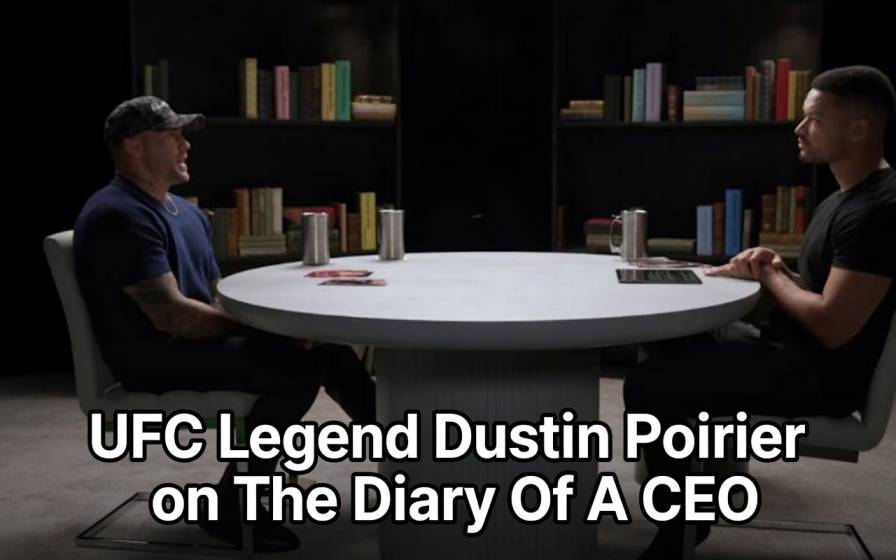
Read the full transcript of former professional mixed martial artist Dustin Poirier’s interview on The Diary Of A CEO, July 6, 2026.
Editor’s Note: In this powerful conversation, Dustin Poirier opens up about life after fighting, the pressure of losing a career-defining identity, and the personal struggles that followed his retirement. He speaks candidly about the airport incident, his relationship with alcohol, and how therapy has helped him unpack childhood pain and emotional weight. Poirier also reflects on family, fatherhood, and the challenge of finding purpose beyond the Octagon. It’s a raw, honest, and deeply human look at one of MMA’s most respected figures.
Introduction
STEVEN BARTLETT: Dustin Poirier.
DUSTIN POIRIER: Yo.
STEVEN BARTLETT: You know, there’s a question that we kind of throw around in society. We say it quite flippantly to people we meet, friends, family, strangers. But in this context, I want to ask it in the most sort of intentional way. And give me the long answer. How are you doing?
DUSTIN POIRIER: As a whole, great. Recently, there’s been some turbulence, you know, but I’m doing well. Doing well.
STEVEN BARTLETT: There’s been some turbulence.
DUSTIN POIRIER: Yeah.
STEVEN BARTLETT: Give me some color on that.
DUSTIN POIRIER: Last week, which is not new to me, let my emotions get the best of me, kind of was in a bad spot mentally, started drinking, got arrested, you know, got into some trouble at the airport. In Atlanta. And, you know, not proud of it, but it is what it is.
Early Life and Background
STEVEN BARTLETT: I want to give some background context, and I spent the last couple of days sort of looking through your childhood and where you come from and who you are to try and fill the picture of Dustin Poirier in my head. And I’ve got lots of photos of you here as a young man. Got another one even younger here that I’ll share with you here.
DUSTIN POIRIER: Yeah.
STEVEN BARTLETT: And I think this is incredibly important context because I’d watched you fight the best there is and beat the best that there is in the UFC. But it wasn’t until I understood your earliest context that I started to understand the picture of where you’ve come from. And also, in some part, how that makes you who you are today. So take me back. What is the early context that people need to understand to really understand you as a man?
DUSTIN POIRIER: I’m just a man trying his best, trying to provide for my family, learning as I go. Not scared to work hard, not scared to chase dreams. Just a kid from Lafayette, Louisiana, who found something to put his all into and try to become great at it, you know, with fighting.
STEVEN BARTLETT: Your father and your grandfather were fighters?
DUSTIN POIRIER: My father boxed growing up when he was younger. My grandfather was in the Navy and worked in the oil field and stuff. They weren’t successful fighters. I wouldn’t say they were like — nobody knew who they were, but definitely, yeah, I come from fighters for sure.
STEVEN BARTLETT: And from money? Do you come from money?
DUSTIN POIRIER: No, definitely not.
STEVEN BARTLETT: What was that like growing up? Was there—
DUSTIN POIRIER: It was normal to me because I didn’t know any different, you know? It wasn’t like I missed a meal or anything like that, but definitely wasn’t rich or anything or had money to do a whole lot of things when I was younger. But a working-class family, you know?
STEVEN BARTLETT: And your parents divorced when you were younger?
DUSTIN POIRIER: Yeah. Yeah, I lived with them up until about maybe kindergarten or first grade, then they got divorced.
STEVEN BARTLETT: Do you have any sort of mental models or mental images of them being together when you were younger? Is there any memories of them being together?
DUSTIN POIRIER: Honestly, dude, not to be — to turn it dark or anything, but the early memories I have of them together aren’t the best. You know, it’s fighting and violence and stuff.
STEVEN BARTLETT: Physical fighting? Yeah.
DUSTIN POIRIER: Yeah.
His Father’s Struggle With Alcohol
STEVEN BARTLETT: In that Instagram post you wrote recently after the incident in the airport, you mentioned your father and you mentioned, I think, some of his struggles. He had his own struggles with alcohol.
DUSTIN POIRIER: Yeah, his whole life he has. Yeah, alcohol has ruined his life.
STEVEN BARTLETT: And alcohol was present when you were a young man?
DUSTIN POIRIER: Oh yeah, yeah. He’s been an alcoholic my entire life.
STEVEN BARTLETT: Did you have a relationship with him after the divorce?
DUSTIN POIRIER: Yeah, of course. I don’t know what that’s called, split custody or something, where every other weekend I would go to his house, spend the weekend at his house.
STEVEN BARTLETT: How did that season of your life, do you think, as you look back, shape the man that you became? Like, that early context, under the age of 10 years old, that violent parents, they divorce, they separate, your dad is struggling with alcohol. Like, how do you look back on that?
DUSTIN POIRIER: As a grown man, I look back and think my father was an idiot for, you know, getting — not being there with his kids. You know, as a father, I think about that. Like, waking up with my kids in the house, running up to me, making them breakfast every day. Like, I couldn’t — I never want to live that type of life. I can’t even imagine it. So as an adult and a father looking back on it, I think he’s made a lot of mistakes that, you know, I think he still lives with.
STEVEN BARTLETT: And your mom? Got some nice photos of her as well. I guess that’s your wife. But she seems to have been a real constant throughout your life.
DUSTIN POIRIER: For sure. For sure. I’ll be on vacation with her in a week. Yeah, look at my face.
STEVEN BARTLETT: Post-fight.
DUSTIN POIRIER: Her and my grandmother raised me. She was, you know, everything. Mothers are everything. And she still is, you know, calling me, texting me every day, checking on me, asking how I am.
STEVEN BARTLETT: And you got 2 brothers?
DUSTIN POIRIER: So I have 2 brothers I grew up with, 2 brothers and a sister I met when I was 25, 26 years old from my father.
Trouble in School and Juvenile Detention
STEVEN BARTLETT: I guess I’m trying to figure out as well, because I heard about what you were like in school. You struggled in school. Yeah. It sounds like you got in a lot of fights when you were younger. I’m trying to figure out where that came from in you.
DUSTIN POIRIER: I mean, living in South Louisiana, we fought all the time. But I just kept doing it. I just kept going with fighting, you know?
STEVEN BARTLETT: As a young man, I read that you were expelled from school as well. And was that again for fighting and struggling to—
DUSTIN POIRIER: Yeah, yeah, fighting. The one that got me expelled was a fight.
STEVEN BARTLETT: And that seems to be a quite consistent pattern from 10 to 14, struggling in school, fighting. And then at 15, I hear that you end up in a juvenile detention center.
DUSTIN POIRIER: 14.
STEVEN BARTLETT: 14. What was the road there? What happened?
DUSTIN POIRIER: I had gotten into some trouble at one of the times I was living with my father. I got into a fight and physically hurt somebody in the fight and got arrested. And I was on probation at the time, and I wasn’t going to school. Got picked up for truancy and some other things like that for not going to school and failed the drug test. I was on probation at the time, failed the drug test, and then they sent me to juvenile detention.
STEVEN BARTLETT: Were you drinking at that age?
DUSTIN POIRIER: Yeah.
STEVEN BARTLETT: At 15.
DUSTIN POIRIER: Mm-hmm.
STEVEN BARTLETT: When did you start drinking?
DUSTIN POIRIER: I was talking to my wife the other day, and I was thinking about that. I don’t know, 12, 13, probably.
STEVEN BARTLETT: It’s quite curious to me that, you know, 14, 15, you’re getting in trouble for fighting, you end up in a detention center, you’re drinking from 12 years old. And it begs the question to me, as someone that’s done lots of these interviews, like, what was going on in that young man’s mind?
DUSTIN POIRIER: I don’t have an answer for what was going on. Not having anywhere to put my focus. I wasn’t trying to be the best at something. I was just living day to day, doing whatever. You know, I didn’t have any goals. I was a young kid. You know, it’s tough to say, to look back to that young and really say what I was thinking at that age. I was just being a kid, I guess.
STEVEN BARTLETT: Were you a happy kid?
DUSTIN POIRIER: Yeah.
STEVEN BARTLETT: You were a happy kid? Yeah. And you were spending the week with your mother and then the weekends with your father?
DUSTIN POIRIER: The weekend or every other weekend. I forget exactly how it was. Yeah.
The Airport Incident and His Father’s Homelessness
STEVEN BARTLETT: And when you talk about his life being ruined by alcohol, what do you mean by that?
DUSTIN POIRIER: I mean, he has — he’s ruined his marriages, he’s ruined his relationships, he’s ruined his friendships, he’s ruined his relationships with his family, with his kids. Two sons — three. Well, my little brother kind of is off and on talking to him, but he has two kids that don’t speak to him at all. And won’t, you know, he’s been in jail plenty of times for alcohol-related stuff. And yeah, if I could paint a picture of what you think of a classic drunk or alcoholic, you know, very selfish and continues to go back to it, continues to — he’s actually homeless right now.
STEVEN BARTLETT: He’s homeless right now.
DUSTIN POIRIER: Yeah. Part of that, me getting in trouble at the airport was, I just felt — and it’s not my weight to carry, you know, but I just felt, I tried to help him out and he’s back out on the street. It’s like he almost doesn’t want help, you know?
And I was just kind of, on Father’s Day, I was traveling to work and I just couldn’t stop thinking about my father. And I started drinking in the airport and that’s kind of what led to the incident.
But when I feel like that, you know, I’ve been going to therapy and stuff like that. Years ago, I started going to therapy, and when I started feeling better, I stopped practicing everything I learned through therapy, you know. And then I felt that feeling again, just an — I guess you call it depression, just didn’t feel well.
And when I feel like that, I know I shouldn’t drink. And I drank anyway. So, you know, not that my father or anything’s an excuse. Obviously, I did what I did. But I knew better in the moment when I’m feeling like that to drink or do anything. You know, alcohol has never benefited me, especially in times like that where I’m mentally not the best.
STEVEN BARTLETT: You used the word depression there to describe that feeling, to give it a word. So let’s use that word. Can you paint a picture for me in terms of what that actually feels like? That day that you wake up, it’s Father’s Day, you don’t feel good. Like, what is that?
DUSTIN POIRIER: No, I felt good in the morning, you know, I spent the morning with my kids. My daughter wrote me a letter, she gave me presents, you know, did all the Father’s Day stuff. I had a great morning, but then when I left my home to go fly out, I started feeling it, you know, and days leading up to that, it would come off and on, coming off and on, and I would think about, you know, my father and it would kind of bring me down, but it wasn’t that bad. But for Father’s Day, it just hit me, man. It hit me hard.
STEVEN BARTLETT: Because he’s currently homeless?
DUSTIN POIRIER: Yeah.
STEVEN BARTLETT: Here in Louisiana?
DUSTIN POIRIER: Yeah.
DUSTIN POIRIER: I actually, man, when I got out of jail in Atlanta and flew back home on that Tuesday, I got back late, maybe Tuesday. Wednesday morning I drove to where he lives, or where he sleeps, and went to the sheriff’s office, got in contact with the coroner. I had to do a whole process to sign an OPC, order of protective custody. I tried to get him to pick him up against his will and all this stuff, and they did, but I went at the wrong time, man. I went early in the morning when I woke up, and when they picked him up, he wasn’t disoriented. He was normal, you know? And so they released him again.
STEVEN BARTLETT: What is the range of feelings and emotions you have towards him at the moment?
DUSTIN POIRIER: You know, he’s always — it’s tough. And I’m not angry at him.
STEVEN BARTLETT: I’m—
Depression, Therapy, and the Weight of Childhood
DUSTIN POIRIER: And once again, this isn’t an excuse for my actions. You know, my father— It just came to a head on Father’s Day. But just— upset to see him doing this to himself and not getting out of his own way and continuing to let it get just worse and worse progressively over the years when he knows better, you know, when he knows better.
I mean, most people, when you make a mistake or do something, you try to fix it. You try to make tomorrow better than yesterday, you know, next year better than this year. Everybody just keeps doing the same thing, and that’s because he’s addicted to alcohol.
STEVEN BARTLETT: What is his story?
DUSTIN POIRIER: I wish I knew more so I could tell you, but he’s been a hard worker his whole life, you know, did whatever, worked in the oil field for a long time, but check to check his whole life. Simple guy, you know, was a really good athlete in school. Got a woman pregnant at a young age in high school, so he couldn’t continue to focus and chase his dreams of playing football. You know, back then when you got a girl pregnant, you got married and got a job and things like that. So that’s what he did.
STEVEN BARTLETT: So that day you wake up, you’re feeling okay in the morning. It’s Father’s Day. You start thinking about your father. You get that feeling that you describe as depression. Which is just— what is that feeling? For one that has never experienced it before.
DUSTIN POIRIER: You know, I’ve had bouts with depression throughout my career. When it hits me, you know, it hits me hard. And that day it hit me. It hit me hard, man. You know, going to the airport, it just feels like everything has its own gravity and it’s going to pull me towards the negative no matter what it is. It’s like a cloud in my head that I just can’t get out from under it. It’s hard to explain to you unless you’ve been through it.
That’s what I try to tell my wife, because she’s always so happy and so, you know, which is great. But when I feel like that, and it doesn’t happen often, but man, when it hits me, it’s bad. You know, it’s bad.
STEVEN BARTLETT: Do you remember the first time you felt that?
DUSTIN POIRIER: I don’t, but my wife— you know, me and my wife have been together a long time, on and off through middle school and high school and all that. But she tells me—
STEVEN BARTLETT: Yeah, there she is.
DUSTIN POIRIER: She tells me, “Don’t you remember? I’ve always thought something— you know, you never wanted to be around big crowds. You’d go to all the parties with me when I was younger and do all that stuff.” Yeah, because I just didn’t like to be around that many people that much. You know, maybe it was anxiety I was dealing with. I don’t know. This stuff is all new to me. So I would tell her how I feel and she’s like, “Don’t you remember?” So she thinks I’ve been having it, but I started noticing it more recently, in the last 3 or 4 years.
STEVEN BARTLETT: Was there a catalyst at all? A catalyst moment, something that happened that caused you to feel that?
DUSTIN POIRIER: If I could link it to something, it was I lost a big fight, came back home.
STEVEN BARTLETT: Which fight?
DUSTIN POIRIER: My second fight with Justin Gaethje.
STEVEN BARTLETT: Yeah.
DUSTIN POIRIER: Lost that one, came back home, everything was good, and then it would just— I was really emotional, man. You know, some days I would be fine, some days I would be sad. And I was like, “Something’s off, you know? Something’s off.” So that’s when I started going to therapy and trying to unpack some of the stuff that I didn’t even know I was walking around with, you know?
Going to Therapy
STEVEN BARTLETT: Did you learn anything through the process of therapy? I’ve been to therapy too. It’s a good one.
DUSTIN POIRIER: Yeah. The day I got back from Atlanta, I started going to therapy again.
STEVEN BARTLETT: After the airport incident?
DUSTIN POIRIER: Yeah. Right before I went to try to help my father, I went through a therapy session. So I had kind of closed the door on therapy when I started feeling good again. But then I’m starting to realize it’s not something that you just fix. It’s something you have to work on always.
And that’s what I’m trying to do. Since the last week, I’ve been waking up early, reading some stuff, writing, doing something hard in the morning, just trying to do everything that I was doing that made me feel better 3 years ago. And I’m trying my best, man.
STEVEN BARTLETT: Have you learned anything about yourself through the process of therapy?
DUSTIN POIRIER: That maybe some of the childhood stuff I’m still carrying around. I don’t think about it, you know, it’s not like the first— but a lot of it is unconscious. Deep down, I’m still carrying things, I think, from my childhood. And everybody— you know, I’ve learned a lot through therapy. Everybody deals with different emotions and processes things differently. And I’m still going through it. You know, I’m back in therapy now.
STEVEN BARTLETT: I’ve been able to interview lots of people, and so I’ve interviewed psychologists, lots of them, so many therapists. One of the things that I noticed, which was quite stark to me, was that young boys in particular that grow up without a stable father figure are much more likely to have anger issues, be depressed, struggle in life. And the data skews more towards young boys without that sort of stable father figure.
But also, if you compound that with there being violence in the home from a young age, that’s another factor which exacerbates the situation. So those are two of the things that stood out to me — the absence of your father, and also having a father or a parent that’s dealing with addiction, which is another burden for so many reasons. Those three things are the things that, from your story, I thought — those are challenges that are understandable to stay with you as an adult.
DUSTIN POIRIER: Yeah, for sure. And then you don’t even think about them at all throughout your whole life, and then you sit down with somebody and start opening things up and talking about things. You say, “Well, maybe this could be linked to different things, and I could be carrying stuff that isn’t mine to carry.” You know, as I’m growing up and being more mature and talking and speaking with professionals and stuff, I’m starting to unpack some of that.
STEVEN BARTLETT: And was that difficult to do?
DUSTIN POIRIER: Therapy?
STEVEN BARTLETT: Yeah.
DUSTIN POIRIER: Yeah, man. Yeah. You know.
STEVEN BARTLETT: It’s difficult to even say, isn’t it?
DUSTIN POIRIER: And even at the beginning, when I first started doing interviews with Ariel Helwani and stuff, and I would bring it up like, “I’m working on myself, I’m going to therapy.” It felt weak in the moment, like, who am I? I’m going through therapy, I’m telling the world I’m going to therapy.
But then I look at it in hindsight, I’m like, you know what, that’s strength. You know, especially in a tough guy sport. We’re fighting and bleeding and beating each other up, fighting the best guys in the world, and I need to go to therapy to unpack some stuff. It’s just crazy. The human mind is incredible.
STEVEN BARTLETT: It’s funny because we go to the gym, right? And we work on our physical performance. But going to therapy — we have to hide that?
Fighting as an Outlet
DUSTIN POIRIER: And the gym was a part of therapy for me. Fighting was a part of therapy for me. And I always was scared of that. What am I going to do to sabotage myself when I retire from fighting? Because I don’t have this outlet anymore.
I’ve been fighting for 20 years, I always had somewhere to go. I always had to get better at the gym, to work on fighting, to focus on something. Every day I could get up and push myself to try to be better, to answer a new question, to do anything with fighting to get better on multiple levels, whether it’s the techniques or whether it’s my physical fitness, anything. There was always something to work on, always.
And when I retired, I was kind of worried about that. Like, how will life look post-fighting? You know, I was scared of it. I was scared of it.
STEVEN BARTLETT: Because you’ve been fighting since you were, what, 16, 17?
DUSTIN POIRIER: Yeah.
STEVEN BARTLETT: And you’re 37 now, so it’s just over 2 decades that fighting has been your kind of north star and your orientation.
DUSTIN POIRIER: It was always there for me. Always there for me. You know, no matter what was going on, I could go to the gym and drown out any noise in my brain, quiet that voice in your head. And I was scared to not have that anymore. And I still have it. I can still go to the gym every day if I want, but it’s not the same. You know, it doesn’t feel the same.
STEVEN BARTLETT: It doesn’t feel the same.
DUSTIN POIRIER: Not being on the mats, preparing to fight someone for your life and your family’s well-being in front of the world. If I’m just training just to spin my wheels, it doesn’t feel— I’ve done this my whole life, training. Still fun. I have fun. But it doesn’t feel the same to me anymore.
STEVEN BARTLETT: Because there’s not a big goal at the end of it to focus your being.
DUSTIN POIRIER: Exactly.
Life After Fighting
STEVEN BARTLETT: When you look through the last 20 years, do you see fighting as a really productive distraction in some respects then?
DUSTIN POIRIER: For me, yeah. For me, 100%. Yeah, it was an outlet. It was something to focus on. It was something to try to be the best at. It consumed me, man. It consumed me. Fighting was my entire life.
And now post-fighting, it’s like separating myself from the fighter. I’m trying to figure it out still. You know, a buddy of mine told me the other day, a wise man told him, “If you’re lucky, you die twice. If a man’s lucky, he gets to die twice.” And that’s kind of what I’m going through right now. That makes sense to me. You know, that part of me that every day woke up and pushed itself to be the best fighter it could be is dead.
I’m retired Dustin now. I’m businessman Dustin. I was a father before when I was still fighting, but I have other things, other hats to wear. You know, I’m just trying to figure it out. I’m trying to figure it all out.
STEVEN BARTLETT: And it’s only been 11 months.
DUSTIN POIRIER: A year.
STEVEN BARTLETT: Not even a year.
DUSTIN POIRIER: Yeah.
STEVEN BARTLETT: July 30th, wasn’t it, last year that you retired?
DUSTIN POIRIER: Here in New Orleans.
STEVEN BARTLETT: Do they offer you any support with that retirement process?
DUSTIN POIRIER: As far as—
STEVEN BARTLETT: As far as giving you a roadmap for how to deal with the mental shift? There’s no sort of post-fighting program?
DUSTIN POIRIER: There should be, for sure. There should be, but no. Because it’s quite a familiar story across sports, right? And that’s what I was always— when I would see it happen, I knew, I was like, “I’m never going to be that, you know? I’m never going to be the guy that goes and gets arrested or gets hooked on drugs or blows all of his money.” You see it over and over, and not just in fighting, in professional sports.
It’s like you’ve done something so long, your whole life, so intense, and it takes all of you. When it’s gone, it’s like, what else can I do to the maximum? What else can give me a dopamine hit? What can I just pour myself into and go crazy on? And a lot of times it’s bad things, dangerous things. You know, you see it time and time again.
And I always said, “I’ll never be that guy.” And I’m not. You know, I ran into some trouble the other week, but I’m still making a lot of right decisions. You know what I mean? I’m not that. It just sucks to be at this point where I always saw those guys getting arrested and doing stuff, and I was like, “Man, what an idiot. What an idiot.” But I wasn’t going through it then. I didn’t understand it at that time.
The Airport Incident and Alcohol
STEVEN BARTLETT: And alcohol has been a constant through your childhood, through your career?
DUSTIN POIRIER: For me drinking?
STEVEN BARTLETT: Yeah.
DUSTIN POIRIER: No, I mean, I—
STEVEN BARTLETT: When you were young?
DUSTIN POIRIER: Celebrate? When I was younger, probably every weekend. But as I became an adult and focused on fighting, I went years without drinking.
STEVEN BARTLETT: Oh, okay.
DUSTIN POIRIER: And then even now, well, as I— when I retired, it slowly became more and more and more because I didn’t— not have— you know, when I was in training camp, I wasn’t getting drunk and drinking like that. I had to wake up the next day and run miles and be at the gym and make a weight, and I was really focused. But when I retired, I didn’t have to anymore, so then it kind of started slipping back in.
And even when I was fighting, you know, celebrations, gatherings, I would drink. I would drink, but it wasn’t a weekly— it wasn’t a weekly or daily thing. But I’ve always had a bad relationship with alcohol. Like, I’ve always— 90% of the times, if I do drink, I’m going to drink to be the best at drinking. I’m going to drink more than everybody, you know. That’s danger.
It can benefit you in other things, that drive and that craziness, you know, you can focus it on something and it’ll benefit you or it can hurt you, you know? And that’s the way I’ve always been. So as learning myself over the years, I know, you know, to be careful with alcohol and going through mental things. Like, I know, especially when I’m feeling the way I felt that day, to not touch it. But I just told that voice to shut up and I just drank and did what I wanted to do, you know? But I know better. As I got older, it’s gotten better, you know, but until recently.
Dopamine, Alcohol, and the Decision to Quit
STEVEN BARTLETT: I sat here with a lady called Dr. Anna Lembke. She’s like a dopamine expert. And I actually didn’t really know until she sat here and explained it to me that alcohol gives you a big hit of dopamine.
DUSTIN POIRIER: Yeah.
STEVEN BARTLETT: She also said to me that, sort of genetically person to person, we all have a different vice. So for example, she said that she got addicted to erotic novels. Now, another person would never get addicted to that. Some people’s vice is alcohol, so they do what you described, which is they have one, and then it’s just straight line up until— Right. Yeah. Other people, they can have one or two or three, and it kind of plateau, and they stop, and they go home.
DUSTIN POIRIER: And I envy them. You know, I have— my wife is like that. One of my good buddies is like that. They can have two drinks and be done. If I drink, we’re drinking till the bottle’s gone. You know, that’s— no matter how many times in my life I’ve said, “It’s going to be different this time. I’m only going to have two.” It’s never, never worked out.
So coming back home, talking to my wife and stuff, I’m going to cut alcohol completely out of my life. You know, I made that decision. I’m not going to be like my father or make another mistake like I made in the airport. It’s just, it’s not helping me in any way. You know, it might be a quick release and a quick hit of dopamine, but it’s not benefiting me in any way. So I got to cut it out, cut it out from my life.
STEVEN BARTLETT: It’s not an easy thing to do.
DUSTIN POIRIER: With socializing and things like that, it’s tougher to be the sober one. But in everyday life, it’s not hard for me. You know, I’ve never been an alcoholic. I just have a bad relationship if I do drink. So cutting it out completely is, you know, not a big deal.
What Happened at the Airport
STEVEN BARTLETT: So take me to that day then. You wake up, you go to the airport, you’re flying to Atlanta. You’re going somewhere. Where are you going?
DUSTIN POIRIER: Atlanta. I’m going to— to South Florida. It was actually a 3-leg trip. I was supposed to go to South Florida for a day, that afternoon fly out, go to LA, shoot a commercial for 3 days, from LA, Vegas, work for CBS for the weekend, and then fly home. So it was a 3— it was a—
STEVEN BARTLETT: Oh, big trip.
DUSTIN POIRIER: Yeah, 3-leg trip. We didn’t even get the first leg. We didn’t even get the first leg, man.
STEVEN BARTLETT: What happened? What was the sequence of events?
DUSTIN POIRIER: On my flight from Lafayette, Louisiana, I drank 2 champagnes. Nothing crazy, you know, just— landed in Atlanta, had a little bit of a layover, went to a bar, restaurant bar, started drinking champagne. Some guys came in, took some shots. One thing led to another. Go to my gate, get into it with the desk agent. They called security, called the police.
STEVEN BARTLETT: Do you remember what you said to the desk agent? No, no. The police didn’t tell you after?
DUSTIN POIRIER: No.
STEVEN BARTLETT: So you didn’t even get on the plane?
DUSTIN POIRIER: No, I never got on the plane. I don’t believe— I’m pretty sure, 90% sure I never got on the plane. And it might have been that the desk agent might have saw I was intoxicated and it’s like, no, you can’t get on this plane. And that’s might have what started it. I don’t know.
But I do want to apologize to those desk agents, whoever they are, and the police for having to put up with me, man. They did it. I actually asked a lawyer in Atlanta who I’ve been working with, if he can please give me that officer’s information, his address. I want to, if I can write him a letter, if his cell phone, if I can call him just to tell him how great of a job he did, you know, dealing with a person in that condition and how professional he was. And, you know, he’s incredible. It could have been so much worse. It could have been so much worse. I just want to thank him. I didn’t get to do that.
STEVEN BARTLETT: So there’s some kind of argument with the desk agents that you— I’m guessing you can’t recall.
DUSTIN POIRIER: No.
STEVEN BARTLETT: And then they say you’re not getting on the flight.
DUSTIN POIRIER: Yeah. And that leads to them calling the police, the security or police, and the video we see is of the security guy coming in. The police officer, yeah.
The Video He Refuses to Watch
STEVEN BARTLETT: You’ve watched the video, right?
DUSTIN POIRIER: No, so my wife watched it. A buddy of mine— I’ve kind of pieced it together at this point. I don’t want to see it, man.
STEVEN BARTLETT: You don’t want to see it?
DUSTIN POIRIER: I don’t want to see it.
STEVEN BARTLETT: Okay.
DUSTIN POIRIER: I don’t want to see it. Even when my wife started playing it and I heard it, she went and watched it in the other room. And then I have a buddy I work out with 5 days a week. He’s kind of— between him and my wife, I’ve put the pieces together and pretty much know the extent of what happened.
STEVEN BARTLETT: Why don’t you want to watch it?
DUSTIN POIRIER: I just don’t want to see it, man.
STEVEN BARTLETT: Can you articulate why that is?
DUSTIN POIRIER: To see myself in that condition, disrespecting police officers, disrespecting workers at the airport, disrespecting myself, disrespecting my family. I just don’t feel like it’s going to benefit me to see that. If anything, I think it’s going to bring me down. I’m going to keep thinking about it. Like I said, for the most part, I understand what happened, know what happened. I don’t need to see it again.
STEVEN BARTLETT: So in that video, you seem to get aggressive quite quickly, and you offered this gentleman a fight. He kind of backs off. He knows who you are, clearly, straight away. He backs off. What I find interesting also is he pulls out his taser. He says, “Might tase you.” As you walk away and you’re arrested, you dap him up and you congratulate him on the job he did?
DUSTIN POIRIER: Yeah, my buddy was telling me that. He was telling me like his— my buddy’s wife thinks that’s the best part of the video.
STEVEN BARTLETT: It’s the best part. Because it’s funny because you’re known as—
DUSTIN POIRIER: Yeah, so I didn’t watch the video at all.
STEVEN BARTLETT: Mm-hmm.
DUSTIN POIRIER: And I— every day passing, I’d be able to piece a little bit more together and memories kind of, you know, flashes of what happened are kind of playing in my head. But I got home, deleted all my social media. I posted that on Instagram, then I uninstalled all social media off my phone. So I haven’t since Father’s Day, or the day after Father’s Day, I haven’t been on anything.
I haven’t seen, I know they’re making fun. I know they’re talking about me. Obviously I’ve been in the light with being a professional athlete for a long time. I know how this goes. So I just uninstalled all my stuff. So I haven’t seen any of the clips, any of the videos, any of the anything, you know, besides what my wife and my buddy are telling me.
STEVEN BARTLETT: Your buddy that you trained with? Yeah, yeah. Well, it was interesting because you seemed, as you walked away, you were quite polite.
DUSTIN POIRIER: Yeah, that’s what I told him. I was like, maybe I realized what was going on, you know, maybe I had an aha moment, like, what the hell is— what am I doing, you know, in that drunken stupor. I don’t know.
STEVEN BARTLETT: You said to him that he did a good job, right? Yeah, which was quite nice, right?
DUSTIN POIRIER: And I— looking back at it now, with what they’re telling me and the way he handled it, he did a great job, you know? I need to thank him. Because like I said, it could have been so much worse. What if it was a young hothead cop who wanted to be a superstar or wanted to, you know, it could have been horrible. You know, I could be sitting here facing serious charges. And just to put my wife and my children through that, you know, just— Yeah, it’s not good.
Facing the Consequences
STEVEN BARTLETT: You said you went to jail that day?
DUSTIN POIRIER: Yeah.
STEVEN BARTLETT: You got charged with being drunk and disorderly or intoxicated?
DUSTIN POIRIER: No, they charged me with public intoxication.
STEVEN BARTLETT: Okay. And they let you go the same day?
DUSTIN POIRIER: Yeah, I spent like a night, spent the night or the afternoon in jail until I sobered up.
STEVEN BARTLETT: And they released you on probation or something?
DUSTIN POIRIER: I’m not on— well—
STEVEN BARTLETT: What’s it called? I don’t know what the laws are here.
DUSTIN POIRIER: I haven’t been to court and all that stuff yet, so they just know they on bond.
STEVEN BARTLETT: Okay, on bond. Okay. And that’s when you go in, you know, after then go and you do the therapy session, you go and try and find your father.
DUSTIN POIRIER: Yeah.
STEVEN BARTLETT: All these trips are canceled, I’m guessing, at that point. Yeah. You have to go home and speak to your wife, right?
DUSTIN POIRIER: Right.
STEVEN BARTLETT: Can’t be easy.
DUSTIN POIRIER: It wasn’t fun for sure, you know, to let her down. And it’s just been so long since I— I don’t even know how to address it really when I got home. I haven’t been in trouble, I haven’t been arrested in so long, you know, decades and decades. I don’t even know when’s the last time I got arrested. This is the first time in a very long time.
But to go back and my partner who’s been with me through everything and has grown with me through everything, to go back and like see her face to face. Yeah. I just keep apologizing and it’ll never happen again.
STEVEN BARTLETT: If I’m a fly on the wall during that conversation when you get home, what do I observe?
DUSTIN POIRIER: Me telling her it’ll never happen, never happen again, and her telling me it can’t happen again, you know. Yeah, man. I’m telling her that I’m going to focus on myself and be better from this. I know it sucks right now in the moment, but this decision, this arrest, this quit drinking for the rest of my life is going to benefit me and my kids in the future. So things happen, you learn. And that’s just what it is, you know?
Jolie: His Anchor at Home
STEVEN BARTLETT: You met her, Jolie, when you were 14 years old?
DUSTIN POIRIER: Younger.
STEVEN BARTLETT: Younger, really?
DUSTIN POIRIER: Yeah. 14 is like a freshman in high school. We were dating in middle school.
STEVEN BARTLETT: And in many respects, she’s really— she sacrificed quite a lot for your career. A lot, man.
DUSTIN POIRIER: A lot. She dropped out of college and moved with me to South Florida for me to chase my dreams.
STEVEN BARTLETT: Because she was going to nursing school, wasn’t she?
DUSTIN POIRIER: Yeah. And I honestly don’t think I would have made it to the point I made it to in fighting if I didn’t have an anchor like that at home. Man, she’d been my best friend for a long time. Yeah, so to go home after getting arrested and speaking to her— not only did I let myself down, but I have a family. I have kids. I let my family down, man. That’s what hurts.
STEVEN BARTLETT: This is another beautiful photo.
DUSTIN POIRIER: Yeah.
STEVEN BARTLETT: The gang.
Letting His Family Down
DUSTIN POIRIER: That’s them. Yeah, man, I let them down, let myself down. But like I said, I’m going to learn from this and continue pushing forward, and it will never happen again. It’s going to affect the trajectory of my whole life, this one arrest. My son and my daughter are never going to grow up and see me intoxicated. They’re never going to see me say things or do things I don’t mean to do or mean to say. So like I said, it sucks, man. It’s bad, but it’s going to benefit me and my family in the long run. So it’s just something that had to happen, I guess.
STEVEN BARTLETT: So did she know what had happened before you got back from jail? Had she seen videos or—
DUSTIN POIRIER: No, no, no, no, she hadn’t. No, the police officer called her when I was in a holding cell and stuff. So yeah. She knew what was going on. She didn’t know in the moment. She probably knew a couple hours after, once they booked me and all that.
The Public’s Reaction
STEVEN BARTLETT: What’s interesting is we’ve seen these kind of incidents happen before, but I’ve never seen such a large amount of people understand. You would expect the reaction to be from the general public, from fighters, from people at large, to be, “Oh my God, this is a bad person.” But I think because you’ve conducted yourself in a certain way throughout your career, that wasn’t the sentiment.
DUSTIN POIRIER: I’m not seeing what people are saying.
STEVEN BARTLETT: It wasn’t the sentiment, I can tell you. It was crazy. I was saying it to my fiancée. I was saying the reason why the sentiment has been, “He’s going through some things and this is a good man,” is because, A, you’ve conducted yourself so well throughout your career. You’ve had good values in victory and in loss. But also, I think because you’ve actually spoken about some of these struggles publicly.
DUSTIN POIRIER: I’ve never bit my tongue. I’ve always been open about what I’m going through. When I was able to pinpoint and talk about what I was going through, when I didn’t know, I couldn’t speak on it. But as I got older and started doing therapy, I’m able to speak on it. And yeah, I am going through things on some days.
STEVEN BARTLETT: Well, that’s what I’d say to you is, I know you’ve not looked at the internet, but the internet has been heavily supportive of you.
DUSTIN POIRIER: And you know what, I think a lot of that probably is longtime fight fans and people who’ve been following my career a long time. I grew up in fighting, so people got to watch me from a kid, grow up. So they know my character for the most part.
It was a bad day. It’s not a bad life. I messed up. I had a really bad day where I was angry at the world. And obviously alcohol doesn’t help that. And I really messed up. But people have seen me year after year, and I mean well, and I really mean it. And I think they know it’s authentic.
I am just a human being, and I make mistakes. So I think those fans, if people are sticking up for me, it’s because they know it’s Dustin. Like, he’s going to shake back, or he’s going to turn this into a positive somehow. And that’s my goal. I don’t want to let anybody else out there down. I’m trying my best. I have to take care of myself first, and I’m doing that, the right steps. And that’s just it. I think the people who are standing up for me have watched me grow up.
The Viral Clips That Gave Context
STEVEN BARTLETT: Well, dare I say, I think that was the majority of the sentiment, was that this is a good man who’s struggling, and it was people sending sympathy because of that. But also because there’s a couple of clips that went viral online of you speaking on both Theo Von’s show and Joe Rogan’s show. And so in the wake of this clip going viral of you in the airport, these other clips go viral with them, which is you. Oh, you haven’t seen it? Okay.
DUSTIN POIRIER: I mean, obviously I did the interviews or whatever you’re talking about, so I said it. So I’m sure if you showed it, I would remember, but I haven’t seen what people are talking about.
STEVEN BARTLETT: Well, this clip went viral at the same time. And this is what gave it context.
VIDEO CLIP BEGINS:
DUSTIN POIRIER: Have to. Yeah, you just— there’s no— if you get complacent or if you—
UNIDENTIFIED SPEAKER: Why?
DUSTIN POIRIER: What? I’m like, it’s honestly, bro, I’m a danger to myself when I’m having nothing, no goal circled on my calendar. I’m a danger to myself, man. Yeah, yeah. I beat myself up mentally. I’m home, I drink, I’m— it’s just not good. I have to have some kind of battle. Yeah, yeah. Hmm. And I’ve always been like that, but as I’m getting older, I’m kind of recognizing— oh, you can see it more. Yeah. So I kind of set goals.
VIDEO CLIP ENDS:
STEVEN BARTLETT: So that clip went viral, and there was a clip just like it of you on Joe Rogan, which is you saying almost identically the same thing, which also went viral with it. So this gave everybody context. And so you see that and you go, okay, we understand. And I think we’re now old enough, mature enough to understand that once a pro athlete leaves a high-octane, high-adrenaline sport like UFC, that your brain has changed.
DUSTIN POIRIER: For sure.
STEVEN BARTLETT: And not least because of the dopamine, but also there’s other reasons why. Head injuries are quite prevalent in the sport. So there was a huge amount of sympathy. I just wanted you to know that because I know you’ve not seen it, but—
DUSTIN POIRIER: I mean, I still feel horrible, but— and not even using fighting or head trauma or my homeless father or any of that stuff as an excuse. I just want to say that I did these things. I know better. I know right and wrong. I don’t want to lean on these as a crutch for my actions.
STEVEN BARTLETT: And the other clip that went viral— just so you know, just saying, because this is you and Joe Rogan talking about a similar thing.
VIDEO CLIP BEGINS:
DUSTIN POIRIER: On the show, I was talking about it’s like a gift and a curse, man. It’s like you have to be all in at something. Those kind of people who are built like that, whether it’s fighting or drinking, or whether it’s good or bad, you’re going all in. It’s dangerous.
UNIDENTIFIED SPEAKER: Problem.
DUSTIN POIRIER: Yeah, the problem is, like we see with Conor, when they don’t have the fighting, then they go all in with the other things. Yeah, yeah, right. Fighting was always, for me, always pulled everything together. That’s why retiring is scary, man. Days are long. I have a lot of time. I don’t have to get ready for a fight. You’re still a young man too. You still have a whole lot of life ahead of you. 37, man. Yeah, so it makes you think, what do I do now? What do I do with my future? What do I do? What do you want to do? Dude, I kind of got, for a week or so, I wouldn’t say depressed, but I kind of got into a funk. Like, what the hell am I going to do with my life? Every day I would wake up for the last 20 years, how can I be a better fighter? How can I— what’s new in fitness? How can I push myself? I want to be the champion. And then boom, you lay the gloves down and you wake up and you’re a f*ing civilian.
VIDEO CLIP ENDS:
Support From Fellow Fighters
STEVEN BARTLETT: And that’s meant that some of your fellow peers like Jon Jones have come out and said some really nice things, and other fighters have come out and said some really nice things and sent their support and well wishes.
DUSTIN POIRIER: I appreciate it. I’m working on myself. I’m trying my best.
STEVEN BARTLETT: Were you aware that Jon Jones had done a post and stuff?
DUSTIN POIRIER: My buddy Kyle said, the guy who I work out with every day I was talking about, he told me that Jon Jones came out and said something and it was positive. He said Matt Brown as well, a former fighter, did a video. He said it was really nice and stuff. And I’m sure I’ll see some of that stuff.
I don’t want to keep reliving the moment that much. I don’t want to keep diving back. But when I do get back on social media or do start watching videos again, I’m sure I’m going to see some of it. And I appreciate everybody, but it feels weird. I’m not looking for sympathy or for this to be made okay. It’s not okay. You know, it’s not.
Mental Health, Purpose, and Life After Fighting
STEVEN BARTLETT: But I think the reason I’m sort of really keen to tell you is once upon a time, we didn’t really understand mental health. And so people were thought to be crazy or whatever when they acted out of character. But I think the world has gotten to such a place now where we think about context a bit more. And this was really— it was really nice to see for me, having done a little bit of background research as well, to see that people’s first reaction wasn’t just to villainize somebody, it was to understand. People actually went, oh no, this is someone struggling with their mental health. It’s not a bad person, it’s a bad mental health situation. Which I’ve actually not really seen before, which was, as I say, it was really nice. But I know you, I know what you’re saying. You’re saying you don’t want to blame anything, right?
DUSTIN POIRIER: I don’t want to blame anything or have a crutch to lean on about my actions, about what happened. I did it. I’m not blaming it on mental health or anything like that, even though I’m focusing on that now. I did that. I decided to drink that day when I wasn’t feeling well. It’s all on me.
STEVEN BARTLETT: So is it kind of a bit of a roller coaster in your world post-fighting in terms of your mental health? Is it ups and downs and ups and downs?
DUSTIN POIRIER: Yeah, big time.
STEVEN BARTLETT: And what is the—
DUSTIN POIRIER: Some days I wake up and I feel like I made the right decision. I need to be home. I need to be doing things around the house. I’m going to be here every day with my kids, making them breakfast. And then some days I wake up and I’m like, what the f* am I doing? I can beat all these guys still. I can still beat these guys.
But I don’t know if that ever leaves. I might be 60-year-old having coffee one day saying the same thing. I could beat these guys. I don’t know if that’s just a competitive spirit. I don’t know if that’s just fighting your whole life. But these top guys that are winning now and fighting now on these upcoming cards, I can beat them still. I know I can.
And then I wake up the next day and I’m like, ah, good thing I don’t have to fight these guys anymore. Then the next day it’s like, I can be the world champion. It’s just up and down every day.
STEVEN BARTLETT: And how does your mental health sort of correlate to those ups and those thoughts?
DUSTIN POIRIER: Even though I have those days where I want to fight and I think I made the right decision, my mental health has been pretty even, up until recently. I haven’t been worried about myself or having to go to my journal and sit in the morning and have coffee like I’ve been doing this last week.
But when I do start feeling 100% normal, okay again, I need to continue to do those things. I can’t stop because I feel good. It’s a constant. Something’s going on with my brain. I have to practice these things every day. And now being removed from the incident, removed from 3 years ago when I felt really bad and I was in a dark place, I’m realizing that it’s not a eureka moment where you’re fixed. You’ve got to— this is everyday work for the rest of your life, most likely. I’m pretty sure.
STEVEN BARTLETT: Was it just the last week, or was it— you said in recent times?
DUSTIN POIRIER: In recent times, that was like the boiling point on Father’s Day. But there’s been days, yeah, there’s been days where I’ve not expressed to my wife how I’m feeling, and I was feeling down, or—
STEVEN BARTLETT: The last 2 months?
DUSTIN POIRIER: A couple, a few months, yeah. There’s good days, bad days.
STEVEN BARTLETT: Where you haven’t expressed to your wife how you’re feeling?
DUSTIN POIRIER: Yeah, some days I will tell her, but some days I don’t. I just continue to go along my day. I don’t want to be that guy to where I wake up and my wife’s worried about how I’m feeling that day. I don’t want her worrying about me like that. I wonder who’s waking up today. Is this depressed, is upset Dustin waking up today, or is this my normal husband I’m waking up to? I don’t want to worry her.
So some days, if I’m feeling really bad, which hasn’t been that often lately, I’ll tell her. I don’t want my daughter coming in the bedroom going, “Why is Dad staying in bed all day?” I don’t want to tell her again that I’m not feeling good today. She doesn’t understand. She’s about to be 10 years old. She can’t comprehend what’s going on. I can barely comprehend it. So to keep them more on a steady day-to-day thing, if it’s just slightly off, I just suck it up and go about my business.
STEVEN BARTLETT: But there will be days where you stay in bed all day.
DUSTIN POIRIER: There has been, yeah.
STEVEN BARTLETT: And you try and sort of avoid the conversation with your daughter?
DUSTIN POIRIER: Yeah, it’s not often, but it happens. Yeah.
STEVEN BARTLETT: Do you find that if you don’t talk about it, it kind of comes out in other ways? Because I—
DUSTIN POIRIER: Well, you bottle it up so long until it finds a way out. Yeah, yeah.
STEVEN BARTLETT: Which kind of brings us to the airport incident, I guess.
DUSTIN POIRIER: Could be.
STEVEN BARTLETT: To some degree. Right.
DUSTIN POIRIER: But even the airport incident, those days leading up, even if I did have an off day, I didn’t feel like it was that bad, that serious, that dangerous to myself or anybody else. I really didn’t feel like that.
STEVEN BARTLETT: It’s an interesting thing I’ve often actually contended with when I’m having bad moments — do I tell my partner — so I can really relate to the feeling. Because in part, I think as a man, sometimes you want to be— you have it within you that you need to be strong and steady, especially with my fiancée. I’m like, I have to be strong and steady. So if I’m having a bad day or whatever, I feel like I have to keep it to myself. But then it always finds a way out and it hurts her, it’ll hurt the relationship. So actually, I think with age, I’ve gone, actually, to avoid all problems, be honest as fast as you can. Right. Yeah.
DUSTIN POIRIER: Honesty is always the best. It’s always the best.
STEVEN BARTLETT: Is that kind of how you feel as well with it? Or is it similar?
DUSTIN POIRIER: I mean, for the most part, I am really open and honest. But if I’m just kind of feeling off — and I know you don’t understand what that means, or maybe you have something you can link it to when you feel kind of just like today’s not my day — if I’m feeling off, I’ll let her know. I’ve been pretty honest.
But if it’s just slight, like I’m just not feeling right, I won’t even bring it up. I’ve got to be a dad and continue to do things every day and stuff like that. But if I’m feeling really down to where I don’t even want to leave the house at all, I’ll let my wife know.
Finding Purpose After Retirement
STEVEN BARTLETT: On this point of purpose, when you were talking to Theo and Joe, you were saying that the purpose you had for 20 years has now gone. So in its place, you kind of need to find something else. You need to figure out what’s in its place. How are you thinking about that today?
DUSTIN POIRIER: I retired at 36 years old. That’s young. The days are long. I have all day, every day — I need to stay busy. And that’s what I have been doing, working with CBS, working with the podcast we have down in South Florida every Monday. I’ve just been trying to say yes to as much stuff as I can, so I don’t have time to sit back and think.
And that could have been my demise as well. Maybe I was being too busy. Maybe I wasn’t focusing on my mental health and myself as much. It’s easy to get lost in these whirlwinds of busy — be here, be there. Life just moves so fast sometimes.
STEVEN BARTLETT: Do you have a plan for what you want to commit yourself to? You’re 37 now, right? So you’ve got another 50 years ahead of you to climb other mountains potentially. Right.
DUSTIN POIRIER: No, I don’t have anything locked down — what I’m going to do, exactly what I’m going to focus everything on, but I need to find something, man.
STEVEN BARTLETT: Has there ever been anything that compared?
DUSTIN POIRIER: No, nothing ever will. Nothing. I have a void inside of me that nothing will— Being a father is very fulfilling, and I love it, and it’s rewarding, and I actually enjoy it. But nothing fills that void of what fighting was in my life. I haven’t found anything yet. I don’t think there is.
STEVEN BARTLETT: You don’t think there is?
DUSTIN POIRIER: I just don’t know what’s going to consume me and take all of myself the way fighting did. I woke up thinking about it, I went to sleep thinking about it. It was my life, man. I cared so much about it, man. I was in love with it.
STEVEN BARTLETT: You can still play a role in the industry though, no?
DUSTIN POIRIER: Yeah, and that’s what I thought was a good avenue. That’s what I was trying to do. That was my goal after fighting — to stick around the sport, whether I’m on the desk broadcast or with the podcast, anything pertaining to the sport where I can talk about it, be around the sport that’s given me everything I have and taught me so many lessons in life. I just want to be around it, speaking about it, being on the mats, helping younger fighters, whatever.
And I was doing that when I retired. I’m still doing it, but it’s not the same. It’s not the same. No.
STEVEN BARTLETT: How does it compare as a percentage? Is it 20% the way there, 50% the way there, or—
DUSTIN POIRIER: Probably closer to 20. It’s not even 50.
STEVEN BARTLETT: Have you spoken to other fighters who have expressed the exact same sentiment, that fighting was the Mount Everest for them, and they don’t know what to do next?
DUSTIN POIRIER: Not really to that exact point, but other fighters have reached out and said, “Hey, I’m all ears if you ever want to talk about it. I went through it as well. Laying the gloves down isn’t as easy as you think.” People who I look up to have reached out to me, and I never took anybody up on it. I never started speaking to other fighters about what they do to get past it, and I should.
STEVEN BARTLETT: It’s not a new problem, is it? No, this is everyone, but lots of people have expressed it, right?
DUSTIN POIRIER: And it’s not just a new problem with fighting, it’s a problem, I think, with a lot of athletes who’ve done it for a long time and reached the pinnacle. And when it’s over, you have a lot of life left to live.
STEVEN BARTLETT: I’ve had similar sentiments expressed from some of my friends that were in the military and then left the military at 36, 37 years old. It’s like that was their Everest. That was also the camaraderie that they had being in camp and being on base and stuff like that, and going away, being deployed, and then they come back and they’re civilian all of a sudden.
DUSTIN POIRIER: Right.
STEVEN BARTLETT: It’s difficult.
DUSTIN POIRIER: Yeah, man. But that’s life. Life’s difficult. You’ve got to figure something else out. You’ve got to solve a new puzzle. Life keeps going.
The Airport Incident and What Comes Next
STEVEN BARTLETT: You were going off to work when you were caught up in this airport incident.
DUSTIN POIRIER: Yeah.
STEVEN BARTLETT: How are you thinking about work prospects and stuff like that, considering all that swirling around at the moment?
Life After Fighting: Sponsors, Contracts, and the Future
DUSTIN POIRIER: And, well, I’m just worried about losing everything I’ve been working on. That is a possibility as well. Post-fighting, when I retired, all the stuff that I’ve been doing, all the desk work, that’s me focusing on getting better at all that stuff. I’m like, did I just ruin everything that I was working for? I don’t know yet. It’s still too early to really have those answers, I think.
STEVEN BARTLETT: Have you got sponsors and stuff like that, or is it just your partners where you do guest work and podcasts and stuff like that?
DUSTIN POIRIER: No, I have a bunch of sponsors.
STEVEN BARTLETT: Yeah. And they’ve been understanding?
DUSTIN POIRIER: Ah, it’s kind of murky right now. I think it’s still too fresh. I know one big one isn’t a sponsor anymore.
STEVEN BARTLETT: Oh, you lost a sponsor?
DUSTIN POIRIER: Oh yeah, I’m sure I lost a few. I’m waiting to see when the smoke clears, who’s still with me or not. That day cost me not only embarrassment and embarrassment to my family, it cost me a lot of money too. I’m going to— I’m losing sponsors, I’m losing gigs and losing things that I had set up.
STEVEN BARTLETT: You’re losing gigs you had set up in the future as well?
DUSTIN POIRIER: Well, we’ll see. Obviously the gigs, the 3 things I was supposed to do that week are gone. And then a big sponsor of mine is gone because of it.
The Paramount Contract and Desk Work
STEVEN BARTLETT: And of the professional commitments you have coming up, what are those kinds of things that you have? I know you said in an interview that I watched that you’d reached out to— was it Paramount?
DUSTIN POIRIER: Oh, I work with Paramount.
STEVEN BARTLETT: You work with them, but you’d reached out to them to say, listen, I want to sharpen my skills as a commentator, as a desk analyst. And so you’d reached out to them post-retirement, because you wanted to get more and more into that.
I just thought it was really cool that you proactively reached out to them and said, “Listen, I’m here.”
DUSTIN POIRIER: Yeah, if you guys think that I would be a good fit anywhere on a broadcast or anything, I would love to talk about fighting and talk about this sport as it continues to grow with what I’ve learned through the two decades of doing it. If I can be a voice in this area, please let me do it. And they did.
And I told them, I’m coachable. I don’t have no hard feelings. If I’m doing something wrong, please let me know. Because a lot of these other people who work the desk come from a media background or things like that. Of course, we have a lot of fighters who work the desk, but a lot of these other people might not take criticism and coaching as well as somebody who’s been coached their whole life.
So I’m letting them know, if there’s something I’m doing that is not the right etiquette, if I can do something better, please let me know. Coach me. It’s no judgment. You’re never going to rub me the wrong way. Please let me know. I want to be good at this. That’s what I was trying to let them know.
STEVEN BARTLETT: Well, it’s cool, because a lot of people, they come in with a lot of ego, especially if they’ve been at the peak of their powers in one profession. They kind of don’t want to humble themselves enough to listen.
DUSTIN POIRIER: Oh, this is a whole new thing for me, talking on TV and talking about fights and things like that. It’s a whole new thing. So I wanted to learn as much as I can.
STEVEN BARTLETT: And you have a contract with them?
DUSTIN POIRIER: Yeah, I did. We’ll see.
STEVEN BARTLETT: Oh, you’re worried that it might not be—
DUSTIN POIRIER: It could be. Yeah.
STEVEN BARTLETT: I guess when something like this—
DUSTIN POIRIER: I had a year contract with Paramount CBS to work the desks for the fights.
STEVEN BARTLETT: Okay. Well, I hope they all stick with you.
DUSTIN POIRIER: We’ll see. I think in a few weeks, I’m back on the podcast. So I know they’re bringing me back to the Monday podcast. We talk about fights every Monday. In 2 weeks, I’ll be back on that. And so we’ll see if that continues.
Starting Over at 37: The Athlete’s Dilemma
STEVEN BARTLETT: The other thing is you are young. You’re 37. I’m 33. And that’s how I can almost relate. It would be like if my career was wrapping up in a couple of years, like my main— I guess my career is business, so I can kind of do that forever.
DUSTIN POIRIER: Well, for sure.
STEVEN BARTLETT: But if I had spent the last 20 years of my life— I’ve spent the last 15 years of my life building businesses. So if I wrapped up in a couple of years’ time and I had to change profession and I couldn’t do what I’ve done for the last 20 years anymore. Gosh. That’s what athletes go through.
DUSTIN POIRIER: For sure.
STEVEN BARTLETT: They climb the mountain, and then aging happens, and they get older like we all do, and then they have to say, “Right, brand new mountain.” That doesn’t happen to most people in most careers. You kind of just keep climbing up.
DUSTIN POIRIER: Yeah, yeah, yeah. True. I never thought about it, comparing it to other careers.
STEVEN BARTLETT: Do you enjoy the desk work?
DUSTIN POIRIER: I really do, man.
STEVEN BARTLETT: Yeah?
DUSTIN POIRIER: That’s why I’m scared to lose it too, because I really enjoy being connected to the sport. This sport has, like I said, given me everything I have. Me and my family, everything we have is through fighting.
Financial Planning and Planting Seeds Early
STEVEN BARTLETT: And this is obviously a bit of a personal question, but it gives useful context — at 37 years old, you’re thinking as a man, I’ve got to provide for my family for the next 30, 40 years potentially. Are you set up sufficiently? Because there’s a lot of talk around fighters not getting paid that much in the UFC as well.
DUSTIN POIRIER: I mean, the career I’ve had, yeah, I don’t have to work another day in my life.
STEVEN BARTLETT: Really?
DUSTIN POIRIER: Yeah.
STEVEN BARTLETT: Oh, congratulations. Well done. Because a lot of people also, they go out and, you know, we hear the stories of buying a little too many watches or gambling or whatever it might be.
DUSTIN POIRIER: I need to stop gambling. That’s what I need to do. I told my wife the other day, she was like— she’s like, “I just paid some bills. I saw you made another deposit to the gambling thing.” I was like, I can’t cold turkey everything. Give me one. Let’s go one thing at a time. Gambling’s a couple steps up on the list. I got some other things I need to stop doing first.
STEVEN BARTLETT: Well, if you can take care of yourself the rest of your life, then, you know, all good, right? To have fun still.
DUSTIN POIRIER: Right, right. Yeah.
STEVEN BARTLETT: So a lot of people, a lot of fighters, a lot of people generally can’t say that when they leave.
DUSTIN POIRIER: But I’ve always, I have a few businesses in Louisiana and elsewhere. I’ve always planted seeds my whole life. I started investing when I was 23 years old. Before I was even making real, real money, I was investing what little I had. I always planted these seeds because I knew I couldn’t fight forever. It was going to end any— I could have gotten in a car accident and never fight again. It could end any day with fighting. I knew that. So I’ve always planted seeds to try to have my future taken care of, always, since a young age.
STEVEN BARTLETT: Smart.
DUSTIN POIRIER: Actually, when I was like 18, 19, I told my wife, I’m not going to fight past 35 years old. And I almost hit that mark. I was too young to, at the time when I told her that, too young to see the full picture and know how my career was going to play out. But 36, I hung it up.
But I told her from a very young age, 35, I lived half my life and I have a whole other life to live at 35. I can go to college. I can do, be whatever I want to be. I have a whole other life to live. So I kind of always angled at 35 to pivot.
STEVEN BARTLETT: And that was the moment.
DUSTIN POIRIER: Yeah, man.
STEVEN BARTLETT: That’s the moment where you retired.
DUSTIN POIRIER: Oh, yeah.
Looking Back: The Retirement Photo
STEVEN BARTLETT: How does it feel looking at that photo?
DUSTIN POIRIER: Man, these are my brothers in this picture, man.
STEVEN BARTLETT: I can see the emotion in your faces.
DUSTIN POIRIER: Yeah, my mother’s back there, and I mean, this is my family. All these guys are my family members. It was a special day. And I got to do it in Louisiana, it meant a lot to me. It really meant a lot to me.
Yeah, I mean, I was just a kid chasing dreams and it just flew by so quick. And I guess that’s a part of me that’s scared for the future — I don’t know. For 20 years I was dreaming about being the best. I just want to dream again. I don’t know what that dream will be. I just need that in my life, whatever that is. Yeah, special day, man.
STEVEN BARTLETT: So many emotions in your face as you look at that photo.
DUSTIN POIRIER: Yeah, I’m trying not to tear up, dude.
STEVEN BARTLETT: How come?
A Piece of Myself Left on the Mat
DUSTIN POIRIER: Because it just makes me feel that way, because I still love it, but I know I need to walk away from it, continue walking away from it. But I still love it. And like I told you, it’s like a piece of me. Like those gloves, me putting them on the mat is a piece of myself I left, you know. I really truly believe that.
You know, I was a kid when I started this, the fight life. It taught me how to be a man. It taught me how to do business. It taught me a lot of things about myself. I didn’t go to school. Fighting was my education. Traveled the world and met people and sat at tables I would’ve never dreamed of sitting at through fighting. It was just an incredible journey.
But if I can go back in time to when I was a kid, 16, 17, if I could do it again, I would do it again, even knowing everything that, what could be, what damage I could take, I would do it again. That’s how fun the ride was. But nobody rides for free. That’s why I’m saying I would do it again. The damage, the ups, the downs, the unknown. Nobody rides for free. Whether you’re working, clocking in at a job, working in an office for your whole life, or you’re fighting men all over the world, we’re exchanging something for something. So I would do it again. I’m just glad I got to do it here in Louisiana, where it all started. That was special to me.
STEVEN BARTLETT: Mm.
DUSTIN POIRIER: Because UFC doesn’t come here often to Louisiana. The time they came before my retirement was back in 2015, and I fought on that one as well. To get them to come back here just for my retirement was a big deal. And I’m proud of that and proud of bringing it back to the city.
STEVEN BARTLETT: Mm-hmm.
DUSTIN POIRIER: I have a game room at my house and the UFC actually sent me a retirement picture, a big picture frame with my wife, my daughter. Their names were on the canvas for this fight, and I didn’t even know. The UFC printed their names on the canvas of the octagon.
STEVEN BARTLETT: Oh, really?
DUSTIN POIRIER: So they cut them out of the thing and they have them framed in a nice shadow box with pictures from the fight and their names and stuff. That was really nice, man. So I had this picture hanging on my wall in my game room in my house. I actually need to call Mike, this guy here, Mike Brown. I need to call him back. He tried to call me and he’s been texting me the last few days. I need to call him back, let him know I’m good.
STEVEN BARTLETT: Mm-hmm.
DUSTIN POIRIER: I’ve been silencing every call, just not wanting to talk to people since Father’s Day, but I need to start reaching back out.
A Fall From Grace
STEVEN BARTLETT: There’s a lot in your head, isn’t there? That photo seems to have teleported you back in a—
DUSTIN POIRIER: I’m just thinking about that night, thinking about the guys in the picture, seeing my mom in the background, my friends. It was just an incredible night. And it hurts me a little bit, to be sitting here talking about getting arrested last week. It feels like such a fall from grace, looking at this picture. Like I was on top of the world in this moment. I felt like I did it all the right way. I even had the UFC play Sinatra, “I Did It My Way,” when I was walking out the octagon that night. And it’s life.
STEVEN BARTLETT: That’s life.
DUSTIN POIRIER: That’s life.
STEVEN BARTLETT: It’s life. It’s part of the hero’s journey — the ups, the downs, the redemptions, all of it. And everything you teach. It’s funny because when I think about your earliest context, it was, in my objective, subjective view, difficult. It was a real challenge. You got a father that’s an alcoholic, the violence in the home, growing up in a working-class area, and you rose from that. And look what happened.
DUSTIN POIRIER: Yeah, it was beautiful.
STEVEN BARTLETT: And then look at—
DUSTIN POIRIER: I’m proud of it.
STEVEN BARTLETT: And then the roller coasters go down too, and that’s why they’re so good when they go the opposite way. And so this is just — for me, this is maybe just the platform of your next era.
DUSTIN POIRIER: For sure, whatever that is, I’m here for it. But man, I’m just learning and living, and trying my best just like everyone else.
STEVEN BARTLETT: It’s incredible though what you’ve proven that you can do.
DUSTIN POIRIER: I honestly, no BS, look you in the eyes — I feel like anything I set my mind to, I can accomplish. I can make it happen.
STEVEN BARTLETT: Look, you’ve done that.
DUSTIN POIRIER: Yeah.
STEVEN BARTLETT: You don’t need to look me in the eyes and no BS me. You’ve done something that very few men could ever accomplish, especially considering where you came from. So I think I am quite excited to see what you set your mind to next, because if that’s what you’re able to accomplish by 35 years old or something, God only knows what you could do with the next 2 decades of your life if you aimed all that energy at an equally terrifying goal.
DUSTIN POIRIER: I would love to. That’s what I need, something terrifying. I need something like that, something that I can’t stop thinking about.
STEVEN BARTLETT: Mm-hmm.
DUSTIN POIRIER: You know?
STEVEN BARTLETT: And you’ve got the mentality that few have, right? To accomplish this, you’ve got the core components to be wildly successful, as you say, with whatever you put your mind to.
DUSTIN POIRIER: But I’m not scared to work for it.
Hanging Up the Gloves
STEVEN BARTLETT: At this moment, in this photo, were your family encouraging you to hang up the gloves?
DUSTIN POIRIER: My wife was.
STEVEN BARTLETT: Yeah.
DUSTIN POIRIER: Nobody else in my family, no.
STEVEN BARTLETT: How come?
DUSTIN POIRIER: She was pregnant. She was a few months away from giving birth to my son. I had been doing it for a long time. We just kind of both knew it was about the time.
The Fear of CTE and Brain Trauma
STEVEN BARTLETT: You said you were scared because of the void of purpose that would be in your life thereafter. But I’ve also heard you say you’re scared of the brain injuries that fighters often get in the wake of any sort of contact sport. I had the great privilege of interviewing arguably the world’s leader on CTE. And for people that don’t know, CTE is a progressive brain disease caused by repeated head trauma leading to abnormal protein build-up, which leads to brain decline. Older adults with a history of traumatic brain injuries have a 230% greater risk of developing Alzheimer’s than those without. 61% of UFC fighters stated they worry about potential long-term brain damage, with about 21% noticing differences in their brain function after their fighting career. And lastly, a 2023 study found that more than 40% of brains from contact sport players who died before the age of 30 had CTE. I think I heard you say that you were concerned about brain damage or brain trauma from fighting.
DUSTIN POIRIER: Yeah, part of me laying the gloves down, like I said, for my wife wanting me to, was because she was kind of worried about my behavior a few years back. And I went to a neurologist and did a scan with contrast where they put the dye in your brain and your veins and do all that stuff. And I had some changes in my brain, but we don’t have a passport of before or throughout the process. We just have a snapshot of right now of my brain.
But yeah, the neurologist told me that it has to be posthumous. You can’t — you put a chemical in the brain, it releases a protein — so we won’t know until I pass away and they study my brain if I have it or not. But the doctor was telling me, looking at the things you have going on, like, I can’t say you have it, but—
STEVEN BARTLETT: Your wife was noticing different behavior?
DUSTIN POIRIER: Yeah. Just emotional and—
STEVEN BARTLETT: It’s not a conversation people have a lot about CTE. I actually only learned about it about a year ago when I interviewed this person and I couldn’t believe it.
DUSTIN POIRIER: Yeah.
STEVEN BARTLETT: I couldn’t believe that athletes that are doing contact sports, kids that are doing American football are—
DUSTIN POIRIER: And not only fighting, I played football all my youth as well. So I’m sure my head’s been rattled a good bit.
STEVEN BARTLETT: I have a brain scan here, which is really for the listeners at home to show them what advanced CTE looks like on the brain. But it is these kind of plaques that build up in the brain from contact head injuries. And what the symptoms of that are often mental health disorders. And there’s a spectrum of addictions also sort of associated with CTE. People sometimes see boxers, for example, slurring their words and such. And that’s also within the same family and category of CTE.
DUSTIN POIRIER: Yeah.
STEVEN BARTLETT: But as you say, it’s not something you know when you’re alive and they have to posthumously look at your brain and check if you have it. And what did the neurologist say, that it was a little bit abnormal?
DUSTIN POIRIER: I have scarring and stuff. I’d have to pull out my phone and find the exact terminology for the parts of the brain. I don’t know. I have a thinning in the back of my brain at whatever part. And you have a septum in your brain, like your nose.
STEVEN BARTLETT: Yeah.
DUSTIN POIRIER: And my septum is splitting, separated a good bit. And the neurologist thinks my left and right side aren’t communicating as smoothly as they should because of the separation.
STEVEN BARTLETT: And they suspect that that’s to do with head trauma.
DUSTIN POIRIER: We don’t know.
STEVEN BARTLETT: Do you feel different? I know it’s a strange question to ask, but have you noticed any difference in yourself other than the differences one would experience when they left a job that was that significant?
DUSTIN POIRIER: No, besides ups and downs with mood and stuff like that. That’s one of the things I kind of notice. And being honest, spontaneous decisions — I noticed like if I’m like, f it, I’ll just put $5,000 on this bet right now. Just, I wouldn’t normally do that, I feel like, but maybe it’s just who I am now. I don’t know. Or saying, f it, I’m going to get drunk as I can right now in the airport. I feel like that is spontaneous decision-making that I wouldn’t normally do, I think, but maybe I would. I don’t know.
If we’re talking about brain trauma and decisions I made or ways I feel, I’m sure I can draw links to all kinds of stuff. I don’t even know if it would make sense or would be correct. When you’re scrambling for answers, it’s easy to draw lines and say, “Well, this is because of that. This is because of that.” I feel normal. Besides the ups and down days and stuff like that, I feel normal.
The Possibility of a Return
STEVEN BARTLETT: So, is there any possibility that you ever return to the UFC? If you had to plot it as a percentage? 5%. And since you’ve retired, has that percentage gone up or down, do you think? Progressively?
DUSTIN POIRIER: Down, I think.
STEVEN BARTLETT: Down. Okay.
DUSTIN POIRIER: Down, I think. Because I would have to — first of all, I’d have to get my wife on board that I’m going to do another training camp and do this again. But I’d have to reinstate myself in the drug testing protocol. And I think I’d have to do like 6 months of clean drug testing before I’m eligible to compete again. So that would be another 6 months. It’s just a lot of hoops to jump through.
His Father’s Struggle With Addiction
STEVEN BARTLETT: And your father? Difficult, extremely difficult. Layers of emotion. It’s funny, we’ve all got people in our life — well, a lot of people have people in their lives where they’ve watched them struggle with addiction. They’ve tried to help them. They can’t make sense of why they won’t accept the help, why they won’t change. They know they’re doing — like, I’ve heard it’s such a familiar story.
DUSTIN POIRIER: Yeah, man.
Father’s Struggles and Looking Ahead
STEVEN BARTLETT: What’s the latest with him?
DUSTIN POIRIER: He was— latest with him is 2 days ago, he was sleeping in his truck behind a business.
STEVEN BARTLETT: And how’d you find this out? Oh, you have a—
DUSTIN POIRIER: Dude, when I got a— this is Father’s Day week.
STEVEN BARTLETT: This is a—
DUSTIN POIRIER: My sister sent me this. Somebody who she knows, he was parked, my dad was parked at the park. Somebody snapped a picture of him getting out of his car.
STEVEN BARTLETT: He’s, so he’s got his top off. Oh gosh.
DUSTIN POIRIER: No shoes.
STEVEN BARTLETT: No shoes.
DUSTIN POIRIER: My sister actually gave him that truck that he’s living in.
STEVEN BARTLETT: God.
DUSTIN POIRIER: And we’re still working. We’re still working to get something, get him to do something or admit himself, just to help himself, you know?
STEVEN BARTLETT: Sorry. I’m so sorry.
DUSTIN POIRIER: I mean, that’s life. But to see your father like that, you know, it’s just like—
STEVEN BARTLETT: Damn, man. Is it alcohol?
DUSTIN POIRIER: Yeah.
STEVEN BARTLETT: It’s alcohol?
DUSTIN POIRIER: Yeah.
STEVEN BARTLETT: Does he do other types of drugs?
DUSTIN POIRIER: Never smoked a cigarette in his life. Never smoked marijuana. Doesn’t take pills. Like, just alcohol.
We’re trying. Me and my sister are trying to— his other kids don’t want anything to do with him, but me and my sister are trying to get him right. And my wife’s super on board, like, trying everything too to— but if he doesn’t want to help himself, we can only do so much, you know.
But like I said at the beginning, that’s not my weight to carry, you know. I’m trying my best. I’m a father now too. I gotta look out for me and mine. I can’t babysit my father, you know.
STEVEN BARTLETT: It can often drag people down themselves if they try and save someone from themselves.
DUSTIN POIRIER: Yeah, dude, I almost lost my mind on Father’s Day. I’m the guy you’re talking about.
STEVEN BARTLETT: Yeah, I know it because I’ve got a sort of personal story in this regard where I had to sit with one of my close relatives, and I could see that they were destroying themselves trying to save someone else. And they are the only person in this family that I’m talking about that have made that decision to try and save this person. And they are paying the price. They are sick. They are upset all the time. They’ve got constant despair.
Whereas all the other siblings in that family have thought, “F it.” And it would appear that they’re living more peaceful lives because they’ve said, “F it.” But because of this person’s heart, they’re unable to just cut it off and let this person go.
Is there part of you that’s worried that someday you’re going to get a call and it’s going to say—
DUSTIN POIRIER: I’ve been waiting for months, every day. I’ve been waiting. Me and my wife talk about this all the time. Like every time I get a call about my dad from my sister or something, I’m just waiting for the, you know, waiting for the news. He’s not in good health and he’s 74, 75 years old. Like, no telling if he’s eating and I don’t know. You know, every call I was like, this is the one.
STEVEN BARTLETT: What did your mom think about this? About your father?
DUSTIN POIRIER: I mean, as of most recently, she didn’t know. She didn’t even know that he was homeless. I told her recently. After all this stuff happened, you know, I explained to her that he’s— she’s just sorry that I have to deal with this. And, you know.
STEVEN BARTLETT: She got remarried and then— Mm-hmm. Yeah.
DUSTIN POIRIER: Yeah.
What’s Next: Family, Rest, and Moving Forward
STEVEN BARTLETT: So what’s next?
DUSTIN POIRIER: Vacation with my family.
STEVEN BARTLETT: Where you off to?
DUSTIN POIRIER: Right here in Florida, 30A. Go on vacation with my family, sit in the sun with my kids and family, just have a good time, man. Stay off the internet. Continue to work on myself. Have good mornings. That’s it.
STEVEN BARTLETT: Well, you know, I know you’re not looking at the internet, but I just wanted to let you know that the internet’s been really kind. There’s a lot of really, really cool—
DUSTIN POIRIER: I don’t hear that too often, so that’s good to hear.
STEVEN BARTLETT: That’s actually why I wanted to do this interview as well, is in part I just wanted to tell you that, but also I just wanted, I hoped we could be a bit of a platform for people understanding the complicated nature of mental health and purpose and addiction and alcohol and all these things that through doing this show I’ve been able to sort of piece together myself.
I’ve probably interviewed 700 people now. You don’t find many new things, right? One of the most crazy things I’ve learned from doing this show is like, oh f*, we’re all the same. Yeah, we all struggle with the same things at the most fundamental level, you know. And we’re all excited to see what it is you put your great talent and your mentality and your obsession to in the next season of your career, because whatever it is, thank you, man, it’s going to be incredible.
DUSTIN POIRIER: Yeah, I just got to find it and continue doing it and continue working on myself.
STEVEN BARTLETT: And please be patient with yourself.
DUSTIN POIRIER: Yeah, man, patience is a virtue I wasn’t blessed with. But I’m working on it. I’m working on it every day. Every single day, man.
The Closing Question: What Are You Doing to Improve the World?
STEVEN BARTLETT: We have a closing tradition where the last guest leaves a question to the next, not knowing who they’re leaving it for. And the question left for you is, “Dear next guest, what are you doing to improve the world?”
DUSTIN POIRIER: Trying to leave it better than I found it. Leave it a better place than I came into with everything I can, you know. For the most part, making the right decisions and showing that people do care, trying to be a good person who cares about people and stuff like that.
That’s what hurts me too, man, is me doing that. I wasn’t myself, you know. I know it’s easy for me to say and try to hide behind a drunkenness or mental breakdown and all. I feel like all those are excuses, but that’s— people who know me know that’s not how I roll, man. I just feel bad about it because my intentions are always 99.9% of the time good, you know. And to hear about the video and everything I did. I just hurt myself, man, really let myself down. Hard to look in the mirror at times.
But I’m going to continue doing what I was doing before this happened, you know, leave the world a better place than I found it, man, and teach my kids to do the same.
The Good Fight Foundation
STEVEN BARTLETT: And in 2018, you did start The Good Fight Foundation.
DUSTIN POIRIER: Yeah.
STEVEN BARTLETT: You and your wife, after clearing out your old fight gear and auctioning it off to support Lafayette families, you started this foundation and you’ve actively been involved in the charity. I went on the website and saw you driving delivery trucks and packing school supplies in the kitchen. But also, I saw the work that you’d done in Uganda, providing kids in Uganda with multiple new water wells as well.
And you were, at 30 years old, awarded the first ever Forrest Griffin Community award, the award presented annually by the UFC to recognize an athlete’s exceptional volunteering and charity work. And you didn’t have to do that, you know, especially at such a young age, at sort of 28 years old when this all began. And if people do want to go and check out the foundation, I’m going to link it below. It’s called the Good Fight Foundation. And I looked at the mission statement on the website, and it’s exactly what this question asks. It’s how can you do good for other people in the world that need it.
DUSTIN POIRIER: And I truly, honestly, 100% believe I’m doing it, you know?
STEVEN BARTLETT: I think you are.
DUSTIN POIRIER: I’m using the platform I built through hard work to benefit as many people as I can. You know, fighting was going to benefit me and my family every time I walked to the ring. So why couldn’t I— my mindset was, why couldn’t I stack more on my back and go in with a cause and sell everything I wore that night and benefit a family or benefit a person or another organization? I was like, let me stack up as much on my back as I can and keep this momentum going with the foundation.
But when we first started it, I didn’t auction off everything I wore to the Octagon, and we didn’t link it to goals. It was just kind of random. We were packing up my house, moving from South Florida back to Louisiana, and we had all this stuff. And we just saw a news article that a police officer got killed a couple streets away from where me and my wife went to school. And he left behind a wife and kids. Officer Middlebrook here in Lafayette, Louisiana.
And we’re like, “We’re packing up the house. What about all these gloves and fight shorts that you fought in on these big fights? Maybe we can sell it and donate to his family.” And that’s what sparked the whole foundation starting.
We did it for maybe a year, a year and a half, 2 years just out of my name before we made it an actual nonprofit. We were just eBaying fight-worn stuff and donating it to the food pantry and donating it to this fallen officer’s family. And then it turned into, “Let’s keep this going and see if other fighters would get behind this and give it a name. So it’s not Dustin Poirier does this, it’s the Good Fight Foundation. So more people maybe get behind it.” And it just kind of organically happened.
That’s something I’m very proud of. In a couple weeks we have the backpack back to school drive. We do probably 1,300 backpacks filled with every school supply on the school supply list for Louisiana.
STEVEN BARTLETT: Wow.
DUSTIN POIRIER: Yeah.
STEVEN BARTLETT: It’s incredible.
DUSTIN POIRIER: It takes everybody to make these goals happen, man. Not just the monetary side, but going in this warehouse and packing every single backpack because we stretch the dollar with this foundation. You know, we don’t have any paid— everything is, and we try to keep it as minimal as possible to keep everything affordable. So we buy bulk backpacks, break all the pallets down to backpacks, bulk flashcards, everything that goes in the backpack for the school year, we buy bulk and have to pack every backpack ourselves.
STEVEN BARTLETT: Wow.
DUSTIN POIRIER: And it’s something that I really enjoy doing. And I’m happy I have a platform to do it and raise awareness. And, you know, no kid should go to school without a— that’s just one of the things we’ve done annually, but no kids should go to school without the proper school supplies they need, you know? It’s crazy. So just small stuff like that, you know, we’re just trying to make a difference.
STEVEN BARTLETT: Well, if anyone wants to donate, you can go to the Good Fight Foundation. I’ll link it below. They’re doing incredible work, so it’s a wonderful thing, wonderful cause. And as you say, you run it in a very lean way so that you can optimise for doing more and more good. Dustin, thank you so much.
DUSTIN POIRIER: Thank you, man.
STEVEN BARTLETT: Thank you so much for being such a class act, and thank you for agreeing to have me interview you today. It’s a real honour. You’re a legend in my eyes for so many reasons, not just because of the man that you are, but because you’ve climbed impossible mountains and also the way that you conduct yourself after fighting, which is really inspiring to me. The values, the integrity, the orientation towards family, towards doing good, and actually to being openly human.
DUSTIN POIRIER: Definitely, definitely in that, you know, it’s my first time living life, man.
STEVEN BARTLETT: The good, the bad, and the human. And you’re willing to be so honest and open about that. And there’s lots and lots— and I know this sounds like a crazy thing to say, but that airport incident is going to help a lot of people in a lot of ways that I don’t think you’ll ever get to see indirectly because of what I think is going to come from it.
DUSTIN POIRIER: Thank you, man. I hope you’re right. And I’m an open book. I’ll talk about it and talk about my struggles, and I hope it does help somebody.
STEVEN BARTLETT: Thank you.
DUSTIN POIRIER: Thank you.
STEVEN BARTLETT: YouTube have this new crazy algorithm where they know exactly what video you would like to watch next based on AI and all of your viewing behavior. And the algorithm says that this video is the perfect video for you. It’s different for everybody looking right now. Check this video out, and I bet you, you might love it.
Related Posts
- Transcript: Roger Federer International Tennis Hall of Fame Induction Speech – ITHF 2026
- Transcript of Kobe Bryant’s Last Interview: On Purpose Podcast
- In Depth: w/ Kobe Bryant on NBA Journey (2012) (Transcript)
- Michael Jordan’s Basketball Hall of Fame Enshrinement Speech
- Mishal Husain Show: w/ Gary Lineker – Netflix, FIFA and the Trump World Cup (Transcript)