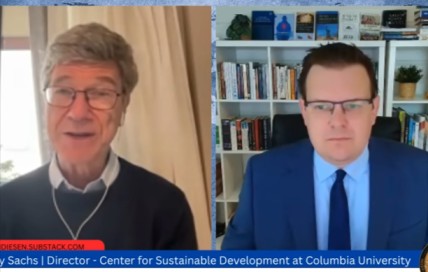
Editor’s Note: In this episode, host Glenn Diesen is joined by Professor Jeffrey Sachs to break down the rapidly escalating security crisis in Europe and the growing threat of a direct NATO-Russia conflict. Focusing heavily on recent escalations, Sachs argues that the shifting role of the Baltic states has made the region the most volatile and dangerous flashpoint on the planet. Together, they explore how the total absence of European diplomacy, rampant anti-Russian sentiment, and historical amnesia are pushing the continent toward a catastrophic war.
TRANSCRIPT:
The Baltic States: Europe’s Most Dangerous Flashpoint
GLENN DIESEN: Welcome back. We are joined today by Professor Jeffrey Sachs to discuss a situation, a security situation in Europe, which appears to be becoming more and more dangerous. So thank you very much for coming back on the program.
I’ve been looking with great concern at the possibility of a NATO-Russia war breaking out because we’ve always over the past 4 years had this incremental escalation, and it now appears to have reached a point where it seems almost impossible for Russia not to retaliate. That is, drones are attacking Russia out of the territory of the Baltic States. First it was denied by NATO, and now they recognise that it’s happening, but they claim that Ukraine doesn’t have the right to use their territory, but the fact that they’re doing this is Russia’s fault anyways.
So it’s, yeah, it’s quite incredible stuff. And now they’re condemning Russia for threatening to retaliate. So how do you make sense of this situation?
Europe’s Russophobic Leadership and the Absence of Diplomacy
JEFFREY SACHS: Of course, as has been the case for many years, there is no diplomacy taking place between Europe and Russia. Both sides, therefore, are talking past each other. The Europeans are strident. The European voice is in the lead. Are from the Baltic States and from Poland, which are the most Russophobic parts of Europe.
Strangely, Europe gave the voice for the European community, which is 450 million people, over to the Baltic States in, in the person of their external relations vice president, Kaja Kallas. Also the Commissioner for Defense, who is from Latvia, or Lithuania, excuse me. It’s very strange. Much of Europe is not of this strident Russophobic view. The Baltics, for lots of reasons, psychological and geographical, are, and they are driving European policy right now to a shocking extent. And unfortunately, the major powers in Europe, especially Germany and France, don’t put on the brakes.
We have in the person of Chancellor Merz the most irresponsible leader of Germany in decades, actually. He is an outright warmonger. He has not shown one scintilla of interest in diplomacy, even contacting his counterpart, President Putin, even having foreign ministers of Germany and Russia meet to discuss the situation. Merz seemed to have determined in his mind that he would base his government’s policy on remilitarizing Germany, a not very pleasant prospect, I have to say.
Germany’s Special Burden of Responsibility
And so one of the things that has gone wrong, in addition to the voice of Europe being the voice of 3 Baltic states with the combined population of 6 million people, and the most extreme of all Russophobia, is Germany, which I think plays an extraordinarily dangerous and irresponsible role in all of this. Because Germany has the most responsibility as not only the largest country of Europe, but also the country that explicitly promised the Soviet Union in 1990 in unambiguous terms that NATO would not enlarge. It was the country that was supposed to be the guarantor of the end of the Ukraine war in 2015 with the Minsk II agreement. It failed on that as well.
So Germany has a special burden of responsibility. Of course, history is another matter, but not even going to the history of World War II, but just going to the history of German reunification and afterwards, Germany has cheated repeatedly, and Chancellor Merz acts as if there is no responsibility at all.
France, Britain, and the Brew of Escalation
Then we move to France, which is just bizarre in its foreign policy, I have to say. Maybe Macron’s idea, which is not all wrong, but is absolutely peculiar in how it is being carried out, is Europe’s strategic autonomy. I have no problem with Europe’s strategic autonomy from the United States. But to implement it through warmongering with Russia is quite a dangerous game, completely unnecessary.
One could argue for Europe’s strategic autonomy on the simple fact that we’re 80 years after the end of World War II, and it’s time that Europe get on with it. It doesn’t need the United States to either be its defender or the determinant of its foreign policy. But Macron seems to think that in order to carry out his idea of strategic autonomy, he has to be a hostile, Russophobic leader as well.
Add in Britain to this mix, which is also and always Russophobic and has been since 1840 at least. We have quite a brew, which is no diplomacy, only talk of escalation.
Ukraine’s Strategy: Provoking a Wider War
Now the actual events of escalation taking place from Ukraine. And let’s understand the Ukrainian situation. This is a radical government. It has not anything to do with democracy, obviously. It is a small group that runs the state under martial law, that is extraordinarily corrupt, as everybody knows. Either you see it in the villas owned by Ukrainians all over Western Europe, or you see it in the reports of Nabu, and many, many other accounts. But you have a dictatorship, corrupt and extremist.
And so this is what is happening right now. And Ukraine is trying to provoke Europe into an expanded war, just like Israel always tries to provoke the United States into joining Israel in an expanded war in the Middle East. Ukraine will do whatever it can to provoke an expanded war.
This is Ukraine’s tactic because Ukraine can’t fight Russia, but maybe Europe will fight Russia. Maybe if Europe fights Russia, then the United States, they think, will have to fight alongside Europe.
I don’t know what goes through their minds, but sending drones through Baltic airspace, if that’s what they’re doing, and it seems like it is the case, then this is par for the course. They have bombed Russia’s nuclear triad, bombing the airplanes sitting on the tarmac as part of the surveillance mechanisms of nuclear arms control. They have taken whatever provocative steps they can. They want a wider war, because they think that that’s their best chance to win.
The Baltic States: The World’s Most Dangerous Hotspot
You combine all of this Baltic state Russophobia, Europe giving over its foreign policy to the Baltic states, a German leadership which for the first time since World War II, I would say, is openly calling for remilitarization, which incidentally runs against the Four Plus Two Treaty that was negotiated for German unification, which says precisely that Germany will not remilitarize in the context of a reunified Germany, and the aberrant leadership of France and the UK, and we have a perfect colossal disaster.
Which makes now the Baltic front line probably the world’s most dangerous hotspot, even more than the contact line of the war in Ukraine. The Baltic states are probably the most dangerous place on the whole planet right now. That’s saying a lot because we have the war in Iran, we have the war in Palestine, we have the war inside Ukraine, we have the tensions in Taiwan. But I would say the Baltic States are now on the front line because they are screaming for war, for vengeance, for hatred of Russia, and counting on Europe to follow through, through an active engagement in war.
Drones, Escalation, and the Slow Return of Diplomacy
GLENN DIESEN: Well, there’s some indications that, well, either Russia — there were some drones entering the Baltic States from Russia now. In what appears — well, it could be a retaliation. Some arguing that the Russians simply scrambled Ukrainian drones, so they went in by accident. Others are saying that the Russians brought down and then essentially attacked the Baltics with Ukrainian drones. It’s hard to say, it’s only the speculation.
But anyways, it does appear that the situation is escalating. And of course, all of this is also fuelled by mutual rhetoric now, of war. And it’s, yeah, it’s very concerning because in such a war they’re talking about, there will be no winners. There will be only mass death. And it doesn’t seem to make much sense.
So we’re now moving to a place, it seems, we’re either going to actually enter war with Russia, you know, whatever the consequences would come from this, or there’s time to put an end to this thing. And we’re seeing some discussions now in Europe at very slow, slow speed, but nonetheless about restoring possibly diplomacy with Russia.
Merkel’s Call and the Question of European Diplomacy
And indeed, of all people, Angela Merkel, she argued that it’s time to speak to Russia, and it has been a mistake by the EU not to do this. I mean, it’s a bit strange coming after more than 4 years of fighting, but still, it’s quite significant, it seems, because for more than 4 years the Europeans have been sitting on the sidelines boycotting all diplomacy and presenting it as some kind of virtue that, “Oh, we don’t speak to the Russians,” as if, you know, this is a sign of how good they are.
Did you see any potential here? Because so far they’re talking about whether they should talk to Russia, and if they can agree, then who should represent them. And if they can agree, then of course they have to come to agreement what they should actually speak with a common voice. And whenever they 27 EU countries will speak with a common voice, it tends to be the lowest common denominator being aggressive as possible. So probably they will end up asking for Russia’s capitulation, or I’m not sure where they’re going.
But at this point, it seems better if any European leader would just pick up the phone and at least just talk. I don’t know. Are you optimistic about at least the efforts to decriminalize diplomacy? I mean, I haven’t heard anyone talk about speaking with the other side in a long time. They’re not doing it yet, but at least they’re discussing the possibility of it.
The Spiral into Ethno-Hatred
JEFFREY SACHS: I think what has happened is that the rhetoric and the warmongering is spinning out of control. And I think there is an analogy with what’s happening with Israel and Palestine.
For a long time, Israel was engaged in a strategy to conquer and control all of Palestine, including, of course, that means the occupied territories of the West Bank and Gaza and East Jerusalem, and even to expand into neighboring countries in Lebanon and Syria. But this was mainly, I would say, strategic security policy. It has spiraled, especially after the October 7th attack by Hamas, but more generally in the changing milieu, into the most radical ethno-hatred, dehumanization, massacres, and in the end, genocide against the Palestinian people.
The reason I mention this is that the war in Ukraine has been a war of great power politics. It’s a war that emerged from NATO enlargement and Russia’s resistance to it. That emerged from a coup in February 2014, where the Russian view, which I agree with, is that the United States was a major actor and proponent of the coup, and that it was directed against Russia in order to bring Ukraine into NATO. The idea was to overthrow a government that was neutral and wanted to remain outside of NATO.
And one could say that this was unpleasant, dangerous, great power politics, a great game over Ukraine of the kind that Zbigniew Brzezinski described in the 1990s. But in the context of events, it has spiraled into a deep ethno-hatred, especially we see it in Poland and the Baltic States, places where I have worked and supported 30 years ago when a new era of peace looked to be taking hold.
And I worked with Poland to help them to cancel their debts and to stabilize their currency and to open their trade and to join Europe, all of which, and I helped Estonia to introduce a currency and worked with Kaja Kallas’s father, who was then governor of the Central Bank of Estonia. But the idea at the time for me, and the idea as expressed by Germany and the United States and President Gorbachev and President Yeltsin, was that this was in the interest of a new peace and a common European home.
And the Four Plus Two Treaty, which enabled German reunification, speaks of a treaty following the Helsinki Final Act in which it said that security in Europe is indivisible and that no security could be at the expense of another country and that there would not be remilitarization and so on.
Radicalized Rhetoric and the Danger of Boiling Over
But what has happened now is rampant radicalized ethno-hatred. These countries have their historical memories, I think, grossly distorted in my own view, about Russia, but stoked by the war in Ukraine and by the unrestrained rhetoric and the tragedy of war itself. There’s no appreciation at all, not even for a moment, a nanosecond, that what is at stake in the Ukraine war has a lot to do with Russia’s security vis-à-vis the United States.
That isn’t admitted or understood or acknowledged at all. Everything became interpreted as Russian evil, as Russian aggression, as unprovoked war and massacre by the Russians. All of it false in its pseudo-history, all in its deliberate denial of basic facts about German reunification, about NATO, about Minsk II, and many, many other things. Arms control, the US abandonment of the Anti-Ballistic Missile Treaty, the US participation in the Maidan coup, all of the history that you and I and many others have talked about for years. None of this is mentioned for a moment in Germany or in Estonia or in Latvia or in Lithuania or in Poland or by the European Commission in any way.
So what we have instead is just the emergence of hatred. Hatred can boil over. This is what makes this so dangerous. In the Israel context, which I mentioned, hatred boiled over to open genocide. The Israelis have no self-control anymore. They don’t even know how they’re viewed by the rest of the world. They don’t understand because they are in the grip of hatred.
And I would say that this is what is happening on the front in Europe right now, in the Baltic States and in Poland, and in Russia’s response. What are you doing? Do you really want a war in Europe? And then that echoes back and we heard from Berlin, “Ja, we have to get ready for a war in Europe, maybe by 2029.” And we hear about the need to prepare for war, the nuclear umbrella.
Now, this debate — should we actively support drones attacking Russia, the celebration when Ukraine attacks Moscow and so forth with a drone attack. Now, the only thing I can say, Glenn, is that not only is this about to boil over, but maybe just maybe it’s giving some responsible people in Europe the idea that this has reached the point where there’s no self-control on the European side, and it could completely explode, and explode in a way that would be devastating for all of Europe.
And so maybe this is the genesis of the idea, four years late, that somebody should be discussing this with the Russian counterparts. And I’ve been saying this for years. You’ve been saying this and many others. Talk to the other side because there’s actually real things that the Russians have to say to help jog the memory of the Europeans about how we got into this colossal disaster.
Merkel, Bucharest, and the Road to War
And with Chancellor Merkel, it’s very interesting and very poignant. I like Chancellor Merkel. I respect her as a level-headed, decent, honest, hard-working leader, and as someone who wanted peace in Europe. But she herself has described what went wrong.
And the poignant moment is between the first day and the second day of the Bucharest NATO summit in 2008, when the United States was pushing for NATO enlargement and Chancellor Merkel knew and said so, “This could be the path to war with Russia.” Very sensible. And the United States was pushing for a fixed date, what they called a MAP, which was a plan for NATO enlargement to Ukraine and incidentally to Georgia in the South Caucasus region, which is not only not the North Atlantic, but isn’t even in Europe. It’s part of Asia. But not to digress.
Chancellor Merkel knew and wrote that the commitment to expand NATO was likely to lead to war. And she resisted the first day of the NATO summit and then gave in the second day, and gave in in a way which she thought she was still holding some ground. There won’t be a specific plan or date. But the conference would close with the unequivocal declaration that NATO will enlarge to Ukraine and to Georgia. That was the end of Germany’s voice for restraint.
And then, unfortunately, fast forward to the events of February 21st, specifically, 2014, when the coup was nearly undertaken in Kyiv, and the Germans, together with colleagues, negotiated with the then president of Ukraine, President Viktor Yanukovych, that there would be no coup and that President Yanukovych’s term would extend till late in 2014, at which point there would be new elections held. And Germany agreed to that, and the United States did. And there were conversations with President Putin that evening about this agreement.
And then the next day, the coup leaders stormed the government buildings in Kyiv. And then the US immediately recognized the new government rather than saying, “Wait a minute, we had an agreement. This is extraconstitutional. President Yanukovych is still the president.” The United States played its card and immediately recognized the new government. It didn’t formally recognize it. It said that it would work with the new government. Didn’t call for constitutional order, and Germany went along. So this was the next step.
The Failure of Minsk II
And then one year after that came the Minsk II agreement. It was actually February 2015, and Germany was to be the guarantor of the Minsk II agreement. And people may not recall the Minsk II agreement, but it was an agreement to end the fighting in the Donbas by creating a new constitutional order in which the Donbas, the two oblasts of Lugansk and Donetsk, would be granted autonomy for essentially self-rule within Ukraine. And Ukraine agreed with this. The agreement was unanimously adopted by the UN Security Council. Germany and France were to be the guarantors of Minsk II.
And then the United States and Ukraine privately said, “No, we’re not going to implement this.” And Germany did not stand up and say, “Wait a minute, we have an agreement. It’s backed by the UN Security Council. We are responsible for enforcement. It will be implemented.” Germany remained silent. So much so that in 2022, I believe it was, Chancellor Merkel rather strangely said, “Well, we never really meant it. It was to buy time for Ukraine.” I actually don’t believe that was her view in 2015, but it was her excuse in 2022 when she was under attack for having signed such an agreement. Under attack within Germany for having been too obliging to the Russians.
And so all of this is to say, we’ve come to a point of hatred and we’ve come to a complete amnesia about actual events, and we’ve come to a point where this could easily boil over into open war in the Baltics or other parts of Europe. In other words, the potential for complete disaster.
The Search for a European Diplomat
And so maybe, maybe, maybe this is why Chancellor Merkel, among others — I mean, it’s surely why Chancellor Merkel is saying we need to talk — but maybe it’s why some others are also perhaps agreeing that Europe needs to talk.
It’s quite notable, by the way, in this discussion of search for the individual that would be the counterpart, where Chancellor Merkel herself is named as a potential European representative, or Mario Draghi is mentioned as a possible European representative, it’s taken for granted that their own real external affairs chief, Kallas, could not be that person. Because her Russophobia is so, so blatant, so, so basic that she cannot serve the role of diplomat. They know that.
That by itself is very, very sad. It’s like saying we need diplomacy, but in the US context, it can’t be the Secretary of State. He’s no diplomat. That’s what it would be like saying. But Europe is implicitly acknowledging that fact.
The Suppression of Nuanced Discussion
GLENN DIESEN: Well, the EU picked Kallas as the foreign policy chief when the EU was following the line that they were boycotting diplomacy and weapons were the path to peace. So if you don’t want any diplomacy at all, then I guess she could be a good choice.
I often think about what you just mentioned as well, that how could you go from Angela Merkel, who once stated that offering a membership action plan for NATO to Ukraine would be interpreted by Moscow as a declaration of war, to where we are now, where it’s impossible to even discuss our side having provoked anything.
I sometimes think that part of the way the narrative has been manipulated, or the discussion has been suppressed, is they often tend to present any issue as being only two sides. Either it’s our narrative or the Russian narrative, and essentially have to pick one.
And I think of in this country, actually, in Norway, we used to, because of our geography, have a key point in the American-led missile defence, which is now NATO missile defence, strategic missile defence, which threatened to undermine Russia’s nuclear deterrent. And the Norwegians used to be quite concerned about this. And then WikiLeaks taught us that the American ambassador to Norway was making the point that, “Well, we can flip the Norwegians. All we have to do is make this an issue of alliance solidarity.” That is, either the Norwegians are repeating what the Russians are saying, or they prioritize NATO solidarity. And he argued if we frame it like this, there’s no way they can anymore talk about security. And also making the point that we’ll engage with NGOs, think tanks, journalists, politicians. And later on you saw another WikiLeaks cable being released where they essentially confirmed that, “Oh no, they’re all falling in line now.”
So it’s not more complicated than that. Either you repeat the Kremlin talking point or you have solidarity. And I noticed in this war as well, that’s what they’re saying as well. If you’re saying, “Well, NATO provoked this,” well, that’s a Kremlin talking point. “NATO helped to topple the government.” Kremlin talking point. There’s no discussion. It’s just pick one camp, and somehow arguing for war, pretending this was unprovoked, that’s the pro-Western and pro-Ukrainian position.
If you mention perhaps that kidnapping all these young Ukrainian men and sending them to their death is not pro-Ukrainian, well, that’s a pro-Kremlin talking point as well. If you’re pro-Ukraine, you’re pro-conscription, sending all these men to die. It’s, yeah, it’s—
Europe’s Responsibility and the Case for Honest Diplomacy
JEFFREY SACHS: I think it would be very interesting in the Norwegian context to ask the leadership today, what was Norway’s position at the Bucharest NATO summit in its actual position? I happen to have some information about that. And I believe that NATO, that Norway’s position was to be aghast at what George Bush was promoting, and to ask, how is it that Bush, who promised that he wouldn’t go down that path, went down that path?
I’d like to know what Norway’s leadership says about that. Is there any remembrance of events in 2008, of attitudes in 2008, of the sense that Chancellor Merkel expressed and wrote down at least honestly, in her recent book, her diary, in effect, or her memoirs, that yes, she knew that this was tantamount to war, or would be seen that way from the Russian side. I’d like to know what the Norwegians would remember about that, the Norwegian leadership, because there is historical memory, and that reflection should be helpful.
There’s a lot of American bullying. We know that there’s a lot of arm twisting. You step out of line, Americans will say you’re corrupt. They’ll try to bring down your government. They’ll do one thing or another. But this is actually what has brought Europe to this disaster.
I view Europe’s situation today as tragic and as mistaken. I view the Russophobia as a terrible self-harm of Europe. By being so Russophobic, Europe has hurt itself many, many times in history. It’s a long and fascinating subject that I’m writing about and studying myself right now. It’s very harmful for Europe to take these extreme positions. It doesn’t unify Europe, it just brings Europe closer to disastrous conflict by absolutely deliberately evading history and not attempting any honest assessment.
But people do know, at least there are people who should remember and can recall. And again, I put primary responsibility for all of this on Chancellor Merz because Germany has the most responsibility here and the most accountability here. Not only World War II, but I’ll put that in. And not only the terms of German reunification, but the explicit promises of no NATO enlargement, the terms of the 4+2 Treaty, the events around Maidan, the events around Minsk II.
If Merz would just spend an honest day, one day, reviewing German recent history and diplomacy, and how many times Germany lied to the Soviet Union and to Russia since 1990. And by the way, I’ll add one more incidental fact, which is also puzzling but true. Germany took the lead in saying no NATO enlargement. The United States and Germany expressed this absolutely explicitly to Gorbachev and to Yeltsin.
And then around 1992, the US started to reconsider. And Germany, interestingly, especially the business community, started to lobby for NATO enlargement as early as 1993. So while I tend to put a lot of blame on US foreign policy, of manipulation and reneging on commitments, Germany actually has a direct independent responsibility, not just falling into line with the United States, which it did often enough, but rather independently blowing off the terms of German reunification within a three-year period and starting to lobby for NATO enlargement.
And I know that some scholars are studying this right now. The German businesses, I think, believed that they were going to invest in Eastern Europe and they wanted the security of these countries being within the NATO umbrella. But they gave short shrift, or no shrift, I should say, to the fact that Germany had explicitly promised in the 4+2 agreement not to move troops into even East Germany, and that this was in the context of absolute clarity, not ambiguity, as our narrative says now, but absolute clarity that that commitment included not just not moving troops into Eastern Germany, which is what’s in the Four Plus Two Treaty, but more generally into Central and Eastern Europe.
Much less to the Baltic States and to Ukraine and to Georgia, which became the ploy and the plot soon after those commitments were made. So I would above everything like the German Chancellor to review the history and from the position of honesty say it’s time to talk to our counterpart.
The Limits of Diplomacy in a “Good Guys vs. Bad Guys” World
GLENN DIESEN: Yeah, but again, when we meet, I wonder what can actually be achieved now. I saw Finland’s foreign minister make this statement that “NATO is not a threat, but Russia is a threat to world peace.” So in other words, this is how you see the world now — more NATO is more peace, less Russia is more peace. Essentially, the world is good guys and bad guys. If the good guys have more guns, the bad guys are weak, and then we’ll have peace. This is the thinking. So there’s no—
JEFFREY SACHS: I agree with that. Glenn, I just believe, I hope, without proof, but I hope that face-to-face discussions where, frankly, the Europeans are forced to remember some recent history would be helpful. There is a lot of experience, both the actual events and experimental data, which shows that face-to-face discussions can make some difference, that it’s very hard to keep a false narrative directly in the face of the counterpart on a prolonged basis.
I happen to know well Foreign Minister Lavrov. I respect him enormously. He is a walking encyclopedia of the last 36 years of history. I think he would be a very excellent counterpart for discussions of these issues. And I believe, since I’ve seen a lot of them with my own eyes, I think that the Europeans would have a lot to remember and that that would be beneficial for Europe’s own security.
GLENN DIESEN: Yeah, I agree. Well, when diplomacy becomes sitting in a room with people you agree with only, then it’s easy to have this bubble mentality where crazy narratives begin to move forward and dominate. Anyways, I’ve already taken too much of your time, so thank you very much and enjoy your day in Brazil.
JEFFREY SACHS: Thanks a lot. See you soon. Bye-bye.
Related Posts