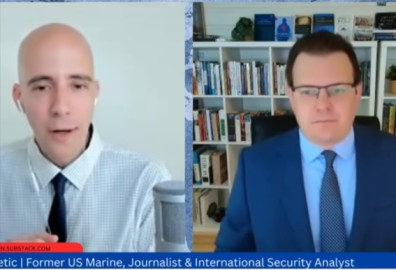
Read the full transcript of geopolitical analyst Brian Berletic’s interview on Greater Eurasia Podcast, May 24, 2026.
Editor’s Note: In this episode, host Glenn Diesen is joined by former US Marine and geopolitical analyst Brian Berletic to analyze the shifting landscape of global conflict. Together, they explore the commonalities behind the economic war against China and the active military confrontations involving Russia and Iran. The discussion delves into how the United States utilizes diplomacy and a multi-domain strategy to preserve its global primacy against a rising multipolar world.
Introduction
GLENN DIESEN: Welcome back. We are joined again by Brian Berletic, a former US Marine, author and host of The New Atlas, to discuss what brings the economic war against China and the wars against Russia and Iran. What are the commonalities? What brings them all together? So thank you. It’s good to see you again.
BRIAN BERLETIC: Thank you so much for having me back.
Trump, China, and the Pressure on Iran
GLENN DIESEN: So Trump recently had this meeting with Xi, and they seemed like one of the key objectives was for Trump to get China’s support to put pressure on Iran to essentially put an end to the war on terms favorable to the United States. It did remind me to some extent about how the United States also wanted China to put pressure on Russia to essentially capitulate.
I guess the problem there would be if China is next on the chopping block, then it would be great self-harm. So how are you seeing this? Because you have argued that China would be the ultimate target in all of these theaters of war.
BRIAN BERLETIC: Absolutely. And the US administration admits this. There are senators and representatives in Congress who constantly, almost on a daily basis, admit this.
And I don’t think that the— I don’t think the United States, and I don’t think President Trump and his policymakers went to China thinking that China was going to put pressure on Iran, just like China would never put pressure on Russia, because why would China help the United States eliminate one of their own allies and isolate themselves even further?
And so people have to kind of understand what the US uses diplomacy for. They don’t use diplomacy to solve issues peacefully. They use diplomacy to create more pretext for additional war and to shape geopolitics ahead of those wars. This is what they’ve done up to the lead-up to the overthrowing of Ukraine in 2014, provoking the war with Russia in 2022, and the last 2 years of war of aggression against Iran. And this is exactly what they’re doing to China itself using diplomacy.
So when you understand that that’s why they’re doing that, that’s how they’re using diplomacy, then it makes much more sense. And the way they try to frame it in the minds of Americans— people have to remember they have many different target audiences when they do these different things and say these different things— that they’re trying to put it into the mind of Americans that America is such a reasonable country, no matter how evil China is, America wants to talk with them.
This is the same game they just played with Iran up until the US launched its war of aggression against Iran. This is the same game they’ve been playing with Russia for years in regards to Ukraine. “We’re the neutral mediator” when it’s their proxy war from the beginning and run by the US top to bottom all the way up until and including today.
The Illusion of Balance of Power
GLENN DIESEN: But it seems to some extent to be self-defeating though, because if one looks at the international system, that peace would be created through a balance of power, which all the major powers would be constrained. You would think that having a more independent and stronger Iran or Russia, that this would create some balance of power on the Eurasian continent.
But is the only reason for the United States to essentially seek to weaken all the centres of power be to have a certain hegemonic position? Path to security, or is there any other objectives? Why? Because if I was in the United States, I would see, being in rapid relative decline, you having the Chinese rising very, very strong and powerfully, I would want to restore a balance of power. This is traditionally what the United States did with its offshore balancing. It would come late into wars when all the major powers had exhausted their blood and treasury, and the main goal was to assert or restore a balance of power where the major powers would balance each other and then pull out before others, they would begin to collectively balance the United States.
But now attempting to weaken Iran, weaken Russia, it seems like there won’t be any check on its main adversary. Indeed, for the Russians to survive now or the Iranians to survive, they really have to put even more trust and more dependence on China. It just doesn’t seem like this is what would be rational behaviour for a country which would want to balance its opponents.
BRIAN BERLETIC: The United States only pretends to seek a balance of power between nations. It ultimately wants primacy. And this is stated US foreign policy objective since during the Cold War, after the Cold War, and from the very end of the Cold War all the way up until now. Every official US government strategy paper, every think tank policy paper— this is what they’re obsessed with. This is their ultimate objective, is primacy.
They wanted to try to put wedges between Russia and Iran, Russia and Iran and China. They tried to play these games for decades and decades, all during the Cold War and ever since the Cold War. But this is at a very late stage of the game where everyone knows what’s going on.
I guess there probably are still circles of political interests around the world who don’t get that, who actually think they can cut a deal with the United States. I hope that’s a very small number. We can never tell for sure, but I’m almost certain, especially in Moscow and Beijing, they understand this fully. And there’s nothing the US can do to trick them.
They basically have to trick them into working against each other because they are actually natural allies. They’re natural economic partners. The vast majority of their history sharing a border for centuries and centuries has been in peace and prosperity, not conflict. The Sino-Soviet split was a historical anomaly, was not the norm.
US Primacy and the Proxy System
BRIAN BERLETIC: And so that’s where they are at this point. This is why the US cannot— and isn’t trying to create— if they could, they could topple Iran or topple Russia and install a client regime in its place and control them that way. That’s what they ultimately would want to do. That’s what they have tried to do and have so far failed to do.
But that’s the only way they could create— it wouldn’t be an independent center of power though. It’d be just another US proxy. And that’s ultimately what they’re trying to do. That’s what they’ve always done. This is what they’ve transformed Europe into. It is not an independent power balancing between the US and Russia, Iran, and China. It is just an extension of US foreign policy.
So is Israel and the Persian Gulf states in the Middle East. So is Japan, South Korea, and the Philippines here in the Asia-Pacific region. That’s how they are doing their business right now. That’s what their objective is. They could say that they want independent power to try to create some sort of balance, but they want primacy, only primacy.
And when you understand that, again, everything that they’re doing makes so much more sense— that they’re weakening even their own so-called allies to subordinate them further, to extract more use out of them as proxies against countries that are still resisting US primacy. Especially Russia, especially Iran, and especially China.
Eurasian Integration and the Question of US Primacy
GLENN DIESEN: Yeah, that’s a great point because I was even thinking back in 2012 when Hillary Clinton was making this point that the Russians were trying to re-Sovietize the region, and she was referring to the Eurasian Economic Union, which is a geo-economic grouping that is, yes, seeking to organize a more or less a trade bloc. And her whole argument was we should seek to slow this down or reverse it, or just break up the Eurasian Economic Union altogether, or what was becoming the Eurasian Economic Union.
And I thought to myself then, that would be foolish, because if the US is really worried about the rise of China, wouldn’t this geoeconomic club arrange some kind of a balancing with the Chinese? But of course, this would only make sense if you’re after an actual balance of power. If the goal is to knock out not just the Russians, but the Chinese as well, then suddenly it makes more sense.
But when you talk about restoring primacy though, how would you assess this, or what do you expect to see? Are we talking about the global military primacy, financial dominance, control over trade routes, technological dominance? What is it, or how are you reading the situation?
The U.S. Strategy of Controlled Disruption
BRIAN BERLETIC: Well, the United States seeks to do all of these things. How realistic? Now that’s another question entirely, and a lot of it isn’t realistic, and a lot of it is becoming less and less realistic as time goes by.
What they’re trying to do is not really— they realize that China is surpassing the U.S., not just the U.S., but the U.S. plus all of its proxies, and there really is nothing they can do about that. And so they’re thinking, if we cannot fight with China head-to-head, what can we do? We can just wreck everything, drag everyone down, create a mess out of absolutely everything, and then possibly we will emerge on the other side of this stronger. This is their thinking. This is what they’re basically saying openly now.
They almost admittedly say that they’ve gone after Iran. They’ve not just disrupted energy exports from Iran to China, but from the entire Middle East, to not just China, but to all of Asia. At the same time, they had these LNG export projects from the US to Asia that made no business sense at all. They were working on these for years, and you can even find old presentations online where they’re presenting it to the public and they’re like, “No, if you really think about it, it makes perfect sense.” And they were talking about contested waterways and people like, “What contested waterways?” And then I guess in the back of their mind, they’re like, “Well, just wait, you’ll see.” And here we are now. There’s contested waterways. Who created them? The U.S. created them, knowingly created them.
They created this crisis in the Middle East. They are interdicting ships from the Middle East all the way to the Indian Ocean and beyond. They’re putting pressure on Indonesia. Whether they succeed or not, that’s another story. But they want access, military access, to the Strait of Malacca— or I should say, more military access to the Strait of Malacca— because they have already been placing what is essentially a global blockade on Russian energy exports. They’ve included Venezuelan energy exports until the US just outright captured Venezuela. They’re blockading Cuba. They’ve targeted ships traveling to China.
And so when you really think about it and zoom out and look at the big picture, they’re going after trade routes all around the globe. They’ve been preparing for this for years. They’ve reorganized the entire US Marine Corps into an anti-shipping force specifically for this. And this isn’t a Trump administration policy. This was something that was being prepared since probably under the Obama administration and carried over each subsequent administration. And now it is ready. And now they’re actually using the U.S. Marine Corps to interdict shipping in the Middle East. And they’re going to use it for that from everywhere, from the Middle East all the way to the Asia Pacific.
And so that’s what they’re doing. They’re using their remaining military power. They understand they’re not going to catch up with Russia or China, but they’re using their remaining military power to create as much damage, destruction, instability as possible, trying to target Russia, Iran, and China as much as possible, but also Asia. There are countries in Asia now that are signing deals with the United States for those LNG exports from the US, which again made no sense until just now that the Middle East has been turned into a war zone.
And what does this grant the US? It grants them not complete control over these countries, but more leverage over them to coerce them further into making an enemy out of China rather than this balancing act so many countries in the region have been performing. And this is what they did to Russia. We all remember before 2014 how much business was going on between Europe and Russia and how well that was going and how optimistic things were. I was very optimistic about Europe’s future with Russia and even with China. And then the US incrementally, step by step, and through a series of wars and proxy wars, they managed to shut all of that down. They literally blew up pipelines to cut Europe off from Russia.
And now they’re doing the same thing to Asia, and they’re using energy dependence. They used energy dependence for subordinating Europe, and now they’re going to do the same for Asia. I think they’ll have less success and at a much slower pace than they have with Europe for many different reasons. But I would not underestimate that, and that is their goal.
So their goal isn’t to somehow come up with more power to overwhelm Russia, Iran, and China, but to use the remaining power to create as big of a mess as possible, to derail peace, prosperity, and cooperation as much as possible and then hope out of the ashes they are the ones that come out strongest. That is what they’re doing.
This is why I would warn people, don’t underestimate what they’re willing to do, the amount of damage they’re willing to create. This disaster they’ve created in the Middle East fits perfectly into this strategy. This is not something they want to undo. This is something they want to make worse, which is why they have not made any serious deal with Iran. They easily could have many times over. They could have saved face at any point along the way. They’re deliberately moving forward with escalation and further conflict. They want the conflict to continue.
They want to implode things, but not all at once overnight. They want to manage it just like they managed cutting Europe off from Russian energy. That wasn’t overnight. That was over years. It’s still taking place actually right now. And now they’ve started this process of cutting off Middle Eastern energy to Asia. And now they’re going to repeat the whole process for Asia that they’re already well underway with in Europe. And again, if you zoom out, you see they’re targeting Russia, Iran, and China in the process.
The Flaws in the U.S. Blockade Strategy
GLENN DIESEN: The massive flaw in this strategy though is that you have Russia as the largest energy producer and they have the massive border, direct border with China, which is the largest consumer. And unlike the relationship between the Russians and the Germans, for example, there’s no middle country where you can disrupt. So for example, before the Orange Revolution in Ukraine, you had about 80% of gas from Russia going to Europe went through Ukraine. So if you just disrupt Ukraine, then you can disrupt this gas supply. But you don’t have this with China and Russia. So you’re putting these two massive Eurasian giants together, and together they can have a gravitational pull to bring in countries like Iran as well as others.
So it looks as if this strategy has a lot of flaws to it, or at least risks. But the great powers have always sought control over international waterways. This was recognized by Alfred Mahan at the turn of the century when we moved into the 20th century. This was a source of British dominance, then American dominance.
What kind of surprised me is, as you said, that there’s always been very openness about this among politicians and also in academia. That is, after World War II, the US set up these dual island chains outside China, obviously to shut it down. If you go through the literature all the way to the ’90s and 2000s, there were also regular— you know, “If the Chinese ever get confrontational or try to challenge US leadership, we can shut down the Strait of Malacca.” Again, a key choke point.
You also have people like Brzezinski who was writing that if the Russians after the Cold War would ever begin to try to balance or challenge American authority, they should be made clear that their key maritime corridors would be shut down. The most important one would be the Baltic Sea, which we’re seeing now happening. And as you said, the Nord Stream pipelines— they discussed destroying them years before they actually did. And still, in the Western media, it almost starts to fall into the realm of a conspiracy theory that, “No, the Americans would never shut down energy trade or transportation corridors.” It just— it’s anti-history, and it goes against all the evidence.
But that was— I was getting to my question, which is, how do you see this effect, or how effective do you think this US double blockade, if you will, on the Strait of Hormuz is? Because we see a lot of the Iranian ships going through, some of it’s being also enhanced by the increased energy prices. So essentially the Iranians are doing well, but how are you assessing it?
Assessing the Effectiveness of the U.S. Blockade
BRIAN BERLETIC: Yeah, if the US is trying to replicate its success in cutting Europe off from Russia, they’re not going to shut everything down overnight. And what the US has actually demonstrated is that they don’t need to seize all of these ships. They don’t need helicopters to land on every single one of them. A lot of the ships are just turning back.
If you look at the statistics, people are citing— I think it’s the Financial Times that put out an article about ships running the blockade. But almost an equal number of ships have been turned back or seized by the US, and that seems to be pretty much what’s going on. So they didn’t shut it down completely. Claims by the US that it has— that’s just outright a lie. But cutting back half of the shipping, that is significant. That’s not a non-issue.
And at any time of America’s choosing, they could just start firing on these ships. As a matter of fact, over the course of 3 days, US warplanes fired on 3 ships and disabled 3 ships. And what they’re basically saying is, “We could do this to all of the ships if we wanted to.” And what they’re probably trying to achieve— we don’t know, we’re not in the room when these decisions are being made— they’re probably trying to create a greater deterrence to force more of these ships to turn back than to run through the blockade. But at any time of their choosing, they could just start disabling these ships or even just outright sinking them. They have the firepower to do this.
The reason they’re not is the same reason you see President Trump playing games on social media, talking about peace one minute, war the next, manipulating the markets— because they are creating an economic disaster, but they’re trying to manage it. They don’t want it to collapse all at once. They really don’t want it to collapse completely. They want it to be in a very controlled way. To get what they want ultimately at the end, which is, I would say, most of Asia placed under increased dependency on U.S. energy exports. Not complete dependency, but at least increased dependency on U.S. energy exports. And they’ll use that leverage to disrupt what China is trying to do in the region.
If you’ve been in this region for as long as I have, almost my entire adult life, you can see the transition from a US-dominated region. Asia had been dominated by the US for decades and decades, and the rise of China and the way the rest of the region rose with it— and the way it hadn’t been rising under US domination, because the US doesn’t want anyone to rise. The whole point of being a small percentage of the global population and maintaining primacy over everyone else is keeping everyone else down. If you’re helping lift everybody else up, they’re going to have the power and the ability to say no to you. And this is the last thing the US wants.
And so this is why the US, and the British Empire before that, weren’t lifting poor people up out of poverty and into peace and prosperity. They were keeping these people down. They maintained leverage over them using lethal force when and if necessary. And that’s what the US is still doing. And that’s the design of their future ambitions for primacy over the globe.
Of course, Russia, China, and Iran have a say in all of this, and they are exercising their own options to resist this. And we just have to wait and see who has the ability. Does the multipolar world led by Russia, China, and Iran have the ability to build faster than the US can disrupt and destroy? That’s the question. China has a tremendous ability to build and expand and lift up. Can the US continue to push back down with equal or greater force? That’s what we have to wait to find out.
And all I’m warning is for people not to underestimate how far the US is willing to go to ensure that China doesn’t permanently surpass the US, and that the US doesn’t irreversibly decline into a regional power or even something less than that.
The New Great Game: Eurasian Rivalries and the Limits of Empire
GLENN DIESEN: Yeah. The problem again though would be if the US disrupts too much of global markets, the US doesn’t stand on very solid ground itself. That is, it’s $39 trillion in the hole. It’s a massive debt. They’re struggling now with their bond markets. If again, if a financial crisis would set in now, it’s unclear how they would manage this. I mean, would they, how would they defend the dollar? Would they increase the interest and make the payments unmanageable? Will they reduce it and see the dollar fall apart? So it’s very hard to imagine what they would do if a financial crisis will kick in now.
So again, it seems like a foolish strategy. They’re essentially betting the whole republic on preserving the empire. But you mentioned that the Chinese have to build faster than the Americans destroy. And while part of the goal during the past years when the US was engaged in these forever wars around the world, the Chinese were pumping trillions into this Belt and Road Initiative. To what extent do you see this being a significant buffer or allowing China to diversify away from US-controlled maritime corridors?
BRIAN BERLETIC: It’s kind of hard to tell. They have pipelines, they have transportation corridors that are in operation that they’re already using to bypass the different conflicts and crises the US has created for them. But the United States, as soon as China began working on these corridors, the US began building up armed proxies to attack them and to disrupt them.
So for years, I’ve been covering US-backed militants attacking Belt and Road Initiative infrastructure in Myanmar here in Southeast Asia, Thailand’s neighbor to the west. Also in Pakistan, the China-Pakistan Economic Corridor is constantly under attack by US-backed terrorists. And ISIS in Afghanistan is attacking the Afghan government and Chinese investments in Afghanistan to disrupt China’s attempts to build Afghanistan up into an exporter of raw materials and then using the wealth that they get from that to build up their country, which has been impoverished by decades and decades of US war of aggression, occupation, and proxy war, because they had a proxy war against the Soviet Union in Afghanistan in the ’80s. The US from 2001 to 2021 was literally occupying Afghanistan. And now they’re waging another proxy war against the Afghan government and their Chinese allies to disrupt that.
So this is a constant process, and it is almost, you could say, a global dirty war the US is waging. We know that they’re waging a dirty war against Russia through Ukraine, against Iran openly, a war of aggression, but they’ve been waging this dirty war against China for decades and decades, essentially. And it has mixed results. And at any time they can escalate, but they know at any time China can escalate also. So it’s always a balance.
Just like you said, if we disrupt too much, yes, it could destabilize the US economically. I think they’re less worried about that than the type of escalation Russia, China, and Iran could resort to if they were pushed. All of these countries — and this is how it has been all throughout history — empire has expanded and it picks on and pushes countries they know really don’t want war, would prefer to avoid war. An empire thrives on aggressively pursuing war that it knows everyone else wants to avoid.
The Americans are worried that if they push too hard, they might find themselves in a situation where all of these targeted nations are very willing to wage war, basically for self-preservation.
No Return to the Old Status Quo
GLENN DIESEN: Well, we kind of reached this point. That is, the Iranians are going all out again. They could strike a deal with the US today if they wanted to, but they want to make sure there’s no going back to the old status quo of crippling sanctions and perpetual threats. Same as the Russians, they could also possibly strike a deal this week if they wanted, but that would then also imply a return to the old status quo — which is NATO’s incremental expansion towards Russian borders. And so they all essentially laid down the gauntlet and made the point there’s no more going back to this hegemonic approach to security, that from now on the adversaries of the United States have to be included in the security architecture.
But a lot of this reminds me a bit about — I mean, is this a new great game? Because in the 19th century you saw similar dynamics, the British Empire and the Russian Empire essentially competing, then in Central Asia, but essentially the British were dominating from the sea, controlling all maritime corridors, while the Russian Empire was seeking to connect through land corridors. And this is the Mackinder Great Game, or Eurasian Heartland as well, which, again, if you go through American strategic documents, they keep referring to it. The idea that you have to keep the massive Eurasian continent, spanning from the Atlantic to the Pacific, keep it divided, because once all these powers come together, be it the Russians and the Germans or the Indians and the Chinese, the Chinese and the Russians, then suddenly the maritime power or hegemon at the periphery will no longer be able to dominate. Conceptually, do you think this could fit in the same category as a new Great Game?
BRIAN BERLETIC: I think that’s very much the thinking, and it kind of answers the question as to why doesn’t the US just make friends with Iran or with Russia? It’s because they don’t want any of these countries to be strong. They need to either subordinate them, or weaken them if they refuse to be subordinated. Because otherwise, just as you explained, they will all start working together — and they are all working together.
The United States has done everything within its power. And again, if you go back to the RAND Corporation paper, Extending Russia, all of these conflicts, including the proxy war in Ukraine against Russia, what they’ve done in the Caucasus region, in Central Asia, in the Baltics — this is all to create all kinds of dilemmas for Russia, to weaken Russia. They have a similar strategy they’re using against Iran and again, a similar strategy that they’ve been using against China. So it is all to keep them weakened. If you cannot divide them against one another, just weaken them and create division between them and all of their immediate neighbors. And that is exactly what they’re doing.
So I would say it’s a continuation. It’s the most advanced version of this great game. I would say it probably stretches out far beyond Eurasia at this point. And then it spills into the realm of technology, which is playing a role now that it really wasn’t an issue back then. Today, you could have a country like Iran where it’s able to rapidly adopt and integrate high technology and use it to not just augment its economic activity, but its military deterrence. And that is what they’ve been doing, of course, with help from their allies, but in ways you wouldn’t have seen during the British Empire’s days.
The way technology is rapidly advancing now is something that I think a lot of these policies that we see the US pursuing, which have been set in motion decades ago, they really didn’t take account for how exponentially quickly this technology would be advancing, how it would disseminate into all of these nations, big and small.
And so you keep saying that it’s not rational or it’s not sustainable. I completely agree. It’s completely irrational. It’s unsustainable. The whole concept of global empire in and of itself, I think, is irrational and unsustainable. The question is how much damage are they going to cause? Because we know all empires rise and fall. We know this empire is almost certainly going to fall. How much damage is it going to do in the process? And I think that’s why we should have heightened caution and not underestimate what the US can do, what it’s willing to do. Not in the sense that they’ll be successful, but the amount of damage that they will create in the vain hope that they will be successful, that they themselves think they will be successful.
The Benign Hegemon and the Rise of China
GLENN DIESEN: Yeah, I remember in the ’90s and 2000s, the theories of Kindleberger on the benign hegemon — the US being a benign hegemon — was very popular because at that time so much power was concentrated in the US, and the whole idea was because of this, the US has the ability to essentially mitigate the international anarchy. That is, there’s no great power rivalry anymore, so the US would be able to deliver stability to the world. This would make it benign. That is, it would offer the world open access to technologies, trade, open transportation corridors by sea, freedom of navigation, everyone can participate in international finance. So this was the source of the benign hegemon.
But I remember back then that all the enthusiasm for how benign it was, it was assumed that there was something special or uniquely benign about the United States. But it doesn’t seem sustainable because if one allows this open economic system that allows powers to rise — and the Chinese did rise spectacularly since the ’80s at least — then it would pose a dilemma for the US, because once you have all these rising powers, if you allow them to rise and become very powerful, then the hegemonic era is over. That is, there can’t be a benign hegemon if there is no hegemony.
Now the Chinese are outgrowing the US, so that puts an end to the benign hegemon. And the alternative option is essentially to use all the administrative control over the economic architecture to prevent the rise of rivals — that is, either shut down their access to technologies, shut down the maritime corridors, shut down access to the dollar and banks, or even use military force to prevent the rise. But then they wouldn’t be benign anymore. So again, the benign hegemon was always a very unsustainable concept. My God, how popular it was back then. But of course, it’s a good way of legitimising the empire.
But how do you see the approach of the US now? Because going back to the meeting between Trump and Xi, it looked as if Trump was backing off a bit with the pressure on Taiwan, which is what the Chinese were very much insistent on. So how do you make sense of this? Do you think the US is willing to let go of Taiwan? What I mean is this incremental chipping away and undermining of the One China policy by doing ever more military-political cooperation, pushing for secession — or do you think this is just a distraction by now?
Taiwan, China, and the Limits of U.S. Diplomacy
BRIAN BERLETIC: Just a distraction. This is what the United States has done since agreeing to a One China policy in the first place. On one side of their mouth, they say we agree Taiwan is part of China. There’s only one legitimate government of China. That’s the People’s Republic of China. That is the One China policy that almost every country on earth upholds, including the United States.
And at the same time, even as soon as they were saying that, they were making unilateral declarations inside Washington — the Taiwan Relations Act and the assurances. And what that basically meant was, yes, yes, we said One China to Beijing, but we didn’t mean it. And we’re going to constantly undermine it. Just as we have been all the way up until now.
There are U.S. troops on Taiwan right now, even though it’s internationally recognized as Chinese territory. And I didn’t hear President Trump announce anything about the status of those troops, let alone claiming he would pull them out. And they’re not going to. And everything that they have been doing, are doing, and will continue to do all feeds into using Taiwan alongside the Philippines, alongside Japan and South Korea as a Ukraine-style battering ram, a regional battering ram to use against China. They’re not going to back down from that.
If we look back to the Biden administration, every time U.S. President Joe Biden met with President Xi Jinping, or there was some sort of meeting somewhere between high-ranking officials, U.S.-Chinese officials, the U.S. would say something like this. They would rhetorically back away from Taiwan, but in practice they just continued undermining Chinese sovereignty over Taiwan.
And it’s just such an absurd point of contention to begin with. The fact that the U.S. wouldn’t back off of that just shows you what bad faith actors — the fact that it’s a point of contention in the first place shows what bad faith actors the United States is.
And for people out there who say Taiwan is independent, it isn’t. It’s 100% dependent politically and militarily on the U.S. and economically on the rest of China. It wouldn’t exist economically and as any sort of functional place where human beings lived without the rest of China supporting it economically.
So this is important for people to understand. It’s not independent. It is part of China, but the U.S. has used China’s weakness after World War II to basically capture it. And hold on to it in the same way the British Empire was holding on to Hong Kong. That was always Chinese territory, and the British Empire took it from China. And when China was strong enough, they took it back. And when China is strong enough, they will take Taiwan back.
And the United States will never voluntarily give it up, and they will never even back down from their stance regarding it. They will just say it, just like President Trump says he’s going to make a deal with Iran. No, there’s zero — if there could be a negative percent chance of a deal with Iran, it would be a negative percent chance. The same goes for any sort of U.S.-Russia, Ukraine deal. It’s never going to happen. They just use diplomacy as cover to continue, and that’s the unfortunate part.
And we all want to see all of these conflicts end. We want to see a multipolar world. You were talking about the benevolent hegemony?
GLENN DIESEN: Yeah, benign hegemon, that was Kindleberger.
China’s Model vs. U.S. Primacy
BRIAN BERLETIC: Yeah, I mean, the problem is the United States has always been profit-driven. It is continuously pursuing profit and power. It’s interesting how China is the closest thing to that theory, only they don’t want to be a hegemon. They want a multipolar world, a balance of power between nations. They don’t want to be the nation controlling everyone else. They want to have a balance of power between nations and cooperation.
And the way China is actually building its own military demonstrates that desire. That’s not just words, it is also actions. Their military is physically incapable — if the U.S. collapsed today, it could just take its place tomorrow. It couldn’t. It physically couldn’t because it’s not building that type of military.
And that is kind of the future everyone says they agree to, but they just don’t want it to be Chinese people. And they have to ask themselves, being the leaders who bring that about — and people have to ask themselves personally why they’re so uncomfortable with that. Myself personally, I’m not uncomfortable with that at all. I’m quite happy if China can do it, then let them do it.
The United States obviously couldn’t. The British Empire had no intention of doing that. The U.S. had no intention of doing that. Let China do it. You can see their rise this 21st century. They’ve done that without invading a single country. Who has China gone to war with this 21st century? Who has the U.S. gone to war with? I bet you couldn’t name all the countries the U.S. has waged war against without missing at least one of them. I bet you couldn’t, because they’ve been at war constantly.
And so it’s just so strange how in people’s minds — even people who are skeptical — yes, they know there’s something wrong with the U.S., but they are still resisting an alternate system, multipolarism, because of China. And they can’t really explain rationally why it’s China, because again, it’s irrational. This fear of China is irrational.
And the U.S., of course, invested a lot in creating irrational fear in many people all around the world — of China specifically — because they don’t want it to threaten their unipolar system. They don’t want multipolarism. They don’t want a balance of power between nations because that will be the end of their primacy.
NATO Expansion and Western Bad Faith Toward Russia
GLENN DIESEN: Yes, you make a great point with this, using diplomacy as a distraction strategically, because this was also largely the experience with the Russians after the Cold War. That is when we essentially signed or developed a common inclusive European security institution, the OSCE, in ’94, which was supposed to be based on indivisible security in which we would have security with the Russians, not against them. In other words, not NATO. The U.S. was already planning NATO expansion.
And indeed, Chas Freeman, the former U.S. Assistant Secretary of Defence, was making this point as well, that the Clinton administration was talking out of both sides of their mouth. On one hand, they were telling the Russians, “No, we’re not going to expand NATO, we’re going to have a common security architecture, we’re done with bloc politics, we’re going to have an inclusive Europe.” And then of course, they went to the former Warsaw Pact countries saying, “Oh no, no, NATO’s coming. We’re just trying to calm down the Russians while we essentially” — but yeah, stabbed them in the back.
And even after the decision had been made to expand NATO, when the NATO-Russia Founding Act was established in ’97, the whole idea was that the U.S. would commit not to put its troops into the former allies of Russia, so not move the NATO military infrastructure to the east. And this is a great quote by Clinton, which appears in the book of Sarota, where he essentially says, “Okay, how binding is this agreement?” And he says, “Oh, let me get this straight. This is just an assurance that we’re not going to put our military equipment into the territory of former allies of Russia, unless I one day wake up and decide we do it anyways and we changed our minds.” This is like an actual quote.
So there’s never been any pretense that they were never going to actually live by any of these deals. It’s just, let’s find a way of calming down the opponents while we continue to steam ahead.
Well, my last question was just, what do you see as the eventual, well, the ultimate U.S. objective towards China’s rise? Is it simply to destabilise it, gradually grind it down, or do you think an actual military confrontation, either by the U.S. Army or through proxies, is planned?
The Multi-Domain War Against China
BRIAN BERLETIC: They’re working on a multi-domain strategy. They’re working on it from every single conceivable angle. So what they’re doing to Russia and Iran play into it, obviously. We were talking about Russia and China sharing a border and Russia providing energy to China. But the U.S. — and this is according to The New York Times — the U.S. through the CIA and the U.S. military are overseeing these drone strikes into Russia, striking at Russian energy production.
And right now we could debate about what impact it’s having on Russian energy production, but they’re only going to continue doing that until they’re forced to stop. And I don’t see when that is going to happen. As a matter of fact, I can only see that it’s going to continuously and incrementally escalate. I don’t know how far it could escalate toward, but I see them just continuing that policy.
So they’re striking at Russia, its energy production, to hurt China. They’re striking at Iran and disrupting the entire Middle East to hurt China. They’re constantly putting pressure on every single country here in Asia through political subversion through the National Endowment for Democracy. That’s still a thing that they’re still doing. They’ve been putting pressure on Indonesia right near the Strait of Malacca, which we’ve discussed earlier.
And the U.S. military still has a massive footprint here in the Asia-Pacific region. They are right now integrating South Korea, Japan, and the Philippines into what is essentially a de facto joint NATO-style military alliance where everything is interoperable. They’re all working together with the same systems, using the same intelligence, basically all subordinated under the U.S.
The South Koreans want to change the law so that in a time of war, the South Korean government has control over South Korean troops. Because right now, the United States would be in control of all South Korean forces during a time of war. I don’t know if people know that, but that’s actually a debate that they’re having in South Korea that the United States is not tolerating and will not allow them to change that law.
And so that’s the trajectory everything is going on right now. This is what they are constantly working on. If you look at the mechanics, the inner mechanics of the U.S. empire, that’s what it’s doing day to day, whether or not President Trump has a throwaway comment about maybe backing off Taiwan a little bit here in words. That’s what he’s saying today. Tomorrow could be a different story. In action, they haven’t even slowed down this march toward China.
So it’s going to be war, it’s going to be economic proxy war. Essentially the U.S. is waging a proxy war against China already. They have terrorists attacking Chinese investments in Myanmar, Pakistan, Afghanistan. In Pakistan, there was an attempt to kill the Chinese ambassador to Pakistan. So it’s a very, very serious dirty war that has already been ongoing, and it will just continue to escalate. But to what point, I don’t know.
Can China Rise Faster Than the U.S. Can Destabilise?
And again, that goes back to the question that I think we all have: can China rise and build faster than the U.S. can destabilise and destroy? And if the answer is yes, then maybe there won’t be a war because China will ultimately be able to deter it.
But again, don’t underestimate how far the U.S. will go, because if you understand the mindset of the people who believe in Western primacy and even Western supremacy — these are people who cannot imagine living in a universe where the white West is not dominating over everybody else. It’s just been such a matter of fact for them for so many centuries that they just can’t think about it any other way.
And so we can’t underestimate what they will do to try to achieve this. We’ve all heard people in Europe and even in the United States talking about using nuclear weapons against Russia, against China, against Iran. The president of the United States — I don’t know if he’s joking or trying to warm the public up to it — but he has talked or referenced the possible use of nuclear weapons against Iran.
So we’re in a very dark, dangerous place right now. We all have to be very well aware of that. And we have to try to put as much pressure on the West to make the right decision. And we have to do what we can to support everybody else in this fight against what the West is doing and its resistance to living among all other nations rather than forcing itself upon all other nations.
The Normalization of Extreme Rhetoric
GLENN DIESEN: Now, the speech by Trump, I mean, it’s interesting because it normalizes the crazy stuff because if he says a few times, “Well, soon we’re going to annihilate an entire civilization,” and this has become, okay, this is apparently what a president says.
I mean, you had the same in Europe. Was it in 2022 or ’23? You had the German foreign minister who, and she was making the point that, “Ah, we should fight amongst each other. We’re at war with Russia.” And this was, oh, they pushed back immediately. “Well, we’re not really at war with Russia. This is a Ukrainian-Russian war.”
But these days, all the European leaders can say that, “Oh, we’re essentially at war with Russia,” unless Russia wants to retaliate, then of course this is ridiculous, we’re not at war with Russia. So it’s an interesting development that at one point you see the Americans alienating a lot of their allies, but still they’re all kind of falling in line as well.
In this part of the world, I see the Scandinavians doing the same. They’re all horrified by Trump, how awful he is, we might need an alternative to NATO. But at the same time, the Scandinavian countries, they can’t act fast enough to open up American bases across their territory and hand over their sovereignty to the US, even as they describe Trump as a fascist and all this stuff. It’s quite remarkable.
There is no cohesion. So why, if you think the American president is a fascist, why are we transferring sovereignty to him? Like the South Koreans, why are we handing over control of our military? But those questions are not asked. Anyways, Brian, thank you so much for taking the time. I always look forward to talking to you.
BRIAN BERLETIC: Thank you.
Related Posts
- John Mearsheimer: Ukraine Is Landlocked & Donbas Enters Endgame (Transcript)
- Joe Kent Interview: Iran Trap, U.S. Ground Invasion & Israeli Deception (Transcript)
- Transcript: Laura Loomer Interviews Volodymyr Zelenskyy
- Transcript of Lawrence Wilkerson Interview: Iran War Escalates Toward Global Crisis
- Transcript of Robert Pape Interview: Diary Of A CEO – Mass Casualty Attack