Share & Care!
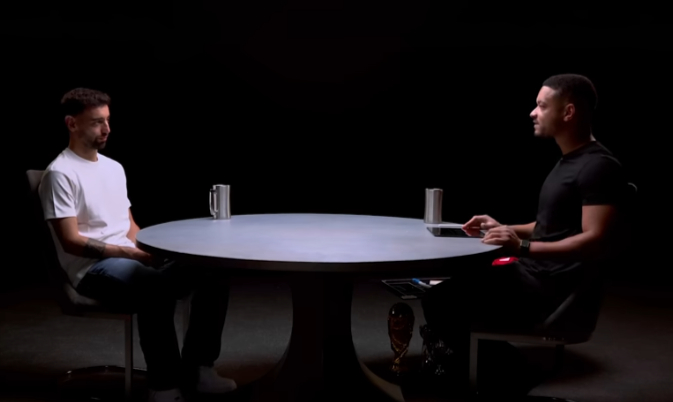
Read the full transcript of Manchester United captain Bruno Fernandes’ interview on The Diary Of A CEO podcast, May 25, 2026.
Editor’s Note: In this episode of The Diary Of A CEO, host Steven Bartlett sits down with Manchester United captain Bruno Fernandes for an intimate, deeply personal conversation. The Portuguese midfielder opens up about his upbringing in Porto, his core family values, and the reasons why he rejected a massive £200 million offer to stay loyal to his dream club. Fernandes also addresses recent media criticisms and reflects on the shifting cultural dynamics, recruitment strategies, and managerial transitions at Old Trafford.
Bruno Fernandes: Early Life, Family Values, and the Making of a Champion
STEVEN BARTLETT: Bruno, to understand somebody, I always think you have to start with where they started and the early context that they grew up in. And we were just talking before we started recording about Porto. I’m on a journey to understand why you are the way that you are, because you’re such an anomaly on the pitch.
And your career, when I track the journey of where you’ve come from and how you continually were promoted and pushed forward at a very young age, it’s clear to me that your early context, your early upbringing, and whatever it was that was present at that age has shaped you in some very, very important way. What is the sort of earliest thing I need to understand about where you came from and that environment?
BRUNO FERNANDES: For me, it’s all about family, it’s about taking care of other people. And I think to succeed, not just in sports, but in life, you need to be very careful of your surroundings. So I think the values of my family, the values of my parents were what make me the person and the player I am today.
The Influence of His Father
STEVEN BARTLETT: The older I’ve gotten, I’m now 33, so I think I’m 2 years older than you, the more I’ve realised, actually, with time, what I learnt from my parents, and the values that my dad in particular gave me. He never, for a lot of the things, it’s not something he ever said to me. It’s like modeling what he did. So seeing how he behaved. What’s that for you?
BRUNO FERNANDES: It’s kind of the same. My father was never a person to show his emotions too much or tell you what to do or how to do it. He would just do it. And you would understand by his behavior, by the way he does things. That was his way of showing us how he has to be doing.
He was never a person of hugging, kissing, and stuff. He’s got now into that. Even when I come out of games and stuff, you see, I always get his hug, I always get his kiss. And this is something that, as a kid, I knew how much he loved me, but in this small aspect, it was always my mom giving this kind of love. He was more, in the way of, he was showing how things have to be done, how much you have to sacrifice yourself to certain things.
My dad was very strong with me in terms of games. Imagine I could come out of a game scoring 2, 3 goals or whatsoever, and my parents, my dad in this case, would always pick up the bad moments I had in games to make me understand that wasn’t— that was good, “But it wasn’t great.” It’s always margin for improvement. It’s all small things.
And I think I’ve learned from such a young age to deal with criticism that I’m now in probably one of the biggest clubs in terms of carrying criticism and attention. That doesn’t hurt me. I don’t like it, obviously no one likes to get criticized, but it doesn’t hurt me. It doesn’t change the way I behave, it doesn’t change the way I want to do things. But from the other side, it makes me understand there are still things to improve. And I listen to that, and I look at my game, and I see if it’s needed of changing, of improvement in my game.
And my dad was always very strong in that with me. And I see nowadays the parents — my dad never wanted me to be a footballer. He wanted me to become a better person, a better player, or a better student. Everything I wanted to do, he just wanted me to do it at 100%. “You want to do this, you have to do the best you can. You can’t just be happy with…” — you go to a test and let’s say in Portugal it was from 0 to 100% and you have 98 and you’ll be the most happiest person in the world. No, you can be happy because that result is amazing, but you left 2% there that you still can improve.
So he was always, always showing me that even if it was just a small thing or a small detail, you still have something more to do. You still have something more that you can improve or become better. And that’s something that has stuck with me, not just in football but in life. I don’t like to do things 50%, 60%, 70%, 80%. Whenever I’m included in something, I want to go full. I want to learn as much as I can. I want to be the best version I can in that aspect, whatever it is.
Starting at 5: FC Infesta and No Fear
STEVEN BARTLETT: It’s really interesting because I wondered to myself how you — I think you started playing football at 5 years old.
BRUNO FERNANDES: Yeah, 5.
STEVEN BARTLETT: And were you good from 5 years old? Were you different from your peers at a young age?
BRUNO FERNANDES: At such a young age, I never think about being a footballer.
STEVEN BARTLETT: And you joined FC Infesta?
BRUNO FERNANDES: Yeah, that was my first club.
STEVEN BARTLETT: At 5 years old. I mean, I’ve got some photos of you as a young man here. You must be roughly around that age then. And remarkably, I read that after one training session, they moved you into the older group, and you played with people 2 years older than you when you were, what, 5 years old?
BRUNO FERNANDES: Yeah, I was 5 playing with the 7-year-olds.
STEVEN BARTLETT: Why did they move you into a different group?
BRUNO FERNANDES: I went for the first session, and it was a futsal session, 5-a-side, but like an indoor thing. And after that first session, they told me that, no, you need to get on the grass. And then I think it comes just — I looked at the other players and at the other people that were training with me, and I didn’t want to be better than them. I just wanted to get at them, which was the same as getting at my brother that was 5 years older than me. For me, it was no difference. If I have to beat him, I will beat him. 1v1, I’m going to go past him. I have to tackle, I’m going to tackle him. He’s going to tackle me stronger, doesn’t matter, I tackle him again. And I had no fear.
And I think that was the thing that make me become better and better because I was never the best. Technical ability, yes, I was good. Was the best? No. Speed, was I quick? Yeah, I was quite quick. Was the quickest? No. Was the strongest? No. Was I the tallest? No. But I had no fear of anything of that. If I had to sprint with someone that was quicker than me, I’m going to go with him and I might not beat him, but I’m going to get close to that.
STEVEN BARTLETT: I actually read that you were so aggressive that referees sometimes asked your coach at Infesta, Sergio, to sub you off, otherwise they’d have to send you off.
BRUNO FERNANDES: Yeah.
STEVEN BARTLETT: I mean, that kind of correlates with what you were saying there about fear. You were aggressive.
BRUNO FERNANDES: I was. That’s what I mean. I had no fear. I wouldn’t look at faces or sizes whatsoever and think, “Oh, he’s bigger than me, he’s going to be stronger than me.” I would get into any ball in any moment in the game with no fear at all.
This is probably the best times in my career between Infesta and Boavista, because this one is Infesta, this one is at Boavista, when I’ve just — I stayed probably a year at Infesta, and Boavista got me straight away.
Moving to Italy: Novara and Udinese
STEVEN BARTLETT: And you moved quickly up and up and up and up. And that was one of the remarkable things I noticed when I looked at you starting playing at 5 years old, getting promoted to an older team, and then quickly, almost in all the clubs — I’m looking at when you were 17 years old and you left Portugal and moved to Italy to join Novara.
BRUNO FERNANDES: Yeah.
STEVEN BARTLETT: And after 3 months there, you were promoted to the first team. And then you very quickly joined Udinese?
BRUNO FERNANDES: Yes.
STEVEN BARTLETT: And at Udinese, you met a guy called Francesco — I can’t pronounce his surname, but — Guidolini?
BRUNO FERNANDES: Guidolini, yeah.
STEVEN BARTLETT: He was really, really formative in your career, wasn’t he? You were, what, 18 years old?
BRUNO FERNANDES: 18 years old, yeah.
STEVEN BARTLETT: Why was he such an important part of your career? What did he teach you or give you at Udinese?
BRUNO FERNANDES: He was the manager that probably gave me the basis and the foundation to be fearless and express myself. To get my head out of so many things that were going on. And as a young kid that has just made the step into the Serie A, you think, “Oh, I need to — now is the moment I need to show myself.” But he was like, “You don’t. You showed me that you have the qualities when you were in second division in Italy. That’s why we bought you.”
And to be honest, I was on the edge of coming to Watford on loan.
STEVEN BARTLETT: Watford?
BRUNO FERNANDES: Yeah, because it’s the same owners. And we’re getting at the edge of the transfer window. They just bought me, and obviously they had a big squad with a lot of players, and they were like, “We’re going to send you to Watford, you’re going to be there playing for them,” blah, blah, blah. And I was like, what have I done? I wasn’t good enough.
And then in the same moment, they called me to go to the hotel, pack my stuff, because it was like the last days of the window. Pack my stuff. I was with my girlfriend, wife now. And she was like, “Don’t worry, we’re going to go anywhere else and you’re going to succeed.” And I said, “But why can’t I make it here? What was it that I did wrong that the manager is not looking at me the same? That is looking to other players.” And in my head, it was like, have I done something wrong? Have I not showed my full potential? Have I not shown that I’m good enough to be in this team?
And I don’t know why, in the middle of all this thought, the sporting director called me again and says, “Bruno, you can’t go anymore. The manager wants you to stay. He says he loved you, he loves your attitude, he wants you to learn from him, he wants you to understand how he wants to play and everything. He says you might not play much this season, but he’s pretty sure that you are the type of player that will succeed at this club.”
And then we had many conversations, and I think when you want a manager for young players that very quickly will play and will think, “Oh, I’m the guy now,” he’s going to make you understand, “Stay calm, I got you, but you’re still not there.” And he was so good for me, it was like a father figure. But not just for me. If you speak with every player that was there at that time, they knew they were important for him because he always showed that.
And that’s why it made me so much more complete in terms of understanding the moments and the process that managers have to go through, their heads and what they think about players that is better or whatsoever, that you don’t understand. Whenever a manager puts you on the bench, you just think, “Doesn’t like me, he’s doing this because he wants to make another one play,” whatever. But the way he did it with me and all the players that were around me at that time, we were so happy that the environment was very, very good.
Dreams and Self-Belief
STEVEN BARTLETT: As a young man, when you’re this age, you’re 18 years old, what are your dreams? And if I’d asked you at the time, what does your future look like? What would you have said to me?
BRUNO FERNANDES: As soon as I became a professional player, I was like, I want to be in the top clubs. I want to play for the big clubs. I want to be in the Champions League. I want to play for trophies. I want to become the players I’m looking at. I want to become like them.
STEVEN BARTLETT: Did you think you could?
BRUNO FERNANDES: Yeah, always. I never doubt.
The Call That Changed Everything
STEVEN BARTLETT: And at 22, you get a call and you return to Portugal and sign a 5-year deal with Sporting, in a deal worth reportedly €8.5 million. That next season, you scored 20 goals and added 13 assists, which is unheard of for a player in your position. And what I read as well is that Tottenham were interested in you at that time, and it was at one point highly likely that you were going to end up moving to Tottenham. I’m very glad you didn’t, as a Man United fan, but tell me about that. So Tottenham call you?
BRUNO FERNANDES: Yeah, I spoke with Tottenham and we were very close to get an agreement done. Then in the last 2 days or 1 day of market, Sporting just said, “We’re not going to sell him, we’re going to keep him because we need him.”
STEVEN BARTLETT: And you wanted to go to Tottenham?
BRUNO FERNANDES: Yes, because I wanted to play in the Premier League. Why? Because for me, it’s the best league in the world. It’s the most competitive one. It’s the one that I think when you grow up, you dream to play for — full stadiums, top clubs, top players.
Obviously, I was lucky enough that my dream club to play in England was Man United, and obviously Tottenham at the time was the option I had, and I was very, very happy to join them because they showed me the process that they were going through, the manager that was there at the time, that also really wanted me, all the new things, the new facilities and everything. So I was very happy with everything that I could see going forward.
But it didn’t happen, and for bigger reasons, I guess. And then in January, I got the call that I was hoping for, for 2, 3 years already.
STEVEN BARTLETT: Tell me about that call. Because I know Manchester United has been in your eye for a long time. I mean, I know you grew up watching people like Cristiano Ronaldo play for this club. And I think when he first played for Portugal, you were a young guy, you were like 8 or 10 years old or something. And he had been a great star of Manchester United. But I think generally, people of our age group, we grew up in the heyday of Manchester United, the Sir Alex Ferguson era as well.
So why Manchester United? And can you zoom me in? If I’m a fly on the wall when you get that phone call from your agent, I guess, that Manchester United are interested — I can see the smile on your face.
BRUNO FERNANDES: Let’s say I was in my wardrobe, I was getting ready to go to bed. My wife was just putting kids — my daughter, at that time I only had my daughter — to bed. And I get the call from my agent.
I knew things were going on and everything, but after what happened with Tottenham, I didn’t want to put my focus on transfer windows. And I never did it in every step of my career that I’ve changed club. I always said to my agent, whenever he’s like 95% sure that the club really wants me and is ready to make an offer, tell me, and then I decide if it’s the right moment and I want to go. Apart from that, I’m like, just keep me apart. I don’t want to know it. I don’t want to lose the focus of what I’m doing to something that I can’t control.
And after the Tottenham thing, I was even more like that, because obviously I was basically done. And then all of a sudden, last day, Sporting just says, “Guys, we’re not going to make it.” So he called me and he said, “Bruno, you told me to not speak to you until we had something—”
STEVEN BARTLETT: Concrete.
BRUNO FERNANDES: Concrete. “But just so you know, they also have agreement already, everything. So it’s just on your side now to say yes or no.”
And I was like, “Yes or no to what?” And he said, “Come on, you’ve seen the news.” I said, “Miguel, the news are every day different. Every day they’re going to put a new club that is interested in me. So I’m not going to be focused on that.” He said, “Okay. Man United is coming for you. I know this is what you want. So just so you know, this is the one that you’ve been waiting for. So it’s on you now to make a decision.”
And then for like 10, 20 seconds, I didn’t say anything. I was crying, but I didn’t want to talk because your voice starts going a little bit chalky. And then all of a sudden, my wife gets into the wardrobe and she says — I’m still on the call — and she goes, “Why are you crying?” And I’m on the phone saying, “Are you crying?” I turned that off and I was like, “Miguel just called me.”
And then in the moment I’m trying to explain to my wife what’s going on, he’s calling me repetitively, like, “I need an answer.” And my wife was like, “Why are you crying so? This is what you have dreamed for. This is the moment you’ve been waiting for.” And I was like, “I don’t know, it’s just too much.”
I’ve never expected, after everything that happened with Tottenham, I would have got the chance to come to the Premier League again. And having the chance to come to the Premier League with Man United is like 100% of the dream complete.
So obviously then I just called him back and I said, “I don’t even want to know anything else, just tell them I’m going.” Obviously, I was very good at Sporting, and I was very happy there, because I really enjoyed my time at Sporting — it was when I became probably the best version of myself as a player, where I improved so much in those 2 and a half years. But then it was like the dream of playing for the Premier League, and I think from every Sporting fan, they really understood that it was time for me to go and do the next step.
Signing for Manchester United
STEVEN BARTLETT: And when you joined Man — I mean, here’s the famous photo of you signing with Manchester United.
BRUNO FERNANDES: Yeah.
STEVEN BARTLETT: It’s funny, the smile that you still have on your face when you look at these photos.
BRUNO FERNANDES: Yes, same. Yeah, it’s because I think when you look back, as I said, this is the day your dream comes true. So it’s probably, professional-wise, I think I put this one and Sporting together because of the importance that Sporting had in my career. But obviously, this was the cherry on top of the cake because this is where I wanted to be.
STEVEN BARTLETT: And you joined the club at a time when the club was in a bit of turmoil, struggling. Sir Alex Ferguson had left, we’d cycled through a bunch of managers, and we had Ole Gunnar Solskjær as the manager. At that point, I think the club was 7th in the Premier League when you joined, and it was going through a time of turbulence. You knew that Manchester United wasn’t the most stable club in the world. But you chose to come here anyway.
And based on your record at Sporting, you would have had a lot of other opportunities to join a club that was more stable. It’s interesting because clubs can have a big impact on a player’s future. Players can have a big impact on a club, but it also goes the other way. And as someone that runs businesses, you know the environment you join has a huge impact on everyone’s behaviour, irrespective of how hard you try. You chose to join a club that was at the time unstable?
BRUNO FERNANDES: Look, the game I watched before I came here was, I think, United-Burnley, and United lost at home 2-1. I don’t remember exactly, but I know they lost that game, and it was just days before I came. And I was like, I still think there is a lot of potential in that team.
And apart from having potential in that team, I’m joining one of the biggest clubs in the world. And I know that clubs go through periods where things don’t go the way they want. But sometimes it’s not just because they’re not great, it’s just because other teams are being better than them. And that’s fine, because in football you’re not going to win all the time.
But the thing you can do is you can bring your own values, your own experience, your own qualities, and try to help everyone else around you to become better, to become the team you want to see. And I think at that time, that period from then to the end of the season, the team was unbelievable. And the season after, we got second place. And because we struggled in certain moments of keeping up to the standard of City, who had a very good end of season.
But for me, I wasn’t like, “I’ll fix that.” I was like, “I’m going to be the magic powder that’s going to solve all the problems.” But I really knew that this club had something special. And for me to join it was like, I can be part of something that is going to become great again. And I still believe that.
And obviously, it can take time. It’s taking more time than I thought. Yes, of course. But at that time, I had too many dreams in my head, and they still are here. And there are still a lot of things that I want to achieve. But this smile and this guy that came here in 2020 is still the same guy that wants to win and succeed at this club.
Culture, Respect, and the Manchester United Environment
STEVEN BARTLETT: I’m wondering, because there’s been so much said about the environment at Manchester United over the years. I know a little bit about the environment when Sir Alex Ferguson was here because I interviewed a lot of his players. And having been to Carrington before and actually going to the grounds and actually sitting in the hospitality lounge and waitresses coming over to me, and talking about when Sir Alex Ferguson was here, and how he knew everyone’s name, and then how it changed — it was really interesting to me to get a lot of this feedback because it highlighted how small things in culture can have a big impact right down to the way players play.
And there’s always the story that Gary Neville told me about Wendy and her charity balls. He told me a story of the players walking past Wendy, who got the charity balls signed for a local charity, and one day a couple of them didn’t sign it. And Sir Alex Ferguson came downstairs and he, quote, “f*ing killed us.” And it’s a strange thing to do — to care that much about a small detail in culture. But over time, Gary told me he understands why Sir Alex Ferguson cared so much.
So my question to you is really about the cultural evolution at this club, and what the fans are desperate to know about — like, how it’s changed and how it feels different from the time you arrived in 2018 up until today.
BRUNO FERNANDES: I’ve brought in my behaviour, the way I’ve been raised and all these things. And I think every different player has brought different things to the club. But I think one of the things that has to be always there is the respect for people. And I think that, for me, is a non-negotiable thing.
Like, if any player comes to this club and he doesn’t respect the physios, the people, the stewards, the people that are in all the desks we have here, the people that work for us in the restaurant, the chefs, and all these people that are around us, taking care of us — even if you don’t see it, or if you don’t think it, or whatever it is — for me, it’s a non-negotiable thing that the respect has to be always there. And more than respect, the care. You need to care about them, because if you have a good foundation, a good base of respect and care in your club, it’s going to get better. The environment gets better. Everything is more positive.
Because I think, and this is probably the way I’ve been raised, I treat everyone in the same way. I don’t treat the players in a way that I don’t treat the cleaning lady or the people that are in the front desk or the stewards at the entrance. If I say good morning to these ones, I say good morning to these ones. I don’t change that. If I give a handshake to these ones, I give a handshake to this one. If I greet them as I’m greeting my teammates, they will feel part of it, they will feel involved, they will feel as important as them.
Even knowing that the role of them is completely different from the others, because the role of a CEO is one thing. But if the cleaner doesn’t clean everything nice and leaves everything prepared and well done, you will notice that something is wrong. You will notice that this is not the place where you want to work. You notice that you don’t want to be the CEO of a company that has trash everywhere.
STEVEN BARTLETT: Yeah.
BRUNO FERNANDES: And so why wouldn’t you greet the person that takes care of you, takes care of your place to look so good and to make an impact when people come in from the outside?
Character, Culture, and Recruitment at Manchester United
STEVEN BARTLETT: It reminds me of something actually Jony Ive said. So Jony Ive is the famous Apple designer that designed all the Apple products that we know and love. And he said, it’s very hard to feel care. He goes, but everyone can feel when someone didn’t care. You go to a restaurant and they didn’t care. Small things. He goes, but it’s like he said, care is just this thing in the background, this ambient feeling you have when you arrive somewhere. But you can’t point out exactly what it is, but you can feel it.
BRUNO FERNANDES: That’s the thing. I think it’s more that you feel it, but you don’t see it.
And I think touching this point, I was talking about cleaners. My mom was cleaning houses for work. So I never wanted the people that were cleaning the house to treat my mom badly, or let’s say downgrade the work she’s doing for them.
Because for example, now I have a person that works in my house. I don’t allow my kids to talk badly to her. I don’t allow my kids to say, “Grab that, put it in place.” And I said it to her in the first day she came to work, and I said, “If something is not in the right place, obviously I want you to clean, I want you to put things in place, I want all of this, but I don’t want my kids to tell you ‘Oh, arrange that,’ or ‘Put this in place.'” No. If they want something, they can ask you, but first of all, they need to be respectful. If they can’t make it, they have to ask you, but in the respect way. But if it’s something that they can make, you have to make them make it. Not like, “Oh, you do it.” No, just explain them how to do it. Show them the way so they learn with it.
And this is probably the way I behave with the people that work with me. It comes a lot because of my background of not liking to see my mom — because I was not in the houses, obviously. I don’t know if they treated well or not. My mum never said to me that any of the people that she worked for were bad to her or treat her in a bad way. So I really think that that made me understand that because I don’t want that for my mum, I won’t make that to other people.
The Post-Ferguson Era: Recruitment and Culture
STEVEN BARTLETT: I’ve been a Man United fan since I was a kid. My siblings were born in Manchester. I was born in Botswana, in Africa. But because I’ve got two older brothers who are Man United fans, I very quickly became a Manchester United fan. I remember like 3, 4 years old. And then as soon as I could, when I was 18, I moved up from the Southwest to Manchester at 18 years old, and I lived here and went to my first Manchester United games.
I’ve seen the club go on this incredible journey from Sir Alex Ferguson’s era to this sort of period of transition to where we are now. And it’s my observation, my honest observation, that after, in the post-Fergie era, the club made some bad decisions as it relates to recruitment and culture. People often talk about Ed Woodward’s — I’m not going to try and stitch you up in any way or get you to talk about anything particular, I’m just expressing my opinion. They talk about Ed Woodward’s strategy towards signing players and it being a bit flippant.
And then you look at the sort of group of lads that we had, and just as a United fan watching on the pitch, I felt the culture was a bit confused. Because it didn’t seem like it seems now, where it seems like there’s this really strong central agreement around the values. It felt a bit, I don’t know, a bit like we had signed players because they were famous or big, but not because they fit.
And I feel when I look at the club now, I go, oh, these guys kind of fit. And whoever’s doing recruiting is thinking about character. It feels to me like there’s been this process over the last couple of years of getting rid of the wrong character profiles. And I think how Amorim really spoke to this, he really talked about getting rid of the players that didn’t have the right character profile.
Just to add one more line to this, I’ve spoken to a lot of players at the club, past and present, and they expressed the same to me as well, that there was an issue with sort of character profile that has now been solved for.
BRUNO FERNANDES: I think the main mistake that the club has done through the years, that we’ve changed manager through manager, they were very different. And that’s already a bad sign, not of recruitment, because then you bring in players that fit that manager, but the next one you brought plays a completely different way, and the 3 or 4 or 5 that you bought don’t fit this one anymore. And then you have to buy another 4 or 5. And then the constant change of strategy in the club, or in the way we wanted to play, or whatsoever, was not the best, because then, obviously, it becomes that the players don’t suit anymore the system.
It’s not even more the character, then it comes up. But it’s more the system. Then obviously, we can talk about character, that certain players were not a perfect fit for the club, but you never know it until you bring it to the club, I think. Sometimes you can see it, and I think there are players that I think the club, by the behaviour they have on the pitch, or the behaviour they have on social media, whatsoever, you can see if they will be a fit for the club or not.
And I think the main thing for the club, as you said there, you need to bring good characters. Because that will be more important to build something than good qualities, because good qualities they will all have. You don’t bring a player to Man United that doesn’t have qualities. But if you can add the qualities to the character, that’s a win-win. Because the qualities will be moments that the quality won’t be as good as you want, because players go through periods that sometimes they play very good, sometimes they play very bad. But the character remains the same.
And that’s the character you want where they are on a low, to be the right character to push himself to be on a high, or at the same time when they are on the low, to be the right character to push the other ones to be at the top level.
And I think that’s the main thing that the club has to do in terms of recruitment and everything, is bringing people, first of all, that want to be at Man United, to play for Man United, not to be at Man United just because it’s a big club. They want to be here because this is the club they think, and they really understand that they want to succeed with this club. They want to bring this club back to the days we were used to see Man United. I know it’s been 12, 13 years, I know, but we want that to get as short as possible, to become that club that won 20 Premier League titles and has joined the most in the Premier League.
So character in a football club is more important than the quality, because the quality, you’re always going to get it, and you can improve it. This is what I heard from Patrice Evra.
“Are You Willing to Die for Manchester United?”
STEVEN BARTLETT: I remember him telling me that he met Sir Alex Ferguson in an airport, I think in France, and Sir Alex Ferguson sat him down and said, “Are you willing to die for Manchester United?” And he said, yes. And so he shook his hand. He said, “Welcome to Manchester United.” And that’s a different way of recruiting. He’s not testing if he can kick a ball well. He’s testing if he’s got the heart and that mentality that I think Fergie and previous sort of cohorts of Manchester United really, really cared about.
BRUNO FERNANDES: I think Sir Alex, obviously he’s done mistakes in recruitment too, because obviously not every player was great, but he always brings players in any time, in any moment, they would fit the club. And that’s the main thing I think in terms of recruitment, that this is like something is not for me to get involved, but I will say it.
I understand the club has different managers coming in, comes in and different ways of playing and whatsoever, but the recruitment has to be for Man United because the player will get normally a 5-year contract and the manager will get 2. And you know that if something is not working, the club always gets rid of the manager first, then it gets rid of the player because it’s much more difficult. So I think you always have to bring players that fit the club, and then you bring managers that fit the club and the players you’ve got.
And I think that has to be the thing that, for example, let’s talk about Klopp and Pep, why they were so successful. Because they chose the players, in together with the club, that will fit the club, the system, and the way they wanted to play. And through the years, have they done mistakes? Of course. Have they bought players that didn’t work? Yes, I think there were more the ones that worked than the ones that didn’t. And the ones that didn’t work, I haven’t seen many of them coming out and talking bad about the club or about the manager whatsoever.
It’s difficult to be there and a club buy you for €50, €60, €70 million, and then you don’t play. When you thought, “Oh, I’m going to play because they’re paying this amount of money for me, I’m going to play.” Then you get there, you don’t play. Of course it’s difficult. But what I’ve seen is that they built in a way that the squad was strong enough to take care of those players that were not playing and were struggling.
Social Media Discipline: A New Culture at the Club
STEVEN BARTLETT: One of the things I’ve noticed as a change, especially this season, is all this social media distraction. People posting on their Instagram stories when they don’t play, their brother, sister posting, “My brother should be playing,” whatever. All of this sort of social media stuff that some players were doing over the last couple of years seems to have vanished.
And this is just an interesting — we talk about small things being interesting signals. It’s one of the things I’ve noticed this year. There isn’t social media nonsense going on. How — I guess my question is, is that something the club has done? Has there been — have they sat you down and said, stop the social media stuff, or is it just a consequence of getting the right people together?
BRUNO FERNANDES: I think it’s a little bit both, but at the same time, I think the club has to be the one being strong with the players. When they see something that is not right, or they don’t like it, or it’s not good on the players, on the team, on the attention this club gets, I think the club needs to talk with them and with the agents, with the families, whatsoever, that speaks out and says something. Because I think it’s also on the players to make the families and everyone that is behind them understand that what they put out or what they say can have consequences on our careers.
STEVEN BARTLETT: Do you talk to the players about this?
BRUNO FERNANDES: If I see something that I don’t like, or if I see them posting or replying to some people on social whatsoever, because from such a young age, I said to my parents, I’ve said to my brother, I’ve said to my sister, “I don’t want you talking without me knowing it.” Not because they don’t know how to talk, whatever, but they’re not aware what can be bad or wrong. They might think they were going to say something that is going to be good for me, but maybe has repercussions on other people, and I don’t want them to do that.
So my parents never spoke, my brother never spoke, my sister never spoke when I wasn’t playing. Let people make noise, let people talk. Doesn’t matter what they say. I know for my mom, for example, she suffers a lot with this. And I say, “Take it in, don’t care, pray, pray at your saints like you do to me all the time, and make sure they do the right thing for me, because that’s what matters.” And she kind of gets okay with that.
Obviously, I know that probably when my brother sees something, or my sister, they want to reply to something, they want to say it’s not true, “Why, why you talking about this, my brother, whatever.” I don’t want them to get involved in that because it’s not going to be good for them, not going to be good for me, and it’s not going to be good for my environment. And I don’t want that.
But I think that is because I was strong with my family in the first moment. And I think that’s how you have to be. I don’t go home to my family and saying, “You know, this manager this, this manager that.” I might say what I like or I don’t like, whatever, but I don’t go in a way of like, if I had someone that could put something out because I’ve been doing this. I don’t care, to people to put out, “Oh, Bruno is training so well, Bruno is doing this, Bruno is doing that.” I know I’m doing it.
Managing Through Change
STEVEN BARTLETT: That’s enough for me. And it’s true because you’ve been through this process of transition with Ollie, then Carrick, then Raph, then Eric, then Ruben, then Fletcher, then Carrick again. And actually, one of the remarkable things is I’ve never noticed your attitude towards the managers be any different. I can’t tell. As far as I’m aware, you support them all, and that’s how it should be. I think if you’ve got a problem, as a player, you should go tell them, but we shouldn’t know, and we don’t know with you. I don’t know what you think of them.
BRUNO FERNANDES: I agree with that because first of all, I like every manager that comes in my way because I learn with them, and every manager that comes in has their own idea, their own thinking, their own way of playing, and they want me to do one thing, the other one another thing, the other one another thing. And for me, that’s good, because they believe that I’m capable of doing different things that I was doing before. So, what I won’t give to the managers is the choice or the option in their head to think, “I’m not going to play Bruno.”
STEVEN BARTLETT: What do you do when you’re not happy about something, though? As the captain, do you go have a chat with them?
BRUNO FERNANDES: No, I do whatever they want me to do. If they think it’s the best thing for the team, I’m going to do it. Either I agree or not, believe it more or not, I make myself available for what they want to do, 100%. If then it works or not, that’s on them to decide that, if it needs to be changed or not. I’m not going to go to the manager and ask them to change formation, the way they play. If they ask me, I give my opinion. If they don’t ask me, I don’t say anything.
STEVEN BARTLETT: What have you learned about what a good manager does and how to be a good manager from the 6 managers you’ve had?
BRUNO FERNANDES: Through my career, I’ve always heard that certain players should be treated in a different way than other players. I don’t believe in that. It’s like the same as having a business. You buy certain people to do certain things because you believe they’re the right person to do that. So I don’t think that you then should change the way you behave with them. You should probably approach them in different ways. I believe in that because I’m not the same as you.
Demanding the Best From Teammates
STEVEN BARTLETT: So do you treat players differently on the pitch? Because you shout at lots of your teammates. Are there some that you won’t shout at as much?
BRUNO FERNANDES: I treat all of them the same, and I think they’re kind of getting to know exactly why I do it. Imagine, during the week we train something, and we have seen images of this, we know what we have to do, the manager has prepared us for that. I demand that, at least. I don’t care who you are. We’ve been a full week preparing the training, the game for this. This we need to know how to do it. Then if you can make a pass, or you can make a goal, or you can make a tackle, that’s different. Those are the qualities I need from each one individually.
But I’ve learned to talk with them in different ways, but with the same end result. Not like, I won’t go to one and be scared of saying things to him, and the other one, because he’s younger, I’m going to shout at him. No, if I have to shout at this one, I will shout at this one. If I have to shout at this one, I’ll shout this one. If I have to praise this one, I’ll praise this one the same way I praise this one.
And I think that you can see in my interviews. I’m not afraid of saying what I feel. At the same time, I’m not afraid of praising players for what they have done or what they’re doing, even if they probably in the moment, they haven’t done as much as they needed to get the praise. But for me, I think he needs that praise to get into the next level. I’m going to give him something, but I make him aware. “I’ve given you something, but I’m expecting something more from you.” It’s like my dad giving me, “You need to be better, you need to do more,” because he knows I’m capable of more.
And this is why I demand from the players. I demand, I’m very strong on them, because I really believe in them. I have said this so many times to so many different players. It’s like, “Trust me, the day I stop talking to you, the day I stop shouting at you is because I don’t believe in you anymore and I don’t believe you can improve anymore.”
Navigating the Managerial Rollercoaster
STEVEN BARTLETT: Your time at Manchester United’s been a bit of a rollercoaster, kind of up and down and up and down. You went second and then you dropped down the league, you’re second. The last two years have been a prime example of that, finishing near the bottom end of the table and then this year back up to third. As a fan, when things get bad and you hear all these rumours breaking online that the manager’s going to be sacked, does that impact the dressing room? You’ve been through it so many times where a manager has been removed — what’s that like when you know things are going bad?
BRUNO FERNANDES: First of all, you feel it for the manager. That’s the first thing, because obviously certain players will feel it more than others, because it’s those players that play more than others. And obviously, the ones that probably don’t play, they don’t like to see managers going, but at the same time, if a new manager comes in, it’s a new opportunity for them to probably get into the team more times than they were getting before.
And I think going through the process of changing manager is probably the worst thing in sports, because it’s starting from zero again. And either people believe it or not, when you’re through a process, you want to get to the end of the process and understand what that has given to you as a player. And what you can do more with that staff, with that team, and with that manager to go even further.
STEVEN BARTLETT: Why didn’t you lose hope? Because you went through that process of starting from zero, making progress, manager goes, back to zero, making progress, manager goes, back to zero.
BRUNO FERNANDES: You know why? Because every time — I’ve spoken about this with Diogo before — every time we come for preseason, it’s like a new start. And you always get that belief of like, “This is going to be the time, this is going to be the time.” These moments through the season that you get this belief, the things are not going well. But the main thing I have is belief in myself. So I always think, if I do things right, and I take people to do things right, and I help them to do things right as a team, we still have a chance of pushing ourselves into positions we want to be.
And this season has been that case because we struggled. Obviously, we didn’t change manager because of results, because we were 2 points behind second place and like 5 points behind first place. From third to seventh place, everyone had the same points, something like that. So we were there. It was something different with the club — they felt that the trust between them was broken or whatsoever, and they decided to start a new process. And that was bad, because for us, when Ruben came, what was passed from the club was like, “This is going to be a process, but we’re going to go through this. There are going to be good and bad times, but we’re going to go through this.”
Obviously, then the club decided that it was time to part ways, and you started from zero with Michael. But then you got results. You went to the end of the season and you finished third. And in the time Michael was here till the end of the season, we were probably the team that made the most points.
STEVEN BARTLETT: What did Michael change?
BRUNO FERNANDES: I think in the first moment, what Michael tried to do was give stability to the team because, as every manager understands, when you come in after a break, you understand that you need to give stability and peace of mind to the players to get back to the level he thought we could have. And he brought the foundation and the base that has been in this club from the time he played till the time he managed, and then he left. So he knows the club, he knows how the club wants to play, and he knows what the fans want to see.
Michael’s Leadership Style
STEVEN BARTLETT: How was he different? What tactically, or from a character perspective, does Michael bring as a manager? I know, just an hour ago or so, it was announced that he’s going to be the Manchester United manager going forward, which is great news. But if you had to describe him to me as a leader and a manager, how is he different?
BRUNO FERNANDES: I think he gives you a lot of calmness, in terms of what he wants from the team, the way he demands, the way he coaches. He gives you a good way of going to the game with a good peace of mind, but with a lot of responsibility. Because I think, from the time he was here with Sir Alex, he gave a lot of responsibility to the players to make decisions and to make choices on the pitch that have to be on you.
He gives you the base, he gives you the foundation, he gives you certain rules — the non-negotiable ones — but then he also knows and he wants us to take some responsibility through the game, because things might change. You prepare a game a full week, obviously, but then the team could come and do a different thing. Like, you prepare to play against a 4-3-3 because they always played 4-3-3, and then they come and they play 3-5-2. And then you go like, “Oh, and now?”
The manager can’t be on the sideline telling you where to press, where to go. So, as a player, you have the foundation, you have the base, you have the rules, the non-negotiables, and from there on, we need to find a way of, like, “Okay, let’s imagine we can’t press, because they’ve changed everything and the press we prepared was not the one we needed. Let’s get compact, let’s get together, they don’t get into our block. When we have the ball, we play with the ball.” We get into halftime, and then the manager will give us the message that he wants to give, or whatever he has seen that we need to do differently, in a way of getting a better result.
And I think that’s what he gave to us — the calmness, and the way he prepares games was very good. But when things were not going in the way we wanted, he gave responsibility to the players to make it work, and then we solve it.
STEVEN BARTLETT: So like a bit of freedom to—
BRUNO FERNANDES: It’s not exactly freedom, because freedom is a different thing. It’s like, he gives you freedom with the ball to make decisions, because he says, “That’s your responsibility on the ball. I can’t tell you where to pass the ball. I can’t tell you where to shoot. I can help you where the space is going to be.” And I think that the most important thing for a player is knowing where space is going to be. You need to know where spaces are, to then play with it.
You know that they have big gaps there, that we can hurt them from there. And this is the message that Michael has passed to the team. It’s like, “If we attack from here, they have less people on this side, we can bring more people in the box from this side. We want a very good counter-press because they have 2 strikers, so we need to have 3 people in the back. 2 of them mark, 1 of them stays behind.” So these are the small things and the foundation that he gives to us.
But then he says many times, “I can’t tell you where to pass, I can’t tell you where to shoot. I give you the solutions, but they might not be there. So you have to find a way of making the good pass, the good shot, the good decision, because I’m not going to be in your head in that moment. In your head, it’s going to be the ideas I gave you, and some of them will be good, some of them won’t work out. So you have to find a way of understanding the good ones I gave you, and the other ones that are not working well, you need to find a way of making it work.”
STEVEN BARTLETT: So it’s more just that he gives you the principles instead of specific instructions on how to play and what to do.
Risk, Tactics, and Playing Style
BRUNO FERNANDES: He kind of gives you, but then he lets you balance through the game. He lets the players read the game, because in 90 minutes, many things happen, and not going to always happen what you see in the video. Hopefully, yes, but not always.
For example, let’s say we had the chance against Nottingham Forest that I passed the ball to Bryan and he scores. We have seen the same chance from Villa against Forest. The exact same chance, exact same movements, exact same passes. And we’ve seen that, we visualized that. And that’s why that works, because we had the ideas, we knew we could make that happen, and we made it.
STEVEN BARTLETT: Does he get angry? Because he seems like such a calm guy. When you see him in press conferences, he’s very calm and very, you know.
BRUNO FERNANDES: Yeah, he did get angry once or twice, but he’s very calm in the way he speaks. But I think everyone gets angry anyway. But he’s a very calm presence and is someone that speaks very well, knows the timing, the words. He knows what to say. And whenever he got — when he, let’s say, more aggressive within us, was the time that we needed to get that from him.
The Philosophy of Risk and Reward
STEVEN BARTLETT: And the way that you play is interesting, because when I was looking at a bunch of your quotes over time, but also how I think about business, you are a player that takes more risks than most people. And we talk a lot about failure in business and how you have to increase your rate of failure to get better outcomes.
But you’re a player that is not shy of taking a risk. And you play in a way where you sometimes lose the ball, but you also, as we’ve seen this year and in many other years, you often are generating more opportunities than any other player on the pitch. How do you think about this?
Because the way you play means that sometimes you’re going to make a lot of mistakes. You’re going to lose the ball more so than other players. I’d argue even more so than some of the previous midfielders we’ve had, like Carrick, who would often choose a more safe option than trying to play it through a thin gap. What’s your attitude towards risk? I think it’s always risk-reward, you know?
BRUNO FERNANDES: You need to understand how much reward you’re going to get from that, and if taking that risk is good for the team or not. Let’s say the position I play, you need that. It has to be one of your main skills to take risks, to do things that the game demands from you, and to make sure that your teammates in the front get the ball in the positions there is going to be the rate of success for them to score a goal is going to be higher.
I might miss 2 or 3 times, but if I get one right, that can become a goal for us. I think there’s nothing better than a risk-reward that is a goal. So I think when you play as a number 10 position, obviously you don’t want to lose the ball. You have to make that as less as possible. But in certain positions, you lose the ball more often than others. Wingers will lose more the ball on 1v1s than midfielders do. Fullbacks will do normally more crosses than center-backs will do. Number 6s will make more tackles than a striker will do.
So it’s a balance in the team that you need to have. Let’s imagine I played with Kobe and Kassad. They’re not a risk player. So if I take 4 times, let’s say, risky pass, and they take 1 each, that’s 6 times a game. So I need to be the one that takes 4, they need to be the ones that take 1 each, because the responsibility they have in the team is the one that they make the team play from the build-up, push the team forward, to then get the ball into the players that have to take the risks. Because if you don’t have the players that take the risks, you’re going to end up bubbling.
And we talk, for example, let’s say Man City. There is a team that’s, let’s say, Guardiola, tiki-taka, all these things. De Bruyne was the player that takes the risks. Cherki is now the player that takes the risks. Phil Foden, Doku, Mahrez will be the ones that are taking the risks on a 1v1.
STEVEN BARTLETT: Has a manager ever told you to take less risks?
BRUNO FERNANDES: Éric told me to take less shots. Less shots? From the outside of the box. He showed me a board with my success rating of shots on target, shots off target, and goals. Showed me the positions where I was more effective, and he told me, “I think you need to get more into these positions to then make your shot.”
Into what positions? Let’s say, close to the box, like in the position we will see the box. And he would say, “More towards left-hand side, you score more goals. More towards the right-hand side, you aim more at the goal. Towards the middle of the edge of the box, you miss more shots.” So it was like, get more into the left side or get more into the right side, or close range, long range.
But then obviously, we come back to the risk and reward, because sometimes, obviously, you’re going to score a great goal from 25 yards out. But how many times you’re going to do it? Out of 5, you maybe score 1, and it’s a lot already. So I need to make that risk become less and less and less, getting more risk probably from 18 yards, because there the possibility of me scoring a goal, it might be 3 in 5, because I’m much more closer, I can put more power in the ball, I can be much more effective.
Positions on the Pitch
STEVEN BARTLETT: You’ve had lots of managers, so they’ve all asked you to play in different positions. But on this pitch here, where is it that you like to play the most?
BRUNO FERNANDES: I think the positions where I can be more effective is this square, let’s say. Yeah. I would say, let’s put it like this. Yeah, no, just need a square. Oh, you just need a square. This is, let’s say, imagine we attacking this side. This is the spaces where I think I can be more effective, in this square here.
STEVEN BARTLETT: And different managers asked you to play in different positions within here?
BRUNO FERNANDES: Yes, because for example, let’s say, let’s put here. With Ruben, he used to play 3 at the back, 1 wing back, 2 midfielders, another wing back, and striker, and 2 10s. With Ruben, I played a lot of times here in this position when he first came, and he wanted me in this position, these 2. More than often, he wanted me to be one of these two, to help here, to help these two midfielders to build up and to get this guy higher in a position when he can be in the last line and to get the ball into these two.
STEVEN BARTLETT: So what position would you call that? Like left—
BRUNO FERNANDES: This was the left 10, let’s say, but he wanted me to play more like as a left midfielder to help them to, first of all, to have more stability in the middle. Second, to get the ball going forward, to take the risk of passing the ball forward. Then I played a lot of times here.
STEVEN BARTLETT: What we’re going to do is we’re going to make you, unfortunately, we’re going to make you blue just so we can see which one you are.
BRUNO FERNANDES: Okay. So in this one, when I played here, many times he wanted me here because they were pressing, let’s say, 3 against 3, and he wanted me to come and do the overload. So we have one more player to build up. So they will open up these ones a little bit more. Get this one more offensive. Normally it was Luke Shaw, and as a fullback he was used to play in this space. And so then we could drive the ball and they couldn’t press with the 3 they had. They wouldn’t be able to press because we always had this one also to bounce the ball.
Then whenever we go up the pitch with the ball, he wanted me here. Ruben did? Yeah. He wanted me to play more, a little bit more higher, to be one of the 3 tens and make this line of 3 tens.
Then for example, with Ole, I was playing — we would play like 4-2-3-1, and I will be the number 10, and you wanted me to do this. Oh, okay, go across. And sometimes you wanted me to do this and get the ball here or here to make the long passes and to make the switches to the wingers.
I think this bit here in the middle is where I’m more — I think we all can see the best version of Bruno. If you ask me where I prefer to play, anywhere on the pitch. I think for the way we play, this is the position I can be more effective, but I think I really enjoy to play here because I really enjoy to get the team to play. And I played many times with Ten Hag like this. I was the number 6 playing with two 8s, and I really enjoyed to play here. And it made myself being different, a different player, more aggressive off the ball, someone that has to cover spaces for these ones.
Commitment and Fitness
STEVEN BARTLETT: Regardless of where you are on the pitch, which can change, what is non-negotiable in terms of how you play?
BRUNO FERNANDES: Commitment. That’s non-negotiable. The commitment I have for what we have to do. It doesn’t change by me liking the position or not, me preferring one position or the other. That won’t change. I think running, fighting, and team spirit can never miss.
STEVEN BARTLETT: It doesn’t appear to me that you ever get tired. And also, one remarkable thing about you is you don’t seem to ever get injured.
BRUNO FERNANDES: I get tired and I got injured, unfortunately.
STEVEN BARTLETT: But how does that happen? Because I watch you run, it’d be the 89th minute and you’re running up and down still. Is that genetic or is that something you do in training?
BRUNO FERNANDES: I think obviously I have to say that I have good genetics, but I was talking with Diogo about this the other day also, and the nutritionist, about genetics, how you treat yourself and everything. But then at the same time, I said to them, “You know what’s different on me than the other ones? Because I always train 100%. I make the training as a game. I don’t care. I go full. And if I don’t feel good, I need to make some extras. If I feel that the training wasn’t like enough, let’s do something else. Let’s do some shots. Let’s do some crosses to someone. Let’s do something that can make me go out of training and feeling like I’m tired.” Why is that important?
STEVEN BARTLETT: Because I think in the game you need to get tired.
Training the Mind and Body Under Fatigue
BRUNO FERNANDES: And then, for example, when I’m training shooting practice or last third passes, I rather train that when I’m tired, because it’s going to be the last 20 minutes of the game. Your brain is not going to work in the same way it was working in the beginning, because you get tired and you get to think slower a little bit. So you need to be able to train your body and your brain when they are tired. And I think if you do that in training, when you get to the game and you start getting tired, your brain is used to that also. Your body is used to be tired, and it knows how to react into that moment.
Becoming Captain of Manchester United
STEVEN BARTLETT: These core principles that have been central to how you play have led you to being given this, the captain’s armband, which was quite— There was lots of talk of it at the time because Maguire was the captain before you, and it’s quite atypical for the captain to be displaced while they’re still at the club and for someone else to be brought in. And as fans from the outside, we wonder, how Maguire takes that, how Harry reacts to that, but also what that means to you to become captain of your dream club.
BRUNO FERNANDES: Obviously, for me, it was a strange time because I was not expecting it. Ten Hag called me to his office to speak with me and to ask me if I wanted to be the captain of the club, because he had decided to change the captain and he wanted me to be the one to lead the team from now on.
Obviously, first thought was like, very grateful. It’s something that I’ve never dreamed about. You can have many dreams, but you don’t dream about being the captain of your club. And I think the second thought was like, this is going to be tough on Harry.
And the first person that I spoke with after I got out of that was Harry, because he knew already. I think the manager spoke to him, and before I said yes, I went to speak with him. Because the manager basically made me question if I wanted also. He didn’t say, like, “You’re going to be the captain, that’s it, point.” He asked me.
And I went to speak with Harry and the first question I made was if he was leaving the club. Because obviously, as you said, it’s not something normal. I’ve never been through this in my whole career. And I spoke with him about the offer that they gave to me, and to be honest, to him. And he said, “If there is someone that deserves that, it’s you. And I’m very, very happy that it’s you getting the captain armband, that if I have to take it off for myself, I think you really deserve that.”
And I think that was the point that made me understand I was doing things right. Obviously, I know for him it was very difficult, and I don’t think he would have said something bad, even if he felt it, to me. But the way we spoke and the way I think I’ve been treating him through these years also — in the same way of, I said straight away to him, “You might have lost that armband, but you’re still one of our leaders, and that won’t change everything that we’ve been through.”
Because Harry, when he was the captain, we always made decisions together also, because I was one of them, and that hasn’t changed now, because every time I have to do or take some decisions for the team, I speak with certain players, and Harry is one of them that is always there.
A Record-Breaking Season
STEVEN BARTLETT: And your performance this season speaks for itself. You’ve won, you’ve done 34 appearances, which I think is an achievement in and of itself because a lot of players aren’t that consistent on the pitch. You’ve scored 8 goals, 20 assists. You’ve got 12 Player of the Match awards, which is the most by any player in the Premier League, 6 Player of the Month awards, and only Sergio Aguero, Harry Kane, and Mohamed Salah have more. All of them have 7.
And you’ve also won Sir Matt Busby’s Player of the Year award for the 5th time. The most by any other Man United player, and that’s an award voted by the fans. And there’s other awards that I know you’ve won in recent times. I saw you on stage the other day winning more awards. What’s happened? Why are you suddenly — you’ve been consistent throughout the whole time since you’ve been at the club, but this year seems to stand out for some reason.
BRUNO FERNANDES: I think for this season, first of all, I think when the team shines, the individual comes up. And I think this season is being much better from the last, let’s say, 2 seasons. At the same time, I think the assists record and all this going around made me having a lot of headlines and stuff like that. Obviously, it’s an achievement that hasn’t been done for any player. It’s just Kevin De Bruyne and Thierry Henry.
STEVEN BARTLETT: So I’ve got the little graph here. It says, yeah, Kevin De Bruyne and Thierry Henry. I actually spoke to Thierry about this as well, and he sends his regards to you, congratulates you on joining him up there with the record.
BRUNO FERNANDES: Yeah, it’s something that I’m very grateful for. To put my name in this case with them up there is something that I’ve never dreamed about or think about. I probably start thinking about that when I got probably into 16, 17 assists. I was like, “Oh, I’m actually getting closer now.” But it was not something that was in my head, because in my head it’s always improving my last season and getting better numbers, better outputs, better performance. And it was never in my mind that I would go to 18, 19, 20, or whatsoever. But obviously, when you start getting close, you start thinking about it a little bit.
STEVEN BARTLETT: And then all of us as fans start watching the games to see if you can do it.
BRUNO FERNANDES: And then, obviously, I’ve been very consistent in terms of performance during my 6 years here, but probably other years were people that stand out more than me, and that’s why I probably didn’t get as much attention as I did this season.
Dealing With Criticism and Misrepresentation
STEVEN BARTLETT: With being captain and with being at the biggest club in the world, I think in terms of fan base, with that comes pressure and responsibility. The world talks about you, no matter what industry you’re in, an occupational hazard of being at the very, very top or the peak of your powers — being even better is more and more talk. And I think especially because of this, people are talking even more about Bruno Fernandes than I’ve ever seen.
In my group chat, I’ve got a Man United group chat, and we’re watching the game, we were willing you to reach this record, which you did. And now because people are saying you’re the Player of the Year in the Premier League, they’re giving you all these big awards. With that comes even more criticism. And I think this is where your childhood has prepared you. Your dad sounds like your dad prepared you.
I wanted to clear something up because it was on my mind, and I imagine it’s frustrating for you, which is when your words are twisted in the media. And recently Roy Keane criticized your mentality based on a quote he got completely backwards. He claimed you said, “I should have shot, but I made the passes,” and used that to suggest that you were chasing individual assist stats. But everyone who actually listened to the interview, including myself, noticed you said almost the exact opposite. You were being self-critical of yourself in saying you should have passed the ball instead of shot because you wanted the best for your team.
And so, interestingly, because I’ve spoken to so many of your teammates over the last couple of days about you, they also told me that this is the exact opposite of your mentality on the pitch and off the pitch. And I know it must be frustrating for your leadership style to be sort of misrepresented in that way. How do you respond to that? Like, how do you deal with that when you hear it and you go, “That’s not what I said”?
BRUNO FERNANDES: Yeah, to be honest, I’ve always said, I don’t mind criticism. I’ve always taken criticism from everyone and anyone, and I never replied to anything or whatsoever. People have an opinion, they think it’s good, bad, whatever. What I don’t like is when people lie about things.
And this case that you said about Roy Keane — basically what he said is a lie because either he saw some other interview, or he can’t say that I said one thing that I have just not said. And luckily for me, it’s everything on record. Imagine if it wasn’t, then people will think, “Oh yeah, Bruno is the guy always trying to get the assist.”
But one thing that is consistent is my number of creations is always the same. So it’s not that I’ve been trying to reach this now. I’ve been creating chances since I came to the Premier League, probably more than anyone else. So he hasn’t changed that. The type of play, or aim of play, or way of playing hasn’t changed since I came to the Premier League. It’s not that this season, probably, Roy Keane saw someone like Bruno creating more because he wanted the assist record. No, he’s seeing the same Bruno that is about risk-reward, is about creating chances for his teammates, is about getting the best out of the other ones.
Because the thing is, you will get criticized anyway. If you’re scoring goals, you’ll get criticized because you’re not passing the ball and you’re shooting. If you’re doing assists, it’s because you’re passing too much and you’re not shooting to score goals. It’s going to always be like that. People will always make the balance the way they want. They won’t balance things, they will put it the way they want the things to be.
And obviously, I think I’ve always showed a lot of respect for Roy Keane and for everything he’s done for the club and for everything he’s always said. I’ve never ever had something to say. I’ve never said something wrong. I even asked for his number to text him, to be honest, to have a word with him, to say that I don’t mind the criticism. I don’t like when people lie about things that I say, because this goes a little bit over the top of the things that I think are acceptable.
I accept criticism. I accept that he can say things that I don’t like, and I don’t like to see it. But as I said before, that improves me. What I don’t like is that people make their own words on what I said, and it’s not true. He can criticize me, killing me, say that I’m not good enough, that I’m not a good captain for him, that I’m not a good player for the club whatsoever. It’s bad. It’s okay. I don’t mind. It’s your opinion.
Obviously I prefer Roy Keane to give me some praise sometimes because I’ve achieved something that not many players have achieved. I understand that this club is about winning trophies. I’ve never taken that off my mind. I’ve always said in front of everyone that I want to win the Premier League and the Champions League. I never said I wanted to be the best player in the Premier League. Never one time any person has heard that Bruno wanted to get the assist record or get the goals record or get the player of the season or get being better than anyone else. No, Bruno wants the club to be successful. Bruno wants the club to win trophies, and that’s all Bruno wants.
I accept his criticism. I accept that he might like me as a player or not, likes me as a person or not. But what I don’t like is that he puts words in my mouth that have not been said. That’s the only thing I don’t like.
Teammates Speak Out
STEVEN BARTLETT: Well, I did actually ask your teammates what you were like, and I asked them on and off camera, on and off the record. I couldn’t get some of them to be very serious, but what I received is lots and lots of voice notes from lots and lots of your former players. I texted around last night, and I’ll play you what they said. My friend Bruno, taking this opportunity to spread some love to you.
The Messages From His Teammates
VIDEO CLIP BEGINS:
BRUNO FERNANDES: I just wanted to take this opportunity to tell you how much we value you as a player and as a person. I think not many people get to see how you are after the games and outside of the pitch. So I would say that’s one of your best qualities, the way you care, the way you’re one of the first to help everyone, leadership, your consistency. That’s something that I take from example, and you know it. It’s been a lot of years together right now, so hopefully this can continue and we can win so many things and so much more things together.
UNIDENTIFIED SPEAKER: Skipper, Tom, for me, you’re a world-class footballer, consistently world-class as well, which is very difficult. I think everyone knows that, how good you are. But I think more importantly, from my view, is how you are as a human being, and that’s the side that not many people get to see. You know, the caring, compassionate, supporting, demanding at the right times. But yeah, I think for me, that is by far and away probably your best quality. It’s why you’re the leader of this team and such a good human being. So for me, proud to call you the captain, but more importantly, a friend.
UNIDENTIFIED SPEAKER: So, top class. I mean, what he does on the pitch obviously speaks for itself, but I mean, away from football, he’s an unbelievable human being. The way he treats people, looks after people, the way he lifts others when they need it. And I feel like the respect he gives everyone around him, that says everything about his character. And I feel like I’ve been lucky to spend a number of years with him. And he’s one of them people that you kind of appreciate having around you every single day. He’s the type of player who makes people around him better without even trying. We love you, Capitano. We love you, Capitano.
VIDEO CLIP ENDS:
STEVEN BARTLETT: I mean, I had so many more, but we just don’t have the time.
BRUNO FERNANDES: Yeah, no, it’s just the standout from that for me is just the way they speak about me as a person, not more as a player. And you picked some people that I’m very demanding on them, like Diogo and Lucas, as being probably the players that have been more time with me. Tom is probably up there with Harry. Harry, Luke, Diogo, and then Tom. And these are people that I really respect a lot, but as I said to you, it’s not what they say about me as a player, it’s more what they say about me as a person. That makes me very proud and very happy because you can be a good player, and I’m going to meet a lot of good players in the world of football, and you can train with a lot of them and meet them a lot. But I think that what stays at the end is the way you behave as a person, and I like to see that I have the good values that my parents showed me.
STEVEN BARTLETT: That’s what I said at the start, when you started describing what your parents had instilled in you back in Porto. It sounded like what all your colleagues and the players you play with said to me as well, because I’ve done this before, and people will say, “Oh, he’s a great player, he’s amazing,” whatever. But what was consistently true through all of those messages, and there’s so many more, is they all chose to speak about you as a human. And that clearly comes from whatever your parents did at a young age. Why does that mean so much to you? I can see it in your face.
BRUNO FERNANDES: Because as I said to you, I think as a player, you can be as good as you want. At the end of the day, I think the way you behave and the way you treat people around you is the most important thing. Because you spend so much time with them that they kind of become part of your day by day. You see them more often than I see my parents, for example.
Obviously, my wife and my kids are the people that I see the most, but then after that, them. I don’t see my friends from Portugal as often as them, my parents, my brother, my sister. I see more them. And the way I behave, the way I’ve been raised, the way I want to live my life, and the way I want my kids to be is the way they have said the things about me. And this makes me very proud.
STEVEN BARTLETT: What is that emotion?
BRUNO FERNANDES: I don’t know, it’s just like, it’s good to hear that, just that.
STEVEN BARTLETT: It’s so interesting because I don’t think anybody else that I’ve met would respond how you’re responding to hearing people talk about you as a man and as a human.
BRUNO FERNANDES: I don’t know. I’m just a soft guy. It doesn’t look on the pitch, but I’m quite a soft guy.
Why He Chose to Stay at Manchester United
STEVEN BARTLETT: One thing I’ve learned from interviewing a lot of founders and building companies myself is that trust is the real currency of business. It’s the thing that gets customers to buy, partners to say yes, and investors to back you. But as you grow, trust stops being just a feeling and becomes something you have to prove. Because the bigger you get, the more exposed you are. Customer data, security expectations, regulations, all of it. And the risk of one small mistake becomes incredibly significant. And if you’ve ever tried to scale while keeping on top of all of that, you’ll know it can become a full-time job.
But our sponsor Vanta automates your compliance processes and brings compliance, risk, and customer trust together through their AI-powered platform. And the companies already using Vanta say they spend 82% less time on audits because of Vanta’s platform. So if your organization wants to inject time back into building and growing, make sure you head over to vanta.com/diary. That’s vanta.com/diary.
I’ve done almost 700 interviews with some of the most interesting people in the world. And one of the things you learn, which is unexpected, is that vulnerability is the doorway to connection. And after sitting here for 2, 3 hours with a guest, I feel a deep sense of connection to them. And as they leave, what I get them to do is to write a question in the Diary of a CEO. We’ve taken all of the questions from the Diary of a CEO. We have put the question here on this card with the name of the person that wrote it. So you can sit at home, as I do with my fiancée and my colleagues at work and other people in my life, whenever we get a minute, we play the Diary of a CEO conversation cards. And it is incredible what happens.
These are great if you’re in a romantic relationship and you want to connect with your partner more. These are also great if you’re in a team and you want to bond your team together. And I have to say, they’re also great for families that want to learn more about each other and that need a good excuse to spend some time in a digital world, in the analog environment, connecting human to human. It is remarkable what the right question at the right time can do. Go to thediary.com and you can get these conversation cards right now.
One of the things I learned through my investigations is that you have a clause in your contract, and you don’t have to confirm or deny this, I’m not going to ask you to, but what I discovered is that you have a clause in your contract which allows you to leave for, I found out, £60 million. And you chose not to leave Manchester United. You got a very, very, very large financial offer. I mean, I’ve seen some of the numbers that are reported, up to £200 million to leave Manchester United. And you chose not to leave.
You could have rode off into the sunset. You, frankly, I think the way you were playing, you could have gone to almost any club in the world. You could have got paid more. And probably would have had a more certain guarantee of winning silverware. And for some reason, you chose to stay. When that offer came in, reportedly from the Middle East, the big offer that we’re hearing, for a contract that was worth reportedly £200 million, why didn’t you go?
BRUNO FERNANDES: I said it before, I haven’t fulfilled my dreams here at this club.
STEVEN BARTLETT: Was that a conversation you had with your wife? What was that conversation? She seems to be there all the time when you make these big decisions.
BRUNO FERNANDES: I never make a decision by myself because obviously moving around nowadays with two kids has a lot to say. And more than, I don’t know, becoming the most richest person in my hometown, I want to live my dreams and pass through the values to my kids that they need to have. And my family is always going to be the number one priority in everything I do because they followed my dream.
F*ing hell. My wife, obviously, I know on the other side it looks like a great life, obviously a lot of money, a lot of good things, but she chose to live my dream with me. And that says a lot about her because let’s say that when she chose to do that, I was 17 years old, going to a club with, how you say, 1,500 a month, in Italy, a lot of uncertainty, let’s say. She had her own life, she had her own dreams. And obviously she said, “I’m going to help you.” And that’s what she did since day one until now. So she always has a say on everything I do.
STEVEN BARTLETT: And you’ve been with her since she was 16. You were 16?
BRUNO FERNANDES: She was 16, I was about to be 17, so more or less that. And then after that, we have constructed a beautiful family. Two beautiful kids.
STEVEN BARTLETT: And so on that day when you get a big offer to leave Manchester United, she’s the first person you speak to?
BRUNO FERNANDES: Of course. As always, I spoke obviously first to my agent because he speaks with me about the offer, but then the first thing I did was call her. And I was in, I think it was Hong Kong that we were. We went on the post-season tour, and the timing was not the best to talk with her because of the time difference and everything. But she was there again, and the words she said were, “Have you achieved everything you wanted to achieve in your career?” “Is this the next step you want to give for your future and for your career?” Because obviously, this is the league I want to be in. This is the best league in the world. This is where I’m going to enjoy my football as I’m not going to enjoy it in any other place. So we still have dreams to fulfil.
STEVEN BARTLETT: Why does that make you emotional?
BRUNO FERNANDES: Talking about family. It’s tough, just because in the football career you go through a lot of ups and downs and a lot of difficult moments. And let’s say the ones that suffered most are them, because they see your good moments, your bad moments, your good things, your bad things, your good side, your bad side also. But they always stand by you, so that’s the most important thing you can have in life.
The Woman Behind the Captain
STEVEN BARTLETT: She’s always been there. She looks like my fiancée a little bit. She’s Portuguese. Portuguese girl.
BRUNO FERNANDES: Very down to earth, I hear. Yeah, she is. She’s the one that pushes me down to earth also when I’m probably getting too much or feeling too big. She’s always also very, very tough on me to make me understand all the things to improve. She’s my, let’s say, she’s the second version of my dad. Probably that’s why I chose her and she chose me in a certain way.
STEVEN BARTLETT: Does she know this? Have you been able to tell her?
BRUNO FERNANDES: Yeah. She’s going to — I can’t say the words of what she’s going to say after she sees this and sees me crying. She’s going to say I’m very soft. I won’t say the word exactly, but let’s say I’m the affection one. The one that likes hugs, that likes — she’s more — I don’t know, she likes — I think through her life, she had many things going on, and she built this thing around her that she doesn’t need — let’s say she doesn’t need much love or whatsoever.
But there are many moments where I know she needs it, I know she feels it, I know she kind of — she’s just not good at saying what she feels. And I’m more open. I show more my emotions. I show more if I care, if I don’t care, if I suffer, if I don’t suffer. She kind of closes a little bit for herself. But she’s a very strong woman, to be honest.
STEVEN BARTLETT: I know you have two beautiful kids together.
BRUNO FERNANDES: Yes, we have a beautiful girl. That was the first one. At the time we were in Italy, and then it came little Gonzalo when we were in England. So one, let’s say that she’s always saying that she’s half Italian, and one that basically looks like British, is white, blonde, and one half English, let’s say, and then two full Portuguese people.
The Celebration, Loyalty, and Manchester United’s Future
STEVEN BARTLETT: I didn’t realize your celebration where you cover your ears is for your daughter. Yeah. She covers her ears, right?
BRUNO FERNANDES: Yeah, she used to do it when she was younger. She’s too old for that now. She’s a little Anna now. Be very, very strong-minded, very strong attitude. She has a lot from me in the terms of being very strong and very— she’s like, she can take care of herself very well. It’s exactly like her mum.
A Fan’s Thank You
STEVEN BARTLETT: Well, I wanted to say thank you. I’m a Man United fan, and hearing that you, you know, have gone through this very tumultuous period with the club, where you could have gone, where you’ve had many offers from many people to go and do something else, and you’ve had offers where people offered you even more money, and for whatever reason, and I think it, I now understand because I’ve understood your values that your parents instilled in you, you chose to stay and to stick with us as a club and as a fan base.
So on behalf of myself and all of my friends at Man United Fans and the Manchester United fan base, I just wanted to say a huge thank you. Loyalty is increasingly rare these days in football, because people are often thinking about other things. So as a Man United fan, thank you so much.
By doing that, you’ve also taught me something as a man. You’ve also taught me what loyalty is and how you treat other people. And you’ve taught me a lesson about responsibility in my businesses, in my relationships, and in my life. And I think this is a really important lesson because there are so many young men that look up to you.
And what you’ve said, through the good and the bad times is that you keep on going. You keep on going. You keep on fighting. You don’t give up. You don’t quit. And it’s so great that the captain of the biggest club on Earth has those values and puts those values before other things that might tempt someone with less integrity. So I just wanted to say a huge thank you. And I also am passing that on from many of your teammates who are very, very, very glad that you stayed.
BRUNO FERNANDES: Okay, thank you very much. I really appreciate that. It’s very kind words from you.
STEVEN BARTLETT: And I hope you stay even longer, because I think we’re coming into an interesting period at Manchester United where I think we have a lot of the sort of foundations in place now to carry on.
BRUNO FERNANDES: That’s what I hope so. And I think this, not the club, but everything in general, the fans and everyone, I think really, really deserve to be back to the glory days.
INEOS and the New Structure at Manchester United
STEVEN BARTLETT: Things have changed. I mean, INEOS are here now. I know quite a lot of the guys at INEOS. I was away on the tour with a couple of them during the American preseason tour. And one of the things they said to me is that when they arrived in the club, there wasn’t structure. A couple of them had said to me, there just wasn’t. And it’s so rare that you have this huge gap between the manager and the ownership, or the players and the ownership, that usually in clubs there’s structure. I think from what I’ve heard from players, they’ve put that structure in place now. How has it changed with INEOS’s arrival?
BRUNO FERNANDES: No, I think it was, first of all, it was important because, as you said, not that we didn’t have a structure, but it was very difficult for players to understand where they had to go to talk in certain situations that we were not very clear who we should talk with. And now I think it’s very clear that you have Jason, that then you have Omar and then you have Sergim. I’m very aware that now the structure that we have is a good foundation and a good base for us to understand where and what places we need to go if we need something as a club or as players.
STEVEN BARTLETT: Has it improved?
BRUNO FERNANDES: We started a process with Ruben, where we thought that would be a process of 3, 4 years. That was the plan of the club. Then we know there was a break in a relationship there between the manager and the club, and they had to change, unfortunately. And now today they have announced that they want to go in a direction with Michael. And hopefully for me, I hope that it stays stable because the main thing the club needs is stability in terms of managing.
Because if you really believe that Michael is the guy and you took him to the job, I think you have to give him the foundations he needs to build what he thinks he needs for a successful team. At the same time, I think you brought someone in that knows what are the values of the club, and I think that’s the main thing and the most important thing, that the club brings people in that know the values and know what’s needed and have a great character to be at this club.
STEVEN BARTLETT: And Michael’s the guy?
BRUNO FERNANDES: Yeah, because as I said, I think he’s the one that knows the club better than any player that’s here. He’s been probably more time at the club. I’ve been with him as a manager, assistant manager, and then manager. The way he behaves, he shows that he has the character to be the manager of Man United. I think that’s very important to have someone that in the full process will know always where he wants to go, where he wants to be, and how much he wants this club to succeed.
What Needs to Happen This Summer
STEVEN BARTLETT: You said that to me earlier, that since Michael Carrick has joined, Man United have won more points than any club in the Premier League, and that’s statistically accurate. For this to continue on and to continue going forward, obviously the summer is going to be really, really important, and I was talking to a few of the other players about this as well, like Diego. What needs to happen this summer, in your opinion, for Manchester United to continue to move up and potentially even fight for the title? We need recruitment.
BRUNO FERNANDES: Obviously, we know, obviously we’re losing Casemiro. There is a pivotal thing that we had, so we’re going to need a player to replace him. Either it’s a player that is already in the house, either it’s a player that’s coming. We need to reinforce the team to become stronger as a team, not we need the best player in the world, this or that. No, we need players that want to come to United to understand that we’re through a process, that we want to win the league, but it might not happen, but this is the way we want to go to become the successful club that we were before.
So I think the recruitment has to be the right one. We need to bring the right people in again, as we did last summer. I think in that, Ruben was great in the choices he made to bring the players he did to the club, because he brought good characters, good players and good professionals also, and I think that’s very important for the next one.
The Closing Question: Five Years of Success
STEVEN BARTLETT: Bruno, we have a closing tradition on this podcast where the last guest leaves a question for the next guest, not knowing who they’re leaving the question for. And the question that’s been left for you is: if we sat here in 5 years’ time and the 5 years that had just passed were a huge success, what would have had to have happened?
BRUNO FERNANDES: Huge success. Oh, Ed. Let’s say that I’ve won the Premier League, I’ve won the Champions League with the club, and we’ve brought— Got the old— We’ve brought the club back to the place it has to be in terms of club, obviously. In 5 years’ time, I would like to be able to touch one of the gold ones too with my national team, of course.
Let’s say that’s my biggest goal in terms of career. Probably the World Cup, I would say, because winning the Premier League and the Champions League with this club will be amazing, but representing my nation will be always the biggest achievement I have in my career, because not many players get to do that, representing your— this is when you represent your people, when you represent your parents, your brother, sister, wife, kids. You represent that small nation in size, but big in quality and big in love and fearless, a fearless country that has conquered the world many times in different ways. And do it in a football way will be a great achievement for us.
A Cult Hero Forever
STEVEN BARTLETT: Irrespective of what happens here, and I very much believe that Manchester United has now the potential to go and challenge for these trophies here because of all the hard work that has been put in by many people in this club, but also because of your loyalty. Irrespective of what happens, you’re going to be a cult hero at this club forever. Not irrespective of this stuff, because I think you’ve done something which is even harder and even more rare in the modern world, which is you’ve shown tremendous loyalty, unbelievable character, you’ve shown humanity, and you’ve set an example for the club when we were at our weakest, when we needed someone to do that the most.
It’s all well and good doing it when everything’s great, it’s all well and good. But being that committed and that loyal and setting that much of an example and continuing to run on the pitch, but also to be an exceptional human off the pitch when times are hard, I think says even more about a man. So again, on behalf of all the Man United fans, a huge, huge thank you. And please sign the contract. When he’s on the table. Bruno, thank you. Thank you very much. We’re done. Thank you so much. Much appreciated. Thank you.
Related Posts
- Transcript: Roger Federer International Tennis Hall of Fame Induction Speech – ITHF 2026
- Transcript of Dustin Poirier Interview: Diary Of A CEO
- Transcript of Kobe Bryant’s Last Interview: On Purpose Podcast
- In Depth: w/ Kobe Bryant on NBA Journey (2012) (Transcript)
- Michael Jordan’s Basketball Hall of Fame Enshrinement Speech