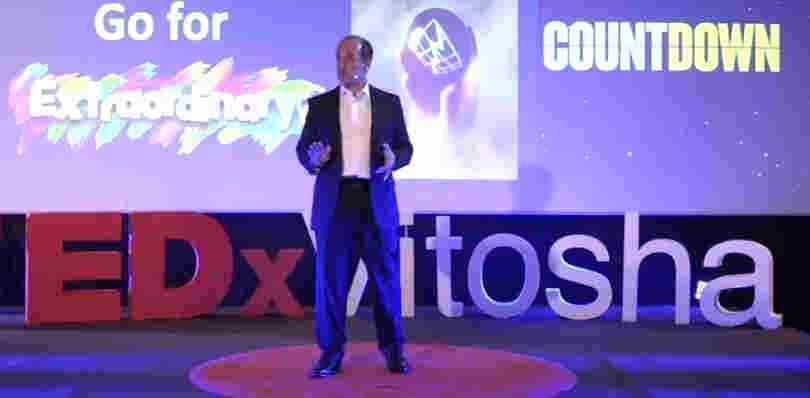
Read the full transcript of strategic advisor Jose Pires’ talk titled “How Do We Go for Extraordinary?” at TEDxVitosha 2024 conference.
Listen to the audio version here:
TRANSCRIPT:
JOSE PIRES: Today, we’re going on a journey for extraordinary, a journey of global collaboration to accelerate innovations that benefit everyone and our planet. To start, please stand up, reach to someone close to you, give them a good handshake and say, “It’s great to be here with you.”
Before we set the stage for extraordinary innovation, we must set the stage for collaboration. That’s our first lesson today. You see, the world is filled with very smart people who lead with their heads. But to go for extraordinary, we must not only lead with our heads, we must lead also with our hands and with our hearts.
Personal Journey
My own journey started in Rio de Janeiro, Brazil, a place filled with beauty and contradictions. I had three older sisters. My dad was a flower grower and my mom was a farm worker with a third-grade education. When my dad died from exposure to toxic pesticides, our life became very, very challenging. We were very poor, but grateful to have food and access to education. I did very well in school.
I joined a terrific U.S. university where I graduated at the top of the class with a background in electrical engineering, mechanical engineering, and physics. And then, when I was hired by one of the most innovative Japanese technology companies, I was at the top of the world.
But at the same time, I had developed a very big head. In order to have extraordinary innovation, we must make it ordinary and accessible to all.
The Japanese Experience
Once I joined this great company, my Japanese boss, Hayashi-san, spoke very little English and my Japanese was no good. So we communicated in “Jinglish,” this hybrid language of one-syllable words.
But I didn’t care. I was super excited to be surrounded by some of the greatest scientists in the world and the greatest technologists. So when Hayashi-san approached me, he said, “Jose-san, I have an assignment for you. This week, you identify 100 innovations in technology development and advanced manufacturing.”
I said, “Time out, Hayashi-san, I’m the new guy. This place was built by some of the greatest minds in the world. I was hoping I would go get some training.” He looks at me, clearly unimpressed, and says, “Jose-san, no training. You must do.”
Whoa. Did I just enter into a Star Wars movie here and Yoda is saying, “Follow the force”? I had no idea what innovation actually meant.
The Challenge
And there I went, in one of the worst weeks of my entire career, walking the research labs and production lines, observing how people did their work and how machines were operating, trying to figure out what were even the right questions to ask. Deep inside, I was very, very scared. I could barely sleep. I did not know what innovation was.
And I thought I was going to lose my job by the end of the week. So by Thursday, I had come up with 20 or so decent ideas. So I decided that I’m going to start preparing my report. I put the best 10 ideas I had in the beginning of the report, the next best 10 ideas at the end of the report.
I made a nice cover for the report. And then I put the 80 or so really not-so-good ideas in the middle of the report. At least I learned how to write reports in college.
The Confrontation
When I met with Hayashi-san on Friday, I thought he would quickly look at my report and then give me my next assignment. Instead, he asked me to please sit down and he proceeded to review every single idea in my report, asking deeper questions on how I intended to implement those ideas. I wasn’t ready for that.
Four hours later, without even a bio break, he’s in the middle of my report, which is the crappy portion of my report. He stops, looks at me and says, “Jose-san, how come you are so stupid?”
With all the advanced education I had, I said, “Uh, I don’t know,” which just made me look dumber. And then he follows up by saying, “Your problem, you think too much like engineer. You must learn to listen to process.”
Great. Now I’m getting some Asian wisdom that I cannot grasp. I have just entered a Karate Kid movie and Mr. Miyagi is telling me that if I wax his car this way, I’ll be a fighter by the end of the week. I started disliking Hayashi-san quite strongly.
He had just destroyed my identity. And then he dismissed me and told me to go home and rest. I went home emotionally and physically torn up, but I couldn’t sleep. I spent the entire weekend thinking about how I’m going to exact revenge on Hayashi-san.
The Realization
And then it occurred to me, what are you complaining about? Look at the challenges that your parents had to face. Are you going to allow this one person to define you? And I was re-energized.
And I went back on Monday and I was ready to show Hayashi-san what I’m capable of. So I come into the production facility. He’s coming from the other side of the room, a big smile on his face, speaking in Japanese, “Ohayo gozaimasu, Jose-san.” I have a fake smile on my face and I’m replying to him.
And then he says, “Jose-san, this week I have a new assignment for you.” When I heard those words, the weight of the world lifted off my shoulders. Yes, let my journey begin. Let me go into a two-year rotational assignment with the best scientists and engineers in the company so that I can get my proper training.
And while I was daydreaming about that, he says, “Jose-san, next week you identify 200 innovations.” I lower my head, I drop my shoulders, I thought about punching him, but by the time I raised my head back up, he was gone.
And I went on to identify 200 innovations.
Lessons Learned
Ladies and gentlemen, to me, Hayashi-san is one of the greatest collaborative leaders of innovation, a lifelong mentor and a father figure. Today’s lessons are not mine, they are his. And more than 50,000 collaborative leaders in over 30 countries that for the past three decades have tested and implemented these principles.
First and foremost, to have extraordinary innovation, we must make it ordinary and accessible to everyone. Every one of us is an innovator.
You see, real innovation doesn’t care about my gender, my race, my age, or how many certificates I have hanging on the “I love myself” wall. Real innovators have four traits that separate them from the rest: purpose, passion, discipline, and resilience. And these traits are only revealed through the test of innovation execution. Or in the words of Hayashi-san, “You must do.”
We must proactively collaborate by engaging our heads, our hands, and our hearts with purpose, with passion, with discipline, and with resilience. Purpose is about aligning our personal and professional interests. If you get to choose what you work on, what would you do? Passion is the fuel.
It’s a lot less like serendipitous love and a lot more like an arranged marriage, where you develop appreciation by overcoming challenges together. Discipline is not following a regimented set of rules. Discipline is consistency with purpose. And resilience is not being stubborn or never quitting. Resilience is being able to engage with the resistance collaboratively to overcome challenges. And if unable to do so, pivoting and taking the longer road. But you’re willing to withstand the pain of that longer road because that purpose is worthwhile for you.
The Novice vs. The Expert
So if Hayashi-san wanted to accelerate innovations, why did he pick on me? Why not leverage the hundreds of experts that he had at his disposal? Because he knew that in the mind of an expert, there is only one way. In the mind of a novice, there are many ways. And innovation and the essence of innovation is the ability to take a different perspective at a problem or opportunity.
Which then begs the question, what is the right mindset for an innovator? Is it the mindset of the novice or the mindset of the expert? And the answer is both. You see, collaborative leaders are masters of contradictions, forces that pull in very different directions.
And while most people spend endless hours trying to decide between option A or option B, these collaborative leaders know that the best solutions lie in the intelligent blending of A and B. The world of greatness is not an “or” world. The world of greatness is an “and” world filled with contradictions. This is very hard to master.
As a result, most leaders and most organizations will fail to set the stage for collaboration, innovation and cultural transformation. For those that succeed, what do you think that matters most, ideas, methods, technologies or people?
The Importance of Ideas, Methods, Technologies, and People
Well, I’ll tell you. It’s all about ideas because we need many new ideas that will create financial and social value to save our planet. But then I’ll say ideas in our organizations and communities, they are everywhere. What are uncommon are people willing to put their reputation behind those ideas. Okay, José, I understand now. So it must be about methods then, right?
Methods. Methods are important because we need a disciplined framework for innovation execution. So I’m going to be using EdCaR, ProSci, Agile, Scrum, Lean Six Sigma and any other method that will allow me to be proficient and effective on the way that I implement this. Hold on.
For nearly three decades, I have been a certified Lean Six Sigma master black belt. For most people, that sounds like a dangerous mental condition. It doesn’t really help them. Methods alone do not transform organizations. People do. Oh, God, José, it’s technologies. I knew it was technologies. Because I hear you talking about the fact that we have exponential technologies that are reshaping the way we work and the way we live.
Yeah, that’s true. I do say that. But if you listen to the whole thing, I also say that technology can make stupid happen at the speed of light. Okay, I give up. It’s people then, right? People. Because people are our most important asset or resource. Not quite.
Transaction leaders refer to people as assets or resources. Collaborative leaders see people as individuals, humans with intrinsic value. Now, the best people, they are able to amplify the core values of our organization and community aligned with the desired cultural transformation. Okay, so what is the answer?
The answer is that the world of greatness is an “and” world. It’s the intelligent blending of ideas, methods, technologies, and people where the right people, they have a disproportional impact on innovation acceleration. Which then begs the question, how do I find these people? How do I find these people who are going to help me accelerate value creation and innovation?
Creating a Meritocracy of Ideas
We must create a meritocracy of ideas with clear execution mechanisms. By all means, we’re going to set up extraordinary innovation as ordinary, accessible to everyone. Everyone knows that they can innovate. But now they have a meritocracy of ideas with clear execution mechanisms that allow them to know how do they go from, “I have an idea,” to “I implemented a new idea that creates value for the world.”
And once you have this meritocracy of ideas with clear execution mechanisms, what you do, you let the innovation execution reveal to you, and the test of innovation execution will show that to you, who are those among us, the collaborative leaders who implement new ideas that create financial and social value in our world?
Conclusion
We live in a fast-changing world with many, many great challenges. Geopolitical instability, technological disruptions, climate change. Many will attempt to predict the future.
But there are only two types of people who predict the future: Those who don’t know, and those who don’t know that they don’t know. The only way to predict the future is to create it, and innovation is the mechanism that allows us to achieve that. There is rarely a single solution.
If the best way to get a good idea is to have lots of ideas, the best way to conquer our greatest challenges is to implement many ideas that create value for humanity and our planet. We must find and develop collaborative leaders of financial and social value creation. Collaborative leaders with purpose, passion, discipline, and resilience. Collaborative leaders who not only lead with their heads, but they lead with their hands, and they lead with their hearts.
And then we must create environments and cultures like this, where we bring these great leaders together, and we have great leaders and great ideas connect to accelerate innovation. Of course, remember Hayashi-san, ideas are interesting, but we must do. Only then, together, we are then truly able to go for extraordinary. Thank you.