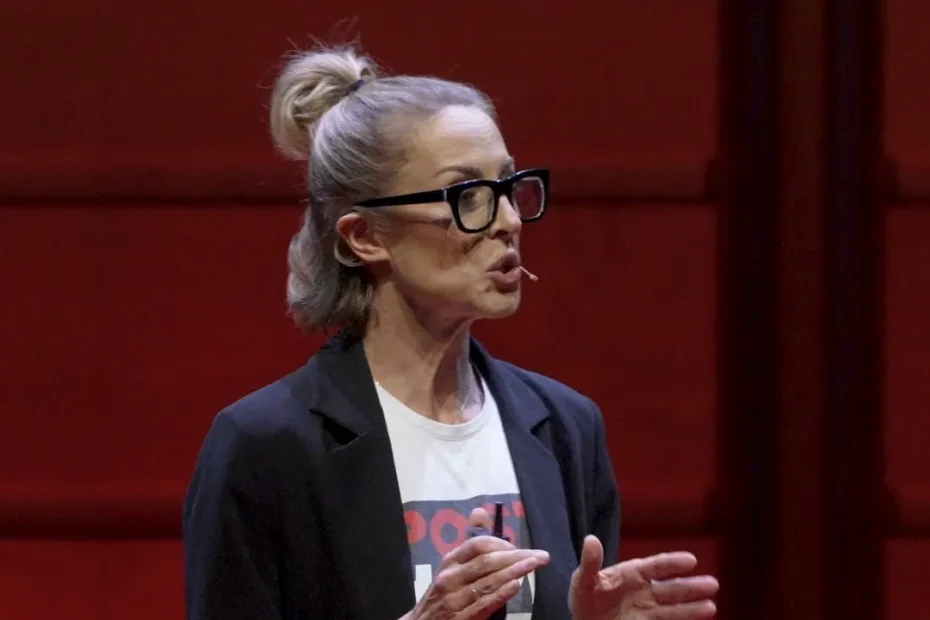
Read the full transcript of author and podcaster Sarah Wilson’s talk titled “How To Respond To Societal Collapse”, at TEDxSydney, September 22, 2025.
The Brutal Truth We Don’t Want to Hear
SARAH WILSON: I’ve got to say, I feel quite self-conscious about standing here today, and that’s because what I’m about to share with you is something that none of you want to hear. About three years ago, I was hit with a brutal, brutal truth, that we were no longer going to make it. Those climate deadlines, we were missing them, and those planetary boundaries that we’d been warned about, we were surpassing them over and over again.
And then a veritable clusterfuck of other crises arrived. AI. So AI singularity is set to arrive in 2027. And that’s the point at which the robots become smarter than humans, which is going to have ramifications globally, of course. And then, of course, we saw nuclear threat dial up. The doomsday clock, which measures our risk of nuclear annihilation, hit 89 seconds to midnight. And then there was Trump, and then there was Gaza, and then, of course, there was the rollout of the fascist tech bros.
Understanding the Polycrisis
We were firmly in a polycrisis, also known as a metacrisis, a complex mess that we are no longer able to fix or to recorrect. Now when I first tried to sort of understand this level of overwhelm, I started imagining in my mind a kind of a mash-up between a Dr Seuss image and a Rube Goldberg machine, okay? Now this is a very, very vivid image in my mind, but so that we could all land on the same page here today, I got my friend, Dr Seuss, to illustrate it for us.
Now one thing I do want to point out is that when I first got a hold of all of this, I also looked around and realised that no one was talking about this, okay? No one was talking about the everything-all-at-once, overwhelming, clusterfucky kind of impossibility of it all. No one was talking about how we, as vulnerable humans, are meant to live and live meaningfully through a world that had radically changed. So I decided to.
My Journey Down the Rabbit Hole
And this is partly because for the last 15 years, this is what I’ve been doing. I’ve been tackling subjects that nobody else wants to touch. I’m also bipolar and thoroughly perimenopausal, which is an explosive combination for tackling such an epic task. So I went down a rabbit hole, and I researched, and I wrote, and I interviewed more than 200 experts, and I emerged a couple of months ago with what I considered to be a path.
The Complex System of Our Civilization
Okay, so we, as humans, we tend to force-fit our issues into a linear narrative with a neat beginning and an end. But what we’re talking about here is civilizational, okay? Our civilisation is called the post-industrial civilisation. It’s roughly 270 years old, and it’s made up of a befuddling array of complex systems, only some of which I’ll draw out here today.
So we have the climate system, and we have the biodiversity system, which feed into the water and the food systems, which in turn cascade into a bunch of other systems, so the trade routes system, the tariff system. What else have we got there? The geopolitics system, and of course, the global financial system. And these are all connected, interconnected, they domino in on each other, they’re interdependent on each other, and you’ve also got a few AI gremlins running around the place.
Now this behemoth, which is overwhelming in itself, sits atop another complex system, and that’s the fossil fuel system, which huffs and puffs to push the whole thing forward. And it’s in turn fanned by the “more, more, more” growth imperative. All right, so it’s very Dr. Seuss-ish, right?
Stupid and Fragile
Now that whole pile-up would not operate without those two things, okay? An endless supply of fossil fuels, as well as the infinite growth imperative. And without it, it’s a bit like when you stop pedalling on the bike, right? The whole thing comes undone. And when I explained this to my friend Jess the other day, who’s somewhere in the audience here today, she said two words: “stupid” and “fragile,” and that pretty much sums things up.
But I’ll give a bit of an example. So the International Institute of Applied Systems recently forecast that if we experience three years in a row of temperatures of 1.5 degrees or more over the pre-industrial temperatures, then the bulk of the European food bowls will collapse. Now I should just point out that as of May 2025, we are well into our second year above that 1.5 degree threshold. The other thing is that when we attempt to solve or fix anything in that pile-up, we face the same dilemma.
So as a climate activist for the last 15 to 20 years, I have been very committed to trying to fix the climate system by getting rid of the fossil fuel system. But of course we now know that the fossil fuel system is 98% tethered to the global financial system. You tip one, you tip the other.
Now you might be saying, all right, but not if we do the big switcheroo to solar panels and wind farms. And indeed, the green energy system has been growing at a rapid rate over the last couple of years, which is great news. However, if we’re going to make a dent in any of this and if we’re going to do it in time, then it’s going to eat into the rare earth mineral system and the water system and the humanitarian system, while ever we’re having to extract those rare earth minerals using child labour and slave labour in Africa. Because if we don’t, it tips the global financial system and so on and so forth.
So we find ourselves in a damned if we do and a damned if we don’t situation.
But this is precisely where all complex civilizations throughout history have arrived at. All of them. They’ve become so complex that all their resources go into keeping the whole thing vertical. And so a fairly minor crisis, like a pandemic over there or a flood or a famine over there, can tip the whole thing.
How Civilizations Collapse
And this is how the Roman Empire, the Mayan Empire, the Qing Dynasty, and scores more civilizations collapse, often disappearing without a trace. And there are two brutal truths I will add to this. The average age of a civilization before it collapses is roughly 250 to 300 years. And I’ll get you just to take another look at how old our civilization is.
The other brutal truth is this. Unlike other civilizations, such as the Roman Empire, which was quite isolated, ours is global. It’s all of that. It’s everything. And it’s all of us.
The Four-Year-Old Metaphor
Now when I first started to think about all of this, I was reminded of a four-year-old who’s made an absolute mess of their bedroom, okay? It’s a creative, although well-intentioned, implosion of balls of wool and textures and craft projects that they can no longer clean up because they lack the level of consciousness. And I thought to myself, we humans are that four-year-old, staring at the mess we’ve made, stunned, and waiting for an adult to come and clean it up.
Finding Relief in Truth
The other reaction I had, and it’s a strange one, it was a sense of profound relief, which might strike you as odd, but as I started to talk about this in my community, I got the same response from others. A lot of people were expressing relief. We’ve got Jeff, who’s finally relieved to be rid of his LinkedIn self.
Now you might be feeling the same, and you might be looking at that pile-up and thinking that cannot hold, and that should not hold, because it goes against logic, and it goes against physics, it goes against nature, and it goes against our nature, and we know it, and we can feel it, and most certainly our children can feel it.
Now in cognitive psychology, they have a term for when we are living a life that does not match up to truth, and it’s called cognitive dissonance, and it creates a very deep sense of despair and loneliness and anxiety. However, when we do choose to face truth, front on, no matter how brutal it might be, we experience something called congruence, and that is felt in the human body as a sense of belonging, a sense of arrival, and a sense of eerie relief.
Our Civilization is Already in Collapse
Now without a doubt, our civilization is already in collapse. There are a number of systems that are already in decline. Climate, biodiversity, democracy is certainly in decline. I just learned recently that 72% of the world is now living in an autocracy and not a democracy. A couple of years ago, we hit peak oil, and in a few decades, we’ll be hitting peak population, after which population will decline, and some say by billions over the next century.
Now when I think of this, I am scared. I find it all incredibly disgraceful, and it begs a bunch of questions, doesn’t it? Like, how long do we have? To which I can only say, nobody knows, and that’s how complex systems go. We just know it’s going to get worse, slow at first, and then quite rapidly. We might also be asking, should I be prepping, and should I be building a bunker?
Finding Beauty in the Hard Questions
To which I say, well, only if you are prepared to defend it with guns, when your neighbor’s children come around starving. Me, I am not prepared to do that. I can’t, because that would be going against everything that I know to be true about being human. And this is the point when I got to where I started to feel I might be on the path that I was seeking, and that’s because collapse was forcing me to ask some very different kinds of questions, some far more beautiful questions.
Like for instance, if we do in fact lose it all, what is left? What truly matters to us? Is it love? Is it nature? Is it relationships? For me, it’s all of these things. And then I found myself asking this very, very beautiful question: who do I want to be in all of this?
Stepping Into Adulthood
And when I started asking it, I realized that what this was about was stepping up into a kind of adulthood, a maturity, an elderhood, a leadership that I think we’ve all been aching for. We are no longer the four-year-olds in the room. We are the adults. We’re the adults that were born into these troubled times, and we are being called upon to step up and meet life and nature where it’s at.
I also started to wonder whether what we’re experiencing is not a correction, and in collapse circles, collapse is often referred to as a simplification, a kind of undoing of all the complexifying, the clusterfucking, the more, more mooring that we’ve been doing that has destroyed our planet.
A Homecoming
And collapse is now forcing us to get off that property ladder, to quit the laundry renovations, to abandon that LinkedIn version of ourselves and instead go back to community, to connecting, to collaborating, and to joining each other in small communities, growing our own food together, all of us, including the tech bros. And this started to feel like a homecoming. It’s like life is centered on this full circle, and we are now coming back into sync with the flow of life and with nature and with our true nature.
So a while back I went home to my parents, and my mom said to me, “Sarah, I don’t get it, you’ve been in this deep, dark place for three years, and yet you seem so happy.” And I said, “You know what, mom, I feel more alive, more connected than ever before. I feel like my life has more meaning than it’s ever had before. It’s like the urgency of what is going on has forced me into living fully and to living fully now.”
More Alive Than Ever
I’m a 51-year-old woman, and I’ve taken to climbing trees again. I go running in the forest and I end up dancing. I have spent countless nights on the floor of my small apartment in Paris in fetal position crying, wailing in grief. But I feel more alive than ever.
And sometimes I reflect on humanity, and I think about all the efforting that we’ve done, the efforting to make a broken and flawed system work, and the efforting we’ve done to save Mother Nature. And now I think, what if she, in her formidable wisdom, is saving us?
Thank you. Thank you.
Related Posts