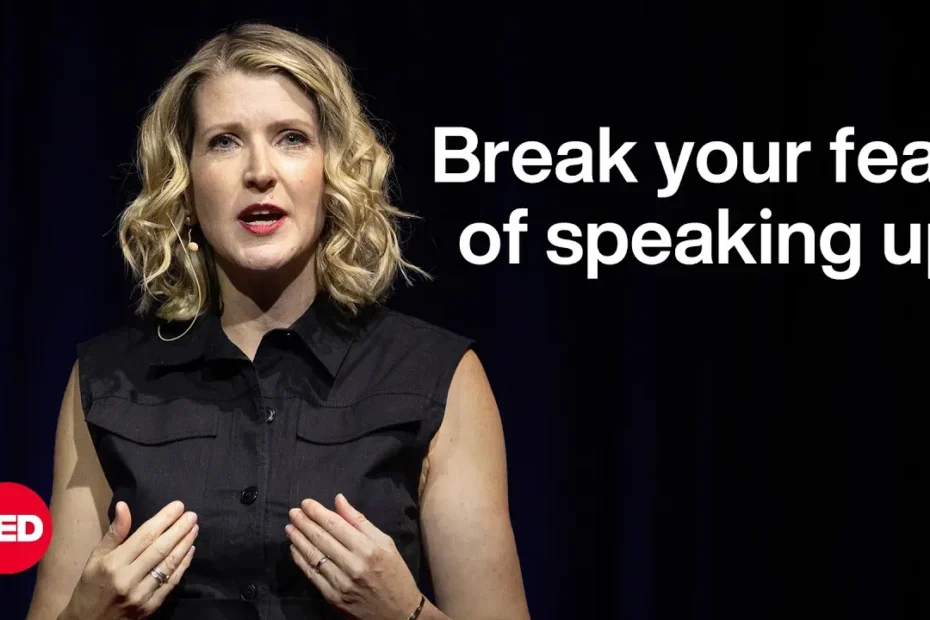
Read the full transcript of healthcare leader Sarah Crawford-Bohl’s talk titled “How to Speak Up — Even When You Don’t Want To: Sarah Crawford-Bohl”, recorded at TEDxRRU on May 4, 2024.
Sarah Crawford-Bohl: Silence. It can be a needed moment of peace and contemplation. But what happens when silence becomes a barrier? A barrier that muffles the voice of truth, of advocacy, of change. Speak up.
Advocate for yourself. Stand up for what you believe in. That’s what they say. Right? Well, even though I know they’re right, it’s easier said than done.
I’m sure we can all think of a time when we faced a crossroads, perhaps the precipice of an uncomfortable conversation, when speaking up felt like the right, if not even essential path. But silence seemed safer. I can vividly see and feel myself being in those moments, times when I stood red faced, embarrassed or offended, frustrated or angry, with a sinking feeling in my stomach, unable to find my voice, and unsure if I had the courage, confidence, or will to face the difficult conversation before me. Sound familiar? We’re not alone.
Research from VitalSmarts, a global leader in organizational performance and leadership, tells us people would rather quit their jobs than address the challenging situation. In this post pandemic time, with baby boomers retiring and a wave of quiet resignation upon us, the world seems to be working short staffed. Now I’m a nurse and have worked in health care leadership for a long time. And I’m here to tell you, in this profession, we can’t risk losing anyone, especially not for the reason of avoiding a challenging conversation. In a world where we are experiencing increasingly rapid cycles of change, we can expect difficult conversations, particularly in the workplace, to happen more often than ever before.
Moments such as sharing feedback, identifying mistakes, or calling out disrespect. They’re not always easy, but often critical to the performance of both individuals and a team. In health care where stakes are high, our willingness to raise concerns can be vital to the quality of care we provide, but also to the safety of patients and the care team. In fact, research also tells us that when we do speak up, we experience more job satisfaction, increased team morale, and in my world, support better patient outcomes. I’ve experienced this for myself.
Now I don’t have all the answers, and I don’t always get it right. In fact, I I make a mess of it sometimes. But often, found it’s a bit like cardio or weightlifting. Well, we feel a bit vulnerable at the time. With practice, we start to experience the benefits.
It gets easier, and we get better at it. We need to find a path to help us get past that initial fight, flight, or freeze response to get us to the table and make leaning into uncomfortable conversations the desired action for our own benefit as well as to benefit those around us. Now I was fortunate. I had some amazing role modeling by parents who encouraged me to use my voice, specifically when I knew I should but didn’t want to. My mom, an intensive care nurse for many years, had a special ability to address tough topics, traumas, embarrassing bodily functions, or sharing critical feedback.
She always created airtime for normally avoided matters. With a fierce moral compass that was sometimes incredibly frustrating, she advocated for what was right, showing me the importance of standing up for oneself and others even when uncomfortable to do so. My mom, she died a long time ago now, and I still miss her desperately. Something I think I miss the most, though, is her always knowing the right thing to do and the way she guided me with that moral compass. And despite having a couple of degrees under my belt, lessons learned from that moral compass, they guide me more than any of my formal learning.
She showed me that as leaders, and I mean all leaders, both formal and informal, we play a pivotal role in leaning into courageous conversations and creating a safe place for others to do the same. It’s probably our strong commitment in this area that inspired me to go into health care leadership, a path that often puts me in an area of high conflict and tricky conversations. But in doing so, exposes me to innovation, change making, and meaningful work. It’s an incredible career that I’m honored to be a part of, and I owe it to my mom and myself to do it well. So when I find myself needing courage and confidence, making that moment to step into the abyss of a difficult conversation, I try to remember my mom’s moral compass and the principles she worked so hard to nurture in me.
I imagine holding a compass in my hand, the cool metal upon my skin, taking a breath, a moment to pause and ground myself. I see the directions of north, south, east, and west as symbols, reminders of her core teachings. North. I think about the north star, a guide towards the good and right thing to do. In tricky situations, I remember my mom’s voice.
Be the best version of yourself. Take the high road. Say what needs to be said. South. The s in south reminds me of support.
When people support me, I feel seen, cared for. When it comes to supporting others, I try to do the same, leaning into tricky conversations with kindness and an intention of helping people grow. And east, the e stands for empathy. Empathy sets the tone for a conversation. As a leader, I want people to feel safe coming to me.
I try to understand their feelings and create a safe place for them to be themselves. And west, the w stands for wonder, getting curious about what might be going on for the other person. I ask questions and listen so I understand before trying to be understood. When I focus on the principles of the compass, I’m able to move from reactive to proactive, getting into a mindset where I can be true to my values and share my voice.