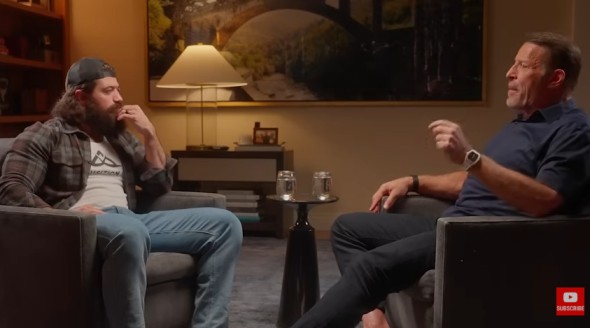
Editor’s Notes: Alex Hormozi sits down with Tony Robbins for a rare, no-fluff conversation about the single shift that took Tony 50+ years to fully understand: why contribution, not achievement, is the real source of lasting fulfillment. Tony breaks down how the words you use literally program your emotions, why “push” motivation built on anger and duty eventually burns you out, and how to flip into “pull” motivation by serving something bigger than yourself. They explore what happens after you’ve “walked on the moon” in business, why success alone can feel empty, and how to set unreasonable, service-driven goals that reignite your drive. If you’re a high-performer who has hit your financial targets but still feels oddly flat, this 69-minute masterclass in meaning, growth, and impact is aimed directly at you. (Jan 21, 2026)
TRANSCRIPT:
Introduction: A Conversation That Matters
ALEX HORMOZI: It’s not every day you get to interview Tony Robbins. And so I figured I could either make this a headline-driven algorithm podcast or just spend an hour and a half asking the questions that mattered most to me. So I did the second one. Enjoy.
Tony Robbins, strategist to some of the most important people in the world, people that you have seen publicly and probably many more that you haven’t seen privately that have impacted your life. And he’s both a wealth strategist but also a life strategist. And so we’re talking politicians, royal families, US Presidents, Margaret Thatcher, Princess Diana, Andre Agassi, Mike Tyson, just the greats.
And he’s also published books. He’s got 100 plus companies in his portfolio that do north of 7 plus billion dollars a year. And as impressive as that is, it’s—
TONY ROBBINS: Actually 12 billion now.
ALEX HORMOZI: 12 billion.
TONY ROBBINS: There you go.
ALEX HORMOZI: I was going to say, I hope this number isn’t wrong. I looked all over the Internet.
Three Lives Changed
Most importantly, at least for me personally, is that you wrote books that changed my life directly and in a couple cool ways. So the first is there was an Indian guy who came here to the US 20-something years ago and he was working as a janitor and he had such a thick accent that they said you’re never going to get employed anywhere. You have to learn how to speak.
And he tried to get, how to get rid of an Indian accent tapes. And those didn’t really exist. And so they were like, well, you can check out these from the public library. It was Tony Robbins tapes. And so he would just mop the floors listening to Awaken the Giant Within.
TONY ROBBINS: Yes.
ALEX HORMOZI: And so he’s mopping the floors and he’s doing it. And that man then started a software company, scaled that, sold it, started another company, sold that for 3.4 billion, did another company, took that from 200 to 1.2 billion. And I met him right around that time and he’s my partner at Acquisition.com.
TONY ROBBINS: Wow.
ALEX HORMOZI: That’s the first impact.
TONY ROBBINS: What’s his name?
ALEX HORMOZI: Sharan Srivatsa.
TONY ROBBINS: Please give him my best. That’s awesome.
ALEX HORMOZI: I will. He would be here if he didn’t have—oh, he’s the man.
The second direct impact is that there was a girl in Michigan who was 100 pounds overweight, had just been arrested six times, just in the first couple years of college, and then was like, I need to change my life and started listening to your tapes and reading your books. Lost 100 pounds, competed in a fitness competition, and then got into business, built a whole roster of clients for herself. And that’s when I met my wife.
TONY ROBBINS: That makes me the most proud.
ALEX HORMOZI: The one that most significantly impacted—
TONY ROBBINS: Well, that’s the most important person in your life, of course.
ALEX HORMOZI: And then the third was me, obviously, and my actual entry into your world was Money: Master the Game. That was the book that got me. And so for that reason, I want to say thank you for just everything you do.
TONY ROBBINS: Well, thank you for all the kind words. I really appreciate it.
The Question: Duty vs. Enjoyment
ALEX HORMOZI: I actually had like five words written down for this whole podcast, and I tried to compress a bunch of questions into just the most succinct thing that was actually top of mind for me that I know will be top of mind for many of the business owners in my audience. So I have probably 60% business owner audience. A third of them are doing over a million a year. We also have people who are just getting started. But a lot of people are predominantly—
TONY ROBBINS: Business brothers and sisters out there, yours and mine.
ALEX HORMOZI: Right. In the game. In the game.
TONY ROBBINS: Bet on yourself and grow. Right. Find a way to give.
ALEX HORMOZI: Yes. And so the first one was, how do you see the dichotomy between duty and enjoyment as it relates to the impact that you want to make with the business that you have?
Words Shape Your Reality
TONY ROBBINS: Well, it’s interesting. Words are tricky. They can produce emotions, and sometimes we pick up words because of the people around us.
I used to play poker with a group of guys when I was like 19, 20, 21, and they were older than I was, and they were all married except one. And I was surprised to see one day—well, one of the guys, I knew he loved his wife so much, but two of the other guys always were talking about their wives like, “I had to go back to the old ball and chain.”
And one day, and I couldn’t help see it, it was like I was a witness of it because I was always sensitive to this.
And sometimes we can pick up words and actually pick up emotions without knowing. It’s just like if somebody yawns, you yawn too. Or somebody starts to laugh. But words are even more powerful.
So duty could be a good word, like if you’re seeing yourself like a soldier. Right. But I don’t look at it that way. I look at it as obligation. No, I don’t look at obligation as the same thing. No, it’s okay. But I say this because I saw this in some of your language and I don’t know if this is helpful to you. I don’t pretend to coach you in any way, but for me, at least, I can tell you I look at it as opportunity.
I don’t feel a sense of duty. I feel a sense of joy in being able to contribute. To me, contribution is what we’re made for. Like, it’s not hard to meet your own needs as a human being. Right. It’s not that difficult today in the world we’re in today. But to have a fulfilling life, you have to have something you care about more than yourself.
And so if you get into business just to make money, there’s nothing wrong with that. Those people usually, even if they succeed, they hit a limit of fulfillment because the economic returns only produce so much.
So I don’t look at duty and enjoyment. I look at it as more like it’s all enjoyment because contribution is the ultimate enjoyment for me. I mean, I get in business for impact, and economics are second. If I have enough impact, you’ll never have to worry about economics in your life. And I found that to be true in my own life.
So I don’t look at it quite that way. I look at it also, though, that if you think you’re going to really enjoy your life and not do anything, I think you’re deluded because you’ll wake up one day because the only thing that makes us feel alive is growth. When you grow, then you have something to give. And when you give, then your life is more meaningful than just pleasure.
You can give yourself pleasure by money, food, alcohol, sex, whatever it is, but it’s never going to be the same as when you have something that’s larger than you that you’re called to.
Push vs. Pull Motivation
It’s like, I hate the word motivation because I’ve never been a motivator, but people use the word. So I’ll say, well, there’s two types of motivation. If you don’t think of it that way. There’s push motivation, which is, let’s say, duty, or “I’ve got to do this” or “I have to do,” or obligation, right? Or just, “I’m going to make this happen.”
And look, brother, you have a huge amount of willpower. It’s pretty obvious by what you’ve accomplished. I have tremendous respect for you, and I do too. But willpower only goes so far. That’s push.
Pull motivation is where there’s something out there that you want to serve more than yourself. That’ll get you up early, keep you up late. And it isn’t hard, it isn’t duty. It is like what I’m made for.
When you tap into that, your energy level will explode, your contribution will explode. Doesn’t mean overnight everything is going to work your way. Of course, it doesn’t work that way, but it will give you the constant endurance to move forward in a way in which you enjoy your life rather than someday. “When I get to this number, then I’m slowly going to feel good” because it’s not true.
You get to the number, and if it’s numbers, it’ll never be enough. As you know that. You’ve done incredibly well. I have so many friends that they got their business, they sold it, they made a billion, two, whatever it is, five months later, they’re looking to get back in business again because so many of their needs were met by the demands and the challenges and the growing.
I think the biggest problem we have as human beings is that we think we shouldn’t have any. It’s like problems make you grow. Problems call to you because, listen, you lift. We’re both in good shape. You wouldn’t be there if you lifted lightweights, did 100 curls with some lightweight. Right. You’re built. You’ve built this body. You built it by challenging it.
But some people, maybe because of your background in the fitness industry, “no pain, no gain.” But today we know that’s not true. We know today that minimum dose will produce the maximum result. If you overdo it, you tear down too much. Right. It’s like finding the right dose, just like anything else, like a drug for somebody.
And so I really think if you think you’re going to just go off and enjoy your life and not add value, you’re going to be deluded, you’re going to be frustrated. I mean, how many people do you know that were rich and famous and the world loved and they killed themselves? Yeah, because they stopped growing. I can give you half a dozen people I thought of in the last 10 years that have done that process.
So I think to me it’s not duty, but I do believe “to whom much is given, much is expected.”
ALEX HORMOZI: It’s one of my favorite words in the whole Bible.
TONY ROBBINS: Oh, really? I come from that place too, but to me, the expectation is a pleasure.
The Power of Language
I think the language we use trains our brain. It’s like if you said to me—if I said to you during the break here, “Let’s have some nutritious snacks.” I said that to a mass audience. Maybe for you respond positively because you’re fit. But most people are like, but if I say “delicious snacks,” they’re interested.
Or someone says to me, “Tony, you meet so many people. Hook me up, introduce me to a great guy, a great woman.” And if I said to them, “Well, I know this guy or I know this woman, they’re really nice” versus, “They’re sensual, they’re sexy, they’re amazing, they’re delicious,” whatever it is, it’s a different piece.
ALEX HORMOZI: They’re not nutritious people.
TONY ROBBINS: But you see what I mean? The words change your biochemistry. The words you attach to an experience become your experience. If you over and over use certain words, you won’t even know it. And you’ll train yourself to have certain—what I call an emotional home. Yeah. Certain emotions you go back to because the language takes you there.
And duty and responsibility. If you’re trained like a soldier, that might work. If you’ve trained yourself that “no pain, no gain,” that might work. But how old are you, may I ask?
ALEX HORMOZI: 36.
TONY ROBBINS: Okay. At 36 years old, you built such a foundation of business, of contribution, of wealth, of your body, that at this stage, it shouldn’t be pain, it shouldn’t be suffering. I don’t think it has to be any of those things. I think it can be total joy. But you have to kind of rewire your brain because otherwise that past training conditions you. In my opinion, that’s the issue. Does that make any sense?
From Push to Pull
ALEX HORMOZI: Yes. And I will just speak for me, the issue that I have is that I got here from push and anger, for sure.
TONY ROBBINS: Yes. Yeah.
ALEX HORMOZI: But I think in the last however many years, I genuinely believe like that’s not as much a part of me. There’s elements of that that are still there, but like, it’s not the core drive anymore.
TONY ROBBINS: Sure. Me too.
ALEX HORMOZI: The difficulty that I have is like, I work the hours that I’m awake, pretty much. And the difficulty that I have is finding enjoyment outside of work. And the contribution from that perspective. Like, I’ve spoken to a number of billionaires, yourself included, where I’m like, the next game.
TONY ROBBINS: Right.
ALEX HORMOZI: And so the game that we’re in right now, I know obviously there should be risks, there should be lots of things that we’re going to do, but I feel like I have a direction of what I know what we’re doing. And when I talk to some of the billionaires that are in more private equity, financial engineering, commodities trading, different than maybe what, obviously what you do. And to a degree, what I do.
The Struggle with Fulfillment and Purpose
TONY ROBBINS: Actually in their business too, they were.
ALEX HORMOZI: Like, you should do something that really helps people. And I was like, I feel like I do that. There’s only 0.1% of the people who see any of the content, the courses, the books, the whatever that we put out, I monetize in any way.
And to a degree, I also reject the idea that charity must be something that does harm to you in order for it to be virtuous. Right. So that is probably a struggle that I have dealt with, which is that I have an apathy issue.
I’ll tell you a microcosm of this is when I got in the fitness industry, I got into it because fitness was the only thing I was really into. And so I was like, well, I’ll do something I love. Because I was a management consultant. I was like, well, this sucks. I’m going to do something I love.
And then as soon as I got into the business of fitness, I realized that the vast majority of my day had nothing to do with fitness at all. And it was like billing and membership sales and all this other stuff.
And when I started getting the testimonials coming into these people who were going through our process, losing weight, getting off medications, whatever, maybe the first couple months, it felt like something. But then on like the hundredth and the thousandth, I was like, yeah, you know, of course you stopped, you moved better and you stopped eating shit. And it worked out, you know. Like, it just, the magic was gone for me.
And so to the same degree that’s, I would say it has occurred within what I do today. But I don’t even feel in some ways that I am driven. I do this because I don’t know what else to do. It’s like, this is the only thing I’m good at.
TONY ROBBINS: Yeah.
ALEX HORMOZI: And so I do what I’ve been rewarded for doing the biggest thing selfishly that I, that I was like, really or I am, you know, looking forward to. I was, I’m trying to navigate that.
TONY ROBBINS: I understand. So it’s almost you got a set point on your fulfillment and you’re not going beyond it.
“F* Happiness” – Choosing Usefulness Over Joy
ALEX HORMOZI: Yes. When I was 20, I got obsessed with positive psychology. I read, I had a trunk of books and every single one of them was self help things like this. Early on, before I had a business, any of that stuff.
And I got to a point where I realized I had read all the books and my life hadn’t changed. And it felt very hopeless for me because my subjective being was the same.
And so I came up with a mantra for myself, which you might laugh at, which was, “f* happiness.” Because I felt so rejected by the notion, because I felt so unattainable for me. And so what I replaced it with was I will be useful.
TONY ROBBINS: That’s great. Meaningful. Meaningful. Meaningful life is a very useful life. Right.
ALEX HORMOZI: And that’s basically what I’ve oriented my entire life around was like, that’s why duty for me feels meaningful. Because it’s like, well, you know, I might not enjoy this whole ride, but like, everyone else can get stuff out of it. And so that’s the struggle that I have. Because I’m okay with that.
TONY ROBBINS: You okay with it, but you’re torn by it, my friend.
ALEX HORMOZI: Yes. No, agree. I will accept that.
What Do You Do After You’ve Walked on the Moon?
TONY ROBBINS: I understand you’ll accept that. Would you accept anything else in your other businesses? Would you accept something that’s mediocre compared to what you’re capable of course? Yeah.
Okay, so I’ll give you my two cents, which is all it’s worth unless you stay emotionally. The guys, the astronauts, you know, I got to interview several of them, right? Think of that. They went out and they competed. They wanted to be an astronaut, right? You had a version of that. I want to be a business owner. Whatever it was you had, right?
And they beat everybody, right? Tens of thousands of people. They got down to 100, down to 25, down to 6, down to the guys that go to the moon, right?
And they get a rocket that’s built by the cheapest bidder on their back, and they shot them out into the moon with technology that’s far less than it’s on your phone right now. And they walk on the moon, they look back and see that image. You and I have seen that they took blue green of the earth, but that was them seeing it.
And they make it back and survive. They splash down, they have a ticker tape parade. They shake the president’s hand. Now what the f* do you do after you’ve walked on the moon? For adventure.
ALEX HORMOZI: Yeah, right.
# The Moonshot Principle: Moving from Achievement to Contribution
TONY ROBBINS: I guess, like you’re 35 and you’ve walked on the moon, what do you do? And most of them became alcoholics and drug addicted. Yeah. The reason is they forgot how to find that joy or that adventure and a smile.
And so you have trained yourself to be pain equals success. And success has a certain amount of value, but f* happiness. You have literally hypnotized yourself into missing it because you weren’t feeling fulfilled.
So the idea that these people keep telling you, I would tell you is true. And I’ll just give my own experience. We’re not the same person, but maybe it’ll be instructive. I don’t know.
So I don’t know, maybe 10 years, I found myself at a place where it’s like, I love my life. I couldn’t be more fulfilled than this. I have the most incredible wife. I have the most incredible kids. You know, I want to be an athlete and make it, you know, right behind you. I have, like, six national championship rings from different teams that I own or that I help to coach and turn around.
I’m working with the greatest athletes in the world, the greatest business people in the world. I’m having fun. I’m. You know, I’ve got homes all over the world. There’s nothing that. What else could make me fulfilled? I mean, this is it, you know, I can’t be anymore. And I’m not complaining.
But then there’s some part of me like you that was hungry for more still. You wouldn’t be asking me that question unless there was part of you that wants a hunger for something called happiness or wants something besides just duty, or you wouldn’t ask me. So. And I’m not telling you I have the answer.
The Billion Meal Challenge
But I’ll tell you what it was. For me, it’s like the same these people told you is me. I’ve always was contributing, same as you. I’ve been doing since very little. But I started saying, you know what I’m going to do? I want to do some moonshots in that area. I know how to scale businesses. I’m growing businesses, and nothing up to 12 billion. It’s like, in those days, it was like 4 billion. Like, what would really get me going.
And at that point, I’ve been feeding people since I was a kid. When I was 11 years old, we had no food on Thanksgiving. Somebody came, delivered food, changed my life. It made me believe strangers care. So I care about strangers. And I started two families, four families. I got to a million four million.
So about this point, I’ve been feeding people for 37 years. So I called my foundation. How many people have I fed in my lifetime? And they said 42 million. I was like, wow, that’s pretty awesome. But I had no association to it. I felt good about it, but I was. I was doing it, you know, all these different ways.
I was like, there’s so much pain out there. Yeah, I’m going to feed a billion people in the next 10 years. It took 37 years to do 42 billion. I started out by saying, well, what if I did as many people I’ve done in my lifetime and in the next 10 years, what if I did as many people in a lifetime in one year? Then I was like, what if we did 100 million people in a year? What about 100 million people a year for 10 years? And then a billion meals right here in the United States?
I got so ignited by that, Alex, that it was more than. It wasn’t money, it wasn’t business, it wasn’t success. It wasn’t, okay, there’s the system. It was like, I have to rip apart. If it took me 37 years to 42 million, to go to a billion is going to require me to think differently, come up with strategy, different, be different.
And to think of a billion lives, that number somehow brought a different level of life. It’s kind of like Kennedy saying, we’re going to go in this decade and we’re going to land on the moon and bring a man back to the Earth. And all the guys at NASA are like, bullshit. This is not going to happen. Right. We don’t have. We don’t have technology to do it. I don’t care. This is what we’re going to do.
There’s something about building a moonshot for contribution outside even what you’ve done in business. And I did it. I said I’d do it in 10 years. I did it eight years.
Scaling to 100 Billion Meals
So then I finished that and was like, you know, I’m traveling around the world. You see people starving. It’s just trying to do what you’re doing. Like, no, I need something bigger. So I was in the UAE and I had a. Had a lunch with MBZ, is the head of the country, brilliant man. And he calls me next day and goes, I want to have lunch with you again. I’m like, that’s cool. I’m happy to do that. Right?
So I come sit down with him, and he goes, I brought you lunch today because there’s two people feeding the most people on Earth, and they should know each other. So he introduced me to Governor Beasley, who ran the World Food Program for the UN. So I said, well, I think he’s doing more than me, he said.
And so we talked. He later won the Nobel Prize, but we stayed in relationship. And because of our relationship, he got so frustrated with the bureaucracy of the UN that one day he said, Tony, I’m going to leave the UN because during his five years, we went from 80 million people at verge of starvation to 385 million people.
Just think of those numbers. If you can think of them as if you just think of his numbers, it doesn’t. But if you follow like one child starving, it’ll change the. Oh, yeah, that system to something more ethereal. It’s like watching a movie. Watch a movie about war. It’s too much. You follow one person and what they go through, you feel it.
So I got associated that and I said to him, what if we create a strike force team if you’re going to leave? How many meals would it take to feed everybody in the world for 10 years that need it? Where it would give us time to build a sustainable solution because you can’t keep doing the same crap, right? He goes, Tony, I don’t know, 40, 50, 60 billion meals.
I said, let’s do a Hundred Billion Meal Challenge. I said, I did a billion meals. When I started, I wasn’t a billionaire. I’ve been blessed, obviously, since that time. You do great work. If you bless others, you’ll be blessed, right? I wasn’t doing it for that reason. It just came about.
So I said, well, there’s got to be 90 or more guys like me in the world. There’s 3,000 billionaires or owners of companies or, you know, countries that’ll do this. So we did this 100 billion meal challenge and we went to Forbes 400. And I thought, we’re going to get 50 of these guys, right? The richest people in the world. Four people stood up. Four. I’m like, this is not working. We have to do something different.
But I won’t bore you with all the details, the strategy, the thought process and. And what kept me going, though, is it’s not just having this unreasonable goal. It’s having strong enough emotional reasons.
Getting in the Trenches
And I got in these environments where people are starving. I got in Sudan. There were a million people cut off by the rebels there and they were starving them out. This is just this last year. And the UN sent all these food people in and they killed the drivers and took the food. MBS, not MBZ, MBS from Saudi Arabia cares deeply. He tried to provide things. They killed everybody so people stop giving money. People are going to starve.
So I said, no, no, there’s something different. I said, I’m just putting a line in the sand. We are going to feed these people. I’m going to provide enough food for a million people in a week. Who will match me? And I got Ray Dalio to match me. Pretty soon I had 40 million bucks.
But how are you going to do it? And this is where it gets so alive. It’s like no one else in the world’s done it. We’re going to do this. Here’s what we’re going to do. I’m going to hire a bunch of. I’m going to find some military contractors. We’re going to take C130s, and we’re going to take drones, and we’re going to deliver the food to the people. We delivered 22,000 meals that month and saved all these people starving to death.
So when you do that, your level of fulfillment explodes. What the f*? Compared to running a business? It’s not even the same. And so I’ve been hooked on that. So now we’ve got 62 billion meals in three years, just beyond anybody ever thought was humanly possible.
And then. So now I said, we’re going to do a song with We Are the World. And I got Jimmy Jam, the most successful Grammy guy, and I got everybody you can imagine in the music business all building it together. We just completed our first version of that.
And then. But then, you know, I’m lucky enough like you, I’m very blessed. So I have a private plane. I have a 737. It burns a lot of carbon. You know, I want to be conscious. How many trees does that burn? 3,000 trees a year. Like, I plan 100 million trees. But not just plant the trees. I’m going to plant 100 million trees. And I’m going to work with the farmers. I’m going to show them how to go from making a buck a day to 12 bucks a day by having 12. And I work with a group to do that.
It’s like, you know, a friend of mine’s daughter was kidnapped and put into slavery. You know, just insanity. It happens in America, it happens overseas. And nobody wants to talk about trafficking, but that got me associated to it. We actually helped somebody. And so I went out undercover. I had markings all over my face. They had a makeup person, they had scars on my face, helped them negotiate these deals with these animals that do this.
It’s the ugliest thing ever seen in my life, but also the most beautiful. But again, I didn’t just give money. I didn’t just write something. I just didn’t put something. I went in the f*ing trenches, and I’m sitting there watching these girls go through the worst thing on earth. Meaning they’re chained to a bed to do eight or ten tricks a day.
And then we get them freed. We brought them to this house. They’d never been out there. They’re out on the ocean. They’re down here playing basketball. They’re like the change in their lives. And saw that I’m hooked.
So my wife and I have now funded 72,000. Started with 30,000 as many. I grew up in a town of 30,000 people. I want to that many children as big as the city I grew up in. Now we’re at 72,000. I’m going tonight. We’ll probably raise $5 million tonight. I’ll do matching funds for everybody at the event to do it.
Get Off Your Emotional Ass
So I’m trying to say to you is get off your ass. And I love you and I respect you. Alex. I’m not coming from that place. I hope you know I’m coming from. You’ve accomplished more than most people dream in their lifetime and I respect that. But when I say get off yourself. Your emotional ass. Stop this f* happiness shit.
ALEX HORMOZI: Yeah.
TONY ROBBINS: And just actually say to yourself. No. Deserve happiness. I’m going to create happiness. But I have to do it differently than done it before. I can’t just get up and just work some trained to work. I can’t. I’m not a f*ing robot anymore. Right.
You’re way too smart and you got way too big a heart. I know you do. I know everybody knows you well. I’ve seen you with your wife. You’re an extraordinary human being. You’re not just the guy here who does all these wonderful things and they do wonderful things for people. You’re absolutely right. But you’re not connected to it.
And you don’t have something that you’re obsessed about that makes you feel fully alive. You’re doing it because you need to. The difference between have to duty and get to. Yeah. That’s the reason rich and poor and. Rich and poor is not money. Right. Rich and poor is feeling fully alive. That’s rich. Right.
Poor is you work your ass off and you have plenty of money and you help all kinds of people. But you don’t connect it. And again, I’m not making a judgment. I hope you can feel my heart. It’s just. I want more for you. And I knew you wouldn’t ask me the damn question. That’s true.
So it’s like. But you need like your energy has got to be shifted. You need a kick in the ass. You need to get an environment where you’re on f*ing fire. And then at that state, you’ve had that state before, I guarantee you, when it got here. But then you got so caught up in the push, I think you’ve missed some of the pull for your life.
And I think this is not just true of you, it’s true of most of us. Why are most people stressed? Like, if you talk to people, successful people, they’re always talking about, I’m so stressed, I’m stressed.
ALEX HORMOZI: Yeah.
TONY ROBBINS: I’ll tell you why you’re stressed. Because you’re managing shit.
ALEX HORMOZI: Yeah.
TONY ROBBINS: You know, you’re managing all these great businesses, you’re managing all this great money. But you know what? When you manage, it puts you back in survival. Are you going to tell me it’s more stressful today than the Dark Ages? I mean, come on. But what’s happened is we have all this. We’re trying to manage and we’re not made to manage.
You’ve been so successful that now you’ve hit a set point. And now the only way that set point is people get to a point where they question and they start going, it worth it or not? But I have to keep doing it. No, Sometimes you make a point, you say, no, I’m going to keep doing, but I’m going to be connected to it at a different level, or I’m going to change paths altogether. I’m going to add a path that brings another dimension to me. Those are the places that go.
So I’m pretty passionate about this answer because primarily because you’re asking me. Because you’re asking a question. It’s a very sophisticated question most people never ask because they never get to where you are. Right. So you’ve gotten to a place where you’ve hit a block, but you’re only 37. God willing, you’ll have 50 or 60 more years of your life. I don’t want you going around doing it out of duty. I want you to go around doing it because I have to get up and work. I want you to do it for something else.
And so I can’t do it for you. But it’d be very useful for you to get an environment. I’m not selling you, but there’s nothing like being in an environment. I know when Pat Robbie came one of our events, and he got 15,000, 20,000 people, and he’s like, ah, I need this stuff. And after an hour, he’s like, this is insane. At the end of the night, he said to me, he goes, this is like the seventh game of the NBA championship. Only lasts 12 hours and it goes for four days, right?
But without energy enhancement, the brain takes over. All of a sudden, now it’s your mind doing it. The reason you’re not happy is the mind is leading. You get in your head, you’re dead. Your heart is so big. And I’m not saying that to placate you because I know we have mutual friends and they all rave about what a generous and credible guy you are. But I don’t see you feeling the level that you have.
And I can see part of it is energy. You can execute with your mind so well. You recognize, I’m sure, like I do, pattern systems. You know, how to put them in place, get it done. But then there’s not the emotional connection. You need a moonshot or two and you need to get connected to the people and see and feel the impact in a new variety. Because otherwise it’s the law of familiarity. You get around anything enough, no matter how good it is, you start taking a little bit for granted. And that’s just human nature. That’s not you. So you have to wake it up and you got to get associated.
The other thing is, you don’t have a kid, do you? No, I’m trying to give you advice, but Look, I have five kids and five grandkids. I adopted three kids. I was 24. I married a woman who was 12 years my senior. She married twice before me with kids from each person. I didn’t recognize the pattern, but it was one of the best things that happened in my life. Even though she wasn’t right for me and I don’t think I was right for her, but I made that choice. I end up with these kids.
So I was 24 and had a 17 year old son instantly. An 11 year old, a 5 year old, and the one on the way. I’ve been doing my thing like you’re doing, very successful. I’m going to change the world now. I got to figure out all these kids in different stages of life. And so I tell you that because that marriage wasn’t the right marriage. But those kids now, my youngest kid is like 42, right? I have a 52 year old daughter.
And thanks to Covid, I have a four and a half year old daughter. Covid was good to me. I never thought at 65 years old I’d have a four and a half year old daughter, right? Are you kidding me? I’ve already done all that, but it’s the greatest joy of my life. Because she makes me see the adventure in the smile. I want to do more for her than I want to do for everything else. Every day is new because everything is new for her.
You just need some new elements so it doesn’t have to be a child. But I wouldn’t mind recommending the possibility for you and your lady. I don’t know how she feels about it, but I think at some point in your life, there has to be something more than you that calls you. I’m not trying to give you a sermon. I’m just so passionate. I have a love for you because you’ve delivered so much value. And I hate when I see someone so much value. And to me, I see this as a little bit of suffering. You wouldn’t call it that, but there’s a conflict inside. I don’t want to see you suffer. You’re too good a human being. I don’t see anybody suffer, much less you.
ALEX HORMOZI: I appreciate that.
TONY ROBBINS: Does any of that make any sense to you? What part makes sense to you? I’m curious.
ALEX HORMOZI: So there’s two. Well, three things. So one was the emotional connection part. The second was the framing of the opportunity. And then the third was around suffering. And so I want to touch on each of those.
TONY ROBBINS: Okay, great.
ALEX HORMOZI: So from the suffering perspective, I find that really interesting because passion comes from the Latin passio, right? Which means suffering or to endure. And so that made actually a tremendous amount of sense for me. And so I actually reframed that whole concept as find a goal worth suffering for.
TONY ROBBINS: Finding.
ALEX HORMOZI: And so I’ve been very accepting of my suffering. And to your point, I actually don’t have a lot of anxiety. That’s actually not the issue that I deal with. I deal with the other opposite, the opposite train of not giving a f*. Is it worth it? Who cares? Why bother? You know, whatever. So that was on the suffering piece.
The Problem with “Goals Worth Suffering For”
TONY ROBBINS: But before you, before you do it, can I give you feedback, please, if I may? Again, I’m not pretending to have the answer for you, but I’m just giving my two cents what you’re asking because I want to see more of that smile that I see in you right now. Okay.
ALEX HORMOZI: I’m wide open.
TONY ROBBINS: This is. This is the real you right here, by the way. But what happened is you’re so in your head, so even think what you did, like “a goal worth suffering for”? F* that. I mean, I don’t have goals that I’m worth suffering for. Don’t get me wrong. Every day is not like pure bliss. And there’s lots of things that I don’t love to do that I need to do to succeed or I got to deal with. That’s part of life.
But pain is part of life. Suffering’s an option. You’ve heard that phrase, but it’s a fact. It’s not just a phrase. That’s why you’ve heard that shit. So more. But when you make it your goal to find a goal we’re suffering for, you’re going to suffer, right? So it’s in your lane.
ALEX HORMOZI: I got my wish.
TONY ROBBINS: You’ve got your wish. And what’s happened is, this part of you is so strong, brother. This part of you is too. But this is the lead right now. If you change the lead to here by that sense of connection, everything else, and get the hell out of your head. Because your brain is always going to reduce things. It’s like your brain will never make you happy. That’s the problem.
It won’t even allow you to enjoy an apple. You go, is it organic? It’s like your brain is analyzing so much. You got so stuck up here that you’re missing this magnificent human being that I see in front of me here. You’re missing to have the joy of him. So stop this getting over suffering for.
ALEX HORMOZI: Can I ask a question on that?
TONY ROBBINS: Yes, of course.
ALEX HORMOZI: So with the, get out of your head, get into your heart.
TONY ROBBINS: Yes.
ALEX HORMOZI: I love the language. I don’t understand what it means.
TONY ROBBINS: I know. Because right now you’re in your head still.
ALEX HORMOZI: Sure.
Meeting Your Multiple Selves
TONY ROBBINS: By the way, when you laugh like this, can you feel the difference? Like this guy right here. They’re smiling at me right now. Is that a different guy?
ALEX HORMOZI: Yes.
TONY ROBBINS: Okay, so tell. So let’s do this.
ALEX HORMOZI: Okay.
TONY ROBBINS: I have multiple parts of me. Most of us in life try to pretend we’re one thing. Society makes you try to pretend you’re one thing. I’m sure your wife has multiple personalities. My wife sure does. When I first met her, I’d have a conversation that she’d be talking about. I’d be like, who is this person over here? Right. I had to come up with different names. Look at the smile on your face. You know exactly what I’m talking about. But I started naming the parts of my wife so I knew I was talking with, Right? There’s Bonnie, Pearl, There’s Sage. There’s some names I can’t tell you that are very interesting.
ALEX HORMOZI: Is this Friday night Leila? Or is this Tuesday morning Layla?
TONY ROBBINS: But the point of the matter is, we as humans try to reduce ourselves for simplicity’s sake and society does to one thing. It’s easier to manage. Right. There are many parts of you. So what’s the part of this guy that’s so intellectual that you know he’s going to suffer and he’s going to get it done anyway? It’s not this guy right here. This guy, like this guy here. This guy’s very. Is this guy different? Yeah. Okay, so you just shifted just like that.
All right, so who’s the guy who’s in his head all the time and just analyzing. Oh, he’s brilliant, by the way. He’s absolutely effing brilliant. And he can succeed anything that’s at. What’s that guy’s name? Give me a nickname for that guy. One of it may be Analytical Alex. There you go.
ALEX HORMOZI: Analytical Alex.
TONY ROBBINS: Analytical Alex. Okay, Analytical what?
ALEX HORMOZI: Analytical Alex.
TONY ROBBINS: Okay, Analytical Alex. Okay, perfect. Okay, who’s this guy was just laughing with me, looked over his wife, big smile on his face. Your smile is infectious. Right. You know, and this is you. Right? Okay, so who is this guy?
ALEX HORMOZI: Anabolic Alex.
TONY ROBBINS: Anabolic Alex. So Anabolic Alex has so much life in him. Can you feel it?
ALEX HORMOZI: Yeah.
Selection: Who Are You Bringing to the Table?
TONY ROBBINS: Okay, so what happens is, think about a relationship. I’ll try it that way. Most people get in a relationship and they. I always tell people the secret to relationship. 80% of having a great lasting relationship or intimate relationship is selection. And people will say to me, well, shit, why don’t you tell me that? Before I was married for 10 years, I said, no, no, no. I don’t mean who you select, who you select to be in this relationship.
So when you’re in the beginning relationship, what do most people do in the very beginning relationship? What will they do for the other person?
ALEX HORMOZI: Best behavior, all that kind of stuff.
TONY ROBBINS: Anything lighting them up lights you up. There’s no transaction value. You’re not trying to see what you can get. Like your joy is making joy for them, right? And you give your all, you dress properly, whatever, properly. But you get the idea. You give your best foot forward.
Then people get married sometimes, and after a certain number of years, they forget and they bring a different person to the table who’s always analyzing, like, what did you do? Versus what I do? And they’re measuring. That’s a transaction. No one wants to be part of a transaction in an intimate relationship. And when you ever do a transaction, it’s not fair anyway, because in a relationship, it’s like a team sport. You’re climbing a mountain. Who’s leading and who’s following changes as you’re climbing, if you’re climbing a big mountain. Right. You can’t lead the whole damn time. You’d love to, but you can’t. You got to switch off. Right, to make things work.
So it’s like, which part of you you select to do business with, which part of you is going to run your business? And so many of your viewers, I can see. I see people different than you. They’ll be like, oh, you know, I just. You know, I know I need to fire this person. I need to let go of this or I got to do this. But, you know, I just can’t hurt them. I was in that stage at one stage of my own life. If you put that person in charge your business, you’re going to fail.
ALEX HORMOZI: Yeah.
TONY ROBBINS: Right, right. Because you’re going to be taking care of this person and hurting your platinum players. Right. You’re hurting your clients. Right?
So it’s like, we all have to pick the person we’re going to be and be conscious of that. And in your case, my friend, it’s not so you can succeed, because this will make you succeed. I have a strong one here, too. But if I let this thing take over, I would be bored shitless. I’d be like, okay, I got five sports teams and I got a billion dollars, and I got this business, that business. And, you know, everybody tells me every day I’m the greatest thing in their life, and I change their life. And I got five kids, and, like, where’s the meaning of my life?
Yeah. That’s what the brain does. Because the brain reduces everything and compares it, whereas the heart magnifies everything. It takes the little things that makes them bigger. What made you attractive to your wife when you first met her? By the way, who’s this guy right here? Anabolic Alex. Right.
ALEX HORMOZI: The honest truth was that I, once I met her, I didn’t want to not be with her.
TONY ROBBINS: Yes. Why? What qualities about her did you not want to be without?
ALEX HORMOZI: I think she let me be me.
TONY ROBBINS: She loved you for being me?
ALEX HORMOZI: Yeah. She just never tried to change me. And I think that was what was so unique.
TONY ROBBINS: That’s quite miraculous. I’m fortunate. The same thing I found that Sage loved me. Not because I was Tony Robbins. She just loved me. I never experienced that before. Right. So. And what else about her besides the fact that she loved you unconditionally?
ALEX HORMOZI: She also loved the same stuff that I loved.
TONY ROBBINS: Yes.
ALEX HORMOZI: And so when we talked, we just wouldn’t stop. And I feel like it has been one very long conversation. We spent two weekends apart since the day we met.
TONY ROBBINS: Wow, that’s beautiful.
ALEX HORMOZI: Like, not in the same. Literally the same place.
TONY ROBBINS: Does she bring out Analytical Alex or Anabolic Alex?
ALEX HORMOZI: We work together. So she sees both sides.
TONY ROBBINS: I’m not asking that. I’m saying which one can she bring out if she wants?
ALEX HORMOZI: Oh, she can bring out whoever she wants.
TONY ROBBINS: That’s right. That’s her power. Right, but who does she want more?
ALEX HORMOZI: Oh, she for sure wants Anabolic.
TONY ROBBINS: Yes, of course. Because look at this man before me. This. Like, you’re a different man right now. When we started here, right? Can you feel that?
ALEX HORMOZI: Yeah.
The Power of Identity
TONY ROBBINS: I didn’t do shit. This is you. But if you don’t identify, like, think about it, the strongest force in the human personality for any human being, you, me, doesn’t matter. The strongest force is that we need to stay consistent with the way we identify ourselves. Right. Identity is the controlling force of human being.
If you are of identity that says, “I always find the way to victory,” you will find the victory if you’re Lance Armstrong and they say, oh, by the way, you have cancer in your brain, in your lungs, and in your testicles, which is inconvenient, since you ride a bike. Right? What does he say? He says, “I will find a way.”
What do some people say their belief is? “I’m at the effect of things. Life controls me. I have to.” What makes people, by the way, miserable is when they feel events control them versus they control events. And all it is is a shift in here and here, right?
So Lance had that belief system and he found the way to live strong. But he also said, “I’m going to find a way to win using drugs that were illegal.” Right? And so it cost him his reputation, but he won all these things, right?
So your identity is everything. And so you have to be careful because very often in life, we identify to who we were a while ago. Like, if I ask someone at an event, do something, they go, “I’m not that kind of person.” Well, when did you decide what kind of person you were? Five years ago, 10 years ago? 20 years ago, 30 years ago? Would you use a phone from 10 years ago? You’d be an idiot. Why would you use the same old identity?
I’m not saying get rid of it. I’m saying let’s expand it. And in you, I don’t have to. I don’t have to teach you shit. You’ve done everything you do. But what I could offer you is conscious choice to find Anabolic Alex, you’ve already mentioned there, and put him in charge. Your level of happiness. Go. And then stop your hypnosis.
You hypnotize yourself a long time. It’s time to transcend. Transcend means end the trance. Whatever you say to yourself over and over again, people you know, you tell a lie big enough, loud enough, long enough, sooner or later people believe you. You’ve told yourself a lie. “F happiness.” No, “F suffering.” That you got to be your new one. “F* suffering.”
Like, I want to engage. Enjoyment. It’s not my duty. It’s my gift. It’s my honor. It’s my opportunity. It’s grace that has put me at this point of my life. Think of all the other people you’ve met. You and I both have busted our ass. We wouldn’t be here with that. But we’ve also had grace in our life. Your woman is grace in your life. My woman is grace in my life.
I always say, listen, I got my wife because of karma. I’ve helped tens of millions of people worldwide. And that was my reward right there, you know? And that makes me smile like you’re smiling right now, because I really believe it’s true.
Transformational Vocabulary
So it’s like those little shifts. I teach something called transformational vocabulary. It’s one of the simplest things in the world. I was in a meeting when I was probably, no, probably younger than you. I was probably 32. And I was two other partners who were very wealthy, super successful, one worth a billion dollars, another very real close to it, but very different personalities. And where three of us were partners in a certain deal.
And I won’t bore you the details, but I’ll give you the core. The core was we went in negotiation. And I’m an open book, as you can probably tell. I don’t claim to be right about everything, but I’m going to share what I believe, right? Certain areas I know just like, you know, right. Because of my life experience.
But when negotiation for me, I was like, f* negotiation. Let’s just put our cards on the table. I want to be able to do business with somebody who’s honest. I’m going to tell you the whole thing. Let’s do something fair, right? But, you know, if you go to certain people, if they don’t fight for it, they’re, they feel like they don’t want to do business, right? They want to feel like they beat you.
So I go on this negotiation, and without telling my partners, I opened the door and I told them the good, the bad, and the ugly. And I said, I think this is a deal that would work. I want a deal that’s more than happy for you because I want, I’m the kind of guy, I’ll do a deal and then afterwards, now I give a person a little bit back, even if they agreed to it. Just, that’s how I got for 20 or 30 years. Because I’m generous, right?
So I’m trying to be generous. But if you try to be generous with a shark, he’ll take your arm. So I’m this 32 year old kid. I’m not realizing you’re much more sophisticated at your age than I was at mine. And so I tell the guys all this stuff, thinking, okay, let’s come together, perfect. But let’s pull together long term. Who cares? As long as we respect each other, love each other, we’re going to crush this opportunity, right?
And the other side, without giving you all the gory details, takes it, uses it, and tries to manipulate us with leverage to make a deal that was far worse than we should be in. Yeah. So I’m effing pissed. I am angry as hell. I’m pissed off. I’m frustrated.
One of my partners goes apeshit. He’s like, “I’m furious.” You saw him in rage, Achilles, and he was so intense that even though I was pissed off, I was like, hey, it’s not that bad, right? You know, I’m trying to calm him down. While I’m trying to calm him down, I notice my other partner, he’s not even moved by this thing. Like, he doesn’t seem him slightly upset, which almost upset me. Don’t you get it? He’s too crazy. In my mind, he’s not feeling enough.
So I said to him, like, aren’t you upset? But he goes, yeah, aren’t you? Fury’s like, calm down. He goes, yeah, I’m a little annoyed at first. When he said, “I’m a little annoyed,” I said annoyed. Like the word annoyed annoyed me, right? Don’t you understand what they did? He’s like, don’t understand. I’m like calming him down in the middle of it all.
I couldn’t help. I’m a student of behavior, so I couldn’t help but notice all three of us have had the same problem delivered to us, and all three of us have radically different emotional responses. Okay, why? And I’m listening and he’s going, “I’m enraged. I’m furious. I’ll kill the motherf*ers.” And I’m thinking, I’m going, “I’m so pissed off. I’m pissed as hell. I’m angry.” And then I’m hearing him say, “I’m annoyed.”
I said, annoyed? I mean, that’s it. He goes, well, then he said, “I’m a little tingled.” Tingled. Look at tingle. What are you talking about? Right? And he’s going, so in the middle of all this, I thought for a moment, I couldn’t help. But I said, you know what? I don’t think I’ve ever seen you really angry. He said, “I don’t really get that angry. It’s very rare.”
I said, what about? He had this deal with this IRS agent, came to his house. He’s a very wealthy guy, right? And the guy was the IRS agent, my guess is, was, you know, you know, threatened by or upset by the level of wealth he had. And so he did some things that he eventually won. It took him five years to get his money back. He fought the IRS and won, which is pretty rare. But during those five years, it was brutal, you know, by anybody looking on the outside.
It said, you’re going to tell me you were annoyed with that? He goes, “No, I was peeved.” Peeved, right. And then I asked him something really interesting. I said, what do you believe about getting angry? And he goes, “I believe if you get angry, the other guy wins, you lose.”
ALEX HORMOZI: Yeah, 100%, right?
The Power of Words and Transformational Vocabulary
TONY ROBBINS: I never thought of it that way. And this other guy believes, if you don’t get angry. When I get angry, I get powerful. And I thought, when I get angry, I get sharp, right? But I also thought, when I’m really happy, I get sharp. And it changed me.
I started saying, okay. I call it transformational vocabulary, because the words you attach to your experience, as I said, become your experience. My mother would call me one time. I’m old enough. You’re probably not old enough. Before we had cell phones, you know, we had these little recorder calls. You know, it was like on a reel to reel. And you called in and got your calls?
Well, I went to England and Europe for about, I don’t know, two weeks. And I gave my staff the time off. They worked their tail off. So my mom calls every day and leaves a message, doesn’t get a call back. And when I called from England, the little beep thing wouldn’t translate. So I didn’t know it was on there. I didn’t know I was upset.
I come home, there are 10 days worth of messages, and every single message, she says, “I am humiliated. This is humiliated. My son is not the president. It’s the most humiliating experience of my life.” And as I’m listening to this going, my mom was always humiliated. Do you know why? If there’s a funnel of experience and it’s painful. Yeah, he’s going. Annoyed Pete. I’m going, pissed off. And he’s going, I’m going to kill him. Right?
My mom always uses the word for anything uncomfortable, for humiliate. So she’s always humiliated. So, like, I’m never depressed. I was so depressed when I got chased out of my house and I had no money. In background, I lived in this place of depression. And I remember reading this book by Claudin Bristol. It’s called the Magic of Believing. And I read the book, and it talked about how to condition your mind.
And one of the things I did, I wrote on soap, on the mirror. I wrote, you know, “only a loser is depressed,” which isn’t true. You can be a winner and be depressed and feel that way. But I knew I wasn’t a loser. That was my leverage. And I literally took the word depression out of my vocabulary. I’ve never used it again. I felt down. I felt pissed off, I felt frustrated, I felt sad, I felt overwhelmed. In moments, I’ve never felt depressed. Because when I was depressed, I got the point where I was questioning whether it’s worth it all. You know what I mean?
And so your words shape your psychology. And so a few word changes as stupid as that sound, as overly simplistic as that sounds, or people give metaphors. They’ll say, oh, man, I’m like. I’m like, I’m at the end of my rope. And I’ll go, well, set it down and come over here. What are you talking about? We hypnotize ourselves, you know?
Or someone will say, well, that person stabbed me in the back. And I’ll walk up to them and I’ll lean them behind their back. I said, I don’t see anything. You know what I mean? No, I don’t. Well, they betrayed me. Well, what did they do? And you dig in. They go, they told someone else something. They said they wouldn’t tell them, but the words escalated the emotion. And once they’re there, as a metaphor or as words, they control us.
The Power of Language in Business and Life
I invite every business person to notice this. I remember, you know, I decided to get divorced when I was 40 or. Yeah. 39 years old. And I didn’t want a divorce. I had forefathers. I was going to stay no matter what. Duty, all those things. That was things that go on for me right then.
I remember going to my friend Peter Guber, and I was like, you know, I just. I just. I don’t know. I can’t imagine doing this. And then I’m going to do. I said, I’m going to give her more than half and I want to take care of her. But I just. The whole part of starting over again, you know, starting over. And he grabbed me by the arm and he goes, “I’m going to teach you what you’ve taught me for the last 10 years.” He goes, “you are not starting over. That language is putting you in this place.” He said, “you couldn’t possibly start over.” He said “you could take everything from you. No one can take the man you become, the knowledge you have, the skill you have, the relationships you have all those things.”
But starting over was my trance for being in pain. And when I stopped doing that, it’s like, no, you know, I’m starting fresh. I know that sounds simplistic, but linguistics change how the brain functions.
And so part of yours is some simple linguistics, but the other part is state. Because anabolic I got to understand. Look, he shows up. All we got to do. So all you got to do is saying, it’s time for anabolic Alex here. And then a moonshot that’s going to wake you up. And then get emotionally so, like, go. Like, if I just provided all this when I first fed people, I would go there in a T shirt and jeans. Not so they acknowledge me, but so I could see and feel the impact. As opposed to, I wrote a check or I did some good work or they did it, the more connected you are.
And that once you get in the habit of that, like people say to me all the time, doesn’t it get old? People come to you 10, 15 times a day and tell you change my life? No, it’s one of the things I enjoy most besides my family. But it’s because I’ve trained myself, never take it for granted. Is that helpful at all?
ALEX HORMOZI: Yes.
TONY ROBBINS: Okay.
ALEX HORMOZI: From the stay in anabolic Alex, do.
TONY ROBBINS: Your best to ask me a question. Because you go back to your brain. I’m happy. You’ve got a very smart brain. We can use him too. But let’s start with anabolic Alex. As you ask.
Creating Emotional Connection Through Contribution
ALEX HORMOZI: So in order to create the emotional connection, because that is like the thing that I probably have struggled the most from. But I think it’s made me disproportionately successful from business perspective, because I can make good calls, right? But you know, I remember the first time I wrote a million dollar check and then multiple million dollar checks to charities, and I was just like, okay, I feel a couple million bucks poor. That’s about it, you know, like, yeah.
TONY ROBBINS: Because you’re not an emotionally substitute in any way. Zero.
ALEX HORMOZI: But like, you know, I did the tours of the school and I was like, I’m glad that this all.
TONY ROBBINS: Jim found the thing. Just contribution for contribution is not what I’m talking about.
ALEX HORMOZI: And this is where I wanted to get. So like. So my, my last little word of the ones we covered, most of them was opportunity.
TONY ROBBINS: Yes.
ALEX HORMOZI: And so I think the question that I have is you have unlimited opportunities.
TONY ROBBINS: Yeah.
ALEX HORMOZI: More opportunities than you can sink your teeth into. How do you go through opportunity selection and balancing your kind of achievement brain outcomes and your philanthropic impact, feeding families outcomes?
Selecting Opportunities: Passion, People, and Impact
TONY ROBBINS: I look at opportunities first, a business perspective. I look at opportunities first to see do I. Do I have passion for what it’s about? Is it something that I would do for free if I felt it was really successful, that it felt fulfilling, it felt alive, it felt it was worth doing? Right. Is there. Is there a mission behind it? Is it just. Is it selling widgets? I have no interest. Right.
Second thing I look for is who are the people I want, people I’m going to enjoy being with. Like I would enjoy being with you in spite of this conversation sounding like I wouldn’t. Because I bring out more anabolic Alex. I bet your wife brings out more anabolic Alex. Right. So I’m trying to make sure, if I was doing business with you, I’d make sure this guy was present. Right.
But I look at the people and I look at their heart and soul, what’s driving them, and I also look at their skill. Because you need both. Right. So somebody’s got a track record. Someone’s negotiating with me right now on a really large project. And if the project made no money, I would probably do the project. As long as I organize it so I can have the kind of reward for my time and my energy. Because the project has such reach, global reach on a very deep level. I’m very connected to it.
And this person’s built a business that went to $2 billion. So they got a great track record. It’s not me caring at all, but together one plus one could equal five, not two. So a deal like that gets my attention because most of the money I make I give away at this stage of my life anyway. Right. It’s like there’s, you know, I don’t hurt for any capital. I know there’s no toy that I’m looking for and it never drove me anyway.
So for me, it’s like if it’s got enough juice in it here, the people I’m going to enjoy being with. And it’s got enough juice in terms of the impact. And then it has track record of the person likely to help get there. So it isn’t all my back. The two of us are adding some value together. It’s about added value. Then I’m in. And it’s like, let’s. Let’s rock this thing. Let’s make it happen. Let’s have some fun.
See, mine is let’s have some fun. Not let’s do the duty, right? It’s like, I’m going to learn, we’re going to grow, we’re going to expand different things, we’re going to touch lives. We’re these things. So those are my core criteria. And I’m not always right.
But one thing I will tell you that I’ve done in business. Because I’ve made some poor choices in the early days on business partners, you know, everybody’s selling when you’re going to business partnership, right. And it’s like going on a date, you know, so it’s like you get sp, you can get sold. And the question is not can they do the job, will they do the job? Well, long term, is there a way team fit like they’re deeper questions.
But I now, when I have so many business deals, the first thing I do early on, I just had this happen recently with somebody own a large power plant, 1.3 gigawatt power plant. I’m converting it to hydrogen. It’s in West Virginia.
ALEX HORMOZI: Steve told me about this. Yeah, yeah.
TONY ROBBINS: So it’s a great. It’s a great project. But I have some people involved that shouldn’t have been involved. And so I have some new code to come on board. And what I do now is I go, they sold me. I was actually liking them. I felt the vision was great. They seemed to have a track record. Everything seemed lined up.
And I said, “look, you know, what I always do in any new partnership is I have everybody check me out legally. I want you to check out all everything online. Hire a private detective if you want know everything about me. And you can ask me any question you want. But I want to do the same with you, because that’s how I know when I’m starting. Now, by the way, though, nothing I hear will I take as true, because you know it’s not true. But I’ll bring it to you and we can discuss it.”
And then you and I can tell you. Most people have large. You and I have large bullshit meters, right. We can tell when something’s bullshit. It’s a perfect example. And this guy, we had a deal worth, you know, 10 figures plus, looked really good. Ghosted us, just ghosted us. Because I, and then I uncovered, I uncovered three or four things he’d done that were not great. I was like, I just saved myself three to five years of pain.
So I do believe in the practical side, but I first, I’m not even interested in going there unless I can first find these pieces and unless I believe already there. But I could get fooled, right? I’m not perfect.
Finding Your Emotional Connection
ALEX HORMOZI: So I have one last question for you, which is the most selfish of all my questions. So you’re 36 years old, you have built businesses and the skill set that you are most proud of is that you’re good at helping business owners. The only thing I feel emotional connection to is teaching young men how to provide for themselves and their families. That’s the only thing that actually like I. Because I know that pain.
TONY ROBBINS: Yes. So you’re connected to it.
ALEX HORMOZI: That’s the only thing makes sense. And to me I built a lot of the business and all that stuff basically around that. But I still, still don’t feel like that massive emotional drive. That being said, what would you have played differently from your 36 year old self to current that you could kind of pass on to me? The basically what can I change about my behavior to maximize my enjoyment and size of impact?
The Science of Achievement vs. The Art of Fulfillment
TONY ROBBINS: You have to make an enjoyment a priority, which you’ve not. You’ve always gotten your priorities, brother. You’re good, you’re. You’re an overachiever. Yeah, but there’s two skills in life. There’s the science of achievement, which you’re unbelievably great at. And there’s the art of fulfillment, which you’re not so great at by your description.
ALEX HORMOZI: Yeah, agreed.
The Science of Achievement vs. The Art of Fulfillment
TONY ROBBINS: By the way, notice the language difference. The science of achievement. It’s a science. Like you and I both know, if you want to make money, there’s a science to it. Right. If you want to be fulfilled though, that’s as unique as every human being you’re going to meet. And so you haven’t found that piece.
Now you gave some clues along the way, like why am I so interested in feeding people? Because I’m such a good person? No, because I suffered, right? So I don’t want other people to suffer. So I started out of that, but now it’s not out of suffering, it’s out of joy. You can get started out of the pain passion does, but you don’t have to stay in the pain. Right. You’ve kind of stayed in the pain even though you’ve gone past it.
But what you just said is a clue for me is that’s the one place I can start to get fully associated to it because I know what it takes to do that and I know what it feels like to be able to take care of my family. I know the contrast. Right. So I would take a look at that and expanding it. But I try to find a way to do it where I had a moonshot. Something that’s like—
ALEX HORMOZI: Yeah.
TONY ROBBINS: Like right now you’re a moonshot of that. What’s that?
ALEX HORMOZI: A moonshot of that.
TONY ROBBINS: Exactly. That’s what I was saying to you earlier. I’m not saying you should go feed people or writing those checks. The problems you wrote those checks. The things you didn’t give a shit about.
ALEX HORMOZI: I mean, it’s true.
TONY ROBBINS: And then you probably feel bad about yourself for doing it.
ALEX HORMOZI: I did.
TONY ROBBINS: I’m supposed to do good stuff. And why don’t I feel good by doing good stuff? Because it’s not your passion.
ALEX HORMOZI: I was like, I selfishly wrote these checks so that I would feel good. And now—
TONY ROBBINS: Now I don’t even feel good.
ALEX HORMOZI: And now I’m just $2 million poorer. But, like, but I shouldn’t feel bad about doing good. And then it was just the whole—
TONY ROBBINS: Thing, by the way, so question. And her heart was having—
ALEX HORMOZI: That sure had.
TONY ROBBINS: Of course.
ALEX HORMOZI: Yeah.
TONY ROBBINS: So analytical. But by the way, as you’re laughing about it now, who’s in charge right now?
ALEX HORMOZI: Anabolic.
Finding Your Moonshot
TONY ROBBINS: Right. That little shift, which sounds like nothing, I hope, if nothing else, you heard me say you play with that just a little bit in your life and bring him to the table. But if you come up with a moonshot connected to that, like, I’m going to—I’m making this completely wrong thing. I’m going to help 10 million young men who right now think they can’t buy a home. They can’t do it.
Most young people here have been sold this bullshit bill of goods. Inflation’s 3%. And yeah, you know, you know I’m going to have 24 million to 4 million. And it’s like, that’s the catastrophizing analytical side. That’s assuming that you’re not going to have any growth in your assets.
ALEX HORMOZI: Yeah.
TONY ROBBINS: And also when you’re 86, which is when that would be 50 years from now. Do you really think you’re just spending the same money? What the hell are you going to be buying? You already own multiple homes. You already have those. They’ve all grown in value.
So most young people, they are not involved with free enterprise, as you know. And so that’s why they want communism, because they’ve never been there. I was in USSR when I was 23 years old and I took a train from Moscow to Siberia with a group of scientists. I was brought because of my fire walking things like that by their government and back. I spent two weeks there. It made me a capitalist because every stop we did, there’s the same thing in every city.
There’s a central place where the train stops and we’ve been having caviar and all these Russians are wealthy on this plane. They’re all supposed to be equal. And then you see people literally three-quarters of a mile around multiple times, maybe half a mile around, waiting in the freezing cold for half a loaf of bread and milk, right? It’s bullshit.
But kids today are thinking, oh, it means free bus, free childcare. They don’t understand there’s no such thing as no free lunch. What life needs you to do is if you live in a free enterprise system and you’re not an owner, you’re going to be in pain. You know that you’ve built businesses.
I tell kids sometimes, they’re like, here’s what I got to understand. If you put $300 aside while you’re still living at home and you’re 19 and you only invested and do it all in the S&P 500, you don’t think about investing. And you stopped investing when you’re 27 and you’ve only put $28,000 in at 65, you got $1.8 million. God forbid, if you keep investing, right? And all the numbers got bigger.
You look at people today, they buy an iPhone and they buy a new one every year. They’ve been going on since 2007. I looked it up just the other day. I actually made a chart to show a kid and he was telling me about, you know, there’s no way you can succeed. And I said, okay, you’ve had an iPhone since the beginning. There’s been 19 years of iPhones. Whatever it’s been, it’s now he’d spend 20.
I took up the exact dollar amounts for each one and what the stock was at the same day. If you would have bought the stock versus the iPhone or just matched it, $22,000 you spend over time, which is gone, or $326,000 you would have. And I’m saying $326,000 will change your life, but for somebody who has nothing, it sure as hell would.
ALEX HORMOZI: Right? Yeah.
TONY ROBBINS: But the other part for it is helping people understand that. It’s like, if I get to be an owner, the whole game changes. Then inflation could be my friend. I don’t have to live in this fear. I can’t have something. So you could bring that to kids, whatever age.
ALEX HORMOZI: Yeah.
TONY ROBBINS: You could bring in the biggest. Say, I got to come something. I’m going to take 10 million or a million or something. Whatever would float your boat. And then when you see those kids and you see scale of that and you see them taking care of their families and you hear stories about that, I don’t think it’ll be old for you. What’d you write the checks for?
ALEX HORMOZI: Kids after school care.
TONY ROBBINS: Okay. And you don’t have any kids, so you have no association that whatsoever. Right. Okay. It’s like shit. But, and I’m not saying write a check. I’m saying go make this happen. Like, go. You’ve done so much. You need to find something there. But you found the thread.
ALEX HORMOZI: Yeah.
From Anger to Impact: The Journey to Financial Education
TONY ROBBINS: For me, I wrote, you know, I wrote four books on finance. I never expected to do it. You know, I wrote it because I got pissed off in 2008. I’ve coached Paul Tudor Jones for 24 years. One of the greatest financial traders in the history of the world. Every single day, measured what he’s doing, coached him through all these pieces.
He had the most success in 1987 when the stock market had his biggest percentage drop in history, 20% in a day, and he made 100%. But then it was like the moon. He went to the moon and then what do you do? And then he broke his leg and then he dropped. So I had to turn him around. Now, we’ve been friends. I’ve worked with him all those years. I learned so much from him.
But when we got to 2008, and I don’t know, all of your viewers have been around back that long, but it was much more brutal in some ways than 2020 and Covid, because Covid, they gave people money. There was no money then. Right. And I remember being so angry because I knew a small number of people basically almost destroyed the entire economic system. And then I thought, they’re going to be punished. And we gave them more money so—
ALEX HORMOZI: That they could have more money they can’t use.
TONY ROBBINS: That’s right. Exactly right. So I was incensed. So out of that anger, I said, I don’t have all the answers, but I have one thing. I have access. So I’m going to interview 50, the book you read. 50 of the smartest individuals on earth who started with nothing, nobody from the lucky sperm club. They all started from scratch.
And I’m going to see, even though they’re radically different, what do they have in common? I’m going to write a book that my billionaire clients are going to love. But an average person could do as well. Well, that journey has never stopped. Then I was like, how do I help people accelerate? It’s like I look around today and I see so many people that don’t feel they have a compelling financial future. And so I started looking around.
ALEX HORMOZI: That’s my heart. Just so you know.
TONY ROBBINS: Pardon me.
ALEX HORMOZI: That’s my heart.
The Private Equity Advantage
TONY ROBBINS: Okay, well, me too. So my approach to that. And maybe I’m going to plant a seed with you because maybe something. When you’re teaching people to add, you probably already know this, but you may not know this part.
So I’m looking around and you know, like in the last 39 years, every single stock market in the world, which is where most people put their money besides real estate, right? And if it’s their own home, it just barely beats inflation, right? As you well know, every stock in the world has been beaten by private equity, by average private equity.
So I interviewed the top 13 guys in the world, right? Well, the top 13 guys in the world. It’s wonderful to interview them. But how are you going to get money in there, right? Because it’s like trying to buy an SP3 Ferrari, right? I went to go get one. They’re all pre-sold at $3 million bucks, right? But if you have another one and if you know the right person.
So I got into some of those cool funds, you know, like, you know, Vista. Yeah. You know, you know, Robert Smith is, I mean, he’s a genius. Got a $100 billion fund. He’s averaged 26% compounded per year for 25 years. It’s like, it’s unheard of, right? Nobody. But you can’t get in. Or you might get in. I got in, but I got such a little—
ALEX HORMOZI: It’s like, we’ll take $100,000.
TONY ROBBINS: Okay? So let’s look at this, let’s just do this. Try this for the people at home. In the last 39 years, if you put your money in the S&P 500, it’s average 9%.
ALEX HORMOZI: Okay?
TONY ROBBINS: So if you put a million bucks in there, you know, at the end of this time you’d have $28.6 million. It’s $100,000. It’d be $2.86 million, right? Yeah, but he put in average private equity. It’s been every stock market in the world. Average private equity. Not the guys I’m talking about. Average private equity is averaged 15.7% per year around the world. 75% higher per year, compounded year after year. Yeah. You put in that same million bucks, instead of $28 million, you have $293 million more 10x. Okay, forget your 3% worries that you’re talking about. Screw that shit. Let’s take it $100,000. Then you have, instead of $2.8 million, have $29 million. Right. Same time.
ALEX HORMOZI: Yeah.
TONY ROBBINS: Passive investor. But the next thing you got to say to me is, Tony, well, yeah, that’s great, Tony, but you can’t get access. So that’s what I believe, too. Like, I had access, but small access. And then I met a guy who’d been through my business master program for 20 years. He started his business. I was telling my frustration about, I’m only getting these little slivers. I don’t have to change your life. Right. I want to get him bigger.
And he goes, Tony, I’m going to tell you where I put the majority of my money. He’s a very sophisticated investor. And I said, okay, I’m leaning in on this one, right? He goes, there’s a company in Houston, Texas. At Houston, Texas, I’m thinking Singapore, London, you know, New York. He goes off the beaten path that has mastered something unbelievable.
He said, you know, that it was private equity. I said, of course. He goes, what if instead of buying the fund and fighting to get a small piece, you could own the company that owns all the funds and make the 2 and 20 yourself side by side with the owners?
ALEX HORMOZI: Yeah.
TONY ROBBINS: I said, you could do that. He goes, there’s only a few companies in the world that do it. These guys are brilliant to get what they call general partnership stakes. So you’re a limited partner, as you know, if you go and you got a limited amount, you get in there.
ALEX HORMOZI: Yeah.
TONY ROBBINS: I said, how do you do that? So I went and met with this guy. Turned out he was a graduate of my program. So 20 years ago, start his business with it. It’s called CAS. It’s Christopher Zook. And I talked to Christopher, and so I put some money in with him, and the next thing I know, I got ownership in Vista. Not I got a little slice. Yes to, right? I’m getting the 2 and 20 so I have 95 of those companies now that have a piece of. It’s nothing but a cash machine beyond your wildest dreams.
I get to work with the smartest people in the world. They’re working all night and I’m right beside them. Earning without working all night on those faces. Right? And now the same thing with sports teams. I worked forever to get my first sports team, LAFC. And you got to go through every. They look at a microscope through every part of your body. It’s just ridiculous. Right?
But the rules have changed recently. And now if you have private equity and the owners don’t own other sports teams, there’s some technicalities with it. There’s a small percentage that you can buy. So I own a part of. I own the Dodgers. When I was growing up, I couldn’t be in right field, I couldn’t afford a ticket. Right. The Dodgers. I own the Golden State Warriors. I owned the Pittsburgh Penguins. I owned Aston Martin’s F1. I own pieces of all these businesses all through our business.
Then I became partners with him and grew that business. When I met him, it was 1.8 billion. That was four years ago. Now we’re at 11 billion just in AUM in that business. So the opportunity to grow is insane. But here’s the problem. You had to be an accredited investor, which means you got a million dollar net worth or qualified purchaser, 5 million. So your young people are going to. I can’t do that.
Opening Investment Access to Everyone
I wrote this book because I found out it just passed three weeks ago. The House just passed the new rule. Why should the richest people in the world, the only people, get access to the most effective investments? Don’t get me wrong, you got to diversify, but you got to have a significant port here if you get this kind of 10 times return.
And so they were smart because like they say, well, you’re not sophisticated. Well, some people have a million dollars but they inherited it. They’re not sophisticated or they’re a good business person, but they’re not a good investor. So a group of people, I was arguing with this and it wasn’t me, finally got resolved. Three weeks ago they passed the law. Now the Senate will pick it up in April.
And what it says is you don’t have to be a credit investor to access anymore. All you got to do is take a test. They’re working on what the test is. That’s interesting. You study for the test and now you can put your money and get the same kind of returns to the richest people in the world. And in my case, you can own a piece of those businesses.
Building Two Businesses: Yours and Your Investments
So when you’re going to show people how to build their own business, the only challenge with your own business is you and I both know if there’s any law of finance that everybody knows, but very few people practice, it’s asset allocation, right? You don’t put all your eggs in one basket. So most people put all the eggs in their business because they feel more control. And then there’s a COVID that happens, right?
So you got to. I always tell people, you need two businesses. The one you’re in, the one you’re building, but also that business plus an investment business where it’s growing. So everything happens here. They’re taken care of here. And if they both win, you get there faster than you ever dreamed of. But you got to know where to put your assets. And this is just part of that process.
So, but for you, it’s like, I know what my passion is there. You can feel my passion. I want to tell everybody about it. It’s like, I don’t give a s* about making money. And it’s like, and of course I make money too. It’s like, it’s unbelievable. You got to find that with this piece. What do you think it would be if you had to tell me right now? I’m not talking to analytical guy. Come back to the analog. I saw your eyes go up there. The analog guy, what would he say? I’m going to call crush something. It’s going to feel so good. I’m going to feel so much joy. I’m going to do X for this many young men. And it’s going to be part of who I am and my legacy and what I’m going to live, what I’m going to enjoy. Not someday along the way.
The $100,000 Moment
ALEX HORMOZI: To answer the question, I think back to what was the big moment for me? Like, what was the moment where, like, wealth felt achievable?
TONY ROBBINS: Yes.
ALEX HORMOZI: So for me, it was $100,000 in my bank account.
TONY ROBBINS: Okay.
ALEX HORMOZI: That was the moment I wrote about in my book. Layla and I were on the kitchen counter and I was like, look, babe, we actually did it.
TONY ROBBINS: That’s awesome. Years and years.
ALEX HORMOZI: Yeah. And it was to, to this day, the richest I’ve ever felt. And I think it’s because it’s the largest relative change in wealth I’ve ever experienced. Because you go from one dollar to a hundred thousand, you get a hundred thousand X and you can’t. 100,000 X. 100,000 takes a lot longer.
TONY ROBBINS: And by the way, once you get the hundred thousand, your brain expands, right?
ALEX HORMOZI: You see what’s possible. And so I think it’s because the first time that I was able to go out of survival, and I remember I looked at Layla and I said, we can f* up for three and a half years. That’s why I was like, we could completely.
TONY ROBBINS: There’s never been overhead at that time. Exactly. Three and a half years.
ALEX HORMOZI: And she’s like, yeah, this guy’s a winner.
TONY ROBBINS: Really?
ALEX HORMOZI: All 100 grand for the both of us for three and a half years. Gee golly. You know, this is after she picks me up from jail for getting a DUI. You know what I mean? That’s why she’s my.
TONY ROBBINS: Oh, that’s awesome.
ALEX HORMOZI: But that, that moment, then like all the other milestones after that, that was the one. And so I think that. I think, because that one milestone is. This is huge.
TONY ROBBINS: It changes your identity.
ALEX HORMOZI: Yes, it does. It changes your whole viewpoint of the world. Your point about the capitalism, the capitalist system.
TONY ROBBINS: Yeah.
ALEX HORMOZI: Is that like, that is a big enough change where you believe in capitalism.
TONY ROBBINS: That’s right.
ALEX HORMOZI: And I think that is a quantifiable goal that I am personally connected to that I would love to help deliver.
TONY ROBBINS: That’s great. I love that. If I can help with it, count on me. I’m in to help you in any way I can. There. I’ll give you education. Anything that you want to add to it, you’re welcome to add to. I’ll give it for free. But that, that’s exciting. And I love the way you did that. You went back to a moment where you knew what it was for you. So that’s where the passion comes from. Right. You know, and by the way, that wasn’t pain.
ALEX HORMOZI: Yeah.
TONY ROBBINS: That passion was an excitement that you felt. So I know the word passion literally comes from pain. I know that, too. But sometimes we caught up on the original definition versus how we can live it. Right. But I love this idea. If you did that, how many. How many people? Does it matter how many? How many? But one person alone feels amazing when you do that. But is there a number that in your mind would say, like, this would be like, insanely fun, insanely great.
Setting an Unreasonable Goal
ALEX HORMOZI: I think I would look at a gener, like the generation. So it’d be like, how many men are in Gen Z?
TONY ROBBINS: Perfect.
ALEX HORMOZI: And then I’m like, that sounds like a good starting point.
TONY ROBBINS: But what would be what? Well, that’s a lot of kids. What’s the first target, though? Because it’s like, it’s like I do the billion, then I went to the 100 billion. Right. You know, you want a reasonable goal, but you need a timeline. So what would be our 36 month goal or 24 month goal? That would be unreasonable, but would get you up early, keep you up late.
ALEX HORMOZI: 100,000 men at 100,000 is a billion in actual bank account wealth. And that sounds. That sounds like a nice round number.
TONY ROBBINS: Yeah, like a nice round number. Help 100,000 men get 100,000. Get 100,000.
ALEX HORMOZI: Yeah.
TONY ROBBINS: And feel the way you felt from that day. Yeah, that’s nice. And then the second lesson you can teach them along the way.
ALEX HORMOZI: Yeah.
TONY ROBBINS: Is how to keep enjoying it, my friend.
Time to Rise Summit
ALEX HORMOZI: Yeah. So, Tony, you have an event coming up. Do you want to tell everyone about it?
TONY ROBBINS: Yeah. It’s called the Time to Rise Summit. I started when I first did, when COVID happened, because I got the governor calling me in California saying, you know that place you’re going to put 15,000 people, 14,000 people. You can put 100 people in because of COVID. And then I tried to move to Vegas. They shut down Vegas and Texas. And so I built a studio.
Anyway, long story short, I said people are trapped at home. They’re depressed, they’re frustrated. I want to make a big difference. How could I do that? Oh, I’ll take away the two things they worry about. No time, they don’t have to travel, and no money. And so I did it for free. We’ve done it now every year for five years. And I didn’t do like two hours. I did three days, but I made it chunkable three hours a day, like going to a great movie, only it’s changing your life.
And instead of New year, new life, and setting some goals that by the end of January they’ve not done, we help you figure out what you want, increase your energy like we’re talking about here, because without that, it doesn’t change. Shift your mindset, figure out what you want, figure out what the plan is, figure out what’s getting in the way. And over three days, and you become part of a community of a million plus people from 193 countries that participate.
And it’s coming up January 29th through the 31st, and it’s at 2pm Eastern, but people do it from all time zones around the world. Again, no charge whatsoever. You can do it from your home. You do it for your office. You might want to do with someone if they go to timetoriseummit.com with no charge, get yourself enrolled, and I look forward to serving everyone.
ALEX HORMOZI: Thank you so much, Tony. It’s been a pleasure.
TONY ROBBINS: Thank you.
ALEX HORMOZI: Thank you.
Related Posts
- Mel Robbins Podcast: w/ Oprah Winfrey – How to Find Your Unique Purpose (Transcript)
- Transcript: Dr Sahar Yousef Interview – Guide To 10X Your Focus & Memory – FO559
- Transcript: Why Working Harder Won’t Make You Rich – Codie Sanchez on Modern Wisdom
- Transcript of Communication Coach Vinh Giang Interview: On Purpose Podcast
- Transcript of Seth Godin Interview: Diary Of A CEO Podcast