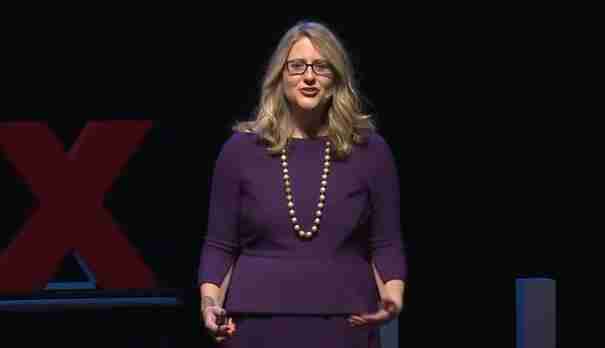
Read the full transcript of Leadership consultant Karen Eber’s talk titled “How your brain responds to stories — and why they’re crucial for leaders” at TED Talks 2021 conference.
Listen to the audio version here:
TRANSCRIPT:
The Power of Making People Feel Seen
KAREN EBER: Maria walked into the elevator at work. She went to press the button when her phone fell out of her hand. It bounced on the floor and went straight down that little opening between the elevator and the floor. And she realized it wasn’t just her phone, it was her phone wallet that had her driver’s license, her credit card, her whole life.
She went to the front desk to talk to Ray, the security guard. Ray was really happy to see her. Maria is one of the few people that actually stops and says hello to him each day. In fact, she’s one of these people that knows your birthday and your favorite food, and your last vacation, not because she’s weird, she just genuinely likes people and likes them to feel seen.
She tells Ray what happened, and he said it’s going to cost at least $500 to get her phone back and he goes to get a quote while she goes back to her desk. Twenty minutes later, he calls her and he says, “Maria, I was looking at the inspection certificate in the elevator. It’s actually due for its annual inspection next month. I’m going to go ahead and call that in today and we’ll be able to get your phone back and it won’t cost you anything.”
The same day this happened, I read an article about the CEO of Charles Schwab, Walter Bettinger. He’s describing his straight-A career at university going in to his last exam expecting to ace it, when the professor gives one question: “What is the name of the person that cleans this room?” And he failed the exam. He had seen her, but he had never met her before. Her name was Dottie and he made a vow that day to always know the Dotties in his life because both Walter and Maria understand this power of helping people feel seen, especially as a leader.
The Power of Storytelling in Leadership
I used that story back when I worked at General Electric. I was responsible for shaping culture in a business of 90,000 employees in 150 countries. And I found that stories were such a great way to connect with people and have them think, “What would I do in this situation? Would I have known Dottie or who are the Dotties I need to know in my life?” I found that no matter people’s gender or their generation or their geography in the world, the stories resonated and worked.
But in my work with leaders, I’ve also found they tend to be allergic to telling stories. They’re not sure where to find them, or they’re not sure how to tell them, or they think they have to present data and that there’s just not room to tell a story. And that’s where I want to focus today. Because storytelling and data is actually not this either-or. It’s an “and,” they actually create this power ballad that connects you to information differently.
The Neuroscience of Storytelling and Data
To understand how, we have to first understand what happens neurologically when you’re listening to a story and data. So as you’re in a lecture or you’re in a meeting, two small parts of your brain are activated, Wernicke and Broca’s area. This is where you’re processing information, and it’s also why you tend to forget 50 percent of it right after you hear it.
When you listen to a story, your entire brain starts to light up. Each of your lobes will light up as your senses and your emotions are engaged. As I talk about a phone falling and hitting the ground with a thud your occipital and your temporal lobes are lighting up as though you are actually seeing that falling phone and hearing it hit with a thud.
There’s this term, neural coupling, which says, as the listener, your brain will light up exactly as mine as the storyteller. It mirrors this activity as though you are actually experiencing these things. Storytelling gives you this artificial reality. If I talked to you about, like, walking through the snow and with each step, the snow is crunching under my shoes, and big, wet flakes are falling on my cheeks, your brains are now lighting up as though you are walking through the snow and experiencing these things.
It’s why you can sit in an action movie and not be moving, but your heart is racing as though you’re the star on-screen because this neural coupling has your brain lighting up as though you are having that activity.
As you listen to stories, you automatically gain empathy for the storyteller. The more empathy you experience, the more oxytocin is released in your brain. Oxytocin is the feel-good chemical and the more oxytocin you have, the more trustworthy you actually view the speaker. This is why storytelling is such a critical skill for a leader because the very act of telling a story makes people trust you more.
The Misconceptions About Data
As you begin to listen to data, some different things happen. There are some misconceptions to understand. And the first is that data doesn’t change our behavior, emotions do. If data changed our behavior, we would all sleep eight hours and exercise and floss daily and drink eight glasses of water. But that’s not how we actually decide.
Neuroscientists have studied decision-making, and it starts in our amygdala. This is our emotional epicenter where we have the ability to experience emotions and it’s here at a subconscious level where we begin to decide. We make choices to pursue pleasure or to avoid risk, all before we become aware of it. At the point we become aware, where it comes to the conscious level, we start to apply rationalization and logic, which is why we think we’re making these rationally-based decisions, not realizing that they were already decided in our subconscious.
Antonio Damasio is a neuroscientist that started to study patients that had damage to their amygdala.
Fully functioning in every way, except they could not experience emotions. And as a result, they could not make decisions. Something as simple as “do I go this way or this way” they were incapable of doing, because they could not experience emotions. These were people that were wildly successful before they had the damage to their amygdala and now they couldn’t complete any of their projects and their careers took big hits, all because they couldn’t experience emotions where we decide.
Another data misconception. Data never speaks for itself. Our brains love to anticipate and as we anticipate, we fill in the gaps on what we’re seeing or hearing with our own knowledge and experience and our own bias. Which means my understanding of data is going to differ from yours, and it’s going to differ from yours, because we’re all going to have our own interpretation if there isn’t a way to guide us through.
Now I’m not suggesting that data is bad and story is good. They both play a key role. And to understand how, you have to see what makes a great story. It’s going to answer three questions. The first is: What is the context? Meaning, what’s the setting, who is involved, why should I even care? What is the conflict, where is that moment where everything changes? And what is the outcome? Where is it different, what is the takeaway?
A good story also has three attributes, the first being it is going to build and release tension. So because our brains love to anticipate, a great story builds tension by making you wonder: “Where is she going with this?” “What’s happening next,” right? A good story keeps you, keeps your attention going. And it releases it by sharing something unexpected and it does this over and over throughout the story.
A great story also builds an idea. It helps you see something that you can no longer unsee, leaving you changed, because stories actually do leave you changed. And a great story communicates value. Stanford has done research on one of the best ways to shape organizational culture, and it is storytelling, because it’s going to demonstrate what you value and encourage or what you don’t value and what you discourage.
Crafting a Power Ballad of Data and Storytelling
As you start to write your power ballad, most people want to start with the data. They want to dig in, because we often have piles of data. But there’s a common mistake we make when we do that. I was working with a CEO. She came to me to prepare for her annual company-wide meeting and she had 45 slides of data for a 45-minute presentation. A recipe for a boring, unmemorable talk. And this is what most people do, they come armed with all of this data and they try to sort their way through without a big picture and then they lose their way.
We actually put the data aside and I asked her, “What’s the problem you’re trying to solve? What do you want people to think and feel different and what do you want people to do different at the end of this?” That is where you start with data and storytelling. You come up with this framework to guide the way through both the story and the data.
In her case, she wants her company to be able to break into new markets, to remain competitive. She ended up telling a story about her daughter, who’s a gymnast who’s competing for a scholarship, and she had to learn new routines with increasing difficulty to be competitive. This is one of your choices. Do you tell a story about the data itself or do you tell a parallel story, where you pull out points from the story to reinforce the data?
As you begin this ballad, this melody and harmony of data and storytelling come together in a way that will stay with you long after.
A Powerful Example: Briana’s Story
Briana was a college adviser. And she was asked to present to her university leadership when she realized that a large population of their students with autism were not graduating. She came to me because her leaders kept saying, “Present the data, focus on the data,” but she felt like university officials already had the data. She was trying to figure out how to help them connect with it.
So we worked together to help her tell the story about Michelle. Michelle was a straight-A student in high school who had these dreams of going to university. Michelle was also a student with autism who was terrified about how she would be able to navigate the changes of university. Her worst fears came true on her first phone call with her adviser, when he asked her questions like, “Where do you see yourself in five years?” and “What are your career aspirations?” Questions that are hard for anybody. But for a person with autism to have to respond to verbally? Paralyzing.
She got off the phone, was ready to drop out, until her parents sat down with her and helped her write an email to her adviser. She told him that she was a student with autism, which was really hard for her to share because she felt like there was a stigma associated just by sharing that. She told him that she preferred to communicate in writing, if he could send her questions in advance, she would be able to send replies back to him before they got on the phone to have a different conversation.
He followed her lead and within a few weeks, they found all of these things they have in common, like a love for Japanese anime. After three semesters, Michelle is a straight-A student thriving in the university.
At this point, Briana starts to share some of the data that less than 20 percent of the students with autism are graduating. And it’s not because they can’t handle the coursework. It’s because they can’t figure out how to navigate the university, the very thing an adviser is supposed to be able to help you do. That over the course of a lifetime the earning potential of someone with a college degree over a high school degree is a million dollars. Which is a big amount. But for a person with autism that wants to be able to live independent from their family it’s life changing.
She closed with, “We say our whole passion and purpose is to help people be their best, to help them be successful. But we’re hardly giving our best service by applying this one-size-fits-all approach and just letting people fall through the cracks. We can and we should do better. There are more Michelles out there, and I know because Michelle is my daughter.”
And in that moment, the jaws in the room went — And someone even wiped away tears, because she had done it, she had connected them to information differently, she helped them see something they couldn’t unsee. Could she have done that with data alone? Maybe, but the thing is, they already had the data. They didn’t have a reason not to overlook the data this time.
The Power of Storytelling and Data Combined
That is the power of storytelling and data. That together, they come together in this way to help build ideas, to help you see things you can’t unsee. To help communicate what’s valued and to help tap into that emotional way that we all decide.
As you all move forward, shaping the passion and purpose of others as leaders, don’t just use data. Use stories. And don’t wait for the perfect story. Take your story and make it perfect.