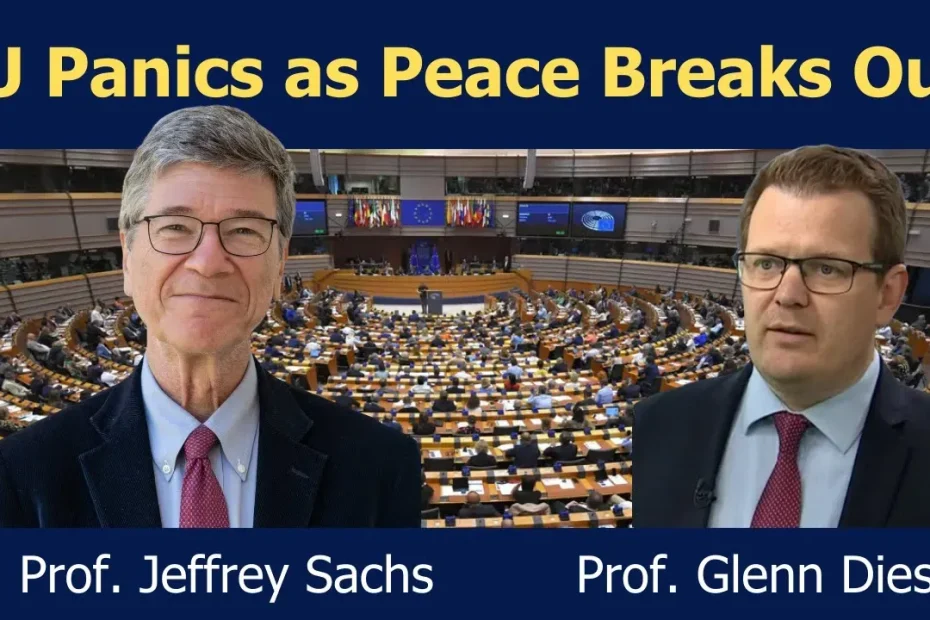
Read the full transcript of Jeffrey Sachs’s talk/lecture/interview at INTERVIEW on Feb 26, 2025.
Listen to the audio version here:
TRANSCRIPT:
GLENN DIESEN: Hi everyone, my name is Glenn Diesen, and today we are joined by a dear friend, Professor Jeffrey Sachs. We have spoken a lot in the past about the US-Russian rivalry at the core of the NATO-Russian rivalry, and we’ve discussed the efforts by the Americans and the Russians to end the war and restore relations. However, today I wanted to ask you about the Europeans and their role.
Europe’s Panic as Peace Prospects Emerge
GLENN DIESEN:You were just speaking at the EU Parliament, and your speech is now all over the internet. We’ve ended up in a very strange situation where everyone wants the war to end. We find the US, Russia, China, indeed most of the world on the same page, including the majority of Ukrainians who are even willing to accept territorial concessions to get peace.
It seems like the one exception, or at least the main exception, is the European Union, in which the threat of peace appears to spark panic. The Danish Prime Minister even argued that peace may be more dangerous than war.
This is a huge shift because the EU was sold as a peace project. Indeed, in the 90s, the Russians contrasted the EU as the “good West” versus NATO as the “bad West.” How can we explain this panic? Is it interest, ideology? Do they believe their own narratives that Russia is attempting to restore the Soviet Union? Is it dependence on the US? How are you reading this dramatic negative shift by the European Union?
JEFFREY SACHS: Thanks, Glenn. Great to be with you. I have to say, I’m confused, because I would have expected more from Europe. Of course, Europe is divided internally. There is a lot of anti-war sentiment in Europe, most vocally from Prime Minister Orbán of Hungary and Prime Minister Fico of Slovakia. There will likely be a new government in Czech Republic later this year that will be an anti-war government. So the old Austrian-Hungarian Empire, the Habsburg lands, are going to be pretty much united against this war.
There are lots of voices all over Europe that want the war to end. That’s what public opinion polls show. But the political leaders, not so much. And in fact, they go down to defeat, one after another, those who have been prosecuting this war.
Political Leaders Against Public Opinion
European leaders became very unpopular during this period. Of course, the economy suffered tremendously by the cutoff of low-cost natural gas from Russia. This sent the German economy into contraction. That spiraled to the rest of Europe. Energy costs have soared. Governments are unpopular.
In Germany, the SPD ruling party has shockingly collapsed in public support. Macron is very unpopular in France. What’s puzzling, why I say I’m confused, is that these politicians are not following public opinion. They’re not acting like politicians trying to maximize public support or the vote. What are they doing exactly?
I had interpreted and still basically do interpret the last 30 years as US-led, a US-led adventure of unipolarity that was manifest most explicitly in NATO enlargement, and that Europe reluctantly signed on to that.
What we think we know from events like the Bucharest summit in 2008 of NATO, Chancellor Merkel and President Sarkozy of France were resistant to following the US line of NATO enlargement and especially a clear commitment, a roadmap for Ukraine and Georgia to join NATO. So they were resistant, but they dropped their resistance at the Bucharest summit under pressure from the United States and then acceded to the US approach.
That included Europe agreeing to the coup and the fact that the United States actively promoted regime change in February 2014, and actually the United States recognized a government brought in by a violent coup a day after European foreign ministers had negotiated almost exactly the opposite, a continuation of the Yanukovych government for many months until there would be national elections later in 2014. So the Europeans folded their hand on February 22nd, 2014 and went the American route.
US Expansion and European Compliance
My interpretation has been that America led what I have called a game. It was a game of US expansion, US unipolarity, US aiming to weaken and extend Russia. The word “extend Russia” is the word that the Rand Corporation used in 2019 to say, “do everything you can to weaken, annoy, undermine Russia.” What a policy, by the way, just mind boggling that adults should behave like children in this reckless manner. But that’s what they did.
Now, Europe suddenly is given a prospect that this absurd, failed, disastrous approach will end. And they say, “No way. We’ll continue the war.” Of course, they can’t continue the war. Even with the United States, Russia was winning the war on the battlefield and wasn’t going to be defeated. Europe by itself, it’s preposterous to talk in the terms that they are speaking.
So to come back to your question and my confusion, why is Europe missing the moment?
Why Europe Is Missing the Moment
I think that there are several obvious things to say. First, Europe institutionally doesn’t have a foreign policy. It’s 27 countries. The EU does not have, under the rules of the game of the European Union, the power to have a foreign policy. Whether it would be a good one or not is a question. But the foreign policy is essentially what comes out of decisions of 27 disparate countries. So that’s a first point.
Second, there is absolute fear in the Baltic states because the Baltic states have been depending on the United States to back them up. And with the U.S. backing them up, they thought they could be as nasty towards the Russians as they wanted, rhetorically, even to their own ethnic Russian populations, trying to ban the Russian language or Russian schools, because they thought the United States was standing with them.
So these tiny countries have been the most vociferous, Russophobic of all countries.
How would you behave that way? Well, they counted on the U.S. to have the big club that was going to protect them. And now the U.S. isn’t protecting them. So they are in a panic, definitely.
To my mind, what these countries, the Baltic states, were doing in recent years, it was so dangerous. If you have a powerful neighbor, don’t spend every day attacking it, damning it, hating it, trying to undermine it, saying it should break into pieces. If you’re tiny and you have a big neighbor next door, don’t even talk that way. Be clever. They have statecraft. But they thought, “Oh, the United States will protect us so we can be as loud and nasty as possible.” Okay, now they really are panicking.
But how can anyone explain the words of the Danish prime minister? I can’t. Every theory I have, if I were the Danish prime minister and I was worried about an invasion by a great power, I’d absolutely be worried about the United States of America, because Donald Trump has expressed very vividly his eyes on Greenland. I don’t think President Putin expressed his voracious appetite for Greenland or for Denmark. In fact, I know that he obviously has not. But Donald Trump has.
And so if you are the prime minister of Denmark and your job is national security, how can you be taking this kind of line, that continued war is best, and so much oblivious to what the real changing geopolitics is for your country?
I find it extremely confusing, or maybe confusing isn’t the right word. I find it very dismaying that there is such incoherence in the European approach.
The Need for Direct Dialogue
Now, that was a long-winded answer to say that there are probably many factors that explain the incoherence of Europe right now. I can say at one level, I’ve been saying to the European leaders for years, open a direct discussion with Moscow. This is what you need to do for many different points of view to end the war, to achieve collective security, to have a new security arrangement in Europe, to understand the different points of view. This is the one thing that has not happened until today.
They don’t get that. They seem to like to travel to Kyiv for their photo opportunities. God knows why they regard that as a photo opportunity. It’s a disaster, this approach. But they don’t aim for diplomacy with Russia.
Now the United States is actively in diplomacy with Russia, and this is a good thing for the world, and a good thing for Europe, and a good thing for Ukraine. But even then, Europe doesn’t say, “Oh, we need to open our own channels.” Instead, Europe begs the United States, “Let us be…”
JEFFREY SACHS: You know, the EU has more people than the United States. European Union is closer to Russia, of course, geographically. It has more at stake. Why does the EU need to go through the United States begging for a place to discuss with Russia? Why not open a discussion directly with Russia, which the Russian government has said repeatedly, of course, it’s open to? This is an interesting situation, which the Europeans are more or less begging the Americans to be allowed to be a part of it, but nobody wants to pick up the call and actually call Moscow and talk to them.
GLENN DIESEN: So it is a bit of a contradiction, but it seems also that the unity in the EU often depends on creating these narratives where only one option is legitimate, and everything else is illegitimate. This is a good way of fixing the compelling consensus. So you mentioned we have some opposition in Europe, so Viktor Orbán, Robert Fico, well, also across the Atlantic, of course, the United States, who now have Donald Trump, and one might get a Czech as well on pushing for peace. But they’re immediately labeled as Putinist. We do not discuss their arguments, and the only legitimate position is that war is the only path to peace, and everyone is either radical left or radical right if they deviate from what we demand should be the consensus.
And so it does appear that we have replaced strategic thinking with these moralistic slogans where there can only be one position. So we end up often with these slogans where we say NATO should be allowed to expand because the alternative is that Russia’s dictating to Ukraine what it can do. We’re having these other slogans that we can’t talk to the Russians, as you said, without the Ukrainians. Indeed, even talking to the Russians is problematic because it could embolden Putin. What would you say to those who essentially lean on these moral assumptions behind these slogans?
The Case for Normal Statecraft
JEFFREY SACHS: I would say that they should engage in normal statecraft, normal, prudent statecraft. I’m not talking about secret treaties. I’m not talking about secret alliances. I’m not talking about secret concessions. But the idea of simply engaging with your counterpart, a powerful counterpart, on your continent to discuss issues of life and death importance is the first rule of diplomacy. And that is what disappeared. The norm became don’t talk to the other side. This is a shockingly wrong idea.
When you talk, two things happen. One, you actually learn something because the other side has views, reasons, motivations that maybe you don’t understand. So it’s extremely important to talk to the other side. A second point is a more human point and what I’m about to say is proven in hundreds of experimental game studies, which is when you talk to the other side you are much more likely to reach an understanding with the other side through the process of communication, through the humanization of the relationship. It may sound naive but it’s actually not naive. Diplomacy requires two-way communication. Negotiation is not with the machine, it’s with another person, it’s with another foreign minister.
I speak to foreign ministers all over the world. The good ones speak to each other. I think in our previous discussions I mentioned a bizarre occasion that I had with the G20 when it was hosted by Indonesia and the foreign ministers met in Bali. I was invited to speak to them by video so I was on a Zoom call with the foreign ministers of the G20. What was shocking to me was the European and American foreign ministers would not speak to the Russian foreign minister who was in the room.
The whole idea was to show like high school kids, we’re in a clique, we’re not even talking to you, you don’t belong to our clique. It was so immature. I was stunned. I could speak to them but they wouldn’t talk with each other even though they were physically in a room together. The idea was don’t shake hands, don’t be in a common picture, don’t have a discussion with each other.
So this became a norm and Europe has at least a thousand years, you could argue two thousand years of diplomatic experience, inventing a lot of what we call diplomacy. They should know to talk with each other. They should understand, the prime minister of Denmark should understand, Russia’s going to be there tomorrow, it’s going to be there next year, it’s going to be there in 10 years. Are you kidding to talk this way?
The Collapse of European Foreign Policy
JEFFREY SACHS: So this is I think a collapse of basic processes, essentially my guess has been because they farmed everything out to the United States, which also by the way wasn’t true for even the decades of the 1980s, 90s and the first years of the 2000s. We should recall that when the United States pursued its absolutely destructive, illegal and idiotic war in Iraq in 2003, many major European powers were against it. When the U.S. pushed for NATO enlargement in 2008, I spoke with European leaders who said to me, “What is your president doing? Why is he doing this? This is destructive.”
But from my experience, all European foreign policy collapsed in 2008. After that, it was only follow the U.S. lead and I’m hoping, I’m counting on some kind of revival of this. It’s interesting in the last few days, Europe has shown glimmers of a European voice, not constructive glimmers by the way. It’s been more “we oppose the U.S., they want peace, we want war,” but at least it’s a European position. I’m going to count that as a modest step forward, that at least Europe is talking like Europe.
Now, if they could think a little bit, then they would realize that the warmongering is both doomed to fail because Europe cannot support Ukraine in a war and Ukraine cannot be victorious. It can only lose hundreds of thousands of more people and massive amounts of territory, by the way, if this war doesn’t end. And Europe should tone down its panic that Russia is about to invade Europe, which it’s not, and open up what Russia has been calling for actually for 30 years, which is true diplomacy over collective security on the European continent. And if it does that, and I’m not giving up on that, this would be a major constructive change and it could come sooner than we think.
GLENN DIESEN: You know, I think this is also the one peaceful outcome that would actually benefit everyone. If there would be a revisiting the discussions of a natural European security architecture, as if we can revive the concept of indivisible security, which was the leading one until we came up with the idea of a hegemonic peace. Yeah, this would eventually be good for Ukraine as well, because the more threatened Russia feels, the more aggressively it will push back. And this is very bad news for front-line states who are on the Russian border.
The Istanbul Negotiations
GLENN DIESEN: But I also want to ask you about, you mentioned the Minsk agreement and all this, but the Istanbul negotiations, because in this battle for narratives, and whenever we have narratives or facts which doesn’t fit the narrative, it’s simply pushed aside. So for example, the Istanbul negotiations in the beginning of 2022 is now completely absent from the EU’s war narrative, because it doesn’t fit with the idea that the Russians simply wanted to restore the Soviet Union or these other narratives they’re pushing. But you were actually there, you flew to Istanbul and as the Russians and Ukrainians were negotiating. What is it that’s missing there from the EU’s narrative?
JEFFREY SACHS: Russia’s aim in 2022 with special military operation, as I interpreted, was to force Ukraine, if I could use that term, because it was under force, to return to neutrality, which would have benefited everybody, Ukraine, Russia, Europe, everybody. So it was pushing for something that made complete sense, and Ukraine as neutral would have been safe, it would have been stable, it would not have been a war zone, but the United States hates neutrality. That was the whole point of the unipolar moment. Neutrality is a violation of “either you’re with us or you’re against us.” If you claim to be neutral, you’re just against us. That was the U.S. view.
So what Russia’s war aim was in February 2022 was neutrality in Ukraine and finally implementation of something like Minsk II, which was autonomy and protection for the ethnic Russian population. These were limited aims, they did not call for the annexation of the Donbas. That was something that came later in the year. It was not an aim in February 2022, and it was not on the table in March 2022. So we now know from so many participants, from the ones that I…
JEFFREY SACHS: I spoke to people in Ankara, actually the Turkish mediators, from the Russians, from the Ukrainians, from the Americans, from the Brits. We know from so many different sources that the two sides had come close to an agreement and it was scotched by the U.S. and U.K. Johnson, Boris Johnson was perhaps the messenger at the end that put the full kibosh to it, but the two sides were close to an agreement because Zelensky was saying publicly at the end of March 2022, all over the place in interviews, in the Financial Times, in many places, “Yes Ukraine can be neutral.” They were reaching an agreement.
The U.S. did not want an agreement at that time. The U.K., which is a—oh, this is another long story, but it shows that you can have imperial nostalgia even for more than half a century or longer. The U.K. is a country that absurdly believes it’s a world empire and acts like one, again, always counting on the U.S. to do its bidding. The U.K. said, “No, we need to defeat Russia to protect Western hegemony.” That’s actually what Boris Johnson publicly said last year. That’s what the war is about. That’s what you and I have been saying. That’s what is plainly the case.
And so the absence of this episode from the European narrative is important, as you say, because this shows that the European narrative is completely a narrative that makes no sense. It’s not true what happened. It’s not true how this unfolded. You wonder, though, do they know and just absolutely refuse to tell the truth or don’t they know because some of them are not very sophisticated and maybe they believe their own narratives or whatever narrative was coming from Washington and so forth. That’s a little confusing to try to understand how they can be so misguided.
Growing Appetite for Peace in Europe
I have to say, though, when I went to the European Parliament, it was a side meeting, not an official meeting of the European Parliament. But people of all parties, all across the Parliament, have written to me afterwards in support. “Thank you. We need diplomacy. We need a European foreign policy.” The reaction has been extremely positive, except from the Commission itself, but from the parliamentarians, from people across Europe, from people of all different political persuasions, by the way. This is not some extremist position, quite the contrary. People want peace in Europe. They want to return to diplomacy in Europe. It’s the leadership that’s not giving them that right now.
GLENN DIESEN: You know, it would be common sense because at the moment the plan of the EU is seemingly to go against the world, to use money it doesn’t have, to buy weapons that don’t exist so they can defeat the world’s largest nuclear power on the battlefield, which considers this to be an existential threat. So it’s not really clear what the strategy is. I see that today the British are now calling for the outright confiscation of Russia’s assets.
JEFFREY SACHS: Of course it’s easy for the UK to say to Europe, “Confiscate Russia’s assets, destroy completely your creditworthiness, your position in the world of finance, your position in the world of monetary economics.” That’s what the British do these days. They bluster, they speak like the great imperial power, sacrificing everyone else.
GLENN DIESEN: Yeah, well it seems like the EU is eager to do this and as Trump prepares to move away from Ukraine after this proxy war has been lost, it was unloaded on the Europeans and the Europeans seem very willing, indeed overly eager to take over this train wreck. It’s shocking that we’re not having any real discussions about actually talking to the Russians and discussing European security. Like I said, it’s probably trapped by their own narratives after three years of claiming to be fighting the new Hitler. I think it would be very difficult to accept that the opposing side might have legitimate concerns. But anyways, here we are. Professor Sachs, thank you so much for your time. I really appreciate it. I know you have a lot to do. Indeed, you’re on your way out at the moment, so I very much appreciate it.
Germany’s Potential Role in European Independence
JEFFREY SACHS: Glenn, if I could just add one more word. Again, it’s only a glimmer of possibility, but when Merz won the election in Germany, of course, he made a statement just afterwards saying that part of his job will be to understand that Europe is going to need to have a position independent of the United States. This was actually a rather clear statement. Again, as we’ve been discussing, what that independent position is, is it on the right side, the wrong side, that’s another matter. But Germany is important in this, of course. Central. There will be a new chancellor. There was a repudiation of the past policy. There is the reality of the U.S.-Russian negotiations.
There is a tradition in Germany of some independence of foreign policy in the last 40 years from Willy Brandt, Helmut Schmidt, Kohl, Schroeder, in fact Merkel until 2008, I would say. So maybe let’s just keep our eye on that and hope that Germany can be a constructive force in restoring European-Russian diplomacy and European-Russian economic relations.
After all, one of the main aims of the U.S. neocons after 1991 was to break the economic links between Germany and Russia. They did that. They blew up the pipeline. They destroyed what was the basis of the German heavy industry, which was low-cost energy and resources from Russia. And Merz, as a party of business, may, just may, come to figure that out sooner rather than later.
GLENN DIESEN: Well, during the Cold War, the Germans, when they did oppose the United States, it was usually to improve relations with Moscow. As Willy Brandt argued, that of indivisible security, security for all or security for none. This was very different to the bloc politics, where maximization of power is equalized to the maximization of security. But Willy Brandt appears to be, not only Willy Brandt, but Merz, appears now to be building up the courage to decouple a bit from the U.S. and confront America, because they’re not hostile enough against Russia. So it’s exactly the wrong time to—
JEFFREY SACHS: It could be. It could be. It could be. Let’s see.
GLENN DIESEN: Well, thanks again. Great to be with you.