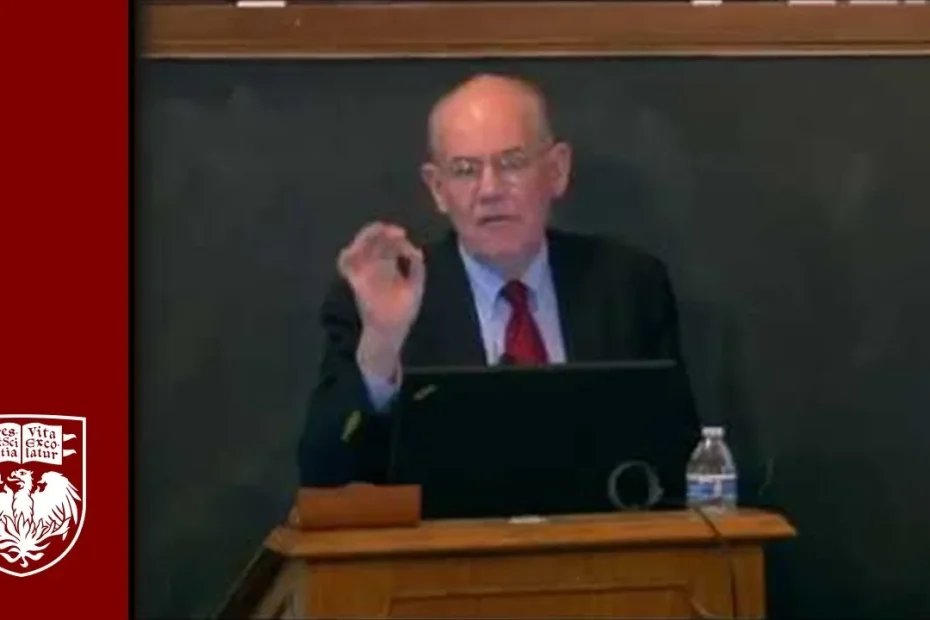
Read the full transcript of Professor John J. Mearsheimer’s lecture titled “UnCommon Core: The Causes and Consequences of the Ukraine Crisis” at the University of Chicago on Sep 25, 2015
Listen to the audio version here:
TRANSCRIPT:
MICHAEL VOLCHAK: All right. Am I on here? Oh, okay. Great. Good afternoon, everyone.
Welcome to the Uncommon Core lecture, “The Causes and Consequences of the Ukraine Crisis.” My name is Michael Volchak. I attended the university from 1986 to 1991. I got a bachelor’s in Political Science and a master’s in International Relations. Professor Mearsheimer was a tremendous influence on my life, completely revolutionizing my worldview, changed how I looked at international relations, politics, just everything.
In fact, he was such a big influence in my life that when I went home for the summer between one of the school years, leaving my college girlfriend here, she gave me a little keepsake picture book. And she said, “Here, to remember the people you love.” And inside was a picture of her on the right and a picture of Professor Mearsheimer on the left. That’s a true story.
When I was here, the two biggest things for me were Military Affairs and the Model United Nations of the University of Chicago, the student organization that I co-founded in 1988. At that time, I discovered that you need a faculty adviser in order to have a registered student organization. So, of course, I thought for about two seconds, and then I went to see Professor Mearsheimer. And I’m not sure if he remembers this, but I asked him, “Will you be our faculty adviser?” And he said, “I will sign the piece of paper if I never have to do anything else after that.”
So I had found my faculty advisor. Without further ado, I would like to introduce the R. Wendell Harrison Distinguished Professor of Political Science, Professor John J. Mearsheimer.
The Ukraine Crisis: Background and Causes
JOHN MEARSHEIMER: Thank you very much for that kind introduction.
Thanks all for coming out to hear me talk. The subject I want to talk about is the causes and consequences of the Ukraine crisis, which of course has been in the news in a really big way since February 2014. And indeed, there was a big story on the civil war in Eastern Ukraine in the newspapers this morning.
I’d like to follow this outline: First, I’ll make a number of preliminary comments to give you some background on this crisis. Then I’ll give you my thinking on what caused the crisis, then tell you why I think the conventional wisdom is wrong, talk a little about the West’s response so far to the crisis, which is just, in my opinion, making a bad situation worse, and tell you what I think should be done. And then finally wrap up with some discussion of the consequences.
America’s Core Strategic Interests
Let me start with some preliminary comments. First, with regard to America’s core strategic interests. For me, core strategic interests are areas of the world where you’re willing to fight and die. And in my opinion, outside of the Western Hemisphere, which is of enormous strategic importance to us, there are only three areas of the world that really matter.
One is Europe, two is Northeast Asia and three is the Persian Gulf. It’s very important to understand that since this country got its independence in 1783, Europe has been the most important area of the world. Even though the Japanese attacked us at Pearl Harbor, we had a Europe first policy going into the war, and we had a Europe first policy throughout the war. It’s in large part because the great powers in Europe are more important than the great powers in Northeast Asia over time. And of course, the Persian Gulf was an important area because that’s where the oil is, and oil is a critical resource that matters greatly in the international system.
So those are the three most important areas outside the Western Hemisphere. And again, since the beginning of this country, Europe has been number one. You want to understand that we’re undergoing a fundamental shift, a shift of great importance. Asia, because of the rise of China, is going to be the most important area of the world for the United States. The Persian Gulf, because it’s inextricably linked with Asia, oil flowing to India, oil flowing to China. The Persian Gulf will be number two. And Europe will be a distant three. We’re basically leaving Europe in the rearview mirror. And of course, you want to keep this in mind because the Ukraine crisis is in Europe and it involves NATO.
The Geography of Europe
How to think about the geography of Europe? This is a simple, if not simplistic way of thinking about it. But here’s a map. You can see where Ukraine is. You can see where Poland is. You can see where Russia is.
The way I think about European security is there’s France, Germany, Poland, Ukraine and Russia. Of course, we’re moving from west to east. These are the big kahunas. These are the big countries that matter. And of course, the two countries that matter the most historically are Germany and Russia, or for most of the twentieth century, Germany and the Soviet Union.
And I put them in red because as you well know, both Germany and the Soviet Union fought bitter wars in Poland, in Ukraine, and we could add in Belarus as well, if need be. But as we go along here, you want to keep in mind that Ukraine is right next to Russia, and Poland is right next to Ukraine. And then out further west is Germany and France.
Ukraine’s Ethnic and Political Divisions
Take this a step further. This is the ethnic breakdown of Ukraine. I’m going to show you a number of maps, all of which are designed to show you that Ukraine is a badly divided country.
This is the Ukraine election of 2004. This is the election in the wake of the famous Orange Revolution, which I’ll talk more about. As you can see, the country is badly divided between the East and the West. The Russian speakers in the East and Ukrainian speakers in the West.
This is the 2010 election, which resulted in Yanukovych getting elected. I’ll talk about President Yanukovych as we go along. He was elected in 2010. And you can see there the voting patterns in the 2010 election look a lot like the voting patterns in the 2004 election.
And then these are two recent surveys that came out from the International Republican Institute that’s here in the United States. This one says, “If Ukraine could enter only one international economic union, which of the following should it be?” And of course, the blue is the EU, and the red is the customs union of Russia, Belarus and Kazakhstan. And the cities up at the top are in Western Ukraine, and the cities down the bottom are in Eastern Ukraine. So you can see very clearly that people in the West would like to join the EU. People in the East have little interest in joining the EU.
Here are the NATO numbers. I mean, these two charts look virtually the same. But all of this tells you that you have a badly divided country. And the conflict between the West and Russia over Ukraine is played out in the context of this situation.
This is a simple little view graph that shows Europe’s dependence on Russian gas. It’s quite clear from that view graph that many of the countries in Eastern Europe and even countries like Germany are heavily dependent on Russian natural gas. And of course, that gives the Russians lots of political leverage in this crisis, and it makes it very difficult for us to put pressure on the Russians.
Causes of the Conflict
Okay. Those are just a number of preliminary comments that I wanted to throw out just to set this up. Let’s talk about the causes of the conflict.
I think if you’re going to talk about the causes of the conflict, you have to come at it from three different perspectives. First of all, you have to ask what are the deep causes of the crisis? What are the structural factors that underpin this conflict? Then you have to talk about the precipitating causes because the crisis broke out on February 22, 2014. Things were not terrible until February 22, 2014, and that’s when everything went to hell in a handbasket.
And the question is what caused it then? If you focus on deep causes, it can’t tell you why something happened in February 2014, but the precipitating causes are designed to get at that. And then what we want to talk about is the Russian reaction. Why the Russians did what they did with regard to Crimea, with regard to Eastern Ukraine. We’re going talk about exactly what they did and then why they did it.
The West’s Responsibility
So let’s start with the deep causes. My argument is that the West is principally responsible for this mess, not the Russians. This, of course, is not the conventional wisdom in the United States. And in fact, for Steve Cohen, who’s now at NYU, Henry Kissinger and maybe a handful of other people, there are not many people who agree with me.
But I think the facts are quite clear on this, that the West is responsible. And my aim is that the main deep causes, the aim of the United States and its European allies to peel Ukraine away from Russia’s orbit and incorporate it into the West. Our basic goal has been to make Ukraine a Western bulwark on Russia’s border. And Russia says, this ain’t happening. Period. End of story. And we will do everything we can to make sure it does not happen. That’s the deep cause.
Three Key Elements of Western Strategy
Now take it a step further. There are three key elements in our strategy.
The first is NATO expansion, and in many ways, the most important. And I’ll talk in some detail about that in a second. But as you all know, since the Cold War ended, starting with the Clinton administration, we have been moving NATO eastward toward Russia’s border. And the Russians have said, this is an absolute no-no. And I’ll walk you through the story in a minute.
Second is EU expansion. EU expansion is all about integrating Ukraine economically into the West, the way we are in the process of integrating Poland, the Czech Republic, Slovakia, the Baltic states into the West. And, of course, we’re doing that with NATO as well. These are two sets of institutions, NATO, military institution, the EU, an economic institution. And the idea again is to take Ukraine, peel it away from Russia, make it part of the West.
The third part of the story is fostering an Orange Revolution. This is all about promoting democracy in Ukraine and in other places. As you all know, the United States runs around the world trying to topple regimes and put in their place democratically elected regimes. And for almost all of you, me included, it’s hard to be against promoting democracy. We all love democracy.
But if you’re Vladimir Putin, or if you’re part of the leadership in Beijing, when the United States talks about democracy promotion, that means toppling your regime. And you won’t be surprised to hear this. They don’t like that in Beijing, and they don’t like that in Moscow. They do not like that. The Chinese believe that we’re behind the protests in Hong Kong.
You go to Beijing and you talk to Chinese elites. The idea that we’re promoting democracy around the world and especially in East Asia just drives them crazy because they think they’re in the crosshairs. And you know what? They are in the crosshairs because our basic strategy is to topple regimes all over the world, not simply because we like democracy, but because we believe that whoever gets elected will be pro-Western. So we’re killing two birds with one stone. We’re promoting democracy and getting leaders who are pro-American. But again, you can see the strategy here, NATO expansion, EU expansion, and promoting democracy.
NATO Expansion
Say a bit more about NATO expansion because it’s so important. NATO expansion took place in two tranches. The first one was in 1999. That’s when you get Poland, the Czech Republic and Hungary incorporated into NATO. The second big tranche was in 2004. And that’s when the Baltic states. You can see Estonia, Latvia, and Lithuania up top, Romania, Bulgaria. These are the light brown countries. That’s the second tranche of NATO expansion.
Now the Soviets made it clear from the mid-1990s, they were adamantly opposed to NATO expansion. But number one, they were too weak to do anything about it. And two, it didn’t involve the states that were right on their border. I mean, there’s no question, as you can see from the map, that Latvia and Estonia are on Russia’s border and Lithuania as well, if you want to include that little enclave between Poland and Lithuania. But the fact is these were very small states. It was early in the game, and the Russians were willing to live with it.
But then the big trouble starts. And it comes in the famous Bucharest summit, NATO’s Bucharest summit in April 2008, where at the end of the summit, a declaration is issued which says “NATO welcomes Ukraine’s and Georgia’s Euro-Atlantic aspirations for membership in NATO. We agreed today that these countries will become members of NATO.”
The Russians made this perfectly clear. This was unacceptable. Russia’s deputy foreign minister said, “Georgia’s and Ukraine’s membership in the alliance is a huge strategic mistake, which will have most serious consequences for pan-European security.” Putin himself said, “Georgia and Ukraine becoming part of NATO is a direct threat to Russia.” You all remember that there was a war between Russia and Georgia in August 2008?
NATO Expansion and the Georgia War
JOHN MEARSHEIMER: That war was a consequence of this because the Georgians thought we were sending them a signal that they could get uppity with the Russians and we would back them because they were going to become part of NATO. That’s not what happened. The Russians clobbered the Georgians, and Georgia is in deep trouble today because it thought it could become part of NATO. So you want to remember that April 2008 summit, very important.
That declaration, very important. And then what happens is you have a war. So those are the deep causes, those three strategies: NATO expansion, EU expansion, and promoting democracy. What about the precipitating cause? Key events leading up to the coup.
It’s the coup of February 22, 2014 that’s of enormous importance. That’s what really throws the crisis into gear. Just think about that word, coup. Orange Revolution promoting democracy, the coup, February 22, 2014. So the question is what causes the coup?
Origins of the Ukraine Crisis
It all starts in November of 2013. At that point, Yanukovych, President Yanukovych, who’s the head of Ukraine, is negotiating with the EU to form an association agreement that brings the EU and Ukraine much closer together. It’s a step in the direction of incorporating Ukraine into the European Union, or to put it in slightly different terms, incorporating Ukraine into the West. The Russians make it clear that this is unacceptable.
Russians are willing to do a deal that involves the EU, Russia, the IMF and Ukraine. But the idea that Ukraine is going to do a deal exclusively with the EU and the Russians are going to be left out in the cold is not something that Putin is willing to countenance. He puts significant pressure on the Ukrainians. He offers them a terrific deal. And as you can imagine, the EU is not offering Ukraine a particularly good deal because you know how much corruption there is in Ukraine. And the EU wants Ukraine to eliminate that corruption, which the Ukrainians really don’t want to do.
So what Putin does is not only make it clear that that deal is not going to happen, but he offers a sweetheart deal of his own. So Yanukovych, on November 21, says no to the EU. This leads to a series of protests. The Ukrainian government, truth be told, under Yanukovych overreacts to the protests, which causes them to spiral out of control. And in January of 2014, you can see there January 22, 2014, you have your first two deaths in the protest.
These are the Maidan protests. And then in the February 18 through February 20 time period, lots of people die. It’s really messy. And what happens is that a number of European foreign ministers, the German foreign minister, French foreign minister, they fly to Kyiv, and a deal is worked out to have elections that will, in effect, remove Yanukovych from power. But the protesters refused to accept the deal.
And there are significant fascist elements among the protesters who were armed. There’s killing on the Maidan. And as a result, Yanukovych flees for his life to Russia. And this all happens on February 22.
Key Events After the Coup
On February 23, parliament votes to repeal minority language laws in the east. This is basically the Russian language. And then on February 27, Russian units begin seizing checkpoints in the Crimea. On the 28th, additional Russian forces begin moving into the Crimea.
The Russians didn’t conquer or invade Crimea. The Russians didn’t invade Crimea. They were already there because they had a leasing agreement. There’s a naval base at Sevastopol, and the Russians were leasing that naval base from Ukraine. So they had military forces there. So when it says Russian units begin seizing checkpoints on the 27th, those were Russian units that were already there. Then additional Russian forces begin moving in on the 28th.
And then on the 6th, the 16th and the 18th, you have a scenario – you have a handful of events that lead to Russia incorporating Crimea. And then, of course, shortly after that, conflict breaks out in Eastern Ukraine. And although we do not have a lot of hard evidence that the Russians are physically involved in Eastern Ukraine, I think it’s quite clear that they are physically involved, that there are Russian troops there. How many is very hard to tell from the outside. And I think it’s very clear that the Russian government is going to great lengths to make sure that those pro-Russian forces in Eastern Ukraine are capable of maintaining certain amount of independence.
Understanding the Russian Response
What is the Russian response? Two parts. First is they took Crimea and they’re not giving it back. Crimea is gone. Second is what they’re doing is not trying to conquer Ukraine. There are many people who say the Russians are going to go on a rampage. They’re going try and reestablish the Soviet Union or a greater Russia and so forth and so on. That’s not going to happen.
Putin is much too smart for that. You remember what happened when the Russians invaded Afghanistan? You remember what happened when we invaded Afghanistan? You remember what happened when we invaded Iraq? Remember what happened when the Israelis invaded Southern Lebanon?
You want to stay out of these places. In fact, if you really want to wreck Russia, what you should do is encourage it to try and conquer Ukraine. Putin, again, is much too smart to do that. What Putin is doing is he’s basically in the process of wrecking Ukraine. And he’s telling the West in very simple terms, you have two choices.
You either back off, and we go back to the status quo ante before February 22, 2014, where Ukraine is a buffer state. Or you continue to play these games where you try and take Ukraine and make it a Western bastion on our doorstep, in which case we’ll wreck the country. And they are, of course, now in the process of wrecking it. And they’re going to keep this conflict going for as long as they have to.
That’s the basic game here. Again, two steps. One took Crimea, no way they’re going to ever let Crimea become a NATO base. And remember, the name of the game here is to make Ukraine part of NATO, not happening. And they’re not getting Crimea. We’ve taken Crimea. We’re keeping it, number one. And number two, you want a frozen conflict or you want to wreck Ukraine so that it can’t become part of the West.
Russian Motivations
Question number two here is what motivates this? What motivates this is that Russia is a great power and it has absolutely no interest in allowing the United States and its allies to take a big piece of real estate of great strategic importance on its western border and incorporate it into the West.
This should be hardly surprising to the United States of America. As all of you know, we have a Monroe Doctrine. The Monroe Doctrine basically says that the Western Hemisphere is our backyard and nobody from a distant region is allowed to move military forces into the Western Hemisphere. I can tell from looking at the audience that most of you are old enough to remember the Cuban Missile Crisis like I am. You remember how we went stark raving crazy at the idea of the Soviets putting military forces in Cuba?
This is unacceptable. Nobody puts military forces in the Western Hemisphere. That’s what the Monroe Doctrine is all about. Can you imagine twenty years from now, a powerful China forming a military alliance with Canada and Mexico and moving Chinese military forces onto Canadian and Mexican soil and us just standing there and saying, this is no problem. We’re all 21st century people and worrying about Chinese forces there is what 19th century people like Vladimir Putin worry about.
Of course, that’s not going to happen. We’re going to maintain the Monroe Doctrine with regard to China just as we did with the Soviet Union during the Cold War. So nobody should be surprised that the Russians were apoplectic about the idea of us putting Ukraine on the western side of the ledger. And by the way, they told us. I gave you the quotes in the wake of the Bucharest summit.
I told you what happened in August 2008 with the Georgia war. The precedents were there. The rhetoric was there. They told us. But we did not stop our efforts to make Ukraine part of the West.
And the Russians responded. Was it surprising? For some reason, President Obama and virtually all of the elites in the West were surprised. I guess this is because they’re 21st century people. And they think that balance of power politics doesn’t matter anymore.
If you think these people in Washington and most Americans are having trouble dealing with the Russians, you can’t believe how much trouble we’re going to have with the Chinese. I’m very popular in China. I go to China quite often. And I usually start my talks by saying, “It’s good to be back among my people.”
Because when I’m in China, I’m intellectually much more at home there than I am in Washington. Because in Beijing, much like in Moscow, you’re dealing with 19th century people like me. Whereas in Washington, you’re dealing with 21st century people. I think the Chinese are going to eat our lunch.
Challenging the Conventional Wisdom
Conventional wisdom is that Putin is the main cause of the crisis. Some say he’s either crazy or irrational. Angela Merkel was making this argument for a while. He’s bent on creating a greater Russia, and he bears marked resemblance to Adolf Hitler.
I know a great deal about Adolf Hitler. I’ve written and I teach extensively on Nazi Germany’s behavior in the ’30s and during World War II. The idea that he bears any resemblance to Adolf Hitler is laughable in the extreme. It’s hard to believe that serious people make that argument.
The idea that he’s bent on creating a greater Russia, I think if he could do it, he’d do it. He can’t do it. Russia is a declining great power. And as I said to you before, if they were trying to create a greater Russia by invading Ukraine and by invading the Baltic states, they’d be jumping into the briar patch. In fact, again, if you want to wreck Russia, what you should do is tell them to try and create a greater Russia.
It will lead to no end of trouble. I think Putin is much too smart for that, and he is in the process of wrecking Ukraine. I want to make that clear. And he’s wrecking Ukraine because he’s basically saying to the West, you can’t have it, and I’ll wreck it before you take it. Is he crazy or irrational?
I don’t think so. I think he’s very strategic. And I don’t think he’s the main cause of the crisis, as I said to you.
Another set of arguments associated with the conventional wisdom. This is that the United States is a benign hegemon seeking to promote European stability, seeking to promote stability in Asia all over the globe and so forth and so on.
There are some countries like Japan and Germany, for sure, Poland, who view the United States as a benign hegemon. There are many countries out there who do not. Iran is one, China is another, and Russia is a third. They just don’t see it that way. And because they don’t see it that way, you should understand that when you take measures, you meaning the United States, that you think are going to be interpreted as benign, the other side will not see them that way.
They will see them as threatening. This gets back to my point about democracy promotion. We believe democracy promotion is an unalloyed good. We can’t understand why people like Putin and the leaders in Beijing don’t understand this, but they don’t understand it. And if you don’t recognize what other people think, you’re incapable of putting yourself in their shoes, you’re going to get yourself into a heck of a lot of trouble.
And of course, that’s exactly what happened here. And then another argument is that Putin’s behavior proves that it was wise to expand NATO eastward to try to include Ukraine and Georgia. What’s very interesting is that there is no evidence that we thought Putin was aggressive before the crisis. There’s no evidence that we thought that.
There’s no evidence that we were talking about expanding NATO because we had to contain the Russians. Because again, NATO expansion was driven by 21st century men and women. They believe balance of power politics is dead. That’s what happened here. Do you understand?
Putin is a 19th century man. He does view the world in terms of balance power politics, as do we when it comes to the Monroe Doctrine in the Western Hemisphere. But in this case, in the case of Europe, we were thinking like 21st century men and women. And we thought that we could just drive right up to his doorstep and it wouldn’t matter. We did not think that Russia was aggressive.
What happened here is that after the crisis broke out on February 22, we then decided that Russia was aggressive. We then decided that Russia was bent on creating a greater Russia. It was after the fact. By the way, this is why President Obama and virtually all Washington was caught with their pants down when this crisis broke out after February 22 because they did not see it coming.
The American Response
Talk a little bit about our response. We’re basically doubling down. We’re getting tougher and tougher with the Russians. That’s our strategy. That’s exactly what you’d expect if you’re going to blame them, given that we’re incapable of blaming ourselves because we never do anything wrong. You all know that.
The American Perspective
JOHN MEARSHEIMER: All the problems in the world are caused by everybody else, never by the United States because we’re a benign hegemon. Well, if we’re the good guys and they’re the bad guys and they’re misbehaving, they’re bent on creating a greater Russia, oh my god, this is the 1930s all over again. Any sort of concession to Putin is Munich, October 1938, can’t do that. So what you do is you double down. You get tougher and tougher.
Then this brings us to the question of whether we can succeed or not. My argument is you’re playing a losing hand. The reason you’re playing a losing hand is because this is a competition between economic considerations and security considerations. The basic mindset of people in the West is that you can punish the Russians economically and they’ll throw their hands up. My argument is when security considerations are at stake, when core strategic interests are at stake, and there’s no question, ladies and gentlemen, in Russia’s case, this is a core strategic interest, countries will suffer enormously before they throw their hands up.
So you can inflict a lot of pain on the Russians, and they’re not going to quit. And they’re not going to quit because Ukraine matters to them. And by the way, Ukraine doesn’t matter to us. You understand there’s nobody calling for us to fight in Ukraine. Even John McCain, who up until recently has never seen a war he didn’t want to fight, is not calling for using military force in Ukraine.
What John McCain is saying is that Ukraine is not a vital strategic interest for the West. That’s what he’s saying. It is a vital strategic interest for the Russians. They’ve made that perfectly clear and not just Putin. So in terms of the balance of resolve, it’s all on their side.
The Risks of Escalation
And I showed you that slide up there that depicted how much economic leverage the Russians have because of all that natural gas going westward. So we’re playing a losing hand here. But let’s assume that I’m wrong. Let’s assume that we’re playing a winning hand and that we are capable of backing Putin into a corner. And we’re getting close to pushing him off a cliff.
Is this good? You’re talking about a country that’s got thousands of nuclear weapons. And the only circumstance really under which states use nuclear weapons is when they’re desperate, when they think their survival is at stake. So what you’re talking about is putting Putin in a situation where he’s desperate. And if you go home and Google Putin and nuclear brinksmanship, you’ll be reading all the articles that come up for the next two years.
Because he’s making it clear that you’re fooling around with his core strategic interests. And again, he’s got thousands of nuclear weapons. So you’re putting yourself in a position where you’re willing to risk a possible nuclear war over a piece of real estate, Ukraine, that is not of vital strategic interest to the United States. Again, it’s not of vital strategic interest to us.
The NATO Question
What’s truly amazing about all of this is that we were talking about incorporating Ukraine into NATO when we have now acknowledged by not taking military action over Ukraine that it’s not a vital strategic interest. You understand that when you incorporate Ukraine into NATO, you’re giving them an article five guarantee, which says you’ll come to their defense if they’re attacked. You only give article five guarantees to countries that are of vital strategic interest, like Germany during the Cold War. What were we doing thinking about giving an article five guarantee to a country that is not a vital strategic interest?
It just shows you how discombobulated American foreign policy is these days. And of course, the Ukraine crisis is just one of many messes that we’ve made. As you know, we have the Midas touch in reverse. There’s nothing that we do that doesn’t go south. Afghanistan, Iraq, Libya, Ukraine, I could go on.
So the point I’m making to you is I do not think that this is going to work. But if it does work, I’m not sure it’s a good thing. I had some quotes from the New York Times that really capture what we’re doing. I won’t leave them up there, but they make it very clear that we’re playing hardball with the Russians. This was the Times piece last year that gave good synoptic version of the Obama administration’s thinking on how to deal with this crisis.
A Solution: Neutral Ukraine
Now what should be done? My view is we should create a neutral Ukraine, which is a buffer state between NATO and Russia. Basically, what I’m talking about is going back to the status quo ante before we got this foolish idea in our head that we could peel Ukraine away from Russia and make it part of NATO, make it part of the EU, make it more generally part of the West. We should work to create a situation where Ukraine is neutral and it’s a buffer state.
Just to go back to my simple or simplistic graphic, depending on your views, this is how I think about European security. This is what you want. You want NATO to include France, Germany and Poland. You want Ukraine as a buffer state, and then you want Russia on the eastern flank of that border state. And this is not what you want.
You do not want a divided Ukraine where Western Ukraine is in NATO, Eastern Ukraine is in Russia, and the Russians and the Americans who hate each other at that point are eyeball to eyeball on the Dnieper River. Not a good idea.
How do you get to this end? Very simple, explicitly abandon NATO expansion. By the way, NATO expansion is dead. I’ve talked to countless policymakers who say this, it’s dead. But what we have to do is explicitly abandon it, say it is not happening. We have to fashion an economic rescue plan for Ukraine that includes Russia, the IMF and the EU. This, of course, is what Putin wanted to do in 2013. And the EU said no foolishly.
We want to go to great lengths to guarantee minority rights, especially language rights in Ukraine. This gets back to those maps that I was putting up that show that this is in very important ways a civil war. And what we have to do is dampen down the conflict inside Ukraine. We have to give the people in Eastern Ukraine a lot of autonomy, and we definitely have to protect minority rights. Are we going to do any of this? No.
Consequences
And this is my last slide. Will there be a new Cold War? No. Russia is not the Soviet Union. And as I said to you before, we have a potential peer competitor on the horizon who could be of proportions we’ve never seen before. The Chinese threat, once it materializes, is going to be something like we’ve never seen. We’re going to have our hands full in Asia.
Europe is not going to matter. And Russia is going to be with us. The balancing coalition against China is going to be South Korea, Japan, Vietnam, Taiwan, Singapore, India and Russia. The Russians will be with us. And that’s another reason this whole policy is so stupid. What we’re effectively doing is driving the Russians into the arms of the Chinese. There’s a great strategy. We need the Russians on Iran. We drive the Russians closer to Iran.
Just so they just sold the Iranians S-300 anti-aircraft missiles. We need the Russians on Syria. We need the Russians on all sorts of issues. We don’t need to have a fight with the Russians now. We don’t. We’re not going to have a cold war.
Will the United States still pivot to Asia? Yes. All we need is one big crisis out there. It’s coming, probably in the South China Sea sooner rather than later, if you’ve been reading the newspapers. And once that happens, we will focus laser-like on Asia because that’s a peer competitor. Russia is not a peer competitor.
What are the implications for NATO? This gets back to the previous question. I think that NATO is in serious trouble and will disappear as a functioning alliance over time in large part because I think we’re going to pivot to Asia.
Implications for Asian Allies
What are the implications of all this for our Asian allies? It’s a very interesting question. I was in Japan in December of 2014. And the Japanese, like a lot of people in Asia, number one, wonder whether we’re going to be there for them. Because they see us causing trouble over Ukraine. They see us picking a fight with ISIS.
And they say if the United States is fighting ISIS, dealing with the Russians over Ukraine, are they going to be able to pivot to Asia? And then furthermore, they say, even if the United States does pivot, can we trust them? If you look at how this gang operates in Washington, it does look like the gang that can’t shoot straight. Do we want to depend on them? If you’re Japanese and you’re depending on the American security umbrella, especially the American nuclear umbrella, don’t you scratch your head and say, can I rely on Washington in a crunch with the Chinese over the Senkaku Islands? Not clear.
So I think this has not been good for our relations with our Asian allies. What are the implications for Iran and Syria? As I said before, remains to be seen. We need the Russians on Iran. We need the Russians on Syria. And, you take a stick and you poke the Russians in the eye and you continue to poke them in the eye, they’re going to look for ways to retaliate.
And, I wouldn’t be surprised if somewhere down the road, they don’t play ball with us on Iran. We don’t get a deal with the Iranians. Be interesting to see what the Russians then do, see if they’re interested in maintaining the sanctions regime.
And Syria is a total mess, as you know. And if there’s any hope of resolving that, the Russians are going to have to be involved. And again, it’s going to be hard to get a lot of cooperation given what’s going on over Ukraine.
Is Crimea lost to Russia for good? Yep, it’s gone. Gone.
Implications for Ukraine
What are the implications for Ukraine? This is in many ways the most important part of my talk, and I’ll just take two or three minutes, then we can go to Q and A.
When I give this talk, many people in the West think that there’s sort of a deep seated, immoral dimension to my position because I’m blaming the West and not Putin, who certainly has authoritarian or thuggish tendencies. There’s no question about that.
But I actually think that what’s going on here is that the West is leading Ukraine down the primrose path. And the end result is that Ukraine is going to get wrecked. And I believe that the policy that I’m advocating, which is neutralizing Ukraine and then building it up economically and getting it out of the competition between Russia on one side and NATO on the other side is the best thing that could happen to the Ukrainians.
What we’re doing is encouraging the Ukrainians to play tough with the Russians. We’re encouraging the Ukrainians to think that they will ultimately become part of the West because we will ultimately defeat Putin, and we will ultimately get our way. Time is on our side. And, of course, the Ukrainians are playing along with this. And the Ukrainians are almost completely unwilling to compromise with the Russians and instead want to pursue a hard line policy.
Well, as I said to you before, if they do that, the end result is that their country is going to be wrecked. And what we’re doing is, in effect, encouraging that outcome. I think it would make much more sense for us to work to create a neutral Ukraine. It would be in our interest to bury this crisis as quickly as possible. It certainly would be in Russia’s interest to do so. And most importantly, it would be in Ukraine’s interest to put an end to the crisis. Thank you.
I’ll be happy to take questions. I would just ask people if you would stand up and just identify yourself quickly.
Q&A Session
AUDIENCE QUESTION: They have a microphone? They have a microphone for you. And there stood Hans Morgantau right before you for those of us who knew. Okay. So many questions and points. First, point of information. When you talk about the gang in Washington, you need to make it clear, hopefully, that you don’t mean only the present gang. You mean from at least 2008 forward. Right?
JOHN MEARSHEIMER: Yeah. I mean the whole Washington – both the politics and the government. Right. Republicans, Democrat. As far as I’m concerned, the Republicans and the Democrats on foreign policy are like Tweedledee and Tweedledum. Right.
AUDIENCE QUESTION: Right. For anybody who thinks it matters, whether you get Hillary Clinton or some Republican, you’re living in a dream world. There’s just no meaningful difference between them. They both have the Midas touch in reverse. That leads to my second question. Is anybody listening to you and Stephen Cohen and partial, what’s the one I want? Kissinger. Partial Kissinger, Stephen Cohen, and you. Is anybody listening that we could hope to vote for or support?
JOHN MEARSHEIMER: No. I don’t know. No. No one. No one. And I’m going to give this up in a moment. No. But so there’s no one. So we’re really doomed. That’s it, right? Okay. I mean, there’s no enlightenment in store. We can’t even make…
JOHN MEARSHEIMER: Can just say something just in response to your question? I believe that since 1989, the United States has been by far the most powerful state on the planet. And for those of you who believe we live in a unipolar world, you’re effectively saying that we are the only great power in the system.
# JOHN MEARSHEIMER:
And given that tremendous amount of power that we have, we’re really free to go out and do all sorts of foolish things because it doesn’t blow back on us in any meaningful way. The United States is a remarkably secure great power. So we’re allowed to pursue these foolish policies. And in that context, it’s very hard to make arguments against the establishment that carry the day.
I think what will happen if China continues to rise is that it will force the United States to think more strategically. Because when you live in a serious threat environment, the point I’m making to you is that the United States does not live in serious threat environment. We’re an incredibly secure country. We’re the most secure country, most secure great power in the history of the world, and we’re more secure today than we have ever been in our entire history. Despite all the rhetoric that you hear from Washington and in the media about how dangerous the world is. This is just not a serious argument.
It’s not a dangerous world, right? We are incredibly secure. We have a peer competitor. It will force us to focus the mind, much the way happened when the Soviet Union was there, Nazi Germany was there, Imperial Japan, Imperial Germany.
On Ukraine’s Potential Division
# AUDIENCE QUESTION:
I really enjoyed your lecture. I have two questions briefly. It’s hard to take issue with the goal of a neutral Ukraine. But some years before the crisis broke out, I used to listen to RUI, which was Radio Ukraine International on shortwave. And they were fairly open about the cultural crisis within the country leading back a few years before this. As I look at, say, the former Czechoslovakia, do you see a possibility of two neutral states formerly known as Ukraine as nonviable? And if so, why?
# JOHN MEARSHEIMER:
Yeah. If you look at what happened in Europe after World War II, Yugoslavia broke up into a series of remnant states. Czechoslovakia, as you pointed out, broke up into a series of remnant states. And the Soviet Union itself broke up into a series of remnant states.
And that’s because inside of those territorial boundaries, you had different nations that wanted their own states, Serbs, Croats in the case of Yugoslavia, Czech, Slovaks in the case of Czechoslovakia. And we know that there were probably fifteen or sixteen different groups inside of the former Soviet Union.
So the question is, inside Ukraine, do you have a similar situation between the people in the East and the people in the West. I think if you look at the survey data, it still shows that the clear majority of Ukrainians in both the West and the East want to maintain the integrity of Ukraine. They don’t want to split Ukraine in half.
I think we should do everything we can to maintain that attitude among the Ukrainian people. My great fear is that as time goes by and the animosity continues to grow, that you may reach a point where there is a lot of sentiment to just break Eastern Ukraine and Western Ukraine off from each other and end up with two Ukraines. But I don’t see that happening now.
# AUDIENCE QUESTION:
Second and final question. As we look at parts of our recent additions to NATO, Hungary, Romania, Bulgaria, and look at where their political systems are careening, has NATO lost the moral imperative for its reason to being?
# JOHN MEARSHEIMER:
Well, I mean, what we tried to do with NATO expansion and with EU expansion and with democracy promotion was to turn all of Europe into one giant security community in which all of the member states were liberal democracies that were hooked on capitalism and deeply embedded in these institutions and would therefore obey the rules that define the institution, and we would all live happily ever after. That was the goal.
And I think everybody understood that Western Europe looked terrific on all of those dimensions. And what we’re going to try and do is extend these institutions eastward and consolidate democracy in countries like Hungary and Poland. And we were going to make them look more like Western Europe over time.
We had some success and there are some failures. And if you talk to most people who study Europe today and spend lots of time over there, they’re quite pessimistic about where Europe is headed, not only regarding Eastern Europe, but also with regard to Western Europe. And I’m not sure in twenty-five years what it will all look like.
In my opinion, the biggest issue is demographic. And that is that Europeans have not been making lots of babies for a long time. And as a result, they’re going to have to import lots of people. And these are countries that do not have a rich history of integrating people in a smooth way, much the way the United States does.
And it’s no accident, I think, that you’re now beginning to see the rise of far right parties all across Europe because of all of the immigration. So one could paint a pretty bleak picture about Europe’s future. But the counter to that would be, we’ve now got all those countries like Romania, right, like the Czech Republic, like Slovakia embedded in these institutions.
And these institutions will go to great lengths to combat those tendencies and in maybe a more incremental way, facilitate the spread of liberal democracy and capitalism. We’ll see whether that happens or not. But people today are nowhere near as optimistic as they were in the early 1990s when it looked like we had the wind at our back and everything was going to play out over time in favor of the West and especially in favor of the United States. You all remember Frank Fukuyama’s very famous piece, “The End of History,” right, which I think reflected that optimism when the Soviet Union was losing the Cold War and about to collapse. But times have changed.
On China as a Rising Power
# AUDIENCE QUESTION:
Okay. You said, we’re going to have our hands full with China. And so just two questions. What kind of a time frame are you thinking things might start to really happen in that direction? And can you just paint a few scenarios of the sort of things that you think might happen when we have our hands full with China so we know what we can look forward to?
# JOHN MEARSHEIMER:
Yes. I think when you think about China at this point in time, there are three situations that stand out. One is Taiwan. Two is the South China Sea, which has been in the newspaper a great deal over the past few months. Chinese basically claim that they control all the South China Sea.
And as you know, they’re building airfields on reefs in the Spratly Islands. And we’ve told them that’s unacceptable. And their neighbors, the Vietnamese, the Philippines think that’s unacceptable. So the South China Sea is a potential flash point. Taiwan is a second flash point.
And the third flash point, which was in the news earlier this year and for much of 2013 and 2014, are those rocks in the East China Sea. The Japanese call them the Senkaku Islands, the Chinese call them the Diaoyu Islands. And as I was saying to you folks before I was in Japan in December of last year, December 2014, and it’s really quite amazing how worried the Japanese are about China. And part of it is sort of for realpolitik reasons, but it’s also because the Chinese say those islands, which the Japanese considered to be sacred territory, really belong to China. And the Japanese are greatly fearful that as China gets more powerful, it will take those islands.
So those are the three main flash points at the time. There are other possible scenarios that we worry about. The Korean Peninsula is one because the Chinese are allied with the North Koreans, we’re allied with the South Koreans. China and India, they have a border conflict. So we go on and on.
But those are the big three. Now your question about the time frame is an excellent one. I used to say that it will take another ten, fifteen years before China becomes powerful enough for this problem to manifest itself. I’m not sure about that. I think it’s possible.
It’s not likely. I’m choosing my words carefully. I think it’s possible that you could have a conflict involving the United States and China over the South China Sea or over the Senkaku/Diaoyu Islands in the next year or so. I mean those problems are on the front burner. And it’s basically a zero sum game.
I mean, either the Chinese own the Senkaku/Diaoyu Islands or the Japanese do. So we could have trouble out there much sooner than I have anticipated up to now.
On Nationalism and Internal Pressures
# AUDIENCE QUESTION:
You’ve talked about this from the point of view of a logical international relations. What do you think of the internal pressures on these countries? Putin has a historically restive population, highly nationalistic, and in major economic troubles. Now, he may be responding to pressure from his own population to deal with this. On a smaller scale, we see Netanyahu responding to his population, settlers and so on, and disrupting part of the Middle East. Do you see that happening here with the radical right, say, and the neocons influencing Washington policy?
# JOHN MEARSHEIMER:
I think just with regard to the United States and the neoconservatives, I think the neoconservatives have been one of the principal driving forces behind America’s foolish foreign policy since 2001. But as I said before, when I was talking about the Republican Party looking like the Democratic Party, there’s not a lot of difference between the neoconservatives and the liberal imperialists.
The liberal imperialists are the aggressively oriented Democrats, the neoconservatives are the aggressively oriented Republicans. But they look a lot like Tweedledee and Tweedledum. So the neoconservatives matter for sure, and they mattered during the George W. Bush administration because he was a Republican President. But it’s not just the neoconservatives, right?
And the fact is that you have a foreign policy establishment here that is interested in intervening all over the world. You have a foreign policy establishment that’s filled with people who believe that we have a right and a responsibility to intervene all over the planet. And that leads to unending trouble when you don’t have the magic formula for winning the wars that you get into. See, the problem that we have is we have this interventionist foreign policy that leads to us losing all the time. It’s really quite remarkable.
But just with regard to your point about ideology, I think you do not want to underestimate how important nationalism is both in the Chinese context and in the Russian context. You were alluding to the Russian case, but let me just say a few words about the Chinese case. And this is why getting back to this gentleman’s previous question, I worry so much now about Japan and China getting into a shooting war over the rocks in the East China Sea.
The problem that the Chinese face is that communism, which is the governing ideology, no longer has much legitimacy. And they’ve had to find the substitute ideology. And by almost all accounts, the substitute ideology is nationalism. And at the core of Chinese nationalism is what’s known as the century of national humiliation. Chinese nationalism emphasizes that between roughly 1850 and 1950, that one hundred year period, China was humiliated. And it was humiliated by the European great powers, the United States with the open door policy and especially by Japan. And the Chinese are really just angry about this.
And because nationalism is so important to legitimizing the rulers in Beijing, right, this whole theme of national humiliation is front and center. Well, if you have a crisis over some islands in the East China Sea, and that crisis involves Japan mainly, but also the United States. And you’re talking about the two countries that have humiliated China during that one hundred year period. The potential for trouble is great. And I know a number of scholars in China who are quite dovish, who really worry about a crisis in the East China Sea spinning out of control because of the confluence of Chinese nationalism and Japanese nationalism, which I’ve not talked about.
So nationalism is a very powerful force, not just in the Russian case, but in the Chinese-Japanese case as well.
# AUDIENCE QUESTION:
Hi. I’m Adam Chekhov. I graduated last year also. Thank you for signing the piece of paper that allowed for MolyOne to exist as someone who participated in MUN for all four years. But two questions. One, this is pretty quick. You talked about, like, Russia offered Ukraine a deal involving Russia, the EU, the IMF, Ukraine. Can you lay out the specific terms of that deal in 2013?
# JOHN MEARSHEIMER:
I honestly don’t know what the terms of the deal were.
# AUDIENCE QUESTION:
Okay. Well, then we’ll just skip that one. But I guess the impression that I’ve had is that, like, you do have several well, certainly, like, the US is trying to back Russia into a corner. You do have several people in Germany, like, especially mostly in Merkel’s coalition partner of the SPD, like, in their cabinet, think Sigmar Gabriel is one who is pushing for a more diplomatic solution towards the Ukraine crisis. So in the long term, can you see potentially Germany, which is at this point Europe’s one of their most powerful states, potentially serving in this crisis, metaphorically speaking, sort of the good cop to U.S. as bad cop?
# JOHN MEARSHEIMER:
Yes. Is a great question.
# UnCommon Core: The Causes and Consequences of the Ukraine Crisis
Germany’s Role in the Ukraine Crisis
JOHN MEARSHEIMER: As you all know, Germany is the most powerful country in Europe. And I showed you the map where I told you that Germany and Russia were of enormous importance for thinking about Ukraine. So the question is, how do the Germans think about this? Initially when the crisis first began after the February 22nd coup, I thought the Germans would prevail on the Americans to behave smartly and to slowly but steadily just back off and work out some sort of deal.
Very importantly, you remember I told you about the famous April 2008 Bucharest conference, and I told you what was said in the final declaration that Ukraine and Georgia would become part of NATO? It’s very important to understand that the reason that we did not take concrete steps during the Bucharest crisis to move to include Ukraine and Georgia was because of German and French, but mainly German resistance. Angela Merkel said, bringing Ukraine and Georgia into NATO is a prescription for disaster. The United States though prevailed on getting that statement in the final declaration that I read to you.
So based on that, I thought the Germans would play a key role in tamping down American enthusiasm for doubling down. I proved to be wrong. And, if anything, Angela Merkel has been a bit more aggressive towards the Russians than President Obama has. It’s really quite striking. And therefore, I don’t hold out much hope for the Germans.
One final point I would make about this. I’ve actually spoken on this subject in Germany. In early March, I was in Germany, I was in Frankfurt, and then I was in Berlin talking to different groups. And my view of the Germans is that as a consequence of World War II, the Germans don’t want to be out front on any issue. The Germans, to put it rather crudely, are afraid to look at themselves in the mirror. And the idea of them taking the lead, it horrifies them across the entire political spectrum.
So my message to the Germans when I talked to them was they should be more bolshie when they talk to the Americans. They should tell the Americans more emphatically that they’re wrong and we should be doing this instead of that. And that line of argument gets remarkably little traction because the Germans just don’t want to get too far out front on this. So I don’t see much hope that things will change.
Media Coverage and Public Discourse
Final point I’d make on this. What I find very striking about this whole situation, as I was saying before, I think Steve Cohen, Henry Kissinger, me and there are a handful of other people, my friend Steve Walt, who have been arguing the position that I laid out for you here today. But we are definitely in the minority, a tiny minority.
And what I find very interesting is the extent to which the media here and the media in Europe parrot the conventional wisdom and the extent to which it’s very difficult for people who represent the position I’ve staked out to be heard. So in Europe, you have this situation, and this is especially true in Germany. I don’t read German, but just talking to people when I was there about how the media is dealing with this. The conventional wisdom that I laid out for you is omnipresent in the media. And that makes it very hard to turn this one around.
So I’m not optimistic that there’s any chance this is going to change our policy is going to change, which I think is a tragedy, as I said before. And also it contradicts my earlier enthusiasm about Angela Merkel, which is what you were getting at.
Q&A Session
AUDIENCE QUESTION: I’m Nell Smith, class of ’85 college. Hey, Julius. See you later. About the Bucharest directly, I have a friend that was teaching in Russia this summer and said that people were just – and for those I speak Russian and been to Soviet Union and then post-Soviet Union – suddenly, it’s not you’re no longer a rock star now, apparently, if you’re American and you’re on the streets of Moscow like we’re used to. She said people were coming up to her saying, “What are you doing? Why you and the Germans have caused all of this. You’ve got all these rebels in Ukraine. You organized them secretly in Kyiv,” and it was kind of… but now listening to you, it’s like, that’s actually not that far off, it sounds like. I mean, not we didn’t organize them. But, basically, we kind of told them, “Yeah, go ahead because we’re going to help you,” right?
JOHN MEARSHEIMER: Yes. Okay. Well, let me make a couple of points, very important points. With regard to my response to the gentleman who’s directly behind you about nationalism, this is Russian nationalism coming to the fore. And a lot of what you see in the American case is American nationalism coming to the fore.
You’ve all heard the famous saying or infamous saying, “My country, right or wrong,” right? And there are just all sorts of Russians who are furious at the West and they’re rallying around Putin. One of the reasons that many people think that Putin started this whole thing was because it so improved his standings in the polls or with the Russian public because people behaved the way you said. So people said he started this crisis for that reason. But my point to you is we should be hardly surprised.
Historical Context and Consequences
And this gets back to the China-Japan example. And this is a very scary dimension to a lot of these conflicts. But I just want to say one other thing. I teach – I’ve done all the research for a book on the German killing machine in World War II. I know a great deal about who the Germans killed, how they killed them and so forth.
Some of you here have probably taken my course, War on the Nation State, where I talk about the origins of the Holocaust, the origins of the war on the Eastern Front, killing of Soviet POWs and so forth. But my estimate is that Hitler murdered – this is not killed in combat – Hitler murdered twenty-two million people. And if you look at how that war played itself out in places like Ukraine, there were people in Ukraine who sided with the Germans. And the vast majority of people, of course, fought against the Germans.
But the consequences of that war are inextricably bound up with what’s going on now. And the mere fact that there are some reasonably small number, but nevertheless, some fascists, real fascists involved in Kyiv just spooks the Russians like you would not believe. And a lot of those fascists and people on the far right hate the Soviet Union for all the obvious reasons. See the Soviet Union/Russia is largely responsible for all the killings that took place in Ukraine on the part of the Soviet Union, not the Germans. War history coming in.
So what’s going on inside Ukraine is inextricably bound up with World War II. And then the point that I tried to make to you, although I didn’t develop it at length, is that NATO, which is a Cold War institution, is inextricably bound up with the Cold War. And from a Russian point of view, this military alliance moving up to its doorstep, which was a mortal foe for forty-five years, is going to spook you. And if you have a coup in Kiev and some of the people who come to power have fascist tendencies or are fascists, however you want to define that term, it’s going to have really huge consequences. So this is an incredibly messy situation.
And in the context of all this, what we’ve done is doubled down. And we do not pay much attention to history because it was not a history that concerned us in any meaningful way because it was on the eastern half of the European continent. But the potential for trouble here is just very, very great.
I can’t take any more questions, so you’ll have to ask me afterwards. I’ll answer your question afterwards. Mike told me that.
Related Posts
- Transcript: President Trump Addresses the 81st Session UN General Assembly
- Maggie Haberman: Trump’s ‘Unreality Bubble’ Meets the Midterms (Transcript)
- Transcript: President Trump Remarks on Healthcare, Sep. 18, 2026
- Transcript: Jonathan Swan’s Dive into Trump’s Reality: The Weekly Show
- Transcript: President Trump Remarks in Dublin, Ireland – Sep 12, 2026