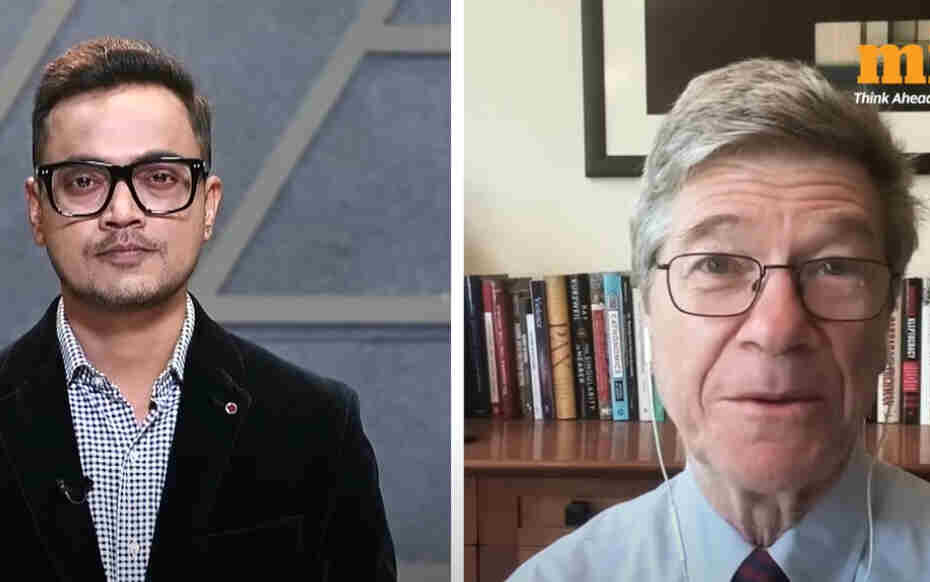
Read the full transcript of top economist Jeffrey Sachs in conversation with host Abhishek Singh of Hindustan Times on “Trump’s Trade Team Incompetent, Alienating India Was STUPID, Mind-Boggling!”, August 30, 2025.
An Unconventional Introduction
ABHISHEK SINGH: You know, we all have a person or two in our lives, a friend perhaps, who knows it all, who can see things before they happen, and tends to drop this phrase often: “I hate to say this, but I told you so.”
The gentleman I’m talking to today told us in detail about the outcome of the Trump-Putin meeting before it happened. And that should tell you why you should watch what I know will be a conversation full of insights.
Professor Sachs, forgive me for what was a somewhat unconventional introduction, but honestly, how else does one address a man who can seemingly predict the future without either using an unscientific term or unfairly diminishing someone of your academic stature and experience. Thank you for taking the time to talk today.
JEFFREY SACHS: It’s my pleasure. But believe me, I’m only guessing. We have Donald Trump in charge, so we can’t be sure of anything.
The Ukraine War: A US-Started Conflict
ABHISHEK SINGH: In that case, especially in these times, that becomes very important – some sort of direction that we can gauge before things actually happen.
Having said that, professor, my first question to you is, let’s just start by talking about what you said will happen and did happen. Putin flew to Alaska. Maybe the first thought in his head upon touching down in Alaska was why did Russia sell this massive piece of land which became a non-contiguous US state for a paltry sum of a few million dollars.
And perhaps that had Russia not sold it to the US, it would have been easier to explain Russia’s objections to what the collective West tried to do in Ukraine. Without going into details of what transpired, as it has been discussed threadbare since then, where do you think things will go from here?
JEFFREY SACHS: I think the United States is pulling back from a war that the US started. The US started this war with NATO expansion and then with overthrowing the Ukrainian government in 2014 in February of that year. I should say participating actively in the overthrow of that government.
So the war started 11 years ago. It’s gone pretty badly for the Ukrainians – terribly, I would say – not well for the United States. Russia is winning on the battlefield and will continue to do so. So Trump wants to get out of this.
On the other hand, the propaganda in the United States and Europe is so warmongering all the time that Trump, not being a very strong person or very bright person, doesn’t quite know how to maneuver in this politics. So he takes two steps forward, one step back. One step forward, two steps back.
But the basic idea is the US is pulling out of an active engagement in the war. Russia is continuing to defeat Ukraine on the ground. The Ukrainian government is a martial law dictatorship, by the way, so it doesn’t respond to the overwhelming call by the Ukrainian people for a negotiated end of the war.
Russia has launched another massive missile and drone strike against Kiev and other cities of Ukraine. This is doing terrible things to Ukraine, but the Ukrainian government – Zelensky and his group – rule again as dictators, and so they don’t respond to the obvious need to negotiate.
All of this means, as a bottom line, there’s a lot of confusion. Trump is unfortunately a weak president, and so he doesn’t know how to close the deal. But what it does mean is that the active phase of the US war against Russia is basically coming to an end, but not in a linear and direct way.
ABHISHEK SINGH: Does it mean we could actually see the cessation of the kind of military exchanges and the conflict which is taking place on ground?
Why the War Could End Tomorrow
JEFFREY SACHS: It could, it should. This war could end at any moment. Ukraine needs to declare neutrality. Ukraine needs to cede territories that it’s lost. It lost them in a war when it could have made peace without these loss of territories in the past. This is what happens in war. You go to war on a gamble, you lose. The war needs to end.
Zelensky, for whatever reason, doesn’t end a war that is in need of ending from the point of view of Ukraine’s own sovereignty, security and safety of its people. So why doesn’t Zelensky end this war as he should have ended in April 2022, for example, when there was a draft agreement, or when Ukraine could have negotiated an end to the war by honoring the Minsk II agreement in 2015 or could have avoided the war altogether had there not been a US coup in February 2014?
Well, the answer is Zelensky represents or is the front person for an extremist nationalist regime that represents some interest in Western Ukraine, imposes its will on the rest of the country, and is causing massive disaster in Ukraine.
So Russia will continue to advance. Some people say that if Zelensky made peace, he’d be killed by his own side. Quite possible. Or he’d be pushed out and have to run to exile. Nobody knows exactly why the irrationality of this destruction continues, but what I’m telling you is that the massive Western propaganda that this is an unprovoked war by Putin because he’s an expansionist, militarist, imperialist is phony, and it’s been obviously phony for years.
This is a war that at its core was a war of US expansion by pushing NATO to Ukraine and to Georgia, which every senior, responsible, honest analyst knew was extremely dangerous and which the Russians objected to for 30 years.
The war can end. If Trump would publicly say NATO enlargement is over, the war will end on that basis.
Territorial adjustments will be made. Given the realities of the ethnic Russian population and the situation on the battlefield, the war could end today. Unfortunately, Trump is not smart enough, doesn’t communicate with the American people properly, and is not brave enough to do what should be done.
Europe’s Pathetic Capitulation
ABHISHEK SINGH: It doesn’t matter how. But what’s important is the possibility that the war could actually come to an end. But, Professor, I quickly want to move from that subject to talk about Trump’s tariffs on India.
And of course, they have kicked in. And just today, India has said it will keep buying oil from wherever it benefits the country. And China didn’t cave in either. In fact, it has ramped up imports of Russian crude. Europe, however, is meekly following the diktats issued by Washington.
The Germans said something. French also said a few things here and there, but frankly, the language of logical verbal protest is not something which this US administration seems to pay much heed to. So do you think the EU has capitulated?
JEFFREY SACHS: Yes. Europe is hardly recognizable as a power in the world. It’s rather pathetic and embarrassing. And all of the European leaders – Starmer in the UK, Merz in Germany, Macron in France – are deeply unpopular with their own people. They tend to have approval ratings of 25% and disapproval ratings of well beyond 50%.
In other words, they are running governments contrary to the public interest and to the public opposition, and yet they keep on their warmongering. Why? This is I have to say is at some level a mystery. It seems to run counter to gravity that all these politicians would continue a campaign that is antithetical to their own country’s interest and own political interests.
One hypothesis is that the United States has owned and operated these countries, many of which have US military bases on them and effectively are semi-occupied countries for a long time. I’m not quite sure whether this explains it.
I do think the UK really has delusions still because every UK Prime Minister still thinks he’s Winston Churchill running the British Empire. So Starmer is just among the most pathetic of them. Why Merz is beyond my understanding. He came into office with some approval, but it’s plummeting, and he speaks only of war. Why this is I don’t know.
None of them has the intelligence, it seems, to pick up the phone and call President Putin and actually discuss issues. They all run to the United States or they run to Kiev. They love to get their pictures taken with Zelensky, who as I said, is a dictator ruling against the interests of his own country. It’s frankly hard to understand.
When I talk about the great powers of the world, I say it’s the United States, Russia, China and India. I don’t include Europe on the list because Europe’s not Europe. It’s not a power. It’s a squabbling smaller countries dependent seemingly on the United States and unable to perceive their own collective interest.
So this is really surprising to most analysts. When I speak with the other analysts around the world, no one can quite really fathom why Europe is so poorly led right now.
India and China: A United Front Against Western Bullying
ABHISHEK SINGH: Professor, compared to Europe’s response, what do you make of India and China, how these two countries have reacted?
JEFFREY SACHS: Very well. And one of the things that I find heartening is that India and China, which have a lot of tensions among themselves, especially originating from Britain, by the way, because it was some junior officer, McMahon, who drew a line on a map to demarcate the Himalayas in a place he never went actually.
And that line, written in 1907, created problems for India and China after 1949 and 1947, when both countries became their modern states. The fact of the matter is, despite these difficulties, these two giants of the world, almost 40% of the world population, two superpowers, need to have close relations, need to get along and have an overwhelming common interest.
And that’s to be not bullied by the Western world, by the United States or by Europe, which doesn’t really bully anymore, but especially by the United States. The whole idea of the BRICS is to say, “Look, we’re in a multipolar world. We have many great powers. No one country, not the United States and nobody else rules this world. We need true multilateralism,” and that is a very important function of the BRICS.
India and China should be the bulwark of that as the two giant nations, two superpowers, and with enormous fundamental reasons for cooperation.
Trump’s Incompetent Trade Team
ABHISHEK SINGH: You know what India especially is taking note of is what Trump’s henchmen like Navarro, Bessent, Hassett have been saying, from comments like “US has the edge in trade talks with India” to an exasperated Navarro publicly hoping India cuts down imports and calling the Russia-Ukraine war “Modi’s war.”
How do you see these statements? A game of brinkmanship constantly ratcheting up, assault on a country which was a strategic partner in the same calendar year. Is Trump hoping that India would blink first? Is that what he’s hoping for?
JEFFREY SACHS: Yes, of course he’s hoping that India will blink first. But I have to emphasize how incompetent these people are. Who are these people?
Navarro is one of the worst students ever to come out of the Harvard Economics Department, where I taught for 22 years. It’s just unaccountable. He makes no sense at all. Bessent is a guy from Wall Street. He’s no policymaker. He’s no global thinker. He has no experience with India or any other place that I can see.
Lutnick is some business guy with a very checkered past. None of these people has true policy knowledge or experience, true knowledge of the rest of the world or even decency, I would say, to have a respected word that can be followed through.
They’re all improvisers trying to please their boss, and their boss is an irascible New York real estate developer with a long line of bankruptcies behind him, many lawsuits. So this is a group that is not in any way what one would expect of a major power in a dangerous world.
It’s a group of improvisers, insulters who don’t believe in rules. Just a kind of thuggery or threats or cajoling or bribes. It doesn’t work. It’s not good. It’s not the way this world should be operating right now. We need statesmen. We need people who are operating with mutual respect, according to trust.
But we have none of that from the US side right now. So I want to say that this is not a considered policy with deep strategy and tactics. This is a kind of improvisation by amateurs who have the control over a powerful military and over a $30 trillion economy, but not to America’s own interest and certainly not to the stability of the world.
Modi Declines Trump’s Calls
ABHISHEK SINGH: So, professor, also, another piece of news which came out in a German newspaper and then in a Japanese newspaper. It was, of course, Prime Minister Modi declined, apparently four calls by the Trump administration in the past few weeks.
Do you think that dialogue, which is very crucial to the relationship between two countries, has also suffered so badly that now the two leaders, who were of course hugging each other in January, in fact February, when Prime Minister Modi visited the US, now cannot even talk to each other?
Trump’s Trade Incompetence and the India Relationship
JEFFREY SACHS: I think it’s extremely important that the United States immediately end the 25% penalty tariff, which is absurd. It was not only wrong headed and unprincipled from the start, it was based on a threat that Trump had made to President Putin that Russia must make an immediate unconditional ceasefire by August 8th.
Then Trump himself ended that threat and the Alaska meeting ended that threat. And the only thing that remains of that threat is the 25% tariff on India. I can’t think of anything more incompetent in American foreign policy than that 25% penalty tariff.
You have to scratch your head and say, “How stupid can they be?” I’m talking about America’s own narrow interest. To have alienated India in this way is something mind boggling, truly. You know, watching this relationship as I have for more than 40 years, I’ve never seen such a bad misstep by the United States.
And it won’t heal in any normal way because it proved a point that I’ve been making for many years, which is that the United States is badly governed, irresponsible and untrustworthy. This is a basic point that I’ve been trying to tell my Indian friends for many, many years.
But it doesn’t have to be in this burning destruction of the relationship the way it is based on something that is already completely out of date. So the US should say, today the penalty tariff is off the table because the whole idea of threatening Russia with these tariffs was taken off the table at the Alaska meeting. This is the starting point for any return to even a semblance of normality beforehand.
Of course, even with a semblance of normality, the lesson will have been learned in India that this is not the way to India’s economic prosperity or national security to align closely with the United States, still less to align closely with the United States against China. That puts things backward.
ABHISHEK SINGH: You’re right. But perhaps, you know, Trump is using what he used to use during his business days, where games of upmanship, brinkmanship, you know, worked while dealing with smaller businesses. Perhaps. But what the Trump administration perhaps needs to understand is that global politics, geopolitics, doesn’t function in that fashion. There has to be something for all countries involved. Having said that, professor, you know, now.
JEFFREY SACHS: I couldn’t agree more with you, by the way. You know, he is a real estate developer in New York with a checkered history, but he would threaten the plumbers or the electricians. I’m sorry, this is not how global politics works. And yet it’s the mode of operation right now of this group.
Trump’s Unintended Unification of the World
ABHISHEK SINGH: Thank you for phrasing that so much better. Having said that, Professor, I quickly want to talk to you about BRICS in this case, and also the fact that both India and China are moving at breakneck speed to strengthen existing ties. Prime Minister Modi is going to Japan, then to China, and on China’s military day, Putin and Kim Jong Un will be in Beijing as well. So Trump, in the end, it seems, has ended up isolating the U.S.
JEFFREY SACHS: Yes. Well, this is absolutely clear. I say Trump is the great unifier of the rest of the world because Trump is showing the rest of the world. No, first of all, the US Market is not the be all and end all. The US Market is not the only way to military goods. It’s not the only way to artificial intelligence. It’s certainly not the only way to a clean energy system. It’s not the only way to fast rail. It’s not the only way to robotics. It’s not the only way to the technology future, and it is not the way to a safe and secure world.
So Trump is quickly educating the rest of the world, perhaps in the opposite way of what he intends. But this is really the main point of what’s happening right now.
Now on the India China relationship, I am calling on China to do one very important thing, and that is to support India as the sixth permanent member of the UN Security Council. We need India to be what it is. It’s a world superpower. It’s the world’s largest nation. It should be core to the world security system. It should be the permanent member of the UN Security Council. And if China calls for that, it will happen. And so this is what I would really like to see as the two countries get closer together.
ABHISHEK SINGH: You know, I don’t know how possible that is, professor, but if China were to do that, then believe you me, the public opinion in India about China will change very rapidly. But professor, another issue that I want to talk to you about is of course what Trump has decided to do with Venezuela. What do you make of his moves? Is he starting another war? Because I was reading an editorial somewhere and it called Trump’s military moves “bringing howitzer to a knife fight.” How do you see this?
Venezuela: A 20-Year Regime Change Operation
JEFFREY SACHS: The United States has been trying to overthrow the Venezuelan government for more than 20 years. It’s engaged in a number of coup attempts, a number of covert operations. It started to try to overthrow Hugo Chavez, President Maduro’s predecessor. It continued through the Maduro period.
It has also involved really crushing sanctions that proved to be far more devastating, for example, than the sanctions on Russia, because Russia is much more powerful country than Venezuela. But in the case of Venezuela, it led to a kind of economic collapse which I think may literally be unparalleled in the peacetime. The economy fell by well over 50% in terms of GDP. There’s been a collapse of oil production, a collapse of living standards, mass outmigration.
It did not topple the regime, as the US said. A president in Latin America said to me that at a dinner that he attended with President Trump during President Trump’s first term. Trump spoke openly about asking the rest of the group, “Well, why doesn’t the US just invade Venezuela?”
So this goes back for quite a while. In fact, this is a more than 20 year project with the CIA, with the military, with the White House. Marco Rubio, who was senator from Florida, has been the lead Senate opponent of Maduro. And so this is also part and parcel of ongoing US policy. They put a bounty on Maduro’s head. It’s all flagrantly vulgar, thuggish and illegal. And it is kind of the another example of America’s delusion of hegemony, in this case, hegemony against a smaller power, not even a power, a smaller country in the Western hemisphere.
ABHISHEK SINGH: So clearly the reason which the US gave is not how you see this, because the US said this is to fight the drug cartels. You clearly see this as a regime change operation at this point in time.
JEFFREY SACHS: Change operation for more than 20 years. And there is one case after another. It’s not even close. At one point, so absurdly, the United States actually announced unilaterally, “Well, Maduro’s not president. We recognize the speaker of the National Assembly, Juan Guaido.” The US just announced another person as president of Venezuela. Then they confiscated Venezuela’s foreign reserves, froze them and said, “No, those are now under the control of the person we designated.”
This has nothing to do with drug cartel. This is pure, total, unequivocal regime change operation, period, full stop.
ABHISHEK SINGH: Yeah, just like there were no WMDs in Iraq and that war was of course on WMDs. Having said that, professor, what do you make of Venezuela’s response? Because apparently Venezuela is also mobilizing its militia. Russia, China, Iran have all come out in support of Venezuela. So do you see this in any way turning into another full fledged war? Because Russia, China and Iran perhaps can see this for what it is, which is, like you said, a regime change operation.
JEFFREY SACHS: God help us if another war is opened up. I can’t predict. I don’t put anything as an impossibility because the U.S. deep state, meaning the CIA and other parts of the U.S. government have been at this for a long time. They want to bring down this regime. They’re determined to do so. It’s the Western Hemisphere. They may take whatever action, whatever kind of coup they might try to organize, they might try to do it not by a war, but by other means, by fomenting unrest, by fomenting a military coup. They tried that in the past to break the Venezuelan military. It didn’t work.
But anything is possible because this is a long standing operation. This isn’t something new. This is something that goes back more than 20 years. In fact, it’s almost a fixation, let me put it that way. And when the US gets fixated on something, especially in the Western hemisphere, it’s like a dog with a bone, as we say. You can’t take it away, the bone away.
And the US has had sanctions on Cuba for more than 65 years. This is fixation. And they’re fixated on bringing down the Venezuelan government, maybe to take over its oil, maybe just to prove the point, maybe to show who’s boss, but. Or maybe for some combination of those reasons. But this is a fixation.
Pakistan and the Imran Khan Situation
ABHISHEK SINGH: Right now, professor from Venezuela, I want to discuss Pakistan for a little while with you. And of course, America’s dalliances with Pakistan. The Pakistani army chief has been to the U.S. Trump has met him. There were news pieces which came out that Prime Minister Modi was also called. Perhaps Trump wanted to put both of them together in a room and perhaps come out as some sort of peacemaker. India, of course, denied any such possibility. And Prime Minister Modi did not go and meet Trump in White House. But having said that, what do you make of America’s involvement with Pakistan, especially after the India Pakistan conflict operations endure.
JEFFREY SACHS: Well, the US has had a deep involvement in the Pakistani military for decades. Again, this is nothing new. The United States brought down the government of Imran Khan. I happen to be an admirer of Imran Khan. And I thought with Imran Khan, if he had the political space, he could have found a way together with the government of India to calm things down and to begin to settle what is a very deep, tragic, difficult, and dangerous conflict.
But the United States gave a signal a few years ago during the Biden period to the Pakistani military. “Bring down this guy. We don’t like him. He’s too close to Russia and to China, and he isn’t backing us in the Ukraine war. Bring him down.” And Imran Khan was brought down and thrown into jail.
What this means is it puts the Pakistani military in control of politics with the US backing. That’s not good for India’s security. It’s not good for finding a resolution to the very deep and troubled and dangerous relationship between India and Pakistan. And the US meddling is a big part of that.
Pakistan does not have a government of public support. Exactly the opposite. And because of that, the situation in Pakistan is dangerous and unstable. And the United States, Trump doesn’t know what he’s doing anyway. But in general, it’s an unstable relationship made far more unstable by the lack of popular government in Pakistan.
Trump’s Abuse of Power and Critics
ABHISHEK SINGH: All right, from talking about the man who, as you said, US may have had a hand in putting him behind the bars, Imran Khan. Let’s talk about a man who was raided in the US this time. And of course, talking about Bolton, once upon a time, you know, he was one of Trump’s favorite men, you know, one of the many apples of his eyes. And of course, he turned against him. In fact, it has been a while since he turned against him. My question to you, sir, is how Trump administration dealt with him. The manner, silencing a critic with raids. That’s not the kind of thing US could be proud of.
JEFFREY SACHS: We’re living in a very unstable period where Trump abuses power. Bolton, to my mind, is a very disreputable figure, by the way. So I’m not. I have no sympathy for Bolton per se in his public career.
ABHISHEK SINGH: I’m just talking about the principle. Of course. I mean, I’m sure you’re right, but.
JEFFREY SACHS: The principle is absolutely one of abuse of power, abuse of every legal tool. We call it lawfare. Also, Trump abuses the judicial system, the penal system, the security system. He operates by decree, by diktat, by politicization, and this is partly the case with Bolton. I’m afraid I’m going to have to stop at this point because I’m getting urgently called from abroad.
ABHISHEK SINGH: Can I ask you one last question, Professor?
JEFFREY SACHS: Very brief, very brief. I apologize.
ABHISHEK SINGH: And my question to you is you haven’t been very friendly to Trump administration either. Do you worry about an action of similar nature against you?
JEFFREY SACHS: Well look I’m not a friend of any recent American president. I think they’ve all been completely miserable.
ABHISHEK SINGH: I am not in US they were not as vengeful.
JEFFREY SACHS: Look I don’t know. I’m hoping not of course but I thought Biden was completely miserable. Failed administration but it goes back a long way. I think since Bill Clinton we have not had a successful administration in the United States.
ABHISHEK SINGH: Right. On that note, thank you. Thank you Professor Sachs for taking the time and talking to us.
JEFFREY SACHS: Pleasure to talk with you. Thanks a lot.
Related Posts