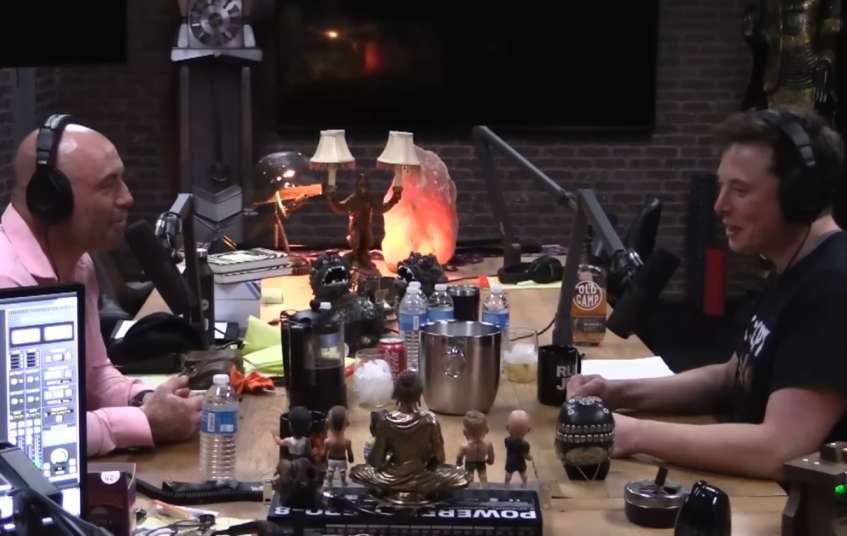
Here is the full transcript of business magnet, investor and engineer Elon Musk’s interview on The Joe Rogan Experience #1169, streamed live on September 7, 2018.
Brief Notes: Elon Musk joins Joe Rogan for a sprawling, late-night conversation that veers from flamethrowers and underground traffic tunnels to artificial intelligence, Mars, and the future of human civilization. Musk explains why he started The Boring Company to tackle Los Angeles gridlock, lays out his fears that unregulated AI could become more dangerous than nuclear weapons, and describes his push to accelerate a global shift to sustainable energy through Tesla and SolarCity.
The two also riff on social media addiction, the simulation hypothesis, human psychology, and the “dark side” of online mobs, with Musk repeatedly returning to the need for more kindness and long-term thinking in how technology is used. Along the way, Musk casually sips whiskey, handles a “not-a-flamethrower,” and infamously takes a puff of a marijuana-tobacco joint—an unscripted moment that would briefly rattle Tesla’s stock and ignite headlines around the world.
—
The Flamethrower That Wasn’t
JOE ROGAN: 4, 3, 2, 1. Boom. Thank you. Thanks for doing this, man. Really appreciate it.
ELON MUSK: Hey, welcome.
JOE ROGAN: It’s very good to meet you.
ELON MUSK: Nice to meet you too.
JOE ROGAN: And thanks for not lighting this place on fire.
ELON MUSK: You’re welcome. That’s coming later.
JOE ROGAN: How does one, just in the middle of doing all the things you do—create cars, rockets, all this stuff you’re doing, constantly innovating—decide to just make a flamethrower? Where do you have the time for that?
ELON MUSK: Well, we didn’t put a lot of time into the flamethrower. This was an off-the-cuff thing. So it’s sort of a hobby company called the Boring Company, which started out as a joke and we decided to make it real and dig a tunnel.
And then we have a merchandise section that only has one piece of merchandise at a time. And we started off with a cap and there was only one thing. It was just boringcompany.com cap or hat. That’s it. And then we sold the hats, limited edition. It just said the Boring Company.
And then I’m a big fan of Spaceballs the movie. And in Spaceballs, Yogurt goes through the merchandising section and they have a flamethrower in the merchandising section of Spaceballs. And “the kids love that one.” That’s the line when he pulls out the flamethrower. It’s like, we should do a flamethrower. So we did.
JOE ROGAN: Does anybody tell you no? Does anybody go, “Elon, maybe for yourself.” But selling a flamethrower, the liabilities, all the people you’re selling this device to, what kind of unhinged people are going to be buying a flamethrower in the first place? Do we really want to connect ourselves to all these potential arsonists?
ELON MUSK: Yeah. It’s a terrible idea. Terrible. Shouldn’t buy one. I said don’t buy this flamethrower. Don’t buy it. Don’t buy it. That’s what I said. But still people bought it. There’s nothing I can do to stop them.
JOE ROGAN: They will come.
ELON MUSK: I said don’t buy it. It’s a bad idea.
JOE ROGAN: How many did you make?
ELON MUSK: It’s dangerous, it’s wrong. Don’t buy it. Still, people bought it. I couldn’t stop them.
JOE ROGAN: How many did you make?
ELON MUSK: 20,000. And they’re all gone in three, I think four days. We sold out in four days.
JOE ROGAN: Are you going to do another run?
ELON MUSK: No.
JOE ROGAN: That was it.
ELON MUSK: Yes. I said we would do 20. We did 50,000 hats and that was a million dollars. And okay, well, we’ll sell something for 10 million. And that was 20,000 flamethrowers at $500 each. They went fast.
JOE ROGAN: How do you have the time to do that, though? I mean, I understand that it’s not a big deal in terms of all the other things that you do, but how do you have time to do anything? I just don’t understand your time management skills.
ELON MUSK: I mean, I didn’t spend much time on this flamethrower. I mean, to be totally frank, it’s actually just a roofing torch with an air rifle cover. It’s not a real flamethrower, which is—
JOE ROGAN: Why it says “not a flamethrower.”
ELON MUSK: That’s why we were very clear this is not actually a flamethrower. And also we were told that various countries would ban shipping of it, but they would ban flamethrowers. So we very—to solve this problem for all the customs agencies, we labeled it “not a flamethrower.”
JOE ROGAN: Did it work? Is it effective?
ELON MUSK: I don’t know. I think so.
JOE ROGAN: So far, yes.
ELON MUSK: You cannot ship a flamethrower.
Digging Tunnels Under LA
JOE ROGAN: But you do so many different things. Forget about the flamethrower. How do you do all that other shit? How does one decide to fix LA traffic by drilling holes in the ground? And who do you even approach with that? When you have this idea, who do you talk to about that?
ELON MUSK: I mean, I’m not saying it’s going to be successful or, you know, I mean, it’s not like asserting that it’s going to be successful. But so far, I’ve lived in LA for 16 years and the traffic has always been terrible. And so I don’t see any other ideas for improving the traffic. So in desperation, we’re going to dig a tunnel and maybe that tunnel will be successful and maybe it won’t.
JOE ROGAN: I’m listening.
ELON MUSK: Yeah. I’m not trying to convince you it’s going to work.
JOE ROGAN: And are the people that—or anyone, but you were starting this, though, this is actually a project you’re starting to implement, right?
ELON MUSK: Yeah. No, we’ve dug about a mile. It’s quite long. Takes a long time to walk it.
JOE ROGAN: Yeah. Now, when you’re doing this, what is the ultimate plan? The ultimate plan is to have these in major cities and anywhere there’s mass congestion. And just try it out in LA first.
ELON MUSK: Yeah, it’s in LA because I mostly live in LA. That’s the reason. It’s a terrible place to dig tunnels. This is one of the worst places to dig tunnels because, mostly because of the paperwork. People think it’s, “what about seismic?” It’s actually, tunnels are very safe in earthquakes.
JOE ROGAN: Why is that?
ELON MUSK: Earthquakes are essentially a surface phenomenon. It’s waves on the ocean. So if there’s a storm, you want to be in a submarine. So being in a tunnel is being in a submarine.
Now, the way the tunnel is constructed is it’s constructed out of these interlocking segments, kind of a snake. It’s sort of a snake exoskeleton with double seals. And so even when the ground moves, the tunnel actually is able to shift along with the ground like an underground snake. And it doesn’t crack or break.
And it’s extremely unlikely that both seals would be broken. And it’s capable of taking 5 atmospheres of pressure. It’s waterproof, methane proof, or gas proof of any kind, and meets all California seismic requirements.
JOE ROGAN: So when you have this idea, who do you bring this to?
ELON MUSK: I’m not sure what you mean by that.
JOE ROGAN: Well, when you’re implementing it so you’re digging holes in the ground, you have to bring it to someone that lets you do it.
ELON MUSK: Yeah. So there were some engineers from SpaceX who thought it would be cool to do this. And the guy who runs it day to day, Steve Davis—he’s a longtime SpaceX engineer. He’s great. So Steve was, “I’d like to help make this happen.” I was, “cool.” So we started off with digging a hole in the ground. He’s got a permit for a pit, big pit, and just dug a big pit.
JOE ROGAN: And you have to tell them what the pit’s for. Or you just say, “hey, we just want to dig a hole”?
ELON MUSK: Nice. Fill out this form. That’s it. Yeah, it was a pit in our parking lot.
JOE ROGAN: But do you have to give them some sort of a blueprint for your ultimate idea? And do they have to approve it? How does that work?
ELON MUSK: Now we just started off with a pit.
JOE ROGAN: Okay, big pit.
ELON MUSK: And now, you know, there’s not really—you know, don’t really care about the existential nature of a pit. You just say, “I want a pit.”
JOE ROGAN: Right, yeah.
ELON MUSK: And saw a hole in the ground. So then we got the permit for the pit and we dug the pit and we dug it in, I don’t know, three days. Two, three days, actually. I think 48 hours, something that. Because Eric Garcetti was coming by for the Hyperloop. He was going to attend the Hyperloop competition, which is a student competition we have for who can make the fastest pod in the Hyperloop.
And he was coming. The finals were going to be on Sunday afternoon. And so Eric was coming by on Sunday afternoon. He was, you know, “we should take this pit and then show Eric.” So we—this was Friday morning and then—yeah. So it was about a little over 40 hours later we dug the pit. It was 24/7. Oh, 24, 48 straight hours, something that. And dug this big pit. And we showed Eric the pit. It’s, obviously it’s just a pit, but, hey, hole in the ground is better than no hole in the ground.
JOE ROGAN: And what do you tell them about this pit? I mean, you said this was the beginning of this idea. “We’re going to build tunnels under LA to help funnel traffic better.” And they just go, “okay”? We’ve joked around about this in the podcast before. They’re, what other person can go to the people that run the city and go, “hey, I’m going to dig some holes on the ground, put some tunnels in there.” And they go, “oh, yeah, okay.”
ELON MUSK: Nothing wrong with a hole in the ground. People dig holes in the ground all the time.
Time Management and Engineering
JOE ROGAN: But my question is, I know how much time you must be spending on your Tesla factory. I know how much time you must be spending on SpaceX. And yet you still have time to dig holes under the ground in LA and come up with these ideas and then implement them.
ELON MUSK: I got a million ideas.
JOE ROGAN: I’m sure you do.
ELON MUSK: There’s no shortage of that. Yeah.
JOE ROGAN: I just don’t know how you manage your time. I don’t understand. Doesn’t even seem humanly possible.
ELON MUSK: You know, I do, basically—I think people don’t totally understand what I do with my time. They think I’m a business guy or something that. My Wikipedia page says “business magnate.”
JOE ROGAN: What would you call yourself?
ELON MUSK: Business Magnet. Can someone please change my Wikipedia page to Magnet?
JOE ROGAN: They’ll change it. Right now. It’s probably already changed. It’s locked.
ELON MUSK: So somebody has to be able to unlock it and change it to Magnet.
JOE ROGAN: Someone will get it.
ELON MUSK: I want to be a magnet. I do engineering and manufacturing and that kind of thing. That’s 80% more of my time ideas.
JOE ROGAN: And then the implementation of those ideas.
ELON MUSK: That’s hardcore engineering, designing things, you know?
JOE ROGAN: Right.
ELON MUSK: Structural, mechanical, electrical, software, user interface engineering, aerospace engineering.
JOE ROGAN: But you must understand there’s not a whole lot of human beings you. You know that, right? So you’re an oddity.
ELON MUSK: Yes.
JOE ROGAN: To chimps me.
ELON MUSK: We’re all chimps.
JOE ROGAN: Yeah, we are.
ELON MUSK: We’re one notch above a chimp.
JOE ROGAN: Some of us are a little more confused. When I watch you doing all these things, I’m, how does this motherfucker have all this time and all this energy and all these ideas, and then people just let him do these things?
ELON MUSK: Because I’m an alien.
JOE ROGAN: That’s what I’ve speculated, yes. I’m on record saying this in the past. I wonder. It’s true. If there was one, I was, if there was, maybe an intelligent being that we created, you know, some AI creature that’s superior to people. Maybe just hang around with us for a little while, you’ve been doing, and then fix a bunch of shit. Maybe that’s the way.
ELON MUSK: I might have some mutation or something that.
JOE ROGAN: You might. Do you think you do? Probably. Do you wonder, you’re around normal people, you’re, hmm, what’s up with these boring, dumb motherfuckers ever?
ELON MUSK: Not bad for a human. But I think we will not be able to hold a candle to AI.
The AI Warning
JOE ROGAN: Hmm. You scare the shit out of me when you talk about AI. Between you and Sam Harris, I didn’t consider it until I had a podcast with Sam once. He made me shit my pants talking about AI. I realized, oh, well, this is a genie that once it’s out of the bottle, you’re never getting it back in.
ELON MUSK: That’s true.
JOE ROGAN: There was a video that you tweeted about one of those Boston Dynamic robots, and you’re, “in the future, it’ll be moving so fast you can’t see it without a strobe light.”
ELON MUSK: Yeah, you could probably do that right now.
The Robot Memory Problem
JOE ROGAN: And no one’s really paying attention too much other than people like you or people that are really obsessed with technology. All these things are happening and these robots are. Did you see the one where PETA put out a statement that you shouldn’t kick robots?
ELON MUSK: Probably not wise for retribution. Their memory is very good.
JOE ROGAN: I bet it’s really good.
ELON MUSK: It’s really good. I bet it is, yes.
JOE ROGAN: And getting better every day.
ELON MUSK: It’s really good.
AI as a Primary Concern
JOE ROGAN: Are you honestly, legitimately concerned about this? Is AI one of your main worries in regards to the future?
ELON MUSK: Yes. It’s less of a worry than it used to be, mostly due to taking more of a fatalistic attitude.
JOE ROGAN: So you used to have more hope and you gave up some of it and now you don’t worry as much about AI. You’re like, this is just what it is.
ELON MUSK: Pretty much. No, it’s not necessarily bad. It’s just, it’s definitely going to be outside of human control.
JOE ROGAN: Not necessarily bad, right?
ELON MUSK: Yes, it’s not necessarily bad. It’s just outside of human control. Now the thing that’s going to be tricky here is that it’s going to be very tempting to use AI as a weapon. It’s going to be very tempting. In fact, it will be used as a weapon.
So the on-ramp to serious AI, the danger is going to be more humans using it against each other. I think most likely that will be the danger.
JOE ROGAN: How far do you think we are from something that can make its own mind up whether or not something’s ethically or morally correct, or whether or not it wants to do something, or whether or not it wants to improve itself or, or whether or not it wants to protect itself from people or from other AI? How far away from something that’s really truly sentient?
The Cybernetic Collective
ELON MUSK: Well, I mean you could argue that any group of people, like a company, is essentially a cybernetic collective of people and machines. That’s what a company is. And then there are different levels of complexity in the way these companies are formed.
And then there’s this sort of collective AI in the Google search. You know, where we’re all sort of plugged in as nodes on the network, like leaves on a big tree. And we’re all feeding this network with questions and answers. We’re all collectively programming the AI.
And Google, plus the older humans that connect to it, are one giant cybernetic collective. This is also true of Facebook and Twitter and Instagram and all these social networks. They’re giant cybernetic collectors.
JOE ROGAN: Humans and electronics all interfacing and constantly now constantly connected.
ELON MUSK: Yes, constantly.
The Drive Toward Innovation
JOE ROGAN: One of the things that I’ve been thinking about a lot over the last few years is that one of the things that drives a lot of people crazy is how many people are obsessed with materialism and getting the latest, greatest thing.
And I wonder how much of that is, well, a lot of it is most certainly fueling technology and innovation. It almost seems like it’s built into us. It’s like what we like and what we want, that we’re fueling this thing that’s constantly around us all the time.
And it doesn’t seem possible that people are going to pump the brakes. It doesn’t seem possible at this stage where we’re constantly expecting newest cell phone, latest Tesla update, the newest MacBook Pro. Everything has to be newer and better.
And that’s going to lead to some incredible point. And it seems like it’s built into us. It almost seems like it’s an instinct that we’re working towards this, that we like it. Our job, just like the ants build the anthill, our job is to somehow fuel this.
ELON MUSK: Yes, I made this comment some years ago, but it feels like we are the biological bootloader for AI. Effectively, we are building it and then we’re building progressively greater intelligence and the percentage of intelligence that is not human is increasing and eventually we will represent a very small percentage of intelligence.
But the AI isn’t formed strangely by the human limbic system. It is in large part our ID writ large.
JOE ROGAN: How so?
ELON MUSK: We mention all those things, the sort of primal drives. There’s all the things that we like, add hate and fear. They’re all there on the Internet. They’re a projection of our limbic system.
JOE ROGAN: That’s true. No, it makes sense. And thinking of it as a, I mean, thinking of corporations and just thinking of just human beings communicating online through these social media networks as some sort of an organism that’s a, it’s a cyborg. It’s a combination. It’s a combination of electronics and biology.
Limbic Resonance and Engagement
ELON MUSK: Yeah. This is in some measure, like the success of these online systems is sort of a function of how much limbic resonance they’re able to achieve with people. The more limbic resonance, the more engagement.
JOE ROGAN: Whereas one of the reasons why probably Instagram is more enticing than Twitter.
ELON MUSK: Limbic resonance.
JOE ROGAN: Yeah. You get more images, more video, tweaking your system more.
ELON MUSK: Yes.
JOE ROGAN: Do you worry or wonder in fact about what the next step is? A lot of people didn’t see Twitter coming, that communicating with 140 characters or 280 now would be a thing that people would be interested in. It’s going to excel, it’s going to become more connected to us, right?
ELON MUSK: Yes. Things are getting more and more connected. They’re at this point constrained by bandwidth. Our input output is slow, particularly output. Output got worse with thumbs. You know, we used to have input with 10 fingers, now we have thumbs.
But images are just, are also, they’re a way of communicating at high bandwidth. You take pictures and you send pictures to people that communicates far more information than you can communicate with your thumbs.
The Failed Attempt to Regulate AI
JOE ROGAN: So what happened with you where you decided or you took on a more fatalistic attitude? Was there any specific thing or was it just the inevitability of our future?
ELON MUSK: I tried to convince people to slow down. Slow down AI, to regulate AI. This was futile. I tried for years.
JOE ROGAN: This scene in a movie where the robots are going to f* take over and you’re freaking me out. Nobody listened.
ELON MUSK: Nobody listened.
JOE ROGAN: No one. Are people more inclined to listen today? It seems like an issue that’s brought up more often over the last few years than it was maybe five, 10 years ago. It seemed like science fiction.
ELON MUSK: Maybe they will. So far they haven’t. I think people don’t like, normally the way that regulations work is very slow, very slow indeed.
So usually it will be something, some new technology. It will cause damage or death. There will be an outcry, there will be investigation, years will pass. There will be some sort of insights committee, there will be rulemaking, then there will be oversight, eventually regulations. This all takes many years. This is the normal course of things.
If you look at say automotive regulations, how long did it take for seat belts to be implemented, to be required? You know, the auto industry fought seat belts, I think for more than a decade, successfully fought any regulations on seat belts.
Even though the numbers were extremely obvious. If you had a seatbelt on, you would be far less likely to die or be seriously injured. It was unequivocal. And the industry fought this for years, successfully. Eventually, after many, many people died, regulators insisted on seat belts.
This time frame is not relevant to AI. You can’t take 10 years from the point at which it’s dangerous. It’s too late.
The Singularity
JOE ROGAN: And you feel like this is decades away or years away from being too late. If you have this fatalistic attitude and you feel like it’s going, we’re in almost like a doomsday countdown.
ELON MUSK: It’s not necessarily a doomsday countdown.
JOE ROGAN: It’s an out of control countdown.
ELON MUSK: Out of control? Yeah. People call it the singularity and that’s probably a good way to think about it. It’s a singularity. It’s hard to predict like a black hole, what happens past the event horizon.
JOE ROGAN: Right. So once it’s implemented, it’s very difficult because it will be able to, once.
ELON MUSK: Change out of the bottle, what’s going.
JOE ROGAN: To happen and it will be able to improve itself.
ELON MUSK: Yes.
JOE ROGAN: That’s where it gets spooky. Right. The idea that it can do thousands of years of innovation very, very quickly.
ELON MUSK: Yeah.
JOE ROGAN: And then we’ll be just ridiculous.
ELON MUSK: Ridiculous.
JOE ROGAN: We will be like this ridiculous biological shitting pissing thing trying to stop the gods. No, stop. We like living with a finite lifespan and watching Norman Rockwell paintings.
ELON MUSK: It could be terrible and it could be great. It’s not clear. But one thing is for sure, we will not control it.
The Merge Scenario
JOE ROGAN: Do you think that it’s likely that we will merge somehow or another with this sort of technology and it will augment what we are now, or do you think it will replace us?
ELON MUSK: Well, that’s the scenario. The merge scenario with AI is the one that seems like probably the best for us. Yes. If you can’t beat it, join it.
JOE ROGAN: Yeah.
ELON MUSK: You know, so from a long term existential standpoint, that’s like the purpose of Neuralink, is to create a high bandwidth interface to the brain such that we can be symbiotic with AI because we have a bandwidth problem. You just can’t communicate through your fingers, it’s too slow.
JOE ROGAN: And where’s Neuralink at right now?
ELON MUSK: I think we’ll have something interesting to announce in a few months that’s at least an order of magnitude better than anything else, I think. Better than probably anyone thinks is possible.
JOE ROGAN: How much can you talk about that right now?
ELON MUSK: I don’t want to jump the gun on that.
The Tertiary Cognition Layer
JOE ROGAN: But what’s the idea behind it? What are you trying to accomplish with it? What would you like, best case scenario?
ELON MUSK: I think best case scenario we effectively merge with AI, where AI serves as a tertiary cognition layer where we’ve got the limbic system, kind of the primitive brain. Essentially you’ve got the cortex, so you’re currently in a symbiotic relationship. Your cortex and limbic system are in a symbiotic relationship.
And generally people like their cortex and they like their limbic system. I haven’t met anyone who wants to delete their limbic system or delete their cortex. Everybody seems to like both.
And the cortex is mostly in service to the limbic system. People may think that the thinking part of themselves is in charge, but it’s mostly their limbic system that’s in charge. And the cortex is trying to make the limbic system happy. That’s what most of that computing power is oriented towards. How can I make the limbic system happy? That’s what I was trying to do.
Now, if we do have a third layer, which is the AI extension of yourself, that is also symbiotic and there’s enough bandwidth between the cortex and the AI extension of yourself, such that the AI doesn’t de facto separate, then that could be a good outcome. That could be quite a positive outcome for the future.
JOE ROGAN: So instead of replacing us, it will radically change our capabilities.
ELON MUSK: Yes, it will enable anyone who wants to have superhuman cognition. Anyone who wants. This is not a matter of earning power, because your earning power would be vastly greater after you do it.
So it’s just like anyone who wants can just do it in theory. That’s the theory. And if that’s the case, then, and let’s say billions of people do it, then the outcome for humanity will be the sum of human will, the sum of billions of people’s desire for the future.
JOE ROGAN: But billions of people with enhanced cognitive ability, radically enhanced, which would be how much different than people today if you had to explain it to a person who didn’t really understand what you were saying? How much different are you talking about? When you say radically improved, what do you mean? You mean mind reading?
The Cyborg Reality
ELON MUSK: It would be difficult to really appreciate the difference. It’s kind of like, how much smarter are you with a phone or computer than without? You’re vastly smarter, actually. You can answer any question if you’re connected to the Internet. You can answer any question pretty much instantly. Any calculation that your phone’s memory is essentially perfect. You can remember flawlessly. Your phone can remember videos, pictures, everything perfectly.
Your phone is already an extension of you. You’re already a cyborg. You don’t even—well, most people don’t realize they are already a cyborg. That phone is an extension of yourself. It’s just that the data rate, the rate at which the communication rate between you and the cybernetic extension of yourself, that is your phone and computer is slow. It’s very slow.
And that’s like a tiny straw of information flow between your biological self and your digital self. And we need to make that tiny straw, like a giant river. Huge high bandwidth interface. It’s an interface problem. Data rate problem. Solve the data rate problem. Then I think we hang on to human machine symbiosis through the long term. And then people may decide that they want to retain their biological self or not. I think they’ll probably choose to retain their biological self versus some sort of—
JOE ROGAN: Ray Kurzweil scenario where they download themselves into a computer.
ELON MUSK: You will be essentially snapshotted into a computer at any time. If your biological self dies, you could just probably just upload into a new unit, literally.
JOE ROGAN: Pass that whiskey. We’re getting crazy over here. This is getting ridiculous.
ELON MUSK: Down the rabbit hole.
JOE ROGAN: Grab that sucker. Give me some of that. This is too freaky. See if I was talking to—
ELON MUSK: I’ve been thinking about this for a long time, by the way.
JOE ROGAN: I believe you have. If I was talking to one of my—cheers, by the way.
ELON MUSK: Cheers. Yeah. This is a great whiskey.
JOE ROGAN: Thank you. I know where this came from. Who brought this to us? Trying to remember. Somebody gave it to us. Old camp, whoever it was. Thanks. Yeah, it is good. This is just inevitable. Again, going back to your—when you decided to have this fatalistic viewpoint. So you tried to warn people. You talked about this pretty extensively. I’ve read several interviews where you talked about this and then you just sort of just said, “Okay, it just is. Let’s just—” And in a way, you’re—by communicating the potential fear. I mean, for sure you’re getting the warning out to some people.
Warning the World About AI
ELON MUSK: Yeah, yeah. I mean, I was really going on the warning quite a lot. I was warning everyone I could. You ever met with Obama. And just for one reason, look, I—
JOE ROGAN: Was talking about AI.
ELON MUSK: Yes.
JOE ROGAN: And what did he say? So what about Hillary?
ELON MUSK: Worry about her first.
JOE ROGAN: Shh.
ELON MUSK: Everybody be quiet. No, he listened. He certainly listened to—I met with Congress. I met with—I was at a meeting of all 50 governors and talked about just AI danger. And I talked to everyone I could. No one seemed to realize where this was going.
JOE ROGAN: Is it that? Or do they just assume that someone smarter than them has already taken care of it? Because when people hear about something like AI, it’s almost abstract. It’s almost like it’s so hard to wrap your head around it. By the time it already happens, it’ll be too late.
ELON MUSK: Yeah, I think they didn’t quite understand it or didn’t think it was near term or not sure what to do about it. When I said, you know, an obvious thing to do is to just establish a committee, government committee, to gain insight before you do oversight, before you do, make regulations to try to understand what’s going on.
And then if you have an insight committee, then once they learn what’s going on, get up to speed, then they can make maybe some rules or propose some rules. And that would be probably a safer way to go about things.
JOE ROGAN: It seems—I mean, I know that it’s probably something that the government’s supposed to handle, but it seems like I wouldn’t want the—I don’t want the government to handle this.
ELON MUSK: Who do you want to handle this?
JOE ROGAN: I want you to handle this.
ELON MUSK: Oh, geez.
JOE ROGAN: Yeah, I feel like you’re the one who could ring the bell better. Because if Mike Pence starts talking about AI, I’m like, “Shut up, bitch. You don’t know anything about AI. Come on, man.” He doesn’t know what he’s talking about.
ELON MUSK: But I don’t have the power to regulate other companies. What am I supposed to—
JOE ROGAN: But maybe companies could agree. Maybe there could be some sort of a—we have agreements where you’re not supposed to dump toxic waste into the ocean. You’re not supposed to do certain things that could be terribly damaging, even though they’d be profitable. Maybe this is one of those things.
Maybe we should realize that you can’t hit the switch on something that’s going to be able to think for itself and make up its own mind as to whether or not it wants to survive or not and whether or not it thinks you’re a threat.
ELON MUSK: And whether—
JOE ROGAN: Or not it thinks you’re useless. Like, why do I keep this dumb finite life form alive? Why keep this thing around? It’s just stupid. It just keeps polluting everything, shitting everywhere it goes, lighting everything on fire and shooting each other. Why would I keep this stupid thing alive? Because sometimes it makes good music, sometimes it makes great movies, sometimes it makes beautiful art, and sometimes it, you know, sometimes it’s cool to hang out with. Yes.
ELON MUSK: For those reasons.
JOE ROGAN: Yeah. For us, those are great reasons. But for anything objective, standing outside like, “Oh, this is definitely a flawed system.” This is like if you went to the jungle and you watched these chimps engage in warfare and beat each other—
ELON MUSK: Chimps are mean.
JOE ROGAN: They’re f*ing real mean.
ELON MUSK: F*ing mean.
JOE ROGAN: They’re real mean.
ELON MUSK: I saw that movie Chimpanzee. I thought it was going to be some Disney thing.
JOE ROGAN: I was like, “Holy cow, what movie was that?”
ELON MUSK: Looks pretty cool. Chimpanzee.
JOE ROGAN: Is it a documentary?
ELON MUSK: Yeah, yeah. It’s kind of a documentary of, damn, these chimps are mean.
JOE ROGAN: They’re mean.
ELON MUSK: Yeah. They’re cruel.
JOE ROGAN: Yeah. They’re calculated.
ELON MUSK: Yeah. Yeah.
JOE ROGAN: They sneak up on each other.
ELON MUSK: And I didn’t realize chimps did calculated cruelty.
JOE ROGAN: Yeah.
ELON MUSK: I was pretty—I left that meeting kind of thinking, “Whoa, this is dark,” right?
Chimps, Bonobos, and Human Nature
JOE ROGAN: Well, we know better because we’ve advanced. But if we hadn’t, we’d be like, “Man, I don’t want to fing live in a house. I like the chimp ways, bro. Chimp ways to go. This is it, man. Chimp life, chimp life.” I know, but we, in a way, to the AI might be like those chimps. I’m like, “These stupid fs launching missiles out of drones and shooting each other underwater”—we’re crazy.
We got torpedoes and submarines and f*ing airplanes that drop nuclear bombs indiscriminately on cities. We’re assholes. Yeah. They might go, “Why are they doing this?” It might look at our politics. Look at what we do in terms of our food system, what kind of food we force down each other’s throats. And they might go, “These people are crazy. They don’t even look out for themselves.”
ELON MUSK: I don’t know. How much do we think about chimps? Not much. Very little. It’s like these chimps are at war. These little—it’s like groups of chimps just attack each other and they kill each other. They torture each other. That’s pretty bad. They hunt monkeys. They’re—but this is probably the most—you know. I mean, when’s the last time you talked about chimps?
JOE ROGAN: Me? Yeah, all the time.
ELON MUSK: You do. Talking to the wrong guy, unfortunately.
JOE ROGAN: Podcast, dude. I talk about chimps every episode.
ELON MUSK: Okay.
JOE ROGAN: People are laughing right now. Yeah, constantly. I’m obsessed. I saw that David Attenborough documentary on chimps when they were eating those colobus monkeys and ripping them apart. I saw that many, many years ago. It just changed how I go, “Oh, this is why people are so crazy. We came from that thing.”
ELON MUSK: Yeah, exactly. And there’s the bonobos. They got a better philosophy.
JOE ROGAN: Yeah. They’re like swingers. Yeah, they really are. They seem to be way more even than us, way more civilized.
ELON MUSK: They just seem to resolve everything with sex.
JOE ROGAN: Yeah. The only rules they have is the mom won’t bang the son. That’s it.
ELON MUSK: Okay, that’s it.
JOE ROGAN: Mom won’t bang her sons. They’re good women.
ELON MUSK: Yeah.
JOE ROGAN: Good women in the bonobo community. Everybody else just banging it out.
ELON MUSK: Yeah. I haven’t seen the bonobo movie.
JOE ROGAN: Well, they’re disturbing. Just at a zoo, you know, you have bonobos at the zoo.
ELON MUSK: They’re just constantly going—
JOE ROGAN: Constantly f*ing.
ELON MUSK: Yeah.
JOE ROGAN: That’s all they do.
ELON MUSK: Just won’t stop. Yeah.
JOE ROGAN: And they don’t care. Get gay, straight, whatever. Let’s just f*.
ELON MUSK: What’s with these labels? I haven’t seen bonobos at a zoo. That’s probably not in the PG section. Yeah.
JOE ROGAN: I don’t think they have them at many zoos.
ELON MUSK: We’ve looked that up before, too. It’s probably pretty awkward.
JOE ROGAN: I think that’s the thing. They like to keep regular chimps at zoos because bonobos are just always jacking off. What’s that they have in San Diego?
ELON MUSK: San Diego’s in Wisconsin. Yeah.
JOE ROGAN: Really interesting.
ELON MUSK: Separate them. Yeah. I mean, how many other—in a cage it’s going to be pretty intense.
Technology and Human Purpose
JOE ROGAN: Yeah, we’re a weird thing. And I’ve often wondered whether or not our ultimate goal is to give birth to some new thing. And that’s why we’re so obsessed with technology, because it’s not like this technology is really—I mean, it’s certainly enhancing our lives in a certain way, but ultimately, is it making people happier?
Right now, most technology, I would say no. In fact, you and I were talking about social media before this, about just not having Instagram on your phone and not dealing and you feel better. Yes.
ELON MUSK: I think one of the issues with social media that’s been pointed out by many people is that I think maybe particularly Instagram people look like they have a much better life than they really do.
JOE ROGAN: Right. By design.
ELON MUSK: Yeah. People are posting pictures of when they’re really happy. They’re modifying those pictures to be better looking. Even if they’re not modifying the pictures, they’re at least selecting the pictures for the best lighting, the best angle. So people basically seem they’re way better looking than they basically really are.
JOE ROGAN: And—
ELON MUSK: They’re way happier seeming than they really are. So if you look at everyone on Instagram, you might think, “Man, there are all these happy, beautiful people and I’m not that good looking and I’m not happy, so I must suck,” you know, and that’s going to make you feel sad.
So when in fact those people you think are super happy, actually not that happy. Some of them are really depressed, they’re very sad. Some of the happiest seeming people, actually some of the saddest people in reality. And nobody looks good all the time. Doesn’t matter who you are.
JOE ROGAN: No, it’s not even something you should want. Why do you want to look great all the time?
ELON MUSK: Yeah, exactly. So I think things like that can make people quite sad just by comparison. Because people generally think of themselves relative to others. We are constantly re-baselining our expectations.
And you can see this say if you watch some show like Naked and Afraid or if you just go and try living in the woods by yourself for a while and you’ll learn that civilization is quite great. People want to come back to civilization pretty fast on Naked and Afraid.
JOE ROGAN: Wasn’t that a Thoreau quote? “The comparison is a thief of joy.”
ELON MUSK: Yeah, well, happiness is reality minus expectations.
Social Media and the Comparison Trap
JOE ROGAN: That’s great too. But “the comparison is the thief of joy” really holds true to people. Is it Theodore Roosevelt? Roosevelt. Fascinating when you’re thinking about Instagram, because what essentially Instagram is with a lot of people is you’re giving them the opportunity to be their own PR agent, and they always go towards the glamorous.
And when anybody does show, hashtag no filter, they really do do that. Like, “oh, you’re so brave. Look at you. No makeup.” They look good anyway. “You look great. What are you doing? Oh, my God. You don’t have makeup on. You still look hot as f*.” You know what you’re doing? I know what you’re doing, too. They’re letting you know. And then they’re feeding off that comment section.
ELON MUSK: Ooh.
JOE ROGAN: Just sitting there like it’s a fresh stream of love. Like you’re getting right up to the source as it comes out of the earth and you’re sucking that sweet water.
ELON MUSK: Emojis. Emojis. A lot of emojis.
The Future of Social Media and Virtual Reality
JOE ROGAN: My concern is not so much what Instagram is, is that I didn’t think that people had the need for this or the expectation for some sort of technology that allows them to constantly get love and adulation from strangers and comments and this ability to project this sort of distorted version of who you really are.
But I worry about where it goes. Like, what’s the next one? What’s the next one? Like, where is it? Is it going to be augmented? Some sort of a weird augmented or virtual sort of Instagram type situation where you’re not going to want to live in this real world, you’re going to want to interface with this, the sort of world that you’ve created through your social media page? Some next level thing?
ELON MUSK: Yeah. Do I live in the simulation? Yeah, maybe in the simulation.
JOE ROGAN: Some Ready Player One type shit. That’s real. Seems we have that HTC Vive here, and I’ve only done it a couple times, quite honestly, because it kind of freaks me out. My kids f*ing love it, man. They love it. They love playing these weirdo games and walking around with that headset on.
But part of me watching them do it goes, wow, I wonder if this is like the precursor. Just sort of like if you look at that phone that Gordon Gekko had on the beach, and then you compare that cell phone. Yeah. You compare that to like a Galaxy Note 9. Like, how the f* did that become that? Right?
And I wonder, when I see this HTC Vive, I’m like, what is that thing going to be 10 years from now, when we’re making fun of what it is now? What is it? How? I mean, how ingrained and how connected and interconnected is this technology going to be in our life?
ELON MUSK: It will be at some point indistinguishable from reality where we’ll lose this.
JOE ROGAN: We’ll lose this. Like you and I are just looking at each other through our eyes. I see you, you see me. I think.
ELON MUSK: I hope you think so.
JOE ROGAN: I think you probably have regular eyes.
ELON MUSK: This could be some simulation.
JOE ROGAN: It could. Do you entertain that?
The Simulation Argument
ELON MUSK: Well, the argument for the simulation, I think is quite strong because if you assume any improvement at all over time, any improvement, 1%, 0.1%. Just extend the time frame. Make it a thousand years. A million years. The universe is 13.8 billion years old.
What would a civilization, if you counted, if you’re very generous, civilization is maybe 7 or 8,000 years old. If you count it from the first writing. This is nothing. This is nothing. So if you assume any rate of improvement at all, then games will be indistinguishable from reality or civilization will end. One of those two things will occur. Therefore, we are most likely in a simulation.
JOE ROGAN: Or we’re on our way to one, right? Well, just because we exist, we could most certainly be on the road. We could be on the road to that, right? It doesn’t mean that it has to.
ELON MUSK: We could be in base reality. We could be in base reality.
JOE ROGAN: We could be here now on our way to the road or on our way to the destination where this can never happen again. Where we are completely ingrained in some sort of an artificial technology or some sort of a symbiotic relationship with the Internet or the next level of sharing information. But right now we’re not there yet.
That’s possible too, right? It’s possible that a simulation is one day going to be inevitable. That we’re going to have something that’s indistinguishable from regular reality. But maybe we’re not there yet. That’s also possible. We’re not quite there yet. That this is real. When I touch, that feels very real. Maybe that’s why everybody’s like in like mason jars and shit.
ELON MUSK: Mason Johnson suede shoes.
JOE ROGAN: People are into like craft restaurants and they want raw wood. Everyone wants to see metal people. It seems like people are like longing towards some weird log cabin type nostalgia reality. Yeah, like holding on, like clinging, just dragging their nails through the mud. Like don’t take me yet.
ELON MUSK: Yes. But then people will go get a mason jar with a wine stem or a handle. That’s dark. Makes me lose faith in humanity.
JOE ROGAN: Wine stem and a handle. Do they have those?
ELON MUSK: Yes.
JOE ROGAN: Oh, those dirty people. That’s just assholes. That’s like people make pet rocks rough, right? Some people are just assholes. They take advantage of our generous nature.
ELON MUSK: It was made with a wine stem made with a handle.
JOE ROGAN: They made it that way.
ELON MUSK: Yes.
JOE ROGAN: So it wasn’t like welded like that onto the masonry. Ah, you.
ELON MUSK: So that would be fine if it was. They glued it on or something. But it was made that way.
JOE ROGAN: White trash chic. Oh, this is disgusting. Look at this.
ELON MUSK: Here it is right there. Yep.
JOE ROGAN: This is terrible. Yeah. That’s like fake breasts that are designed to be hard. Like fake breasts from the 60s. It’s like if you really long for the ones with ripples. Here we go.
ELON MUSK: Yeah. That’s almost what that is.
JOE ROGAN: What are you going to do, man? There’s nothing you can do to stop certain terrible ideas from propagating.
Optimism About the Future
ELON MUSK: Yeah. Anyway, I don’t want to sound like things are too dark because I think you kind of have to be optimistic about the future. There’s no point in being pessimistic. It’s just too negative. It doesn’t help.
I think you want to be. My theory is you’d rather be optimistic. I’d rather be optimistic and wrong than pessimistic and right. At least. Or on that side.
JOE ROGAN: Right. Yeah.
ELON MUSK: Because if you’re pessimistic, you’re just going to be miserable.
JOE ROGAN: Yeah. Yeah. And nobody wants to be around you anyway. If it’s the end of the world, you’re like, “I f*ing told you, bro.”
ELON MUSK: Yeah.
JOE ROGAN: The world’s ending.
ELON MUSK: Yeah.
JOE ROGAN: It is what it is.
ELON MUSK: Enjoy the journey.
JOE ROGAN: Right. If you really want to get morose. I mean, it is what it is for all of us anyway. We’re all going to go. Unless something changes.
ELON MUSK: I mean, ultimately, even if we just sort of existed as humans forever, we’d be. We’d still. Eventually. That’d be like the heat death of the universe a zillion years from now. Right.
JOE ROGAN: Even if we get it past the sun, if we figure out a way past the sun, running out of juice.
ELON MUSK: Eventually it’s going to end. It’s just a question of when. So it really is all about the journey.
JOE ROGAN: Or transcendence from whatever we are now into something that doesn’t worry about death.
ELON MUSK: The universe as we know it will dissipate into a fine mistake of cold nothingness eventually.
JOE ROGAN: And then someone’s going to bottle it and put a fragrance to it, sell it to French people in another dimension.
ELON MUSK: It’s just a very long time. So I think it’s really just about how can we make it last longer.
Multiverse Theory and Simulations
JOE ROGAN: Are you a proponent of the multi universes theory? Do you believe that there are many, many universes and that even if this one fades out, that there’s other ones that are starting fresh right now and there’s an infinite number of them and they’re just constantly in this never ending cycle of birth and death?
ELON MUSK: I think most likely this is just about probability. There are many, many simulations. These simulations are. We might as well call them reality, or you could call them multiverse.
JOE ROGAN: These simulations you believe are created like someone has manufactured.
ELON MUSK: They’re running on the substrate. So that substrate is probably boring.
JOE ROGAN: Boring? How so?
ELON MUSK: Well, when we create a simulation like a game or a movie, it’s a distillation of what’s interesting about life. You know, it takes a year to shoot an action movie and then that’s all distilled down into two or three hours.
So let me tell you, if you see an action movie being filmed, it’s boring. Super boring. Takes, there’s like lots of takes. Everything’s in a green screen. Looks pretty goofy, doesn’t look cool, but once you add the CGI and have great editing, it’s amazing.
So I think most likely if we’re a simulation, it’s really boring outside the simulation because why would you make a simulation that’s boring? It makes simulation way more interesting than base reality.
JOE ROGAN: That is if this right now is a simulation.
ELON MUSK: Yes.
JOE ROGAN: And ultimately, inevitably, as long as we don’t die or get hit by a meteor, we’re going to create some sort of simulation. If we continue on the same technological path we’re on right now.
ELON MUSK: Yes.
JOE ROGAN: But we might not be there yet. So it might not be a simulation here, but it most likely is. You feel other places.
ELON MUSK: This notion of place or where is a…
JOE ROGAN: Flawed.
ELON MUSK: Yes, flawed like that. If you have this sort of that Vive that’s made by Valve and it’s really Valve that made it. HTC did the hardware, but it’s really a Valve thing.
JOE ROGAN: Makers of Half Life.
ELON MUSK: Yes, Valve. Great company.
JOE ROGAN: Great company.
The Nature of Reality and Perception
ELON MUSK: When you’re in that virtual reality, which is only going to get better, where are you? Where are you really? You aren’t anywhere. You’re in the computer.
JOE ROGAN: What defines where you are?
ELON MUSK: Exactly right? It’s your perception.
JOE ROGAN: Is it your perceptions or is it a scale that we have under your butt?
ELON MUSK: You’re right here.
JOE ROGAN: I’ve measured you. You’re the same weight as you were when you left. Meanwhile, you’re experiencing that.
ELON MUSK: Why do you think you’re where you are right now? You might not be.
JOE ROGAN: I’ll spark up a joint if you keep talking. Your manager’s going to come in here. We might have to lock the door right now.
ELON MUSK: You think you’re in a studio in LA?
JOE ROGAN: That’s what I heard.
ELON MUSK: You might be in a computer.
JOE ROGAN: Oh, listen, man, I think about this all the time. Yeah. I mean, it’s unquestionable that one day that’ll be the case. As long as we keep going, as long as nothing interrupts us.
And if we start from scratch and, you know, we’re single celled organisms all over again and then millions and millions of years later, we become the next thing, that is us. With creativity and the ability to change its environment. It’s going to keep monkeying with things until it figures out a way to change reality, to change.
I mean, almost like punch a hole through what is this thing into what it wants it to be and create new things, and then those new things will intersect with other people’s new things. And then there will be this ultimate pathway of infinite ideas and expression all through technology.
ELON MUSK: Yeah.
JOE ROGAN: And then we’re going to wonder, like, why are we here? What are we doing?
ELON MUSK: Let’s find out. Well, I think we should take the actions, the set of actions that are most likely to make the future better.
JOE ROGAN: Yes, Right. Yeah, right, right.
ELON MUSK: And then reevaluate those actions to make sure they’re. That it’s true.
Tesla’s Hidden Features and Easter Eggs
JOE ROGAN: Well, I think there’s a movement to that. I mean, in terms of a social movement, I think some of it’s misguided and some of it’s exaggerated and there’s a lot of people that are fighting for their side out there. But it seems like the general trend of social awareness seems to be much more heightened now than has ever been in any other time in history because of our ability to express ourselves instantaneously to each other through Facebook or Twitter or what have you, and that the trend is to abandon preconceived notions, abandon prejudice, abandon discrimination, and promote kindness and happiness as much as possible.
Look at this knife. Somebody gave it to me.
ELON MUSK: Sorry. Yeah.
JOE ROGAN: What the f* did you do? My friend Donnie, he brought this with him and it just stayed here. I have a real samurai sword if you want to play with that. I know you’re into weapons. That’s from the 1500s. Samurai sword at the end of the table.
ELON MUSK: Yeah, that’s cool.
JOE ROGAN: I’ll grab it. Hold on. Yeah, that’s a legit samurai sword from an actual samurai from the 1500s. If you pull out that blade. That blade was made the old way where a master craftsman folded that metal and hammered it down over and over again over a long period of time and honed that blade into what it is now.
What’s crazy is that more than 500 years later, that thing is still pristine. I mean, whoever took care of that and passed it down to the next person who took care of it and, you know, until it got to the podcast room, it’s pretty f*ing crazy.
ELON MUSK: Yeah.
JOE ROGAN: One day someone’s going to be looking at a Tesla like that. Dude, these f*ing back doors, they pop up sideways like a Lamborghini.
ELON MUSK: You should see what the Tesla can do. You didn’t. You should. I’ll show you afterwards.
JOE ROGAN: Well, I’ve driven one. I love them.
ELON MUSK: Yeah, but most people don’t know what—
JOE ROGAN: It can do in terms of ludicrous mode, in terms of driving super fast and irresponsibly on public roads. Is that what you’re saying?
ELON MUSK: Well, any car can do that.
JOE ROGAN: Yeah. What can it do that I need to know about?
ELON MUSK: I mean, the Model X can do this ballet thing to the Trans Siberian Orchestra. It’s pretty cool.
JOE ROGAN: Where it dances.
ELON MUSK: Yes.
JOE ROGAN: Legitimately. Like it moves around.
ELON MUSK: Yes.
JOE ROGAN: Why would you program that into a car?
ELON MUSK: Seemed like fun.
JOE ROGAN: That’s what I get about you. That’s what’s weird. Like, when you showed up here, you were all smiles and you pull out a f*ing blowtorch. And not a blowtorch, but I’m like—
ELON MUSK: Look at this, dude. A flamethrower.
JOE ROGAN: Not a flamethrower.
ELON MUSK: I want to be clear. It’s definitely not a—
JOE ROGAN: Ballet. You’re having fun. This thing. When you program a car to do a ballet dance, you’re having fun. How do you have the time to do that? I don’t understand why you’re digging holes under the earth and sending rockets into space and powering people in Australia. How the f* do you have time to make the car dance ballet?
ELON MUSK: Well, I mean, in that case, there were some engineers at Tesla that said, “What if we make this car dance and play music?” I was like, “That sounds great. Please do it. Let’s try to get it done in time for Christmas.” We did.
JOE ROGAN: Is there a concern about someone just losing their mind and making it do that on the highway?
ELON MUSK: No, it won’t do that.
JOE ROGAN: What if it’s in bumper to bumper traffic?
ELON MUSK: Nope.
JOE ROGAN: No. Won’t do it.
ELON MUSK: Nope. Actually, you have to. It’s an Easter egg.
JOE ROGAN: Oh, it’s an Easter egg?
ELON MUSK: Yeah. That’s why people don’t know about it. Including people who have the car. It could do lots of things. Lots of things.
JOE ROGAN: Once Reddit gets a hold of it, everyone’s going to—
ELON MUSK: Oh, everyone. If you search for it on the Internet, you will find out. But people don’t know that they should even search for it.
JOE ROGAN: Oh, well, they do now.
ELON MUSK: Yes. Yes. There’s so many things about the Model X and the Model S and the Model 3 that people don’t know about. We should probably do a video or something and explain it because I have close friends of mine and I say, “Do you know the car can do this?” And they’re like, “Nope.”
JOE ROGAN: Do you want to do a video or do you like the fact that some people don’t know?
ELON MUSK: No, I think it’s probably not. We should tell people.
JOE ROGAN: Yeah, probably that would help your product. I mean, it’s not like you don’t sell enough of them. You sell almost too many of them. Right.
ELON MUSK: I mean, I think a Tesla is the most fun thing you could possibly buy ever. That’s what it’s meant to be. Our goal is to make—it’s not exactly a car, it’s actually a thing to maximize enjoyment, make it maximum fun.
JOE ROGAN: Okay. Electronic, like big screen laptop. Ridiculous speed, handling, all that stuff.
ELON MUSK: Yeah.
JOE ROGAN: Do you—you have—
ELON MUSK: And we’re going to put video games in it.
JOE ROGAN: You are?
ELON MUSK: Yeah.
JOE ROGAN: Is that wise?
ELON MUSK: Well, you won’t be able to drive while you’re playing the video game. But for example, we’re just putting the Atari emulator ROM emulator in it so you’ll be able to play Missile Command and Lunar Lander and a bunch of other things.
JOE ROGAN: Yeah, that sounds cool.
ELON MUSK: It’s pretty fun.
JOE ROGAN: I like that.
ELON MUSK: Yeah. And we improved the interface of the Missile Command because it was too hard with the old trackball. So this is a touchscreen version of Missile Command. So you have a chance.
Classic Cars and Mechanical Feel
JOE ROGAN: You have an old car. Don’t you have like an old Jaguar?
ELON MUSK: Yeah, how’d you know that? That’s 61 Series 1E type Jaguar.
JOE ROGAN: I love cars.
ELON MUSK: It’s great.
JOE ROGAN: Yeah, I love old cars. That’s one of the only—
ELON MUSK: Yeah, the only two. Only two gasoline cars I have are that and an old Ford Model T that a friend of mine gave me.
JOE ROGAN: Those are—
ELON MUSK: My only two gasoline cars.
JOE ROGAN: Is the Ford Model T all stock? Well, there’s your car.
ELON MUSK: Okay. I have the convertible.
JOE ROGAN: That is a gorgeous car. God, that’s a good looking car.
ELON MUSK: Yes.
JOE ROGAN: Is that yours?
ELON MUSK: That is. It’s not mine. It’s extremely close to mine, but I don’t have a front license plate on mine.
JOE ROGAN: Oh, it’s a beautiful car. They nailed that.
ELON MUSK: Mine looks like that.
JOE ROGAN: God, they nailed that.
ELON MUSK: That’s what mine looks like. Maybe that is mine.
JOE ROGAN: There’s certain iconic shapes, and there’s something about those cars, too. They’re not as capable, not nearly as capable as a Tesla, but there’s something really satisfying about the mechanical aspect of feeling the steering and the grinding of the gears and the shifting.
There’s something about those that’s extremely satisfying, even though they’re not that competent. Like, I have a 1993 Porsche 964. It’s like a lightweight in the RS America. It’s not very fast. It’s not like in comparison to a Tesla or anything like that. But the thing about it is its mechanical feel. Everything’s like—it gives you this weird thrill. Like you’re on this clunky ride and there’s all this feedback. There’s something to that.
ELON MUSK: Yeah, yeah, absolutely. Yeah. My E type is basically no electronics.
JOE ROGAN: Yeah. So you like that, but you also like electronics.
ELON MUSK: Yes.
JOE ROGAN: Like your Tesla’s soup. It’s like the far end of electronics.
ELON MUSK: Yes.
JOE ROGAN: Drives itself.
ELON MUSK: It’s driving itself better every day.
JOE ROGAN: Yeah.
Autopilot and Self-Driving Technology
ELON MUSK: It’s like we’re about to release the software that will enable you to just turn it on and it’ll drive from highway on ramp to highway exit, do lane changes to overtake other cars to go from one interchange to the next. If you get on, say, the 405, get off 300 miles later and go through several highway interchanges and just overtake other cars and hook into the nav system and then—
JOE ROGAN: And you’re just meditating. Car’s just traveling.
ELON MUSK: It’s kind of eerie. It’s kind of eerie.
JOE ROGAN: What did you think when you saw that video? That dude falling asleep behind the wheel? I’m sure you’ve seen it. The one in San Francisco, he’s right outside of San Jose, dude’s out cold like this. And the car’s in bumper to bumper traffic moving along.
ELON MUSK: Yeah.
JOE ROGAN: You’ve seen it, right?
ELON MUSK: Yeah, yeah.
JOE ROGAN: We changed the software.
ELON MUSK: We changed the software. That’s, I think, an old video. We changed software where if you don’t touch the wheel, it will gradually slow down and put the emergency lights on and wake you up.
JOE ROGAN: Oh, that’s hilarious.
ELON MUSK: Yeah, that’s hilarious. Yeah.
JOE ROGAN: Can you choose what voice wakes you up?
ELON MUSK: Well, it’s sort of more of a—it sort of honks.
JOE ROGAN: Oh, it honks.
ELON MUSK: Yeah.
JOE ROGAN: It should be like, “Wake up, f*face. You’re endangering your fellow humans.”
ELON MUSK: We could gently wake you up with a sultry voice.
JOE ROGAN: Ah, that would be good. Like something with a Southern accent. “Hey, wake up.”
ELON MUSK: “Wake up, sunshine.”
JOE ROGAN: “Hey, sweetie.”
ELON MUSK: Exactly. Why don’t you wake up like—you could pick your—pick what you want.
JOE ROGAN: Yeah. I choose the Australian girl for Siri. I like her voice.
ELON MUSK: Do you want it seductive?
JOE ROGAN: I like Australian.
ELON MUSK: What flavor of—do you want her to be angry? Could be anything.
JOE ROGAN: Do you want those Australian prison lady genes? Now, when you program something like that in, is this in response to a concern or is it your own? Do you look at it and go, “Hey, they shouldn’t just be able to fall asleep. Let’s wake them up”?
ELON MUSK: Yeah, yeah. It’s like, you know, we’re like, “Well, you know, people just falling asleep. We’ve got to do something about that.”
JOE ROGAN: Right. But when you first released it, you didn’t consider it. Right. You’re just like, “Well, no one’s going to just sleep.”
ELON MUSK: People fall asleep in cars all the time and crash.
JOE ROGAN: Yeah.
ELON MUSK: At least our car doesn’t crash. That’s better. It’s better not to crash. Imagine if that guy had fallen asleep in a gasoline car. They do it all the time.
JOE ROGAN: For sure. Yeah.
ELON MUSK: Then they would crash into somebody.
JOE ROGAN: Yeah.
ELON MUSK: In fact, the thing that really got me to—it’s like, man, we better get autopilot going and get it out. There was a guy in an early Tesla driving down the highway, and he fell asleep and he ran over a cyclist and killed him. And the cyclist was—I was like, “Man, if we had autopilot, wouldn’t have run out of—he might have fallen asleep, but at least he wouldn’t have run over that cyclist.”
JOE ROGAN: So how did you implement it? Like, did you just use cameras programmed with the system so that if it sees images, it slows down? And how much time do you give? Is the person who’s in control of it allowed to program how fast it goes?
ELON MUSK: Yes. Yeah. You can program it to be more or less, more conservative, more aggressive driver, and you can say what speed you want it to—what speed is—
JOE ROGAN: Okay. I know you have ludicrous mode. Do you have douchebag mode? It just cuts people off.
Lane Changes and Aggressive Driving
ELON MUSK: Well, for lane changes, it’s tricky because if you’re in LA, unless you’re pretty aggressive, it’s pretty hard to change lanes sometimes.
JOE ROGAN: It’s hard to be Satnam. It’s hard to be Namaste out here in LA if you want to hit that Santa Monica Boulevard off ramp. I mean, you got to be a little pushy.
ELON MUSK: You got to be a little pushy. Yeah. Especially if you’re angry. If you’re a little angry, they don’t want you in. They speed up sometimes.
JOE ROGAN: You know, I think people, overall, are pretty nice on the highway, even in LA, but sometimes they’re not.
ELON MUSK: Do you think the neural link will help that? Everybody be locked in together. This hive mind.
JOE ROGAN: Tunnels will help it. We’re having traffic.
ELON MUSK: That’ll help a lot.
JOE ROGAN: Yeah. How many of those can you put in there?
The 3D Solution: Tunnels vs. Roads
ELON MUSK: Nice thing about tunnels is you can go 3D, so you can go many levels.
JOE ROGAN: Right.
ELON MUSK: So until you hit hell. Yeah. But you could go. You could have 100 levels of tunnel, no problem.
JOE ROGAN: Jesus Christ. I don’t want to be on 99. Not to be on the 99th negative, 99 floors.
ELON MUSK: This is one of the fundamental things people don’t appreciate about tunnels, is that it’s not like roads. The fundamental issue with roads is that you have a 2D transport system and a 3D living and workspace environment. So you got all these tall buildings or concentrated work environments, and then you want to go into this 2D transport system. Hugely inefficient, pretty low density, because cars are spaced out pretty far. And so that obviously is not going to work. You’re going to have traffic, guaranteed.
But if you can go 3D on your transport system, then you can solve all traffic. You can either go 3D up with a flying car or you can go 3D down with tunnels. You can have as many tunnel levels as you want. You can arbitrarily relieve any amount of traffic. You can go further down with tunnels than you can go up with buildings. You’re 10,000 feet down if you want. I wouldn’t recommend it, but—
JOE ROGAN: What was that movie with what’s his face? Bradley Cooper. Not Bradley Cooper, Christian. No. What the f*’s his name?
ELON MUSK: Batman.
JOE ROGAN: Who is Batman? Christian Bale. Where they fought dragons. Him and Matthew McConaughey, they went down deep into the earth. How deep can you go? Yeah, it was.
ELON MUSK: Batman fought dragons.
JOE ROGAN: It’s not Batman, but it’s Christian Bale.
ELON MUSK: Reign of Fire.
JOE ROGAN: Reign of Fire. Never saw that.
ELON MUSK: No. Terrible movie. Terrible movie, but good. I wouldn’t recommend drilling super far down. Yeah, but you get rid of it, it gets hot.
JOE ROGAN: Right.
ELON MUSK: Molten earth is a giant ball of lava with a thin crust on the top, which we think of as the surface, this thin crust, and it’s mostly just a big ball of lava. That’s Earth. But 10,000 feet is not a big deal.
Flat Earth and Modern Skepticism
JOE ROGAN: Have you given any consideration whatsoever to the Flat Earth movement?
ELON MUSK: Ha. I think that’s a troll situation.
JOE ROGAN: Oh, it’s not. No, it’s not. You would like to think that because you’re super genius, but I, as a normal person, I know there’s people way dumber than me and they really, really believe. They watch YouTube videos which go on uninterrupted and spew out a bunch of f*ing fake facts very eloquently and articulately. And they really believe these people. Really believe.
ELON MUSK: I mean, if it works for them, sure, fine.
The Next Generation Roadster
JOE ROGAN: Weird though, right, that in this age where, you know, there’s ludicrous mode in your car goes 1.9 seconds, 0 to 60? 2.2. Which one’s 1.9? The Roadster.
ELON MUSK: The next generation Roadster. Standard edition. Yeah.
JOE ROGAN: I’m on top of this s*.
ELON MUSK: That’s what that.
JOE ROGAN: Standard edition.
ELON MUSK: Yeah. Without the performance package.
JOE ROGAN: What performance package?
ELON MUSK: Yes.
JOE ROGAN: What the f* do you need?
ELON MUSK: We’re going to put rocket thrusters on it.
JOE ROGAN: For real?
ELON MUSK: Yes.
JOE ROGAN: What are they going to burn?
ELON MUSK: Nothing. Ultra high pressure compressed air.
JOE ROGAN: Whoa.
ELON MUSK: Just cold gas thrusters.
JOE ROGAN: Do you have to have air tanks or are they sucking the air out of—okay, yeah.
ELON MUSK: It’s an electric pump. Whoa. Pump it up to 10,000 psi.
JOE ROGAN: And how fast are we talking? 0 to 60.
ELON MUSK: How fast do you want to go?
JOE ROGAN: I want to go. We could make it just fly. I want to go back in time.
ELON MUSK: Make it fly.
JOE ROGAN: You make it fly? Sure. Do you anticipate that as being—I mean, you were talking about the tunnels and then flying cars. Do you really think that’s going to be real?
The Problem with Flying Cars
ELON MUSK: Too noisy and there’s too much airflow. So the fundamental issue with flying cars, if you get one of those toy drones, think of how much, how loud those are and how much air they blow. Now imagine if that’s a thousand times heavier. This is not going to make your neighbors happy. Your neighbors are not going to be happy if you land a flying car in your backyard. It’ll be very helicopter-like or on your roof. They’re just really going to be, “What the hell? That was annoying.”
You can’t even—if you want a flying car, just put some wheels on a helicopter.
JOE ROGAN: Is there a way around that? What if they figure out some sort of magnetic technology like all those Bob Lazar type characters were thinking that was a part of the UFO technology they were doing at Area 51, remember? Didn’t they have some thoughts about magnetics?
ELON MUSK: Nope.
JOE ROGAN: No? Bullshit.
ELON MUSK: Yes.
JOE ROGAN: Really?
ELON MUSK: Yeah. There’s a fundamental momentum exchange with the air, so you must accelerate. There’s a certain—you have a mass and you have gravitational acceleration. And mass, mass times your mass times gravity must equal the mass of airflow times the acceleration of that airflow to have a neutral force. So it’s impossible to go down and then you won’t move. But if MG is greater than MA, you will go down, and if MA is greater than MG, you will go up. That’s how it works.
JOE ROGAN: There’s just no way around that.
ELON MUSK: There is definitely no way around it.
JOE ROGAN: There’s no way to create some sort of a magnetic something or another that allows you to—
ELON MUSK: Technically, yes, you could have a strong enough magnet, but that magnet would be so strong that you would create a lot of trouble.
JOE ROGAN: Would you suck cars up into your car? Just pick up?
ELON MUSK: I mean, you’d have to repel off of either material on the ground or in a really nutty situation, off of Earth’s gravitational field and somehow make that incredibly light. But that magnet would cause so much destruction. You’d be better off with a helicopter.
Magnet Roads and Underground Transport
JOE ROGAN: So if there was some sort of magnet road, like you have two magnets and they repel each other. If you had some sort of a magnet road that was below you and you could travel on that magnet road, that would work?
ELON MUSK: Ha ha ha. Yes. Yes, you can have a magnet road.
JOE ROGAN: A magnet road. Is that too ridiculous?
ELON MUSK: No, it would work. You could do that. I would not recommend it.
JOE ROGAN: There’s a lot of things I don’t recommend.
ELON MUSK: I would super not recommend that. Not wise, I think. No magnet roads. No, no, no. Definitely not. Definitely not. That would cause a lot of trouble.
JOE ROGAN: So you put some time and consideration into this other than, you know, instead of my foolishly rendered thoughts. So you think that tunnels are the way to do it?
ELON MUSK: Oh, it’ll work for sure.
JOE ROGAN: That’ll work.
ELON MUSK: Yes.
JOE ROGAN: And your, these tunnels that you’re building right now, these are basically just test versions of this ultimate idea that you have.
ELON MUSK: You know, it’s just a hole in the ground.
JOE ROGAN: Right. We played videos of it where you—the idea is that you’re going to drop that hole in the ground. There’s a sled on it, and the sled goes very fast, like 100 miles an hour plus.
ELON MUSK: Yeah, you can go real fast. You can go as fast as you want. And then if you want to go long distances, you can just draw the air out of the tunnel, make sure it’s real straight, draw the air out of the tunnel. Yeah. So vacuum tunnel. And then depending on how fast you want to go through these wheels, or you could use air bearings, depending upon the ambient pressure in the tunnel. Or you could mag-lev if you want to go super fast.
JOE ROGAN: So magnet road.
ELON MUSK: Yes, but underground. Magnet roads.
JOE ROGAN: Underground magnet.
ELON MUSK: Otherwise you’re going to really create a lot of trouble with—because there’s metal things.
JOE ROGAN: So magnet road is the way to go. Just underground.
ELON MUSK: If you want to go really fast underground, you would be maglev in a vacuum tunnel.
JOE ROGAN: Mag in a vacuum tunnel.
ELON MUSK: Magnetic levitation in a vacuum tunnel. Pardon?
JOE ROGAN: With rocket launchers.
ELON MUSK: No, I would not recommend putting any exhaust gas in the tunnel.
JOE ROGAN: Oh, okay. I see what you’re saying. Because then you got to get it out, right? You’ll have to pump it out. And you probably have a limited amount of air in the first place. How much can you breathe? Do you have to pump oxygen into these cubicles?
ELON MUSK: No, you have a pressurized pod. It’d be like a little tiny underground spaceship, basically.
JOE ROGAN: Like an airplane. Because you have air in an airplane, it’s not getting new air in it, is it?
ELON MUSK: It is, yes.
JOE ROGAN: They have a little hole.
ELON MUSK: Yeah, they have a pump.
JOE ROGAN: Really?
ELON MUSK: Yeah.
JOE ROGAN: So it gets it from the outside.
ELON MUSK: Yes.
JOE ROGAN: Wow. I didn’t know that.
ELON MUSK: And it’s—the air is—airplanes have it easy because essentially you can—they’re pretty leaky, but—Jesus. Yeah, but as long as they—as long as the air pump is working at a decent speed, they have backup pumps. So they’ll have three pumps or four pumps or something. And then that—then there’s—it exhausts through the outflow valve and through whatever seals are not sealing quite right. Usually the door doesn’t seal quite right on a plane, so there’s a bit of leakage around the door, but the pumps exceed the outflow rate, and then that sets the pressure in the cabin.
Electric Supersonic Aircraft
JOE ROGAN: Now, have you ever looked at planes and gone, “I could fix this. I just don’t have the time”?
ELON MUSK: I have a design for a plane.
JOE ROGAN: You do?
ELON MUSK: Yes.
JOE ROGAN: A better design.
ELON MUSK: I mean, probably. I think it is. Yeah.
JOE ROGAN: Who have you talked to about this?
ELON MUSK: And I’ve talked to friends.
JOE ROGAN: Friends.
ELON MUSK: Friends.
JOE ROGAN: And I’m your friend.
ELON MUSK: Girlfriends.
JOE ROGAN: And you can tell me. What do you got? What’s going on?
ELON MUSK: Well, I mean, the exciting thing to do would be some sort of electric vertical takeoff and landing supersonic jet of some kind.
JOE ROGAN: Vertical takeoff and landing, meaning no need for a runway. Just shoot up straight in the air and then—how would you do that? They do that on some military aircraft, correct?
ELON MUSK: Yes. The trick is that you have to transition to level flight and then you—the thing that you would use for vertical takeoff and landing is not suitable for high speed flight.
Electric Aviation and Energy Density
JOE ROGAN: So you have two different systems. I’ve thought about this quite a lot.
ELON MUSK: I’ve thought about this quite a lot. An interesting thing about an electric plane is that you want to go as high as possible, but you need a certain energy density in the battery pack because you have to overcome gravitational potential energy. Once you’ve overcome gravitational potential energy and you’re at a high altitude, the energy you use in cruise is very low. And then you can recapture a large part of the gravitational potential energy on the way down.
So you really don’t need any kind of reserve fuel, if you will, because you have the energy of height, gravitational potential energy. This is a lot of energy. So once you can get high, the way to think about a plane is it’s a force balance. So the force balance, so a plane that is not accelerating is a neutral force balance. You have the force of gravity, you have the lift force of the wings. Then you’ve got the force of the whatever thrusting device, the propeller or turbine or whatever it is, and you’ve got the resistance force of the air.
Now, the higher you go, the lower the air resistance is. Air density drops exponentially, but drag increases with a square. An exponential beats a square. The higher you go, the faster you will go for the same amount of energy. And at a certain altitude, you can go supersonic with less energy per mile. Quite a lot less energy per mile than an aircraft at 35,000 feet because it’s just a force balance.
JOE ROGAN: I’m too stupid for this conversation.
ELON MUSK: It makes sense, though.
JOE ROGAN: No, I’m sure it does. Now, when you think about this new idea of designing, when you have this idea about improving planes, are you going to bring this to somebody? Are you just chucking?
ELON MUSK: Well, I have a lot on my plate.
JOE ROGAN: Right, that’s what I’m saying. I don’t know how you do what you do now, but if you keep coming up with these. But it’s got to be hard to pawn these off on someone else either. Hey, go do a good job with this vertical takeoff and landing system that I want to implement to regular planes.
Priorities: Sustainable Energy Over Electric Aviation
ELON MUSK: Electric airplane isn’t necessary right now. Electric cars are important. Solar energy is important. Stationary storage of energy is important. These things are much more important than creating electric supersonic VTOL. Also the planes, naturally, you really want that gravitational energy density for an aircraft and this is improving over time.
So it’s important that we accelerate the transition to sustainable energy. That’s why electric cars, it matters whether electric cars happen sooner or later. We’re really playing a crazy game here with the atmosphere and the oceans. We’re taking vast amounts of carbon from deep underground and putting this in the atmosphere. This is crazy. We should not do this. It’s very dangerous.
So we should accelerate the transition to sustainable energy. I mean the bizarre thing is that obviously we’re going to run out of oil in the long term. There’s only so much oil we can mine and burn. We must have a sustainable energy transport and energy infrastructure in the long term. So we know that’s the end point. We know that. So why run this crazy experiment where we take trillions of tons of carbon from underground and put it in the atmosphere and oceans? This is an insane experiment. It’s the dumbest experiment in human history. Why are we doing this?
JOE ROGAN: Do you think this is a product of momentum? That we started off doing this when it was just a few engines, a few hundred million gallons of fuel over the whole world, not that big of a deal. And then slowly but surely over a century, it got out of control and now it’s not just our fuel, but it’s also fossil fuels are involved in so many different electronics, so many different items that people buy. There’s just this constant desire for fossil fuels, constant need for oil without consideration of the sustainability.
ELON MUSK: The things like oil, coal, gas, it’s the easy money. It’s the easy money.
JOE ROGAN: Have you heard about clean coal? The President’s been tweeting about it. It’s got to be real clean coal, all caps. Did you say he used all caps? Clean coal?
ELON MUSK: You know, it’s very difficult to put that CO2 back in the ground. It doesn’t like being in solid form. It takes a lot of energy.
JOE ROGAN: Like some sort of a filter. Giant building sized filter sucks carbon out of the atmosphere. Is that possible?
ELON MUSK: No, it’s not possible. Nope, definitely not.
JOE ROGAN: We’re not f*ed.
The Carbon Problem and Timeline for Change
ELON MUSK: No, we’re not f*ed. I mean this is quite a complex question. We’re really just, the more carbon we take out of the ground and add to the atmosphere and a lot of it gets permeated into the oceans, the more dangerous it is. I don’t think right now, I think we’re okay right now. We can probably even add some more. But the momentum towards sustainable energy is too slow.
There’s a vast base of industry, vast transportation system. There’s 2.5 billion cars and trucks in the world. And the new car and truck production, if it was 100% electric, that’s only about 100 million per year. So it would take, if you could snap your fingers and instantly turn all cars and trucks electric, it would still take 25 years to change the transport base to electric. Makes sense because how long does a truck, car, truck last before it goes into the junkyard and gets crushed? About 20 to 25 years.
JOE ROGAN: Is there a way to accelerate that process like some sort of subsidies or some encouragement from the government financially?
The Hidden Subsidy of Fossil Fuels
ELON MUSK: Well, the thing that is going on right now is that there is an inherent subsidy in any oil burning device. Any power plant or car is fundamentally consuming the carbon capacity of the oceans and atmospheres, or just say atmosphere for short. So you can say, okay, there’s a certain probability of something bad happening past a certain carbon concentration in the atmosphere.
And so there’s some uncertain number where if we put too much carbon in the atmosphere, things overheat, oceans warm up, ice caps melt, ocean real estate becomes a lot less valuable. Things are underwater, but it’s not clear what that number is. But it’s definitely a scientist riddle. It’s really quite, the scientific consensus is overwhelming, overwhelming. I mean, I don’t know any serious scientists, actually zero, literally zero, who don’t think that we have quite a serious climate risk that we’re facing.
And so there’s fundamentally a subsidy occurring with every fossil fuel burning thing. Power plants, aircraft, car, frankly, even rockets. I mean, rockets use up, they burn fuel, but there’s just, with rockets there’s just no other way to get to orbit, unfortunately. So that’s the only way. But with cars, there’s definitely a better way with electric cars and to generate the energy. Do so with photovoltaics because we’ve got a giant thermonuclear reactor in the sky called the sun. It’s great, sort of shows up every day, very reliable.
So if you can generate energy from solar panels stored with batteries, you can have energy 24 hours a day and then you can send it to the poles or near to the north with high voltage lines. Also, the northern parts of the world tend to have a lot of hydropower as well. Anyway, all fossil fuel powered things have an inherent subsidy, which is their consumption of the carbon capacity of the atmosphere and oceans.
So people tend to think, why should electric vehicles have a subsidy? But they’re not taking into account that all fossil fuel burning vehicles fundamentally are subsidized by the cost, the environmental cost to Earth. But nobody’s paying for it. We are going to pay for it. Obviously in the future we will pay for it. It’s just not paid for now.
Electric Vehicle Technology and Range
JOE ROGAN: What is the bottleneck in regards to electric cars and trucks and things like that? Is it battery capacity?
ELON MUSK: Yeah, I’ve got to scale up production. Got to make the car compelling, make it better than gasoline or diesel cars.
JOE ROGAN: Make it more efficient in terms of the distance it can travel.
ELON MUSK: Yeah, you got to be able to go far enough, recharge fast.
JOE ROGAN: And your roadster, you’re anticipating 600 miles, is that correct?
ELON MUSK: Yeah, yeah. 600 miles.
JOE ROGAN: Is that right now? Have you driven one 600 miles now?
ELON MUSK: No, we could totally make one right now that would do 600 miles. But the thing is it’s too expensive. So the car’s…
JOE ROGAN: How much more so?
ELON MUSK: Well, you know, just have a 200 kilowatt hour battery pack and you can go 600 miles.
JOE ROGAN: What do you have now?
ELON MUSK: 330 mile range. So that’s plenty of mile range.
JOE ROGAN: What is that in terms of kilowatts?
ELON MUSK: Well, that would be for Model S, 100 kilowatt hour pack. We’ll do about 330 miles, maybe 335. But some people have hypermiled it to 500 miles.
JOE ROGAN: Hypermiled it?
ELON MUSK: Yeah, just go on 45 miles an hour or something.
JOE ROGAN: Yeah, 30 miles an hour on level ground.
ELON MUSK: With you pump the tires up really well and go on a smooth surface. And you can go for a long time, but you can definitely comfortably do 300 miles.
JOE ROGAN: Is there any…
ELON MUSK: This is fine for most people. Usually 200 or 250 miles is fine. 300 miles is, you don’t even think about it really.
Solar Power Integration
JOE ROGAN: Is there any possibility that you could use solar power? That solar power would one day, especially in Los Angeles. I mean, as you said about that giant nuclear reactor a million times bigger than Earth, just floating in the sky. Is it possible that one day you’ll be able to just power all these cars just on solar power? I mean, we don’t ever have cloudy days. If we do, there’s three of them.
ELON MUSK: Well, the surface area of a car is, without making the car really blocky or having some like a G wagon. Yeah. And just having a lot of surface there where maybe solar panels fold out or something.
JOE ROGAN: Like your E class. That’s what we needed.
ELON MUSK: The E type.
JOE ROGAN: Yeah, the E Jaguar E type with a giant long hood. That could be a giant solar panel.
ELON MUSK: Well, at the beginning of Tesla, I didn’t want to have this unfolding solar panel thing that you’d press a button and it would just unfold these solar panels and recharge your car in the parking lot. Yeah, we could do that. But I think it’s probably better to just put that on your roof.
JOE ROGAN: Right.
ELON MUSK: And then it’s going to just be facing the sun all the time. Because otherwise your car could be in the shade. You know, it could be in the shade. It could be in a garage or something like that.
JOE ROGAN: Didn’t a Fisker have that on the roof? A Fisker Karma new generation for. I believe it was only for the radio. Is that correct?
ELON MUSK: Yeah, I mean, I think it could recharge two miles a day or something.
JOE ROGAN: Did you laugh when they started blowing up? When they got hit with water, do you remember what happened?
ELON MUSK: They got what?
JOE ROGAN: Yeah. When they had a dealership, the Fisker Karmas were parked.
ELON MUSK: Is that with a flood in Jersey?
JOE ROGAN: Yes, yes. When the hurricane came in, they got overwhelmed with water and they all started exploding. This f*ing great video of it. Did you watch the video?
ELON MUSK: I didn’t watch the video, but I did see it. I stuck a picture of the…
JOE ROGAN: Watch that video. Laughed my ass off. They all blow up. They got wet and they blew up. That’s not good.
ELON MUSK: Yeah, we made our battery waterproof, so that doesn’t happen. Smart activity.
JOE ROGAN: Move.
ELON MUSK: Yeah. There was a guy in Kazakhstan that, I think it was Kazakhstan that he just boated through a tunnel, under an underwater tunnel, a flooded tunnel, and just turned the wheels to steer and pressed the accelerator and it just floated through the tunnel and he steered around the other cars. You’re like, that’s amazing. It’s on the Internet.
Autopilot and Traction Control
JOE ROGAN: What happens if your car gets a little sideways? If you’re driving in snow? What if you’re driving, if your autopilot is on and you’re in Denver and it snows out and your car gets a little sideways, does it correct itself?
ELON MUSK: Oh, yeah. It’s got great traction control.
JOE ROGAN: But does it know how to correct. Do you know how, when your ass end kicks out, you know how to counter steer?
ELON MUSK: Oh, yeah. No, it’s really good.
JOE ROGAN: It knows how to do it.
ELON MUSK: Yeah.
JOE ROGAN: Whoa.
ELON MUSK: It’s pretty crazy.
JOE ROGAN: That’s pretty crazy.
ELON MUSK: Yeah.
JOE ROGAN: So, like, if you’re going sideways, it knows how to correct itself.
ELON MUSK: It generally won’t go sideways.
JOE ROGAN: It won’t?
ELON MUSK: No.
JOE ROGAN: Why not?
ELON MUSK: It will correct itself before it goes sideways.
JOE ROGAN: Even in black ice.
ELON MUSK: Yeah. This video is where you can see the car. The traction control system is very good. It makes you feel like Superman. It’s great. You feel like you can. It will make you feel like this incredible driver.
JOE ROGAN: I believe it.
ELON MUSK: Yeah.
JOE ROGAN: Now, how do you program that?
ELON MUSK: We do our testing on an auto ice lake in Sweden.
JOE ROGAN: Oh, really?
ELON MUSK: Yeah. And like Norway and Canada and a few other places.
JOE ROGAN: Porsche does a lot of that, too.
ELON MUSK: New Zealand as well.
JOE ROGAN: They do a lot of their driver training school on these frozen surfaces. So you’re just, the car’s going sideways whether you like it or not, and you have to learn how to slide into corners and how to adjust.
Electric Motors and Precision Control
ELON MUSK: Well, electric cars have really great traction control because the reaction time is so fast. So with a gasoline car, you’ve got a lot of latency. It takes a while for the engine to react. But for electric motors, incredibly precise. That’s why you imagine if you had a printer or something, you wouldn’t have a gasoline engine printer. That would be pretty weird. Or a surgical device. It’s going to be an electric motor on the surgical device, on the printer. Gasoline engine’s going to be just chugging away. It’s not going to have the reaction time.
But to an electric motor, it’s operating at the millisecond level, so it can turn on and off traction within inches of getting on the ice. Let’s say you drive a patch of ice, it’ll turn traction off and then turn it on a couple inches right after the ice, like a little patch of ice. Because in the frame of the electric motor, you’re moving incredibly slowly. You’re a snail. You’re just moving so slowly because it can see at 1,000 frames a second. And so it’s like, say, “one Mississippi.” It just thought about things a thousand times.
JOE ROGAN: So it’s realized that your wheels are not getting traction. It understands there’s some slippery surface that you’re driving on and it makes adjustments in real time.
ELON MUSK: Yes. In milliseconds.
JOE ROGAN: That would be so much safer than a regular car.
ELON MUSK: Yes. It is.
JOE ROGAN: Just that alone for loved ones, you’d want them to be driving your car.
ELON MUSK: Yes.
JOE ROGAN: I’m on board.
ELON MUSK: F* motors.
JOE ROGAN: F* regular motors.
Tesla Safety Records
ELON MUSK: The S, X and 3 have the lowest probability of injury of any cars ever tested by the US government. This is, yeah, but it’s pretty funny. It’s pretty crazy. We, you know, people still sue us. Like they’ll have some accident at 60 miles an hour where they twisted an ankle and they sue. Like they’d be dead in another car. They still sue us.
JOE ROGAN: But that’s to be expected, isn’t it?
ELON MUSK: It is to be expected.
JOE ROGAN: Do you take that into account with the same sort of fatalistic undertones, just sort of just go, ah, you got to just let it go. This is what people do.
ELON MUSK: Tell you, I’ve got quite a lot of respect for the justice system. Judges are very smart and they see. I haven’t so far. I found judges to be very good at justice. And juries are good, too. They’re actually quite good. You know, people you read about occasional errors in the justice system. Let me tell you, most the time, they’re very good.
And the guy I mentioned who fell asleep in the car and he rode over a cyclist, and that was what encouraged me to get autopilot out as soon as possible. That guy sued us.
JOE ROGAN: He sued you for falling asleep?
ELON MUSK: Yes. I’m not kidding. He blamed it on the new car smell.
JOE ROGAN: What? Yes, he blamed him falling asleep on your new car smell. There’s somewhere there’s a lawyer.
ELON MUSK: This is a real thing that happened.
JOE ROGAN: There’s a lawyer that thought that through in front of his laptop before he wrote that up.
ELON MUSK: Yes, he got a lawyer and he sued us. And the judge was like, “you, this is crazy. Stop bothering me.”
JOE ROGAN: No, thank God. Yes, thank God. Thank God there’s a judge out there with a brain.
ELON MUSK: Tell you, judges are.
JOE ROGAN: Judges are very good, some of them. What about that judge? Boys up the river in Pennsylvania, who’s selling those kids out, know about that story?
ELON MUSK: No.
Kids for Cash Scandal
JOE ROGAN: Judge was selling young boys to prisons. He was literally. Yeah, literally under bribes for. He was.
ELON MUSK: Was this an elected judge or?
JOE ROGAN: Somebody.
ELON MUSK: Said, you have a judge that’s actually a politician?
JOE ROGAN: No, he’s an elected judge. This is a very famous story. He’s in jail right now, I think, for the rest of his life. And he put away. He would take a young boy would do something, like steal something from a store, and he would put him in detention for, you know, five years. Something regret, ridiculously egregious. And they investigated his history and they found out that he was literally being paid off. Was it by private prisons? Is that what the deal was? There was some sort of. But anyway, this judge is two judges.
ELON MUSK: Two judges.
JOE ROGAN: Kids for cash scandal is what it’s called, 2008.
ELON MUSK: Yeah.
JOE ROGAN: Common pleas judges.
ELON MUSK: So I think they are elected.
JOE ROGAN: And who was paying them?
ELON MUSK: Oh.
JOE ROGAN: Someone. It was proven to the point where they’re in jail now that someone was paying them to put more asses in the seats in these private prisons. A million dollar payment to put them.
ELON MUSK: In the youth centers, builder.
JOE ROGAN: A million dollar payment.
ELON MUSK: I do think it’s this private prisons thing is creating a bad incentive, right? Yes, but I mean, that judge is in prison, thank God. Yes, but for people who think perhaps the justice system consists entirely of judges like that, I want to assure you this is not the case. The vast majority of judges are very good.
JOE ROGAN: I agree.
ELON MUSK: And they care about justice and they could have made a lot more money if they wanted to be a trial lawyer. And instead they cared about justice and they made less money because they care about justice. And that’s why they’re judges.
Police Officers and Military Personnel
JOE ROGAN: I feel that same way about police officers. I feel like there’s so many interactions with so many different people with police officers that the very few that stand out, that are horrific, we tend to look at that like this is evidence that police are all corrupt. And I think that’s crazy.
ELON MUSK: No, most police are very honest.
JOE ROGAN: Yes.
ELON MUSK: And the military personnel that I know are very honorable, ethical people, and much more honorable and ethical than the average person. That’s my impression.
JOE ROGAN: That is my impression as well.
ELON MUSK: And that’s not to suggest that we be complacent and assume everyone’s honest and ethical. And obviously, if somebody is given a trusted place in society, such as being a police officer or a judge and they are corrupt, then we must be extra vigilant against such situations and take action. But we should not think that this is somehow broadly descriptive of people in that profession.
JOE ROGAN: I couldn’t agree more. I think there’s also an issue with one of the things that happens with police officers, prosecutors, and anyone that’s trying to convict someone or arrest someone, is that it becomes a game. And in games, people want to win. And sometimes people cheat.
ELON MUSK: Yes, yes. I mean, if you’re a prosecutor, you should not always want to win. There are times when you should, like, okay, I just should not want to win this case and then just pass on that case. Sometimes people want to win too much. That is true.
I think also it becomes tough. If you’re like a district attorney, you tend to sort of see a lot of criminals and then your view of the world can get negatively, have a negative view of the world because, you know, you’re just interacting with a lot of criminals. But actually, most of society does not consist of criminals.
JOE ROGAN: Right.
ELON MUSK: And I actually had this conversation at dinner several years ago with just Rio Tony. I was like, “man, it must sometimes seem pretty, pretty dark because, you know, man, there’s some terrible human beings out there.” And he was like, “yep.” And he was dealing with some case which consisted of a couple of old ladies that would run people over somehow for insurance money. It was rough. I was like, “wow, that’s pretty rough.”
It’s hard to maintain faith in humanity if you’re a district attorney. But, you know, it’s only a few percent of society that are actually bad. And then if you go to the worst, say 0.1% of society or the worst, one in a thousand, one in a million. You know, like, how bad is the millionth worst person in the United States? Pretty damn bad. Like damn evil. Like the millionth. Like the millionth. Well, one in a million of evil is so evil, people cannot even conceive of it.
But there’s 330 million people in the United States, so that’s 330 people out there somewhere. By the same token, there’s also 330 people who are incredible angels and unbelievably good human beings.
JOE ROGAN: Yeah.
ELON MUSK: On the other side.
Human Nature and Prejudice
JOE ROGAN: But because of our fear of danger, we tend to, our thoughts tend to gravitate towards the worst case scenario.
ELON MUSK: Yes.
JOE ROGAN: And we want to frame that. And it’s one of the real problems with prejudice, whether it’s prejudice towards different minorities or prejudice towards police officers or anything. It’s like we want to look at the worst case scenario and say, “this is an example of what this is all about.”
And you see that even with people, how they frame genders. Some men frame women like that. They get ripped off by a few women and they decide all women are evil. Some women get f*ed over by a few men, all men are shit. And this is very toxic and it’s a very unbalanced way of viewing the world. And it’s very emotionally based. And it’s based on your own experience, your own anecdotal experience. And it can be very influential to the people around you. And it’s just, it’s a dangerous way. It’s a dangerous thought process and pattern to promote.
ELON MUSK: It is. It is a very dangerous pattern. I really think, you know, people should give other people the benefit of the doubt and assume that they’re good until proven otherwise. And I think really most people are actually pretty good people. Nobody’s perfect.
JOE ROGAN: They have to be. If you think the vast numbers of us that are just interacting with each other constantly, we have to be better than we think we are.
ELON MUSK: Yeah.
JOE ROGAN: There’s no other way.
ELON MUSK: I mean, here are these weapons. But how many times, nobody’s presumably tried to murder you and you’re nobody yet. Yes. Nobody’s like. But the sword’s right there.
JOE ROGAN: Fake flamethrower here. It’s not a flamethrower. Now we got a real problem. I’m going to put it on that side too. I’m going to leave it for the guests. Yeah. I’m like, “look, man, if I say something that f*ed up, it’s right there.”
ELON MUSK: So it’ll liven things up for sure. Guaranteed to make any party better.
JOE ROGAN: Yeah, well that’s, I mean, that’s the armed civilization theory, right. That an armed community is a safe and polite community. You ever been to Texas? It’s kind of true.
ELON MUSK: Yeah.
JOE ROGAN: I mean people in Texas are super polite and everyone’s got a gun.
ELON MUSK: Yes. Don’t make somebody angry. Don’t know what’s going to happen.
JOE ROGAN: Yeah, it’s not a good move. Piss people off when everybody can have a gun.
ELON MUSK: Better off.
JOE ROGAN: Just let that guy get in your lane.
ELON MUSK: Yeah, yeah. You know, we got a big test site in central Texas near Waco. Yeah. SpaceX in McGregor about 15 minutes away from Waco.
JOE ROGAN: That’s close to where Ted Nugent lives. Shout out to Ted Nugent.
ELON MUSK: Okay, cool. Yeah, we have lots of fire, loud explosions and things. And people, they’re cool with it.
JOE ROGAN: They don’t give a f* out there.
ELON MUSK: They’re very supportive.
JOE ROGAN: Yeah, you can buy fireworks where your kids go to school.
ELON MUSK: Yeah, it’s dangerous.
JOE ROGAN: Yeah, but it’s free.
ELON MUSK: It’s free.
JOE ROGAN: There’s something about Texas that’s very enticing because of that. It is dangerous. But it’s also free, right?
ELON MUSK: Yeah, yeah. I kind of like Texas, actually.
JOE ROGAN: Well, I prefer it over places that are more restrictive but more liberal. Because you could always be liberal. Just because things are free and just because you have a certain amount of right wing type characters, it doesn’t mean you have to be that way. And honestly there’s a lot of those people that are pretty f*ing open minded and let you do whatever you want to do as long as you don’t bother them.
ELON MUSK: Yeah, exactly.
The Hope for Human Connection
JOE ROGAN: That’s my hope right now with the way we’re able to communicate with each other today and how radically different it is than generations past is that we all just—the dust settles and we all realize like what you were saying that most people are good.
ELON MUSK: Most people are good.
JOE ROGAN: The vast majority, yes.
ELON MUSK: I think you should give people the benefit of the doubt. For sure.
JOE ROGAN: I think you’re right.
ELON MUSK: Yeah.
JOE ROGAN: You know what could help that? Mushrooms. Don’t you think they’re delicious? Yeah, right?
ELON MUSK: Yeah.
JOE ROGAN: They’re good for you too.
ELON MUSK: Yeah.
JOE ROGAN: All of them. All kinds of them. What do you see in terms of, like, when you think about the future of your companies, what do you see as, like, bottlenecks? You want some more of this?
ELON MUSK: Ah, sure. Thank you.
Bottlenecks to Innovation
JOE ROGAN: What do you see in terms of, like, bottlenecks of things that are holding back innovation? Is it regulatory commissions and people that don’t understand the technology that are influencing policy? What could potentially be holding you guys back right now? Is there anything that you would change?
ELON MUSK: Yeah, that’s a good question. You know, I wish politicians were better at science. That would help a lot.
JOE ROGAN: That’s a problem.
ELON MUSK: Yes.
JOE ROGAN: There’s no incentive for them to be good at science.
ELON MUSK: There isn’t, actually, you know, they’re pretty good at science in China, I have to say. Yeah. The mayor of Beijing has, I believe, an environmental engineering degree and the deputy mayor has a physics degree. I met them. And the mayor of Shanghai is really smart.
JOE ROGAN: You’re up on technology. What do you think about this government policy of stopping use of Huawei phones? And there’s something about the worry about spying. I mean, from what I understand from real tech people, they think it’s horseshit.
ELON MUSK: Oh, I like phones. I don’t know. I don’t know.
JOE ROGAN: Like the government say, don’t buy Huawei phones. Are you up on that at all? No. Should we just abandon this idea?
ELON MUSK: Well, I think, like, I guess if you have like, top secret stuff, then you want to be pretty careful about what hardware you use. But, you know, like, most people do not have top secret stuff and like, nobody really cares what porn you watch. Or it’s like nobody actually cares.
JOE ROGAN: And if they do, that’s kind of on them.
ELON MUSK: National spy agencies do not give a rat’s ass what porn you watch. They do not care. So what secrets does a national spy agency have to learn from the average citizen? Nothing.
JOE ROGAN: Well, that’s the argument against the narrative. And the argument by a lot of these tech people is that the real concern is that these companies, like Huawei are innovating at a radical pace and they’re trying to stop them from integrating into our culture and letting this—right now, they’re the number two cell phone manufacturer in the world. Samsung is number one. Huawei is number two. Apple is now number three, they surpassed Apple as number two.
And the idea is that this is all taking place without them having any foothold whatsoever in America. There’s no carriers that have their phones. You have to buy their phones unlocked through some sort of a third party and then put—okay, so. And the worry is, you know, that these are somehow or another controlled by the Chinese government. The communist Chinese government is going to distribute these phones. And I don’t know if it’s—the worry is economic influence, that they’ll have too much power. I don’t know what it is. Are you paying attention to any of this?
ELON MUSK: Not really. I don’t think we should worry too much about Huawei phones. You know, maybe our national security agencies shouldn’t have Huawei phones. Maybe that’s a question mark. But I think for the average citizen it doesn’t matter. They’re not—I’m pretty sure the Chinese government does not care about the goings on of the average American citizen.
The Future of Privacy
JOE ROGAN: Is there a time where you think that there will be no security? Where it will be impossible to hold back information? That whatever bottleneck we’ll let go, we’re going to give in. That whatever bottleneck between privacy and ultimate innovation will have to be bridged in order for us to achieve the next level of technological proficiency. That we’re just going to abandon it and there’ll be no security, no privacy.
ELON MUSK: Do people want privacy? Because they seem to put everything on the Internet.
JOE ROGAN: Well, right now they’re confused. But when you’re talking about your Neuralink and this idea that one day we are going to be able to share information and we’re going to be some sort of a thing that symbiotically create—symbiotically connected.
ELON MUSK: I think we really need to worry about security in that situation. For sure. That’s like a security we paramount, sure.
JOE ROGAN: But also what we will be is we’ll be so much different. Our concerns about money, about status, about wealth, all these things will seemingly go by the wayside. If we really become enlightened, if we really become artificially enlightened by some sort of an AI interface where we have this symbiotic relationship with some new Internet type connection to information, what happens then? What is important and what is not important? Is privacy important when we’re all gods?
ELON MUSK: I mean, I think the things that we think are important to keep private right now we probably will not think are important.
JOE ROGAN: Right. Information, right. What do you, what do you hide? Emotions. What are we hiding?
ELON MUSK: I mean, I think like I don’t know, maybe it’s like embarrassing stuff.
JOE ROGAN: Right? Embarrassing stuff.
ELON MUSK: But there’s actually like, I think people, there’s like not that much that’s kept private that people—that is actually relevant. That people, other people actually care about. You think other people care about it, but they don’t really care about it and certainly governments don’t.
JOE ROGAN: Well, some people care about it, but then it gets weird when it gets exposed. Like Jennifer Lawrence, when those naked pictures of her got exposed. I think in some ways people liked her more. They realized like she’s just a person, just a girl who likes sex and is just alive and has a boyfriend and sends them messages and now you get to look into it and you probably shouldn’t have, but somebody let it go and they put it online and—all right.
ELON MUSK: She seems to be doing okay.
JOE ROGAN: She’s a person. She’s just you and me and it’s the same thing. She’s just in some weird place where she’s on a 35 foot tall screen with music playing every time she talks.
ELON MUSK: Yeah. I mean, I’m sure she’s like not happy about it, but she’s clearly doing fine.
JOE ROGAN: But once this interface is fully realized, where we really do become something far more powerful in terms of our cognitive ability or our ability to understand irrational thoughts and mitigate them, and that we’re all connected in some sort of an insane way. Our thoughts on wealth, our thoughts on social status, like how many of those just evaporate? And our need for privacy, maybe our need for privacy will be the ultimate bottleneck that we’ll have to surpass.
ELON MUSK: I think the things that we think are important now will probably not be important in the future, but there will be things that are important. What will be more important things? There might be some war of ideas potentially. I don’t think Darwin’s going away.
JOE ROGAN: Right.
ELON MUSK: Darwin’s going to be there. Darwin will be there forever.
JOE ROGAN: Forever. Yeah.
ELON MUSK: It would just be a different arena. Different arena.
JOE ROGAN: A digital arena.
ELON MUSK: Different arena. Darwin’s not going away.
The Challenges of Running Companies
JOE ROGAN: What keeps you up at night?
ELON MUSK: Well, it’s quite hard to run companies.
JOE ROGAN: Yeah.
ELON MUSK: Especially car companies. I have to say. It’s quite challenging.
JOE ROGAN: The car business is the hardest one of all the things you do.
ELON MUSK: Yes.
JOE ROGAN: Because it’s a consumer oriented business as opposed to like SpaceX and not that SpaceX—
ELON MUSK: SpaceX is no walk in the park, but a car company. It’s very difficult to keep a car company alive. It’s very difficult. You know, there’s only two car companies in the history of American car companies that haven’t gone bankrupt. And that’s Ford and Tesla. That’s it. Yeah.
JOE ROGAN: Ford rode out that crazy storm, huh? They’re the only ones by the skin of their teeth. Shout out to the Mustang.
ELON MUSK: Yeah, yeah.
JOE ROGAN: By the skin of their teeth. That is interesting, right?
ELON MUSK: Same with Tesla. We barely survived.
JOE ROGAN: How close did you get to folding?
ELON MUSK: Very close. We—2008 is not a good time to be a car company, especially a startup car company and especially an electric car company. That was like stupidity squared.
JOE ROGAN: And this is when you had those cool roadsters with the T top, with the Targa top.
ELON MUSK: Yeah, we had like use a highly modified Elise chassis. The body was all completely different, by the way. That was a super dumb strategy that we actually did.
JOE ROGAN: Why was it dumb?
ELON MUSK: It was based on two false premises. One false premise was that we’d be able to cheaply convert the Lotus Elise and use that as a car platform and that we would be able to use technology from this little company called AC propulsion for the electric drivetrain and the battery.
Problem is the AC propulsion technology did not work in production and we ended up using none of it in the long term. None of it. We had to redesign everything. And then once you add a battery pack, an electric motor to the car, it got heavier, it got 30% heavier. Invalidated the entire structure, all the crash structure, everything had to be redone. Nothing like—I think it had less than 7% of the parts were common with any other device, including cars or anything less than 7%.
JOE ROGAN: Yes, everything. Including tires and wheels, bolts, brakes.
ELON MUSK: Yeah, even steering wheel. The steering wheel was—I think the steering wheel was almost the same. Yes. The windscreen different? No, I think the windscreen was the same.
JOE ROGAN: Same, yes.
ELON MUSK: I think we were able to keep—
JOE ROGAN: The less than 7%.
ELON MUSK: So that’s basically every body panel was different. The entire structure was different. We couldn’t use the HVAC. The HVAC system, the air conditioner was a belt driven air conditioner. So now we needed something that was electrically driven. We needed a new AC compressor and—
JOE ROGAN: All that takes away from the battery life as well, right?
ELON MUSK: Yeah. We needed a small, highly efficient air conditioning system that fit in a tiny car and was electrically powered, not belt driven. It was very difficult.
Weight Distribution and Engineering
JOE ROGAN: How much did those weigh, those cars, the roadster?
ELON MUSK: I think it was about 2,700 pounds. It’s still very well, depending on British version, 2,650 to 2,750 pounds, something like that.
JOE ROGAN: And what was the weight distribution?
ELON MUSK: It was about 50. Well, there were different versions of the car. So it was about 55 on the rear. It was rear bias.
JOE ROGAN: Right. But not bad like considering like a 911, which is like one of the most popular sports cars of all time. Heavy rear end bias.
ELON MUSK: Well, I mean, yeah, the 911, I think the joke is like they managed to do it despite Newton not being on their side. Yeah. If you’re fighting Newton, it’s very difficult. Well, like you’ve got this. The moments of inertia on a 911 don’t make any sense.
JOE ROGAN: They do once you understand them. Once you understand them, you don’t want to.
ELON MUSK: You don’t want to hang the engine off the ass. This is not a wise move.
JOE ROGAN: You don’t want to let up on the gas when you’re in a corner.
ELON MUSK: The problem with something that’s where the engine is mounted over the rear axle or off the rear axle towards the rear, is that your polar moment of inertia is fundamentally screwed. You cannot solve this. It’s unsolvable. You’re screwed. Polar moment of inertia, you’re screwed.
JOE ROGAN: Right.
ELON MUSK: Like essentially if you spun the car like a top. That’s your polar moment of inertia. You’re just. I promise I wouldn’t swear on this show, by the way.
JOE ROGAN: Really?
ELON MUSK: To who? So it’s my friend.
JOE ROGAN: Tell that friend to go f* himself. Who told you not to swear?
ELON MUSK: A friend.
JOE ROGAN: They’re not a good friend.
ELON MUSK: Yes, tell me.
JOE ROGAN: Realize you’re f*ing Elon Musk. Do whatever you want, man. If you ever get confused, call me.
ELON MUSK: I’ll swear in private. Swear up a storm.
JOE ROGAN: Just say frickin. It’s a fun way. There’s like old house moms, wives and shit that have children. “Oh, this frickin thing.”
ELON MUSK: Yeah. But anyway, like the Porsche. It’s kind of incredible how well Porsche handles given that. It’s the physics. The moments of inertia are so messed up. To actually still make it work well is incredible.
JOE ROGAN: Well, if you know how to turn into the corner, once you get used to the feeling of it, there’s actual benefits to it. There are some benefits.
ELON MUSK: The car I had before Tesla was a 911.
JOE ROGAN: OK, 997 or 996?
ELON MUSK: Yeah, 997.
JOE ROGAN: Great car, man.
ELON MUSK: Yeah. I mean, particularly on the Porsche turbo when they had the variable vanes. The turbo. And you didn’t have the turbo lag. That was great. That was really great. The turbo lag was like you floor it, phone home, call your mom. The older one, about an hour later.
JOE ROGAN: The car accelerates and super dangerous, too, because then the rear wheels start spinning. There’s something fun about it, though, like feeling that rear weight kicking around. And again, it’s not efficient.
ELON MUSK: It had a good feel to it. Yeah, I agree.
JOE ROGAN: But that’s what I was talking about earlier about that little car that I have, the 93 911. It’s not fast, it’s not the best handling car, but it’s more satisfying than any other car I have because it’s so mechanical. Everything about it crackles and bumps and it gives you all this feedback. And I take it to the Comedy Store because when I get there, I feel like my brain is just popping and it’s on fire. It’s like a strategy for me now that I really stopped driving other cars there. I drive that car there just for the brain juice, just for the interaction.
ELON MUSK: I mean, you should try Model S P100D. It’ll blow your mind or your skull.
JOE ROGAN: Okay. Yeah, tell me what to order. I’ll order it.
ELON MUSK: Model S P100D.
JOE ROGAN: Okay, Jamie, that’s the car that I drive. Okay. Okay. I’ll get with the car you drive. Okay.
ELON MUSK: It will blow your mind out of your skull.
JOE ROGAN: I believe you. How far can I drive?
ELON MUSK: How far can I. About 300 miles.
JOE ROGAN: That’s good for LA regular days.
ELON MUSK: You’ll never notice the battery.
JOE ROGAN: Never?
ELON MUSK: Never.
JOE ROGAN: How hard is it to get, like, one of them crazy plugs installed in your house? That difficult?
ELON MUSK: No, it’s super easy. It’s like a dryer plug. It’s like a dryer outlet.
Solar Roof Technology
JOE ROGAN: Didn’t you come up with some crazy tiles for your roof that are solar paneled?
ELON MUSK: Yeah, yeah, I have it on my roof right now, actually. I’m just trying it out. It’s like. It. The thing is, it takes a while to test roof stuff because roofs have to last a long time. So, like, you want your roof to last, like, at least 30 years.
JOE ROGAN: Over a regular roof now.
ELON MUSK: So there’s two versions. There’s like the solar panels you put on a roof. So, like, depends on whether your roof’s new or old. So if your roof’s new, you don’t want to replace the roof. You want to put, like, solar panels on the roof, right? So that’s like retrofit. And then we’re trying to make the retrofit panels look real nice.
But then the new product we’re coming out with is if you have a roof that’s either you’re building a house or you’re going to replace your roof anyway, then make the tiles have solar cells embedded in the tiles. And then it’s quite a tricky thing because you want to not see the solar cell behind the glass tile. So you have to really work with the glass and the various coatings and layers so that you don’t see the solar cell behind the glass. Otherwise it doesn’t look right.
JOE ROGAN: Right.
ELON MUSK: So it’s really tricky.
JOE ROGAN: There it is. Jamie, put it up there. Yeah, that looks good. Is there a.
ELON MUSK: See, like if you look closely, you can see, if you zoom in, like, you can see the. You can see the cell, but if you zoom out, you don’t see the cell. Right.
JOE ROGAN: Well, it looks cool, though.
ELON MUSK: That’s hard. That’s really hard because you have to have sunlight go through.
JOE ROGAN: Right.
ELON MUSK: But when it gets reflected back out, it doesn’t. It hides the fact that there’s a cell there.
JOE ROGAN: Now, are those available to the consumer right now?
ELON MUSK: Well, we have, I think those on.
JOE ROGAN: That roof right there.
ELON MUSK: Yes.
JOE ROGAN: That’s amazing. Oh, that looks good.
ELON MUSK: Yeah.
JOE ROGAN: Ooh, I like that.
ELON MUSK: That one’s hard.
JOE ROGAN: Oh, so you get that kind of fake Spanish looking thing.
ELON MUSK: I like that. That’s French slate.
JOE ROGAN: That’s white people in Connecticut smoking pipes. Look at that one. Yeah, that’s badass, dude.
ELON MUSK: Does it all actually work? I believe you.
JOE ROGAN: So the solar panels that are on that house that we just looked at, is that sufficient to power the entire home?
ELON MUSK: It depends on your energy, on how expensive expenditure. Yeah, yeah. So generally, yes, I would say it’s probably for most it’s going to vary, but anywhere from more than you need to, maybe half, like call it half to 1.5 of the energy that you need depending on how much roof you have relative to living space and how.
JOE ROGAN: Ridiculous you are with TV.
ELON MUSK: TV is no problem. Air conditioning, air conditioning is the problem. If you have an efficient air conditioner and you don’t. And depending on how like, are you air conditioning rooms when they don’t need to be air conditioned, which is very common because it’s a pain in the neck. You know, it’s like programming a VCR. It’s like it’s just the blinking 12. So people are just like, hell with that. I’m just going to make it this temperature all day long.
JOE ROGAN: Right. They don’t have a smart home where if you’re in the room, then it stays cool.
ELON MUSK: Right? Yeah. It should predict when you’re going to be home and then cool the room. The rooms that you’re likely to use with a little bit of intelligence. We’re not talking about, like genius home here we’re just talking like elementary basic stuff, you know, like if you could hook that into the car, like it knows you’re coming home. Like there’s no point in cooling the home, keeping the home really cool when you’re not there, but it can tell that you’re coming home. It’s going to cool it to the right temperature.
Smart Home Integration
JOE ROGAN: Right now do you have an app there that works with your solar panels or anything like that?
ELON MUSK: Yeah, yeah, we do. But we need to hook it into air conditioning to really make the air conditioning work.
JOE ROGAN: Have you thought about creating an air conditioning system? I know you have. Trick question.
ELON MUSK: Cannot answer questions about future potential.
JOE ROGAN: Okay, let’s just let it go. We’ll move on to the next thing.
ELON MUSK: That would be an interesting idea.
JOE ROGAN: Yeah, I would say radiant heating, all that. Good ideas. Now when you think about the efficiency of these homes and you think about implementing solar power and battery power and is there anything else that people are missing? Is there any other? Like I just saw a smartwatch that is powered by the heat of the human body. Some new technology.
ELON MUSK: It’s able to fully power that way.
JOE ROGAN: I don’t know if it’s fully or if it’s like this watch right here, this is a Casio, it’s called a Protrek. And it’s like an outdoors watch and it’s solar powered and so it has the ability to operate for a certain amount of time on solar. So if you have it exposed, it could function for a certain amount of time on solar.
ELON MUSK: Yeah, well, you know, like there’s the self winding watches where it’s just got a weight in the watch and as you move your wrist, the weight moves from one side to the other and it winds the watch up. That’s a pretty cool thing.
JOE ROGAN: Yeah, yeah. Well, it’s amazing that like Rolex is that it’s all done mechanically. There’s no batteries in there, there’s no nothing.
ELON MUSK: Yeah, you could do the same thing and create a little charger that’s based on wrist movement. It really depends on how much energy your watch uses.
JOE ROGAN: You know what’s f*ed up about that though? We accept a certain amount of fuckery with those watches. Like, I brought my watch, I have a Rolex that my friend Lorenzo gave me and I brought it to the watch store and I said, “This thing’s always fast.” I said, “It’s always like after a couple months, it’s like five minutes fast.” And they go, “Yep,” they go, “Yeah, really? It’s just what it does.” Hold on. I go, “So you’re telling me that it just is always going to be fast?” They said. “Yeah, it’s just like every few months you got to like reset.”
ELON MUSK: It seems like they should recalibrate that thing.
JOE ROGAN: They can’t. They tried. They say every few months, whether it’s four months or five, five months or six months, it’s going to be a couple minutes fast.
ELON MUSK: Okay. It seems like they should really recalibrate that because if it’s always fast, you could just delete those minutes.
JOE ROGAN: You need to f*ing kick down the door at Rolex and go, “You bitches are lazy.”
ELON MUSK: It’s kind of amazing that you can keep time mechanically on a wristwatch with these tiny little gears.
JOE ROGAN: It’s amazing. I mean, the whole luxury watch market is fascinating. I’m not that involved in terms like, I don’t buy them. I bought them as gifts, so I don’t buy them for myself. But when I look at them online, there’s million dollar watches out there now that are like, they have like little rotating moons and stars and they live. Look at this thing. How much is that one? Jamie? These are f*ing preposterous.
ELON MUSK: I like gears.
JOE ROGAN: I love them.
ELON MUSK: Yeah, I think they’re beautiful.
Watches and Craftsmanship
JOE ROGAN: But there’s some of these people that are just taking it right in the ass. They’re buying these watches for like $750,000. I’m like, yo, that’s a Timex, son. Nobody knows. It’s not any better than some Casio that you could just buy online. Like, look at that, though.
Well, here’s the thing. If you’re a person that doesn’t just want to know the time, you want craftsmanship, you want some artisan’s touch. You want innovation in terms of like a person and figuring out how gears and cogs all line up perfectly to every time it turns over. It’s basically a second. I mean, that’s just—there’s art to that.
ELON MUSK: Yeah, I agree.
JOE ROGAN: It’s not just telling time. I like this watch a lot, but if it got hit by a rock, I wouldn’t be sad. It’s just a watch. It’s a mass produced thing that runs on some quartz battery. But those things—there’s art to that.
ELON MUSK: No, I agree. It’s beautiful. Yeah. Love it.
JOE ROGAN: Yeah. There’s something amazing about it because it represents the human creativity. It’s not just electronic innovation. There’s something—it’s a person’s work in that.
ELON MUSK: Yes.
JOE ROGAN: But you don’t have a watch on.
ELON MUSK: No.
JOE ROGAN: Ever.
ELON MUSK: I used to have a watch.
JOE ROGAN: What happened?
ELON MUSK: My phone tells the time.
JOE ROGAN: Good point. What if you lose your phone? Do you—wait, hold on. Let me guess. You are a no case guy.
ELON MUSK: That’s correct. Living on the edge. Living on the edge without a case.
JOE ROGAN: Neil deGrasse Tyson. Neil deGrasse Tyson was in here last week. I marveled at his ability to get through life without a case.
ELON MUSK: That’s right.
JOE ROGAN: You know, he takes his phone and he flips it in between his fingers like a soldier would do with his rifle. He just rolls that shit in between his fingers.
ELON MUSK: Okay.
JOE ROGAN: Marvelous.
ELON MUSK: Wow.
JOE ROGAN: He says that’s the reason why they do it. He said when you look at someone who has a rifle, why would they do that? Why would they flip it around like that?
ELON MUSK: Right.
JOE ROGAN: So that when it goes to drop, they have it in their hand, they catch it quickly. So that’s what he does with his phone. He’s just flipping his phone around all the time. I got that in Mexico. I was hoping it holds joints.
ELON MUSK: Does it do anything? It seems open. It just opens a hole. Get stored, store things in there.
JOE ROGAN: But like, try to put a joint in there, close it. You put like one—one blunt one. But it seems pretentious, you know, that’s the idea behind it. I bought it when I was in Mexico because I figured it would be a good size to hold joints or franc.
The Infamous Joint
ELON MUSK: So is that a joint or is it a cigar?
JOE ROGAN: No.
ELON MUSK: Okay.
JOE ROGAN: It’s marijuana inside of tobacco.
ELON MUSK: Okay, so it’s like posh pot tobacco. Posh.
JOE ROGAN: You never had that?
ELON MUSK: Yeah, I think I tried one once.
JOE ROGAN: Come on, man. You probably can’t because of stockholders, right?
ELON MUSK: I mean, it’s legal, right? It’s totally legal. Okay.
JOE ROGAN: How does that work? Do people get upset at you if you do certain things? There’s tobacco and marijuana in there.
ELON MUSK: That’s all it is.
JOE ROGAN: The combination of tobacco and marijuana is wonderful. First turned onto it by Charlie Murphy and then reignited by Dave Chappelle. There you go.
ELON MUSK: Plus whiskey. Ha ha. Exactly.
JOE ROGAN: Perfect balances it out.
ELON MUSK: Alcohol is a drug. It’s been grandfathered in.
JOE ROGAN: Well, it’s not just a drug. It’s a drug that gets a bad rap. Because if you just have a little—it’s great, fine. Yeah. A little sip here and there and your inhibitions are relaxed and it shows your true self. And hopefully you’re more joyous and friendly and happy and everything’s good.
The real worry is the people that can’t handle it. Like, the real worry about people who can’t handle cars that can go 0 to 60 in 1.9 seconds or anything. Have you ever considered something that, like, imagine if one day everyone has a car that’s on the same, at least technological standard as one of your cars, and everyone agrees that the smart thing to do is not just to have bumpers, but to perhaps have some sort of a magnetic repellent device, something, some electromagnetic field around the cars that as cars come close to each other, they automatically radically decelerate because of magnets or something?
Autonomous Safety and Transportation Evolution
ELON MUSK: Well, I mean, our cars break. Automatically break? Yeah, yeah.
JOE ROGAN: When they see things.
ELON MUSK: Yes.
JOE ROGAN: But like a physical barrier, like—
ELON MUSK: Well, the wheels work pretty well. The wheels do, yeah. Yeah, they work pretty well. Decelerated at 1.1 to 1.2 Gs, that kind of thing.
JOE ROGAN: Is there a concern that one day all your cars will be on the road and that there’ll still be regular people with regular cars 20, 30 years from now that’ll get in the mix and be the main problem?
ELON MUSK: Yeah, I think it’d be sort of like it was a time of transition where there were horses and gasoline cars on the road at the same time. Must have been pretty weird.
JOE ROGAN: Oh, that would be the weirdest.
ELON MUSK: Yeah. I mean, horses were tricky. You know, back in Manhattan had like 300,000 horses. You figure like a horse lives 15 years, got 20,000 horses dropping dead every day or every year. I should say every year it’s 20,000 horses. If there’s 300,000 horses in 15 year lifespan.
JOE ROGAN: Back in the gangs in New York days, that movie.
ELON MUSK: Yeah, yeah. It’s a lot of dead horses. And you need a horse to move the horse. Right. And they’ll probably get pretty freaked out if they have to move a dead horse.
JOE ROGAN: Do you think they know what’s going on?
ELON MUSK: Yeah. That’d be like pretty weird.
JOE ROGAN: No, I would imagine.
ELON MUSK: Why am I dragging this horse around? And I’m a horse.
Musk’s Role in Civilization
JOE ROGAN: Do you ever stop and think about your role in civilization? Do you ever stop and think about your role in the culture? Because me, as a person who never met you until today, when I think of you, I’ve always thought of you as being this weirdo super inventor dude who just somehow or another keeps coming up with new shit.
But there’s not a lot of you out there like everybody else seems to be. I mean, obviously you make a lot of money and there’s a lot of people that make a lot of money. You like that clock?
ELON MUSK: Yeah.
JOE ROGAN: Pretty dope, right?
ELON MUSK: This is a great clock. Yeah.
JOE ROGAN: You want one? I’ll get you one.
ELON MUSK: Sure.
JOE ROGAN: Okay. Done.
ELON MUSK: I like weird things like this.
JOE ROGAN: Oh, this is the coolest. It’s TGT promotion.
ELON MUSK: What is this?
JOE ROGAN: TGT Studios. TGT Studios.
ELON MUSK: Yeah. Yeah.
JOE ROGAN: It’s a gentleman who makes all this by hand. Yeah, it’s really cool.
ELON MUSK: My study is filled with weird devices.
JOE ROGAN: Well, get ready for another one. All right, I’m sending it your way.
ELON MUSK: Cool.
JOE ROGAN: You want a werewolf, too? I’ll hook you up.
ELON MUSK: All right, I’ll take one.
JOE ROGAN: One werewolf and one clock coming up. Do you think about your role in the culture? Because me, as a person who never met you until today, I’ve always looked at you and like, wow. Like, how does this guy just keep inventing shit? Like, how do you keep coming up with all these new devices?
And what? Do you ever consider how unlike—I had a dream once that there was a million Teslas. Instead of, like, one Tesla, there was a million Teslas.
ELON MUSK: Okay?
JOE ROGAN: Not just the car, but Nikola.
ELON MUSK: Oh, yeah, sure.
JOE ROGAN: And that in his day, there was a million people like him who were radically innovative. It was a weird dream, man. It was so strange, and I’ve had—
ELON MUSK: It more than once, results in very rapid technology innovation, that’s for sure.
JOE ROGAN: It’s one of the only dreams in my life I’ve had more than one time. Okay, like, where I’ve woken up and it’s in the same dream. I’m in the same dream, and in this dream, it’s 1940s, 1950s, but everyone is severely advanced. There’s flying blimps with, like, LCD screens on the side of them, and everything’s bizarre and strange.
And it stuck with me. For whatever reason, obviously this is just a stupid dream, but for whatever reason, all these years, that stuck with me. Like, it takes one man like Nikola Tesla to have more than a hundred inventions that were patents, right? I mean, he had some pretty great, pretty f*ing amazing ideas. Yes, but there was—in his day, there was very few people like him.
ELON MUSK: Yeah, that’s true.
JOE ROGAN: What if there was a million? Like what?
ELON MUSK: And then things would advance very quickly, right?
JOE ROGAN: But there’s not a million Elon Musks. There’s one motherfucker. Do you think about that or you just try to not?
The Burden of Innovation
ELON MUSK: Hmm. I don’t think—I don’t think you’d necessarily want to be me. Well, what’s the worst part about it? I don’t think people would like it that much.
JOE ROGAN: Well, most people wouldn’t, but they can’t be you. So that’s like—that’s like some superhero type shit, you know? You wouldn’t want to be Spider Man. Rather just sleep tight in Gotham City. I hope he’s out there doing his job.
ELON MUSK: It’s very hard to turn it off.
JOE ROGAN: Yeah. What’s the hardest part?
ELON MUSK: Might sound great if it’s turned on, but what if it doesn’t turn off?
JOE ROGAN: Now, I showed you the isolation tank and you’ve never experienced that before. I think that could help you turn it off a little bit. Just for the night. Yeah. Just give you a little bit of sleep, a little bit of perspective. Magnesium that you get from the water as well, that makes you sleep easier because the water has Epsom salts in it.
But maybe some sort of strategy for sacrificing your biological—not sacrificing, but enhancing your biological recovery time by figuring out a way. Whether it’s through meditation or some other ways, to shut off that thing at night. You must have a constant stream of ideas that’s running through your head all the time. Getting text messages from chicks?
ELON MUSK: No, I’m getting text messages from friends saying, “What the hell are you doing smoking weed?”
JOE ROGAN: Is that bad for you?
ELON MUSK: It’s legal.
JOE ROGAN: It’s got approved.
ELON MUSK: It’s not—you know, I’m not a regular smoker of weed.
JOE ROGAN: How often do you smoke it?
ELON MUSK: Almost never. I mean, I don’t actually notice any effect.
JOE ROGAN: Well, there you go. There was a time where I think it was Ram Dass or someone gave some Buddhist monk a bunch of acid and he ate it and it had no effect on him.
ELON MUSK: I doubt that I would say that.
JOE ROGAN: Too, but I’ve never meditated to the level that some of these people have, where they’re constantly meditating all day. They don’t have any material possessions, and all of their energy is spent trying to achieve a certain mindset. I would like to cynically deny that. I’d like to cynically say they just f*ing think the same way I do. They just hang out with flip flops on and make weird noises. But maybe.
ELON MUSK: No, you know, I know a lot of people like weed, and that’s fine, but I don’t find that it is very good for productivity for you, not for me.
JOE ROGAN: Yeah. I would imagine that for someone like you. It’s not someone like you. It would be more like a cup of coffee.
ELON MUSK: Right.
JOE ROGAN: You have a latte.
ELON MUSK: Yeah, it’s more like the opposite of a cup of coffee. It’s like a cup of coffee in reverse.
JOE ROGAN: Oh, weed is.
The Drive to Be Useful
ELON MUSK: Yeah.
JOE ROGAN: No, I’m saying you would like more. More like what would be beneficial to you would be like coffee.
ELON MUSK: I like to get things done, like to be useful. That is one of the hardest things to do is to be useful.
JOE ROGAN: When you say you like to get things done in terms of like what gives you satisfaction when you complete a project, when something that you invent comes to fruition and you see people enjoying it. That feeling, yes.
ELON MUSK: Doing something useful for other people that I like doing.
JOE ROGAN: That’s interesting for other people.
ELON MUSK: Yes.
JOE ROGAN: So do you think that that is maybe the way you recognize that you have this unusual position in the culture where you can uniquely influence certain things because of this? I mean, you essentially have a gift, right? I mean, you would think it was a curse, but I’m sure it’s been fueled by many, many years of discipline and learning. But you essentially have a gift and that you have this radical sort of creativity engine when it comes to innovation and technology. It’s like you’re just, you’re going at a very high RPMs all the time. What is that?
ELON MUSK: Why it doesn’t stop? I don’t know what would happen if I got into a sensory deprivation tank. Let’s try it. Sounds concerning. It’s like running the engine with no resistance, that seems.
JOE ROGAN: Is that what it is though? Maybe it’s not.
ELON MUSK: Maybe it’s fine. I don’t know. I’ll try it. I’ll try it.
JOE ROGAN: Have you ever experimented with meditation or anything?
ELON MUSK: Yes.
JOE ROGAN: What do you do or what have you done rather?
ELON MUSK: I mean, you just sort of sit there and be quiet and then repeat some mantra which acts as a focal point. It does still the mind, it distill the mind, but I don’t find myself drawn to it frequently.
JOE ROGAN: Do you think that perhaps productivity is maybe more attractive to you than enlightenment or even the concept of whatever enlightenment means? Like what are you trying to achieve? When you’re meditating all the time with you, it seems like almost like there’s a franticness to your creativity that comes out of this burning furnace. And in order for you to calm that thing down, you might have to throw too much water on it.
ELON MUSK: It’s like a never ending explosion.
A Never Ending Explosion
JOE ROGAN: What is it like? Try to explain it to a dumb person like me. What’s going on?
ELON MUSK: Never ending explosion.
JOE ROGAN: It’s just constant ideas just bouncing around.
ELON MUSK: Yes.
JOE ROGAN: Damn.
ELON MUSK: Yeah.
JOE ROGAN: So when everybody leaves, it’s just Elon sitting at home brushing his teeth. Just a bunch of ideas bouncing around your head.
ELON MUSK: Yeah, all the time.
JOE ROGAN: When did you realize that that’s not the case with most people?
ELON MUSK: I think when I was, I don’t know, five or six or something, I thought I was insane.
JOE ROGAN: Why did you think you were insane?
ELON MUSK: Because it was clear that other people did not. Their mind wasn’t exploding with ideas all the time.
JOE ROGAN: They weren’t expressing it. They weren’t talking about it all. And you realized by the time you were five or six, like, oh, they’re probably not even getting this thing that I’m getting.
ELON MUSK: No, it was just strange. It was like, hmm, I’m strange. That was my conclusion. I’m strange.
JOE ROGAN: But did you feel diminished by it in any way? Like knowing that this is a weird thing that you really probably couldn’t commiserate with with other people? They wouldn’t understand you.
ELON MUSK: I hope they wouldn’t find out because they might like put me away or something.
JOE ROGAN: You thought that for a second?
ELON MUSK: Yes.
JOE ROGAN: When you were little.
ELON MUSK: Yeah. I knew they put people away. What if they put me away?
JOE ROGAN: Like when you were little, you thought this.
ELON MUSK: Yes.
JOE ROGAN: Wow. You thought, this is so radically different than the people that are around me. If they find out I got this stream coming in.
ELON MUSK: Yeah.
JOE ROGAN: Wow.
ELON MUSK: But, you know, I was only like five or six.
JOE ROGAN: Do you think this is like, I mean, there’s outliers, biologically, you mean? There’s people that are 7 foot 9, there’s people that have giant hands, there’s people that have eyes that are 20/15 vision. There’s always outliers. Do you feel like you caught this? Like you have got some, you’re like on some weird innovation, creativity sort of wave that’s very unusual. Like you tapped into, I mean, just think of the various things you’ve been able to accomplish in a very short amount of time. And you’re constantly doing this. That’s a weird. You’re a weird person.
ELON MUSK: Right, I agree.
JOE ROGAN: Yeah. Like, what if there’s a million Elon Musks?
ELON MUSK: Well, that would be very, very weird.
JOE ROGAN: Whoa.
ELON MUSK: Yeah, it’d be pretty weird. I agree. Real weird. Definitely.
JOE ROGAN: Yeah.
ELON MUSK: What if there were a million Joe Rogans?
JOE ROGAN: Oh, there probably is. There’s probably 2 million. I mean, I think that’s the case with a lot of folks.
Making Things People Love
ELON MUSK: Yeah. I mean, but my goal is try to do useful things. Try to maximize the probability the future is good. Make the future exciting. Something you look forward to, you know. With Tesla, we’re trying to make things that people love, you know, it’s like, not how many things can you buy that you really love, that really give you joy? So rare. So rare. I wish there were more things. That’s what we try to do. Just make things that somebody loves.
JOE ROGAN: When you think about making things that someone loves, like do you specifically think about like what things would improve people’s experience? Like what would change the way people interface with life that would make them more relaxed or more happy? You really think like when you’re thinking about things like that, is that one of your considerations? Like what could I do that would help people that maybe they wouldn’t be able to figure out?
ELON MUSK: Yeah.
ELON MUSK: What are the set of things that can be done to make the future better? I think a future where we are a space faring civilization and out there among the stars. This is very exciting. This makes me look forward to a future. This makes me want that future, you know, the things there needs to be. Things that make you look forward to waking up in the morning, you wake up in the morning, you look forward to the day, look forward to the future.
A future where we are a space faring civilization and out there among the stars. I think that’s very exciting. That is a thing we want. Whereas if you knew we would not be a spacefaring civilization, but forever confined to Earth, this would not be a good future. That would be very sad. I think it would be sad.
The Future Among the Stars
JOE ROGAN: Don’t want a sad future of just the finite lifespan of the Earth itself and the solar system itself. That even though it’s possibly, I mean, how long do they feel like this sun and the solar system is going to exist? How many hundreds of millions of years?
ELON MUSK: Well, it’s probably if you’re saying when does the sun boil the oceans?
JOE ROGAN: Right.
ELON MUSK: About 500 million years.
JOE ROGAN: So is it sad that we never leave because in 500 million years that happens? Is that what you’re saying?
ELON MUSK: No, I just think like if there are two futurists and one futurists who are out there among the stars and the things we read about and see in science fiction movies, the good ones, are true. We have these starships and we’re going to see what other planets are like. We’re a multi planet species and the scope and scale of consciousness is expanded across many civilizations and many planets and many star systems. This is a great future. This is a wonderful thing to me and that’s what we should strive for.
JOE ROGAN: But that’s biological travel. That’s cells traveling physically to another location.
ELON MUSK: Yes.
JOE ROGAN: Do you think that’s definitely where we’re going?
ELON MUSK: No.
JOE ROGAN: Yeah, I don’t think so either. I used to think so and now I’m thinking more likely less than ever, like almost every day. Less likely.
ELON MUSK: We can definitely go to the moon and Mars.
JOE ROGAN: Yeah.
ELON MUSK: Do you think we will go to the asteroid belt and we can go to the moons of Jupiter, Saturn, we can even get to Pluto.
JOE ROGAN: That’d be the craziest place ever. If we colonized Mars and re terraformed it and turned it into like a big Jamaica. I think we should, I mean imagine.
ELON MUSK: Great, that’d be great. It’s potent, there’s magical.
JOE ROGAN: Right. We can turn the whole thing into Cancun. Well, I mean over time it wouldn’t.
ELON MUSK: Be easy, but yes.
JOE ROGAN: Right.
ELON MUSK: You could just warm it up.
JOE ROGAN: Yeah, you can warm it up. You could add air, you get some water there. I mean over time, hundreds of millions of years or whatever it takes.
ELON MUSK: Could be a multi planet species.
JOE ROGAN: That would be amazing.
ELON MUSK: Multi planet species. That’s what we want.
JOE ROGAN: Air conditioned.
ELON MUSK: I’m pro human.
JOE ROGAN: Me too. Yeah, me too.
ELON MUSK: I love humanity. I think it’s great.
JOE ROGAN: We’re glad as a robot that you love humans because we love you too and we don’t want you to kill us and eat us.
ELON MUSK: I mean, you know, strangely, I think a lot of people don’t like humanity and see it as blight, but I do not.
Love Is the Answer
JOE ROGAN: Well, I think one of those, I think part of that is just they’ve been, you know, they’ve been struggling. When people struggle, they associate their struggle with other people. They never internalize their problems. They look to other people as holding them back. And people suck and f* people and it’s just, you know, it’s a never ending cycle. But not always. Again, most people are really good. Most people, vast majority.
ELON MUSK: This may sound corny, it does sound corny. But love is the answer.
JOE ROGAN: It is the answer.
ELON MUSK: Yep.
JOE ROGAN: Yeah, it is. It sounds corny because we’re all scared, you know, we’re all scared of trying to love people being rejected or someone taking advantage of you because you’re trying to be loving.
ELON MUSK: Sure.
JOE ROGAN: But if we all could just relax and love each other.
ELON MUSK: Wouldn’t hurt to have more love in the world.
JOE ROGAN: It definitely wouldn’t hurt. Yeah, it’d be great.
ELON MUSK: Yeah, we should do that.
JOE ROGAN: Yeah, I agree, man.
ELON MUSK: Really?
JOE ROGAN: How do you get to fix that? You have a love machine you’re working on?
ELON MUSK: No, but probably spend more time with your friends and less time on social media.
Social Media and Happiness
JOE ROGAN: Now, deleting social media from your applications, from your phones, does that give you 10% boost to happiness? What do you think the percentage is?
ELON MUSK: I think probably something like that. Yeah.
JOE ROGAN: Good. 10%.
ELON MUSK: I mean the only thing I’ve kept is Twitter because I kind of need some means of getting a message out. That’s about it. So far, so good.
JOE ROGAN: Well, what’s interesting with you, you actually occasionally engage with people on Twitter.
ELON MUSK: Yeah.
JOE ROGAN: What percentage of that is a good idea?
ELON MUSK: Good question.
JOE ROGAN: Probably 10%.
ELON MUSK: Right.
JOE ROGAN: It’s hard.
ELON MUSK: It’s mostly, I think it’s on balance, more good than bad, but there’s definitely some bad.
JOE ROGAN: So do you ever.
ELON MUSK: Hopefully the good outweighs the bad.
JOE ROGAN: Do you ever think about how odd it is? The weird feeling that you get when someone says something shitty to you on Twitter and you read it?
ELON MUSK: Yeah.
The Dark Side of Social Media
JOE ROGAN: The weird feeling. This is a weird little negative jolt. It’s like a subjective negative jolt of energy that you don’t really need to absorb, but you do anyway. Well, f this guy. F him.
ELON MUSK: I mean, there’s a lot of negativity on Twitter.
JOE ROGAN: It is. But it’s weird in its form. Like the way if you ingest it and if you try to be like a little scientist as you’re ingesting it, you’re like, how weird is this? And I’m even getting upset at some strange person saying something mean to me. It’s not even accurate.
ELON MUSK: I mean, there are a vast number of negative comments. For the vast majority, I just ignore them. The vast majority. Every now and again, you’re drawn in. It’s not good.
JOE ROGAN: It’s not good.
ELON MUSK: Make mistakes.
JOE ROGAN: Yes, you can make mistakes.
ELON MUSK: Make some mistakes.
JOE ROGAN: We’re all human. We can make mistakes. Yeah, it’s hard. And people love it when you say something and you take it back. They’re like, “F you, we saved it forever. Fing screenshot that sh. Bitch. You had that thought.” You had that thought like, “Well, I deleted it.” Not good enough. You had the thought. I’m better than you. I never had that thought. You had that thought, you piece of sh. Look, I saved it. I put it on my blog.
ELON MUSK: Yeah, I’m not sure why people think that anyone would think that deleting a tweet makes it go away. It’s like, hello, been on the Internet for a while.
JOE ROGAN: Well, it’s even like, the thing is, they don’t want you to be able to delete it. Because the problem is if you don’t delete it and you don’t believe it anymore, it’s really hard to say, “Hey, that thing above, I don’t really believe that anymore. I changed the way I view things,” because people go, “Well, f* you, I already have that over there. I’m just going to take that. I’m not going to pay attention to—”
ELON MUSK: That sh you wrote underneath. It’s on your permanent record.
JOE ROGAN: It’s forever, bro.
ELON MUSK: Like high school. “We’ll put this on your permanent record.”
JOE ROGAN: Yeah, it’s like a tattoo. You keep it.
ELON MUSK: Oh, yeah, yeah.
The Lack of Compassion Online
JOE ROGAN: Well, it’s this thing where there’s a lack of compassion. It’s a lack of compassion issue. People just like, intentionally shty to each other all the time online and trying to catch me. They’re more trying to catch people doing something that’s arrestable. Like a cop trying to get arrests on his record.
It’s like they’re trying to catch you with something more than they’re logically looking at it, thinking it’s a bad thing that you’ve done or that it’s an idea they don’t agree with so much they need to insult you. Trying to catch you.
ELON MUSK: Yeah. I mean, it’s way easier to be mean on social media than it is to be mean in person.
JOE ROGAN: Yes.
ELON MUSK: Way easier. Yeah.
JOE ROGAN: It’s weird. It’s not a normal way of human interacting.
ELON MUSK: It’s cheating.
JOE ROGAN: You’re not supposed to be able to interact so easily with people who are not looking at you.
ELON MUSK: Yes.
JOE ROGAN: You would never do that. You’d never be so mean to someone looking in their eyes. And if you did, you’d feel like sh.
ELON MUSK: Most people.
JOE ROGAN: Yeah. Unless you’re a sociopath, you’d feel terrible.
ELON MUSK: Yes.
Closing Thoughts: Be Nice
JOE ROGAN: Elon Musk, this has been a pleasure.
ELON MUSK: Yeah, likewise.
JOE ROGAN: It really has been.
ELON MUSK: It’s been an honor. Thank you for having me.
JOE ROGAN: Thanks for doing this because I know you don’t do a lot of long form stuff like this. I hope I didn’t weird you out and I hope you don’t get mad that you smoke weed.
ELON MUSK: It’s not bad.
JOE ROGAN: It’s legal. We’re in California. Just as legal as this whiskey we’ve been drinking.
ELON MUSK: Exactly.
JOE ROGAN: This is all good, right?
ELON MUSK: Cheers.
JOE ROGAN: Thank you. Is there any message you would like to put out other than “love is the answer”? Because I think you really nailed it with that.
ELON MUSK: No, I think, you know, I think people should be nicer to each other and give people—and give more credit to others and don’t assume that they’re mean until you know they’re actually mean. You know, just—it’s easy to demonize people. You’re usually wrong about it. People are nicer than you think. Give people more credit.
JOE ROGAN: I couldn’t agree more. And I want to thank you not just for all the crazy innovations you’ve come up with and your constant flow of ideas, but that you choose to spread that idea, which is—it’s very vulnerable, but it’s very honest. And I—it resonates with me. And I believe it. I believe it’s true, too. So thank you.
ELON MUSK: You’re welcome.
JOE ROGAN: All you aholes out there, be nice. Be nice. Bitch. All right. Thank you, everybody.
ELON MUSK: Thank you, Elon. Thank you.
JOE ROGAN: Good night, everybody.
Related Posts
- Joe Rogan Experience: #2429 with Tom Segura (Transcript)
- This Past Weekend: #630 with Stephen Wilson Jr. (Transcript)
- Shawn Ryan Show: SRS #264 with Hunter Biden (Transcript)
- Tucker Carlson Show: Matt Gaetz on ADL, Israel Policy, and Identity Politics (Transcript)
- TRIGGERnometry: Christina P on Woke Culture, Feminism, and More (Transcript)