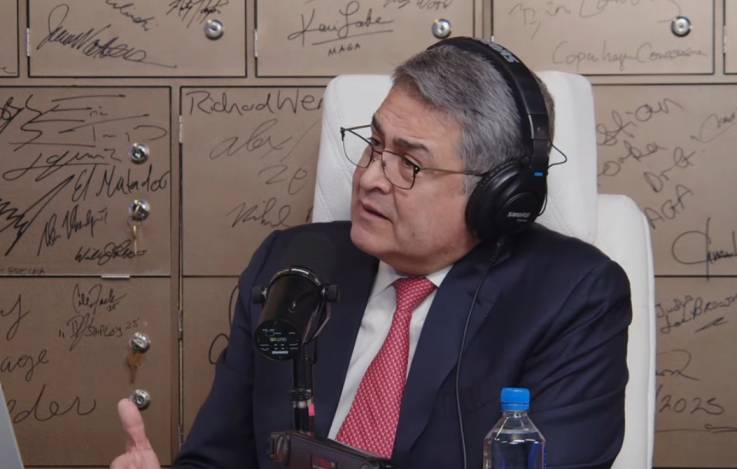
Here is the full transcript of former Honduran president Juan Orlando Hernández’s interview on PBD Podcast, (Ep. 702) with host Patrick Bet-David, premiered December 18, 2025.
Brief Notes: Patrick Bet-David sits down with former Honduran president Juan Orlando Hernández for a tense, two-hour interrogation over allegations that he turned Honduras into a “narco state” while secretly partnering with cocaine traffickers. Hernández, recently pardoned by President Donald Trump after a U.S. conviction and 45-year sentence, insists he was the target of a political hit job by the Biden administration and corrupt cartel witnesses cutting deals to save themselves. He describes learning there is “a hit” on his life, recounts his extradition, time in a U.S. prison, and surreal encounters with figures like Sam Bankman-Fried, Diddy, and 6ix9ine behind bars. The conversation also digs into Honduras’s homicide and drug-trafficking statistics, his government’s tough-on-crime laws, Trump’s decision to grant clemency, and whether Hernández plans a political comeback—or is simply fighting to clear his name.
Introduction
PATRICK BET-DAVID: Today we have with us the previous president of Honduras, Juan Orlando Hernández. You’ve seen him all over television in the last two weeks because he was just pardoned by President Trump. It’s great to have you on the podcast.
JUAN ORLANDO HERNÁNDEZ: Thank you for having me.
The Allegations and Counter-Narrative
PATRICK BET-DAVID: Yes. So question for you. When I call a lot of different people, I have friends in high places. I have friends in low places, and I have friends who were formerly associated with Mexican cartel. I have friends who have done a lot of different things. Here’s what I hear.
There are people that think you helped funnel 400 tons of cocaine into America. They don’t think you’re a good guy. They think you were part of it. They think you took the $1 million bribe from El Chapo. They think you took millions of dollars to help with your campaign for 2013. They have a lot of bad things to say about you, which we’ll talk about a lot of that stuff.
And you have a PowerPoint here with us, so we’ll learn about that as well. Then there’s a complete opposite side.
The other side is a group of people who say you lowered smuggling when you became president. You got rid of a lot of these cartels. The cartel didn’t like you because you were hurting their business. Because to sell cocaine, 84% of cocaine is made in Colombia and the world. And it goes from Colombia to Venezuela to Honduras. They have to go Honduras to Guatemala to Mexico, then here.
So they produce it here for $1,750, then goes to Honduras, $13,500. Then it goes $17,000 and US $40,000. If it goes to New York City, this is 2016 numbers I’m giving to you. And they say you stopped it. So because you stopped it and you were hurting business, they started saying, “Oh, you’re behind at all this other stuff” to throw you under the bus.
So then you got served 45 years. And we’ve all seen a video where you’re walking up. Rob, if you want to put it up.
And they said, “No, this guy’s going away for jail. He’s a bad guy.” But the real bad guys were the ones that wanted to hurt you. So some say that’s what happened.
And then some people who are more pro-Trump folks had more of a technical question for you. They wanted to know how is it in a country like Honduras where presidents can only serve one term for four years, you were able to get Supreme Court to change things to run a second term? And they want to know how some people in America can do that for President Trump to run for a third term. So they’re asking a technical question from you.
But having said that, who are you? Can you share with the people your story, why you’re here, why you’re even willing to go talk to camera after being pardoned? The audience wants to know.
Fighting the Narco Traffickers
JUAN ORLANDO HERNÁNDEZ: Well, again, thank you for having me. Yes, thank you all, the team. The reason I’m here is because I want the world to know the truth. When I was sentenced, I told the judge and looked to the press and said, “Tell the world that I am an innocent man. Sooner or later you will find out.”
Now that you are giving me the opportunity, we are going to talk about things that I haven’t said before. And I encourage you that you can go deep into this and you are going to see things that are really scary.
I couldn’t believe that after being called the champion against narco trafficking in Central America, then the deep state and some agents, some public officials in the United States, they were indicting me when they were giving me recognition prizes.
How this started: Honduras became the main bridge between south and North America for drugs to come through Honduras and then to Mexico, as you said before. But the thing is this, with that comes a heavy price to the Honduran people. 80% of all the violence was related with drugs.
So when you wake up and somebody—I was a Speaker of Congress and somebody said to me, “Mr. Speaker, this morning we have the report: 76 people were killed last night.” And I said, and the day before, 75. And we are just 8 million people.
When you have that kind of problem, you cannot—in myself, I cannot look the other way. If you look the other way, it’s because you already made a decision not to do that. But I am not that kind of guy.
And when I was trying to do something, some other people in Congress, they were telling me, “Look, Mr. Speaker, they are going to kill us. Remember a couple of months ago, two years ago, they killed the two anti-drug czars that we have in Honduras.
So people were scared. But I said, “You know, we have to do it.” And what I did was what nobody wanted to do. So we amended our constitution to allow the extradition. For almost a century it wasn’t allowed extradition of Honduran nationals to any other country.
To do that, I know that I was putting my life at risk, but most scary for me was putting my family’s life at risk. But at one point you have to make the decision: what are the country that we are going to inherit our children? If it is a mess, then we became the country with the highest murder rate in the planet.
PATRICK BET-DAVID: Wow. What year was this? What year is this?
JUAN ORLANDO HERNÁNDEZ: Was from 2009, 8, 9, 10 and 11. And I became speaker of the House in 2010. So I started to create those instruments in order to go after the narco traffickers.
I did also lead and approve in Congress the anti-laundry money law, the seizing law. We create a very controversial law that some people from the United States didn’t like it, the Democrats, but from the very far left, they call it the “shooting down law.”
Illegal planes were coming from Venezuela with cargo and all of them were landing in Honduras. And what happened at this—what I’m going to say, I haven’t said it before. Before I became president, there were three deadly incidents in Honduras. They shot down three planes.
But you know what happened with the chief of the Air Force? Because of the pressure of the US Government, the Democratic administration, the president of Honduras at that time, he fired the chief of the Air Force.
And when I realized that, I said, “How can you do that if this guy, what he’s doing is doing his duty?” In any country, if there’s an illegal plane carrying drugs that are deadly and is in the Honduran airspace, what are you going to do? You have to do something. And they fired him.
So I said, “We are going to create a law with all the protocols based in the international treaties” and we created that law. But before I started as a president, I received the visit of the US Ambassador.
PATRICK BET-DAVID: By the way, who fired him? Was it Roberto?
JUAN ORLANDO HERNÁNDEZ: No.
PATRICK BET-DAVID: Micheletti? No. Who fired him?
JUAN ORLANDO HERNÁNDEZ: The guy who fired was Pepe Lobo.
PATRICK BET-DAVID: He’s from the same party as you?
JUAN ORLANDO HERNÁNDEZ: Yes.
PATRICK BET-DAVID: So he’s also Republican. He would be a conservative.
JUAN ORLANDO HERNÁNDEZ: He’s kind of a conservative.
PATRICK BET-DAVID: Okay, so just to bring context, so the one prior to him, Roberto Micheletti, if I’m saying it correctly, he was a Democrat. He’s a liberal. Then Lobo is previous to you, comes in, he fires the chief of Air Force who shot down three planes that were flying drugs into Honduras and then going to the next state.
JUAN ORLANDO HERNÁNDEZ: Yes.
PATRICK BET-DAVID: What? How did he explain that to the people when he fired a chief of Air Force? What did he say on TV?
The Shooting Down Law and US Pressure
JUAN ORLANDO HERNÁNDEZ: They didn’t say anything. When I asked them, they told me we have pressure from the United States saying that we cannot do that. And I said, “Why?” And they said that some time ago in Peru, there was an accident. They shot down a civilian plane. There were some passengers from missionary people, nuns.
And I said, “Now we have to create a law to be sure of that, our Air Force, although it is small, but it is the most professional in the region.”
But when we created that, I’m going to say something else too, that I haven’t said it before. And you, if you dig into the classified cables from the State Department and also from the Defense Department, you are going to find out.
I met with the former South Commander before I became President. It was in January of 2014, was a private meeting. But then he made that public because he went to have a meeting in the Senate. And we talked about—with him was General Kelly.
And I told him, “Listen, General Kelly, you know what’s going on in Honduras. We’re going to extradite people. It’s going to be dangerous. We need the backup of the United States because we are not as big as Colombia to support the terrorist attacks that we are expecting. We are going to transform the police. I need to use the military force because as in the United States, the military in Honduras is very well regarded by the people. So we have to create so many other instruments. But we want to work side by side with you. I have to reform the tax collection system and so many other things.”
And he said, “But if you use that law, the shutting down law, we are going to be with our hands tied because the State Department doesn’t like that.”
And I said, “Listen, the new law is based on the International Treaty of Chicago, and there is a lot of protocols and we are professionals regarding our Air Force.”
And so later on I found out when I saw the cables during my trial, the declassified cables that he told the State Department, “President Hernández told me that he was going to do this because it was a very important deterrent.”
After a year, he said it in Congress. Before that law, let’s say every year was about 300 flights, illegal flights. After that law, we have just two.
So that’s the reason, because in the International Narcotics Strategic Report that the United States issues every year, we are improving the whole time that I was in office and my government was certified also as a trustee’s partner in the fight against narco traffickers.
And who made those reports? The DEA, the Coast Guard, but also Customs. And there is in Key West, they have a task force of 19 agencies monitoring that. I was invited there with my whole Security Council team and was invited to the White House, to the CIA, to the FBI, to the DEA at a very high level.
And we were discussing how this fight was going on, and everybody was saying, “Juan Orlando is doing unprecedented things and the results are historic.” But also they said, “Juan Orlando, he’s a man of his word. He managed to approve the extradition when he was speaker of Congress, and then when he became president, he was the first to use that.”
We extradited during my term, about 40 kingpins from Honduras. But later on, they used that extradition treaty to extradite me. How is that hypocrisy? Who did it? The Biden administration.
PATRICK BET-DAVID: The Biden administration. We know General Kelly and Trump. You know how General Kelly feels about Trump?
JUAN ORLANDO HERNÁNDEZ: Yeah.
PATRICK BET-DAVID: A couple years ago, he called him a true fascist and made some comments. But while you’re saying this, I want to show something with stats. Rob, can you pull up what happened under the President’s watch? Zoom in a little bit when he was talking about crime.
So this is Honduras intentional homicide rate per 100,000 population from 2000 to 2025. You notice 48.3 per hundred thousand. Goes up, goes up, goes up. Keep going. 2008: 55. 2009: 64. 2010: 74 per hundred. Then it’s 83, 82, back to back.
Then you get elected, 2013, then it’s 72, 65, 55, 54, 40, 38, 41, 35, 38, 34. And obviously the lowest levels we’ve seen from 2000.
So what you were doing was working. You said you extradited 30 kingpins out. But when you say Biden’s administration, Obama, it seems like you were at one point an ally of Obama, Biden and Trump. You’ve gotten along with the left and you’ve gotten along with the right.
What happened for the Democrats to all of a sudden switch on you, flip on you and come in and arrest you, and you’re getting 45 years in prison? You know, the numbers that we’ve seen.
The Break with the Democratic Administration
JUAN ORLANDO HERNÁNDEZ: What happened is very simple. My policies didn’t always match the desires of the Democratic administration, such as, for example, using the military to fight violence. I created a military police for public order. In our constitution, the military has the duty to do public order too. But we didn’t have that unit. So I created that special unit.
You know what I was told by the State Department? “You shouldn’t be doing that, Mr. President, because you are militarizing the security of your country.”
And I said, “Are you aware that we have the highest murder rate in the planet? Are you aware of the corruption in the civilian police? Are you aware of that?”
PATRICK BET-DAVID: Who are you saying this to?
JUAN ORLANDO HERNÁNDEZ: To the State Department.
PATRICK BET-DAVID: What specific name? Who are you? How high a ranking of leaders in American politics are you speaking to?
The Extradition Law and U.S. Pressure
JUAN ORLANDO HERNÁNDEZ: People who were representing the Honduran desk in the State Department. But also I told them, listen, if you are pressuring me to go back in this, you are asking me to undo what I told the Honduran people that I was going to do during my campaign. I am not that kind of guy.
And I said, if you don’t want to help us, although this problem of passing drugs to Honduras, and this is more the rate you are responsible because in your country you consume the drugs. And we are responsible also as a country because it goes through Honduras. And the guys in South America are responsible too, because they produce it. We have to work together and everybody do his part.
But if you don’t want to do it, I have to do it because it is my country, it is my people who are dying. It is my state who’s becoming more corrupt because of this. At one point there was a judge, he was going to have a hearing about a narco and you know, 15 days before his son disappeared.
And the same day that was going to be the hearing, the little boy came in into the building of the judge. What do you think that he was going to do? They kill in public, in the street. The anti-drug czar Aristides Gonzalez and then the one who was going to follow after him, they killed him also.
Because in a problem like this, of course not as famous like yours, but he was saying in Honduras, everybody knows each other. We know who the narco traffickers are. We know who are the public officials who are doing business or meetings with them. The police is a highly corrupt police force. And we have to do something about that.
PATRICK BET-DAVID: In Honduras?
JUAN ORLANDO HERNÁNDEZ: In Honduras.
PATRICK BET-DAVID: And that judge was in Honduras?
JUAN ORLANDO HERNÁNDEZ: This is anti-drug czar. He was an anti-drug czar. His name was Alfredo Landaverde, but he also worked in Congress because he was from the Christian Democratic Party. He was like an advisor for that whip.
PATRICK BET-DAVID: But this judge who they took his son for 15 days and he reappeared in court in a building the day of—that judge was in Honduras?
JUAN ORLANDO HERNÁNDEZ: Was in Honduras.
PATRICK BET-DAVID: And who took his son away for 15 days, who was it? A cartel from Mexico or from—
JUAN ORLANDO HERNÁNDEZ: No, from Honduras.
PATRICK BET-DAVID: From Honduras, yes.
JUAN ORLANDO HERNÁNDEZ: Okay, got it.
PATRICK BET-DAVID: So I’m assuming he sided with narcos on the—with narco on that day.
JUAN ORLANDO HERNÁNDEZ: He resigned. He went lost. And so we have to create—we have to use the advantage, as I saw at that time, I have to use the advantage of getting together with the United States to get rid of those guys.
Other people in Honduras said, you cannot allow that somebody else, other state, is going to judge Honduras. And I said, listen, we’re at a point that we are going to lose our country. We have to do something about that.
The former president Mel Zelaya, who is the husband of the actual lady president Xiomara Castro, once told me, “You made a mistake approving the extradition.” And I said, “Why? You know that we need help to get rid of this. What’s the biggest problem in Honduras?”
And he said, “Well, the Americans are not friends of anybody. You will learn that.” But then time passed. And he opposed the extradition law. But then Manuel Zelaya—Manuel Zelaya, okay. But then he was asked by a guy from the United States, “Are you going to get rid of the extradition when they won in 2021?”
He said, “We will, but first we are going to use it to extradite Juan Orlando.”
PATRICK BET-DAVID: You’re the last person they extradited.
The Synchronized Indictment
JUAN ORLANDO HERNÁNDEZ: No, but I was the first in his when they started. But the funny thing is this. He said that. And then a very high-profile leader from his party, Liberal Party, the very radical left, he was bragging in public and he said in public television, he said, “Of course, six months before the election, we were called from the U.S. Embassy and we sit with the lady candidate and we make a deal that they were going to get rid of Juan Orlando and we agree not to go to China.”
Because during my government, we have relationship with Taiwan. We didn’t have it with China. But then that’s the reason, because the former Vice President, Kamala Harris went to the inauguration of the lady president, Xiomara Castro.
And the same day, at the same time that they were having a meeting, the Vice President Harris and the President Xiomara Castro, was the time in which they were putting my indictment over here. You see how synchronized it was?
PATRICK BET-DAVID: Okay, so the same day that this meeting happens, this picture right here, which is Kamala Harris and Xiomara Castro are meeting, on that same day you get indicted.
JUAN ORLANDO HERNÁNDEZ: Yes.
PATRICK BET-DAVID: Same exact day.
JUAN ORLANDO HERNÁNDEZ: The same exact day.
PATRICK BET-DAVID: Okay, so now—so what the average person would speculate is the fact that they came in, supported her to indict you to say, “You do that, we’ll back you up.” Is that what you’re speculating on, what happened?
Venezuela Connection and the Left
JUAN ORLANDO HERNÁNDEZ: It is not a speculation. It is what has happened. But also, in addition to that, you see this, the left in Honduras is really close with the left in Venezuela. They are so close that you see the connection with the Attorney General. Pam Bondi said it about three, four months ago that the Honduran government was receiving money to allow drugs coming from Venezuela passing through Mexico. She said it because she knew something about that.
And have you heard about the Cartel de los Soles? That’s the cartel in Venezuela. The thing is this. When I was in office, I called the Venezuelan ambassador during my first term. And I told Mr. Ambassador, “We have a problem. Two things. A lot of Venezuelans are here in Honduras. They are claiming that your government is having a repression. You don’t allow them to go to the street and you don’t respect the result of the election.”
And the other thing is, “Look at these maps. Look at these prices. You know, flights coming from Venezuela to Honduras.” I said, “I already spoke to the president in Colombia and they are helping us to stop that.”
Because in my government, we create like a maritime shield in the Atlantic and aerial shield in the air and land shields to stop drugs coming through our territory. And so I am going to ask you—ask the president of your country to help us to stop this.
And I asked him three times, and at the end, I said, “If you don’t have an answer in the next 15 days, you are going to have to leave my country because you don’t want to help us with the main problem that we have.” And at the end he said, “I haven’t had any answer from my government.”
PATRICK BET-DAVID: And this is Venezuela.
JUAN ORLANDO HERNÁNDEZ: This is Venezuela, the same guys. So the left in Honduras and the left in Venezuela, they started a campaign saying that they were calling me a dictator because I was using the military to stop violence. Then they said narco dictatorship.
But the reason, because they launched that campaign was because they were trying to hide the links that the Libre party, the very left party in Honduras had with the narcos. Now it is public, a video that I couldn’t see it properly during my trial because I didn’t have the time. I see it more with more time after my trial.
And the video is so clear. The brother of the former president, who is the brother-in-law of the lady president, was seated with the main narcos in Honduras making deals, saying the narcos were saying, “The only chance that we have is for these guys to win. And if they win, they’re going to get rid of the extradition.”
And the other laws that I had created when I was speaker at that time were about three weeks before the election that I won to Xiomara Castro. But also they said if we don’t do this, we are—I don’t want to say the word, but was a cursed word. Like they were going to be very complicated.
And so that video is exculpatory, but they didn’t allow me to use it in my trial.
PATRICK BET-DAVID: Is that video public?
JUAN ORLANDO HERNÁNDEZ: It is public.
PATRICK BET-DAVID: And is it in Spanish or is it in English?
JUAN ORLANDO HERNÁNDEZ: It is in Spanish and translated to English. Do we have that video?
PATRICK BET-DAVID: I’m going to find it, right? I think you do.
JUAN ORLANDO HERNÁNDEZ: Was it in the email that was sent to him?
PATRICK BET-DAVID: I think so.
JUAN ORLANDO HERNÁNDEZ: Okay, can you look? And what would be the video if you want to look for it? What word should he type to find a video?
The Carlos Zelaya Video
JUAN ORLANDO HERNÁNDEZ: Was Carlos Zelaya. Type in control F. Carlos. Carlos Narcos could be Libre Narcos meeting. And at the end there were—they were in agreement saying that they were going to support with I think was $650,000 and some other help to win the election.
So they wanted them, the radical left, to win the election in order for me to lose. Because I was—they know what’s going to happen if I win. And when I win—when I won, we seized almost a billion dollars.
And this guy was the same guy who was on my trial. And when he was asked, “If you are accusing Juan Orlando of this, do you have any evidence?” And he said, “No, I don’t have anything. Do you have any record? Do you have a video? You have an audio? Do you have a document?” “I don’t have.”
“But you do have a lot of videos from other people.” And he said, “Yes, I did.” And this is also that I haven’t said it before. When I was reviewing my—they call it discovery. I saw the interviews that these guys have with the DEA. They met in Belize and this meeting was published by the New York Times a week before I won the election. They were started to have a meeting to work together.
So he was asked, he and his brother, “Tell us the names of the Honduran politicians, public officials that you work with and you paid them in order to do your business of narco-traffickers.” So they give a lot of names, but they didn’t mention my name.
And at that time I was the most recognized politician because I just a couple of weeks have won the election. Why they didn’t mention me at all for three years that they were talking with the DEA? They mentioned me after because they knew that that was the jail-free card that they need.
And when he was asked on trial, “So tell us why did you leave Honduras and came to the United States?” And he said, “Well, because we were afraid of the extradition. We were afraid of being incarcerated in Honduras.” And so how he was saying that he was protected. And this is the kind of witnesses that they presented in my trial.
PATRICK BET-DAVID: So that’s interesting. So Kamala comes in. Xiomara’s brother was involved. Rob, do you have that clip?
JUAN ORLANDO HERNÁNDEZ: I do.
PATRICK BET-DAVID: So let’s look at this. Can you go back and verify what he just said? You just had something pulled up right there.
“September 2024, an investigative organization InSight Crime released a video recorded in 2013 that purportedly showed Carlos Zelaya, which is the brother, prominent congressman and brother of current first gentleman Manuel Zelaya at a meeting with the leaders of Los Cachiros drug trafficking organization. The discussion—the video—the drug traffickers discussed offering more than $525,000 in bribes, some of which claimed would go to the commander, an apparent reference to Manuel Zelaya, Xiomara Castro’s husband.”
“After that, Carlos Zelaya acknowledged that the meeting did take place and he resigned from his leadership position in Congress, but stated he was unaware the individuals’ illicit businesses. President Castro described her brother-in-law’s actions as a deplorable error.”
Tony Hernández and the TH Brick
So now somebody can say the following to you. Respectfully, somebody could say, okay, that obviously makes sense. And I want to go back to Kamala Harris, and I got some questions for you there. But your brother, Tony Hernández, right? Your brother Tony Hernández, who is facing life right now, he was in Congress previously himself, I believe, and he had ties to drugs, to traffickers, even.
At one point, there was even a—the brick. As you know, they would put the logo of the bricks on the bricks of cocaine that they would sell. Your brother’s letters are on a brick of cocaine that says “TH,” similar to the Tommy Hilfiger logo. “TH,” which is Tony Hernández.
JUAN ORLANDO HERNÁNDEZ: That’s the brick right there, Rob.
PATRICK BET-DAVID: Yeah, that’s what the brick looks like. “TH.” That says Tony Hernández. I’m sure you’ve seen this before and you know his link with a guy he used to do business with because he had locations both in Colombia and in Honduras making cocaine, dealing with a guy named Rodolfo. I have his name. Rodolfo. Let me give the full name because I want to make sure I get this correctly. I don’t want to get this wrong.
JUAN ORLANDO HERNÁNDEZ: There was a witness, El Cinco, I believe his name was.
PATRICK BET-DAVID: El Cinco is somebody else. That according to my investigation. Rob, if you want to pull up this guy.
JUAN ORLANDO HERNÁNDEZ: Is that it?
The Brother’s Alleged Connections
PATRICK BET-DAVID: Rodolfo Alfredo Vergara Bonifante, also known as El Cinco. In coverage tied to your brother Tony Hernandez’s case, as described as a cocaine, Colombian cocaine supplier, partner. He’s a hitman. He’s part of, you know, Sinaloa. So what the outside would say, respectfully, Mr. President, is you can’t make the claim of the current president ties, that the brother accepted bribes because your brother did the same thing, and he’s facing life today.
JUAN ORLANDO HERNÁNDEZ: This guy stepped down.
PATRICK BET-DAVID: Yours is facing life, right? So to somebody that may say, I don’t know if you can really make that argument, what would you say? Somebody knowing your brother had ties to getting money, and he’s facing life today.
JUAN ORLANDO HERNÁNDEZ: First of all, now that I have reviewed my discovery, and in that discovery was all the information about my brother’s child, I am convinced nothing of that was true. But I am going to tell you something else.
PATRICK BET-DAVID: Please.
JUAN ORLANDO HERNÁNDEZ: When I saw the style of life of my brother, he didn’t have even a new car. He didn’t have even money in his account. Everybody knew him in Honduras. He was an average guy, a very young guy. When you saw the whole thing that they create about him, everybody was saying in Honduras, it doesn’t make any sense at all.
But look at this other fact. There is a guy from the DA who led the team who captured El Chapo. And he wrote a book. His name is, his last name is, I think it’s Cogan, Andrew Cogan. So he said, “We follow El Chapo for almost nine months in a clockwise basis, 24 hours. He wasn’t leaving the city, he was just moving to another like a mountain in Mexico.”
But they even say this, all those terror, that during that time El Chapo was going to South America, to Central America. That’s not true. And he was the one who led the capture of El Chapo at that time. And during that time is the allegation of the witnesses saying that about my brother.
So the question is, if the prosecutors, the DA knew about that, why they didn’t ask that same agent to go and testify against my brother. And the other thing is this three, no, four, actually four guys who allegedly were in that meeting, they were, they had dealings with the government, they agree, they have a plea deals, but didn’t go, they didn’t go and testify because they know that it didn’t happen at all.
But now I don’t want to go into more further details because I haven’t spoken with my brother for almost seven years and his lawyer is doing some work at this time.
PATRICK BET-DAVID: You guys haven’t spoken for seven years?
JUAN ORLANDO HERNÁNDEZ: No, I haven’t.
PATRICK BET-DAVID: Is that because he can’t talk to anybody or you’ve chosen not to communicate with them?
Seven Years of Silence
JUAN ORLANDO HERNÁNDEZ: At the beginning I said, if they are following him, if they are attacking him because they want to affect me, I don’t want to affect him. But then he was in jail and I was in office. And even though this other part, there was a cable, a classified cable, and I told once to the public official from the U.S., “Listen, if you have something related with my brother and you give it to me, I was, I’m going to be the one giving it to you so that you can persecute him.”
But after that I also asked the U.S. ambassador in Honduras, “Mr. Ambassador, I don’t like this. My family is a very honorable family. What we have is our name. We don’t have money, we don’t have anything. We are a middle class family. We are coming from the…”
PATRICK BET-DAVID: There’s great stories about your parents, your family. You come from a rural area, but you come from a good family. You went to school in Albany, you went here and over there in your state, I think you went and became a lawyer. You went to a law school, if I’m not mistaken. So yeah, the stories about your family is very good. The stories about your brother…
JUAN ORLANDO HERNÁNDEZ: But listen, this is the point. I told the ambassador, “Can you ask the DOJ for a meeting? So can my brother go and be interviewed and be interrogated by the DA, by the prosecutors?” And he said, “But we don’t have any guarantees, Mr. President.”
I said, “I am not asking for guarantees. What I am asking is if something is wrong and you have to proceed, you can do it, but if you don’t have any problem, but also you have to do it.” So he went. He came to the United States, he met with the DA and he came back. Do you think that if we were, if the people who the prosecutors portrayed us like that I was going to do that?
El Rojo and Other Connections
PATRICK BET-DAVID: I don’t know. I’m looking at the connection with your brother because you said, I said El Cinco, which is the Rodolfo guy we spoke about earlier. But there’s also El Rojo, and that’s Victor Hugo Diaz Morales, if I’m not mistaken. And he’s the guy that has said that he’s killed 18 people. I think one time he shot his girlfriend and even killed…
JUAN ORLANDO HERNÁNDEZ: Killed a little kid one time. A terrible guy.
PATRICK BET-DAVID: Terrible guy. And there was some ties with him and your brother as well.
JUAN ORLANDO HERNÁNDEZ: What’s the problem is that this guy was from Guatemala. He is, Guatemala is close to our hometown. So my brother was doing some cooking business. I mean, food for small parties. So in the place in which we were born, those guys used to come.
The problem with my brother, I told him, sometimes you have to avoid people. Don’t even tell them directly, “I don’t want to be, you shouldn’t be here.” But of course, somebody else said, if you do that, they are going to kill you. But anyway, that’s the thing. Now that I’ve seen the whole information, there is nothing. But my duty from now on is, as I’m doing it right now, is to explain to the world what really happened. Because truth has to come.
PATRICK BET-DAVID: And I appreciate it. And that’s why we’re doing this. And I applaud you for doing this. But my point for saying this is because you went after the current president’s brother, Carlos, his ties. And then I was like, well, the other side’s going to tell you about Tony Hernandez. And it says El Rojo and El Cinco.
So it’s not like your brother didn’t have some ties there. But you’re saying your brother’s innocent. This is what I want to get to. Let’s go back with the new president. Kamala Harris comes in with her beautiful mask that she’s wearing. And, you know, to claim that they’re extremely safe. And so they’re celebrating the new president, you know, winning. And then on that day, you’re getting indicted.
JUAN ORLANDO HERNÁNDEZ: Great.
Conversations with Obama and Biden
PATRICK BET-DAVID: Have you ever personally had any conversations with Obama, Biden or Kamala Harris?
JUAN ORLANDO HERNÁNDEZ: With Obama and with Biden.
PATRICK BET-DAVID: And what was the context of your conversation with Obama and with Biden?
JUAN ORLANDO HERNÁNDEZ: Well, with Obama, we started to work, remember in 2014, the huge wave of unaccompanied children coming from Central and South America. So we started to work in that and we launched an international event in Honduras trying to manage that thing. And they asked me to come even to speak to both houses of Congress to tell them that we were going to work together.
And I said, “Listen, I don’t need to do that. We are working really close in that because I feel so sad that the coyotes, the smugglers are using that natural love and empathy of families trying to bring their, the children I lost in the way.” But at the end we were very successful in that.
But we create what we call it like a program from the Northern Triangle of Central America. And Biden was the one in charge of that program. And we were working so close that at some point, I guess that you already have that video there. He said it publicly in Guatemala. He said, “Mr. President,” referring to me, “You are risking your life. You are risking your family life.”
PATRICK BET-DAVID: This is Obama, Biden.
JUAN ORLANDO HERNÁNDEZ: This is Biden and doing a fight against organized crime. And that is also our fight. He said it right there. But then we continue meeting. When President Trump won the election, Biden called me and he said, “Mr. President, Vice President Pence is in charge of the transition. I wanted to ask you to receive a call from him because we want to continue what we have been doing in the Northern Triangle.”
And I received a call from Vice President Pence. So he was given the new administration that I was the one who was doing that work in Central America to stop drugs, to stop illegal immigration. And how is that then during his administration, when he became president, those things changed. I mean it is a hypocrisy of he didn’t know what was going on in his government. Sorry to say that this is Biden.
PATRICK BET-DAVID: Well, that’s obvious. Did the current admin, the previous administration under Biden, that Kamala Biden, Garland. Did any of those guys speak with you? Because Garland gave a 21 minute speech where this is it Bible you ex Honduras when you were being extradited. Is this the speech rap?
JUAN ORLANDO HERNÁNDEZ: Yes, sir.
PATRICK BET-DAVID: Just play it a few seconds of it. Go for it.
Garland’s Extradition Speech
JUAN ORLANDO HERNÁNDEZ: “Lando Hernandez, the former president of Honduras, was extradited to the United States to face federal charges. Hernandez is charged with participating in a corrupt and violent drug trafficking conspiracy to facilitate the importation of tons of cocaine into the United States from 2004 to 2022.
As is charged in the indictment, Hernandez abused his position as President of Honduras from 2014 through 2022 to operate the country as a narco state. Hernandez is alleged to have received millions of dollars from multiple drug trafficking organizations, including from the former leader of the Sinaloa cartel known as El Chapo.
In return, drug traffickers in Honduras were allowed to operate with virtual impunity. We allege that Hernandez corrupted legitimate public institutions in the country, including parts of the national police, military and national Congress. And we allege that Hernandez worked closely with other public officials to protect cocaine shipments bound for the United States.”
PATRICK BET-DAVID: Okay, so during this administration, while they’re playing offense like this with you, okay, indictment, you know, smuggling cocaine, the average person watches this. You’re a criminal. You’re a horrible human being. Right. That’s what the average person is going to see. During Biden, did Biden, Kamala Garland, anybody, any of the higher ups of his organization talk to you, reach out to you with Biden?
JUAN ORLANDO HERNÁNDEZ: We work very close with Biden. Yeah.
PATRICK BET-DAVID: So Biden was good with you?
JUAN ORLANDO HERNÁNDEZ: Yeah.
PATRICK BET-DAVID: Himself, directly, yeah. So when you see something like this, how surprised were you? When were you expecting, expecting this or you’re surprised by this and not…
JUAN ORLANDO HERNÁNDEZ: I wasn’t. I couldn’t believe it.
PATRICK BET-DAVID: So let me get this straight. So when this speech is being made, you’re fully surprised. You don’t even know. You can’t even believe that this is taking place.
Transforming the Police Force
JUAN ORLANDO HERNÁNDEZ: Yeah, because this guy, this former Tony Jenner Garland, he was saying that we were using the police. But the other branch of the State Department, they call it INL, we work with them in how to transform the Honduran police. I was given awards, I was given recognitions because we worked that with the Inter American Development bank.
And we work with several other polices from Chile and from other countries. We became like the example of how to purge, how to transform a police force who used to be at the order of the narcos. We fire almost 60% of the police force in Honduras. And that’s the reason. Because I have to use…
PATRICK BET-DAVID: You make a lot of enemies if you do that. So these are people. It’s because I know the model. You can bribe them and you can win them over. Right.
The Threat on His Life
JUAN ORLANDO HERNÁNDEZ: But thanks to God, I am alive. As you said it, this guy, every group of this, they’re trying to kill me. And right now, if I go back to my country, there is a hit on me. I’m telling you this right now. I haven’t said it before.
During my trial, I received a report, my lawyer from the FBI. Unfortunately, my lawyer was so ill that he couldn’t come regularly to visit me. But in one case I was reviewing that and there was an informant who was talking to the FBI. And this guy was saying, “I was in a meeting. The top leaders of the radical left, the Liberal Party, were doing agreements with one of the main criminal organizations in Honduras to kill President Hernández. And then they helped that party to win.”
And then the other argument was that they were going to kill my daughters, my family. And they killed a son of a former president. And it was right there. And I was so mad. And I even asked the judge for a special hearing. I said, “How can—why you didn’t tell me this at the time? I can do anything to protect my family from here, but at least I can hold them.”
And at this point, the attorney general office in Honduras, they didn’t say anything about that. And now how is that? Garland was saying that when all other branches of government in the United States, they were applauding. They were saying that model that Honduras has to transform the police is the model that we need in the region.
PATRICK BET-DAVID: And so is your family now out of Honduras? Do you have any family there still or no?
JUAN ORLANDO HERNÁNDEZ: Yeah. Now, this morning, from very early in the morning, I have to call them because the president, the lady president said about three in the morning, posted her social account that I was going to get into the country and she was fearing a coup d’état and I was going to empower a new president.
I mean, I cannot back to my country right now because I know what is going on over there. The political persecution, but also all the enemies. Some people who were extradited during my administration, they are already back in Honduras, but also the Honduran people. Last Sunday already spoke. 80% of the Honduran people rejected the radical left government.
So they are trying to create a crisis to steal the election at the style of the Venezuelan government does it every time. And they have been using me for almost 12 years to create crisis. And now I have to put before I came here with you, a post saying, “That’s another trick, that’s another lie. What Honduras needs is finally to count the last vote and the institutions have to be preserved and all the civil society, the other groups and the international observers who already said that the election is okay, we just want to finish counting the last vote.”
And we already know who won the election. But that’s the way that these people operate and rob.
The Current President’s Accusations
PATRICK BET-DAVID: Who is this Xiomara Castro de Zelaya? She’s the current president. She said this eight hours ago to the Honduran people: “I report with historical responsibility that based on verified intelligence information, Juan Orlando Hernández, pardoned in the US, plans his entry into the country to proclaim the winner of the elections at the same time that an aggression is underway aimed at breaking the constitutional democratic order through coup against my government. In the face of this serious situation, I urgently request the conscious and peaceful support of the Honduran people. I call upon the people’s social movements, collectives, grassroots organizations, militants and citizens to urgently and peacefully gather in Tegucigalpa to defend the popular mandate, reject any coup attempt and make visible to the world that a coup is being hatched there.”
Do you have any plans of going back?
JUAN ORLANDO HERNÁNDEZ: I cannot go back right now, if you allow me. Although President Trump already pardoned me and he has the courage to do it because he already passed—I mean, for what I have been go through, the lawfare against him is—I mean, I haven’t seen a case in history where he faced. So he understood and he knows what really happened with my case. So he pardoned me.
But you know, I haven’t seen my family for almost four years and now they are facing those threats. I want to reunite with my family for a while. Meanwhile, the new government in Honduras is established. I want to go back to my country. My dream is to take care of my family, my mother, my children, my grandchildren. And that’s what it is. But you know, being there right now, they are in danger. And the Biden administration, they took away their visas and they couldn’t even come to my trial.
PATRICK BET-DAVID: Your family’s visas were taken away by the Biden administration?
JUAN ORLANDO HERNÁNDEZ: Yeah.
PATRICK BET-DAVID: You know that they didn’t even come to my trial when I see other trials from the really bad narcos, the real ones, and their family is right there. And my family couldn’t come.
PATRICK BET-DAVID: That’s unbelievable.
JUAN ORLANDO HERNÁNDEZ: You know how that makes me feel.
PATRICK BET-DAVID: Oh, my God.
JUAN ORLANDO HERNÁNDEZ: That’s not—that’s cruel and inhumane. Anyway.
PATRICK BET-DAVID: That’s terrible to hear that. And by the way, do you know who did—who took the visas away? Anybody specific? Because I don’t know if Biden did it. Somebody on his team probably did it. Because it doesn’t sound like you have a bad relationship with Biden.
The Biden Administration’s Role
JUAN ORLANDO HERNÁNDEZ: No, I think that he even know. I think—I mean, there was a group of the very radical left in the Biden administration that did this whole thing. I guess there were people from the State Department and the White House.
PATRICK BET-DAVID: But you don’t know any names of who that would have been?
JUAN ORLANDO HERNÁNDEZ: I have an idea, but I don’t want to say it. What I know is that there was a guy during the Biden administration. He was applauding me every time, even taking pictures with me. When President Trump won the election, he asked my former chief of staff if I can go to meet Biden. And I said, “Listen, but the United States has already a new president. My relationship is with President Trump.”
But anyway, I went and Biden was there, and this guy was there. He was setting up the meeting. And I said, “So this is going to be your campaign headquarters?” Something like that. Because I want to be put distance between that political thing. I said, “No, no, no.” Like that.
And when I was signing the third country agreement to stop illegal immigration with President Trump, we signed it in New York. And before I did that, I went to several countries in Central America to talk to the president so that we can do it together. As Charles Wolf said in a video, and I think it is in the presentation, Chad Wolf was saying, “President Hernández helped us to convince the other leaders of the region to do that.”
And when I signed that, the same day that guy started to attack me recklessly.
PATRICK BET-DAVID: The same guy?
JUAN ORLANDO HERNÁNDEZ: The same guy.
PATRICK BET-DAVID: And do we know this guy?
JUAN ORLANDO HERNÁNDEZ: I don’t want to say right now, but I’m going to give you the information.
PATRICK BET-DAVID: Well, how many—so because you’re going to have—one name is going to be Blinken. I’m sorry, one name would be Blinken. Anthony Blinken.
JUAN ORLANDO HERNÁNDEZ: Okay.
PATRICK BET-DAVID: I don’t think it’s Lloyd Austin. Mayorkas.
JUAN ORLANDO HERNÁNDEZ: I don’t remember clearly if his name was—last name was Gonzalez, Menendez or Gonzalez. The same one who was making deals with the Venezuelan regime. Got it. Is the very radical left. But you know, some there is—this is the other part of the Democrats, Gonzalez. I don’t know if I don’t remember.
PATRICK BET-DAVID: It could be the senior director of National Security Council for the Western hemisphere.
JUAN ORLANDO HERNÁNDEZ: Could be that leader.
PATRICK BET-DAVID: He reported to Jake Sullivan.
Congressional Support and Contradictions
JUAN ORLANDO HERNÁNDEZ: But you know, several congressmen and senators used to come to Honduras and to see how things were going on. And the funny part is this. They came to the Senate or the House and they report to their committee and there was a consistency between the International Narcotic Strategy reports saying that Honduras was improving every year. It is right there. And that information is produced by the DEA, Coast Guard and the customs.
But also when they went to Honduras and they meet with the US Embassy team, the security team, they came to report and one senator said, “Something really good is happening in Honduras and it has to do with the new leadership of President Hernández. Now the two very bad guys came to surrender to the United States because they felt the heat from the President Hernández government.”
You know who one of those guys was? One who was lying in my trial and it was a senator who was briefed and who went to Honduras. He even came, they went, some of them even came to my home to tell me, “Could you please talk to the other presidents in the region so that we can expand what you have here in Honduras?”
PATRICK BET-DAVID: Is this a well-known senator in the US?
JUAN ORLANDO HERNÁNDEZ: Yes, several.
PATRICK BET-DAVID: Do you have their names or—
JUAN ORLANDO HERNÁNDEZ: I don’t remember clearly. I remember that he was from Delaware.
PATRICK BET-DAVID: Delaware is where Biden’s from.
JUAN ORLANDO HERNÁNDEZ: But I can send you the names and the photos and everything. And there were meetings also and they were asked about how Honduras were doing and they were saying words like this: “He took unprecedented measures. The historic results are right there. He’s a man of his word.”
And they even said in the cables and they told me in private, as never before, look at this: “As never before, the United States has a close and effective relationship against narco traffickers than with the government of President Hernández.” And that is in the classified cable.
PATRICK BET-DAVID: Is that Tom Carper?
JUAN ORLANDO HERNÁNDEZ: I think, yeah. He used to be in my home.
PATRICK BET-DAVID: Tom Carper used to be in your home?
JUAN ORLANDO HERNÁNDEZ: Yeah.
PATRICK BET-DAVID: And so he’s thankful for what you’re doing. He’s asking you to talk to the people around to minimize the cartels and work with other world leaders. And then he comes back around to the Senate and then he sides against you.
JUAN ORLANDO HERNÁNDEZ: No, no, no.
PATRICK BET-DAVID: He’s a good guy.
JUAN ORLANDO HERNÁNDEZ: He didn’t say anything that I know. Okay, got it. But in the Senate report, in the—how do you call the place? And they put all the hearings. You are going to find that information over there.
PATRICK BET-DAVID: I got it.
JUAN ORLANDO HERNÁNDEZ: Okay.
PATRICK BET-DAVID: Interesting.
JUAN ORLANDO HERNÁNDEZ: Well, and I can send it to you, too.
PATRICK BET-DAVID: I’d love to see it. I would love to see it. But let’s stay on this because, Rob, if you can pull up the map. Do me—just pull up the map where on the PowerPoint that he has. Can you go show where—
JUAN ORLANDO HERNÁNDEZ: Okay.
PATRICK BET-DAVID: If you can go to present mode, if you could.
The International Certification and Political Motivations
JUAN ORLANDO HERNÁNDEZ: But also if I could add something else. There were not only this, the International Narcotic Strike Report saying that the improvements of Honduras against the drug traffickers. My administration was certified every year during my two terms as a reliable partner in the fight against drugs. And that report by law has to be sent on March every year from the office of the President in the name of the President, to Congress so that Congress can allocate money to the agency so that they can work with a reliable partner.
It is right there. It is in the official documents. And so when you ask if they knew this, and in my case there was a single US Official testifying against me, it was. That’s why we call a law fair, because it was for political reasons, because they didn’t like that I was using the military, that I was tough in law and order.
They didn’t like. Also, I back up the decision of President Trump moving the embassy from Tel Aviv to Jerusalem. I did the same too. I back up Israel in the United Nations as well, the new concepts that we create to attract investors to Honduras as the new free economic zones. After that, I went to see how they function in South Korea, in Singapore, in Asia. They were all against those ideas. They said there were two libertarians.
And I said, “Listen, it is in Honduran territory. I want Honduras to be exposed to the best opportunities so that they can come and invest.” And we are very well located in the center of the continent. We create a dry canal to move cargo from the Pacific to the Atlantic. And of course, I wanted a train to do that faster, because the Panama Canal doesn’t. It is not enough to move all the maritime cargo that move from one ocean to the other.
So these other things, I mean, they didn’t agree on that. And so many other things. For example, Honduras is a very Christian population. 94% could be Catholics or evangelicals. And they were pressuring me to change our constitution because in the Constitution there is something that a provision that nobody can adopt children if they are couples of the same sex.
And I said, “Listen, any president who wanted to do that in Honduras, all the churches or the people from faith is going to overthrow that government. So you have to understand that we have our own values. We believe in family, of course, we respect if anybody is, let’s say, gay or however they can want to call it. If it is a human being, we have to respect them. But you know, if you are going to talk to children that you can go to the school dressed like a little girl or whatever, you cannot do that in Honduras.” So there were so many other things that they didn’t like.
PATRICK BET-DAVID: So in Honduras a gay couple cannot adopt kids?
JUAN ORLANDO HERNÁNDEZ: Kids. No, no. It’s in the constitution for almost 20 years ago.
Constitutional Restrictions and the Bukele Comparison
PATRICK BET-DAVID: It’s in the constitution that gay couples cannot adopt kids in Honduras. Yeah, very interesting. So, you know, as we’re going through this, it’s making me think about something and I want to come back to all these flows of how drug is coming in, how it was in 2007 and how it changed.
It reminds me of you being the person that gave the playbook of what Bukele is doing right now. Because if I look at your playbook, you came in Honduras, all the drugs is going through you. You don’t make cocaine, Colombia does, but it goes through Venezuela, you, Guatemala and then Mexico. Right, okay, so you come in.
In Honduras, a president can only serve one term. I think it’s four years. In El Salvador, president can only serve one term. I think it’s five years. Okay, so you come and you were able to change the constitution so you can go for a second term.
JUAN ORLANDO HERNÁNDEZ: Well, I didn’t ask the Supreme Court to rule in that way. They were a group of congressmen, mayors and other people, former presidents, and they went to make a request saying if the mayors in Honduras can be reelected, if congress people can be reelected. But also Honduras has signed a treaty that we have to respect the political rights of the citizens who want to choose. You have let them do it.
And the other right is the guy who is in office because at the end is the will of the people if they want to vote for him or not, if he’s in office. But during my reelection, the other good part is that every party that wanted to compete went to compete. They participate. I asked so many governments to send observers and they were there. And the people of Honduras choose. That was the highest votes that a candidate could have in history.
PATRICK BET-DAVID: And I’m aware. So that means the Supreme Court. But the Supreme Court was probably on your side when they did this. I’m assuming they wanted you to be reelected. But this is kind of where I’m going with this with Bukele.
JUAN ORLANDO HERNÁNDEZ: Where I’m going with this with Bukele.
PATRICK BET-DAVID: Is you went in 2013, became president. He became president 2019. So six years prior to you, he became president. You’re a young man yourself, he’s much younger, but you’re in your 50s. He’s now in his 40s, I believe. I think he just turned 40, maybe 39. 40 years old. 41 years old.
He goes in and he goes after Mara Salvatrucha MS-13, right? You go after your drug lords. How old is he right now, Rob? 44. Okay, so you go after the narco, he goes after MS-13, he puts them in jail and crime rate drops dramatically. If you can pull up the data of what happened to crime rate in El Salvador, it’s astonishing when you look at that. Okay, Whether he did it or his people did it, Supreme Court changes.
Now he can run infinitely and be the president. Some people call on him a not a dictator. But there’s different words that you call Bukele now. He’s made the place safer. They like him. It’s great. Yeah. He lowered it from 38 per 100,000 in 2019 to 20 to 17 to 7.8 to 2.4. Right now it’s 1.9 per 100,000. Insane figures they’ve never seen before. Right, so goes after MS-13, you go after narco, he cleans up crime.
JUAN ORLANDO HERNÁNDEZ: You clean up crime, we create a new security, high security prisons too.
PATRICK BET-DAVID: Yeah. So. Meaning he’s modeling you. Right, but the difference is, you know, they come after you, but they leave him alone.
The Radical Left’s Playbook
JUAN ORLANDO HERNÁNDEZ: They were coming after him too. If President Trump doesn’t win, that’s my deduction, they were coming after him.
PATRICK BET-DAVID: So if President Trump doesn’t win, they go after Bukele next.
JUAN ORLANDO HERNÁNDEZ: Yes.
PATRICK BET-DAVID: So what you’re telling me is right now, if a Newsom wins in 2028.
JUAN ORLANDO HERNÁNDEZ: And also creating, creating stories, nothing. Nothing. Got it solid.
PATRICK BET-DAVID: Right.
JUAN ORLANDO HERNÁNDEZ: You know why we have to realize, if you look at the world, look, Lady Le Pen in France right now, look Bolsonaro, look Bibi Netanyahu. Look, President Trump by excellence, he is the example of political persecution. Look at this other lady, President Áñez in Bolivia. She just went out of jail. Look at my case.
This is part of the playbook of the radical left in the planet. And that’s the reason, because they were trying to go after President Bukele too. It’s clear at this water. What’s their playbook to go after leaders of the conservative movement.
PATRICK BET-DAVID: Why?
JUAN ORLANDO HERNÁNDEZ: Because they want to destroy in order to give the opportunity to them. What happened in Honduras was they attacked me. They pushed me hard, my party, too. In order for the radical left to go in power, this is what they did. And I’m going to send you more detailed information so that you can have it and you can see it for yourself.
But also being here, I could ask anybody not to rely on whatever media says, please go and do your own research you have done. I am impressed when I was talking with your people, how deep you were into my past and everything. But you have to do that in order to understand what is going on.
Because nobody wanted to do what I have to do. And I have to do it even though I knew that I was not only in danger myself, but my family. Because at the end, I cannot look back to the other way, as the former presidents in Honduras did. If I knew that something was terrible, terribly bad in Honduras, I have to do something because that’s what I am.
And I have to clean my name. The name of my family, the name of my team, and the name of the country that at that point decided to get rid of. That violence, of course, had a heavy price. And it would be easy for me at the beginning saying, “Okay, I’m going to make a deal. What do you want me to say? And I’m going to be free in two years, three years.”
And some of these other guys, did you know, one of the guys who testified against me, he told the judge that he was responsible for 57 deaths and he wasn’t even six years in jail. He was walking around in the streets in the United States. But then President Trump ICE sent them to Honduras.
Witnesses Who Killed Dozens Walk Free
PATRICK BET-DAVID: This is a guy from Honduras. He killed 57 people in Honduras. He’s in the streets here in America. He only did six years in jail.
JUAN ORLANDO HERNÁNDEZ: And President Trump, less than six years.
PATRICK BET-DAVID: What’s this guy’s name?
JUAN ORLANDO HERNÁNDEZ: Alexander Ardón.
PATRICK BET-DAVID: Alexander Ardón?
JUAN ORLANDO HERNÁNDEZ: Yes.
PATRICK BET-DAVID: Who gave him only six years?
JUAN ORLANDO HERNÁNDEZ: The Biden DOJ. They make a deal. And this is. This is the other part. Even worse, right?
PATRICK BET-DAVID: Alexander Ardón, a former Honduran mayor and convict, the drug trafficker confessed to involvement in 56 murders and trafficking tons of cocaine to the US and plea deal. He was sentenced to time served in the US federal court January 2020 by exchanges extensive cooperation as a witness of major drug cases, including the trial of former Honduran President Juan Orlando Hernández.
JUAN ORLANDO HERNÁNDEZ: Oh, wow. And there is another guy who, who told the judge that he was responsible of 78 killings in Honduras. He’s the leader of Los Cachiros. And I bet that he was about to get out too, because of those deals. And when he was asked in 2013 about the politicians who were working with him, he didn’t even mention me.
And he said no. “The only thing that I have about Juan Orlando is that my brother gives $250,000 to his campaign. And my brother was in a meeting with him. My brother put me in a video call.” And at what time was that somebody asked? 2011, 2012. We didn’t even have cell phone services at that time in that place. That’s how they create those things, you see.
And now the damage that they have done to the image of my team, of my country, my family. I was thrown in a jail, like three or five days before President Trump became in office. They ordered that have to be moved to a jail in Hazelton. When I went there, some people told me, “You shouldn’t be here.” The other guy told me, “I cannot be with you in my cell because my group has a rule. You were part of the law enforcement. Law enforcement. You were at the highest level. They can ask me to stab you. And I have to do it.”
Sent to a Dangerous Prison
PATRICK BET-DAVID: Hazelton, is this. By the way, this is the one Rivera Maradiaga.
JUAN ORLANDO HERNÁNDEZ: Yeah.
PATRICK BET-DAVID: Who killed 78 people in 2013. And he was. So you’re in jail and a guy saying, if they find out you’re my cellmate, they tell me to stab you.
JUAN ORLANDO HERNÁNDEZ: I have to do it. Yeah.
PATRICK BET-DAVID: And this is your cellmate?
JUAN ORLANDO HERNÁNDEZ: Yeah. No, he. He didn’t want me to be in his cell.
PATRICK BET-DAVID: So what, did they move you?
JUAN ORLANDO HERNÁNDEZ: Well, I have to. I have to go to. To find another place in order to avoid that. And there were some.
PATRICK BET-DAVID: Hazelton.
JUAN ORLANDO HERNÁNDEZ: Yeah. There were some others saying, did you.
PATRICK BET-DAVID: Pull up Hazelton Rob?
JUAN ORLANDO HERNÁNDEZ: There were some others telling me, “Listen, you shouldn’t be here. You are in danger here. It is really complicated. And there is a lot of people from the cartels, from Mexico.” And why didn’t send me over there? The only explanation that I have is because they wanted to get rid of me.
PATRICK BET-DAVID: I got you. So they put you there so somebody.
JUAN ORLANDO HERNÁNDEZ: Would kill you to get rid of you. That’s my deduction. That.
PATRICK BET-DAVID: That logic makes sense to me. That logic makes sense to me. If somebody wants to get rid of you, have somebody else do. They’re already doing life anyway, so what do they have to lose?
JUAN ORLANDO HERNÁNDEZ: Nothing.
Prison Life and Encounters with High-Profile Inmates
PATRICK BET-DAVID: It’s an easy way to get rid of a target. Yeah, this, by the way, this jail. If some people are wondering who stayed here, Whitey Bulger stayed at this jail. Okay. Anthony Tonacosta, mob-related inmates after Bulger, okay, you got some very MS-13 and Latin King cartel killers stay at this place.
These are the names you got: Photios, Freddy Giz, Frank Cadillac, Frank Salami, James, Alex Fields Jr. You got some interesting people that stayed here. So they’re sending you to a place as if you’re a full-on killer. That’s who they put you with. And you said you got three, four. So this is January 16th, January 15th. Is that around the day of 2025 when they put you in jail?
JUAN ORLANDO HERNÁNDEZ: No, was 21.
PATRICK BET-DAVID: Oh, this is first time when Trump lost.
JUAN ORLANDO HERNÁNDEZ: This is after. When President Trump wins this last time, five days before they gave the order.
PATRICK BET-DAVID: To move you to Hazelton. That’s what I’m saying. So January 15th, because Trump—oh, Trump won, but he got elected. He was inaugurated January 20th. So is this in October or is this in January?
JUAN ORLANDO HERNÁNDEZ: In January.
PATRICK BET-DAVID: In January. Got it. And when you were there, is this where you met Sam Bankman-Fried? Where did you meet Sam Bankman-Fried from?
JUAN ORLANDO HERNÁNDEZ: It was in Brooklyn. In Brooklyn. I was in a special unit and of course I met Sam there. This other guy who is a singer, you call it mogul, music mogul. Diddy. Yeah, yeah.
PATRICK BET-DAVID: You were in prison with Diddy and Sam Bankman-Fried?
JUAN ORLANDO HERNÁNDEZ: Yeah.
PATRICK BET-DAVID: Did you speak with them?
JUAN ORLANDO HERNÁNDEZ: Yes, well, at the beginning, you know, I didn’t know them as the figures they were. I mean, also I was just by myself, you know, reviewing my case. There was another guy, rapper, he’s very famous. They call it 69, I think. But I didn’t know until the other inmates told me.
PATRICK BET-DAVID: Tekashi 6ix9ine.
JUAN ORLANDO HERNÁNDEZ: Yeah, they called me. Those guys are really big in music and things like that. But with Sam, we developed a close relationship. He was—we were talking about my case, things like that. I met his father and mother because at one point I was really preoccupied about my family when I know that they had that green light from the MS-13 over my daughters.
And I said, you know, I cannot sleep. I don’t know what can I do? And he said, “Listen, you have to move your family from Honduras.” But I said, “I don’t have any means to do it.” And we were talking about how can we do. And at the end, I told my lawyer, “You have to call my wife and you have to tell her and do whatever you want you have to do in order to protect them.”
But at the end I have to be in my home for almost three months without going out at all. And you know, it’s—at one point I said to God, I made my peace with God. And I said, “My Lord, you can do whatever you want with me. It is. You’re right. But please protect my family. That’s just what I’m asking.”
PATRICK BET-DAVID: Did Sam Bankman-Fried help you financially with the family or no?
JUAN ORLANDO HERNÁNDEZ: No, no, no.
PATRICK BET-DAVID: What was he like to you? Did you enjoy the conversation?
JUAN ORLANDO HERNÁNDEZ: He was a very quiet guy, but he had new ideas about the war. And when he was reviewing my case, he said, “Listen, this is clearly a setup.” And I said, “But how can I explain it?” You already passed for a trial and you know what it is and it is hard, you know, when the prosecutors and the judge agree that you cannot—for example, they didn’t allow me to bring the experts from Honduras to explain to jurors how I passed those laws to pass your traditional law, the seizing of assets law, the anti-money laundering law, the reform of the police.
It’s easy to say it, but to do it is a huge risk. And they were going to come to explain to that. And you know, the judge agreed with the prosecutors and they didn’t allow them to come to do it.
Sam Bankman-Fried’s Defense of Hernández
PATRICK BET-DAVID: Do you know what Sam Bankman-Fried said about you? Have you read what he said about you or—
JUAN ORLANDO HERNÁNDEZ: No. My daughter was explaining to me.
PATRICK BET-DAVID: Sam Bankman-Fried told Mario Nafal, Rob, I think you have it somewhere. And he explains to him that—he says, “I spent a year and a half in the same unit as Juan Orlando. I got to know him fairly well. I’d like to think we became friends. And I can’t think of a single inmate more deserving of a pardon. He was framed.”
And SBF spent extensive time helping yourself with trial prep and review the evidence and his account. You were convicted in 2024 for decades-long cocaine conspiracy involving hundreds of murders. But the actual evidence: a ceremonial machine gun, a selfie with a cartel-connected soccer fan and testimony from the exact cartel leaders you were arrested and extradited. Those cartel leaders were offered early release.
JUAN ORLANDO HERNÁNDEZ: If they could implicate a bigger fish.
PATRICK BET-DAVID: They chose to testify against a man who put them in prison. The result, your presidency: murder dropped 50%, drug trafficking dropped 90%. Every major cartel leadership extradited to the US. SBF: “He wasn’t just a narco trafficker. He wasn’t just not a narco trafficker. He was probably the most effective anti-cartel leader in the world. Juan Orlando is the most innocent prisoner I’ve met, including myself.”
The pardon came days before Honduras’ November 30th election where Trump endorsed Nasri Asfura of your national party. The race is now a technical tie. The Trump warning there will be hell to pay if the electoral body changes the result. That’s what Sam Bankman-Fried said about you. Interesting. Did you ever speak to Diddy?
Encounters with Diddy and Prison Advice
JUAN ORLANDO HERNÁNDEZ: Was Diddy a couple of words? You know, we were getting into the elevator coming from the legal—
PATRICK BET-DAVID: He doesn’t like elevators. It’s bad news to be around elevators.
JUAN ORLANDO HERNÁNDEZ: With him, but I didn’t know him at all. And he said, “So you are going to 4 North,” which was the same floor. I said yes. “So you are the new guy?” And he said yes. And he said, “Why you advise me?” And I said, “Look, you have to keep your mind busy.”
PATRICK BET-DAVID: You told him, yeah, if you are—
JUAN ORLANDO HERNÁNDEZ: Go, you have to do exercise every day. If you like music, you have to—
PATRICK BET-DAVID: He likes other people’s music.
JUAN ORLANDO HERNÁNDEZ: But also if you are going to fight your case, get into that with your lawyers, be busy because this thing could make you crazy. But if you focus on that—and then he continued to do that. There were some discussion between another guy between if they were going to see some channel from the news or the other. And I said, “Listen, take your time, don’t fight about that.”
PATRICK BET-DAVID: Oh, he was fighting with another guy from the news?
JUAN ORLANDO HERNÁNDEZ: No, they were discussing, but I was trying to stop like a fight.
PATRICK BET-DAVID: He was trying to watch a documentary by 1957. He wanted to watch this. But that’s interesting. But was he cordial with you? Was he respectful with you?
JUAN ORLANDO HERNÁNDEZ: Yeah, very respectful. At one point I was watching a dish and there was another dish there. It was dirty. I don’t know who was belonged to and I wasn’t. And so he came and said, “Thank you for watching my dish.” Well, I didn’t know that was yours. And I said, “A president washing.” And I said, “Listen, I mean I can clean the floor here. I was raised like that. I don’t care about those things.”
They think that because you are president, you are like—no, I mean it’s the way that you are raised. And I think that helped me with a lot of respect from so many people in jail too.
PATRICK BET-DAVID: How long were you with all of them with SBF, with Diddy, with Tekashi?
JUAN ORLANDO HERNÁNDEZ: With this guy Tekashi, I think was about a couple of months.
PATRICK BET-DAVID: Oh really?
JUAN ORLANDO HERNÁNDEZ: With Diddy? Could be a little bit longer than that. With Sam, I think could be a year and a half.
PATRICK BET-DAVID: Oh, so you guys spend real time together with Sam?
JUAN ORLANDO HERNÁNDEZ: Yeah, well, with Sam, we prepared a lot of questions for my trial, and unfortunately, my lawyer, we lost confidence and trust with him, but we lost communication. And at the end, when I finally came and said, “Listen, I know that you don’t have any questions for the witnesses. I already work on that.” And then when he was looking at that, he said, “This is amazing.” Well, I did your work. Now please do it. But he couldn’t do it. Is this a guy that was sick? The guy, yeah. Yeah, he was really sick, but also afraid. He was taking care of his mother. She was also sick. And I bet that he also was afraid of some things.
PATRICK BET-DAVID: Of course, I mean, if they—
JUAN ORLANDO HERNÁNDEZ: If you’re his lawyer, his life’s probably—
PATRICK BET-DAVID: Also on the line.
Future Political Ambitions
PATRICK BET-DAVID: Would you ever—with what Xiomara was saying on that, on her tweet, would you ever speak to go back and be the president again? If the people want you to be president of Honduras again?
JUAN ORLANDO HERNÁNDEZ: I believe that I did my duty as a citizen serving my country. I consider myself a soldier for my country. If they ask me to do something, I will. But, you know, going into the public arena again, that’s going to avoid to pay a debt that I feel with myself, you know, because I was so immersed in my work.
Remember that I was 16 years in Congress, and I was Secretary of Congress, which is one of the more demanding jobs in Honduras. And then there was a speaker and two times president. I couldn’t spend the quality time that I need with my family. Sometimes you are at home, they are there at your table, but you are not there. And I feel bad about that because now that I’m being in jail, I’ve been blessed.
My wife was always there, my children every day. All this information that sometimes I couldn’t even remember things. They were digging in, and they put it together. So I want to spend the rest of my life with my family, enjoy my grandchildren. And of course, I have to do this study to explain the world, what the truth is, because what I want to inherit to my children is a clean name.
It’s also to help the team that I put together. They also risk their lives. But also the name of Honduras has to be clean. It has to be recognized that although we were very complicated at that time, there was a generation who took the wigs to change that, and we did it.
PATRICK BET-DAVID: So the challenge—the challenge with that is if—it seems like a pattern of if a person on the left gets elected president of the US you guys are screwed. So if you go back and your success is reliant upon Americans supporting you, cleaning up the streets and cleaning up your country, when those people are not there, they’re not going to have your back, then what do you do?
JUAN ORLANDO HERNÁNDEZ: Well, we have to figure out because we can no longer be—we cannot go back to where we were.
PATRICK BET-DAVID: Yeah, I want to—
JUAN ORLANDO HERNÁNDEZ: And that’s the reason, because the people voted so overwhelmingly against the radical left. The same ones that for 12 years were calling me narco dictatorship. They did it because they were hiding the links that they have that now they are exposed. They even terminate the extradition treaty to avoid them to be extradited here. But also now you know, that doesn’t work for them, trying to create lies or whatever. That’s the reason because I also, before I came here, I have to put a tweet responding to the lady president.
Responding to President Castro
PATRICK BET-DAVID: Did you tweet already at her or no?
JUAN ORLANDO HERNÁNDEZ: Yes.
PATRICK BET-DAVID: What did you say? Can you go up to it, Rob. You can look at the Juan Orlando Hernandez.
PATRICK BET-DAVID: I don’t think it’s that one. What is the—go to people, Rob. What is the account? No, that’s not it. I just found it yesterday.
JUAN ORLANDO HERNÁNDEZ: You can go home or you can go to Instagram. It’s more clear.
PATRICK BET-DAVID: It’s one Orlando H. Let’s go to one Orlando H. Don’t put Hernandez. Just put one Orlando H and it will come up right there. The first one. There you go. There you go.
JUAN ORLANDO HERNÁNDEZ: Yeah.
PATRICK BET-DAVID: Okay, so which one is it? Is it this one?
JUAN ORLANDO HERNÁNDEZ: The accusation.
The Noriega Model and Drug Trafficking Strategy
PATRICK BET-DAVID: Okay, zoom in a little bit. “The accusation made by Jimmy Castle, completely false. There’s no plan for my entry into the country, nor any attempt to break the constitutional law. This narrative only seeks to spread panic, distract the public and create chaotic—a tactic well known from the leaders of Libre. For 12 years my name has been used to distract. In the past four years, the government has relied on hate and lies as a smoke screen to hide its absolute failure. The strategy no longer works. The people of Honduras rejected them clearly and decisively at the polls.”
“Today, once again, they are launching…” Rob, can you increase it up a little bit? “Another attack using my name to cling to power through chaos. We are not in 2021. Their lies have been exposed. Honduras must keep a firm focus on the special vote tally awaiting the official results from the CNE. The process must be monitored and supported by all sectors of Honduran society as well as the national and international observers. Election matters to all of us, not just the political parties.”
“I have been clear in my public statement. I have no intention of returning at this time precisely because this government has shown it does not respect guarantees of rights and because my security and that of my family would be seriously at risk due to the evident political persecution and weaponization of justice against me. Once again, time has proven me right. I have information that has led to attacks on my life, that of my family.”
“One thing is political or ideological difference. Another is entirely crossing the line and putting human lives on the line. I hold the current government leaders and leadership of Libre fully responsible for any attack, persecution, and risk my family or I may face. History will judge those who use the power of state to intimidate, persecute and sow hatred among my Honduran brothers and sisters.”
“My only desire is to be with my family, recover lost time and heal. As a father, husband, son, I want to care for my loved ones. And as a good Honduran, I wish for peace, unity and prosperity for my country so that Honduras may grow, strengthen and move forward. May God continue to protect and bless Honduras.”
Yeah, question for you. Because when you go through this process and someone thinks and says, okay, why would the President pardon you? Okay, one, you know, Roger Stone is very good at what he does and he can come in and say, “Hey, this guy’s innocent, he didn’t do anything wrong. We should pardon this guy.” Okay, then you’re pardoned.
JUAN ORLANDO HERNÁNDEZ: Fine.
PATRICK BET-DAVID: Two is you could play a role in making South and Central America safer. Because when you think about what’s going on over there with Maduro, every day we’re seeing what’s going on with Maduro. Another boat, another boat, another boat, another boat. And hey, you know, President Trump is trying to get involved with Maduro and Maduro is going after Musk. Maduro is going after Trump and he says, “Don’t worry, be happy. We’re going to be okay. We don’t want a war, we don’t want this.” In your eyes, how big of a role is Maduro playing in everything that’s going on in South and Central America?
Maduro’s Influence in Latin America
JUAN ORLANDO HERNÁNDEZ: We could see that in two different times. If you look back five, six, eight years ago, it was a really important role because he inherited all the system that Chavez created and Chavez was very good at that. But in Honduras the last times, the last years, he’s very influential. Listen to this. Everybody knows in Latin America and on the planet that Maduro stole the last election, but the Honduran government, the Libre president, said it publicly: “There is no doubt at all the winner is President Maduro.”
That’s not even just a joke, it’s a bad joke. But they are so close that they are willing to risk their approval ratings. But the other thing is that when the Attorney General, Pam Bondi, said the drugs are coming from Venezuela and then go through Honduras, she knows what I know for almost 13 years, 15 years. And they are so close. That’s the reason I expelled the Venezuelan ambassador at that time.
But the other relationship is that all the tactics that they use, for example, creating those small groups of radicals, they put weapons in their hands, they go and fire in the streets, they burn homes of the political opposition. They have done that in Honduras too. And right yesterday they were taking the streets, putting fires with tires, with whatever, trying to block everything, trying to protest.
Unfortunately, the police and the army forces, they said we have to protect the results of the election, the will of the Honduran people. But now the president, the Libre president, is punishing, removing those officials who did that protection to the citizens yesterday.
PATRICK BET-DAVID: What is that you’re playing?
JUAN ORLANDO HERNÁNDEZ: This is the protest ongoing in Honduras as of 19 hours ago.
PATRICK BET-DAVID: This is as of 19 hours ago in Honduras.
JUAN ORLANDO HERNÁNDEZ: That’s what those groups, those groups of radicals from the left were doing because they already know that they lost the election. They don’t want the electoral body to come with the final result, but they want to continue in power. Those are the guys. It’s the same script, the same playbook that they use in Venezuela. They call it “collectivos.”
PATRICK BET-DAVID: Collectivos, yeah. So who won, though?
Honduras Election Transparency
JUAN ORLANDO HERNÁNDEZ: I have to be respectful of the institutions. They have to pronounce. But what I’m going to tell you is what I know about the count of the copy of each electoral poll document that our party has. Our party won the election clearly, but they have to count it in the electoral process.
Because in Honduras, if there is a table and let’s say 200 people come to vote here, every party has a representative, but the electoral body also has a representative. But also you can come as a citizen five meters, five meters far, and you can record whatever you want.
PATRICK BET-DAVID: Really?
JUAN ORLANDO HERNÁNDEZ: Yeah.
PATRICK BET-DAVID: That’s how you guys do it in Honduras?
JUAN ORLANDO HERNÁNDEZ: Yes.
PATRICK BET-DAVID: So people actually trust elections in Honduras?
JUAN ORLANDO HERNÁNDEZ: Yeah, everybody’s involved in that.
PATRICK BET-DAVID: Wow. Did you hear that, Rob? Did you hear that? So you got one from each party there, representative. And people can come within five meters. Five meters is 15 feet, give or take, five meters away. They can record and stream it live and the people can see it.
JUAN ORLANDO HERNÁNDEZ: And I promoted that reform when I was in Congress.
PATRICK BET-DAVID: Is that a new law?
JUAN ORLANDO HERNÁNDEZ: It is in the law.
PATRICK BET-DAVID: When did that happen?
JUAN ORLANDO HERNÁNDEZ: I think when I was in Congress, I think it was 2013, something like that. But the thing is this. Everybody’s counting and they say this is the ballot and they say Liberal Party, National Party, and everybody can be recording there. But also the ones who are on the table, they are taking notes, that copy for each party. We are very good at keeping those records.
So the information that I have from that process is that we won the election in the three: presidency, Congress and mayors.
PATRICK BET-DAVID: And who was the candidate for presidency?
JUAN ORLANDO HERNÁNDEZ: Tito Asfura.
PATRICK BET-DAVID: Good guy.
JUAN ORLANDO HERNÁNDEZ: Good guy, very humble, very charismatic, hard working. He has been all around the country. And of course, I have to tell you the words of President Trump the other day showed what really was going on with the other candidates.
The CIA and Noriega Connection
PATRICK BET-DAVID: The last thing I want to say to you is because while they’re giving the pardon to you, you know, it makes me think about how things have worked over the years. And I’m not even talking about your part, but my mindset. 1976, George Bush Sr. is the director of CIA. There’s a lot of drugs going on in South and Central America, a lot of issues. So in 1976, while he’s the director of CIA, Noriega goes to see him from Panama. Okay?
And he goes to see him, comes back, allegedly. You can verify this, Rob, it could be wrong, but allegedly the CIA ends up paying him almost $200,000 a year for him to give intel to us, to the CIA. By ’83, he’s making millions of dollars a year. Tens. Noriega’s on fire. He’s doing very well for himself. And every single time—oh, so he was on the payroll. Yes, he was on—can you find out what the number was? No evidence of Bush personally authorized it. I just wonder what the number was. I hear it was almost $200,000.
So he gets on the payroll, then he starts making millions of dollars in exchange for being on the payroll and allowing the drug deals. Every single time one of the drug disputes took place and they didn’t pay him, he would give their names to the DEA and they would get arrested.
Well, by ’83, ’85, ’86, it was no longer communism in Russia, was no longer the enemy. There you go. $200,000 to $320,000 a year. Communism was no longer the enemy. Eventually the enemy became war against drugs.
JUAN ORLANDO HERNÁNDEZ: Right.
PATRICK BET-DAVID: And so now we’re more into Reagan era. By 1988, they bring Noriega to Miami and then he gets arrested. The arrest is done. You know, he goes to jail. But during that time of him being on the CIA’s payroll, he leaked a lot of information to them.
So, one, what are your thoughts about Noriega? What do you think about that business model? Do you think it’s still currently happening today? Do you know what I’m asking?
JUAN ORLANDO HERNÁNDEZ: Not really.
PATRICK BET-DAVID: So what I’m asking is guys like Noriega who are used to give intel on other people that are selling drugs and a government would allow them—this could be from the Biden administration, why they wanted to work with some of these guys. This could have been Kamala. This could have been, you know, any of these. As long as you’re sending me information about other people for me to catch and you’re willing to rat other people out, I’ll let you keep making your billions—kind of like what they did for them to come after you. Okay, what are your thoughts about what happened with them? And do you think any of those methods are being used today?
Honduras’s Anti-Drug Strategy
JUAN ORLANDO HERNÁNDEZ: I don’t really know. I cannot tell other than my government. For me it was simple. If drugs go through Honduras, we have a lot of death, a lot of corruption. So my policy was to avoid drugs coming to Honduras. That’s the reason we created a maritime shield. And we worked with the South Command. They put some very big ships in the Atlantic and we, with a small navy, we did our part too.
We also created the aerial shield, the shooting down law, and also we created a land shield. What that means is that I worked with the Guatemalan government to put a special bi-national force in that border. We did the same with El Salvador and with Nicaragua. So Honduras was protected with those three shields. The thing is, can you go to that map, Rob, the one that he had on his PowerPoint? Please continue.
PATRICK BET-DAVID: So if you look at that. Yes, I think this is in 2007.
JUAN ORLANDO HERNÁNDEZ: 2007. You know who the president was at that time? The guy who is the husband of the Libre president right now. So it started right there. Before, they were moving drugs from Venezuela to the Dominican Republic. But then the Dominican Republic created the shooting down law. I got the idea.
PATRICK BET-DAVID: You got the idea from DR.
JUAN ORLANDO HERNÁNDEZ: I got it, yes. And then if you move to the other one.
PATRICK BET-DAVID: And what does that law mean? What does that law mean?
JUAN ORLANDO HERNÁNDEZ: If there is a flight, you have to have a legal permit. There has to be communication between the country that you are coming from to the country that you are supposed to land. So they already have that information—that flight, the airline says you’ve approved it, the name of the pilot, whatever.
And then if they don’t have that permit, which is an illegal flight, all planes come up and they have a protocol of how to communicate by radio, but also by signals. And they tell them, “You have to land in that airport or ship, whatever.” If they don’t do it, we’re going to shoot you.
Now I can say, because I already passed, we weren’t in the business of killing pilots. We were in the business of stopping those flights. And we achieved that, as General Kelly told those guys in the State Department. As a deterrent, that law is incredible. And we achieved that. That’s the reason you see at this time, what is this year? No, that’s by sea. This is by sea. Look, 2010. That’s the trend. That’s the trajectory that was going on after this Mel Zelaya guy was in power.
So that’s the problem that we had. That’s the reason we started with that law. If you continue to the next…
Drug Trafficking Routes: Evidence from SOUTHCOM
PATRICK BET-DAVID: So this shows, though, right? That goes from now from Venezuela to Honduras because of Zelaya Castro’s close relationship, friendship with the Venezuelan regime.
JUAN ORLANDO HERNÁNDEZ: Yes. And if you see now Dominican Republic have lower, lower. Okay, if you continue. Look now. No, this is by. Keep going now. If you see Honduras is almost free, then we weren’t even between the fifth countries with more drugs passing through. After being the first, that’s not what we did. And they didn’t allow me to use that information on trial.
And do you know that information where it’s coming from? From SOUTHCOM.
PATRICK BET-DAVID: That’s coming from SOUTHCOM.
JUAN ORLANDO HERNÁNDEZ: That’s the information that they share with us.
PATRICK BET-DAVID: So it’s as accurate as it gets.
JUAN ORLANDO HERNÁNDEZ: Yes, they have a satellite system and human sources also.
PATRICK BET-DAVID: This is 2017.
JUAN ORLANDO HERNÁNDEZ: Yes. But if you continue to do that, it improves even more. You see how Honduras is free. All the things is moved to the Pacific, to Costa Rica, to Guatemala and to Mexico. And Honduras is in the middle. The green.
PATRICK BET-DAVID: Can you put an arrow on it, Rob, so the audience can see where it’s at? That green right there?
JUAN ORLANDO HERNÁNDEZ: Yeah. They come to Belize, to Guatemala, whatever. Because that’s what we did.
PATRICK BET-DAVID: And this is 2020.
JUAN ORLANDO HERNÁNDEZ: 2020, the last year of my presidency.
The Current Political Situation in Honduras
PATRICK BET-DAVID: Interesting. And has it—did the flow of drug come back up when the liberal individual won, Xiomara won? Did it open up again?
JUAN ORLANDO HERNÁNDEZ: If you look at the International Narcotic Strategic Report, you are going to find that argument that the situation complicated when they came to power, which matched with the statement of Attorney General Bondi.
PATRICK BET-DAVID: Yeah. So it looks like you’re optimistic about the new guy that’s in. It looks like you’re optimistic if he wins. Xiomara Castro, if he wins, what do you think will happen to Xiomara Castro?
JUAN ORLANDO HERNÁNDEZ: I mean, there is a lot of wrongdoings that happen. Now the Attorney General in Honduras is elected for seven years, which means that the guy who is now in office, who is from the same radical left party of the later president, if he continues there, they are going to be protected.
You see that guy that we saw in that video with the Cachiros, the brother-in-law of the President, he even started the indictment having that piece of evidence. But a couple of days ago, the candidate from the radical left Liberal Party, Rixie Moncada, she said it in public. And now we asked the Attorney General that he has to indict former President Hernández in less than 24 hours.
The Attorney General was doing what he was asked, a political order. So I have to fight that legal challenge too. But that’s the thing. So in order to answer you, all depends how the Attorney General office are going to develop. And all depends also if the United States is going to request them in extradition or something. Because the Attorney General Bondi already said something about the Honduran government.
Final Reflections and Gratitude
PATRICK BET-DAVID: Yeah. So final words. You know, the audience watched you and I think they need to know. Normally we’ll have people that will reach out who are dignitaries or leaders of countries who have done what they’ve done. They’ll initially, they’ll come up and they’ll say these topics are off. You know, we can’t talk about these topics.
I think you need to know this. There is nothing, and I’m saying you as the audience, there’s nothing he told me or his camp told us that’s off base for us to ask nothing or else we wouldn’t do the interview. So I applaud you for doing that because you’re coming in here knowing I could ask any question.
And I brought up your, you know, I brought up all this stuff. I played clips of Merrick Garland. I played everything. The audience now can make a decision for themselves.
But to me watching this, it’s very obvious. You hurt a lot of people that were making a lot of money illegally. The narco who don’t like you. And you made some very, very bad enemies with people that make money illegally.
And when you make bad enemies with them and when you have a guy who’s killed 56 something people, does less than six years, and he gives away names and they tie you to one of them and he goes free. It’s on the streets. And he was sent back by ICE April of 2025 under Trump’s regime.
You know, it says there’s some wrongdoing there and some manipulation going on under Biden administrations, probably not himself, probably Kamala Harris and some of the other people that were doing what they were doing. But is there any final words you want to give to the audience?
JUAN ORLANDO HERNÁNDEZ: Well, I want to thank all of those Hondurans and all the people from, even from the United States, even former presidents in the region who were not only praying for my release, but some of them write letters to President Trump saying what they knew about me.
But also I want to thank the people who put together all this information for the White House to review it. And of course, I want to thank President Trump because he knew me when we worked together. But he now also has more detail what really happened. It is in the documents, it is in the statements right there.
And of course, people like Roger Stone, that I didn’t even know him. He just empathized because he went through to something like I was. And of course, I want to thank you. My lawyer told me, as you told me, “Juan Orlando, if you want the world to know, you have to take this opportunity.”
I don’t know who or your team called my lawyer and he said, “You have to be there, please.” Because I don’t know much about the United States community, of course, but then when I do a research, and my little daughter said, “Father, please, you have to go there. We need the people of the United States to know the truth.”
And now that’s my task. I have to clean my name, the name of my family, the name of my team, of my country. But also I want to ask anybody, anybody who go and do a research about my case, and I told the judge the day of my sentence, “Please release all these things for people to know.”
Because if you do that, your conscience, the day you die, at least you were going to say, you know, “I allow everybody to see what really was there.”
And in Honduras, we are a small country, everybody knows each other. I’m coming from a rural area and they know me. So my teachers, my family, I mean, my friends, everybody was like in shock. How could that be?
If you look at the asset that they seize, about 80% is an inheritance from my father. My father bought those pieces of land, let’s say 70 years ago, 80 years ago. I am not one who has money. Otherwise I could have paid very good lawyers. At the end, I ended up with a lawyer appointed by the judge.
PATRICK BET-DAVID: No way. Yes, your lawyer, the one that is sick was appointed by the judge.
JUAN ORLANDO HERNÁNDEZ: No, no, that was the one who we started to pay, but we couldn’t continue with him. But then the judge appointed another lawyer, Renato Stabil, and he was working with us. And he said at one point, “I feel ashamed what they have done to you.”
And I want to say something very important for me. Thanksgiving for you is such an important day. Last Thanksgiving, before this, I was called to have a visit and a legal visit. I said, “Wow.” And the officer said, “There no legal visits.” But he was there.
And he said, “I’m not here to talk about your case, and I’m here to be with you because you shouldn’t be here.” He’s an amazing person and a very good lawyer. He put together a memo very compelling. I am pretty sure that whoever read that memo was clear that there was a very great injustice.
But I also think that when you talk about the deep state in America, some people said, “That’s a conspiracy theory.” I have lived. Fortunately, you have a very strong institution. That’s the reason. Because America is what it is. They are good people, too.
And I know that very good people who knew me were working backwards, sending information to my family and saying, “Use this.” We couldn’t use it on trial, but now we can use it in public. So in a way, I’m trying to prosecute my case in public.
And thank you for helping me to do that, because I don’t want anybody to go through what I have been through as well as my family. So I want to fight for this lawless way of doing things to stop. And at the conservative movement in the planet, they have to know that this is real. So we have to work on that.
Closing Remarks
PATRICK BET-DAVID: Well, God willing, you will be with your family, with your wife and your daughters, who here. Soon you’ll be back with your friends here. Soon you will get back that land that your father got 70 years ago back to you that he passed down to his son.
And you’ll be able to do exactly what you want to do for your family and justice will be served. And again, I respect you for coming out and sitting down and having this conversation, and it was great to learn more about you. This was an incredible, fascinating conversation with you. Thank you so much for coming out.
JUAN ORLANDO HERNÁNDEZ: I appreciate you.
PATRICK BET-DAVID: All the best you.
JUAN ORLANDO HERNÁNDEZ: Thank you.
PATRICK BET-DAVID: And by the way, with the PowerPoint you gave. Are you okay if we share that with the audience?
JUAN ORLANDO HERNÁNDEZ: Sure.
PATRICK BET-DAVID: Okay, so here’s what we’re going to do. If you’re watching this, Rob, let’s put that in the Minnect circle. If anybody wants to go see it, it’ll be in the Minnect circle free. Go investigate all of it. Because it’s 60 something pages. We only showed eight or nine pages of it. You can go see it all. Take care everybody. God bless. Bye bye, bye.
Related Posts
- Transcript of Elizabeth Lane Interview on Propaganda Network: Tucker Carlson Show
- Transcript of Justice Ketanji Brown Jackson Interview: IMO Podcast
- Transcript: Mary Talley Bowden Interview on Tony Fauci’s Diary @ Tucker Carlson Show
- Transcript of CIA Whistleblower Jim Erdman Interview: Tucker Carlson Show
- Transcript of Shawn Ryan Interview: Trump’s Betrayal – Tucker Carlson Show