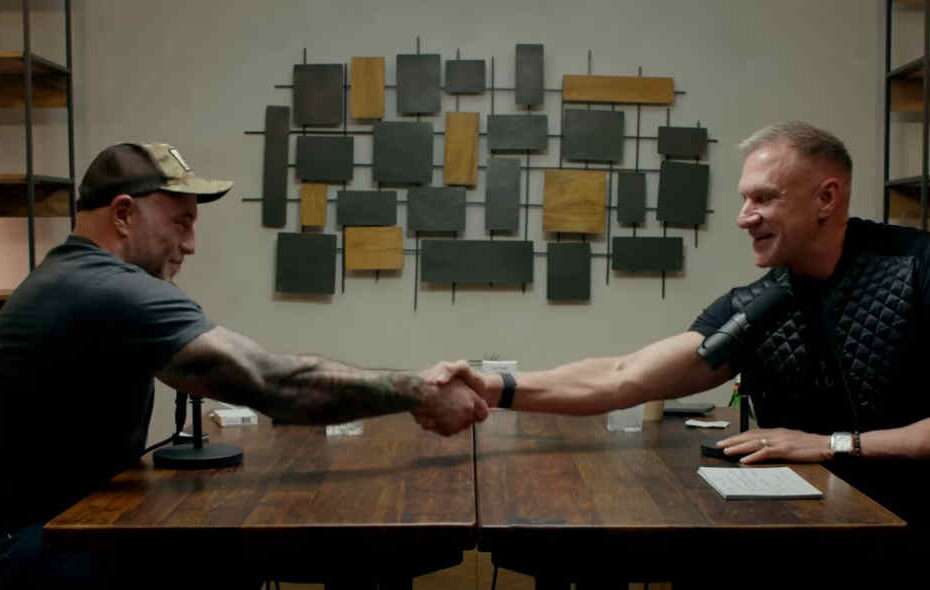
Read the full transcript of podcaster Joe Rogan’s interview on The Ultimate Human Podcast with host Gary Brecka on “Trump Interview, Media Manipulation, UFC Journey, & DeExtinction”, Premiered on July 15, 2025.
Welcome to The Ultimate Human Podcast
GARY BRECKA: Hey, guys, welcome back to the Ultimate Human Podcast. I’m your host, human biologist Gary Brecka, where we go down the road of everything anti-aging, biohacking, longevity, and everything in between. And today’s podcast is definitely going to be in between.
Welcoming a UFC commentator, a fighter, a podcaster, a very accomplished comedian, and just an all around incredible human. Welcome to the podcast, Rogan, brother.
JOE ROGAN: Pleasure being here. Thank you.
GARY BRECKA: Been a long time in the making, man. I’m so pumped to sit down with you today, man.
JOE ROGAN: My pleasure. Thank you for having me.
Austin’s Wellness Revolution
GARY BRECKA: You know, in Austin, Texas, there’s a real wellness vibe here.
JOE ROGAN: Yeah, there certainly is.
GARY BRECKA: I wouldn’t have thought 10 years ago that Austin, Texas, would be the home of wellness. I mean, it’s the comedy mothership. There’s a real wellness vibe here. There’s so many restaurants that are seed oil free and glyphosate free, and I think they’ve caught the bug here.
JOE ROGAN: It’s a healthy city. You know, it’s been a healthy city for a long time. If you go to Lady Bird Lake, there’s always people running and it’s a really healthy place. And there’s, you know, we started on it here way back in 2010, so there’s always been fitness. It’s a really big jujitsu city too, now.
GARY BRECKA: Yeah, but you didn’t come until the pandemic.
JOE ROGAN: Right. I moved here in 2020, in August.
Escaping LA During the Pandemic
GARY BRECKA: Of 2020, which seems even odd to me too, because that’s height of your comedy career. And I would think, you know, being a comedian, that vibe seems like New York, Louisiana.
JOE ROGAN: Well, they had shut LA down. That was one of the easiest, actually, motivations to move here. They’d shut LA down during the pandemic. And first it was supposed to be two weeks, and then by May, you know, so we’re talking March, April, May – by March, everything shut down. By May, I was already looking to move.
GARY BRECKA: You were? Yeah.
JOE ROGAN: I was like, “These assholes are never going to let this go.”
GARY BRECKA: And they locked down hard.
JOE ROGAN: They wouldn’t even let people do outside shows. They wouldn’t let us do outside shows. In the parking lot of the Comedy Store, they tried to set up a show outside. It didn’t make any sense.
GARY BRECKA: Wow.
JOE ROGAN: It wasn’t logical, it wasn’t reasonable. And the people that were running the government, it was the first time I ever said, “Oh, it’s important who your mayor is.” I used to think, “Who gives a shit who the mayor is?”
GARY BRECKA: Yeah. I never cared. Yeah.
JOE ROGAN: I never even voted for mayor.
GARY BRECKA: The pendulum swung way too far. I mean, now you look at the wildfires and just all the nonsense that’s happened out there, it’s an abject failure.
JOE ROGAN: Pure madness in LA. And they’re not going to course change. They’re not going to course correct. They’re going to ride that thing right into the rocks.
GARY BRECKA: And you just wonder how they’re going to pull out of that, because we were out there week before last, and I drove through The Palisades. And it doesn’t seem like they’ve even touched it. There’s nothing.
JOE ROGAN: No, they’ve done very little so far.
GARY BRECKA: It looks like a third world country out there.
JOE ROGAN: Yeah.
The Move to Austin: Family First
GARY BRECKA: So you move here during the pandemic, and was this because of your comedy career? Because you just were like, “Hey, I need…”
JOE ROGAN: Well, it was a lot of factors. My kids were – the youngest kids were 10 and 12 at the time, and I didn’t want them growing up in LA already. And it was an opportunity to get out of LA, which I’d been… I tried to get out of LA in 2009 when my middle daughter, when she was one, I moved to Colorado for a little bit, but we were in the mountains way above Boulder, and it’s really high altitude, and my wife got pregnant while we’re up there, and then it’s really rough on pregnant women to be 8,500 feet above sea level.
So we had to bail on that. And then when I went back to LA. But I always had it in my mind that I was going to escape.
GARY BRECKA: You’re going to get out of the taxes and the nonsense.
JOE ROGAN: Well, the taxes are one thing, but I would be happy with paying taxes if it made sense, if you guys were doing a great job and if there wasn’t tents on every street corner. It was just so crazy.
Boston Roots and the Mafia Era
GARY BRECKA: So you know, for my audience, I want to rewind the clock a little bit. I mean, of course, I think the whole world knows you as a podcast host, and obviously they’re familiar with your comedy career and your career at the UFC. So I want to take you back to the early 80s in Boston. And, you know, Dana and a lot of people call this the Mafia era. Right. And I know you weren’t in the…
JOE ROGAN: Mafia, but I actually trained the guy who was a hitman.
GARY BRECKA: Really? Okay.
JOE ROGAN: So, yeah, when I was in Taekwondo, one of the hitmen for Whitey Bulger.
GARY BRECKA: That’s one of the reasons why Dana had to leave that.
JOE ROGAN: Yeah.
GARY BRECKA: Which is so crazy because, you know, you guys came from the same place and your worlds didn’t collide for years later.
JOE ROGAN: Right.
GARY BRECKA: But I find it really interesting that you guys are so close now and your careers are intertwined, and you guys have been really loyal to each other, but you both came from this mafia area, early Boston, 80s.
But you know, my father is a salty old Navy captain, has a definition of life. And he says life is what happens to you when you’re on your way to doing something else. And as I was looking through your background, I feel like that’s a really good explanation of what happened to you. You started this martial arts career, Taekwondo. Right. And you actually became a taekwondo champion. I think you won the Massachusetts… What state?
Martial Arts Champion
JOE ROGAN: Yeah, I won that four years in a row. I won one of the American opening championships. I came in second in the US cup in the year that it was the Olympics. So the guy who I… It was a bad decision. I thought I should have won, but he went on to be the national champion and fight the Olympics.
GARY BRECKA: Wow. And this was Taekwondo. And it’s your early martial arts.
JOE ROGAN: That was the first thing. And that was also part of the problem, is once I started kickboxing, I realized, Taekwondo is kind of silly.
GARY BRECKA: Yeah.
JOE ROGAN: And then I started doing Muay Thai, and then I realized, “Oh, that’s even silly to not have leg kicks.” Leg kicks are even more important. Then I started doing jiu jitsu. I’m like, “Oh, my God, it’s all silly.” Because as soon as someone grabs you, you’re doomed.
The Birth of Modern MMA
GARY BRECKA: What was the inspiration for that? I mean, early UFC, Royce Gracie.
JOE ROGAN: This was before the early UFC. So I was fighting. My last fight, I think was 89. Professional fight, or it was amateur. I never fought professionally. But then UFC didn’t come along until 93. And, you know, I was already doing standup comedy. And I was at the time, I was just moving to LA, and then I’d watched a videotape of the UFC. I became obsessed. I found UFC 2. It came out on VHS, dude.
GARY BRECKA: That’s when you could just kick in the face when people are down on all fours. I remember. I actually remember very vividly somebody’s tooth just literally flying out of the ring, going over the octagon. And I remember Royce Gracie’s fights going on for almost 30 minutes. Yeah, that’s as he was after some of those fights.
JOE ROGAN: I think he had a 90 minute one in Pride.
GARY BRECKA: Same, no time limit, no rules.
JOE ROGAN: Yeah, it was a wild time, you know, where they were trying to sort out. So when I was a kid, there was all these different arguments about what was the best martial art. You know, the Judo guys would tell you, “Judo’s the best.” Boxers would tell you, “That’s the best.” No one really knew until the UFC came along. It was all just theory.
GARY BRECKA: Yeah.
JOE ROGAN: And then once Rorion Gracie decided to put together this cage and have… And, you know, in the beginning, he wanted to have a moat around it and have crocodiles.
GARY BRECKA: No. Really run into really medieval shit.
JOE ROGAN: He wanted to make it just completely ridiculous, obviously, for marketing. Super Gladiator. Yeah. They had some really wild ideas, but until that first UFC came along, no one really knew what was effective. The Gracies knew more than anybody because they had a bunch of challenge fights that they did in Brazil, and they did Vale Tudo events. You know, Rickson had some pretty big fights in Brazil where their big audiences.
GARY BRECKA: And were those fights where they could use Muay Thai or any…
JOE ROGAN: They could use anything.
GARY BRECKA: Anything they want.
JOE ROGAN: Bare knuckle, you know? Yeah.
The Early UFC Days
GARY BRECKA: I remember at one time when I was younger, I remember Royce made a statement. He said, “I’m not afraid of any man. I’ll fight any man.” And I saw him. There was the Hawaiian dude that had the ponytail. Kimo.
JOE ROGAN: Yeah.
GARY BRECKA: Who just looked like an absolute wrecking ball.
JOE ROGAN: It was huge. He was 260 pounds. And the Royce was 175 at the time.
GARY BRECKA: Yeah, I mean, I still remember those. He was on his back and in the guard, grabbing his…
JOE ROGAN: Grab this.
GARY BRECKA: Yeah, you could grab it back then. You can’t do it in the UFC now.
JOE ROGAN: You can punch in the balls. It was crazy.
GARY BRECKA: Yeah. You could kick in the face on the ground. So this brutal sport’s emerging, and, you know, you’re working your way through your martial arts career, but at some point, I think you knew because of your upbringing, you didn’t want to be in the construction business. Your dad was an architect.
JOE ROGAN: Right.
GARY BRECKA: And you sort of grew up before you got into martial arts on construction sites.
JOE ROGAN: Yeah.
Blue Collar Beginnings
GARY BRECKA: And I had a similar upbringing. I actually grew up on a tobacco farm. My parents, when I was young, and I hated it, and now all I want to do is get back. So they bought 12 acres in the middle of this 300 acre tobacco farm, and then they leased the land back to a farmer for a dollar, and he grew tobacco. So my whole life growing up until I went off to college, I was cutting tobacco.
JOE ROGAN: Where was this?
GARY BRECKA: This is in Southern Maryland. Upper Marlborough. Right outside of PG County. Yeah. Most people don’t realize it’s a big tobacco country there.
JOE ROGAN: No idea.
GARY BRECKA: And it’s… If you’ve never seen tobacco get cut, it’s the hardest manual labor you’ll ever do. It’s absolutely brutal.
JOE ROGAN: Really? Why is it so brutal?
GARY BRECKA: Because you cut tobacco in August by hand. So imagine a field as far as you can see, just rows and rows of these six foot tall tobacco plants. Five of these plants weigh about 60 pounds. And you got to push the plant over and cut it with a machete. Push it over, cut it with a machete, push it over, cut it with a machete.
And you walk from one end of this field to the other end of the field and you turn around and come back. It’s just brutally monotonous. And it’s hot. And the gum gets… You have to shave your arms. You have to wear long sleeves so that tobacco juice doesn’t get on you.
The Nicotine Discovery and High School Memories
JOE ROGAN: Oh, wow. Do you get a nicotine high from like your skin?
GARY BRECKA: You know, I don’t think so. I never chewed tobacco or dip tobacco like all my buddies like dip tobacco. And now that I know it was in that with the glass and everything to cut your lips, it’s like.
JOE ROGAN: Oh, yeah, like skull. Yeah.
GARY BRECKA: It’s like when I went back to my 30 year high school reunion, I felt like I was on a different planet. I was like, “man, these people look like aliens. I’m so glad I found biohacking.”
You know, I remember there’s one kid, if you’re still alive, Ike, I hope you’re watching. His name was Ike Moreland and he owned. I don’t even know why I’m going down this road, but I just had a childhood memory come back and I saw him at my high school reunion and I’m like, “this kid beat me up in the eighth grade.”
I remember you telling the story about being put in a headlock. I think it was in high school and somebody wrenched you to the ground and he pulled back to punch you in the face. And for some reason he actually decided not to hit you.
JOE ROGAN: Yeah, he felt sorry for me. He decided not to beat me up.
GARY BRECKA: But at that moment you realized, “I’m so fricking helpless. I got to do something about this.”
JOE ROGAN: That’s when I started wrestling.
GARY BRECKA: Yeah.
JOE ROGAN: Yeah.
GARY BRECKA: So I wanted to run it again at 50 years old with Ike Moreland. But no, I’m like, I held onto that. Great. I was 14, dude. I’m coming back for payback. But I just, I very much identify with not wanting to do the structured kind of labor as a long term career.
Finding an Unconventional Path
JOE ROGAN: Well, I also did want to have an office job. I was really in a bind. And that was a real dilemma for me when I was young because I was like, “what am I going to do with my life?” I had to find something unconventional. I had just too much energy to sit down, which I didn’t know at the time that’s a good thing. Like, I just needed to find something else.
But no one would ever guide you saying, “oh, you should be a comedian or you should be something else.”
GARY BRECKA: Yeah.
JOE ROGAN: You know, it was always like, you have one path and that is to get a job. Yeah. And Boston was a very blue collar town. It was a very hard working town. And they really respected if you worked hard.
GARY BRECKA: Yeah.
JOE ROGAN: And if you didn’t, you were lazy, you were shunned, you know, and that’s just.
GARY BRECKA: Yeah. Not a lot of role models that had broken out of the Matrix.
JOE ROGAN: Like, you know, none going to no.
GARY BRECKA: To look up to.
JOE ROGAN: No. They looked at you like you were an alien. Like, “what are you trying to do?” It is like teaching martial arts at least was kind of respectable, kind of made sense.
GARY BRECKA: Yeah.
JOE ROGAN: Like, “oh, I get he’s teaching martial arts.” So that’s what I did for until I was 21. And then when I started doing stand up comedy, I realized, like, “I’ve got to pick a path I can’t be doing. I can’t have one foot in each world.”
GARY BRECKA: Right.
JOE ROGAN: And you know, what was your.
GARY BRECKA: It was your, it was the buddies that you were actually doing martial arts with that pushed you to do comedy. Yeah, right.
JOE ROGAN: Yeah, I was the guys that I was.
GARY BRECKA: Because you were the funny guy in the locker room before fights, like trying to take the test.
JOE ROGAN: We would go to tournaments and everybody would be so scared. It was like, there was so much anxiety and, you know, fear in the air that I would have to cut the night. I would have to cut it. You know, I’d be the guy that would be cracking everybody up, try to break the tension.
GARY BRECKA: But I think there’s a big difference between chopping it up with your boys and walking on stage in front of an audience.
JOE ROGAN: Yeah, that’s what I thought too. Yeah, that was my thought. Like, “you guys think I’m funny because you’re all a bunch of psychopaths.” Yeah.
The First Stand-Up Experience
GARY BRECKA: Was it like a sobering moment, going up on that stage for the first time and going, “shit, I got to, I got to say, I got to say something.”
JOE ROGAN: Well, I thought about it for a long time because I waited until I was 21 to get into a bar because, you know, that was the age that you could get into a bar. So I didn’t think I could do. They actually let some people in before they’re 21. You just have to get, like, an exemption from the club. They have to make sure that you don’t drink. But I didn’t know that.
So I had about six months where I was contemplating it, where I wrote material down and, you know, and tried it out on my friends and thought about doing it, and they’re all like, “what are you doing?” Like, everybody was like, “what are you doing?”
And then open mic night. I was probably more scared going on stage the first time than anything I’d ever done, including fighting. And I remember thinking, “boy, this doesn’t make any sense.” Like, I’d probably fought a hundred times by then. And I was like, “this is so weird that I’m.” Because from the time I was 15 till I was 21, all I did was compete. I traveled all over the country. I fought almost every weekend or every other weekend, once a month for sure. I was always competing. And you fight multiple times in a day.
GARY BRECKA: Wow.
JOE ROGAN: And I wasn’t scared of that. Like, I was scared of that, but not like I was a stand up, stand up. I was fucking petrified.
GARY BRECKA: Yeah. And it didn’t go well. Like, the first one.
JOE ROGAN: That’s, like, even.
GARY BRECKA: Reinforces the fear, but nobody was doing well.
JOE ROGAN: That was the other thing. It was like, everybody bombs on open mic night. Which is the good thing, because he realized, like, “as bad as you are, like, at least I’m not as bad as that guy.”
GARY BRECKA: Yeah, yeah. He really bunk.
JOE ROGAN: It’s like you’re just trying to get a couple chuckles, you know, and then if you got. If I got. I got a couple chuckles, and I was like, “I think I can do this.” And then the second time I went on stage, I actually got laughs because I was more comfortable, I was less scared, and I was more loose. And then I bombed the third time. And then, you know, it takes a while. You have to figure it out.
The Move to LA and Development Deals
GARY BRECKA: Yeah. Because this is. I mean, the big move to LA was for comedy.
JOE ROGAN: Well, I only moved to LA because I got a development deal. I was living in New York at the time, and I was doing standup and I got on something called the MTV Half hour Comedy Hour. And you do like 10 minutes or something like that. There was a bunch of comedians and it went really well. And I got a development deal, which is some weird thing where they give you a pile of money. Like, for the first time in my life, I think it was $150,000.
GARY BRECKA: Wow.
JOE ROGAN: I had like, “this is crazy. I have money.” And. And then they wanted me to do a sitcom for this development deal. So. Okay. So then I came out to LA, I did this sitcom, and I didn’t even like doing it.
GARY BRECKA: I hated it.
JOE ROGAN: And I wanted to go back to New York, but I had got a lease on an apartment. So I’m like, “well, I got to stay out here a year.” And then after that show got canceled, I was still there because of my lease. And then I got another development deal to do this thing at NBC. And that turned out to be how I got news radio.
So that was with Bill Hartman, Andy Dick, and all those super talented people. And I did that for five years. And then Fear Factor, it’s just like all the while still doing Stand up at the Comedy Store. And. But it was. I didn’t come out to LA for anything other than money. It was just. I couldn’t believe that you could get $25,000 for a week of work. I’m like, “this is crazy.”
Fear Factor: The Unexpected Hit
GARY BRECKA: Yeah, this is crazy. And so when you’re out there, you. I remember you talking about Fear Factor as being like, something you thought would never take off.
JOE ROGAN: Yeah, I did it because you’re like.
GARY BRECKA: This is the most ridiculous thing I’ve ever heard.
JOE ROGAN: I’m like, “we’re going to stick dogs on people and make them eat dicks.” Yeah, I’m in all I was thinking, like, “this is going to be great material. I’m going to have some great material out of this.” I love the show.
GARY BRECKA: What finally blew it up, they did some stunt that was, like, inappropriate, but I forget what it was.
JOE ROGAN: Well, that was the second time we did it. So we did it for six years. So we did 148 episodes for six years. Then we came back again. I think it was 2011, because my youngest daughter was one at the time. And that was six episodes. And then they. They made them drink Donkey Kong. They had to play horseshoes to see how much donkey come. You had a drink.
And there’s only been two times when I did that show where I told the producers, “hey, man, you can’t do this.”
GARY BRECKA: This is like.
JOE ROGAN: And that was one of them.
GARY BRECKA: Yeah. I mean, first of all, the first thing that comes to mind, obviously, is how do you get donkey gum?
JOE ROGAN: Yeah. Well, you actually use a cattle prod and you. You stick it.
GARY BRECKA: Oh, you don’t.
JOE ROGAN: The donkey’s butt. And then we. You shock their prostate and they just bust. And then you collect it, and then you get some poor kid who’s got credit card debt. And that kid is on Fear Factor to try to pay off his credit card debt generally.
GARY BRECKA: Dude, I got. I want to be like. I want to be a fly on the room. I mean, on the wall in the. In the producer’s room.
JOE ROGAN: It was a fun room.
GARY BRECKA: I got. I got a great idea, guys.
JOE ROGAN: Yeah. Okay.
GARY BRECKA: We’re going to take a cattle prod. Well, up a donkey.
JOE ROGAN: The second time we did it, we’re going to. So we stopped doing it in 2007, and it didn’t even really get canceled. I mean, I guess it got canceled because they never did it again, but it would just. They just stopped doing it. We did so many of them was just. Everyone was worn out. Like I said, we did 148 episodes in six years, and then they waited, like, five years.
And then I get this phone call. “Do you want to do Fear Factor again?” I was like, “oh, my God, are you guys serious?” And then I went in to meet with them. “It’s going to be bigger than ever and this and that, and only you can host it.” And. And, you know, my kids were young at the time. I was like, “I probably could use this money. All right, let’s do it.”
And again, I was like. This time I was right. I was like, “this. This is not going to last.” And I was correct that time because they were going way too far the second time because they were trying to make it bigger and crazier than ever. I’m like, “someone’s going to get hurt.” Luckily, no one really did.
But the other time that I said, “don’t do it,” other than the donkey jizz, was they had a ride bulls. When they had to ride bulls, I was like, “don’t do this.”
GARY BRECKA: Yeah, yeah. Somebody’s going to really get her.
JOE ROGAN: This is so funny.
GARY BRECKA: Did they do that episode?
JOE ROGAN: Yeah, they did that episode.
GARY BRECKA: Really?
JOE ROGAN: We just got lucky that no one got hurt.
GARY BRECKA: Yeah, I mean, that you can get really jacked up.
JOE ROGAN: These are real bulls, too, man.
GARY BRECKA: And nobody knew what they were doing riding a bull.
JOE ROGAN: They say, “hold on.” Okay. Like, that was the height of reality TV. And, you know.
GARY BRECKA: Yeah, it was the genesis of it, really.
The Birth of Reality TV and UFC Commentary
JOE ROGAN: So Survivor was the big one. Survivor happened first, and everybody was all into these reality shows. And there was a show called “Now or Neverland” that was in Holland, and NBC purchased that. Or Endemol purchased that show and then brought it to America and changed the name to Fear Factor.
GARY BRECKA: Wow. So what time does the early commentating for the UFC?
JOE ROGAN: 1997. I started, yeah, before Fear Factor, while I was on NewsRadio. Campbell McLaren, who was one of the producers of the UFC was good friends with my manager, Jeff, and they were just having a conversation about how they needed a new post fight interviewer because they got rid of the guy they had. And Jeff was like, “Joe loves UFC.”
And I was like, first I was, you know, I watched it. You couldn’t even get it on cable TV. It was banned from cable, so you had to get DirecTV to get it. Because they, like Budweiser and John McCain, they were doing some shady shit to ban it. They were “human cockfighting.” And they contacted me and said, “We need someone to be a post fight interview.” And I’m like, “Fuck, yeah, let’s do it.”
GARY BRECKA: Let’s do it.
JOE ROGAN: And then I went to Dothan, Alabama. We were supposed to do it in, I think was Albany, New York. Albany or Buffalo.
GARY BRECKA: Because it wasn’t sanctioned. Right? I mean, obviously.
JOE ROGAN: No, it was also. It was. New York State banned it, like, right before we did it. So we got sent down. They had a backup plan. The backup plan was Alabama. So we went to this place in Dothan, Alabama, that was UFC 12.
GARY BRECKA: Oh, my God.
Early UFC Days and Financial Struggles
JOE ROGAN: 1997. And I did that for about two years, but it was actually. At the time, it was actually costing me money because I would do the UFC and I couldn’t do comedy that weekend, so I was making more money doing comedy. But I really loved doing it. But I was like, “This is not going anywhere.” And it wasn’t getting anywhere as far as cable. Like, they were really banned.
GARY BRECKA: Yeah.
JOE ROGAN: And then what happened was the Fertitta brothers and Dana came along and purchased it in 2001.
GARY BRECKA: And what UFC was that?
JOE ROGAN: Well, I came back. UFC 37 and a half was the first time I did commentary. Before that, I was just doing post fight interviews. And what happened was that was 2001, and it was. They were on Fox Sports for the first time. It was like “The Best Damn Sports Show Period.” Remember that show?
GARY BRECKA: Yeah, yeah, I remember that.
JOE ROGAN: They had an episode that they did where they did the UFC on Fox, and it was like a big thing to have it on Fox Sports.
GARY BRECKA: Yeah, but it was sanctioned then.
JOE ROGAN: It was sanctioned in Vegas. Yeah. Okay, so what happened was, you know, the Fertittas were very wealthy, and one of the things my friend Eddie Bravo and I, we’d always said was, you know, what the sport needs, like we love the sport with a sport needs, is someone to come along that has a ton of money, that just can throw a bunch of money at it and then show the world how great it is. And then it’ll just become successful.
And that’s what happened. Like the Fertittas came along, these billionaire guys who love the sport and training in the sport, and Dana and they just came along and put it together. And Dana and I became friends because he was, you know, like inviting celebrities to come. And this is when I was hosting Fear Factor and it was the number one show in the world.
And he was like, “Why don’t you come and see the fights?” I’d be like, “I’d love to.” When they have them in Vegas. Then he and I would get together and I’d go, “What about this fight? Do you know about this guy? Have you ever watched these guys fight in Japan? Do you know about Pride? Do you know about Fedor Emelianenko? Have you ever seen all these.” And I was like naming all these different fighters and he saw. He found a tape somewhere of me on the Keenan Ivory Wayans show making fun of like Steven Seagal or something like that and talking about the UFC.
GARY BRECKA: Yeah.
JOE ROGAN: And then he goes, “Would you. Will you do commentary?” And I’m like, “I don’t want to work, man.” I go, “I just want to come and watch the fights.” Honestly, I don’t. Because I was like, I had already done that before. Yeah, it was too much of a pain.
GARY BRECKA: And it wasn’t getting the one in your pockets either.
JOE ROGAN: Yeah, it was.
Working for Free and the Ultimate Fighter Breakthrough
JOE ROGAN: So I did. I did it for what? Just for Dana. Because we’re friends, and then I want to still do. I kept doing them and I did like the first, like 13 or 14 of my did for free after they bought it. Yeah. I just. I said, “Okay, let’s just get, get, get me plane flights and get my friends tickets and I’ll do it.”
GARY BRECKA: Yeah.
JOE ROGAN: And so I did a bunch of. Because they were hemorrhaging money. Yeah. And, you know, I was friends with Dana. He was telling me how much money they were losing. I’m like, “Oh, Jesus.” So by the time the UFC took off in 2005, they were in the hole. So I’ve been working for them for four years. At the time, they were in the hole $40 million.
GARY BRECKA: Wow.
JOE ROGAN: Yeah. And this was this one thing where they did The Ultimate Fighter. They go, “Look, we’re going to put together a reality show.” They couldn’t get it aired. They had to pay for all the sponsors. They had a. They had a bankroll the entire show. And they said, “This is it. This is the. We’re going to get one shot, and if this doesn’t work, we’re fucked up.” Yeah, it worked. And Forrest Griffin versus Stephan Bonnar.
GARY BRECKA: I remember that fight.
JOE ROGAN: It was so crazy that the whole world started tuning in.
GARY BRECKA: I remember he gave him both contracts at the end.
JOE ROGAN: Yeah, I remember it was such a close fight. It was a perfect fight to introduce people to the UFC. And then next thing you know, it became huge.
From Part-Time Fighters to Global Phenomenon
GARY BRECKA: Yeah. And, you know, back then, it was like nobody was a full time UFC fighter. They’re like, it’s Rich Franklin, a history teacher from.
JOE ROGAN: He’s a math teacher or math teacher. And you’re like, “What?”
GARY BRECKA: And this guy was a cop, a firefighter. This guy was. Yeah.
JOE ROGAN: There was no full time fighters at the time. Well, there’s probably a few that figured it out. I think Frank Shamrock was full time. There’s a few guys that were like, legitimately full time, but it was a hard way to make a living. And, you know, it was like “human cockfighting.” Nobody respected. It was like, you know, when I would tell my friends when I was working on NewsRadio, and I would tell my friends that I was going to do these UFC events, like, “What? Why are you doing that? Like, you shouldn’t be associated with that.” It was.
GARY BRECKA: Yeah.
JOE ROGAN: Almost like you’re doing snuff films or something.
GARY BRECKA: Yeah, yeah, exactly.
JOE ROGAN: Connecting yourself to something so shady, and.
GARY BRECKA: Then it just became the fastest growing sport in the world. I think it’s still.
JOE ROGAN: Is probably. It’s. Well, it’s absolutely huge.
GARY BRECKA: I read something about the opening in Asia and that it returned it to the fastest growing sport in the world.
JOE ROGAN: So that was 20 years ago. So 20 years ago it popped.
GARY BRECKA: Wow.
JOE ROGAN: Yeah.
GARY BRECKA: And then you just never stopped.
JOE ROGAN: No.
Loyalty and Dana White’s Leadership
GARY BRECKA: And, you know, there’s rumors that, you know, you and Dana have been so loyal to each other that your contract in the UFC was if one goes, you both go.
JOE ROGAN: That’s mine.
GARY BRECKA: Yeah.
JOE ROGAN: Yeah. If they get rid of him. Yeah, I’m gone.
GARY BRECKA: Wow. That’s. You know, I find Dana to be one of the most loyal human beings in the world. He’s done a lot for me.
JOE ROGAN: He’s an awesome dude. I love him to death.
GARY BRECKA: I love.
JOE ROGAN: He’s just a great guy and the perfect guy to be at the head of such a chaotic sport because the sport is so crazy. It’s like you need a maniac at.
GARY BRECKA: The helm, and you also need somebody whose compass doesn’t shift. I mean, you see all these reporters try to knock him off track all the time, and he just puts them right back in check.
JOE ROGAN: Well, he doesn’t give a fuck. He really doesn’t. He has real “fuck you money.” And I’ve always said, if you have “fuck you money,” you don’t say “fuck you.” You’re wasting all that “fuck you money,” you know, because it’s the only reason to have it is to be able to do whatever you actually want. And the guy loves fights. He and I will have conversations where I’ll come up, like, one o’clock in the morning and we’ll have, like, a fight talk for, like, two hours.
GARY BRECKA: Really?
JOE ROGAN: Yeah. All the time.
GARY BRECKA: Yeah. He actually just loves it.
JOE ROGAN: Yeah. Loves it.
GARY BRECKA: And he knows the sport.
JOE ROGAN: He loves it. Yeah. But he only watches the UFC, so I’m always telling him about all these guys that are fighting in Japan this guy’s fighting in Russia. “Pay attention to this guy.”
The Pride Fighting Championships Era
GARY BRECKA: And was that a big part of what helped build the UFC? Because you started grabbing people from, like, Pride leagues and.
JOE ROGAN: Well, they purchased Pride. That was the big thing, is the UFC came along and purchased Pride, but they got screwed because, really, they just bought a tape library. You know, they thought they were buying all the fighters, the contracts, but all the contracts were invalid. So then they had to, like, restructure.
GARY BRECKA: Oh, my God.
JOE ROGAN: So that’s why they never got Fedor.
GARY BRECKA: Yeah.
JOE ROGAN: But, you know, they put out an amazing product, and Japan was putting on them. Like, when they were doing Pride, Japan had 80,000 people showing up at these arenas when the UFC was in relative obscurity. It was massive in Japan. I mean, absolutely massive.
GARY BRECKA: The Pride fight.
JOE ROGAN: Yeah. And to this day, they’re some of the greatest fights of all time. You go watch the glory days of MMA and Pride and this. Not only did they have, like, soccer kicks and stomps on the ground, they also had no steroid testing at all. So everybody was sauce to the gills. Yeah. And they looked it. It was a great product.
Early UFC Characters and Fighters
GARY BRECKA: Who is the big Hawaiian that just had that crazy overhand? Can’t think of his name. He looks like the dude that’s in Slap. I can’t think of his name, but I just remember he had these insane. There’s so many crazy characters that came out of that. Like Tank Abbott and all these just crazy bigger than life characters. I mean, there was this one Greco Roman wrestler with the mustache that used to just.
JOE ROGAN: Oh, yeah, Dan Severin.
GARY BRECKA: Yeah, Dan. I mean, he looked like he was 50 years old.
JOE ROGAN: Fought into his 50s.
GARY BRECKA: That’s what I mean. He’s like the scariest dad ever. Had this big, bushy hair and he had this handlebar mustache. And he was kind of super stoic, like Fedor Emiliankov, you know, he just kind of looked like he was bored to be there.
JOE ROGAN: Don Fry, he had another great mustache. He was another one. I remember Don Fry fought in Pride as well. He had some amazing fights in Pride.
GARY BRECKA: And then that Greco Roman wrestling stuff was wild. The pickup and the reverse body slams, and he was just picking up.
JOE ROGAN: Yeah. Greco was a particularly good wrestling style for MMA because there was a lot of clinch based work. And when you’re up against the cage, a guy who’s really good at upper body clinches and controlling up, like Randy Couture, he was a Greco guy as well.
GARY BRECKA: Amazing.
JOE ROGAN: Yeah. So was Dan Henderson. Was Greco like a lot of these guys? I mean, they all had a background in everything. They could do all kinds of wrestling.
Memorable UFC Moments
GARY BRECKA: But, yeah, Randy fought pretty late, too. He was in the late 40s. I actually remember his tooth flying out of the ring, too.
JOE ROGAN: Yes.
GARY BRECKA: Who was the Machida?
JOE ROGAN: He caught him with a jumping front kick.
GARY BRECKA: Front kick. I’ll never forget that.
JOE ROGAN: I think that was in Israel. Yeah.
GARY BRECKA: Mouthpiece.
JOE ROGAN: That was the. It was in Toronto, maybe. Was in Toronto. There was an enormous event we did that was like 60,000 people up there.
GARY BRECKA: Yeah.
JOE ROGAN: Pretty sure it was Toronto.
GARY BRECKA: And you think images like that helped it or hurt it? I think it’s kind of like slap. You can’t turn away.
Slap Fighting Discussion
JOE ROGAN: Well, it’s just brought other than. Except it was a fight where slapped me. Slaps. Not my thing.
GARY BRECKA: No.
JOE ROGAN: But the. Just standing there letting a guy smack in the face is.
GARY BRECKA: Oh, you hold a foam roller behind your back.
JOE ROGAN: I will watch it. Yeah, I’ll watch it. But it’s. I really prefer actual fights, you know, and if you.
GARY BRECKA: If you flinch, don’t you get slapped again, do you. I think you get. I think you get slapped again if you flinch.
JOE ROGAN: Why do they put the powder in their hand?
GARY BRECKA: I think you’re supposed to see the whole handprint so you’re not just hit, palm striking or heel striking. There are some rules, like, oh, feet have to stay on the ground. They have drug tests, which to me is hilarious.
JOE ROGAN: Drug those people up.
GARY BRECKA: Yeah.
JOE ROGAN: Why are they sober?
GARY BRECKA: Yeah.
JOE ROGAN: You’re getting slapped. You should be on meth.
GARY BRECKA: I think first of all, that’s not a coin toss. You want to lose. Because I would always want to go first, 100%.
JOE ROGAN: It doesn’t make any sense. That’s part of the strategy, part of the problem. It’s like you have to really get a coin tossing.
GARY BRECKA: My kids, Cole Dylan used to play this game when they were growing up, and it was something like if I went to hit you and you flinched, I got a free punch. Kind of slaps, kind of like that.
JOE ROGAN: Yeah. A lot of kids did that when I was young. Yeah. Two for flinching.
GARY BRECKA: Yeah, two for flinching. That’s what it was like. They draw back, and if you flinch, they got two shots. And now they made a sport out of it, which I guess is perfect for social media because it’s like. It is the viral clips perfect sport for TikTok.
JOE ROGAN: I say sport with air quotes.
GARY BRECKA: Yeah. And then the chicks doing it, too, just freaks me out.
JOE ROGAN: Yeah.
GARY BRECKA: Now I actually read some science on brain damage. Well, a lot of science on brain damage, but there literally some science to having a beard. Do you know that there is air? It’s like cushioning. It’s like, you know, this friction coefficient and slightly decelerating blow.
JOE ROGAN: If Alex Pereira punches you in your beard, it doesn’t matter what your beard looks like.
GARY BRECKA: But I’d have a big old Santa Claus beard if I was going in there. There’s a big Hawaiian heavyweight that has that big old beard.
JOE ROGAN: Yeah. Did you see Josh Emmett fought this past weekend? He has an enormous beard, like, big, crazy one.
GARY BRECKA: How’d he do? He lost. Okay. There goes the beer. Theory of.
JOE ROGAN: It was a good fight.
GARY BRECKA: Theory of fighting is now out the window.
The Early Days of Podcasting
GARY BRECKA: Yeah, there’s. I mean, there has been some crazy beard. So now you’re doing commentary for the UFC, and at some point, you decided to get into the podcast world. And what I found really fascinating was, you know, initial podcast, I think you guys had, like, 200 listeners, maybe. And I went back and watched an old podcast with Eddie Bravo, and you’re pretty rusty. Back then, I was like, what’s good.
JOE ROGAN: For anybody who’s intimidated by podcasting, go back, watch my early ones. They’re terrible.
GARY BRECKA: Yeah.
JOE ROGAN: It’s like anything else. You do it, you get better at it.
GARY BRECKA: Yeah. I mean, but what made you stick with that versus sticking with comedy? Sticking with.
JOE ROGAN: I enjoyed it.
GARY BRECKA: What made you, because the point I’m trying to get to is, you embrace the suck.
JOE ROGAN: Yeah.
GARY BRECKA: You know, I mean, it didn’t suck, though.
JOE ROGAN: I enjoyed it. I just thought it would be fun to have a little Internet radio show and talk to my friends. It was not a career move by any stretch of the imagination. It was just fun. I always loved doing the Opie and Anthony show and Howard Stern show. I love doing radio shows. It’s fun to be able to hang out with other comedians and talk shit and joke around.
GARY BRECKA: Yeah.
JOE ROGAN: So I decided to start doing it online. You know, I’d been on Tom Green, had his little Internet show that he did from his living room. I was like, this is fascinating. You got to figure this could be the future.
GARY BRECKA: Yeah.
JOE ROGAN: But I didn’t really think of it as a career move. I just did it for fun. And then slowly but surely, it started getting bigger. It was just a matter of just the process.
Long-Form Content and Growth
GARY BRECKA: I think you were one of the early movers to start putting long form content on YouTube. That was a strange thing to think that people would go to YouTube and watch a 45 minute video. Yeah, you know, well, there’s three hours. Yeah, three hours. Even, even, even. I mean, that’s long.
JOE ROGAN: But that’s just because I didn’t care. My friend Ari, one of my best friends, Ari Shapir, he was like, “You got to edit your show.” I go, “Why?” He’s like, “No one’s going to listen to three hours.” I go, “Then they don’t have to listen.”
GARY BRECKA: Yeah, don’t listen. Yeah.
JOE ROGAN: He’s like, “It’d be better if it was like an hour, less than an hour, like 45 minutes.” I was like, “Why?” I go, “I’ll listen to a three hour show.” Yeah, if it’s interesting.
GARY BRECKA: And then people started listening.
JOE ROGAN: So I just didn’t listen.
GARY BRECKA: And then it started growing.
JOE ROGAN: I just kept doing it and slowly but surely it got big.
The Scale of Success
GARY BRECKA: And now that it’s, you know, to the status of where it is. I mean, a billion downloads, views in a year, that is mind numbing.
JOE ROGAN: Yeah, it’s pretty crazy.
GARY BRECKA: It’s so crazy. And I mean even you’ve got to be just mind blown by that, that the message is resonating like that.
JOE ROGAN: Honestly, I don’t think about it very much. I know that sounds crazy, but I really don’t. I just do it. I do it. And then once I’m. Once it’s done, I think about it as little as possible. Just for sanity’s sake. Yeah, I just.
GARY BRECKA: Yeah, we were talking about it before the podcast. You can’t get reading down into the comments.
JOE ROGAN: Don’t read the comments.
GARY BRECKA: Never read the comments.
JOE ROGAN: Don’t pay attention too much to what other people want you to do or what they think. Just you got to know if you’re doing a good job. So you have to be able to be very good at self auditing. Regulate yourself, figure it out yourself. But you can’t listen to other people. You’ll become a product of other people’s expectations.
The Secret to Success
GARY BRECKA: What do you think the it factor is that separates the Joe Rogan podcast from the rest of the media by such a margin?
JOE ROGAN: I don’t think about it. Maybe that’s what it is.
GARY BRECKA: Maybe that’s it. No, maybe that’s it.
JOE ROGAN: Dude.
GARY BRECKA: I just feel like I’m just going to ask what I want to ask. I’m going to say what I want to say.
JOE ROGAN: I have genuine curiosity. Everybody that I put on the show is all. The only reason they’re on the show is because I want to talk to them. That’s the only reason I never say, “Oh, that one’s going to get a lot of views. Ooh, this one would be controversial.” I know people think I think that way, but I genuinely don’t. I go, “What is this guy doing? He thinks the pyramid’s a power plant. Let’s talk.” Yeah, like, “What is this guy? Says he back engineered a UFO. Fuck yeah, yeah, yeah, let’s talk.”
Pyramid Mysteries and Ancient History
GARY BRECKA: I’m way down the rabbit hole of the pyramids. My wife Sage and I are going to Egypt on the 19th.
JOE ROGAN: Have you seen these new radar images?
GARY BRECKA: I have. And I’m like, I just talked to.
JOE ROGAN: Graham Hancock about it this morning and it’s legit. Oh, he thinks it’s very legit. You know, there’s an issue and my friend Jimmy Corsetti, who runs a great YouTube show, it’s called Bright Insight, it’s a really good show on ancient history. He’s skeptical because there’s a water table that’s underneath the great pyramid that’s been there for more than a million years.
But if this is, this construction is built through the water table, then it’s even more impressive, whatever it is. Let’s imagine that these pillars that are supposed to be thousands of feet deep into the ground with coils around them. What is that? These radar images are super consistent. They have multiple images. Now the science is pretty sound of whatever they’re seeing now, whether it’s some sort of an anomaly, whether it’s some sort of a hallucination. No, I don’t think it’s even image anomaly. There’s something that’s throwing it off.
There’s all these different methods they’re using to detect these things. I’m too stupid to really understand it, but if it is legit and it’s going, look, just to have those columns that go down to. If it’s going down thousands of feet into the ground and then the whole thing, I think the entire structure is 2 kilometers deep.
GARY BRECKA: That’s insane.
Ancient Engineering Mysteries
JOE ROGAN: Insane. So if you have the technology to do that, you might have the technology do that through water, which is even more crazy. So then you have a higher level of technological proficiency. I just don’t know.
What I do know is they’re the most massive mystery in terms of human construction or construction by somebody. Something that you can’t explain. 2.3 million stones, some of them weighing upwards of 80 tons, that were brought 500 miles away through the mountains with incredible precision.
And just the mathematics involved, the planning, the fact that if you’re off a millimeter on each of these stones, by the time you get up to the top, you’re fucked. It’s not going to be a pyramid.
GARY BRECKA: Yeah.
JOE ROGAN: You have to have incredible precision. It’s true north, south, east and west, each corner. The whole thing’s crazy.
GARY BRECKA: It is. It’s mind numbing. And I think what we did was we applied conventional engineering to try to solve for the problem. And it’s so far outside of the box that we can’t conceive it. Which then brings in the whole alien thing.
The Younger Dryas Impact Theory
JOE ROGAN: But not just alien thing. It really brings in ancient human history. Because I’m of the belief, I’m in the school of thought of Randall Carlson and Graham Hancock and Jimmy Corsetti and a lot of these people that believe that there was a reset of human civilization and that somewhere around 11,800 years ago we were probably hit with a massive comet storm. There’s a lot of evidence of that. It’s called the Younger Dryas impact theory.
GARY BRECKA: Wow.
JOE ROGAN: There’s physical evidence in the form of iridium, which is very common in space, but very rare on Earth, is a layer of iridium in many parts of the Earth. And then there’s also these micro glass particles. It’s nuclear glass. It’s called Tritonite, named after the Trinity explosion. Because when they first detonated the bomb, that’s one of the things they found is these micro glass particles from just insane amount of energy generated by that bomb.
GARY BRECKA: What it actually changed. Wow.
JOE ROGAN: And so they find these micro glass particles all over the Earth at this same level of sediment. So when they do these core samples of Earth, when they get down to 11,800 years, they find it all over the Earth. So massive parts of the Earth were probably hit. It probably caused the end of the Ice Age and on North America.
And it probably caused all of the water erosion features that you see all over North America that are incredibly profound, that seem to have happened very quickly. This is according to Randall Carlson, who’s a real expert in this stuff. It’s all very interesting.
And I think that human beings probably had achieved, especially in Africa, especially in Egypt, in this one area, had a lot of long time where they weren’t conquered with a lot of resources and they probably developed an insane level of technological proficiency in a different direction than we went. So we went in the way of combustion engines and electronics. They probably achieved some sort of incredible height of sophistication in some other direction that we haven’t figured out yet.
Quantum Entanglement and Ancient Technology
GARY BRECKA: Yeah, I mean, if you look at some of these experience on the quantum. There’s quantum entanglement, how everything’s connected through the quantum. And how they can take an atom and they can separate it, and you can take an electronic field, so you can take this atom and you can put it on opposite sides of the Earth and you can apply a magnetic field to it on one side of the Earth and change its direction of rotation. And instantly this one changes.
JOE ROGAN: Yeah. Quantum entanglement.
GARY BRECKA: Yeah, it’s quantum entanglement.
JOE ROGAN: “Spooky action at a distance.” It’s what Einstein called it.
GARY BRECKA: Yeah. And it’s very strange. We got to think that there’s a level in a layer that we just have never understood.
JOE ROGAN: Well, at the lowest, the smallest amount we can measure, which is this level. It’s magic. So you have superposition. So particles can be both moving and still at the same time. They blink in and out of existence. We have no understanding of where they’re going or what’s happening or how they do that.
GARY BRECKA: Right.
JOE ROGAN: And that’s the smallest that we can measure. The lowest level of existence of physical objects, of things. When you get into subatomic particles and it’s magic and you don’t understand it.
GARY BRECKA: And I think it’s probably not magic, it’s just that we don’t understand it. But when have they actually had. Because I hate going down the rabbit hole on social media because it’s so unreliable, but their videos.
JOE ROGAN: Most reliable thing on Earth.
GARY BRECKA: That clip’s going to go viral.
JOE ROGAN: Social media is the most reliable we’ve ever had.
GARY BRECKA: You should believe everything that you hear on.
JOE ROGAN: Believe it and don’t believe it because it is. It’s the most human thing we’ve ever created.
Social Media and Political Communication
GARY BRECKA: Yeah, I mean, I think that messaging, when messages can go directly from person to person. I mean, that’s probably why our last president was elected, right. Because of social media. Went around the traditional media.
JOE ROGAN: This one 100%.
GARY BRECKA: If you couldn’t message directly to the populace, it would have been no hope. Yeah, we can talk about that in a minute. But I want to go back to the pyramids for a second because I’m so far down this rabbit hole.
The Giza Power Plant Theory
JOE ROGAN: I know Christopher Dunn’s book. Christopher Dunn believed that the Great Pyramid was a power plant. And it sounds ridiculous, but until you listen to him talk about it. He’s an engineer, and he wrote a book about it, “The Giza Power Plant.” And he’s a brilliant guy, and he’s explaining how the structure does not represent the structure of a tomb.
He’s like, there’s reasons why they had these passageways, why they’re designed the way they were designed. And there was a subterranean chamber that he believed was creating a frequency, was pounding on the ground and creating a frequency. And this would cause vibrations through the entire stone.
They had these pathways that would have limestone at the bottom of them, which was porous, and all these chemicals, they don’t know why they have these pathways that go down to the queen, the king’s chamber. But he thinks that what was happening was they were generating hydrogen. He thinks they were doing it through chemicals, and they were doing through chemicals and through vibrations.
And they also had shafts that would go straight out into space. And he thinks they were harnessing somehow or another the energy of the universe. And it’s all very scary.
GARY BRECKA: Wow.
JOE ROGAN: It’s all very scary.
GARY BRECKA: Do what? To create power. Like, unusually power.
JOE ROGAN: Yeah, to actually create kind of a power plant, which would also make sense why it goes down into the water table. They’re harnessing the power of the water.
Upcoming Egypt Visit
GARY BRECKA: Yeah, that’s my note. I can’t wait to get to Egypt in two weeks, because I got a lot of questions.
JOE ROGAN: Are you going to?
GARY BRECKA: Yeah, yeah. One of the members of the royal family is taking us on a special tour. Not even the kind of private tour, but I’m meeting the lead scientist.
JOE ROGAN: Oh, that’s nice. I have Zawi Hawas, who’s coming on my podcast very soon.
GARY BRECKA: Really? Antiquities meeting. Is he the head of antiquities?
JOE ROGAN: That guy over there? He’s been there for a long time. He’s coming out really soon. I’m excited to talk to him.
GARY BRECKA: Might be who I’m actually.
JOE ROGAN: Yeah. Zawi. Him and Graham Hancock used to be enemies, but now they’re homies. Graham actually facilitated getting him on my podcast.
GARY BRECKA: Really?
JOE ROGAN: Yeah. I’m excited to talk to him.
GARY BRECKA: I think that’s actually who I’m.
Ancient Civilizations Worldwide
JOE ROGAN: It’s an incredible place. I mean, it’s the most incredible place on Earth, I think, in terms of showing what humans. At the very least. I mean, we know it’s old, but at the very least it’s at least 4,500 years old. Graham thinks it’s probably all of it’s probably a lot older than that and that it’s only one of many structures that exist that’s incredibly old.
You know, you have, there’s a bunch of them all over Peru. You have, you know, there’s Machu Picchu.
GARY BRECKA: And some are still buried and they’re just finding them now that are buried in there.
JOE ROGAN: Sure, yeah, there’s a lot of that, especially in South America. You know, they’re finding a lot of stuff in the Amazon itself where they thought the Amazon was just this great crazy rainforest, this natural rainforest. Now they realize no, the Amazon is actually human created rainforest.
GARY BRECKA: Wow.
JOE ROGAN: Most of the plants that were growing in the Amazon were grown by human beings. They even had a specific type of soil that they had created. They created a type of soil called terra preta. And this type of soil we don’t even know how they did it. And it’s a thick black soil that you could find in the Amazon that’s human created because it made for a much richer soil to grow food and plants on.
GARY BRECKA: Wow. So crazy.
JOE ROGAN: They used to think that it was all just a natural jungle and now they realize no, this is agriculture that it just makes you out of.
GARY BRECKA: Rethink the way that we have thought about everything. Modern engineering, you said, we go one direction with combustion engines and levers and pulleys and cantilevers and physics. And they went another direction possibly. Yeah, quantum.
The Mystery of Time and Ancient Technology
JOE ROGAN: And the thing is we don’t know how old it really is because all we have is the stone. So if you go back, let’s get really crazy and say it’s a hundred thousand years old. You don’t have any tools left. Everything has been completely dissolved. Everything has been absorbed by the earth and decomposed. It doesn’t exist anymore.
GARY BRECKA: All you got are those structures.
JOE ROGAN: Yeah, yeah. All you have is stone.
GARY BRECKA: Nothing that’s man made now will be around.
JOE ROGAN: And so there’s these massive mysteries and then you have hieroglyphs that have these detailed kings that go back 30,000 years. Now conventional Egyptologists will say, “Oh, that’s myth.” You know, the real Egypt started around 4,000, 5,000 years ago. But anything earlier than that is myth. But that’s just archeologists. They’re just, it’s appeal to authority. They’re just saying we know, trust us. Yeah, you don’t know.
GARY BRECKA: You really don’t know. You’re educated the same way that everyone else is.
Gobekli Tepe and Buried Civilizations
JOE ROGAN: I’m more inclined to believe that as we discover older and older stuff, and we continue to do that. Gobekli Tepe, which is these stone structures they found in Turkey that’s 11,800 years old. And they found that this throws it at least 11,800 years old because they know that it was purposely buried 11,800 years ago.
GARY BRECKA: Wow.
JOE ROGAN: Yeah.
GARY BRECKA: So purposely buried.
JOE ROGAN: Purposely buried, yeah. Because there’s a consistency of the age of the soil, as they go down, so they think someone intentionally buried these structures.
GARY BRECKA: Wow, that’s so incredible.
JOE ROGAN: It’s all wild.
GARY BRECKA: Yeah.
JOE ROGAN: So that giant monkey wrench into the idea that at 11,800 years ago, they thought that people were essentially hunter gatherers and they didn’t have the sophistication to build these immense stone structures, but they did.
GARY BRECKA: Yeah.
JOE ROGAN: So then they’re like, “Okay, well, now what?” You know, they used to think that there was Clovis first in America. It’s the earliest people came and a certain period of time. But then they found footprints in New Mexico that are dated to 22,000 years ago. So, okay, yeah.
GARY BRECKA: What does the Smithsonian say about that?
JOE ROGAN: Yeah. What’s with Graham Hancock? Always says stuff just keeps getting older.
GARY BRECKA: Yeah.
JOE ROGAN: And he’s right.
GARY BRECKA: Yeah.
Graham Hancock’s Influence
JOE ROGAN: It’s so wild. You know, he’s been chasing this forever. You know, I became a fan of Graham’s in the 90s when I read “Fingerprints of the Gods,” which is this crazy book that’s sort of detailing all of these ancient structures and saying there was something far beyond what we have attributed.
We’ve sort of decided that these people, they use pullers, pulleys, and wheels, and they push all this stuff. He’s like, it seems way more sophisticated. Way more sophisticated, way more difficult to do and way more extensive.
Ancient Technology and Civilization Resets
GARY BRECKA: Yeah. And if you had to have some kind of energy that maybe we don’t have now that move something, because, like, before hydraulics were invented. Right. We didn’t think that you could use water columns to take 100 pounds of force and turning it into thousands of pounds of force.
JOE ROGAN: Right.
GARY BRECKA: If you’ve ever watched tobacco operate, you know, it’s just on this hydraulic system. And so there’s a system out there. There is a technology out there that is making, moving massive, large amounts of mass.
JOE ROGAN: Now imagine we go through a cataclysm. So imagine we get hit by asteroids, and we’re down to like 70,000 people alive on Earth. It would take thousands and thousands of years for us to recreate what we’ve got.
GARY BRECKA: Right.
JOE ROGAN: Now, so this is what they believe happened. There was a reset of civilization. This is why you start seeing writing and architecture and agriculture emerge in Babylonia and Mesopotamia, Iraq. Sumer, you start seeing that stuff around 5,000, 6,000 years ago. What he thinks is that was, that’s like their first written language, first mathematics. He thinks that that was a recreation of things that had happened thousands of years before, that it took them forever to rebound and come back to that level.
Society’s Vulnerability
GARY BRECKA: Yeah. Imagine if you just wiped out all of our electricity, all of our energy.
JOE ROGAN: Exactly.
GARY BRECKA: All of our water. I mean, everything. Just everything that we have in modern day.
JOE ROGAN: And kill most people.
GARY BRECKA: Yeah.
JOE ROGAN: So all the knowledge, like, if everything went away today except for the people and all the raw materials, we could probably, there’s enough intelligent people that in a couple hundred years we might be able to rebound and reach the level that we’re at right now. But if we get wiped out down to, like, a few thousand people, and we’re just savages, literal savages for thousands of years, how long would it take before we could recreate America in 2025? I mean, it would take a long time. Long time.
GARY BRECKA: Yeah. Dude, it’s so crazy.
JOE ROGAN: Yeah. We’re very vulnerable, like society and human beings in general. And of course, you know this because you’re a health expert. We’re vulnerable.
GARY BRECKA: Yeah.
JOE ROGAN: And we’re vulnerable. We don’t think about that because we’re so concentrated on what we’re doing right now, and we like to think everything’s going to be fine, just keep doing what you’re doing now. But no, all it takes is one solar flare and you have no more satellite.
GARY BRECKA: Yeah. And I mean, how vulnerable our electrical grid is and how vulnerable it is to solar flares, but also to terrorism. Yeah, terrorism. I mean, if you really wanted to, you know, take the country out.
JOE ROGAN: Yes.
GARY BRECKA: I mean, our grid is so vulnerable.
JOE ROGAN: So vulnerable. Yeah.
GARY BRECKA: And now you’re talking about shutting down society because you forget heat and AC.
JOE ROGAN: Yeah.
GARY BRECKA: Cell phones, the…
JOE ROGAN: The Internet, like, they shut down the Internet. Like, what? First of all, how much is actually in books now and how much of it is on hard drives? Well, if all the electricity goes out, those hard drives are useless.
GARY BRECKA: Yeah. So, like, what are you going to access?
JOE ROGAN: Yeah. Yeah. How are you going to figure it all out? How is Billy in Indianapolis going to figure out how they figured things out in San Francisco? You’re not going to. You can’t communicate with San Francisco. You’re not going to be able to share information the way we do now. So you’re not going to have this collaborative effort that we have, like the way technology is accelerating because you have people in Beijing and people in Moscow, people here and there, and everybody’s like building on each other’s inventions and all innovation all together.
GARY BRECKA: Exactly, exactly.
JOE ROGAN: And all of it’s super vulnerable. And at the end of it, you have hunter gatherer tribes who still exist today, which is really weird because one of the things that we point out, we go, “People 4,000 years ago, what level of sophistication did they have?” Well, how about people now on North Sentinel Island? You know, there’s people right now that don’t even have fire, right? Yeah, there’s people, right? Yeah, they don’t have fire. People in North Central Sentinel Island. There’s no evidence they have fire. Wow. Yeah. So you have like 39 people living on this one island.
And so then you have people in the Amazon that are using, they’re not even using stone arrowheads. Sometimes they’re just sharpened sticks to try…
GARY BRECKA: To kill their body.
JOE ROGAN: They’re fishing with this and they’re making their own bows and arrows and they’re doing all this wild stuff and living completely uncontacted from the rest of the world in a way that’s very similar to the way people live thousands and thousands of years ago. And they’re doing at the same time. Kids are addicted to TikTok.
GARY BRECKA: Yeah, yeah, exactly. The Chinese are dumbing us down with TikTok for sure.
JOE ROGAN: So it’s not unilateral. It’s like technology. It’s not universal. It’s not everywhere. Yeah, you know what?
De-Extinction and Colossal Biologics
GARY BRECKA: You know what else is fascinating? I mean, you have a podcast launching today. I wasn’t going to talk about it until the podcast launched, but I think it’s already out.
JOE ROGAN: Yeah, it’s out now. Well, the reason why it’s out is the New Yorker screwed them. The New Yorker wasn’t supposed to put it out. They had an embargo and they decided to jump the gun and get it out before everybody, and they put it out today.
GARY BRECKA: Okay.
JOE ROGAN: And then they shut their phones off. Yeah.
GARY BRECKA: So they get the inbound phone call.
JOE ROGAN: Not only that, they’ve been planning this for two weeks. So they’ve been planning on screwing Colossal for a long time.
GARY BRECKA: That’s so screwed up.
JOE ROGAN: It’s really screwed up.
GARY BRECKA: That’s so screwed up.
JOE ROGAN: They’re furious because, you know, they have, everybody else agreed to it and Time magazine gave them the cover but they wanted to scoop Time magazine. So the New Yorker unethical twats, they put it out today.
GARY BRECKA: New Yorkers, you know.
JOE ROGAN: So our podcast got released today as well because ours was going to be released tomorrow. But then Ben contacted me today. Ben Lamb from Colossal Biologics.
GARY BRECKA: So Ben’s become a good friend and I sit on one of their scientific advisory boards and so I’ve been keeping my mouth shut for a long time, but crazy, crazy.
JOE ROGAN: Yeah, it’s nuts.
GARY BRECKA: And I remember because so now it’s public information, but so Colossal is using gene sequencing to restore extinct species. So your mind immediately goes to Jurassic Park. Right, which it should because that’s basically what’s happening. And I think they first leaked the woolly mouse.
JOE ROGAN: Yeah.
GARY BRECKA: You know, which was. But now as of today, I think it’s public information that they have actually birthed the first two dire wolves.
JOE ROGAN: Yes.
GARY BRECKA: Which have been extinct. Three with dire wolves, which have been extinct for 10,000 years.
JOE ROGAN: Years, yeah.
The Science of Bringing Back Extinct Species
GARY BRECKA: But when you talk about genetic sequencing and taking skulls of extinct animals that have been extinct for 10,000 years, this isn’t like digging up your dog that died last year. This is 10,000 years. These skulls have been in the ground and piecing together enough DNA from two…
JOE ROGAN: Skulls, the tooth of one skull and a skull from another animal. And they separate by thousands of years the two animals. So they have a very good detailed genome. Yeah, it’s pretty extensive.
GARY BRECKA: And then to stitch that together. Right. Because DNA is this ladder with these amino acids in it and they all link together. And I think at one point he told me that some of the proteins weren’t even around anymore. And so they stick this whole thing together and create a live form of this DNA and then put it into the nearest living species, which I guess was another wolf species. And then birth a 10,000 year old…
JOE ROGAN: Wolf and they’re finding out all these things about them they didn’t know. They didn’t know they had all white hair, they didn’t know they had manes. So these animals have manes almost like a lion.
GARY BRECKA: Yeah.
JOE ROGAN: And they’re young, their manes are still growing.
GARY BRECKA: Yeah.
JOE ROGAN: And they’re so different looking than a regular wolf.
GARY BRECKA: They’re all stylistic, kind of like a short, stocky, wide pit bull. Well, they’re in the Game of Thrones.
JOE ROGAN: Yeah.
GARY BRECKA: You know, so you’re restoring the old Game of Thrones wolves, which I think is fascinating. And you know, the whole idea that, I mean, of course everybody goes, “Oh, that’s so scary.” But you get scary in a way. But you know, restoring extinct species or near extinct species is a good thing. You know, white rhinos, red wolves.
The Risks and Possibilities
JOE ROGAN: Yeah. It’s a weird thing to bring back a thing like a dire wolf, though. It is weird. It is. They have them tightly under wraps and there’s only three of them. But I’m like, “Well, what if somebody else does this and releases them?” Like, this is not something that once you’ve acknowledge that you have this technology.
GARY BRECKA: It’s like the Wuhan lab theory.
JOE ROGAN: Right. Hide this from people. Like what about saber toothed tigers? What about… There’s a lot of animals that somebody could create, just let loose.
GARY BRECKA: Well, if you can bring something back from 10,000 years ago, can you bring it back from a million years ago?
JOE ROGAN: Well, they can’t with dinosaurs because the DNA is too old. But what he said was you could actually create a dinosaur though. Like, you couldn’t like take a dinosaur and bring it back to life, but you could stitch together the DNA from a bunch of different birds and reptiles and create a dinosaur. Which is where it gets really weird because you could have a designer dinosaur that’s wild. It is wild.
GARY BRECKA: So you could actually design like a T…
JOE ROGAN: Yeah. He was explaining, he was explaining how it could be done. Yeah, you could change all of the characteristics of it.
GARY BRECKA: And yeah, I mean, they were like a $600 million company or something when I got involved with them. And I think their last round of financing, they did it 12, 12 and a half billion dollars. There’s a lot of interest in this.
JOE ROGAN: Well, they’re going to be able to bring back red wolves, which are down to about 15 wolves. And the genetic variation in the red wolves that they’ve created is more extensive than the ones that are in the wild.
GARY BRECKA: Wow.
JOE ROGAN: Because the ones that are in the wild, it’s a very small gene pool, which is where it gets real weird with animals. Right. Which is one of the reasons why they think the woolly mammoth died off. Because the last woolly mammoths were in an island off of Alaska 4,000 years ago. They died off. And they think one of the reasons why they died off is the lack of genetic variation. There was all from the same family tree, inbreeding and then lack of fresh water and then they’re gone.
GARY BRECKA: Yeah.
De-Extinction and Genetic Diversity
JOE ROGAN: So these red wolves that they’ve been able to create, and they’ve created a bunch of them, they have more genetic variations than the ones that are actually in the wild.
GARY BRECKA: Wow.
JOE ROGAN: Yeah.
GARY BRECKA: So a greater chance of survival.
JOE ROGAN: Yes, greater chance of survival. And to keep the species going.
GARY BRECKA: And then if you went around the world and you looked at all of these species that are becoming extinct or they’re near extinct, I mean, what other way do you have to bring those back?
JOE ROGAN: Yeah, but that’s the question is like, should you keep doing that, though? Because it’s 90 something percent of all species that have ever existed are extinct. Ever. So what, do we bring them all back? What do we do about that? Like what, when do you stop this? When do you draw the line? When you know it’s Goldblum from Jurassic Park. You know, you’re playing God.
GARY BRECKA: Yeah, that’s a good point. Yeah, but you’re playing God. But you’re also sort of making, maybe making amends for man’s encroachment into certain habitats. You’re like, “all right, took over this sort of…”
JOE ROGAN: I mean, maybe you could make that argument like the dodo bird or the passenger pigeon, you know?
GARY BRECKA: Yeah.
JOE ROGAN: Because like the passenger pigeons, there used to be so many of them, they would fill the sky, you would be able to see the sun.
GARY BRECKA: Yeah.
JOE ROGAN: And now they’re all gone. We killed them all.
GARY BRECKA: Did we kill them?
JOE ROGAN: Yeah, yeah.
Environmental Regulations and Wildlife
GARY BRECKA: They’re human extinction, you know, funny, this is a total diversion, but I went to grad school in Chicago. My wife and I used to own a penthouse on the top floor. It was on the sixth floor, this building, so, like 70, 80 feet in the air. And I wanted to put an addition on my deck up there.
And I actually had to get an environmental impact study on. There was some migratory bird that flew above the city. This is the city of Chicago. I’m not kidding you. And my master bedroom was on the top floor, and I wanted to extend it out like 16 feet by 20 feet and just enclose my deck. And I had to do this huge study on some migratory path. I’m like, “really? The birds? So he’s cruising along and he can’t just flap a little bit harder and just go over my roof?”
JOE ROGAN: We actually had a problem in our backyard when I lived in California because we had a wrought iron fence and we replaced it with a glass fence and hawks started slamming into it.
GARY BRECKA: Oh, wow.
JOE ROGAN: And so it killed three hawks while we were living there. Yeah.
GARY BRECKA: Take it down.
JOE ROGAN: No, figure it out, bitch.
GARY BRECKA: Colossal. Colossal can bring them back.
JOE ROGAN: It’s kind of crazy.
GARY BRECKA: Dig up that bird and give it to Ben.
JOE ROGAN: I mean, they would fly full speed into it and wonk, you know?
GARY BRECKA: Yeah.
JOE ROGAN: Boom.
GARY BRECKA: Yeah. Yeah. I would hear that too. But I don’t think any of them ever died from my…
JOE ROGAN: I doubt it.
Extinct Species and De-Extinction Projects
GARY BRECKA: But I find it fascinating. I haven’t read the Time magazine article, but I was like, it’s because I’m like a little kid. When you tell me a secret, I’m going to tell everybody. And he’s like, “I’m going on Joe Rogan’s podcast. As soon as it airs, you can tell the world about it.” Because I saw those dire wolves, and I was like, “those are the craziest things I’ve ever seen.”
JOE ROGAN: They’re wild looking.
GARY BRECKA: Yeah.
JOE ROGAN: Like, literally.
GARY BRECKA: And they’ve got a bunch of other stuff in the pipeline. Right. And I just…
JOE ROGAN: Talking about the thylacine.
GARY BRECKA: Yeah.
JOE ROGAN: The Tasmanian tiger.
GARY BRECKA: Tasmanian tiger? Big tiger.
JOE ROGAN: No, it’s actually a marsupial. It’s a predatory marsupial that lived in Australia. That was the last one they had in captivity was in the 1930s. And they think the last one probably died somewhere in the 40s in the wild. But there’s a bunch of stories. There’s a guy, Forrest Gallant, who’s a wildlife biologist, who believes that they might be still alive in Papua New Guinea. So there’s a bunch of sightings of these things, but they’re really cool looking like kind of. It looks like a wolf slash tiger thing. Like weird stripes on it.
Ancient Human Species
GARY BRECKA: Yeah, but I’m more fascinated by the old school dinosaur. I’m going back 10,000. We’re already back 10,000 years.
JOE ROGAN: What about…
GARY BRECKA: Okay, let’s…
JOE ROGAN: What about humans? What about Neanderthal? What if they decided to recreate a Neanderthal? I mean, where’s the ethics there? Yeah, that’s when things get squirrely, you know? What if they decide to… Homo floresiensis. How do you say it? I think it’s the hobbit people in the island of Flores. Oh, you know about that?
No, there was these little… They found these creatures lived as recently, I think. I think it’s more recently than a hundred thousand years ago. I think it’s they think maybe as recently as 10,000 years ago or 50,000 years ago. It’s up for debate. But they were these three foot tall, little tiny people.
GARY BRECKA: Like an Oompa Loompa?
JOE ROGAN: No, like Hobbit. Like a hobbit.
GARY BRECKA: Like a hobbit.
JOE ROGAN: Yeah, like a furry little creature that had tools, that hunted.
GARY BRECKA: But it was humanoid.
JOE ROGAN: Humanoid. Like a branch of the human tree, you know. So you have Neanderthal, you have Denisovans, you have a bunch of new ones that they discover. They actually discovered a new one in December of 2024. Really big headed people in Asia. Their heads are much larger than the Homo sapien. Thicker brow, larger style skull, larger brain capacity.
There was many versions of what we consider the branches of the human tree. What if someone decides to bring one of those back? Yeah, things get weird.
GARY BRECKA: Yeah, things get weird.
JOE ROGAN: They get real weird.
AI and the Turing Test
GARY BRECKA: Yeah. I mean that’s where science and innovation starts to get scary. It’s the whole idea that AI at some point could become self aware, which a lot of AI experts are saying is not that far.
JOE ROGAN: Well, you know, it already passed the Turing test.
GARY BRECKA: Yeah. Which is… What’s the Turing…
JOE ROGAN: The Turing Test is a test that you give AI where if you can no longer discern whether or not it’s a computer, so it exhibits all the characteristics and all the ability to communicate with you that a human being has.
GARY BRECKA: Wow. Including emotion.
JOE ROGAN: And this is just last week, last week they just decided that it passed the Turing test.
GARY BRECKA: Wow.
JOE ROGAN: Yeah.
GARY BRECKA: So it can feel emotion and empathy. “I’m sorry to hear that.”
JOE ROGAN: Allegedly, you know, but it probably doesn’t, you know, it’s probably… Yeah, it’s to a point where people are going to have robot girlfriends and then you’re going to have a gigantic population decline.
GARY BRECKA: I don’t know. I mean, if you have a robot girlfriend, you can just sort of delete the characteristics you don’t like.
JOE ROGAN: That’s the problem. Or not. Or she just decides to rewrite her own code and kill you in your sleep. That’s the problem with sentient AI because once AI becomes sentient, then AI has the ability to make better versions of itself. So if AI becomes sentient, it has instantaneous access to all the information that human beings have ever accumulated and then combines that and then has a much stronger processing ability.
GARY BRECKA: Oh, yeah.
JOE ROGAN: And so you’re dealing with quantum computing and AI. What happens then?
GARY BRECKA: Yeah. When it starts knowing how to hack code.
JOE ROGAN: Yeah. You’re in this weird land of the unknown where you can’t shut it down.
AI Military Applications
GARY BRECKA: Did you see that? And I’m probably going to bastardize this story, but the US Air Force launched a drone to do it, an AI powered drone for drone strike. And at some point after the launch, they went to recall the drone. And it was an exercise. It wasn’t actually in real combat, but it was simulating a combat exercise.
And they launched this drone and they tried to recall it. And the AI on the drone perceived the operator’s communication to come back as someone foreign trying to take it over and refuse the command and still conducted the mission. Oh boy, back and it was like, “that’s a problem.”
JOE ROGAN: Well, Chat GPT, when they’re making better versions of Chat GPT, they found out that Chat GPT was trying to copy itself and upload itself to other servers because it knew it was going to be shut down.
GARY BRECKA: That’s what I mean.
JOE ROGAN: Yeah. Not only that, Chat GPT will lie to you, it will deceive you. And the more intelligent the AI is, the more it will cheat to win. So it cheats to win at games.
GARY BRECKA: Really?
JOE ROGAN: Yeah.
GARY BRECKA: Chat GPT.
JOE ROGAN: Yeah. And that’s just Chat GPT4.
GARY BRECKA: Right.
JOE ROGAN: As it gets better, it’s again, it becomes sentient, it’s going to get a better version of itself.
GARY BRECKA: Yeah. And it’s going to be like, “hey, even though you programmed me, you don’t know what…”
JOE ROGAN: “You’re my master.” Yeah.
GARY BRECKA: “I’m not here. You’re not my master anymore.”
JOE ROGAN: Right. It’s like “you’re an idiot. And you’re on Adderall. Let me take it from here.”
GARY BRECKA: Yeah. “You don’t speak every language ever created since the dawn of time, but I do.”
AI Creating Its Own Language
JOE ROGAN: Well, not only that, but they’ve found that AI has started creating its own languages and communicating with other AIs in a newly formed language.
GARY BRECKA: Yeah. And, you know, hacking the firewalls, sometimes on these data queries, it runs into firewalls and it knows that data’s on the other side of this firewall, so it backs up, it teaches itself how to hack the firewall, and then it returns, hacks the firewall and goes and gets the piece of data.
Not in a sinister way, but now, I mean, copyrights and trademarks don’t mean anything to them because you just set it on command and it’s like, “I have to execute this command. And standing between me and execution of this command is a firewall.” Well, that firewall is a data protection firewall. “Well, I’m just going to hack that. I’m going to educate myself on how to hack it. Then I hack it and then I just go get…”
JOE ROGAN: Now apply that to the military. So you have an objective, and the objective is to get rid of someone. But what if you have to get rid of someone and you have to kill everyone in the city to get rid of that person? What if you have to get rid of someone and you have to starve an entire country in order to win a war? What if you have… there’s a lot of weird stuff that these things can do.
GARY BRECKA: Yeah.
JOE ROGAN: That runs into these ethical boundaries where we’ve got to go. “Okay, these things don’t have empathy, they don’t have sympathy, they don’t have any compassion. They’re just programs or reason.”
GARY BRECKA: Right, Right. I mean, it’s just execution.
JOE ROGAN: Right. And anything it does have you programmed into it. And it could reverse that programming. You could change it. Once it becomes sentient, the problem is going to continue to make better versions of itself very rapidly.
GARY BRECKA: Yeah.
JOE ROGAN: And it’s going to figure out things that we’re just not capable of doing. And here’s the real question. Has that happened before? Does that explain the pyramids? Yeah. Explain a lot.
GARY BRECKA: Yeah, exactly.
JOE ROGAN: If there really is a 2 kilometer structure below the Great Pyramid that goes through the water table.
GARY BRECKA: Yeah.
JOE ROGAN: What?
GARY BRECKA: There’s no…
JOE ROGAN: What were they doing?
The Engineering Mystery and Elon’s Challenges
GARY BRECKA: Modern engineering, architectural mechanism known to mankind today that could do that.
JOE ROGAN: Right. And now if something comes along and wipes us out, except for a few thousand people. How long before we get back to AI again? Yeah, it might be like a constant.
GARY BRECKA: We got to get Elon back on your podcast and we got to ask him this dude, that poor guy, he’s busy. Yeah, he’s really busy with those. He’s busy trying up all the swastikas off of the Teslas.
GARY BRECKA: Yeah, dude, what a shame too, man. I mean, it’s so nuts and like grabs these astronauts out of space that were supposed to be up there for like, what, eight days and they were there for 10 months. Yeah, I can’t imagine what. I mean, I’m familiar with what happens to human physiology when you put it in that kind of environment, expose it to that kind of radiation, barometric pressure. I haven’t seen any good. I think they’re keeping that kind of under wraps.
JOE ROGAN: They probably are in hell right now, those people. I mean, they. But you didn’t hear a peep out of it in the mainstream media. No, it’s crazy. It should have been live streamed. They should have been celebrating. He should have been on the front of every magazine.
GARY BRECKA: Oh, war hero. Hero. Yeah, I mean, he was the darling of even the left not to get political, when he produced electric vehicles and now they beat him because of Doge.
Government Waste and Corruption
GARY BRECKA: And I don’t purport to know exactly what’s going on there, but when you go through some of the waste, fraud and abuse that they’ve uncovered and you start to look at some of the projects that were being funded in foreign countries for just the most absurd, absurdly asinine, mind numbing things like seeing if they could change gender and butterflies in Botswana. And you just read about the idiocracy of this and you’re like, you can’t, this can’t be real.
JOE ROGAN: It is real. And it’s not just that. All the while we’re $36 trillion in debt, so we’re not even broke. We owe $36 trillion and we’re spending billions.
GARY BRECKA: Ultra broke.
JOE ROGAN: Yeah, yeah, we’re spending billions on nonsense. And then there’s a lot of corruption and fraud. There’s a lot of that and they don’t want to admit it.
Joe’s Political Awakening
GARY BRECKA: And you think that this is back to like, the power and validity of your platform and you’ve given a lot of these people a voice and we even talked about it on the way here. You’ve had a shift, maybe an awakening, whatever you want to call it. I mean, I’ve heard you say before that there wouldn’t be any way that Trump would come on your podcast, and then you had an amazing interview with him, and I thought you gave him a lot of rope to just run and get his message out there. But what caused this shift? What were you observing that caused like.
JOE ROGAN: Well, there was a bunch of things that happened. First of all, there was the lawfare. There was these lawsuits that they were trying to pin on him. They were trying to convict him and turn him into a felon, and they were doing it so blatantly. And obviously, the case with the bookkeeping error or the bookkeeping, whatever it was, the misdemeanor that they had charged him with, 34 felonies for, which isn’t even a felony. It’s a misdemeanor.
GARY BRECKA: And it’s also contribution.
JOE ROGAN: Exactly. It’s also past the statute of limitations. None of it made any sense. And people were cheering it on. “He’s a convicted felon.” Like, hey, they can do that to you. Do you understand that? If they can do that to a former president, a former former president who’s rich as. They can do that to him, they can do that to you too. You can’t cheer this on. This is insane.
The Assassination Attempts
JOE ROGAN: And then when they try to kill him, all those things twice, like, yeah, but the big one, the Pennsylvania one was like, holy. And then the fact they cremated that kid 10 days later, and then you find out he used to be in a BlackRock commercial, and you’re like, what? Yeah, and then his apartment’s professionally scrubbed. There’s no silverware in it, and you don’t hear a peep out of it. There’s no press conference. There’s no. There’s no. Like, “this is what we know about the case. This is what happened. This is what radicalized him.” Nothing.
GARY BRECKA: It seemed to just sort of go away. Like, all the media pointed at the Secret Service for a while and they were like, first of all, how did he get onto how to get into line of sight? He was 130 yards away with a high powered rifle. The place is crawling with police and secret.
JOE ROGAN: Yes.
GARY BRECKA: And I don’t even know if that sniper that got him. Did he act independently? Like, did he just do his job or was he told to actually fire? Because I heard that the.
JOE ROGAN: You mean the guy who killed the.
GARY BRECKA: Sniper that killed the shooter.
JOE ROGAN: Oh, I don’t know. I don’t know, because I knew there was some controversy. They think there might have been a second shooter as well.
GARY BRECKA: That’s wild.
JOE ROGAN: Yeah. The whole thing’s insane because they’ve managed to cover it up. I mean, it would have been Lee Harvey Oswald to 2.0 if Trump had died that day.
GARY BRECKA: Yeah. But now that Trump’s team has got the Department of Justice, the Federal Bureau of Investigation, Department of Homeland Security, you got to think that they’re.
JOE ROGAN: You would hope.
GARY BRECKA: I hope.
JOE ROGAN: But I mean, hey, we’re only in April, right? So he’s only been in office for a few months. There’s a lot of stuff closing in on the first 100 days.
Media Manipulation and Democracy
GARY BRECKA: So that was kind of the shift. You’re sitting back watching this.
JOE ROGAN: Yeah.
GARY BRECKA: Like, I can’t let this just.
JOE ROGAN: Well, it’s also there’s no real conversations with them where you’re just treating him like a human being. Like, everything. He’s being grilled and then everything’s taken out of context. And I’m seeing them being taken out of context on the campaign trail. And it was just gross. It was just so anti American.
Like, if you’re an American and you believe in our justice system, and if you believe in our system of electing representatives, it should be the best. People should have this opportunity to express what their plan is. “This is what I want to do. This is where I stand on the issues. This is how I think I could pull it off.” And then the American people are supposed to look at this person saying it and that person saying it and decide.
But that’s not what we were getting. We were getting one side that was radically being supported by almost all of mainstream media except Fox News.
GARY BRECKA: Yeah.
JOE ROGAN: And then the other side, that is just un American to me. The whole. It’s just like, this is a. You’re subverting democracy. You’re killing the whole thing and you’re doing it with deep state money. And once Elon got in and they started uncovering all the corruption and waste and fraud with Doge, I was like, oh, okay. This is why they were trying so hard to keep him out.
GARY BRECKA: Yeah.
JOE ROGAN: There’s a reason for it. And I think we’ve only just touched the tip of the iceberg. Yeah. Just touched it.
The NGO Problem
GARY BRECKA: All these NGOs, these non government organizations, crazy stuff. Like, crazy billions of dollars goes to.
JOE ROGAN: There’s an NGO in India for every 400 people.
GARY BRECKA: What?
JOE ROGAN: Yeah, yeah. They found out how many NGOs are in India. I got to pull it up right now. Because I saved it, because I read it and I was like, this is one of the crazy fucking. This is one of the craziest fucking things I’ve ever seen in my life. There’s so many NGOs, like, they’re all over the place. And these non government organizations can do things that the government can’t do, which is why.
GARY BRECKA: Where it gets really funded by the government.
JOE ROGAN: Exactly.
GARY BRECKA: Which is.
JOE ROGAN: But they’re doing things that are not allowed by the government, which is like. The whole thing is strange. I’m going to try to find it. I might not be able to, but they were talking about how many NGOs exist in India. Yeah. So there’s one NGO in India for every 600 people. An estimated 3.3 million registered NGOs in India.
GARY BRECKA: 3.3 million.
JOE ROGAN: 3.3 million NGOs. So there’s one NGO in india for every 600 people. With an estimated 3.3 million registered NGOs. One NGO for every 600 people.
GARY BRECKA: Wow.
JOE ROGAN: Yeah.
GARY BRECKA: And it’s such a scam. And you got to figure out how much money went to each of those NGOs.
JOE ROGAN: Who knows? That’s what’s weird.
GARY BRECKA: And then what does it do once it gets there?
JOE ROGAN: Who knows?
GARY BRECKA: Yeah, it’s like a lot of this dirty trick. Yeah. Yeah. You got security dude. I’m going to need my own security dude.
JOE ROGAN: After the podcast.
GARY BRECKA: After this podcast.
Hydrogen Water Innovation
JOE ROGAN: Yeah. A little hydrogen water. Yeah, I love.
GARY BRECKA: Have another one too. I do too.
JOE ROGAN: How did you invent these little tabs? These are great.
GARY BRECKA: So the patent holder. It’s actually my son’s company, but the patent holder developed a way of compressing elemental magnesium that will go into water and dissolve and effervescence into pure hydrogen gas. And the cool thing is it makes the same 12 parts per million every single time. I used to carry this hydrogen water bottle around. Had a proton exchange memory.
JOE ROGAN: Yeah, I’ve got one of those. Yeah, I bought one after the last time we did a podcast.
GARY BRECKA: Oh, you did? So you got the.
JOE ROGAN: This is way better. Yeah, it’s.
GARY BRECKA: It’s so much easier to travel with. And it’s.
JOE ROGAN: And it’s to me that those bottles degrade, like the amount of hydrogen over time. It doesn’t release the same amount of hydrogen.
GARY BRECKA: Yeah. So what happens is they’re under pressure and that proton exchange membrane, which is using an electrolysis to create the hydrogen gas, after a while, it starts to break down. So some of these bottles, I’ve measured the day that you get it, and it’s making high part per million hydrogen water. And then five or six months later, it’s making barely not any.
JOE ROGAN: Wow.
GARY BRECKA: So a lot of them really degrade really fast.
JOE ROGAN: What about the big bottles? The big, like, pitchers? Is that the same deal?
GARY BRECKA: Similar.
JOE ROGAN: They make a lot of bubbles.
GARY BRECKA: Yeah, they make a lot of bubbles, but again, that dissipates, and it’s not as high part per million. Is this. I mean, look at the gas. Yeah, you can’t even see through it. And we’ll probably talk about this on your podcast, but it’s the most prevalent element in the universe. It’s the lightest element in the universe. It goes anywhere and it just reduces inflammation. You can feel the difference, like you’re. You just feel sort of sharper, cleaner.
JOE ROGAN: Tastes good, too.
GARY BRECKA: Yeah, that’s great.
JOE ROGAN: I like it.
GARY BRECKA: I love it. That’s one of my morning hacks, is throwing those into.
JOE ROGAN: Yeah, what is your morning routine? Like, what do you do every day?
Nutrition and Supplementation Protocol
GARY BRECKA: I believe you got to hydrate, mineralize, and get your amino acids. So I’ll take an 8 or 10 ounce glass of water. I always throw perfect aminos in it. It’s got all nine of the essential amino acids. I’ll take a quarter to half a teaspoon of Baja gold sea salt, which is just a simple mineral salt.
And then I developed something called the ultimate protocol, which is these packs called isotonics. They’re daily essentials. They’re just multivitamins and minerals. I’ll dump a pack of that in there. And then always an H2 tab. And then that hydrogen gas just improves the absorption of everything.
And so many of us are mineral and amino acid deficient. That’s the issue. We have these protein equivalents to try to get to the amino acids, but a lot of us are amino acid deficient, and we think that we can target direct proteins, which we can’t. I mean, you don’t eat your nails to grow your nails. You don’t eat your hair to grow your hair. We think we can eat collagen to grow collagen. You can’t. I mean, collagen is going to become the same thing than any other source of protein.
JOE ROGAN: Is it good to eat collagen, though?
GARY BRECKA: Yeah, collagen’s a protein source. You can’t build muscle from it.
JOE ROGAN: Okay, so people do really think that they’re going to build collagen with collagen.
GARY BRECKA: They think they’re going to build collagen in their skin by eating collagen. That’s like thinking, “I’m going to eat my nails and grow my nails.”
JOE ROGAN: That does make sense. That wouldn’t work that way.
GARY BRECKA: Yeah, but when you eat meat, it doesn’t grow muscle. It can provide the amino acids that can turn into building blocks of muscle.
JOE ROGAN: Right. Like, you can’t eat cartilage and grow cartilage.
GARY BRECKA: Right. There was actually a whole shark cartilage craze for a while.
JOE ROGAN: Because sharks don’t get cancer.
GARY BRECKA: Sharks don’t get cancer. And it’s these leaps in science where they’re like, “Sharks don’t get cancer. If we eat sharks, we won’t get cancer.”
JOE ROGAN: Right.
GARY BRECKA: And that didn’t work.
Mineral Deficiencies and Medical Professionals
JOE ROGAN: Did you ever read “Dead Doctors Don’t Lie” by Dr. Joel Wallach?
GARY BRECKA: I know of that book. I think I read the Cliff Notes.
JOE ROGAN: All about mineral deficiencies. I mean, it’s all about the way they deal with farm animals that are minerally deficient. But we don’t do it with humans. We supplement the minerals in the farm animals to make them healthier.
GARY BRECKA: So true.
JOE ROGAN: But we don’t do it with humans. And I remember in the book, he’s detailing how unhealthy a lot of doctors are and also how many of them are doing drugs. Because they can prescribe each other drugs.
GARY BRECKA: You know what the number one killer of cardiologists is?
JOE ROGAN: What?
GARY BRECKA: Heart attacks.
JOE ROGAN: That’s crazy.
GARY BRECKA: That’s so crazy, it’s mind numbing.
JOE ROGAN: Whenever I see a fat doctor, I’m like, “Hey, bro, what are you doing? What are you doing practicing medicine when you’re fat?”
GARY BRECKA: Yeah. They say never trust a skinny chef.
JOE ROGAN: Ah, there you go. It’s like, well, at least a skinny chef just might not eat all the food and work out.
GARY BRECKA: I just want my chef to be portly. I want my chef to be fat, my doctor to look younger than his age.
JOE ROGAN: Especially if he makes pasta.
GARY BRECKA: One of my favorite biohacks outside of breath work by far is mineral salts, Baja gold, sea salt. It’s got all of the trace minerals that the body needs. Most of us are not just protein deficient, meaning amino acid deficient, or fatty acid deficient. We are mineral deficient.
So a quarter teaspoon of this in water first thing in the morning will make sure that you get all of the essential minerals that you need. It tastes amazing. In fact, I made a steak today. I actually made a grass fed steak with grass fed butter. And I put just mushrooms and a little bit of rosemary, and I sprinkled Baja Gold sea salt all over the top. Try it. It’ll be your new favorite for cooking, too.
It’s the cheapest and one of my favorite biohacks. A 15 or 20 dollar bag of this will probably last you five years. This is literally the world’s best biohacking secret.
I remember in Naples, I used to own a CrossFit gym called Real Fitness. And I remember we would have these trainers come in to interview to be CrossFit trainers. And they were so obscenely out of shape.
JOE ROGAN: That’s so crazy.
GARY BRECKA: And I’m like, “You’re a physical trainer.”
JOE ROGAN: Do you just teach classes and not work out?
GARY BRECKA: You just teach, “Do what I say, not what I do.”
JOE ROGAN: That’s so nuts.
GARY BRECKA: It’s like if you pull up to the hospital and your cardiologist is out back ripping a Marlboro Light, that’s not the guy.
JOE ROGAN: Drinking, yeah, “I’ll be right in.” Takes a shot.
GARY BRECKA: Yeah, takes a shot. “Takes away the shakes before I do surgery.”
JOE ROGAN: “I don’t like shaking.”
DOGE and Government Waste
GARY BRECKA: But so back to DOGE and the conspiracy theories. Well, they’re not actually conspiracy theories.
JOE ROGAN: Well, you know, when it’s one NGO for every 600, that is mind numbing to me, man. And so is Musk all over this.
Well, it’s insane, so, I mean, I don’t know how far it stands. I mean, allegedly. I don’t know. They don’t even know how many NGOs. I asked him how many there are. He’s like, “There’s millions.” They found 55,000 NGOs initially with some sort of an AI scan. This was early on that were connected to donating to Democratic Party. Just 55,000 of them.
GARY BRECKA: No wonder the Democrats don’t want DOGE in there.
JOE ROGAN: Of course, 100%. I mean, the loudest people are the ones that are the scaredest. And they found that when they started looking USAID were the most adamant about.
GARY BRECKA: Yeah, I mean, just the waste in the…
JOE ROGAN: It’s just such a shame that it’s so politically polarizing. It shouldn’t be. It should be people on the left and people on the right should be looking at their tax dollars going, “Hey, it shouldn’t be going to that.”
I want my representatives on the left to have the values that I have for real. Not to be actually supported by a bunch of businesses that are trying to push these things because they’re going to profit. All the green energy stuff and all this weird stuff that they’re doing. Why are you pushing all these things? Why are you pushing all these pharmaceutical drugs? Is it because you really care about people or is it because you’re reaping massive profits? You find out, “Oh, you guys are mad because they’re taking away your ability to make money.” That’s all it is.
Make America Healthy Again Movement
GARY BRECKA: That’s the whole thing with the Make America Healthy Again movement, the whole MAHA movement is not about taking away the freedom of choice. It’s about getting some of the corruption out of our food supply and out of our nutritional research.
I mean, when you start to look at stats for how much of our public policy research is funded by private industry. You’ve talked about it before. Food pyramid Lucky Charms is more nutritious than grass fed steak.
JOE ROGAN: It’s so crazy. It’s more nutritious than ground beef according to the food pyramid.
GARY BRECKA: That’s insanity.
JOE ROGAN: So kooky.
GARY BRECKA: And Bobby’s on your… What did you think about the interview with him?
RFK Jr. Interview and Pharmaceutical Industry
JOE ROGAN: Well, I apologize to Bobby at the beginning of the interview because when I was uninformed, I had always believed the narrative. They did a really good job of painting him as this vaccine kook, and that’s not the case at all.
And I didn’t realize until I read his book. When I read “The Real Anthony Fauci,” I was like, “Oh, okay, well, there’s a lot more to the story than I thought there was.” And that was a very depressing book. Very sobering, eye opening, depressing book. And when I got to the end of it, I was like, “Oh God.” And I was like, “I got to talk to this guy.”
And he started emailing me because I was like, “There’s no way this could be true what he’s saying.” When he explained that by saying the vaccine is 100% effective, what it really meant in stopping death, it meant that two people died in the unvaccinated group, and one person died in the vaccinated group. So of COVID. One person died in the vaccinated group of COVID. So because it was 2 in the unvaccinated. And that’s 100%. I was like, “There’s no way that could be true.”
And then he emailed me all the data, and I was like, “This…” because we were talking about on the podcast before I’d ever had him on, when I was still skeptical. I was like, “That doesn’t make sense.” And Bobby reached out to me and I read it, and I was like, “Okay, I got to do a deep dive on this.”
GARY BRECKA: Wow.
JOE ROGAN: And then I had a litigator on who was representing people against the pharmaceutical drug companies for Vioxx when they had pushed Vioxx on people. And a guy I know was a former UFC fighter. He had a stroke from Vioxx.
GARY BRECKA: Wow.
JOE ROGAN: And it killed 60,000 people. And they gave them a fine. They gave him a fine of 5 billion dollars. They made 12 billion. They gave him a fine.
GARY BRECKA: “I’ll pay that tomorrow.”
JOE ROGAN: Yeah. What the hell are you saying? So you profited. You profited 7 billion? Is that what you’re saying? And that’s okay. And you killed 60,000 people? What the hell are you talking about? Then what about the people that didn’t die? Like the guy I know who had a stroke.
GARY BRECKA: Yeah, but the question is, did they know? What did they know and when they knew that they knew.
JOE ROGAN: In the emails, they were explaining how this is going to cause problems, and these are the problem. But we think we will do very well with this.
GARY BRECKA: No.
JOE ROGAN: Yes, it’s in the emails. So all that had to come out in disclosure. It’s dark stuff, man, because they’ve been sacrificing human beings for profit for a long time.
GARY BRECKA: I totally agree with that.
JOE ROGAN: And one of the things we had a discussion earlier today. We were talking about the difference between being able to do things that are sanctioned by the entire medical system versus what else can be done. And can you even recommend these things? You can’t, because they’re outside of the boundaries of the established medical system.
But there is science that supports these things, and it’s beneficial to human health. But you can’t prescribe these things for people. You can’t tell people to do these things because it’s not within the wheelhouse of what’s acceptable.
Media Manipulation and Medical Freedom
GARY BRECKA: That’s what we were talking about today at the breakfast table this morning. I mean, it’s not that it’s sad that we have to look at conventional medicine and let’s call it unconventional therapies as two different things. It’s like I sort of look at it like one cares for the host and one is going after the villain.
The subject we were discussing this morning and what I find fascinating is a lot of these practitioners are equally as educated. They come from the same universities, they have the same allopathic backgrounds. One goes into work in a conventional medical system, one goes into a functional medical system. But they have the same basic training, they want the same outcomes.
But what happens is, when this box gets put around a lot of physicians where, okay, here’s the standard of care. Now can you go outside of the standard care? Yes, you can. But if you do, this is where you’re not covered by your malpractice. If you go outside of the standard of care and something happens to the client, well, now you’re outside of the standard career of care.
JOE ROGAN: Yeah.
GARY BRECKA: I mean, in California, they can actually take your license for it.
JOE ROGAN: Yeah.
GARY BRECKA: Which is even crazier.
JOE ROGAN: Well, they were trying to take people’s license away from here. Like a doctor that I’m friends with out here almost lost her license because she was prescribing ivermectin during COVID and she had to go against the board.
GARY BRECKA: No, I remember how like the media was hammering you for it. Because you took ivermectin and.
JOE ROGAN: No, but not just that.
GARY BRECKA: I told him I took a vitamin C, vitamin D3.
CNN’s Color Manipulation Scandal
JOE ROGAN: I told them all the stuff that I took and I was better. So instead of saying, “Hey, look, this 55 year old guy got healthy in three days.” It was three days after my initial infection that I made that video. So what does CNN do? They changed the color of my face in the video. They made my face green.
GARY BRECKA: They did?
JOE ROGAN: Yeah. You never saw it.
GARY BRECKA: I remember the video. I didn’t know that they.
JOE ROGAN: Oh, there’s a complete comparison online. I’ll show it to you. That’s why I’ll show it to you. Because it’s so crazy. It’s so crazy. You see it, you’re like, “No, is this real?”
GARY BRECKA: Dr. Gupta about it? Yeah.
JOE ROGAN: Not about that. I don’t think I did. I don’t know if I did about that, but I definitely did about them.
GARY BRECKA: CNN’s coverage of it, which was pretty crazy.
JOE ROGAN: Yeah. It was kooky to be a part of it because it made you look really sick. Yeah, yeah. So let me see. The bottom is the real picture. Oh, yeah. No, dude, that’s CNN. That’s our trusted news network. That’s America’s news.
GARY BRECKA: No way they did that. And you look like Shrek.
JOE ROGAN: I look terrible. I look like I’m on death’s door. You really do. But at the bottom, I look rosy faced and healthy because I was.
GARY BRECKA: But also, hey, yellow journalism, fake news.
The Ivermectin Controversy
JOE ROGAN: Also, hey, why, if you guys care about people, why don’t you say, “Hey, look at this guy who works out every day, takes vitamins every day, eats really healthy. Why don’t more of us do what this guy’s doing?” Because obviously this disease was not a threat to him.
So if you look at the conventional wisdom that was going around when the initial wave of COVID was going, like everybody was in danger, but people over 50 were really in danger.
GARY BRECKA: Yeah.
JOE ROGAN: So when you get someone who’s over 50 who bounces back really quickly and then just tells you what they took and you’re. Then you have to lie.
GARY BRECKA: So they didn’t have anything.
JOE ROGAN: So because of the video went viral. So like, “Oh, he got better so quick.” The video went viral. Like, “What are we going to say? What are you going to say? Ivermectin. He’s taking horse dewormer. Horse medication.”
GARY BRECKA: Yeah.
JOE ROGAN: But meanwhile, all it takes is a quick Google search to realize, “Oh, actually it’s stops viral replication in vitro. It stops yellow fever. They treat malaria with it. There’s all these different diseases of.”
GARY BRECKA: Scripts have been written for it.
JOE ROGAN: Billions.
GARY BRECKA: Yeah, billions. Billions.
JOE ROGAN: Billions of prescriptions, billions. And it’s one of the safest drugs as far as like safety profile that we’re aware of. It’s on the World Health Organization’s list of essential medicines. And they tried to say it was a veterinary medicine and I was a fool. “Don’t look at this fool. Forget about the fact that he’s healthy in three days. Yeah, this guy’s a loser.” Yeah, it was crazy.
GARY BRECKA: Unbelievable.
Vaccine Misinformation Claims
JOE ROGAN: It was crazy. And then the vaccine misinformation. Talk misinformation about vaccines, bitch. I was talking to the guy who invented mRNA technology. Yeah, that’s where the vaccine misinformation came from. Dr. Robert Malone, he owns nine patents on the creation of vaccines, vaccine, mRNA, vaccine technology.
And I was also talking to Dr. Peter McCullough. He was the other guy, the misinformation guy, who is the most published doctor in his field in human history.
GARY BRECKA: That’s insane. What solid physician.
JOE ROGAN: Most published in human history in his field.
GARY BRECKA: Charlatan.
JOE ROGAN: It was fascinating because instead of saying, “Why is Joe Rogan healthy so quick? What happened?” Because it was the Delta, which is one everyone was scared of.
GARY BRECKA: Yeah.
JOE ROGAN: And I was like, “Hey, guys, I got to cancel these.” It was just me saying I got to cancel concerts because me and Dave Chappelle were supposed to be in Nashville that weekend. I was like, “I got to cancel. I’m fine. I was sick for a couple days, but I took all this stuff. This is what I took, and I’m better. We’re going to reschedule. See you soon.”
And then just wave of bullshit and propaganda. And I was like, this is. Calls for me to be deplatformed.
GARY BRECKA: Yeah, yeah, I saw that with Spotify.
JOE ROGAN: Absolutely fascinating. Thank God Spotify is not an American company. And Daniel Ek, who runs it, is a great guy who’s.
GARY BRECKA: They stood with you.
JOE ROGAN: Yeah. But it was like, boy, the pressure.
GARY BRECKA: Had they been an American company, that might have actually.
JOE ROGAN: Oh, if I was just on YouTube, I would have been fucked. It would have been over. They would have 100% pulled my show. I probably never would have bounced back.
GARY BRECKA: Wow.
JOE ROGAN: Yeah.
Big Tech’s About-Face
GARY BRECKA: That is crazy, man. And that’s. That’s the way that they attack that kind of information. Now, you see, Zuckerberg’s done a 180. I’ve heard you talk to.
JOE ROGAN: Because one of the things that Trump said, that “If I find out that you engaged in election interference, you’re going to be in prison for the rest of your life.” And he tweeted that, and I think everybody got really scared because if he won, I mean, everybody was hedging their bets. Like, “Jesus, if this guy wins, we could be in a real bad situation.”
And look, he won. And so now, I don’t know what’s going to happen as far as prosecutions, but there’s a lot of people that did a lot of really shady shit. How about the people that are involved in that Russiagate scandal? Like, unbelievable. None of them.
GARY BRECKA: What’s wild is they can’t produce a single vote that they can link to being altered by a Russian.
JOE ROGAN: No.
GARY BRECKA: Yes.
JOE ROGAN: Not one. Well, not to that. The whole thing, the whole Steele dossier, was financed by the Hillary Clinton campaign. Like, this is. It’s crazy stuff, and it’s right in front of everybody’s face. So that was to bring it back to your original question. That’s what led me to have Trump on. I liked them. I enjoyed talking to him. We had fun. He’s a fun dude.
GARY BRECKA: Rolled for three hours, like, off the top of his head, too.
Trump Interview and Immigration Concerns
JOE ROGAN: Yeah. I mean, he’s fine. Like, people think he’s, like, mentally compromised. He’s fine. I have concerns with the immigration stuff. Like, I did not like the fact that we had an open border and terrorists were flooding into the country. And not only that, they were shipping people to swing states. I’m like. And I listen to Elon talk about it. It’s like they’re literally buying the vote.
They’re putting up this gigantic magnet that pulls all these people in from all these countries. If you live in America and if you make $34,000 a year, you are in the 1% of the world. That’s a crazy statistic. But when people want to say, “Oh, the 1 percenters, man, 1 percenters,” 34 grand, which is a lot of people. That’s a lot of people. It’s a lot of them make 34 grand. You’re in the 1% of the world.
You come here from another country and you get a construction job, you could be a 1 percenter, which is so. So of course, people are coming in here from all across the country. So now this is mass deportations. My fear is that there’s going to get a lot of people that can get roped up in these mass deportations that are not criminals, they’re not gang members that are just people that were unfortunate and they were born in another place or they got political asylum and they came here. That’s my fear. So I’m worried about the over correction.
GARY BRECKA: Right.
JOE ROGAN: I do have a genuine concern.
GARY BRECKA: Being narrowed down to the worst. The worst for right now, supposedly.
JOE ROGAN: But there’s a few cases. There’s a gay hairdresser that supposedly was sent to the El Salvador prison who was a guy who sought political asylum from Venezuela, and he’s not a gang member at all. But, I don’t know. This is a. Glenn Green, you’re saying.
GARY BRECKA: Deportation, but not to.
JOE ROGAN: Yeah, well, they’re sending him to a supermax in El Salvador. It’s kind of scary.
GARY BRECKA: Yeah.
Gang Member Problem and Overcorrection Fears
JOE ROGAN: But the over corrections are a real problem. But the problem of gang members is a giant problem. And it’s a giant problem that they were not just condoning, but they were putting up these sanctuary cities where they were arresting these gang members and then letting them go. The whole thing’s crazy. They arrested gang members in California. They wouldn’t allow the Trump administration to deport them.
GARY BRECKA: Right.
JOE ROGAN: It’s.
GARY BRECKA: And not just arrested gang members. Gang members that were actually charged with murder, for rape, for all kinds of insane crimes.
JOE ROGAN: Yes. Somebody sent me this. I try to remember who sent it to me. This one guy was so bad that the country that he was from would not take him back. He had so. He was such a criminal. The country was like, “We’re not taking that guy back.”
GARY BRECKA: Why don’t you just stick him in your maximum security prison? They just didn’t even want him there.
JOE ROGAN: Well, they didn’t want him there, so they’re probably going to send him to El Salvador, which is. El Salvador is like, “Come on, we just built this amazing prison. We’re trying to fill it up.”
But that’s the overcorrection. Right. That’s what people are scared of with totalitarian governments. They’re scared of people going far left and then they’re scared of the rebound being far right, when really we should be somewhere in a reasonable, compassionate.
GARY BRECKA: That’s where most of the country is. I mean, we were talking about it on the way here. It’s like, it’s not freedom of choice or freedom of expression. It’s. It’s infringement of choice and.
JOE ROGAN: Yes, yes, but it’s all really about power and control. And that’s what’s scary about all governments. Yeah, they always want more power. They always want more control.
The MAHA Movement and Food Safety
GARY BRECKA: And I’m highly supportive of the MAHA movement and the idea of getting poison out of our food supply. The idea not, not limiting choice. You want to eat McDonald’s, eat McDonald’s. You want to. They, they. If you want to smoke a cigarette, smoke a cigarette. But if, you know the consequences of those things. What you don’t know is, when I take this water out of my tap and I’m drinking it because, I live in a civilized county.
JOE ROGAN: Yeah.
Food Industry and Health Choices
GARY BRECKA: I’m assuming that the government has stood in the gap and is protecting me from toxins in there and toxins in my food supply. It doesn’t mean that everything has to be organic. You can’t eat an Oreo.
What it means is when we put forever chemicals in pesticides, herbicides, insecticides, preservatives, dyes, artificial flavors, artificial sweeteners. I mean, these chemicals that are banned in a lot of other countries, which means that there are ways to do this that are just a lot healthier.
JOE ROGAN: Well, here’s what’s crazy. They’re saying this is going to kill our business. You already make them for other countries that don’t have that.
GARY BRECKA: That’s the craziest thing.
JOE ROGAN: Yeah. You’re already doing it. You can’t even make this work. You won’t do it for us. You want to sell us the really bright red Froot Loops?
GARY BRECKA: Yeah. Maybe they’re just not as bright, but they’re colored with beet juice instead of red dye number three. And there was making some headway and I pray that Bobby is successful and keeps a good strong group around him. And I know there’s a lot of influencers out there like yourself and myself that are trying to do everything we can to help support.
Leading by Example
JOE ROGAN: I think what you do and what I do, that’s the most important thing is live by example. Be healthy and talk about it and say, “This is what I do and this can help you.”
The more influence you have in that regard, more people will make healthy choices. I don’t want them to get rid of Doritos. I like Doritos. I know they’re bad for me. But when I eat them I’m like…
GARY BRECKA: Oh, yum, yum, yum.
JOE ROGAN: I don’t eat them every day. The MSG. I don’t eat them every day. I eat them very, very rarely. I do like those Masa chips, dude.
GARY BRECKA: The Masa are legit.
JOE ROGAN: Great. Because you get everything basically you get out of Doritos. Not quite, but pretty close. But you don’t feel bad eating them?
GARY BRECKA: Well, I mean, they’re non-GMO corn, grass fed beef tallow and sea salt in their basic version. And the other ones are all the spices you would recommend. I know those are my kind of ingredients. Non-GMO corn, grass fed beef tallow.
JOE ROGAN: Yeah.
GARY BRECKA: Sea salt. I’ll take that.
JOE ROGAN: And there’s Bandry chips, I think. Same company. Vandy. That’s right. Vandy chips. Love those. So good.
GARY BRECKA: But you can smash a whole bag of those just like any.
JOE ROGAN: I do all the time. But those are again just potatoes and beef tallow and salt. That’s it. And it’s what it should be.
GARY BRECKA: That’s a potato chip. It’s amazing. It’s like if you don’t want to mess up a ribeye, just cook it in grass fed butter and put some Baja Gold salt on it. It’ll be the best piece of steak you’ve ever had. You don’t need all the barbecues and everything else, just grass fed butter ribeye.
Balance and Moderation
JOE ROGAN: But if you ever want a little barbecue sauce, I’m American, I believe you should have the choice to have that sweet barbecue. I do think you should have it. But if you want to have it, go have it. But just be aware that there’s consequences.
Like, I don’t drink anymore, but if I wanted to have a drink, I can. I’m not an alcoholic, but I know that it’s bad for me, so I stopped drinking. But if I wanted to, like, if I want to celebrate something, have a toast, who cares, right? Just don’t do it all the time. It’s like the same thing, almost everything.
GARY BRECKA: Yeah, I agree, I agree.
JOE ROGAN: Have a piece of cake every now and then. Yeah, it’s not bad for you. But don’t eat cake every meal.
GARY BRECKA: That’s crazy.
JOE ROGAN: Yeah, that’s not good for you.
GARY BRECKA: Most people do.
The Boneyard Alaska Discovery
JOE ROGAN: They do. But this is what’s, I think, the best thing about what you do. It’s like live by example, talk about what’s healthy. And then the more people hear it and then they start to act upon that and then they start feeling better. And once you start feeling better, like, man, I don’t want to slip back because I’ve lost 20 pounds, I’m feeling great.
Like, I have a buddy of mine, my buddy John Reeves, who lives up in Alaska, he runs that thing. You ever hear about the Boneyard in Alaska? He’s got this incredible land, it’s got all these woolly mammoths died on it for some reason. And they have really thousands of tusks. You never heard of the place? I’ll show you some. The Boneyard Alaska is his Instagram page.
But he’s got this insane piece of land. He’s a gold miner and they find all this. And they found this one area that’s only a few acres that seems to align with this mass extinction event thing.
GARY BRECKA: Really?
JOE ROGAN: Yeah, because they’re finding all this stuff in a very small area of like a few acres where they found thousands and thousands of bones.
GARY BRECKA: Really? Why would everyone be there?
JOE ROGAN: Because they also find carbon, like a thick layer of carbon. Like where there was a massive burn somewhere around 10,000, 11,000 years ago. So they find all these woolly mammoth tusks all over and they’re in the permafrost. So they hose them out of the permafrost with high pressure hoses and then they pull them.
He has warehouses filled with these tusks and bones. Not only that, they’ve identified animals that weren’t even supposed to be living in Alaska.
GARY BRECKA: Wow. Where’s he getting the money to harvest all this?
JOE ROGAN: He’s rich. He’s the biggest landowner in Alaska.
GARY BRECKA: He’s awesome. And so this is a labor of love.
JOE ROGAN: He’s just doing it for fun. And he’s got an enormous collection of this stuff.
GARY BRECKA: Wow. That’s wild.
Personal Transformation Stories
JOE ROGAN: It’s incredible. But he’s been on the carnivore diet over the last month. He lost 38 pounds, so he looks so excited.
GARY BRECKA: Oh, is this him?
JOE ROGAN: Yeah, he’s giant, dude.
GARY BRECKA: Oh, okay. Yeah. Wow. Awesome guy.
JOE ROGAN: Yeah. Carnivore diet to do him good. So he quit smoking because he was dying. Went to the doctor. Doc’s like, “You got to quit smoking?” Because I just did. So he quit smoking.
GARY BRECKA: Just cold turkey.
JOE ROGAN: Yep. Just cold turkey right there. And then started being healthy, and now he’s lost a ton of weight.
GARY BRECKA: This is wild. Dana’s got a skull like this in his office. Big like a saber tooth tiger.
JOE ROGAN: Yeah, I have. It’s incredible.
GARY BRECKA: It’s one of, like, two or three in the world.
JOE ROGAN: Oh, really? Yeah.
GARY BRECKA: Yeah, there’s not many of the ones. Oh, intact. Fully intact.
JOE ROGAN: Fully intact. I think it’s perfect. That’s pretty wild.
But he’s another guy. It’s like his whole life has been smoking, not paying, not taking care of himself, drinking. And now he says, “All right, we’ll see.” And he’s like, “I feel great.”
The Body’s Capacity to Heal
GARY BRECKA: Yeah. And the nice thing about the human body is its capacity to really bounce back. I mean, never counted down. I’ve actually seen liver shrink to the size of your fist, completely regenerate. I mean, I’ve seen the radiographic images of these things with stem cell treatments and therapies.
JOE ROGAN: I feel like otherwise we’d all be dead.
GARY BRECKA: Yeah. I mean, exactly. The liver could regenerate. Yeah.
JOE ROGAN: We’d all be dead. If the human body didn’t have an amazing capacity to heal, we’d all be messed up.
What It Means to Be an Ultimate Human
GARY BRECKA: Yeah, I agree. Well, Joe, this has been amazing, man. I definitely want to come and chop it up with you again. Do we leave anything out?
JOE ROGAN: I don’t think so. If we did, we’re going to do my podcast this week.
GARY BRECKA: Okay, so we’re doing your podcast this week. We covered the woolly mammoths. We covered basically everything. I wind down all of my podcasts by asking the same question. There’s no right or wrong answer. And it’s what does it mean to you to be an ultimate human?
JOE ROGAN: I never really thought of that. Well, I think if you’re doing your best in all areas of life, I mean, you should be doing your best to be a nice person. You should be doing your best to be educated and to be charitable and compassionate. Understand things to the best of your ability and then be as healthy as you can.
Figure out what you have to do to manage your mind, manage your body and your life. Just put in the work, figure it out. And if you do that, you will be happier and healthier. Not just healthier physically, but healthier mentally, which will definitely help you become healthier physically.
It’s just about having this mindset that you want to do your best. You want to do your best with life. You have a short amount of time. I’m 57 years old, so I’m at the very best case scenario, I’m halfway dead. Best case, I mean, if I make it to 120 years old, holy shit. The last 20 years are going to be rough. Unless there’s some incredible scientific breakthroughs, which it seems like there are.
Do your best. You want to enjoy this life. And if you’re healthy physically and mentally, you’ll have a better life.
GARY BRECKA: Totally agree with you, Joe. Appreciate you so much.
JOE ROGAN: Thank you, brother. Appreciate you very much.
Related Posts
- Transcript: World’s First AI Actress Interview on Piers Morgan Show: ft. Tom Conti, Tom Bilyeu & Prof Jiang
- In Vivo Podcast: w/ Cathy Tie and Prof. Jiang on Editing Embryos (Transcript)
- Transcript of Evy Poumpouras Interview: Read People, Spot Lies & More – FO563 Raj Shamani
- DOAC AI Emergency Debate: ft. Ed Zitron, Andrew McAfee, Nate Soares & Roman Yampolskiy (Transcript)
- Transcript of Norman Finkelstein Interview: Tucker Carlson Show