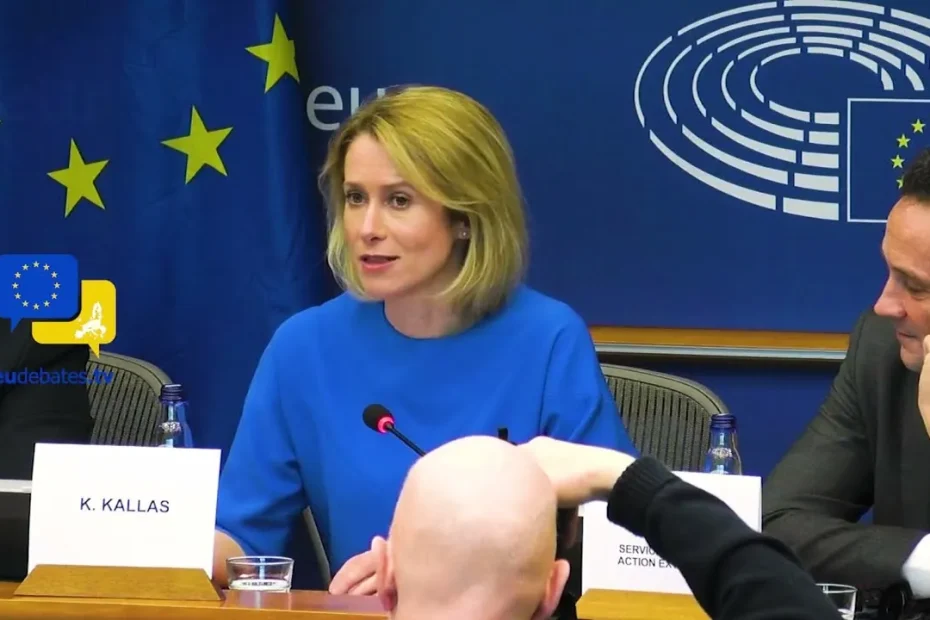
Read the full transcript of Kaja Kallas’ speech on the A New Era for EU-Latin America Relations! at the 5th High-Level Seminar ‘Latin America and the Caribbean Back on the European Policy Radar’.
Listen to the audio version here:
TRANSCRIPT:
Introduction
KAJA KALLAS: Ladies and gentlemen, honourable members of the European Parliament, esteemed representatives from Latin America and the Caribbean, I must say it’s great to be here and I must also apologise that my Spanish is not as good as my predecessor’s Spanish was, but we will work on that. It’s clear that the next decade will shape the rest of the century. We are in this very critical juncture. In fact, right now it feels like the next few days could do this too.
The world is very uncertain. It is shaped by war, economic volatility, competition, rejection of global norms and rules and the looming threat of climate change. In this context, isolation may be tempting to some. To put up barriers of protection and tell yourself that you don’t need the rest of the world.
This is not the European way. We know from our experience that we are stronger when we do things together. To face the challenges ahead, be it security of our societies, the defence of territorial integrity, the future of AI or climate change, we need to work together. This starts with partners and allies who share common interests and values.
EU-LAC Relationship
The strength of the EU-LAC relationship comes from a common history of deep ties between our peoples. We share a commitment of values that are not only European, but universal. Democracy, human rights, the rules-based international order. We also share a belief of pursuing our own interests while making the very best of partnerships too.
In Europe, we call it strategic autonomy. In Latin America and the Caribbean, you call it sovereignty.
But we mean the same thing. We don’t want dependencies. We don’t believe in spheres of influence. We don’t want the world divided into blocks. In a world increasingly dominated by the idea of short-term deals and transactions, the EU will be firm and pragmatic in defending its interests and values.
But we believe the best way to do this is through long-term partnerships with reliable, trusted partners. In uncertain times, the stability built on trust attracts also investment, fosters opportunity and allows societies to thrive. This is our proposition, because this is who we are in the European Union. Our history has taught us the painful but crucial lesson.
Long-term, reciprocal cooperation yields better outcomes than selfish, short-term competition. A transaction might bring a quick win, and we will not shy away from them, but trust allows both sides to take calculated risks and make investments to greater value over time. This is, by the way, the logic of the Global Gateway Investment Agenda. That is also why Latin America and the Caribbean are part of the solution, not the problem.
Global Partnership
It’s not merely a regional partner for the EU, it is a global and geopolitical partner playing a crucial role in shaping the future of the world. We are the region’s largest investor, 36%, third largest trading partner and leading donor. The EU is one of the world’s most open economies, with over 70% of imports entering tariff-free. We believe in fair and mutual beneficial economic partnerships.
Our agreements with the 22 LAC countries have driven a 45% decrease in trade value since 2013. And the collaboration between our regions goes beyond trade and economic rules.
First, our collaboration is essential in addressing the global challenges. Together we defend and still we must reform the international rules-based order. Because in a world of giants, rules are the protection, the nuclear weapon of a smaller state. Together we also promote peace, security, democracy and multilateralism.
We represent a third of United Nations members. The EU and Latin America and Caribbean countries have often been united in defending international law and confronting global threats like Russia’s aggression in Ukraine. A war that undermines the core principles of sovereignty and international law.
Second, Latin America and Caribbean is central to Europe’s economic security and de-risking strategy. Just as Europe plays an important role in Latin America and Caribbean’s diversification, stability and growth, with EU investments supporting almost 3 million jobs in the region. For Europe, this is not about countering China, but about defending our shared values and interests. We value our partnership with Latin America and the Caribbean in its own right.
Third, LAC is an indispensable partner in today’s world. It remains a cultural and democratic powerhouse. It is home to the planet’s richest biodiversity, half of the world’s tropical forests, and is a key ally in the fight against climate change. With an impressive renewable energy capacity, accounting for 60% of the power mix, double the world average, and rich in critical raw materials, LAC plays a vital role in our green and digital transition agenda.
Caribbean Focus
President Bondolian will attend the CARICOM Summit in Barbados this week. In a fast-changing and complex world, this high-level visit matters. The Caribbean’s voice in the global south is very strong, and its role in climate advocacy is crucial, giving its vulnerability to natural disasters. Climate-related natural disasters have tripled in the region in the last 50 years.
We must tackle global challenges and stand up for multilateral solutions together. As we look into the future, our partnership must focus on our priorities. The triple transition, green, digital, and fair, is at the core of our collaboration. These three pillars are essential for our growth and resilience in both regions. The triple transition is deeply embedded in our trade and investment agreements, and is a cornerstone of the global gateway.
This strategy is our offer to build sustainable, high-quality infrastructure, and do it together. To scale up in the region, we are working with our Latin American and Caribbean partners.