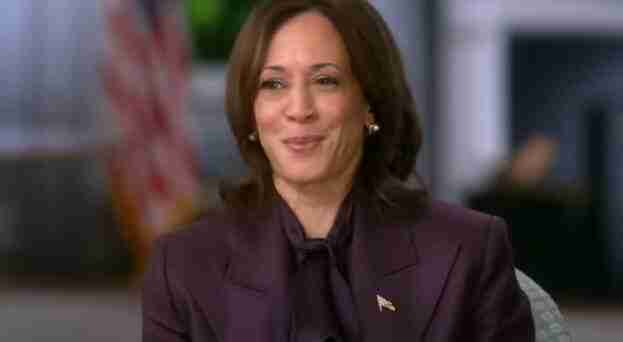
Read the transcript of 60 Minutes Interview with Kamala Harris and Gov. Tim Walz. [It’s actually 20 minutes!]
Listen to the audio version here:
TRANSCRIPT:
The Campaign Trail
BILL WHITAKER: Kamala Harris has been a candidate for president for just two and a half months and the post-convention honeymoon is over with the election. Just 29 days away, Harris and her running mate, Minnesota governor, Tim Walz face unrelenting attacks from Donald Trump and the race remains extremely close. We met the 59-year-old vice president this past week on the campaign trail and later at the vice president’s residence in Washington, DC. We spoke about the economy and immigration, Ukraine and China, but we began with the escalating war in the Middle East one year after the Hamas terror attack on Israel.
Addressing the Middle East Crisis
BILL WHITAKER: The events of the past few weeks have pushed us to the brink, if not into an all-out regional war in the Middle East. What can the U.S. do at this point to stop this from spinning out of control?
KAMALA HARRIS: Well, let’s start with October 7th. 1200 people were massacred. 250 hostages were taken, including Americans. Women were brutally raped. And as I said then, I maintain Israel has a right to defend itself. We would, and how it does so matters. Far too many innocent Palestinians have been killed. This war has to end.
BILL WHITAKER: We supply Israel with billions of dollars in military aid. And yet Prime Minister Netanyahu seems to be charting his own course. The Biden-Harris administration has pressed him to agree to a ceasefire. He’s resisted. You urged him not to go into Lebanon. He went in anyway. Does the U.S. have no sway over Prime Minister Netanyahu?
KAMALA HARRIS: The work that we do diplomatically with the leadership of Israel is an ongoing pursuit around making clear our principles.
BILL WHITAKER: But it seems that, uh, Prime Minister Netanyahu is not listening.
KAMALA HARRIS: We’re not going to stop pursuing what is necessary for the United States to be clear about where we stand on the need for this war to end.
BILL WHITAKER: Do we have a, um, a real close ally in Prime Minister Netanyahu?
KAMALA HARRIS: I think with all due respect, the better question is, do we have an important alliance between the American people and the Israeli people? And the answer to that question is yes…
Economic Concerns
BILL WHITAKER: And while the war in the Middle East has dominated recent headlines, it’s the economy that most concerns American voters this election year, as always. There are lots of signs that the American economy is doing very well, better than most countries, I think. But the American people don’t seem to be feeling it. Groceries are 25% higher and people are blaming you and Joe Biden for that. Are they wrong?
KAMALA HARRIS: We now have historic low unemployment in America among all groups of people. We now have an economy that is thriving by all macroeconomic measures. And to your point, prices are still too high. And I know that, and we need to deal with it, which is why part of my plan, you mentioned groceries, part of my plan is what we must do to bring down the price of groceries.
[BILL WHITAKER comments: Harris says she’ll press Congress to pass a federal ban on price gouging for food and groceries, but details are yet to be defined.]
BILL WHITAKER: You want to expand the child tax credit.
KAMALA HARRIS: Yes, I do.
BILL WHITAKER: You want to give tax breaks to first-time home buyers and people starting small businesses, but it is estimated by the nonpartisan committee for responsible federal budget that your economic plan would add $3 trillion to the federal deficit over the next decade. How are you going to pay for that?
KAMALA HARRIS: Okay. So the other economists that have reviewed my plan versus my opponent and determined that my economic plan would strengthen America’s economy, his would weaken it. My plan, Bill, if you don’t mind, my plan is about saying that when you invest in small businesses, you invest in the middle class and you strengthen America’s economy. Small businesses are part of the backbone of America’s economy.
BILL WHITAKER: But pardon me, Madam Vice President, the question was, how are you going to pay for it?
KAMALA HARRIS: Well, one of the things I’m going to make sure that the richest among us who can afford it, pay their fair share in taxes. It is not right that teachers and nurses and firefighters are paying a higher tax rate than billionaires and the biggest corporations. And I plan on making that fair.
BILL WHITAKER: But we’re dealing with the real world here.
KAMALA HARRIS: But the real world includes —
BILL WHITAKER: How are you going to get this through Congress?
KAMALA HARRIS: You know, when you talk quietly with a lot of folks in Congress, they know exactly what I’m talking about because their constituents know exactly what I’m talking about. Their constituents are those firefighters and teachers and nurses. Their constituents are middle class, hardworking folk.
BILL WHITAKER: And Congress has shown no inclination to move in your direction.
KAMALA HARRIS: I disagree with you. There are plenty of leaders in Congress who understand and know that the Trump tax cuts blew up our federal deficit. None of us and certainly I cannot afford to be myopic in terms of how I think about strengthening America’s economy. Let me tell you something. I am a devout public servant. You know that; I am also a capitalist and I know the limitations of government.
Kamala Harris’s Political Journey
[BILL WHITAKER comments: Kamala Harris has been in government for decades. She was first elected San Francisco district attorney in 2003, then California attorney general.
She went on to the U.S. Senate and now vice president.]
BILL WHITAKER: A quarter of registered voters still say they don’t know you. They don’t know what makes you tick. And why do you think that is? What’s the disconnect?
KAMALA HARRIS: It’s an election, Bill. And I take it seriously that I have to earn everyone’s vote. This is an election for president of the United States. No one should be able to take for granted that they can just declare themselves a candidate and automatically receive support. You have to earn it. And that’s what I intend to do.
BILL WHITAKER: Let me tell you what your critics and the columnists say. They say the reason so many voters don’t know you is that you have changed your position on so many things. You were against fracking. Now you’re for it. You supported looser immigration policies. Now you’re tightening them up. You were for Medicare for all. Now you’re not. So many that people don’t truly know what you believe or what you stand for. And I know you’ve heard that.
KAMALA HARRIS: In the last four years, I have been vice president of the United States and I have been traveling our country and I have been listening to folks. And seeking what is possible in terms of common ground, I believe in building consensus. We are a diverse people geographically, regionally, in terms of where we are in our backgrounds. And what the American people do want is that we have leaders who can build consensus where we can figure out compromise and understand it’s not a bad thing as long as you don’t compromise your values. To find common sense solutions, and that has been my approach.
Immigration Challenges
[BILL WHITAKER comments: But one issue that has proven impervious to compromise is immigration. Over the past four years, the Biden-Harris approach has been inconsistent and Republicans are convinced immigration is the vice president’s Achilles heel.]
BILL WHITAKER: You recently visited the southern border and embraced President Biden’s recent crackdown on asylum seekers. And that crackdown produced an almost immediate and dramatic decrease in the number of border crossings. If that’s the right answer now, why didn’t your administration take those steps in 2021?
KAMALA HARRIS: The first bill we proposed to Congress was to fix our broken immigration system, knowing that if you want to actually fix it, we need Congress to act. It was not taken up. Fast forward to a moment when a bipartisan group of members of the United States Senate, including one of the most conservative members of the United States Senate, got together, came up with a border security bill. Well, guess what happened? Donald Trump got word that this bill was afoot and could be passed, and he wants to run on a problem instead of fixing a problem. So he told his buddies in Congress, kill the bill. Don’t let it move forward.
BILL WHITAKER: I’ve been covering the border for four years, and so I know this is not a problem that started with your administration.
KAMALA HARRIS: Correct.
BILL WHITAKER: But there was an historic flood of undocumented immigrants coming across the border the first three years of your administration. As a matter of fact, arrivals quadrupled from the last year of President Trump. Was it a mistake to loosen the immigration policies as much as you did?
KAMALA HARRIS: It’s a long-standing problem. And solutions are at hand. And from day one, literally, we have been offering solutions.
BILL WHITAKER: What I was asking was, was it a mistake to kind of allow that flood to happen in the first place?
KAMALA HARRIS: I think the policies that we have been proposing are about fixing a problem, not promoting a problem. OK.
BILL WHITAKER: But the numbers did quadruple.
KAMALA HARRIS: And the numbers today, because of what we have done, we have cut the flow of illegal immigration by half.
BILL WHITAKER: Should you have done that…
KAMALA HARRIS: We have cut the flow of fentanyl by half. But we need Congress to be able to act to actually fix the problem.
Addressing Trump’s Rhetoric
BILL WHITAKER: You have accused Donald Trump of using racist tropes when it comes to Haitian immigrants in Springfield, Ohio, when it comes to birtherism, when it comes to Charlottesville. In fact, you have called him a racist and divisive. Yet Donald Trump has the support of millions and millions of Americans. How do you explain that?
KAMALA HARRIS: I’m glad you are pointing these comments out that he has made that have resulted in a response by most reasonable people to say it’s just wrong. It’s just wrong.
BILL WHITAKER: With so many people supporting Donald Trump, a man you have called a racist, how do you bridge that seemingly unbridgeable gap?
KAMALA HARRIS: I believe that the people of America want a leader who is not trying to divide us and demean. I believe that the American people recognize that the true measure of the strength of a leader is not based on who you beat down. It’s based on who you lift up.
Campaign Trail Insights
[BILL WHITAKER comments: The Harris campaign has been hopscotching the country and with less than a month to go, the pace is picking up. The vice president told us she has lost track of how many states she’s visited.]
BILL WHITAKER: How are you doing?
KAMALA HARRIS: I’m doing well.
[BILL WHITAKER comments: We joined her on the trail late last week in the crucial swing state of Wisconsin in the town of Ripon, the birthplace in 1854 of the Republican Party. And at a rally plastered with country over party banners, Harris appeared with staunch conservative Liz Cheney. As vice chair of the House January 6th committee. Cheney became one of Donald Trump’s fiercest critics.
LIZ CHENEY: I have never voted for a Democrat, but this year I am proudly casting my vote for Vice President Kamala Harris.
[BILL WHITAKER comments: That proclamation spurred a chant of approval from the crowd.]
BILL WHITAKER: Four years ago, if someone had told you that you would be campaigning with Liz Cheney, what would you have said to them?
KAMALA HARRIS: That’d be great.
BILL WHITAKER: Really diplomatic.
LIZ CHENEY: Would you ever have thought that you’d be campaigning with Kamala Harris?
KAMALA HARRIS: I hope that if you had said to me four years ago, our Constitution is going to be under threat and it’s going to be crucial for the parties to come together and to support Vice President Harris because she’ll defend the rule of law. I know I would have said that’s exactly what I’ll do.
KAMALA HARRIS: I thank you all.
Foreign Policy Challenges
[BILL WHITAKER comments: Whoever wins the presidency will take on a host of daunting challenges, especially beyond our borders. Back in Washington, Vice President Harris told us she’s determined the U.S. must win the economic competition with China for the 21st century. And as for the war between Russia and Ukraine:]
BILL WHITAKER: What does success look like in ending the war in Ukraine?
KAMALA HARRIS: There will be no success in ending that war without Ukraine and the U.N. Charter participating in what that success looks like.
BILL WHITAKER: Would you meet with President Vladimir Putin to negotiate a solution to the war in Ukraine?
KAMALA HARRIS: Not bilaterally without Ukraine. No, Ukraine must have a say in the future of Ukraine.
BILL WHITAKER: As president, would you support the effort to expand NATO to include Ukraine?
KAMALA HARRIS: Those are all issues that we will deal with if and when it arrives at that point. Right now, we are supporting Ukraine’s ability to defend itself against Russia’s unprovoked aggression. Donald Trump, if he were president, Putin would be sitting in Kiev right now. He talks about, oh, he can end it on day one. You know what that is? It’s about surrender.
Personal Insights
BILL WHITAKER: A hard left turn here, but you recently surprised people when you said that you are a gun owner. And then if someone came into your house —
KAMALA HARRIS: That was not the first time I’ve talked about it. That’s not the first time I’ve talked about it.
BILL WHITAKER: What kind of guns you own and when and why did you get it?
KAMALA HARRIS: I have a Glock and I’ve had it for quite some time. And I mean, look, Bill, my background is in law enforcement. And so there you go.
BILL WHITAKER: Have you ever fired it?
KAMALA HARRIS: Yes. Of course, I have at a shooting range. Yes, of course I have.
Tim Walz: The Running Mate
[BILL WHITAKER comments: When we come back, vice presidential candidate Tim Walz gets the 60 minutes treatment and Kamala Harris talks about why Donald Trump decided not to.]
BILL WHITAKER: Democratic vice presidential candidate Tim Walz was little known outside Minnesota just two months ago. He didn’t exactly come from nowhere. He was a sixth-term congressman and now is governor of Minnesota, where he has championed abortion rights, gun control and other progressive ideas. But it was calling former President Trump and Senator J.D. Vance weird that may have landed him on the ticket.
BILL WHITAKER: Two months ago, you and Kamala Harris barely knew each other. Now you’re running together vying for the top offices in the land. It’s not possible that you agree on everything. And what have been some disagreements you’ve had since you became a team?
TIM WALZ: Well, she probably disagreed with you, said, Tim, you know, you need to be a little more careful on how you say things, whatever it might be.
[BILL WHITAKER comments: Whatever it might be, Walz has been criticized for embellishing or telling outright falsehoods about his military record and about his travels to Asia in the 1980s.]
BILL WHITAKER: In your debate with J.D. Vance, you said, I’m a knucklehead at times, and I think you were referring to the time that you said that you were in Hong Kong during the Tiananmen Square unrest when you were not.
TIM WALZ: Yeah.
BILL WHITAKER: Is that kind of misrepresentation? Isn’t that more than just being a knucklehead?
TIM WALZ: I think folks know who I am, and I think they know the difference between someone expressing emotion, telling a story, getting a date wrong by, you know, rather than a pathological liar like Donald Trump.
BILL WHITAKER: But I think it comes down to the question of whether you can be trusted to tell the truth.
TIM WALZ: Yeah, well, I can’t. I think I can. I will own up to being a knucklehead at times, but the folks closest to me know that I keep my word.
BILL WHITAKER comments: Walz proudly touts his record as governor of Minnesota, but it also has opened him up to criticism from his Republican opponents.
BILL WHITAKER: Former President Trump says that you and your administration here in Minnesota has been dangerously liberal, radical left, he calls it. So what do you say to that criticism that rather than being a knucklehead, you’re a radical leftist? What do you say to that criticism that rather than leading the way, you in Minnesota are actually out of step with the rest of the country?
TIM WALZ: President Trump may be referring to that, that our children get breakfast and lunch in school so that they can learn. He may be talking about we have a paid family medical leave policy that was promoted by the business community. He may be talking about, you know, we’re going to be a better place for our kids rather than lifting up the things we do, the best of it. Donald Trump’s critiques of that. Not only are they wrong, but I’m waiting for what is his solution here in Minnesota. We’re so optimistic we walk on water half the year.
[It was that kind of humor and candor that helped land Tim Walz the job as Kamala Harris’s running mate.]
BILL WHITAKER: Before you joined the ticket, you called Republicans weird. And that’s sort of become a rallying cry for Democrats. Why do you think that label stuck?
TIM WALZ: I was really talking about the behaviors, being obsessed with people’s personal lives in their bedrooms and their reproductive rights, making up stories about legal folks legally here eating cats and dogs. They’re dehumanizing. They go beyond weird because I said this, it becomes almost dangerous.
Let’s debate policy in a real way and let’s try and find an objective truth again.
BILL WHITAKER: Kamala Harris and Tim Walz are in a full sprint to November 5th, hoping their arguments will give them a chance to cross the line ahead of Donald Trump and J.D. Vance.
BILL WHITAKER: You are sitting here with us. The Trump campaign canceled an interview that they had agreed to, to participate in this broadcast. What do you make of that?
KAMALA HARRIS: If he is not going to give your viewers the ability to have a meaningful, thoughtful conversation, question and answer with you, then watch his rallies. You’re going to hear conversations that are about himself and all of his personal grievances. And what you will not hear is anything about you, the listener. You will not hear about how he’s going to try to bring the country together. Find common ground.
And Bill, that is why I believe in my soul and heart, the American people are ready to turn the page.