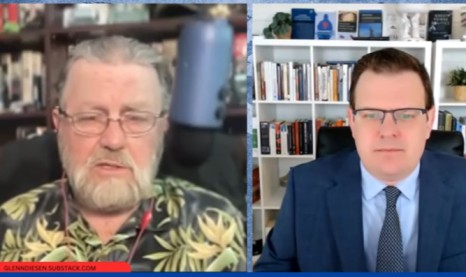
Editor’s Notes: In this episode, Glenn Diesen is joined by former CIA analyst Larry Johnson to discuss the escalating tensions in the Middle East following the imposition of a U.S. naval blockade on Iranian ports. The conversation delves into the fragility of the current ceasefire and the potential for a “global food system collapse” as energy and fertilizer prices spike. Johnson provides a critical assessment of the Trump administration’s “scatterbrained” strategy, highlighting internal divisions between the President and Vice President JD Vance regarding a 10-point peace plan. Additionally, the two explore the shifting geopolitical landscape, noting how China and Russia are increasingly working to broker peace settlements that bypass U.S. influence. (April 16, 2026)
TRANSCRIPT:
Introduction
GLENN DIESEN: Welcome back. Today is April 15th, 2026, and we are joined by Larry Johnson, a former CIA analyst who now publishes at Sonar 21, and I will leave a link in the description, which I highly recommend. So thank you very much for coming back on the program.
LARRY JOHNSON: I always enjoy our conversations.
The Naval Blockade on Iran
GLENN DIESEN: Glad to hear it. And let’s start with straight over moose because — yes. Well, we are in a ceasefire, at least so we’re told. Yet a blockade has been put now on Iran’s ports, which is an act of war, which is a strange escalation to do during a ceasefire. And yeah, it tends to be brought into the conversation by spokespeople in the White House, even at the same time as they’re saying we’re abiding by the ceasefire. So it’s unclear what the ceasefire means, but at least they’re not shooting at them, it appears.
LARRY JOHNSON: Right.
GLENN DIESEN: But what is the likely success of this blockade? Because from what I understand, they have to keep a fairly safe distance and the waterway is not narrow when you go this far down south.
LARRY JOHNSON: Yeah. So this is all — it’s like Japanese Kabuki theater. It’s very stylized, very scripted. The US has a version of what’s going on. They are stopping every ship. There’s not a ship getting out. Boy, they’ve got it locked down tight. Meanwhile, the other reports indicate that ships are — that Iran’s allowing ships to leave and those ships are not being stopped.
The people that are in a position to know what’s actually going on described it as — one described it, he says, “It’s like a security guard at a mall. Yeah, he’s got a uniform, but no real authority to do much and not terribly effective.”
So this could potentially heat up, but as you noted in your introduction, Iran has the potential. They’ve got coastal defense cruise missiles. They’ve got close-range ballistic missiles. And they have a variety of drones, both underwater and on water and in the air — sort of the three dimensions that they can use against any ship, any US ship that gets within say 200 miles of the coast.
So the Abraham Lincoln, for example, in March, it had gotten within 220 miles of the coast and it got attacked and suffered damage that even Donald Trump later admitted. Yeah, they’d been attacked from — he said 17 sides.
So right now it appears that Chinese vessels carrying oil for China have left the strait and are making their way to China and have not been stopped. Now, this could all change, but if the US — you need to do a proper interdiction on these ships, you need helicopters. Destroyers, you know, they can come up and threaten to shoot you, but they’re not going to carry that job out.
Even if you had an aircraft carrier and the two Marine — they look like small aircraft carriers, they carry lots of helicopters — they still can only cover a limited area. And it is stretching air assets. It really is putting a strain on US air assets is what I’m hearing. Both the maintenance costs, the stress, the time up in the air, and it’s not easy to figure out where ships are. The ocean, these oceans are big and the ships don’t have — there’s not an easy automatic way to track it.
I mean, I learned that the hard way over, you know, in working with the Joint Special Operations Command over 23 years. And when we would do exercises, some that were maritime — trying, you know, unless you put a transponder on a ship and it turns on, it sends out a beacon like friend or foe, then fine, you might be able to track it. But otherwise, there’s no way to know. You can ping, you can see something on radar, but it doesn’t necessarily tell you what it is.
Contradictions in US Policy
So then we get to what’s the purpose of the blockade. And this is where the Trump administration is all over the board. Early on, they immediately lifted sanctions on Russia and Iran. Why? Because they wanted the supply of oil, keep the supply of oil up. But now this week, they’ve reimposed sanctions on Russian oil and they’re trying to shut down the flow of Iranian oil. And they’ve already lost 20% of the world’s supply.
And yet the oil markets are acting like, “Oh boy, happy days are here again.” Prices are going down on the oil futures, but the actual price people are paying where the ships finally dock is like $140 to — I’ve seen one price as high as $210 a barrel for Singapore.
So the economic gut punch that’s coming from this — the West, they got their eyes closed.
Trump’s State of Mind
And what compounds this is the literal craziness of Donald Trump. He is out of touch with reality. He doesn’t remember from one day to the next what it is that he has said. He says things that he believes sincerely are true that just are not true.
Such as Iran’s begging for negotiations. No, they’re not. Not at all. We’re the ones begging for those negotiations. Iran can live without it.
And Trump is having — he’s emotionally volatile, yelling at people, getting angry. And so the best description I’ve heard of it is: “It’s like kids living with an alcoholic, abusive father. Don’t wake dad up, tiptoe quietly, don’t do anything to get the old man angry because he’s going to start punching you or beating you.” That’s how they’re treating Donald Trump right now, which is frightening.
So there is a lot going on behind the scenes. This is not some great 5D chess game that Trump’s maneuvering and trying to accomplish this objective or the other. No, man, he’s making it up as he goes along piece by piece. And the only one that has been firm about this — that this is a bad decision, this is wrong — has been JD Vance. And Trump’s gone out of his way to humiliate and isolate JD Vance.
Contradictory Messaging and Overstretched Assets
GLENN DIESEN: And well, I often wonder when I see these tweets — today he tweeted out that “China is very happy that I’m opening the Strait of Hormuz. I’m doing it for them, for the Chinese.” At the same time putting a blockade on Iranian ports in which 90% of the oil goes to China. And that same day, Scott Bessant comes out and says that, well, we’re going to sanction probably two Chinese banks at least for trading, for buying Iranian oil because Iran is a sponsor of terrorism. That’s the argument.
So at the same time, the US is opening the Strait of Hormuz for China. I mean, I don’t know who the audience is for this. I mean, the Chinese are not sitting there going, “Oh, well, wonderful. How kind.” I mean, is it for the MAGA cult? It’s hard to see who this is for.
But with the naval blockade, as you said, it requires a lot of naval assets which are being overstretched. But with more assets in the region, they have to dock somewhere for maintenance. A lot of the logistics appears to have taken some damage and hits. To what extent do you think this makes the US more exposed?
LARRY JOHNSON: Oh, it’s unsustainable. And you know, “we’re winning, we’re in control” — then why is the George H.W. Bush carrier sailing along the west coast of Africa to get to the Persian Gulf region? Why didn’t it take the shortcut and come through the Med, down the Suez Canal, and then through the Red Sea? Because they’re scared to death that they’d get sunk by the Houthis. Scared to death. That’s the reality.
And you bring up the excellent point about where are they going to get the maintenance and service for these ships — if nothing else, to be refueled, refitted. Diego Garcia is really the closest base. So the United States has got itself in an unsustainable military operation.
Diplomatic Maneuvering Around the US
And so what’s going on is Trump’s pronouncements — everything is being done for the American audience. Just to give us, “Hey, things are cool, things are all right, don’t worry, it’s all great.” But the reality of what’s actually unfolding out there is something else.
Meanwhile, like they’re attacking China, yet we’ve seen in the last — this week, end of last week and into this week — China and Russia have stepped up their activities in trying to broker a peace, working with the Saudis, working with the Emiratis, working with the Iranians. Russia approached Turkey. The Turkish foreign minister signed on board. “Yeah, we’ll do that.” So there’s actually work to work around the United States, ignore the United States as not being relevant any longer.
But to conduct these air assets and naval assets required to try to do an interdiction — it’s going to get stressed out. And to be the most effective at it, they’ve got to be close into the Iranian shore. But the closer they get, the more vulnerable they are if this war kicks off and goes hot again.
The Ceasefire and Peace Negotiations
Right now we have a ceasefire that’s in effect until Monday. Pakistan is undertaking significant efforts right now to try to get the negotiations back on. JD Vance, I’ve learned, was the one that had agreed to the Iran 10-point plan for negotiations, restarting negotiations. Trump then, under pressure from all of his Zionist donors, backed away and said, “We didn’t accept any of that.” They were actually making some progress until Vance was basically told, “Shut up and come home, stop talking.”
But now the realization about the economic effects — the negative effects on the US economy and the global economy — it’s starting to hit home.
Economic Fallout
You know, God, the more I watch this Scott Bessant, the more I dislike the man. He just — you want to just go and punch him in the face. He’s such a weaselly, oily character. They try to pretend that things are great and things are not great.
You know, it’s anecdotal, but one of my neighbors is a rancher. He’s got a ranch 20 miles outside of where we live. He was commenting that he’s had to pay — the price of diesel is up over $2 a gallon. So that’s adding almost 40% to his fuel costs. Fertilizer is triple the cost. And then on top of it, he needs to buy — we’ve had a drought in Florida. And so the hay, the grass that normally would feed cattle hasn’t grown. So he’s had to purchase hay, or trying to purchase hay. He says it’s very difficult to come by right now.
He said last year he bought 40 bales of hay at $40 a bale. Now it’s $90. So it’s more than doubled in price. And instead of 40 bales, he needs 90. So he’s now up to $3,600 as opposed to $1,600 — almost more than double the price. And he says, “I’m in the red.”
That’s happening to farmers and ranchers across the United States. And around the world. So what we’re looking at here is the beginnings of what’s going to be a collapse of the global food system, potentially. I mean, it could get that serious.
A Scatterbrained Approach
So this is very — the Trump administration is a bit like Nero fiddling away while Rome is burning. They’re not putting out the fire. And instead, the policy moves are, as you pointed out, completely contradictory.
One minute, “Oh, we don’t need the — who cares about the Strait of Hormuz? We don’t need it,” said Trump. And then the next minute, he’s demanding in the most foul language possible that Iran open the strait. And then he’s complaining that the Europeans aren’t pitching in to help. Then he turns around and he blockades it so nothing gets out. And now he’s saying, “Oh yeah, we’re helping China. China loves us for what we’re doing because we’re stopping the flow of oil to China.”
I mean, it’s all over. It’s a complete scatterbrained approach. And the only thing that explains it — it’s not 5D chess, man. This is a mental illness.
The Shock to the System
GLENN DIESEN: Well, that’s why it just looks like this shock to the system is difficult to absorb, especially now. I mean, if it happened like 2 or 3 decades ago, maybe it would’ve been easier, but we now have all this just-in-time logistics where we don’t rely on warehouses. So everything has to run smoothly in order to reduce logistics costs. That can’t absorb much shock.
You have people where you have record numbers living paycheck to paycheck or severely in debt. So if you suddenly have a slight increase in food prices or energy, it’s very difficult to absorb it. Now we’re going to have this massive energy shock where the prices double. We have a massive food shortage coming up, prices are spiking. You can see how the problems will just start to spread through the entire system.
And because it’s so all-encompassing, it’s going to affect everything. It’s quite dramatic. Such a massive shock to the system. I don’t think they know what’s coming down the road.
Well, I guess we shouldn’t listen too much to what Trump is saying as opposed to what he’s doing. But he did say that this war will soon be over. Of course, he’s been overly optimistic since day one. But do you think he’s expecting a defeat of Iran? Because I see a lot of US military hardware being moved into the region. Or do you think desperation is kicking in so they need to find an out?
Trump’s Narrative and the Path to a Deal
LARRY JOHNSON: Well, it’s more about creating a narrative that he thinks will sell, that sounds good on Fox News. He literally confines himself to watching Fox, reading the New York Times, and not doing much else beyond that. So he’s got really a narrow information flow, and up until about 2 or 3 weeks ago, he wasn’t getting the bad news. Because if he’d get bad news, he’d fly into a rage and blame the person that was delivering the news.
This is Shakespearean. I mean, this is a modern version of King Lear that has gone mad. And no one’s come up with a solution, a fix. What do we do with this guy? He should actually be removed from office, receive medical care, be in one of those care facilities for people with dementia. But instead he’s allowed to still be in charge of this country and to make decisions, irrational decisions at that. To think that it was a good idea to send out a picture of himself as Jesus, healing the sick. And then he turned around to say, “Oh, that was a— no, I was a doctor, what are you talking about?”
There’s growing concern within the White House, I’m told. And I’m told by somebody who’s in a position to know. So this is worse than the Biden situation. Biden could fly off the handle too, but he was relatively harmless. Trump is not. Trump has a viciousness to him and he’s lost all empathy.
Right now, with the information that’s coming out about the so-called blockade, it appears that the Navy is deliberately lying to him, telling him what he wants to hear. Meanwhile, there are efforts underway to restart the talks and to use the whole nuclear issue as the way to get out of this. JD Vance wants to exit the war, and the way you exit it is basically you resurrect JCPOA. You don’t call it that, but that’s what it is. It would be on-site inspections by IAEA, continued support of the Non-Proliferation Treaty by Iran, but instead of a 10-year agreement, this will be a permanent, a forever agreement. That’s why he’ll be able to say it’s a much better agreement than what they had before, because now he’s got a permanent, a forever agreement and Israel safe.
There are also reports out today that there’s going to be a ceasefire between Israel and Hezbollah. And that, again, goes back to one of the demands that Iran made. So if they pull that off, the problem is Trump is very much being driven around by Bibi Netanyahu. So even though Vice President Vance may be given the green light to do certain things, he doesn’t have the ultimate authority here. And Trump’s decisions are very mercurial. One day he’s in favor of it, the next day he’s opposed to it.
Victory Narratives and the Reality on the Ground
GLENN DIESEN: I saw him give an interview where he was arguing, “We could have this war over with soon. We can get a deal which makes sure Iran doesn’t get a nuclear weapon.” And this gives me some optimism because this sounds like an out. I mean, if this was the goal — Iran not to have a nuclear weapon — they could have kept the JCPOA. They could have easily got another agreement, something with commitments plus transparency, something they can verify.
But it’s the fact that it was first linked up to these other issues — limiting its ballistic missile programme or decoupling from its regional partners — all these things were also to capitulate its conventional deterrence. So I thought this could be a sign of optimism. On the other hand, I always blame myself when I listen too much to what Trump is actually saying. It’s more interesting to see what he’s actually doing.
He’s pushing a victory narrative, and he always refers to how many leaders he’s killed, the infrastructure destroyed, the military targeting which has been diminished. Does he genuinely believe that a lot of killing equals victory? Because the forever wars in the Middle East proved that the US can have all these tactical victories, but it doesn’t win. Or is he just selling a war?
LARRY JOHNSON: Well, he’s repeating what he’s being told. The Pentagon, through Hegseth, is basically lying to him. They’re not giving him the true picture of what this conflict actually is. They tout, “Oh, we’ve blown up this and we’ve blown up that.” Meanwhile, they’re not reporting that Iran has rapidly rebuilt and repaired several of the sites that we thought we had destroyed — sites that are now back in operation.
What I am hearing is that within military circles, the planners are extremely concerned about new weaponry that China has introduced. They’re out saying, “Oh, China has promised Trump that they’re not introducing weapons.” Well, I’m not sure that China has even said that to Trump, but even if they said it, they’re not doing it. They’re doing the exact opposite. There is real concern that there has been a significant upgrade in the air defense system with the assistance of China, and that F-35s and all the fourth-generation fighters that the United States has flown into the region will be vulnerable and will likely be shot down, at least some.
China’s Role and the Prospects for Peace
GLENN DIESEN: Yeah, I’ve seen some reports of Chinese aircraft delivering unknown material in Iran. I’m assuming that these are weapons. I didn’t take Trump’s comment about China’s promise that seriously, because it looks like Trump and the Chinese essentially want the same thing. Trump needs headlines which suggest that the Chinese respect his authority, that they wouldn’t dare to send weapons. And the Chinese are also happy with the headlines that they’re not supplying weapons. So it seems like they both win. But of course, I do think the Chinese are supplying.
What is the likelihood, though, that there could be a ceasefire extended, or an actual peace agreement? Because I always thought that the main challenge for Trump is, on one hand, he would like an out, but what the Iranians demand as an out essentially prevents — well, it’s too big of a price to pay, too humiliating a defeat, especially after making all these victory laps claiming to have won.
LARRY JOHNSON: Yeah, well, I think if he can build the narrative and avoid the humiliation by simply selling the story that, “Hey, I have got a permanent end — forever and ever Iran will never have a nuclear weapon” — he can sell that. And then excuse the lifting of sanctions as, “Oh, and we’re going to fulfill our promise that Iran’s going to become a great economic power.”
The other component of this, though, is what happens with the war between Lebanon, Hezbollah, and Israel. I think Israel has suffered enough damage in that war that they’re also looking for a way out. So if they can get some sort of new ceasefire agreement in place with Hezbollah, I think they’ll take it. Still doesn’t solve the Gaza question.
But there are other pressures here. Jared Kushner and Steve Witkoff and their associates have got significant investments in the Gulf, particularly in the United Arab Emirates, and they’re at risk of losing that money. So that’s the other incentive to try to get it negotiated as quickly as possible, so they can try to salvage their investments in those countries.
I don’t think UAE is recoverable now. I think it’s beyond recoverable. But there has been direct diplomatic intervention with the Chinese, with the UAE, and also with the Saudis and the Qataris. Russia is talking as well. So Russia and China are working together to try to create a peace settlement that will exclude the United States. The United States will not be party to that. And who knows, they could conceivably pull that off. I don’t rule out anything on that front.
The Damage to Israel
GLENN DIESEN: After the 12-day war, we spoke at length about the damages to Israel’s infrastructure, economy, and industries. Do we know anything yet about the hit they’ve taken? Because there are limits on the information coming out. The reports we’re getting don’t really cover the extent of the damage. What do we know so far?
LARRY JOHNSON: It has been substantially worse. And we know that because if they had not caused significant damage, the Israelis would not have the censorship in place that they do. Because they would allow the media to come in and say, “Look, our air defense system has worked spectacularly. We haven’t been hit. All the structures are standing. We’re in great shape.” They haven’t done that because the opposite is true. They’ve taken a serious drubbing.
They’re also working this respite. We’re now 8 days into this and it ends next Monday. We’ll see if it gets extended. The Trump administration is desperate to get a deal done, and Iran’s ready to go back and fight. So we’ll see if Trump makes any further concessions. They will portray it as, “Oh, Iran came begging to the table. We’ve got to keep talking. That was all Iran’s doing.” And there’s no guarantee that Iran will come back to the table either.
GLENN DIESEN: Yeah, it’s been a few humiliating rounds. I’m thinking when Trump said, “We have some constructive talks, so we’re not going to hit them.” And then for the foreign minister to come out and say, “No, we actually have no talks at all.” I mean, if they really wanted peace, this seems like a very strange game to play.
LARRY JOHNSON: Yeah.
The Breakdown of Negotiations
GLENN DIESEN: What do we know now about the Iranian position? I spoke to some Iranians who made the point that the negotiations seemed strange — that Vance couldn’t really answer questions, he had to pick up the phone and call all the time. But also, I was told that at the end, when they thought the negotiation was still going, Vance essentially and his team just packed up and said, “Okay, I guess we’re done,” and broke it off. So it’s very hard to read this kind of diplomatic behavior.
LARRY JOHNSON: Yeah, that was, I think, the most telling part. From Professor Morandi’s account, Vance didn’t have the courtesy to say, “Okay, hey, listen, Foreign Minister Arati, we’ve just got to recognize we’re at an impasse. We’re not going to be able to solve anything at this point. We’re going to go back and brief President Trump, and maybe we can get together next week or the following week to try to make some more progress.” Nothing like that. It was just, “Okay, we’re out of here.” And the Iranians were like, “Where’d the Americans go?”
When I first heard that, I sent Professor Morandi a note and said, “Hey, I hope you guys are talking to the Russians or the Chinese about having them fly you back to Iran, because if you’re at least under Chinese or Russian protection, they won’t try to kill you. Whereas if you’re flying on an Iranian airplane, I wouldn’t put it past them to try to shoot you down.” I guess what happened is they flew on a Pakistani-flagged airline back, and that prevented Iran from being attacked by Israel.
Diplomacy Under Threat
GLENN DIESEN: Yeah, it’s so strange that killing leaders and negotiators has become a new thing. It became normalized a bit too quickly, I feel. It’s going to make it very difficult to have diplomacy in the future. I remember a Washington Post article that argued this should be a form of deterrent — if you don’t agree to deals, it would kill the negotiators personally. This doesn’t look like a good, stable peace agreement can come from this.
But overall, where do you see this conflict going now? If the blockade’s not going to work, the negotiations are moving forward, the military capabilities are built up — are we just going back to war?
The Naval Blockade Strategy and Its Limitations
LARRY JOHNSON: I think that’s where we’re ultimately headed. I mean, I can see, look, from a logical standpoint, you can see that there’s a clear exit ramp here for Trump. They can exit out of this war and try to start, try to get an economic solution in place that will start to repair the damage that’s been done by having closed down the Strait of Hormuz and having shut down basically the export activities out of United Arab Emirates, Qatar, Saudis. I mean, Bahrain is toast. You know, the US base there is not coming back. Similarly, Kuwait has suffered some significant damage. That may be unrecoverable.
But just because we can see the logic in that, you know, let’s solve it. The pressure that Trump is under from Bibi Netanyahu is significant, and he’s shown that he’s unwilling to really confront them and say, look, the United States is going to chart its own path forward. And this still doesn’t, this leaves unresolved the situation in Gaza. It leaves unresolved the situation in Lebanon.
And, you know, I had to go back and look. I didn’t realize it, but, you know, this Lebanese war has been going on now for 51 years. You know, it really, the civil war in Lebanon between the Christians and the Muslims, the Shia in particular, you know, got kicked off back in 1975 when the Phalangists, you know, this Christian sect, attacked and killed about 35 Shia civilians. And boom, civil war was on, and that raged until it was sort of a truce in 1990. But, you know, now in the ensuing, so in the ensuing 30 years, we still had these constant flare-ups. So 2006, Israel again invades southern Lebanon. There were bombings in Beirut in the ’90s. So, you know, the conflict has never really gone away. And now in this latest round, you know, Hezbollah’s, you know, holding its own and inflicting serious damage on Israel, which Israel can’t sustain.
So I could see the efforts to bring a peace. But to come back to what you said, let’s look at what Trump is doing. Is Trump telling US military units, okay, start withdrawing, let’s pull back, we’re going to scale down? No, just the opposite. The Senmore were ramping up. Now, I think the debacle that happened surrounding the rescue of that downed pilot or the crew member from the F-15 two weeks ago, I think that has finally persuaded both the Pentagon and the White House that any kind of ground operations out of the question, just too dangerous, too costly. Too unpredictable.
So they’re going to continue with this economic pressure. One school that’s advocating the complete blockade of Iranian ports believes that if we shut down their ability to send oil out, it will ultimately damage their ability to produce oil, and then they’ll be in a crisis. They won’t have any income, and then they’ll implode. That, and there are some within the Trump administration that give that very serious credence. I think it’s crazy, but that’s what they’re pushing.
The Ceasefire as a Strategic Tool
GLENN DIESEN: But could that be the goal of the ceasefire though, that it’s just to lower the intensity? Because as the war is going now, the United States is using all this, well, they’re using all this expensive interceptor missiles. Their assets in the Gulf states are being attacked, Israel is getting attacked. So it kind of, this high-intensity war doesn’t really work in US advantage.
But if one can call a ceasefire and then at the same time begin to gradually bleed the Iranians instead, putting some blockade on their ports, which would also hurt the Chinese, essentially have some, try to assert some escalation control, a little bit like what was achieved in Ukraine, where essentially NATO countries can fire their missiles at Russia and then pretend it’s Ukraine and Russia can’t respond. Something similar that allows them to begin to drain and, you know, mow the lawn, if you will, in Iran without Iran being able to respond in a significant way. Or do you think it’s delusional that such a blockade can be enforced properly and Iran would not retaliate in some way?
LARRY JOHNSON: Yeah, no, I think it’s delusional on their part because the blockade of the ports is not Iran’s only outlet. In other words, they can go through Turkmenistan. They can go through, you know, so there are roads in. It’s not their only access to the outside world. Now, those ports, yeah, volume-wise, it can have an effect. But again, I don’t think the United States has got the naval power in place to really stop it, to stop it completely, particularly if they start using the Chinese. Chinese have signaled very strongly that they’re not going to put up with this, and that if any attempt by the United States to interfere with Chinese maritime traffic is going to be resisted.
GLENN DIESEN: How so though? What are the Chinese saying?
LARRY JOHNSON: Oh, they said they would treat it as an act of war. So, yeah. So I mean, and I know that the US military planners, that’s the last thing they want is to be, you know, to get into a war with China because I think it’s now pretty apparent United States wouldn’t last 2 weeks with China, if they actually got into a full-blown war. Because we simply don’t have the strategic depth. We’ve drained our inventories of key weapon systems, THAADs, Patriots, you know, the PAC-3 batteries. You know, JDAMs are way down, JASSMs that we’ve used extensively, way down, Tomahawks way down. And then you get to the supply chain problem, which China controls. To rebuild some of those weapons systems, you need the rare earths that China is not providing now, and we don’t have a good alternative to go to.
The Wider Strategic Consequences
GLENN DIESEN: Yeah, it looked like, yeah, the, if China, not if, well, given that China is the main peer competitor of the United States, and ever since the days of Obama back in 2016, at least the goal was to pivot to Asia to contain, none of what’s being done now by Trump seems to make much sense. I mean, when he came to power, he suggested, “I’ll wrap up the Ukraine war, I’ll end the forever wars.” I mean, all of this made sense if the objective was to transfer the resources to the Western Hemisphere in East Asia.
But now that the US is still fighting in Ukraine, at least, you know, selling weapons, it still has its intelligence assets there. And now also doing this forever with Iran, it’s hard to see how the wider or larger strategic objective, you know, in this massive shift of power can actually be achieved. It’s very strange to watch given that it looked like Trump had a very, you know, strategic outlook when he came in and how little it corresponds with his actual actions. But let me just ask a last question. How do you think, what will be the wider consequence of this? I mean, of course, energy crisis, we may have food crisis, but without a crystal ball, what do you think are likely developments we might see from this war?
LARRY JOHNSON: Look, we’re trying to figure out what the hell are they going to do. It’s going to be, the US is losing influence in the Gulf. It basically, it promised all these Gulfies, “Hey, we got your back, we can protect you. You sign up with us, we’ll protect you.” Well, it turned out they couldn’t protect them.
They’ve been, the most bizarre actions and behavior is that of the UAE. They are the most virulently opposed to Iran. And they’ve taken the biggest beating of all the, with maybe the exception of Bahrain. The Saudis are still there. They’re playing a double game. They’re still trying to stay in bed with the United States, but they’re under pressure to seek an accommodation with Iran.
So, you know, they just announced that the pipeline that flows to the Red Sea that had been sabotaged, they already hit the other day. They’ve now repaired it, they’re flowing, the oil’s moving again, but they don’t move that much oil. I mean, it made just like 7 million barrels per day, which, you know, sounds like a lot, but it’s not a lot. It’s still 50% about what they were putting out before. And it’s still vulnerable that if this war goes hot, the Houthis will take out that port, that terminus.
So the ability of the United States to dictate the future of that region is limited. The power of the US dollar is going away. We saw the auction for Treasury bills. It was, again, it dropped in terms of percentage of foreign buyers. So the Fed had to step in and buy up that amount. So I think you’re going to see an expansion of Chinese and Russian influence throughout the Gulf. And I don’t see Iran backing off from using, you know, let’s say charging a user’s fee. “If you come into the Gulf, you’re going to have to pay a fee,” one way that they’re going to recover and pay for the damages that were done as a result of this war launched by the United States and Israel.
So Trump’s erratic behavior is not, he’s not going to get better. In fact, we will see further deterioration. I honestly don’t know if he’ll make it to the end of his term because his behavior is so odd and it’s creating real concern now in Washington. So that’s going to be at play.
Political Fallout and the Midterms
GLENN DIESEN: Yeah, the ability to lead. Seeming personal meltdown, the collapse, or not collapse, but the divisions within MAGA and decline of his administration. I think all of this is, yeah, creating a lot of panic and desperation, which is not what you want to see in a president at war, but yeah, here we are.
LARRY JOHNSON: Well, and the news about the midterms, it’s, well, the prediction markets, the Polly markets as they’re called, they are growing, showing a growing probability that the Democrats are going to sweep not just the House, but the Senate. And they could have as many as a majority of 54, 55 senators with Republicans losing, you know, losing, you know, well over 10 seats.
And then at that point, you know, Trump has no agenda left. And, you know, he can be mad all he wants. The question is, will the Democrats impeach him? Or will they just let him sit there and sort of twist slowly in the wind like a body hanging off of a scaffold?
You know, JD Vance has tried desperately to try to keep Trump from going down the path of going to war with Iran, and he failed. And you’re going to see, it’s going to be a mixture of political chaos in Washington with the possibility of Trump making some very irrational, dangerous decisions. But the sort of the good news for Iran is it’s got solid backing in relationships with China, with Russia, and increasingly it looks like the Asian countries, since, you know, they’re starting to go in their own direction, and I’m talking Japan, South Korea, Indonesia, Malaysia, Vietnam, that the influence the United States once wielded there is slipping away very, very rapidly.
GLENN DIESEN: Yeah, not the best statecraft we’ve seen. So, I know you have a busy day ahead of you, so thank you very much for taking the time.
LARRY JOHNSON: All right, my friend, keep doing the good work. The world benefits from your wisdom.
GLENN DIESEN: Will do.
LARRY JOHNSON: Okay, take care. Bye.
Related Posts