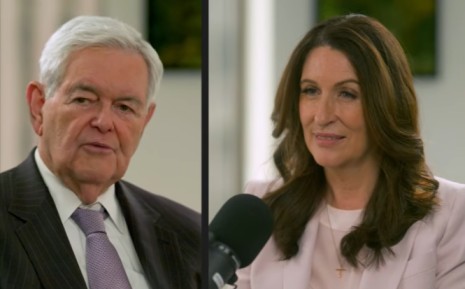
Read the full transcript of former House Speaker Newt Gingrich’s interview on Pod Force One, May 27, 2026.
Editor’s Note: In this episode of Pod Force One, host Miranda Devine sits down with former Speaker of the House Newt Gingrich to unpack the future of the Republican party and the upcoming midterms. Drawing on his experience as a historic political architect, Gingrich shares his straightforward strategy for a conservative victory while breaking down why he views the modern left as fundamentally out of touch with everyday Americans. The two also dive into Donald Trump’s unique political authenticity, comparing his impact on the national establishment to monumental figures in American history.
INTRODUCTION
MIRANDA DEVINE: Joining me today on Pod Force One is the former Speaker Newt Gingrich, who I would say without doubt is probably the most consequential Republican strategist in the modern era. And you, of course, are famous as the former Speaker of the House, having been the architect of the Republican revolution that ended four decades of Democrat rule. You balanced budgets and you were hugely successful in a way that hadn’t been done and gave Republicans, I think, hope for the future. So now you look 30 years later— was it?
NEWT GINGRICH: No.
MIRANDA DEVINE: Yeah, 30 years later. And you see the midterms looming. You see a president, President Trump, who’s in the middle of a war in Iran. You see gas prices up. What’s your outlook?
The Republican Revolution and Economic Legacy
NEWT GINGRICH: Well, let me say, first of all, the 30 years would be 1996. And that was the year we actually became the first reelected Republican House since 1928. Wow. So it was pretty consequential. Yes. As you point out, we then went on to balance the budget for 4 straight years for the only time in the last century. So we were— I look, I think—
MIRANDA DEVINE: That was no accident.
Gasoline Prices and the Midterm Outlook
NEWT GINGRICH: If you tell me the price of gasoline on Labor Day, I am pretty confident I can tell you about the election. If the president can get gasoline down somewhere in the $3 range and people begin to feel like it’s going to continue to come down, the Republicans will win the largest off-year election in modern times.
MIRANDA DEVINE: Really?
NEWT GINGRICH: Yes. That’s my personal judgment. Partially because with the one big beautiful bill last year, the weight of economic growth is going to be so enormous. We’ll probably be at 5 or 6% growth by this fall, which means that jobs will be showing up, people will have wages rising faster than inflation, and we will really be back rolling as the arsenal of democracy.
The other thing is that the Democrats really have become a party that is, I think, weak and woke and far too liberal. And I think as a result, they are almost like George McGovern in ’72. They are open to the potential for a collapse on a scale they can’t quite imagine.
And only, frankly, the liberal news media misleading them, like the recent Washington Post poll, which had, I think, 27% Trump voters in the poll when he got 50% in the election. Now, that’s actually a disadvantage in the long run for the left because it means they’re always operating off of bad information, and they don’t realize how much they’ve got to change and how much trouble they’re in.
Polling, Media Bias, and the Power of Campaigns
MIRANDA DEVINE: Well, everyone talks about how President Trump’s polls are not good, but he’s polling better than the Democratic Party.
NEWT GINGRICH: Well, I mean, first of all, I don’t trust any public poll. They’re always designed to make you feel bad, right? I remember in ’94, in October, I was in Idaho going in to do a radio interview, and I saw the cover of USA Today. And it said “Democrats gaining in poll.” And I knew that none of my team had said anything to me about the change in polling. So I had to go through this hour-long interview on radio thinking in the back of my head, what’s behind that headline?
Well, when you read the actual story, it said Democrats have gained ground with people who are not likely to vote. But Republicans have actually widened their margin among people who are going to vote. That somehow got translated into a pro-Democrat headline. So I start there.
Second, Michael Barone said many years ago that in all of the industrial countries, the left does very much better before the actual campaign because the liberal media is so heavily biased. But once the campaign starts, the more people learn, the worse the Democrats, so the liberals around the world do.
I remember in 1988, I was involved in George H.W. Bush’s campaign, and the vice president in May was down 19 points behind Dukakis. In November, he beat him by 8. That means that every 4th American switched. And that’s the power of campaign.
So I think President Trump around the 4th of July will put back on his candidate hat. And from there to the election, he will, I think, win the argument. Again, with the one caveat, gasoline prices have to come down.
The Iran War and Its Political Implications
MIRANDA DEVINE: Which really means that the Iran war has to be finished.
NEWT GINGRICH: Or you have to open up the strait. You can fight Iran forever as long as you get the Strait open. I mean, what we’re worried about is getting oil out of the Persian Gulf. If the price of gas comes down to $3 or $3.25, people— Trump’s been very clever. People don’t care if you’re using air power.
MIRANDA DEVINE: Right.
NEWT GINGRICH: It doesn’t feel like a real war. You’re not getting terrible pictures of American troops getting killed.
Was the Timing of the Iran Strike a Mistake?
MIRANDA DEVINE: Do you think it was a mistake for him to go when he did? And people are saying, why didn’t he wait until after the midterms?
NEWT GINGRICH: I called Trump during the South Carolina primary in 2016. And he was really beating up George W. Bush about the war. And I called him and said, you know, Bush is like at 80% approval among South Carolina Republicans. So why are you doing this? And he said, you know, the war was wrong and somebody has to have the guts to say it. If that cost me the nomination, that’s fine.
MIRANDA DEVINE: Wow.
NEWT GINGRICH: And I thought, you know, that’s real leadership. I mean, that’s a— whether you agree with it or disagree with it, that’s not sticking your finger in the wind.
And I think, and I don’t know this for sure, but I have a hunch that he realized that despite everything we’d done last year, which had been quite significant, and we really had put their program back, with the bombing of the nuclear facility, the bombing of the facilities and what the Israelis had done. That it was increasingly clear that the Iranian dictatorship hadn’t gotten the message and that they were moving back towards rebuilding their program and being aggressive with terrorism.
And I think he felt that to wait for another 8 or 9 or 10 months and give them the breathing space to keep rebuilding would be very dangerous. Furthermore, what if he lost the off-year election and his hands were tied?
MIRANDA DEVINE: Yeah.
NEWT GINGRICH: And then he couldn’t act. So I think, I do think they had a fundamental miscalculation. In that, and this is probably in part because of advice from the Israelis, I think they believed that if you could take out the leadership, that the system would be in shock and would agree to your terms. And I thought that was a fundamental misunderstanding of the religious dictatorship, which for 47 years had been chanting “death to America” and which was pretty well indoctrinated.
I mean, I think probably 20% of the country really is deeply into the religious dictatorship and 80% of the country wishes they’d go away. But that 20%, which includes, for example, the head of the IRGC, the top military guy, well, he— to give you a sense, the revolution occurs in ’79. This guy joined the Iranian Revolutionary Guard in ’79. They started a war, they ended up in a war with Iraq in ’80. The war lasted 8 years. They took a million casualties, probably 300,000 to 400,000 dead. This guy served through that whole war.
Now, if you’ve been willing to fight 8 years and lose a million people, the idea that an American bombing campaign for 6 days or 2 weeks is going to somehow scare you— they just hunker down. And I think they will find out, but I think they’ve made a profound mistake because I think that they believe that Trump in the end doesn’t have the courage to do what it’s going to take. And I think that’s probably a profound misreading of Trump.
The Republican Midterm Strategy
MIRANDA DEVINE: The midterms, you have a strategy.
NEWT GINGRICH: Yes.
MIRANDA DEVINE: You think that the Republicans could follow and you think would result in victory for them. What is it?
NEWT GINGRICH: Well, let me say, first of all, that I think what we’re witnessing, this nationwide fight with redistricting, with the fight with the universities, with the courts. The only time I know of in American history that we’ve had a fight on a national scale that was this intense was when Jefferson decided in 1796 to destroy the Federalists. Right. And it took him basically 16 years.
And the word, as you know, the word “gerrymander” comes because in the last desperate effort to survive in Massachusetts, the Federalists drew up a map, and one of the districts in the map looked— the guy said, “That looks like a salamander.” And Eldridge Gerry had drawn the map, and the other guy said, “No, no, that’s a gerrymander.” So this whole fight we’re in can be taken back to Jefferson and the Federalists.
And people forget that we then had a period that was called the Era of Good Feeling, which lasted until 1824. Well, the reason it was an era of good feeling is they had destroyed their opponents. They didn’t compromise. They didn’t have some great meeting and sing kumbaya. There were no Federalists left.
The Four Boxes: A Strategic Framework
NEWT GINGRICH: And I think, so I start with the idea, we are currently in a fight. You see this with this most recent California male athlete winning three different female prizes, which on the left is a core value. And you can’t— you have to say forget Title IX, forget women’s rights, etc. What really matters now is transgenderism dominates everything else. That is about a 13, 14% issue. About 80, 85% of the country’s opposed.
And I can take you through a whole series of places where the Democrats are on one side and the American people on the other. So I think what you’re going to see, my strategy is pretty simple. And it starts, of course, as I said earlier, we have to get the price of gasoline down. But once that’s through, I think there are basically— I think of them as kind of like boxes. There are 4 of them.
The first one is good ideas Republicans will implement if we get reelected. And that’s important because people don’t vote to thank you for what you did last year. People vote because what you say you’ll do for them next year. And so we have to prove that we’re still the party of ideas, that we’re actually trying to solve real problems and move in the right direction.
The second box, I think, is the gap between the Democrats and the American people. I mean, in many ways, they’re now an anti-American party. And you can see it. We run a project called the America’s New Majority Project, which is a website of that name. And we have just issue after issue after issue where they’re consistently on the wrong side.
I think the third box is that they’re not so much liberal or socialist as they’re just crazy. I mean, you look at Steyer running for governor of California, who in his platform has proposed, at taxpayers’ expense, bringing back to the United States everybody that’s been deported by ICE. Now, that’s got to be a 12% issue, 7% issue. I mean, we’re actually going to test it. But the idea that we’re going to spend your tax money to bring back a Venezuelan murderer or an El Salvadorian rapist— people will— this is not— Trump was right in the State of the Union when he said these people are crazy. But they—
Blue Cities and the Democratic Machine
MIRANDA DEVINE: Democrats still win elections. They still have control of these big blue cities, New York.
NEWT GINGRICH: Which is a different issue.
MIRANDA DEVINE: Right.
NEWT GINGRICH: Let me get to that in a second. I give you my fourth box and I’ll be happy. Which is basically Truman made the do-nothing Republican Congress the key to his come-from-behind victory. I think Trump has a do-really-bad-things Democratic Congress. I think if you look at what Schumer stands for and what Jeffrey stands for, the country will be opposed to almost all of it.
So those are the boxes. The blue cities are a different problem. Over the course of a long period of time, certainly 30, 50, 60 years, machines grew up which, using taxpayers’ money, have so much power that you almost can’t beat them. And if you can beat them temporarily for mayor, you can’t beat them for city council. And if you can beat them for mayor and city council, you can’t beat the bureaucracy.
So you have, for example, in Baltimore, the third most expensive school system in the country, which has an enormous number of young people who can’t pass the state exams. And the teachers union has a budget so large that no reform group can take them on. And from the teachers union standpoint, the system works perfectly. They all get paid on Friday.
MIRANDA DEVINE: Yeah.
The Lion King, Liberal Fantasy, and the Failure of False Compassion
NEWT GINGRICH: The fact that kids can’t read is unfortunate, but you didn’t really expect them to do that. So you go to a place like New York or Chicago. It’ll be interesting to see if this election in Los Angeles, whether or not there’s a genuine populist outrage that does break up the machine. But it’s very, very hard.
Many years ago, Henry Kissinger invited me out to his farm in Connecticut because he wanted me to spend the weekend with Lee Kuan Yew. And Lee Kuan Yew was the elder statesman who had created Singapore, which at that time was the most amazing success story. And so I had an opportunity to have coffee one morning. I turned to him and I said, “Mr. Minister, how did you make so many correct decisions to shape modern Singapore?”
And he said, “You know, when I was a young student in England, it was when they had the socialist government with Clement Attlee. And so when I got to be in charge of Singapore, every time I was faced with a major decision, I would ask myself, what would Attlee do? And I would do the exact opposite.”
Wow, that’s brilliant. Well, you got Mandami, he’s nuts. Yeah, he’s not a socialist, he’s crazy. You have the mayor of Chicago who’s actually nuttier than Mondame, just as a personality, who recently came out and said he was against locking up criminals. Yeah, because it didn’t work.
MIRANDA DEVINE: But that’s their mantra, all of them, all these — well, socialist Democrats.
NEWT GINGRICH: I have two stories, if you’ll forgive me. The first is that they all belong in Alice in Wonderland. Because you remember the moment where Alice meets Humpty Dumpty and they talk about words, and Humpty Dumpty says, “Words mean what I say they mean.” And Alice says, “Well, but don’t words have their own meaning?” And Humpty Dumpty says, “No, it’s a question of who’s master, you or the word.” Okay, so these guys all live in a fantasy world.
Second, I tell people the reason liberals can’t deal with violence, whether it’s international or domestic, is that they all saw The Lion King and they thought that it was a documentary. And so they think that lions and zebras sing and dance together, right? And when you try to say to them, “You know, lions actually eat zebras,” — “Oh no, didn’t you see the movie.”
Now, I’ve been telling this story for 3 years. On the train on the way up here from Washington, I talked to a woman who had just come back from a safari in Africa, in South Africa, who said that the guys who were on the safari said to her, “We’re getting killed by people who’ve seen The Lion King because we take them out and they see the lion eating the zebra and they’re going, ‘That’s wrong. They don’t do that. Why aren’t they singing it?'” She said, “Honest to God, I have people who are just in a state of shock to realize that lions—” You know, Phil Graham captured that one time. He said, “If the lion lies down with the lamb, I’d like to be the lion.”
MIRANDA DEVINE: Right. Well, Donald Trump told that story about the snake at his rally, which is very popular. A kind woman took the snake in and the snake ends up biting her and she’s so shocked. And I think he’s talking about the illegal migration issue. But I think liberals describe what they’re doing, say, with the border as compassion, or with homelessness, or with law and order, not locking up criminals. They pretend they’re being compassionate, but they know really that they’re not being compassionate.
NEWT GINGRICH: I’m not sure. Let me first say about the snake — the first great snake story was in September of 1941 when Franklin Roosevelt was trying to explain to the country why Nazi Germany was dangerous, and we were extending our Navy protection all the way to Iceland. And he said, “You know, if you stand next to a rattlesnake, you don’t have to wait for it to bite.” And I think there’s a lot to that.
MIRANDA DEVINE: Well, Iran — you could say the same about Iran.
The Existential Threat of Iran and the Tragedy of False Compassion
NEWT GINGRICH: Well, that is — I think that’s exactly — I mean, I think Trump should go and give a series of speeches in cities that he would like to have not be nuked. And just say, “Look, this is a very simple test. You may be willing to risk losing Chicago. I’m not.” And I think that that frames it because, but again, to go back to people who don’t believe — you say to them, “For 47 years they said death to America. What do you think they meant when they would say death to America?” And if you’re a good liberal, you say, “Well, that was really a symbolic explanation of the degree to which they resent what we did with Mossadegh in 1952.” And you just think to yourself, these people are crazy. This is why I do believe they’re actually crazy.
But on the compassion thing, there’s a great book — I can’t quite remember the author’s name right this second — but it’s called The Tragedy of American Compassion. It was written about 1993. We used it a lot when we did welfare reform, and it’s a study of the break during the Great Society.
Prior to the Great Society, the people who dealt with the poor were very tough. For example, they were opposed to giving them money because they’d spend it on alcohol and drugs. They were opposed to giving them money for doing nothing because it would teach them to be indolent. And so the very people, starting in the Victorian era, the very people who went into the slums really as missionaries — they wanted to help the poor. But they wanted to help the poor become non-poor.
Starting in the 1960s, you have this academic class which had been growing in the ’50s and ’60s, which then became bureaucrats. And their view was — and you see this as what’s destroyed public education in the big cities — their view was, “These poor people, you really can’t expect them to be able to do anything.” George W. Bush once, in one of his better statements, talked about the tragedy of false compassion.
MIRANDA DEVINE: Mm-hmm. And the soft bigotry of low expectations.
NEWT GINGRICH: Soft — yeah, exactly. You phrased it better than I did. I think you get a lot of that if you listen to people. You know, if you were to say to the teachers union in Baltimore, “How can you explain entire schools in which nobody can read?” They would explain, “Well, you know, these are just kids that we need to provide welfare for. You can’t really expect them to do anything.” And I think similarly, the willingness to say, “Well, I know he may have killed a couple of people, but, you know, he had a really bad childhood.”
MIRANDA DEVINE: Right.
NEWT GINGRICH: And I think this is sort of what the mayor of Chicago said recently. That locking people up doesn’t work.
MIRANDA DEVINE: Mm-hmm.
NEWT GINGRICH: Which makes you say, “All right, so you’d put murderers on the street” — which, by the way, the former governor of North Carolina did, and your paper covered it. He released people who so far have been identified as killing 18 people since they left jail. I mean, it’s sort of worse than Dukakis was.
Weaponized Empathy and the Dependency Class
MIRANDA DEVINE: There’s this sort of toxification or weaponization of particularly female empathy. Gad Saad calls it suicidal empathy. And we had an incident in New York recently where a young woman was attacked by this maniac on the subway, but she refused to prosecute because she said, “I didn’t want to be responsible for another Black man going to jail.” A few weeks later, he allegedly murders a retired teacher going to the subway.
So that’s a classic example of where her natural nurturing instincts, or the feminine compassion, or whatever, has been, I think, deliberately manipulated and weaponized by the left to serve their purposes. I don’t think there’s a benign reason for why Democrats want to dismantle law and order in these cities, or allow the teachers union to create generations of unskilled kids who are going to live lives on the margin. Isn’t that the Democrats perpetuating that dependency class they need?
NEWT GINGRICH: I think that’s part of it. There’s an elitism in the dominant wing of the Democratic Party that doesn’t believe every American is endowed by their creator, doesn’t believe you have the right to pursue happiness, but if you’ll just relax, they’ll take care of you. And the core problem they have is that it doesn’t work. It doesn’t fit reality. And I think that’s really the crisis that they have.
And as you said, the amazing thing about America is we have such enormous mobility that if a system starts to not work, people leave, right? And you’re going to have, I think, at least 13 congressional districts that switch after the next census. And frankly, if they keep deporting illegal immigrants, the number may be higher because part of the reason I think the Democrats wanted as many illegal immigrants as possible was because it would give them potentially greater count in the census.
But you also have this whole problem — we have not even scratched the surface of how deep the corruption in the system is. And how much it’s about money. If you look at school districts, for example, where they get paid based on the number of days the students are there, and you realize that they are reporting students — one of the people, there’s a terrific book called The Failure Factory about the Baltimore schools, and this reporter went and interviewed this one guy who’s about 18 or 19, who had never gone to school ever. And yet he had been carried on the rolls, and the system had been paid for 18 years for basically a ghost student.
And so I think you can’t — there’s some weird combination of genuine corruption, because it’s a little bit like the Jerry Maguire movie — “Show Me the Money.” Genuine ideological elitism, right? So since I am brilliant and wonderful, how can I expect you, who’s a mere mortal, to have to bear the great burdens I bear? So if you’ll just relax and be dependent, I’ll be happy to take care of it — and vote for me.
And vote for you, exactly. Now the problem they’ve got — Margaret Thatcher once said, “The challenge of socialism is that you run out of other people’s money to spend.” And the problem they’ve got now is that the system has ground down enough that it’s beginning to be obvious that it doesn’t work. And that’s part of the great fight that we’re in as a country, which for the left is really an existential fight. If Trump and the Republicans win, the left will be permanently crippled.
Trump as an Existential Threat to the Left
MIRANDA DEVINE: And is it because Trump represents an existential threat to them uniquely? Trump Derangement Syndrome had to happen, that they have manufactured this gargoyle of Trump that’s unrecognizable to anyone who really knows him?
NEWT GINGRICH: Remarkable. Alan Guelzo is a great historian of Lincoln, wrote me one day and said there are remarkable parallels between the Southern newspapers’ attack on Lincoln and the attacks on Trump. And that they both represented an awareness of an existential threat. That if Lincoln was to survive, the Southern slaveholders would inevitably disappear. And if Trump survives, the modern left will disappear, literally disappear. So in that sense, they’re fighting an identity war that goes very deep.
But there’s another piece of it, sort of in two parts. Trump came out of Queens. Well, you know this better than I do. He came out of Queens.
MIRANDA DEVINE: Yeah.
NEWT GINGRICH: Which is very different than Manhattan. He was never accepted in Manhattan. And he learned, I think, as much as anything from Page Six, that you always counterpunch. And he also learned — he says this in one of his books — he also learned that any news helps. Because the New York Times attacked him one time for not keeping the Art Deco front of the building because his engineers said it would cost $3 million. And so, for 3 or 4 days in a row, they attacked him. He said the result was people who didn’t realize he was building condos called and asked if they could buy a condo. So he decided that was really good. That worked out really well. And so you have this innate sense of publicity.
But Trump — there’s a movie, I think it’s called Invincible, which is a Mark Wahlberg movie about the fellow, about the guy who tries out for the Philadelphia Eagles.
MIRANDA DEVINE: Oh yeah.
Trump’s Authenticity and Blue-Collar Appeal
NEWT GINGRICH: And it’s exciting. Actually plays for the Eagles through 3 or 4 years. Well, the opening of the movie is Wahlberg as a blue-collar guy in South Philadelphia going to the neighborhood bar. Now, I was born in Harrisburg. My relatives lived in Steelton. I had uncles who worked for Bethlehem Steel. So I feel the rhythm of a good neighborhood bar in that kind of community.
And it’s the kind of bar where, you know, if Joey comes in wearing a yellow sweater, everybody picks on him, right? “Your wife made you wear that? I mean, you want to show you were a coward? You know, what do you— is the last thing you had? Did you get that from Salvation Army?” I mean, you know, and when you watch that scene, you’re watching Trump, because Trump’s natural rhythm is the blue-collar workers, because Trump was not a finance guy. Trump did an amazing amount of construction. And so he was very used to talking to blue-collar workers.
Well, if you are the elites, whether you’re the Republicans who hate Trump or the Democrats who hate Trump, you first of all know that one should be elegant.
MIRANDA DEVINE: Right.
NEWT GINGRICH: That the president—
MIRANDA DEVINE: Decorous.
NEWT GINGRICH: Decorous, yeah. The president should have a sense of decorum. And he is an assault on their sensibility. I mean, how dare he be like this? And part of what makes him so formidable is he’s totally authentic.
I mean, he was personally happy coming down the big escalator in June of 2015 and saying to the world, “I’m rich. And because I’m rich, I learned how to make a lot of money. Wouldn’t you like to make a lot of money? So everybody who’d like to make a lot of money, aren’t I your candidate?”
Well, that is so— you know, if you are a George H.W. Bush or Mitt Romney, or for that matter Obama, who’s the great chameleon, probably the most dishonest president in our history in that he was a radical leftist who masqueraded as a moderate, but he did it so elegantly that anybody— you know, everybody in this city, the number of really rich people who voted for him because he made them feel good. He was Black, so they could say they voted for Black, and he just felt comfortable. He felt like the kind of guy who’d go to Nantucket.
Okay, well, Trump ain’t going to be accepted on Nantucket either. So Trump, for example, goes to Mar-a-Lago, which is large and gaudy and, you know, 1923. And it’s very funny, he wants to create a club, and you know the story, but it just tells you about Trump. So he wants to create a club at Mar-a-Lago. Well, the elegant people who are on the Palm Beach city council, first of all, were sort of shocked that some parvenu like Trump would show up and buy the place. And then second, the idea he’s going to have a club. So they didn’t want to give him a license.
And Trump promptly had, I think, an African-American and a woman member immediately and had his lawyer say to him, “We are prepared to file a civil rights lawsuit that you are blocking us because we’re integrated.”
MIRANDA DEVINE: Brilliant.
NEWT GINGRICH: And there are several places that are not. So all of a sudden they cave. But if you watch him, Trump doesn’t back off and he doesn’t hunt for compromise.
MIRANDA DEVINE: No.
NEWT GINGRICH: Now he’s willing to work at it once you agree we’re going in his direction. He’ll work out the details so that you also get to go there comfortably. But about the direction we’re going in, he doesn’t negotiate. And so it’s a fascinating anomaly.
Recognizing Trump Early: The 2016 Campaign
MIRANDA DEVINE: And you were very early in recognizing Trump back in the 2016 campaign, and you backed him. What did you see in him back then? And did that cost you friends in the party, in the Republican Party?
NEWT GINGRICH: Well, if it did, I didn’t notice it. Look, I was a revolutionary. I used to say publicly, “I am a revolutionary.” I had been shaped by Goldwater’s campaign. I began watching Reagan after his great speech in October of 1964. I studied him during the governor’s race in ’65, ’66. I first met him in ’74, which is a great side story to go back to. So I was a genuine Reaganite as opposed to the establishment wing of the party. And when we did the Contract, I mean, we approached Washington as a sort of a revolutionary army to change the place.
MIRANDA DEVINE: Contract for America.
NEWT GINGRICH: And I told people at the time, I thought we’d last 3 or 4 years. Because the establishment’s huge. And so if you take it on, it gets to take you on. And I just knew that we would burn out.
MIRANDA DEVINE: But how did you survive then? I mean, your Contract for America.
NEWT GINGRICH: Well, we survived for 4 years, which is the length of time I thought we could.
MIRANDA DEVINE: Oh, okay.
NEWT GINGRICH: We had the momentum of the popular will. Which is a key to America, that in the end, the American people really do count. They really do make a difference. So I had a background of being always on the side of dramatic and bold change. I thought the system was sick. I thought that it needed a vast overhaul.
And I’d been a big fan of Thatcher. And I tell everybody, if you want to understand how complicated and hard this is, watch Yes Minister and Yes Prime Minister, which were done by Anthony Jay, who was her advisor. And so there are comedies based on real incidents in her government. She loved it. She thought it was a great show. But it’s worth looking at because it makes you realize this system can’t function. As you’re seeing now in Great Britain as it decays.
So I’d known Trump a little bit. I’d met him when I was speaker. We joined his golf club, I think around 2006 or ’07. He and Callista got along really well. And in January of 2015, we were at a national security conference in Des Moines, and we got a call from Trump who said, “Gosh, we’re all in the same hotel. Why don’t we get together for breakfast?” So we went down and joined him, and he told some great war stories, which I won’t draw it out with. They were totally Trump.
MIRANDA DEVINE: On the campaign trail?
NEWT GINGRICH: No, this is still January 15th.
MIRANDA DEVINE: Okay.
NEWT GINGRICH: And then he said, “All right, so you ran for president, you know what this is all about. If I run, what would it take for me to get to South Carolina to test the water?”
And I said, “You can’t do that because everybody will know you’re not serious. The news media will know it, the voter will know it, and you just won’t get anywhere. If you’re going to run, you have to build a nationwide operation, put together a nationwide program, and be a serious candidate. Now, if after South Carolina it makes no sense, then you can drop out. But it has to be a real campaign.”
And he says, “All right, what would that cost?” And I said, “I think given your name ID and your organization, you can probably put together a national campaign for $70 million.” And he sits back and he goes, “$70 million, that would be a yacht. This would be a lot more fun than I thought.”
And then when I left, I turned to Callista, I said, “He’s running.” So why did he only want to look at South Carolina? Because that was the break point. That was the first primary.
MIRANDA DEVINE: You go save some money, put your toe in the water if it doesn’t work.
NEWT GINGRICH: Yeah, you have to be a nationwide candidate to be real. So you try out Iowa, New Hampshire, and South Carolina. He did call me at one point. He said, “I only spent $38 million. I could not get to $70 million.”
MIRANDA DEVINE: I just couldn’t.
Seeing the Signs: Trump’s Grassroots Momentum
NEWT GINGRICH: So I got intrigued. When I got intrigued was, Vince Haley, who now is his domestic policy guy, at the time worked for us. And he called me one night in August and he said, “You have to see the C-SPAN of Trump in Arizona where he’s talking about illegal immigration and he brings a father up on stage, steps back, and lets the father talk about the killing of his son.” He said, “He has something going we haven’t seen.”
Well, I trust Vince’s judgment a lot. So I leaned forward and thought, “There’s something interesting here.”
Then Callista and I watched— you may remember the first Fox debate, which is the one where he and Megyn Kelly melt down and have some really nasty exchanges. And everybody who was an elegant country club person flinched. And even my good friend Frank Luntz talked his focus group into not liking Trump.
And I’m sitting there— Callista and I are sitting there— and I’m looking at places like Time, even Sports Illustrated, a lot of these places where you could vote. Now there are at that time 16 candidates. Trump’s getting 70%.
MIRANDA DEVINE: On these online polls.
NEWT GINGRICH: On these online polls.
MIRANDA DEVINE: Right.
NEWT GINGRICH: Across the whole thing. And I’m sitting there thinking— because I try to let reality teach me, and then I have to think through what— if it means I have to change my opinion, then I need to let reality— what is reality? And I’m thinking, there’s something here. He’s figured something out.
Well, part of it— when I wasn’t frankly any smarter than anybody else— The Apprentice had been on for 13 years. It was a highly rated show. And I used to tell reporters, “If The Apprentice had been on PBS right after Downton Abbey, you would have realized how formidable he was.” But because it was on NBC, none of you had ever seen it.
MIRANDA DEVINE: And people got to know his personality, who he was, that he got to know television.
NEWT GINGRICH: Remember, he actually did more hours of television than Reagan. People forget this. And he did Miss Universe and so forth. And he’s a natural showman. He’s actually a vaudevillian. Which is why he does these hour-long, you know, let me give you my 20-minute speech interspersed with 40 minutes of fun.
MIRANDA DEVINE: He gets energized by those rallies, doesn’t he?
NEWT GINGRICH: He uses them as focus groups. What do people respond to? What’s dead. And he’s constantly evolving, which is something people don’t realize. I mean, the Trump who’s there today is not the Trump I was talking to in ’15, because he’s learned and he’s learned and he’s learned.
So I was sitting around one afternoon because I was intrigued. I mean, I thought having an outsider was good. I thought it was unlikely but good. Having a business executive, I thought, would be a good change. Because I’m a historian, not a lawyer. And unlike Romney, who’s an investor, Trump’s an entrepreneur, which is very different psychologically.
And I was thinking, I campaigned a lot in Iowa over the years for Jack Kemp back in ’88, for candidates, and then for myself. And I’m thinking, you know, Iowans like to have you come by at least 3 times for coffee while they think about whether or not they want to vote for you. And I thought, what are the odds of Donald J. Trump dropping by for coffee? And I concluded it was zero.
So I called him one afternoon. I said, “You need to do a Facebook video every day so that Iowans think you’re in their home because they will have seen you every day. And that will create a sense, and they’ve got to be on issues and they’ve got to be positive. About Iowa. But about any positive issue. Because even in Iowa, in addition to farming, people care about the debt, they care about immigration.”
So at Christmas, we’re at my sister-in-law’s and I get this call and he says, “This is Donald.” I said, “Yeah, Merry Christmas.” He said, “I’ve done 58 videos, so there.” Then he hangs up.
So sometime in March, I get a call from his daughter. She says, “We now have 8 million followers.” And her voice changes. She goes, “And it costs nothing.” And I think the rest of them didn’t get this.
MIRANDA DEVINE: Yeah.
The McDonald’s Moment: Trump’s Earned Media Genius
NEWT GINGRICH: They didn’t realize it. I mean, the other classic example of Trump is you have Harris out here raising an enormous amount of money and you have Trump thinking, “Why don’t I go to McDonald’s?” That was brilliant. It is brilliant.
MIRANDA DEVINE: But no one else could do it.
NEWT GINGRICH: It’s pure Trump. So I think I’ll go to McDonald’s because you want to make the point she’d never worked at McDonald’s. He said, “I think I’ll go to McDonald’s and pass out french fries.” Well, if you looked at the total earned media that he got announcing it, getting up to it, doing it, talking about it afterwards, you can’t raise enough money to do the commercials that offset that.
MIRANDA DEVINE: And creating those iconic images.
Trump’s Authenticity and Media Mastery
NEWT GINGRICH: Yeah. And then of course, a couple days later, Biden, who I think by that point was pissed off at Harris because she had not invited he and Jill to her rally in front of the White House. Then makes this comment about the garbage really relates to Trump’s people. They then figure out, they drive a garbage truck from Michigan to Wisconsin. So he gets into the garbage truck, which has Trump on the side now, puts on the jacket.
But here’s the genius. He then walks into this huge rally wearing the jacket. And says, “You know, they tell me I look thinner with this jacket on, maybe I should campaign in it the rest of the time.”
Well, again, how much media do you think that’s going to get? And normal everyday routine politicians can’t get that kind of media, and you can’t raise enough money to have effective commercials because what he communicates— and sometimes it drives me crazy— but what he communicates is he’s authentic. When he’s brilliant, he’s authentic. And when he’s goofy, he’s authentic. But he’s Trump both times.
MIRANDA DEVINE: How do you fit him into history in terms of how consequential he is?
Trump’s Place in History
NEWT GINGRICH: Third. Third. If he wins this fall. Probably fifth or sixth if he doesn’t. He’ll be like, at a minimum, he’ll be like Andrew Jackson. He will have taken on the national establishment and substantially altered it.
But if he gets 2 more years, at which point I think we’ll win in ’28. So then we have his successor for either 4 or 8 years, which begins to move towards a Rooseveltian period. With 2 more years, he will have driven the change in deep enough, and he will have broken the left.
MIRANDA DEVINE: But if he loses this fall, it’s going to be a nightmare because the left— I mean, it’s very different, I think, from the Democrats you were tackling back in the ’90s. In Congress, I mean, you’ve got people who may come into the Senate like Graham Plattner in Maine, who’s literally had a Nazi symbol, and who has all sorts of terrible ideas.
The History of Left-Wing Radicalism
NEWT GINGRICH: Let me say, first of all, it’s easy to forget that the first great wave of left-wing rebellion was in the late ’60s and early ’70s. We had, according to the FBI, 2,500 bombings in the United States. We had a million people surrounding the Pentagon. There was a genuine hard left. The Black Panthers were real, and you had all sorts of people, the Weathermen.
MIRANDA DEVINE: So that was trying to be a revolution.
NEWT GINGRICH: Right. I mean, these were serious people. They were crazy, but they were serious. Some of them became Barack Obama’s close friends.
MIRANDA DEVINE: Yes.
NEWT GINGRICH: His first fundraiser was at the home of two radicals who were clearly openly illegal and violent.
MIRANDA DEVINE: He’s got Saul Alinsky’s textbook for radicals selling on his website at the new museum.
NEWT GINGRICH: Which makes perfect sense. So I wouldn’t overstate what’s happened now. It’s sort of like watching cancer metastasize. It was bad here, but it was not very many people. But they all went to universities. They all created networks. So what we have now is sort of the third generation.
You know, you have people like— I mean, I don’t know if it’s because, like Humpty Dumpty, AOC thinks words mean what she says, but if you take one of her most recent interviews I saw where she talked about how the American Revolution was a revolution against the wealthy— well, the general in charge of the army was the largest landowner in the United States. The author of the Declaration of Independence owned a plantation. You go down the list and you realize, no, this was the moneyed class rising against the British because they saw the British as a direct threat to their security.
And they then write the Constitution precisely because they saw people like AOC who in Shays’ Rebellion were trying to destroy property rights. And they thought, “Boy, we’d better lock this baby down or it’s going to get out of control.”
So I can’t tell when I watch somebody like her to what degree she’s ignorant and to what degree, like Humpty Dumpty, it doesn’t matter. They’re just words.
Obama, Trump, and the Weaponization of Justice
MIRANDA DEVINE: Barack Obama the other day talking about how basically Trump was weaponizing the Department of Justice against his political opponents, and that those were norms that were never broken under him.
NEWT GINGRICH: He was the one who did that to Trump, yet he can say that. He’s the one we now know held the meeting in the White House to try to undermine the elected president, and successfully did for those first two years.
So you go, you look back and you ask yourself— and this is one of the great ironies of life. If Trump had not been so deeply attacked and then had two impeachment attempts and then had what he thought was a stolen election and then had four attempts to put him in prison and two assassination attempts, would he in fact have been the Trump we now deal with? Or at each stage were they driving him to a bolder and more radical decision that if you are this bad, then I’m going to rip you out root and branch.
He calls them crazy now, which I totally approve of, actually. I think it’s accurate. But I think in a way it’s a two-way dance. He has so alienated them because he takes on all of their values.
I mean, the whole series of decisions now is in a way that somebody has to chronicle. Clarence Thomas is now the most important member of the Supreme Court. Now, if you’re a left-winger, this has got to be close to your worst nightmare. And of course, as you know, Clarence Thomas luckily is not Black, because if he were Black, he couldn’t be voting the way he’s voting. So he must be a white person who just looks odd.
And we were very fortunate. When you get to be an ambassador, you get an administrative swearing-in, and then you go to the White House and you get a ceremonial swearing-in. And when Callista got to be ambassador to the Vatican, we asked Clarence if he would swear her in. We went over and chatted with him for a while. And he’s just— I’ve known him for a long time, but he’s amazing. And he represents such a deep, passionate belief that each one of us has been endowed by our Creator, that we really do have the right to pursue happiness.
MIRANDA DEVINE: “All men are created equal.” That’s right.
Clarence Thomas and the Real World
NEWT GINGRICH: And he really believes this. And he really believes that his life personifies it. You can grow up in a segregated Savannah and end up as a justice of the Supreme Court. So when people then say to him, “Don’t you realize you’re oppressed? Don’t you realize that all those people are out to get you?” I think he just, like me, thinks they’re crazy. This is not an ideological fight. This is a fight between sanity and some understanding of the real world.
MIRANDA DEVINE: That’s a problem though. You have to have an understanding of the real world. And I think Clarence Thomas, who grew up with his grandfather taking him out to the farm, cutting down trees, dealing with nature and the consequences of bad mistakes, and someone like AOC who’s never really grappled with the real world— a lot of socialists are university trained, have never really—
The Academic Worldview vs. The Real World
NEWT GINGRICH: Yeah, I’m reading an interesting novel about Montana, and it involves a woman professor who’s into women’s studies and all that stuff, who’s encountering the idea that you actually have to feed the chickens. They don’t actually come wrapped. And you have to put up the fence.
And the distinction that the guy who is working with her keeps making— because he’d grown up there, although he had a degree in engineering and he’s very smart and well-educated— the point he’s making is the difference between— he said, “If you’re an academic, all you have to do is a performance. And as long as you can perform correctly and have the right emotions and have the right words, you’re fine.” He said, “We actually have to do something. The difference in these two worldviews is unbelievable.”
And this is where Trump was different. I remember he and I did an event for Romney in Las Vegas leading the campaign, and we were walking together over to the event, and he’s looking at some building or something. He says, “You know, I could tell you within 1% the total amount of concrete in that building altogether.” And I realized he was serious. I mean, he had over his lifetime invested in understanding the construction business well enough that he could do it.
Many years ago, Southwire was the largest independent wire manufacturer in the world, founded by a guy named Roy Richards, who was a Georgia Tech engineer. And I went by to see him one day and I said, “You know, what was the key to this?” He said, “I had the great advantage that I was the only CEO of a wire company who was an engineer. All the others were finance people. So they would turn to their engineer and their engineer would always give them a cautious answer because they didn’t want to be found to have made a mistake.” He said, “I knew exactly how to get right to the margin because I did it myself.”
And I think what you have with Trump at one level is he’s run all these businesses. He has solved problems. I love the opening of The Art of the Comeback, where the opening page says, “I’m $600 million in debt to the banks. The Atlantic City properties are losing money. The war in Iraq is going to make the economy worse. And my wife just called to say she’s filing for divorce.” He said, “Now this is the moment when you either get depressed or you plan a comeback. And this book is about the comeback.”
Fantastic. I was telling somebody today, the Iranians should read this. He’s not going to be intimidated. He’s not going to get tired. He’s not going to be flustered. He’s going to go golf. And while he’s golfing, he’s going to think. And then he’ll come up with a solution none of us would have. I mean, I think I’m reasonably good at this business. He’s better.
The Clinton Impeachment in Hindsight
MIRANDA DEVINE: Can I ask you, back with Bill Clinton, do you think in hindsight it was a mistake to impeach him over the Monica Lewinsky scandal?
NEWT GINGRICH: Yes, I think it was a mistake because the real problem wasn’t Lewinsky. The real problem was he had committed perjury in a case involving sexual harassment while he was governor, and perjury is a felony. In fact, he was stripped of his law license in Arkansas after he left the presidency and for 5 years couldn’t practice because he clearly committed a felony. And so I always argued the question is, are you allowed to commit felonies?
But by allowing— and this is partly the way the report was written— by allowing it to be about sex, it trivialized it. I realized that we were really off course in August of that year when I was at the OK Cafe in Atlanta with my two daughters who at that time were, I guess, in their early 20s. And they both said to me, “If our friends lose money on their 401 because of some stupid intern, we are going to be mad at you because frankly it ain’t a big enough deal for us to lose a lot of money.”
I realized at that point I had completely misunderstood how the culture was evolving.
MIRANDA DEVINE: Wow. And I guess also it meant that the Democrats had a talking point, which was, “You impeached our president over a triviality, therefore anything goes in the future.”
Clinton, Gore, and the Cost of Political Miscalculation
NEWT GINGRICH: No, I don’t know. I don’t know if that happened or not because they didn’t particularly do it to George W. No. Oh. But what it did do— I was once at the green room, I think, for Meet the Press with one of Clinton’s lawyers who was very close to him. So we were talking about all this. And he said, he turned to Clinton at one point and said, “In April, you went on national TV and said, ‘I did not have sex with that woman.’ Why did you do that?”
He said, “Because they were going to impeach me in 30 days unless I stopped it. And so I had to lie or I would have been impeached.” And given those two choices, he, for him, took the right choice.
Once it was over and once people had basically concluded that it was not a large enough problem to impeach him, it made him look stupid. You know, you didn’t necessarily want your daughter to go out on a date with him, but that didn’t matter. He actually left office at the high point of his popularity.
And if Gore had understood that, because I think Gore was actually offended by the whole— if Gore understood that and had campaigned with him, he might have beaten George W. Bush. But he consciously wanted to be a step away from Clinton. And Gore was frankly not popular enough to be a step away from Clinton.
A Revolutionary Upbringing: War, Defeat, and a Life’s Mission
MIRANDA DEVINE: What made you this kind of revolutionary politician from your childhood?
NEWT GINGRICH: I think your dad—
MIRANDA DEVINE: My stepfather was a career soldier. Your father had walked out before you were born.
NEWT GINGRICH: Yeah. No, no, they got divorced. He didn’t want that. And my mother remarried and my stepfather adopted me. He was a career soldier. We were stationed in France in ’57 and went to Verdun, which is the largest battlefield in World War I on the Western Front. About 600,000 French and Germans were killed in a 9-month period. It’s amazing. If you ever get to visit, it’s an astonishing battlefield.
Stayed with a friend of my father’s who had been drafted and sent to the Philippines, served on the Bataan Death March, spent 3.5 years in a Japanese prison camp. So we spent all day looking at the cost of war and all evening looking at the cost of defeat.
MIRANDA DEVINE: How old were you?
NEWT GINGRICH: I was 15. We moved that summer to Stuttgart, which is the 7th Army headquarters. The week we arrived, was the first Berlin crisis, and the U.S. Army went ashore in Lebanon with tactical nuclear weapons offshore. And we kept a footlocker packed in order to— for my mother to take our dog and my two sisters and me to Switzerland if the balloon went up.
The apartment we lived in was on the road coming out of the Kaserne. The headquarters. And at 3 or 4 in the morning, they would call an alert because this was before there were missiles. And their goal was to prove to the Russians that they could move the headquarters out faster than the Russian jets would get there. And so I’d get awake because the phone would ring, my dad would get up. We literally were looking at— you could watch the convoy.
And it hit me one morning, we weren’t leaving. So maybe they’d get out before the bombers got there, but my mother and my sisters and I wouldn’t.
I spent August— I was going to be either a vertebrate paleontologist or a zoo director, and I spent August thinking and praying about it and decided late August of ’58 that— the countries can die. That was also, by the way, the summer where the French paratroopers came back and killed the Fourth Republic. They came back from Algiers and literally killed the French Fourth Republic and brought de Gaulle back, who created the Fifth Republic, which still exists. It’s the longest-serving non-monarchical government in French history.
So all that’s going on around me as a kid, and I decided in August that while I’d like to be a zoo director or a vertebrate paleontologist, the countries can survive and that my job was to do 3 things: figure out what would it take for America to survive, figure out how would you explain it so the American people would give you permission, and figure out how would you implement it if you had permission. And I would say from August of ’58 to today, that’s all I’ve done. Really? I still do it every day, all day.
History as a Guide: Patterns, Perspective, and Political Strategy
MIRANDA DEVINE: And you became a professor of history. As a vocational degree, right?
NEWT GINGRICH: I was going to make history, right? And therefore I was going to study it.
MIRANDA DEVINE: Wow. And has that served you well?
NEWT GINGRICH: Unbelievably well. Yeah, because there are very few things that are totally new. And so if you see a pattern or you see something, you say, okay, who else did it and when did they do it and what did they learn? So as I was talking to you about it earlier, the big fight we’re in right now really resembles Jefferson. Yeah. Well, it helps to know a little bit of history so you know who Jefferson is.
MIRANDA DEVINE: Yeah. And it makes you calmer, I guess. Because your perspective on the left and how crazy they are, you can see back to ’68.
NEWT GINGRICH: Well, and I also studied Thatcher, and when she ran on her third election, became the longest serving British prime minister in the 20th century. The left had developed what the British press called the “loony left.” And so the whole campaign was describing the socialists as the loony left, and she won a smashing third victory.
Part of it also is I’m always looking for what has worked in the past that I think could work. So, for example, in talking about the Democrats being crazy, the great prior example is ’72 with Nixon. McGovern runs a campaign which by the summer of ’72, he just looks like he’s out to lunch. I mean, he ends up at the Democratic Convention with left-wing activists downstairs demanding that he come down at 2 in the morning to negotiate with them. And he does. So here you have national television covering the person who wants to be president of the United States arguing with a bunch of graduate student nutcakes. And you think to yourself, what does that teach me about him?
And I learned at the time, a couple years later, from a Louisiana congressman who said, you know, this older couple were driving down the road. They were hardcore Democrats, never voted for a Republican. And they’re listening to the radio. And the wife turns and says, “Well, you know, he just ain’t us.” And that was it.
So when we get to Dukakis and George H.W., you’ve got Bush down 19 points in May, but we had done focus groups and we knew that if people knew how radical Dukakis was, that he would collapse. I mean, the Reagan Democrats wanted to vote for a Democrat. So when you started the focus group, he was doing fine. And then you would tell them step by step how radical he was. And one lady in Boston was the key to me for the whole campaign. A lady in Birmingham who says, “Why, if that was all true, he’d be a liberal. I couldn’t vote for a liberal.” And that literally was the base of the whole campaign when we were 19 points behind.
The Secret of Success
MIRANDA DEVINE: So last question, you’ve been successful yourself, you’ve met lots of successful people. What’s the secret of success?
NEWT GINGRICH: Large vision. Enormous moral courage, extraordinary persistence, willingness to learn, and eagerness to let others take credit.
MIRANDA DEVINE: I would say Donald Trump ticks all those boxes except the last one.
NEWT GINGRICH: Well, look, we all have weaknesses. I mean, I wish in some ways I was as good as he is at his best. I’m glad I’m not as bad as he is at his worst.
MIRANDA DEVINE: Wonderful. Thank you so much, Speaker Gingrich. Thanks so much for tuning in to PodForce One. Let us know what you thought of this week’s show in the comments below, and don’t forget to like and subscribe so you don’t miss any future episodes.
Related Posts
- Transcript: President Trump Addresses the 81st Session UN General Assembly
- Maggie Haberman: Trump’s ‘Unreality Bubble’ Meets the Midterms (Transcript)
- Transcript: President Trump Remarks on Healthcare, Sep. 18, 2026
- Transcript: Jonathan Swan’s Dive into Trump’s Reality: The Weekly Show
- Transcript: President Trump Remarks in Dublin, Ireland – Sep 12, 2026