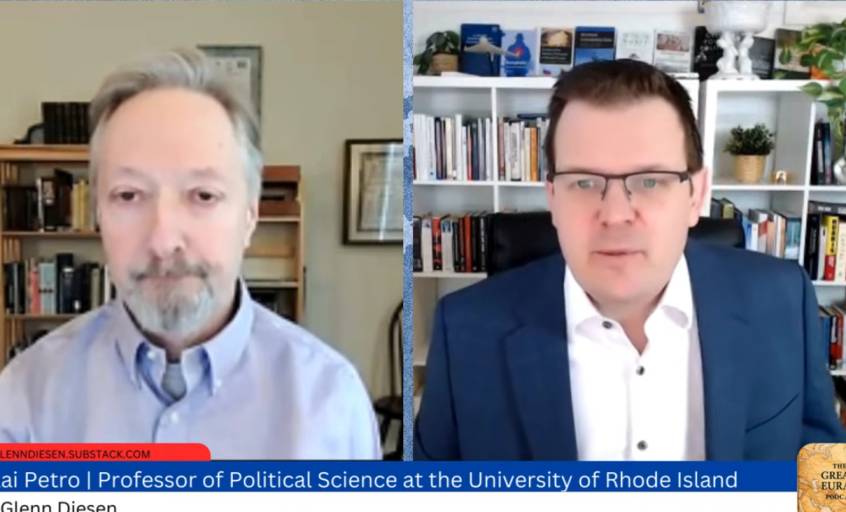
Editor’s Notes: In this insightful interview, Professor Nicolai Petro joins Glenn Diesen to analyze the shifting geopolitical landscape as the 2026 Munich Security Conference begins. The discussion focuses on Europe’s “strategic vacuum” and the internal contradictions within the EU as it grapples with the transition from a U.S.-led hegemonic order to a multipolar world. Petro and Diesen examine the divergent paths of the U.S. and Europe, the implications of Germany’s renewed military ambitions, and the ongoing challenges posed by the conflict in Ukraine. Their conversation provides a critical perspective on why Western leaders are looking backward to the past while the global majority moves toward a new, decentralized international system. (Feb 14, 2026)
TRANSCRIPT:
Introduction
GLENN DIESEN: Welcome back. Today we are joined by Nicolai Petro, a professor at the University of Rhode Island, who also served as the U.S. State Department Special Assistant for Policy on the Soviet Union. So thank you for coming back on.
NICOLAI PETRO: Nice to be with you again, Glenn.
The Munich Security Conference and the Transition to Multipolarity
GLENN DIESEN: So we see that this annual Munich Security Conference has started and the theme is the destruction of the international order. And my interpretation though is more or less that, yeah, this is a reference to the disorganized and, well, let’s say destructive transition into a multipolar system. It didn’t necessarily have to be this messy, but it also appears that the US and Europe are moving in very different directions.
So the split in this transatlantic alliance obviously is a key theme. But the Americans obviously seem to be, well, at times maybe overly pragmatic and disregard some of the traditional institutions in order to position themselves more favorably. The Europeans, on the other hand, seem to be trapped in wishful thinking in a strategic vacuum.
That being said, obviously at the Security Conference now multipolarity is a key theme and the breakdown therefore of the post-Cold War order. How do you define though the, I guess the current transition to multipolarity?
NICOLAI PETRO: Chaos. The word you use, a vacuum of strategic thinking. Yeah, that’s a good way to think of it. The absence of strategy in a transition to something we don’t know and from a European perspective that we don’t necessarily want. And that combination has led to the very vacuum you’re talking about.
You and I are not at the Munich Security Conference this year. But I wonder if there will be any defenders of the proposition that a multipolar world could be a more secure world if approached correctly. In other words, if engaged in such a way that all the participants received and saw the benefit of participating as equals in a multipolar world.
The main difference between the hegemonic order, also known as the rules-based order, and the multipolar order, it seems to me, is that the latter is more democratic. It involves more voices in an actual discussion of the needs of the nations themselves and how they can contribute as well as benefit from a new participatory multipolar arrangement.
The very concept of multipolarity presumes the existence of multiple poles of interest. So from the perspective of the nations that saw themselves at the top of the international pecking order, this is an uncomfortable transition. Even though they may not have been, as in the case of Europe, at the very top, they were nevertheless behind the lead dog, so to speak, and as a result they knew where they were going because the lead dog, the United States, was leading them in that direction.
So now that the lead dog is going who knows where and may even be biting his harness to free himself from the rest of the pack. Well, the rest of the pack is a bit lost, I guess I would say. But it would be good for them to at least be able to engage and perhaps listen to the voices that are coming out of what used to be called the global South. But I think that term doesn’t do it justice. It’s better to refer to it as the global majority.
Europe’s Struggle with the New Reality
GLENN DIESEN: Yeah, well, if you listen to some of the speeches being made there, especially Kaja Kallas, as well as the German Chancellor Merz. Well, from Kallas, more or less the message was that we need order, otherwise there will be chaos. But order can only more or less be achieved by the structures of the past. That means more or less to restore the system we had.
So the Europeans must work and reconnect with the US and collectively we should be allowed to dominate, that is, the political West should dominate the international system. This is a, well, from my perspective, this seems like a key weakness though, for the Europeans. The inability to, I guess, have any imagination for a post-hegemonic world, a world where the political West aren’t unified and they aren’t in a dominant position. In other words, reluctance to accept this new distribution of power as a reality. And how for Europe to find a new position.
Indeed, Merz also came out in the most aggressive language. You don’t really want to hear from a German chancellor. That is, he said yet again that the German army must be the most powerful one in Europe. He said the war in Ukraine will only end when Russia has been exhausted economically and militarily. And he also argued that we, being the Germans and Europeans, imposed unheard of losses and costs on Russia.
So this is the new language of Germany, where this essentially sounds like Germany has gone to war now with Russia and the defeat of Russia is what should bring stability and order back. It doesn’t seem to make any peace with new realities, not just the new international distribution of power, but also where the war is actually going.
How do you see in the coming months as the US will continue to chart its own path?
The Ukraine war will continue to, well, Ukraine will continue to unravel. How are the Europeans going to, I guess, respond to this new international system? Or how can they?
NICOLAI PETRO: If Merz were a politician here in America, we know the playbook it would be. This is not Germany’s war. This is Merz’s war. And I think that was the playbook certainly that Donald Trump played successfully against Joe Biden with respect to his adventures overseas. So I suspect something similar will have to happen.
I mean there is not a lack of political voices in Germany and other countries calling for a new approach toward Russia. There is a resistance by the established elite which has too many sunken costs in the current policy that it cannot distance itself from the policies that have been conducted so far without damaging their own political reputation and the political reputation of the party.
It is possible, I don’t know how likely it is, but it is possible. And because it is logical to assume that the more aggressive the tone of the German government, the more it will be opposed by other interests in Germany, other political forces will coalesce against it.
The difficulty is entirely internally German at this point. The grand coalition between SPD, Social Democrats and Christian Democrats with satellite parties around them has defined, has said for so long to the German people that there is no alternative to them, that the German people will simply have to wake up one day and say, well, there is actually an alternative.
In this case today, right this very moment, it is the AfD and they are the biggest party. So they just have to overcome the psychological unwillingness to have essentially, what is it, a real two-party system. A two-party system in which there would be the establishment and then the anti-establishment and to vote for the anti-establishment.
We can speculate endlessly about how close this is in which countries the shift to anti-establishment is closer than in others. It is a reasonable bet to assume that if things continue along the present deteriorating trajectory in foreign policy, in economic policy for the EU, the voters will respond in this way. But we just don’t know when.
Authoritarianism in Europe
GLENN DIESEN: Well, I was wondering how you see the, or what you expect from the Americans at the Munich Security Conference. I guess last year’s conference was very much colored by the appearance of J.D. Vance. He, you know, he shook the Europeans to their core by arguing that their threat didn’t derive from China or Russia, but from within, this creeping authoritarianism which was met with outrage by the Europeans.
But you know, it’s not as if the authoritarianism in Europe has been stable. It’s been, I think escalating over the years. I mean if you go back 20 years when the Europeans tried to pass this EU constitution back in 2005, you know, back then only France and Netherlands, they did a referendum, it didn’t go through and kind of the EU mentality has always been, well, let’s just steam ahead.
So they repackaged the whole thing then as the Lisbon Treaty, in which you don’t need any referendums at all in 2007, yet one country demanded a referendum, which was Ireland. And as you remember, they voted no. So they were forced to vote again until they voted yes. But this was kind of seen as laying the foundation for some authoritarianism.
But since then, of course, we saw the banking crisis 2013 in Cyprus, then in Greece, where bank closures were imposed by forcing, denying liquidity. And of course, now you jump forward another decade. It’s very different as the political, I guess, support collapses among the leadership.
France, I mean, they arrested the main opposition figure, Le Pen. Germany, they have already criminalized the Alternative for Germany, which is the most popular party now in Germany, considering actually banning it. Romanians voted the wrong way and their election was annulled on this fraudulent claims of foreign involvement. The EU is pushing now for Orban’s removal in Hungary. The EU even sanctions its own citizens, denying money and travel, essentially making their own citizens hostages.
And these efforts to continue to centralize power, especially, you know, taking advantage of this crisis, we know how it’s a very authoritarian process. And you get the feeling this is not the final station, that we’re going to continue down this path.
So while they were very dismissive of Vance, the Europeans, I don’t think that the view of J.D. Vance and US has changed much. Indeed, just in December, with the new US security strategy, suggesting that perhaps the US should begin to cultivate opposition in Europe to get rid of some of these authoritarians. Do you expect something similar to be played out this year as well?
NICOLAI PETRO: It’ll be interesting to see who the head of the delegation is. I don’t know. Do you know who the senior person at Munich will be?
GLENN DIESEN: No, I didn’t see the American side.
NICOLAI PETRO: No. So it’ll be interesting to see if they send another symbolic figure like the vice president or a much more junior figure. Yeah, that’ll say something. And then it is likely, if it’s a junior figure, it’ll not be so much a political statement as a new sort of vision of some kind. It’ll be a restatement of the principles of the new national security strategy, which we already know about.
What I don’t expect to see is, and this is curious in a way or something worth thinking about, the EU leadership is rejecting multipolarity, rejecting the principle in favor, the principle of looking toward a diverse and multipolar future in favor of looking backward to a hegemonic past in which they knew their role.
The United States, however, is not looking forward either. It is not looking forward to playing a new role in a multipolar world. It is also looking backward to reestablishing hegemony with an emphasis not on obligation to its subordinates, to the states that are tied to it in some sort of form of dependence, but rather going its own way, asserting its primacy and demanding obedience by those states with which it is tied economically and politically in treaty organizations.
So that’s the real source of the friction. But it doesn’t help the world order, doesn’t help the world move toward multipolarity. And there could easily be times when the United States and Europe reach an accommodation to further delay and undermine the transition to a multipolar world. I see that as more likely than a willingness of this or any future American administration to truly think about the benefits that the United States might gain from a multipolar world.
Marco Rubio and the US Delegation
GLENN DIESEN: Well, I was going to say Marco Rubio is going, though, so I’m guessing the delegation is led by Marco Rubio. Well, there wouldn’t be any, well, I guess, yeah, but…
NICOLAI PETRO: Well, it could have been the NATO ambassador, US Permanent Ambassador to NATO, but no, Rubio is a more senior figure, a more predictable figure, I think, one who will speak probably less to the internal disagreements, the philosophical disagreements that exist between the EU and the United States and probably more on security issues as the United States sees them and therefore from Rubio’s perspective, how the Europeans need to deal with them, helping the United States to solve them for the Europeans.
GLENN DIESEN: Yeah, that’s it, I think. Well, it seems like the United States essentially wants to make the point to the Europeans that the old order they want to bring back, that it’s over, that it’s a new era. But of course, I think Marco Rubio will deliver this in a more diplomatic manner than perhaps J.D. Vance.
But I don’t think that’s enough for the Europeans, though, because you heard already from Chancellor Merz that, you know, we have to repair the transatlantic ties, you know, get the gang back together and, well, essentially go back to the way things were. But I think, no, the Trump strategy…
Europe’s Strategic Dilemma
NICOLAI PETRO: If they haven’t figured out, if Europeans haven’t figured this out yet, I think probably other nations have. But the Trump strategy is to place especially dependent allies, and that’s a very key point. Allies that the Americans feel are totally dependent on the United States before an inevitable choice. The inevitable choice being the one that the United States will graciously allow them to have.
But first they will point out all the reasons why the European leadership needs to abandon any other course than the one set out for them by the United States. And what’s interesting, when you look at examples like Greenland and the other complaints that America has made about Europe in terms of defense spending and other things, the Europeans go along with this because of their fear.
They, as I said to continue the analogy of the dog sled, they’re only interested in following the leader’s butt. The rest of the world is too frightening for them to go out on their own or to. Well, now we see perhaps Merz, sometimes Macron, but mostly Merz, trying to argue that he’s the new lead dog. Well, I frankly don’t think enough time has passed since World War II for the majority of Europeans to feel entirely comfortable with that choice.
GLENN DIESEN: Well, I think the Europeans are too divided in too many ways though, first of all in terms of how they should deal with the United States, because some suggest that the Europeans should just sacrifice more national interest and bow to the US, hoping that they will be rewarded. And other group of Europeans think it’s necessary to diversify ties so they won’t be captured by the U.S. In other words, you have other partners, then the U.S. won’t have that much leverage over the Europeans.
NICOLAI PETRO: But that’s a long term strategy. Short term, their actual policy is very similar to the first group, which only plays into America’s hands, I think.
Competing Visions for European Leadership
GLENN DIESEN: But it’s also the expectations they have because some assume that as the United States packs up and reprioritizes where to devote its resources now, so the Western hemisphere in Asia, that this, some believe that this will force the Europeans to integrate more than ever before, that now we’ll finally move out of Uncle Sam’s basement and stand on their own feet.
The other group thinks that, well, the US has always been the pacifier. So if the US leaves, then there’s no way the Europeans will get along that much. I mean, you just said the Germans think that they’re going to be the top dog now in Europe with they’re going to build the largest conventional army, which I don’t think any European countries look forward to this prospect.
Meanwhile, the French think that they should probably have a key lead, while the British obviously think that they are the junior partner of the U.S., something to connect the U.S. and the Europeans. So they all have their different views in terms of who should take leadership. And again, this is what the American pacifier prevented or removed.
NICOLAI PETRO: But the question, the key point I think that you raised is the second group believes that. So the first group is given a leader and an ideology they don’t have to think about because it is provided to them by the leader of the United States. The second group argues for an alternative position of the EU in world affairs. But what is it?
Well, what is the EU vision of its role in the world? If it is essentially a liberal order like the one that the United States, that they believe the United States used to be the leader of, then its only real competitor again is the United States. So they’re not helping themselves.
And I don’t think there’s enough of a commitment to, I mean, I may be wrong, but I don’t think there’s much of an institutional commitment of the EU to having a real global presence and to fostering some sort of autonomous or independent EU agenda. The position that the current leadership of the EU has always been comfortable in is providing a little bit of extra funds, a little bit of extra support to whatever the United States vision and agenda was around the world, but not to take its own initiative, because that would involve debating what the substance of an EU worldview might be.
It would be interesting to speculate what such a worldview might be, because at its heart, given the diversity within the EU, which is not matched by anything in the United States, multipolarity should ring a bell in the hearts and minds of many European countries and achieve and be seen as a recognizable alternative to hegemony.
But at least I think for the current political leadership of the EU, they don’t have the vision and therefore to establish some sort of individual identity distinct from the United States. And therefore they can’t compete. Again, they don’t have the resources. They cannot compete because they have no intellectual vision of their role in the future. And that’s a much deeper problem for the EU that won’t be resolved, well, until there’s a sweeping change in the current political, in the leadership of both national and EU institutions.
The Problem of Outsourced Strategic Thinking
GLENN DIESEN: Yeah, I think that’s a great point. And that was one of the benefits for the Europeans to be led by Washington. That is, they could outsource this strategic thinking instead of coming up with competing ideas and resolving it. And whatever Washington decided, it was sold in the language of liberal democratic values, which would then unify and create consensus.
The problem now, of course, is there’s no vision anymore. So they’re just stuck with this empty rhetoric where everything they do is about values and they keep reassuring themselves that they are the champions of this liberal democratic ideals. But it does beg the question though, do you think the European Union could realistically position itself as an autonomous pole, or is this, yeah, it’s not how power politics work. I mean, too many divisions.
NICOLAI PETRO: The problem is that there, as you say, there is no consensus within the EU on the role that the EU should play in foreign policy. The EU foreign policy structure is still in its process really of coming into its own, and it competes sometimes directly with the foreign policy leadership of the national states.
So in a way that is much more dramatic than, for example, in the financial sector, where the banking system is structured under the European Central Bank and there are budgetary limits, things like that. Now, there are ways of getting around this, and there are always exceptions, but nevertheless, the structure is in place.
The EU, in terms of its foreign policy still has to rely on the cooperation of national governments. And that makes it tremendously ineffective ultimately at coming up with a grand strategy, because there is too much political diversity within the EU. I’m sure that visionaries of a grand EU, an imperial EU, would want to see that go away and to insist, for example, that there be a united and therefore more forceful policy that could tap into the resources of individual states.
But that will never be in the interests of individual states to concede that sort of power to central organization like the EU. And the fight is on two levels, and it’s very difficult to see how the EU can overcome it. One level is the institutional level at which the EU bureaucracy does not have the strength to impose its will in areas like foreign policy or even defense policy.
And on the other level, there is the simple matter of political diversity within nation states. So nation states, faced with the prospect of the EU becoming more intrusive and taking over more functions, will fight more against it as well, delaying the prospects, perhaps weakening it, perhaps leading, as some often speculate, to an unraveling of the EU.
It’s not clear what the future will hold, but again, if I’m right in speculating that anti-establishment, the time will come when anti-establishment forces that are today considered anti-establishment will be in the majority, then that will also be accompanied by a weakening of EU institutions and a strengthening of national policies.
Internal Contradictions of EU Governance
GLENN DIESEN: I think it’s a problem with the EU. There’s too many of these internal contradictions, because on one end, one gets the impression that the EU prefers weak national leaders because this makes it easier to rule from Brussels. But these weak leaders, they fail then to advance, you know, basic national interests. So you hollow out not just the political power in the nation states, but also their economic prowess. So it only gets weaker and weaker and the stability isn’t really there.
And to a large extent the EU is also based, many of the EU projects is based on the idea that, you know, you don’t let a good crisis go to waste. This is when you can centralize power. Indeed this was part of the criticism of the euro because the euro was kind of conceptualized as a half-built house. That is, you know, if you impose a monetary union, you can’t really make it work without a fiscal union. And you can’t have a fiscal union without a political union.
But they never had consent for political union. So they just put the common currency there. Obviously fiscal problems will come, then you will force through a fiscal union. And in order to have this, you have to force through a political union. So essentially predictably cause crisis. And in this crisis there’s an opportunity to centralize power.
NICOLAI PETRO: But the problem is that explains EU policy in Ukraine.
GLENN DIESEN: Yeah, but there’s a problem. Once there’s a crisis, shows that the EU is a problem in weakening the continent. This is used as a reason for giving them more power. So they keep saying we need more Europe when Europe is failing. It’s a very strange and contradictory approach.
But, well, I’m glad you brought up Ukraine because that was kind of my next question. Do you see Ukraine having strengthened or weakened then the internal cohesion of Europe? Because on one hand Russia’s the boogeyman is now seems to be the main unifier. Why 27 member states can have the same foreign policy. On the other hand, it has also increased dependencies. And of course this whole concept of a geopolitical EU is, well, it’s seemingly a disaster. So it’s very hard. I don’t know how you assess this. Is it going both ways?
The EU’s Shifting Strategy and Economic Warfare
I think it pulls in different directions in different phases of the conflict. So at the very outset of the conflict there was a predictable rallying effect within Ukraine and there was a largely predictable response of the EU to support Ukraine cautiously, but to look over their shoulder at the United States to see what they would do. And when the Biden administration said yes, we’re going in, and you can go in too, basically permitting the EU to support the United States effort then, we had a combined and unified front against Russia.
But that unified front expected a rapid defeat of Russia. So now, without going into the technical details of who’s winning at this point, the rhetoric has changed. At the very least, we can all see that the rhetoric has changed and that specifically going back to the EU, the EU no longer talks about victory in real terms of Ukraine. It is talking about a ceasefire that preserves Ukraine, what is left of Ukraine. And now defining that as victory.
The victory is no longer pushing Russia out. The victory has now been defined as saving what can be saved in Ukraine. And this is a huge defeat for the EU if one looks back even four years over what the original demand and policy was. And of course a large part of that comes from the perceived withdrawal of the United States from the conflict, although as many analysts point out, it has on the one hand rhetorically withdrawn, but on the other hand continues to provide essential intelligence and technical support when needed to Ukraine. Whether that’s to actually achieve a peace settlement or to drag it out is at this point not entirely clear.
The Absence of an EU Peace Plan
So the strategy of the EU is again to return to the first thing we talked about, a lack of strategy, because the strategy that they had at the outset of the conflict has failed, but they have no alternative. And to this day there is no EU peace plan and apparently no group within the entire EU structure that is tasked with the objective of devising a peace plan. Instead, all of this is given over to Ukraine and to ostensibly follow what Ukraine says.
But of course that’s only a viable strategy so long as all that the EU needs to provide is funding. And funding, by the way, that comes in drips and spurts. It’s not a reliable source of funding that the EU provides to Ukraine. And over the next two years, the amount that has been allocated to date, namely the 90 billion euro funding for two years, is about a quarter shy of the actual amount that Ukraine believes it needs to carry on essential state functions and continue the war at a minimum level. That’s all.
So the EU strategy is to basically wait. Wait for what? Well, we see maybe part of the answer in the new media campaign that we’ve seen over the last two months or so flooding major Western newspapers and media outlets. The expectation again that Russia, the Russian economy will soon collapse. We just see article after article which, when you read them, they read as if they were from the same script. They’re from the same small group of think tanks and they are based on projections off of past trends, trends that are a month or two months in the making at the end of the year that we know are seasonal trends.
Flawed Economic Analysis
So any serious analyst can look at these and say well there’s always a downturn in the fourth quarter and then there’s a recovery in the spring and there are these cycles to economic life that every economist knows. But the fact that we are portraying these cyclical downturns as inevitable, as leading to inevitable ruin, without ever talking about the measures that the Russian government has in the past successfully taken and is already beginning to take now to counter these.
And secondly, without ever actually discussing in a comparative fashion how the same problems are affecting the Ukrainian economy, their own problems leads to the distorted impression that seems to be the one that the EU wants to promote. Namely that if somehow Ukraine with the EU’s assistance can continue this devastating war for at least another year or so, well, two years given the budget outlay so far by the EU, then certainly this time, unlike previous times, the Russian economy will indeed collapse.
And then I’m not sure what exactly is supposed to happen, but in some way shape or fashion Russia will withdraw or want to make major concessions and that can be sold as a greater defeat of Russia than the current terms that are being discussed. And therefore again, the EU is saying to Ukraine keep fighting, keep dying, we’ll pay most of the bills.
GLENN DIESEN: So okay, we come full circle, then we’re back to the Europeans’ wishful thinking and strategic vacuum that is keep fighting a little bit longer and hope that somehow Russia will just fall apart without, again, the main thing clear how economic crisis, what actually a victory would look like. I think if we’re honest that the Russians see this as an existential threat, we would have to reconsider some of these assumptions.
The Contradiction in European Assumptions
NICOLAI PETRO: Yeah, the main weakness of the current spate of articles about the imminent collapse of the Russian economy is not that we’ve seen this argument before, although that should be a cautionary signal to anyone, but that there is no actual new information here and the information as it is provided is extremely one-sided.
Every economy has its ups and downs. Economy is a complex organism that when one side of it becomes weak, other aspects, particularly in things like interest rates, lending patterns, things like that, foreign trade partners, they all step in to rebalance the structure. So an actual economic collapse, whatever that may mean, and again it is telling that that is never defined, is nearly impossible to envision in the modern world.
Curiously, for all the rhetoric that EU leaders occasionally spout about Putin being unreasonable, unwilling to negotiate, etc., the assumption that they are making about the impact that the collapse of the Russian economy would have on its military strategy is based fundamentally on the reasonableness of Putin and the Russian leadership. Because they say, well, once costs of this amount have been imposed, a reasonable leader, presumably like Putin, will indeed decide to withdraw.
So there is this two-facedness about how European leaders actually view the Russian leadership. And again there are persistent reports from both Russian sources as well as European sources now that France, for example the French administration, if not Macron personally, but the French administration has in fact reached out and begun to re-establish high level political contacts with the Russian leadership. So that is also in the wind, although not being publicly discussed.
GLENN DIESEN: Yeah, well I think that’s an excellent point, betting on the reason of Putin which they’re warning that there is no reason. There was another contradiction coming out now as well. That is the German Chancellor was making the point that Scholz was saying that two years ago Orban went to Moscow and he didn’t have a mandate because the Prime Minister of Hungary needs permission to talk to Putin and he achieved nothing. So what’s the point of talking to Russia? This was more or less the argument. But of course he said at the same time you have Macron now looking to set up diplomatic ties. So there’s no, I think this is another indicator of the strategic vacuum that they’re just punching in all different directions.
NICOLAI PETRO: Right. And seeing what sticks.
Looking Backward vs. Looking Forward
GLENN DIESEN: Yeah. Well, thank you very much for sharing your insights on this. Yeah, to summarize, the US is seeking to revive dominant position for itself in the international system by shuffling, reshuffling the deck and the Europeans are running around like headless chickens.
NICOLAI PETRO: So if I could summarize something, one phrase that I want to emphasize is that the EU and the United States do share a great deal in terms of their political vision, but it is essentially backward looking. But they have different visions of what they are trying to get back to and that’s going to lead to conflict even though it is backward looking, which is not a good thing in either case.
By contrast, the multipolar view promoted by the BRICS nations, including in particular Russia, is forward looking, is looking to some alternative to what was in the past. And therefore I think that makes it ultimately more promising because it is more hopeful.
GLENN DIESEN: Yeah, but again, there comes the contradiction. I don’t think it’s possible for the Europeans to consider a multipolar system within the format of BRICS because they keep looking backwards. I mean, I’ve suggested that perhaps the Europeans should consider, you know, even joining BRICS as well as the Americans. But this was interpreted as join the Warsaw Pact, you know, because they see it as this bloc versus this bloc. So going back to the Cold War, I tried to make the point that the BRICS isn’t a bloc. That is, the UAE and Iran aren’t in a bloc, India and China aren’t in a bloc. It’s, that’s not the point. But again, they keep looking backwards, so.
The Multipolar Alternative
NICOLAI PETRO: They keep looking for someone to discipline. And in the BRICS world, the multipolar world is less disciplined in many respects, but it is in some ways easier. It will be diplomatically easier to reach accords because questions that are values issues, axiological issues, issues of what gives you the right to have the kind of government that you have within the BRICS context, within a multipolar context are off the table. And those are the main sources today of conflict in the world.
GLENN DIESEN: Well, yet again, let me thank you for letting me pick your brain and have a great weekend.
NICOLAI PETRO: Thank you, you too.
Related Posts